Notas
First record of Amobia quatei (Diptera: Sarcophagidae: Miltogramminae) from the Indian subcontinent as kleptoparasite of Anterhynchium flavomarginatum (Hymenoptera: Vespidae: Eumeninae)
Primer registro de Amobia quatei (Diptera: Sarcophagidae: Miltogramminae) del subcontinente indio como cleptoparásito de Anterhynchium flavomarginatum (Hymenoptera: Vespidae: Eumeninae)
 Amir MAQBOOL amaqbool@uok.edu.in
Najitha A. BANU najirila2010@gmail.com
Amir MAQBOOL amaqbool@uok.edu.in
Najitha A. BANU najirila2010@gmail.com
First record of Amobia quatei (Diptera: Sarcophagidae: Miltogramminae) from the Indian subcontinent as kleptoparasite of Anterhynchium flavomarginatum (Hymenoptera: Vespidae: Eumeninae)
Revista de la Sociedad Entomológica Argentina, vol. 81, núm. 3, 2022
Sociedad Entomológica Argentina
Recepción: 10 Marzo 2022
Aprobación: 27 Julio 2022
Abstract: Amobia quatei Kurahashi, 1974 was reared from the puparia collected from the brood chambers of mason wasp Anterhynchium flavomarginatum (Smith, 1852). The species is reported for the first time from Indian subcontinent. This is also the first host record for the kleptoparasite A. quatei. A redescription of the kleptoparasite supplemented with illustrations of habitus and genitalia, along with notes on the biology of the host are provided.
Keywords: Biology, Distribution, Host record, Morphology, New record.
Resumen: Amobia quatei Kurahashi, 1974 fue criada a partir de puparios recogidos en cámaras de cría de la avispa albañil Anterhynchium flavomarginatum (Smith, 1852). La especie se registra por primera vez en el subcontinente indio. Este es también el primer registro de hospedero para el cleptoparásito A. quatei. Se proporciona una nueva descripción del cleptoparásito, complementada con ilustraciones del hábito y la genitalia, junto con notas sobre la biología del hospedador.
Palabras clave: Biología, Distribución, Morfología, Nuevo registro, Registro de hospedadores.
Kleptoparasitism is a form of competition where one species steals items already acquired by another species. Thus, development of kleptoparasitic species is at the expense of host organism, through the misappropriation of its food resource, ending up killing the host either directly or indirectly (Eggleton & Belshaw, 1992; Iyengar, 2008). Most members of subfamily Miltogramminae are kleptoparasites in the nests of solitary wasps and bees (Barth, 1908; McCorquodale, 1986; Spofford et al., 1989; Spofford & Kurczewski, 1990; Polidori et al., 2006; Piwczynski et al., 2017).
The genus AmobiaRobineau-Desvoidy, 1830 contains 14 species distributed all over the continents except Antarctica from the subpolar regions to the tropics (Verves & Protsenko, 2019; Johnston et al., 2020). Currently three species of the genus are known from India: A. auriceps (Baranov, 1935), A. pelopei (Rondani, 1859) and A. signata (Meigen, 1824). The genus Amobia is morphologically characterized by the anterior margin of anepimeron with distinct swelling below ampulla, and the reduction of the epiphallus (Shewell, 1987; Pape, 1996; Johnston et al., 2020). The species of this genus are specialized parasites of potter wasps and generally attack the nests of Vespidae and Sphecidae (Verves & Protsenko, 2019). Their predatory maggots feed on the mass-provisioned food supply of the host larvae, which may include paralyzed lepidopteran caterpillars, beetle larvae (mainly Chrysomelidae and Curculionidae) and sawflies (Hymenoptera), adult dipterans and spiders in the nests of hosts, but sometimes the larvae live in the solitary bees’ nests (Spofford et al., 1989; Verves & Khrokalo, 2006). Different parasitoids and predator species have been reared from the nests of the wasp Anterhynchium flavomarginatum (Smith, 1852) including the kleptoparasitic fly A. oculata (Zetterstedt, 1844) (Itino, 1986; Barthélémy, 2012).
Anterhynchium flavomarginatum is a solitary mason wasp belonging to subfamily Eumeninae, whose members are predators, hunting lepidopterous or coleopterous larvae for their young (Iwata, 1976). The species has a wide distribution in Asia and make mud nests in open cavities like bamboo internodes and hollow larval galleries created by wood boring beetle larvae (Itino, 1986).
Amobia quatei Kurahashi, 1974 was first described from Vietnam and its kleptoparasitic behaviour was confirmed by Barthélémy (2010). Here we report the kleptoparasite A. quatei for the first time from Indian subcontinent, a region coincident with the Indian subregion. i.e., the area south of the Himalayas bounded by Afghanistan, Burma, and the Chagos archipelago (Wachkoo et al., 2019). This discovery is the first report of this species as a kleptoparasite of A. flavomarginatum.
This study is based on material reared from the puparia collected in the brood chambers of potter wasp A. flavomarginatum in the Kashmir Valley (Jammu and Kashmir), located in the northwestern part of the Indian subcontinent between 33°22′ and 34°50′N latitude and 73°55′ and 73°33′E longitude (Maqbool et al., 2018; Wachkoo et al. 2018). The Kashmir valley represents a transitional zone between Oriental and Palaearctic regions, sharing boundaries with the north-western tip of the Oriental and mid-south of the Palaearctic region (Maqbool et al., 2022).
The taxonomic study was conducted using a G2Mark stereomicroscope (G2Mark, India). Adult specimens of A. quatei were identified using Kurahashi & Chaiwong (2013) and A. flavomarginatum specimens were identified using Li et al. (2019). Terminology of adult sarcophagid morphology follows McAlpine (1981), and Sinclair (2000) for the male terminalia. For the extraction and preparation of male genitalia the procedure of Wachkoo et al. (2021) was followed.
During the study, sarcophagid puparia were collected in the closed chambers of A. flavomarginatum. The puparia were carefully removed and individually stored in 10 ml transparent tubes. A few drops of honey water (1:1) were placed on the inside walls of vials (for the emerging flies) and the open end was closed with cotton wool.
Photographs of eggs, larvae and live kleptoparasite were captured with a mirrorless camera (Nikon Z50) attached with a macro lens (Tokina f2.8 100 mm). Proper exposure was achieved with an external flash (Godox TTL 685). For habitus images, specimens were glued to card points and properly illuminated using a light box (Wachkoo et al., 2021). The above camera setup was mounted on an auto stacking rail (Stackrail rs90) to capture multiple images with different focus points, which were then merged in CombineZP software to generate focus stacked images. Final plates were assembled with Adobe Photoshop ® CS4. For the photography of slides methodology of Maqbool et al. (2021) was followed.
Specimens have been deposited in Cluster University Zoological Museum (CUZM) Srinagar, Jammu & Kashmir (India).
Host. Anterhynchium flavomarginatum (Smith, 1852) (Fig. 1).
In the month of July, 2020, a couple of mason wasps were observed constructing nests in the old wood boring beetle (Cerambycidae) larval galleries in the logs of walnut (Juglans regia L.). A pile of dry walnut log was examined and 9 nests were found with a total of 23 brood cells, from which this species was reared.
Nest structure. In most of the nests (n=5) three brood cells were constructed but sometimes only two (n=4) cells were observed. Cells were partitioned with single walls made up of some clayish material having sand grain inclusions. Similar type of material was used for closing plugs, which included two or three consecutive layers. Two consecutive brood cells were separated by an empty intercalary cell (Fig. 1f-g). The 3rd brood cell was usually preceded by an empty vestibular cell. In one of the nests with a diapausing prepupa only one brood cell was observed with two empty vestibular cells.
Biology. Nesting activity was seen from last week of June to early September. The wasp first inspected the inside of the hollow gallery and then started cleaning it by removing the frass and debris. The wasp brought wet mud, holding it between her mandibles (Fig. 1a) and constructed the nest by stroking and shaping it with mandibles. After constructing concave posterior wall of 1st brood cell (BC.), a single egg was laid and suspended at the posterior cell wall by a thin silken thread (Fig.1c). Egg was cylindrical, slightly arched and creamy in colour measuring 3.0-3.2 mm in length and 0.97-0.98 mm in diameter (Fig. 1d). The brood cell was then mass provisioned with 9-15 lepidopteran caterpillars (Fig. 1g), which were lightly paralyzed and could defecate. After completing the provisioning of 1st brood cell, it was closed by constructing an anterior wall. An empty space was left between the posterior wall of 1st brood cell (BC.) and the anterior wall of 2nd brood cell (BC.) forming the intercalary cell (IC) (Fig. 1f). Second egg was laid in next brood cell followed by mass provisioning. The nest opening was finally closed by constructing a 2-3 layered closing plug of similar material used for cell walls. Mud was spread from edge to centre by head movements and opening and closing movements of mandibles (Fig. 1e). Egg hatched in 48-60 hours. The larva bit a hole on the body of caterpillar and sucked fluid initially (Fig. 1h) and later consumed the solid parts of the caterpillar too. The 1st instar appeared yellowish white (Fig. 1h) and gradually changed to greenish and then dark green (Fig. 1i). The larva had a transparent cuticle which became thicker gradually till prepupal stage. Larva ejected the faecal pellets (meconium) just before turning into a prepupa, which was creamy yellow and had a thick cuticle (Fig. 1j). It took 23-29 days for the brood to complete development and emerge as an adult. Larvae that entered the prepupal stage in late September to early October, overwintered and became pupae in the next summer (early June to mid July). Life history studies suggest that it has at least 3 generations per year and the last generation overwintered in the prepupal stage.
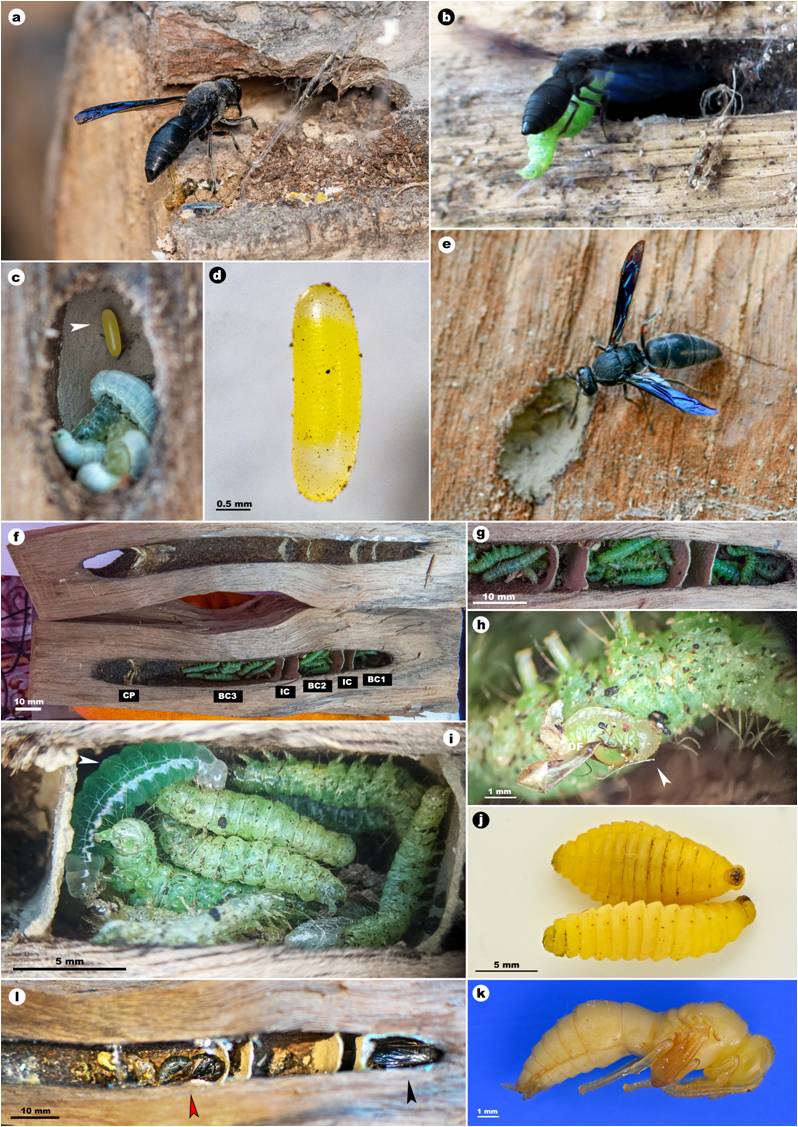
Fig. 1.
Anterhynchium flavomarginatum (Smith, 1852). a. wasp carrying nest building material between mandibles. b. wasp with a caterpillar for cell provisioning. c. a suspended egg with mass provisioned prey. d. egg. e. wasp constructing the closing plug. f. opened nest. g. brood cells. h. 1st instar feeding. i. 3-day old larva feeding. j. prepupae. k. pupa. l. advanced pupa (red arrow head) and fully developed adult (black arrow) ready to emerge (BC1–BC3 = brood cells, IC = intercalary cell, CP = closing plug).
Kleptoparasite. Amobia quatei Kurahashi, 1974 (Figs. 2-4).
Material examined. India: Jammu and Kashmir, Srinagar: Hyderpora, 34° 02′01′′N 74° 47′35′′ E, 1,591 m a.s.l., 05.x.2019, A. Maqbool leg. (3♂, 4♀, CUZM - A_Maqbool00010 to A_Maqbool00017).
Diagnosis. Antennae black, arista bare, palpi black (Fig. 2a), more than 10 proclinate and 1 reclinate fronto-orbital setae (Figs 2e-g); thorax dark in colour with silver dusting anteriorly and laterally, thoracic dorsum with three dark indistinct longitudinal stripes with median 1 subdivided into 3 fine lines anteriorly, scutellum dark with grey dusting apically (Fig. 2b); wings hyaline, veins dark brown, basicosta blackish (Fig. 2c); legs black; abdomen dark and grey dusted, tergites 3-5 with 3 characteristic dark spots, median ones elongated and linked with anterior and posterior ones, looking like a single median stripe, tergite 3 with a pair of median marginal bristles, tergites 4-5 with median and lateral marginal bristles (Fig. 2d); cercus sickle shaped in lateral view (Fig. 3a), broad at base and tapering towards apex, surstylus shorter than cerci, straight in lateral view and in posterior view (Fig. 3b) medially curved towards cercus.
Distribution. China, Hong Kong, India (present report), Malaysia, Philippines, Thailand and Vietnam (Kurahashi, 1974; Pape, 1996; Kurahashi & Tan, 2009; Barthélémy, 2010; Kurahashi & Chaiwong, 2013).
Kleptoparasitism. Five nest construction observations were made. In one observation only a female of A. quatei was seen following a female wasp during nest construction. Soon after completion of plug construction, the wasp left whereas A. quatei fly examined the recently constructed plug and left without any action (Fig. 4a). On opening the nest, 3 brood chambers were observed. Two brood chambers had wasp larvae feeding on caterpillar provisions and one brood chamber had a single unhatched wasp egg. No fly eggs or larvae were observed in brood chambers. However, 3 nearby nests brood chambers had no wasp larvae or pupae but small dipteran pupae (5.8-6.0 mm x 2.2-2.5 mm) (Fig. 4b-c). On rearing these at room temperature, adults of A. quatei emerged (Fig. 4d), suggesting it as a kleptoparasite with its larvae feeding on the caterpillar provisions in the brood cells of A. flavomarginatum.
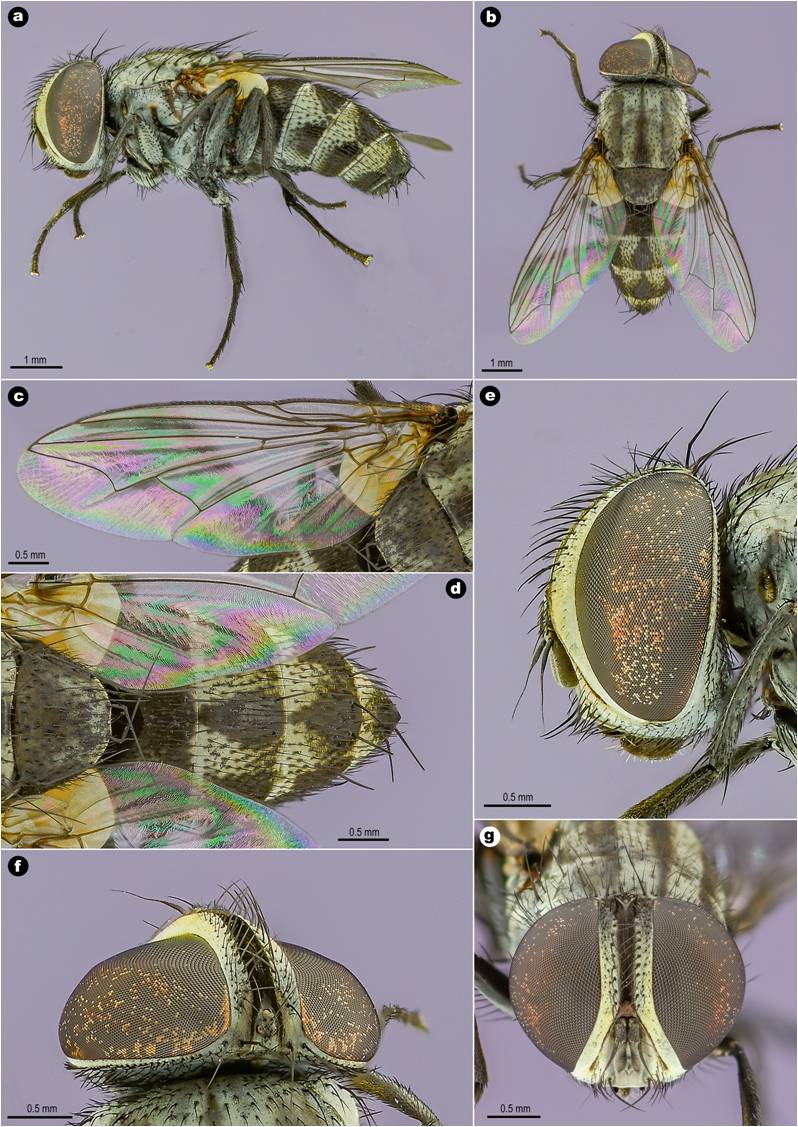
Fig. 2.
Amobia quatei Kurahashi, 1974. a. habitus, lateral view. b. habitus, dorsal view. c. wing. d. abdomen, dorsal view. e. head, lateral view. f. head, dorsal view. g. head, front view.
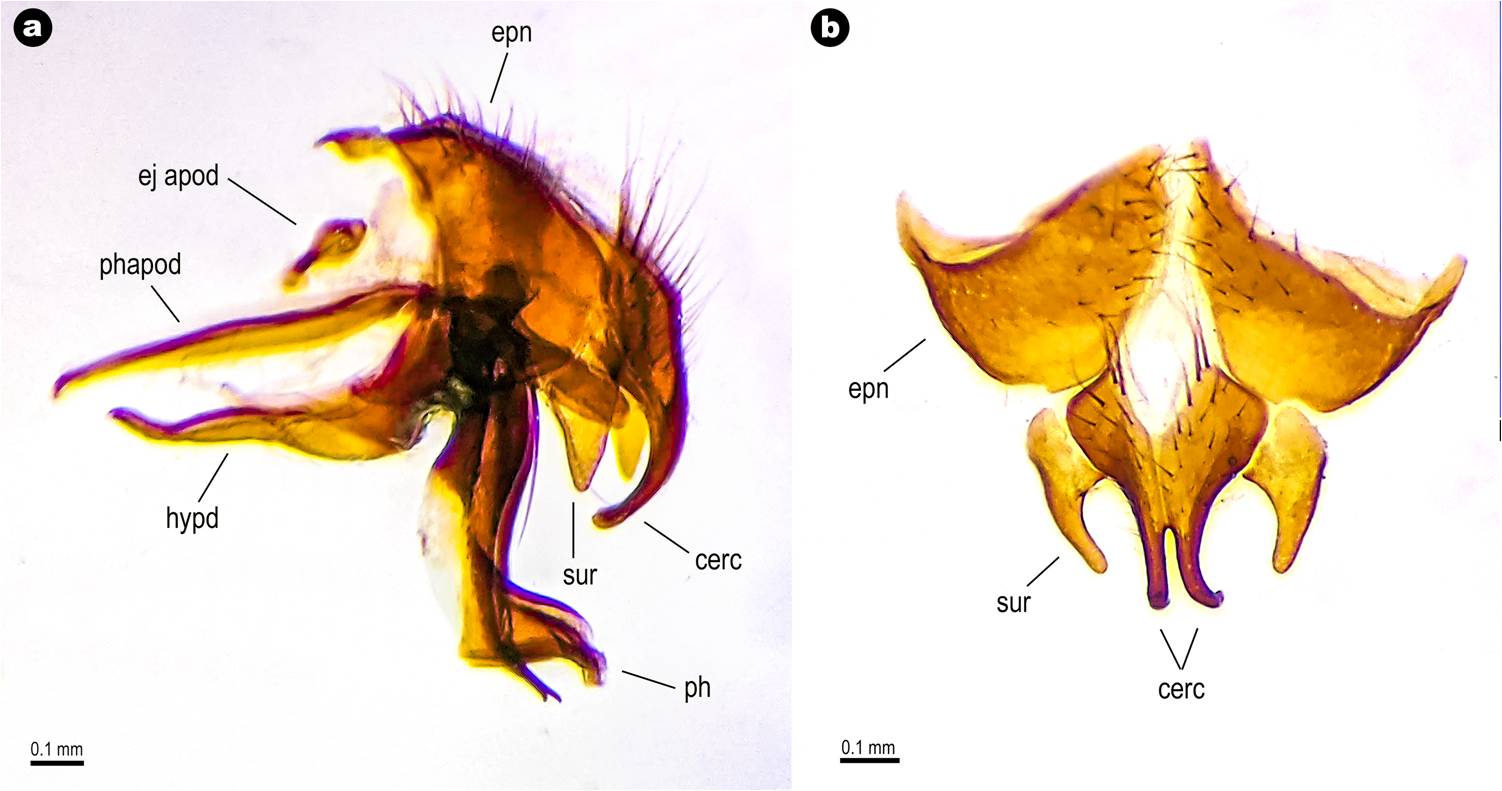
Fig. 3.
Amobia quatei Kurahashi, 1974. a. male genitalia, lateral view. b. cerci and surstyli, posterior view (cerc = cercus; ej apod = ejaculatory apodeme; hypd = hypandrium; phapod = phallapodeme; ph = phallus; sur = surstylus).
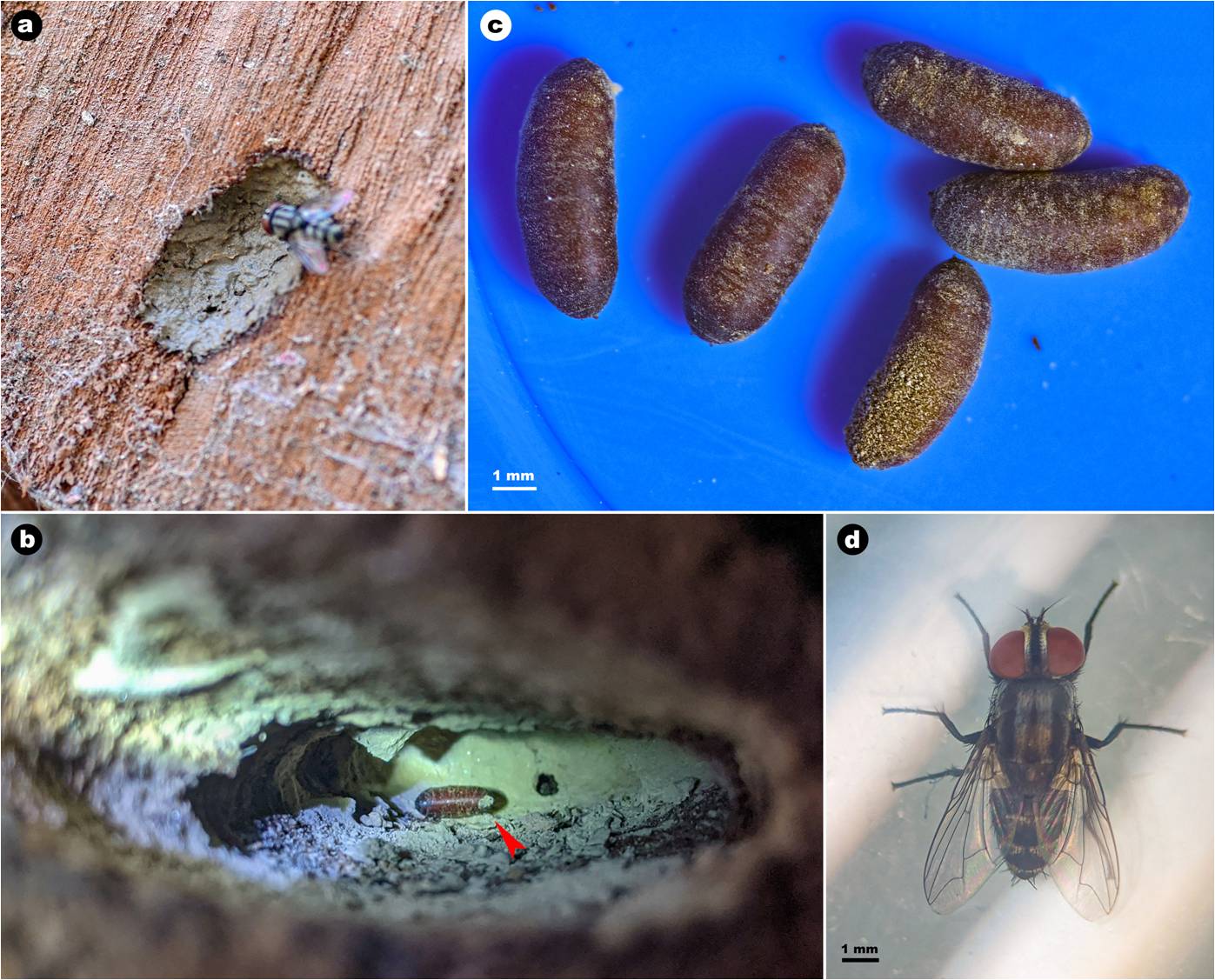
Fig. 4.
Amobia quatei Kurahashi, 1974. a. fly inspecting the closing plug of a nest. b. a single puparium in the brood chamber. c. puparia collected from a nest. d. a freshly emerged fly.
Acknowledgments
We thank two anonymous reviewers for their comments and suggestions for improving this manuscript.
REFERENCES
Barth, G.P. (1908) The nesting of Anacrabro ocellatus Pack. Bulletin of the Wisconsin Natural History Society, 6, 147-153.
Barthélémy, C. (2010) Nesting biology of Isodontia diodon (Kohl, 1890) (Hymenoptera: Sphecidae), a predator of cockroaches, in Hong Kong. Journal of Hymenoptera Research,19(2), 201-216.
Barthélémy, C. (2012) Nest trapping, a simple method for gathering information on life histories of solitary bees and wasps. Bionomics of 21 species of solitary aculeate in Hong Kong. Hong Kong Entomological Bulletin,4(1), 3-37.
Eggleton, P., & Belshaw, R. (1992) Insect parasitoids: an evolutionary overview. Philosophical Transactions of the Royal Society, 337, 1-20.
Itino, T. (1986) The spatial patterns of parasitism of eumenid wasps, Anterhynchium flavomarginatum and Orancistrocerus drewseni by the miltogrammine fly Amobia distorta. Researches on Population Ecology,30(1), 1-12.
Iwata, H. (1976) Evolution of instinct: comparative ethology of the Hymenoptera. Amerind Publishing, New Delhi, India.
Iyengar, E.V. (2008) Kleptoparasitic interactions throughout the animal kingdom and a re-evaluation, based on participant mobility, of the conditions promoting the evolution of kleptoparasitism. Biological Journal of the Linnean Society, 93, 745-762.
Johnston, N.P., Wallman, J.F., Dowton, M., Szpila, K., & Pape, T. (2020) Taxonomic revision of Australian Amobia Robineau Desvoidy, 1830 (Sarcophagidae: Miltogramminae): integrating morphology and genetics finds a new species and tackles old problems. European Journal of Taxonomy, 722, 75-96. https://doi.org/10.5852/ejt.2020.722.1135
Kurahashi, H. (1974) Note on the genus Amobia from the Indo‒Australian area with description of a new species (Diptera, Sarcophagidae). Pacific Insects, 16(1), 57-60.
Kurahashi, H., & Chaiwong, T. (2013) Keys to the flesh flies of Thailand, with description of a new species of Robineauella Enderlein (Diptera: Sarcophagidae). Medical Entomology and Zoology,64(2), 83-101.
Kurahashi, H., & Tan, S.H. (2009) The sarcophagid flies from Peninsular Malaysia (Diptera: Sarcophagidae). Medical Entomology and Zoology,60(4), 283-296.
Li, T.J., Barthélémy, C., & Carpenter, J.M. (2019) The Eumeninae (Hymenoptera, Vespidae) of Hong Kong (China), with description of two new species, two new synonymies and a key to the known taxa. Journal of Hymenoptera Research, 72, 127-176. https://doi.org/10.3897/jhr.72.37691
Maqbool, A., Akbar, S.A., & Wachkoo, A.A. (2018) First record of the genus Ficobracon (Hymenoptera: Braconidae) from India, with description of new species. Zootaxa, 4379, 421-428. https://doi.org/10.11646/zootaxa.4379.3.5
Maqbool, A., Wachkoo, A.A., Stuke, J.H., Akbar, S.A., & Clements, D.K. (2021) Neotype designation and redescription of Sicus indicus Kröber, 1940 (Diptera: Conopidae). Zoosystema, 43(11), 197-203. https://doi.org/10.5252/zoosystema2021v43a11
Maqbool, I., Varga, O., Maqbool, A., Wachkoo, A.A., Banu, N.A., & Rather, S.U. (2022) Xorides xylotrechi sp. n. (Hymenoptera: Ichneumonidae: Xoridinae) parasitizing Xylotrechus stebbingi (Gahan, 1906) (Coleoptera: Cerambycidae) in India. Zootaxa,5150(1), 121-128. https://doi.org/10.11646/zootaxa.5150.1.7
McAlpine, J.F. (1981) Morphology and terminology - adults. Manual of Nearctic Diptera (ed. McAlpine, J.F., Peterson, B.V., Shewell, G.E., Teskey, H.J., Vockeroth, J.R., & Wood, D.M.), pp. 9-63. Research Branch, Agriculture Canada, Ottawa.
McCorquodale, D.B. (1986) Digger wasp (Hymenoptera: Sphecidae) provisioning flights as a defence against a nest parasite, Senotainia trilineata (Diptera: Sarcophagidae). Canadian Journal of Zoology, 64, 1620-1627. https://doi.org/10.1139/z86-244
Pape, T. (1996) Catalogue of the Sarcophagidae of the world (Insecta: Diptera). Memoirs on Entomology, International, 8, 1-557.
Piwczyński, M., Pape, T., Deja-Sikora, E., Sikora, M., Akbarzadeh, K., & Szpila, K. (2017) Molecular phylogeny of Miltogramminae (Diptera: Sarcophagidae): Implications for classifcation, systematics and evolution of larval feeding strategies. Molecular Phylogenetics and Evolution, 116, 49-60. https://doi.org/10.1016/j.ympev.2017.07.001
Polidori, C., Federici, M., Papadia, C., & Andrietti, F. (2006). Nest sharing and provisioning activity of females of the digger wasp, Cerceris rubida (Hymenoptera, Crabronidae). Italian Journal of Zoology, 73, 55-65. https://doi.org/10.1080/11250000500502079
Shewell, G.E. (1987) Sarcophagidae. Manual of Nearctic Diptera, Vol. 2. (ed. McAlpine, J.F.), pp. 1159-1186. Research Branch, Agriculture Canada, Ottawa.
Sinclair, B.J. (2000) Morphology and terminology of Diptera male terminalia. [Chapter] 1.2. Contributions to a manual of Palaearctic Diptera (with special reference to flies of economic importance). (ed. Papp, L., & Darvas, B.), pp. 53-74. Science Herald, Budapest.
Spofford, M.G., & Kurczewski, F.E. (1990) Comparative larvipositional behaviours and cleptoparasitic frequencies of Nearctic species of Miltogrammini (Diptera: Sarcophagidae). Journal of Natural History, 24, 731-755. https://doi.org/10.1080/00222939000770511
Spofford, M.G., Kurczewski, F.E., & Downes, W.L. (1989) Nearctic species of Miltogrammini (Diptera: Sarcophagidae) associated with species of Aculeata (Hymenoptera: Vespoidea, Pompiloidea, Sphecoidea, Apoidea). Journal of the Kansas Entomological Society,62, 254-267.
Verves, Y.G., & Khrokalo, L.A. (2006) 123. Fam. Sarcophagidae - sarcophagids. Key to the Insects of Russian Far East, pp. 64-178. Dalnauka, Vladivostok.
Verves, Y.G., & Protsenko, Y.V. (2019) Potter Wasps (Hymenoptera : Vespidae, Eumeninae) as Hosts of Amobia Robineau-Desvoidy, 1830 (Diptera: Sarcophagidae, Miltogramminae) in Ukraine. Jordan Journal of Natural History, 6, 39-49.
Wachkoo, A.A., Khurshid, N., Maqbool, A., & Akbar, S.A. (2018). Two first acalyptrate fly (Diptera: Acalyptratae) records from India. Ukrainska Entomofaunistyka,9, 33-36.
Wachkoo, A.A., van Steenis, J., Maqbool, A., Akbar, S.A., Skevington, J.H., & Mengual, X. (2021) Two flower fly species (Diptera: Syrphidae) new to India. Journal of Insect Biodiversity,29(2), 44-52. https://doi.org/10.12976/jib/2021.29.2.3
Wachkoo, A.A., van Steenis, J., Rather, Z.A., Sengupta, J., & Banerjee, D. (2019) First record of the genus Spilomyia (Diptera, Syrphidae) from the Oriental region. Turkish Journal of Zoology, 43, 239-242. https://doi.org/10.3906/zoo-1811-27
Notas de autor
aijaz_shoorida@yahoo.co.in