Notas
First record of Opsiphanes cassina fabricii (Lepidoptera: Nymphalidae) feeding on Christmas palm Adonidia merrillii (Arecales: Arecaceae)
Primer registro de Opsiphanes cassina fabricii (Lepidoptera: Nymphalidae) alimentándose de palma Navidad Adonidia merrillii (Arecales: Arecaceae)
First record of Opsiphanes cassina fabricii (Lepidoptera: Nymphalidae) feeding on Christmas palm Adonidia merrillii (Arecales: Arecaceae)
Revista de la Sociedad Entomológica Argentina, vol. 81, núm. 4, 2022
Sociedad Entomológica Argentina
Recepción: 13 Septiembre 2022
Aprobación: 27 Octubre 2022
Abstract: The “Split-banded Owlet-Butterfly” Opsiphanes cassina Felder & Felder (Lepidoptera: Nymphalidae) comprises 12 subspecies occurring throughout Central America and in northern and western South America. In this work, O. cassina fabricii (Boisduval) was identified feeding on “Christmas palm” Adonidia merrillii (Becc.) Becc. (Arecales: Arecaceae) in the gardens of a housing unit in the state of Tabasco, Mexico. Identification was based on wing characters and genitalia morphology of males and females. This is the first record of O. cassina fabricii feeding on A. merrillii leaflets, which broadens the host plant range of this insect. In addition, some biological aspects and the damage caused by this species to “Christmas palm” are discussed.
Keywords: Defoliator larvae, Insects on palms, Kerpis palm.
Resumen: . La “Mariposa Búho de Banda Dividida” Opsiphanes cassina Felder & Felder (Lepidoptera: Nymphalidae) comprende 12 subespecies que ocurren a través de América Central y en el norte y oeste de América del Sur. En este trabajo se identificó a O. cassina fabricii (Boisduval) alimentándose de “palma Navidad” Adonidia merrillii Becc. (Becc.) (Arecales: Arecaceae) en los jardines de una unidad habitacional del estado de Tabasco, México. La identificación se basó en los caracteres de las alas y en la morfología de la genitalia de machos y hembras. Este es el primer registro de O. cassina fabricii alimentándose de foliolos de A. merrilli, lo que amplía el rango de plantas hospedantes de este insecto. Además, se discuten algunos aspectos biológicos y los daños que esta especie causa a la “palma Navidad”.
Palabras clave: Insectos en palmas, Larvas defoliadoras, Palma Kerpis.
The “Split-banded Owlet-Butterfly” Opsiphanes cassina fabricii (Boisduval) (Lepidoptera: Nymphalidae: Satyrinae) is a subspecies distributed in Mexico, Guatemala, Belize, El Salvador, Honduras and probably Nicaragua (Bates, 1932; Bristow, 1991). In Mexico, it has been recorded in tropical and subtropical areas of the states of San Luis Potosí (Brown, 1944), Veracruz (Raguso & Llorente-Bousquets, 1990), Campeche (Maya et al., 2005), Oaxaca and Nayarit (Vargas-Fernández et al., 2008), Tamaulipas, Jalisco and Colima (Warren et al., 2012), Chiapas (Morales-Morales et al., 2018) and Tabasco (Osorio-Osorio et al., 2021).
The “Christmas palm”, Adoninia merrillii (Becc.) Becc. (Arecales: Arecaceae), known in Mexico as the “Kerpis palm”, is a tropical species native to the Philippine Islands (Jones, 1995). It is one of the most popular and widely distributed ornamental palms in tropical areas of the world, although it is also used as a houseplant in subtropical and temperate regions. It is frequently used for planting in urban and suburban lawns due to its neat habit composed of a compact crown of bright green, feathery, arching fronds (leaves) on a slender, ringed trunk, and the production of clusters of bright red fruit at maturity (Jones, 1995). In Tabasco, Mexico, it is an introduced ornamental species with wide distribution in public parks and gardens of housing units (Magaña & González, 2017).
Opsiphanes cassina fabricii larvae feed on hard monocotyledonous plants of the family Arecaceae (Young & Muyshondt, 1975; DeVries, 1985; Ackery, 1988; Bristow, 1991). This species has a limited host plant range. In San Salvador it was found on “coconut palm” Cocos nucifera L., palm Brahea salvadorensis H. Wendl. Ex. Becc., and “cuban royal palm” Roystonea regia (Kunth) O. F. Cook (Young & Muyshondt, 1975). In Costa Rica, it was reported on C. nucifera, “corozo palm” Bactris minor (L.) H. E. Moore and “coyol palm” Acrocomia vinifera Oerst. (Young & Muyshondt, 1975; DeVries, 1985). In Tabasco, Mexico, it was found in practically all commercial plantations of “oil palm” Elaeis guineensis Jacq. (Osorio-Osorio et al., 2021). Given that there are about 33 native and introduced palm species in the state of Tabasco (Magaña & González, 2017), it is very likely that O. cassina fabricii uses other palm species as food. Therefore, the aim of this work was to determine the identity of O. cassina fabricii, a potentially defoliating species of the “Christmas palm”.
On April 17, 2022, two O. cassina adults were observed on the foliage of a Christmas palm in the gardens of the Villas del Cielo housing unit, municipality of Centro, Tabasco State, Mexico (17.810277, -92.929444, 13m) (Fig. 1a). On close examination of the fronds of this palm and three other adjacent palms, a total of 12 eggs, seven larvae and two pupae were detected on the underside of the frond leaflets. The eggs were inspected daily at the same detection site until hatching, and then during larval and pupal development until adult emergence. A sample of six pupae was collected, placed in a plastic container, and transported to the Plant Health Laboratory of the Academic Division of Agricultural Sciences of the Universidad Juárez Autónoma de Tabasco, where it was kept inside an insect rearing chamber with a temperature of 28 ± 2 .C, relative humidity of 75 ± 5% and a photoperiod of 12 hours. The emerged butterflies were killed with 0.2 ml of 70% alcohol injected into the mesosternum of the thorax. Then, standard mounting of the butterflies was carried out, which allowed an optimal examination of the body and wings. The genitalia and eighth abdominal segment of males and females were prepared in 10% potassium hydroxide solution to remove piliform scales and preserved in 75% ethanol. Identification was based on the revision of the genus Opsiphanes by Bristow (1991), who used wing characters to identify species and subspecies. Likewise, the structure of the genitalia of males and females was compared with the diagnosis of O. cassina fabricii established by Osorio-Osorio et al. (2021). The taxonomic identity was complemented with observations on the in situ biological development of this species and the type of damage it causes to the “Christmas palm”.
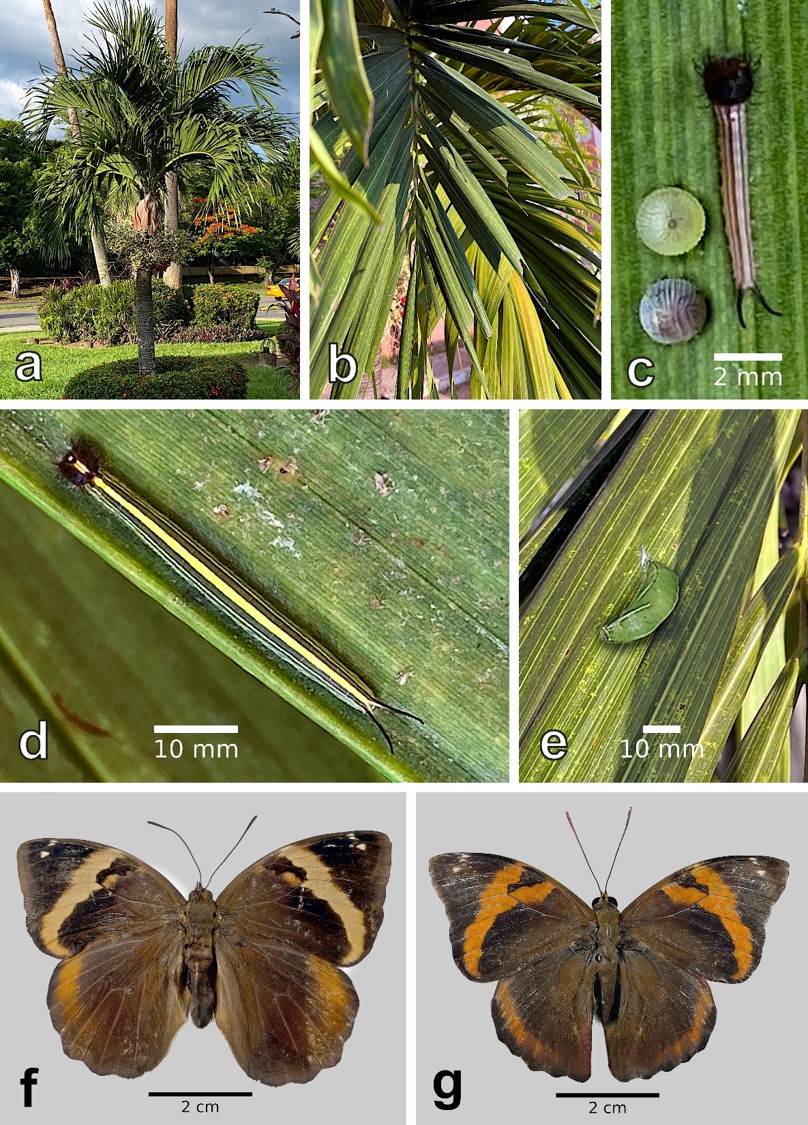
Fig. 1.
Damage and developmental stages of Opsiphanes cassina fabricii in “Christmas palm” Adonidia merrillii.
a) The palm A. merrilli. b) Leaflets damaged. c) Eggs and 1st instar larva. d) 3rd instar larva. e) Pupa. f) Adult female. g) Adult male.
According to the morphological study of the wings and genitalia of the adults, the subspecies found on “Christmas palm” corresponded to O. cassina fabricii. This is the first record of this species feeding on leaflets of this ornamental palm (Fig. 1b), which broadens its host plant range. The female of this species oviposits on the abaxial surface (underside) of the leaflets of the oldest or most mature fronds (Fig. 1c). Newly emerged larvae feed by scraping the epidermis from the leaf surface (Fig. 1c). From the 2nd instar onwards, they move towards the apex or edge of the leaflets, where they feed by completely cutting off small portions of the leaf blade. The larvae from the 3rd to the 5th instar cut off and consume elongated portions of the leaf blade, from the edge of the leaflet to the midrib, thus causing the most significant damage to the plant at these stages of development (Fig. 1d). Feeding occurs during the night, at dawn or dusk. During the day, the larvae remain inactive, hiding on the abaxial surface of the leaflet covered by a mesh of silky threads. At the end of the 5th instar, the larvae move to the upper leaves of the plant, where by pupating they attach themselves to the underside of the most hidden leaflets (Fig. 1e). The pupa is of the obtecta type; newly formed, it is green and as development progresses it turns light brown. The life cycle of O. cassina fabricii on A. merrilli foliage lasted 65-69 days. The egg lasted 7-8 days, the larva 48-49 days, and the pupa 10-11 days. This development time is similar to that reported by Mexzón & Chinchilla (2011) and Osorio-Osorio et al. (2021) in “oil palm” E. guineensis. Adults are chocolate brown, with less intense shade in females (Fig. 1f, g). Females are slightly larger than males (forewing length 39-42 mm and 35-37 mm, respectively).
The level of damage caused by O. cassina fabricii on “Christmas palm” was relatively low. However, it could be a potentially defoliating species for this ornamental palm, since O. cassina fabricii is widely distributed in commercial “oil palm” plantations in the study area (Osorio-Osorio et al., 2021). In addition, O. cassina has historically caused significant defoliation in “oil palm” plantations in Central America (Genty et al., 1978; Rhaindis et al., 1993; Chinchilla, 2003; Mexzón & Chinchilla, 2011; Rosales, 2020), and its population outbreaks are under permanent surveillance through integrated pest management strategies in Colombia (Calvache, 2001), Venezuela (Rodríguez et al., 2006) and Guatemala (Rosales, 2020).
Two species of Lepidoptera insects have been previously reported on “Christmas palm”. The “saddle caterpillar” Acharia stimulea (Limacodidae) a species recorded in Florida (Howard et al., 2001), and O. cassina merianae Stichel which was found in Trinidad (Cock, 2020). The host plants of O. cassina fabricii in urban areas are known to include the palms B. saldorensis, R. regia, Cocos sp., B. minor and Bactris gasipaes Kunth (Bristow, 1991). It is very likely that O. cassina fabricii feeds on a larger number of ornamental palm species than previously reported, as documented by Bristow (1991) for other subspecies of O. cassina.
In summary, in this work we present the detection, identification and damage caused by the defoliator O. cassina fabricii on “Christmas palm” A. merrilli. This is the first record of the herbivory of this species on “Christmas palm” foliage, which broadens its host plant range, and could be a species with potential defoliator for this ornamental palm.
Acknowledgments
Joseph Ocarl is grateful for the scholarship granted by the National Council of Science and Technology (CONACYT) of México.
REFERENCES
Ackery, P.R. (1988) Hostplants and classification: a review of nymphalid butterflies. Biological Journal of the Linnean Society, 33, 95-203.
Bates, M. (1932) Notes on the metamorphosis of the Brassolidae (Lepidoptera). Bulletin of the Brooklyn Entomological Society, 26-27, 155-163.
Bristow, C.R. (1991) A revision of the brassoline genus Opsiphanes (Lepidoptera: Rhopalocera). Zoological Journal of the Linnean Society, 101, 203-293.
Brown, F.M. (1944) Notes on Mexican butterflies, IV. Journal of the New York Entomological Society, 52, 343-360.
Calvache, G.H. (2001) Manejo integrado de plagas en el agoecosistema de la palma de aceite. Palmas, 22, 51-60.
Chinchilla, C.M. (2003) Manejo integrado de problemas fitosanitarios en palma aceitera Elaeis guineensis en América Central. Manejo Integrado de Plagas y Agroecología (Costa Rica), 67, 69-83.
Cock, M.J.W. (2020) Field identification of caterpillars and adults of bark butterflies Opsiphanes spp. (Lepidoptera, Nymphalidae) in Trinidad, W.I. Living World 2020 published by Trinidad and Tobago Field Naturalists' Club. https://ttfnc.org/livingworld/index.php/lwj/article/view/cock2020c.
DeVries, P.J. (1985) Hostplant records and natural history notes on Costa Rican butterflies (Papilionidae, Pieridae & Nymphalidae). Journal of Research on the Lepidoptera, 24, 290-333.
Genty, P., Desmier De Chenon, R., & Morin, J.P. (1978) Les ravageurs du palmier à huile en Amérique Latine. Oléagineux, 33, 325-419.
Howard, F.W., Moore, D., Giblin-Davis, R.M., & Abad, R.G. (2001) Insects on palms. CAB International, Wallingford, UK.
Jones, D.C. (1995) Palms throughout the world. Smithsonian Institution Press, Washington, D.C
Magaña, M.A., & González, A. (2017) Estudio taxonómico de la familia Arecaceae en el municipio de Macuspana, Tabasco, México. Kuxulkab’, 23, 5-15.
Maya, A., Pozo, C., & Mayuc, E. (2005) Las mariposas (Rhopalocera: Papilionidae, Pieridae y Nymphalidae) de la selva alta subperenifolia de la región de Calakmul, México, con nuevos registros. Folia Entomológica Mexicana, 44, 123-143.
Mexzón, R.G., & Chinchilla, C.M. (2011) Opsiphanes cassina Felder (Lepidoptera: Nymphalidae), defoliator of the oil palm (Elaeis guineensis Jacquin) in Central América. ASD Oil Papers, 36, 14-22.
Morales-Morales, C.J., Aguilar-Astudillo, E., Alonso-Bran, R.A., Cena-Velázquez, J.M., & Gómez-Castañeda, J.C. (2018) Revisión de la subfamilia Brassolinae (Nymphalidae) depositadas en la colección entomológica de la Facultad de Ciencias Agronómicas, Villaflores, Chiapas. Entomología Mexicana, ., 565-570.
Osorio-Osorio, R., Sainto, E., Valencia-Hernández, B., Valdez-Carrasco, J.M., Hernández- Hernández, L.U., de la Cruz-Lázaro, E., Márquez-Quiroz, C., & Ortega-Ramírez, M.E. (2021) Opsiphanes cassina fabricii (Boisduval), in oil palm plantations at Tabasco, México. Southwestern Entomologist, 46, 737-749.
Raguso, R.A., & Llorente-Bousquets, J. (1990) The butterflies (Lepidoptera) of the Tuxtlas Mts., Veracruz, Mexico, revisited: species-richness and habitat disturbance. Journal of Research on the Lepidoptera, 29, 105-133.
Rhainds, M., Chinchilla, C.M., & Castrillo, G. (1993) Desarrollo de un método de muestreo para las larvas de Opsiphanes cassina Felder en palma de aceite. Manejo Integrado de Plagas (Costa Rica), 30, 15-18.
Rodríguez, G., Silva-Acuña, R., Cásares M.R., & Díaz, Q.A. (2006) Fluctuación poblacional de adultos de Opsiphanes cassina Felder (Lepidoptera: Nymphalidae) en plantaciones de palma aceitera, Elaeis guineensis Jacq., en el estado Monagas, Venezuela. Entomotropica, 21, 41-52.
Rosales, R.D.G. (2020) Manejo integrado de Opsiphanes cassina y Durrantia sp. en el cultivo de palma de aceite. Guatemala. GREPALMA. Boletín La Palma, 15, 1-12.
Vargas-Fernández, I., Llorente-Bousquets, J.E., Luis-Martínez, A., & Pozo, C. (2008) Nymphalidae de México II (Libytheinae, Ithomiinae, Morphinae y Charaxinae): distribución geográfica e ilustración. UNAM/CONABIO. México, DF.
Warren, A.D., Davis, K.J., Grishin, N.V., Pelham, J.P., & Stangeland, E.M. (2012) Interactive Listing of American Butterflies. http://www.butterfliesofamerica.com/opsiphanes_cassina_fabricii_specimens.htm (Accessed 18 August 2022).
Young, A.M., & Muyshondt, A. (1975) Studies on the natural history of Central American butterflies in the family cluster Satyridae‐Brassolidae‐Morphidae (Lepidoptera: Nymphaloidea). III. Opsiphanes tamarindi and Opsiphanes cassina in Costa Rica and El Salvador. Studies on Neotropical Fauna, 10, 19-55.
Notas de autor
rodolfo.osorio@ujat.mx