Artículos científicos
Mortality of Turkish diatomaceous earth against German cockroach (Blattella germanica L. Blattodea: Ectobiidae) adults
Mortalidad de tierra de diatomeas de Turquía contra adultos de la cucaracha alemana (Blattella germanica L. Blattodea: Ectobiidae)
Mortality of Turkish diatomaceous earth against German cockroach (Blattella germanica L. Blattodea: Ectobiidae) adults
Revista de la Sociedad Entomológica Argentina, vol. 81, núm. 4, 2022
Sociedad Entomológica Argentina
Recepción: 10 Noviembre 2021
Aprobación: 28 Octubre 2022
Abstract: In this study, the mortality of diatom earth from Turkey coded ACN-1 against the German cockroach (Blattella gemanica L. Blattodea: Ectobiidae) adults on concrete, ceramic and parquet surfaces was investigated. Biological tests were carried out on three different surfaces against the adults of B. germanica at doses of 2.5, 5, 10 and 20 g/m. diatom earth coded ACN-1 for 6 days. In all surface applications of ACN-1 diatomaceous earth, exposure time and doses caused significant effect on mortality rates of B. germanica adults. Diatom earth ACN-1 at 2.5 g/m. caused 97.5%, 92.3% and 90% of mortality of B. germanica adults on the surfaces of concrete, ceramic and parquet at the end of the first day, respectively and 100% of mortality was obtained at the end of the second day in all conditions with this dose. For all other application doses, 100% mortality of B .germanica adults was observed at the end of the first day. In general, the mortality activity of ACN-1 diatom eartn against B. germanica adults was found to be similar on all three surfaces. We conclude that the Turkish diatom earth coded ACN-1, which is harmless to the environment, has the potential to be used in the control of B. germanica, which is a medical pest, and can be a good alternative in the control against this pest.
Keywords: Blattella germanica, Surface application, Turkish diatomaceous earth.
Resumen: En este estudio se investigó la mortalidad de una tierra de diatomeas obtenida en Turquía codificada ACN-1 frente a adultos de la cucaracha alemana (Blattella gemanica L. Blattodea: Ectobiidae) en superficies de hormigón, cerámica y parqué. Se realizaron ensayos biológicos en tres superficies diferentes frente a adultos de B. germanica a dosis de 2,5; 5; 10 y 20 g/m2 de tierra de diatomeas ACN-1 durante 6 días. En todas las aplicaciones, el tiempo de exposición y las dosis causaron un efecto significativo en las tasas de mortalidad de los adultos de B. germanica. La tierra de diatomeas ACN-1 a 2,5 g/m2 causó un 97,5%, 92,3% y 90% de mortalidad de adultos de B. germanica en las superficies de hormigón, cerámica y parquet al final del primer día, respectivamente, y se obtuvo un 100% de mortalidad al final del segundo día en todas las condiciones con esta dosis. Para todas las demás dosis de aplicación, se observó una mortalidad del 100% de los adultos de B .germanica al final del primer día. En general, la actividad de mortalidad de la tierra de diatomeas ACN-1 contra los adultos de B. germanica resultó similar en las tres superficies. Al final del estudio, se reveló que la tierra de diatomeas ACN-1, que es inocua para el medio ambiente, tiene potencial para ser utilizada en el control de B. germanica, plaga de importancia sanitaria, y puede ser una buena alternativa en el control contra esta plaga.
Palabras clave: Aplicación superficial, Blattella germanica, Tierra de diatomeas turca.
INTRODUCTION
The German cockroach, Blattella gemanica L. (Blattodea: Ectobiidae) is a cosmopolitan species that shares its lives with people in hot and humid places, generally in places where food is prepare such as homes, restaurants, bakeries, and hospitals. Cockroaches can pass from one place to another through very small openings and over long distances in materials such as potatoes and onions packages, beverage cans, canned food, other food packages, and clothes folds. Cockroaches are of great importance because as a result of sharing their habitat with people worldwide, they transmit diseases such as cholera, plague and polio (Burgess et al., 1973). In addition, cockroaches can cause allergic reactions as well as trigger asthma (Waldvogel et al., 1999). Cockroaches can take an active role in the majority of food poisoning as a result of leaving their saliva, feces and eggs on them. In addition, they leave disagreeable odors. For this reason, cockroaches are harmful both medically and economically (Roberts, 1996).
Synthetic pesticides have been mostly used for controlling pest insects in homes and production areas. Throughout history, chlorinated hydrocarbon compounds (such as dichloro diphenyl trichloroethane, DDT), organophosphate compounds (such as chlorpyriphos, malathion, parathion), pyrethroid components (such as alphamethrin, cypermethrin, deltamethrin) and carbamate components (such as aldicarbaryl, etc.) have been used for controlling cockroaches. Since the insecticides mentioned have a wide range of effects, they are harmful to the environment, humans and beneficial arthropods (Mansouri et al., 2004) and cause the development of resistance mechanisms on pests. Indeed, cockroaches have also developed resistance to these commonly used insecticides (Rust & Reierson, 1991; Dong et al., 1998; Holbrook et al., 1999; Jialin et al., 2007). Therefore, boric acid and gel with insecticide have been used to control these pests in recent years. Although boric acid is relatively safe for humans, it can cause skin irritation. It is also harmful to plants. Due to all these negativities of these pesticides used for controlling cockroaches, new ways of controlling this pest are sought (Gondhelakar et al., 2021).
The first study data with diatom earth (diatomaceous earth, DE) date back to the beginning of 1930 (Zacher & Kunike, 1931). DE is originally organic and is a sediment composed of fossilized siliceous shells of algae that have lived in all aquatic ecosystems. Cell walls of algae are made up of amorphous silica (SiO2 + H2O). Recent studies have revealed that DE is significantly effective against warehouse pests (Wakil & Shabbir, 2005; Athanassiou et al., 2007; Kostyukovsky et al., 2010; Alkan et al., 2019). In addition to its insecticidal effect, DE could be used as filtration, absorbent, filler, silicon supplement in humans, and moisture retainer in packaging of nutrients (Durmuşkaya, 2009; Çolak et al., 2011; Çetin & Taş, 2012). DE is probably the most effective among natural powders that could be used as an insecticide. The insecticidal effect of DE is accepted as a physical struggle method since it does not have a chemical effect on insects. DE has an effect on the insect cuticle in the form of an injury and results in death as a result of the insect's dehydration (Ebeling, 1971). Besides its water absorption feature, DE can also absorb oil very well. Therefore, it is very effective on the protective waxy layer on the insect cuticle. Death in insects occurs as a result of water loss and drying (Burgess, 1978; Cloarec et al., 1992). While DE is an organic substance that can be used effectively for internal parasite control in poultry (Stadler et al., 2012), it has also been defined as a harmless substance by the US Environmental Protection Agency.
The insecticidal efficacy of DE can vary significantly depending on the test conditions used, the type of diatom (marine or freshwater diatoms), the geographic area from which it is taken, the formulation process, oil absorption capacity, and chemical / mechanical modification of DEs. (Tarshis, 1959; Patourel. & Zhou, 1990; Quarles, 1992; Faulde et al., 2006). The fact that DE is completely organic, environmentally harmless, has low toxicity to fish, aquatic animals, birds and all wildlife and mammals (oral LD50 value> 5000 mg / kg body weight in rats) and is also very important for controlling stored product pests. Therefore, in this study, the objective was to test the mortality effect of Turkish local DE (ACN-1) on adults of the German cockroach B. germanica.
MATERIALS AND METHODS
Insects
Blattella germanica colonies were grown in plastic cups (60 liters) and kept at room temperature (25 ± 1 °C and 65 ± 5% relative humidity). Cardboard egg containers were placed in the plastic boxes as to provide an adequate habitat. We supplied water in glass tubes with cotton stoppers and dry dog food to the insects. For biological tests, newly formed adults of B. germanica of both sexes were used.
Surfaces used in biological tests
Concrete surface. A mixture of 200 g cement + 50 ml water was poured into plastic boxes (100 × 100 × 60 mm) and then they were left to dry to form the concrete surface.
Parquet surface. Parquet, which was produced in accordance with HDR and 717 E-1 standards, is 8×195×1200 mm in dimensions and it was cut to dimensions of 100×100 mm for use in the tests.
Ceramic surface. The tile surfaces used in the study were 150×150 ×5.5 mm in size, according to TS202 standards, from the mixture of clay, kaolin, quartz, feldspar and limestone materials and they were reduced to 100×100 mm dimensions.
Turkish diatom earth used in the biological tests
The diatom earth coded ACN-1 was taken from the region of Ankara, Turkey. A sample of at least 5 kg was taken from the diatom reserve. The diatom sample brought to the laboratory in rock form was prepared in a natural way. It was dried at 100 ± 10 °C for 2 hours in a controlled ventilated oven until it had a moisture content of 3-5%. After drying, the small pieces were obtained by grinding them in a laboratory mill at top speed for 10 seconds. All samples were then sifted through a 100 mesh (149 µm) standard sieve and the moist, soft small pieces remaining under the sieve were dried in a ventilated oven at 40 °C for 24 hours. Thus, a natural powder diatom soil with a particle size of 149 micron or less was obtained.
Biological tests
Biological tests were carried out in a climate chamber of 25 ± 1 °C and 65 ± 5% relative humidity. During the experiment, the insects were not given water or food, and were exposed to doses of 2.5, 5, 10 and 20 g/m2 of diatom earth. The corresponding amount of diatom earth was weighed with the help of sensitive scales (provide brand and precision) and left on the concrete, ceramic and parquet surfaces. After the diatoms were distributed over the surfaces, ten newly emerged adults of B. germanica were left on the surfaces. In the control units, DE was not applied. Four replicates for each treatment were performed. Dead-alive cockroaches were counted on a daily basis for six consecutive days.
For time trials, 6, 9, 12, 18, 24-hour trials were set up as a separate application by keeping the dose with the highest % mortality during the dose trials constant, so separate control units were set up for each exposure time. Time trials were also carried out with four replications and 10 adults per replication.
Data analysis
The mortality rates (percetanges) of B. germanica were calculated for each surface used in biological tests. The variable mortality rate was subjected to Arcsin transformation and two-way analysis of variance (ANOVA) (SPSS, 2015) was applied to the data. The differences between the means were determined at the 5% significance level using the Duncan test (SPSS, 2015). Statistical analysis was performed after the mortality rates were corrected by using Abbott's formula at the end of the experiment.
RESULTS
Mortality rates of Blattella germanica adults exposed to different doses of DE ACN-1 on concrete surface
The mortality rates of B. germanica adults exposed to the four DE ACN-1 different doses (2.5, 5, 10 and 20 g/m.) evaluated on the concrete surface for six days are given in Table I. Mortality rates obtained at the end of the first day for all doses were statistically similar (F3,12 = 1.0; P = 0.426). While 2.5 g/m2 dose of DE ACN-1 caused 100% mortality of B. germanica adults on the concrete surface at the end of the second day, for all other doses, the mortality rate of adults reached 100% at the end of the first day.
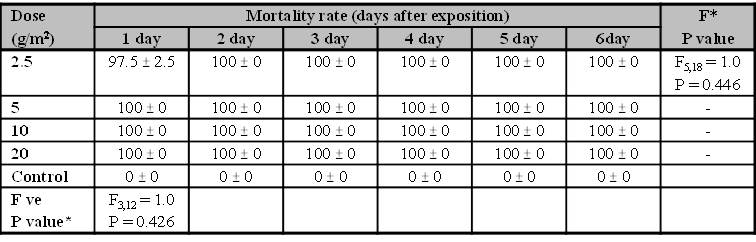
Table I.
Mortality rate (%) of Blattella germanica adults (mean ± se) exposed to different doses of DE ACN-1 for six days on the concrete surface.
*Two-way analysis of variance (ANOVA) applied to the data (n = 4).
Mortality rates of Blattella germanica adults exposed to different doses of DE ACN-1 on parquet surface
The mortality rates of B. germanica adults exposed to the four DE ACN-1 different doses (2.5, 5, 10 and 20 g/m2) evaluated on the parquet surface for six days are given in Table II. Similar to results of concrete, 2.5 g/m2dose of DE ACN-1 caused 100% mortality of cockroaches’ adults on the parquet surface at the end of the second day; for the other doses, the mortality rate of adults reached 100% at the end of the first day. However, in this case, mortality on the first day at 2.5 g/m2 of DE ACN-1 was significantly different compared to the other doses.
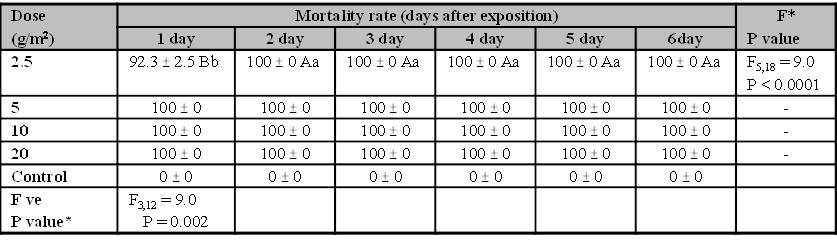
Table II.
Mortality rate (%) of Blattella germanica adults (mean ± se) exposed to different doses of DE ACN-1 for six days on the parquet surface.
*Two-way analysis of variance (ANOVA) applied to the data. Differences between the means were determined according to Duncan test at 5% significance level. Different uppercase letters in the same line and different lowercase letters in the same column are statistically different from each other (n = 4).
Mortality rates of Blattella germanica adults exposed to different doses of DE ACN-1 on ceramic surface
The mortality rates of B. germanica adults exposed to the four DE ACN-1 different doses (2.5, 5, 10 and 20 g/m2) evaluated on the ceramic surface for six days are given in Table III. The lowest mortality rate for a one-day exposure period was for the dose of 2.5 g/m2. As of the second day, the mortality rate reached 100% in all doses. As for parquet surface, mortality on the first day at 2.5 g/m2 of DE ACN-1 was significantly different compared to the other doses.
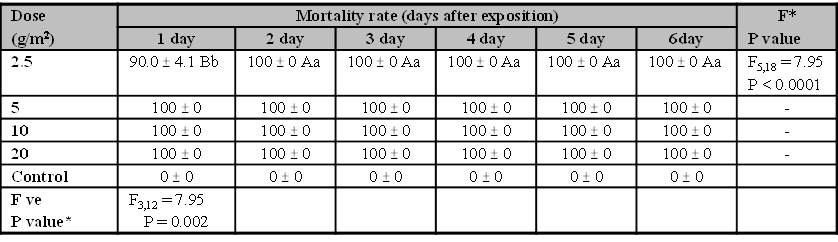
Table III.
Mortality rate (%) of Blattella germanica adults (mean ± se) exposed to different doses of DE ACN-1 for six days on the ceramic surface.
*Two-way analysis of variance (ANOVA) applied to the data. Differences between the means were determined according to Duncan test at 5% significance level. Different uppercase letters in the same line and different lowercase letters in the same column are statistically different from each other (n = 4).
The mortality effect of 5 g/m2 constant dose value of DE ACN-1 at different exposure times and different surfaces to Blattella germanica adults
Mortality rates of B. germanica adults resulting from 5 g/m2 dose of DE ACN-1 after 6, 9, 12, 18 and 24 h on concrete, parquet, ceramic surfaces are given in Table IV. The lowest mortality rate of B. germanica adults was observed for the parquet surface and the highest mortality rate was found for the concrete surface, while the mortality rate of B. germanica adults on the ceramic surface was statistically similar to both the concrete and parquet surfaces. The mortality rate of the German cockroach after 9 h and 12 h of exposure on all surfaces was statistically similar (F2,9= 087 P = 0.448; F2,9 = 3.0 P = 0.1). While the lowest mortality rate of the cockroaches caused by DE ACN-1 on the concrete and parquet surfaces was obtained at the end of 6 h, reaching 100% after 12 h of exposure (Table IV). On the other hand, on the ceramic surface, the lowest mortality rate of the cockroaches was achieved at the end of the 6-hour period, and 100% mortality was observed after 18 h of exposure.
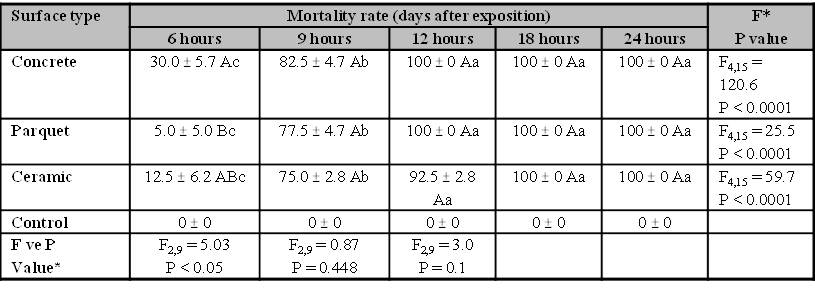
Table IV.
Mortality of Blattella germanica adults exposed to 5 g/m2 of DE ACN-1 for different times on concrete, parquet, ceramic surfaces.
*Two-way analysis of variance (ANOVA) applied to the data. Differences between the means were determined according to Duncan test at 5% significance level. Different uppercase letters in the same line and different lowercase letters in the same column are statistically different from each other (n = 4).
DISCUSSION
This work was the first study that evaluated the mortality effect of four different doses of Turkish diatom earth coded ACN-1 against B. germanica adults on three different application surfaces (concrete, ceramic, parquet) under laboratory conditions. Since diatom earth (DE) is a non-toxic insecticide, it is used for controlling house and stored product pests (Quarles, 1992). Hosseini et al. (2014) studied the insecticidal effect of diatom earth from other origin (not Turkish DE) on B. germanica adults and nymphs. In their study, researchers found that DE had a mortality rate of 33.3% - 81.1% at doses of 2.5, 5, 10, 15, 20 g/m2 at the end of 24, 48, 72 h against B. germanica nymphs. They reported that the mortality rate was 66.7% - 100% at dose of 25 g/m2. They found that all doses of DE had a mortality rate of 40% to 80% for B. germanica adult males. This difference in the mortality of the German cockroaches by DE in the present study is due to the origin of the DE. These studies showed that the effect of DE against insects generally increases as the application dose and application time increases. Shams et al. (2011) determined the effectiveness of 250, 323, 426, 562 and 750 mg/kg doses of a commercial diatom preparation named Silicosec® against Sitophilus granarius (L.) (Coleoptera: Curculionidae) adults on wheat under laboratory conditions. They calculated the mortality rates of diatom earth applications on the insect 24, 36 and 48 h after the application. They found that the mortality rate of S. granaries increased as the dose of the diatom earth and the exposure time of the insect increased. Similar to these results, in this study, as the exposure time and dose value increased, the mortality rate of adult the German cockroaches increased in parallel.
In the biological tests carried out, there was generally not much difference between application surfaces on the diatom activity and therefore on the killing efficacy of the tested species, it was determined that the local diatom has different activities regardless of the application surface. As a result of biological experiments established with DE ACN-1 and three different application surfaces, we found that the dose of 2.5 g/m2 caused the lowest mortality rate of B. germanica adults (90%) on the ceramic surface at the end of the first day. Besides, from the second day of treatment, 100% mortality of B. germanica adults on all surfaces were recorded. At the dose of 5 g/m2 and above doses of ACN-1, the mortality rate B. germanica adults on all surfaces was 100% at the end of one-day exposure.
Cockroaches have generally developed resistance to insecticides that have a broad spectrum of action. At the same time, it is known that these broad-spectrum insecticides are harmful to mammals and even to the entire ecosystem. With the increasing environmental awareness in recent years, insecticides that are easily degradable or completely organic in nature are promising as alternative methods for insect control. For this reason, diatom earth, which does not threaten the environment and mammalian health and is non-toxic to the ecological environment, was tested during this study.
All these results showed that DE ACN-1 has the potential to be used in B. germanica adults control and it could be an alternative to synthetic insecticides with broad-wide spectrum of action used in the control of this insect. Also, due to its resistance to chemical pesticides used in the control of German cockroaches, it is recommended to use DE to control this insect pest. However, the applicability of diatom earths under natural habitats of German cockroaches and the determination of the interaction with other living factors when applied in natural conditions should be demonstrated by a comprehensive study.
Acknowledgments
This work is part of the first author's master thesis. Also, thanks to Dr. Sean Putnam for his critical review of the English of the manuscript.
REFERENCES
Alkan, M., Ertürk, S., Atay, T., & Çağlayan, A. (2019). Insecticidal efficacy of local diatomaceous earths against adult and larvae of Tenebrio molitor L., 1758 (Coleoptera: Tenebrionidae).Turkish Journal of Entomology, 43, 347-254.
Athanassiou, C.G., Kavallieratos, N.G., & Meletsis, C.M.(2007). Insecticidal effect of three diatomaceous earth formulations, applied alone or in combination, against three stored-product beetle species on wheat and maize. Journal of Stored Products Research. 43, 330-334.
Burgess, N.R.H., Mc Dermott, S.N., & Whiting, A. (1973). Aerobic bacteria occoring in the hind gut of the cockroach, B. orientalis. The Journal of Hygiene. 71, 1-7.
Burgess, N.R.H. (1978). The cockroach as a health hazard. Proceedings of the Infection Control Nurses Association. ., 31-33.
Cloarec, A., Rivauit, C., Fontaine, F., & Le Guyander, A. (1992). Cockroaches as caries of bacteria in multifamily dwellings. Epidemiololgy and Infection. 109, 483-490.
Çetin, M.,& Taş, B. (2012). Biyolojik orijinli tek mineral: Diyatomit. Türk Bilim Araştırma Vakfı (TÜBAV) Bilim Dergisi. 5, 28-46
Çolak,H., Uğurluay, G., Nazlı, B., & Bingöl, E.B.(2011). Paketlemede kullanılan nem tutucu filtrelerin hindi etinin raf ömrü üzerine etkisi. İstanbul Üniversitesi Veterinerlik Fakültesi Dergisi. 37, 107-116
Dong, P.A., Valles, R.M., Scharf, M.E., Zeichner, B., & Bennet, G.W.(1998). The Knockdown resistance (kdr) mutation in pyrethroid-resistant german cockroaches. Pesticice Biochememistry and Physiology. 60, 195-204.
Durmuşkaya, C. (2009). Nano teknoloji uzmanı, Diyatomeler. Bilim Teknik Dergisi. ., 56-59
Ebeling, W.(1971). Sorptive dusts for pest control. Annual Review of Entomology. 16, 123-158.
Faulde, M.K., Scharninghausen, J.J., & Cavaljuga, S. (2006). Toxic and behavioural effects of different modified diatomaceous earths on the German cockroach, Blattella germanica (L.) (Orthoptera: Blattellidae) Under Simulated Field Conditions. Journal of Stored Products Research. 42, 253-263.
Gondhalekar, A.D., Appel, A.G., Thomas, G.M., & Romero, A. (2021). A review of alternative management tactics employed for the control of various cockroach species (Order: Blattodea) in the USA. Insects. 12, 1-20.
Holbrook, G.L., Roebuck, J.A.M.I.E., Moore, C.B., & Schal, C.O.B.Y. (1999) Prevalence and magnitude of insecticide resistance in the German cockroach (Dictyoptera: Blattellidae). In Proceedings of the 3rd International Conference of Urban Pests” (WH Robinson, F. Rettich, and GW Rambo, Eds.) 141-145.
Hosseini, S.A., Bazrafkan, S., Vatandoost, H., Abaei, M.R., Ahmadi, M.S., Tavassoli, M., & Shayeghi, M. (2014) The insecticidal effect of diatomaceous earth against adults and nymphs of Blattella germanica. Asian Pacific Journal of Tropical Biomedical. ., 228-232.
Jialin, Z., Mingsheng, W., & JianMing, C. (2007). Resistance investigation of Blattella germanica to six insecticides and control strategy in Hefei city. Chinise. Journal of Vector Biology and Control. ., 98-99.
Kostyukovsky, M., Trostanetsky, A., Menasherov, M., Yasinov, G., & Hazan, T.(2010). Laboratory evaluation of diatomaceous earth aganist main stored product insect. Proceedings of the 10th International Working Conference on Stored-Product Protection, 27 June to 2 July 2010, Estoril, Portugal (Editörler: Carvalho, M.O.; Fields, P.G.; Adler, C.S.; Arthur, F.H.; Athanassiou, C.G.; Campbell, J.F.; Fleurat-Lessard, F.; Flinn, P.W.; Hodges, R.J.; Isikber, A.A.; Navarro, S.; Noyes, R.T.; Riudavets, J.; Sinha, K.K.; Thorpe, G.R.; Timlick, B.H.; Trematerra, P.; White, N.D.G.) Julius Kühn-Institut, Berlin, Germany, 701-704 s.
Mansouri, F., Azaizeh, H., Saadf, B., Tadmor, Y., Abo-Moch, F., & Said, O.(2004). The Potential of Middle Eastern Flora as a Source of New Safe Bio-Acairicides to Control Tetranychus cinnabarinus, the Carmine Spider Mite. Phytoparasitica.32, 66-72.
Patourel,G.N.J., & Zhou, J.J. (1990). Action of amorphous silica dusts on the German cockroach Blattella germanica (Linneaus) (Orthoptera: Blattidae). Bulletin of Entomological Research. 80, 11-17.
Quarles, W. (1992). Diatomaceous earth for pest control. The IPM Practitioner. 14, 1-11.
Roberts, J. (1996) Cockroaches linked with asthma. British Medical Journal: International Edition, 312(7047), 1630-1630.
Rust, M.K., & Reierson, D.A.(1991). Chlorpyrifos resisance in German cockroaches (Dictyoptera: Blattellidae) from restaurantsJournal Economic Entomology. 84, 736-740.
Shams, G., Safaralizadeh, M.S., & Imani, S.(2011). Insecticidal effect of diatomacaous earth aganist Callosobruchus maculatus (F.) (Coleoptera: Bruchidae) and Sitophilus granarius (L.) (Coleoptera: Curculionidae) under labaratory conditions. African Journal of Agricultural Research. ., 5464-5468.
Stadler, T., Buteler,M., Weaver, D.K., & Sofie, S.(2012). Comparative toxicity of nanostructured alumina and a commercial inert dust for Sitophilus oryzae (L.) and Rhyzopertha dominica (F.) at varying ambient humidity levels. Journal of Stored Products Research. 48, 81-90.
Tarshis, I.B. (1959). Sorptive dusts on cockroaches. California Agriculture.13, 3-5.
Wakil, W., & Shabbir, A.(2005). Evaluation of diatomaceous earth admixed with rice to control Sitophilus oryzae (L.) (Coleoptera: Curcilionidae). Pakistan Entomologist. 27, 15-18.
Waldvogel, M.G., Moore, C.B., Nalyanya, G.W., Stringham, S.M., & Watson, W.D. (1999). Integrated cockroach (Dictyoptera: Blattellidae) management in confined swine production, pp. 183-188. In W. H. Robinson, F. Rettich, and G. W. Rambo [eds.] Proceeding of the 3rd international conference of urban pests. Graficke Zavody Hronov, Prague, Czech Republic.
Zacher, F., & Kunike, G. (1931). Untersuchungen über die insektizide Wirkung von Oxyden und Karbonaten. Arbeiten aus der Biologischen Reichsanstalt für Land und Forstwirtschaft, Berlin. 18, 201-202.
Notas de autor
htunaz@ksu.edu.tr