Resumen: Los bosques son esenciales para el bienestar humano ya que proporcionan múltiples bienes y servicios (de regulación, provisión, culturales) que benefician la salud humana. Los insectos polinizadores representan uno de los componentes más importantes de la diversidad forestal porque tienen un papel importante tanto en la conservación de la biodiversidad de especies de plantas como en la producción agrícola. En un monitoreo plurianual de colonias silvestres de Meliponini en un bosque del Chaco Seco, hemos utilizado un método simple para encontrar colonias dentro de los árboles, incluso cuando las condiciones impedían la actividad de forrajeo de las abejas (frío, calor extremo). Describimos brevemente este método y discutimos su utilidad para los ecólogos y las comunidades campesinas.
Palabras clave: Ecorregión Chaqueña, Nidificación, Neltuma, Tribu Meliponini.
Abstract: Forests are essential for human wellbeing since they provide multiple goods and services (of regulation, provision, cultural) that benefit human health. Insect pollinators represent one of the most important components of forest diversity because they have a significant role both in the plant species biodiversity conservation and agricultural production. In a multiannual monitoring of Meliponini wild colonies in a Dry Chaco forest, we have used a simple method to find colonies inside trees, even when conditions prevented foraging-activity of bees (cold, extreme heat). We briefly describe this method here and discuss its utility for ecologists and peasant communities.
Keywords: Chacoan ecoregion, Meliponini tribe, Neltuma, Nesting.
Notas
Listening inside the trees: A novel and simple method to find active nest of stingless bees (Hymenoptera: Apidae, Meliponini) in Dry Chaco forests
Escuchando dentro de los árboles: Un nuevo y sencillo método para encontrar nidos activos de abejas sin aguijón (Hymenoptera, Apidae, Meliponini) en los bosques del Chaco Seco
Sociedad Entomológica Argentina
Recepción: 07 Septiembre 2022
Aprobación: 16 Diciembre 2022
Forests are considered one of the richest biodiversity hotspot of our planet especially those located among tropics (FAO, 2004). These ecosystems are essential for human wellbeing since they provide multiple goods and services (of regulation, provision and cultural) that benefit human health (Rondeux, 1999; Meneguzzo & Zabini 2021). The diversity of forest species is closely related to the structural complexity of the vegetation through multiple ecological interactions. Pollinators represent one of the most important components of forest diversity because they have a significant role both in the plant species biodiversity conservation and surrounding agricultural production. It is estimated that, within 90% of the pollination that occurs in flowering plants throughout the world, 67% is carried out by insects, constituting the most important group of pollinators, both for wild and cultivated plant species (Fründ et al., 2013). The role of pollinating insects, mainly bees, has been widely demonstrated for all types of crops (Potts et al., 2010; Khalifa et al., 2021). However, many forest ecosystems still have scarce information on the diversity of pollinators they harbor.
Tropical and subtropical dry forests are among the most threatened ecosystems globally (Hoekstra et al., 2005). In Argentina, the largest forest ecosystem is the Dry Chaco and since two decades ago, it has become a global deforestation hotspot, due to the advance of the agricultural frontier (Hansen et al., 2013; Fehlenberg et al., 2017). In the semi-arid portion of Dry Chaco forests, around 10.5 million hectares were lost in natural areas until 2012 (Vallejos et al., 2015), with Santiago del Estero being one of the provinces with the highest proportion of transformed area (23% of the total area) during the last fifteen years (Vallejos et al., 2015). This landscape transformation resulted in a population decrease of many species and increased the risk of negatively impact the provision of ecosystem services; mainly due to a decrease in its surface and a greater presence of degradation agents in the remaining fragments. For hundreds of years, peasants and native communities that live within Dry Chaco forests have been selecting and using tree species to obtain energy. Although many families have access to electricity or gas kitchens, culturally, the use of forest firewood is what they prefer to cook or heat their houses. However, being an unplanned activity, it became a degradation factor that threatens the sustainability of this ecosystem and the diversity of species that also depend on trees, such as wood-cavity-nesting species.
Among the Hymenoptera pollinating insects, the Apoidea superfamily includes the native stingless bees of the Meliponini tribe, which are eusocial insects with generalist foraging behaviors. They find their greatest diversity in the Neotropical region, registering approximately 400 species (Camargo & Pedro, 2007; Michener, 2007) and reach their southern distribution limit in northern and central Argentina (Roig-Alsina et al., 2013; Álvarez & Abramovich, 2015; Álvarez, 2015; Zamudio & Alvarez, 2016; Álvarez & Lucia, 2018). In Argentina, the members of the Meliponini tribe are mainly associated with wooded and jungle areas in the north of the country and so far 35 species of stingless bees have been cited (Roig-Alsina et al., 2013; Álvarez et al., 2016). Over time, this group of species have established close links with the local vegetation and their floral resources (pollen, nectar, resins), which are essential for their subsistence and the growth of the colonies (Nagamitsu & Inoue, 2005). Usually in these environments they use holes and cavities in tree trunks or on thick branches to install their colonies, so the availability of substrates for nesting could be a limiting factor (Rasmussen & Camargo, 2008; Vossler, 2012; Palacio, 2021). In Santiago del Estero, seven species have been recorded (Diodato et al., 2008; Álvarez, 2015; Chianetta et al., 2020; Palacio 2021); however, requirements of each species to nest in the forest and the presence of particular tree-bee associations have been scarcely studied. The objective of this communication is to describe a simple method to confirm the occurrence of active nests of native stingless bees from Argentine Chaco ecoregion which could serve and help other people in the recording of nests of these species, especially in winter, when they decrease their daily activity and other methods become inaccurate.
The study area of this work was located in the northwest of Santiago del Estero province, within the Pellegrini Department, between the city of Rapelli and the town of Pozo Betbeder (26°27'43.40"S, 64°22'26.48"W) (Fig. 1). The community of "La Aloja" is made up of 12 families whose homes are located within a 1,000 ha of native forest fragment. Half of this fragment is for communal use, while the other half is for private use. Its residents lack electricity or gas supply, so the main source of heat and energy is natural forest firewood. The vegetation structure is variable within the communal use area, being more open and degraded in the surroundings of the community. The vegetation consists of the typical species of the seasonal xerophyte forest that is characterized by two open tree strata with some scattered emergent and a continuous shrubby stratum (Morello & Adamoli, 1974; Tálamo et al., 2013). The upper stratum reach the 15m approximately, and is occupied by both "quebracho" species, the red (Schinopsis lorentzii (Griseb.) Engl.) and the more frequent white (Aspidosperma quebracho-blanco (Schltr.) Lyons). The middle stratum present species such as the "mistol" (Sarcomphalus mistol(Griseb.)), the "guayacán" (Caesalpinia paraguariensis (Parodi) Burkart), "brea" (Parkinsonia praecox (Ruiz & Pav.) Hawkins), several species of acacias, cacti and Neltuma (N. alba, N .ruscifolia and N. nigra Griseb.).
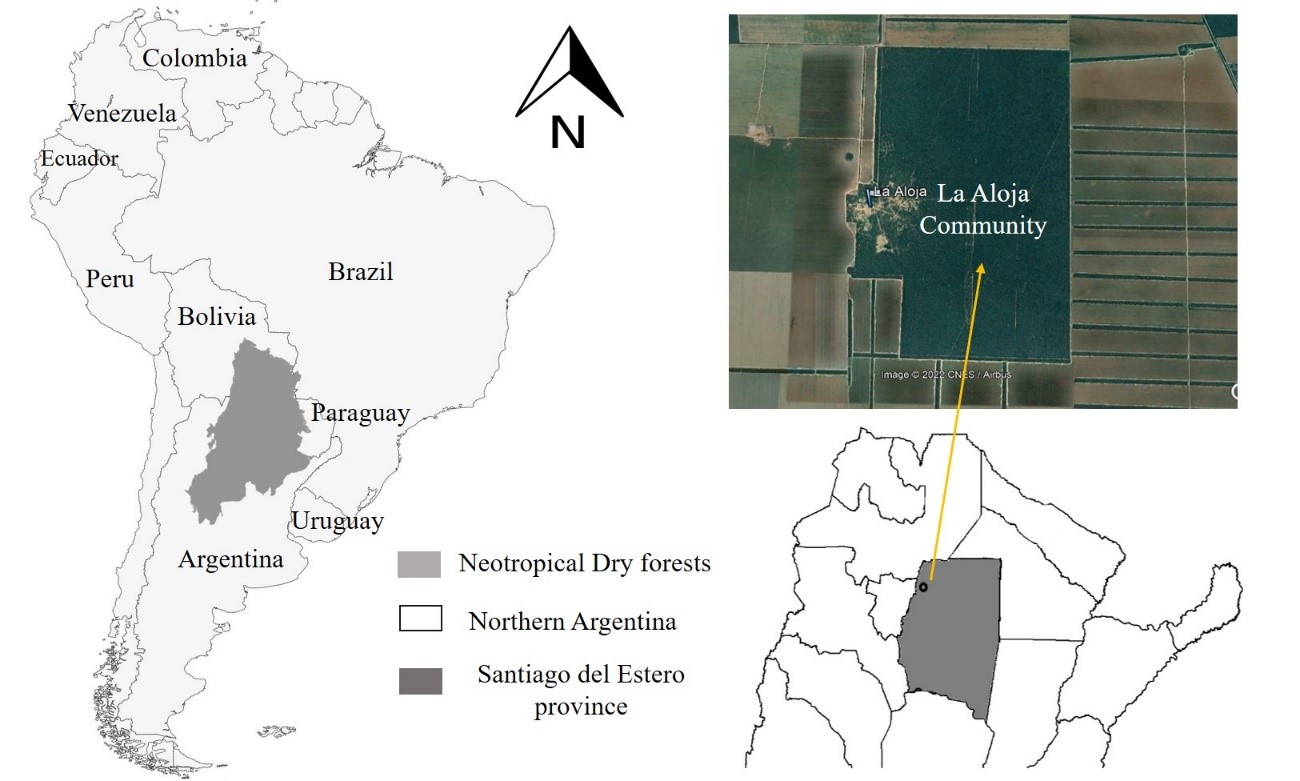
Fig. 1.
Location of Neotropical Dry forests and study area within Argentina. The 1000 ha of forest fragment where La Aloja community lives is shown in the upper-right corner.
Previous studies referred to the stingless bees nesting mention that in order to find the nests, it is convenient to search for them when the bees are active and consider the flight activity of the foraging worker bees when leaving and entering the nest (Palacio, 2021). However, this method impedes from year-round evaluations, and samplings are restricted to the time of the day in which bees are active. In this study, the sampling took place once a month for two years (2020-2022) and consisted in walking and inspecting trees within the forest in a random design searching bee nests. When we discovered a bee nest, we recorded the location with a GPS, the tree species, and when it was possible, we also collected some bees. In order to assess the presence of stingless bees inside the trees we developed a simple, fast and effective method by using a hose like a stethoscope. Once located a putative nest, we placed the hose in the holes present in the tree at one side and the ear of the observer on the other side (Fig. 2a). The hose has to be gently introduced within the tree hole to avoid breaking the entrance. The hose consists of a transparent plastic material, approximately 1 cm section and 60 cm long (Fig. 2b, c). In this way, this tool makes it easy to hear the buzz that the colony produces inside the trees. This procedure to confirm the presence of active nests greatly facilitates the study of bees especially during winter; when, due to low temperatures, bees tend to lower their activity and do not leave the colony (even their entrances or “piqueras” remain closed and inconspicuous) (Fig. 3). The hose can also be used as an aspirator to catch bees when they enter or leave the nest; in which case, it has to carry a mesh to intercept bees and avoid swallowing them.
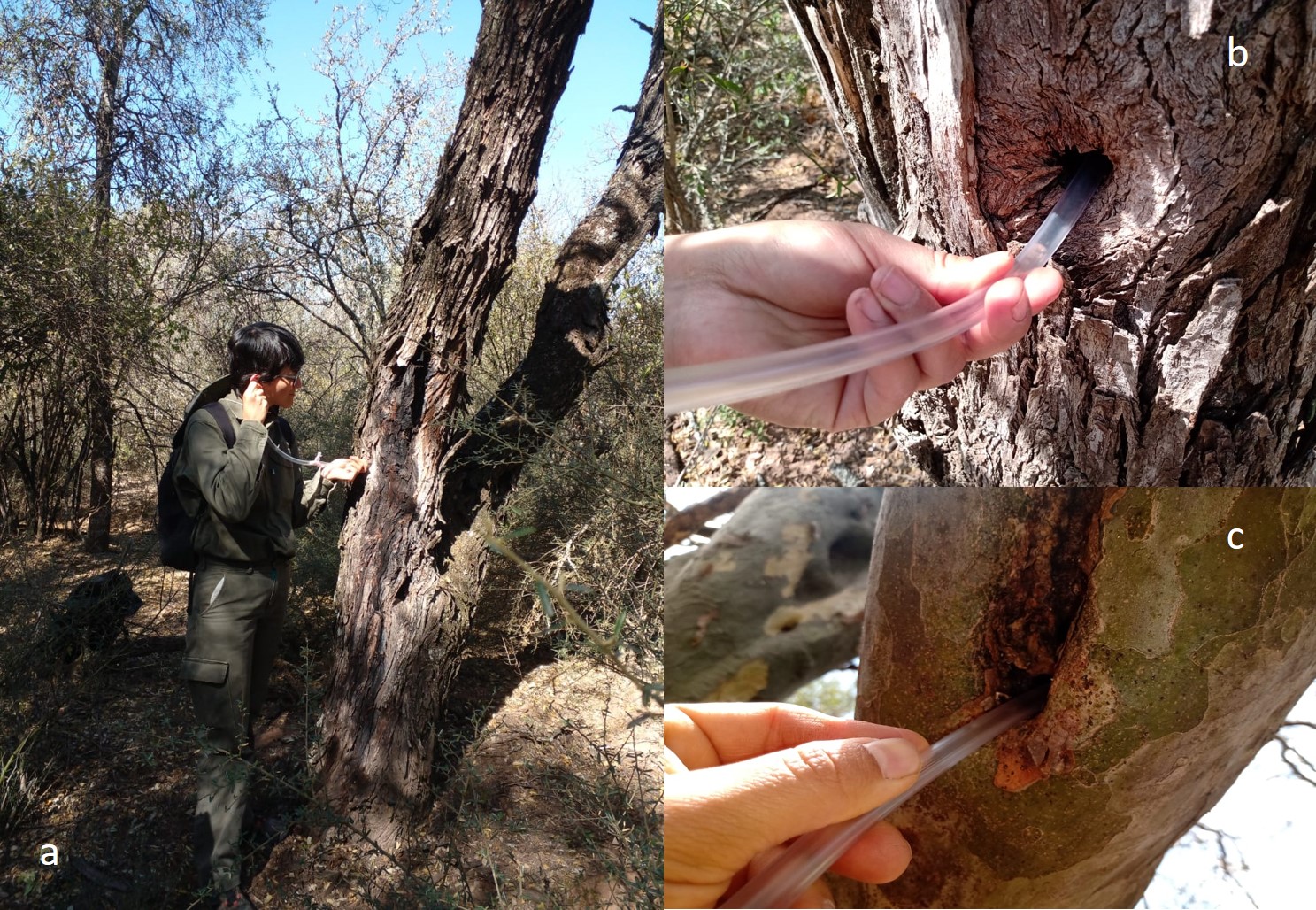
Fig. 2.
Method to detect native bees nest. a. Plastic hose used to hear the buzz of the colonies, b. Hose placed inside the holes of Neltuma nigra, c. Hose placed inside the holes of Caesalpinia paraguariensis.
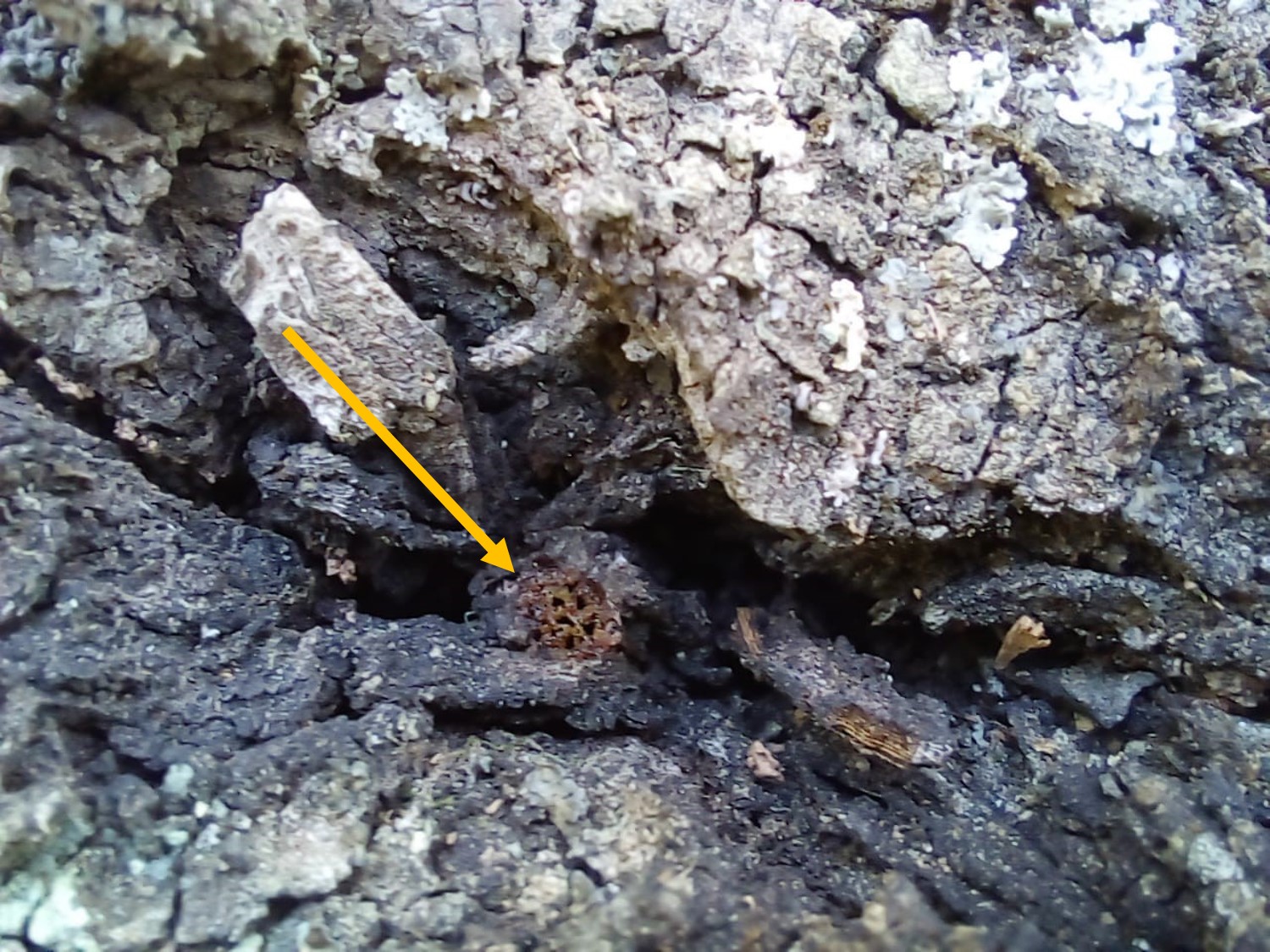
Fig. 3.
Entrance or "piquera" of the species Plebeia catamarcencis closed with wax (due to low temperatures) on the bark of Neltuma nigra.
During the two years sampling, we found three species of stingless bees, which were easily recognized in the field by the shape of the nest entrance, when present (Chianetta et al. 2020). We confirmed these identifications with the collected material using the keys of Álvarez (2015) as follows: Plebeia catamarcencis (Holmberg, 1903) ("quella"), followed in a much smaller proportion by Plebeia molesta (Puls, 1868) ("tiusimi"), and by Lestrimelitta chacoana ("cayasán"). These three species are the most frequent species of the La Aloja fragment.
Most of the nests recorded (N= 125) were found in individuals of P. nigra, from 0 to 2 meters on the stem. The hose method was mainly used to verify the presence of colonies of P. catamarcencis, since many nests of this species lacked an obvious entrance and when it was present, it was closed with wax. In addition, the method was useful to detect the others two species as well. The “hose method” was effective both to detect the presence of a living (i.e., buzzing) colony inside the trees, listening with it inside each hole, and it was also useful to verify, once the entrance was found in a previous date, that the colony was still inside (in spite of the lack of foraging activity). The lack of activity of the workers during winter (e.g., entering and leaving the nest), even in hours of maximum temperature, makes it very difficult to detect the entrance (and/or the presence of a living colony) with the naked eye, even on marked colonies that were registered in previous field survey (because they close the entrance). Even when the observation of each stem was done meticulously to find the entrances, on many occasions it was decisive to have the hose to listen and detect the buzz of the bees inside the trees, confirming the presence of an active hive in them, and allowing a more accurate monitoring through consecutive years. With this tool, we were able to detect the presence of more than 50% of the total nest recorded. With this device, it is unnecessary to break the entrance with the hose to hear the buzz; however, if it is accidentally damaged, the bees are able to reconstruct it immediately.
In all, we consider that this simple method to confirm the presence of stingless bee colonies can be used not only by ecologists but also by people who live within the forest and use its resources (firewood for cooking and heating) so that, before cutting down a tree, they can use the hose to listen the characteristic buzz made by bees, especially during winter. By using this tool, people may avoid cutting the tree and thus losing the hive inside it, which is something that happens frequently (Zelaya P. unpublished data). Yet, there is a need to inform about the relevance of keeping the nests alive to the inhabitants.
We thank the entire La Aloja community for allowing us to investigate their forests and open the doors of their homes, especially to J. Graneros and the Villoni Family. Also, thanks for the collaboration of M. Carro, J. Carolini, and F. Frohlich during the field works and the nests searching. Likewise, we appreciate the constant support of the National Scientific and Technical Research Commit tee and especially to the Rufford Foundation for supporting this research with a small grant (#27572-1). We thank editor and two anonymous reviewers which comments and suggestions improved our manuscript.
patitovzelaya@gmail.com
Fig. 1.
Location of Neotropical Dry forests and study area within Argentina. The 1000 ha of forest fragment where La Aloja community lives is shown in the upper-right corner.
Fig. 2.
Method to detect native bees nest. a. Plastic hose used to hear the buzz of the colonies, b. Hose placed inside the holes of Neltuma nigra, c. Hose placed inside the holes of Caesalpinia paraguariensis.
Fig. 3.
Entrance or "piquera" of the species Plebeia catamarcencis closed with wax (due to low temperatures) on the bark of Neltuma nigra.
