Notas
The synanthropic austral-most record of the species Loxosceles hirsuta and the formal record of Loxosceles laeta (Araneae: Sicariidae)
Registro sinantrópico más austral de la especie Loxosceles hirsuta y registro formal de Loxosceles laeta (Araneae: Sicariidae)
The synanthropic austral-most record of the species Loxosceles hirsuta and the formal record of Loxosceles laeta (Araneae: Sicariidae)
Revista de la Sociedad Entomológica Argentina, vol. 82, núm. 2, 2023
Sociedad Entomológica Argentina
Recepción: 17 Enero 2023
Aprobación: 24 Mayo 2023
Abstract: A formal record of the medically important species Loxosceles laeta (Nicolet, 1849) and new records of Loxosceles hirsuta Mello-Leitão, 1931 (Araneae: Sicariidae) are provided for La Pampa province, Argentina, comprising its southernmost record. The specimens of L. hirsuta in this work were found inhabiting human structures and were collected in different localities, between long time lapses, which suggests that L. hirsuta much like L. laeta is highly synanthropic and established in La Pampa.
Keywords: Argentina, Distribution, Medical importance, Recluse spider.
Resumen: Se proporciona el registro formal de la especie de importancia médica Loxosceles laeta (Nicolet, 1849) y nuevos registros de Loxosceles hirsuta Mello-Leitão, 1931 (Araneae: Sicariidae) para la provincia de La Pampa, Argentina, correspondiendo a su registro más austral. Los especímenes de L. hirsuta de este trabajo fueron encontrados habitando estructuras humanas y recolectados en diferentes localidades, entre largos períodos de tiempo, lo que sugiere que L. hirsuta, al igual que L. laeta, es altamente sinantrópica y está establecida en La Pampa.
Palabras clave: Araña reclusa, Argentina, Distribución, Importancia médica.
The genus Loxosceles Heineken & Lowe, 1832 comprises 143 species distributed throughout the Neotropical region, Europa, Asia and Africa (World Spider Catalog, 2022) and is well known for having species of medical interest. Loxosceles species are mainly characterized by the absence of soil-adhering setae, a single femoral thorn in the palpal femur, a large colulus and the absence of spigots in the posterior median spinnerets (Gertsch, 1967). Some species are synanthropic, often found living inside the human infrastructure, which leads to accidental bites. The Loxosceles bite can cause the cutaneous form that manifests as pain and erythema that can develop into a necrotic ulcer. In some cases, it can develop a systemic form causing serious systemic injuries such as hemolysis, disseminated intravascular coagulation (DIC), and acute renal failure (ARF) occur, which can lead to death (De Roodt et al., 2002; Isbister & Fan, 2011). Despite the bad reputation of these spiders which, in this case is augmented by the symptoms of their bites, they are very shy and reclusive. The vast majority of spider species will always tend to escape from encounters with humans. They often hide in bed sheets or clothes and when people use them the spiders bite due to the inability to escape the confinement situation.
Five Loxosceles species are recorded in Argentina: L. laeta (Nicolet, 1849) in the laeta group; L. variegata Simon, 1897 in the gaucho group; L. spadicea Simon, 1907, L. hirsuta Mello-Leitão, 1931, and L. intermedia Mello-Leitão, 1934 in the spadicea group (Catálogo de Arañas de Argentina, 2022). The spadicea group is characterized by males with a spherical palpal bulb and a thin embolus with a carina at its base and by females having well separated spermathecae with small epigynum ducts (Gertsch, 1967). In Argentina, the accidents with Loxosceles are attributed to L. laeta and the majority of the cases occurs between the months of October and February (De Roodt et al., 2002). Although L. laeta is easily recognized and is widely spread in Argentina, there are no formal records of the species for La Pampa or the south of Argentina (Mello- Leitão, 1940).
In the present study, L. laeta is formally registered in La Pampa and the southernmost records of L. hirsuta are provided.
Specimens of L. hirsuta and L. laeta inhabiting human infrastructure in La Pampa province were manually collected and preserved in 75% ethanol. Female genitalia was cleared with 10% potassium hydroxide. The specific identification was followed by Gertsch (1967). Specimens were deposited in CE-UNLPam (Colección Entomológica de la Universidad de La Pampa). Geographic distribution maps were constructed using QGIS 2.8.2 (QGIS Development Team, 2023). Photos were taken with a Zeiss Axiocam ERc5s camera attached to a Zeiss Stemi 508 stereoscopic microscope and composed using CombineZM free software.
Loxosceles hirsuta Mello-Leitão, 1931
(Figs. 1a, c; 2 a, c; 3)
Diagnosis: Loxosceles hirsuta is very close to Loxosceles spadicea but can be readily recognized by the long and broad ratio of tibia palpus in males (Fig. 1c) and by the distance of tubular seminal receptacles in females which are separated by four or five times basal width (Fig. 2d) (Gertsch, 1967).
Material examined: La Pampa: Toay (36°40´41.815´´S; 64°23´32.103´´W), 2 ♂, 28 Sep. 2019, 30 Nov. 2021, Liébana Santillán A. Col; Santa Rosa (36°33´22.615´´S, 64°18´2.667´´W), 8 ♂, 3 ♀, 7 imms, 1 July 2022, 15 Aug. 2022, 1 Sept. 2022, Peralta Seen N. & Diez F Cols.
Known distribution: Buenos Aires: (Mello-Leitão 1944), Reserva Ecológica Costanera Sur (Zapata & Grismado 2015); Córdoba: Córdoba (Gertsch 1967; Magalhaes 2017); Misiones: ElDorado, Puerto Victoria, Puerto Bermberg (Gertsch 1967); Salta: Rosario de la Frontera (Mello-Leitão 1941); Tucumán: Tucumán (Gertsch 1967).
New record: La Pampa: Santa Rosa, Toay.
Loxosceles laeta (Nicolet, 1849)
(Figs. 1b, d; 2b, d; 3)
Diagnosis: Loxosceles laeta males are recognized by the elongated palpal segments and by the thin femur which is one-half to two-thirds of the lateral width of the tibia (Fig. 1d). Females can be recognized by the long tubular seminal receptacles, with a pouch at the base, which is usually angled or produced into a distinct tubercle or short blind finger (Fig. 2d) (Gertsch, 1967).
Material examined: La Pampa: Santa Rosa (36°33´27.871´´S; 64°18´1.897´´W), 2 ♂, 3 ♀, 9 imms, 1 Sept. 2022, Peralta Seen N. & Diez F Cols.
Known distribution: Buenos Aires (Holmberg, 1876; Mello-Leitão, 1944); Córdoba: Córdoba (Gertsch 1967; Magalhaes 2017); Entre Ríos: Rosario Tala (Mello-Leitão, 1945); La Rioja: Nonogasta (Mello-Leitão, 1941); Salta: Santa Bárbara, Tolombon (Mello-Leitão, 1941); Santiago del Estero: Villa Unión (Mello-Leitão, 1942).
New record: La Pampa: Santa Rosa.
A new formal record of Loxosceles laeta is provided and L. hirsuta is registered for the first time in La Pampa province comprising the austral-most record of the species. Like those found in Zapata & Grismado (2015), the specimens of L. hirsuta in this work were found living in human infrastructure, indicating that this medically important species is highly synanthropic. Also, the time-space and locality of the records suggest that this species has become established in La Pampa. Furthermore, its north-south expansion suggests that L. hirsuta might show traits of an invasive species as demonstrated in Canals et al. (2016) and Faúndez et al. (2020) for L. laeta in Chile. Finally, although no bites of L. hirsuta have been reported, more surveys should be conducted to better understand its distribution, which will help to recognize, describe and prevent the envenomation that this species could produce.
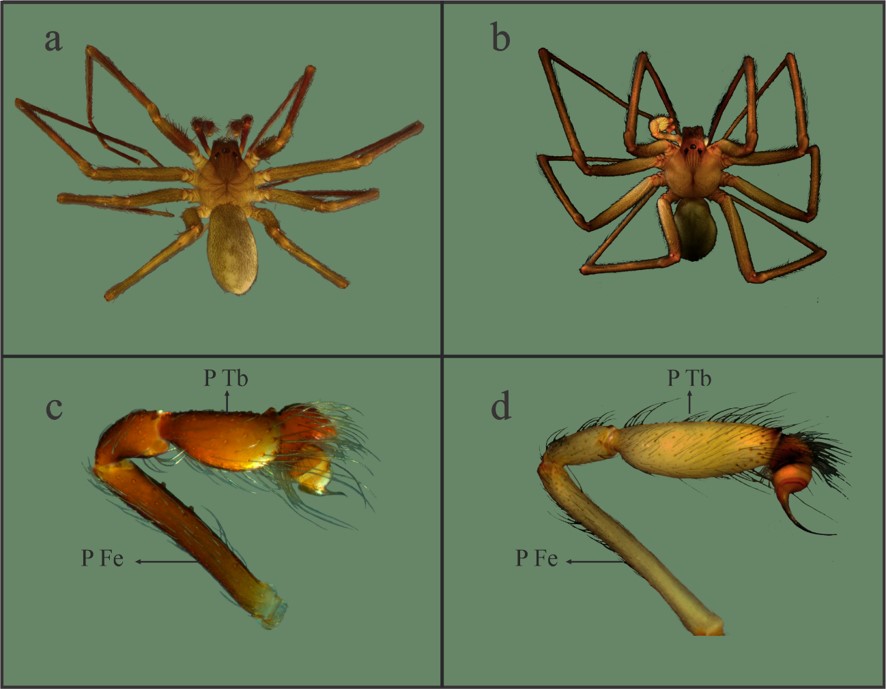
Fig. 1.
Males of Loxosceles found in this study.L. hirsuta. a. Male dorsal view. c. Male right palp. L. laeta. b. Male dorsal view. d. Male right palp. References = P tb: Palp tibia, P Fe: Palp femur.
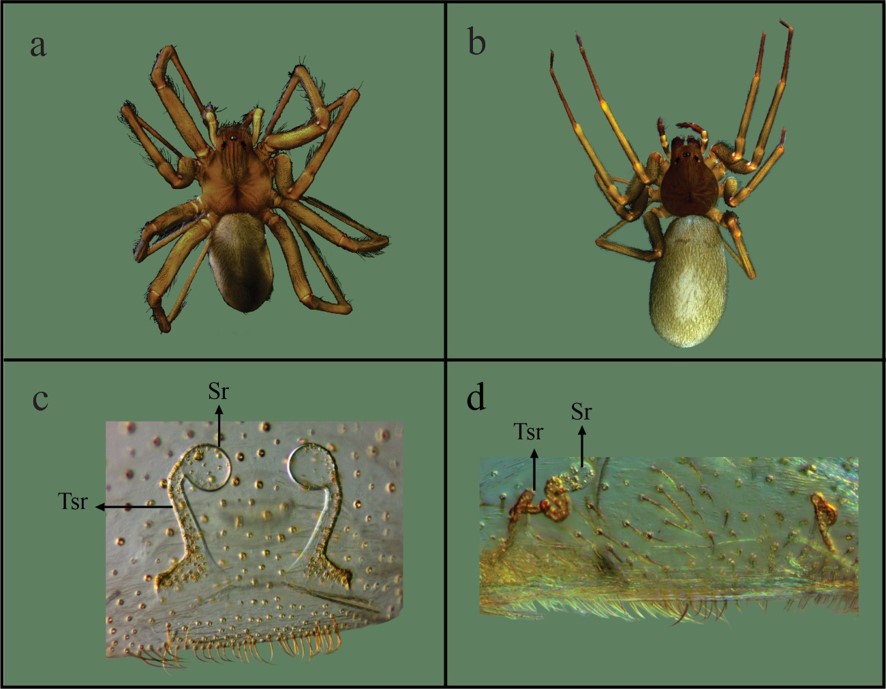
Fig. 2.
Females of Loxosceles found in this study.L. hirsuta. a. Female dorsal view. c. Female genitalia. L. laeta. b. Female dorsal view. d. Female genitalia. References = Sr: Seminal receptacles, Tsr: tubular seminal receptacles.
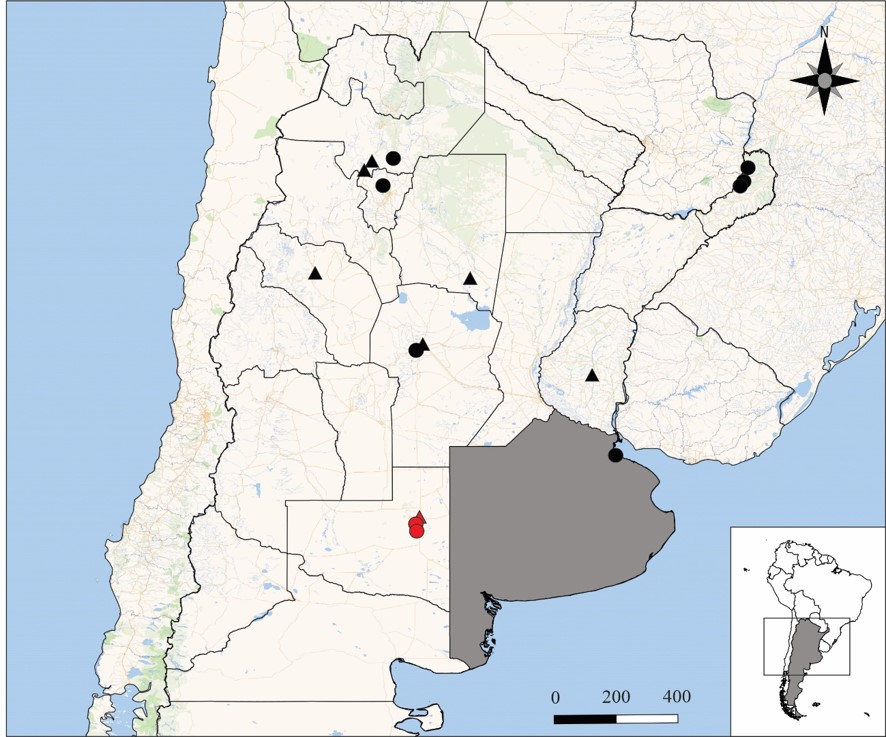
Fig. 3.
Geographic distribution of Loxosceles hirsuta and L. laeta in Argentina. References = circles: L. hirsuta, black circles: records of locality according to bibliography, red circles: new record, triangles: L. laeta, black triangle: records of locality according to bibliography, red triangle: new record, grey area: provinces without locality of capture according to literature.
Acknowledgments
Special thanks to Dr. Juan José Martínez, Dr Liébana María Soledad and Santillán Miguel and to the anonymous reviewers for improving the manuscript. Also, thanks to Amanda Santillán Liébana for helping in the collection of the specimens of this work. This research was supported by Facultad de Ciencias Exactas y Naturales (Universidad Nacional de La Pampa).
REFERENCES
Canals, M., Taucare‐Ríos, A., Brescovit, A. D., Peña‐Gomez, F., Bizama, G., Canals, A., Moreno, L., & Bustamante, R. (2016). Niche modelling of the Chilean recluse spider Loxosceles laeta and araneophagic spitting spider Scytodes globula and risk for loxoscelism in Chile. Medical and Veterinary Entomology, 30, 383-391.
Catálogo de Arañas de Argentina (2022) Catálogo de Arañas de Argentina. Museo Argentino de Ciencias Naturales "Bernardino Rivadavia". https://sites.google.com/site/catalogodearanasdeargentina/ (Accessed 25 July 2022)
De Roodt A.R., Salomón, O.D., Lloveras, S. C., & Orduna, T. A. (2002) Envenenamiento por arañas del género Loxosceles. Medicina, 62, 83-94.
Faúndez E.I, Alvarez-Muñoz C.X., Carvajal M.A., & Vargas, C.J. (2020) The recent expansion of Chilean recluse Loxosceles laeta (Nicolet) (Arachnida: Araneae) in Southern Patagonia. Revista de la Sociedad Entomológica Argentina, 79(2), 56-58.
Gertsch, W.J. (1967) The spider genus Loxosceles in South America (Araneae, Scytodidae). Bulletin of the American Museum of Natural History, 136, 117-174.
Holmberg, E.L. (1876) Arácnidos argentinos. Anales de Agricultura de la República Argentina, 4, 1-30.
Isbister, G. K., & Fan, H. W. (2011). Spider bite. The Lancet, 378, 2039-2047.
Magalhaes, I.L.F., Brescovit, A.D., & Santos, A.J. (2017) Phylogeny of Sicariidae spiders (Araneae: Haplogynae), with a monograph on Neotropical Sicarius. Zoological Journal of the Linnean Society,179, 767-864.
Mello-Leitao, C.F. de. (1940) Arañas de la provincia de Buenos Aires, y de las Gobernaciones de La Pampa, Neuquén, Rio Negro y Chubut. Revista del Museo de La Plata,9, 3-63.
Mello-Leitão, C.F. de. (1941). Las arañas de Córdoba, La Rioja, Catamarca, Tucumán, Salta y Jujuy colectadas por los Profesores Birabén. Revista del Museo de La Plata (N.S., Zool.), ., 99-198.
Mello-Leitão, C.F. de (1942) Arañas del Chaco y Santiago del Estero. Revista del Museo de La Plata (N.S., Zool.), ., 381-426.
Mello Leitão, C.D. (1944) Arañas de la provincia de Buenos Aires. Revista del Museo de La Plata (N.S., Zool.), 3, 311-393.
Mello-Leitão, C.F. de (1945) Arañas de Misiones, Corrientes y Entre Ríos. Revista del Museo de La Plata (N.S., Zool.), ., 213-302.
QGIS Development Team (2023). QGIS Geographic Information System. Open Source Geospatial Foundation Project. http://qgis.osgeo.org (Accessed 15 May 2023).
World Spider Catalog (2022) World Spider Catalog. Version 23.5. Natural History Museum Bern. http://wsc.nmbe.ch (Accessed on 25 July 2022).
Zapata, L., & Grismado, C. (2015) Lista sistemática de arañas (Arachnida: Araneae) de la Reserva Ecológica Costanera Sur (Ciudad Autónoma de Buenos Aires, Argentina), con notas sobre su taxonomía y distribución. Revista del Museo Argentino de Ciencias Naturales (n. s.), 17, 183-211.
Notas de autor
nicolasperaltaseen@gmail.com