Notas
Recepción: 08 Agosto 2023
Aprobación: 13 Diciembre 2023
Abstract: Philorea Erichson, 1834 (Pimeliinae: Physogasterini) is a South American endemic genus of the Desert, Puna and Atacaman biogeographic provinces, in the territories of Peru, Bolivia and Chile. The objective of this work was to update the knowledge of the genus in the Peruvian territory, providing a checklist of species and new distribution records. From examination of 821 specimens, a total of 15 species of Philorea are recorded for Peru. Also distributions maps and comments about its distribution patterns are provided.
Keywords: Darkling beetles, Distribution patterns, South America, South American transition zone, Species list.
Resumen: Philorea Erichson, 1834 (Pimeliinae: Physogasterini) es un género sudamericano endémico de las provincias biogeográficas de Desierto, Puna y Atacama, en los territorios de Perú, Bolivia y Chile. El objetivo del presente trabajo fue actualizar el conocimiento del género en el territorio peruano, aportando un catálogo de especies y nuevos registros de distribución. A partir del examen de 821 especímenes, se registran un total de 15 especies de Philorea para Perú. Asimismo, se presentan mapas de distribución y comentarios sobre sus patrones de distribución.
Palabras clave: Escarabajos tenebriónidos, Listado de especies, Patrones de distribución, Sudamérica, Zona de transición sudamericana.
The genus Philorea Erichson, 1834 (Pimeliinae: Physogasterini) includes around 24 species distributed in localities of Peru, Bolivia and Chile (Kulzer, 1956; Peña, 1980; Vidal & Flores, 2000) within the South American transition zone (Morrone, 2015). This is the most diverse genus of the Physogasterini tribe, a set of six genera and around 69 species endemic to the arid and semi-arid regions of South America (Lacordaire, 1859; Kulzer, 1956; Ferrú & Ruiz De Gamboa, 2021).
The genus Philorea was proposed by Erichson (1834) to accommodate his new species Philorea picipes Erichson, 1834. This first species was temporarily transferred by Solier (1844) to the genus Polpochara Solier, 1844, to later be restored to its original genus by Erichson (1847). The second species, Philorea peruana (Erichson, 1847) was described under the genus Physogaster Guérin-Méneville, 1834 (Erichson, 1847), being later placed in the genus Philorea by Kulzer (1956). Lesne's contributions (1911, 1917, 1935) added four new species Philorea escomeli Lesne, 1911, Philorea mucronata Lesne, 1911, Philorea setipennis Lesne, 1911 and Philorea arequipana Lesne, 1935, as well as distribution records for previously described species. In his revision of the Physogasterini tribe, Kulzer (1956) reviewed the genus, described nine species, synonymized Philorea arequipana under Philorea picipes and presented a key for all species known until then. One more species was described by Kulzer (1966) in a subsequent contribution. Later, Peña (1980) and Vidal & Flores (2000) described four and three species respectively. More recently, Ferrú & Elgueta (2011) offered a brief review of Philorea species in Arica and Parinacota region of northern Chile, including distribution records for 12 known species and two undescribed species. Some morphological characters of head and abdominal ventrites of Philorea were treated and illustrated by Ferrú & Ruiz De Gamboa (2021).
Within the tenebrionid fauna of Peru, the genus Philorea is currently represented by 15 species (Smith et al., 2015), with high rate of endemism (about 67 %) and with an uncertain number of undescribed species observed in collecting trips and entomological collections (Giraldo & Flores, 2016). This genus has been found in coastal deserts (0-1000 m), equatorial dry forest (0-2800 m), western Andean ranges (1000-3800 m) and high Andean plateaus “Puna” (3800-5000 m) (Giraldo & Flores, 2016). Available published records account for its presence in particular habitats such as “lomas” vegetation in coastal desert (Aguilar, 1963, 1976), western Andean dry ravines “quebradas” (Pierre, 1980) and Sechura desert (Juárez-Noé & González-Coronado, 2019).
The purpose of the present work is to update the knowledge of the genus Philorea, providing a checklist of Philorea species and new distribution records in Peruvian territory.
This study is based on direct and indirect examination of type and non-type specimens housed in the following collections: California Academy of Sciences, San Francisco, California, USA (CASC, Rachel Diaz-Bastin, Chris Grinter); Instituto de Entomología, Fundación Miguel Lillo, San Miguel de Tucumán, Argentina (IFML, Aranda et al. 2016); Museo de Entomología Klaus Raven Büller, Universidad Nacional Agraria La Molina, Lima, Perú (MEKRB, Clorinda Vergara); Muséum National d'Histoire Naturelle, Paris, France (MNHN, Antoine Mantilleri, Christophe Rivier); Museum für Naturkunde der Humboldt Universitat, Berlin, Germany (MNHUB, Bernd Jaeger); Museo de Historia Natural, Universidad Nacional Mayor de San Marcos, Lima, Perú (MUSM, Mabel Alvarado); Natural History Museum Basel, Basel, Switzerland (NHMB, Christoph Germann); Laboratorio de Sanidad Vegetal, Servicio Nacional de Sanidad Agraria, Lima, Perú (SENASA, Norma Nolazco); Senckenberg Museum, Frankfurt, Germany (SMF, Andrea Hastenpflug-Vesmanis).
The primary source of distribution records were 821 specimens examined in Peruvian entomological collections, namely MEKRB, MUSM and SENASA. Indirect examination of type specimens housed at CASC, MNHN, MNHUB, NHMB and SMF was carried out through images sent by their respective curators. Species determination was also based on original descriptions and dichotomic keys presented by Lesne (1911, 1935), Kulzer (1956, 1966) and Peña (1980). Male specimens were recognized by smaller and slender body, elongated antennae and legs, and scales on abdominal ventrites 2-3, diagnostic morphological characters proposed by Kulzer (1956) and Ferrú & Ruiz De Gamboa (2021).
The checklist includes distribution status, synonymy, type specimens examined, type localities, supplementary records and material examined, as available for each species. The distribution records of specimens that were not assigned to described species due to their poor condition, doubtful resemblance to known species, or preliminary assignment to undescribed species were summarized in a table indicating regions and provinces according to Peruvian territorial jurisdictions, number of specimens found for each of them, as well as geographic coordinates and altitude data. Overall, type and non-type localities were employed to plot distribution maps for the genus in Peru. The frequency of distribution records according to its latitude and altitude were plotted with histograms and their patterns were interpreted taking into account habitat selection of genus and collecting effort performed in Peruvian territory.
Distribution maps were elaborated using SimpleMappr (Shorthouse, 2010). Histogram plots for latitude and altitude data were elaborated with PAST software (Hammer et al., 2001).
Checklist of Philorea species recorded in Peru
1. Philorea acunai Peña, 1980 ENDEMIC
Type locality. PERU, Arequipa (North of Camana on road to Nasca).
Note. Type locality offered by the author is assumed to be an imprecise midpoint between Camana and Nasca, since the road distance that separates both cities is 393 km.
2. Philorea escomeli Lesne, 1911 (Fig. 1a)
Type specimen examined. Syntype (MNHN).
Type locality. PERU, Arequipa (Arequipa) “Pérou méridional, environs d’Arequipa”.
Supplementary records. CHILE, Arica and Parinacota (Camarones, Codpa) (Peña, 1980; Ferrú & Elgueta, 2011).
Material examined. PERU, Arequipa, Arequipa, 31-VII-1998, L. Cuadros, 1 male (MEKRB), Yura, Quiscos, 16°05'19.68''S 71°36'41.04''W, 2950 m, VII-2015, J. Ugarte, 1 male, 1 female (MEKRB).
3. Philorea koepckei Kulzer, 1956 ENDEMIC (Fig. 1b)
Type specimen examined. Allotype (SMF).
Type locality. PERU, Arequipa (Arequipa, 2200 m).
Supplementary records. PERU, Ica (NE from Nasca at 2000 m) (Pierre, 1980).
Material examined. PERU, Arequipa, Arequipa, 20-II-1983, E. Deza, 1 male, 1 female (MEKRB), Chiguata, 3100 m, II-1948, Weyrauch, 1 female (MUSM), La Joya, 16°22'58.52''S 71°44'04.08''W, 2000 m, 03-IV-2022, G. Sarabia, 1 male, 4 females (MUSM), 16°30'28.8''S 71°44'20.4''W, 1850 m, 17-I-2022, A. Giraldo, 8 males, 13 females (MEKRB), Santa Isabel de Siguas, 16°11'59.00"S 72°03'06.13"W, 1654 m, 24-IX-2017, O. Quispe, 7 males, 11 females (MEKRB), 16°18'57.17''S 72°04'03.58''W, 1667 m, 15-II-2016, E. Quispe, 2 females (MUSM), Yarabamba, 16°28'53.04''S 71°37'42.6''W, 2318 m, 08-V-2015, J. Ugarte, 49 males, 29 females (MEKRB), 16°29'21''S 71°37'54''W, 08-V-2015, 2349 m, matorral, D. Samanez, 62 males, 42 females (MEKRB), Yarabamba, Linga, 16°41'13''S 71°39'40''W, 1781 m, 23-III-2017, C. Bravo, 2 males, 1 female (MUSM), Yura, 16°07'06''S 71°38'04.2''W, 3026 m, 27-XI-2013, C. Carranza, 1 male, 1 female (MUSM), 10 km northeast to Uyupampa, 16°10'04.8''S 71°38'31.19''W, 3130 m, 18-I-2022, 3 males, 6 females (MEKRB); Castilla, Huancarqui, 16°04'14.57"S 72°26'33.65"W , 1624 m, 19-25-IV-2021, I. Medina, 1 female (MUSM), 16°02'28.27"S 72°26'02.07"W , 1528 m, 19-25-IV-2021, I. Medina, 1 female (MUSM), 20-27-IX-2021, I. Medina, 1 male (MUSM), 16°06'29.02''S 72°23'20.66''W, 1144 m, 06-IV-2022, G. Sarabia, 5 females (MUSM); Caylloma, Lluta, 16°02'02''S 72°13'48''W, 2960 m, matorral, 13-IV-2015, J. Ugarte, 14 males, 32 females (MEKRB), 16°06'20.32''S 72°15'10.24''W, 1588 m, 19-25-IV-2021, I. Medina, 1 female (MUSM), 16°06'26.09''S 72°14'56.42''W, 1598 m, 19-25-IV-2021, I Medina, 1 male, 1 female (MUSM), Lluta, Huayca, 16°11'10''S 72°01'40''W, 2010 m, colecta manual, 23-IX-2020, M. Bobadilla, 2 females (MUSM), Majes, 16°09'38.13''S 72°16'28.90''W, 213 m, 19-25-IV-2021, I. Medina, 1 female (MUSM), 16°09'41.31''S 72°16'21.05''W, 211 m, 20-27-IX-2021, I. Medina, 2 females (MUSM); Islay, Jesus, 13-III-1964, A. Florez, 1 male, 1 female (MUSM); Unión, C. C. Chaucalla, 15°34'50.7''S 73°06'11.17''W, 910 m, 04-IV-2012, L. Huerto, 1 female (MUSM). Moquegua, General Sánchez Cerro, La Capilla, 16°45'40.01''S 71°20'59.99''W, 2735 m, 22-III-2017, M. Cardenas, 2 males, 1 female (MUSM), 16°45'51.17''S 71°21'59.97''W, 2585 m, 19-VII-2017, M. Cardenas, 6 males, 6 females (MUSM); Mariscal Nieto, near to Cruz Misionera, 17°14'52.8''S 71°15'03.6''W, 1332 m, 17-I-2022, A. Giraldo, 1 male, 4 females (MEKRB), near to centro poblado Otora, 17°00'10.8''S 70°52'12''W, 2748 m, 25-II-2022, A. Giraldo, 1 male, 4 females (MEKRB), Torata, 16°55'02.87"S 70°59'01.05"W, 2840 m, matorral, II-2019, J. Ugarte, 20 males, 20 females (MEKRB), 17°02'46.2''S 70°56'11.3''W, 2290 m, 26-XI-2018, L. Castro, 1 male (MUSM).
4. Philorea leechi Kulzer, 1956 ENDEMIC (Fig. 1c)
Type specimen examined. Holotype (CASC).
Type locality. PERU, Ica (40 miles S from Nasca “costal loma”).
Material examined. PERU, Arequipa, Camaná, Ocoña, 16°22'35.2″S 73°03'24.5″W, 850 m, 21-VII-2021, E. Medina, 3 males, 1 female (MUSM); Caravelí, lomas, 15°19'47.80''S 74°59'42.49''W, 670 m, 09-XII-2019, T. Neyra, 1 female (MUSM), 15°20'34.3''S 75°00'41.02''W, 709 m, 21-VIII-2020, T. Neyra, 1 male (MUSM), 15°20'43.7''S 75°00'25.52''W, 702 m, 20-VIII-2020, T. Neyra, 1 female (MUSM), 15°21'47.05''S 75°00'55.35''W, 580 m, 21-VIII-2020, T. Neyra, 2 females (MUSM), 15°24'31.26''S 75°01'18.71''W, 304 m, 19-VIII-2020, T. Neyra, 3 males (MUSM), Bella Union, Quebrada Sacaco, 15°24'42.9''S 74°47'41.6''W, 295 m, 26-30-V-2012, C. Carranza, 2 males, 3 females (MUSM). Ica, Nasca, San Juan de Marcona, 15°11'47.25''S 75°11'58.34''W, 09-II-2014, L. Huerto, 3 males, 2 females (MUSM), 15°12'44.4''S 75°10'35.9''W, lomas, trampas pitfall, 24-III-2019, I. Galindo, 6 males (MUSM), 15°12'44.4''S 75°10'35.9''W, 732 m, lomas, 07-VIII-2019, I. Galindo, 1 male, 1 female (MUSM), 15°14'03.3''S 75°06'17.7''W, 836 m, tillandsial, trampas pitfall, I. Galindo, 3 females (MUSM), 15°14'03.3''S 75°06'17.7''W, 836 m, tillandsial, colecta directa, I. Galindo, 2 males (MUSM), 15°21'08.78''S 75°01'15.09''W, 668 m, 22-VIII-2020, T. Neyra, 1 male (MUSM), 15°24'13.98''S 75°03'51.63''W, 257 m, 24-VIII-2020, T. Neyra, 1 female (MUSM), lomas de San Fernando, 15°07'29''S 75°20'19.8''W, 430 m, 03-IV-2010, D. Silva & M. Vilchez, 2 males, 2 females (MUSM).
5. Philorea michelbacheri Kulzer, 1956 (Fig. 1d)
Type specimen examined. Holotype (CASC).
Type locality. PERU, Arequipa (Mollendo “loma zone”).
Supplementary records. CHILE, Arica and Parinacota (25 km E from Arica, Azapa) (Kaszab, 1969; Ferrú & Elgueta, 2011).
Material examined. PERU, Arequipa, Camaná, Ocoña, 16°23'15.32''S 73°03'18.59''W, 812 m, loma costera, 11-II-2021, E. Medina, 1 male (MUSM); Islay, lomas de Matarani, 16°41'49.081''S 72°27'41.408''W, 307 m, 12-I-I2022, A. Giraldo, 5 males, 1 female (MEKRB), lomas de Mollendo, 16°56'34.8''S 72°04'26.399''W, 864 m, 21-II-2022, A. Zúñiga, 2 males, 3 females (MEKRB).
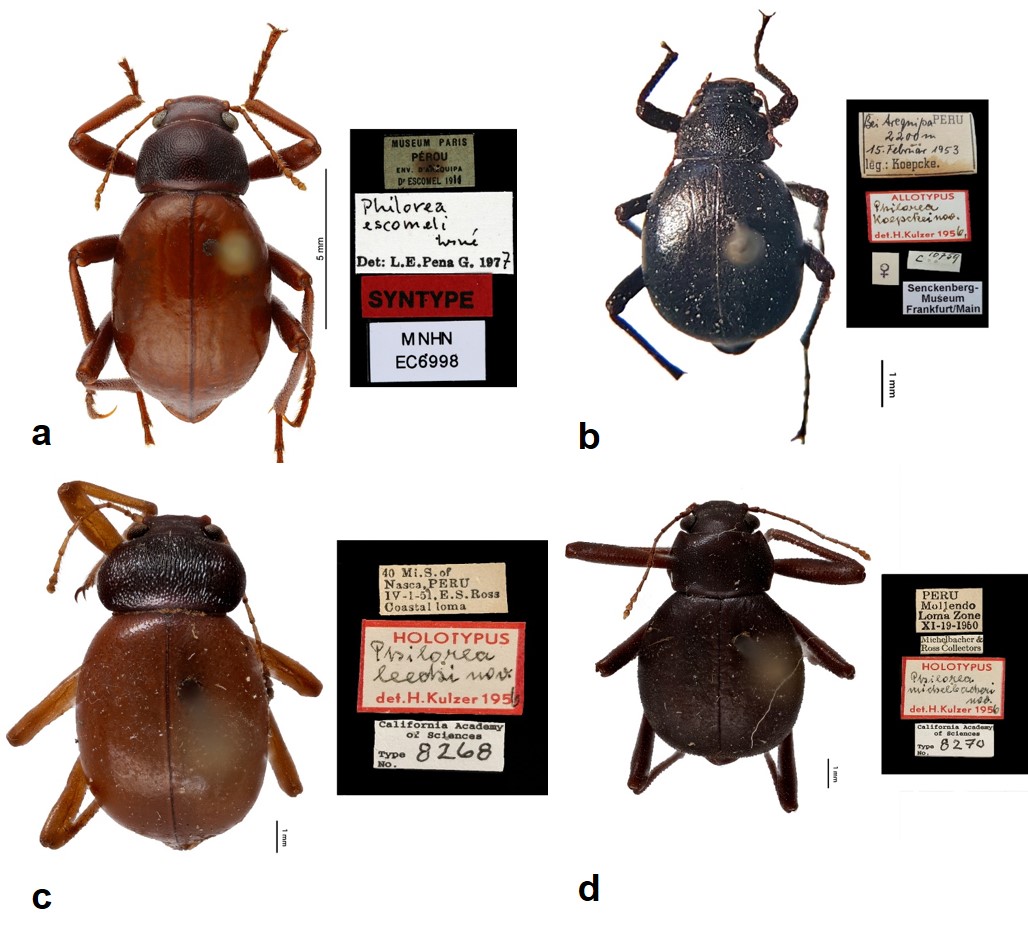
Fig. 1.
Habitus of type specimens in dorsal view. a. Philorea escomeli Lesne, 1911 MNHN syntype (photo by Christophe Rivier); b. Philorea koepckei Kulzer, 1956 SMF allotype (photo by Andrea Hastenpflug-Vesmanis); c. Philorea leechi Kulzer, 1956 CASC holotype (photo by Rachel Diaz-Bastin); d. Philorea michelbacheri Kulzer, 1956 CASC holotype (photo by Rachel Diaz-Bastin).
6.Philorea mucronata Lesne, 1911 ENDEMIC (Fig. 2a)
Type specimen examined. Syntype (MNHN).
Type locality. PERU, Lambayeque (Éten). Lesne (1911) wrote “Pérou septentrional et moyen” because the author also recorded specimens of Lima (Lima).
Supplementary records. PERU, Lima (Huacho) (Kulzer, 1956), Lima (“lomas” near to Lima city on sandy places) (Aguilar, 1963), Piura (Sechura) (Juárez-Noé & González-Coronado, 2019).
Material examined. PERU, Ancash, Huarmey, Huarmey, 10°09'27"S 78°06'26"W, 129 m, 23-27-II-2022, M. Lozano, 2 males, 4 females (MUSM). Lambayeque, Lambayeque, El Colorado, 06°08'13.2"S 80°15'11.7"W, 22 m, trampas de caída, V-2008, A. Giraldo, 1 male (MEKRB), La Capilla, 06°36'16"S 80°10'35.3"W, 3 m, trampas de caída, V-2008, A. Giraldo, 1 male, 1 female (MEKRB); Chiclayo, cerro Reque, 06°51'16.20"S 79°47'36.63"W, 36 m, 09-VIII-2023, A. Giraldo, 4 males, 5 females (MEKRB), near to Puerto Eten, mineroducto El Galeno, 06°59'15.29"S 79°46'09.45"W, 26 m, 09-IX-2009, S. Carbonel, 2 males (MUSM), 06°59'15.29"S 79°45'74.04"W, 29 m, 10-IX-2009, S. Carbonel, 1 male, 1 female (MUSM), 06°59'59.90"S 79°47'03.98"W, 14 m, 08-IX-2009, S. Carbonel, 2 females (MUSM), 07°00'31.88"S 79°45'51.53"W, 18 m, 10-IX-2009, S.Carbonel, 2 females (MUSM), 07°01'17.29"S 79°46'24.26"W, 12 m, 10-IX-2009, S.Carbonel, 2 females (MUSM), Lagunas, 07°00'23"S 79°45'27"W, 21 m, 02-05-VIII-2022, M. Lozano, 1 male, 2 females (MUSM). Piura, Sechura, dunas Las Partidas, 06°06'53.87"S 80°27'48.66"W, 15 m, trampas de caída, V-2008, A. Giraldo, 1 male (MEKRB).
7.Philorea opaca Peña, 1980 ENDEMIC (Fig. 2b)
Type specimen examined. Paratype (MNHN).
Type locality. PERU, Arequipa (S from La Joya).
Note. Type locality offered by the author is imprecise, without indicating the distance from the reference site.
8. Philorea penai Kulzer, 1966 ENDEMIC (Fig. 2c)
Type specimen examined. Paratype (NHMB).
Type locality. PERU, Ancash (220 km N from Lima city).
Material examined. PERU, La Libertad, Trujillo, 04-VIII-1973, E. Carbonel, 1 female (MEKRB); Virú, 04-X-2000, R. Jaramillo, 1 female (MEKRB). Lima, Lima, lomas de Pachacamac, 09-III-1970, R. García, 4 males, 7 females (MUSM), 16-VII-1972, R. García, 1 male, 2 females (MUSM).
9. Philorea peruana (Erichson, 1847) ENDEMIC (Fig. 2d)
= Described as Physogaster peruanus Erichson, 1847
Type specimen examined. Holotype (MNHUB).
Type locality. PERU.
Material examined. PERU, Ica, Pisco, Independencia, 13°42′54.46″S 75°57′31.54″W, 337 m, área de cultivo, pan traps, 14-16-VI-2017, M. Cardenas, 5 females (MUSM).
Note. The original description only stated origin of the specimens at country level. The first precise indication of its distribution in Peruvian coastal desert is offered here. This species bears a superficial resemblance to species of the genus Entomochilus Solier, 1844 (Pimeliinae: Physogasterini), because its body surface is covered with hirsute setae and its limbs are relatively short. However, its placement in the genus Philorea was verified with the observation of the following diagnostic characters (Kulzer, 1956; Ferrú & Ruiz De Gamboa, 2021): clypeus with straight anterior margin, slightly marked frontoclypeal suture, and meso- and metatibiae without sharp edges or strong spines.

Fig. 2.
Habitus of type specimens in dorsal view. a. Philorea mucronata Lesne, 1911 MNHN syntype (photo by Christophe Rivier); b. Philorea opaca Peña, 1980 MNHN paratype (photo by Christophe Rivier); c. Philorea penai Kulzer, 1966 NHMB paratype (photo by Christoph Germann); d. Philorea peruana (Erichson, 1847) MNHUB holotype (photo by Bernd Jaeger).
10. Philorea picipes (Erichson, 1834) (Fig. 3a)
= Philorea arequipana Lesne, 1935
Type specimen examined. Syntype of P. arequipana (MNHN).
Type locality. CHILE, Arica and Parinacota (East from Tacora plateau “volcanic ash fields above 15,000 feet”).
Supplementary records. PERU, Tacna “sandy slopes of the valley” (Lesne, 1911). PERU, Arequipa “environs d’Arequipa” (Lesne, 1917, 1935). PERU, Puno (Urcunimuni) (Lesne, 1917). CHILE (based only on type locality) (Ferrú & Elgueta 2011).
Material examined. PERU, Arequipa, Arequipa, Yura, 16°14'52.8''S 71°40'37.2''W, 2635 m, 18-I-2022, A. Giraldo, 5 males, 1 female (MEKRB); Caylloma, Lluta, 16°02'02''S 72°13'48''W, 2960 m, matorral, 13-IV-2015, J. Ugarte, 7 males, 5 females (MEKRB).
11. Philorea pilosula Kulzer, 1956 (Fig. 3b)
Type specimen examined. Holotype (NHMB).
Type locality. CHILE, Arica (Azapa). Also two paratypes from CHILE, Arica (Azapa, Chaca) and one paratype from PERU, Arequipa (Mollendo “loma zone”).
12. Philorea rossi Kulzer, 1956 ENDEMIC(Fig. 3c)
Type specimen examined. Holotype (CASC).
Type locality. PERU, Arequipa (12 miles SE from Camana “costal loma”).
13. Philorea setipennis Lesne, 1911 (Fig. 3d)
Type specimen examined. Holotype (MNHN).
Type locality. PERU, Arequipa (Arequipa) “Pérou méridional, environs d’Arequipa”.
Supplementary records. PERU, Puno (Urcunimuni) (Lesne, 1917). CHILE, Arica and Parinacota (80 km NE from Azapa, Chapiquiña, Misituni, Putre, Socoroma, Zapahuira “Sapahuira”), Tarapacá (Alto Camiña, Champaja, Poroma, Quipinta) (Kaszab, 1969; Peña, 1980; Ferrú & Elgueta, 2011).
Material examined. PERU, Moquegua, General Sanchez Cerro, near to Quinistaquillas, 16°48'50.4''S 70°53'16.8''W, 1835 m, 25-II-2022, A. Giraldo, 1 female (MEKRB); Mariscal Nieto, Torata, Bocatoma Estuquiña, 17°02'58.68''S 70°51'21.86''W, 2493 m, 15-VII-2013, L. Huerto, 1 female (MUSM), 17°06'40.60''S 70°53'26.36''W, 1437 m, 15-VII-2013, L. Huerto, 1 male, 1 female (MUSM), 2493 m, 15-VII-2013, L. Huerto, 1 female (MUSM), Bocatoma Otora, 17°05'50.44''S 70°55'14.59''W, 2191 m, 17-VII-2013, L. Huerto, 1 female (MUSM), near to Chujulay, 17°01'01.2''S 70°45'39.599''W, 3291 m, 24-II-2022, A. Giraldo, 1 male, 2 females (MEKRB), Sajena Alta, 16°59'09.02''S 70°50'33.45''W, 2493 m, 12-VII-2013, L. Huerto, 1 male (MUSM), 17°06'40.60''S 70°53'26.36''W, 2493 m, 15-VII-2013, L. Huerto, 1 female (MUSM).
14. Philorea stangei Peña, 1980 ENDEMIC
Type specimen examined. holotype (IFML) (Aranda et al. 2016, p. 29, fig. 98)
Type locality. PERU, La Libertad (5 km S from Pacasmayo “Pascamayo”).
15. Philorea weyrauchi Kulzer, 1956 ENDEMIC (Fig. 3e)
Type specimen examined. Paratype (SMF).
Type locality. PERU, Lima (20 km E from Ancon, 650 m).
Material examined. PERU, Lima, Huaral, Chancay, lomas de Iguanil, IX-1999, W. Tori, 1 male (MEKRB), Huaral, 04-VIII-1980, V. Flores, 1 male (MEKRB), Río Seco, 11°19'57''S 77°16'49''W, 464 m, 14-IX-2018, M. Lozano, 1 female (MUSM), 11°20'04.22''S 77°16'38.71''W, 399 m, 07-11-VIII-2015, P. Sanchez, 1 female (MUSM); Huaura, lomas de Lachay, trampas de caída, VI-2000, A. Giraldo, 1 male (MEKRB); Lima, 21-V-1936, J. E. Wille, 11 males, 3 females (SENASA), Pachacámac, Picapiedra, Río Limón, 01-V-1952, 1 male, 1 female (MEKRB).
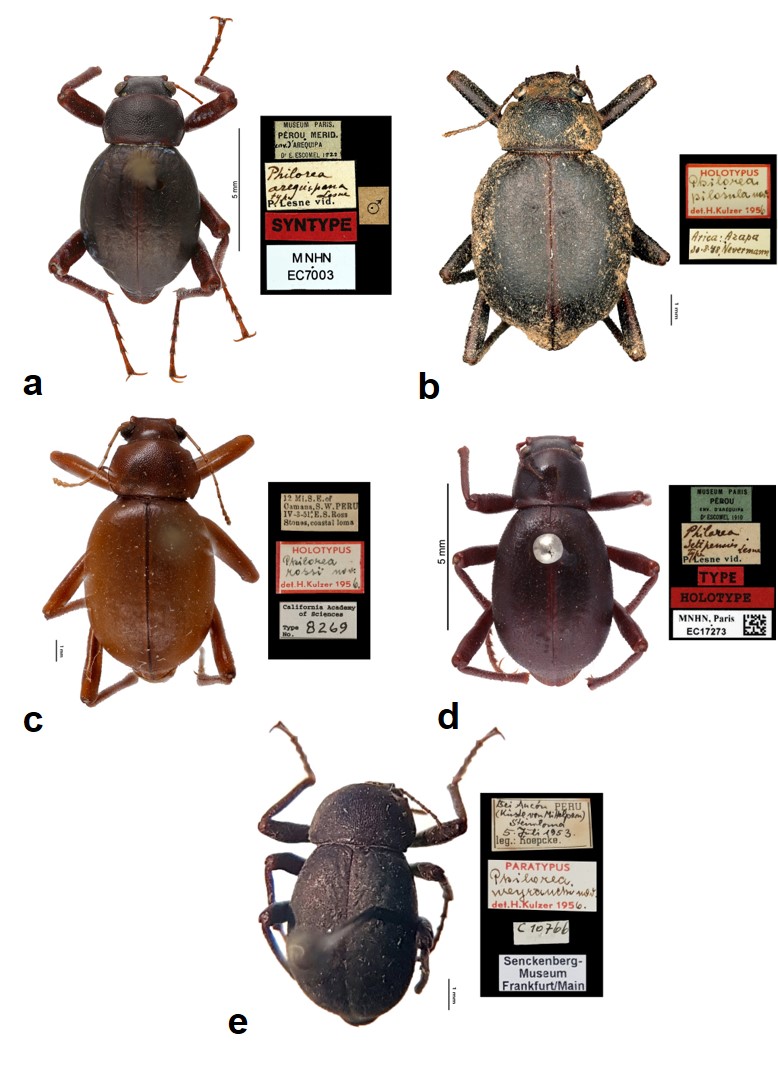
Fig. 3.
Habitus of type specimens in dorsal view. a. Philorea arequipana Lesne, 1935 MNHN syntype (photo by Christophe Rivier); b. Philorea pilosula Kulzer, 1956 NHMB holotype (photo by Christoph Germann); c. Philorea rossi Kulzer, 1956 CASC holotype (photo by Rachel Diaz-Bastin); d. Philorea setipennis Lesne, 1911 MNHN holotype (photo by Christophe Rivier); e. Philorea weyrauchi Kulzer, 1956 SMF paratype (photo by Andrea Hastenpflug-Vesmanis).
According to the checklist presented here, the genus Philorea in Peru is still represented by 15 species in agreement with Smith et al. (2015). It has been possible to examine type specimens of thirteen species, which represents 87 % of the recorded species in Peru. In the Peruvian collections, specimens corresponding to 10 species were found, namely P. escomeli, P. koepckei, P. leechi, P. michelbacheri, P. mucronata, P. penai, P. peruana, P. picipes, P. setipennis and P. weyrauchi. Otherwise, five species are currently known only from their type specimens and are not properly represented in Peruvian collections. It is very likely that these five species have restricted distributions and have therefore been overlooked by collecting surveys in Peru.
Distribution records of undetermined specimens of genus Philorea are presented in Table I. These records include 288 specimens from 6 regions and 17 provinces of the Peruvian territory. Systematic studies on the genus are still in progress, with a large number of specimens not reliably assigned to the described species. Wingless darkling beetles are prone to speciation due to aridity and orographic barriers with isolated populations diverging into species by vicariance. Based on the examination of specimens carried out for this work, it is proposed a conservative guess of 14 undescribed Philorea species in Peruvian territory, an increase of 93% in relation to current number of 15 species.

Table I.
Distribution records of undetermined specimens of the genus Philorea arranged in regions and provinces of Peruvian territory.
Specimen numbers in parentheses. Geographic coordinates in decimal degrees and altitude in meters
Taking into account all the available distribution records, distribution maps were elaborated, including 178 localities (Fig. 4 a-d). These records place the northern limit of the genus to around 5°S and an altitudinal range between sea level and 4380 meters. As expected according to previous works (Aguilar, 1963; Pierre, 1980; Giraldo & Flores, 2016; Juárez-Noé & González-Coronado, 2019), records are mostly located west to the Andes in coastal desert vegetation “lomas”, dry ravines “quebradas” and northern dry forests. Available records above 3800 meters are restricted to those of P. picipes and P. setipennis in Urcunimuni at Puno region (Lesne, 1917) and eight scattered localities in Junin, Arequipa, Moquegua and Tacna regions. At first glance, high Andean environments do not have suitable habitats for this genus, however the presence of arid patches or dry micro-habitats cannot be ruled out, which should be verified with a greater collection effort in these places. The histogram plot of latitude datashows higher frequencies (0.84) for southern latitudes from 12°30'00" S (Fig. 5a) and the histogram plot of altitude data shows higher frequencies (0.56) for altitudes under 800 meters (Fig. 5b). These patterns could be explained by the fact that arid zones cover a greater altitudinal extension from the Paracas Peninsula (14°S) to the Peruvian-Chilean border (18°S) as can be seen in ecological maps and satellite images of Peru. Since most of records were under 800 meters, it seems that "lomas" vegetation is the most valuable habitat for species in the genus, with its particular combination of seasonal fog-mediated precipitations and sandy soils. Available records for P. leechi, P. michelbacheri, P. mucronata, P. penai, P. pilosula and P. weyrauchi and several undetermined specimens are evidence to support that claim.
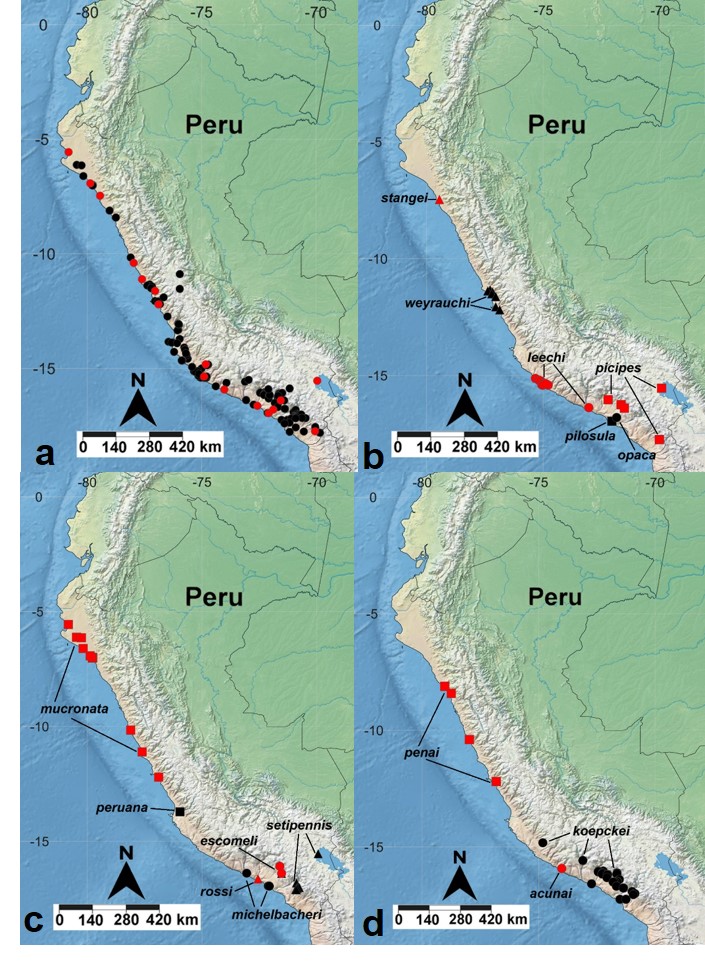
Fig. 4.
Distribution maps of genus Philorea in Peru. a. Overall distribution of the genus, previously published records (red circles), localities based on examined specimens (black circles); b. Distribution of Philorea leechi Kulzer, 1956 (red circles), Philorea opaca Peña, 1980 (black circles), Philorea picipes (Erichson, 1834) (red squares), Philorea pilosula Kulzer, 1956 (black squares), Philorea stangei Peña, 1980 (red triangles) and Philorea weyrauchi Kulzer, 1956 (black triangles); c. Philorea escomeli Lesne, 1911 (red circles), Philorea michelbacheri Kulzer, 1956 (black circles), Philorea mucronata Lesne, 1911 (red squares), Philorea peruana (Erichson, 1847) (black squares), Philorea rossi Kulzer, 1956 (red triangles) and Philorea setipennis Lesne, 1911 (black triangles); d. Philorea acunai Peña, 1980 (red circles), Philorea koepckei Kulzer, 1956 (black circles) and Philorea penai Kulzer, 1966 (red squares).
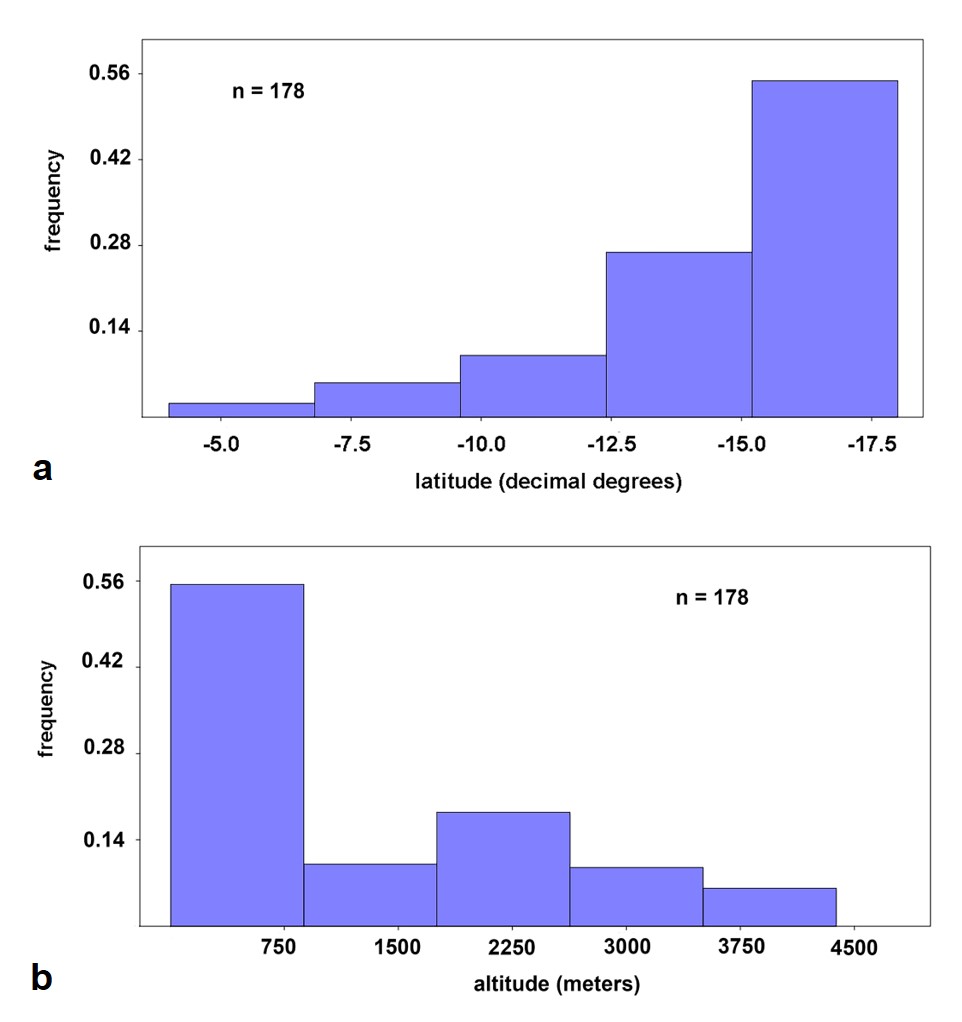
Fig. 5.
Histogram plots for distribution data of genus Philorea in Peru. a. latitude (decimal degrees); b. altitude (meters).
Acknowledgments
The author wishes to thank Clorinda Vergara (MEKRB), Mabel Alvarado (MUSM), and Norma Nolazco (SENASA) for the collaboration provided during the visit of their respective entomological collections. Photos of type specimens were kindly provided by Rachel Diaz-Bastin and Chris Grinter (CASC), Christophe Rivier and Antoine Mantilleri (MNHN), Bernd Jaeger (MNHUB), Christoph Germann (NHMB) and Andrea Hastenpflug-Vesmanis (SMF). Also to two anonymous reviewers for their valuable suggestions that improved the manuscript.
REFERENCES
Aguilar, P.G. (1963) Los artrópodos de las lomas en los alrededores de Lima. Revista Peruana de Entomología, 6(1), 109-114.
Aguilar, P.G. (1976) Fauna desértico-costera peruana – I Invertebrados más frecuentes en las lomas. Revista Peruana de Entomología, 19(1), 67-70.
Aranda, S.G., Córdoba, S.P., & Sánchez, F.R. (2016) Catálogo de los tipos primarios de Coleoptera depositados en la Colección Entomológica del Instituto Fundación Miguel Lillo. Acta Zoologica Lilloana, 60(1), 10-46.
Erichson, W.F. (1834) Coleoptera. Meyen, F.J.F. Beiträge zur Zoologie, gesammelt auf einer Reise um die Erde. Nova Acta Physico-Medica Academiae Caesareae-Leopoldino-Carolinae, Naturae Curiosorum, 16 (Suppl. 1), 219-276. Bonn.
Erichson, W.F. (1847) Conspectus insectorum coleopterorum quae in Republica Peruana observata sunt. Archiv für Naturgeschichte Berlin, 13(1-2), 67-185.
Ferrú, M.A., & Elgueta, M. (2011) Lista de coleópteros (Insecta: Coleoptera) de las regiones de Arica y Parinacota y de Tarapacá, Chile. Boletín del Museo Nacional de Historia Natural de Chile, 60, 9-61.
Ferrú, M.A., & Ruiz De Gamboa, M. (2021) Género nuevo y especie nueva de Physogasterini (Coleoptera: Tenebrionidae) del norte de Chile, con una clave para los géneros de la tribu. Revista Mexicana de Biodiversidad, 92, e923724
Giraldo, A.E., & Flores, G.E. (2016) Peruvian Tenebrionidae: A review of present knowledge and biodiversity. Annales Zoologici, 66(4), 499-513. http://dx.doi.org/10.3161/00034541ANZ2016.66.4.002
Hammer, Ø., Harper, D.A.T., & Ryan, P.D. (2001) PAST: Paleontological Statistics Software Package for Education and Data Analysis. Palaeontologia Electronica,4(1), https://past.en.lo4d.com/windows (Accessed 20 July 2023)
Juárez-Noé, G., & González-Coronado U. (2019) Actualización a la lista de coleópteros (Insecta: Coleoptera) de la Región Piura, Perú. Graellsia, 75(2), e097. https://doi.org/10.3989/graellsia.2019.v75.233
Kaszab, Z. (1969) The scientific result of the Hungarian Soil Zoological Expeditions to South America. 17 Tenebrioniden aus Chile (Coleoptera). Opuscula Zoologica Budapest, 9, 291-337.
Kulzer, H. (1956) Neue Tenebrioniden aus Südamerika. (15. Beitrag zur Kenntnis der Tenebrioniden). Entomologische Arbeiten aus dem Museum George Frey, 7, 895-964.
Kulzer, H. (1966) Neue Tenebrioniden aus Sud-America (Col.). Entomologische Arbeiten aus dem Museum George Frey, 17, 48-69.
Lacordaire, T. (1859) Histoire naturelle des insectes. Genera des coléoptères, ou exposé méthodique et critique de tous les genres proposés jusqu’ici dans cet ordre d’insectes. Tome Cinquième première partie, Roret, París.
Lesne, M. (1911) Synopsis des Philorea, Coléoptères Tènebrionides de la tribu des Physogasterines. Bulletin du Muséum d'Histoire Naturelle de Paris, 17, 292-295.
Lesne, M. (1917) Notes sur les Philorea, Coléoptères Tènebrionides de la Faune des Andes. Bulletin de la Societé Entomologique de France, 22(2), 71-72.
Lesne, M. (1935) Troisième note sur les Philorea, [Col. Tènebrionidae]. Bulletin de la Société Entomologique de France, 40(9), 131-132.
Morrone, J.J. (2015) Biogeographical regionalisation of the Andean region. Zootaxa, 936(2), 207-236.
Peña, L.E. (1980) Aporte al conocimiento de los tenebriónidos de América del Sur. Revista Chilena de Entomología, 10, 37-59.
Pierre, F. (1980) Note on the Tenebrionidae fauna of the arid regions of Peru (Coleoptera). Bulletin de la Societe Entomologique de France, 85(7-8), 180-192.
Shorthouse, D.P. (2010) SimpleMappr, an online tool to produce publication-quality point maps. http://www.simplemappr.net (Accessed 20 July 2023)
Smith, A.D., Giraldo-Mendoza, A.E., Flores, G.E., & Aalbu, R.A. (2015) Beetles (Coleoptera) of Peru: A Survey of the Families. Tenebrionidae Latreille, 1802. Journal of the Kansas Entomological Society, 88(2), 221-228. http:dx.doi.org//10.2317/kent-88-02-221-228.1
Solier, A.J.J. (1844) Essai sur les Collaptérides de la tribu des Molurites. Memorie della Reale Accademia delle Scienze di Torino, 6, 213-340.
Vidal, P., & Flores, G. (2000) Descripción de nuevas especies de Physogasterini de Chile (Coleoptera: Tenebrionidae). Contribuciones Académicas Ocasionales de la Pontificia Universidad Católica de Chile, 2000(1), 1-12.
Notas de autor
alfre2cotobius@yahoo.com
