Notas
First Record of Simulium (Chirostilbia) (Diptera: Simuliidae) in the province of Buenos Aires, Argentina
Primer registro de Simulium (Chirostilbia) (Diptera: Simuliidae) en la provincia de Buenos Aires, Argentina
First Record of Simulium (Chirostilbia) (Diptera: Simuliidae) in the province of Buenos Aires, Argentina
Revista de la Sociedad Entomológica Argentina, vol. 82, núm. 4, 2023
Sociedad Entomológica Argentina
Recepción: 09 Agosto 2023
Aprobación: 21 Octubre 2023
Abstract: Blackflies are dipterans that belong to the family Simuliidae, common inhabitants of lotic ecosystems. The present study reports the first record of Simulium (Chirostilbia) subpallidum Lutz for Buenos Aires, rising to eight registered species of blackflies in the province. This report represents, to date, the southernmost distribution detected for the species and subgenus in South America.
Keywords: Blackfly, Neotropical Region, Salado River, Simulium subpallidum, Taxonomy.
Resumen: Los simúlidos son dípteros pertenecientes a la familia Simuliidae, habitantes comunes de los ecosistemas lóticos. El presente estudio reporta el primer registro de Simulium (Chirostilbia) subpallidum Lutz para Buenos Aires, llegando a ocho especies registradas de simúlidos para la provincia. Es la distribución más austral detectada para la especie y el subgénero en América del Sur.
Palabras clave: Región Neotropical, Río Salado, Simúlidos, Simulium subpallidum, Taxonomía.
Blackflies are dipterans that belong to the family Simuliidae. The immature stages - eggs, larvae, and pupae - inhabit lotic water bodies such as rivers, streams, and pluvial channels, while the adults are terrestrial (Crosskey, 1990). The females of some species have blood-sucking habits that affect the quality of human lives and other animals due to their bites and their role as vectors of pathogens (Adler et al., 2010).
The genus Simulium Latreille is the most abundant worldwide with 38 subgenera and 1971 known species (Adler, 2022). The subgenus Chirostilbia (Chirostilbia) Enderlein is endemic to the Neotropical Region and includes species distributed mainly in Brazil and to a lesser extent in Bolivia, Guyana, Uruguay, Paraguay, Venezuela, and Argentina (Adler, 2022). According to Coscarón & Coscarón-Arias (2007), in Argentina, the subgenus Chirostilbia was represented by Simulium pertinax Kollar, S. subpallidum Lutz, and S. acarayense Coscarón & Wygodzinsky, being S. pertinax recorded for the provinces of Entre Ríos, Corrientes, and Misiones, while S. subpallidum only for the province of Misiones, and S. acarayense for the provinces of Entre Ríos and Misiones. The three species breed in creeks with clear water and the immature stages were found attached to aquatic vegetation; S. pertinax presents a marked anthropophily while the blood-sucking habits of S. subpallidum and S. acarayense are not known (Coscarón & Coscarón-Arias, 2007).
Simulium subpallidum and S. acarayense were considered as a complex of species by Coscarón & Coscarón-Arias (2007), however, Hernández et al. (2007) synonymized both species and currently are cited as synonymous. Nevertheless, according to Coscarón & Coscarón-Arias (2007) both species could be accurately distinguished by the female and male scutum and genitalia characteristics. In addition, Gil-Azevedo et al. (2012) found that there are differences in morphological characters present in immature stages which are related to environmental variables, and in this sense, cytological or molecular analyzes are necessary to confirm the identity of the species. Until these studies can be carried out to dilucidate the taxonomic status of the species, they are also considered as synonymous here.
In the province of Buenos Aires seven species of blackflies belonging to five subgenera are registered, as follows: Simulium (Cerqueirellum) chaquense Coscarón, S. (Cer.) delponteianum Wygodzinsky, S. (Psaroniocompsa) lutzi Knab, S. (Pternaspatha) nigristrigatum (Enderlein), S. (Psilopelmia) rubiginosum (Enderlein), S. (Psi.) wolffhuegeli (Enderlein), S. (Thyrsopelma) orbitale Lutz (Coscarón & Coscarón-Arias, 2007; Adler, 2022). The species considered of health importance due to the inconvenience generated by their bites in the province are S. lutzi, S. chaquense, and S. wolffhuegeli (Coscarón-Arias, 2005). For this reason and because people are suffering from the stings from blackflies, this work aimed to carry out a survey of blackflies species conducted in the Salado River in the province of Buenos Aires.
Blackfly pupae were collected in a drainage channel of the Salado River basin in the city of Junín (34°32'38.34"S, 60°54'57.21"W), located northwest of Buenos Aires province. Blackfly pupae were isolated individually in plastic tubes until the emergence of adults, which were thereafter preserved in 80% ethyl alcohol. In addition, microscopic preparations of the adults and pupal exuviae were made following the methodology of Calvão-Brito & Maia-Herzog (2003). A stereomicroscope Leica MC120HD with antero-posterior illumination and a microscope Olympus BX41 were used for identifications. Specimens were identified according to Lutz (1910), Coscarón (1982, 1991) and Coscarón & Coscarón-Arias (2007), and by direct comparison with the material deposited at the Coleção de Simulídeos do Instituto Oswaldo Cruz, Fundação Oswaldo Cruz (CSIOC/FIOCRUZ) of Río de Janeiro, Brazil.
From 6133 emerged and examined adults in the laboratory, we herein report ten adults of S. subpallidum for the first time in Buenos Aires province. It should be noted that the specimens were identified based on morphological characters (Fig. 1) of the scutum, cibarium, claws and genitalia of the female, scutum and genitalia of the male, and cocoon, gills and trichomes of the pupa. The presence of this specie was recorded during November and December 2018, and during February, April, June, and August 2019. The study material is currently deposited in the Laboratory of Entomopathogenic Fungi – CEPAVE (Centro de Estudios Parasitológicos y de Vectores), Buenos Aires, Argentina.
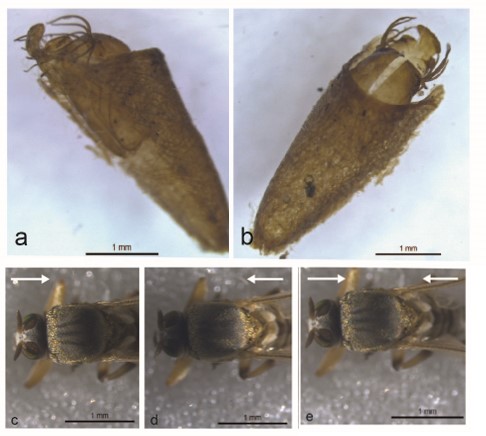
Fig. 1.
Simulium subpallidum Lutz. Pupal exuviae. a. Lateral view. b. Dorsal view. Female scutum, dorsal view: c. Anterior illumination. d. Posterior illumination. e. Antero-posterior illumination.
Immature stages of Simulium subpallidum were collected in rivers with clear, strong-flow waters, attached to the vegetation (Coscarón & Wygodzinsky, 1972; Coscarón, 1982). The feeding habits of the females are not known (Coscarón & Coscarón-Arias, 2007), however, Pepinelli (2008) reports that females of S. subpallidum are anthropophilic in Brazil. This species is present in Argentina, Guyana, Paraguay, Uruguay, Venezuela, and several states of Brazil (Coscarón et al., 2008; Adler, 2022). Distribution in ARGENTINA: Misiones: Leandro N. Alem, Tobuna, El Dorado; streams: Mborá, Yacuí, Itaembé; stream between Santa María and Apóstoles; Capioví and Uruguay Rivers. Entre Ríos: El Palmar. Buenos Aires: Junín, Salado River (New Record).
This study reports the first record of the subgenus Chirostilbia and the species S. subpallidum in the province of Buenos Aires, increasing to eight the number of species recorded for the province. Also, this is the southernmost distribution ever detected in South America.
In Argentina, the last blackfly new record made for the province of Buenos Aires was of S. chaquense in 2003 (Marino, 2003). Both species, S. chaquense, and S. subpallidum, are characteristic of northern Argentina and present a distribution that is expanding towards the south of the country. The colonization of new water courses by blackflies may be due to changes in the physicochemical variables of the water (Jitklang et al., 2020), or to the availability of natural substrates (Soriano Hernando et al., 2019), among other reasons. Thus, sustained samplings over time are necessary in order to learn about the changes (disappearance or replacement of species) that take place in the diversity of blackflies in the Salado River basin.
Simulium subpallidum can be considered a species of sanitary importance due to its anthropophilic behavior. For this reason, we strongly recommend to perform periodical monitoring of the species in the province of Buenos Aires to learn about its biology and population dynamics.
In the future, it is essential to carry out studies where molecular and cytological techniques are applied, as a complement to the morphological characteristics, to elucidate the taxonomic status of the complex of species S. subpallidum and S. acarayense.
Acknowledgments
We thank Alejandra C. Gutiérrez, Marina García, Florencia Paolucci and Marianel L. Falvo for their critical review and suggestions for this manuscript. This study was funded by the Comisión de Investigaciones Científicas y Técnicas de la Provincia de Buenos Aires (CICPBA), Argentina. EO received a doctoral scholarship from CICPBA. Finally, we are very grateful to the editor and anonymous reviewers for their comments that greatly improved this manuscript.
REFERENCES
Adler, P.H. (2022) World blackflies (Diptera: Simuliidae): a comprehensive revision of the taxonomic and geographical inventory. https://biomia.sites.clemson.edu/pdfs/blackflyinventory.pdf (Accessed 1 November 2023).
Adler, P.H., Cheke, R.A., & Post, R.J. (2010) Evolution, epidemiology, and population genetics of blackflies (Diptera: Simuliidae). Infection, Genetics and Evolution, 10(7), 846-865.
Calvão-Brito, R.H.D.S., & Maia-Herzog, M. (2003) Modificação na técnica para montagem de simulídeos (Insecta, Diptera) em lâmina/lamínula. Revista Brasileira de Zoologia, 20, 773-774.
Coscarón, S. (1982) Notas sobre Simúlidos Neotropicales X. Sobre un grupo peculiar de especies del género Simulium del S.E. de Brasil, Paraguay y N.O. de Argentina (Diptera - Insecta). Revista de la Sociedad Entomológica Argentina, 41(1-4), 65-76.
Coscarón, S. (1991) Insecta, Diptera, Simuliidae. Fauna de Agua Dulce de la República Argentina. Vol. 38 (2). FECIC, Buenos Aires.
Coscarón, S., & Coscarón-Arias, C.L. (2007) Simuliidae Neotropical (Diptera: Insecta).Aquatic Biodiversity of Latin America (ABLA), Vol. 3. Pensoft Publishers, Sofia-Moscow.
Coscarón, S., & Wygodzinsky, P. (1972) Notas sobre Simúlidos Neotropicales III. Sobre tres especies de jejenes con hembras de color claro del S.E. del Paraguay y del N.E. de la Argentina (Simuliidae, Diptera). Revista del Museo de La Plata (N.S.) Sección Zoología, 11, 209-231.
Coscarón, S., Coscarón-Arias, C.L., & Papavero, N. (2008) Catalogue of Neotropical Diptera. Simuliidae. Neotropical Diptera, 2, 1-90.
Coscarón-Arias, C.L. (2005) Simuliidae. Artrópodos de Interés médico en Argentina. Serie: Enfermedades Transmisibles (ed. Salomón, O.D.), pp. 47-56. Fundación Mundo Sano. Buenos Aires, Argentina.
Crosskey, R.W. (1990) The natural history of blackflies. John Wiley, Chichester.
Gil-Azevedo, L.H., Coscarón, S., & Maia-Herzog, M. (2012) The phylogeny of Simulium .Chirostilbia) (Diptera: Simuliidae) and perspectives on the systematics of the genus in the Neotropical Region. Memorias do Instituto Oswaldo Cruz, 107(2), 178-185.
Hernández, L.M., Shelley, A.J., De Luna-Días, A.P.A., & Maia-Herzog, M. (2007) New specific synonymies and taxonomic notes on Neotropical blackflies (Diptera: Simuliidae) belonging to the subgenera Chirostilbia Enderlein, Hemicnetha Enderlein, Inaequalium Coscarón & Wygodzinsky, Psaroniocompsa Enderlein and Psilopelmia Enderlein. Zootaxa, 1506, 1-80.
Jitklang, S., Sawangproh, W., Kuvangkadilok, C., Baimai, V., & Adler, P.H. (2020) Ecology of black flies (Diptera: Simuliidae) in streams of northern and southern Thailand: Factors associated with larval and pupal distributions. Acta Tropica, 204, 105357.
Lutz, A. (1910) Segunda contribução para o conhecimento das espécies Brasileiras do gênero “Simulium”. Memorias do Instituto Oswaldo Cruz, 2, 213-267.
Marino, H.A. (2003) Los simúlidos (Diptera - Simuliidae) en la cuenca del río Salado, Provincia de Buenos Aires, Argentina: Ecología y control. Entomología y Vectores, 10 (4), 613-620.
Pepinelli, M. (2008) Simuliidae (Diptera, Nematocera) do Estado de São Paulo. Universidade Federal de São Carlos, São Paulo, Brazil. https://repositorio.ufscar.br/handle/ufscar/1616 (Accessed 1 November 2023).
Soriano Hernando, O., Álvarez Cobelas, M., Cirujano Bracamonte, S., Ruiz Arrondo, I., Díaz Alegre, J., & Aguado Abril, A. (2019) La influencia de la vegetación acuática en el desarrollo de las poblaciones de Simulium erythrocephalum (De Geer, 1776) (Diptera, Simuliidae) en Madrid: su relación con las emergencias masivas de mosca negra. REMASP, 2(8), 1-8.