Notas
The genus Phymatestes in Peru: synonymy of Strongylacanthus peruvianus under Phymatestes monstrosus and updated checklist (Coleoptera: Tenebrionidae: Lagriinae: Goniaderini)
El género Phymatestes en Perú: sinonimia de Strongylacanthus peruvianus bajo Phymatestes monstrosus y catálogo actualizado (Coleoptera: Tenebrionidae: Lagriinae: Goniaderini)

The genus Phymatestes in Peru: synonymy of Strongylacanthus peruvianus under Phymatestes monstrosus and updated checklist (Coleoptera: Tenebrionidae: Lagriinae: Goniaderini)
Revista de la Sociedad Entomológica Argentina, vol. 84, núm. 1, 2025
Sociedad Entomológica Argentina
Recepción: 08 Mayo 2024
Aprobación: 12 Febrero 2025
Abstract: The Neotropical genus Phymatestes Pascoe, 1866 includes 23 species, of which five have been recorded so far in Peru. The monotypic genus Strongylacanthus Brèthes, 1925 currently placed in the Stenochiini tribe (Stenochiinae) is proposed as junior synonym of the genus Phymatestes (Coleoptera: Tenebrionidae: Lagriinae), based on the new synonymy of Strongylacanthus peruvianus Brèthes, 1925 under Phymatestes monstrosus Gebien, 1912. This nomenclatural change is based on morphological evidence obtained after examination of Strongylacanthus peruvianus type specimen and comparison with Phymatestes monstrosus specimens deposited in several entomological collections. Also, an updated checklist of the genus Phymatestes in Peruvian territory is presented, including the new record of Phymatestes brevicornis (Lacordaire, 1859).
Keywords: Darkling beetles, Neotropical region, New synonymy, Species list, Taxonomy.
Resumen: El género neotropical Phymatestes Pascoe, 1866 incluye 23 especies, de las cuales cinco han sido registradas hasta ahora en Perú.El género monotípico Strongylacanthus Brèthes, 1925 actualmente ubicado en la tribu Stenochiini (Stenochiinae) es propuesto como sinónimo junior del género Phymatestes (Coleoptera: Tenebrionidae: Lagriinae), basado en la nueva sinonimia de Strongylacanthus peruvianus Brèthes, 1925 bajo Phymatestes monstrosus Gebien, 1912. Este cambio de nomenclatura se basa en la evidencia morfológica obtenida después de examinar el espécimen tipo de Strongylacanthus peruvianus y su comparación con especímenes de Phymatestes monstrosus depositados en varias colecciones entomológicas. Asimismo, se presenta un catálogo actualizado del género Phymatestes en el territorio peruano, incluyendo el nuevo registro de Phymatestes brevicornis (Lacordaire, 1859).
Palabras clave: Escarabajos tenebriónidos, Listado de especies, Nueva sinonimia, Región Neotropical, Taxonomía.
Phymatestes Pascoe, 1866 is a Neotropical genusof Lagriinae: Goniaderini, distributed in tropical areas of Central and South America (Bousquet et al., 2018; Bouchard et al., 2021; Aalbu et al., 2023). First studies about the genus belong to Gebien (1912, 1928). Many years later, the revision work was performed by Ferrer & Moraguès (1998, 2000) including the description of 11 species from several countries. In subsequent contributions, four species from French Guiana (Ferrer & Moraguès, 2001), Grenade (Ferrer & Moraguès, 2003), Panama (Ferrer & Ødegaard, 2005) and Peru (Ferrer, 2009) were added. As a result, 23 species are currently known, with five species recorded in Peru (Smith et al., 2015), included within the so-called Amazonic taxa, distributed along the Eastern Andes range (800-3500 m) and the Amazonian plain (0–800 m) (Giraldo & Flores, 2016).
The monotypic genus Strongylacanthus Brèthes, 1925 was described based on a single specimen from Junín (Pangoa), Peru, and according to the original description it has morphological affinities with the genus Dicyrtus Duponchel, 1844 and some species of the genus Strongylium W. Kirby, 1819, specifically with Strongylium gibbum Mäklin, 1867 (Brèthes, 1925). Following Brèthes's statements, Strongylacanthus was included in catalogues either within Strongyliini tribe (Gebien, 1944) or Strongyliinae subfamiliy (Blackwelder, 1945). Currently, reviews of Peruvian tenebrionid fauna (Smith et al., 2015; Giraldo & Flores, 2016) and a recent review of genus-groups in the family Tenebrionidae (Bouchard et al., 2021) still considered it as a Peruvian endemic valid genus in Stenochiini tribe of Stenochiinae subfamily. However, upon examination of the holotype specimen of Strongylacanthus peruvianus Brèthes, 1925, the author of this contribution suspected its validity as a separate genus in the tribe Stenochiini and rather saw it as similar to species of the genus Phymatestes. These preliminary impressions were corroborated after examination of comparative material housed in several entomological collections.
The present work deepens the knowledge of the genus Phymatestes in Peruvian territory, proposing the synonymy of Strongylacanthus under Phymatestes and providing an updated checklist of Phymatestes species for Peru.
This study was carried out with the collaboration of the following institutions: Natural History Museum, London, United Kingdom (BMNH, Dmitry Telnov); Instituto Argentino de Investigaciones de lasZonas Áridas, Mendoza, Argentina (IADIZA, Gustavo E. Flores); Museo Argentino de Ciencias Naturales Bernandino Rivadavia, Buenos Aires, Argentina (MACN, Arturo Roig-Alsina); Museo de Entomología Klaus Raven Büller, Universidad Nacional Agraria La Molina, Lima, Perú (MEKRB, Clorinda Vergara); Muséum National d'Histoire Naturelle, Paris, France (MNHN, Antoine Mantilleri, Christophe Rivier); Museo de Historia Natural, Universidad Nacional Mayor de San Marcos, Lima, Perú (MUSM, Mabel Alvarado); Stuttgart State Museum of Natural History, Stuttgart, Germany (SMNS, Arnaud Faille).
Direct examination of specimens was carried out with specimens from Argentinean and Peruvian entomological collections, namely MACN, MEKRB and MUSM. The Strongylacanthus peruvianus holotype housed at MACN (Bachmann & Flores, 2008) was temporarily borrowed, examined and photographed at IADIZA. Indirect examination of specimens housed at BMNH, MNHN and SMNS was carried out through images sent by their respective curators. Species determination was also based on original descriptions and dichotomic keys presented by Bates (1868), Gebien (1912, 1928), Brèthes (1925), Ferrer & Moraguès (1998, 2000), and Ferrer (2009).
The checklist includes distribution status, synonymy, material examined, type localities, published records and notes, as available for each species. All available records were employed to plot distribution maps for the genus in Peru using the free online resource SimpleMappr (Shorthouse, 2010).
Placement of Strongylacanthus peruvianus Brèthes, 1925 (Fig. 1a, b)
The original description of Strongylacanthus stated: “Winged. Eyes coarsely faceted, widely separated from each other, deeply furrowed anteriorly, epistomal canthus slightly raised, apex of frons punctuated between epistomal canthi. Pronotum transverse, slightly narrowed at basal third, with sinuate margins at both sides, longitudinally impressed on disc and with a fossa on each side. Scutellum triangular, transverse. Elytral base twice as wide as pronotal base, basal third parallel-sided, apical two thirds widened hump-shaped, apex slightly pointed, humeral angles prominent, interstriae longitudinally raised, interrupted by tubercles. Procoxae rounded, with anterior and posterior intercoxal process. Mesosternum deeply impressed at middle. Metasternum wide, anteriorly produced until the middle of mesocoxae, posteriorly with transverse impressions at both sides. First abdominal ventrite arc-shaped produced towards metacoxae. Femora bearing an apical tooth on inner and outer sides. Ventral surface of tarsi, excluding apical tarsomere, densely setose. Claws simple.” Also, the autor said: “genus near to Dicyrtus…would be placed between Strongylium (near to S. gibbum Mäkl), but its pronotum well margined laterally is distinctive. Would be near to Dicyrtus, but it doesn´t have legs with bidentate femora.”
The original diagnosis of Strongylacanthus peruvianus was based on a single specimen and stated: “Piceous black, piceous-ferruginous elytra, pronotal disc longitudinally impressed and with a fossa on both sides, elytra sparsely punctuated, basal third parallel-sided, apical two thirds hump-shaped, pointed apex, bearing costiform interstriae, interstriae more or less interrupted. Length: 14mm”. Its original description stated: “Labrum transverse, well exposed, broadly rounded anteriorly, with fine and dense punctuation. Apical maxillary palpomeres not dilated, trapezoidal. Mandibles obtusely bidentate apically. Antennae scarcely dilated towards apex, 3rd antennomere longer than 4th, antennomeres 3-11 with noticeable punctures, apical antennomere longer than previous ones. Epistomal canthi moderately raised with frontal impressions between them; head almost devoid of punctuation, except on the occiput where it is quite dense. Inner edge of each eye with a marginal line that meet each other forming a posterior arch. Eyes coarsely faceted and deeply incised by epistomal canthi. Pronotum wider than head and narrower than elytra, anterior and posterior margins subtruncated, lateral margins carinated, with two blunt teeth in anterior angles; with a deep longitudinal impression and two fossae on disc; very scarcely punctuated. Scutellum subtriangular. Elytra almost twice as wide basally as pronotum, anterior thirds parallel-sided, hump-shaped in posterior two thirds; apically acuminate. Punctuation relatively fine, not dense. Humeral angles rather prominent; widened section of elytra with costiform interstriae, interrupted by tubercles. Femora with two apical ventral teeth, tibiae and tarsi simple, all tarsomeres densely setose ventrally, except for the apical tarsomere. Claws simple.”
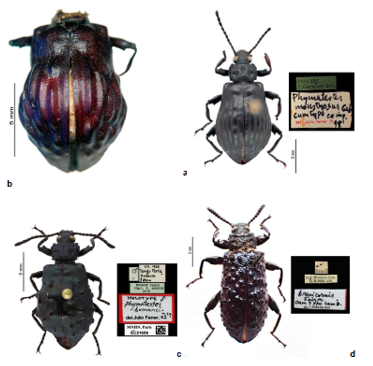
Figure 1.
Habitus of Phymatestes specimens
a. Strongylacanthus peruvianus Brèthes, 1925 holotype MACN (photo by Gustavo Flores). b. Phymatestes monstrosus Gebien, 1912 cum type comparatum SMNS (photo by Aron Bellersheim). c. Phymatestes bomansi Ferrer, 2009 holotype MNHN (photo by Christophe Rivier). d. Phymatestes brevicornis (Lacordaire, 1859) cum type comparatum BMNH (photo by Dmitry Telnov).
The holotype of S. peruvianus (MACN) is in bad condition, head and pronotum have been detached and lost, only remaining the hind section of the body (Fig. 1a). However, the original description provided the missing characters and allowed comparisons with tenebrionid specimens from the Peruvian Amazon. These comparisons showed that diagnostic characters of S. peruvianus fit well with those of genus Phymatestes, specifically with Phymatestes monstrosus Gebien, 1912 (Fig. 1b). In this regard, there is a striking coincidence in shape and ornaments of the elytra, as well as the apically toothed femora. Brethés thought he was looking at a new genus of Stenochiini tribe based on characters such as eyes incised by epistomal canthi, elytral tubercles and physogastric elytra, but examination of Stenochiini specimens in Peruvian entomological collections suggests that these are only superficial resemblances. Diagnostic characters for Stenochiini tribe and some of its constituent genera in the New World were proposed sixty years after the Strongylacanthus’s description (Doyen, 1989). Based on these considerations, the synonymy of the genus Strongylacanthus Brèthes, 1925 under Phymatestes Pascoe, 1866, and the synonymy of Strongylacanthus peruvianus Brèthes, 1925 under Phymatestes monstrosus Gebien, 1912 are proposed.
Checklist of Phymatestes species recorded in Peru
Genus Phymatestes Pascoe, 1866
PhymatestesPascoe, 1866: 142; Gebien, 1941: 816; Blackwelder, 1945: 536; Ferrer & Moraguès, 1998: 373-392, 2000: 113-123; Gonzales et al., 2014: 22, 33; Gonzales et al., 2015: 102; Smith et al., 2015: 223; Bousquet et al., 2018: 36; Bouchard et al., 2021: 37, 299, 538; Aalbu et al., 2023: 156, 160, 169, 170, 172, 179, 183, 192, 193. Type species (automatic): Lagria tuberculata Fabricius, 1792 (by monotypy). Note: replacement name for Phymatodes Dejean, 1834; placed on the Official List of Generic Names in Zoology by the ICZN (1989, Opinion 1525).
= PhymatodesDejean, 1834: 203; Blanchard, 1845: 39; Lacordaire, 1859: 394; Gebien, 1941: 816; Blackwelder, 1945: 536; Bousquet et al., 2018: 36; Bouchard et al., 2021: 37, 299, 538. Type species: Lagria tuberculata Fabricius, 1792 (by monotypy). Note: name suppressed for the purposes of the Principle of Homonymy and the Principle of Priority by the ICZN (1989, Opinion 1525).
= GamaxusBates, 1868: 315; Gebien, 1928: 191; Gebien, 1941: 816; Blackwelder, 1945: 536; Ferrer & Moraguès, 1998: 373; Smith et al., 2015: 223; Bouchard et al., 2021: 36, 192; Aalbu et al., 2023: 156, 172, 192 (synonymy). Type species: Gamaxus hauxwelli Bates, 1868 (by monotypy).
= StrongylacanthusBrèthes, 1925: 13; Gebien, 1944: 516; Blackwelder, 1945: 544; Smith et al., 2015: 226; Bouchard et al., 2021: 85, 353. Type species: Strongylacanthus peruvianus Brèthes, 1925 (by monotypy) new synonymy.
1. Phymatestes bomansi Ferrer, 2009 ENDEMIC (Fig. 1c; 3a)
Type material examined: Holotype and two paratypes (MNHN); 1 [♂] [VII.1962/Tengo María/Huanuco/Pérou] [MUSEUM PARIS/COLL. P. ARDOIN/1978] [HOLOTYPE ♂/Phymatestes/bomansi/n. sp./det. Julio Ferrer, 02] [MNHN, Paris/EC21609]; 2 [XII.1963/IV.1964/Tingo Maria/Huanuco. Perou/leg. H. Bomans] [MUSEUM PARIS/COLL. P. ARDOIN/1978] [PARATYPE/Phymatestes/bomansi/n. sp./det. Julio Ferrer, 02] [MNHN, Paris/EC21610], [MNHN, Paris/EC21611].
Type locality: PERU, Huanuco (Tingo Maria).
2. Phymatestes brevicornis (Lacordaire, 1859) NEW COUNTRY RECORD (Fig. 1d; 3a)
= Phymatodes clavicornis Fairmaire, 1892
= Gamaxus hauxwelli Bates, 1868: 314, 315; Blackwelder, 1945: 536; Smith et al., 2015: 223; Bouchard et al., 2021: 192; Aalbu et al., 2023: 156, 172, 173 (synonymy).
Material examined: Sixteen specimens (BMNH); 1 [♂] [?] [F. Bates./8I-19.]; 1 [Phymatodes/tuberculatus (Fabr/?] [Gamaxus/F. Bates/Hawkswelli/F. Bates]; 1 [Brazil] [E. Y. Western Coll./B. M. 1924-176] [brevicornis/Fairm./cumtypo comp./det. J. FERRER 2003]; 1 [♀] [Pará] [F. Bates./8I-19.]; 1 [Pará] [Pascoe./Coll./93-60.]; 1 [Pará] [Gamaxus/hauxwelli/F. Bates] [Pascoe./Coll./93-60.]; 1 [♂] [Phymatodes/brevicornis/Dej,/X. coll. Dove./Cayenne] [F. Bates./8I-19.]; 1 [♂] [brevicornis/Dej,/Cayenne] [F. Bates./8I-19.]; 1 [Phymatodes/dentipes/Deyr. Cay.] [E. Y. Western Coll./B. M. 1924-176] [Phymatestesbrevicornis/det. J. FERRER 2003]; 1 [Peru/?] [Fry Coll./1909-100.]; 2 [Amazon/Nauta] [Fry Coll./1905-100.] [brevicornis/det. J. FERRER 2003]; 4 [Nauta] [Pascoe./Coll./93-60.].
Type localities: ARGENTINA, La Plata [P. clavicornis]. FRENCH GUIANA “Cayenne” [P. brevicornis]. PERU, Loreto (Pebas) [G. hauxwelli].
Published records: ARGENTINA, BRAZIL, FRENCH GUIANA, VENEZUELA (Ferrer & Moraguès, 1998; Gonzales et al., 2014, 2015).
Notes: Gebien (1928) suggested for first time that Bates’s diagnostic characters for Gamaxus did not support its generic status. After that, Gamaxus was included either as synonym of Phymatestes within Goniaderini tribe (Gebien, 1941) or as a separate genus within Goniaderinae subfamily (Blackwelder, 1945). When the genus Phymatestes was systematically revised (Ferrer & Moraguès, 1998), these authors agreed with Gebien's treatment for Gamaxus but without going beyond a guess. Recent reviews still considered it as a Peruvian endemic valid genus in Goniaderini tribe of Lagriinae subfamily (Smith et al., 2015; Giraldo & Flores, 2016; Bouchard et al., 2021). Based on holotype examination, Aalbu et al. (2023) correctly recovered the synonymy of Gamaxus under Phymatestes and placed its type species G. hauxwelli as synonym of P. brevicornis. Label data of BMNH specimens illustrated in the present work suggest that these nomenclatural changes were inadvertently established in 2003, part of unpublished work by the entomologist Julio Ferrer.
3. Phymatestes monstrosus Gebien, 1912 (Figs. 1a, b; 3a)
= Strongylacanthus peruvianusBrèthes, 1925: 13; Gebien, 1944: 516; Blackwelder, 1945: 544; Smith et al., 2015: 226; Bouchard et al., 2021: 353 new synonym.
Type material examined: Holotype (MACN); 1 [Pangoa Tambo/C. Rospigliosi] [Repreparo/M. Viana/XII-1959] [type!] handwr. by Brèthes [Strongylacanthus/peruvianus Br.] handwr. by Brèthes.Two specimens (SMNS); 1 [Peru 1913/C. Gerstner ded.] [Phymatestes/monstrosus Geb/cumtypo comp./det. Julio Ferrer 1998]; 1 [Marcapata/Peru] [monstrosus/coll. P. G. Machatscheck/SMNS 2008].
Type localities: PERU, Junin (Toro river). BOLIVIA, Yungas de La Paz. [P. monstrosus]. PERU, Junin (Pangoa) [S. peruvianus].
Published records: PERU, Junin (Rio Toro), Puno (Chaquimayo “Chiquimayo”, Linquipata “Linguipato”) (Ferrer & Moraguès, 2000).
Other material examined: PERU, Cusco, La Convencion, Echarate, C. Monte Carmelo, 12°26'06.80"S 72°59'14.64"W, 1327 m, light trap, 28-IX-2010, J. Peralta, 2 (MUSM), C.C.P.P. Tunquio, 12°15'24.84"S 72°52'28.40"W, 885 m, 27-IX-2010, C. Carranza & S. Cavero, 1 (MUSM), Quebrada Quitacalzón, 13°01'13.00"S 71°29'50.00"W, IX-1991, B. León, 1 (MUSM). Pasco, Oxapampa, Chuchurras, 1929, 1 (MUSM), Quebrada San Alberto, 2250 m, 10°32'29"S 75°22'09"W, 22-IX-2002, H. Gamarra, 1 (MEKRB).
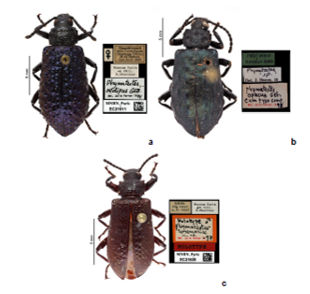
Figure 2.
Habitus of Phymatestes specimens.
a. Phymatestes oedipus Gebien, 1928 specimen MNHN (photo by Christophe Rivier). b. Phymatestes opacus Gebien, 1912 cum type comparatum SMNS (photo by Aron Bellersheim). c. Phymatestes rosemariae Ferrer & Moraguès, 2000 holotype MNHN (photo by Christophe Rivier).
4. Phymatestes oedipus Gebien, 1928 ENDEMIC (Fig. 2a; 3b)
Material examined: Three specimens MNHN; 1 [♀] [Chambireyacu/pres/Yurimaguas/(Huallaga-Pérou)/M. de Mathan/Juin-Aout 1885] [Museum Paris/ex Coll./R. Oberthur] [Phymatestes/oedipus Geb/det. Julio Ferrer 1994] [MNHN, Paris/EC 21611]; 2 [Peruvio] [MUSEUM PARIS/COLL. J. CHATANAY 1914] [Phymatestes/oedipus Geb/det. Julio Ferrer 1996] [MNHN, Paris/EC 21612] [MNHN, Paris/EC 21613]. Three specimens SMNS; 2 [Peru, Dep. Huanuco/Rio Llullapichis, Stat. Panguana/233 m, 9°36,823’S74°56,127’W/20.09.-7.10.2013, F. Wachtel leg.] [Phymatestes/oedipus Gebien/R. Grimm det. 2014] [Phymatestes/oedipus Gebien/R. Grimm det. 2015]; 1 [Peru, Dept. Huánuco/Panguana, ACP, Rio/Yuyapichis, 230 m/9°37’S/074°56’W/22.ix.-10.x.2017/leg. M. Hiermeier] [Phymatestes/oedipus Gebien/R. Grimm det. 2017]. Two specimens MUSM; 1 [Pucallpa/30-I-1947/J. Schunke]; 1 [Pucallpa/03-II-1947/J. Schunke] [Phymatestes/tuberculatus/FABR/det: H. Kulzer].
Type locality: PERU (without further details).
Published records: PERU, Loreto (Chambirayacu “Chambireyacu”, Iquitos) (Ferrer & Moraguès, 1998).
5. Phymatestes opacus Gebien, 1912 ENDEMIC (Fig. 2b; 3b)
Material examined: Two specimens SMNS; 1 [Peru Departamento Juni/San Ramon 11°08’S 75°18’W/ca 24 km NW Richtung Oxabamba/ca. 1200 m, Pampa Hermosa/28.XII.1997, LF, B. Kreusel leg.]; 1 [PERU 1916-17/Gerstner dedit.] [Phymatestes/sp./Det. J. Doyen. 19] [Phymatestes/opacus Geb./cumtypo comp./det. Julio Ferrer 1998]. Six specimens MEKRB; 1 [Oxapampa/26-III-2005/J. Moreno]; 3 [Oxapampa/02-IV-2005/P. Lopez]; 1 [Oxapampa/12-V-2005/R. Müller]; 1 [Oxapampa/11-VI-2005/R. Müller].
Type locality: PERU, Junin (Chanchamayo, 3000 m) as stated in the original description. However according to Ferrer & Moraguès (2000), the type bears a label that says “Juancabamba, 3000 m”.
Notes: Ferrer & Moraguès (2000) interpreted the type’s label data “Juancabamba” as Huancabamba in northern Peru, but it most probably refers to Huancabamba district in Oxapampa province (10°25′44″S 75°31′21″W). This species was recorded from Rio Grande do Sul (Gebien, 1912) and Bolivia (Gebien, 1941), but these records were not subsequently corroborated in the available checklists and reviews.
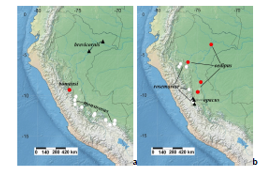
Figure 3.
Distribution maps of genus Phymatestes in Peru.
a. Distribution of Phymatestes bomansi Ferrer, 2009 (red circles), Phymatestes brevicornis (Lacordaire, 1859) (black triangles) and Phymatestes monstrosus Gebien, 1912 (white hexagons). b. Distribution of Phymatestes oedipus Gebien, 1928 (red circles), Phymatestes opacus Gebien, 1912 (black triangles), and Phymatestes rosemariae Ferrer & Moraguès, 2000 (white hexagons).
6. Phymatestes rosemariae Ferrer & Moraguès, 2000 (Fig. 2c; 3b)
Type material examined: Holotype and two paratypes (MNHN); 1 [♂] [Bolivie/Riv Songo/A. H. Fassl] [Museum Paris/ex Coll./R. Oberthur] [HOLOTYPE ♂/Phymatestes/rosemariae/n. sp./det. Julio Ferrer 1997] [HOLOTYPE] [MNHN, Paris/EC21605]; 2 [♀] [Pérou/Tarapoto/Mai a Aout 1886/M. de Mathan] [Museum Paris/ex Coll./R. Oberthur] [PARATYPE] [PARATYPE ♀/Phymatestes/rosemariaen. sp./det. Julio Ferrer 1997] [MNHN, Paris/EC21606] [MNHN, Paris/EC21607].
Type localities: BOLIVIA (Songo river, Region Chaporo). PERU, San Martin (Tarapoto, Mara?).
Material examined: PERU, Huanuco, Tingo Maria, 24-IX-1996, E. Salas, 1 (MEKRB). Pasco, Oxapampa, 17-VI-2000, J. Montes, 1 (MEKRB). San Martin, Mariscal Caceres, 06°28'15.28"S 77°16'02.89"W, 1974 m, 19-IX-2013, J. Peralta, 2 (MUSM); Moyobamba, Soritor, 06°08'20.194"S 77°04'59.732"W, 888 m, 17-IX-2013, J. Peralta, 4 (MUSM).
According to the checklist presented here, the number of Phymatestes species in Peru is updated to six, adding the new record for P. brevicornis. From the distribution maps, an apparent altitudinal segregation of species can be inferred, P. bomansi, P. monstrosus, P. opacus and P. rosemariae in Eastern Andes range (800-3500 m) and P. brevicornis and P. oedipus in the Amazonian plain (0-800 m). Specimens of this genus are still scarce in Peruvian collections, because mass sampling methods (pitfall traps, flight interception traps) do not seem to be effective for this kind of beetles. Available collection data for the genus Phymatestes indicate that some were collected along with passalids beetles in Guyane, maybe in decaying logs (Ferrer & Moraguès, 2001); in a similar way hand collecting and beating using canopy cranes in Panama were useful to obtain specimens of this and several other tenebrionid genera (Ferrer & Ødegaard, 2005).
Acknowledgments
Examination of S. peruvianus type was possible through the loan by Arturo Roig-Alsina (MACN) and the request by Gustavo Flores (IADIZA), during author's visit for the Fourth International Tenebrionoidea Symposium (Mendoza, Argentina) (November 25-26th, 2015). Also, the author thanks Clorinda Vergara (MEKRB) and Mabel Alvarado (MUSM) for facilitating access to their respective entomological collections. A digital copy of Brèthes's work was obtained thanks to Sonia Pirotzky from Sociedad Entomologica Argentina library. Photos of type and non-type specimens were kindly provided by Dmitry Telnov (BMNH), Antoine Mantilleri and Christophe Rivier (MNHN) and, Aron Bellersheim and Arnaud Faille (SMNS).
REFERENCES
Aalbu, R.L., Kanda, K., Merkl, O., Ivie, M.A., & Andrew Johnston, M. (2023) Reconstitution of some tribes and genera of Lagriinae (Coleoptera, Tenebrionidae). ZooKeys, 1172, 155-202. https://doi.org/10.3897/zookeys.1172.103149
Bachmann, A.O., & Flores, G.E. (2008) A catalog of the types of Tenebrionidae sensu lato (Insecta, Coleoptera, Cucujiformia) deposited in the Museo Argentino de Ciencias Naturales “Bernandino Rivadavia”, Buenos Aires. Revista del Museo Argentino de Ciencias Naturales n.s., 10(1), 81-110.
Bates, F. (1868) Descriptions of new genera and species of Heteromera. The Transactions of the Entomological Society of London, 1868, 259-274.
Blackwelder, R.E. (1945) Checklist of the coleopterous insects of Mexico, Central America, the West Indies, and South America. Part 3. Bull. U.S. Natl. Mus., 185[1942–1947], iv + 343–550. [DP: 21.V.1945 (verso of title page, 1982 ed.)] https://doi.org/10.5479/si.03629236.185.3
Blanchard, E. (1845) Histoire des insectes, traitant de leurs moeurs et de leurs métamorphoses en général et comprenant une nouvelle classification fondée sur leurs rapports naturels. Didot, Paris.
Bouchard, P., Bousquet, Y., Aalbu, R.L., Alonso-Zarazaga, M.A., Merkl, O., & Davies, A.E. (2021) Review of genus-group names in the family Tenebrionidae (Insecta, Coleoptera). Zookeys, 1050, 1-633. https://doi.org/10.3897/zookeys.1050.64217
Bousquet, Y., Thomas, D.B., Bouchard, P., Smith, A.D., Aalbu, R.L., Johnston, A.M., & Steiner Jr., W.E. (2018) Catalogue of Tenebrionidae (Coleoptera) of North America. ZooKeys, 728, 1-455. https://doi.org/10.3897/zookeys.728.20602
Brèthes, J. (1925) Nouveaux Coléopteres Sud Américains. Nunquam Otiosus (Buenos Aires), 4, 11-16.
Dejean, P.F.M.A. (1834) Catalogue des coléoptères de la collection de M. le comte Dejean. Deuxième édition. [Livraison 3]. Méquignon-Marvis Père et Fils, Paris.
Doyen, J.T. (1989) Reconstitution of Coelometopini, Tenebrionini and related tribes of America North of Colombia (Coleoptera: Tenebrionidae). Journal of the New York Entomological Society, 97, 277-304. https:// www.jstor.org/stable/25009773
Ferrer, J. (2009) Description d’une nouvelle espéce du genre Phymatestes Pascoe, 1863 du Pérou (Coleoptera, Tenebrionidae, Goniaderini). Nouvelle Revue d'Entomologie (N.S.), 26(4), 341-345.
Ferrer, J., & Moraguès, G. (1998) Contribution à la connaissance des Tenebrionidae néotropicaux: le genre Phymatestes Pascoe, 1868 (Coleoptera). 1re partie: le groupe de Ph. tuberculatus. Bulletin de la Société entomologique de France, 103(4), 373-392. https://doi.org/10.3406/bsef.1998.17446
Ferrer, J., & Moraguès, G. (2000) Contribution à la connaissance des Ténébrionides néotropicaux. Le genre Phymatestes Pascoe, 1868. 2e partie: les groupes de Phymatestes exsculptus Perty et Phymatestes monstrosus Gebien (Coleoptera, Tenebrionidae). Bulletin de la Société entomologique de France, 105(2), 113-123. https://doi.org/10.3406/bsef.2000.16646
Ferrer, J., & Moraguès, G. (2001) Description d'une nouvelle espèce guyanaise du genre Phymatestes Pascoe (Col., Tenebrionidae). Bulletin de la Société entomologique de France, 106 (1), 97-98. https://www.persee.fr/doc/bsef_0037-928x_2001_num_106_1_16734
Ferrer, J., & Moraguès, G. (2003) Contribution à l'étude des Ténébrionides néotropicaux (Coleoptera, Tenebrionidae). Bulletin de la Société entomologique de France, 108 (2), 161-165. https://doi.org/10.3406/bsef.2003.16946
Ferrer, J., & Ødegaard, F. (2005) New species of darkling beetles from Central America with systematic notes (Coleoptera: Tenebrionidae). Annales Zoologici (Warszawa), 55(4), 633-661.
Gebien, H. (1912) Neue Kàfer aus der Familie Tenebrionidae Museums Wiesbaden. Jahrbücher des Nassauischen Vereins für Naturkunde, 65, 241-242.
Gebien, H. (1928) Über einige Gruppen amerikanischer Tenebrioniden (Col. Heter.). 2. Teil. Stettiner Entomologische Zeitung, 89, 97-164.
Gebien, H. (1941) Katalog der Tenebrioniden. Teil II. Mitteilungen der Münchener Entomologischen Gesellschaft, 31, 331-362, 803-834, 1137-1146.
Gebien, H. (1944) Katalog der Tenebrioniden. Teil III. Mitteilungen der Münchner Entomologischen Gesellschaft, 34, 497-555.
Giraldo, A.E., & Flores, G.E. (2016) Peruvian Tenebrionidae: A review of present knowledge and biodiversity. Annales Zoologici (Warszawa), 66(4), 499-513. https://doi.org/10.3161/00034541ANZ2016.66.4.002
Gonzales, D., Yvinec, J.-H., & Ferrer, J. (2014) Contribution à l’étude des Ténébrionides de Guyane. I. Catalogue préliminaire (Coleoptera, Tenebrionidae). Contribution à l’étude des Coléoptères de Guyane (ed. Touroult, J.). Supplément au Bulletin de liaison d’ACOREP-France “Le Coléoptériste”, 8, 21-39.
Gonzales, D., Yvinec, J.-H., & Ferrer, J. (2015) Contribution à l’étude des Ténébrionides de Guyane. II. Nouveaux signalements pour la Guyane (Coleoptera, Tenebrionidae). Contribution à l’étude des Coléoptères de Guyane (ed. Touroult, J.). Supplément au Bulletin de liaison d’ACOREP-France “Le Coléoptériste”, 9, 98-107.
Lacordaire, T. (1859) Histoire naturelle des insectes. Genera des coléoptères ou exposé méthodique et critique de tous les genres proposés jusqu’ici dans cet ordre d’insectes. Tome cinquième première partie. Contenant les familles des Ténébrionides, Cistélides, Nilionides, Pythides, Mélandryides, Lagriides, Pédilides, Anthicides, Pyrocroïdes, Mordellides, Rhipiphorides, Stylopides, Meloïdes et Oedémérides. Roret, Paris.
Pascoe, F.P. (1866) On the Longicornia of Australia, with a list of all the described species, &c. The Journal of the Linnean Society of London, 9[1867–68], 80-142. https://doi.org/10.1111/j.1096-3642.1866.tb00190.x
Shorthouse, D.P. (2010) SimpleMappr, an online tool to produce publication-quality point maps. http://www.simplemappr.net (Accessed 20 April 2024).
Smith, A.D., Giraldo-Mendoza, A.E., Flores, G.E., & Aalbu, R.L. (2015) Beetles (Coleoptera) of Peru: A survey of the families. Tenebrionidae. Journal of the Kansas Entomological Society, 88(2), 221-228. https://doi.org/10.2317/kent-88-02-221-228.1
Notas de autor
alfre2cotobius@yahoo.com