Comentarios
The book series “Biodiversidad de artrópodos argentinos” as a proxy to evaluate the state of knowledge of our national joint-legged invertebrate biodiversity
La serie de libros “Biodiversidad de artrópodos argentinos” como proxy para evaluar el estado del conocimiento de nuestra biodiversidad nacional de invertebrados de patas articuladas
The book series “Biodiversidad de artrópodos argentinos” as a proxy to evaluate the state of knowledge of our national joint-legged invertebrate biodiversity
Revista de la Sociedad Entomológica Argentina, vol. 84, núm. 4, e0412, 2025
Sociedad Entomológica Argentina
Recepción: 23 Agosto 2025
Aprobación: 08 Octubre 2025
Abstract: The six-volume “Biodiversidad de artrópodos argentinos” (BAA), comprising 265 chapters, is central to understanding Argentina's arthropod diversity. This study synthesizes BAA data, compiling a database of 24,308 species across 64 orders, 730 families, and 6,855 genera, encompassing four classes and 13 subclasses. The parsimony analysis of endemicity showed two groupings of provinces: Andean and Neotropical. Misiones, Buenos Aires, Tucumán, and Salta were the most diverse provinces, collectively harboring 40 % (8,892) of recorded species. Significant knowledge gaps were identified, with La Pampa estimated to have over 1,000 undiscovered species, and other provinces like Formosa also lacking substantial data. Taxonomic coverage was uneven; Coleoptera, Hymenoptera, Diptera, Hemiptera, and Lepidoptera accounted for 75 % of documented diversity. Only two of the 27 richest families had complete distributional data. Endemism analysis identified 2,313 endemic species (65 % Coleoptera), concentrated in Tucumán, Buenos Aires, and Salta. Argentina holds 1.93 % of global species for the orders analyzed, but it could reach up to 3 %. The study highlights critical challenges: research effort is heavily concentrated in Buenos Aires and Córdoba, misaligned with diversity hotspots; aquatic taxa and microfauna are underrepresented; and many diverse families lack species list and distributional records. Key priorities include targeted sampling in underrepresented provinces, the execution of taxonomic revisions, and developing open-access databases.
Keywords: Argentina, Arthropoda, Endemic, Knowledge, Provinces.
Resumen: La serie "Biodiversidad de artrópodos argentinos" (BAA), con 265 capítulos publicados, es clave para el conocimiento de la diversidad de artrópodos de la Argentina. Se sintetizan aquí los datos que contiene, compilando una base de 24.308 especies en 64 órdenes, 730 familias y 6.855 géneros. Un análisis de parsimonia de endemismos reveló dos agrupaciones principales de provincias: andinas y neotropicales. Misiones, Buenos Aires, Tucumán y Salta fueron las provincias más diversas, albergando el 40 % (8.892) de las especies registradas. Se identificaron brechas de conocimiento; por ejemplo: La Pampa podría tener más de 1.000 especies no descubiertas, y existe una importante carencia de datos para Formosa. La cobertura taxonómica es desigual; Coleoptera, Hymenoptera, Diptera, Hemiptera y Lepidoptera representan el 75 % de la diversidad. Solo dos de las 27 familias más ricas tienen datos de distribución completos. Se estiman 2.313 especies endémicas (65 % de Coleoptera), concentradas en Tucumán, Buenos Aires y Salta. Argentina posee el 1,93 % de las especies globales basado en un análisis de taxones superiores, pero podría llegar al 3 %. El esfuerzo de investigación se encuentra concentrado en Buenos Aires y Córdoba, desalineado con “hotspots” de diversidad; taxones acuáticos y microfauna están subrepresentados; y muchas familias de gran diversidad no poseen listados de especies ni registros detallados. Las prioridades clave son el muestreo dirigido a provincias subrepresentadas, la realización de revisiones taxonómicas y el desarrollo de bases de datos abiertas.
Palabras clave: Argentina, Arthropoda, Conocimiento, Endémicos, Provincias.
INTRODUCTION
Argentina is a country displaying high environmental heterogeneity characterized by geographical and climatic contrasts, ranging from the towering Andes to the vast Patagonian plains, and from the humid subtropical forests of the northeast to the dry deserts in the west and south (Brown et al., 2005). These landscapes are part of two biogeographical regions, the Neotropical and the Andean, but most of the Argentinean territory is occupied by the South American Transition Zone (Roig-Juñent et al., 2018; Arana et al., 2021). The Neotropical region stretches from the north reaching its central and central eastern parts (Morrone, 2017). Its biota shares affinities with the Nearctic region in the north and the Andean region in the south, mediated by two transitional zones. Within the Neotropical region, biotas attain significant levels of richness (Antonelli & Sanmartín, 2011), a phenomenon linked to substantial changes during the Paleogene, Neogene, and Quaternary periods. These include events such as the Andean uplift, the opening of the Drake Passage, the closure of the Isthmus of Panama, the formation of the Orinoco and Amazon River basins, and climatic changes (Arana et al., 2021 and cited references). The Andean region comprises in Argentina a long trip south the parallel 36.5 S along the eastern slope of the Andes. Morrone (2014a) includes the Patagonian Steppe in the Andean region whereas others considered it as part of the South American Transition Zone (Roig-Juñent et al., 2018; Agraín et al., 2025). The biota of the Andean region shows closest affinities with the Australian region (Monrós, 1958; Roig-Juñent, 1993; Morrone, 2014a). Between the Andean and the Neotropical regions extends in the west and southward from the 34th parallel the South American Transition Zone. This zone represents an area of overlap between the Neotropical and Andean biotas, featuring gradients of species replacement and partial segregation between both biotas (Morrone, 2018), characterized in the present mostly by desert or semidesert habitats (Roig-Juñent et al., 2018). The geological history of the Andes profoundly influenced the South American Transition Zone, facilitating the expansion of arid and semi-arid areas across South America (Oggero et al., 2019).
As expected, such geographic and climatic diversity is also mirrored by an astonishing diversity of life. Among the most numerous and ecologically significant inhabitants of these varied ecosystems are the arthropods—a phylum encompassing insects, arachnids, crustaceans, and myriapods. While often overlooked, this group represents a crucial component of Argentina's biodiversity. Currently divided in major divisions: the chelicerates and two mandibulate clades: myriapods and pancrustaceans (insects + crustaceans) (Giribet & Edgecombe, 2019), arthropods dominate terrestrial ecosystems (Kremen et al., 1993) and represent the most diverse animal phylum, encompassing approximately 80 % of all animal species, with over 1,300,000 species described (Zhang, 2011).
From an agroecosystem’s perspective, this immense diversity is often oversimplified across large areas characterized by a limited number of plant and animal species (Pimentel et al., 1992; Altieri, 1999). Nevertheless, the study of arthropod diversity is a central asset for any country (Morrone & Coscarón, 1998). In this regard, it is also important to highlight that the reduction of natural areas can lead to the decline of natural populations and genetic diversity (Leigh et al., 1993). Regrettably, western culture often considers most arthropods as pests to be controlled rather than protected. This perception is inaccurate, as arthropods constitute a substantial component of ecosystems and provide crucial functions for ecosystem processes; therefore, their preservation is essential (Kim, 1993). Indeed, major policymakers worldwide are aiming for self-sustaining, low-input, diversified, and energy-efficient agricultural systems (Altieri, 1999; Altieri et al., 2017). Consequently, the study and conservation of arthropods is not merely a conservationist agenda, as their inventory can contribute to the assessment of the economic value of areas and the discovery of organic compounds with potential applications in medicine or industry (Eisner, 1991; Roberts, 1992). Furthermore, arthropods can serve as indicators of ecosystem integrity (Maleque et al., 2006) and are key factors in several ecological processes, including nutrient cycling, pollination, seed dispersal, soil structure and fertility, acting as a source of nutrients, and providing biological control of other organisms (Pimentel et al., 1992; Martínez et al., 2018 and references therein). Therefore, understanding the richness and distribution of Argentinean arthropods is not merely an academic pursuit. It is fundamental for effective conservation strategies, sustainable land management, and comprehending the intricate web of ecological interactions that underpin the health of the nation's ecosystems. However, documenting this immense diversity presents a significant challenge, and our knowledge remains incomplete, particularly in hyperdiverse groups like insects (McKay & Cabrera Walsh, 2025). In addition, in Argentina conservation studies dealing with arthropods are scarce (Agraín et al., 2025).
The book series "Biodiversidad de artrópodos argentinos" (BAA), or “Biodiversity of Argentinean arthropods” in English, is the most comprehensive and modern work on the challenge of documenting their diversity of forms and ways of life within this country. These studies, while providing valuable insights, underscore the need for continued and expanded research efforts to fully appreciate and protect Argentina's remarkable arthropod biodiversity. By delving deeper into the taxonomy, ecology, and distribution of these fascinating creatures, we can better understand their ecological roles and the threats they face in a rapidly changing world. Since its initial publication in 1998, the primary objectives of BAA have been to compile and synthesize existing knowledge regarding the diversity and natural history of each arthropod group; to catalog species records for Argentinean provinces; and to assess the current state of knowledge and its gaps (Claps et al., 2023b). Although BAA book series has previously provided a summary of its contents on volumes 2, 4, and 6 (Claps et al., 2008, 2023b; Roig-Juñent et al., 2014b) this work is built upon this foundation (i.e., 265 published book chapters) sharing these former aims, yet providing a more comprehensive framework by considering the six published volumes collectively, extracting and updating core diversity statistics, and giving further perspectives on the extracted data.
The main goal of this study is to delineate core patterns of the Argentinean arthropod diversity on the basis of the BAA data, emphasizing known diversity across all Argentinean provinces and distinct geographic regions. Secondary goals are to evaluate the current state of knowledge, the human resources available, and to propose future research directions. Specifically, we describe the country-level basic statistics for the BAA book series and summarize the major patterns of Argentinean arthropod diversity, aiming to provide a general framework of what is known at different taxonomic levels. We explore the major geographic patterns of diversity by considering Argentina's provinces and highlighting known diversity and endemism. Additionally, we provide an updated projection of the percentage of diversity held in Argentina versus world species richness by order at the species/genus level. Lastly, using the data from the Argentinean entomologist survey (Agraín & San Blas, 2011), we analyze and discuss the human resources potentially dedicated to their study. Finally, using all the achieved data, we broadly summarize current knowledge and future research directions and perspectives.
MATERIAL AND METHODS
Sources of information
Our main source of information is the six volumes of BAA: Morrone & Coscarón (1998), Claps et al. (2008, 2023a, b), and Roig-Juñent et al. (2014a, b). The six volumes are freely available from https://csnat.unt.edu.ar/investigacion/ institutos/insue/investigacion/publicaciones/libros. We built a database containing the lists of species together with their classification scheme and distribution by provinces (political states) or marine biogeographic provinces when available. For taxa treated in two or more volumes, we prioritized the most recent or comprehensive treatment. For example, data on Carabidae (Insecta: Coleoptera) and Formicidae (Insecta: Hymenoptera) were sourced from Volume 1, which provided species-level lists for each order. In contrast, the updated information in Volume 6 only included information at the generic level. Regarding literature sources for world diversity comparisons, statistics for the number of species/genera were extracted from Zhang (2011).
Abbreviations used in text for Argentina`s provinces and biogeographical regions
Argentinean provinces are referred in text as AP. We follow the same terminology to denote each AP that was used in the six volumes of BAA: Bs.As. (Buenos Aires), Cba. (Córdoba), Cha. (Chaco), Chu. (Chubut), Cm. (Catamarca), Cs. (Corrientes), E.R. (Entre Ríos), Fo. (Formosa), Ju. (Jujuy), L.P. (La Pampa), L.R. (La Rioja), Malv. (Islas Malvinas), Mnes. (Misiones), Mza. (Mendoza), Nq. (Neuquén), R.N. (Río Negro), Sal. (Salta), S.E. (Santiago del Estero), S.L. (San Luis), S.C. (Santa Cruz), S.Fe (Santa Fe), S.J. (San Juan), T.F. (Tierra del Fuego), and Tuc. (Tucumán). Provinces, when not listed in alphabetical order, are ordered according to the variable mentioned in the same sentence.
For biogeographical areas we use for regions: Andean region (AN), Neotropical region (NE), and South American Transition Zone (TZ), and for marine biogeographic provinces: Argentinean Sea (mPBA) and Magellanic (mPBM).
Parsimony analysis of endemicity of the Argentinean provinces
We performed a parsimony analysis of endemicity (Morrone, 2014b) of the Argentinean provinces based on their Arthropod species. The data matrix of 24 provinces x 6369 species (see Data Statement) was analyzed with software TNT v1.6 (Goloboff & Morales, 2023), with a traditional heuristic search employing extended implied weighting, using a k value of 3.046875, which was calculated with the script setk.run (written by Salvador Arias).
Mapping
All maps were made using QGIS Development Team (2024) v. 3.36.1 program.
Endemism estimation
We classified endemism into two categories: confirmed and inferred. Confirmed endemics refers to those explicitly designated as endemic to Argentina by the authors of each chapter, either in the provided species lists or, for chapters without species lists, based on the number of endemic species mentioned. Conversely, inferred endemics were derived from species lists that included distributions both within Argentina and other countries. Species recorded exclusively in Argentina in such lists were classified as endemic—thus, their (inferred) endemicity was deduced from distributional data rather than direct author attribution. Lists lacking distributional data outside Argentina were excluded from this category.
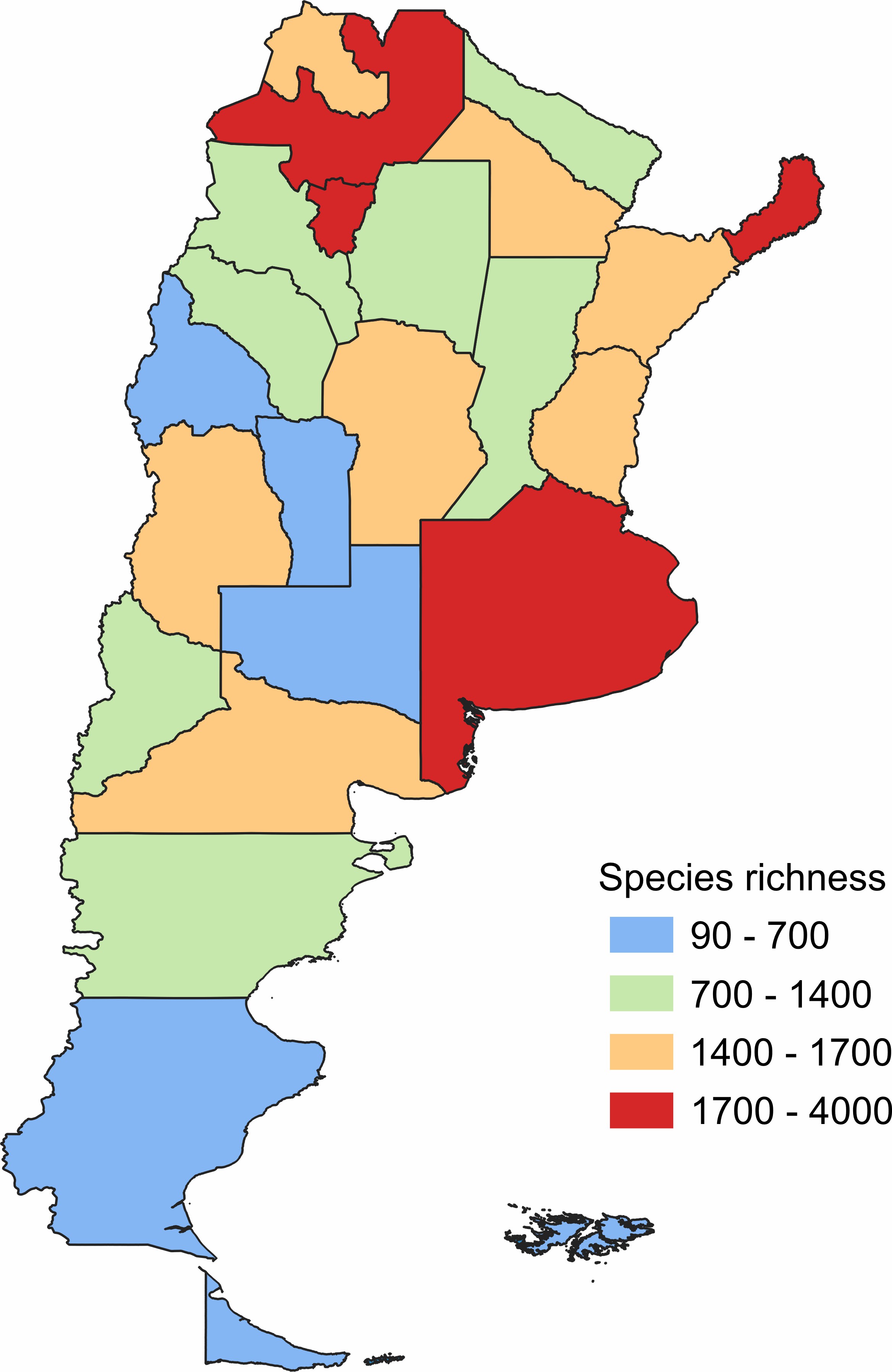
Figure 1.
Arthropod species richness by province of Argentina.
Estimation of Undiscovered Species per Order
For each arthropod superclass, the estimated number of undiscovered species per order in Argentina was extrapolated. This extrapolation used the mean ratio of Argentinean to global species richness calculated across all orders within that superclass.
Estimation of Undiscovered Species per Province
Potential undiscovered species richness per province was estimated employing a spatial interpolation method where each province expected species richness was calculated as the mean between its observed richness and the combined richness of all adjacent provinces. The richness gap or potential number of species to be added to each province, was calculated subtracting the observed species richness from the estimated potential richness.
RESULTS
Spatial patterns of Argentinean Arthropods diversity
We found that the AP with the highest diversity of arthropods are Mnes., Bs.As., Tuc., and Sal., a pattern that is repeated both for the number of genera and species (Figs. 1, 2). Altogether these four provinces account for almost 37 % (8,892 species) of the species described for the country.
The potential undiscovered species richness analysis showed that the most underestimated province is L.P. with more than a thousand species expected to be added, then For., S.E., Ju., Cm., S.J., S.Fe, and E.R. with an estimated 700 to 400 species to be potentially added in the future (Fig. 2).
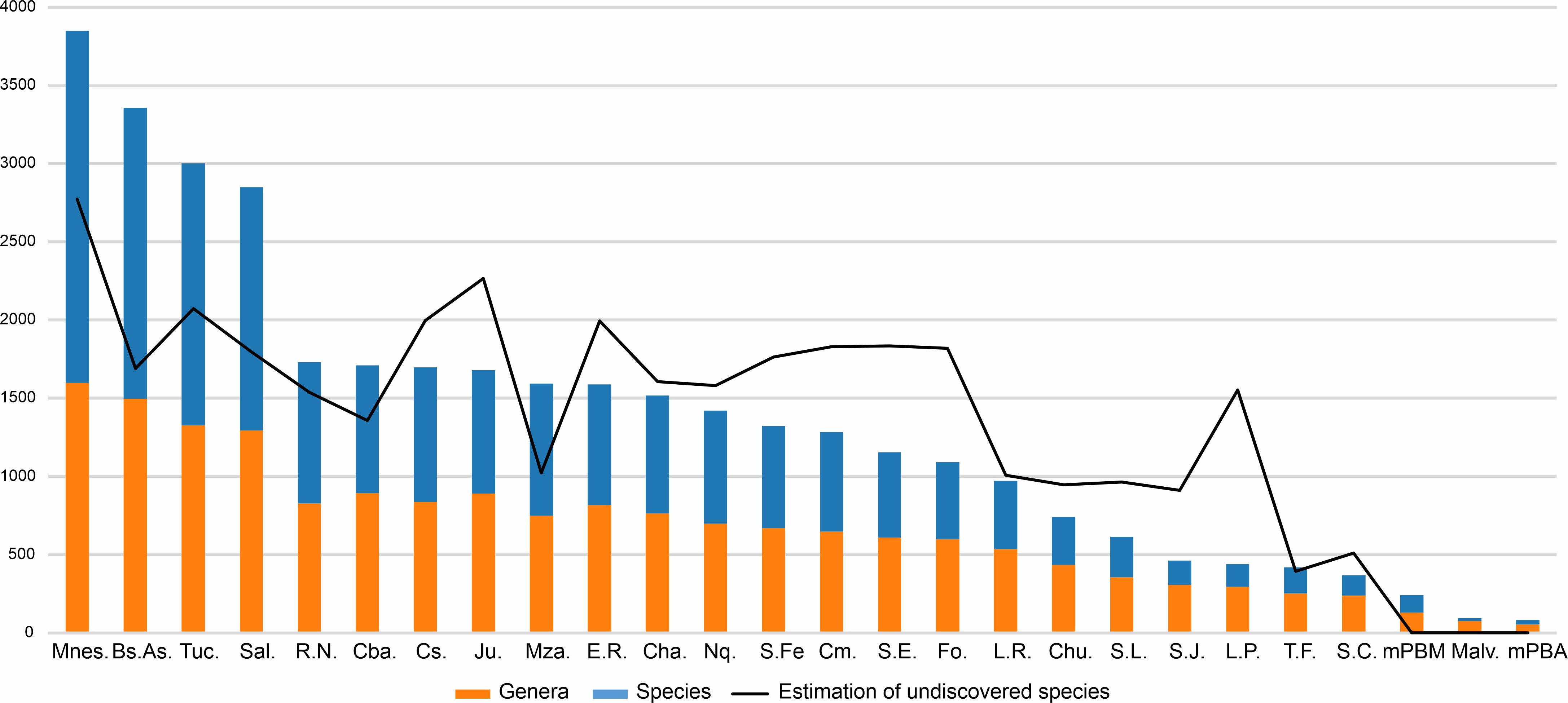
Figure 2.
Histogram showing generic and species richness of Arthropoda across Argentinean provinces, with line graph showing the potential undiscovered species richness by an average of the richness of bordering provinces
The y-axis represents the taxonomic richness (genera/species). Provinces are ordered along the x-axis by richness.
The parsimony analysis of the data matrix produced a single tree (Fig. 3). Provinces are grouped in two clades, basically corresponding to the Andean and Neotropical regions. Within the latter, there are five subclades that correspond to provinces traditionally grouped as geographical units: (1 - Cuyo): Mza., S.J., and S.L.; (2 - Argentine Northwest - NOA): Cm., Ju., L.R., Sal., and Tuc.; (3 - Central region): S.E. and Cor.; (4 - Pampas region): S.Fe, E.R., and Bs.As.; and (5- Argentine Northeast - NEA or Litoral): Cha., Cs., Fo., and Mis.
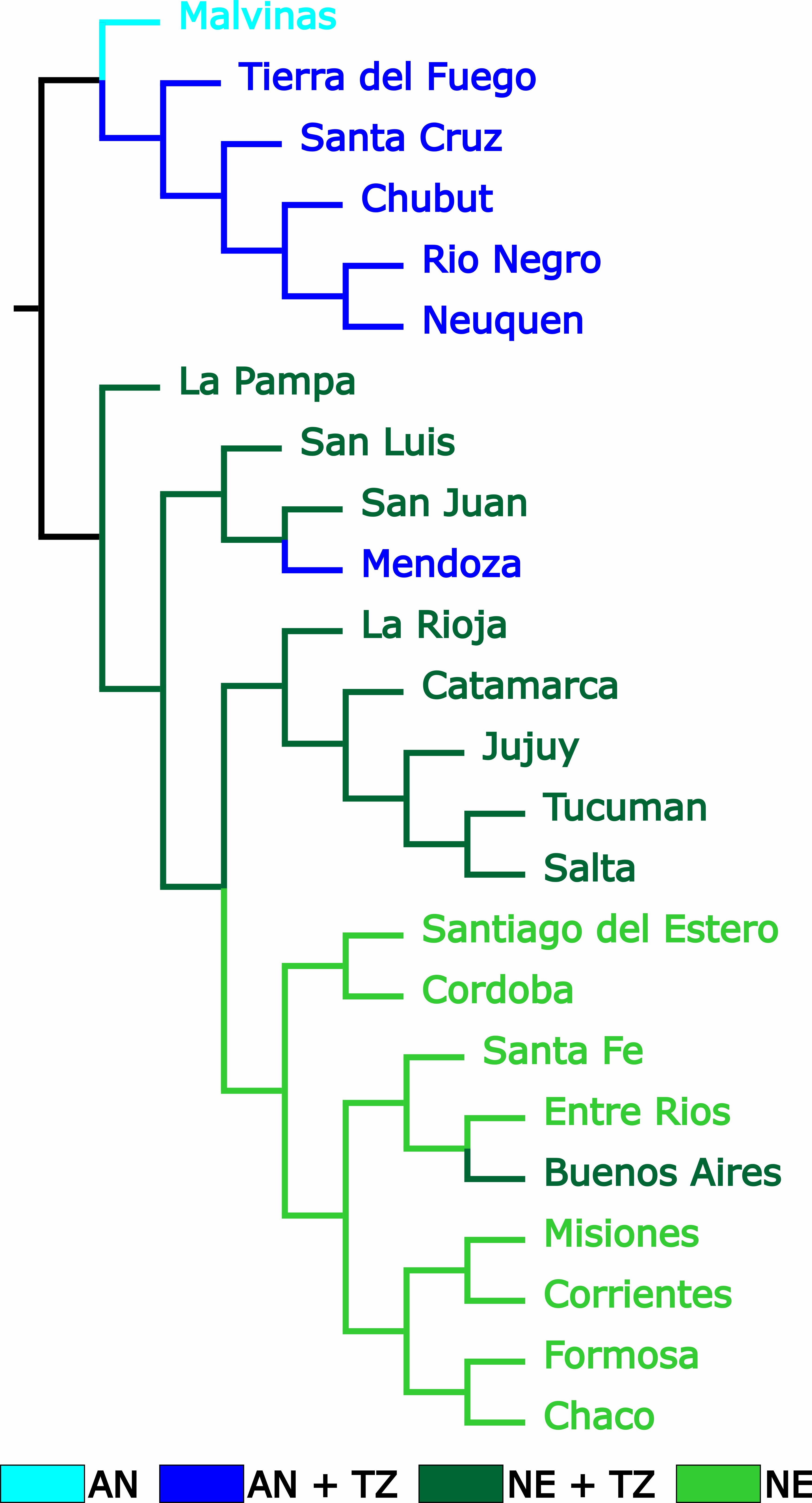
Figure 3.
Cladogram showing the phylogenetic relationships among Argentinean provinces based on shared arthropod species. Most parsimonious tree resulting from implied weighting analysis using k = 3.046875.
Taxonomic composition of Argentinean arthropods diversity
The Argentinean arthropod fauna encompasses 13 classes belonging to four subphyla (between parentheses): Arachnida (Chelicerata); Branchiopoda, Cladocera, Malacostraca, Maxillopoda, Ostracoda (Crustacea); Archaeognatha, Entognatha, and Insecta (Hexapoda); and Chilopoda, Diplopoda, Pauropoda, and Symphyla (Myriapoda). These classes include a total of 24,308 species within 64 orders, 730 families, and 6,855 genera.
The most diverse orders in Argentina, ranging from approximately 1,000 to 7,000 species, are the primarily terrestrial (and freshwater) insect orders Coleoptera, Hymenoptera, Diptera, Hemiptera, and Lepidoptera and Arachnida order Araneae. In contrast, the most diverse and primarily aquatic (marine and freshwater) Crustacea order Amphipoda, has fewer than 300 species (Fig. 4).
Regarding the number of genera included, the most diverse are the insect orders Coleoptera, Diptera, Hemiptera, Hymenoptera, and Lepidoptera, with more than 500 genera each. They are followed by Araneae of Chelicerata, with 476 genera and in eighth place Amphipoda of Crustacea, with 127.
Finally, considering the number of families present in Argentina, the most diverse are Hemiptera (Insecta), Oribatida, and Araneae (Chelicerata) with 78, 69, and 68 families, respectively. They are followed by Coleoptera, Diptera, Hymenoptera (Insecta), and Decapoda (Crustacea), with near or more than 40 families each (Fig. 4).
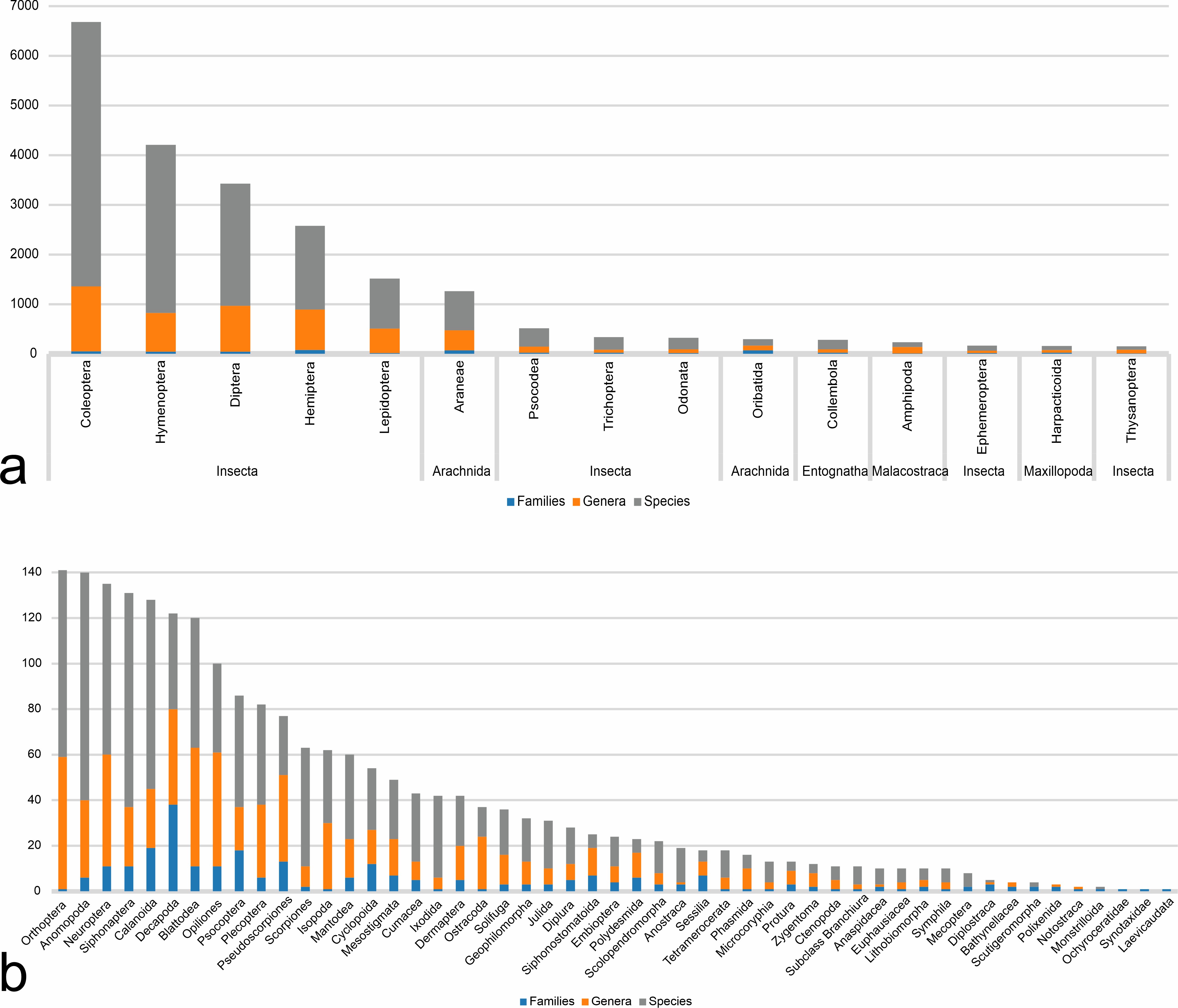
Figure 4.
Number of species (grey), genera (orange), and families (blue) in the orders of arthropods of Argentina
a. Orders with more than 150 species in Argentina. b. Orders with less than 150 species.
At family level, among the 27 richest arthropod families in Argentina—collectively representing 50 % of the country’s diversity— eight correspond to Hymenoptera, seven to Coleoptera, five to Diptera, and seven to other orders. The four largest families correspond to Curculionidae, Staphylinidae, Chrysomelidae, and Carabidae (Coleoptera), with more than 800 species each, followed by Noctuidae (Lepidoptera) with 600 species, Scarabaeidae (Coleoptera) with 600, Geometridae (Lepidoptera) with 596, and Miridae (Hemiptera) with 550 species (Fig. 5). On the other hand, 453 families (more than the 60 % of the families) correspond to the least rich families in Argentina, with less than 10 species each. Of those, the orders that include more of these least rich families correspond to Oribatida with 62 families, Araneae with 46 (Chelicerata), Hemiptera (Hexapoda) with 42 and Decapoda (Crustacea) with 37 families.
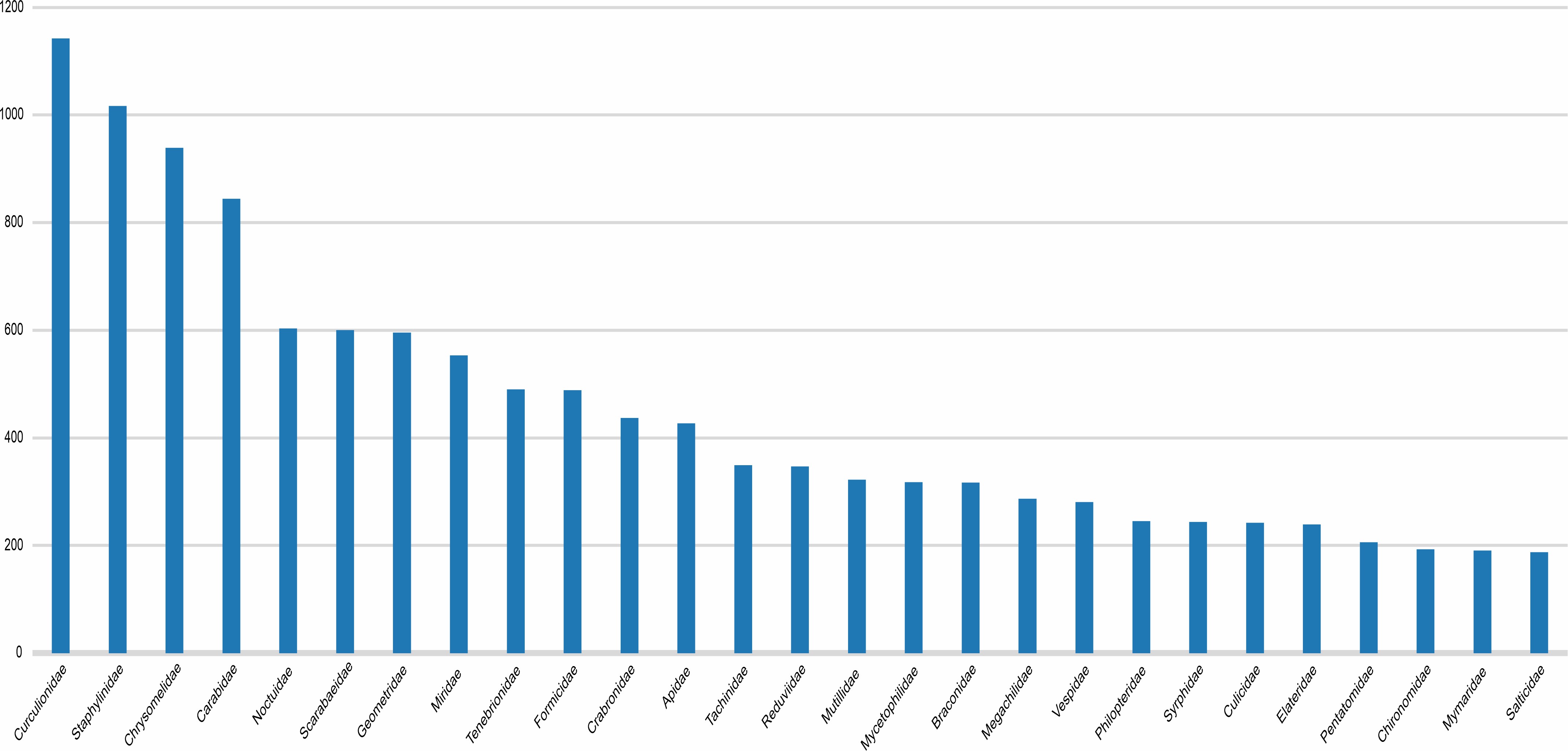
Figure 5.
Histogram showing the number of species of the 27 richest families of Arthropods of Argentina.
Endemism Patterns in Argentinean Arthropod’s Fauna
Our analysis of endemic species considers both confirmed and inferred endemic species (see methods section). The former accounts for 1,193 species and the latter for 1,120 species. Of those species, Coleoptera account for almost 65 % of all the endemism of the country, followed by Diptera and Hymenoptera with more than 13 % each (Fig. 6). The other 14 orders account altogether for less than 9 % of the endemism (Fig. 6).
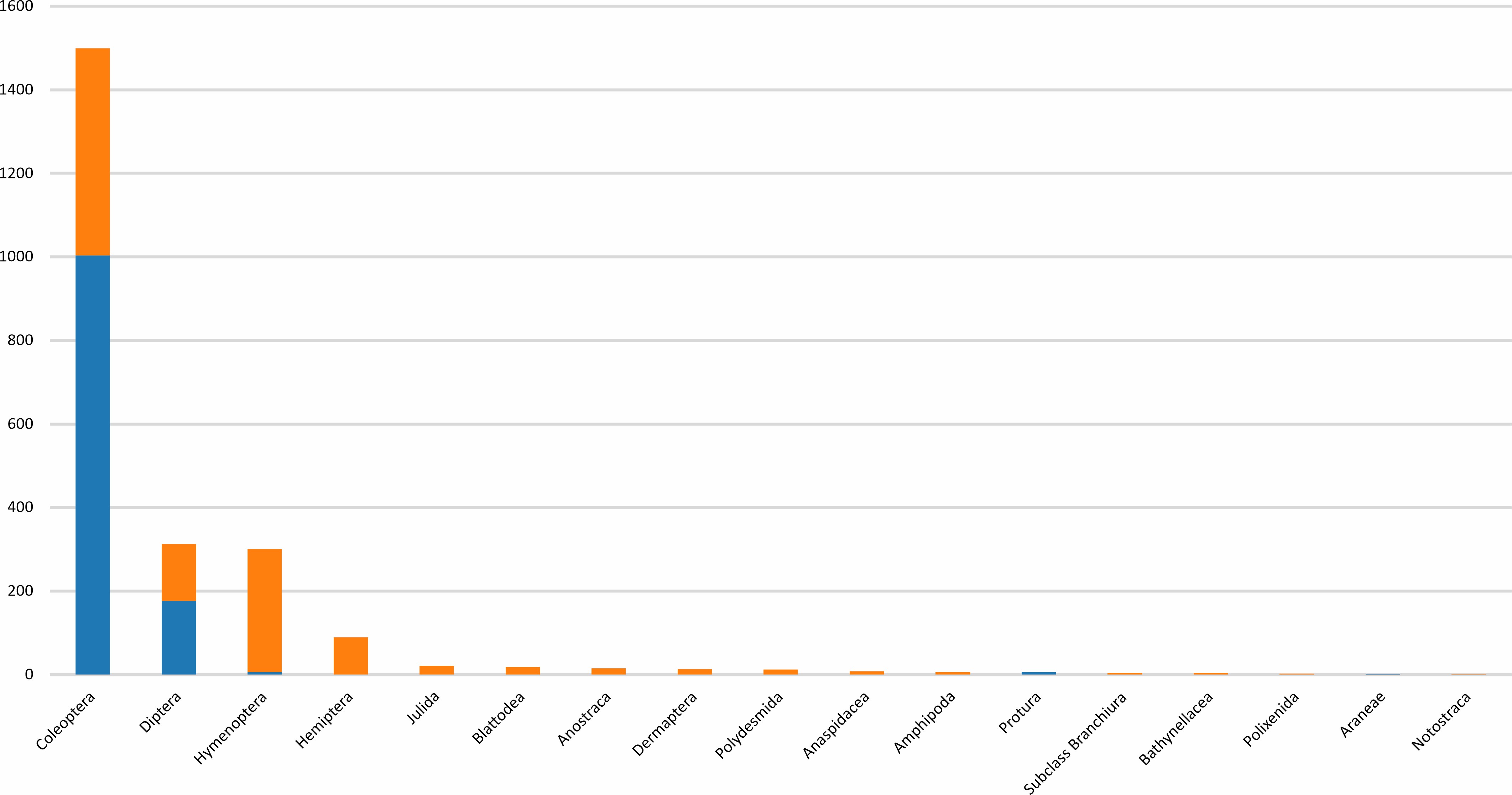
Figure 6
Number of endemic species of Arthropods of Argentina.
Confirmed endemism in blue and inferred endemism in orange.
The families with the highest number of endemic species are Carabidae (Coleoptera), Megachilidae, Pompilidae (Hymenoptera), Membracidae (Hemiptera), and Dytiscidae (Coleoptera) (Fig. 7). The 15 families detailed in Fig. 7 sum up altogether almost 94 % of the endemism of the country (as resulted from the present analysis).
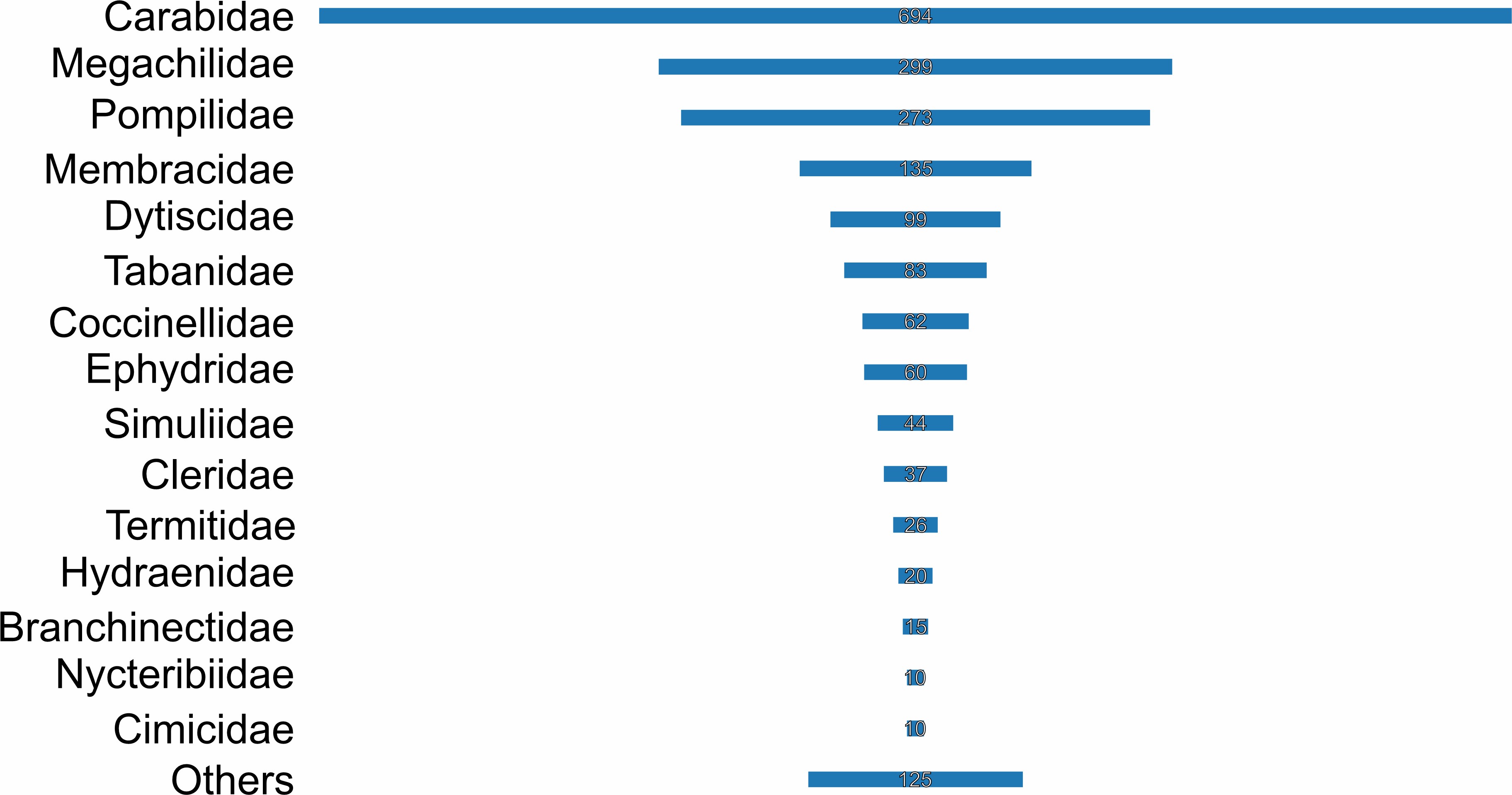
Figure 7.
Funnel chart illustrating the number of inferred endemic species within the 15 arthropod families with the highest endemic richness.
The x-axis displays families, ordered by their total endemic species count.
At the provincial level, we considered only the inferred endemism (the only with detailed distribution data) and the few species with detailed distribution in the country and marked as endemic by the author, totaling 951 species. The provinces with the highest occurrences of species endemic to Argentina were Tuc., Bs.As., Mza., and Sal. (Fig. 8). These four provinces gather almost the 60 % of the Argentinean endemic species. A similar pattern was observed for provincial endemism, except that Sal. ranked fourth, while Mnes. ranked third (Fig. 8). L.P. is the least rich of provincial endemism, with only one, Priocnemis atelerythra (Holmberg) (Hymenoptera: Pompilidae), followed by Malv. with two, Meropathus vectis Perkins (Coleoptera: Hydraenidae) and Trechisibus falklandicus Schweiger (Coleoptera: Carabidae). There are more endemic species from each province, such as several genera and species of weevils, opilionids, and other Arthropoda from Malv. (Morrone, 2015; Posadas & Morrone, 2015), but they are not cited explicitly in the volumes of BAA, or the available distribution data are only given for Argentina as a whole, lacking the provincial-level resolution required for our analysis.
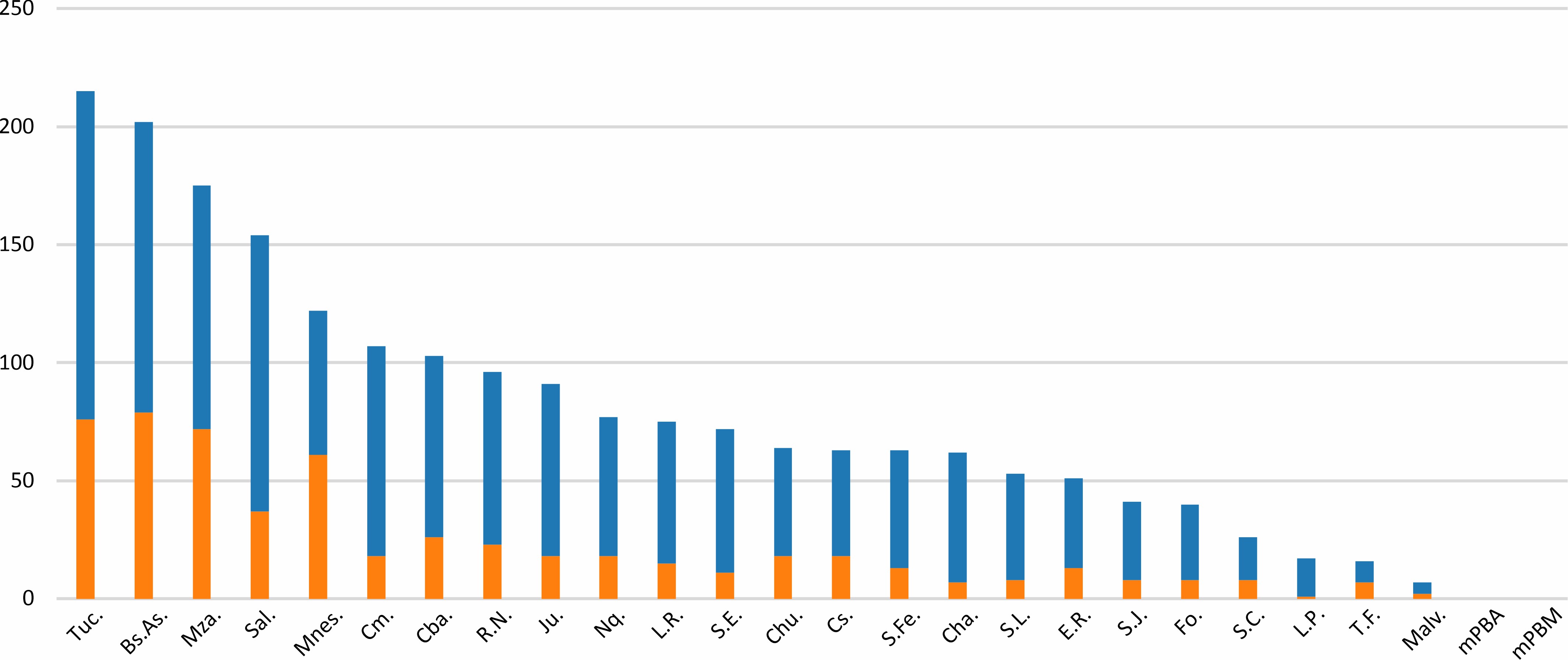
Figure 8.
Histogram showing the number of inferred Argentinean endemic species per province (blue) and those additionally endemic for the province itself (orange)
Provinces are ordered along the x-axis by total endemic richness.
At family level, Carabidae (Coleoptera) had the highest number of Argentine endemism in all provinces, except Mza. and Ju., where Megachilidae and Pompilidae (Hymenoptera) constitute the families with higher number of Argentine endemism, respectively (Fig. 9). Worth mentioning is that Mza., L.R., Chu., S.L., and S.C. do not have Argentine endemism of Membracidae (Hemiptera), and T.F. and Malv. have only endemism of Carabidae and Hydraenidae (Coleoptera) (Fig. 9).
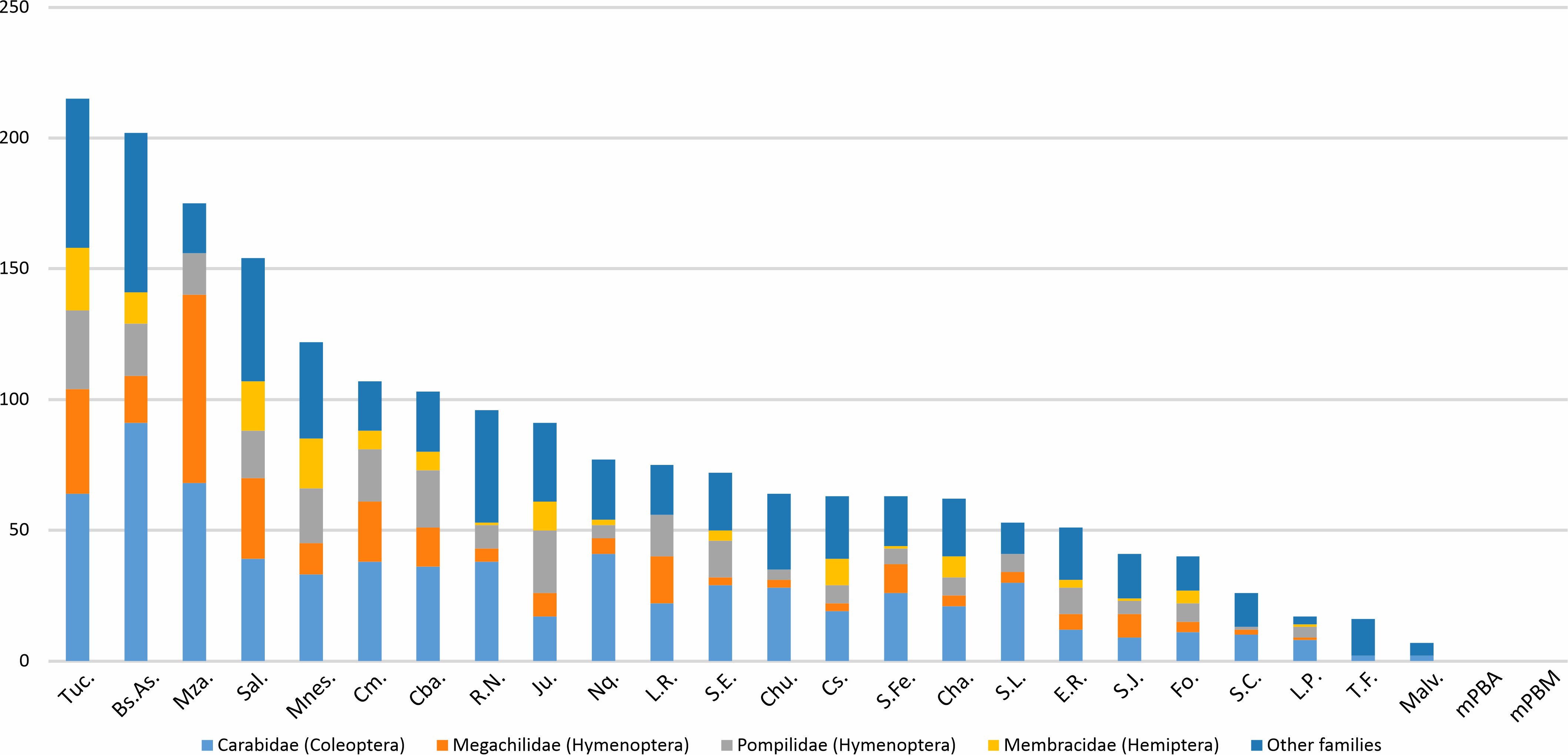
Figure 9
Histogram detailing the number of Argentinean inferred endemic species per province, with a breakdown of the four families with the highest species richness.
Families are differentiated by color, with provinces ordered along the x-axis by total endemic richness.
Argentinean arthropod’s diversity in a global context
Table I presents a concise overview of the information on all BAA volumes, detailing the number of species within superclasses, classes, and orders identified in Argentina alongside global species counts. Argentina holds the 1.93 % of world species among the orders analyzed. Furthermore, based on disparities in mean proportional richness at the superclass level between Argentina and the world, we estimated the number of species yet to be discovered in Argentina. This analysis indicates that Coleoptera, Lepidoptera, and Diptera (Insecta) exhibit the most significant underestimation of richness in Argentina, followed by Decapoda, Isopoda, and Ostracoda (Crustacea).
In previous analyses (e.g., Claps et al., 2008, 2023b; Roig-Juñent et al., 2014b), the representativeness of Argentinean Arthropoda was assessed by comparing the country's species richness with global richness for each taxon (e.g., order, family, or other taxonomic rank) covered in the six volumes. These studies estimated representativeness values ranging from 3.1% to 3.7%.
Projecting the representativeness of superclasses, classes, and orders suggests that Argentina’s share of the world’s species could reach 3 % or higher if hyperdiverse groups such as Coleoptera, Diptera, and Lepidoptera were fully included.
Knowledge Gaps
The BAA book series contains the major bulk of information about Argentinean Arthropods, yet there are many species-rich families without data on distribution inside Argentina and also outside the country (Table II). Many species-rich families, with more than 200 species each, lacked distribution data entirely or have distribution records limited to Argentina (Table II, families bolded). Moreover, of the seven richest families of Arthropoda, Curculionidae (~1,100 species), Staphylinidae (~1,000), Chrysomelidae (~1,000), and Scarabaeidae (~650) lack a list of species for the country and Noctuidae (~650) lack the species distribution.
Finally, another gap in knowledge can be assessed by accounting specifically lack for updated data corresponding to taxa treated only in BAA volume 1, published in 1998. Most of them correspond to Crustacea and Miriapoda superclasses (Table III).
DISCUSSION
Unveiling Argentine Arthropod Diversity: Spatial Distribution, Taxonomy, and Endemism
While studies of Argentine arthropods are clearly extended beyond the BAA series, its six volumes represent a foundational milestone, offering the first comprehensive synthesis of the country’s arthropod diversity. This work consolidates that knowledge into a generalized framework, revealing both progress and persistent gaps. Below, we summarize the key patterns and challenges emerging from our analysis.
Spatial patterns
Buenos Aires, Mnes., Sal, and Tuc. provinces collectively harbor ~40 % of Argentina’s documented arthropod species. From those, three provinces are known as highly diverse provinces, related to the highly diverse ecoregions or equivalent biogeographic provinces present, Upper Parana Atlantic Forest or Parana Forest in Mns. and Southern Andean Yungas or Yungas in Tuc. and Sal. (Brown et al., 1993, 2006; Morello et al., 2012; Di Bitetti et al., 2003; Morrone, 2014a). In Tuc. and Sal. provinces, also the diverse ecoregions or biogeographic provinces present could be an additional factor for its diversity, i.e., Dry Chaco or Chaco, High Monte or Monte, and Central Andean Puna and Central Andean Dry Puna or Puna (Morello et al., 2012; Morrone, 2014a). In the case of Bs.As. which does not present species-rich ecoregions or biogeographic provinces and has less diversity of environments than the precedent provinces, its richness could be underscored by the historical influence of research effort on perceived diversity (see below, “Bridging Biodiversity and Expertise”). On the other hand, provinces like L.P., T.F., and S.C. are between the least rich of the country. The low species richness in the two southernmost provinces (S.C. and T.F.) may be attributed to their cold climates (Carrara et al., 2024). This explanation is particularly plausible for T.F., a well-surveyed Patagonian province (Roig-Juñent et al., 2013, 2024). Low species richness on L.P., surrounded by far richer provinces, could be explained by lower researcher numbers and historical lower collecting efforts (specifically regarding Arthropods).
As the species richness of each province could be biased by several factors, including researchers working in it, as other topics such as ecological or conservation interests (Soberón et al., 2000; Meyer et al., 2016), we calculated the expected richness of each province as the mean value of the richness of the bordering provinces. The focal and bordering provinces, in most cases, share ecoregions and biogeographic provinces, thus a similar biodiversity is expected. This would underestimate the values for the richest provinces, but could help us estimate the potential real richness of the most understudied ones. As a result, and in agreement with Pall (2015), we found that L.P. is the most understudied province in the country, specially related to diversity of Arthropods. This province is bordered by provinces with many ecoregions and biogeographic provinces shared and they have considerably more species richness, emerging as critical knowledge gap, with expected richness far exceeding current records. This is a notorious gap since L.P. is a key component of the Pampas plain and despite its more arid western parts with Monte biogeographic province, its eastern and central areas are highly productive, similar to the eastern part of the humid Pampas (i.e., humid Pampas Bs.As., Cor., and S.Fe).
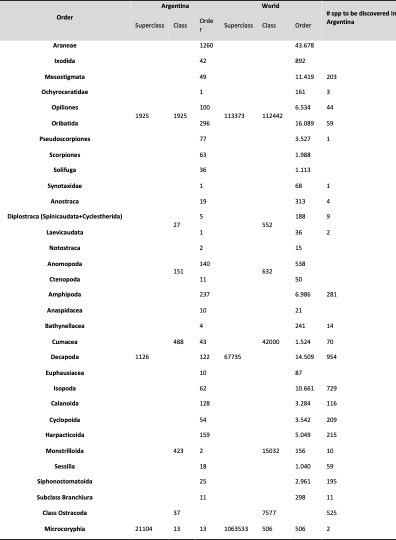
Table I.
Arthropod Order Diversity, Argentina vs. Global.
For each arthropod superclass, the estimated number of undiscovered species per order in Argentina was extrapolated. This extrapolation used the mean ratio of Argentinean to global species richness calculated across all orders within that superclass.
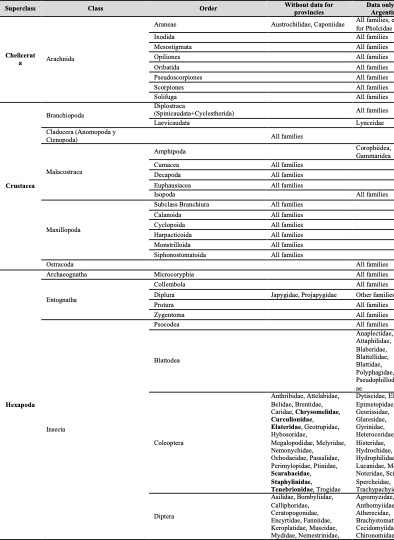
Table II
Families without data on distribution outside or inside Argentina, arranged by superclass, class, and order.
Most diverse families (with more than 200 species) are shown in bold.
The cladogram depicts groups of provinces reflecting the main biogeographic regions of South America, Andean and Neotropical. Within the latter, provinces are joined by geographic closeness.
Taxonomic diversity and global context
The most diverse orders —Coleoptera, Diptera, Hymenoptera, Hemiptera, and Lepidoptera— dominate Argentina’s arthropod fauna, mirroring global trends (Zangh, 2011), with a disparity in Lepidoptera, which is the second worldwide, but the fifth in Argentina. This could be explained by the number of species-rich families not treated yet (see Final considerations).
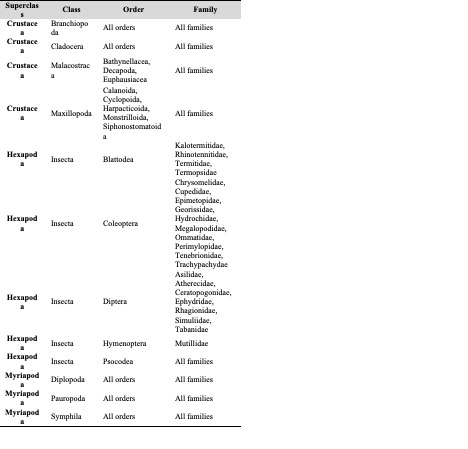
Table III.
Taxa Included in BBA Volume 1 (1998) but Not in Subsequent Volumes.
In the last volume of BAA, Claps et al. (2023b) estimated 26,251 species for Argentina (excluding Crustacea), representing ~3.11 % of global arthropod diversity for the groups covered. Their conservative extrapolation suggested 36,526 total species, with potential estimates reaching 124,400 depending on global scaling. Our updated database, incorporating all six BAA volumes (including Crustacea), documents 24,308 species. By calculating superclass-level averages—a less biased approach than whole-taxa extrapolation—we estimate Argentina’s arthropod diversity at 38,778 species. This aligns closely with Claps et al.'s (2023b) conservative figure, reinforcing that Argentina’s arthropod fauna remains significantly under-documented, particularly in hyperdiverse orders like Coleoptera, Lepidoptera, and Diptera (Insecta), followed by Decapoda and Isopoda (Crustacea).
Endemism richness
Considering the preliminary analysis of patterns of endemism by provinces herein presented, most of the Argentina’s endemic species are concentrated in Tuc., Bs.As., Mza., and Sal., with Coleoptera (especially Carabidae) contributing disproportionately. The ecoregion of Southern Andean Yungas, in Cm., Ju., Sal., and Tuc. (Morello et al., 2012), harbors numerous endemism, for some groups like vascular plants, this place harbor almost the 40 % of the endemism of the country (Zuloaga et al., 1999). Similarly, Szumik et al. (2011) used a large dataset of plants, amphibians, birds, mammals, reptiles, and insects to detect areas of endemism in Argentina and Ferretti et al. (2014) used a large dataset on Mygalomorph spiders. Both studies also found the most endemic rich areas in the Yungas (Sal. and Tuc.) and Parana Forest (Mnes.) biogeographic provinces. In the present study, Sal. and Tuc., plus Ju. (which also includes part of the Yungas) harbor the 35 % of the Arthropods endemic to Argentina while Mnes. being fifth, harboring the 13 %. Interestingly none of the studies mentioned Mza. nor Bs.As. as important endemism areas.
Bridging Biodiversity and Expertise: An Analysis of Arthropods and Entomologists by Province
First explorations in Argentina were made by foreign entomologists, and from 1880 by national researchers (Willink, 1969, Roig-Juñent et al., 2013). Agraín & San Blas (2011) offer a comprehensive overview of human resources dedicated to entomology in the last decade. This survey-based study remains the sole comparative reference point for a preliminary assessment. Their data in conjunction with the spatial distribution of biodiversity, reveals that from 1958 the National Scientific and Technical Research Council (CONICET) has been the predominant funding body for human resources in Argentinean arthropod research, primarily through the allocation of tenure-track positions, which have exceeded initial fellowships. This funding pattern suggests a potential future shortfall of personnel relative to the anticipated workload. The survey also identified a strong orientation towards basic science, with main focus towards subsequent technological transfer predominantly channeled into agricultural and medical applications. Geographically, Bs.As., Tuc., Cor., Mza., and Ju. exhibited the highest concentration of human resources, in this order, while two of the most biodiverse provinces, Mnes. and Sal., are demonstrably experiencing a scarcity of human resources dedicated to arthropod research (Fig. 10).
The high arthropod diversity observed in Mnes., Tuc., and Sal. could be explained by the ecoregions and biogeographic areas of that provinces (as mentioned before), but that of Bs.As. not. The richness of Bs.As. may be partially attributable to their extensive historical engagement in academic arthropod studies. For instance, high diversity for Bs.As. could be explained by a researcher’s bias, this province holds the oldest museums and research institutions attributable to their extensive historical engagement in academic arthropod studies. For instance, high diversity for Bs.As. could be explained by a researcher’s bias, this province holds the oldest museums and research institutions of the country, the Museo Argentino de Ciencias Naturales "Bernardino Rivadavia" (created in 1812) and the Museo de La Plata (created in 1877) and the oldest scientific journal, the Revista del Museo Argentino de Ciencias Naturales (established in 1864 as the Anales del Museo Público de Buenos Aires) (Castello & Piacentino, 2015), as the Revista de la Sociedad Entomológica Argentina from 1926 edited in Buenos Aires for more than a 60 years. For these reasons Buenos Aires (city and province) holds the richest history of research. This is also represented by the actual number of researchers, being by far the largest in the country (Fig. 10a).
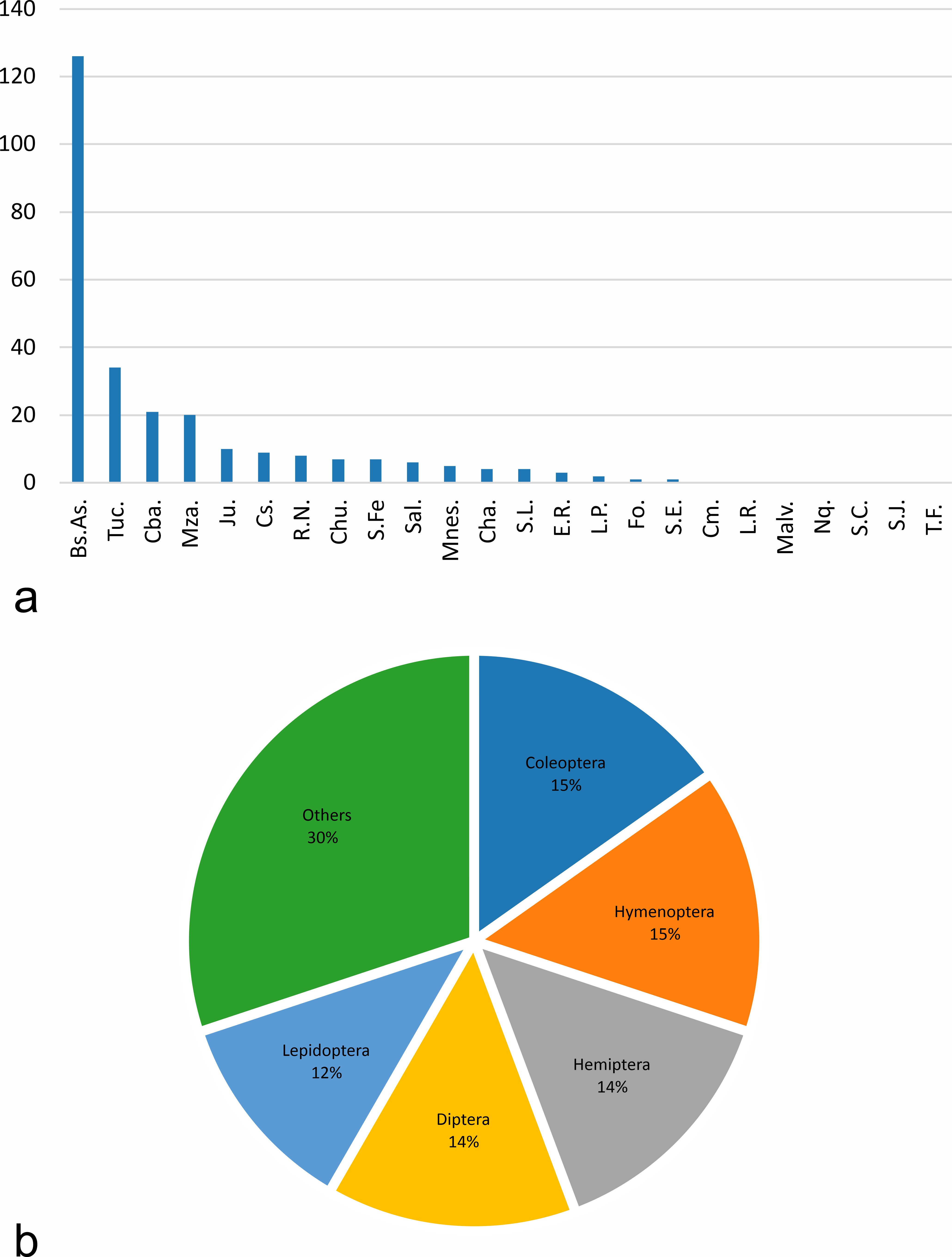
Figure 10.
Graphs of data analyzed from Agraín & San Blas (2011).
a. Researchers by provinces in Argentina. b. Researchers by Order of Arthropoda (detailing only the top five which account for almost 70 % of the researchers of the country)
In analyzing research focus, the survey by Agraín & San Blas (2011) found that while Coleoptera and Hymenoptera are ecologically prevalent and the most frequently studied orders, they were included by only 15 % of human resources (Fig. 10b). These orders were mentioned fewer than 40 times, underscoring a shortage of specialists. Hemiptera and Diptera with 14 %, followed in research interest by Lepidoptera (12 %). Here is also important to mention that these most studied orders are also the most diverse not only in Argentina but also at a global scale. Other orders like Orthoptera, Thysanoptera, Araneae, and Acari garnered a mere 2 % mention on average. The remaining orders were barely represented (0.4 %, often a single mention), indicating a critical lack of specialists in the country. This scarcity is even more pronounced at the family level. For instance, in Agraín & San Blas (2011), among the 268 respondents, it became clear that most human resources were dedicated to the study of arthropod families with agricultural or medical interest. These included ants, weevils, moths, mosquitoes, fruit flies, and assassin bugs, among others. The study also revealed a lack of sufficient research capacity for most families in our territory; for example, out of a total of 190 families mentioned, 125 (66 %) were cited only once.
Final Considerations of the Current Degree of Knowledge
The current understanding of Argentina’s arthropod diversity, while substantial, reveals critical gaps that constrain both present conclusions and future research trajectories. At the provincial level, understudied provinces like L.P. and Fo. exhibit high predicted richness but remain poorly sampled, necessitating targeted fieldwork. Taxonomically, only two (Carabidae and Megachilidae) of the 27 richest families have complete distribution records—coincidentally, these also harbor the highest endemism. Strikingly, of those 27 richest families, 13 had distribution records limited to Argentina and 12 families (including the three most species-rich, each with >900 species) lack distribution data entirely, undermining biogeographic and conservation assessments.
Furthermore, several species-rich arthropod families and superfamilies are absent from the BAA, and therefore in the present analysis, and deserve attention. Worth to mention are the lepidopteran Erebidae (approximately 25,000 species globally) and the superfamilies Gelechioidea (~20,000), Papilionoidea (~20,000), Pyraloidea (~16,000), and Tortricidae (~11,000), among other taxa in diverse orders. Incorporating these taxa would change the current findings and provide a more precise depiction of Argentina's arthropod diversity.
Finally, many taxa covered exclusively in BAA Volume 1 (1998) —including crustaceans and myriapods— require urgent revision to reflect modern systematic advances. Prioritizing updates for these groups, alongside expanded coverage of species-rich families, should be a cornerstone of future BAA volumes.
CONCLUSIONS AND STRATEGIC PRIORITIES
Our comprehensive synthesis documents 24,308 arthropod species across 64 orders, 730 families, and 6,855 genera from the BAA series, revealing a distinct concentration of biodiversity in Argentina's Neotropical provinces - particularly Tuc., Sal., Mnes., and Bs.As. However, this apparent pattern masks significant knowledge gaps and research disparities that must inform future directions.
Addressing geographic and research biases: While the core of Argentina’s arthropod diversity is concentrated in Mnes., Tuc., and Sal., the majority of research effort and institutional resources remain centralized in Bs.As. This imbalance is further exacerbated in provinces like L.P. and Fo., which show high predicted species richness but remain critically understudied. Likewise, provinces like Cm. and Ju. display unexpectedly low recorded richness, despite encompassing portions of the Yungas —one of the country’s most biodiverse biogeographic provinces. Addressing these gaps will require coordinated fieldwork initiatives that align sampling efforts with true diversity gradients rather than historical research convenience.
Expanding Taxonomic Coverage: Prioritize revisions of neglected groups, especially those treated only in BAA Volume 1 (1998) or excluded entirely (e.g., Lepidoptera Erebidae and Gelechioidea). Also, inclusion of underrepresented lineages, such as aquatic arthropods (e.g., freshwater Decapoda) and soil microfauna (e.g., Pauropoda), to correct current terrestrial biases.
Integrating Ecological and Evolutionary Perspectives: Increasing studies that can link taxonomy to function in topics such as ecological roles of arthropods (e.g., pollination, decomposition, etc.) and their responses to environmental change, as well as studies with the goal of unraveling evolutionary drivers that may have shaped Argentina’s unique assemblages.
Digitizing and Mobilizing Data: Accelerate digitization of museum collections and literature records to create open-access databases. In this regard, our group is currently compiling a database of Argentine arthropods using the BAA series as a core source. This initiative aims to merge existing datasets into a unified, updatable catalog —a critical tool for research and conservation.
Linking taxonomic information to economic dimension: Studies on the economic, medical, veterinary, forensic, and agronomic systems including arthropods or their related organisms should be increased.
Strengthening Collaborative Networks: Foster national partnerships: Bridge institutional divides by creating shared research agendas (e.g., ATAs in Entomology) and training programs. In addition, engage international expertise: Collaborate with neighboring countries to resolve cross-border distribution gaps and refine endemism estimates.
A Call to Action
The BAA series has undeniably established a vital foundation, but transforming Argentina's arthropod research into a dynamic, conservation-relevant discipline now demands coordinated action on multiple fronts. We must implement systematic efforts to address geographic and taxonomic biases while embracing innovative methodologies —from integrative taxonomy to genomic approaches. Equally important is engaging policymakers to secure sustained funding for neglected taxa and regions.
By addressing these challenges through collaborative, interdisciplinary approaches, we can evolve from today's fragmented knowledge toward a comprehensive understanding of Argentina's arthropod biodiversity. Such advancement will prove essential not only for scientific progress but for developing evidence-based conservation strategies in an era of unprecedented environmental change. The time has come to translate these priorities into concrete actions that will illuminate and safeguard Argentina's extraordinary arthropod diversity for the generations to come.
Acknowledgments
GSB, FA SRJ, and LC are grateful to CONICET for the research support. We thank the Willi Hennig Society for making the TNT program freely available. FA is grateful to the ANPCyT (Agencia Nacional de Promocion Cientifica y Tecnica, Argentina) PICY-2019-03121 and CONICET PIP 2021-2023 (11220200102638CO). We sincerely appreciate the insightful comments and thorough corrections from Cristian Grismado and two anonymous reviewers, which significantly refined this work.
REFERENCES
Agraín, F. & San Blas, G. (2011). Resultados del primer Censo Nacional de la Sociedad Entomológica Argentina (SEA). Boletín de la Sociedad Entomológica Argentina, 2011(Special issue), 1-10.
Agraín, F., San Blas, G. & Roig-Juñent, S. (2025). A biogeographic approach towards Andean ground beetles conservation (Coleoptera: Carabidae). Biodiversity and Conservation, 34, 2469-2491. https://doi.org/10.1007/s10531-025-03081-2
Altieri, M. A. (1999). The ecological role of biodiversity in agroecosystems. In M. G. Paoletti (Ed.), Invertebrate biodiversity as bioindicators of sustainable landscapes (pp. 19-31). Elsevier.
Altieri, M. A., Nicholls, C. I. & Montalba, R. (2017). Technological approaches to sustainable agriculture at a crossroads: An agroecological perspective. Sustainability, 9(3), 349. https://doi.org/10.3390/su9030349
Antonelli, A. & Sanmartin, I. (2011). Why are there so many plant species in the Neotropics? Taxon, 60, 403-414. https://doi.org/10.1002/tax.602010
Arana, M. D., Natale, E. S., Ferretti, N. E., Romano, G. M., Oggero, A. J., Martínez, G., ... & Morrone, J. J. (2021). Esquema biogeográfico de la República Argentina. Opera Lilloana, 56, 1-238.
Brown, A. D., Placci, L. G. & Grau, H. R. (1993). Ecología y diversidad de las selvas subtropicales de la Argentina. In F. Goin & F. Goñi (Eds.), Elementos de política ambiental (pp. 215-222). Cámara de Diputados provincia de Buenos Aires.
Brown, A., Martínez Ortiz, U. & Acerbi, M. (2005). Un enfoque ecorregional de la problemática ambiental en la Argentina. La Situación Ambiental Argentina, 25-27.
Brown, A. D., Pacheco, S., Lomáscolo, T. & Malizia, L. (2006). La situación ambiental en los bosques andinos yungueños. In A. Brown, U. Martínez Ortiz, M. Acerbi & J. Corchera (Eds.), La situación ambiental Argentina 2005 (pp. 52-71). Fundación Vida Silvestre Argentina.
Carrara, R., Giménez, V., Muñoz-Escobar, C. & Roig-Juñent, S. (2024). Potential biodiversity maps of Geadephaga (Coleoptera) from Subantarctic forests: Relating diversity patterns and conservation hotspots with forest integrity. Agriculture and Forest Entomology, 27(2), 160-170. https://doi.org/10.1111/afe.12650
Castello, H. P. & Piacentino, G. L. M. (2015). La publicación científica más antigua y prestigiosa del Museo Argentino de Ciencias Naturales "Bernardino Rivadavia" en sus 201 años de historia. Historia Natural (tercera serie), 5, 125-143.
Claps, L. E., Debandi, G. & Roig-Juñent, S. (2008). Diversidad de artrópodos argentinos (Vol. 2). Sociedad Entomológica Argentina. https://seargentina.com.ar/libros-digitales-de-libre-acceso/
Claps, L., Morrone, J. J. & Roig-Juñent, S. (2023a). Biodiversidad de artrópodos argentinos (Vol. 5). INSUE - UNT Ediciones
Claps, L., Morrone, J. J. & Roig-Juñent, S. (2023b). Biodiversidad de artrópodos argentinos (Vol. 6). INSUE - UNT Ediciones.
Di Bitetti, M. S., Placci, G. & Dietz, L. A. (2003). A biodiversity vision for the Upper Paraná Atlantic Forest ecoregion: Designing a biodiversity conservation landscape and setting priorities for conservation action. WWF.
Eisner, T. (1991). Chemical prospecting: A proposal for action. In F. H. Bormann & S. R. Kellert (Eds.), Ecology, economics, ethics: The broken circle (pp. 196-202). Yale University Press.
Ferretti, N., González, A. & Pérez-Miles, F. (2014). Identification of priority areas for conservation in Argentina: Quantitative biogeography insights from mygalomorph spiders (Araneae: Mygalomorphae). Journal of Insect Conservation, 18, 1087-1096. http://dx.doi.org/10.1007/s10841-014-9718-5
Giribet, G. & Edgecombe, G. D. (2019). The phylogeny and evolutionary history of arthropods. Current Biology, 29, R592-R602. https://doi.org/10.1016/j.cub.2019.04.057
Goloboff, P. & Morales, M. (2023). TNT version 1.6, with a graphical interface for MacOs and Linux, including new routines in parallel. Cladistics39, 144-153. https://doi.org/10.1111/cla.12524
Kim, K. C. (1993). Biodiversity, conservation and inventory: Why insects matter. Biodiversity & Conservation, 2, 191-214. https://doi.org/10.1007/BF00056668
Kremen, C., Colwell, R. K., Erwin, T. L., Murphy, D. D., Noss, R. A. & Sanjayan, M. A. (1993). Terrestrial arthropod assemblages: Their use in conservation planning. Conservation Biology, 7, 796-808. https://doi.org/10.1046/j.1523-1739.1993.740796.x
Leigh, E. G., Wright, S. J. & Herre, E. A. (1993). The decline of tree diversity on newly isolated tropical islands: A test of the hypothesis and some implications. Evolutionary Ecology, 7(1), 76-102. https://doi.org/10.1007/BF01237735
Maleque, M. A., Ishii, H. T. & Maeto, K. (2006). The use of arthropods as indicators of ecosystem integrity in forest management. Journal of Forestry, 104(3), 113-117. http://dx.doi.org/10.1093/jof/104.3.113
Martínez, F. J., Cheli, G. H. & Pazos, G. E. (2018). Structure of ground-dwelling arthropod assemblages in vegetation units of Área Natural Protegida Península Valdés, Patagonia, Argentina. Journal of Insect Conservation, 22(2), 287-301. https://doi.org/10.1007/s10841-018-0062-z
McKay, F. & Cabrera Walsh, G. J. (2025). Contributions to the knowledge of Argentine entomological biodiversity associated with biocontrol research at the FuEDEI. Revista de la Sociedad Entomológica Argentina, 84(1), e0108. https://doi.org/10.25085/rsea.840108
Meyer, C., Weigelt, P. & Kreft, H. (2016). Multidimensional biases, gaps and uncertainties in global plant occurrence information. Ecology Letters, 19, 992-1006. https://doi.org/10.1111/ele.12624
Monrós, F. (1958). Consideraciones sobre la fauna del sur de Chile y revisión de la tribus Stenomelini (Coleoptera: Chrysomelidae). Acta Zoológica Lilloana, 15, 143-153.
Morello, J., Matteucci, S. D., Rodríguez, A. F. & Silva, M. (2012). Ecorregiones y complejos ecosistemicos argentinos. Orientación Gráfica Editora.
Morrone, J. J. (2014a). Biogeographical regionalisation of the Neotropical region. Zootaxa, 3782(1), 1-110. https://doi.org/10.11646/zootaxa.3782.1.1
Morrone, J. J. (2014b). Parsimony analysis of endemicity (PAE) revisited. Journal of Biogeography, 41, 842-854. https://doi.org/10.1111/jbi.12251
Morrone, J. J. (2015). Biogeographical regionalisation of the Andean region. Zootaxa, 3936(2), 207-236. https://doi.org/10.11646/zootaxa.3936.2.3
Morrone, J. J. (2017). Neotropical biogeography: Regionalization and evolution. CRC Press.
Morrone, J. J. (2018). Evolutionary biogeography of the Andean region. Taylor & Francis.
Morrone, J. J. & Coscaron, S. (1998). Biodiversidad de artrópodos argentinos. Una perspectiva biotaxonómica. Ediciones Sur. https://seargentina.com.ar/libros-digitales-de-libre-acceso/
Oggero, A. J., Angeli, J., Ponce, M. M., Arana, M. D. & Morrone, J. J. (2019). Biogeografía evolutiva del grupo Cheilanthes squamosa (Cheilanthoideae: Pteridaceae). Boletín de la Sociedad Argentina de Botánica, 54, 61-62.
Pall, J. L. (2015). Biodiversidad y conservación de Hemiptera: Heteroptera (Insecta) en la provincia de La Pampa, Argentina [Doctoral dissertation, Universidad Nacional de La Pampa]. https://sedici.unlp.edu.ar/handle/10915/44983
Pimentel, D., Stachow, U., Takacs, D. A., Brubaker, H. W., Dumas, A. R., Meaney, J. J., ... & Corzilius, D. B. (1992). Conserving biological diversity in agricultural/forestry systems. BioScience, 42(5), 354-362. https://doi.org/10.2307/1311782
Posadas, P. & Morrone. J. J. (2015). Entomofauna de las Islas Malvinas. In: Giordano, C. J. (ed.), Universidad y soberanía: Estudios sobre la guerra y la posguerra de Malvinas y Atlántico Sur, Editorial de La Universidad Nacional de La Plata, La Plata, pp. 321-333.
QGIS Development Team. (2024). QGIS Geographic Information System (Version 3.36.1). Open Source Geospatial Foundation. http://qgis.osgeo.org
Roberts, L. (1992). Chemical prospecting: Hope for vanishing ecosystems? Science, 256(5060), 1142-1143. https://doi.org/10.1126/science.256.5060.1142
Roig-Juñent, S. (1993). Insectos de América del Sur: Su origen a través del enfoque de la biogeografía histórica. Multequina, 1, 107-114.
Roig-Juñent, S., Claps, L. & Morrone, J. J. (2014a). Biodiversidad de artrópodos argentinos (Vol. 3). INSUE - UNT Ediciones. https://seargentina.com.ar/libros-digitales-de-libre-acceso/
Roig-Juñent, S., Claps, L. & Morrone, J. J. (2014b). Biodiversidad de artrópodos argentinos (Vol. 4). INSUE - UNT Ediciones. https://seargentina.com.ar/libros-digitales-de-libre-acceso/
Roig-Juñent, S., Griotti, M., Domínguez, M. C., Agrain, F. A., Campos-Soldini, P., Carrara, R., Cheli, G., Fernández-Campón, F., Flores, G. E., Katinas, L., Muzón, J. R., Neita-Moreno, J. C., Pessacq, P., San Blas, G., Scheibler, E. E. & Crisci, J. V. (2018). The Patagonian Steppe biogeographic province: Andean region or South American transition zone? Zoologica Scripta, 47(6), 623-629. https://doi.org/10.1111/zsc.12305
Roig-Juñent, S., Griotti, M., Miras, D. & Carrara, R. (2024). Geadephaga (Insecta: Coleoptera) from the sub-Antarctic Tierra del Fuego archipelago: Species-richness, distribution maps and taxonomic key. Polar Biology, 47, 1441-1456. https://doi.org/10.1007/s00300-024-03315-z
Roig-Juñent, S., Ruiz-Manzanos, E. & Agrain, F. A. (2013). La exploración científica en el sur de América del Sur a lo largo de 237 años: Un ejemplo con Carabidae (Coleoptera). Revista del Museo Argentino de Ciencias Naturales, 15(2), 151-160.
Soberón, J., Llorente, J. & Soberón, J. M. (2000). The Linnean and Wallacean shortfalls in México: An assessment of biodiversity inventories and taxonomic expertise. Biodiversity and Conservation, 9(7), 849-866. https://doi.org/10.1016/j.biocon.2023.110027
Szumik, C., Aagesen, L., Casagranda, D., Arzamendia, V., Baldo, D., Claps, L. E., ... & Goloboff, P. (2011). Detecting areas of endemism with a taxonomically diverse data set: Plants, mammals, reptiles, amphibians, birds, and insects from Argentina. Cladistics, 28(3), 317-329. https://doi.org/10.1111/j.1096-0031.2011.00385.x
Willink, A. (1969). Contribución a la Historia de la Entomología Argentina. Miscelánea 28, UN Tucumán y Fundación Lillo, 30 pp.
Zhang, Z.-Q. (Ed.). (2011). Animal biodiversity: An introduction to higher-level classification and taxonomic richness. Zootaxa, 3148(1), 1-237. https://doi.org/10.11646/zootaxa.3148.1.1
Zuloaga, F. O., Morrone, O. & Rodriguez, D. (1999). Análisis de la biodiversidad en plantas vasculares de la Argentina. Kurtziana, 27, 17-167.
Notes
Información adicional
redalyc-journal-id: 3220