THEMATIC ARTICLE
Advancing in the neuroleadership field: a systematic and integrative review
Avançando no campo da neuroliderança: uma revisão sistemática e integrativa
Avanzando en el campo del neuroliderazgo: una revisión sistemática e integradora
 Kelly Guarnier kelly.guarnier@gmail.com
Paula Chimenti paula.chimenti@coppead.ufrj.br
Kelly Guarnier kelly.guarnier@gmail.com
Paula Chimenti paula.chimenti@coppead.ufrj.br
Advancing in the neuroleadership field: a systematic and integrative review
Cadernos EBAPE.BR, vol. 21, no. 6, e2022-0184, 2023
Fundação Getulio Vargas, Escola Brasileira de Administração Pública e de Empresas
Received: 01 August 2022
Accepted: 26 June 2023
Abstract: Scholars and managers have long discussed the best profile for successful leadership, which can influence employee performance and organizational growth. Despite leadership being the focus of many studies and continuous training, what explains leaders’ effectiveness within institutions and companies remains unclear. To better understand this phenomenon, we perform a comprehensive review of empirical studies and theoretical essays (N = 93) exploring the application of neuroscience in an organization’s practices and leaders’ development. We conducted a systematic review using these references and built narrative arguments organizing understudied areas and defining a process to classify and integrate trends. The study is different from previous research in identifying groups of research areas such as the biological, brain, psychological, management, emotional, and cognitive approaches, as well as research topics such as culture, decision-making, engagement, ethics, and human development. Moreover, we suggest a theoretical framework comprising those approaches and the main research topics to stimulate the move of the field forward. The article contributes to the literature by organizing the state of the art of research and presenting neuroleadership as a construct. We conclude with suggestions for future research that we hope will address existing gaps and contribute to building relevant theories and policy recommendations.
Keywords: Neuroleadership, Self-management, Engagement, Decision-making, Integrative review.
Resumo: Acadêmicos e gestores há muito discutem o melhor perfil para uma liderança bem-sucedida, que pode influenciar o desempenho dos funcionários e o crescimento organizacional. Apesar da liderança ser o foco de muitos estudos e treinamento contínuo, ainda não está claro o que explica a eficácia dos líderes dentro das instituições e empresas. Para entender melhor esse fenômeno, realizamos uma revisão abrangente de estudos empíricos e ensaios teóricos (N = 93) explorando a aplicação da neurociência nas práticas e desenvolvimento de liderança e organizacionais. Realizamos uma revisão sistemática utilizando essas referências e construímos argumentos narrativos organizando as subáreas estudadas e definindo um processo através do qual é possível classificar e integrar tendências. O estudo se diferencia de pesquisas anteriores ao identificar grupos de áreas de pesquisa como as abordagens biológica, cerebral, psicológica, gerencial, emocional e cognitiva, bem como temas de pesquisa como cultura, tomada de decisão, engajamento, ética e desenvolvimento humano. Além disso, sugerimos um referencial teórico compreendendo essas abordagens e os principais tópicos de pesquisa para estimular o avanço do campo. Este artigo contribui para a literatura organizando o estado a arte da pesquisa e apresentando a neuroliderança como um construto. Concluímos com sugestões para pesquisas futuras que esperamos abordar as lacunas existentes e contribuir para a construção de recomendações relevantes para políticas de teorias.
Keywords: Neuroleadership, Self-management, Engagement, Decision-making, Integrative review.
Resumen: Hace mucho tiempo que académicos y gestores discuten cuál es el mejor perfil para un liderazgo exitoso, que pueda influir en el desempeño de los empleados y en el crecimiento de la organización. A pesar de que el liderazgo es objeto de muchos estudios y formación continua, todavía no está claro qué explica la eficacia de los líderes dentro de las instituciones y empresas. Para comprender mejor este fenómeno, realizamos una revisión exhaustiva de estudios empíricos y ensayos teóricos (N = 93) que exploran la aplicación de la neurociencia a las prácticas de una organización y el desarrollo de líderes. Realizamos una revisión sistemática utilizando estas referencias y construimos argumentos narrativos organizando áreas poco estudiadas y definiendo un proceso para clasificar e integrar tendencias. El estudio se diferencia de investigaciones anteriores en la identificación de grupos de áreas de investigación como los enfoques biológico, cerebral, psicológico, de gestión, emocional y cognitivo, así como temas de investigación como la cultura, la toma de decisiones, el compromiso, la ética y el desarrollo humano. Además, sugerimos un marco teórico que comprenda esos enfoques y los principales temas de investigación para estimular el avance del campo. El artículo contribuye a la literatura al organizar el estado del arte de la investigación y presentando el neuroliderazgo como un constructo. Concluimos con sugerencias para investigaciones futuras que esperamos que aborden las brechas existentes y contribuyan a la construcción de teorías relevantes y recomendaciones de políticas.
Palabras clave: Neuroliderazgo, Autogestión, Compromiso, Toma de decisiones, Revisión integradora.
Palavras chave: Neuroliderança, Autogestão, Engajamento, Tomada de decisão, Revisão Integrativa
INTRODUCTION
Leadership is a key element in developing professionals’ skills and achieving greater results for employees, teams, and organizations (Hughes, Lee, Tian, Newman, & Legood, 2018). The effectiveness of current techniques for developing leaders have been questioned, creating a need for new skills, such as the ability to deal with stress in uncertain scenarios (Alcañiz, Parra, & Giglioli, 2018). Despite the volume of studies in this area, it remains unclear how individual-difference variables may impact individual choices, with important implications for organizational behavior (Good & Michel, 2013). Boyatzis, Smith, and Blaize (2006) state that, over the decades, many leadership concepts (see Yukl & Van Fleet, 1990) have been offered with which to understand the personal characteristics that define a great leader, such as extraversion enhancing charisma or high cognition.
Good and Michel (2013) point out that neuroscience techniques began being used within organizations to meet this need through implicit objective measures of individual abilities, instead of relying, for example, on self-reports. Thus, combining the fields of psychology, neuroscience, and organizational behavior can widen the breadth and depth of the advances in inquiry about leadership (Mom, Van Den Bosch, & Volberda 2009). Calabrese and Roberts (2002) used some findings from Wolfe and Brandt (1998) to show that the results of this advance in neuroscience research indicate that human development is complex due to the connection between mind and body. The authors explain that experience causes physiologic changes in the brain. Thus, IQ may not be static or guarantee the best problem-solving capability. Some abilities can best be increased when individuals experience emotional situations during learning (Calabrese & Roberts, 2002).
As a result, the application of neuroscience knowledge to leadership strategies - so-called neuroleadership - combines brain science and psychology to identify the skills of effective leaders in creating solutions capable of meeting the challenges of companies (Pittman, 2019). Because neuroscience being applied to leadership is a recent phenomenon, it is still unclear, in the literature, what neuroleadership really is: a construct, a style, a tool? We also require a better understanding of neuroleadership as compared to existing concepts, theories, and styles. Antecedents and consequents of neuroleadership should be mapped and tested to reveal how the variables involved in applied neuroscience influence organizational achievement. Therefore, there is a gap to be explored regarding what defines neuroleadership and its limits. Based on the above, wherein mindset becomes more of a focus than skillset (Kramer, 2016), the main question in this article is as follows: What is neuroleadership, and what is it not? How should neuroleadership be positioned in the literature? Does this new approach to leadership make a difference in leader effectiveness in the current context?
This investigation explains the importance of the synchrony between various theories - neuroscience, organizational behavior, and leadership (Okhuysen & Bonardi, 2011). It also makes new advances for leadership by identifying standard neural processes in other behaviors (Becker & Cropanzano, 2010). The study’s relevance lies in introducing a framework with which to establish the foundations for neuroleadership as a process for thinking and developing leaders.
In this work, we use the current literature to understand the state-of-the-art of neuroleadership within organizations. Then, we adopt a new view of the relationship between brain functions and human behavior, considering the relationships between leaders, followers, and context. Thus, we deliver two main contributions: (a) performing the first systematic and bibliometric literature review regarding neuroleadership, and (b) using the knowledge of applied neuroscience in organizations to ground a theoretical framework via which to explain the neuroleadership construct.
THEORETICAL BACKGROUND
Studies of neuroscience applied to organizational development began in the 1950s when the seminal Hodgkin-Huxley papers were published. From this moment, computational neuroscience has become an established discipline, evolving to understand the computational functions of the brain (Moore, 2010).
Technological advances have made room for neuroscience to grow, allowing us to understand complex interpersonal behaviors (Kuhlmann & Kadgien, 2018). Organizational cognitive neuroscience (see Senior & Lee, 2013) and neuroleadership (Gocen, 2021; Massaro, 2015; Pittman, 2019; Rock & Schwartz, 2007; Zwaan, Viljoen & Aiken, 2019) delimitate a new interdisciplinary field by using neuroscientific techniques and recent discoveries to answer questions about behaviors within organizations. Kuhlmann and Kadgien (2018) argue that “neuroleadership aims to discover screening tools for good leaders to improve leadership skills, and to identify unconscious factors affecting behavior in hopes of improving management and leadership practices.”
It seems exciting to understand brain functions and increase knowledge so as to critically analyze the limitations of current techniques for developing leaders and followers (Trichas, Schyns, Lord, & Hall, 2017). Massaro (2015, p. 227) adds that integrating these multidisciplinary views may help to “disseminate one of the core principles of their field - that is, to improve individuals’ psychophysical conditions, both inside and outside the workplace, a holistic and synergistic approach is the most desirable framework.” One practical example is taken from Balthazard, Waldman, Thatcher, and Hannah (2012), who used EEG to identify neural differences between transformational and non-transformational leadership. Nevertheless, neural bases alone may not be used to determine a typo or style. Lindebaum and Cartwright (2010) found that context can influence leadership classifications and, consequently, the interactions of teams within an organization. Moreover, leadership is a complex concept influenced not only by a leader’s beliefs, values, and attitudes but also by followers and the context (Boyatzis et al., 2006).
Mapping leadership qualities based on neurological variables may be helpful in research advances (Balthazard et al., 2012). In addition, one potential benefit of the type of research pursued is that neurologically based assessments may void human biases (Van Vugt & Von Rueden, 2020). Senior and Lee (2013) mentioned that we need to extend the literature to show that brain activity can explain the attitudes and patterns of behaviors, such as transformational leadership. Box 1 presents examples of studied brain structures and functionalities:
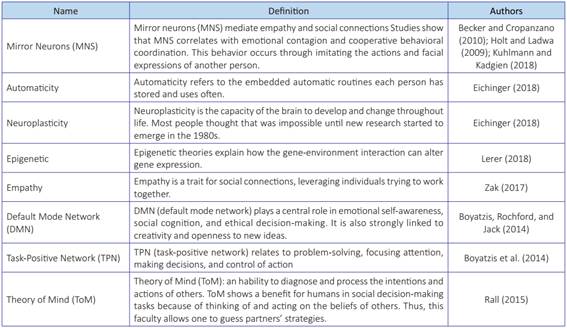
Box 1
Brain Structures and Functionalities
Source: Elaborated by the authors.
Boyatzis et al. (2014) make valuable contributions to defining influential leaders using these functions. They argue that productive leaders can switch between the TPN and the DMN. Thus, once individuals increase their ability to navigate more quickly and fluidly between the task and relationship roles, this reduces cognitive effort and changes the activation between the TPN and DMN (Boyatzis et al., 2014).
Recent discoveries regarding the impact of social relationships on human beings have identified social pain associated with actual or potential threats to our social connections (Lieberman & Eisenberger, 2009). Also, studies on neuroscience associated with leadership in organizations present the concept of trust, which can be a determining factor in performance (Zak, 2017). Furthermore, employees’ trust in the company’s culture and leadership practices makes them more motivated with their work (Antonakis, Ashkanasy, & Dasborough, 2009).
According to Barkley (1997), the brain has three executive functions. The first is impulse inhibition, which involves controlling an impulse and weighing the consequences against the desire to take action. The working memory assigns meaning to memories relevant to the decision within the attentional field. It assesses whether this decision is worth making and its long-term impact (Barkley, 1997). However, a merely technical understanding the brain mechanism linked to decision-making is not sufficient, because the human brain contains structures that “support” decisions in opposite directions. Moreover, based on the context, this process may imply constant and unequal conflict (Alcañiz et al., 2018). Therefore, to change a decision-making pattern, it is necessary to change a habit, which requires a set of behaviors to be performed over time (Waldman, Balthazard, & Peterson, 2011). This process reveals why it is so challenging to implementing leadership development (Alcañiz et al., 2018).
The brain builds a model of probable actions and motivations that are stimulated and impacted by others. Stress leads to the creation of defenses against potential external threats (Scarlett, 2016). On the other hand, positive emotions help build good relationships (Zwaan et al., 2019). Although there are still many unknown variables affecting leaders’ success in the current stage, applying the lenses of neuroscience to the leadership fields allows new perspectives within which to understand human motivations and desires. It is important to consider ethical concerns when using neuroscientific technologies in analyzing and developing leaders in the workplace. Lindebaum (2013a, 2013b) argues that using neural indicators to predict leadership ability risks excluding individuals with traits that differ from those prioritized by neuroleadership researchers.
Neuroscience, as applied to leadership, is not only a tool for leaders to use in developing themselves and their employees, but it is a different approach that increases further knowledge to traditional leadership. Implications for leadership and the social work profession suggest that neuroscience applied to leadership actions leads to enriched practice, improved retention, and better results (Pittman, 2019). Liebowitz et al. (2019) point out that from their research, business professionals should continue to apply their experiential learning through intuition to complement their data in making strategic decisions. This concept helps explain how to engage people, the internal process of decision-making, and the importance of self-manage. Rock and Schwartz (2007) assert that neuroleadership can help us find better strategies to change habits by understanding different ways of learning about ourselves, but what neuroleadership is? Even today, authors still publish papers focused on Organizational Cognitive Neuroscience (OCN) instead of neuroleadership.
METHODOLOGY
To present more detailed insights into the phenomenon of neuroleadership, the authors designed this present study based on a integrative and systematic review (Snyder, 2019). According to Wong, Greenhalgh, Westhorp, Buckingham, and Pawson (2013), this approach can address subjects studied by various groups of researchers within diverse disciplines. That is why the methodological choice to meet the research objective will be not a full systematic review process; rather, the proposal provides guidelines for conducting an integrative review (Snyder, 2019). In doing so, we followed the approach presented by Tranfield, Denyer, and Smart (2003) and Sivarajah, Kamal, Irani, and Weerakkody (2017).
To review the literature, we first conducted a comprehensive search for relevant studies. The Scopus database was chosen for the project because it is the largest database of peer-reviewed abstracts and citations in scientific journals, books, and conference articles. Scopus provides a broad view of global and interdisciplinary scientific information, with content that includes more than 5,000 peer-reviewed editors selected by an independent content review board (Figueiredo, Chimenti, Cavazotte, & Abelha, 2022).
- 1. . Search by keyword. The initial processing of data with the keywords “neuroscience” and “leadership” resulted in 401 works, and after adding the keyword “neuroleadership,” the processing resulted in 414 works.
- 2. . Document type selection. When selecting peer-reviewed articles in English, the number found was 224.
- 3. . Selection of search fields. At this stage, the areas selected were Medicine, Business, Psychology, Neuroscience, Biochemistry, Genetics, Molecular Biology, and Nursing. Considering the keywords, this resulted in nine (with the keyword “neuroleadership”) and 158 articles (with the keywords “neuroscience” and “leadership”) with these filters. In total, there were 167 articles. Other subject areas, such as Arts and Humanities; Computer Science; Economics, Econometrics, and Finance; Multidisciplinary, Agricultural, and Biological Sciences; Pharmacology, Toxicology, and Pharmaceutics; Physics and Astronomy; Engineering; Environmental Science; Health Professionals; Mathematics; Chemical Engineering; Immunology and Microbiology; and Materials Science, were not included, due to the synergy with the theme of the research.
- 4. . The analysis and synthesis of the works were in agreement, considering the synergy with the theme. As a criterion for analysis, the selected papers describe quantitative or qualitative studies on neuroscience applied to leadership, considering the context in which there is a relationship between the leader and the follower. In this case, the final sample included 93 articles.]
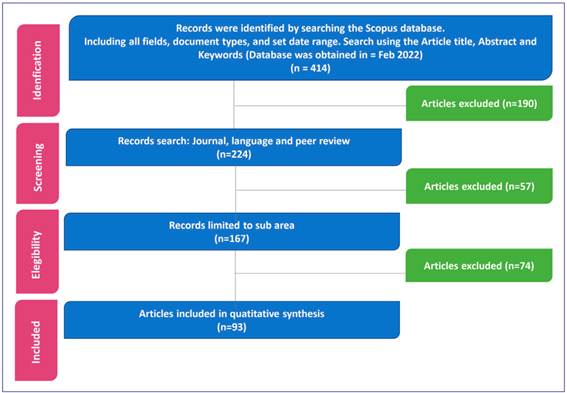
Figure 1
The methodological process
Source: Elaborated by the authors.
We chose a Bibliometric Analysis (BA) to complement our systematic reviews of the literature (Cucino, Passarelli, Di Minin, & Cariola, 2021). The focus of this BA is to provide objective analysis techniques and strengthen the systematic analysis. This approach allows us to identify interrelationships between authors and their citations based on statistical analysis (Ferreira, 2018; Glänzel & Czerwon, 1996). Saldanha (2009, p. 5) states that “the reverberative nature of coding - comparing data to data, data to code, code to code, code to category, category to category, category back to data, etc. - suggests that the qualitative analytic process is cyclical rather than linear.” We completed the following steps to codify our findings: classifying, prioritizing, integrating, synthesizing, abstracting, conceptualizing, and theory building.
RESULTS
Descriptive analysis
We use descriptive statistics to report our database and analyze information. The database includes 93 documents from 246 authors. The papers are from 17 countries. The reference period is from 1992 to 2021.
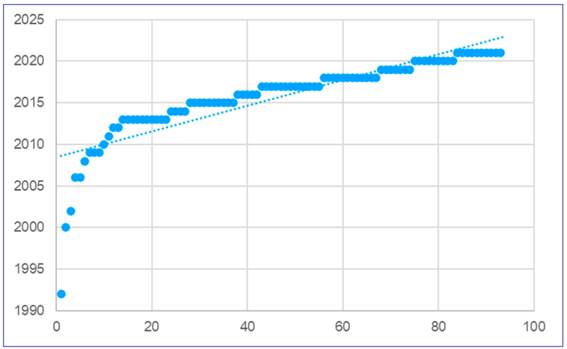
Figure 2
Papers published (from 1992 to 2021)
Source: Elaborated by the authors.
Although the first studies began in the 1990s, only since 2010 has there been an increasing number of articles addressing neuroscience in organizations, perhaps because of the advancement of technology. Even though we observe more studies in this field, there is still a predominance of theoretical studies, which indicates a gap regarding practical experiments within organizations.
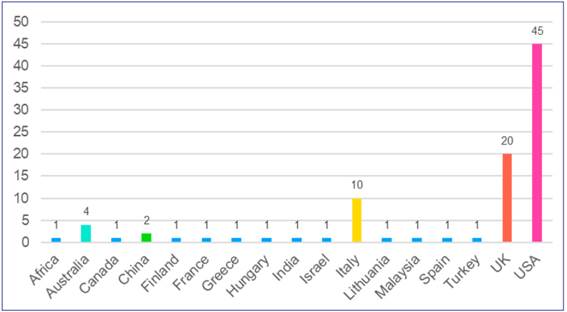
Figure 3
Researchers by geographical location (from 1992 to 2021)
Source: Elaborated by the authors.
The highest concentration of neuroleadership and OCN studies were produced in the United States of America (USA), followed by the United Kingdom (UK). This corroborates the need for other countries to engage with the theme.
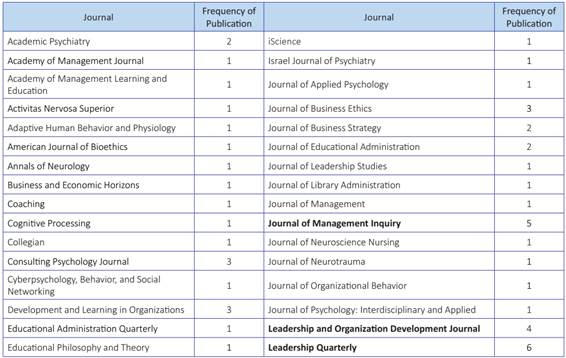
Box 2
Frequency of journals with large numbers of publications in the review
Source: Elaborated by the authors.
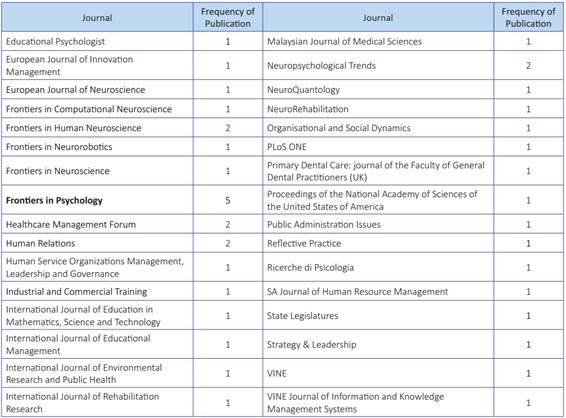
Box 2
continuation
Although diverse journals publish scientific articles related to the research theme, we see the most publications in Frontiers (especially in Psychology and Neuroscience), whose focus is publishing studies on the boundaries between areas of knowledge. In addition, the Leadership Quarterly and Leadership and Organizational Development Journal considers leadership as a phenomenon and publishes many systematic and qualitative articles. Moreover, the Journal of Management Inquiry’s papers in the management field emphasize qualitative research, inductive reasoning, “non-traditional” research, and thought-provoking articles meant to generate academic conversation. Most of the editorial boards for these journals are American, which explains the high incidence of studies coming from the US.
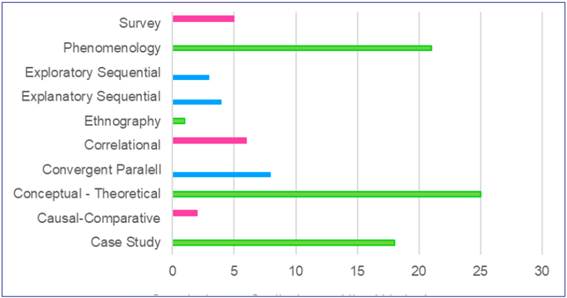
Figure 4
Frequency of methodologies used
Source: Elaborated by the authors.
Qualitative methods were the most used, at almost 70%. Phenomenological studies focused on understanding and explaining the new phenomena called OCN and neuroleadership. Most of these studies discussed the insights, application, gaps, and opportunities regarding neuroscience knowledge in organizations and attempted to more deeply problematize and explain leadership concepts and tools, integrating psychological motivations with brain functioning. Papers that were positioned in terms of grounding knowledge focus their efforts on adding new concepts, tools, or even theories related to multidisciplinary findings. For example, Rock (2018) proposed a new tool for developing leaders, one aimed at habit changes. Finally, case studies sought to observe, analyze, and synthesize knowledge through experiences with individuals and groups. In this sense, Alcañiz et al. (2018) studied the application of virtual reality as an emerging methodology for leadership assessment and training.
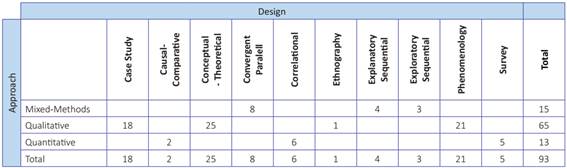
Box 3
The research design of the analyzed articles
Source: Elaborated by the authors.
We observed that the qualitative approach represents almost 70% of the efforts among scholars. Following Creswell’s (2013) definitions, research designs concentrate on three qualitative methods: case study design (19.4%), conceptual-theoretical design (26.9%), and phenomenology design (22.6%).
Co-citation analysis
From the sample, we obtained 5,003 directly cited references. Following Eom (2009), we found six clusters and 0.015 densities. The density represents the number of existing links divided by the number of potential links in a network. In our study, we see less than 1% of potential links, which indicates an opportunity to advance this field. The co-citation analysis reveals topics of interest.
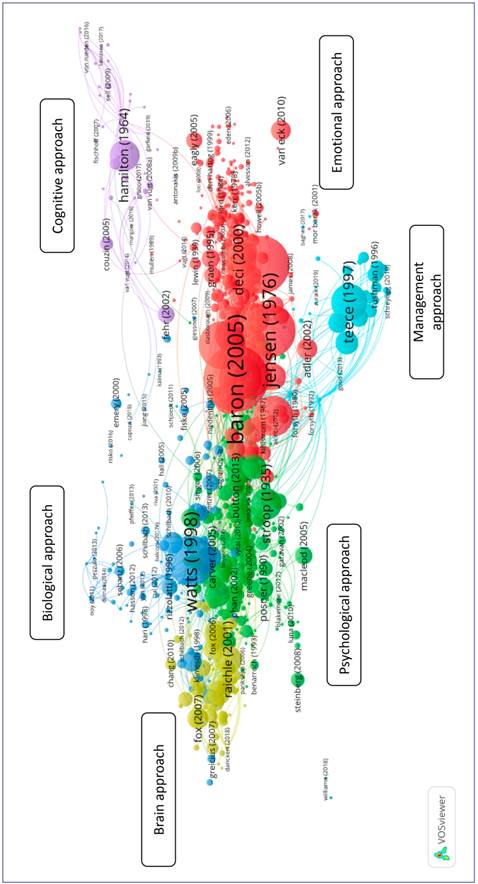
Figure 5
Co-citation analysis
Source: Elaborated by the authors.
The most cited authors have published seminal works contributing to the advancement of the multidisciplinary knowledge used in this article. In the red cluster, Bar-on, Tranel, Denburg, and Bechara (2005) contributes to studying emotions and their influence on behavioral expressions, serving as a basis for understanding the engagement process. In the green cluster, Stroop (1935) studies inferences in verbal reactions, providing insights into the psychological aspects of the decision-making process in the face of stimuli. In the blue cluster, Watts and Strogatz (1998) addresses human development from an evolutionary perspective. This approach uses biological insights to contribute to self-knowledge and, consequently, self-management. Additionally, Hamilton (1964), as part of the purple cluster, presents reflections on cognitive insights regarding the manifestation of social behavior and its implications. This knowledge helps explain the formation of groups and shared values, as well as how we make choices. In the light-blue cluster, Teece, Pisano, and Shuen (1997) introduces the concept of dynamic capabilities in business by analyzing the management context. Finally, in yellow cluster, Raichle et al. (2001, p. 676) presents the idea that the “baseline or control state is fundamental to the understanding of most complex systems.” Raichle et al.’s (2001) study suggests that the interaction between mind and body is an important source of analysis, explanation, and the means of producing assertive forms of development in individuals and groups.
Thematic analysis
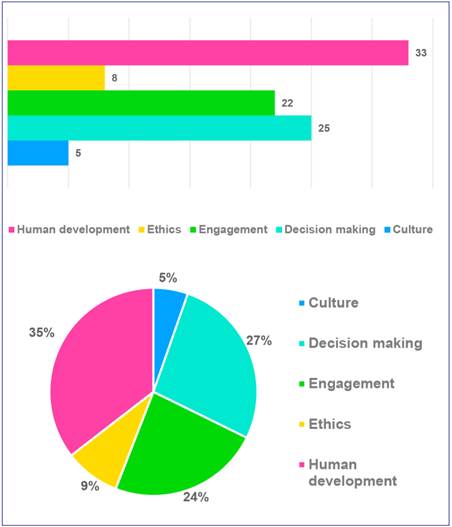
Figure 6
Thematic distribution of papers’ main research focus
Source: Elaborated by the authors.
According to the thematic analysis of the articles, it was possible to group the 93 copies into five main emergent research themes based on a careful analysis of the content. First, the objective of each investigation was to explain potential applications of neuroscience in organizations using the research methods mentioned above. These investigations seek to reveal patterns of behaviors. Thus, the authors used several neuroscience, psychology, and leadership lenses to establish correlations and boundaries. In this sense, the articles focused on studying decision-making, engagement, self-management, and ethical implications. In addition, studies focused on how to produce and transform culture by analyzing individual behavior.
Box 4briefly describes the five themes and the main reference authors.
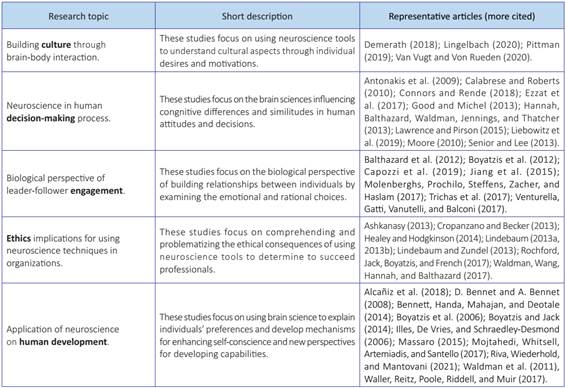
Box 4
The main research focuses on using cognitive neuroscience and neurolearship lenses
Source: Elaborated by the authors.
We observed that engagement, decision-making, and self-management reresent 86% of the topics studied in the systematic review, considering the five research topics. Thus, to finalize the results found in this research, we will deepen the three themes most studied by the authors and correlate them with the other two that are less studied. Therefore, over the subsequent three paragraphs, we will also see whether these correlate with culture and the ethical care needed to advance in this area of knowledge.
Engagement
Kahn (1990) brought to light the description for engagement as a present situation regarding the preferred self cognitively, affectively, and physically experienced by humans. These three dimensions mean individuals start involved in tasks physically. Then, those people become emotionally connected, sharing beliefs and values. Next, they tend to be more alert in a cognitive aspect which boosts creativity (Kahn, 1990). These steps leverage the engagement between people and the organizational culture, challenges, goals, and daily activities.
According to our systematic review, Cooper (2000, p. 11) begins the conversation about the necessity of leaders, at all levels, creating a vision and a focus on strategy. The author also states that, considering the “complex and changing world, leaders also need new insights and skills that up-end conventional thinking about human potential, trust, energy, initiative, and commitment.” We observe leadership phenomena in terms of a shared or distributed process among individuals. This means that leadership is not an exclusive estate of a particular individual or even those in formal leadership positions (Balthazard et al., 2012).
Then, Snaebjornsson and Vaiciukynaite (2016) stimulate the discussion related to underrepresented subjects in leadership research. One highlighted example is the importance of emotions in leader-follower communication. Recent developments have brought alternative methods, such as social cognitive neuroscience methods, to the leadership field (Snaebjornsson & Vaiciukynaite, 2016). In this sense, to understand the engagement process in different situations and the role of leaders in influencing followers, the literature suggests an alternative, using neuroscience insights about biological and psychological interaction as the foundation for social interaction (Molenberghs et al., 2017). However, Balthazard et al. (2012) cited studies from the past decade (e.g., Stevens, Galloway, Berka, & Sprang, 2009) examining an emerging area of neuroscience and its neurophysiological synchronicity. This research debated the need to map the brains of leaders, their entire teams, as well as individuals who may not be in formal leadership roles (Balthazard et al., 2012).
Conversely, we challenge the notion that it is only possible to apply neuroscience in organizations through case studies by using imaging exams or electrodes on employees. Boyatzis et al. (2012) brought to light an example in which resonant leaders activated neural areas associated with the mirror neuron system, the default mode or social network, and positive affect. In contrast, experiences with dissonant leaders negatively activated the regions associated with the mirror neuron system and those related to avoidance, narrowed attention, decreased compassion, and negative emotions. In this sense, following Lindebaum (2013a, 2013b), we agree that we must be cautious in using the neuroscience approach to predict behavior. In short, Scarlett (2016) understands that some of the answers will emerge from the study of the nervous system. Accordingly, these studies increase knowledge about the brain, leveraging the applications for organizational challenges.
Decision-making
Early research in decision-making assumed that decisions were underpinned by rational grounds (Kuhlmann & Kadgien, 2018). Years later, neuroscience spurred a discussion regarding the conscious control of behavior (Lawrence & Pirson, 2015). Thus, organizational cognitive neuroscience has increasingly generated interest in explaining how unconscious processes influence workplace relationships and the role of effective management in driving health culture (Demerath, 2018). In this sense, it is possible to identify emotional intelligence as an important element to use in engaging people by considering that emotions are one of the key element for connection between people. Consequently, we can use neuroscience to analyze the effects of emotions on follower outcomes (Antonakis et al., 2009).
Hannah et al. (2013) comment that there is agreement regarding leaders’ need to be adaptable and effective in terms of how they conduct tasks and social challenges. Thus, we can see the importance of integrating reason and emotion into the decision-making process (Rochford et al., 2017). To deeply understand this dynamic, researchers have sought to explore brain function in human subjects during social interactions, such as social reward; competition, cooperation, coordination; and strategic reasoning (Rall, 2015). Thus, for years, scholars have known the involvement of human motivations in social decisions related to financial outcomes (Wray, 2017). According to Rall (2015), it is possible to see, in several neuroimaging studies, the relationship between the striatum and the social partner’s decision. This relationship may concern reciprocating or not reciprocating cooperation. In this sense, Rall (2015) observed that, in cooperation actions, the images reveal encoded abstract rewards, such as the positive feelings garnered via cooperation.
Accordingly, Rall (2015) cites studies by Dobbins and Han (2006) to explain that, in the decision-making process, the striatum registers social prediction errors to indicate decisions about reciprocity. Additionally, after some interactions, the trustor and trustee learn from experience. This suggests that “prior beliefs can reduce the amount of trial-by-trial learning, which demonstrates both top-down and bottom-up influences on the neural basis of social cooperation” (Rall, 2015, p. 600). Relatedly, Liebowitz et al. (2019) found that, once employees gain more experience, their intuition types may change. Some people have more static intuition styles, which can be differentiated from leadership features. Some people can see the big picture and decide by using more intuition than analytics. Thus, Liebowitz et al. (2019) highlight the importance of listening to body signals to develop improved intuition, although cultural differences may impact executive decisions.
Finkelstein, Whitehead, and Campbell (2009) believe in the premise that leaders can make good decisions even given a mixture of unstructured and incomplete data, various perspectives, time pressures, and other sources of uncertainty. This allows for a broad understanding of the context of strategic decisions that go beyond the rational processes of analysis.
Human development
Although we are discussing the power of using neuroscience to better engage people and reach sustainable decisions, studies show that the development journey begins with the self (Riddell, 2017). In this sense, Kramer (2016) argues that leaders must learn how to change their current mental models. This change means generating the capacity to see what others cannot see and driving people toward a future that does not yet exist. Thus, leadership behaviors and attitudes have produced effects on employees in the past and will continue to be effective in the future (Riddell, 2017).
Relatedly, neuroscience provides insights into design interventions by revealing information about the connections and maturation of the brain (Capozzi et al., 2019). Understanding the neural underpinnings of behavior in different groups and contexts allows us to create interventions that can work for any generation (Lerer, 2018). Kuhlmann and Kadgien (2018) believe in the benefit of using knowledge of neural circuitry to devise new strategies for management. Understanding the neuroscience of how habits are formed, for instance, can help us design better ways of changing behavior (Boyatzis et al., 2006). Scarlett (2016) complements this subject by stating that it also means that we can identify what the brain requires to remain calm, conscious, and balanced.
Furthermore, maintaining healthy leadership involves unconscious biases, which have wide-ranging impacts on building culture, creating some resistance to the adoption of new protocols (Riddell, 2017). Implicit intentions and unconscious biases may reveal the contradictions between self-reported behaviors and perceived outcomes. These factors may also explain why logical communication is frequently ineffective in driving individual, group, and cultural change (D. Bennet & A. Bennet, 2008; Riddell, 2017). Moreover, as practitioners, leaders often face challenges in attempting to change the habits of many individuals (Rock, 2018). Hoffman (2018) argues that a deeper understanding of the circuitry underlying learning and habit formation may help researchers and managers change behaviors, rather than habits (Rock, 2018).
Kuhlmann and Kadgien (2018) acknowledge self-awareness as the first step toward individual self-management and development. The authors also indicate that psychological research is helpful in calling attention to the design of external stimuli and desirable responses. Balconi, Cassioli, Fronda, and Vanutelli (2019) suggest the manipulation of brain activity, specifically Transcranial Magnetic Stimulation (TMS), to strengthen certain ways of thinking. These clinical trials and experiments suggest applications to prevent burn-out, for example.
In the next section, we will discuss and problematize the correlations of these constructs and how they contribute to advancing neuroleadership theory.
DISCUSSION
The present research was designed to investigate the literature about neuroleadership by using an integrative review to organize current knowledge, as well as shedding light on opportunities to advance the theory in this field. According to Ashkanasy (2013), one of the first publications about neuroleadership was by Rock and Schwartz (2007). Box 5 presents the chronological definitions and various points of view of the authors. These different approaches corroborate the fact that the literature remains segregated. In the same way, these definitions reflect the evolution of studies about the brain and new explanations of human behavior. During the time, many criticisms appeared because it was unclear what to do after mapping professionals’ brain regions and their correlations with patterns of behavior (see Ashkanasy, 2013; Healey & Hodgkinson, 2014; Lindebaun, 2013).
Conversely, Pittman (2019) points out that, through the combination of brain science and leadership, it is possible to identify and develop management skills such as decision-making, influence, and self-development, which contribute to a leader achieving greater results. Moreover, in this study, we have shown that it is possible to apply neuroscience to a leadership agenda without necessarily running EEGs or fMRIs on professionals. Additionally, another opportunity concerns what exactly defines neuroleadership. In this sense, we intend to state that neuroleadership is not merely a tool or way of thinking about leadership differently. In the same way, this is not a style, state, or trait of managing. Accordingly, we agree with Schor (2014) that there is no one formula and phenotype for success as a leader. Nevertheless, integrated principles and approaches boost the likelihood of success and fulfillment in leadership roles in different contexts and managing distinct followers (Schor, 2014).
Balthazard et al. (2012) claim that it may be fascinating to identify leadership features based on neurological variables. They also argue that the necessity of extending their applicability becomes apparent in the practical results of the time. Although the authors comment on the challenge of establishing neuroscientific tools in an organization, Massaro (2015) points out that some insights from his studies, such as behaviors developed using neuroscience tools, should reflect improved skills. For example, neuroplasticity shows that our brain can learn new behaviors and habits after practice.
On the other hand, Lindebaum (2013a, 2013b) argues that several studies seek to integrate leadership research with neuroscience, highlighting that neuroscience can help identifying and developing leaders as socially desirable brain characteristics. Lindebaum (2013a, 2013b) also argues that it is essential to overlook the broader ethical implications of neuroscientific approaches to identifying and developing influential leaders. Given the mounting interest in the topic, we also outline some valuable sources and debates to better respond ethically to the use of neuroscience in leadership research.
In this sense, our findings reinforce the notion that neuroleadership includes the knowledge of neuroscience, using the essential elements of the brain to explain the implicit motivations for behavior (Trichas et al., 2017). Therefore, we believe that neuroleadership integrates the relationships between human development, engagement, and decision-making, as obtained from the thematic analysis. Thus, the proposed process influences the production of better results. According to Box 5, the authors bound the explanation of the concept in a general way.
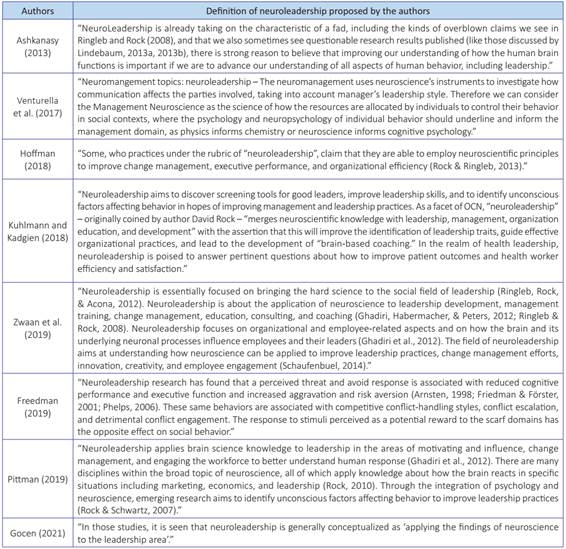
Box 5
A chronological view of the definitions of neuroleadership
Source: Elaborated by the authors.
From this research, we observe that the minority of the studies can be briefly summarized based on the definition of neuroleadership, as well as the benefits of using the neuroscience approach for managerial outcomes. In this context, we propose a framework (see Figure 7) grounding a neuroleadership agenda, which considers this a construct. This construct means that the process of neuroleadership begins with self-management by using neuroscience-based findings to develop leadership skills.
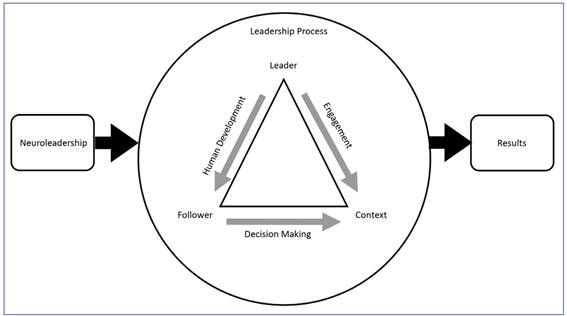
Figure 7
The neuroleadership process
Source: Elaborated by the authors.
Our framework reflects the process with a systemic view of neuroleadership. First, it suggests the idea that neuroleadership is more than a leadership style or tool for development. Then, we propose that neuroleadership is a construct. Following Adner (2017), we studied the relationship between constructs found in our bibliometric and thematic analysis. Van De Ven (2007, p. 113) reinforces the idea that “constructs are related to each other by propositions [...].” Thus, we can understand a construct as a latent variable that functions within a model or theory as an antecedent or consequent.
Antonakis et al. (2009) state that people are also influenced by context, even if they have some traits and preferences. So, the authors mention the correlation of leader, follower and context. Depending on some changes on these elements, the relation can be modified. In this sense, we define “neuroleadership” as a process that comprises leadership’s key elements, based on brain science, to better understand individual behavior. By integrating human development, engagement, and decision-making, professionals can achieve better results and enhance organizational culture. This insight means that, by practicing neuroleadership in organizations, we can leverage individuals, teams, and business results. Thus, we agree with Carton (2022, p. 61) that our framework can be useful for future research in a more structured way and may provide some new direction to scholars in defining their studies “within the landscape of leadership research.”
Then, the neuroleadership process means that leaders can influence followers to make some decisions according to some common direction, and, at the same time, leaders and followers can change their mindset depending on the context. More than that, once leaders are more conscious about their strengths and weaknesses, they can establish positive communication with their followers and improve it when necessary. Once followers validate their leaders’ ideas and attitudes, they start connecting with their leaders, and this positive relationship stimulates high engagement levels, through emotionally connections (Kahn, 1990). And in this case, both leader and follower can work in a more aligned way, and it facilitates the decisions making and execution.
Additionally, we put forward four propositions:
P1: human development is the first step to increasing self-skills and influencing others’ improvement capabilities.
Holt and Ladwa (2009) argue that new discoveries in neuroscience have strongly improved our comprehension of the brain’s neural pathways and how to manage relationships with other people. Thus, once professionals learn how to modulate their emotions, this increases social intelligence and supports building relationships between leaders and followers (Hyland, 2013).
P2: self-management influences the engagement process between leaders and followers
Uncertainty causes fear messages in our brain because it is difficult to deal with ambiguity (Salati & Leoni, 2017). The alarm generated when we feel we are losing control arouses cognitive and social resources, increasing stress and lowering defenses (Connors & Rende, 2018). This creates difficulties in dealing with situations of pressure. In short, considering the organizational context, managers have a fundamental role in maintaining a positive view of the future (Alcañiz et al., 2018). Thus, Salati and Leoni (2017) believe that it is important for leaders to be aware of how their emotions and actions impact team results.
P3: people with higher levels of self-management and engagement are more likely to make better decisions.
Wang (2021) asserts that brain functions execute decisions prior to visible behaviors. In this sense, emotions play a crucial role in decision-making. The higher the capacity to identify our own emotions and the emotions of others, the better individuals regulate their emotions and make wise decisions (Roberson, 2021). According to Cucino et al. (2021), decision-making is an important foundation of leadership. There are two dimensions of decision-making practices within leadership: an individual decision and how leaders engage their teams in collective decisions.
P4: neuroleadership can help achieve better results through a process that begins with human development, which allows increasing engagement and leveraging better decision-making.
Pittman (2019) states that boosting organizational results through biological knowledge about the workforce is valuable. While this is a relatively new field, with many questions still to be answered, it provides substantial insights into the inner workings of organizational culture and climate.
CONCLUSION
Neuroleadership is one of the expanding areas of interest for scholars and managers (Zwaan et al., 2019). The insights obtained from this integrative review enable us to provide a framework integrating current knowledge and offering a broad view of what neuroleadership is. The investigation provides three key contributions to the field of leadership and organizational management. Firstly, we organize the current and dispersed knowledge about our study theme in the systematic review. Our findings highlight the historical context of neuroscience applied in the leadership field, including opportunities and concerns. Secondly, the bibliometric and thematic review shows the main constructs used to investigate the contribution of neuroleadership. Secondly, this analysis allowed us to more broadly understand the current concerns, gaps, and opportunities in this area of knowledge. Thirdly, we proposed a framework for better explaining neuroleadership. The study shows the need to organize constructs and their relationships with the object of research in the organizational context.
Our literature review found some gaps regarding the application of neuroleadership in various business, context, and professional profiles. There are many opportunities for scholars to propose and test new tools and studies for developing leaders because most of the theoretical and experimental studies are produced in the USA and UK and a high percentage of these studies are still essaying rather than empirical propositions. From our bibliometric analysis, we see that the literature still contains gaps in terms of linking constructs and their relationships and impacts on leaders, teams, and organizations. Another gap is indicated by the few studies proposing models and frameworks.
This research opens paths for new studies. Based on our findings, we highlight certain paths toward the development of future research:
-
Studies should include experiments that allow scholars to extend data and design new tools for human development based on the neuroleadership concept.
-
Studies should continue developing our findings and framework, as well as empirically testing the propositions that we brought to light.
-
More studies should be based on field experiments with professional participants to establish well-founded causal relationships while increasing external validity.
-
Longitudinal studies should verify whether different neuroleadership frameworks are relevant to different cultures.
-
Studies should also propose new tools by using neuroscience insights to build new leadership capabilities.
The managerial implications of this study address the integrative review of current literature about neuroleadership, suggesting the possibility of proposing training techniques and communication models for leaders and influencers based on an understanding of how the engagement process occurs in followers. Also, this study aimed to ensure that the leaders and professionals related to human development support this understanding and relay it to the broader business.
Although the USA and the UK are still the main suppliers of research in the field, there is accelerated growth in the participation of Eastern countries in the production of knowledge about neuroleadership. Future analyses may include a wider search in non-indexed journals, books, and theses. Additionally, we did not include studies I languages other than English. For the next research agenda, it is important to use different methods to test the academic contribution proposed in empirical works. Additionally, scholars may continue improving and/or debating our theoretical proposition.
This study has certain limitations. The first concerns the sample being gathered from one database. Although we used further reading to increase the information in the theoretical background section, the database may have omitted relevant publications or issues. In addition, the filtering criteria may also have missed relevant research. The second concerns the fact of neuroleadership is a recent phenomenon. In this sense, researchers are still adding to the empirical literature. That is why I also agree with Lindebaum and Zundel (2013) in thinking that neuroscience will continue to significantly influence the research agenda in leadership and elsewhere.
REFERENCES
Adner, R. (2017). Ecosystem as structure: an actionable construct for strategy. Journal of Management, 43(1), 39-58. Retrieved fromhttps://doi.org/10.1177/0149206316678451
Alcañiz, M., Parra, E., & Giglioli, I. A. C. (2018). Virtual reality as an emerging methodology for leadership assessment and training. Frontiers in Psychology, 9, 301393. Retrieved fromhttps://doi.org/10.3389/fpsyg.2018.01658
Antonakis, J., Ashkanasy, N. M., & Dasborough, M. T. (2009). Does leadership need emotional intelligence? Leadership Quarterly, 20(2), 247-261. Retrieved fromhttps://doi.org/10.1016/j.leaqua.2009.01.006
Arnsten, A. F. T. (1998). The biology of being frazzled. Science, 280(5370), 1711-1712. Retrieved fromhttps://doi.org/10.1126/science.280.5370.1711
Ashkanasy, N. M. (2013). Neuroscience and leadership: take care not to throw the baby out with the bathwater. Journal of Management Inquiry, 22(3), 311-313. Retrieved fromhttps://doi.org/10.1177/1056492613478519
Balconi, M., Cassioli, F., Fronda, G., & Vanutelli, M. E. (2019). Cooperative leadership in hyperscanning. Brain and body synchrony during manager-employee interactions. Neuropsychological Trends, 26, 23-44. Retrieved fromhttps://doi.org/10.7358/neur-2019-026-bal2
Balthazard, P. A., Waldman, D. A., Thatcher, R. W., & Hannah, S. T. (2012). Differentiating transformational and non-transformational leaders on the basis of neurological imaging. Leadership Quarterly, 23(2), 244-258. Retrieved fromhttps://doi.org/10.1016/j.leaqua.2011.08.002
Bar-On, R., Tranel, D., Denburg, N. L., & Bechara, A. (2005). Exploring the neurological substrate of emotional and social intelligence. In J. T. Cacioppo, & G. G. Bernston(Eds.), Key readings in social psychology: social neuroscience (pp. 223-237). New York, NY: Psychology Press.
Becker, W. J., & Cropanzano R. (2010). Organizational neuroscience: the promise and prospects of an emerging discipline. Journal of Organizational Behavior, 31(7), 1055-1059. Retrieved fromhttps://doi.org/10.1002/job.668
Bennet, D., & Bennet, A. (2008). Engaging tacit knowledge in support of organizational learning. VINE, 38(1), 72-94. Retrieved fromhttps://doi.org/10.1108/03055720810870905
Bennett, J. I., Handa, K., Mahajan, A., & Deotale, P. (2014). Psychiatry chief resident opinions toward basic and clinical neuroscience training and practice. Academic Psychiatry, 38(2), 141-144. Retrieved fromhttps://doi.org/10.1007/s40596-014-0052-8
Boyatzis, R. E., Passarelli, A. M., Koenig, K., Lowe, M., Mathew, B., Stoller, J. K., Phillips, M. (2012). Examination of the neural substrates activated in memories of experiences with resonant and dissonant leaders. Leadership Quarterly, 23(2), 259-272. Retrieved fromhttps://doi.org/10.1016/j.leaqua.2011.08.003
Boyatzis, R. E., Rochford, K., & Jack, A. I. (2014). Antagonistic neural networks underlying differentiated leadership roles. Frontiers in Human Neuroscience, 8, 79428. Retrieved fromhttps://doi.org/10.3389/fnhum.2014.00114
Boyatzis, R. E., Smith, M. L., & Blaize, N. (2006). Developing sustainable leaders through coaching and compassion. Academy of Management Learning & Education, 5(1), 8-24. Retrieved fromhttps://doi.org/10.5465/AMLE.2006.20388381
Calabrese, R. L., & Roberts, B. (2002). Character, school leadership, and the brain: learning how to integrate knowledge with behavioral change. International Journal of Educational Management, 16(5), 229-238. Retrieved fromhttps://doi.org/10.1108/09513540210434603
Capozzi, F., Beyan, C., Pierro, A., Koul, A., Murino, V., Livi, S., Becchio, C. (2019). Tracking the leader: gaze behavior in group interactions. iScience, 16, 242-249. Retrieved fromhttps://doi.org/10.1016/j.isci.2019.05.035
Carton, A. M. (2022). The science of leadership: a theoretical model and research agenda. Annual Review of Organizational Psychology and Organizational Behavior, 9, 61-93. Retrieved fromhttps://doi.org/10.1146/annurev-orgpsych-012420-091227
Connors, B. L., & Rende, R. (2018). Embodied decision-making style: below and beyond cognition. Frontiers in Psychology, 9, 348035. Retrieved fromhttps://doi.org/10.3389/fpsyg.2018.01123
Cooper, R. K. (2000). A new neuroscience of leadership: bringing out more of the best in people. Strategy & Leadership, 28(6), 11-15. Retrieved fromhttps://doi.org/10.1108/10878570010694365
Creswell, J. W. (2013). Qualitative inquiry and research design. Choosing among five approaches(3a ed.). London, UK: SAGE Publications.
Cropanzano R., & Becker W. J. (2013). The promise and peril of organizational neuroscience: today and tomorrow. Journal of Management Inquiry, 22(3) 306-310. Retrieved from https://doi.org/10.1177/1056492613478518
Cucino, V., Passarelli, M., Di Minin, A., & Cariola, A. (2021). Neuroscience approach for management and entrepreneurship: a bibliometric analysis. European Journal of Innovation Management, 25(6), 295-319. Retrieved fromhttps://doi.org/10.1108/EJIM-01-2021-0015
Demerath, P. (2018). The emotional ecology of school improvement culture: charged meanings and common moral purpose. Journal of Educational Administration, 56(5), 488-503. Retrieved fromhttps://doi.org/10.1108/JEA-01-2018-0014
Dobbins, I., & Han, S. (2006). Cue- versus probe-dependent prefrontal cortex activity during contextual remembering. Journal of Cognitive Neuroscience, 18(9), 1439-1452. Retrieved fromhttps://doi.org/10.1162/jocn.2006.18.9.1439
Eichinger, R. W. (2018). Should we get aboard the brain train? Consulting Psychology Journal, 70(1), 89-94. Retrieved fromhttps://doi.org/10.1037/cpb0000107
Eom, S. B. (2009). Author cocitation analysis: quantitative methods for mapping the intellectual structure of an academic discipline. Hershey, PA: Information Science.
Ezzat, H., Camarda, A., Cassotti, M., Agogué, M., Houdé, O., Weil, B., Masson, P. L. (2017). How minimal executive feedback influences creative idea generation. PLOS ONE, 12(6), e0180458. Retrieved fromhttps://doi.org/10.1371/journal.pone.0180458
Ferreira, F. A. F. (2018). Mapping the field of arts-based management: bibliographic coupling and co-citation analyses. Journal of Business Research, 85, 348-357. Retrieved fromhttps://doi.org/10.1016/j.jbusres.2017.03.026
Figueiredo, J. A. L., Chimenti, P., Cavazotte, F., & Abelha, D. (2022). Uma década de pesquisas sobre liderança e seus efeitos na criatividade-inovação: uma revisão sistemática e narrativa da literatura. Revista Brasileira de Gestão de Negócios, 24(1), 66-91. Retrieved fromhttps://doi.org/10.7819/rbgn.v24i1.4151
Finkelstein, S., Whitehead, J., & Campbell, A. (2009). The illusion of smart decision making: the past is not prologue. Journal of Business Strategy, 30(6), 36-43. Retrieved fromhttps://doi.org/10.1108/02756660911003103
Freedman, B. D. (2019). Risk factors and causes of interpersonal conflict in nursing workplaces: understandings from neuroscience. Collegian, 26(5), 594-604. Retrieved fromhttps://doi.org/10.1016/j.colegn.2019.02.001
Friedman, R. S., & Förster, J. (2001). The effects of promotion and prevention cues on creativity. Journal of Personality and Social Psychology, 81(6), 1001-1013. Retrieved fromhttp://dx.doi.org/10.1037/0022-3514.81.6.1001
Ghadiri, A., Habermacher, A., & Peters, T. (2012). Neuroleadership: a journey through the brain for business leaders. Berlin, Heidelberg: Springer.
Glänzel, W., & Czerwon, H. J. (1996). A new methodological approach to bibliographic coupling and its application to the national, regional and institutional level. Scientometrics, 37(2), 195-221. Retrieved fromhttps://doi.org/10.1007/BF02093621
Gocen, A. (2021). Neuroleadership: a conceptual analysis and educational implications. International Journal of Education in Mathematics, Science and Technology, 9(1), 63-82. Retrieved fromhttps://doi.org/10.46328/ijemst.1237
Good, D., & Michel, E. J. (2013). Individual ambidexterity: exploring and exploiting in dynamic contexts. Journal of Psychology: Interdisciplinary and Applied, 147(5), 435-453. Retrieved fromhttps://doi.org/10.1080/00223980.2012.710663
Hamilton, W. D. (1964). The genetical evolution of social behavior. Journal of Theoretical Biology, 7(1), 1-16. Retrieved fromhttps://doi.org/10.1016/0022-5193(64)90038-4
Hannah, S. T., Balthazard, P. A., Waldman, D. A., Jennings, P. L., & Thatcher, R. W. (2013). The psychological and neurological bases of leader self-complexity and effects on adaptive decision-making. Journal of Applied Psychology, 98(3), 393-411. Retrieved fromhttps://doi.org/10.1037/a0032257
Healey, M. P., & Hodgkinson, G. P. (2014). Rethinking the philosophical and theoretical foundations of organizational neuroscience: a critical realist alternative. Human Relations, 67(7), 765-792. Retrieved fromhttps://doi.org/10.1177/0018726714530014
Hoffman, T. (2018). Neuropsychoanalysis and executive consultation: know your mind, it’s the royal road to leadership. Organizational and Social Dynamics, 18(1), 62-77.
Holt, V. P., & Ladwa R. (2009). Mentoring. a quality assurance tool for dentists part 5: the roots of the modern approach to mentoring and coaching. Primary Dental Journal, 16(4), 157-163. Retrieved fromhttps://doi.org/10.1308/135576109789389469
Hughes, D. J., Lee, A., Tian, A. W., Newman, A., & Legood, A. (2018). Leadership, creativity, and innovation: a critical review and practical recommendations. The Leadership Quarterly, 29(5), 549-569. Retrieved fromhttps://doi.org/10.1016/j.leaqua.2018.03.001
Hyland, C. (2013). Building thinking, feeling and knowing teams. Industrial and Commercial Training, 45(6), 359-361. Retrieved fromhttps://doi.org/10.1108/ICT-03-2013-0019
Illes, J., De Vries, R., Cho, M. K., & Schraedley-Desmond, P. (2006). ELSI priorities for brain imaging. The American Journal of Bioethics, 6(2), W24-W31. Retrieved fromhttps://doi.org/10.1080/15265160500506274
Jiang, J., Chen, C., Dai, B., Shi, G., Ding, G., Liu, L., … Fiske, S. T. (2015). Leader emergence through interpersonal neural synchronization. Proceedings of the National Academy of Sciences of the United States of America, 112(14), 4274-4279. Retrieved fromhttps://doi.org/10.1073/pnas.1422930112
Kahn, W. A. (1990). Psychological conditions of personal engagement and disengagement at work. Academy of Management Journal, 33(4), 692-724. Retrieved fromhttps://doi.org/10.2307/256287
Kramer, R. (2016). From skillset to mindset: a new paradigm for leader development. Public Administration Issues, 5, 26-45. Retrieved fromhttps://doi.org/10.17323/1999-5431-2016-0-5-26-45
Kuhlmann, N., & Kadgien, C. A. (2018). Neuroleadership: themes and limitations of an emerging interdisciplinary field. Healthcare Management Forum, 31(3), 103-107. Retrieved fromhttps://doi.org/10.1177/0840470417747004
Kumar, H., & Raghavendran, S. (2013). Not by money alone: the emotional wallet and talent management. Journal of Business Strategy, 34(3), 16-23. Retrieved fromhttps://doi.org/10.1108/JBS-11-2012-0073
Lawrence, P. R., & Pirson, M. (2015). Economistic and humanistic narratives of leadership in the age of globality: toward a renewed Darwinian theory of leadership. Journal of Business Ethics, 128(2), 383-394. Retrieved fromhttps://doi.org/10.1007/s10551-014-2090-2
Lerer, B. (2018). From Freud to biology, from genes to medicines: a 40 year perspective. Israel Journal ofPsychiatry, 55(3), 65-71. Retrieved from https://cdn.doctorsonly.co.il/2019/02/11_From-Freud-to-Biology.pdf
Lieberman, M. D., & Eisenberger, N. I. (2009). Pains and pleasure of social life. Science, 323(5916), 890-891. Retrieved fromhttps://doi.org/10.1126/science.1170008
Liebowitz, J., Chan, Y., Jenkin, T., Spicker, D., Paliszkiewicz, J., & Babiloni, F. (2019). If numbers could “feel”: how well do executives trust their intuition? VINE, 49(4), 531-545. Retrieved fromhttps://doi.org/10.1108/VJIKMS-12-2018-0129
Lindebaum, D. (2013a). Ethics and the neuroscientific study of leadership: a synthesis and rejoinder to Ashkanasy, Cropanzano, and Becker, and McLagan. Journal of Management Inquiry, 22(3), 317-323. Retrieved fromhttps://doi.org/10.1177/1056492613478515
Lindebaum, D. (2013b). Pathologizing the healthy but ineffective: some ethical reflections on using neuroscience in leadership research. Journal of Management Inquiry, 22(3), 295-305. Retrieved fromhttps://doi.org/10.1177/1056492612462766
Lindebaum, D., & Cartwright, S. (2010). A critical examination of the relationship between emotional intelligence and transformational leadership. Journal of Management Studies, 47(7), 1317-1342. Retrieved fromhttps://doi.org/10.1111/j.1467-6486.2010.00933.x
Lindebaum, D., & Zundel, M. (2013). Not quite a revolution: scrutinizing organizational neuroscience in leadership studies. Human Relations, 66(6), 857-877. Retrieved fromhttps://doi.org/10.1177/0018726713482151
Lingelbach, D. C. (2020). No peace, no rest: paying more attention to actors at the wealth-power nexus. Journal of Management Inquiry, 29(2), 236-239. Retrieved fromhttps://doi.org/10.1177/1056492619866259
Massaro, S. (2015). Neurofeedback in the workplace: from neurorehabilitation hope to neuroleadership hype? International Journal of Rehabilitation Research, 38(3), 276-278. Retrieved fromhttps://doi.org/10.1097/MRR.0000000000000119
Mojtahedi, K., Whitsell, B., Artemiadis, P., & Santello, M. (2017). Communication and inference of intended movement direction during human-human physical interaction. Frontiers in Neurorobotics, 11, 234311. Retrieved fromhttps://doi.org/10.3389/fnbot.2017.00021
Molenberghs, P., Prochilo, G., Steffens, N. K., Zacher, H., & Haslam, S. A. (2017). The neuroscience of inspirational leadership: the importance of collective-oriented language and shared group membership. Journal of Management, 43(7), 2168-2194. Retrieved fromhttps://doi.org/10.1177/0149206314565242
Mom, T. J. M., Van Den Bosch, F. A. J., & Volberda, H. W. (2009). Understanding variation in managers’ ambidexterity: investigating direct and interaction effects of formal structural and personal coordination mechanisms. Organization Science, 20(4), 685-834. Retrieved fromhttps://doi.org/10.1287/orsc.1090.0427
Moore, J. W. (2010). A personal view of the early development of computational neuroscience in the USA. Frontiers in Computational Neuroscience, 4, 1492. Retrieved fromhttps://doi.org/10.3389/fncom.2010.00020
Okhuysen, G., & Bonardi, J. P. (2011). Editor’s comments: the challenges of building theory by combining lenses. Academy of Management Review, 36(1), 6-11. Retrieved fromhttps://doi.org/10.5465/amr.36.1.zok006
Phelps, E. A. (2006). Emotion and cognition: insights from studies of the human amygdala. Annual Review of Psychology, 57, 27-53. Retrieved fromhttps://doi.org/10.1146/annurev.psych.56.091103.070234
Pittman, A. (2019). Leadership rebooted: cultivating trust with the brain in mind. Human Service Organizations Management, Leadership and Governance, 44(2), 127-143. Retrieved fromhttps://doi.org/10.1080/23303131.2019.1696910
Raichle, M. E., MacLeod, A. M., Snyder, A. Z., Powers, W. J., Gusnard, D. A., & Shulman, G. L. (2001). A default mode of brain function. Proceedings of the National Academy of Sciences of the United States of America, 98(2) 676-682. Retrieved fromhttps://doi.org/10.1073/pnas.98.2.676
Rall, J. (2015). Mind Full. Recent brain research offers intriguing insights into leadership and decision-making. State Legislatures, 41(7), 34-37.
Riddell, P. M. (2017). Reward and threat in the adolescent brain: implications for leadership development. Leadership and Organization Development Journal, 38(4), 530-548. Retrieved fromhttps://doi.org/10.1108/LODJ-03-2015-0062
Ringleb, A., & Rock, D. (2008). The emerging field of neuroleadership. NeuroLeadership Journal, 1, 3-19.
Ringleb, A. H., Rock, D., & Ancona, C. (2012). NeuroLeadership in 2011 and 2012. NeuroLeadership Journal, 4, 5-39.
Riva, G., Wiederhold, B. K., & Mantovani, F. (2021). Surviving COVID-19: the neuroscience of smart working and distance learning. Cyberpsychology, Behavior, and Social Networking, 24(2), 79-85. Retrieved fromhttps://doi.org/10.1089/cyber.2021.0009
Roberson, K. (2021). North star decision making. Journal of Library Administration, 61(8), 1028-1033. Retrieved fromhttps://doi.org/10.1080/01930826.2021.1984149
Rochford, K. C., Jack, A. I., Boyatzis, R. E., & French, S. E. (2017). Ethical leadership as a balance between opposing neural networks. Journal of Business Ethics, 144(4), 755-770. Retrieved fromhttps://doi.org/10.1007/s10551-016-3264-x
Rock, D. (2010). Impacting leadership with neuroscience. People and Strategy, 33(4), 6-7.
Rock, D. (2018). A neuroscience-based approach to changing organizational behaviour. Healthcare Management Forum, 31(3), 77-80. Retrieved fromhttps://doi.org/10.1177/0840470417753968
Rock, D., & Ringleb, A. H. (2013). Handbook of Neuroleadership. New York, NY: NeuroLeadership Institute.
Rock D., & Schwartz, J. (2007). The neuroscience of leadership. Reclaiming Children and Youth, 16(3), 10-17. Retrieved fromhttps://doi.org/10.1111/ijmr.12071
Salati, M. E., & Leoni, A. (2017). Neuroscience within companies: some case studies. Neuropsychological Trends, 21(1), 23-33. Retrieved fromhttps://doi.org/10.7358/neur-2017-021-sala
Saldanha, J. (2009). The coding manual for qualitative researchers. London, UK: SAGE Publications .
Scarlett, H. (2016). Why every organization needs to become more brain-savvy. Development and Learning in Organizations, 30(5), 11-13. Retrieved fromhttps://doi.org/10.1108/DLO-03-2016-0031
Schaufenbuel, K. (2014). Bringing mindfulness to the workplace. Chapel Hill, NC: UNC Kenan-Flagler Business School.
Schor, N. F. (2014). Pursuit and achievement of leadership: a view from the top. Annals of Neurology, 76(6), 784-788. Retrieved fromhttps://doi.org/10.1002/ana.24290
Senior, C., & Lee, N. (2013). The state of the art in organizational cognitive neuroscience: the therapeutic gap and possible implications for clinical practice. Frontiers in Human Neuroscience, 7, 56810. Retrieved fromhttps://doi.org/10.3389/fnhum.2013.00808
Sivarajah, U., Kamal, M., Irani, Z., & Weerakkody, V. (2017). Critical analysis of big data challenges and analytical methods. Journal of Business Research, 70, 263-286. Retrieved fromhttps://doi.org/10.1016/j.jbusres.2016.08.001
Snaebjornsson, I. M., & Vaiciukynaite, E. (2016). Emotion contagion in leadership: followercentric approach. Business and Economic Horizons, 12(2), 53-62. Retrieved fromhttps://doi.org/10.15208/beh.2016.05
Snyder, H. (2019). Literature review as a research methodology: an overview and guidelines. Journal of Business Research, 104, 333-339. Retrieved fromhttps://doi.org/10.1016/j.jbusres.2019.07.039
Stevens, R. H., Galloway, T., Berka, C., & Sprang, M. (2009). Can neurophysiologic synchronies provide a platform for adapting team performance? In D. D. Schmorrow, I. V. Estabrooke, & M. Grootjen (Eds.), Foundations of augmented cognition: neuroergonomics and operational neuroscience (Vol. 5638, pp. 658-667). Berlin, Heidelberg: Springer .
Stroop, J. R. (1935). Studies of interference in serial verbal reactions. Journal of Experimental Psychology, 18(6), 643-662. Retrieved fromhttps://doi.org/10.1037/h0054651
Teece, D. J., Pisano, G., & Shuen, A. (1997). Dynamic capabilities and strategic management. Strategic Management Journal, 18(7), 509-533. Retrieved fromhttps://doi.org/10.1002/(SICI)1097-0266(199708)18:7<509::AID-SMJ882>3.0.CO;2-Z
Tranfield, D., Denyer, D., & Smart, P. (2003). Towards a methodology for developing evidence-informed management knowledge by means of systematic review. British Journal of Management, 14, 207-222. Retrieved fromhttps://doi.org/10.1111/1467-8551.00375
Trichas, S., Schyns, B., Lord, R., & Hall, R. (2017). “Facing” leaders: facial expression and leadership perception. Leadership Quarterly, 28(2), 317-333. Retrieved fromhttps://doi.org/10.1016/j.leaqua.2016.10.013
Van De Ven, A. H. (2007). Engaged scholarship: a guide for organizational and social research. Oxford, UK: Oxford University Press
Van Vugt, M., & Von Rueden, C. R. (2020). From genes to minds to cultures: evolutionary approaches to leadership. Leadership Quarterly, 31(2) , 101404. Retrieved fromhttps://doi.org/10.1016/j.leaqua.2020.101404
Venturella, I., Gatti, L., Vanutelli, M. E., & Balconi, M. (2017). When brains dialogue by synchronized or unsynchronized languages. Hyperscanning applications to neuromanagement. Neuropsychological Trends, 21(1), 35-51. Retrieved fromhttps://doi.org/10.7358/neur-2017-021-vent
Waldman, D. A., Balthazard, P. A., & Peterson, S. J. (2011). Social cognitive neuroscience and leadership. Leadership Quarterly, 22(6), 1092-1106. Retrieved fromhttps://doi.org/10.1016/j.leaqua.2011.09.005
Waldman, D. A., Wang, D., Hannah, S. T., & Balthazard, P. A. (2017). A neurological and ideological perspective of ethical leadership. Academy of Management Journal, 60(4), 1285-1306. Retrieved fromhttps://doi.org/10.5465/amj.2014.0644
Waller, L., Reitz, M., Poole, E., Riddell, P. M., & Muir, A. (2017). Experiential learning as preparation for leadership: an exploration of the cognitive and physiological processes. Leadership and Organization Development Journal, 38(4), 513-529. Retrieved fromhttps://doi.org/10.1108/LODJ-03-2015-0057
Wang, Y. (2021). What is the role of emotions in educational leaders’ decision making? Proposing an organizing framework. Educational Administration Quarterly, 57(3), 372-402. Retrieved fromhttps://doi.org/10.1177/0013161X20938856
Watts, D. J., & Strogatz, S. H. (1998). Collective dynamics of small-world networks. Nature, 393, 440-442. Retrieved fromhttps://doi.org/10.1038/30918
Wolfe, P., & Brandt, R. (1998). What do we know from brain research? Educational Leadership, 56(3), 8-13 Retrieved from https://www.ascd.org/el/articles/what-do-we-know-from-brain-research
Wong, G., Greenhalgh, T., Westhorp, G., Buckingham, J., & Pawson, R. (2013). RAMESES publication standards: Meta-narrative reviews. BMC Medicine, 11, 20. Retrieved fromhttps://doi.org/10.1186/1741-7015-11-20
Wray, C. (2017). A proposed new psychological model for judgement and decision-making: Integrating the tri-partite model with hemispheric difference. Leadership and Organization Development Journal, 38(4), 549-563. Retrieved fromhttps://doi.org/10.1108/LODJ-06-2015-0120
Yukl, G., & Van Fleet, D. D. (1990). Theory and research on leadership in organizations. In M. D. Dunnette, & L. M. Hough (Eds.), Handbook of industrial & organizational psychology(2a ed.). Palo Alto, CA: Consulting Psychologists Press.
Zak, P. J. (2017). The neuroscience of trust. Harvard Business Review. Retrieved from https://hbr.org/2017/01/the-neuroscience-of-trust
Zwaan, L. A., Viljoen, R., & Aiken, D. (2019). The role of neuroleadership in work engagement. SA Journal of Human Resource Management, 17, a1172Retrieved fromhttps://doi.org/10.4102/sajhrm.v17i0.1172
APPEDIX
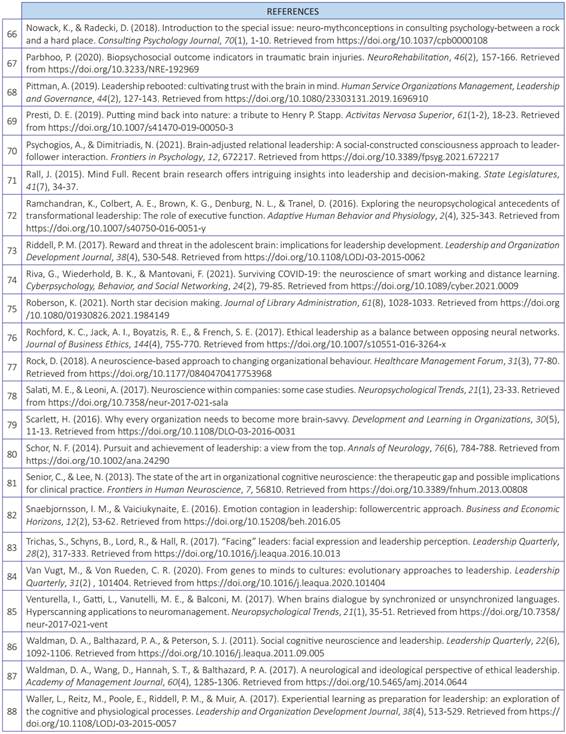
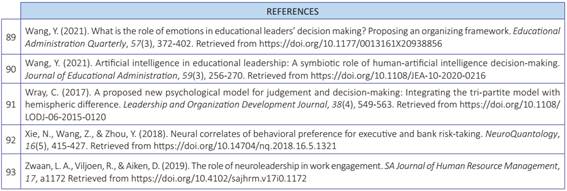
References used as the object of this review (93 papers)
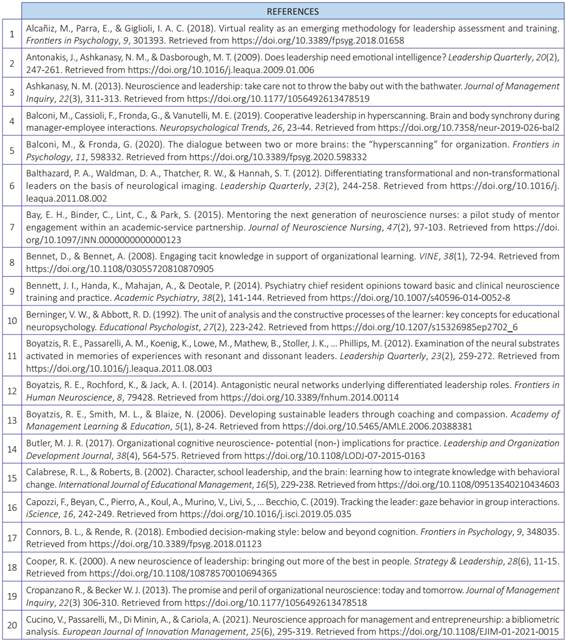
Box A
References used in the paper analysis
Source: Elaborated by the authors.
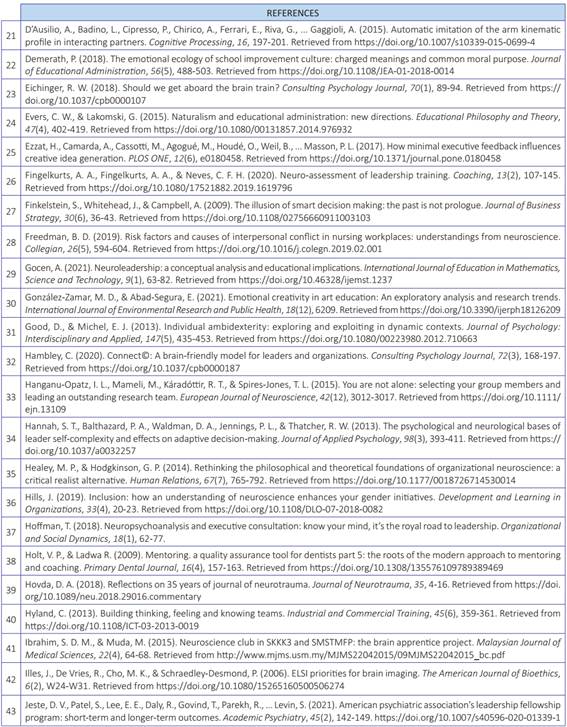
Box A
continuation
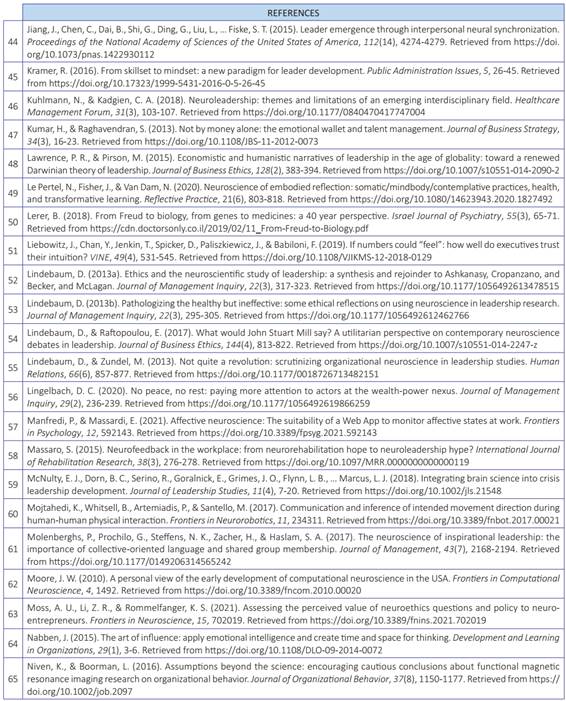
Box A
continuation
Box A
continuation
Box A
continuation
Notes
Author notes