ARTICLE
Received: 04 February 2023
Accepted: 08 May 2023
DOI: https://doi.org/10.1590/1679-395120230032x
Abstract: The aim of the current study is to assess how fans structure their fannish based on discussions about the insertion of political agendas in media products, which is a recurring behavior observed in the entertainment industry in recent times. Based on the analysis of Star Wars fan’s interactions about the recent introduction of characters representing political identities in the saga, the study addressed the Foucauldian concept of subjectivation through the manifestation of truths, by adopting his archaeogenealogical method. Two moral agencies resulted from this analysis, namely: the innovation evaluated by Star Wars fans concerning the insertion of new representative characters in the saga and the adequacy such changes need to meet, although remaining in compliance with the established form of the saga canon. Both agencies reflect the concern with maintaining the franchise’s status quo rather than with the political agenda. The current study has evaluated the courage to tell the truth as a cynical practice committed to perpetuate its own subjectivity by ruling other truths.
Keywords: Fannish, Subjectivity, Cynicism, Archeogenealogy, Star Wars.
Resumo: O objetivo do presente estudo é avaliar como os fãs estruturam sua fanidade a partir de discussões sobre a inserção de pautas políticas em produtos midiáticos, uma ação recorrente observada na indústria do entretenimento nos últimos tempos. A partir da análise das interações dos fãs de Star Wars sobre a recente introdução de personagens que representam identidades políticas na saga, o estudo abordou o conceito foucaultiano de subjetivação por meio da manifestação de verdades, adotando seu método arqueogenealógico. Dessa análise resultaram dois agenciamentos morais, a saber: a inovação avaliada pelos fãs de Star Wars quanto à inserção de novos personagens representativos na saga e a adequação que tais mudanças precisam atender, embora mantendo-se em conformidade com a forma estabelecida do cânone da saga. Ambas as agências refletem a preocupação com a manutenção do status quo da franquia e não com a agenda política. O presente estudo avaliou a coragem de dizer a verdade como uma prática cínica empenhada em perpetuar sua própria subjetividade ao reger outras verdades.
Palavras-chave: Fanidade, Subjetividade, Cinismo, Arqueogenealogia, Star Wars.
Resumen: El objetivo del presente estudio es evaluar cómo los fans estructuran su condición a partir de discusiones sobre la inserción de agendas políticas en los productos mediáticos, que es un comportamiento recurrente observado en la industria del entretenimiento en los últimos tiempos. Con base en el análisis de las interacciones de los fanes de Star Wars sobre la reciente introducción de personajes que representan identidades políticas en la saga, el estudio abordó el concepto foucaultiano de subjetivación a través de la manifestación de verdades, adoptando su método arqueogenealógico. Dos agenciamientos morales resultaron de este análisis, a saber: la innovación evaluada por los fanes de Star Wars en cuanto a la inserción de nuevos personajes representativos en la saga y la adecuación que dichos cambios deben cumplir, aunque permaneciendo en conformidad con la forma establecida del canon de la saga. Ambos agenciamientos reflejan la preocupación por mantener el statu quo de la franquicia más que por la agenda política. El presente estudio ha evaluado el coraje de decir la verdad como una práctica cínica comprometida con perpetuar su propia subjetividad al regir otras verdades.
Palabras clave: Fan, Subjetividad, Cinismo, Arqueogenealogía, Star Wars.
INTRODUCTION
Consumer practices can be interpreted as socio-cultural relationships taking place in distributed networks (Arnould & Thompson, 2015; Peñaloza & Mish, 2011), by overlapping social and marketing-related matters (Bardhi & Eckhardt, 2017; Kozinets et al., 2017). These interactions are strongly delimited by consumer subcultures (Schouten & McAlexander, 1995; Ulusoy & Firat, 2018), which tend to have strong influence on the very development of their participants’ identity (e.g., goths, hippies, surfers, fans) (Fuschillo, 2018; Kozinets, 2001).
Fans - defined as specialized consumers - have been investigated in consumer research as members of consumer tribes (B. Cova et al., 2007; Goulding et al., 2013) or of brand communities (Guschwan, 2012; Muñiz & O’Guinn, 2001; Yeritsian, 2021). Most recently, they were associated with prosumption because they collaborate with other marketing agents (Chen, 2021; Souza-Leão & Costa, 2018; Sugihartati, 2020) in their own consumption experience (Ay & Kaygan, 2022; Fuschillo, 2018; Seregina & Weijo, 2017).
Whatever the case is, fans are featured by their intense relationship with media products (e.g., music, sports, films, series), at high involvement and knowledge levels (Ay & Kaygan, 2022; Chen, 2021; Hewer et al., 2017), as well as with other fans and consumer communities that bring them together (i.e., fandoms) (Fuschillo, 2018; Guschwan, 2012; Kozinets & Jenkins, 2022). Both aspects indicate how their practices are constitutive of identity (Arsel & Thompson, 2011; B. Cova & V. Cova, 2012).
The last decades in the entertainment industry - which is the main producer and distributor of cultural objects consumed by fans (C. Hackley & A. R. Hackley, 2018) - were featured by the insertion of certain political identities (e.g., blacks, women, homosexuals) in pop culture and by the consequent discussions about this movement (Kozinets & Jenkins, 2022; Martin, 2019; Monaghan, 2021; Press & Liebes, 2016). This factor has had repercussions in productions by this industry and in its awards, which depict a process of changes in contemporary society (Cobb & Horeck, 2018; Kozinets & Jenkins, 2022; Molina-Guzmán, 2016). This process has encouraged a double fan movement, which encompassed both their interest in and engagement to such discussions (Martin, 2019; Monaghan, 2021) and their positioning against the insertion of political agendas in media products (Griffin, 2015). Since identity construction processes result from constant negotiation with other identities (Barnhart & Peñaloza, 2013; Hall, 1997; Maciel & Wallendorf, 2021), the emphasis on the recent discussion about political identities in products consumed by fans suggests that such positions may influence the very configuration of fan identity.
This process is guided by a knowledge set that is constantly perpetuated, contested and re-signified through consumer relations (Canniford & Karababa, 2013; Galvagno, 2011), and it underlies the elaboration of consumer identity projects as the elaboration of subjectivity (Cappellini et al., 2019; Jantzen et al., 2012; Nøjgaard & Bajde, 2021), based on Foucault’s theory. According to Foucault (2012a), conducts reflecting collective constructions of knowledge are the conditions enabling the production of subjectivities. Thus, becoming a subject is the outcome of an ethical work based on processes capable of producing truths (Foucault, 2003a, 2011).
This process can derive from the way consumers relate to the knowledge supporting their practices, by producing ethical conditions in the market context they are part of (Lehtokunnas et al., 2022; MacGregor et al., 2021; Zimmerman, 2020). In the case of fans, it is the consequence of how they relate, both epistemologically and socially, to media products consumed by them (Brennan, 2014; Fathallah, 2014). Thus, the aim of the current study was to investigate how fans structure their fannish based on discussions about the insertion of political agendas in media products.
In order to do so, it focused on the Star Wars franchise, which is one of the most famous franchises in the pop culture industry (Hills, 2003; Proctor, 2013) and which, recently, was centrally positioned in this process of transforming the entertainment industry into the representation of political identities (Brown, 2017). Its new movie trilogy has introduced leading characters representing women, blacks, Latinos and, potentially, homosexuals, a fact that led its fandom to discuss about the impact the introduction of these political identities would have on the franchise (Brown, 2017; Condis, 2014; Proctor, 2018). Thus, the present research has analyzed how Star Wars fans structure their fannish in light of the introduction of characters representing political identities in the saga.
The research justification endorses the validity of investigating the relationship between consumer identity projects to produce subjectivities beyond the market scope (Earley, 2013; Mikkonen, Moisander, & Fırat, 2011). It is an effort to apply the discussions of the cultural approach to consumer research about market relations functioning to support the elaboration, maintenance, and exercise of subjectivation (Camargo et al., 2021; Giesler & Veresiu, 2014; Lehtokunnas et al., 2022; Zwick & Dholakia, 2004). Nevertheless, the study is interested in contributing to understanding consumers’ subjectivity based on content and knowledge produced by media products associated with the entertainment industry (Addis & Holbrook, 2001; Denegri-Knott et al., 2018; Hackley, 2002; Wood & Ball, 2013). Broadly, it follows the suggestion to expand investigations of Consumer Culture Theory (CCT) (Arnould & Thompson, 2015; Holt, 2017) through Foucauldian contributions, either by accessing its theoretical concepts (Cavalcanti et al., 2021; Thompson, 2017) or by exploring its methodological approach (Brownlie et al., 2009; Souza-Leão et al., 2022; Thompson & Tian, 2008).
FAN SUBJECTIVITY PRODUCTION
Fans were introduced to consumer research by Kozinets (2001) as a consumer subculture, a specialized type of consumers who are highly engaged to the media products consumed by them (Numerato & Giulianotti, 2018; Sugihartati, 2020). Based on this perspective, fans are featured by their productive ability (Zajc, 2015) to form their own consumption experience (Seregina & Weijo, 2017) and, consequently, to establish a unique consumption identity forged through their interactions in communities known as fandoms (Chen, 2021; Souza-Leão & Costa, 2018).
Studies about fans have advanced based on the understanding of their insertion in participatory culture (Canavian, 2021; Chen, 2021; Fuschillo, 2018; Guschwan, 2012; Souza-Leão & Costa, 2018; Sugihartati, 2020). This perspective assumes that fans intensify their relationship with media products and with other fans based on the cultural convergence phenomenon (Jenkins, 2006). This phenomenon is largely catalyzed by the appropriation of available technologies, a fact that enables proactive consumption featured by fans’ ability to promote the product consumed by them (Guschwan, 2012) in a process that leads them to constantly reframe their consumption practices (Fuschillo, 2018; Kozinets & Jenkins, 2022).
This process can lead to both collaborations to and disagreements about media products and their own consumption practices (Goodman, 2015; Hewer, Gannon, & Cordina, 2017; Yeritsian, 2021). It is a movement capable of providing information to help producers to adapt their media products in order to reflect market changes (Chen, 2021; Fathallah, 2014).
Both positions reveal ways to legitimize fan consumption (Sugihartati, 2020; Ulusoy & Firat, 2018). It happens because fans often reframe their fannish by producing knowledge about media products in order to make their expectations and opinions about them public (Fathallah, 2014; Hills, 2017). Based on this perspective, they corroborate or oppose media texts accounting for the very confirmation of their fannish (Brennan, 2014; Goodman, 2015). The ability of fans to mobilize knowledge about media products is what enables them to establish their own fannish condition, which is outlined based on an authoritative discourse capable of positioning them before the market logic (Cavalcanti et al., 2021).
The way fans converge and debate about their fannish condition reveals the social ethics in which they recognize themselves as subjects through their relationships with their peers, media products, and the fandom they are part of (Fathallah, 2014; Jansen, 2020). According to Camargo et al. (2021), the intensity of the fans’ consumption relationship works as a beacon of behavior and political position since fans incorporate for themselves an aesthetic that represents their support or rejection of the content of the media products they consume.
This process can be seen in fan movements that indicate support to, or criticism of, transformations observed in the entertainment industry after the insertion of political representativeness in their productions (Griffin, 2015; Monaghan, 2021). The discussion held by Star Wars fans about the insertion of characters representative of political identities in the new phase of the fictional universe is an interesting example of this movement (Proctor, 2018; Wood et al., 2020). These discussions reflect, in a broader way, the indication by Kozinets (2001) that intense fan articulations lead fans to take social positions that go beyond consumption itself.
It happens because cultural practices established through consumption are the pillars used by consumers to build their subjectivities (Arnould & Thompson, 2015; Bardhi & Eckhardt, 2017). Thus, whenever consumers resort to market relations to elaborate their subjectivities (Veresiu et al., 2018; Zimmerman, 2020), they also create the conditions to establish and legitimize certain ways of life (Mikkonen et al. Firat, 2011). It happens because, in contemporary society, the knowledge individuals have about the context they live in is strongly influenced and legitimized by their consumption practices, and it leads them to produce the ethics ruling their existence (Lehtokunnas et al., 2022; Nøjgaard & Bajde, 2021).
SUBJECTIVATION THROUGH TRUTH-TELLING
According to Foucault (2012b), subjects are entities built through socio-historical processes of relationships between the exercise of power and knowledge production. These entities can result from objectification processes, whose institutionalized knowledge-power relations produce subjects, as well as from subjectification processes, whose subjects produce themselves through self-government. This process takes place through an ethical work, based on which subjects relate and are subject to different truths that underlie their existence (Foucault, 2010). Therefore, subjectivity derives from truths that allow subjects to know and recognize themselves in the world through social positions taken before others and themselves (Foucault, 2011).
The truths are intimately the production of knowledge that preserve social practices such as consumption. In the wonder, the truths propagated and resignified by consumers are interpreted as beacons for the inclusion or exclusion of agencies that make up market intelligence (Zwick & Denegri-Knott, 2009). In the cultural approach of consumer research, it is highlighted that Foucault’s truths are fluid and negotiable, continuously elaborated by the subjects who utter them and the context in which they are uttered. Therefore, when consumers produce truths, they are demarcating the ontological conditions and norms that regulate the social context in which they live (Mikkonen et al., 2011; Thompson, 2017).
Consequently, these truths ground subjects in two different ways, namely: externally, through moralities observed in the forms of government and knowledge guiding them; and internally, by incorporating their wills (Foucault, 2011). Being able to meet, in a simultaneous and balanced way, one’s wills and the established moralities is precisely what makes it possible building ethical subjects (Foucault, 2012b) capable of elaborating subjective transformations (Foucault, 2014) based on the production and reproduction of the different truths ruling them (Foucault, 2003a). This balance is enabled by apatheia, a process through which ethical subjects control their passions based on their rationality (Foucault, 2012a).
Individuals’ relationship with truth can be understood as an existential path that does not end, since they continuously elaborate themselves, just as truths are formulated and reformulated in this process (Foucault, 2011). This process reflects how knowledge is continuously produced and becomes truths based on its usefulness to subjects (Besley & Peter, 2007). According to Deleuze (1988), truths are directed towards desires that mutate throughout the subjects’ existence and resistance.
According to Thompson et al. (2018), the elaboration of Foucauldian subjectivity and the exercise of resistance can be seen in how consumers negotiate their wills with moral and ethical precepts that guide their marketing practices. In the wonder, certain market narratives are treated as regimes of truth that lead consumers to align or not their position with what is considered ethical in the consumer ethos to which they are a member (Coskuner-Balli, 2020; Mikkonen & Bajde, 2013).
The incorporation of truths by subjects is what Foucault (2011) called veridication, which refers to the practice of playing games of truths, in which truths are validated against others; therefore, relating to truths allows subjects to know themselves, as well as the conditions enabling their relationship with the social world (Foucault, 2010). However, it does not mean that all truths are compatible; when truths about the same object do not agree, they start to postulate their own value at the expense of the truth of others (Foucault, 2003a).
Denegri-Knott and Tadajewski (2017) evoke the Foucauldian truth perspective as an interpretation of the need to position oneself in the face of market truths that leads consumers to produce their truths to be verified in the face of those that are pre-existing. The production of truths exercised by consumers is a commitment to themselves when they establish what is representative of them and indicate to their peers’ ways of manifesting through market relations (Cavalcanti et al., 2021; Mikkonen et al., 2011).
This is the reason why subjects’ relationship with truth is not established in an internal dimension. It is necessary telling the truth. This procedure is what Foucault (2014) calls alethurgy. The manifestation of truth by subjects both (re)affirms this truth for themselves and for others, and places it in dialogue with other truths, either to establish likely negotiations or necessary differences. However, this practice is far from being simple or easy, mainly due to its dialogical nature, since truth requires courage, both from those who tell it and from those who accept to listen to it.
This courage takes place through what Foucault (2005) calls parrhesia: i.e., the need of telling the truth candidly and, above all, freely; the commitment to what one believes, without resorting to false arguments or to attempts to persuade others. Only subjects who know the truth, and who are able to tell it, know themselves, which is the first step to rule themselves. It is about being committed to truth, which is evidenced in subjects’ self-care, that, in its turn, is a fundamental practice of building themselves as ethical subjects (Foucault, 2012b).
METHODOLOGICAL PROCEDURES
Considering the purpose and theoretical lens adopted in this investigation, the current study resorted to methodological contributions built by Foucault throughout his work. Such choice derives from Foucault’s proposal (2001) about his methodology being inseparable from the concepts investigated throughout his philosophical trajectory. Additionally, it is in line with recent marketing studies that explore how discursive, non-discursive, and self-practices are produced and exercised through market relations, but which are not limited to this context (Camargo et al., 2021; Denegri-Knott et al., 2018; Tadajewski & Jones, 2021).
If, on the one hand, Foucault (2001) has elaborated an archaeological method for his knowledge cycle, on the other hand, he has developed genealogical studies for his power and ethical subject cycles (Foucault, 2003a, 2012a). Just as Foucault’s own philosophy is about complementary constructions (Foucault, 2012a), Deleuze (1988) advocated that the Foucauldian methodological trail is a unique procedure aimed at addressing different practices (i.e., discursive, non-discursive and the self).
The Foucauldian analysis reveals institutionalized power relations in market competition through the actions of multiple agents, which is present in the discourses and conducts exercised by consumers (Thompson, 2017). No wonder Browlie et al. (2009) point out that the Foucauldian methodology allows investigation of how certain marketing knowledge is intrinsic to forms of consumer government, allowing the expansion of marketing theorization. Additionally, Thompson and Tian (2008) consider that the genealogical phase of Foucault’s methodology makes it possible to propose critical reflections that go beyond the production of marketing knowledge intrinsic to consumer behavior - i.e., popular memories -, allowing for discussion of how the hegemonic status is produced and maintained of certain social groupings.
Given the contiguity among methodological steps observed in Foucault’s research, its further approach was called Archeogenealogy, since the outcomes of each step are used as starting point for the next one (Paltrinieri, 2012). Consequently, Foucauldian analysis explores nuances of coexistence among consumers associated with producing truths, forms of government, and ethical consumer relations (Camargo et al., 2021; Tadajewski, 2011; Thompson et al., 2013). Thus, the following subsections present a brief explanation of the data collection, the systematization of the analytical procedures based on guidelines presented throughout Foucault’s work (2001, 2003a, 2006, 2012a, 2012b) and, an illustration with an example of how the collected data were analyzed as an adaption of Souza-Leão, Moura, and Nunes (2022) proposal to Foucauldian analysis for consumer research.
Data collection procedures
Foucault (2001) explains that his philosophical investigations use historical investigations to access present phenomena. The author points out that his methodological approach uses historical data as a means, not a purpose.
The Foucauldian methodology allows access to the conditions that produced contemporary practices and institutions - whether through discourses, conflicts, or exercises of the self (Garland, 2014). It is an approach that, for the study of marketing, allows an understanding of the historicity of a phenomenon and can be carried out by investigations that use data from the present when looking into the entire history of the present itself (Souza-Leão et al., 2022; Tadajewski, 2011). No wonder recent marketing research resorts to Foucauldian methodology to analyze data collected through ethnographic approaches (Camargo et al., 2021; Denegri-Knott et al., 2018).
Aligned with these researches, the present study adopts and adapts Kozinets (2019)’ proposals for collecting data on an online consumption ethos. TheForce.net, which is the biggest Star Wars online fandom, was herein analyzed as empirical locus. Among several topics available at the portal, the current study has focused on those dealing with fan discussions about transformations made in new productions of the franchise, such as the introduction of characters representative of political identities in the saga. This process resulted in the analysis of 24,459 messages published in 40 forum topics from March 2014 to May 2020.
Data analysis procedures
Foucault’s archeology focuses on discursive practices that enable knowledge production. Foucault (2001) has indicated the need of identifying statements converging into discursive formations, based on certain enunciative functions and discursive formation rules. Thus, discursive formations result from the archeology of knowledge; they are analyzed based on bundles of relations deriving from statements, which are identified through the signs composing discourses and their relations. This process highlights the actions of discourses, which concern the enunciative functions that, in their turn, show certain formation rules of the analyzed discourse.
The genealogy of power, in its turn, analyzes how discourses underlie the exercise of power, based on discursive practices, in order to analyze non-discursive practices (Foucault, 2003a, 2006). This process reveals operators that evidence power diagrams. Power operators are identified based on criteria constituting them (Foucault, 2006), namely: differentiation systems, which attest how different behaviors affect each other; types of objectives, which guide each exercise of power; instrumental modalities, which concern technologies capable of enabling the exercise of power; institutionalization forms, which refer to moralities that make it possible exercising power; and rationalization degrees, which indicate the likely scope of power relations.
The overlap of discursive practices over the non-discursive ones gives support to practices of self, which reveal the conditions accounting for building subjects (Paltrinieri, 2012). The analysis of the genealogy of the subject reveals subject-forms as consequence of power diagrams, based on moral agencies identified through certain criteria (Foucault, 2012a), namely: ethical substances, which indicate the ways subjects simultaneously meet the wills of self and moralities observed in their life; subjection modes, which reveal how different behaviors are seen based on the way subjects position themselves in the context they live in; the elaboration of ethical work, which reflects subjects’ effort to know themselves and to manifest this knowledge to others; and finally, the teleology of the moral subject, which addresses how subjects relate to truths produced by themselves and to those evoking the culture they are part of.
Illustration of Foucauldian analysis
In order to illustrate the analysis carried out, we highlight one message from TheForce.Net members that exemplify the inferences of the different archeogenealogy analytical stages. It is an adaptation of Souza-Leão et al. (2022) model to illustrate Foucauldian analysis to consumer research.
The highlighted message (see Figure 1) presents a comment from a fan that opens the topic called “How great to have a female lead!”, published in December 2015 to address the marketing and cultural importance of having a Female Jedi.
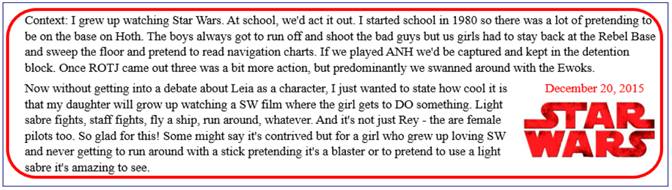
The highlighted message indicates that, despite having grown up as a female Star Wars fan, the female role until then was supporting. However, the paradigm shift in having the protagonist participate in battles on an equal basis with the male characters endorses an understanding grounded in the new generations: the Attack of Diversity.
This discursive formation results from concatenating statements, enunciative functions, and formation rules. Namely, in the highlighted discourse, it is possible to observe three statements: support for growth, celebration for the narrative, and expansion of the audience for the representativity in new productions. Both share the regularity transposed into two enunciative functions: supporting changes and pointing out opportunities. These functions indicate, respectively, that there are movements among fans who agree with the representation inclusions promoted in new productions and that new audiences demand these transformations. They are, therefore, analogous to the rule of formation of the propitious context, defined by the consideration that girls on her daughter’s age want and are interested in playing fights - e.g., Light saber fights, staff fights, flying a ship, running around, whatever.
When added to several other messages with similar content, it is possible to consider that the Attack of Diversity discursive formation is analogous to a Versatility power operator defended in the positioning of fans in the face of more representation in new Star Wars productions. Observing Figure 1, it is possible to understand that this power operator is present in the behavior of fans who seek to align their speech with the transformation (rationalization degree) operated in the saga. It is a trend-following exercise (instrumental modality) when the fandom incorporates the function of embracing marketing configuration (institutionalization form). They demand a coherent representation (objective type) associated with social representativeness (differentiation system). Therefore, they support the Fandom power diagram, advocating the importance of these changes for old - i.e., the mother - and possibly new fans - i.e., her daughter.
Considering the regularity of the messages that express the same position as the fans, it is possible to associate the Fandom power diagram with the Innovation moral agency. To understand this morality, it is possible to return to Figure 1. By proposing the topic in which the validity of Star Wars in having a female lead in new productions is discussed, the fan attests to her consideration for social demands (subjection mode). In this perspective, she preaches tolerance (ethical substance) by contextualizing her position, informing how she grew up as a female fan of the saga. When discussing future generations and mentioning her daughter, she highlights the obligation (teleology of the moral subject) that the fandom’s oldest members empathize (elaboration of ethical work) with the new audience coming from the changes operated in the new productions.
RESULTS DESCRIPTION
Data analysis enabled identifying a subject-form deriving from two moral agents, as shown in Figure 2. Results were herein presented based on these moral agents, starting from analytical categories (in bold) and from their constitutive criteria (in italics), which were reported in light of the empirical contexts evidenced in the analyzed data. In addition, data strata showing bundles of relations of each moral agent were used to illustrate the herein conducted analysis. Finally, such findings were interpreted based on Foucault’s theory.
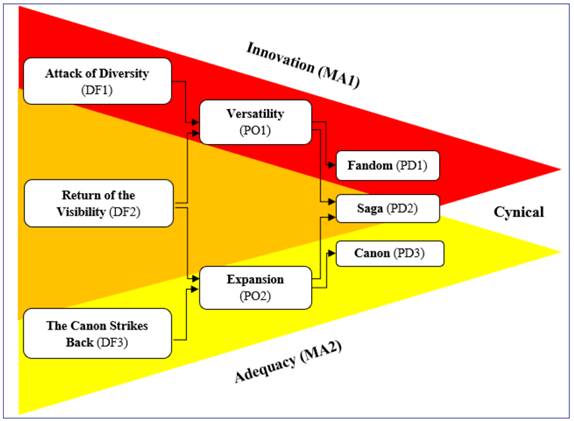
Figure 2
Analytical Map
Source: Elaborated by the authors.
Innovation
Innovation (MA1) refers to fans’ positive understanding about transformations made in the new Star Wars productions, such as the recent introduction of political representativeness in the saga. Based on such an understanding, fans consider that changes observed in the fictional universe reflect the demands of contemporary society and enable the entertainment industry to enrich the saga. This moral agency is based on an attitude of tolerance (ethical substance), which is seen as an obligation (teleology of the moral subject) of the new franchise to meet the new demands of pop culture. This basis is materialized through two strands. On the one hand, they align this position with respect to the canon (subjection mode) to enable the preservation (elaboration of ethical work) of features enshrining the saga. On the other hand, they show empathy (elaboration of ethical work) by attesting consideration to social demands (subjection mode).
These strands are linked to two power diagrams that point towards the way fans interact about consequences of having greater diversity in new productions of the fictional universe. In the first strand, the fandom (PD1) establishes how the introduction of characters representative of minorities affects relationships among fans. The Saga (PD2), in its turn, indicates that such changes enable expanding the positioning of the fictional universe in the entertainment industry.
Diagrams have the power operator that deals with the versatility (PO1) observed in the new trilogy in common. Its premise is that the media product is broad enough to (re)build its narrative in order to meet external interests, such as market trends and social demands. This process leads fans to discuss about how the transformation (rationalization degree) carried out in the aforementioned productions is a trend-following exercise (instrumental modality) that reflects on the way the saga adapts to a new marketing configuration (institutionalization form).
However, on the one hand, fans treat the fictional universe as cinematographic production (differentiation system) focused on adapting to the market (objective type). On the other hand, they legitimate how one of the main products of the entertainment industry needs a coherent representation (objective type) associated with social representativeness (differentiation system).
Such paths help better understanding how this operator correlates to two discursive formations. Based on the first perspective, attack of the diversity (DF1) refers to the way producers incorporate contemporary social transformations into the universe by including representativeness in the main characters of the saga. Such an understanding is in line with two different rules, namely: politicizable fiction, which reproduces fans’ argument that the Star Wars narrative has features conducive to the incorporation of social agendas. On the other hand, the understanding that there is a favorable market confirms that fans understand that different marketing agents (i.e., audience, media, producers) appear to be open to and interested in aligning to representativeness agendas.
The rules in question have shared an enunciative function - i.e., to support changes in the saga. This function is established based on statements that celebrate such transformations as the potential to expand the media product (i.e., new audience, new characters, new political plots). As a singularity, the rule dealing with social agendas - named politicizable fiction - is also analogous to the enunciative function of praising greater representativeness, which happens through statements dealing with how this growth reflects recent social and economic changes that can be incorporated to the saga expansion process. On the other hand, the rule dealing with market interest - referred to as favorable market - has the function of confirming the continuous disposition of fans as particularity; it is evident in statements, according to which, the Sequel Trilogy only endorses how the fictional universe has long been egalitarian and had presented prominent representative characters in previous episodes (e.g., Princess Leia, Lando, Princess Padmé, Mace Windu).
The formation rule dealing with market possibilities to expand the saga - referred to as the favorable market - also gives substance to the other discursive formation that correlates to the power operator called “versatility” (PO1): return of the visibility (DF2). This discursive formation concerns the idea that the increasing representativeness introduced in the Sequel Trilogy allows Star Wars to be again one of the main topics of pop culture.
A fan-written text about the announcement of a main role to be played by actress Daisey Ridley in the Sequel Trilogy is presented in Fig 3 to illustrate the moral innovation agency (MA1).
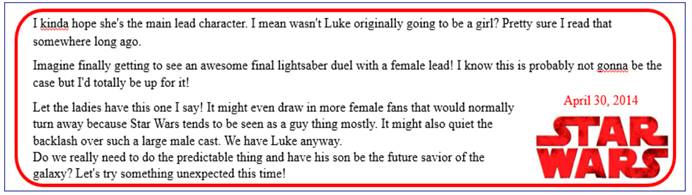
The text shows innovation (MA1) in fan’s understanding that a female protagonist would be an unexpected change. He/she considers that leaving the emblematic fights of the fictional universe (i.e., lightsaber duels) to women would be of paramount importance to help the fandom (PD1) reaching a larger female audience. Likewise, he/she considers that this aspect can expand the possibilities of the saga (PD2) and emphasizes that the initial idea of George Lucas was that the main role in the Original Trilogy (i.e., Luke Skywalker) was a woman. Both arguments mobilize the versatility (PO1) that can be operated in the narratives of the new productions of the franchise.
Such a versatility (PO1) correlates to the two discursive formations: when it is considered valid for the female audience - and, more broadly, the demand for diversity - to celebrate a female Jedi protagonist: an attack of diversity (DF1) in the entertainment industry; and by considering that this aspect can change the image of the saga as product mainly developed for the male audience, which enables the return of the visibility (DF2) of the saga. Both arguments are based on the rule of favorable market, since the fan considers that new productions can try the unexpected and be successful. In the example presented above, the rule is supported by the enunciative function of fans’ support to changes the Sequel Trilogy can implement, either for Star Wars or for the fandom.
Adequacy
Adequacy (MA2) refers to the fannish position that takes into consideration how the space given to greater representativeness must fit the logic already established in the saga, which made it so emblematic for the entertainment industry. Based on this agency, fans consider that there are positive points in transformations implemented in the Sequel Trilogy, as long as they meet aspects previously established in the fictional universe. Just like innovation (MA1), adequacy presents the aspect of respect to the canon (subjection mode), which takes place through the elaboration of preservation (elaboration of the ethical work) of merits that have legitimized Star Wars in pop culture. On the other hand, it also indicates conformity to the dominant context (subjection mode) when fans prioritize the interest in a better narrative (elaboration of ethical work) before political agendas. These paths overlap one another in a teleology of the moral subject, which attests to the passion of fans who advocate that the saga presents omnipotence (ethical substance) in its canon.
The strand shared between agencies can be seen in the commonality of the power diagram that forms them, namely: the saga (PD2), which was described in the previous section. More specifically, adequacy is also associated with the power diagram of the canon (PD3). This diagram indicates how discussions about the introduction of representative characters are guided by the concern that it cannot compromise established aspects of the fictional universe.
Both diagrams are formulated by the power operator that deals with expansion (PO2). It is a movement whose opening space for political identities in new productions of the saga is discussed as the likelihood to expand one of the most celebrated media products of pop culture. On the one hand, the Sequel Trilogy is discussed as a cinematographic production (differentiation system) focused on adapting itself to the market (objective type). On the other hand, because it is a new production in the franchise (differentiation system), its development (objective type) must be implemented as the continuity of the aspects enshrined in previous productions. Both strands establish respect to the canon (instrumental modality), through canonical foundations (institutionalization form), in order to maintain (rationalization degree) the established values.
The strand this power operator shares with the other - called versatility (PO1), as described in the previous section - relates them together to the same power diagram that indicates fans’ relationships with possibilities for new productions in the cultural object - named saga (PD2), as described in the previous section - and shares the basis of discursive formation that deals with the return of the visibility (DF2), which was described in the previous section. The other strand leads to the singularity of the expansion (PO2), which was established by the discursive formation called the canon strikes back (DF3). This discursive formation addresses the understanding of fans that certain values established in previous Star Wars productions must prevail among transformations accounting for greater representativeness. This formation is based on two rules, one referring to the favorable market (described in the previous section) and the other to the fantasy fiction that reflects fans’ desire for the narrative to be careful at the time to introduce such a representativeness, since they fear contamination with political or social agendas external to the canon.
The two rules in question share the enunciative function to confirm the disposition of fans (described in the previous section) to accept greater representativeness in Star Wars. The uniqueness of the second rule - called fantasy fiction - is attested in the enunciative function focused on prioritizing fictionality. Its statements consider that the fandom should not be involved in political agendas, minimize discussions of this nature and advocate that, although contemporary issues are relevant, they are not part of the saga’s fantasy and futuristic topics.
The message of a fan who addressed the likely introduction of homosexual protagonists in the Sequel Trilogy was herein presented as an example of adequacy (MA2) in Figure 4.
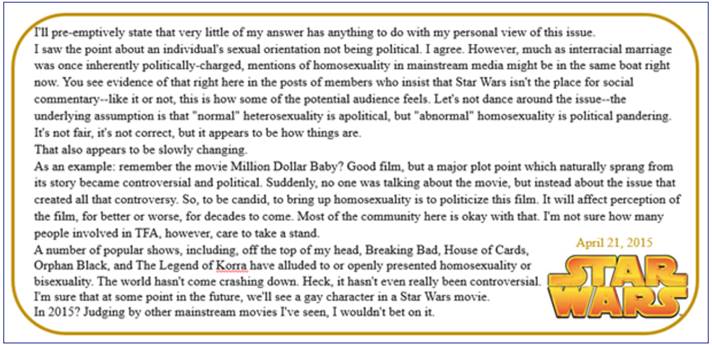
Adequacy (MA2) was required by the fan who reasoned about how the likely introduction of homosexuality in the first movie of the Sequel Trilogy tends to politicize it and affect fans’ perception about it. This would be an expansion (PO2) in the franchise that would require caution. Although he/she understands that the canon (PD3) of Star Wars allows introducing this agenda, he/she warns that it must be done in a way to avoid causing strangeness to the fans of the saga (PD2).
Consequently, the fan’s message shows how this expansion (PO2) should reproduce the discursive formation the canon strikes back (DF3), since canon values must guide the way homosexuality should be addressed, so the subject does not stand out from the saga. Thus, it evokes the rule of fantasy fiction, which states that any topic observed in the movies must submit to their narrative axis, a fact that indicates the function of prioritizing fictional aspects to the detriment of social reality.
RESULTS REFLECTIONS
When Star Wars fans interact about the introduction of characters representative of political identities in the narrative, they elaborate truths that evidence two positions in this regard. On the one hand, they formulate such an introduction as an innovative aspect, either because it reaches new audiences who feel represented or because it produces new possibilities and political plots that had not been previously explored in the saga. On the other hand, they discuss about how such an introduction should be appropriate and indicate that it must be done with caution in order to preserve values and knowledge established in the movies, which have made them one of the most emblematic franchises in the entertainment industry. Thus, the following two sections present reflections from the inferred results.
Insertion of representativeness: a path to fans’ cynicism
Including political representation in its content is a process that, despite starting from the entertainment industry itself, is assumed by fans as an Innovation to be incorporated into fans’ interest in the new content they consume. When the fandom positively welcomes such changes, it considers how the saga is open, so there is versatility in this inclusion of representativeness. The versatile aspect is closely related to the growth of the resonance of the media object present in the fans’ speeches that reverberate an increase in consumers’ interest in diversity and discussions about such changes that generate greater visibility to what they are a fan of.
Fan discourses indicate an interest in members of the fandom who are attracted by a growing representativity (Bennett, 2014) and an agreement with changes in the management of the entertainment industry (Taylor et al., 2019). However, the observed power relations broaden the discussion about the predisposition of fandom to authenticate or reject narratives promoted by media product managers (Canavian, 2021). Even if the new contents interfere with the narrative truth of the media product, it was possible to identify which part of the fandom is willing to acclaim such changes to legitimize and expand the social value of its fannish.
Despite being open to changes guided by the inclusion of representativeness, fans establish a movement of Adaptation of the new contents of the media object and how their consumers assimilate these. Pointing out what can change in the new saga without corrupting the canon, they articulate correct and valid ways to promote expanding the media product. In this movement, fans elaborate discourses in which they negotiate ways to (re)popularize the media product and to respect the canonical formula that made it embellished in pop culture.
Fan discourses indicate how mass media narratives have gradually improved their content representative of diversity, allowing the expansion of these guidelines in fandom (McInroy et al., 2022), but also that they are concerned about changes that could bring down the narrative quality of the media product (Moura & Souza-Leão, 2022). Consequently, the power relations analogous to these discourses endorse the prerogative of fans to reject the authenticity of narrative contents that may be representative but do not do justice to the media object they consume (Canavian, 2021). If representativeness threatens the quality of the media object, it is a danger to the fannish condition itself, inseparable from the relationship between the fan and continuous interest in what it consumes.
The way these agencies are articulated reveals that they acknowledge the importance of representativeness not because of its value itself, but because of externalities, such as audience expansion and new narrative possibilities, as long as they do not put the saga at risk. Representativeness is a path, not a fannish’ purpose. It is a vector capable of impact on fans’ relationship with the media object and its consequent fannish condition. Based on Foucault’s later theorization, the subject-form identified in this positioning is of the cynical type.
Foucault (2011) has analyzed cynicism as a way to deepen his discussions about the association between subjectivity and courage to tell the truth. Cynicism can be understood as a radical parrhesia, a living mode through alethurgical acts. Foucault (2005) clarifies that parrhesia is a way of life supported by saying everything you want and know about a topic; it is an ontic condition in which all truth is exposed in the social context in which one lives. Aleturgy, on the other hand, is the process of manifesting the truth of oneself to others, in order to prevent the non-truth - i.e., the false, the hidden, the invisible - from sustaining social practices; it is a way of positioning ourselves before others, regardless of the power tensions that may exist (Foucault, 2014). Both represents elements to be Cynical, subjects that manifest truth in themselves in order to position their will and moralities before themselves and the others (Foucault, 2011).
Practicing cynicism lies beyond the courage to tell the truth. The cynic is the one who tells the truth and embodies it in such a scandalous and free way that it takes on an unashamed nature. Based on the cynic’s viewpoint, his/her parrhesia is the ethical commitment to transform the world into a better place. Therefore, this view is significantly different from its understanding in contemporary society, which started understanding it as only committed to itself (Foucault, 2011).
According to Mikkonen et al. (2011), Foucauldian cynicism can be observed in how consumers incorporate rhetorical discursive strategies and criticism of the market relations in which they operate. Cynicism is practiced when a consumer propagates truths that encourage critical self-reflection by other consumers about their role in society. It is a manifestation of truths that meet their will but which can also curb the behavior of others when other market agencies transform their perspectives based on contact with cynical consumers.
Fandom seen as the heterotopic space of a cynical reason
The cynicism of fans indicates that fannish subjectivity is evident as articulation between games of truth capable of supporting it based on the way its truth is capable of appropriating other truths in order to (re)define the limits of the media products they relate to. This process is in line with recent CCT discussions focused on consumer interactions as environment for subjectivation processes based on Foucault’s theory (Cappellini et al., 2019; Lehtokunnas et al., 2022; MacGregor et al., 2021; Nøjgaard & Bajde, 2021; Zimmerman, 2020). Otherwise, it confirms fans’ productive capacity to agency their desires (Souza-Leão & Costa, 2018) based on the appropriation and reframing of knowledge about media products (Chen, 2021; Zajc, 2015).
The herein analyzed Star Wars fans are committed to their fannish, which is clearly articulated as the condition presupposing overlap among their productive capacity (Andrews & Ritzer, 2018; Chen, 2021), truths established by the narrative (Booth, 2008; Hills, 2015) and the marketing performance of the media product (Cavalcanti et al., 2021; Proctor, 2013). Therefore, it is a hedonic will subjected to an economic morality. It is possible analyzing it from two different perspectives.
Overall, a priori, it does not appear to be related to instances under the aegis of an institutionalized knowledge that dichotomizes emotion and instrumental reason, a fact that presupposes creative thinking. More specifically, instrumentalizing a social cause to an economic logic (i.e., moralities) in favor of an adequate way (i.e., will) for an existence can meet the contemporary view of the cynic as selfish. The courage to say the unexpected, which asserts itself as the truth of a given subjectivity, is precisely what makes this fan a cynic. After all, he/she is not committed to any cause - be it social, political, or economic - rather than to the conditions enabling the maintenance of truths that allow him/her to exist.
However, one should take into consideration that this truth is being told in a family setting. The fandom encourages fans to express their perspectives among peers, which can happen in a collaborative way (Chen, 2021; Guschwan, 2012) or to establish disagreement (Goodman, 2015; Hewer et al., 2017; Yeritsian, 2021). In both cases, fans aim to carry out a transformation to indicate that the fandom is an arrangement of connections combining rationality and imagination, something that, according to Foucault (2003b), is immanent to the way subjects relate to the truth. The overlap between imagination and rationality is what enables different subjects to connect to each other in social spaces that take into consideration different ways of living.
Such an understanding leads to the interpretation of fandom as heterotopy. Foucault (1986) has presented this concept as a multiple social space elaborated in reference to other spaces, although it has its own articulations; a recreation of pre-existing spaces based on the negotiation of truths deriving from different agencies. Thus, heterotopy is formed by social relationships that allow producing spaces within spaces, where heterogeneous agencies add up through autonomous concepts of utopia that overlap each other in a flexible and adaptable way. Thus, fandom is a heterogeneous and utopian space that allows the manifestation of different truths.
Understanding the fandom as heterotopy reinforces the idea of heterotopic possibilities established through market interactions (see Rokka & Canniford, 2016; Roux & Belk, 2019). More specifically, the current results research reinforces and expands the discussion suggested by Chen (2021) about how productive consumption practices of fans on Web 2.0 produce heterotopias. According to the aforementioned author, fan practices produce such spaces either by allowing transit between different market agencies (i.e., consumer, prosumer and producer), or by adapting face-to-face interactional relationships (e.g., identity projects, tolerance towards others, friendliness between peers) thanks to the virtual ambience.
FINAL CONSIDERATIONS
Based on the analysis of how fans structure their fannish by means of discussions about the introduction of political agendas in media products, it was possible concluding that it happens in a cynical way, which is herein understood, in Foucauldian terms, as a courageous way of telling the truth. After all, the investigated fans have attested that the introduction of characters representative of political identities in the Star Wars saga taken on a useful function due to its current social relevance and to the continuity of the franchise as an example of pop culture. However, this useful function must comply with the franchise’s identity itself. Ultimately, what these fans are saying is that the truth that matters to them is the one that sustains their fannish condition, i.e., the subjectivity. Other truths - be them about identity representativeness or any other political agenda, or even those related to other spheres - may be articulated to the aforementioned one, if they are perceived as both susceptible to articulation and adequacy.
Thus, the current study presents itself as a promising source for the investigation of fan subculture based on the understanding of fannish as a unique subjective formation featured by its ability to mobilize and articulate knowledge about the community itself, by the media product fans are linked to and by different social spheres (e.g., cultural, political, economic). Furthermore, it introduces fandom as a representative object of the study about the consumer community; it is done by taking into consideration this cultural dimension as heterotopic space of relationships.
The fans’ cynical subjectivity is produced as a consumer reaction to political insertion. However, it is not limited to this scope. No wonder the current research contributes to fan studies by showing how fans prioritize their relationship with the media product in the face of a position - i.e., for or against - a political agenda. This priority is not a lack of political positioning but a preference to maintain the conditions - i.e., narrative quality and popularity of the media product - that allow them to be fans.
More broadly, the study contributes to explaining how consumer relations are sustained by conditions that allow consumers to be produced and to produce themselves as subjects. However, these subjectivities go beyond consumption relations, being able to endorse, reject or neglect political discussions with which they are associated. Thus, it attests to the validity of executing the Foucauldian method to understand the conditions that produce subjects in consumer relations.
Specifically, it is necessary to indicate that the study is limited to the interactions of the most relevant pop culture fandoms regarding the insertion of representativeness in the content they consume. In this sense, it seems promising to expand the discussions of the present study to how fans of other emblematic sagas in pop culture (e.g., Game of Thrones, Wizarding World, Lord of The Rings, etc.) perceive such changes in the representation of productions in the entertainment industry, including reflections through the identity-political prism. Additionally, future research that explores the inclusion of professionals from multiple ethnicities (e.g., black, Asian, Latin or Native American, etc) and sexualities in the production and management of media objects can expand the discussions presented in this study.
ACKNOWLEDGMENTS
National Council for Scientific and Technological Development (CNPq) and Science and Technology Support Foundation of Pernambuco (Facepe) have supported the current research. Coordination for the Improvement of Higher Education Personnel (Capes) supports the graduate program researchers are affiliated to.
REFERENCES
Addis, M., & Holbrook, M. B. (2001). On the conceptual link between mass customisation and experiential consumption: an explosion of subjectivity. Journal of Consumer Behaviour, 1(1), 50-66. https://doi.org/10.1002/cb.53
Andrews, D. L., & Ritzer, G. (2018). Sport and presumption. Journal of Consumer Culture, 18(2), 356-373. https://doi.org/10.1177/1469540517747093
Arnould, E., & Thompson, C. J.(2015). Introduction: consumer culture theory: ten years gone (and beyond). Consumer culture theory, 17(1), 1-21. https://doi.org/10.1108/S0885-211120150000017001
Arsel, Z., & Thompson, C. J.(2011). Demythologizing Consumption Practices: How Consumers Protect Their Field-Dependent Identity Investments from Devaluing Marketplace Myths. Journal of Consumer Research, 37(5), 791-806. https://doi.org/10.1086/656389
Ay, U., & Kaygan, H. (2022). Autonomy or loyalty? Community-within-community interactions of a local football fandom group. Journal of Consumer Culture, 22(2), 437-455. https://doi.org/10.1177/1469540520982337
Bardhi, F., & Eckhardt, G. M. (2017). Liquid Consumption. Journal of Consumer Research, 44(3), 582-597. https://doi.org/10.1093/jcr/ucx050
Barnhart, M., & Peñaloza L. (2013). Who Are You Calling Old? Negotiating Old Age Identity in the Elderly Consumption Ensemble. Journal of Consumer Research, 39(6), 1133-1153. https://doi.org/10.1086/668536
Bennett, L. (2014). ‘If we stick together we can do anything’: Lady Gaga fandom, philanthropy and activism through social media. Celebrity studies, 5(1-2), 138-152. https://doi.org/10.1080/19392397.2013.813778
Besley, T., & Peters, M. A. (2007). Subjectivity and truth: Foucault, education, and the culture of self. Peter Lang.
Booth, P. (2008). Rereading Fandom: MySpace Character Personas and Narrative Identification. Critical Studies in Media Communication, 25(5), 514-536. https://doi.org/10.1080/15295030802468073
Brennan, J. (2014). The Fannish Parergon: Aca-Fandom and the Decentred Canon. Australasian Journal of Popular Culture, 3(2), 217-232. https://doi.org/10.1386/ajpc.3.2.217_1
Brown, J. A. (2017). #wheresRey: feminism, protest, and merchandising sexism in Star Wars: The Force Awakens. Feminist Media Studies, 18(3), 335-348. https://doi.org/10.1080/14680777.2017.1313291
Brownlie, D., Hewer, P., & Tadajewski, M. (2009). Thinking “Communities of Academic Practice”: on space, enterprise and governance in marketing academia. Journal of Marketing Management, 25(7-8), 635-642. https://doi.org/10.1362/026725709X471532
Camargo, T. I., Souza-Leão, A. L. M., & Moura, B. M. (2021). Fans’ (esth)et(h)ics elaboration: Poaching as true love practice. Revista de Administração de Empresas, 62(2), 1-17. https://doi.org/10.1590/S0034-759020220203
Canniford, R., & Karababa, E. (2013). Partly primitive: discursive constructions of the domestic surfer. Consumption Markets & Culture, 16(2), 119-144. https://doi.org/10.1080/10253866.2012.662818
Cappellini, B., Harman, V., Marilli, A., & Parsons, E. (2019). Intensive mothering in hard times: Foucauldian ethical self-formation and cruel optimism. Journal of Consumer Culture, 19(4), 469-492. https://doi.org/10.1177/1469540519872067
Cavalcanti, R. C. T., Souza-Leão, A. L. M. de, & Moura, B. M. (2021). Fan Affirmation: Alethurgy on an Indie Music Fandom. Revista De Administração Contemporânea, 25(5), e190395. https://doi.org/10.1590/1982-7849rac2021190395.en
Chen, Z. T. (2021). Poetic prosumption of animation, comic, game and novel in a post-socialist China: A case of a popular video-sharing social media Bilibili as heterotopia. Journal of Consumer Culture, 21(2), 257-277. https://doi.org/10.1177/1469540518787574
Cobb, S., & Horeck, T. (2018). Post Weinstein: gendered power and harassment in the media industries. Feminist Media Studies, 18(3), 489-491. https://doi.org/10.1080/14680777.2018.1456155
Condis, M. (2014). No homosexuals inStar Wars? BioWare, “gamer” identity, and the politics of privilege in a convergence culture. Convergence: The International Journal of Research into New Media Technologies, 21(2), 198-212. https://doi.org/10.1177/1354856514527205
Coskuner-Balli, G. (2020). Citizen-Consumers Wanted: Revitalizing the American Dream in the Face of Economic Recessions, 1981-2012. Journal of Consumer Research, 47(3), 327-349. https://doi.org/10.1093/jcr/ucz059
Cova, B., & Cova, V. (2012). On the road to prosumption: marketing discourse and the development of consumer competencies. Consumption Markets & Culture, 15(2), 149-168. https://doi.org/10.1080/10253866.2012.654956
Cova, B., Kozinets, R. V., & Shankar, A. (2007). Consumer Tribes. Elsevier.
Deleuze, G. (1988). Foucault. University of Minnesota Press.
Denegri-Knott, J., Nixon, E., & Abraham, K. (2018). Politicising the study of sustainable living practices. Consumption Markets & Culture, 21(6), 554-573. https://doi.org/10.1080/10253866.2017.1414048
Denegri-Knott, J., & Tadajewski, M. (2016). Sanctioning value. Marketing Theory, 17(2), 219-240. https://doi.org/10.1177/1470593116677766
Earley, A. (2013). Connecting contexts. Marketing Theory, 14(1), 73-96. https://doi.org/10.1177/1470593113514427
Fathallah, J. (2014). “Except that Joss Whedon is god”: fannish attitudes to statements of author/ity. International Journal of Cultural Studies, 19(4), 459-476. https://doi.org/10.1177/1367877914537589
Foucault, M. (1986). Of Other Spaces. Diacritics, 16(1), 22-27. https://doi.org/10.2307/464648
Foucault, M. (2001). Questions of Method. In J. D. Faubion(Ed.), Power: Essential Works of Michel Foucault(Vol. 3, pp. 223-238). Allen Lane.
Foucault, M. (2003a). Society Must Be Defended: Lectures at the Collège de France, 1975-1976. Picador.
Foucault, M. (2003b). The ethics of the concern of the self as a practice of freedom. In P. Rabinow, & N. Rose (Eds.), The Essential Foucault (pp. 25-42). The New Press.
Foucault, M. (2005). Hermeneutics of the Subject: Lectures at the Collège de France, 1981-1982. Palgrave Macmillan.
Foucault, M. (2006). The history of sexuality, vol. 1: The Will to Knowledge. Penguin.
Foucault, M. (2010). The Government of Self and Others: Lectures at the Collège de France, 1981-1982. Palgrave Macmillan.
Foucault, M. (2011). The Courage of Truth: The Government of Self and Others II, Lectures at the Collège de France, 1983-1984. Palgrave Macmillan.
Foucault, M. (2012a). The history of sexuality, vol. 2: The use of pleasure. Palgrave Macmillan.
Foucault, M. (2012b). The history of sexuality, vol. 3: The care of the self. Palgrave Macmillan.
Foucault, M. (2014). On the Government of the Living: Lectures at the Collège de France, 1979-1980. Palgrave.
Fuschillo, G. (2018). Fans, fandoms, or fanaticism? Journal of Consumer Culture, 20(3), 146954051877382. https://doi.org/10.1177/1469540518773822
Galvagno, M. (2011). The intellectual structure of the anti-consumption and consumer resistance field. European Journal of Marketing, 45(11/12), 1688-1701. https://doi.org/10.1108/03090561111167441
Garland, D. (2014). What is a “history of the present”? On Foucault’s genealogies and their critical preconditions. Punishment & Society, 16(4), 365-384. https://doi.org/10.1177/1462474514541711
Giesler, M., & Veresiu, E. (2014). Creating the Responsible Consumer: Moralistic Governance Regimes and Consumer Subjectivity. Journal of Consumer Research, 41(3), 840-857. https://doi.org/10.1086/677842
Goodman, L. (2015). Disappointing Fans: Fandom, Fictional Theory, and the Death of the Author. The Journal of Popular Culture, 48(4), 662-676. https://doi.org/10.1111/jpcu.12223
Goulding, C., Shankar, A., & Canniford, R. (2013). Learning to be tribal: facilitating the formation of consumer tribes. European Journal of Marketing, 47(5/6), 813-832. https://doi.org/10.1108/03090561311306886
Griffin, P. (2015). Popular culture, political economy and the death of feminism: Why women are in refrigerators and other stories. London: Routledge.
Guschwan, M. (2012). Fandom, brandom and the limits of participatory culture. Journal of Consumer Culture, 12(1), 19-40. https://doi.org/10.1177/1469540512438154
Hackley, C. (2002). The Panoptic Role of Advertising Agencies in the Production of Consumer Culture. Consumption Markets & Culture, 5(3), 211-229. https://doi.org/10.1080/10253860290031640
Hackley, C., & Hackley, A. R. (2018). Advertising at the threshold: Paratextual promotion in the era of media convergence. Marketing Theory, 19(2), 195-215. https://doi.org/10.1177/1470593118787581
Hall, S. (1997). Representation: Cultural Representation and Signifying PracticesOpen University Press.
Hewer, P., Gannon, M., & Cordina, R. (2017). Discordant fandom and global football brands: “Let the people sing.” Journal of Consumer Culture, 17(3), 600-619. https://doi.org/10.1177/1469540515611199
Hills, M. (2003). Star Wars in fandom, film theory and the museum: the cultural status of the cult blockbuster. In J. Stringer(Ed.), Movie Blockbusters(pp. 178-189). Routledge.
Hills, M. (2015). The expertise of digital fandom as a “community of practice.” Convergence: The International Journal of Research into New Media Technologies, 21(3), 360-374. https://doi.org/10.1177/1354856515579844
Hills, M. (2017). “The one you watched when you were twelve”: Regenerations of Doctor Who and Enduring Fandom’s “Life-Transitional Objects.” Journal of British Cinema and Television, 14(2), 213-230. https://doi.org/10.3366/jbctv.2017.0364
Holt, D. B. (2017). Contemporary consumer culture theory. Routledge.
Jansen, D. (2020). Thoughts on an ethical approach to archives in fan studies. Transformative Works and Cultures, 33. https://doi.org/10.3983/twc.2020.1709
Jantzen, C., Fitchett, J., Østergaard, P., & Vetner, M. (2012). Just for fun? The emotional regime of experiential consumption. Marketing Theory, 12(2), 137-154. https://doi.org/10.1177/1470593112441565
Jenkins, H. (2006). Fans, Bloggers and Gamers: exploring Participatory Culture. New York University Press.
Kozinets, R. V. (2001). Utopian enterprise: Articulating the meanings of Star Trek’s culture of consumption. In R. W. Belk, & R. F. Bell (Eds.), The power of the situation: How context frames consumer choice(pp. 67-88). Routledge.
Kozinets, R. V. (2019). Netnography: The essential guide to qualitative social media research. Sage.
Kozinets, R. V., & Jenkins, H. (2022). Consumer movements, brand activism, and the participatory politics of media: A conversation. Journal of Consumer Culture, 22(1), 264-282. https://doi.org/10.1177/14695405211013993
Kozinets, R., Patterson, A., & Ashman, R. (2017). Networks of Desire: How Technology Increases Our Passion to Consume. Journal of Consumer Research, 43(5), 659-682. https://doi.org/10.1093/jcr/ucw061
Lehtokunnas, T., Mattila, M., Närvänen, E., & Mesiranta, N. (2022). Towards a circular economy in food consumption: Food waste reduction practices as ethical work. Journal of Consumer Culture, 22(1), 227-245. https://doi.org/10.1177/1469540520926252
MacGregor, C., Petersen, A., & Parker, C. (2018). Promoting a healthier, younger you: The media marketing of anti-ageing superfoods. Journal of Consumer Culture, 21(2), 164-179. https://doi.org/10.1177/1469540518773825
Maciel, A. F., & Wallendorf, M. (2021). Space as a Resource in the Politics of Consumer Identity. Journal of Consumer Research, 48(2), 309-332. https://doi.org/10.1093/jcr/ucab002
Martin, A. L. (2019). Fandom while black: Misty Copeland, Black Panther, Tyler Perry and the contours of US black fandoms. International Journal of Cultural Studies, 22(6), 737-753. https://doi.org/10.1177/1367877919854155
McInroy, L. B., Zapcic, I., & Beer, O. W. (2022). Online fandom communities as networked counterpublics: LGBTQ+ youths’ perceptions of representation and community climate. Convergence, 28(3), 629-647. https://doi.org/10.1177/13548565211032377
Mikkonen, I., & Bajde, D. (2013). Happy Festivus! Parody as playful consumer resistance. Consumption Markets & Culture, 16(4), 311-337. https://doi.org/10.1080/10253866.2012.662832
Mikkonen, I., Moisander, J., & First, F. A. (2011). Cynical identity projects as consumer resistance - the Scrooge as a social critic? Consumption, Markets & Culture, 14(1), 99-116. https://doi.org/10.1080/10253866.2011.541163
Molina-Guzmán, I.(2016). #OscarsSoWhite: how Stuart Hall explains why nothing changes in Hollywood and everything is changing. Critical Studies in Media Communication, 33(5), 438-454. https://doi.org/10.1080/15295036.2016.1227864
Monaghan, W. (2021). Post-gay television: LGBTQ representation and the negotiation of ‘normal’ in MTV’s Faking It. Media, Culture & Society, 43(3), 428-443. https://doi.org/10.1177/0163443720957553
Moura, B. M., & Souza-Leão, A. L. M. D. (2022). Time to DTR: Fan Paratextualization About Game of Thrones’ Last Season. Revista de Administração da UFSM, 15(2), 311-330. https://doi.org/10.5902/19834659665633
Muñiz, A. M., & O’Guinn, T. C. (2001). Brand community. Journal of Consumer Research, 27(4), 412-432. https://doi.org/10.1086/319618
Nøjgaard, M. Ø., & Bajde, D.(2021). Comparison and cross-pollination of two fields of market systems studies. Consumption Markets & Culture, 24(2), 125-146. https://doi.org/10.1080/10253866.2020.1713112
Numerato, D., & Giulianotti, R. (2018). Citizen, consumer, citimer: The interplay of market and political identities within contemporary football fan cultures. Journal of Consumer Culture, 18(2), 336-355. https://doi.org/10.1177/1469540517744692
Paltrinieri, L. (2012). L’Expérience du Concept. Publications de la Sorbonne.
Peñaloza, L., & Mish, J. (2011). The nature and processes of market co-creation in triple bottom line firms: Leveraging insights from consumer culture theory and service dominant logic. Marketing Theory, 11(1), 9-34. https://doi.org/10.1177/1470593110393710
Press, A., & Liebes, T. (2016). Feminism and Hollywood: Why the backlash? The Communication Review, 19(4), 267-279. https://doi.org/10.1080/10714421.2016.1237717
Proctor, W. (2013). ‘Holy crap, more Star Wars! More Star Wars? What if they’re crap?’: Disney, Lucasfilm and Star Wars online fandom in the 21st Century. Participations: Journal of Audience & Reception Studies, 10(1), 198-224. https://www.participations.org/10-01-12-proctor.pdf
Proctor, W. (2018). ‘I’ve seen a lot of talk about the #blackstormtrooper outrage, but not a single example of anyone complaining’: The Force Awakens, canonical fidelity and non-toxic fan practices. Participations: International Journal of Audience and Reception Studies, 15(1), 160-179. https://www.participations.org/15-01-10-proctor.pdf
Rokka, J., & Canniford, R. (2016). Heterotopian selfies: how social media destabilizes brand assemblages. European Journal of Marketing, 50(9-10), 1789-1813. https://doi.org/10.1108/EJM-08-2015-0517
Roux, D., & Belk, R. W. (2019). The Body as (Another) Place: Producing Embodied Heterotopias Through Tattooing. Journal of Consumer Research, 46(3), 483-507. https://doi.org/10.1093/jcr/ucy081
Schouten, J. W., & McAlexander, J. H. (1995). Subcultures of Consumption: An Ethnography of the New Bikers. Journal of Consumer Research, 22(1), 43-61. https://www.jstor.org/stable/2489699
Seregina, A., & Weijo, H. A. (2017). Play at Any Cost: How Cosplayers Produce and Sustain Their Ludic Communal Consumption Experiences. Journal of Consumer Research, 44(1), 139-159. https://doi.org/10.1093/jcr/ucw077
Souza-Leão, A. L. M., & Costa, F. N. (2018). Assemblaged by desire: potterheads’ productive consumption. Revista de Administração de Empresas, 58(1), 74-86. https://doi.org/10.1590/S0034-759020180107
Souza-Leão, A. L. M., Moura, B. M., & Nunes, W. K. D. S. (2022). All in One: Digital Influencers as Market Agents of Popular Culture. Revista Brasileira de Gestão de Negócios, 24(2), 247-274. https://doi.org/10.7819/rbgn.v24i2.4167
Sugihartati, R. (2020). Youth fans of global popular culture: Between prosumer and free digital labourer. Journal of Consumer Culture, 20(3), 305-323. https://doi.org/10.1177/1469540517736522
Tadajewski, M. (2011). Producing historical critical marketing studies: theory, method and politics. Journal of Historical Research in Marketing, 3(4), 549-575. https://doi.org/10.1108/17557501111183662
Tadajewski, M., & Jones, D. G. B. (2021). From goods-dominant logic to service-dominant logic? Service, service capitalism and service socialism. Marketing Theory, 21(1), 113-134. https://doi.org/10.1177/1470593120966768
Taylor, C. R., Mafael, A., Raithel, S, Anthony, C. M., & Stewart, D. W.(2019). Portrayals of minorities and women in super bowl advertising. Journal of Consumer Affairs, 53(4), 1535-1572. https://doi.org/10.1111/joca.12276
TheForce.net. (2015a, December 20). How great to have a female lead!https://boards.theforce.net/threads/how-great-to-have-a-female-lead.50035937
TheForce.net. (2015b, April 20). Homosexuality and TFAhttps://boards.theforce.net/threads/homosexuality-and-tfa.50029463
TheForce.net. (2023, April 30). Daisy Ridley (Rey) in EpisodeVII. https://boards.theforce.net/threads/daisy-ridley-rey-in-episode-vii.50019976
Thompson, C. J. (2017). Canonical Authors in Consumption Theory. In S. Askegaard, & B. Heilbrunn(Eds.), Producing foucaldians: consumer culture theory and the analytics of power(pp. 212-220). Routledge.
Thompson, C. J., Arnould, E., & Giesler, M. (2013). Discursivity, difference, and disruption. Marketing Theory, 13(2), 149-174. https://doi.org/10.1177/1470593113477889
Thompson, C. J., Henry, P. C., & Bardhi, F. (2018). Theorizing reactive reflexivity: Lifestyle displacement and discordant performances of taste. Journal of Consumer Research, 45(3), 571-594. https://doi.org/10.1093/jcr/ucy018
Thompson, C. J., & Tian, K. (2008). Reconstructing the South: How Commercial Myths Compete for Identity Value through the Ideological Shaping of Popular Memories and Countermemories. Journal of Consumer Research, 34(5), 595-613. https://doi.org/10.1086/520076
Ulusoy, E., & Fırat, FA. (2018). Toward a theory of subcultural mosaic: Fragmentation into and within subcultures. Journal of Consumer Culture, 18(1), 21-42. https://doi.org/10.1177/1469540516668225
Veresiu, E., Giesler M., & Ger, G. (2018). Beyond Acculturation: Multiculturalism and the Institutional Shaping of an Ethnic Consumer Subject. Journal of Consumer Research, 45(3), 553-570. https://doi.org/10.1093/jcr/ucy019
Wood, D. M., & Ball, K. (2013). Brandscapes of control? Surveillance, marketing and the co-construction of subjectivity and space in neo-liberal capitalism. Marketing Theory, 13(1), 47-67. https://doi.org/10.1177/1470593112467264
Wood, R., Litherland, B., & Reed, E. (2020). Girls being Rey: ethical cultural consumption, families and popular feminism. Cultural Studies, 34(4), 546-566. https://doi.org/10.1080/09502386.2019.1656759
Yeritsian, G. (2021). Participation from above and below: Brand community and the contestation of cultural participation. Journal of Consumer Culture, 21(2), 278-295. https://doi.org/10.1177/1469540518787576
Zajc, M. (2015). Social media, prosumption and dispositives: New mechanisms of the construction of subjectivity. Journal of Consumer Culture, 15(1), 28-47. https://doi.org/10.1177/1469540513493201
Zimmerman, H. (2020). Becoming ethical: Mediated pedagogies of global consumer-citizenship. Journal of Consumer Culture, 20(1), 43-60. https://doi.org/10.1177/1469540517729005
Zwick, D., & Denegri-Knott, J. (2009). Manufacturing Customers: The database as new means of production. Journal of Consumer Culture, 9(2), 221-247. https://doi.org/10.1177/1469540509104375
Zwick, D., & Dholakia, N. (2004). Consumer subjectivity in the Age of Internet: the radical concept of marketing control through customer relationship management. Information and Organization, 14(3), 211-236. https://doi.org/10.1016/j.infoandorg.2004.01.002
Notes
DATA AVAILABILITY
REVIEWERS
PEER REVIEW REPORT
Author notes
