Abstract: This work builds on the idea that the transition to marriage is influenced simultaneously by social context, family context, and individual’s early biography and socioeconomic status. Unlike previous studies that examine the transition to marriage in Mexico, I consider theoretically and analyze empirically the role of intergenerational influences on marriage timing. Using data from the National Family Planning Survey, I estimated a set of nested discrete-time hazard models to evaluate the effects of mothers’ marriage age on children’s transition to marriage. I find that children of mothers who married young enter into marriage earlier than children of mothers who delayed marriage. This relationship persists after controlling for important socioeconomic factors. In fact, the effect of mothers’ age at marriage on children’s age at marriage is larger than the effect of mother’s education. I also find this relationship to be similar for both sons and daughters, suggesting that family influences are a key aspect of the transition to marriage in Mexico.
Keywords:nuptialitynuptiality,intergenerational influencesintergenerational influences,life courselife course,transition to adulthoodtransition to adulthood.
Resumen: Este trabajo se fundamenta en la idea de que la transición al matrimonio o unión está simultáneamente condicionada por el contexto social y familiar, por el nivel socioeconómico de los individuos y por su historia de vida. A diferencia de otros estudios previos, analizamos teorética y empíricamente las influencias intergeneracionales sobre el momento de la vida en que se produce la unión. Sobre la base de datos de la Encuesta Nacional de Planificación Familiar, estimamos modelos anidados de riesgo de tiempo discreto para establecer en qué medida la edad de la madre a la primera unión se relaciona con la edad en la que los hijos se unen por primera vez. Encontramos que los hijos de madres casadas o unidas a edades tempranas ingresan al primer matrimonio antes que aquellos cuyas madres han retrasado dicha unión; que esta asociación persiste aún controlando por otras características socioeconómicas individualesde hecho, la influencia de la edad materna en esa transición es mayor que la de su nivel educativo; y que esta relación es similar para hijos e hijas, sugiriendo que las influencias intergeneracionales son un elemento clave en la transición al matrimonio en México.
Palabras clave: nupcialidad, influencias intergeneracionales, curso de vida, transición a la adultez.
Artículo
Intergenerational similarities in the transition to marriage in Mexico
Similitudes intergeneracionales en la transición al matrimonio en México
Asociación Latinoamericana de Población
Studies about the transition to marriage in industrialized societies with strong family ties have emphasized the role of intergenerational influences in delineating nuptiality patterns. Family demographers in Italy, Spain and Japan recognize that there are multiple dimensions of family background influences beyond the more studied socioeconomic characteristics when explaining the current trends of later marriage. Surprisingly, little research has addressed similar questions when studying the transition to marriage in familistic developing countries. Moreover, in societies with relatively stable nuptiality patterns, such as those in Latin America,1 it is even more surprising that research has overlooked the role of family ties and influences in explaining the persistence of marriage trends.
A small but growing body of research has begun to document socioeconomic differences in the transition to marriage in Mexico (e.g., Lindstrom and Brambila Paz, 2001; Gómez de León, 2001; Quilodrán, 2001; Parrado and Zenteno, 2002; Solís, 2004; Ojeda, 2007; Pérez Amador, 2008), a country with a very stable age at first marriage during most of the twentieth century when important socioeconomic and demographic changes also took place. However, when highlighting that heterogeneity in socioeconomic status translates into heterogeneity in the transition to marriage, the Mexican literature pays little or no attention to explaining whythe average age at marriage continues to be so stable.2 Moreover, little attention has been devoted to possible cultural explanations such as the role of family influences on keeping marriage timing constant and almost universal.
Indeed, one of the mechanisms underlying the stability of early marriage in Mexico could be related to the persistent importance of family ties between generations. Parents’ values, attitudes and behaviors are transmitted to their children trough social learning and social control. In this sense, young adults adopt or reject new behaviors depending on parental approval. Therefore, the marriage outcomes of new generations could be influenced not only by their own acquired characteristics, but also, by those of their parents. In a country like Mexico, where the majority of young adults live in the parental home until they marry, day-to-day interactions between parents and children facilitate family influences and control.
In this paper, I advance the study of the transition to marriage in Mexico by examining the role of intergenerational influences. While past research in this country has focused exclusively on family background socioeconomic correlates of union formation, this analysis examines family influences by analyzing the extent to which mothers’ age at marriage is related to their children’s age at marriage. The general hypothesis is that children of mothers who married young would be more likely to marry at younger ages, net of important socioeconomic controls. To test this hypothesis, I make use of a unique Mexican survey in which mothers were asked about the major events in the life course of their children. The data also allow me to take a gender-comparative approach to highlight important differences between sons and daughters. This analysis will contribute to a better understanding of the continuity of marriage trends in Mexico, and provide additional evidence, from a different geographical and cultural setting, to the international research on intergenerational influences.
Nuptiality patterns in Mexico were relatively stable during the second half of the twentieth century. The median age at marriage remained particularly stable at 23 years for men and increased only slightly for women from 21 to 22 years (Quilodrán, 2001). The proportion of unions that were consensual also remained fairly constant at about 18%, and the proportion of never-married by age 50 did not change from its level of 7%. Similarly, the levels of marital dissolution remained relatively low at around 7.5%. Moreover, the living arrangements among single young men and women showed no dramatic change, the majority of them live in the parental home until the time of marriage (Pérez Amador, 2004).
Surprisingly, the stability in nuptiality patterns coexisted with important socioeconomic changes occurring during the same period. Educational attainment increased from 3 to 8 years of schooling between 1970 and 2000, and the gender educational gap virtually disappeared in pre-secondary education. Among young women aged 20-24, labor force participation rates increased from 25% to 35% during the same period. Still, these socioeconomic transformationsdid not seem to influence the age at marriage or union formation, reflecting, perhaps, the strong family orientation among Mexicans.
Despite the rise in education and women’s labor force participation, Mexican society is still characterized by distinct gender roles and strong family ties between generations.
An important proportion of working women from all socioeconomic backgrounds leave their careers to become wives and mothers, perform most of housework and child-rearing –independent of their work status–, and are the predominant caregivers to their elderly parents. In addition, the majority of women and men believe that wives should not work when their husbands earn enough money to support the family, that mothers should not work, and that for women, family is more important than work (García and Oliveira, 2006). These traditional behaviors and attitudes are thought to be transmitted across generations and reinforced from parents to children.
Therefore, in addition to the well-known socioeconomic predictors of marriage timing as demonstrated by the specialization/independence theory (Becker, 1973 and 1974) and the marital-search theory (Oppenheimer, 1998), family influences are important predictors (e.g., Thornton, 1991; Reher, 1998; Giulio and Rossina, 2007; Thornton, Axinn and Xie, 2007) and should be considered when explaining the apparent stability in the age at marriage in Mexico. Moreover, under the life course perspective, principle of linked or interconnected lives, family members live interdependently; social and historical influences are thus expressed through a network of shared relationships (Elder, 1998).
In analyzing the role of family influences in marriage timing in Mexico, I use an adaptation of Thornton’s (1991) theoretical framework that links marital experiences of parents to union formation of their children. The use of this theoretical model represents a new and different view of the correlates of the transition to marriage in Mexico. The framework contemplates six mechanisms through which marriage behavior of parents influence children’s transition to marriage and cohabitation. They are: status attainment, social control, earlier maturation, parental home environment, attitudes toward nonmarital sex and cohabitation, and attitudes toward marriage. Due to data limitations, not all of these can be considered when analyzing the relationship between mothers and children’s age at marriage in Mexico. For example, the quality of the parental home environment is certainly important in predicting children’s transition to marriage, but the data used for these analyses lack any measure to approximate it. In the following paragraphs, I explain in more detail how the other mechanisms might be in place and function within Mexican society. As explained by Thornton, they could operate simultaneously rather than individually, and by no means determine exhaustively the connection between parents’ and children’s family behavior.
Status attainment: under this mechanism it is assumed that parents that marry at younger ages have lower educational attainment and socioeconomic achievement than parents that marry later. As a consequence, their children also have lower educational attainment and therefore, lower age at marriage. One of the reasons why this relationship holds is because school enrollment (i.e. student role) competes with the role of being a husband or wife. Hence, children that exit the educational system are at higher risk of entering into marital unions than children enrolled in school –the longer the school attendance, the higher the age at marriage–. An important consideration when applying this logic to the Mexican case is that the educational composition of the Mexican population is changing considerably. That is to say, the levels of education are increasing, but most people still finish or leave school at ages relatively younger than the median age at marriage. Thus, the relationship between educational attainment and marriage timing is complex and it might not be the same for children as it was for their mothers.
Social control: the majority of Mexican children co-reside with their parents until the time of marriage. This tradition facilitates parental supervision and interaction with children. In addition, mothers typically stay at home taking care of their children, which also makes easier parental influences on children. Moreover, the majority of children co-reside with both parents during their years in the parental come due to the low levels of separation and divorce. Therefore, parent-child co-residence encourages parental control over children, monitoring of their behavior, and the transmission of beliefs and attitudes from one generation to the next.
Early maturation: one of the consequences of parents’ low socioeconomic status on their children is in relation to low educational attainment, which is also related with an early entry into the labor market. It is relatively common for young adults to contribute to the household income when co-residing with parents, in so doing they begin preparing for their own independent family. Thus an early entry into the labor market facilitates an early entry into marriage as well. This is particularly true for young men, who traditionally have and still maintain the role of household provider.
Attitudes toward premarital sex, cohabitation and marriage: since parents who married at a young age are more likely to have lower educational attainment, they are also more prone to have more traditional ideas about family issues; and conversely, parents who delayed marriage are more likely to have non-traditional ideas. Data from the National Survey of Family Planning conducted in 1995 show an important association between women’s age at marriage and the acceptance of premarital sex, cohabitation, and divorce –women married at older ages are more likely to approve of them relative to those who married at younger ages–. There is also a positive relationship between the age at marriage and the age that women consider as ideal to get married. Studies drawn on data from the Panel Study of Mothers and their Children in the Detroit Metropolitan Area in the U. S. and from the British Household Panel Survey in the U.K. have found considerable intergenerational transmission of attitudes toward family issues (e.g., Axinn and Thornton, 1993; Murphy and Wang, 1998; Barber, 2000). Therefore, positive attitudes toward earlier or later marriage are likely transmitted from mothers to children, and such attitudes have effects on children’s marriage timing.
Given the context of marriage stability and strong family ties and influences, I expect children’s late marriage to occur mainly when parents themselves experience it, or when parents demonstrate their acceptance of this innovative behavior. As a first scenario, younger generations adopt this particular option through social influence and social learning, mechanisms demonstrated in the case of intergenerational transmission of cohabitation (Axinn and Thornton, 1992), teenage pregnancy (Kahn and Anderson, 1992), family formation preferences (Barber, 2000), and other social phenomena in industrialized societies. As shown in previous research, marriage occurs later among the Mexican educational elite; consequently I expect this group to transmit this behavior to the next generation. I hypothesize, therefore, that a delay in marriage is likely to occur when parents and children achieve relatively higher levels of education and, moreover, when parents themselves married above the average timing. That is to say, children of highly educated parents and children of parents who postpone marriage are more likely to delay marriage regardless of their own educational attainment.
Under a second scenario –when parents accept new behaviors–, I argue that children of non-traditional families, in regards to the division of household labor, such as those in which the mother works outside home will be more prone to delay marriage. By using parents’ occupation and educational attainment as proxies for openness to innovative behavior, one could investigate this relationship. A similar argument was empirically tested in Italy regarding the adoption of cohabitation among recent generations of young Italians (Giulio and Rossina, 2007). The study found that better educated parents seem more open-minded to their daughters’ choice of cohabiting. Because Mexican and Italian societies both have strong family ties between generations, I expect that Mexican nontraditional parents, regardless of their own marriage timing, are more prone to accept or even promote children’s delay of marriage.
In sum, I anticipate the diffusion of marriage-delaying ideas, if any, not only reflect increasing educational attainment of women and men; but also, the intergenerational transmission of behaviors and ideas. Even among the highly educated, I expect these parental influences. Thus, I expect that new generations of highly educated women, even when marrying later than their less educated peers, would marry earlier than women whose parents also attained relative high education and married relatively late.
Following these arguments, I formulate my research questions as follows. The first question investigates the extent to which mother’s age at marriage has a direct effect on children’s age at marriage. Second, I consider whether the effect of mother’s age at marriage on children’s age at marriage is due to or mediated by mother’s education and labor force participation, as those are strong predictors of both mother’s and children’s age at marriage. The third research question analyzes the extent to which the effect of mother’s age at marriage on children’s age at marriage is mediated by children’s educational attainment and labor force participation. Finally, a fourth research question recognizes that the effect of mother’s age at marriage on children’s age at marriage might be a result of common conditions experienced by a family, not the direct effect of intergenerational influences. Hence, it analyzes the extent to which children of the same mother (siblings) share common unobserved characteristics, and whether they inhibit the direct effect of mother’s marriage timing on children’s risk of marriage.
In order to answer my research questions, I make use of data from the National Family Planning Survey (hereafter referred to by its Spanish acronym ENPF). The enpf is a nationally representative sample of women aged 15 to 54 living in Mexico collected face-to-face in 1995 by the Mexican National Population Council (CONAPO). The questionnaire follows a traditional fertility survey format. A unique aspect of this cross-sectional survey is that, in addition to retrospective birth and marital histories, it includes a module on the life course transitions into adulthood of the respondent’s children aged 15 and older, which allows for the identification of the children’s marital status and age at marriage. The original sample contains complete interviews for 11,686 respondents; however, given the focus of this paper I retain only those women who have at least one child older than 15 years (8,538 cases). Since the respondents could have more than one child and because part of my goal is to identify gender differences between daughters and sons, every woman is matched with each reported child –resulting in an analytic sample of 11,383 children–. Thus, the unit of analysis is not the respondent, but her children. Children range in age from 15 to 35 years in the analytic sample.
The retrospective information for both the respondent and her children made it possible to apply event history techniques to estimate the transition to marriage; however, the cross-sectional nature of the data in enpf limits the number of variables that can be reasonably included in statistical models, requiring some of them to be treated as constant or time invariant. Still, as hinted above, time-varying dummy measures of selected events in the transition to adulthood can be included, such as ending formal education, entering into the labor market and leaving the parental home. The specific limitations of each variable are described in the following measures section.
Also of concern is the absence of information about family background other than the respondent’s educational attainment, occupation and income at the time of the survey. Information about husband/partner’s educational attainment, occupation and income is only available for women currently married/cohabiting and co-residing in the same household with her partner. For all respondents, household characteristics –such as floor and construction materials, number of rooms, electricity, sewer and water availability– are also recorded in the household questionnaire and could be used as proxies of socioeconomic status. However, such information is also in reference to the time of the survey, not necessarily at the time when the child left home or in any way related if the child no longer lives in the parental home. This lack of retrospective information is an important weakness of enpf and therefore of this analysis.
Finally, how enpf collected the retrospective questions of children’s transition to marriage did not distinguish between consensual unions and legal marriages. To the extent that mothers’ age at marriage is related differently to the kind or quality of children’s marital union, the results of this analysis may obscure important similarities or differences. How this limitation might affect my results is not entirely clear, however. Depending on whether we are particularly interested in the timing of official marriages versus the more robust conceptualization of union-formation, the effects of the independent variables will likely be overestimating the effect. Therefore, the results must be interpreted cautiously.
Children’s Marriage Timing: I conceptualize marriage broadly to include consensual unions in addition to the more traditional understanding. Even though contains respondent’s marital histories that separate marriages and consensual unions, the unit of analysis of this paper is the children of respondents and for them the question of interest refers broadly to union, which includes both marriage and consensual unions. This limitation is not too problematic, because, independently of data availability, a majority of previous research studies have grouped these two models together as both are socially recognized and have coexisted in Mexico since colonial times, and is similar to other countries of Latin America and the Caribbean.3 Therefore, while I often refer to the risk of “marriage” it solely out of convenience, the outcome variable is more accurately the risk of first marriage consensual union at given age.
Mother’s Age at First Marriage: while the data include respondents’ complete marital and consensual union histories, I do not distinguish between these two types of union but consider them together. For simplicity I refer to it as marriage. (i.e., union) as a linear interval-level variable. In preliminary analyses I examined two categorical specifications: one that grouped age at marriage into four categories according to its quartiles and another that used the mean minus/plus one standard derivation; the coefficients for these categories showed a linear relationship between mothers’ age at marriage and children’s risk of marriage. In addition, the linear measure was the most parsimonious specification according to the Bayesian Information Criterion (BIC).
Children’s Educational Attainment: because educational attainment was collected as part of the household questionnaire, it is not available for children not coresiding with their mother. Therefore, I approximated a time-varying measure of educational attainment by using children’s age and two questions answered by the respondent: "Is your child enrolled in school?" and "At which age did he/she finish/leave school?” Thus, I assigned four categories of the educational attainment4 according to the typical age at which each level is achieved, assuming no grade retention, skipping or interrupted educational trajectories. I select this measure rather than a continuous variable of years of schooling because, under the ideational change argument, it may be the level of education, and not the years of schooling, responsible for exposing young men and women to nontraditional ideas, alternative role models, or modern life styles that incluence their aspirations for alternative family formation.
Children’s School Enrollment: I used a time-varying dummy indicating the years enrolled in school. The last year of enrollment was assigned one year before the reported age of leaving school. I also construct this measure by assuming no grade retention, skipping or interrupted educational trajectories. Despite the assumptions and limitations of this measure, its inclusion is important because it has been found that when enrolled in school, men and women have a lower risk of getting married and thus it is an important variable to control for in my investigation. Moreover, its inclusion is essential to isolate the effects of educational attainment from school enrollment.
Mothers’ Years of Schooling: in the case of the respondents, I took advantage of an item that asks for the “highest grade completed” in addition to the basic question of “educational level”, which allows me to measure years of schooling. I prefer this measure because nearly 90% of mothers report an educational attainment of primary schooling (grades 1-6) or zero years of schooling; thus, a categorical specification would obscure the heterogeneity within primary educated mothers. In addition, exploratory analysis confirmed this specification to be the most parsimonious specification according to the BIC criterion.
Children’s Labor Force Participation: respondents were asked two questions regarding their children’s labor force participation: “Has your child ever worked?” and “At which age did he/she start to work?” I used these questions to create a time varying dummy that is equal to one on and after the reported age at first job. This measure serves as a proxy of children’s capability of becoming independent from their parents, and in the case of daughters of their exposure to a nontraditional life trajectory.
Mothers’ Labor Force Participation: the ENPF collected respondents’ work status and occupation at the time of the survey. Using this information would be problematic because it requires the assumption that the respondent’s work status is constant throughout their life and a significant proportion of Mexican women leave the labor force at the time of or directly following marriage and/or childbearing. Instead, I use the question: “Have you ever worked?” to create a dummy variable indicating a positive answer. While this is not an ideal measure, within the context of intergenerational influences it serves as a proxy of mothers' openness and exposure to non-traditional ideas.
In addition to those key variables, a set of four control variables is included in the models predicting the transition to marriage. The first is a retrospective variable indicating the age at leaving the parental home. The others are fixed measures of locality of residence, number of siblings, and children’s birth cohort. Each of these variables is detailed in the following paragraphs.
Locality of Residence: the size of the area of residence is available for the respondent at the time of survey. The measure is dichotomous: 1) localities with less than 2,500 inhabitants, and 2) localities of 2,500 or more inhabitants. The second category is considered an urban setting. Although this measure requires the assumption of constant place of residence for both mothers and children, its inclusion is important because previous research consistently find a higher mean age at marriage in urban settings than rural (e.g., Gómez de León, 2001; Parrado and Zenteno, 2002; Quilodrán, 2001; Solís, 2004; Echarri and Pérez Amador, 2007; Ojeda, 2007; Pérez Amador, 2008). The measure also serves as proxy of contextual and normative environment.
Living arrangements: since the majority of Mexican young adults live in the parental home until they marry, the inclusion of this variable in the analysis is important. Young never-married adults living independently do represent a special group of the population. Co-residence with parents is particularly high for women; for instance, 80% of never married women 15-29 years old were living in the parental home in 1995 (Pérez Amador, 2004). Therefore, I used two questions “Does your child co-reside with you?” and “At which age did he/she stop living with you?” to create a time-varying dummy variable indicating if the children did not co-reside with their mother.
Children’s Birth Cohort: respondents’ children were born between 1960 and 1980. Although I recognize it is still likely difficult to detect cohort changes in the intergenerational influences of marriage timing for such a small window of time, I divided the sample into two birth cohorts. The first group includes those born between 1960 and 1969; in the second are children born between 1970 and 1980. Previous research has found no real difference in marriage timing among cohorts born before 1970 (e.g., Parrado and Zenteno, 2002). However, there is controversy about the existence of recent family changes such as the delay in motherhood and the increase in consensual unions among cohorts born in the 1970s.
Number of Siblings: previous research has found that the number of siblings is inversely related to the age at marriage. Therefore, I include in the analyses a continuous variable indicating the number of siblings. In preliminary analyses, I examined a categorical specification but the interval-level proved to be the most parsimonious according to the BIC criterion.
In Table 1, I show the respondents’ characteristic as listed above and children’s characteristics by sex. The majority of children (around 75%) are between 20 and 24 years of age. Most of them are still enrolled in school (around 80%) and the levels of educational attainment are fairly similar between men and women. The proportion of son’s with work experience is substantially higher than that of daughter’s (i.e., 83% versus 54%), reflecting the traditional division of labor in the Mexican society. Finally, the proportion of sons and daughters already married by the time of survey is 36% and 47%, respectively.
Table 1. Descriptives of variables in the model predicting the effect of mother’s age at marriage on children’s transition to first marriage by sex. Mexico. 1995
Descriptives of variables in the model predicting the effect of mother’s age at marriage on children’s transition to first marriage by sex. Mexico. 1995
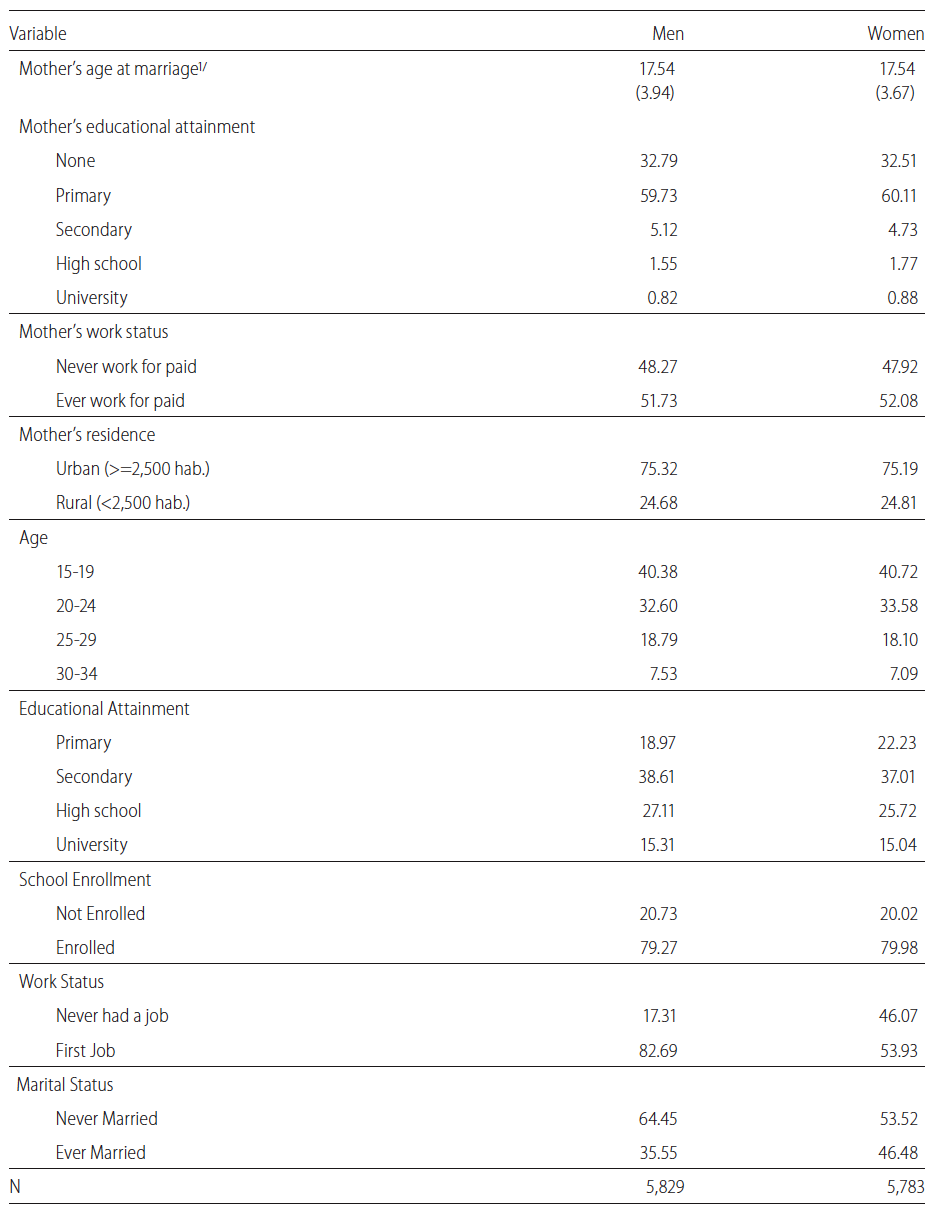
Note: 1/ Mean and (Std. Dev.)
Source: ENPF-1995, data mining.In order to provide answers to my research questions, I estimated a set of nested discrete-time hazard models (Allison, 1982) to evaluate the effects of mothers’ marriage age on children’s transition to marriage. To do so, I transformed the cross-sectional data into person years, generating one record for each year of exposure to the risk of marriage. I assumed the beginning of exposure to be at age 12 (the earliest reported age at marriage in the sample), and censored the never married at age 35. Consequently, the total number of person years was 49,526 for men and 43,670 for women. Separate models were estimated for men and women.
The dependent variable in the analysis is a dummy indicator of whether marriage occurred within a specific time-interval; that is to say, each model estimates the log-odds of marriage occurring in a given time-interval conditional on remaining single through the previous interval. In order to control for the duration dependency, I specified the duration of exposure as a linear spline with knots defined at 15, 22 and 25 for women, and 18 and 25 for men. Hence, the hazard rate changes linearly within each of the segments separate by the knots. The models are specified as follow:
All the models included the duration dependency function (DUR) and the control variables living arrangements (LIV), number of siblings (SIB), cohort (COH), and ruralurban residency (URB). In Model 1, I included only mothers’ age at marriage (MAM) with the goal of showing whether it has an overall and direct association with their children’s risk of marriage. In Model 2, I added mothers’ educational attainment (MEDU) and labor force participation (MLFP) in order to examine if mothers’ age at marriage influences children’s risk of marriage indirectly via either or both of these well-known predictors of marriage timing. Models 1 and 2 take into account the key family influence covariates under investigation, providing answers to my first and second research questions.
In Model 3, I controlled for children’s educational attainment (EDU), enrollment (ENR), and labor force participation (LFP) which investigates the extent to which the effect of mothers’ age at marriage on children’s age at marriage is mediated by children’s educational attainment and the transition into the labor market.5 This model provides an answer to my third research question, which asks if the influences of mothers’ marriage timing on children’s risk of marriage vanish or attenuate after controlling for children’s own acquired characteristics. Models 1-3 are estimated with robust standard errors in order to account for the clustering of children within mothers.
In Model 4, I consider the existence of unobserved heterogeneity by incorporating a random-effect term (zj) to accommodate dependence among the risk of marriage of different children of the same mother (i.e., shared unobserved heterogeneity).6 Thus, the model analyzes the extent to which children of the same mother (siblings) share common unobserved characteristics, and whether they inhibit the direct effect of mothers’ marriage timing on children’s risk of marriage. In addition, the random effect can be interpreted as the combined effect of omitted mother-specific (time-constant) covariates that cause children of the same mother to be more prone to marry than others. This model provides a speculative answer to my fourth research by addressing if the effect of mothers’ age at marriage on children’s risk of marriage is a result of common conditions experienced by their family not the direct effect of intergenerational influences.
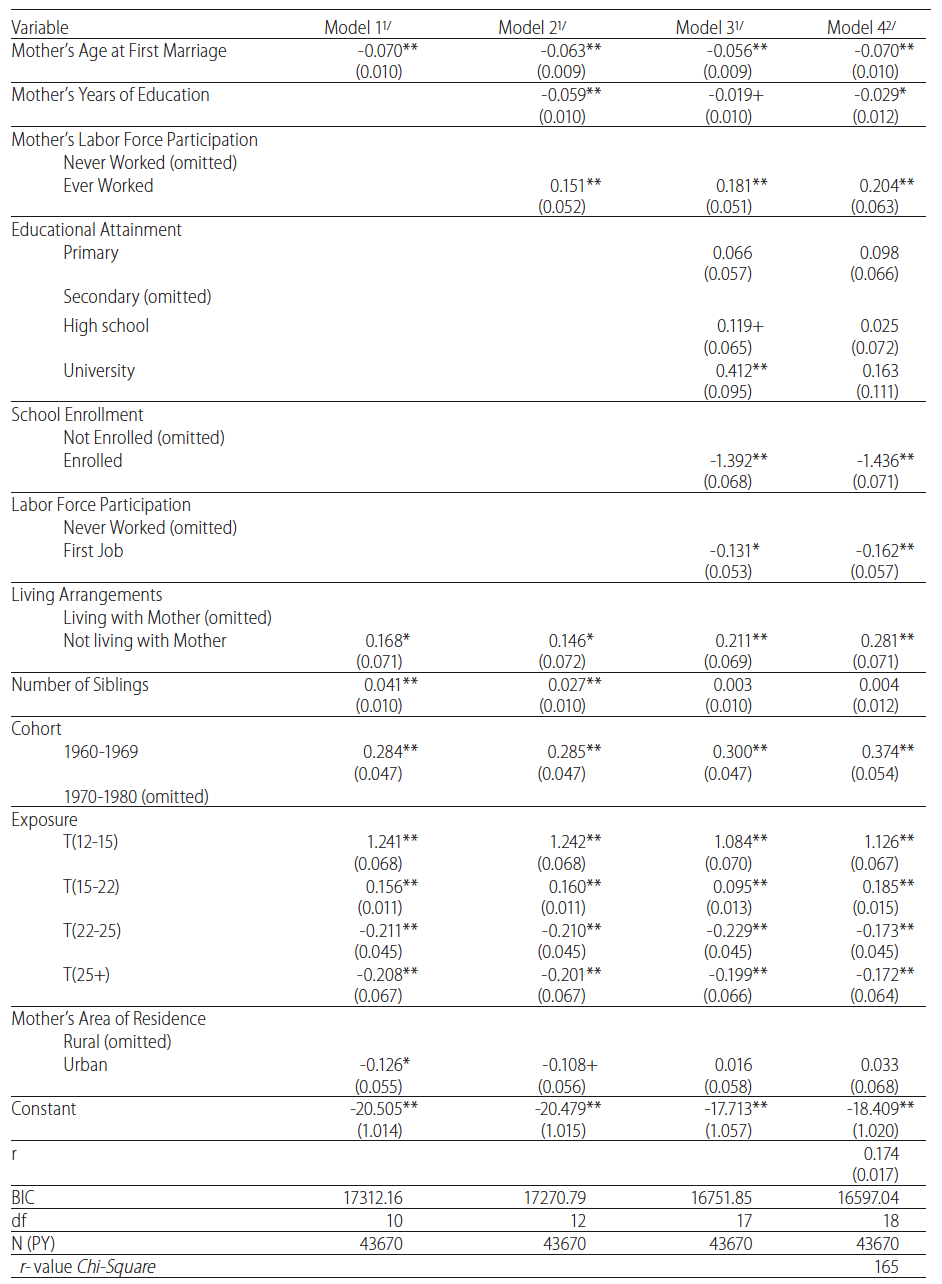
In Table 2, I present the estimated coefficients for the four model specifications of daughters’ transition to marriage.
Table 2. Parameter estimates from discrete-time hazard models predicting the transition to first marriage among women. Mexico. 1995.
Parameter estimates from discretetime hazard models predicting the transition to first marriage among women Mexico 1995
Note: 1/ Robust standard errors (in parenthesis) were estimated for Models 1, 2, and 3 due to cluster of children within mothers.
Note: 2/ Model 4 accounts for cluster-level frailty within mothers.
**=p<.01; *=p<.05; +=p<.10.
Source: ENPF-1995, data mining.Results from Model 1, presented in the first column, indicate that the risk of marriage is reduced by 7% (i.e., 1-exp(-.07)=.07) for each additional year of age at marriage of the mother. Consequently, the risk of marriage for daughters whose mother married at the age 18 would be 24% higher than for daughters whose mothers married at the age of 22, and 39% higher than daughters whose mothers married at the age of 25. The results of Model 1 are therefore consistent with the idea of a positive relationship between mothers’ and daughters’ age at marriage, suggesting possible intergenerational influences on marriage timing.
The four control variables are also significantly associated with the risk of marriage. Daughters not co-residing with their mother have 18% higher risk of marriage than those co-residing with their mother, consistent with the typical negative attitude towards independent living arrangements in early adulthood in Mexican society. Also in accordance with findings elsewhere regarding the number of siblings, the risk of marriage increases by 4% for each additional sibling in the family. There are signals of a delay in marriage among daughters born in the 1970s. The significant positive coefficient indicates that relative to them, daughters born in the 1960s have a 33% higher risk of marriage. This finding seems consistent with recent literature in Latin America, which suggests that generations born after 1970 are pioneering some family change (e.g., Rosero-Bixby, Castro-Martin and Martin-García, 2009). Finally, daughters of mothers residing in urban settings at the time of survey have a 12% lower risk of marriage than those whose mother resides in rural localities. Given the limitation of this measure and considering that marriage sometimes involves residential change, this finding only serves as a proxy of the contextual and normative environment the daughters were exposed to.
In Model 2, the inclusion of mothers’ years of schooling and work status indicates that net of the effects of these two predictors of both mothers’ and daughters’ marriage timing, there is a positive association between their ages at marriage. That is to say, the risk of marriage for daughters is reduced by 6.1% for each additional year of age at marriage for mothers. More importantly, the size of the standardized coefficients7 indicates that mothers’ age at marriage is as important as their education in predicting daughters’ risk of marriage. Accordingly, each additional year of schooling for mothers reduces by 5.8% their daughters’ risk of marriage. Possibly, the latter relationship also approximates the association between higher family’s socioeconomic status and later marriage.
Regarding mothers’ occupation, daughters whose mother ever worked for pay have a 16% higher risk of marriage than daughters whose mothers never worked. Earlier marriage among the former might reflect a situation in which daughters are sharing or are fully responsible of housework, and/or a situation of low socioeconomic status where mothers’ work for pay is a necessity to complement household income. The inclusion of mothers’ occupation and education does improve the model fit according to the BIC. Model 2 has a smaller bic and the difference between bics from Model 1 and 2 indicates very strong evidence of a better fit (i.e., 17,312-17,271=41).
The third column in Table 2 displays the results from Model 3, in which I included daughters’ education and labor force participation characteristics. Before describing how these variables are related to the risk of marriage, it is important to notice that mothers’ age at marriage is still positively related to daughters’ age at marriage (i.e., negatively associated with the risk of marriage). Moreover, by controlling for daughters’ educational attainment, the coefficient for mothers’ years of schooling was reduced from -0.06 to -0.02, suggesting that the effects of mothers’ education on daughters’ risk at marriage are due in part to the correlation between mothers’ and daughters’ education. In contrast, the coefficient for mothers’ age at marriage decreased just slightly; hence, net of daughters’ own acquired characteristics, their risk of marriage is still reduced by 5% for each additional year of age at marriage for mothers. Therefore, once controlling for daughters’ education, the size of mothers’standardized coefficients8 indicates that mothers’ age at marriage is more important than their education in predicting daughters’ risk of marriage.
As for daughters’ education and labor force participation characteristics, current school enrollment is associated with 75% lower risk of marriage. Once controlling for the inhibiting effect of school attendance, daughters with high school education have 13% higher risk of marriage than their secondary-educated peers; whereas relative to the latter, daughters with at least one year of university education have 51% higher risk of marriage. Regarding the first incorporation to the labor market, daughters that initiated their work trajectory are 12% less likely to enter into marriage than daughters never incorporated into the work force. After including these variables in the model, neither number of siblings nor locality of residence had statistically significant effects on daughters’ risk of marriage.
The results of Model 3, therefore, suggest that mothers’ age at marriage provides a fairly uniform negative effect on daughters’ risk of marriage, net of both mothers’ and daughters’ education and labor force participation characteristics. This finding suggests that beyond own and family basic socioeconomic characteristics, there are other forces associating mothers’ and daughters’ marriage timing. I can only speculate on cultural aspects, such as attitudes towards family formation or gender roles, which might be transmitted from one generation to the next. Because these kinds of unobserved characteristics, as well as other socioeconomic characteristics not available in the data set, could be correlated with both mothers’ and daughters' age at marriage, it is difficult to unambiguously interpret their relationship. For this reason, in Model 4, I consider the existence of unobserved heterogeneity by adding a random-effect term, which contemplates dependence among the risk of marriage of different children of the same mother. I expect the unobserved heterogeneity shared among siblings eliminates the common familial influences and allows observing whether mothers’ age at marriage still has effects on daughters’ risk of marriage.
The inclusion of the random-effect term in Model 4 significantly improved the model fit. Its bic is 155 points smaller than Model 3’s bic, showing very strong evidence of a better fit to the data (i.e., 16,752-16,597=155). Results from this model are displayed in the last column of Table 3. Due to the relatively small within-mother correlation (i.e., 0.17), the estimated hazard ratios are close enough to those from the model without random-effects, with the exception of daughters’ educational attainment, which no longer has a statistically significant effect on the risk of marriage. For all other variables, the substantive interpretation of their effects is about the same.
Results from Model 4, therefore, provided reasonable evidence that maternal age at marriage has effects on daughters’ risk of marriage. The influence of mothers’ marriage timing on daughters’ marriage timing goes beyond its correlation with some traditional predictors of marriage formation, such as educational attainment, school enrollment, labor force participation and mothers’ education. Hence, daughters’ risk of marriage is reduced by their mother’s age at marriage by 7% for each additional year delayed, suggesting that daughters whose mother married early would enter into marital unions earlier than daughters whose mother married later.
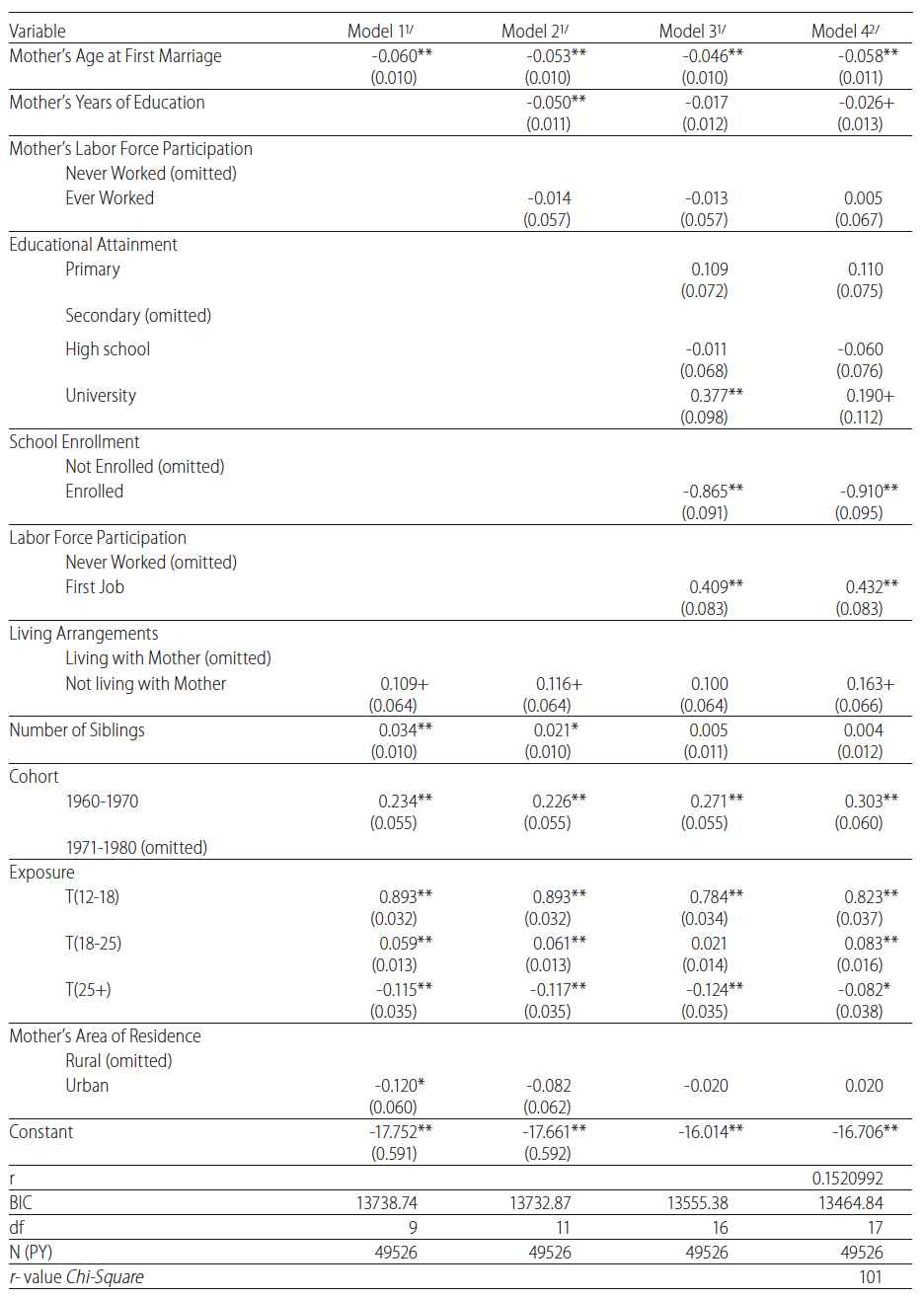
The estimated coefficients for the four model specifications of sons’ transition to marriage are displayed in Table 3.
Table 3. Parameter estimates from discrete-time hazard models predicting the transition to first marriage among men. Mexico, 1995
Parameter estimates from discretetime hazard models predicting the transition to first marriage among men Mexico 1995
Note: 1/ Robust standard errors (in parenthesis) were estimated for Models 1, 2, and 3 due to cluster of children within mothers.
Note: 2/ Model 4 accounts for cluster-level frailty within mothers.
**=p<.01; *=p<.05; +=p<.10.
Source: ENPF-1995, data mining.Results from Model 1, presented in the first column, indicate that sons’ risk of marriage is reduced by 6% (i.e., 1-exp(-.06)=.06) for each additional year their mothers delayed marriage. Consequently, the risk of marriage for sons whose mother married at the age 20 would be 26% higher than for sons whose mothers married at the age of 25. Contrary to some theoretical expectations, the effects of mother’s age at marriage seem to be similar between daughters and sons, possibly indicating that when it comes to the time of family formation, Mexican mothers influence their children in a similar manner regardless of the sex of the child. The results of Model 1, therefore, suggest possible intergenerational influences on marriage timing regardless of the sex of the child.
The four control variables also have significant effects on sons’ risk of marriage. The effects are very similar to those observed in the daughters’ sample. Specifically, Young males not co-residing with their mother have 12% higher risk of marriage than those coresiding with their mother. Analogous to the results for daughters regarding the number of siblings, sons’ risk of marriage increases by 3% for each additional sibling in the family. Also comparable to daughters, there are signals of a delay in marriage among sons born in the 1970s. Hence, sons born in the 1960s have 26% higher risk of marriage than those born in the 1970s. Finally, sons of mothers residing in urban settings at the time of survey have 11% lower risk of marriage than those whose mothers reside in rural localities, reflecting more traditional patterns of marriage in these settings.
The inclusion of mothers’ years of schooling and work status in Model 2 suggests that net of the effects of these two predictors of both mothers’ and children’s marriage timing, there is a positive association between sons’ and mothers’ ages at marriage. Specifically, the risk of marriage for sons is reduced by 5.2% for each additional year of age at marriage for mothers. At the same time, each additional year of schooling for mothers also reduces by 4.8% their sons’ risk of marriage. Similar to daughters’ results, the size of the standardized coefficients9 indicates that mothers’ age at marriage is as important as their education in predicting sons’ risk of marriage. Different from the results of daughters, however, the association between mothers’ occupation and sons’ risk of marriage is not statistically significant. Neither is mother’s locality of residence at the time of survey, once controlling for their education and labor force participation status.
Sons’ education and labor force participation characteristics were included in Model 3. The results, presented in the third column of Table 3, indicate that mothers’ age at marriage still has a statistical significant effect on sons’ risk of marriage. Therefore, net of sons’ own acquired socioeconomic characteristics, their risk of marriage is further reduced by 4.5% for each additional year of their mothers’ age at marriage. In contrast, once controlling for sons’ variables, mothers’ years of schooling are no longer associated with their risk of marriage, suggesting that the effects of mothers’ education on sons’ risk of marriage are due to the influences of mothers’ education on sons’ education. Therefore, once controlling for sons’ socioeconomic characteristics, the size of mothers’standardized coefficients10 indicates that mothers’ age at marriage is more important than their education in predicting sons’ risk of marriage.
The effect of sons’ education on their risk of marriage shows that, while in school, young men have 58% lower risk of marriage than their peers no longer enrolled in school. Regarding educational attainment, relative to sons’ with secondary education, collegeeducated sons have 46% higher risk of marriage, once controlling for the inhibiting effect of school enrollment. Whereas sons with high school education do not differ in their risk of marriage from sons with secondary education, high-school-educated daughters have a significant higher risk of marriage than their secondary-educated peers. This gender difference could suggest that the educational credentials required for men to get married are higher than the ones needed by women. After attending college, however, there are no substantial gender differences in the relative risk of marriage (i.e., college educated young adults, regardless of their sex, have around 50% higher risk of marriage than their secondary educated peers).
Regarding the first incorporation to the labor market, sons that initiated their work trajectory are 51% more likely to enter into marriage than sons never incorporated into the work force. In contrast, daughters with work experience are less likely to form unions than their never-worked peers. This is an important, although not surprising, result that confirms the traditional gender division of labor in Mexican families. After including sons’ education and labor force participation in the model, neither number of siblings nor living arrangements have statistically significant effects on sons’ risk of marriage.
Returning to the focal point, results of Model 3 show that mothers’ age at marriage provides a fairly uniform negative effect on sons’ risk of marriage, net of both mothers’ and sons’ education and labor force participation characteristics. In a similar way to daughters, this finding suggests that beyond own and family basic socioeconomic characteristics, there might be other forces associating mothers’ and sons’ marriage timing.
For the same reasons explained before, Model 4 contemplates dependence among the risk of marriage of different sons of the same mother. By eliminating common familial influences, this model, allows observing whether mothers’ age at marriage still has effects on sons’ risk of marriage.The inclusion of the random-effect term in Model 4 significantly improved the model fit. Its bicis 90 points smaller than Model 3’s BIC, showing very strong evidence of a better fit to the data (i.e., 13,555-13,465=90). Results from this model are displayed in the last column of Table 3. Although the within-mother correlation is relatively small (i.e., 0.15), there are some differences in the estimated hazard ratios relative to those from the model without random-effects. The effects of mothers’ age at marriage on sons’ risk of marriage, however, are still statistically significant. The major differences are found in the effects of mother’s education and premarital living arrangements, which became statistically significant again. For all other variables, the substantive interpretation of their effects on sons’ risk of marriage is about the same.
Results from Model 4, therefore, provided reasonable evidence that maternal age at marriage has effects on sons’ risk of marriage. Hence, sons’ risk of marriage is reduced by 6% for each additional year of age at marriage for mothers. It seems that the influence of mothers’ marriage timing on children’s marriage timing extends beyond its correlation with traditional predictors of marriage formation like educational attainment, school enrollment, labor force participation and mothers’ education, suggesting that children whose mothers married early enter into marriage earlier than children whose mothers married later. The gender similarity in the intergenerational influences of marriage timing is an important finding of this research.
The age at marriage remained fairly constant during the second half of the past century in Mexico, when important socioeconomic and demographic changes also took place. Major contributions to the study of the transition to marriage in the country have documented the significant role of socioeconomic differences in marriage timing (e.g., Lindstrom and Brambila Paz, 2001; Parrado and Zenteno, 2002). Little or no attention has been devoted, however, to cultural explanations such as the role of family influences in keeping marriage timing constant and almost universal. In this paper, I provide a piece of empirical evidence that suggests family influences have a considerable role in the timing of the transition to marriage. Specifically, I find that children of mothers who married young entered into marriage earlier than children of mothers who delayed marriage. This relationship persists after controlling for important socioeconomic factors. In fact, the magnitude of the effects of mothers’ age at marriage on children’s risk of marriage is larger (i.e., more important) than the magnitude of the effects of mothers’ education.
The influence of mothers’ age at marriage on both daughters and sons’ marriage timing is similar. In other settings, daughters’ transition to marriage was found to be more strongly influenced by their mothers’ age at marriage than sons’ (Thornton, 1991), possibly because the former are more strongly socialized by their mothers, whereas the latter by their fathers (Rossi and Rossi, 1990). Although only few of the predictors of marriage timing here analyzed show traditional gender differences, the similarity in the effects of maternal age at marriage between daughters and sons signals strong family ties in the Mexican society.
Other gender similarities, such as the positive effect of not co-residing with their mother on children’s risk of marriage, further show Mexican’s familistic orientation – suggesting the existence of negative attitudes towards independent living arrangements in early adulthood–. At the same time, the gender differences, such as the effects of mothers and children’s labor force participation, and children’s educational attainment, illustrate the traditional division of labor within families. Whereas no effect is found in this regard among sons, earlier marriage among daughters whose mothers work outside home might reflect a situation in which daughters are sharing or are fully responsible for housework. The opposite direction in the relationship between labor force participation and the risk of marriage, added to the positive effect of college education only among sons, suggest that the educational credentials required for men to get married are higher than the ones needed by women and that their function as household provider is still expected.
When analyzing family patterns in several countries in Latin America, including Mexico, Fussell and Palloni (2004) suggested that social and economic change in the region is not necessarily incompatible with stable family trends due to the centrality of marriage in men' and women's lives. Accordingly, my findings suggest that differences in marriage timing are not only due to socioeconomic factors. Holding both mothers’ and children’s education constant, the age at which mothers get married has an effect on their children’s age at marriage –suggesting that young men and women from all educational backgrounds are receptive of parents’ behaviors and,possibly, attitudes towards family formation–. Qualitative and quantitative studies about attitudes toward gender roles within the family in Mexico have found educational differentials regarding whether women should work outside the home, but educational differences are minor regarding whether or not they should marry and what the ideal age to do it is (Quilodrán, 2001; García and Oliveira, 2006). The strong family ties between parents and children could facilitate the endurance of these beliefs.
This study has important limitations that must be highlighted. The primary one is the use of cross-sectional data. Although the analysis was possible due to the available retrospective information of mothers’ and children’s marriage timing, I was forced to assume some of the variables in the model were not only constant, but also, have constant effects on children’s risk of marriage. I also made important assumptions regarding the educational attainment of children, which I assumed coincides with the typical grade associated with the age they report leaving school. While not all children have uninterrupted educational trajectories, however I had to assume so. Another limitation is that the analysis ignores the effects of fathers’ age at marriage on their children’s, which might be of particular importance for sons.
Finally, while it is possible that intergenerational influences and similarities of marriage timing between parent and children are changing –they could be becoming stronger or weaker–, the small window of time provided by the cohorts of children analyzed here does not allow a thorough examination of continuity or change. Moreover, new research conducted with data of younger cohorts, suchas those born during the 1980s suggest important transformations in the transition to first union among Mexicans, namely a noticeable delay in the age at first union, an increase in the time these cohorts are taking to complete the transition, and more importantly, a significant increase in nonmarital cohabitation that is substituting marriage as the traditional type of first union. In this study, cohabitating unions and marriages were analyzed together due to data structure; however, given the emerging dynamics just listed above, grouping the two types of unions might no longer be justifiable. When more suitable data become available, future research should address these issues and include measures attitudes toward marriage across generations. Such would provide a better understanding of the role of parental influences on the transition to marriage in Mexico net of confounding beliefs and attitudinal measures.
*: The research reported herein was supported by grants from the National Institute of Health-Fogarty Centers under the project International Training in Population Health (D43-TW001586) at the University of Wisconsin-Madison. Computation was carried out using facilities of the Center for Demography and Ecology at the University of Wisconsin-Madison that are supported by Center Grants from the National Institute of Child Health and Human Development and the National Institute on Aging. Earlier versions of this article were presented at meetings of the Population Association of America, and the Mexican Society of Demography.
Descriptives of variables in the model predicting the effect of mother’s age at marriage on children’s transition to first marriage by sex. Mexico. 1995
Note: 1/ Mean and (Std. Dev.)
Source: ENPF-1995, data mining.Parameter estimates from discretetime hazard models predicting the transition to first marriage among women Mexico 1995
Note: 1/ Robust standard errors (in parenthesis) were estimated for Models 1, 2, and 3 due to cluster of children within mothers.
Note: 2/ Model 4 accounts for cluster-level frailty within mothers.
**=p<.01; *=p<.05; +=p<.10.
Source: ENPF-1995, data mining.Parameter estimates from discretetime hazard models predicting the transition to first marriage among men Mexico 1995
Note: 1/ Robust standard errors (in parenthesis) were estimated for Models 1, 2, and 3 due to cluster of children within mothers.
Note: 2/ Model 4 accounts for cluster-level frailty within mothers.
**=p<.01; *=p<.05; +=p<.10.
Source: ENPF-1995, data mining.