Artículos originales
Induced (ℰ, ℳ)-structures on Topological Categories
(ℰ, ℳ)-estructuras inducidas en categorías topológicas
Induced (ℰ, ℳ)-structures on Topological Categories
Revista Integración, vol. 39, no. 2, pp. 241-256, 2021
Universidad Industrial de Santander
Received: 02 September 2020
Accepted: 17 July 2021
Abstract.:
In this paper, we describe a convenient categorical structure with respect to a class of monomorphisms ℳ and epimorphisms E for any topo-logical category. We show in particular that the structure that we introduce here, which is induced by topological functors and their initial liftings, allows the study of some ℳ - coreflective subcategories of a topological category. We pay special attention to projective structures.
MSC2010: 18A20, 18A32, 18G05, 54A05, 55U40.
Keywords: (ℰ, ℳ)-category, initial lift, topological category, topological functor.
Resumen.: En este artículo describimos una estructura categórica conveniente respecto a una clase de monomorfismos ℳ y una clase de epimorfismos E, para cada categoría topológica. En particular, mostramos que la estructura que introducimos aquí, que es inducida por functores topológicos y levantamientos iniciales, permite el estudio de algunas subcategorías ℳ -correflexivas de una categoría topológica. Prestamos atención especial a estructuras proyectivas.
Palabras clave: Categoría topológica, (ℰ, ℳ)- categoría, funtor topológico, levantamiento inicial.
1. Introduction
For arbitrary category various canonical factorization of arbitrary morphisms, through regular epimorphisms, strong epimorphisms (the orthogonal class to monomorphisms), and extremal epimorphisms, and its relations with limit operations were considered by G. M. Kelly in [12]. He showed closure properties of the class of epimorphism factors under composition, and cointersections in some cases, as well as essential uniqueness of the canonical factorizations. He tried to avoid unnecessary completeness hypotheses to prove J. R. Isbell's results under other and usually weaker conditions. Isbell in [11] has developed some notions and results of the structure theory of categories that relate adequacy to ideal structure and completeness, in particular Theorem 3.2 of [11] established that every reflexive set functor on a full subcategory of a well-behaved category C, with free sums, direct product and (Mono, Epi) factorizations; is representable in C.
The notion of closure operator in an arbitrary category X, introduced in [4] and defined on a class of subobjects, has led to a useful tool in diverse theories like Topos in [13], Heyting algebras in [6] and in any partially-ordered set, viewed as a category, the full reflexive subcategories are in one-to-one correspondence with the order-preserving expansive idempotent functions. For the Top category, closure operators have been used to describe some relations and properties in "good" categories (see M. M. Clementino in [3] and G. Castellini in [2]), these categories necessarily carry a special type of categorical structure (see 2.1 of [5]); in order to define a closure operator on a category X with respect to a class of monomorphisms ℳ, it is usually considered that X is finitely ℳ - complete and X has a factorization system (ℰ, ℳ) for morphisms (see [5]), with ℰ a class of epimorphisms namely defined by ℳ and the concept of orthogonal morphism. H. Herrlich in Theorem 2.2 of [8] (and J. R. Isbell in [11]) gives the characterization for the epi-reflexive subcategories, and in Theorem 6 of [7], H. Herrlich and G. E. Strecker proved the theorem for mono-coreflective subcategories with the use of an (ExEpi, Mono) system of factorization, the characterization theorem of ℳ -coreflective subcategories that are a categorical dual version of the theory of Stone-Cech compactification, requires an ℳ wellpowered (ℰ, ℳ) category X with coproducts and ℳ a class of monomorphisms. For a topological category X in the sense of R. Nakagawa [14], we will show that X has the categorical structure to hold closure operators and the characterization theorem of ℳ - coreflective subcategories.
We devote special attention to the case of a class ℳ generated by an object and the projective property. This class of subobjects has similar behavior under inverse image and joins as the union of sets under inverse image. This last allows us to adapt, to an arbitrary topological category, one method of relating lower limit operators with bicoreflective categories that H. Herrlich provides in [9].
We now briefly describe the main content of the article. In the first section, we introduce the notion of topological category and the notation for initial liftings that enables us to give a common treatment of the categories studied here. In the second section, we enumerate the notion of ℳ subobjects, initial ℳ subobjects in a topological category, as well as some results that make explicit the behavior that a topological category inherits, through the topological functor, with respect to factorizations, separating objects and limits. In the third section, we then prove our most general result relating the class of morphisms for which the object in the fiber of a one-point set is projective and characterize the embedding as the orthogonal family associated with it, Proposition 4.3. The last section is devoted to show that a correspondence between lower limit-operators and bicoreflective subcategories can be established due to the properties that the subobjects and initial subobjects have.
2. Preliminaries and notation
Let {(Xi,Ti)\i Є I} be a family of topological spaces. For each family of functions {fi: Y → Xi\i Є I} there is the coarser topology ρ on Y that makes continuous each fi: (Y, ρ) → (Xi,Ti). This fundamental construction in the Top category can be generated in many categories similar to Top. The following definitions and results are on 12 of [14].
For a generic category S a functor F : X → S is said to be a topological functor if for any F−source (X, (fλ : X → F(Xλ ))λ∈Λ ), there exists a unique X−source (X, (fλ : X → Xλ )λ∈Λ ), which will be called F−initial lift of (fλ )λ∈Λ , satisfying the following conditions:
1. 
2. (F-initiality) For an X-source (Y, (gλ: Y → Xλ)λ∈Λ) and an S-morphism h : F(Y) → X such that fλo h = F(gλ) for any A Є Λ, there exists a unique X- morphism  such that
  and
and 

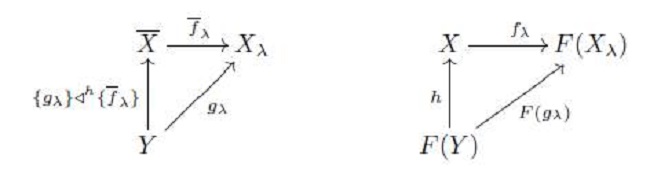
An X -morphism f : X → Y is said to be an F-initial morphism in X if the X- source (X, (f )) is an F-initial lift of (F(X), (F(f ))).
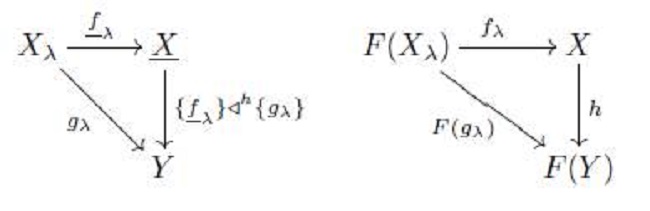
Dual: S-sink, F-sink, cotopological functor, F-final morphism and F-final lift described by the commutative diagram
Proposition 2.1 (See 12.4 of [14]). If a functor F : X → S is topological, then it is faithful.
Theorem 2.2 (See 12.7 of [14]). A functor F : X → S is topological if and only if it is co-topological.
The next result gives a property of lifting of limits and colimits.
Corollary 2.3 (See 12.9 of [14]). Suppose that F : X → S is a topological functor. If S is complete, then X is complete and, if S is cocomplete, then X is cocomplete.
Definition 2.4 (See 13.1 of [14]). Let F : X → S be a functor. A pair (X,F) with X a locally small category is said to be a topological category if the following conditions hold:
1. S = S et and F is a topological functor.
2. For any A Є Obj(Set), the class F-1(A) := {X Є Obj(X)\F(X) = A} is a set.
3. For a set {p} consists of precisely one point p, F-1({p}) consist of precisely one X- object.
The proof of the dual theorem of next theorem is in 8 of [14].
Theorem 2.5 (Characterization of ℳ - coreflective subcategories). Suppose that X is an M - wellpowered (ℰ, ℳ) -category with ℳ ⊆ Mono(X) and that X has coproducts. Then, for a full and isomorphism-closed subcategory U of X, the following conditions are equivalent:
1. U is M - coreflective in X.
2. U is closed under coproducts and satisfies that if f : X → Y belongs to ℰ and X Є Obj (U), then Y Є Obj (U).
3. Lifted structures to topological categories
A topological category (X, F ) is based on the category S et through the functor F, in order to give a structure on X, we use the lifting property of F (initial or final) to lift every structure of (ℳ, ℰ )- category on S et to a structure of (ℳ ', ℰ ') -category on X, this structure inherits closure properties respect to composition, limits, and existence of unions.
Notation. Let F : X → S be a topological functor and ℳ ⊆ Mono(S),

And

where 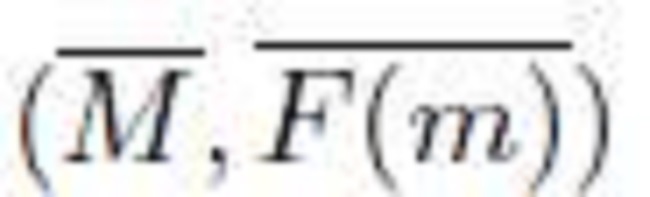 is an F-initial lift of (F (M ),F (m)), and for every pair of X- morphisms f and g, f ≅ g denotes that there is an X- isomorphism φ with f = g o p. For every X-object X, an element of ℳF (or ℳF ) with codomain X is called ℳF- subobject (or ℳF-subobject of X).
Proposition 3.1. If F : X → S is a topological functor with X locally small and ℳ ⊆ Mono(S), then:
1. ℳF ⊆ Mono(X) and ℳF ⊆ Mono(X).
2. If ℳ contains all identity morphisms of S, ℳ f and ℳFcontain all identity morphisms of X.
3. If M is closed under composition with isomorphisms, then ℳ f and ℳFare closed under composition with isomorphisms.
Proof. 1. It follows from proposition 21.13 part (1) of [1].
2. Let IX be an identity morphism of X, F(IX ) = IF(X)∈ ℳ, next we show that IX is an F−initial morphism, suppose that g : Y → X is an X-morphism and h : F(Y ) → F(X) is an S−morphism such that IF(X) ◦ h = F(g), then h = F(g), letting g ◁h IX := g, we have F(g◁hIX) = F(g), the unicity of g◁hIX is a consequence of Proposition 2.1. Finally, since all F−initial lifts of the same morphism are isomorphic, we have that IX ≅IF(X).
3. Let m : M → X be an ℳ F−subobject of X, i.e., m ∈ ℳ F and Cod(m) = X, and ϕ : Z → M an X−isomorphism, we have F(m ◦ ϕ) = F(m) ◦ F(ϕ) ∈ M, next we show that if m ∈ M F , then m ◦ ϕ is an F−initial morphism, suppose that g : Y → X is an S−morphism and h : F(Y ) → F(Z) such that F(ϕ ◦ m) ◦ h = F(g), by the property of F−initiality of m, there is a morphism g ◁F (ϕ)◦h m, letting

we have that F (g ◁h(m o Ф)) = h, and

hence m o Ф o g◁h(m o Ф) = g by Proposition 2.1, the unicity of g◁h(m o $) is a consequence of Proposition 2.1. Finally since all F-initial lifts of the same morphism are isomorphic, we obtain that m o Ф ≅ F (m o Ф).
Notation. Let F : X → S be a topological functor and ℰ ⊆ Epi(S),
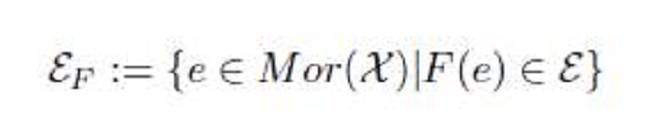
And

with (E,F(e)) an F-final lift of (F(E),F(e)).
Proposition 3.2. If F : X → S is a topological functor and ℰ ⊆ Epi(S), then:
1. ℰF ⊆ Epi(X) and ℰF ⊆ Epi(X).
2. If ℰ contains all identity morphisms of S, ℰ p and ℰ p contains all identity morphisms ofX.
3. If ℰ is closed under composition with isomorphisms, then ℰ p and ℰ p are closed under composition with isomorphisms.
For a topological category (X, F) it is well known that X is well-powered and cowell-powered (see 13.1 of [14] and 21.16 of [1]), that is X is Mono(Set)F -well-powered. A similar result, with a similar proof, but with a minor variant is the following:
Proposition 3.3. Let F : X → S be a topological functor with X a locally small category and ℳ a class of monomorphisms in S closed under composition with isomorphism. If S is ℳ -wellpowered, then X is Mf - wellpowered and ℳ f -wellpowered.
Another property of topological functors is that it can reflect and preserve separators (see 21.16 of [1]), we indicate in particular the following separator object P in a topological category (X, F) since it can be detected as an object of a certain specific subcategory of X (Proposition 5.6).
Proposition 3.4. Let (X ,F) be a topological category, for any set {p} consisting of precisely one point p, the object P Є F-1({p}) is a separator on X.
A version of the following Proposition for factorizations of initial sources or a version for initial morphisms and (ℰ, ℳ)- topological functor can be seen at 4.2 of [10] and 21.14 of [1] respectively.
Proposition 3.5. Let F : X → S be a topological functor. If S has (ℰ, ℳ)- factorization, then X has (ℰ f, Mf) and (ℰ f, ℳ f)-factorization.
Proposition 3.6. Let F : X → S be a topological functor. If S has ℳ -pullbacks, then X has ℳ f-pullbacks and Mf-pullbacks.
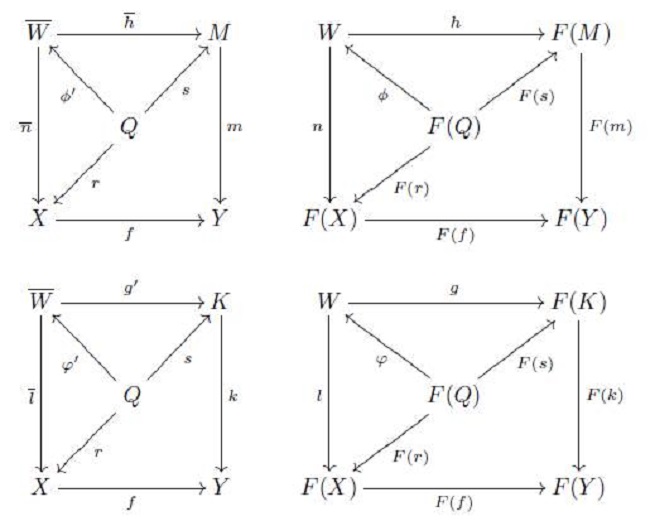
Proof. Let f : X → Y, m : M - Y and k : K → Y be A7-morphisms with m G MF and k Є MF • Let n,h, and l,g be the M-pullbacks of F(m),F(f) and F(k),F(f), respectively. Notice that n, h, and l,g' are the MF -pullback and the Mf-pullback, respectively, where g' = (f o 1) ◁g k. The universal property follows from the next commutative diagrams
where 
Corollary 3.7. Let F : X → S be a topological functor. If S is a finitely ℳ -complete category, then X is finitely Mf - complete and finitely ℳ f -complete.
The (ℰ, M)- situations generated by Herrlich in [10] has a similar construction of (ℰ, ℳ)- structures for the concepts of (ℰ, ℳ)- topological category and (ℰ, ℳ)- topological functor.
4. Lifting of projective objects
Definition 4.1. Let f : X → Y be an S-morphism, an S-object P is said to be projective with respect to / if for every S-morphism y : P → Y there is an S-morphism x : P → X with / o x = y. For every S-object P, one defines

Let (fλ: Xλ → Y)λЄ∧ be a sink in X, Pis projective with respect to (fλ)λЄ∧ if for every X- morphism y : P → Y there is a X0Є ∧ and a morphism x : P - Xλ0 , with fλ0ox = y.
Remark 4.2. Let {p} be a set consisting of precisely one point, Πset({p}) = Epi(Set) and (ΠSet({p}))⊥ = Mono(Set)..
Proposition 4.3. If (X,F) is a topological category and P Є F-1({p}), then the following holds:
1. Πx(P) is stable under pullbacks and Πx(P) ⊂ Epi(X).
2. (Πx(P)) ⊥ = Mono(Set)F.
3. X is a (Πx(P), (Πx(P)) ⊥) - category.
Proof. 1. Consider a pullback
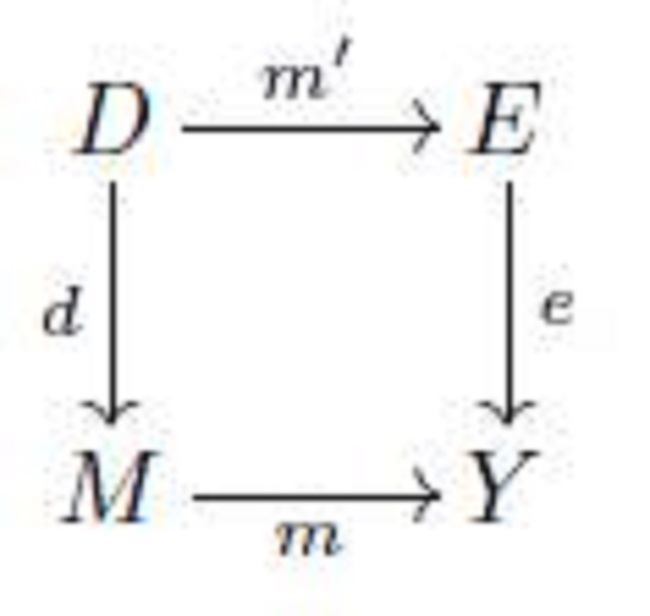
with e Є Πx (P), since P is projective with respect to e for every morphism y : P → M, there is a morphism x' : P →E with e o x' = m o y, by the pullback property there is a morphism x : P → D with d o x = y and m' o x = x'
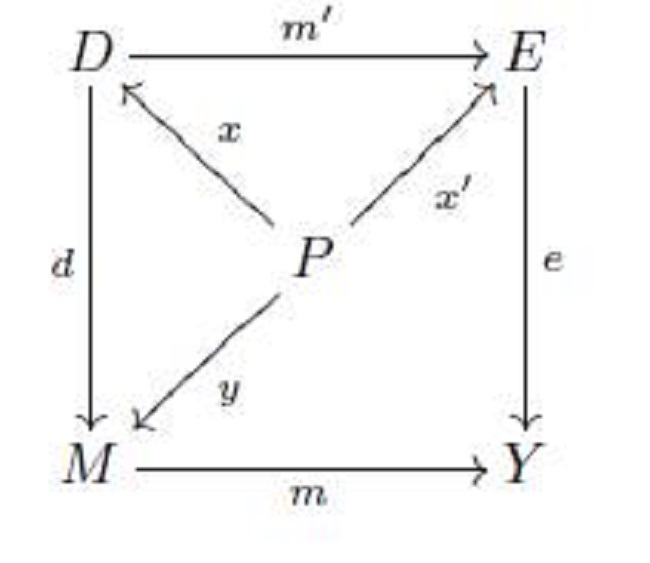
hence d Є ΠX(P).
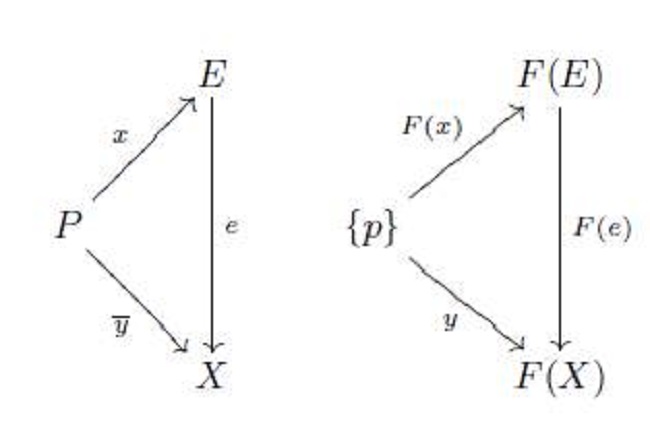
Let e Є Πx(P), one has F(e) Є ΠSet({p}), since for every y : {p} - F(X), there is an X-morphism X such that the following diagram commutes
For any two X−morphisms u, v : X → Z with u ◦ e = v ◦ e, one has F(u) ◦ F(e) = F(v) ◦ F(e) hence F(u) = F(v) and u = v.
2. Let m ∈ (ΠX (P))⊥, suppose that v ◦ e = F(m) ◦ u with e ∈ ΠSet({p}), consider u : E → M and v : X → Y the F−initial lifts of u and v respectively. By F−initiality of v, there is a X−morphism t = (m◦u) ◁ev. Next we shown that t ∈ ΠX (P), if y : P → X is an X−morphism, there is a Set−morphism x : p → E with F(y) = e ◦ x, and the F−initial lift x : P → E of x is an X−morphism with F(t ◦ x) = F(y), hence t ◦ x = y. Since m ◦ u = v ◦ t, there exists an X−morphism with v = m ◦ d and u = d ◦ t. The Set−morphism F(d) satisfies v = F(m) ◦ F(d) and u = F(d) ◦ e, and considering that e is an epimorphism, F(d) is the unique Set−morphism with that property.
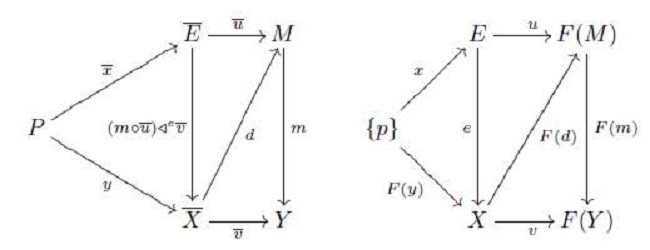
Hence F(m) ∈ (ΠSet ({p}))⊥, and F(m) is a Set−monomorphism. To show the F−initiality of m suppose that F(m) ◦ h = F(g) with g : Y → X a X−morphism and h : F(Y ) → F(M) a Set−morphism, one has the following commutative diagram:
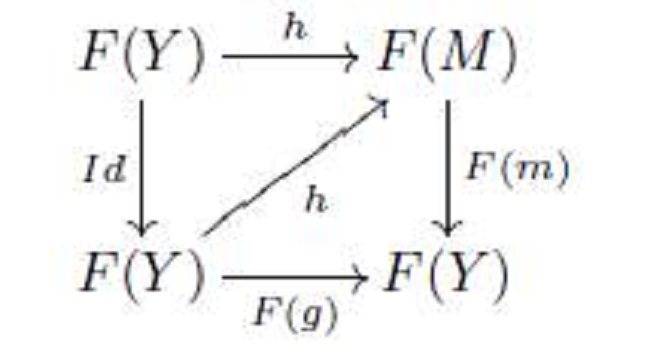
for (F(Y ), (h, Id)) a F−initial lift of (F(Y ), (h, Id)) and letting g ◁hm := d one has the commutative diagram
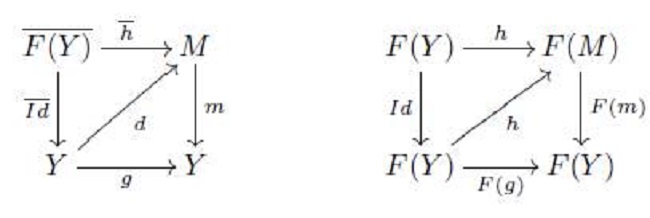
hence m is F initial.
Let m Є Mono(Set)F and e Є Πx (P) with m o u = v o e we have the commutative diagrams:
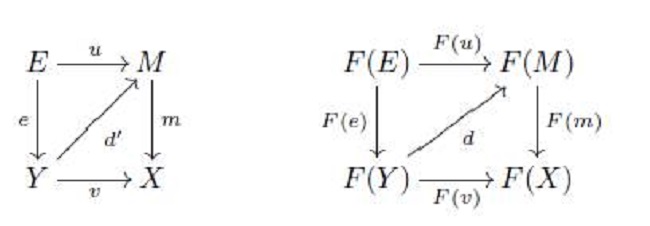
with d′ = v ◁dm, hence m ∈ (ΠX (P))⊥.
3. Let f : X → Y be an X−morphism. Consider the factorization of F(f) in Set given by the inclusion i of A = F(f)(F(X)) to F(Y ) and e the restriction of F(f) to A, then F(f) = i ◦ e. Consider the F−initial lift i : A → Y of i, and t = f ◁ei, we have that f = i ◦ t and, by (2), i ∈ (ΠX (P))⊥, also as in the proof of (2) we have that t ∈ ΠX (P). Now we showed that the factorization f = i ◦ t has the diagonalization property. For every n ∈ (ΠX (P))⊥ and X−morphisms u : X → N and v : Y → Z with v ◦ f = n ◦ u we have the following commutative diagrams
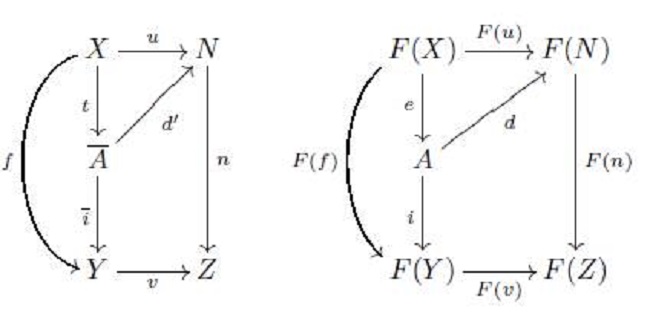
with d′ = (v ◦ i) ◁dn, the existence, and uniqueness of d′ follow from the fact that n ∈ Mono(Set)F , this last by (2). Therefore, f = i◦t is a (ΠX (P), (ΠX (P))⊥)−factorization of f.
Lemma 4.4. Let (X, F) be a topological category, P ∈ F−1({p}) and (mλ : Mλ → X)λ∈Λa family of elements of (ΠX (P))⊥, then
1. For NΛ = ∪F(mλ )(F(Mλ )) and i0: NΛ→ F(X) the inclusion, ∨mλ≅ i0holds.
2. P is projective with respect to the sink, belonging to (ΠX (P))⊥−union, (jλ : Mλ→∨Mλ )λ∈Λ.
Proof. Let (mλ : Mλ→ X)λ∈Λ be a class of elements of (ΠX (P))⊥. For each λ ∈ Λ we define:
(a) hλ as the restriction of F(mλ ) to its image and Nλ as F(mλ )(F(Mλ )), note that by definition and (2) of Proposition 4.3 we have that hλ is a bijection.
(b) iλ as the inclusion from Nλ to ∪F(mλ )(F(Mλ )).
(c) kλ : F(Mλ ) → ∪F(mλ )(F(Mλ )) as kλ := iλ◦hλ.
Since i0 is an initial morphism, for every λ ∈ Λ there is a jλ : = mλ◁kλ i0 with mλ = i0◦jλ , i.e., mλ≤ i0.
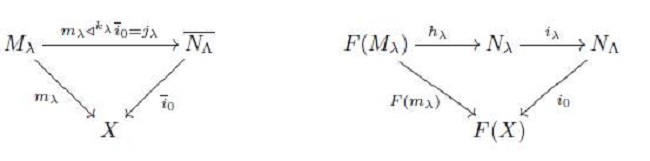
Next, we show that for every n ∈ (ΠX (P))⊥, if {uλ : Mλ→ N}λ∈Λ is a family of X−morphisms and v : X → Y is an X−morphism such that for every λ ∈ Λ, n ◦ uλ =v ◦mλ , then there is a uniquely determined morphism d : N → N with n ◦ d = v ◦ i0 and d ◦ jλ = uλ for all λ ∈ Λ, definition of M−union (see 1.9 of [5]). Suppose that, for each λ ∈ Λ there is a commutative diagram on X
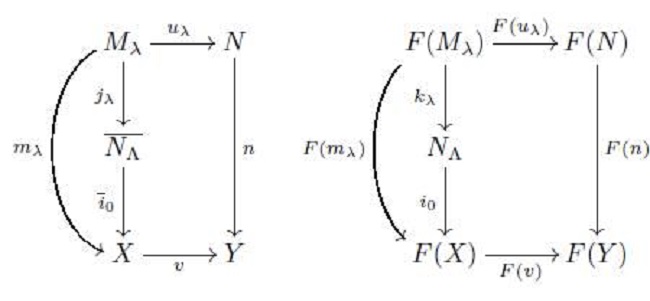
with n ∈ (ΠX (P))⊥. Considering the commutative diagram
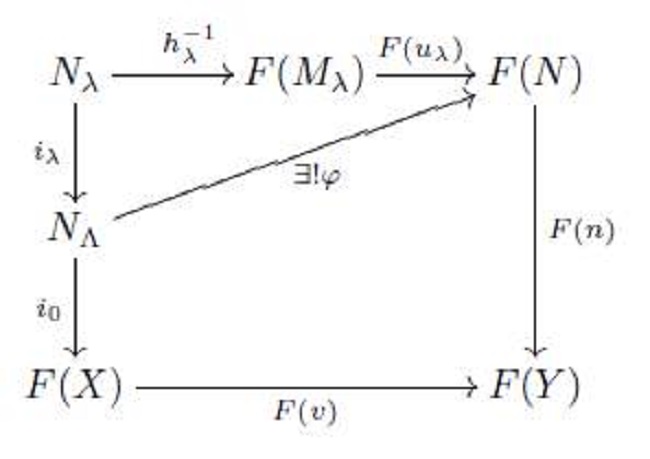
where φ is defined as follows, for every x ∈ NΛ, there is a λx∈ Λ such that x ∈ Nλx ,and φ(x) := F(uλx ) ◦ h−1λx (x), note that if x ∈ Nα∩ Nβ , then

By (2) of Proposition 4.3, F(n) is a monomorphism, then F(uα ) ◦ h−1α (x) = F(uβ ) ◦h−1β (x)), hence φ is well defined. We can define φ′ = (v ◦ i0) ◁φn, it makes the next diagram commute
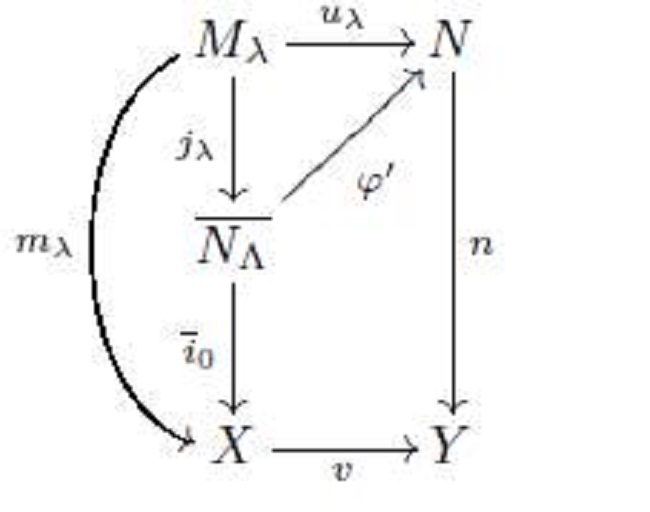
hence ∨mλ ≅ i0 and for each λ ∈ Λ, jλ = mλ◁kλi0.
Finally, for any X−morphism y :  , there is a λ0∈ Λ with F(y)(p) ∈ Nλ0 ,let z : {p} → Nλ0 the constant function with value F(y)(p), we have the commutative diagrams
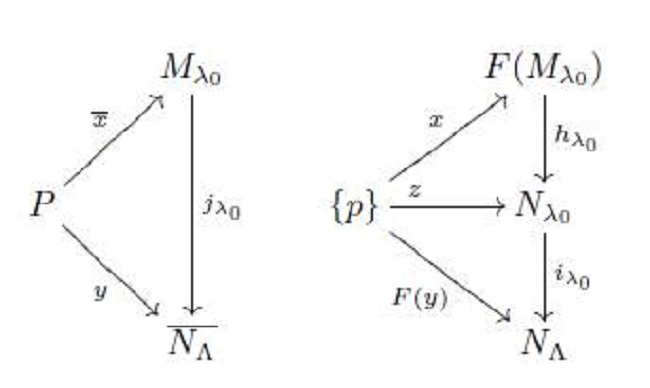
where x : {p} → F(Mλ0) is the constant function with value h-1λ0(F(y)(p)) and x̅ is an F-initial lift of x. Thus, P is projective with respect to (jλ)λЄ Λ. 0
Next result gives a property of good behavior of inverse images with respect to unions (see 1.L of [5]).
Proposition 4.5. Let X be an ℳ -complete category with an object P such that for every X - morphism e:

For every X - morphism f : X → Y and non-empty family (mλ)λЄΛin M\y, if P is projective with respect to (jλ: Mλ→ M)λЄ Λ, the sink belonging to a union m = Vmλ, then f-1(Vmλ) ≅ Vf-1(mλ).
Corollary 4.6. Every topological category (X, F) with P ∈ F−1 (p) is a category with (ΠX (P), (ΠX (P))⊥)−factorization, and for every X−morphism f : X → Y and nonempty families (mα : Mα→ Y )α∈Λin (ΠX (P))⊥, one has

Corollary 4.7. Let (X, F) be a topological category and P ∈ F−1 ({p}), then the following holds:
1. X is a (ΠX (P),Mono(Set)F )−category.
2. (ΠX (P))⊥ ⊂ Mono(X).
3. For every X−morphism f : X → Y and every non-empty class (mλ )λ∈Λin (ΠX (P))⊥|Y one has

Proof. By Proposition 3.1 and Proposition 4.3 we have (1) and (2), by Lemma 4.4 and Proposition 4.5 we have (3).
Theorem 4.8. Let (X, F) be a topological category and P ∈ F−1({p}). IfM= (ΠX (P))⊥ and ℰ = ΠX (P), then the following holds:
1. X satisfies the hypothesis of the characterization of M−coreflective subcategories (see Theorem 2.5).
2. Any object P with F(P) = {p} is a separator in X; furthermore, any M−coreflective subcategory, with P as an object, is bicoreflective.
3. For every morphism f, the operator f−1 (_) preserves M−unions.
Proof. 1. By (2) of Proposition 4.3, we have that M = Mono(Set)F , and by (1) of Proposition 3.1, we have that ℳ ⊂ Mono(X). By (3) of Proposition 4.3, X is an (ℰ, ℳ)−category. Note that in Set for every set X a representative set of Mono(Set)−subobjects of X is the set of inclusion functions with codomain X, thus Set is Mono(S)−wellpowered, and by Proposition 3.3 we have that X is M−wellpowered.
2. It follows from Proposition 3.4 and Proposition 6.11 of [14].
3. It follows from (3) of Corollary 4.7.
5. Lower limit-operators and bicoreflective subcategories
The bicoreflective subcategories of Top have been related to limit-operators of Kura-towski closure operator (see Method 3 of [9]), as we will see below, the (ℰ, ℳ f) and (ℰF, ℳ )- category structures inherited by the Set category to any topological category, is ideal for extending the relationship presented in Top to a topological category (X, F).
Let (X,F) be a topological category, we denote by C0 an additive, grounded (see [5]) and defined by final sinks closure operator in X respect to ℳF , which is defined below.
Definition 5.1. A closure operator C0 in X with respect to MF is said to be a closure operator defined by final sinks if for all F−final sink (fλ : Xλ→ X)λ∈λ , and any ℳ F subobject m of X, is C0−closed iff for all λ ∈ Λ, f−1λ (m) is C0−closed, i.e.,

Definition 5.2. Let C0 be a closure operator in X with respect to N ⊂ Mono(X), a lower limit-operator with respect to C0, is given by a family l = {lX}X∈X of maps lX : N|X→ N|X such that for every X ∈ Obj(X):
1. (Extension) m ≤ lX (m) ≤ C0X (m) for all m ∈ N|X ;
2. (Additivity) lX (m ∨ n) ≅ lX(m) ∨ lX (n) for m, n ∈ N|X ;
3. (Continuity) f : X → Y , f(lX (m)) ≤ lY (f(m)) for all f : X → Y and m ∈ N.
Remark 5.3. The additivity property implies the monotonicity of l (and then the well defined by isomorphism, m ≅ n implies lX (m) ≅ lX (n)), hence the continuity condition can equivalently be expressed as

for all f : X → Y and n ∈ ℳ |Y .
Remark 5.4. Let X have (ℰ, ℳ)−factorizations and ℳ −pullbacks:
1. If h : X → Y is a X−isomorphism with g = h−1 : Y → X, for every ℳ −subobject m of Y , g(m) ≅h−1(m);
2. for every commutative diagram in X
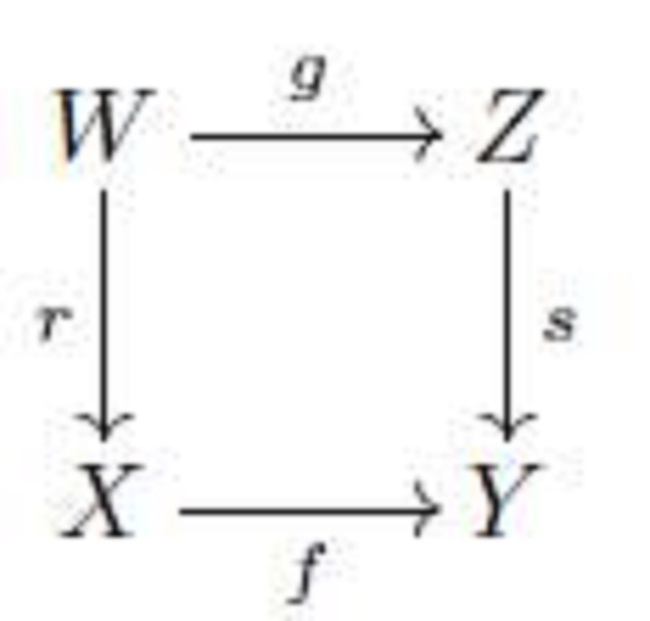
and every ℳ - subobject m of Z, r(g-1(m)) ≤ f-1(s(m)).
For every lower limit-operator l with respect to C0, note that for every ℳ ≅ subobject with C0X(m) = m we have that m ≤ lx(m) ≤ C0X(m) ≤ m, so we have that lx(m) ≅ m. We denote by U(l) the full subcategory of x with class of objects:

Proposition 5.5. For every lower limit-operator l with respect to C0the subcategory U(l) is replete.
Proof. Let X ∈ U(l) and h : X → Y be a X−isomorphism, suppose that m ∈ ℳ |Y with lY (m) ≅ m, for g := h−1 : Y → X, we have that for every n ∈ M|Y

hence lx(g(m)) ≅ g(m). Since X Є U(l) we have that C0x(g(m)) ≅ g(m), then

Thus, m ≅ C0Y(m) and Y G U(l)
Proposition 5.6. Let l be a lower limit-operator with respect to C0and P be an object such that F(P) - {p}. The subcategory U(l) has P as an object.
Proof. Let m : M → P be an ℳ−subobject of P. Suppose that m = oX , then C0X (oX ) ≅ oX since C0 is grounded. On the other hand, if F(m) is the constantfunction {q} → {p}, then F(C0X (m)) is a constant function {r} → {p}. The F−initiallift of the constant function {r} → {q} shows that C0X (m) ≤ m.
Proposition 5.7. For every lower limit-operator l with respect to C0one has:
1. U(l) is closed under coproducts.
2. If f : X → Y is in EFand X Є Objthen Y Є Obj (U(l)).
Proof.
1 Let {Xλ}λ∈Λ be a class of X-objects indexed by a set Λ. The final lift (X, (iλ )λ∈Λ ) of the F−sink (⨿F(Xλ ), (iλ : F(Xλ ) →⨿F(X)λ )λ∈Λ ) is the coproduct of {Xλ}λ∈Λ in X.
Let m ∈ ℳ|X with lX(m) ≅m, for every λ ∈ Λ one has that

hence 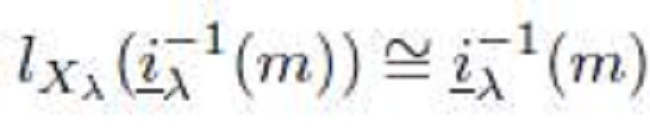 , since every Xλ is an U(l)-object one has that

finally C0X (m) ≅ m.
2 Let f : X → Y in ℰF and X ∈ Obj(U(l)), and m ∈ MF |Y with lY (m) ≅ m, one has

hence lX(f−1 (m)) ≅ f−1(m), since X ∈ Obj(U(l)), one has C0X (f−1(m)) ≅ f−1 (m),and C0Y (m) ≅ m since C0 is defined by final sink.
Theorem 5.8. For every lower limit-operator l with respect to C0, the full subcategory U(l) is a bicoreflective subcategory of X.
Proof. The Theorem of characterization of ℳ-coreflective subcategories applied to the (ℰf, ℳF) structure on X, Theorem 4.8 part (1) and Proposition 5.7, shows that U(l) is ℳ- coreflective in X. By Proposition 5.6 and (2) of Theorem 4.8 one has that U(l) is bicoreflective in X
For ℳ - Mono(Set) and a topological category (X,F) we consider the (ℰF, ℳF)-structure for X induced by F. We consider Ko an additive closure operator on X with respect to MF.
Theorem 5.9. Let A be a bicoreflective subcategory of X, and for every X-object X let rX : A(X) → X be an A-coreflector of X . The operator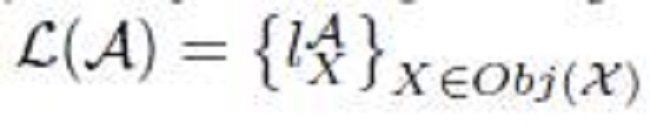 defined(up to isomorphism) by:

for every m Є ℳp|x, is a lower-limit operator with respect to K0. Furthermore, if C0is idempotent, and A is ℳp-coreflective, then (A) is idempotent.
Proof. Let X be a X- object, and m Є ℳp|x , by (2) of Lemma 4.4 and (2) of Proposition 4.3 we have that lAx(m) is in ℳF , by definition m ≤ lAx(m). Since

one has that lAx(m) ≤ K0x(m).
For m,n Є ℳf|x , by Corollary 4.6 one has that

Hence  .
.
Let f : X → Y an X−morphism and m ∈ MF|Y , and Rf the X-morphism withf ◦ rX = rY ◦ Rf, one has that:
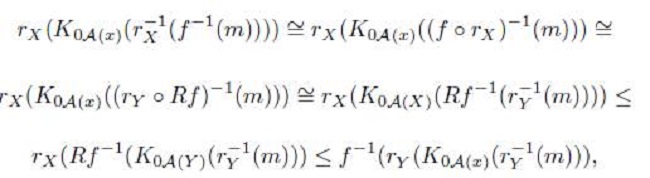
then  . If K0 is idempotent, and every rX is in ℳF , then

References
[1] Adámek J., Herrlich H. and Strecker G.E., Abstract and Concrete Categories: The Joy of Cats, Wiley, New York, 1990.
[2] Castellini G., "Connectedness with Respect to a Closure Operator", Appl. Categ. Structures., 9 (2001), No. 3, 285-302. doi: 10.1023/A:1011247621101.
[3] Clementino M.M., "On Connectedness via Closure Operators", Appl. Categ. Structures., 9 (2001), No. 6, 539-556. doi: 10.1023/A:1012512306420.
[4] Dikranjan D. and Giuli E., "Closure operators I", Topology Appl., 27 (1987), No. 2, 129-143. doi: 10.1016/0166-8641(87)90100-3.
[5] Dikranjan D. and Tholen W., Categorical Structure of Closure Operators, Springer Netherlands, 1st ed., vol. 346, Dordrecht, 1995.
[6] Freyd P., "Aspects of topoi", Bull. Aust. Math. Soc., 7 (1972), No. 1, 1-76. doi: 10.1017/S0004972700044828.
[7] Herrlich H. and Strecker G.E., "Coreflective subcategories", Trans. Amer. Math. Soc., 157 (1971), 205-226. doi: 10.1090/S0002-9947-1971-0280561-2.
[8] Herrlich H., "Reflexionen und Coreflexionen", in Topologische Reflexionen und Coreflexio-nen (ed.Dold and Eckmann) Springer-Verlag Berlin (1968), 76-113.
[9] Herrlich H., "Limit-operators and topological coreflections", Trans. Amer. Math. Soc., 146 (1969), 203-210. doi: 10.1090/S0002-9947-1969-0252473-2.
[10] Herrlich H., "Topological Functors", Topology Appl., 4 (1974), No. 2, 125-142. doi: 10.1016/0016-660X(74)90016-6.
[11] Isbell J.R., "Subobjects, adequacy, completeness and categories of algebras", Instytut Matematyczny Polskiej Akademi Nauk (Warszawa)., 36 (1964), 3-32.
[12] Kelly G.M., "Monomorphisms, epimorphisms, and pull-backs", J. Aust. Math. Soc., 9 (1969), No. 1-2, 124-142. doi: 10.1017/S1446788700005693.
[13] MacLane S. and Moerdijk I., Sheaves in Geometry and Logic, Springer-Verlag, 1st ed., New York, 1994.
[14] Nakagawa R., "Chapter 14 categorical topology", in Topics in General Topology (ed. Morita and Nagata.), Elsevier (1989), 563-623.
Notes