Estudios e investigaciones
Immersive technologies in higher education: faculty profiles and barriers to integration
Tecnologías inmersivas en la universidad: perfiles del profesorado y obstáculos para su integración

Immersive technologies in higher education: faculty profiles and barriers to integration
RIED-Revista Iberoamericana de Educación a Distancia, vol. 29, núm. 1, pp. 161-184, 2026
Asociación Iberoamericana de Educación Superior a Distancia

Esta obra está bajo una Licencia Creative Commons Atribución-NoComercial 4.0 Internacional.
Recepción: 01 Junio 2025
Aprobación: 31 Julio 2025
Abstract: Introduction: The study analyses the barriers perceived by university faculties to integrate immersive technologies (AR, VR and MRI) in higher education. Despite their pedagogical potential, these technologies face technical, pedagogical, economic, institutional and ethical/social barriers. Methodology: A quantitative, non-experimental approach was used by means of an online survey of 775 teachers from Spanish and Latin American universities with experience in XR technologies. The instrument included socio-demographic variables and 23 items on perceived difficulties, analysed by Multiple Correspondence Analysis (MCA). Results: The MCA identified four teacher profiles: (1) critical and experienced, (2) average or transitional, (3) technopositive or innovative, and (4) selective critical. Economic difficulties were the most prominent, followed by pedagogical and technical difficulties. Perceptions varied according to age, gender, subject area and institutional context. Discussion: Barriers are not homogeneous and respond to structural and cultural factors. Technical and economic difficulties affect older teachers or those from institutions with fewer resources. Pedagogical and ethical barriers are of particular concern to teachers in the humanities and social sciences. Institutional resistance to change also emerges as a key obstacle. Conclusions: The study evidences the need for differentiated training strategies and institutional support. It is recommended to move towards longitudinal and qualitative research that delves into the evolution of these perceptions and the impact of educational innovation policies.
Keywords: immersive technologies, higher education, virtual and augmented reality, difficulties, multiple correspondence analysis.
Resumen: Introducción: El estudio analiza las barreras percibidas por el profesorado universitario para integrar tecnologías inmersivas (RA, RV y RM) en la educación superior. A pesar de su potencial pedagógico, estas tecnologías enfrentan obstáculos técnicos, pedagógicos, económicos, institucionales y éticos/sociales. Metodología: Se empleó un enfoque cuantitativo, no experimental, mediante encuesta online a 775 docentes de universidades españolas e iberoamericanas con experiencia en tecnologías XR. El instrumento incluyó variables sociodemográficas y 23 ítems sobre dificultades percibidas, analizados mediante Análisis de Correspondencias Múltiples (ACM). Resultados: El ACM permitió identificar cuatro perfiles docentes: (1) crítico y experimentado, (2) promedio o de transición, (3) tecnopositivo o innovador, y (4) crítico selectivo. Las dificultades económicas fueron las más destacadas, seguidas de las pedagógicas y técnicas. Las percepciones variaron según edad, género, área disciplinar y contexto institucional. Discusión: Las barreras no son homogéneas y responden a factores estructurales y culturales. Las dificultades técnicas y económicas afectan más a docentes mayores o de instituciones con menos recursos. Las pedagógicas y éticas preocupan especialmente a docentes de Humanidades y Ciencias Sociales. La resistencia institucional al cambio también emerge como un obstáculo clave. Conclusiones: El estudio evidencia la necesidad de estrategias diferenciadas de formación y apoyo institucional. Se recomienda avanzar hacia investigaciones longitudinales y cualitativas que profundicen en la evolución de estas percepciones y en el impacto de las políticas de innovación educativa.
Palabras clave: tecnologías inmersivas, educación superior, realidad virtual y aumentada, dificultades, análisis de correspondencias múltiples.
INTRODUCTION
The significance that Augmented Reality (AR), Virtual Reality (VR) and Mixed Reality (MR) are acquiring in the field of university education can be seen directly from the volume of research that has been carried out on them in recent times. The result of this research is the increase in meta-analyses and systematic reviews on different aspects of them, such as: the acquisition of learning by students (Victoria Maldonado et al., 2024; Yu & Xu, 2022), the pedagogical theories and approaches used for their design (Marougkas et al., 2024; Mohsen & Alangari, 2024), the ethical and psychological aspects involved in its use (Mogrovejo-Zambrano et al., 2024), the possibilities of its use in desktop and immersive versions (Hamilton et al., 2021; Liu et al., 2024) or the cognitive load involved in its use (Luna et al., 2023).
To clarify the terms to be used, it can be pointed out that there is a strong difference between AR and VR, "since, in the latter, virtual data replaces physical data, creating a new reality. On the contrary, in augmented reality, the two realities are superimposed in different layers of information in different formats (computer-generated images, video sequences, animations, etc.) to configure a new reality with which the person interacts" (Cabero-Almenara et al., 2022, 12). For its part, when analysing MRI, it is important to note that it is a technology that combines elements of AR and VR. Thanks to this integration, it is possible to generate virtual objects that allow users to interact with three-dimensional environments, both through total immersion in virtual spaces, characteristic of VR, and through the superimposition of digital content on the real world, characteristic of AR.
These meta-analyses also address the focus of this research: what are the difficulties perceived by teachers and school managers in incorporating them into training (Obeidallah et al., 2023; Sales et al., 2023).
Both research and systematic reviews suggest that teachers, students and school principals perceive several difficulties in incorporating these emerging technologies into university education. The first of these difficulties are financial (Angulo et al., 2023; Familoni & Onyebuchi, 2024; Menjivar et al., 2021; Mulders et al., 2020; Sales et al., 2023; Toala-Palma et al., 2020). This dimension is not limited exclusively to the initial costs associated with the implementation of these technologies, such as the acquisition of devices, the costs of placing the objects produced on specific digital platforms, the investment in specific software for their production, or the costs derived from licences for their use. It also encompasses the costs of the ongoing maintenance of these resources and their inevitable periodic updating.
In addition, the speed at which the technology used in these devices is advancing means that constant investment is required to update them and bring them into line with new standards as they emerge. Therefore, this is not just a one-off investment, but a constant economic investment, which is a clear difficulty for those institutions with limited economic resources.
On the other hand, it should not be forgotten that these economic difficulties include the difficulty of connectivity existing in certain educational institutions, since, for correct use and to achieve an acceptable sense of immersion and movement through the object, a stable internet connection and sufficient bandwidth are required (Sales et al., 2023; Subirats-Blanco & Conde del Rio, 2024).
A number of authors (Obeidallah et al., 2023; Mogrovejo-Zambrano et al., 2024) point to the lack of equity in the use of these technologies, both for institutions and students, as another difficulty, which to some extent derives from the previous one. Therefore, we could speak of the existence of a digital divide that affects both students and educational institutions themselves (computers, virtual reality glasses, tablets and the latest generation of smartphones). This divide not only reflects differences in access to technology but also shows profound inequalities in the real possibilities of participating in learning environments produced by these technologies and, consequently, not being able to use the possibilities they offer (Cabero-Almenara et al., 2025).
To a certain extent, these aspects create another difficulty, which refers to the equity of use of these technologies, both for institutions and students (Mogrovejo-Zambrano et al., 2024). Therefore, one could speak of the existence of a digital divide between students and institutions, as not all students and institutions have access to devices to fully participate in AR, VR or MR-based activities, and this may result in their exclusion from these innovations, widening the digital divide between institutions.
Another large group of difficulties pointed out by different authors focus on the lack of teacher training in the use of AR, VR and MRI in educational contexts and the resistance to change that they show not only to incorporate digital technologies in teaching, but above all the emerging technologies that are appearing (AlGerafi et al., 2023; Marín-Díaz et al., 2022; Perifanou et al., 2023; Sales et al., 2023). This is compounded, on the one hand, by the difficulty of integrating them into learning scenarios (Mulders et al., 2020), and on the other hand, by the lack of relationship with learning theories (Caballero-Garriazo et al., 2023). All of this is a consequence of the lack of existing research on how to use and design these learning objects (Radianti et al., 2020; Sales et al., 2023) and the scarcity of these objects in open format (Upadhyay et al., 2024).
On the other hand, it should not be forgotten that in the research that has found significant results, the effect sizes are not very large (Coban et al., 2022). Although some research suggests that without proper integration of learning strategies in AR scenarios, the effectiveness of learning outcomes may be limited, or even less effective than traditional technology-supported learning methods (Jingru et al., 2025).
Another type of difficulty relates to the existence of different psychological impacts on their use, such as anxiety, fatigue and feelings of disorientation caused by certain types of use such as immersive use (Cevikbas et al., 2023; Mogrovejo-Zambrano et al., 2024; Mulders et al., 2020; Obeidallah et al., 2023) and the cognitive load that requires the learner to invest if objects are not properly designed (Angulo et al., 2023; Bermejo et al., 2023; Bautista et al., 2025; Cevikbas et al., 2023).
The results pointed out by the meta-analyses allow us to identify some major blocks of difficulties that could be determining factors in the application of AR, VR and MR technologies: technical, pedagogical, economic, ethical, social and psychological, as well as resistance to change on the part of institutions and teachers.
In any case, with a view to the integration of the technologies discussed, it is also important to consider technology analysis models such as the TAM (Technology Acceptance Model) and UTAUT (Unified Theory of Technology Adoption and Use of Technology) technology acceptance models, and the TPACK (Technological Pedagogical Content Knowledge) and SAMR (Substitution and Augmentation, Modification and Redefinition) technology integration models. Models formulated at the time by Davis (1989), Venkatesh (2000), Mishra and Koehler (2006) and Puentedura (2006), respectively.
Of all these models, TAM and UTAUT have been the ones that have sparked the most research with respect to AR, VR and RE technologies (Cabero-Almenara & Pérez Díez, 2018; Cabero-Almenara et al., 2021). They point to a series of conclusions that are fundamentally aimed at the fact that they are technologies that arouse a high degree of acceptance that leads them to show potential users a high intention to use them. With regard to the other models, they incorporate two ideas to consider: on the one hand, that a correct incorporation of these technologies requires thinking about the fact that the technology does not position itself alone, but depends on the content it transmits and the methodologies applied with it, and on the other hand, that the incorporation of any technology is not direct in teaching, but implies a slow process of incorporation.
METHOD
The research presented here is non-experimental and of the survey type (Tourrón, 2023) and aims to achieve the following objectives:
- 1. To identify the main difficulties perceived in the implementation of AR, VR and MR in the context of higher education, considering technical (TD), pedagogical (PD), economic (ED), ethical, social and psychological (DES) aspects, as well as resistance to change on the part of institutions and faculty (DRC).
- 2. To explore the association between perceived difficulties and teachers' socio-demographic characteristics, to determine differentiated typologies of teachers in perceived barriers to VR use.
- 3. To determine clusters or profiles of difficulty based on perceived difficulties and socio-demographic characteristics of teachers, to provide a comprehensive characterisation of barriers to the integration of VR in higher education.
Instrument
For the present research, an instrument was designed to collect information specifically adapted to the objectives of the study. This questionnaire consists of two sections. The first section is aimed at collecting socio-demographic data on the participant, such as gender, age, among other personal aspects. The second section, structured using a Likert-type scale, includes a total of 23 items designed to evaluate, on a scale of 1 to 10, the degree of perception regarding the influence of various difficulties.
These items are distributed according to the categories of difficulty presented above in the objectives to be achieved: technical difficulties (4 items), pedagogical (9 items), economic (3 items), related to resistance to change on the part of institutions and teaching staff (2 items), and those of an ethical, social and psychological nature (5 items).
For the validation of the questionnaire, a pilot test was applied to some members of the "Didactic Research Group" from the University of Seville and the "Educational Technology Research Group" from the University of Malaga, and to researchers of the MEREVIA project who had published articles and communications on the application of AR, VR and MR. Subsequently, the statistical analyses of Cronbach's alpha and McDonald's omega were applied to obtain the reliability index.
This research has all the necessary ethical safeguards to ensure the protection of the rights and privacy of the participants. Firstly, all data collected were treated strictly anonymously, ensuring that no individual can be identified from the information obtained. Furthermore, the participants were duly informed about the objectives and procedures of the study, and gave their informed consent freely and voluntarily, also accepting a specific clause on the transfer of data for exclusively scientific purposes. The protocol followed in this research complies with the ethical principles set out in the Declaration of Helsinki, ensuring the respect, dignity and protection of the individuals involved. Furthermore, Regulation (EU) 2016/679 of the European Parliament and of the Council on the protection of individuals with regard to the processing of personal data and on the free movement of such data (General Data Protection Regulation - GDPR) has been strictly followed, thus ensuring responsible, secure and transparent use of the information collected.
Sample
The study sample consisted of a total of 775 participants. Of these, 389 (50.2%) identified themselves as men, 378 (48.8%) as women, while 8 people (1.0%) chose not to answer the question on gender.
Figure 1 shows the frequencies and percentages of participants according to their age.
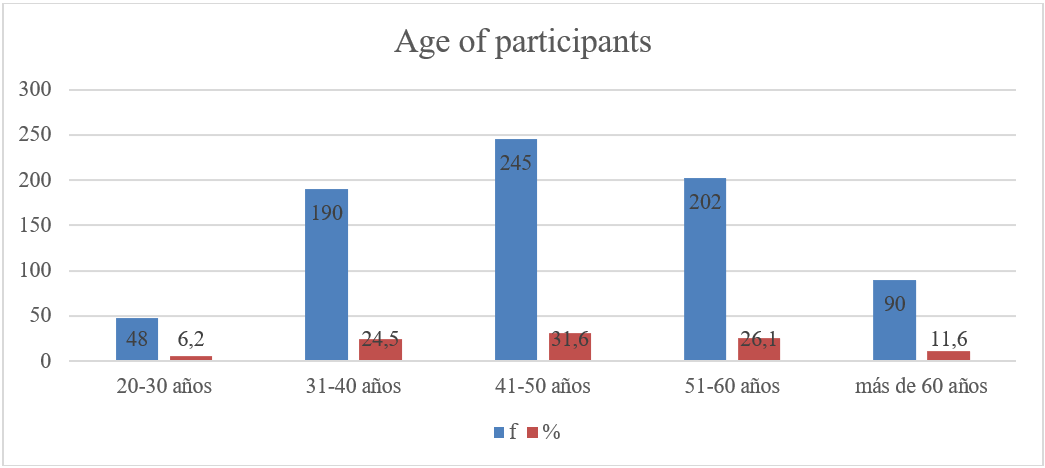
Figure 1
Frequency and percentage of participants' age
As can be seen, 82% of the distribution was between 31-60 years of age. Those between 41-50 years of age stood out.
Of those surveyed, 395 (51.0%) worked in Spanish universities and 380 (49.0%) in Latin American universities.
With regard to the area of knowledge to which the participants belonged, Figure 2 shows the frequencies and percentages to which they belonged.
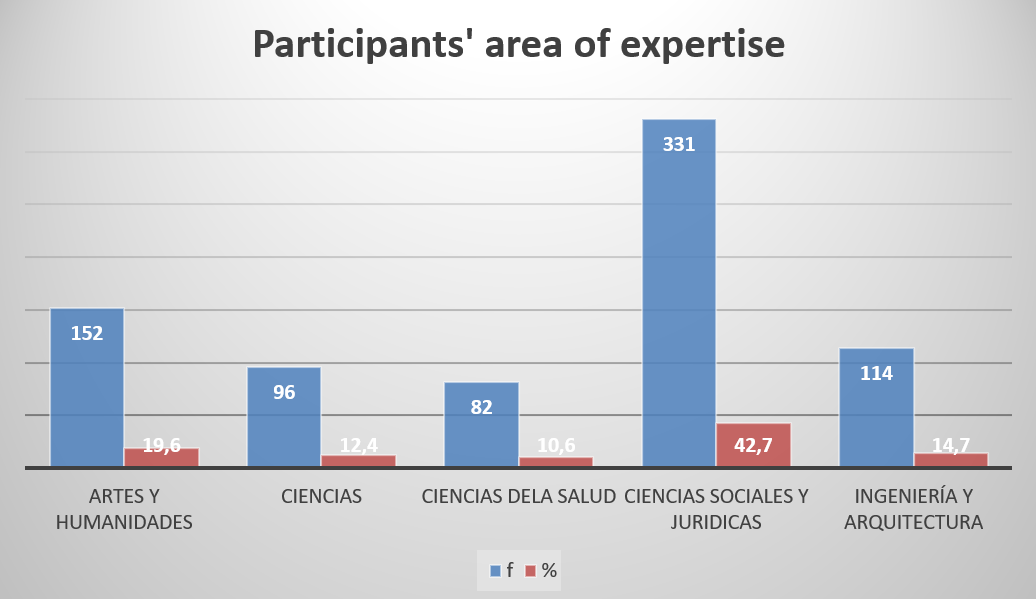
Figure 2
Frequency and percentage of participants' age
As can be seen, the highest percentage of participants belonged to the "Social and Legal Sciences" area of knowledge, which could be explained by the procedure followed for the selection of participants, as they tend to be one of the groups most interested in the incorporation of these technologies into educational practice.
The selection of participants was carried out by means of several strategic procedures. Firstly, we included people who had published, between 2020 and February 2025, an article related to AR, VR and RE in specialised Spanish-language journals. Secondly, those who presented papers on these technologies at the Edutec 2024 Congress were considered. Finally, teachers belonging to different research groups from Spanish and Latin American universities were also included, from whom information was available that showed evidence of their work in the incorporation of these technologies in educational contexts.
Procedure
Prior to the main analysis, a reliability study was carried out on the scales used to measure the different difficulties perceived in the use of AR, ER and MR in higher education. Cronbach's Alpha and McDonald's Omega internal reliability indices were calculated for each of the dimensions included in the questionnaire: technical difficulties (TD), pedagogical difficulties (PD), economic difficulties (ED), resistance to institutional and faculty change (DRC), and ethical, social and psychological difficulties (ESD). These coefficients allow us to estimate the internal consistency of the items that make up each dimension, and are considered robust indicators for assessing the reliability of psychometric scales (Dunn et al., 2014). The values obtained were within acceptable ranges in educational research, indicating adequate reliability for each subscale.
In addition, means and standard deviations were calculated for each dimension of perceived difficulty in order to provide an initial description of the behaviour of the data and to explore the degree of difficulty that participants attribute to each of the categories assessed. This preliminary statistical description provides a solid basis for the subsequent interpretation of the MCA results by contextualising the level of difficulty perceived by teachers in relation to technical, pedagogical, economic, institutional and ethical aspects.
For the analysis of teacher profiles and typologies, we applied the MCA statistical test, a statistic that is used when more than two categorical variables are to be analysed simultaneously and which allows both the categories of the variables and the individuals (cases or subjects) to be represented graphically in a reduced space of two or more dimensions, with the aim of visualising associations, similarities and latent structures in the data (Bond & Michailides, 1997). It has many qualitative variables (nominal or ordinal variables treated as nominal), and aims to identify characteristic profiles of individuals or groups. As Cornejo (1988, p. 97) points out, the aim is to "delve into the relationships of dependence established between two qualitative variables observed in the same population".
This approach makes it possible to identify latent patterns of association between categorical variables and to construct a factor space that graphically represents the configuration of these perceptions, thus facilitating the segmentation and interpretation of teacher profiles (Greenacre, 2007; Le Roux & Rouanet, 2010).
The use of MCA in this context is justified by the categorical nature of the data, derived from ordinal rating scales that capture perceived levels of difficulty in each dimension. The technique makes it possible to reduce the complexity of the information and to represent in a two-dimensional space the most significant relationships between categories, preserving a considerable proportion of the original variance (Abdi & Valentin, 2007; Escofier & Pagès, 2008). The analysis not only allows us to observe how responses are clustered, but also how they interact with possible socio-demographic or institutional factors, offering a more holistic view of barriers to the adoption of immersive technologies (Le Roux & Rouanet, 2010).
In social research it has been used for the analysis of different topics such as: "locus control" (Algañaraz, 2016), the image of teachers in the press (Cabero-Almenara & Loscertales-Abril, 1998), characteristics of Nobel Prize winners or mathematical problem solving as a methodology.
RESULTS
The overall reliability index of the instrument analysed through Cronbach's alpha and McDonald's omega were 0.915 and 0.909, respectively. As for the different dimensions identified, the values achieved are shown in Table 1.
| Reliability index | ||
| Variable | Cronbach's α | McDonald's Ω |
| Technical difficulties | .783 | .778 |
| Pedagogical difficulties | .847 | .830 |
| Economic difficulties | .789 | .783 |
| Difficulties due to resistance to change in institutions | .736 | .734 |
| Ethical. social and psychological difficulties | .799 | .792 |
Thes values, according to Roco-Videla et al. (2024), indicate a high level of reliability of the instrument.
In line with the objectives set out, and with the aim of obtaining an initial descriptive view of the degree of difficulty perceived in the use of AR, VR and RM in higher education, we proceeded to analyse the mean scores and standard deviations corresponding to each of the dimensions assessed. Table 2 shows the mean scores, and standard deviations achieved for each of the difficulties mentioned and for the instrument.
| Mean | Standard deviation | |
| Technical difficulties | 7.14 | 1.86 |
| Pedagogical difficulties | 7.40 | 1.47 |
| Economic difficulties | 8.04 | 1.71 |
| Difficulties due to resistance to institutional change | 7.20 | 2.11 |
| Ethical, social and psychological difficulties | 7.13 | 1.71 |
| Total instrument | 7.36 | 1.32 |
The analysis of the dimensions considering the socio-demographic variables also reveals information to be highlighted. In terms of gender, women report higher levels of difficulties in all the dimensions evaluated, standing out especially in economic difficulties (8.14) and ethical, social and psychological difficulties (7.37). By branches of knowledge, Engineering and Architecture professors had the highest mean scores in the instrument (7.62), with special emphasis on economic difficulties (8.55), while Natural Sciences reported the lowest (7.3). In relation to the type of university, Latin American teachers report more difficulties in all dimensions, with an overall average of 7.67 compared to 7.13 in the Spanish case. By age, an increasing trend is observed: those over 61 years of age report the highest scores in almost all dimensions, reaching an overall average of 7.75, especially in institutional resistance to change (8.06).
After the initial description of the mean scores in each dimension of difficulty, an MCA was carried out in order to explore in more depth the relational structure between the different perceived difficulties and the socio-demographic variables of the teachers, such as gender and age. This technique is particularly suited to address one of the central objectives of the study: to identify differential perception profiles of barriers to the integration of AR, VR and MR technologies based on personal or institutional characteristics. Since the data used comes from categorised scales (treated as qualitative), the MCA allows us to graphically visualise latent associations between categories, revealing patterns of clustering and proximity that might not be evident through traditional statistical analysis. In this sense, the MCA provides a powerful analytical framework to interpret in an integrated way the different dimensions of the phenomenon studied and to generate a meaningful segmentation of the teaching staff according to their perception of the difficulties in adopting immersive technologies in university environments (Cardona et al., 2021).
To facilitate the interpretation of the data in the multiple correspondence analysis, the scores obtained on the difficulty scales (originally measured on a scale of 1 to 10) were transformed into qualitative categories. This recording allowed the values to be grouped into three levels: Low (scores 1 to 4), Medium (score 5 to 8) and High (score 9 to 10). This categorisation strategy responds to the need to adapt the data to the requirements of the applied factor analysis, given that the MCA works with qualitative variables, and contributes to a more intuitive reading of the profiles and associations between levels of difficulty and socio-demographic variables, without losing the informative richness of the original instrument.
As part of the analysis procedure, the ACM was subjected to an iterative optimisation process until an acceptable convergence criterion was reached. This process ensures the stability and validity of the factorial solution obtained, making it possible to adequately represent the relationships between the categories included in the analysis. Table 3 shows the history of iterations carried out during model fitting.
| Iteration number | Variance accounted for | ||
| Total | Increase | Loss | |
| 29 | 38.699544 | .000009 | 24.300456 |
The estimation algorithm achieved stable convergence at iteration 29, with a total variance explained of 38.6% and a final marginal increase of only 0.000009, indicating that an optimal solution was reached (Greenacre, 2007). This value is common in Multiple Correspondence Analysis (MCA) when working with categorical variables related to subjective perceptions and experiences, such as the difficulties faced by teachers when integrating emerging technologies (Le Roux & Rouanet, 2010; Abdi & Valentin, 2007). The residual loss was 24.3, reflecting unexplained variability, which is to be expected in ACM and does not compromise the validity of the model (Escofier & Pagès, 2008). Overall, the results confirm the stability and reliability of the solution, validating the interpretive use of two-dimensional space to analyse the relationships between types of perceived difficulties and teacher characteristics (Greenacre, 2007). This evidence supports the design of more precise strategies for training and institutional support in the adoption of VR/AR/RM in university teaching (Le Roux & Rouanet, 2010).
To assess the internal consistency of the instrument and the quality of the factorial solution obtained through the ACM, a summary of the model is presented below (Table 4).
| Dimension | Cronbach's alpha | Total (eigenvalue) | Inertia | % of variance |
| 1 | .930 | 10.192 | .309 | 40.884 |
| 2 | .888 | 7.207 | .218 | 21.840 |
The analysis reveals a robust and explanatory factor structure, with two main dimensions that capture a significant part of the variability in teachers' perceptions of difficulties in integrating emerging technologies. The first dimension, with a Cronbach's alpha of 0.930 and an eigenvalue of 10.192, explains 40.884% of the variance, reflecting high internal consistency between the grouped categories (Greenacre, 2007; Le Roux & Rouanet, 2010).
The total explained inertia reaches 76.4%, an unusually high value in the context of the MCA, given the complexity of categorical data (Abdi & Valentin, 2007; Escofier & Pagès, 2008). Furthermore, the average Cronbach's alpha (0.913) and eigenvalue (35.058) reinforce the psychometric reliability of the model, indicating that the dimensions are methodologically and conceptually sound (Greenacre, 2007).
This configuration makes it possible to identify logical groupings of barriers - technical, pedagogical, economic, institutional or ethical/social - and to profile different types of teachers according to their experience of these difficulties. The robustness of the model provides a reliable interpretative basis for analysing how variables such as type of university, age, gender or subject area influence the perception of barriers, offering valuable inputs for designing more contextualised and effective training policies, technological investment and support strategies.
Below is the joint graph of category points (Figure 3), the result of the MCA, which allows us to visually observe the associations between the different categories of perceived difficulty and the socio-demographic and academic variables analysed (age, gender, branch of knowledge, and location of the university in which they work).
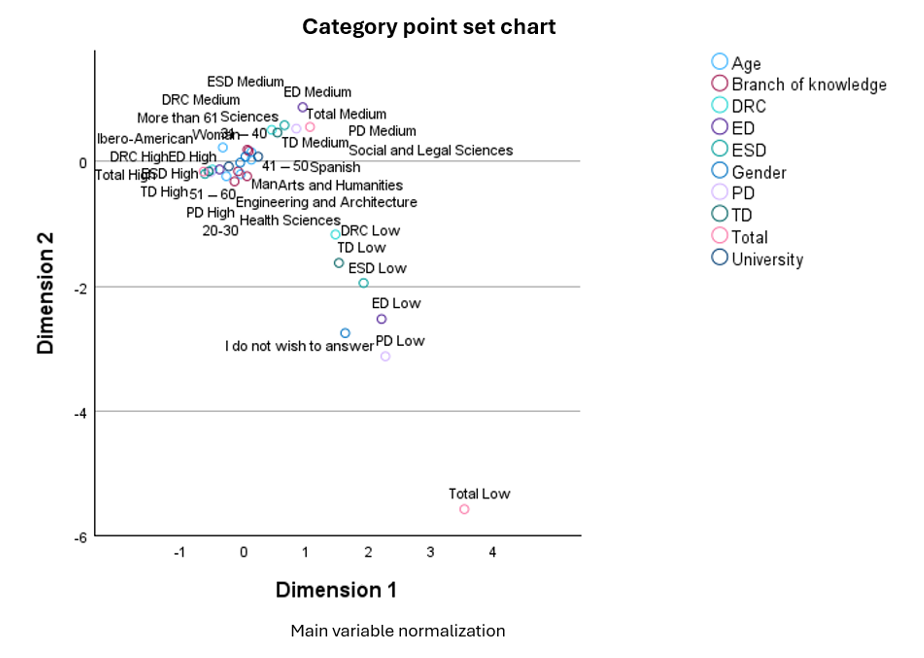
Figure 3
Joint graph of category points (note: ED = Economic Difficulties, ESD = Ethical, Social and Psychological Difficulties; PD = Pedagogical Difficulties; DRC = Difficulties of Resistance to Change; TD = Technical Difficulties)
In this two-dimensional space, proximities between points indicate relationships or similarities in response profiles, while distances suggest differentiation between categories. In the following section, the most salient results of the analysis are discussed, considering the different types of difficulties considered in the study: technical, pedagogical, economic, institutional resistance to change, ethical, social and psychological.
Difficulties
The multiple correspondence analysis reveals a clear polarisation in the perception of university teaching staff regarding the different barriers to the integration of immersive technologies (AR, VR, RE). Technical (TD) and economic (ED) difficulties are associated with older, male, Latin American university lecturers, while pedagogical (PD), ethical/social/psychological (ESD) and institutional resistance to change (IRC) difficulties present a more nuanced but consistent segmentation. In general, those who perceive high levels of difficulty do so cumulatively across several dimensions, while profiles with low perceptions tend to coincide in minimising multiple barriers, indicating consistent patterns of response. These differences suggest the need for differentiated strategies for training, technological and institutional support, addressing both critical and technopositive profiles.
Total difficulties
The Total variable acts as an integrating axis summarising the overall perception of difficulties. "High Total" is grouped with high scores on all dimensions, representing critical teachers who perceive significant structural barriers to the adoption of XR technologies. "Medium Total", located near the centre of the graph, reflects a more balanced position and is representative of the majority of teachers. On the other hand, "Low Total" is positioned in a separate quadrant, next to all the other low categories, indicating a subgroup with a technopositive view, probably with more experience or institutional support. This consistency between levels reveals a latent structure in teachers' perceptions and allows for the identification of extreme and transitional profiles.
Socio-demographic variables
Socio-demographic variables show differential effects on perceptions. Age does not seem to exert a determining influence, with a balanced distribution between the different age groups. In terms of gender, men and women present similar perceptions, but the category "I do not wish to answer" stands out, which is associated with low levels of difficulty and differentiated response patterns. The branch of knowledge introduces greater diversity: disciplines such as Engineering and Architecture tend to minimise barriers, while Social Sciences and Humanities present greater ethical and pedagogical concerns. Finally, institutional location (Spain vs. Latin America) does not generate a strong differentiation, although nuances are detected that could be explored in future studies. These findings allow us to delineate useful teacher profiles for designing contextualised training interventions.
The profiles identified are described below, developing in depth the characteristics that define them, their positioning in relation to emerging technologies and the implications that these findings have for educational innovation at the university.
Profiles
Profile 1: Critical and Experienced Teacher is made up of teachers over 61 years of age, mainly in Latin America and in disciplines such as Social Sciences and Law. They present a high perception of technical, pedagogical, economic, ethical and institutional resistance barriers, adopting a critical stance towards the hasty incorporation of XR technologies without pedagogical or ethical reflection (Aquino Negrin & Hernández Romero, 2021; Tapia Cortes, 2020).
Profile 2: Average or Transition Teacher includes mostly women between 41 and 50 years of age in the Spanish university system. Their perception of difficulties is average in all dimensions, with an attitude open to change if they are provided with training and adequate institutional support (Cajas Bravo et al., 2023). This group is key to facilitating the technological transition from a moderate stance.
Profile 3: Technopositive or Innovative Teacher is composed of young teachers (31-40 years old), some of whom do not declare gender, and come from areas such as engineering, science or education. Their perception of barriers is low, and they adopt an active and enthusiastic attitude towards innovation, although they may underestimate ethical or social risks without critical reflection (Arancibia Muñoz et al., 2017; UNESCO, 2023).
Finally, Profile 4: Selective Critical Teacher groups together mostly women between 51 and 60 years of age, from Spain and humanistic disciplines. Although they do not reject XR technologies, they are particularly sensitive to the ethical and social dimensions, and recognise certain institutional and economic obstacles. Their humanistic and educational justice approach allows them to lead from a critical, ethical and transformative perspective (UNESCO, 2023; Angulo Salazar et al., 2025).
DISCUSSION AND CONCLUSIONS
The results obtained in this research allow us to advance in the understanding of the barriers faced by university professors in the integration of immersive technologies such as AR, VR and MRI in their teaching practices. Using the ACM, clearly differentiated profiles of teachers have been identified, whose perceptions of the difficulties in implementing these emerging technologies are influenced by socio-demographic variables such as age, gender, area of knowledge or location of the university. With regard to technical difficulties (TD), the study reveals that part of the teaching staff -especially the most senior or those linked to less technological areas- perceive significant barriers related to the use, configuration and maintenance of the technologies mentioned, as has also been pointed out in a variety of research studies (Sales et al., 2023; Subirats-Blanco & Conde del Rio, 2024). This dimension is particularly influenced by age, subject area and previous familiarity with digital environments, and is more accentuated in institutional contexts with less technological investment. Despite advances in equipment, technical gaps remain a limiting factor in certain profiles, underlining the need to reinforce technical support and practical training.
Regarding pedagogical difficulties (PD), the results indicate that many teachers face challenges when it comes to pedagogically integrating these technologies within coherent didactic frameworks, as suggested by different research, with which the results obtained here coincide (Mulders et al., 2020; Caballero-Garriazo et al., 2023). These difficulties do not depend solely on technical mastery, but on the methodological understanding of how to apply AR, VR and MRI tools to enrich teaching-learning processes. Teachers in transition and with experience in educational innovation show more receptive attitudes, but demand support to redesign their practices. This dimension reflects the urgent need to articulate training proposals focused on pedagogical transformation and not only on operational instruction.
Economic difficulties (ED) emerge as a transversal barrier, although this is particularly accentuated among young teachers or those from institutions with limited resources. The perception of lack of funding, shortage of equipment or lack of equitable access to immersive technologies generates a sense of practical impossibility to incorporate these tools. This finding coincides with the findings of a variety of research (Mulders et al., 2020; Angulo et al., 2023; Familoni & Onyebuchi, 2024; Obeidallah et al., 2023; Sales et al., 2023) regarding the significance of this type of difficulty in incorporating these technologies in university education. This dimension is closely linked to structural conditions, so overcoming it depends more on institutional decisions and public policies than on the individual action of teachers. Investing in technological infrastructure and guaranteeing its maintenance is therefore a basic condition for progress towards inclusive digitisation.
With regard to ethical, social and psychological difficulties (ESD), a teaching profile was identified that is particularly sensitive to the implications that the use of AR, VR and MRI technologies may have on student subjectivity, educational equity, privacy or the dehumanisation of pedagogical relationships, in short, a problem of equity (Mogrovejo-Zambrano et al., 2024). These concerns are especially frequent in areas such as the humanities and social sciences, and among teachers with a humanistic or critical orientation. This dimension, often forgotten in technocentric discourses, should be seriously considered in the design of innovation policies, through the inclusion of ethical frameworks and protocols of use that guarantee a responsible and person-centred implementation.
Finally, difficulties due to resistance to institutional change (DRC) constitute one of the most relevant barriers, even pointed out by teachers with a high technological disposition. The perception of rigid structures, lack of leadership in innovation, lack of recognition for teaching and excessive bureaucracy hinder motivation and the possibility of implementing the technologies considered in this study. This dimension shows that it is not enough to train teaching staff, but that it is essential to transform the organisational culture of universities, generating environments that value pedagogical experimentation, promote collaborative networks and make their structures more flexible to adapt to change.
Taken together, the five dimensions analysed allow us to understand the complexity of the phenomenon and reinforce the need to adopt a systemic and integrated approach in the promotion of technological innovation in higher education. Although the teaching profiles identified make it possible to differentiate specific attitudes and needs, the barriers cannot be addressed in isolation or individually, as many of them respond to structural and cultural conditions of the university system, on the one hand, in Spain and, on the other, in Latin America.
Another of the main findings of the study is the evidence of a solid and explanatory factor structure, which made it possible to segment teachers according to their levels of perceived difficulty -technical, pedagogical, economic, institutional and ethical/social-. This segmentation revealed not only the existence of extreme profiles, such as the technopositive or the critical and experienced teacher, but also intermediate or hybrid typologies reflecting transitional or selective critical stances. The identification of these profiles represents a significant step forward, as it provides an empirical basis for designing training, support and resource provision policies that are better adapted to the specific realities and needs of teachers.
The study also shows that, although there are differences between subject areas - for example, in the perception of technical difficulties in Engineering versus ethical ones in the Humanities - some barriers are transversal to the entire university system, such as those related to the lack of infrastructure, the scarce specific training of teaching staff or the disconnection with consolidated pedagogical frameworks. These barriers, far from being merely individual, reflect structural limitations of the university environment that need to be addressed from a comprehensive institutional perspective. The analysis also showed that, although age and professional experience are variables that influence the perception of certain difficulties, they do not act as unique or deterministic predictors, but interact with cultural, organisational and attitudinal factors.
In this sense, the use of the MCA has proven to be a valuable methodological tool to reveal the complexity of the phenomenon under study. Unlike other more unidimensional approaches, this method has made it possible to graphically visualise latent relationships between multiple variables, favouring the identification of patterns of perception that would not be easily detectable through traditional analyses. This approach is particularly relevant in the field of education, where the diversity of teacher profiles and institutional contexts demands rich and multifactorial interpretative approaches.
The practical implications derived from this study are highly relevant for the design and implementation of strategies that facilitate the effective integration of immersive technologies - AR, VR and MRI - in university teaching. Firstly, the clear identification of differentiated teaching profiles, reflecting different perceptions of technical, pedagogical, economic, ethical and organisational barriers, underlines the need to develop specific training adapted to the characteristics and needs of each group. This implies designing training programmes that not only address technical operational aspects, but also strengthen methodological skills for coherent pedagogical integration, as well as raise awareness of the ethical and social dimensions of these technologies. Furthermore, the recognition that technical difficulties predominate among teachers with less digital familiarity or in less technological areas calls for a reinforcement of continuous technical support, as well as the simplification and standardisation of tools to facilitate their use. On the other hand, economic and structural limitations, closely linked to institutional conditions, highlight the need to promote sustained investment policies in technological infrastructure that guarantee equitable access and adequate maintenance of resources, especially in universities with less financial capacity. In addition, institutional barriers related to resistance to change, and organisational rigidity require a profound cultural transformation that promotes leadership in innovation, formal recognition of teaching and the creation of collaborative spaces that encourage experimentation and the exchange of good practices. Finally, the ethical and social concerns detected demand the inclusion of clear regulatory frameworks and protocols that guide a responsible use focused on the well-being of students, ensuring that the incorporation of immersive technologies contributes to a more inclusive, equitable and humane education.
Despite the contributions of this work, it is necessary to recognise some limitations that should be considered when interpreting the results. Firstly, the study is based on a purposive sample of teachers with experience or interest in the use of immersive technologies, which may imply a positive selection bias towards this type of tool. This means that the profiles identified could differ if the sample were extended to teachers with no previous contact with these technologies. However, this would also imply another limitation, namely the teachers' lack of knowledge of these technologies.
Secondly, the self-reported nature of the questionnaire and its online application imply certain inherent methodological limitations, such as the possibility of socially desirable responses or the difficulty in controlling homogeneous understanding of the items. Although the questionnaire showed high internal reliability, it would be convenient to contrast the results with observational studies or in-depth interviews.
Furthermore, the categorisation of the ordinal variables into levels (Low, Medium, High) responds to statistical and graphical interpretation criteria, but this recoding may have softened important nuances in the individual responses. Finally, the MCA, although robust, implies a reduction of the original information to a two-dimensional space, so that a part of the variability inevitably remains unrepresented in the interpretative planes.
Future lines of research should move towards a more longitudinal and mixed approach. It would be relevant to develop studies that not only capture the perception of barriers at a given point in time but also analyse the evolution of these perceptions after teachers' participation in training actions or practical experiences with XR technologies. This would make it possible to assess the real impact of training and infrastructure on the transformation of teachers' attitudes, beliefs and practices.
On the other hand, it would be interesting to replicate the research after a couple of years, and therefore to hold two Edutec conferences and publish new articles in scientific journals, to analyse which difficulties have increased and which have been reduced and maintained. And to carry out a comparative study between the two points in time.
It is also proposed to complement the quantitative analyses with qualitative studies that delve deeper into the subjective experience of the perceived difficulties, especially in the extreme profiles detected (for example, the technopositive teacher or the selective critic). The integration of interviews, focus groups or case analyses would enrich the understanding of the meanings that teachers attribute to these technologies, as well as the emotional, ethical or ideological factors that mediate their acceptance or rejection.
It is important to assume, for the correct interpretation of the results, that the procedure followed to obtain the participants, although it is usual in studies of this type, and the criteria used justified their selection. They undoubtedly incorporate a limitation. At the same time, the decompensation by areas of knowledge may imply a limitation, which is why it would be convenient to replicate the research with stratified sample selection procedures, with the application of the "coefficient of expert competence" (Cabero-Almenara & Barroso-Osuna, 2013) and to consider in the sample the existing percentage of teaching staff for each area of knowledge; however, the latter poses a limitation, as we have not worked with university teaching staff, but with those who publish on the incorporation of AR, VR and MR.
Finally, it would be pertinent to extend the sample to other international university contexts, as well as to explore the relationships between the barriers identified and variables such as institutional culture, predominant pedagogical models or the type of academic leadership. This broader and more comparative view would make it possible to generate transferable interpretative frameworks to guide the design of global and local policies that are more coherent with the real needs of university teaching staff in the era of digital transformation. In this sense, it is essential to structure specific training programmes that respond to the different levels of technological mastery and to the teaching profiles identified, so that training is truly contextualised and effective, addressing both those who are in the initial stages of familiarisation with immersive technologies and those with greater experience or a critical orientation. As a future line, it is also proposed to incorporate complementary statistical analyses that make it possible to contrast significant differences between teaching profiles and socio-demographic variables, to further refine training and support strategies.
Funding
The research is funded through the State Programme to Promote Scientific and Technological Research and its Transfer, within the framework of the State Plan for Scientific, Technical and Innovation Research 2021-2023. Ministry of Science and Innovation (MEREVIA (PID2022-136430OB7-IOO).
REFERENCES
Abdi, H., & Valentin, D. (2007). Multiple correspondence analysis. In N. J. Salkind (Ed.), Encyclopedia of measurement and statistics (pp. 651-657). SAGE Publications.
Algañaraz, V. H. (2016). El “Análisis de Correspondencias Múltiples” como herramienta metodológica de síntesis teórica y empírica. Su aporte al estudio del locus universitario privado argentino (1955-1983). Revista Latinoamericana de Metodología de las Ciencias Sociales, 6(1), e003.
AlGerafi, M. A. M., Zhou, Y., Oubibi, M., & Wijaya, T. (2023). Unlocking the potential: A comprehensive evaluation of augmented reality and virtual reality in education. Electronics, 12(18), 3953. https://doi.org/10.3390/electronics12183953
Angulo, G., Lewis, F., Plante, P., & Brassard, C. (2023). Estado del arte sobre el uso de la realidad virtual, la realidad aumentada y el video 360° en educación superior. Edutec. Revista Electrónica de Tecnología Educativa, 84, 35-51. https://doi.org/10.21556/edutec.2023.84.2769
Angulo Salazar, D. B., Andy Shiguango, N. P., Tipan Lugmania, N. D., & Vera Tigrero, M. del P. (2025). Las TIC en el perfil docente: Análisis de los conocimientos y uso de la tecnología. Estudios y Perspectivas Revista Científica y Académica, 5(1), 1495-1514.
Aquino Negrin, O., & Hernández Romero, G. (2021). Tecnologías de la Información y Comunicación como herramientas de trabajo en docentes mayores de 60 años: Uso de las TIC en docentes mayores de 60 años. Revista Científica Sinapsis, 1(19). https://doi.org/10.37117/s.v19i1.429
Arancibia Muñoz, M. L., Valdivia Zamorano, I., Araneda Riveros, S. M., & Cabero-Almenara, J. (2017). Tipologías para la innovación tecnológica en docentes de educación superior a partir de un análisis de conglomerados: Un estudio exploratorio. Revista de Educación a Distancia (RED), 17(55). https://doi.org/10.6018/red/55/5
Bautista, L. E., Maradei, F., & Pedraza, G. (2025). Análisis de la disposición espacial de contenido en entornos de realidad aumentada y su efecto en la carga cognitiva de los usuarios. Pixel-Bit. Revista de Medios y Educación, 72, 39-69.
Bermejo, B., Cortes, D., Oskam, J., Moilanen, T., Loijas, J., Govender, P., Hussey, J., Schmidt, A. L., Burbach, R., King, D., O’Connor, C., & Dunlea, D. (2023). AR/VR teaching-learning experiences in higher education institutions (HEI): A systematic literature review. Informatics, 10(2), 45. https://doi.org/10.3390/informatics10020045
Bond, J., & Michailides, G. (1997). Interactive correspondence analysis in a dynamic object-oriented environment. Journal of Statistical Software, 2(8), 1-30. https://doi.org/10.18637/jss.v002.i08
Caballero-Garriazo, J., Rojas-Huacanca, J., Sánchez-Castro, A., & Lázaro-Aguirre, A. (2023). Revisión sistemática sobre la aplicación de la realidad virtual en la educación universitaria. Revista Electrónica Educare, 27(3), 1-18. https://doi.org/10.15359/ree.27-3.17271
Cabero-Almenara, J., & Barroso-Osuna, J. (2013). La utilización del juicio de experto para la evaluación de TIC: el coeficiente de competencia experta. Bordón, 65(2), 25-38. https://doi.org/10.13042/brp.2013.65202
Cabero-Almenara, J., Barroso-Osuna, J., & Martinez-Roig, R. (2021). Mixed, augmented and virtual reality applied to the teaching of mathematics for architects. Applied Sciences, 11(15), 7125. https://doi.org/10.3390/app11157125
Cabero-Almenara, J., & Loscertales-Abril, F. (Eds.). (1998). ¿Cómo nos ven los demás? La imagen del profesor y la enseñanza en los medios de comunicación social. Secretariado de Publicaciones de la Universidad de Sevilla.
Cabero-Almenara, J., & Pérez Díez, J. L. (2018). Validación del modelo TAM de adopción de la realidad aumentada mediante ecuaciones estructurales. Estudios sobre Educación, 34, 129-153. https://doi.org/10.15581/004.34.129-153
Cabero-Almenara, J., Rodríguez Gallego, M., & Llorente-Cejudo, C. (2025). Realidad mixta, virtual y aumentada: Tecnologías para el aprendizaje. Texto libre. Linguagem e Tecnología, 18, 1-19.
Cabero-Almenara, J., Valencia, R., & Llorente, C. (2022). Ecosystem of emerging technologies: Augmented, virtual and mixed reality. Tecnología, Ciencia y Educación, 23, 7-22. https://doi.org/10.51302/tce.2022.1148
Cajas Bravo, T. V., Silva Infantes, M., & Dávila Morán, R. C. (2023). Percepción docente sobre el uso de la tecnología en la educación superior. Revista Conrado, 19(90), 326-335.
Cardona, C., Padilla, L., & Gutierrez, J. (2021). Análisis de correspondencia múltiple (ACM). https://rpubs.com/ocamilocardona/813536
Cevikbas, M., Bulut, N., & Kaiser, G. (2023). Exploring the benefits and drawbacks of AR and VR technologies for learners of mathematics: Recent developments. Systems, 11(5), 244. https://doi.org/10.3390/systems11050244
Coban, M., Bolat, Y., & Goksu, I. (2022). The potential of immersive virtual reality to enhance learning: A meta-analysis. Educational Research Review, 36, 100452. https://doi.org/10.1016/j.edurev.2022.100452
Cornejo, J. M. (1988). Técnicas de investigación social. El análisis de correspondencia. PPU.
Davis, F. D. (1989). Perceived usefulness, perceived ease of use, and user acceptance of information technology. MIS Quarterly, 13(3), 319-340. https://doi.org/10.2307/249008
Dunn, T. J., Baguley, T., & Brunsden, V. (2014). From alpha to omega: A practical solution to the pervasive problem of internal consistency estimation. British Journal of Psychology, 105(3), 399-412. https://doi.org/10.1111/bjop.12046
Escofier, B., & Pagès, J. (2008). Analyses factorielles simples et multiples: Objectifs, méthodes et interprétation (4th ed.). Dunod.
Familoni, B. T., & Onyebuchi, N. C. (2024). Augmented and virtual reality in US education: A review: Analyzing the impact, effectiveness, and future prospects of AR/VR tools in enhancing learning experiences. International Journal of Applied Research in Social Sciences, 6(4), 642-663. https://doi.org/10.51594/ijarss.v6i4.1043
Greenacre, M. (2007). Correspondence analysis in practice (2nd ed.). Chapman and Hall/CRC.
Hamilton, D., McKechnie, J., Edgerton, E., & Wilson, C. (2021). Immersive virtual reality as a pedagogical tool in education: A systematic literature review of quantitative learning outcomes and experimental design. Journal of Computer Assisted Learning, 37(5), 1-32. https://doi.org/10.1007/s40692-020-00169-2
Jingru, Z., Yahaya, W., & Sanmugam, M. (2025). An educational mobile augmented reality system to enhance undergraduate. Interactive Learning Environments.
Le Roux, B., & Rouanet, H. (2010). Multiple correspondence analysis. SAGE Publications. https://doi.org/10.4135/9781412993906
Liu, J., Liu, Q., Yu, S., Ma, J., Liu, M., & Wu, L. (2024). How do autonomy and learner characteristics combine to influence learners’ learning outcomes and cognitive load in virtual reality learning environments? A fuzzy-set qualitative comparative analysis approach. Education and Information Technologies, 29(1), 77–101. https://doi.org/10.1007/s10639-023-12262-x
Luna, A., Ortiz Colón, A. M., & Rodríguez Moreno, J. (2023). Tecnologías inmersivas en el aprendizaje autorregulado: Revisión sistemática de literatura científica. Digital Education Review, 44, 105–113. https://doi.org/10.1344/der.2023.44.105-113
Marín-Díaz, V., Sampedro-Requena, B. E., Vega-Gea, E. M., & Ruiz-Palmero, J. (2022). Conocimientos tecnopedagógicos del profesorado de secundaria sobre la realidad mixta. Revista Tecnología, Ciencia y Educación, (23), 23–48. https://doi.org/10.51302/tce.2022.1984
Marougkas, A., Troussas, C., Krouska, A., & Sgouropoulou, C. (2024). How personalized and effective is immersive virtual reality in education? A systematic literature review for the last decade. Multimedia Tools and Applications, 83, 18185-18233. https://doi.org/10.1007/s11042-023-15986-7
Menjivar, E., Sanchezs, E., Ruiz Palmero, J., & Valenzuela, T. (2021). Revisión de la producción científica sobre la realidad virtual entre 2016 y 2020 a través de Scopus y WoS. EDMETIC, Revista de Educación Mediática y TIC, 10(2), 26-55. https://doi.org/10.21071/edmetic.v10i2.13422
Mishra, P., & Koehler, M. J. (2006). Technological pedagogical content knowledge: A framework for teacher knowledge. Teachers College Record, 108(6), 1017-1054. https://doi.org/10.1111/j.1467-9620.2006.00684.x
Mogrovejo-Zambrano, J. N., Montalván-Vélez, C. L., Barragan-Espinoza, G. M., & Cabrera-Davila, M. A. (2024). Fenomenología de la realidad virtual: Explorando la experiencia humana en entornos digitales inmersivos. Journal of Economic and Social Science Research, 4(1), 149–159. https://doi.org/10.55813/gaea/jessr/v4/n1/88
Mohsen, M. A., & Alangari, T. S. (2024). Analyzing two decades of immersive technology research in education: Trends, clusters, and future directions. Education and Information Technologies, 29(3), 3571–3587. https://doi.org/10.1007/s10639-023-11968-2
Mulders, M., Buchner, J., & Kerres, M. (2020). A framework for the use of immersive virtual reality in learning environments. International Journal of Emerging Technologies in Learning (iJET), 15(24), 208–224. https://doi.org/10.3991/ijet.v15i24.16615
Obeidallah, R., Al Ahmad, A., & Qutishat, D. (2023). Challenges of extended reality technology in higher education: A review. Journal of Emerging Technologies in Learning (iJET), 18(14), 39-50. https://doi.org/10.3991/ijet.v18i14.39871
Perifanou, M., Economides, A. A., & Nikou, S. A. (2023). Teachers' views on integrating augmented reality in education: Needs, opportunities, challenges and recommendations. Future Internet, 15(1), 20. https://doi.org/10.3390/fi15010020
Puentedura, R. (2006). Transformation, technology, and education. Hippasus. http://hippasus.com/resources/tte/
Radianti, J., Majchrzak, T. A., Fromm, J., & Wohlgenannt, I. (2020). A systematic review of immersive virtual reality applications for higher education: Design elements, lessons learned, and research agenda. Computers & Education, 147, 103778. https://doi.org/10.1016/j.compedu.2019.103778
Roco-Videla, Á., Aguilera-Eguía, R., & Olguin-Barraza, M. (2024). Ventajas del uso del coeficiente de omega de McDonald frente al alfa de Cronbach. Nutrición Hospitalaria, 41(1), 262-263. https://doi.org/10.20960/nh.04879
Sales, S., Macédo, R., De Oliveira, V., Souza, W., Gama, L., De Brito, S., & Winkler, I. (2023). Augmented reality in education for industry 4.0: What are the barriers to adoption? Cuadernos de Educación y Desarrollo, 15(1), 481-505. https://doi.org/10.55905/cuadv15n1-025
Subirats-Blanco, R., & Conde del Rio, M. A. (2024). Integración de la realidad aumentada en la enseñanza del inglés en educación primaria: Mejorando el aprendizaje lingüístico y la adquisición de vocabulario. EDMETIC, 13(2), art.7. https://doi.org/10.21071/edmetic.v13i2.17072
Tapia Cortes, C. (2020). Tipologías de uso educativo de las Tecnologías de la Información y Comunicación: Una revisión sistemática de la literatura. Edutec. Revista Electrónica De Tecnología Educativa, (71), 16–34. https://doi.org/10.21556/edutec.2020.71.1489
Toala-Palma, J., Arteaga-Mera, J., Quintana, J., & Santana, I. (2020). Virtual reality as a tool for educational innovation. Episteme Koinonia, 3(5). https://fundacionkoinonia.com.ve/ojs/index.php/epistemekoinonia/article/view/835
Tourrón, J. (2023). Análisis de datos y medidas en educación (Vol. II). Unir.
UNESCO. (2023). Informe GEM 2023: Tecnología en la educación. Una herramienta en los términos de los docentes. UNESCO.
Upadhyay, B., Chalil Madathil, K., Hegde, S., Anderson, D., Wooldridge, E., Presley, D., Perez, L., & Reid, B. (2024). Barriers toward the implementation of extended reality (XR) technologies to support education and training in workforce development programs. Proceedings of the Human Factors and Ergonomics Society Annual Meeting, 68(1), 265–269. https://doi.org/10.1177/10711813241275080
Venkatesh, V. (2000). Determinants of perceived ease of use: Integrating control, intrinsic motivation, and emotion into the technology acceptance model. Information Systems Research, 11(4), 342-365. https://doi.org/10.1287/isre.11.4.342.11872
Victoria Maldonado, J. J., Fuentes-Cabrera, A., Fernández-Cerero, J., & Sadio-Ramos, F. J. (2024). Influencia de la realidad virtual en el rendimiento académico en educación secundaria a través de un meta-análisis. Pixel-Bit. Revista de Medios y Educación, 71, 107-121. https://doi.org/10.12795/pixelbit.104279
Yu, Z., & Xu, W. (2022). A meta-analysis and systematic review of the effect of virtual reality technology on users' learning outcomes. Computer Applications in Engineering Education, 30(6), 1470-1484. https://doi.org/10.1002/cae.22532
Información adicional
How to cite: Cabero-Almenara, J., Palacios-Rodríguez, A., Barroso-Osuna, J., & Siles-Rojas, C. (2026). Immersive technologies in higher education: faculty profiles and barriers to integration [Tecnologías inmersivas en la universidad: perfiles del profesorado y obstáculos para su integración]. RIED-Revista Iberoamericana de Educación a Distancia, 29(1), 161-184. https://doi.org/10.5944/ried.45535
Información adicional
redalyc-journal-id: 3314