2026
291
01062025
21082025
 Patricia Aldape-Valdes
 Elvira G Rincon-Flores
Leticia Castano
Sadie Guerrero
Elvira G Rincon-Flores
Leticia Castano
Sadie Guerrero
Abstract: Academic leveling is one of the primary challenges in higher education, particularly in STEM disciplines—one that has intensified after the academic lockdowns of COVID-19 and for which traditional remedial courses have not yielded the expected results. This study evaluated the impact of an Adaptive Learning Strategy (ALS) designed to reinforce prior knowledge in 1,309 first-year students enrolled in the courses of Computational Thinking, Fundamental Mathematical Modeling, Mathematical Reasoning, and Mathematical Thinking at a private university in Mexico. Unlike conventional remedial approaches, the ALS offers a flexible, student-centered learning experience through brief adaptive modules integrated into regular courses. These modules, supported by an artificial intelligence platform, generate personalized learning pathways, adapt content, produce analytics, and facilitate data-driven instructional decision-making. The research adopted a mixed-methods approach (QUAN > QUAL) and a quasi-experimental design with matched samples to ensure group comparability. Results revealed statistically significant differences in academic performance in favor of the experimental groups compared to the control groups. Additionally, both students and instructors evaluated the ALS positively in terms of usefulness and learning experience. Findings suggest that an adaptive, integrated, and technology-mediated strategy is a promising alternative to address academic leveling in introductory university courses, offering substantial advantages over traditional remedial methods.
Keywords: adaptive learning, artificial intelligence, academic leveling, higher education.
Resumen: La nivelación académica es uno de los principales retos de la educación superior, particularmente en las disciplinas STEM, un desafío que se ha intensificado tras el confinamiento académico y ante el cual los cursos remediales tradicionales no han mostrado los resultados esperados. Este estudio evaluó el impacto de una estrategia de aprendizaje adaptativo (EAA) orientada a reforzar conocimientos previos en 1.309 estudiantes de primer año inscritos en las unidades formativas de Pensamiento Computacional, Modelación Matemática Fundamental, Razonamiento Matemático y Pensamiento Matemático de una universidad privada en México. A diferencia de los enfoques remediales convencionales, la EAA ofrece una experiencia de aprendizaje flexible y centrada en el estudiante mediante breves módulos adaptativos integrados en los cursos regulares. Estos módulos, respaldados por una plataforma de inteligencia artificial, generan rutas personalizadas de aprendizaje, adaptan contenidos, producen analíticas y facilitan la toma de decisiones docentes basadas en datos. La investigación adoptó un enfoque mixto (CUAN > CUAL) y un diseño cuasiexperimental con muestras emparejadas para asegurar la comparabilidad entre grupos. Los resultados mostraron diferencias estadísticamente significativas en el desempeño académico a favor de los grupos experimentales respecto a los grupos control. Además, estudiantes y profesores evaluaron positivamente la EAA en términos de utilidad y experiencia de aprendizaje. Los hallazgos sugieren que una estrategia adaptativa, integral y mediada por tecnología constituye una alternativa eficaz para abordar la nivelación académica en cursos universitarios iniciales, ofreciendo ventajas sustanciales sobre los métodos remediales tradicionales.
Palabras clave: aprendizaje adaptativo, inteligencia artificial, nivelación, educación superior.
Estudios e investigaciones
Smart leveling: an AI-driven adaptive learning strategy in higher education
Nivelación inteligente: estrategia de aprendizaje adaptativo con IA en educación superior
Patricia Aldape-Valdes
Elvira G Rincon-Flores
Leticia Castano
Sadie Guerrero

Recepción: 01 Junio 2025
Aprobación: 21 Agosto 2025
In recent decades, Adaptive Learning (AL) has emerged as an innovative educational strategy aimed at personalizing the teaching-learning process, responding to the needs, rhythms, and styles of each student (Ochukut et al., 2023). Its development has been closely linked to advances in educational technology, data analytics, and the development of Artificial Intelligence (AI), which has made it possible to design more dynamic and personalized learning experiences. These innovations offer the possibility of addressing one of the significant challenges of contemporary education: transforming teaching and learning practices to accelerate educational progress (UNESCO, 2019).
In this context, AL is presented as a solid and promising alternative to address one of the most persistent challenges in higher education: academic leveling (Dagunduro et al., 2024; du Plooy et al., 2024; Shi & Liu, 2025). Upon entering university, a considerable number of students have deficiencies in fundamental knowledge, particularly in STEM (Science, Technology, Engineering, and Mathematics) disciplines, where gaps in key concepts, logical reasoning, or quantitative skills often limit their academic performance (Ross et al., 2022). Traditional leveling approaches, based on standardized remedial courses, have demonstrated limitations by not considering the particularities of each student. Therefore, a different educational strategy is required, which focuses on the individual requirements and the real performance of each student. Before addressing the Adaptive Learning Strategy (ALS) proposed in this study, some theoretical foundations that support it are presented.
The lack of prior knowledge in the initial years of professional careers worsened after the COVID-19 pandemic restrictions. Classical theories of learning emphasize the cruciality of previous knowledge to facilitate the understanding of new concepts. Wood et al. (1976) stated that students require structured support to build on their existing knowledge; however, when this prior knowledge is insufficient, the scaffolding process intensifies and becomes more complex.
Learning is most effective when instruction is calibrated just beyond students’ current level, provided there is sufficient prior knowledge on which to build (Vygotsky, 1978). In the absence of such prior knowledge, remedial instruction is required to enable learning. Sweller (1988) indicated that the lack of prior knowledge increases the cognitive load, which hinders the learning process. This idea aligns with Vygotsky's theory regarding the need to apply leveling strategies to support students.
The meta-analysis carried out by Hattie (2008) compiled more than 800 studies on the factors that influence student learning, highlighting that prior knowledge is fundamental because it provides the base on which new learning is built. Students with relevant background knowledge tend to have a deeper and more effective understanding of new concepts. In fact, Hattie (2017) found that prior ability has an effect size of 0.94 on academic performance, which is considered highly significant.
Research shows that engineering students with deficiencies in algebra or calculus are at higher risk of dropout (Klingbeil et al., 2007; McKenna et al., 2000). Drawing on cognitive load theory, Sweller et al. (1998) argue that insufficient prior knowledge can overwhelm students when they encounter complex topics (e.g., design or programming). Therefore, at the university level, bridging strategies—such as remedial courses, reinforcement programs, tutoring, and introductory modules—together with pedagogical approaches that scaffold learning, are needed to ensure that students master the necessary prerequisites before progressing in their programs (Felder & Brent, 2005; Seymour & Hewitt, 1997).
Some universities have adopted multiple strategies to support the academic leveling of new students. For example, California State University has a peer-mentoring STEM program in which students in advanced semesters mentor first-time students, providing them with information about careers and sharing their personal experiences. Having a peer who offers guidance and support during the initial semesters has proven to be an effective strategy to improve retention rates and facilitate a faster, more positive integration into university life (Taha et al., 2015; Rockinson-Szapkiw et al., 2021).
Other universities, such as Massachusetts Institute of Technology (MIT) with its MIT Introduction to Technology, Engineering, and Science (MITES) program or the National Autonomous University of Mexico (UNAM) and its program inspiring women to enter STEM, among many others, have implemented specific programs to strengthen STEM careers. These programs not only offer academic advice to help students level up but also provide emotional support to those who begin their university education, to strengthen their knowledge, and prepare them to face the challenges of these disciplines.
Adding to the structural factors that explain the lack of prior knowledge in particular areas, the COVID-19 pandemic significantly exacerbated this problem (Filatova et al., 2023; López del Puerto et al., 2021). In response, several institutions developed remote programs during and after the pandemic, with a special focus on supporting academic leveling, particularly in STEM courses (Lasater et al., 2021; Schaal et al., 2021).
However, some of the traditional strategies used for leveling, such as preparatory courses before the formal start of the program's subjects, need to be rethought. In the study carried out by González-Beltrán et al. (2018), data mining techniques were applied to analyze whether these leveling courses significantly affected the performance or approval of students in Calculus subjects. However, the results showed no evidence to support such a correlation.
Although leveling courses before university admission have been one of the most common strategies implemented by universities, they are not always the most effective. One of the primary reasons is that these courses tend to address all the contents of the previous educational level in a general way, without considering that students do not all have the same knowledge gaps. This can demotivate students and lead to their negative perception of the usefulness of the content. However, thanks to technological advances, Adaptive Learning (AL) emerges as a promising alternative to achieve academic leveling as it allows the learning process to be personalized, focusing only on the topics that each student needs to reinforce (du Plooy et al., 2024; Taylor et al., 2021).
AL has been implemented for several years, classified under the umbrella of Personalized Learning, according to Jing et al. (2023). The AL approach aims to personalize learning and materialize the principle of student-centered education. Similarly, Hernandez et al. (2022) define Personalized Learning as an educational approach that adjusts the learning experience of each student according to their individual needs, strengths, abilities, and interests, being flexible regarding what, when, how, and where to learn throughout their curriculum and various formative experiences. In this way, multiple strategies and technologies provide different degrees of autonomy and options, allowing students to play an active, leading role in their learning within these environments.
Digital technologies enable multiple approaches to personalize learning. The broader and more thoughtful their use, the more precise and responsive personalization can become. Adaptive Learning is an educational strategy that utilizes data-driven technology to tailor learning itineraries for personalized learning, providing effective and efficient content pre-designed by the teacher based on the student's performance level, profile, and learning needs. This allows teachers to identify gaps in content comprehension to improve actions and adjust their educational practice, optimizing student performance (Rincon-Flores et al., 2024). Thus, the teacher’s role shifts from content provider to facilitator of learning. However, to achieve these efficiencies, teachers must use technological systems appropriately and efficiently (Cavanagh et al., 2020).
Based on a computer science and information technology survey in higher education, Simon and Zeng (2024) agreed that most university leaders and faculty display a positive attitude towards Adaptive Learning (AL) and consider it a strategy with high potential to improve student success. In addition, Rincon-Flores et al. (2023) demonstrated that technology-assisted AL effectively optimizes learning. Similarly, Sarıyalçınkaya et al. (2021) argue that AL allows the teaching trajectory of each student to be defined according to their learning style, based on the evaluation of their previous knowledge.
In the field of technological systems, one must understand the relevance of data and its processing. Long and Siemens (2011) highlighted that the strong drive to increase efficiency and reform higher education has made it natural to orient learning towards new digital formats. This has led to an explosion of compiled educational data, including activity flows, student interactions with peers and mentors, administrative records, and other valuable sources of information. The possibility of collecting this massive volume of data, analyzing it in real time, and applying machine learning techniques to identify patterns is primarily due to the support of artificial intelligence (Miao et al., 2021). Today, these elements are integrated into adaptive learning platforms that incorporate artificial intelligence (AI) as the core of their operations.
Fernández-Morante et al. (2022) reported that learning analytics has enormous potential to optimize educational processes; however, for this potential to produce meaningful results, the focus must shift from technology to learning-centered instructional design. Similarly, Kara and Sevim (2013) added that adaptive platforms use algorithms, assessments, feedback, adjustments, instructor intervention, and different means to offer new learning materials to students who have reached the expected level or provide reinforcement activities to those who have not yet achieved it.
One of the main advantages of adaptive platforms lies in their ability to generate learning analytics and monitor student progress at both the individual and group levels. These tools collect real-time data on performance, study habits, and areas of opportunity, enabling more timely and effective pedagogical decision-making, both during and after implementation. The strategic use of adaptive platforms with AI integration not only optimizes teaching intervention but also strengthens personalization and promotes equity in STEM courses, characterized by high academic heterogeneity (Koester et al., 2016; Li et al., 2023). These technologies facilitate differentiated learning paths adjusted to the specific needs of each student, thus increasing their chances of academic success.
In this sense, Moskal et al. (2017) highlighted that adaptive platforms employ a data-based and, in some cases, non-linear instructional approach, which promotes academic leveling and continuous content adaptation. This perspective sees adaptive platforms as a high-value pedagogical resource for addressing the challenges of teaching in complex and diverse educational environments.
Regarding instructional design, other methodologies, such as Self-Regulated Learning and Microlearning, can complement AL (Rincon-Flores et al., 2024). The former requires the student to use self-regulation strategies, respond to feedback, and maintain interdependent motivations (Zimmerman, 1990), while the latter offers brief, focused content, facilitating the assimilation of key concepts (Allela et al., 2020). An effective ALS integrates structured content design, relevant teaching strategies, a coherent implementation model, and technologies that enhance personalization (Rincon-Flores et al., 2024; Simon & Zeng, 2024; Shi & Liu, 2025).
A successful example of an ALS application in STEM courses has been at the University of Central Florida (UCF), which redesigned its physics courses by incorporating appropriate technology to serve 4,500 students, achieving improvements in student success, increased learning outcomes, and greater engagement with content (Dubey et al., 2023). Similarly, India’s state of Haryana, aware of AL’s positive impact, became the first to implement it on a large scale, selecting an educational technology partner to provide relevant software and content for 500,000 tablets distributed to public school students across the country (Press Trust of India, 2022).
On the other hand, the results of AL are not always successful or conclusive. An example is the study by Wang et al. (2023), where, although students in the experimental group (adaptive learning) improved significantly between pre-test and post-test, their results were not statistically significant from the control group (teacher-led learning). Similar findings were reported by Eau et al. (2022), who found benefits only in some students, particularly those with high performance. Similarly, Olmos-López et al. (2023) evaluated an approach in which teachers personalized instruction using a predictive model of student performance; however, the predictions were primarily useful for estimating group performance. Thus, instruction was not personalized at the individual level but was adapted to group needs.
The ALS presented in this study integrates adaptive leveling modules within first-year courses in STEM programs, addressing basic knowledge that students should have mastered by the time they graduate from high school. Each module begins with a mandatory diagnostic exam that defines a personalized learning path, allowing only the necessary content to be taken. This occurs in the first few weeks but remains available for consultation throughout the course. Participation is not optional and represents 5% of the final grade, encouraging its use and ensuring that all students reach the required level.
The ALS presents four key components to ensure its pedagogical and technological effectiveness: content design, the didactic model, the role of the teacher, and the technological platform.
Content design is based on micro-learning, breaking content down into small lessons with specific goals. Each lesson includes contextualization, recognition material, examples, exercises, and a final quiz. The knowledge-check resources include one base and two optional reinforcements. The contents are presented in various formats, including videos, infographics, readings, and animations. The quiz has items of varying difficulty depending on the student's level.
Based on principles of self-regulated learning and self-study, the didactic model allows students to control their learning and adapt it to their needs. The pedagogical structure is designed for autonomous learning, managing time, pace, and needs. The student begins with an initial diagnostic examination. Based on the results, each reflects and follows a personalized learning path that indicates lessons to be reinforced. Each lesson includes context, videos, explanations, examples, exercises, and a quick quiz. A final diagnostic exam is presented at the end of all lessons, and the grade is recorded.
Although the self-study model promotes student autonomy, the teacher is key to the student’s success. The teacher motivates the class, provides guidance regarding the adaptive module, and ensures that diagnostic tests are performed in class. The teacher reviews AI-generated outcome analytics on the technology platform to identify and track specific needs, thus acting as a strategic companion in the leveling process.
To implement the ALS, it was necessary to select a platform that would allow teachers to create content, integrate various materials, and use AI for analysis, monitoring, and generation of personalized paths. RealizeIT was selected after the assessment of different options for its integration with the LMS, variety of content formats, detailed analytics, user-friendly interface, and its Adaptive Intelligence Engine. This engine uses mathematical and statistical models and algorithms to record and analyse the progress, strengths, weaknesses, and preferences of each student (Howlin & Lynch, 2014). It detects learning patterns and offers personalized and adaptable paths based on each student's interaction with the content, as well as recommendations for resources and practices to facilitate the mastery of concepts.
The study adopted a mixed approach, CUAN > CUAL (Creswell, 2015), where qualitative data complemented quantitative data. A quasi-experimental design was applied, with control and experimental groups in four first-year courses: Computational Thinking and Fundamental Mathematical Modeling in the School of Engineering and Sciences (SES), Mathematical Reasoning in the School of Business (SB), and Mathematical Thinking in the School of Social Sciences and Government (SSG). The research was carried out between August and December 2024 at a private university with multiple campuses throughout Mexico among students of medium and high socioeconomic status.
To evaluate the impact of the Adaptive Learning Educational Strategy (ALS), implemented through the technological platform, on the leveling of students' prior knowledge in the Mathematical Thinking (MT), Mathematical Reasoning (MR), Mathematical Modeling (MM), and Computational Thinking (CT) training units, and to analyze the learning experiences of teachers and students.
The non-probabilistic sampling process resulted in a sample comprising 1,309 students from the Schools of Engineering and Sciences, School of Business, and School of Social Sciences and Government. Samples per course were matched; for this, the participants of the experimental and control groups with equivalent characteristics were selected using SPSS software (version 29). The variables considered for the pairing were: final high school grade, gender, type of school of origin (public or private), and grade obtained in the pre-test. As a result, the matched sample comprised 734 students: 120 from the Mathematical Thinking course, 50 from Mathematical Reasoning, 410 from Mathematical Modeling, and 154 from Computational Thinking. Figure 1 shows some sociodemographic characteristics of the total sample.
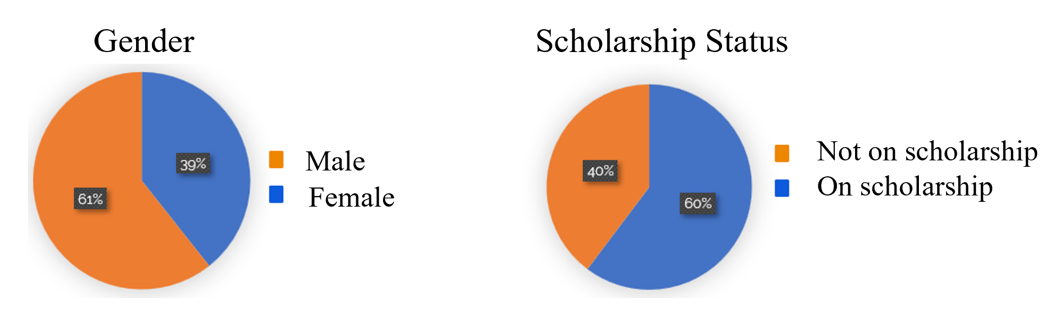
In addition, 88% of students came from private schools and 12% from public schools. Regarding the teaching staff, 40 teachers participated in both treatments; however, only 11 responded to the final survey. Their average age was 40, and the average teaching experience was 10 years.
A pre- and post-test of previous knowledge was applied in each course. These instruments were created by the teams of teachers in charge of developing the contents of the leveling modules. Subsequently, a pilot study was conducted to verify that item difficulty and discrimination indices were appropriate and that the scales showed adequate internal consistency (Cronbach’s alpha), see Table 1.
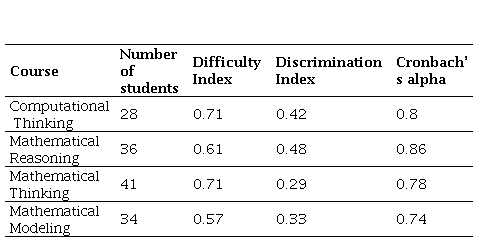
Each instrument was piloted with twice as many items as planned. Following the analysis, the 16 items with the best psychometric results were selected, resulting in each instrument consisting of 16 items.
At the end of each course, a survey was applied to students and teachers in the control and experimental groups. The objective of this questionnaire was to collect information on the learning experience in relation to the ALS for leveling. The dimensions of this instrument were: Learning Path, Learning Process, Teaching Process, Content, Engagement, Usability, User Experience, and Satisfaction. The instrument utilized a continuous-interval Likert scale with a range of 0 to 100 points to capture nuances in the intensity of each response.
ANOVA tests were performed to analyze the results of the pre- and post-test, after verifying the assumptions of normality and homogeneity of variances. Likewise, a Difference-in-Differences (DiD) analysis was applied to estimate the real effect of the treatments. As for the survey, since it used a continuous Likert-type scale, chi-square tests identified differences between the teachers in the experimental groups. Also, the use of data provided by the adaptive platform was analyzed. Finally, the open questions in the questionnaires were analyzed through thematic categorization to complement and enrich the quantitative results.
The study was carried out in accordance with the ethical principles set out in the Declaration of Helsinki. All students, professors, and academic authorities were informed about the objectives and procedures of the study. Participants were explicitly notified that all information collected would be held to strict confidentiality standards, ensuring absolute anonymity. Moreover, all participants gave their informed consent before starting their participation.
Table 2 presents the results of the comparative analysis between the control and experimental (adaptive) groups in the post-test of prior knowledge for each course. The assumptions of normality (Shapiro–Wilk test) and equality of variances (Levene test) were verified. Since no statistically significant differences were identified between treatments in the pre-test, it was decided to perform a one-factor ANOVA without covariates, dispensing with the use of ANCOVA.
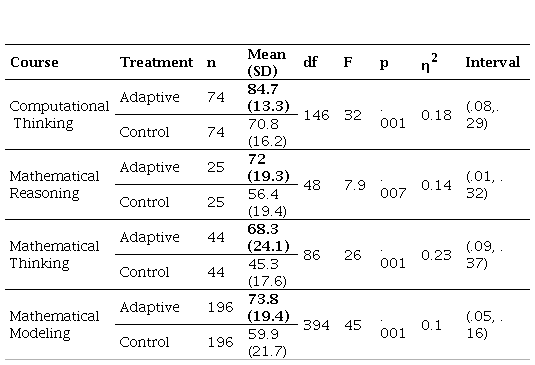
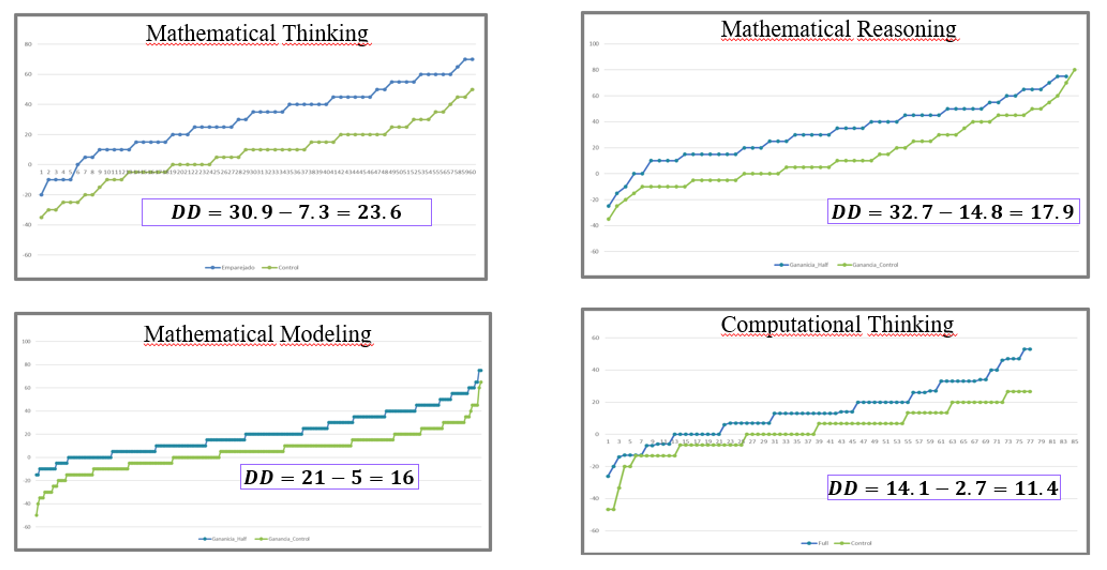
The results showed statistically significant differences between the control and experimental groups, with a higher performance in the experimental groups (β = 17.2, CI 95% [11.4, 23.6], p < .001). Figure 2 shows the learning gains estimated by the Difference in Differences (DiD) model, where the blue line represents the performance of the experimental groups and the green line corresponds to the control groups. The adaptive intervention yielded net increases (difference-in-differences, DiD) of 11.4, 17.9, 23.6, and 16.0 points in Computational Thinking, Mathematical Reasoning, Mathematical Thinking, and Mathematical Modeling, respectively. The weighted average additional gain was approximately 16.2 points relative to the control group. This pattern is consistent with an effect attributable to the intervention.
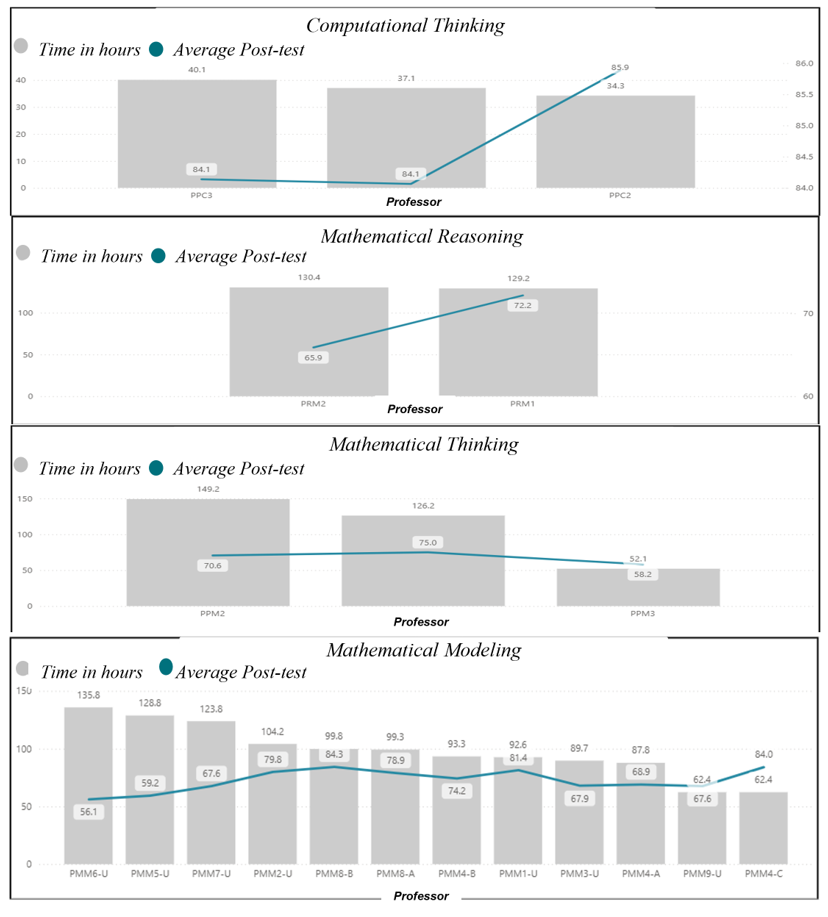
The descriptive analysis of data use could identify no clear correlation between the total time of use per group (in hours) and the average score obtained in the post-test. This suggests that the platform adapts to the individual needs of each student: while some required more time to achieve the expected learning, others achieved it in less time. For example, students in Mathematical Reasoning and Computational Thinking recorded fewer hours of use and obtained higher grades, while those in Mathematical Modeling and Mathematical Thinking spent more time and achieved better performance (see Figure 3).
A survey was sent to students via email to assess the ALS. Participation was voluntary and, although the teachers made efforts to motivate them, the response rate was lower than expected. The results are presented in Table 3. In the survey, seven dimensions related to ALS were established, that is, to the entire process involved, from the content to the user experience. The scale employed continuous Likert responses. The interpretation of the scores fell into five categories: 0–19: strongly disagree; 20–39: disagree; 40–59: neutral; 60–79: agree; and 80–100: totally agree. This coding allowed for a finer analysis of the variability in participants' perceptions.
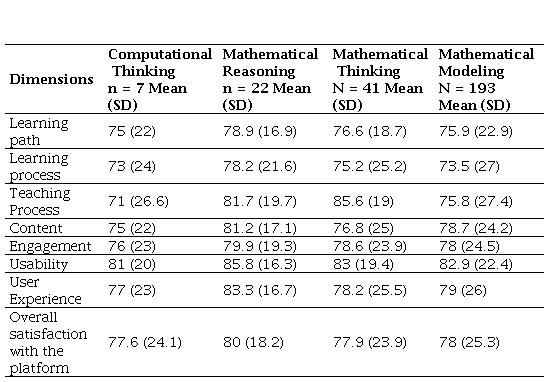
According to the established scale, the results fell above the "Agree" level. No statistically significant differences were found between the courses, indicating that the evaluations were consistent among students in the different subjects. An additional finding, derived from a survey question on the use of resources external to the adaptive platform, was that 57% of the students reported not having used additional materials to recover previous knowledge.
The most frequent comments were categorized into the following strengths and areas of opportunity:
Students valued the ability to access the platform at any time and progress at their own pace.
They emphasized that the exercises were well organized, starting from the basics to the advanced.
The videos were highlighted as an effective and easy-to-understand tool.
The platform was seen as practical and understandable, with good material to review and reinforce knowledge.
The platform facilitates remembering and reviewing forgotten topics efficiently.
The use of videos was valued, but they suggested that they be more interactive and have step-by-step explanations.
They proposed a better explanation of errors in the exercises to understand how to correct them.
On the other hand, with respect to teachers, only 11 responded to the survey since it was not mandatory (see Table 4).
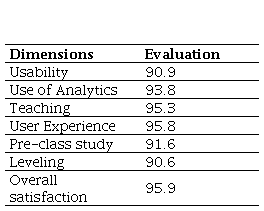
As can be seen in Table 4, the teachers positively evaluated the Adaptive Learning Strategy, highlighting the dimensions of Teaching and User Experience. The most frequent comments were the following:
It improves the teaching-learning process innovatively.
It promotes greater student engagement and participation.
It facilitates pre-class study and the leveling of basic knowledge, which implies a time saving in classes.
It allows students to learn from home.
It offers data analysis to make decisions on how to support lower-performing students and recognize higher-performing students.
It increases students' security and confidence by corroborating answers and gaining solid knowledge.
The results of this study show significant differences in academic performance in favor of experimental groups that used ALS, compared to control groups with a traditional approach. Table 2 shows that, in the four training units, all groups with adaptive modules outperformed the control groups. Likewise, these experimental groups registered superior net learning gains, between 11.4 and 23.6 points, as illustrated in Figure 2. These findings suggest that ALS can effectively facilitate the recovery of previous knowledge when implemented comprehensively, incorporating a solid content design, a coherent didactic model, an active teaching role, and an appropriate technological platform. This coincides with the studies of Rincon-Flores et al. (2024), Shi and Liu (2025), and Simon and Zeng (2024), who highlighted that the impact of AL is enhanced when approached with appropriate teaching strategies and platforms that facilitate these strategies.
The AI technology platform is a vital component of the ALS, as it enables dynamic personalization of learning. By accurately diagnosing each student's prior knowledge, AI adapts learning paths to their specific needs in real-time. As Moskal et al. (2017) pointed out, adaptive platforms employ a data-driven—and, in some cases, non-linear—approach to instruction and leveling, dynamically adjusting to student interactions and achievement levels. This results in content delivery in the most appropriate sequence and time to support individual progress. Figure 3 illustrates how the platform adjusts to the particularities of each student: while some require more time to achieve the expected learning, others need less.
Regarding the assessment of the ALS, Table 3’s analysis shows the respondents’ positive perception in all the dimensions evaluated, which included pedagogical (content, teaching, and learning process) and technological (engagement, user experience, and usability) aspects, as well as general satisfaction. All exceeded the agreed-upon values, with no significant differences between teachers, indicating a homogeneous perception by the students. In addition, 57% of the students did not require external resources to recover previous knowledge, evidencing the sufficiency of the material. The qualitative comments highlighted the organization of the content, the usefulness of the exercises and videos, and the effectiveness of the platform to review and consolidate learning, in line with the findings of the University of Central Florida, which indicated greater student success, better learning outcomes, and more engagement (Dubay & Chen, 2023). However, suggestions to increase the interactivity of audiovisual resources and offer more detailed feedback coincided with du Plooy et al. (2024), who pointed out the potential of AL to improve both academic performance and student engagement.
Similarly, the teachers positively evaluated the ALS. (See Table 4, which presents the outstanding scores above 90/100 in all dimensions, especially in Teaching and User Experience.) The qualitative comments highlighted that the strategy innovatively improves the teaching-learning process and encourages more student engagement and participation. These findings, both in perceptions and in academic results, support the effectiveness of the ALS for leveling, using short modules integrated into the training units. They also confirmed that its success lies in a comprehensive design that combines well-structured content, relevant teaching strategies, an adequate teaching model, and appropriate technology, as pointed out by Rincon-Flores et al. (2024) and suggested by Shi and Liu (2025).
However, it is also essential to consider studies that show divergent results. For example, the research of Wang et al. (2023) and Eau et al. (2022) indicated that although the adaptive system favored academic improvement, no significant differences were detected between the groups in absolute terms. Similarly, the study by Rincon-Flores et al. (2024) found substantial improvements in learning gain, academic results, and other indicators in favor of adaptive groups compared to control groups; however, in the area related to the achievement of disciplinary competencies, no significant differences were found between the two groups, regardless of the course or stage evaluated.
Although the results of this research are promising, its limitations in external validity should be noted. The study was conducted at a private Mexican university, implying that the specific conditions of this environment could bias the findings. Therefore, generalizations to other educational contexts, especially those where resources and conditions differ significantly, should be ventured cautiously. Likewise, the interest of both teachers and students in using technological tools could be greater in this type of institution, which usually offers access to advanced resources and specialized support. Thus, future research should delve into the factors that enhance or limit the impact of ALS in different educational contexts.
On the other hand, the transferability of this ALS with adaptive modules to virtual environments and distance education is fully viable thanks to its digital format, which allows 24/7 access to the content from anywhere with an internet connection. The technological platform employed also facilitates its integration with different learning management systems (LMS), which extends its applicability to various educational contexts, provided that the necessary technological infrastructure is in place. Note that although adaptive modules have also been applied in distance courses, they were not included in the present study due to the small sample size, which included only face-to-face groups.
The ALS proposed in this study is a promising alternative to close gaps in students’ prior knowledge acquired in upper secondary (high school) education. Its implementation through short modules integrated into regular courses resulted in significant recovery without resorting to parallel or additional remedial courses. Under this approach, each student addresses only the content they need, when they require it, avoiding the unnecessary repetition of topics already mastered.
The results suggest that the articulation of the key components of the strategy—content structured in microlearning, a didactic model focused on self-study and self-regulation, an active teaching role in motivating and follow up, and a technological platform with AI to personalize learning paths and monitor progress—positively impacted academic performance, the recovery of previous knowledge, and the favorable perception of the participating students and teachers. In addition, the formal incorporation of the modules as part of the evaluation encouraged participation and compliance with the leveling process.
While the results are encouraging, areas for improvement include increasing the number of videos, providing more detailed feedback in exercises, and encouraging teacher use of the platform's analytics to identify learning patterns and personalize feedback. In some cases, the resistance of certain professors limited the full integration of the module with the dynamics of the course and the application of measurement instruments.
In conclusion, an integrally designed Adaptive Learning Strategy (ALS)—delivered as short modules embedded within regular courses and mediated by an AI platform—can effectively level first-year STEM students’ prior knowledge, offering a viable alternative to traditional remediation models. Future research should examine ALS implementations across diverse contexts (public institutions, rural settings, and fully online modalities) and conduct longitudinal studies to assess sustained effects on academic performance, retention, and learner autonomy.
Finally, it is pertinent to promote educational policies that integrate adaptive leveling strategies into the curriculum and encourage continuous teacher training in the use of learning analytics to strengthen accompaniment and feedback.
How to cite: Aldape-Valdes, P., Rincon-Flores, E. G., Castano, L., & Guerrero, S. (2026). Smart leveling: an AI-driven adaptive learning strategy in higher education [Nivelación inteligente: estrategia de aprendizaje adaptativo con IA en educación superior]. RIED-Revista Iberoamericana de Educación a Distancia, 29(1), 299-320. https://doi.org/10.5944/ried.45482
redalyc-journal-id: 3314
The authors acknowledge the financial support of the Writing Lab, Institute for the Future of Education, Tecnologico de Monterrey, Mexico, in the production of this work.
