Estudios e investigaciones
Participatory methodology for creating microlearning digital resources with generative AI
Metodología participativa para la creación de recursos digitales de microaprendizaje con inteligencia artificial generativa
 Bell Manrique-Losada
 Sandra Isabel Arango-Vásquez
Mariutsi Alexandra Osorio-Sanabria
Sandra Isabel Arango-Vásquez
Mariutsi Alexandra Osorio-Sanabria
Participatory methodology for creating microlearning digital resources with generative AI
RIED-Revista Iberoamericana de Educación a Distancia, vol. 29, núm. 1, pp. 381-409, 2026
Asociación Iberoamericana de Educación Superior a Distancia

Esta obra está bajo una Licencia Creative Commons Atribución-NoComercial 4.0 Internacional.
Recepción: 01 Junio 2025
Aprobación: 02 Septiembre 2025
Abstract: In recent years, advances in information technology and the Internet have transformed education by creating new opportunities for learning and collaboration in the production of Digital Educational Resources (DERs). Both students and teachers are leveraging the potential of models, methods, and approaches derived from Generative Artificial Intelligence (GenAI). The study analyzes and describes a microlearning-based methodology to guide interaction between actors and support the co-creation of Microlearning Resources (abbreviated microDERs) using GenAI. Adopting a qualitative approach, the study integrates Participatory Action Research (PAR) and the Creative Social Problem Solving (CSPS) methodology. It unfolds in three phases: (1) recognizing the context and conducting exploratory, participatory, thematic delimitation; (2) collaboratively designing microDERs with high school and higher education students and teachers, including the evaluation of GenAI tools; and (3) validating the methodology through co-creation workshops, bootcamps, and qualitative analysis. Data are collected and analyzed through co-creation workshops with students and teachers from elementary, high school, and higher education. Findings on the contributions of the actors in each phase indicate that combining PAR and CSPS improves interaction and knowledge building in the co-creation of DERs using GenAI.
Keywords: education, learning, artificial intelligence, information technology.
Resumen: En los últimos años, los avances en las Tecnologías de la Información (TI) e Internet han transformado el ámbito educativo. Estos avances han creado nuevas oportunidades de aprendizaje e interacción colaborativa en la producción de recursos educativos digitales. Tanto estudiantes como docentes reconocen esta oportunidad y están aprovechando el potencial de los modelos, métodos, TI y enfoques derivados de la inteligencia artificial generativa (IAGen). Este estudio analiza y describe el proceso de implementación de una metodología basada en principios de microaprendizaje para guiar la interacción entre actores y lograr la cocreación de recursos de microaprendizaje (microRED) con IAGen. La investigación adopta una perspectiva cualitativa y se estructura metodológicamente desde la articulación de la Investigación Acción Participativa (IAP) y la Metodología de Solución Creativa de Problemas Sociales (SCPS). Este estudio se desarrolla en tres fases: 1) Reconocimiento del contexto y delimitación temática participativa exploratoria; 2) Diseño colaborativo de microRED con estudiantes y docentes de secundaria y educación superior, integrando retos y evaluación de herramientas de IAGen; y, 3) Validación de la metodología propuesta a través de talleres de cocreación, bootcamp y análisis cualitativo. La recopilación y el análisis cualitativo de los datos se realiza a través de talleres de cocreación con estudiantes y docentes de básica secundaria y educación superior. Como resultado del análisis de las contribuciones de los actores en cada fase, se concluye que los enfoques de IAP y SCPS mejoran la interacción y la generación de conocimiento asociado al uso de la IAGen para la cocreación de RED.
Palabras clave: educación, aprendizaje, inteligencia artificial, tecnología de la información.
INTRODUCTION
Reviewing educational strategies to improve student learning outcomes is essential for promoting creativity and critical thinking. In this regard, microlearning—which provides brief and accessible content through Digital Educational Resources (DERs)—emerges as a valuable alternative (Denojean-Mairet et al., 2024; Torgerson & Iannone, 2019).
The integration of Generative Artificial Intelligence (GenAI) further enhances its impact by enabling the personalization and creation of materials tailored to specific contexts (Miao & Holmes, 2024; Piantari et al., 2024). At the same time, the co-creation of DERs between students and teachers fosters autonomy and the social appropriation of knowledge, which is the process by which communities produce, use, and apply knowledge. Consequently, this strengthens democratization and supports social transformation (Gonnet, 2019).
This study analyzes the implementation of a participatory methodology in educational contexts to facilitate the co-creation of Microlearning Resources (abbreviated microDERs in Spanish) using GenAI tools. The research was carried out in three phases: (1) recognizing the context and mapping of actors, needs, challenges, and knowledge; (2) collaboratively designing microDERs with high school (10th and 11th grades) and higher education (9th semester) students, integrating challenges and evaluating GenAI tools; and (3) validating the methodology through co-creation workshops, bootcamps, and qualitative analysis.
Adopting the Participatory Action Research (PAR) approach and the Creative Social Problem Solving (CSPS) method, the study involves students and teachers in reflective and participatory cycles to collaboratively build knowledge (Kemmis & McTaggart, 2005). These approaches promote knowledge exchange and community participation (Ritzer, 2008), as well as ensure that microDERs co-creation responds to the needs and perspectives of the participants.
The article is organized into four sections. First, the conceptual framework section focuses on the fundamentals of PAR, CSPS, microlearning, and GenAI. Next, the methodology section outlines the three phases of the microDERs co-creation process. Then, the results section presents the activities, actors, and artifacts from each phase. Lastly, the last section contains discussion, conclusions, and future work.
CONCEPTUAL FRAMEWORK
Participatory Action Research (PAR)
PAR is a methodology that combines theory, action, and participation to understand social phenomena. It adapts to regional contexts to foster the collective building of knowledge (Fals Borda, 2001; Sirvent & Rigal, 2012). PAR views individuals as agents capable of transforming their realities through collaborative research, not as objects of study (Fals Borda, 2001). Furthermore, it strengthens social ownership and supports the transition of social ecosystems by integrating democratic practices, knowledge, and systemic perspectives on problems (Arnanz et al., 2023).
Creative Social Problem Solving (CSPS)
CSPS is a participatory methodology based on design thinking that focuses on the collaborative design of contextualized educational and social solutions (Mirón, 2022). Through creativity, critical analysis, and co-design tools, CSPS fosters co-creation, critical thinking, and stakeholder empowerment for identifying problems, designing strategies, and assessing impact. When integrated with PAR, CSPS broadens diagnostic capacity and strengthens solution design in educational, community, and organizational contexts.
Generative Artificial Intelligence (GenAI)
GenAI is a branch of Artificial Intelligence (AI) that uses deep neural networks and natural language processing to automate information processing and present results as symbolic representations of human thought. It produces semi-finished knowledge products in multiple formats (Cain, 2024; Cabeza-Rodríguez, 2025; Samoili et al., 2021). In education, GenAI enhances the creation of personalized teaching materials, increases teacher productivity in designing resources and learning environments, and supports learning experiences tailored to students’ needs and interests (Abdous, 2023; Cain, 2024; Dickey & Bejarano, 2023).
Microlearning
Microlearning is an educational strategy that delivers short, focused digital content, incorporating multisensory and multimodal elements to facilitate comprehension and adaptability (Denojean-Mairet et al., 2024; Dolasinski & Reynolds, 2020; Durán & Escudero, 2023; Torgerson & Iannone, 2019). Microlearning structures DERs into seven dimensions—time, content, curriculum, form, process, mediality, and learning type (Hug et al., 2006)—and presents them in formats such as videos, texts, micropodcasts, and short social media messages (Díaz Redondo et al., 2021; Mateus-Nieves & Moreno, 2021).
Figure 1 illustrates the functional interaction of the four conceptual pillars—PAR, CSPS, GenAI, and microlearning—that underpin the proposed methodology. The process begins with defining a processapproach based on educational challenges in the classroom. It then advances through stakeholder interaction and knowledge exchange within the frameworks of PAR and CSPS. Next, GenAI supports the creation of personalized content, which ultimately materializes as microlearning resources.
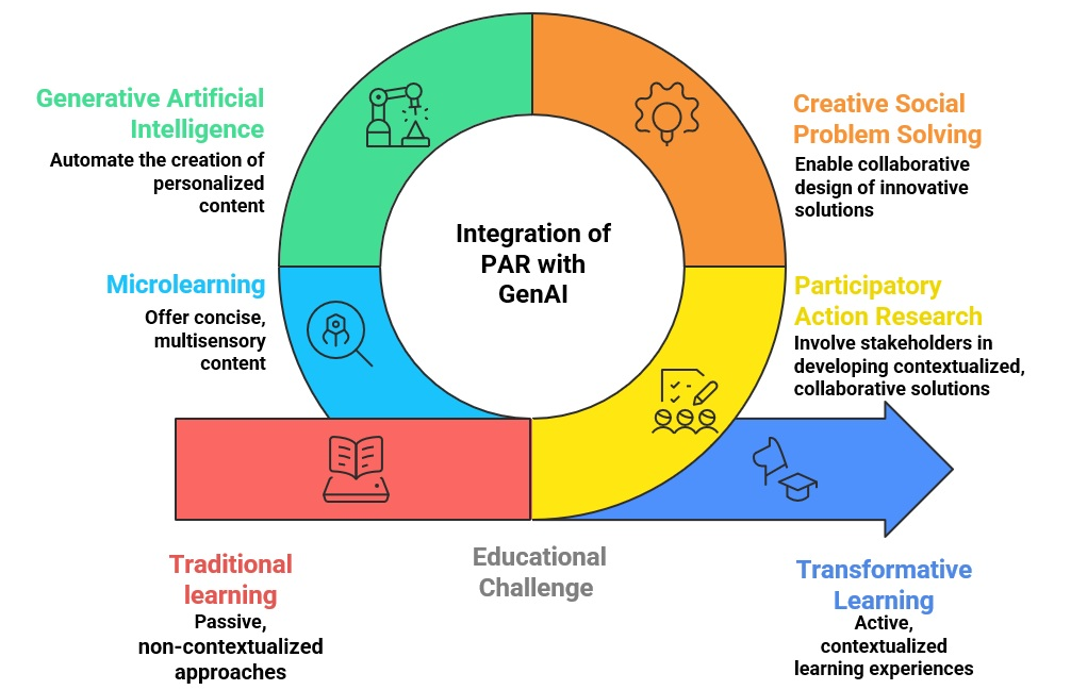
Figure 1
Functional interaction of the study’s conceptual pillars
Source: Prepared by the authors. Software: Napkin.
Background and related studies
The rapid development of AI has led to more personalized and automated educational models, processes, and strategies, providing opportunities to transform pedagogy, resource development, and assessment. However, challenges remain regarding adaptation to individual characteristics (Yang, 2024), dynamic learning processes (Tu et al., 2025), empathy (Zhang et al., 2024), and literacy goals for students (Adeshola & Adepoju, 2023).
From a microlearning perspective, GenAI strengthens collaboration between teachers and technology. This collaboration supports the development of students’ cognitive, psychomotor, and affective skills. It also positions students at the center of the educational process (Memon & Kwan, 2025; Bygstad et al., 2022). In parallel, advances have been made in generating adaptive microcontent using GenAI (Boumalek et al., 2024).
Within this context, two main lines of intervention emerge. The first redefines the teacher’s role by shifting the focus from instructor-centered to student-centered learning and recognizing GenAI tools as integral to the process (Bozkurt, 2023). The second line leverages emerging technologies to design and deliver engaging, relevant content that aligns with the needs and interests of contemporary learners (Holmes et al., 2023; Karras et al., 2020; Luckin et al., 2016; Sengar et al., 2025). This study addresses both perspectives by proposing a collaborative model for creating microDERs through the integration and use of GenAI tools tailored to young students.
METHODOLOGY
This study takes a qualitative and participatory approach, combining PAR and CSPS. This convergence enables the addressing of complex problems in a situated, collaborative, and transformative manner across four dimensions: (1) promoting the social appropriation of knowledge by fostering collaboration between those experiencing the problem and end users of microDERs; (2) generating action-oriented outcomes, as knowledge is translated into artifacts and concrete community actions (e.g., building and using microDERs); (3) encouraging creativity and innovation in searching for solutions to identified challenges; and (4) strengthening communication and dialogue by encouraging open interaction, collaboration, and appropriation processes.
The research is guided by the hypothesis that implementing a microDERs co-creation methodology—with the participation of teachers and young students and supported by GenAI—fosters the development of computational thinking and social interaction. This addresses the central research question: What is the best way to design a co-creation methodology that uses GenAI tools to help teachers and students build microDERs?
Data collection relied on three instruments: (i) focus group guides, which were applied in co-creation workshops with students and teachers and validated through pilot processes; (ii) semi-structured questionnaires, which were used to gather perceptions about the methodology and the resulting products; and (iii) analysis matrices and research logs, which documented interactions, decisions, and adjustments. Content validity was ensured through participant feedback and cross-reviews by the research team.
The data analysis was conducted through a progressive process of open and axial coding, which shaped the emerging categories and revealed their connections. Comparative matrices were used to organize information, identify patterns, and connect findings with the research question. The process was participatory; interpretations were contrasted with the participants, and triangulation strategies reinforced coherence and transparency. Theoretical saturation was achieved in the final workshops when no new categories emerged, confirming the analysis consistency and solidity.
Triangulation and comparison further strengthened the analysis. The co-created microDERs, systematization matrices, and research logs were examined to verify the coherence of the emerging categories across sources. Additionally, interpretations were aligned with the conceptual frameworks of PAR, CSPS, GenAI, and microlearning. This ensured that the findings were theoretically supported and not solely dependent on group dynamics.
Participants
In line with Manzini’s (2015) vision of collaborative design in social innovation, stakeholders from various educational levels were involved, including the research team, high school teachers and students in grades 10 and 11, as well as higher education teachers and ninth-semester students affiliated with a research incubator at the University of Medellín in Colombia. The study relied on a diverse and representative purposive sample. Table 1 shows the educational level, stakeholder, age range, and number of participants involved in designing and validating the methodology.
| Educational level | Actor | Age range | Participants2024-2 | Participants 2025-1 |
| High school | Students (Grades 10 and 11) | 13 – 16 | 33 | 32 |
| Teachers | 40 – 50 | 2 | 2 | |
| Higher education | Ninth-semester students | 18 – 22 | 13 | 19 |
| Research incubator students | 18 – 22 | 8 | 5 |
Procedure
The research was conducted in three phases: (1) recognizing the context and delimitating the theme based on PAR; (2) designing and co-creating microDERs, and (3) validating the methodology. Figure 2 illustrates these phases and their methodological articulation.
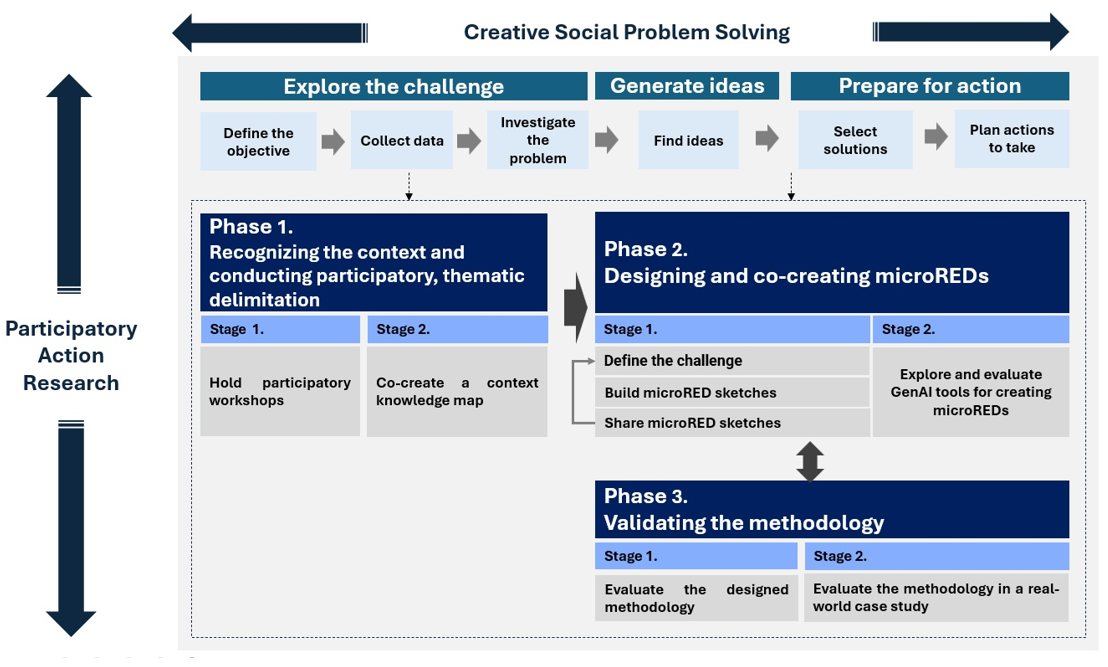
Figure 2
Methodological process
Source: Prepared by the authors.
Phase 1: Recognizing the context and conducting participatory, thematic delimitation
Developed under the principles of PAR, this phase prioritized understanding of the educational context through the experience and voices of stakeholders. During the second semester of 2024, co-creation workshops were held with students and faculty from participating institutions.
Phase 2: Designing and co-creating microDERs
Conducted over two semesters (2024-2 and 2025-1), this phase aligned with PAR and CSPS principles to guide the work toward collaborative and creative solutions. Using the knowledge map, higher education students formulated and developed microDER sketches, which were shared and enriched by high school students in participatory sessions. This interaction enabled the progressive co-creation of prototypes. In parallel, research incubator students explored GenAI tools based on scope, license type, and generable resources to determine their suitability for microDER building.
Phase 3: Validating the methodology
The goal of this phase was to verify the structural (stages and activities) and functional (tasks) coherence of the microDER co-creation methodology in a real-life context. A pilot case with students from a university research incubator was used for this purpose. Validation took place in two stages. The first stage assessed the organization and sequencing of the stages and activities. The second stage applied the methodology to the pilot case to evaluate its effectiveness and relevance under real conditions.
Ethical procedure
The methodology was applied within an ethical framework designed to protect the integrity of participants, especially the minors. This included informed consent and confidentiality and anonymity protocols. The consent forms were written in accessible language for high school students and required signatures from parents or guardians, as well as assent from the minors. This ensured that they understood the purpose of the research and the conditions of participation.
Measures to ensure confidentiality include using codes or pseudonyms in records and reports, storing data securely with restricted access for the research team, and deleting personal information after the retention period. The procedure complied with Colombian Law 1581 of 2012 (Congreso de la República de Colombia, 2012) and 1377 of 2013 (Presidente de la República de Colombia, 2013) regarding the protection of personal data, ensuring minimal data collection and the ethical use of images, videos, and audio recordings.
RESULTS
Results are presented by methodological phase.
Phase 1: Recognizing the context and conducting a participatory, thematic delimitation
This phase was structured in two stages, which enabled a collaborative diagnostic process and collective knowledge-building.
Stage 1: Participatory workshops
During semesters 2024-2 and 2025-1, the research team conducted two workshops with 10th grade and three workshops with 11th grade students. These sessions were designed as co-creation spaces that explored the students’ educational, social, and emotional realities. The participatory dynamics revealed three priority issues: lack of vocational guidance, limited access to educational opportunities (e.g., scholarships and entrepreneurship programs), and the importance of emotional management for fostering a positive school environment.
Stage 2: Context knowledge map
The findings were synthesized into a knowledge map that highlights training needs, student potential, and school environment dynamics. This output guided the subsequent methodological phases, defining challenges and establishing two thematic axes for building microDERs: vocational guidance and emotional management.
Phase 2: Designing and co-creating microDERs
In this phase, the needs identified in the knowledge map were translated into products that integrate microDERs. These products address the challenges outlined in Phase 1. The development process involved collaborative work between higher education and high school students, as well as the pedagogical use of GenAI tools. The results were organized into two stages.
Stage 1: MicroDERs co-creation
During semesters 2024-2 and 2025-1 semesters, higher education students designed sketches in response to the challenges identified in Phase 1. The sketches were shared with high school students, who provided feedback based on guiding questions related to their experiences. This interaction resulted in four products aimed at raising awareness and supporting training processes adapted to the school context. Table 2 details the characterization of the work by academic semester, and Figures 3 and 4 present examples of the co-created products.
| Semester | Participants | Actions | Guiding questions | Products |
| 2024-2 | 13 undergraduate students and 33 high school students (10th grade) | § Review challenges § Design sketches § Share sketches § Review and propose adjustments | § How can vocational uncertainty be reduced to prevent dropouts and strengthen professional development? § How can emotion management strategies be implemented to improve assertive communication in high school students? | § Vía Pro: A career guidance website with thematic capsules, career choice simulators, and student testimonial videos. § Moodies: A mobile app for emotion management with self-regulation exercises, interactive reflection content, and guides for assertive communication. |
| 2025-1 | 19 higher education students and 32 high school students (11th grade) | § Review challenges and sketches from the previous semester § Propose a new challenge § Identify improvements to previous challenges | § How can interpersonal relationships be improved among students through communication strategies that foster coexistence? § How can the Vía Pro tool be improved to provide relevant information for academic continuity? § How can the Moodies app be enhanced to encourage student participation? | § Life is not a game:A board game prototype promoting positive school environment, with analogous microDERs, such as thematic cards and printed guides for collective reflection. § EnRuta: A web platform that enhances the usability of Vía Pro with interactive vocational capsules. § Moodies+: A gamified web platform with microDERs challenges, self-assessments, and multimedia content to encourage student participation. |
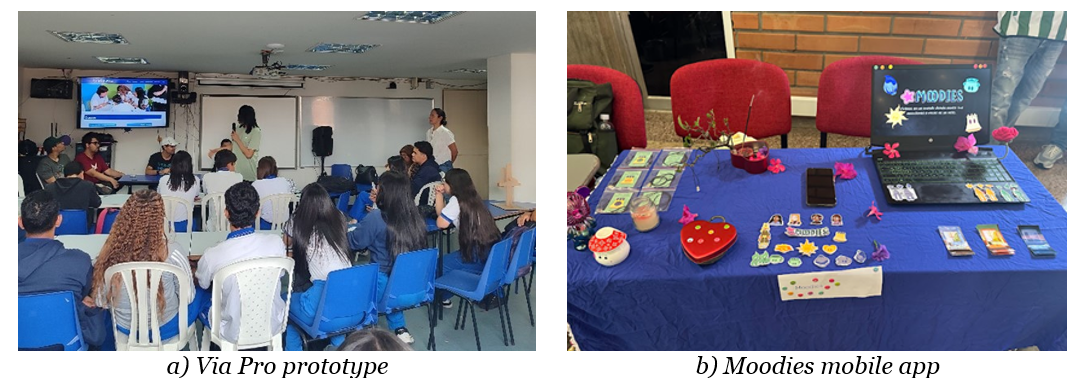
Figure 3
Co-created prototypes in 2024-2
Source: Data collected by the authors.
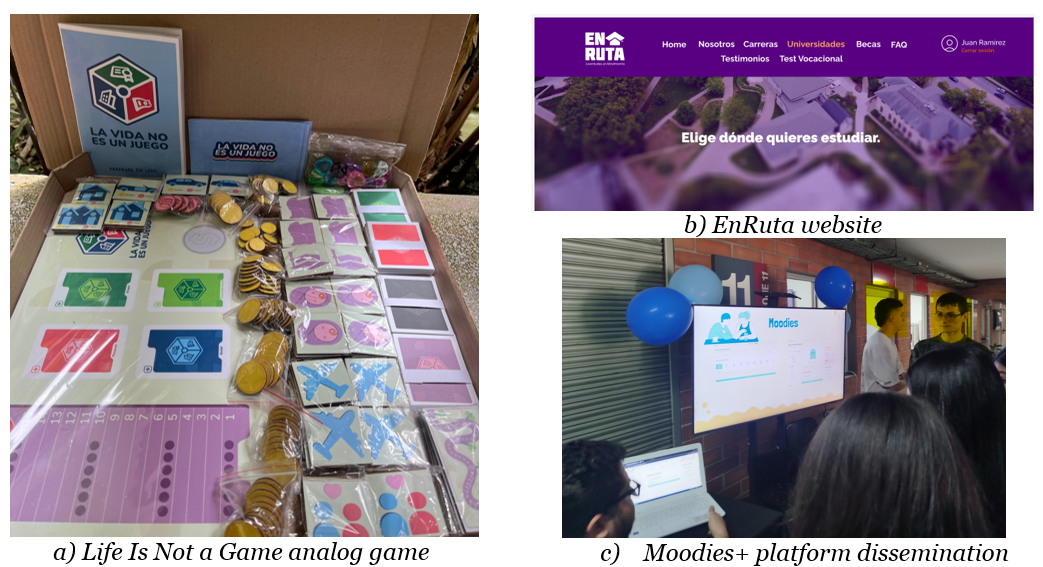
Figure 4
Co-created prototypes in 2025-1
Stage 2. Exploration and evaluation of GenAI tools
Students in the research incubator explored and evaluated 24 GenAI tools. The tools were classified by resource type (text, image, audiovisual, and code), scope, and license (free or proprietary).
Six tools were analyzed for textual resources: ChatGPT, Claude AI, Google Gemini, DeepL, Hugging Face, and Notion AI. Textual resources were the most explored category, and Hugging Face was identified as the only open-source option. While the others are useful for pedagogical writing, multilingual translation, and training guide development, they require proprietary licenses. Additional tools, such as Grammarly, Acrobat AI, and Humata, were also tested for academic text review and synthesis.
Five text-to-image generators were reviewed for visual resources: Adobe Firefly, DALL·E, Magic Design, Midjourney, and Stable Diffusion. Only Stable Diffusion offers a free license. These tools support creating digital images in various formats, including 2D graphics, visual effects, automated designs, and high-resolution illustrations. However, exploration was limited due to restricted access, requiring further advanced evaluation.
Four tools were explored for creating and editing videos with avatars, text-to-video conversion, and visual effects: Lumen5, Pictory, RunwayML, and Synthesia. These tools are proprietary and licensed, which may limit their use by institutions. Additionally, two complementary tools were analyzed for customizing the creation of educational resources: Whisper, a free audio-to-text transcription tool; and ElevenLabs, a realistic voice synthesis platform.
Finally, GitHub, Copilot, Tabnine, Testim, and Applitools were evaluated for their ability to generate, assist with, or validate code snippets in the category of software code generation and automated testing tools. While they cannot be used directly in school education, they have the potential to be used in technical training activities and processes.
In line with the research hypothesis, this phase of the study demonstrated that:
-
Teachers and young students can actively participate in collaborative microDER creation.
-
Students can take on a leadership role in their learning when supported by a methodology that incorporates their participation, teacher mediation, and GenAI tools.
-
A co-creation methodology supported by GenAI tools enables effective design and implementation of microDERs.
-
The design and co-creation process fosters and strengthens computational thinking and social interaction among students.
Phase 3: Validating the methodology
The validation phase documented the microDER co-creation process through illustrations, analysis excerpts, photographs of student activities, and the generated artifacts. Table 3 summarizes the actors involved, detailing the time, session, modality, participants, and activities.
| Stage | Session | Modality | Participants/Actors | Activity |
| 1. Evaluation of the methodology structure | S1 | In-person | § Research team § Research incubator coordinator § Higher education students (research incubator members) | Creative exchange of ideas |
| S2 | In-person | § Research team § Higher education students (research incubator members) | Restructuring and adjustments | |
| S3 | In-person | § Research team | Visual organization | |
| 2. Validation of the methodology implementation | S1 | In-person | § Research team § Research incubator coordinator § Higher education students (research incubator members) | Methodology implementation and evaluation |
Stage 1: Designed methodology evaluation
This stage included three sessions that engaged participants in developing the proposed methodology according to their needs, context, and perspectives.
In Session 1, the research team, students, and research incubator coordinator collaborated to exchange ideas. The students were divided into three groups, and the professor provided guidance while the research team facilitated the process. The activities began with individual reflection, followed by sharing, analysis, and collective building. Key tasks included ideation, process analysis, element prioritization, and reflection on previous experiences in creating resources.
Throughout the session, students defined work paths and action flows for different stakeholders by focusing on co-creating microDERs. These contributions were incorporated into the methodology, fostering a reflective approach to the process. The outcome was the first version of the methodology, which integrated both the researchers’ reference elements and the students’ contributions. Figure 5 presents the evidence from the session.
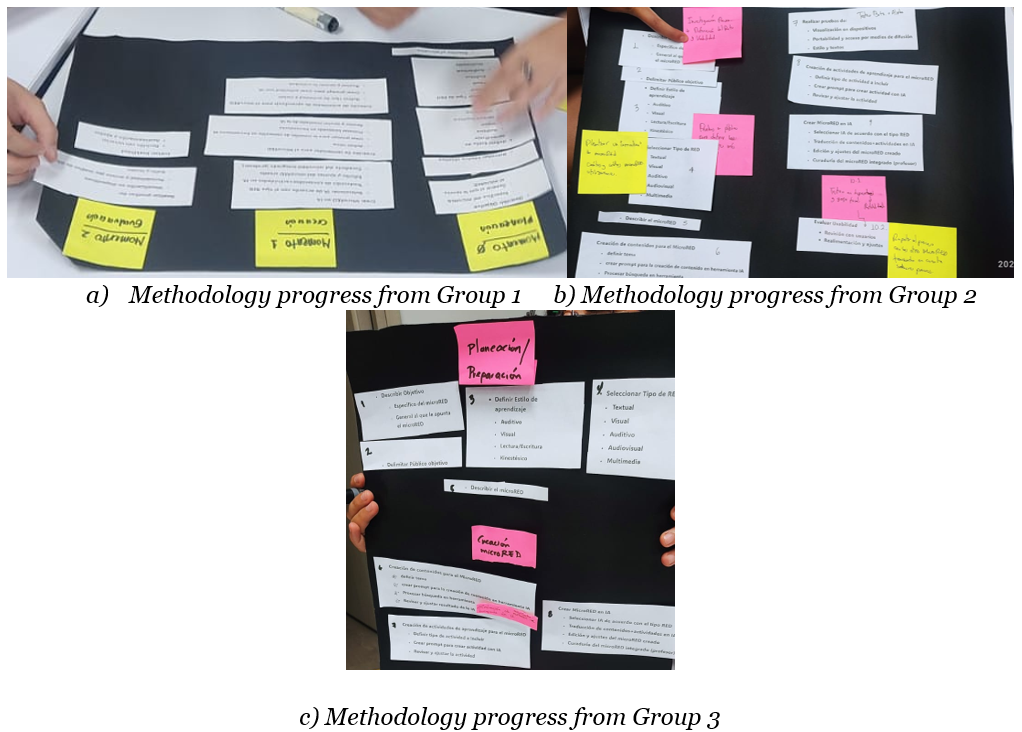
Figure 5
First version of the MicroDER co-creation methodology from Session 1
Source: Data collected by the authors.
In Session 2, students from the research incubator and the research team came together to review the contributions from Session 1, compare proposals, and collaboratively develop a unified version of the microDER co-creation methodology. The session consisted of three activities: sharing proposals, conducting a comparative analysis, and developing a unified version (see Table 4). Table 5 documents the evolution of these proposals and the adjustments made, tracing the contributions and changing management throughout the process.
| No | Activity | Description |
| 1 | Sharing proposals | Each group presented its preliminary version of the methodology, emphasizing steps, GenAI tools, roles, and general observations. Presentations were supported by diagrams or maps to facilitate collective understanding. |
| 2 | Comparative analysis | Using an analysis matrix, participants identified similarities, differences, strengths, and irrelevant aspects among the proposals. The research team moderated discussion, fostering argumentation and reflection. |
| 3 | Collaborative building process | Based on the comparative analysis, participants developed a unified version of the methodology (V1.0). This version was created in a shared document and integrated contributions from all groups. It also refined phases, activities, resources, roles, and observations to ensure overall coherence in the methodology. |
| Elements | Preliminary (V0.1) | V1.0 |
| Date | Sept 2024 – Mar 2025 | Apr – May 2025 |
| Phases | Three stages defined: P1: Recognizing the context P2: Building a MicroDER P3: Validating the methodology | § Three stages are kept § Names are specified: P1: Context definition (Planning/Preparation) P3: Validation/Evaluation |
| Subphases | Defined for P2 and P3: | § Subphases are kept for P2 and P3 § Names are adjusted for P2.SP3, P3.SP1, and P3.SP2 |
| P2: Building a microDER P2.SP1: Content creation P2.SP2: Creation of learning activities P2.SP3: Creation of a microDER using AI P3: Validating the methodology P3.SP1: Testing P3.SP2: Usability | P2: Building a microDER P2.SP3: Creation of a microDER using AI P3. Validation/Evaluation P3.SP1: Test development P3.SP2: Evaluation of microDER usability | |
| Activities | Activities are defined for P1, P2, and P3: | § One activity is added to P1 § Names of 15 activities are adjusted |
| P1: Context P1.A1: Target audience P1.A2: Description P1.A3: Objective (specific and general) P1.A4: Learning style (auditory, visual, reading/writing, or kinesthetic) P1.A5: Type of DER (textual, visual, auditory, audiovisual, or multimedia) | P1: Context definition P1.A1: Identify a learning problem P1.A2: Describe the general learning objective of the microDER P1.A3: Describe the specific objective of the microDER P1.A4: Define/Delimit the target audience P1.A5: Define the learning style (auditory, visual, reading/writing, or kinesthetic) P1.A6: Select the type of microDER (textual, visual, auditory, audiovisual, or multimedia) | |
| P2: Building a microDERP2.SP1: Content creation P2.SP1.A1: Define the topic P2.SP1.A2: Create an AI-generated content prompt P2.SP1.A3: Process searches in an AI tool and adjust and/or refine prompts P2.SP1.A4: Review and adjust AI-generated results P2.SP2: Creation of learning activities P2.SP2.A1: Define the type of activity to include P2.SP2.A2: Create a prompt for activity generation with AI P2.SP2.A3: Review and adjust the activity P2.SP3: Creation of a microDER using AI P2.SP3.A1: Test AI tools according to the type of microDER and select the most appropriate one P2.SP3.A2: Translate and integrate content and activities in AI P2.SP3.A3: Edit and adjust the AI-generated microDER P2.SP3.A4: Curate the integrated microDER (teacher) | P2: Building a microDERP2.SP1: Content creation P2.SP1.A3: Use an AI tool to process searches (adjust and refine prompts) P2.SP3 MicroDERs creation using AI P2.SP3.A1: Test AI tools by DER type to select the most appropriate one P2.SP3.A2: Edit and adjust the AI-generated microDER P2.SP3.A4: Curate the integrated microDER (teacher) | |
| P3: ValidationP3.SP1: Testing P3.A1: Testing P3.SP2: Usability P3.A2: Validation | P3: Validation/EvaluationP3.SP1: Test development P3.SP1.A1: Perform display tests on devices P3.SP1.A2: Perform portability and media access tests P3.SP1.A3: Perform style and text tests P3.SP2: Evaluation of microDER usability P3.SP2.A1: Assess usability with users P3.SP2.A2: Provide feedback and adjust microDER |
In Session 3, the research team organized and visually represented the unified version of the microDER co-creation methodology. The goal was to translate the agreements from Sessions 1 and 2 into a clear, functional, and accessible visual representation to support its implementation and adoption by diverse audiences.
Based on the integrated version from Session 2—which included phases, activities, roles, and implementation conditions—the team explored graphic visualization models for the final representation. The team then conducted an internal validation to assess the model’s clarity, coherence, and design fidelity. This process resulted in a graphical version of the methodology, ready for validation in application settings (see Figure 6).
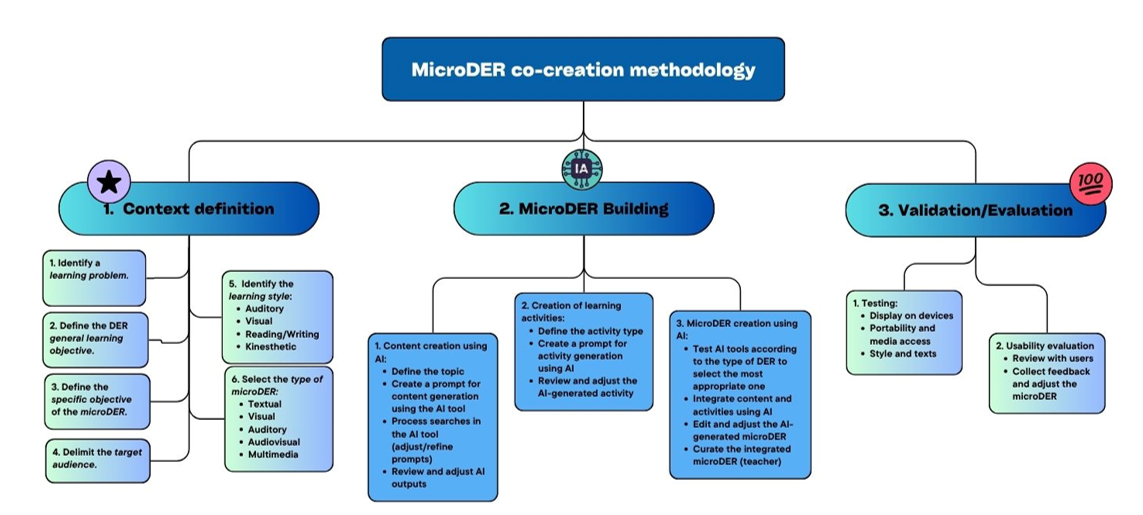
Figure 6
Graphic representation of the proposed methodology
Source: Prepared by the authors.
Stage 2. Methodology implementation
This stage involved applying the designed methodology to a pilot group consisting of the research team, a professor, and students from the participating research incubator. The purpose was to evaluate the methodology’s relevance, applicability, and coherence in creating microDERs using GenAI. A bootcamp-style workshop was conducted (see Figure 7), during which participants developed products that were evaluated to adjust the process and define improvement criteria. The session included four activities: dissemination of methodology, definition of the learning context, implementation of the methodology, and feedback on the process (see Table 6). Figure 8 shows evidence of the microDER pilot planning process, and Figures 9 and 10 present examples of the built microDERs.
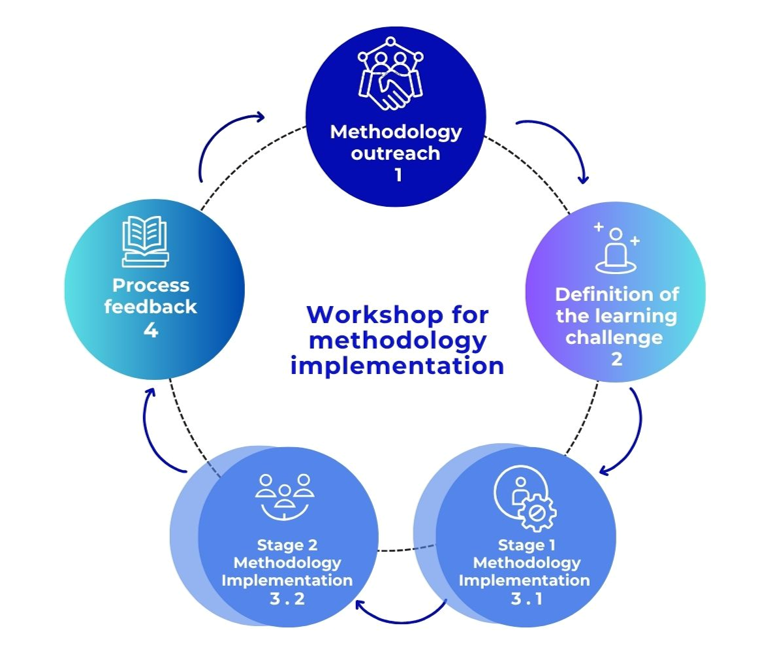
Figure 7
Workshop structure for methodology implementation
Source: Prepared by the authors.
| No | Activity | Description |
| 1. | Methodology dissemination | The research team introduced the project and explained the activities corresponding to the three defined phases, which support the proposed methodology. |
| 2. | Definition of the learning context | The challenge was framed around video game design. Participants used their prior knowledge from the research incubator to define the topic and review related content and activities. |
| 3. | Methodology implementation | Stage 1: Students were organized into working groups and provided with a printed guide and a graphic representation of the methodology (Figure 8.a) to serve as a work plan. Each group carried out the activities autonomously. See Figure 8.b for evidence. |
| Stage 2: Groups developed their microDERs using GenAI tools (see Figures 9 and 10). | ||
| 4. | Process feedback | Groups presented the initial versions of their microDERs and described the creation process and the GenAI tools they used. The audience provided feedback on both the process and products, generating reflections and best practices for future methodology validations. |
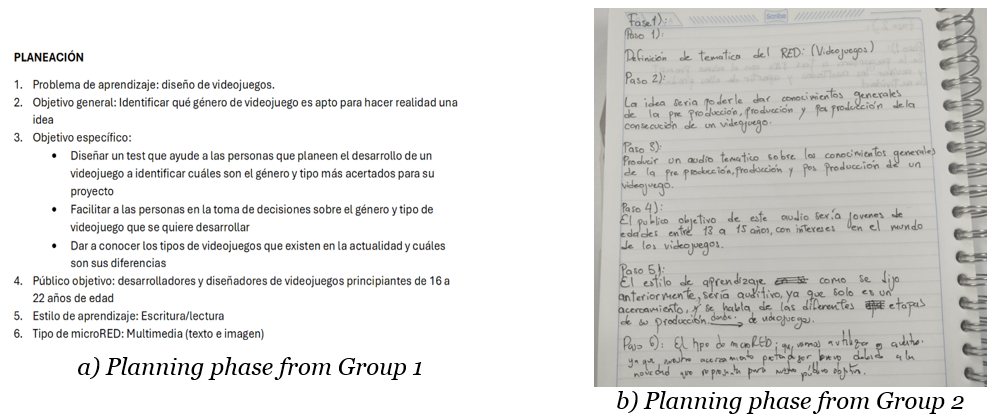
Figure 8
Evidence of microDER planning in Stage 1
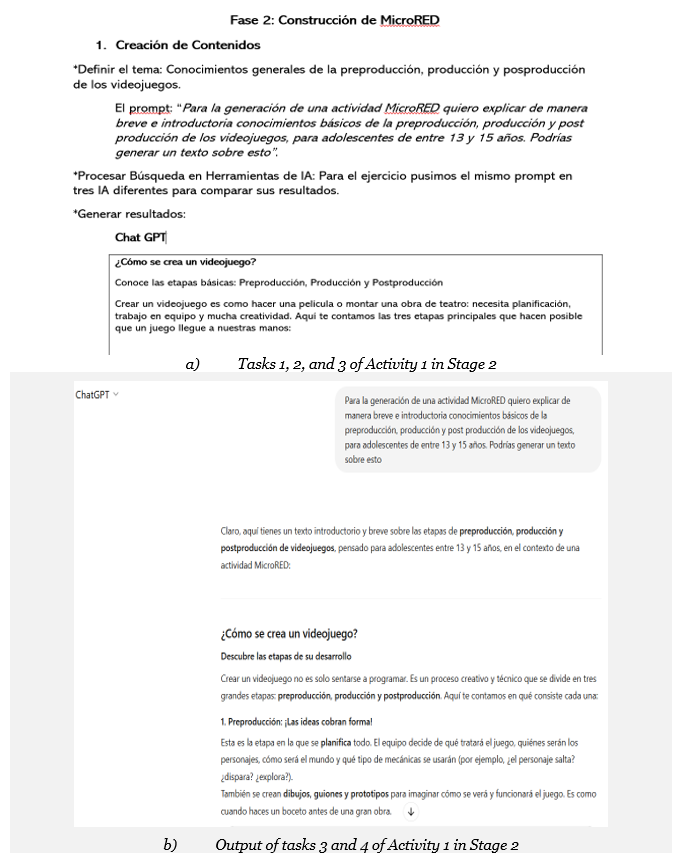
Figure 9
Evidence of microDER building in Stage 2
Source: Data collected by the authors.
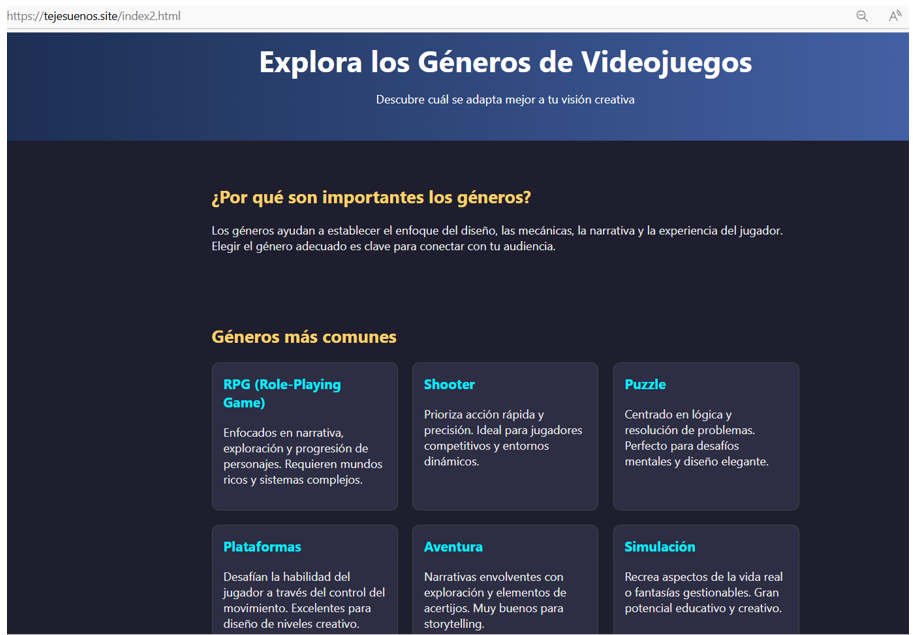
Figure 10
Example of a microDER built in Stage 2
Source: Data collected by the authors.
To conclude this stage, the stakeholders’ roles and action paths were analyzed, as well as the curation formats. In addition, the level of human intervention required to review the outputs of each GenAI was examined across the proposed phases of the methodology implementation process. This discussion enabled adjustments to be made and a consensus to be reached on the operational effectiveness of the process. The resulting contributions were systematized into an updated version of the methodology, which is planned for evaluation with larger pilot groups.
DISCUSSION AND CONCLUSIONS
This study presents a methodology for microDER co-creation supported by GenAI tools. Grounded in PAR and CSPS methodologies, the process relies on collaborative strategies, such as co-creation sessions, bootcamps, and knowledge-sharing with community stakeholders. The problem-oriented, learning outcome-driven process fosters thematic exploration, peer interaction, and innovative practices that differ from traditional curricular approaches (Ortiz Jaramillo, 2022). In these spaces, students experiment, pursue their interests, and develop curiosity for new topics and skills.
The PAR approach is at the core of methodology, providing a foundation for social appropriation in participatory learning contexts. It promotes the pedagogical use of GenAI to redesign teaching and learning environments and support complex DER production processes. In line with Gimenez and Siqueira (2024), the framework facilitates the fragmentation, organization, sequencing, and adaptation of educational content to enhance students’ learning experiences.
The methodology is structured into three interconnected phases. In Phase 1, students collaborated to characterize the school context and gather relevant information from educational stakeholders. This process guided the definition of the research theme and strengthened interaction among participants, consistent with the work of Fals Borda (2001) and Arnanz et al. (2023).
Phase 2 built on these foundations by combining the technical and reflective skills of higher education and high school students, who then explored tools and resources in the classroom. These outputs served as application spaces where concrete, microDER-based solutions were designed and evaluated.
Phase 3 focused on the initial validation of the methodological proposal by incorporating criteria of relevance, applicability, and coherence. This validation is a key input for the next stage: designing and publishing microDERs in open-access virtual environments to assess their impact on computational thinking development in young students.
The findings confirm that the methodology is feasible in real classroom settings and promotes meaningful learning in high school and higher education settings. Consistent with Leal-Urueña’s (2020) approach, it incorporates activities, actors, evaluation procedures, and feedback mechanisms that refine the final product, the microDERs.
Its formal and integrative structure, particularly in the initial and final phases, distinguishes it from other models. Examples include Zhang and West’s (2020) organization of instructional events around a key topic and Kohler et al. (2021) curation of microlearning elements based on connected concepts.
Unlike Monib et al. (2025) instructional design framework, which focuses on the individual, situational, and explicit characteristics of resource beneficiaries, this methodology is strengthened by a central phase that uses GenAI to create microDERs. Systematizing contributions generated in each phase reinforces the proposal’s viability and guides its expansion through pilot group implementation and the publication of microDERs on open-access platforms. References include platforms such as 7taps.com and SafetyCulture.com, which enable the creation of microlearning courses optimized for smartphone use and distribution via social media.
Within this framework, the methodology demonstrates both transferability and scalability with a strategy for social appropriation mediated by GenAI. It also enables students to play an active role in their learning and develop computational thinking and social interaction skills.
Through the promotion of co-creation workshops with the educational community, the involvement of the research incubator, and the development of classroom projects, the methodology has demonstrated its operational feasibility and educational relevance in diverse learning environments.
A growing body of research on microlearning and the use of GenAI in education underscores their transformative potential for pedagogical processes and practices (Gimenez & Siqueira, 2024). However, adapting or redesigning these practices requires addressing challenges related to social interaction, stakeholder collaboration, and specific aspects of DER design, such as parameterization, fragmentation, and reliability.
Additionally, integrating innovative components into pedagogical practices demands incorporating new tools, methodologies, and approaches that support learning outcomes by solving educational problems (Villarreal et al., 2022). As Stanford et al. (2016) note, innovative practices must contribute to achieving objectives, differentiate from traditional approaches, and foster stakeholder interaction and the effective use of resources.
The findings of this study have theoretical and practical implications, as they offer insights into the value of microlearning and the role of GenAI in education. These results also shed light on the evolving roles of teachers and students in new learning environments. The results confirm the effectiveness of microlearning as an instructional approach that delivers brief, targeted content aligned with cognitive load theory. This theory emphasizes that minimizing cognitive load enhances learning (Sweller, 2011).
The proposed methodology functions as both a framework for organizing the microDERs co-creation process and a tool for rethinking learning environments through collaboration and the responsible use of GenAI.
The microDERs co-creation methodology addresses key challenges and guide educators, students, instructional designers, curriculum developers, and content creators in producing AI-driven resources. Its implementation in virtual environments, such as learning management systems and massive open online courses, is strengthened through collaborative tools that encourage interaction, observation, and systematization of contributions from all participants at every stage of the process.
The findings suggest that integrating GenAI complements, rather than replaces, pedagogical processes by enhancing creativity, thematic exploration, and collaborative knowledge building—all of which are essential for strengthening computational thinking. Implementing GenAI fosters dynamic, adaptive learning settings where students develop cross-disciplinary skills, such as problem-solving, critical analysis, and innovation. Thus, GenAI serves as a strategic resource that promotes inclusion, participation, and more meaningful and sustainable learning experiences.
Combining microlearning with participatory approaches, such as PAR and CSPS, makes this methodology innovative and transformative. This integration enables social appropriation and the development of educational resources adaptable to different school settings. It also fosters co-creation and interdisciplinary teaching. Thus, microlearning broadens the possibilities of technological mediation and contributes to more inclusive, flexible, and competency-oriented educational practices that can address contemporary challenges.
Future work should validate the methodology in more high school and higher education institutions and modalities (in-person and virtual environments) to enhance its replicability. As this study was limited to two cases and focused only on design and creation, further research should assess its pedagogical effectiveness and examine the ethical implications of GenAI use in vulnerable settings or limited-access contexts.
Conflict of interest
The author(s) declared no potential conflicts of interest with respect to the research, authorship, and/or publication of this article.
Acknowledgments
This article is part of the preliminary results of research project 1375-2024 "Metodología de cocreación de recursos digitales de microaprendizaje activo para la enseñanza de pensamiento computacional y la interacción social por jóvenes estudiantes de informática" funded by Universidad de Medellín and Instituto Tecnológico Metropolitano (ITM) Medellín-Colombia. We would like to thank ITM Translation Agency (traducciones@itm.edu.co) for translating the manuscript in English.
REFERENCES
Abdous, M. (2023, 22 March). How AI is shaping the future of higher ed. Inside Higher Ed. https://www.insidehighered.com/views/2023/03/22/how-ai-shaping-future-higher-ed-opinion
Adeshola, I., & Adepoju, A. P. (2023). The opportunities and challenges of ChatGPT in education. Interactive Learning Environments, 32(10), 6159-6172. https://doi.org/10.1080/10494820.2023.2253858
Arnanz Monreal, L., García Montes, N., & Villasante Prieto, T. R. (2023). La investigación y acción participativa y transformadora basada en los grupos motores. Prisma Social, (43), 34-56. https://revistaprismasocial.es/article/view/5176
Boumalek, K., El Mezouary, A., Hmedna, B., & Bakki, A. (2024). Transforming microlearning with generative AI: Current advances and future challenges. In M. Lahby, Y. Maleh, A. Bucchiarone, & S. E. Schaeffer (eds.), General aspects of applying generative AI in higher education. Springer Nature. https://doi.org/10.1007/978-3-031-65691-0_13
Bozkurt, A. (2023). Generative artificial intelligence (AI) powered conversational educational agents: The inevitable paradigm shift. Asian Journal of Distance Education, 18(1). https://www.asianjde.com/ojs/index.php/AsianJDE/article/view/718
Bygstad, B., Øvrelid, E., Ludvigsen, S., & Dæhlen, M. (2022). From dual digitalization to digital learning space: Exploring the digital transformation of higher education. Computers & Education, 182, 104463. https://doi.org/10.1016/j.compedu.2022.104463
Cabeza-Rodríguez, M.-Á. (2025). Asistentes ChatGPT en educación superior en línea y satisfacción del alumnado: Un caso de estudio. RIED-Revista Iberoamericana de Educación a Distancia, 28(2). https://doi.org/10.5944/RIED.28.2.43552
Cain, W. (2024). Prompting change: Exploring prompt engineering in large language model AI and its potential to transform education. TechTrends, 68(1), 47-57. https://doi.org/10.1007/s11528-023-00896-0
Congreso de la República de Colombia. (2012, 17 de octubre). Ley 1581 de 2012, por la cual se dictan disposiciones generales para la protección de datos personales [Ley estatutaria; Diario Oficial 48.587, 18 de octubre de 2012]. https://www.funcionpublica.gov.co/eva/gestornormativo/norma.php?i=49981
Denojean-Mairet, M., López-Pernas, S., Agbo, F. J., & Tedre, M. (2024). A literature review on the integration of microlearning and social media. Smart Learning Environments, 11, 46. https://doi.org/10.1186/s40561-024-00334-5
Díaz Redondo, R. P., Caeiro Rodríguez, M., López Escobar, J. J., & Fernández Vilas, A. (2021). Integrating micro-learning content in traditional e-learning platforms. Multimedia Tools and Applications, 80(2), 3121-3151. https://doi.org/10.1007/s11042-020-09523-z
Dickey, E., & Bejarano, A. (2023). A model for integrating generative AI into course content development [Preprint]. arXiv. https://arxiv.org/abs/2308.12276
Dolasinski, M., & Reynolds, J. (2020). Microlearning: A new learning model. Journal of Hospitality and Tourism Research, 44(3), 551-561. https://doi.org/10.1177/10963480209015
Durán Alcalá, M., & Escudero Nahón, A. (2023). Microlearning en el entorno educativo. Revista de Investigación Educativa de la REDIECH, 14, e1763. https://doi.org/10.33010/ie_rie_rediech.v14i0.1763
Fals Borda, O. (2001). Transformaciones del conocimiento social aplicado: Lo que va de Cartagena a Ballarat. Análisis Político, 42, 93-101. https://revistas.unal.edu.co/index.php/anpol/article/view/75309
Gimenez, P., & Siqueira, S. (2024). Microlearning e IA generativa na educação online: Fragmentação, sequenciamento e adaptação de conteúdos para aprendizagem centrada no aluno. In Anais Estendidos do XIII Congresso Brasileiro de Informática na Educação (pp. 314–319). SBC – Sociedade Brasileira de Computação. https://sol.sbc.org.br/index.php/cbie_estendido/article/view/31804
Gonnet, J. P. (2019). ¿Por qué la interacción? Una reconstrucción de los escritos tempranos de Erving Goffman. Revista Reflexiones, 99(1), 0-15. https://doi.org/10.15517/rr.v99i1.35308
Holmes, W., Bialik, M., & Fadel, C. (2023). Artificial intelligence in education. Globethics Publications. https://doi.org/10.58863/20.500.12424/4276068
Hug, T., Lindner, M., & Bruck, P. A. (eds.). (2006). Micromedia & e-learning 2.0: Gaining the big picture [Microlearning Conference Proceedings, 2006]. Innsbruck University Press. http://library.oapen.org/handle/20.500.12657/39646
Karras, T., Laine, S., Aittala, M., Hellsten, J., Lehtinen, J., & Aila, T. (2020). Analyzing and improving the image quality of StyleGAN. In Proceedings of the IEEE/CVF Conference on Computer Vision and Pattern Recognition (pp. 8107-8116). Computer Vision Foundation/IEEE. https://doi.org/10.1109/CVPR42600.2020.00813
Kemmis, S., & McTaggart, R. (2005). Participatory action research: Communicative action and the public sphere. In N. K. Denzin & Y. S. Lincoln (Eds.), The SAGE handbook of qualitative research (3ª ed., pp. 559–603). SAGE.
Kohler, M., Gamrat, C., Raish, V., & Gross, E. (2021). Microlearning and micro-credentials in higher education. In J. R. Corbeil, B. H. Khan, & M. E. Corbeil (eds.), Microlearning in the digital age: The design and delivery of learning in snippets (pp. 109-128). Routledge. https://doi.org/10.4324/9780367821623-10
Leal-Urueña, L. A. (2020). Definición de las especificaciones de diseño. CIDET Moodle (Universidad Pedagógica Nacional). https://cidetmoodle.pedagogica.edu.co/mod/page/view.php?id=94698
Luckin, R., Holmes, W., Griffiths, M., & Forcier, L. B. (2016). Intelligence unleashed: An argument for AI in education. Pearson. https://edu.google.com/pdfs/Intelligence-Unleashed-Publication.pdf
Manzini, E. (2015). Design, when everybody designs: An introduction to design for social innovation. MIT Press. https://doi.org/10.7551/mitpress/9873.001.0001
Mateus-Nieves, E., & Moreno Moreno, E. (2021). Microlearning como estrategia para una educación asincrónica. Épsilon: Revista de la Sociedad Andaluza de Educación Matemática “THALES”, (109), 41-58. https://thales.cica.es/epsilon/sites/default/files/2023-02/epsilon109_3.pdf
Memon, T. D., & Kwan, P. (2025). A collaborative model for integrating teacher and GenAI into future education. TechTrends. https://doi.org/10.1007/s11528-025-01105-w
Miao, F., & Holmes, W. (2024, April). Guía para el uso de IA generativa en educación e investigación. UNESCO. https://unesdoc.unesco.org/ark:/48223/pf0000389227
Mirón, L. (2022). La Escuela Creactiva de Innovación Social. In Jornadas Hacia una Nueva Cultura Científica (pp. 25-34). Editorial Universitat Politècnica de València. https://doi.org/10.4995/NCC2022.2022.15773
Monib, W. K., Qazi, A., & Apong, R. A. (2025). Microlearning beyond boundaries: A systematic review and a novel framework for improving learning outcomes. Heliyon, 11(2), e41413. https://doi.org/10.1016/j.heliyon.2024.e41413
Ortiz Jaramillo, I. (2022). Diseño de bootcamp de programación y pensamiento computacional con enfoque transdisciplinar [Master’s Thesis, Universidad de los Andes]. Repositorio Universidad de los Andes. https://hdl.handle.net/1992/64050
Piantari, E., Al Husaeni, D. N., Anisyah, A., & Erlangga, E. (2024). Analysis of publication trends on artificial intelligence in education: A systematic literature review. In Proceedings of the 9th Mathematics, Science, and Computer Science Education International Seminar (MSCEIS 2023) (pp. 430-443). Atlantis Press. https://www.atlantis-press.com/proceedings/msceis-23/126003203
Presidente de la República de Colombia. (2013, 27 June). Decreto 1377 de 2013, por el cual se reglamenta parcialmente la Ley 1581 de 2012 [Diario Oficial 48.834, 27 de junio de 2013]. https://www.alcaldiabogota.gov.co/sisjur/normas/Norma1.jsp?i=53646
Ritzer, G. (2008). Teoría sociológica moderna (4th edition). McGraw-Hill.
Samoili, S., López Cobo, M., Delipetrev, B., Martínez-Plumed, F., Gómez Gutiérrez, E., & De Prato, G. (2021). AI Watch. Defining artificial intelligence 2.0. Publications Office of the European Union. https://doi.org/10.2760/019901
Sengar, S. S., Hasan, A. B., Kumar, S., & Carroll, F. (2025). Generative artificial intelligence: A systematic review and applications. Multimedia Tools and Applications, 84, 23661-23700. https://doi.org/10.1007/s11042-024-20016-1
Sirvent, M. T., & Rigal, L. A. (2012). Investigación acción participativa: Un desafío de nuestros tiempos para la construcción de una sociedad democrática. Proyecto Páramo Andino. http://hdl.handle.net/11336/187628
Stanford, C., Cole, R., Froyd, J., Friedrichsen, D., Khatri, R., & Henderson, C. (2016). Supporting sustained adoption of education innovations: The Designing for Sustained Adoption Assessment Instrument. International Journal of STEM Education, 3, Article 1. https://doi.org/10.1186/s40594-016-0034-3
Sweller, J. (2011). Cognitive load theory. In J. P. Mestre & B. H. Ross (eds.), Psychology of Learning and Motivation (Vol. 55, pp. 37-76). Academic Press. https://doi.org/10.1016/B978-0-12-387691-1.00002-8
Torgerson, C., & Iannone, S. (2019). Designing microlearning (What Works in Talent Development). ATD Press (Association for Talent Development). https://www.td.org/product/book--designing-microlearning/111919
Tu, Y., Chen, J., & Huang, C. (2025). Empowering personalized learning with generative artificial intelligence: Mechanisms, challenges and pathways. Frontiers of Digital Education, 2, 19. https://doi.org/10.1007/s44366-025-0056-9
Villarreal Contreras, R., Salas Álvarez, D., & Alemán, A. (2022). Prácticas educativas innovadoras desde un enfoque STEAM+A. Fondo Editorial Universidad de Córdoba. https://repositorio.unicordoba.edu.co/entities/publication/d29d8a9e-1990-4682-b97d-adb53844525b
Yang, J. (2024). Deep integration of generative AI with higher education: Scenarios, risks and recommendations. China Higher Education, 5, 52-56.
Zhang, J., & West, R. E. (2020). Designing microlearning instruction for professional development through a competency-based approach. TechTrends, 64(2), 310-318. https://doi.org/10.1007/s11528-019-00449-4
Zhang, Y., Kong, F., Wang, P., Sun, S., Wang, L., Feng, S., Wang, D., Zhang, Y., & Song, K. (2024). STICKERCONV: Generating multimodal empathetic responses from scratch [Preprint]. arXiv. https://doi.org/10.48550/arXiv.2402.01679
Información adicional
How to cite: Manrique-Losada, B., Arango-Vásquez, S. I., & Osorio-Sanabria, M. A. (2026). Participatory methodology for creating microlearning digital resources with generative AI [Metodología participativa para la creación de recursos digitales de microaprendizaje con inteligencia artificial generativa]. RIED-Revista Iberoamericana de Educación a Distancia, 29(1), 381-409. https://doi.org/10.5944/ried.45559
Información adicional
redalyc-journal-id: 3314