Estudios e investigaciones
Active learning in higher engineering education: a decalogue for the design of post-lecture online quizzes
Aprendizaje activo en la educación superior de ingeniería: un decálogo para diseñar quizzes online post-clase
 Dubravka Novkovic
 Ricardo Torres Kompen
Josep Petchamé
Ricardo Torres Kompen
Josep Petchamé
Active learning in higher engineering education: a decalogue for the design of post-lecture online quizzes
RIED-Revista Iberoamericana de Educación a Distancia, vol. 29, núm. 1, pp. 411-430, 2026
Asociación Iberoamericana de Educación Superior a Distancia

Esta obra está bajo una Licencia Creative Commons Atribución-NoComercial 4.0 Internacional.
Recepción: 01 Junio 2025
Aprobación: 06 Agosto 2025
Abstract: Quizzes are a valuable addition to the ever-growing toolkit of active learning strategies in higher education. In distance learning contexts, quizzes are frequently used to assess students’ level of knowledge, to encourage their participation and to support knowledge retention or academic performance. Despite a wealth of studies about quizzes in general, and pre-lecture quizzes in particular, there is relatively little empirical work examining post-lecture online quizzes. This paper discusses Information and Communication Technology (ICT) Engineering students’ experiences with weekly post-lecture online quizzes in a management subject. Participants took a single attempt, automatically graded, quiz on Moodle Learning Management System (LMS) after each subject unit. Once the learning experience was completed, qualitative research was carried out through a Bipolar Laddering (BLA) tool, designed to extract positive and negative perceptions of the students on the implemented online quiz model. Overall, our analysis shows that students view post-lecture online quizzes as a valuable active learning strategy, especially useful as a practice for high-stakes exams. Regular low-stakes quizzing was perceived to foster ongoing engagement with the subject material, to support continuous review and self-directed learning. Building on the student-reported insights, the researchers formulated ten design considerations that may inform the development of effective post-lecture online quizzes, which can be easily implemented in both remote and face-to-face learning contexts.
Keywords: active learning, learning strategy, online quiz, post-lecture test, engineering, Bipolar Laddering (BLA).
Resumen: Los quizzes son una valiosa herramienta entre las diversas estrategias de aprendizaje activo en la educación superior. En contextos de aprendizaje a distancia se utilizan con frecuencia para evaluar el nivel de conocimientos de los estudiantes, fomentar su participación y apoyar la retención de conocimientos o el rendimiento académico. Existen numerosos estudios sobre los quizzes en general, y los quizzes pre-clase, existiendo escasa investigación empírica sobre los quizzes post-clase. Este artículo analiza las experiencias de estudiantes de Ingeniería en Tecnologías de Información y Comunicación (TIC) con quizzes online post-clase semanales en una asignatura de gestión. Los participantes realizaron un quiz de un solo intento, calificado automáticamente, en el Sistema de Gestión del Aprendizaje (en inglés, LMS) Moodle de la institución después de cada unidad temática. Completada la experiencia de usuario del alumnado, se llevó a cabo una investigación cualitativa mediante la herramienta Bipolar Laddering (BLA), diseñada para extraer las percepciones positivas y negativas del alumnado sobre el modelo de quizzes implementado. En general, nuestro análisis muestra que los estudiantes consideran los quizzes online post-clase una valiosa estrategia de aprendizaje activo, especialmente útil para la preparación de exámenes. Los encuestados percibieron que los quizzes semanales fomentan tanto el engagement como el aprendizaje autónomo. Basándose en las observaciones de los estudiantes, los investigadores formularon diez recomendaciones de diseño, que podrían orientar el desarrollo de los quizzes online post-clase eficaces que se pueden implementar fácilmente tanto en contextos de aprendizaje remoto como presencial.
Palabras clave: aprendizaje activo, estrategia de aprendizaje, quiz en línea, examen posterior a la clase, ingeniería, Bipolar Laddering (BLA).
INTRODUCTION
Present-day education has been undergoing a fundamental transformation through the integration of Information and Communication Technologies (ICT), essentially reshaping how knowledge is accessed, delivered and constructed. Within this context, online learning environments, which can be implemented across online, hybrid and face-to-face education models, have expanded and strengthened key elements of flexible learning —such as unrestricted access in terms of time, location and pace (Veletsianos et al., 2021). Grounded in active learning theory —a theoretical framework that emphasizes learners’ active participation in the construction of knowledge— the present study seeks to understand ICT Engineering student perceptions of one of the active learning tools —i.e., online quizzes— implemented in a management course and delivered through a Learning Management System (LMS). As a first step, a research background on active learning and quizzes is presented. Thereafter, a research work aimed at recognizing the student perceptions of the quizzes was developed to understand the actual learner experience. The researchers used Bipolar Laddering (BLA) —a qualitative method in the format of an open-ended questionnaire— to identify positive and negative elements that facilitate and hinder learning. Based on the analysis of student responses, this study offers practical guidance for the effective implementation of post-lecture online quizzes.
The term ‘active learning’ formally emerged in higher education literature over three decades ago as a transformative pedagogical approach (Bonwell & Eison, 1991), which shifted the traditional content-centred approach from passive knowledge transmission to student-centred instruction (Hartikainen et al., 2019). In terms of an active learning definition, a recent peer-reviewed article related to biology education literature and teaching community (Driessen et al., 2020) found that the great bulk of the active learning literature they reviewed (148 articles) failed to clarify what the term actually means. Active learning for the purpose of this study is defined as “a student-centred approach to the construction of knowledge focused on activities and strategies that foster higher-order thinking” (Doolittle et al., 2023, p.1).
As far as the benefits of active learning are concerned, a landmark meta-analysis of 225 studies across Science, Technology, Engineering and Mathematics (STEM) disciplines (Freeman et al., 2014) found that replacing traditional lectures with active learning led to significantly higher participant examination scores and lower failure rates. While increased student engagement and academic performance have been solidly established benefits of active learning (Prince, 2004), it was later confirmed that it also promotes communication and interactivity, fosters stronger sense of community and connectedness, enhances student satisfaction with the learning experience and provides greater flexibility in the education process (Allsop et al., 2020).
On the other hand, there are studies in engineering which reported mixed response to active learning as per Tharayil et al. (2018). Based on observation of engineering classrooms and a qualitative analysis of interviews with 17 undergraduate engineering professors in the United States, the authors found that students were more likely to perceive positively those new ways of teaching only when instructors explained benefits of active learning and provided skilled facilitation of classroom activities, which in turn led to higher participation and course evaluation. Deployed as an inquiry-based lab experience in the context of essential science practices (Owens et al., 2020), active learning attracted student resistance which stemmed from more effort required from all participants. The authors suggested that instructors may lessen the problem by scaffolding practices and consistently giving clear feedback, which helps curb the frustration students may feel when struggling with challenging or unfamiliar scientific tasks. Interestingly, in another STEM study in Texas, Andrews et al. (2020) compared instructors’ and students’ attitudes and behaviours regarding active learning. The instructor survey assessed their attitudes toward active learning, the strategies they employed to reduce student resistance, and instructors’ perceptions of student behaviour. A corresponding student survey invited students to evaluate their instructors’ teaching methods and reflect on their own attitudes and behaviours during class. Both data sets were complemented by classroom observations. The key finding was instructors’ tendency to overestimate student resistance to active learning in their class. Instructors occasionally feared negative reaction from students, particularly those instructors whose tenure, promotion and merit ratings depended considerably on their end-of-semester course evaluations. However, the collected student data painted a different reality: students appreciated active learning activities, engaged with them willingly, stayed focused, and intended to rate both the course and the instructor favourably.
Many instructional strategies fall under the umbrella of active learning. For example, previously cited research of Doolittle et al. (2023) lists fifteen different approaches that appeared at least ten times across 547 reviewed articles, most frequently mentioned being problem-based learning, the flipped classroom, and small group discussions. Other literature reviews also highlight a wide range of instructional activities categorized per different aspects of interest (Arthurs & Kreager, 2017; Kozanitis & Nenciovici, 2023; Mitchell et al., 2017). In engineering education, Villalonga Pons et al. (2023) cite strategies such as problem-based learning, project-based learning, cooperative learning, and learning by doing, considered key indicators of quality in creating effective classroom experiences, especially in online learning environments. Similarly, Gosavi and Arora (2022) observed that active learning strategies often work in tandem, with the implementation of one frequently triggering the use of others.
Specifically on quizzes, Mitchell et al. (2017) discussed the instructional strategy in Information System courses. A recent systematic review of online assessments in higher education (Heil & Ifenthaler, 2023) identified quizzes as a type of automated assessment. The word ‘quiz’ first emerged around 1780, and over time, it became established alongside other evaluation terms such as ‘test’ or ‘examination’ (Dengri et al., 2021). These authors reviewed eleven studies that used quizzes as teaching and learning tools and reported an almost universal increase in post-test scores, together with positive comments from students. Earlier studies had explored the use of pre-lecture quizzes as a strategy for incentivizing and sometimes rewarding students’ class preparation (Brink, 2013; Cook & Babon, 2017; Howell, 2021). A more recent study comparing active lectures with traditional lectures across six faculties at a public university in the United States, highlighted students’ appreciation of both pre-lecture and post-lecture quizzes as valuable tools for improving focus during classes and supporting self-assessment of their learning (Klein et al., 2023). A study conducted by Ross et al. (2018) revealed that 88.6% students enrolled in an online tertiary program at an Australian university agreed or strongly agreed that their quiz results highlighted the areas where their knowledge was lacking. When enhanced by technology and delivered digitally, Raes et al. (2020) showed that quizzes have positively influenced student intrinsic motivation across different learning environments. Indeed, quizzes were perceived as useful and engaging by students regardless of whether they participated remotely or attended in person. Staying in the digital context, in an experimental course for graduate and undergraduate students in Brazil, Rossi et al. (2021) described quizzes as an effective tool for reinforcing knowledge, in particular because answers were corrected immediately. This approach helped solidify key concepts introduced during lectures. Although the study did not measure the isolated effect of quizzes, the researchers underscored the educational benefit of tools that enable immediate feedback on student performance. In another recent study, Gowele (2024) recommended integrating quizzes into mathematics curricula to boost student engagement and performance, identifying online quiz platforms as superior tools for accessibility and student progress monitoring. Indeed, recent research on game-based quiz platforms like Kahoot! reported that consistent use of such tools led to notable gains in learning (Nuci et al., 2021). Moreover, Kirzner et al. (2021) administered Kahoot! quizzes at the end of each class, covering the content of the day. Both quantitative and qualitative results of that study confirmed that students acknowledged the link between gamification and improved learning and retention.
While the existing evidence largely supports the educational benefits of quizzes, by contrast, some studies offer critical perspectives or factors that may impact the effectiveness of testing. Critics point, for example, to test anxiety and stress quizzes cause for some students (Stoyanova & Giannouli, 2022). This suggests that effective implementation may require attention to both quiz frequency and maintaining their low-stakes nature. Nevertheless, the authors found that students’ test anxiety diminished, and they were more motivated when they were allowed multiple quiz attempts with the corrective feedback. These and similar concerns were investigated in a meta-analysis of the ‘testing effect’ conducted by a team of Asian scholars (Yang et al., 2021). Their findings reveal that the benefits of testing spanned 18 academic disciplines, supporting not only the retention of information but also a deeper understanding and practical application of knowledge.
To frame the present study, it is worthwhile mentioning that La Salle-Universidad Ramon Llull (URL) has implemented an educational model called the New Learning Context (NLC) with the objective of meeting the needs of contemporary learners, emphasizing flexibility, active participation and technology integration (Petchamé et al., 2021). Introduced during the 2018-2019 academic year, the NLC model is grounded in five pedagogical principles (Interiority; Mind, Body & Movement; Thought Construction; Self-Regulated Behaviour; Social Dimension of Learning) which are operationalized through five learning environments (Welcoming, Seminar, Workshop, Project and Closure), each designed to support different stages of the learning process. As such, the NLC model is fully aligned with the use of active learning methodologies.
The NLC is supported by a series of technological infrastructure and application enablers of active learning that have been implemented at La Salle-URL Campus to provide students with flexible attendance options, allowing them to attend classes either remotely (through a videoconferencing system) or in person on Campus (Petchamé et al., 2023). The cornerstone of this Smart Classroom system is a Moodle LMS recommended by López-Tocón (2021) as an effective method for learning scientific content.
Unlike previous studies largely related to the use of pre-lecture quizzes (Evans et al., 2021; Gyllen et al., 2021), the present work analyses post-lecture quizzes as a tool for continuous and formative assessment of engineering students. This article examines the active participation of undergraduate students from an ICT Engineering program enrolled in a course on ‘Financial Economics’ which was distributed into seven units and taught over one semester. To promote consistent engagement and reinforce lecture content, students are assigned a post-lecture quiz after each subject unit, approximately once a week. The quizzes consist of 15-20 multiple-response questions (MRQs), administered and automatically graded via a Moodle LMS. Students are expected to complete each quiz individually (single attempt per quiz) within five days of the lecture, allowing the instructor sufficient time to review aggregate results prior to the next class session. While individual quiz grades are reviewed for feedback purposes, they are not factored directly into the course grade. Instead, the quiz participation —defined as timely quiz submission— is what counts toward the 10% of the final grade. This approach emphasizes formative learning over performance pressure, encouraging regular study habits and comprehension checks. Finally, to support exam preparation, all quizzes are reopened four weeks before the final examination. Moodle automatically reshuffles MRQs at each new quiz attempt. At that stage, students are granted unrestricted access and unlimited quiz attempts, supporting them as a self-study resource. The final exam may feature up to two MRQs adapted from the unit quizzes within the 10-question exam structure. Summative course assessment is carried out based on the weighted formula computed as follows: three paper-based tests during the semester (50%); a final written exam (40%); and timely quiz submission (10%).
The aim of this research work is twofold: (1) to deepen the understanding of student perceptions of post-lecture online quizzes as an active learning instrument implemented in a business-related subject of an ICT Engineering undergraduate degree, and (2) to offer practical guidance to instructors seeking to integrate post-lecture online quizzes into their teaching in any type of learning environment.
METHODOLOGY
The present study investigated the ICT Engineering undergraduates experience with post-lecture quizzes using the BLA methodology developed by Pifarré and Tomico (2007) and featured in several higher education research studies (Horna-Saldaña & Canaleta, 2024; Petchamé et al., 2021, 2023, 2024). As defined in Pifarré and Tomico (2007), it is a qualitative research approach that combines open-ended questioning with traditional laddering interview techniques. Following a Socratic-tabula-rasa principle, with no prior prompting, students are first asked to freely identify both positive and negative aspects of their quiz experience. These bipolar elements, representing strengths and weaknesses, are then rated by students on a 10-point scale of importance (1=minimum; 10=maximum) and justified through follow-up ‘Why?’ questions. In the final phase, students are encouraged to propose improvements, suggesting how to enhance positive or address negative aspects.
This method enables the analysis of user experience while minimizing potential bias, as responses arise from students’ direct experiences rather than from leading questions. As such, this approach would be suitable for diverse environments, including digital contexts examined in this research. In bipolar laddering, large samples are not a requirement since the goal is to capture the range and hierarchy of user perceptions, with saturation typically reached after a limited number of responses (Hennink & Kaiser, 2022; Petchamé et al., 2021). The sample purpose is to reveal distinctive cognitive dimensions for their posterior clustering and analysis, instead of building generalizable models. Therefore, rather than statistical representativeness, the focus is on achieving qualitative saturation —the point where additional responses no longer introduce new elements or themes to the emerging constructs. On the other hand, since the active learning tools we analyse in this research (online quizzes) are technology-based and not tied to any specific subject or discipline, the recommendations presented can be applied broadly across different higher education contexts.
For the present study, data points were labelled as described in the article by Petchamé et al. (2024). Positive elements of students’ feedback were labelled as Positive (P) Elements (E) that are either Common (C) —if repeated spontaneously by more than one student— or Unique (U) —if mentioned by a single student. The corresponding labelling scheme has been applied to the negative statements, in this case however, with the letter N (Negative) used instead of the letter P (Positive). Both positive and negative elements were then laddered according to the number of Mentions, which represent the number of times each element was cited by students as their perception of the quiz experience. We then calculated the average for each element, representing the simple mean of the individual importance ratings assigned by the respondents, where ratings ranged from 1 (minimum importance) to 10 (maximum importance). Finally, the variance was calculated to indicate the level of heterogeneity among individual assessments of the same element.
Given the brief nature of student responses, no specialized qualitative analysis tool was required. Hence, three researchers individually analysed all the collected short answers and subsequently met to reach a consensus about each one of the elements (Petchamé et al., 2021). This approach included a triangulation process aimed at improving the result validity (Vaismoradi & Snelgrove, 2019).
RESULTS
Our BLA survey was carried out as anonymous at the end of the 2024-2025 first academic term among four groups of the second-year ICT Engineering students at La Salle-URL. Prior to the survey, all participants completed their learning experience in a business-related subject ‘Financial Economics’. The total number of students enrolled in the course was 209 and 51 of them responded to the BLA survey. Only two male respondents were in the age group 23-25 years old. In addition to age, the surveyed student cohort shared other similarities such as the level of digital literacy, educational background, and socioeconomic status. Respondent demographic data is shown in Table 1 below.
Note that the BLA survey should be administered during the final class session to ensure the students completed full learning experience before providing feedback. Conducting the survey at that time allows for a more comprehensive assessment of the entire learning process and aligns with the usual class attendance patterns observed in most subjects at that stage. Although the number of responses is not a limitation in BLA methodology, the survey could be distributed before the end of the last class session or the time limit for survey completion could be extended to obtain more responses.
| Number | % | AgeM | AgeDE | |
| Male | 38 | 75 | 20.2 | 0.9 |
| Female | 11 | 21 | 20 | 0 |
| Prefers not to declare | 2 | 4 | 20 | 0 |
| Total | 51 | 100 | 20.2 | 0.8 |
As shown in Figure 1 below, over half of the respondents (n=27; 53%) had considerable experience in post lecture quizzes.
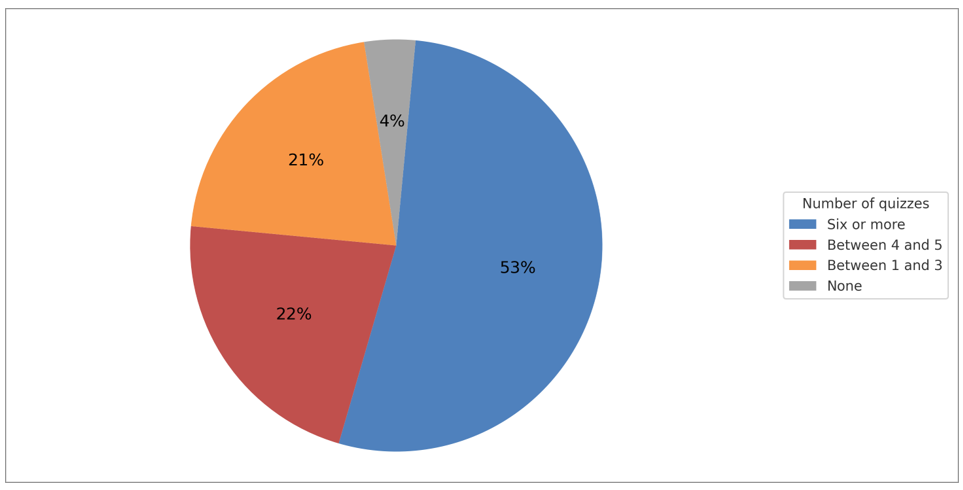
Figure 1
Number of quizzes taken by the respondents
Through the survey, the researchers identified eight Positive Common Elements (PCE-1 to PCE-8) and five Positive Unique Elements (PUE-1 to PUE-5), as per Table 2 below. It displays the positive elements of the quiz experience respondents reported in the form of statements. The ‘Mentions’ column shows the number of times each element was cited, and the associated percentages based on the total number of mentions (n=105). Because each participant could report up to three positive elements, ‘Mentions’ percentages do not sum to 100% of respondents. These results indicate that, for students, the most impactful aspects of the post-lecture online quiz experience were the ability to deepen their understanding of the course material and to help them in exam preparation (e.g., “because it seems to me to be a simple and quick way to prepare for the exam”). Participants also highlighted the immediate feedback online quizzes provide, allowing them to rapidly recognize their knowledge gaps. PCE-4 and PCE-5 received fewer mentions suggesting that those elements may play a more supportive role: regular quizzing to stay current with course topics (“It is positive because it is a mandatory way to continuously be up to date with the subject as well as it contributing to the grade”), as well as online quiz accessibility, availability and variety of question formats. A few students highlighted the dynamic and engaging nature of quizzes which makes learning more enjoyable (“it is fun and motivating”). Mentions of PUE elements were rare, each accounting for just under 1% of the total. Respondents were encouraged to rate on a scale 1 to 10 (1=minimum; 10=maximum) the importance of each reported statement, which is shown below in the ‘Average’ column, while the ‘Variance’ reflects the degree of variation among those individual ratings.
| Statement | Element | Mentionsn | Mentions% | Average | Var |
| Quizzes help me to better understand course material, review and reinforce core subject concepts. | PCE-1 | 28 | 27 | 8.6 | 1.17 |
| Quizzes are a valuable practice tool for exam preparation. | PCE-2 | 25 | 24 | 8.2 | 1.92 |
| Quizzes help me identify gaps in my understanding by means of immediate feedback. | PCE-3 | 14 | 13 | 8.0 | 2.43 |
| Weekly quizzes help me stay up to date with the course. | PCE-4 | 9 | 9 | 8.4 | 1.36 |
| Quizzes are short and flexible, with varying question formats and enough time to complete them. | PCE-5 | 9 | 9 | 8.2 | 1.95 |
| Quizzes are organized by unit, easy to access and always open. | PCE-6 | 7 | 7 | 9.0 | 0.86 |
| Quizzes have a positive impact on my final grade. | PCE-7 | 5 | 4 | 8.2 | 1.36 |
| Quizzes are dynamic and engaging, which makes my learning more enjoyable and motivating. | PCE-8 | 3 | 2 | 8.0 | 0.67 |
| Quizzes include questions beyond the lecture slides which helps me consolidate newly introduced topics. | PUE-1 | 1 | 1 | 10.0 | |
| Quizzes encouraged me to review the lecture slides, focus on key points, and remember the content afterward. | PUE-2 | 1 | 1 | 10.0 | |
| Quizzes foster active learning by applying theory to real-life scenarios. | PUE-3 | 1 | 1 | 10.0 | |
| Quizzes create a competitive element that motivates me to excel. | PUE-4 | 1 | 1 | 7.0 | |
| Randomizing the order of quiz questions helps prevent memorizing patterns and promotes real understanding. | PUE-5 | 1 | 1 | 6.0 |
On the other hand, 51 students shared a total of 63 elements they found challenging in their learning experience. Again, because each participant could report up to three negative elements, ‘Mentions’ percentages do not sum up to the total number of respondents but rather to the total number of mentions (n=63). All negative perceptions are grouped into nine commonly reported themes (NCE-1 to NCE-9) and five unique themes (NUE-1 to NUE-5), as shown in Table 3 below. Students expressed several concerns about post-lecture quizzes, offering suggestions that could potentially increase the educational value of this activity. The most frequently raised point (n=17; 27%) involved time constraints for quiz completion, particularly when questions felt long, repetitive or unclear (n=10; 16%). Other statements were accompanied by ideas to improve learning experience, such as: allow multiple quiz attempts with continued access upon completion; align quiz content more closely with the exam material; include more practical examples and reasoning-based questions; provide more detailed feedback, especially explanations for incorrect answers (as one student noted: “I don't like that it only tells you if your answers are correct or wrong without giving you any arguments to support the answer”). While these observations reflect the experiences of certain students, they may offer useful starting points for implementation of this active learning task. Other points were mentioned less frequently.
| Statement | Element | Mentionsn | Mentions% | Average | Var |
| Some quizzes require too much time to complete within the available time window. | NCE-1 | 17 | 27 | 3.5 | 1.31 |
| Some quiz questions are too long, unclear or repeated. | NCE-2 | 10 | 16 | 4.0 | 0.60 |
| Quizzes don't allow multiple attempts nor access after quiz completion. | NCE-3 | 6 | 9 | 4.3 | 0.56 |
| Some quiz questions do not align well with exams. | NCE-4 | 6 | 9 | 4.2 | 2.14 |
| Quizzes lack practical examples and reasoning-based questions. | NCE-5 | 5 | 8 | 3.4 | 2.64 |
| The number of quiz questions is insufficient. | NCE-6 | 4 | 6 | 5.0 | 0.00 |
| Missing or underperforming on a mandatory quiz can negatively affect the final grade. | NCE-7 | 4 | 6 | 4.3 | 0.19 |
| Quizzes lack feedback such as explanations for error. | NCE-8 | 4 | 6 | 3.3 | 1.69 |
| Some graphs in the quizzes are not visible. | NCE-9 | 2 | 3 | 1.5 | 0.25 |
| Quizzes do not include randomized question sets. | NUE-1 | 1 | 2 | 5.0 | |
| Lack of deadline reminders by email leads to missed quiz attempts. | NUE-2 | 1 | 2 | 5.0 | |
| Quizzes have little weight in the final grade. | NUE-3 | 1 | 2 | 4.0 | |
| Some quiz questions cover material that was not addressed during class sessions. | NUE-4 | 1 | 2 | 2.0 | |
| Quizzes were only somewhat helpful for long-term retention of theoretical concepts. | NUE-5 | 1 | 2 | 1.0 |
Additionally, students proposed improvements for each perceived element of their quiz experience, offering suggestions to either strengthen benefits or mitigate limitations. For example, increasing the number of quizzes (e.g., “There is only one (quiz) per unit, and perhaps it would be beneficial to add one or two more for additional practice” or “Add more questions and make them change from test to test”); notifying students when quizzes are launched (e.g., “Students should be notified via email when a new quiz is published”); making quizzes suitable for practice (e.g., “Unlimited access to the quiz review could be granted immediately following the submission deadline”, or “Add exercises to the quizzes”).
DISCUSSION
The present study researched engineering student perceptions of post-lecture online quizzes as an active learning tool, highlighting perceived benefits as well as potential areas for refinement. While the findings could inform instructors seeking to implement and optimize this pedagogical approach, it is important to interpret student feedback thoughtfully and in context.
Most students recognized post-lecture quizzes as a valuable study tool, particularly for exam preparation. This aligns with previous research demonstrating that regular testing can promote knowledge retention through the ‘testing effect’ (Roediger & Karpicke, 2006). In that regard, quizzes may serve as a scaffolding tool, providing support that is closely aligned with the intended learning outcomes. The overall coherence of the tool could be enhanced by ensuring better alignment between the objectives of formative assessments and the evaluative criteria of summative assessments. Several students noted the benefit of the immediate feedback online quizzes provide, which they felt allowed them to quickly identify and address knowledge gaps —a view consistent with the Hattie and Timperley (2007) model of effective feedback in learning environments. While students tend to emphasize scores, the literature suggests that the feedback itself —not the score— is the true accelerator of learning. Responses to our BLA survey further suggested that weekly quizzes could encourage students to interact more regularly with the course content, potentially reducing the tendency to relay on last-minute exam preparation. Although these perceptions align with the evidence that the use of distributed practice through regular low-stakes quizzes can be more effective for long term knowledge retention than massed practice (Dunlosky et al., 2013), additional evidence would be needed to confirm whether this benefit was consistently achieved in practice. Student comments also highlighted potential motivational benefits of regular assessment, while a few participants noted the quizzes were entertaining, suggesting that the gamification elements of quizzes might positively contribute to the student experience (Dicheva et al., 2015; Majuri et al., 2018).
The mean scores for the importance of Positive Common Elements ranged from 8.0 to 9.0, indicating generally appreciative feedback across main items. The variance values ranged from 0.67 for the item ‘Quizzes are dynamic and engaging’ to 2.43 for ‘Quizzes help me identify gaps in my understanding by means of immediate feedback’, suggesting that some items elicited more divergent opinions than others. The item ‘Quizzes are organized by unit, easy to access, and always open,’ received the highest mean score of 9.0 (SD=0.86), indicating strong consensus, albeit among only seven students who mentioned it.
Participant feedback also revealed several opportunities for improvement. The most frequently mentioned concerns pertained to time constraints and question design. Students found lengthy, repetitive or ambiguously phrased questions as obstacles to effective learning. This echoes the research by Gillmor et al. (2015) stating that poorly constructed assessments can impose unnecessary cognitive load that interferes with intended learning outcomes. Respondents also expressed preference for unlimited quiz attempts and immediate access to results, which may reflect their desire for quizzes to function primarily as learning tools rather than evaluative instruments. This perspective aligns with the formative assessment paradigm described by Black and Wiliam (1998), which emphasized assessment as a way of guiding learning rather than as a performance measure. Another enhancement that students commented on was the opportunity to link theoretical concepts with their practical application. Respondents asked for more reasoning-based questions, which points to higher-order learning objectives in Bloom’s taxonomy of learning (Tofade et al., 2013). The statement calls for reducing the focus on lower-order knowledge-recall questions, and instead prioritizing application, analysis and evaluation-level questions to facilitate deeper understanding and long-term knowledge retention. Last but not least, students commented on the feedback mechanism, particularly noting the absence of explanations for incorrect answers. The importance of explanatory feedback on errors was studied by Shute (2008), who demonstrated that elaborate feedback was more effective than verification feedback alone. Implementing appropriate explanations for both correct and incorrect responses could be a meaningful way to enhance learning, requiring minimal effort.
Looking at mean scores and variances of the Negative Common Elements, the most frequently mentioned statement on the time to complete quizzes (n=17; 27%) received a moderate 3.5 average of importance, suggesting that, while often acknowledged, opinions about it were somewhat mixed. On the other hand, the statement ‘The number of quiz questions is insufficient’ received a maximum 5.0 average (SD=0.00), indicating complete agreement albeit among only four students who touched on it. Two other items attracted our attention because of the range of views they elicited: the statement on the lack of reasoning-based questions (SD=2.64) and the low level of alignment with exams (SD=2.14) —some respondents considered them to be very important, while others gave low ratings.
In terms of the limitations of this study, its very nature, which focuses on identifying positive and negative elements (elicited through the BLA tool) associated with post-lecture online quizzes, led to deliberate exclusion of data on respondents’ academic performance. Future research could incorporate objective measures of academic results, expand the sample size and employ methodological triangulation to strengthen the validity and applicability of the findings. It could also investigate the correlation between quiz engagement patterns and examination performance to provide more robust evidence for optimizing quiz design. Likewise, experimental studies comparing different feedback mechanisms could offer more precise guidance for maximizing the pedagogical effectiveness of post-lecture online quizzes. Additionally, this study was conducted with the second-year cohort of ICT Engineering students. Future research could include participants from different academic levels, for example first-year, third-year or final year students to assess whether the findings hold true across varying levels of experience and knowledge. Researchers could replicate this study to other disciplines that use the online quizzes, to evaluate whether results are specific to engineering or generalizable across fields. To increase sample diversity, future studies could also include international students or participants from other faculties inside or outside the institution.
CONCLUSIONS AND RECOMMENDATIONS
This study explored the use of weekly post-lecture online quizzes as a formative assessment tool for ICT Engineering undergraduates on a management course. While pre-lecture quizzes have been well-studied, post-lecture quizzes received comparatively less attention. In this intervention, students completed automatically graded MRQ quizzes on Moodle LMS after each subject unit, with timely participation accounting for 10% of their final grade. This research integrates an active learning theoretical framework with a qualitative methodology grounded in Constructivist Psychology, aiming to examine user experiences, classify participant perceptions into strengths and weaknesses of the implemented model along with corresponding importance ratings, and collect ideas for enhancing the model benefits and mitigating its limitations.
Findings from the anonymous Bipolar Laddering (BLA) survey suggest that, from the student perspective, post-lecture online quizzes may be a useful active learning strategy, particularly in supporting exam preparation and ongoing engagement with course material. Students reported that frequent low-stakes quizzes can facilitate content recall and knowledge retention, encourage self-directed learning, and promote regular content review. Furthermore, students indicated that active learning may be enhanced when quizzes extend beyond mere information recall and include questions that encourage deeper thinking. Also, student perceptions of quiz effectiveness were closely linked to quiz usability (e.g., intuitive access, manageable length, diverse formats) and system-level support (e.g., timely notifications, visual clarity, etc.). Respondents noted that the effectiveness of post-lecture online quizzes may partly depend on balancing structure (e.g., by-unit organization, consistent availability and feedback) and flexibility (e.g., multiple attempts, explanatory feedback, post-completion access). Finally, our findings suggest that quiz design features can foster student motivation, particularly when the objectives of formative assessments are perceived to be aligned with the summative assessment criteria and post-lecture quiz questions are well-aligned with the course examinations.
Building on these student-reported insights, this study offers the following ten recommendations for designing post-lecture quizzes that may support both online and in-person education formats:
-
Quiz design: Develop concise, clearly worded questions that align with intended learning objectives, while avoiding unnecessary complexity or length.
-
Grade weighting: Consider an appropriate weight of quiz scores within the overall assessment framework to incentivize regular engagement with the course content, without increasing performance anxiety.
-
Exam alignment: Where possible, align quiz content with exam blueprints and in-class coverage to strengthen perceived value for exam preparation.
-
Question quality: Include practical and scenario-based questions that may facilitate transfer of learning to real-world contexts. Where feasible, incorporate reasoning-based items that encourage deeper thinking.
-
Question format: Use a variety of question formats (e.g., multiple-choice, true/false, short answer, blank filling, etc.) to address different learning approaches and dimensions of understanding.
-
Answer feedback: Provide brief explanations or annotated solutions where possible and consider offering at least one quiz retry opportunity to transform errors into learning opportunities.
-
Quiz access: Reopen completed quizzes in a ‘study mode’, i.e., with unlimited attempts, to emphasize their formative role and reduce their perception as high-stakes assessments.
-
Time considerations: Balance quiz comprehensiveness with reasonable time requirements to minimize fatigue and maintain a manageable cognitive load. Where appropriate, consider creating multiple quizzes per course unit.
-
Randomization: Develop question banks with randomization features to discourage rote memorization strategies and promote broader conceptual understanding across attempts.
-
Reflection: Include short post-quiz reflective activities to encourage students to process results metacognitively and identify areas for further study.
These recommendations should be interpreted in the context of the study limitations, as they are primarily based on student perceptions. Future research could test their impact on learning outcomes using objective performance measures and larger, more diverse, samples.
REFERENCES
Allsop, J., Young, S. J., Nelson, E. J., Piatt, J., & Knapp, D. (2020). Examining the benefits associated with implementing an active learning classroom among undergraduate students. International Journal of Teaching and Learning in Higher Education, 32(3), 418-426.
Andrews, M. E., Graham, M., Prince, M., Borrego, M., Finelli, C. J., & Husman, J. (2020). Student resistance to active learning: Do instructors (mostly) get it wrong? Australasian Journal of Engineering Education, 25(2), 142-154. https://doi.org/10.1080/22054952.2020.1861771
Arthurs, L. A., & Kreager, B. Z. (2017). An integrative review of in-class activities that enable active learning in college science classroom settings. International Journal of Science Education, 39(15), 2073-2091. https://doi.org/10.1080/09500693.2017.1363925
Black, P., & Wiliam, D. (1998). Assessment and classroom learning. Assessment in Education: Principles, Policy & Practice, 5(1), 7-74. https://doi.org/10.1080/0969595980050102
Bonwell, C. C., & Eison, J. A. (1991). Active learning: Creating excitement in the classroom (1991 ASHE-ERIC Higher Education Reports). ERIC Clearinghouse on Higher Education, The George Washington University. https://eric.ed.gov/?id=ED336049
Brink, A. G. (2013). The impact of pre- and post-lecture quizzes on performance in intermediate accounting II. Issues in Accounting Education, 28(3), 461-485. https://doi.org/10.2308/iace-50445
Cook, B. R., & Babon, A. (2017). Active learning through online quizzes: Better learning and less (busy) work. Journal of Geography in Higher Education, 41(1), 1–-14. https://doi.org/10.1080/03098265.2016.1185772
Dengri, C., Gill, A., Chopra, J., Dengri, C., Koritala, T., Khedr, A., Korsapati, A. R., Adhikari, R., Jain, S., Zec, S., Chand, M., Kashyap, R., Pattan, V., Khan, S. A., & Jain, N. K. (2021). A review of the quiz, as a new dimension in medical education. Cureus, 13(10), e18854. https://doi.org/10.7759/cureus.18854
Dicheva, D., Dichev, C., Agre, G., & Angelova, G. (2015). Gamification in education: A systematic mapping study. Journal of Educational Technology & Society, 18(3), 75-88.
Doolittle, P., Wojdak, K., & Walters, A. (2023). Defining active learning: A restricted systematic review. Teaching and Learning Inquiry, 11, Article 25. https://doi.org/10.20343/teachlearninqu.11.25
Driessen, E. P., Knight, J. K., Smith, M. K., & Ballen, C. J. (2020). Demystifying the meaning of active learning in postsecondary biology education. CBE-Life Sciences Education, 19(4), ar52. https://doi.org/10.1187/cbe.20-04-0068
Dunlosky, J., Rawson, K. A., Marsh, E. J., Nathan, M. J., & Willingham, D. T. (2013). Improving students’ learning with effective learning techniques: Promising directions from cognitive and educational psychology. Psychological Science in the Public Interest, 14(1), 4-58. https://doi.org/10.1177/1529100612453266
Evans, T., Kensington-Miller, B., & Novak, J. (2021). Effectiveness, efficiency, engagement: Mapping the impact of pre-lecture quizzes on educational exchange. Australasian Journal of Educational Technology, 37(1), Article 1. https://doi.org/10.14742/ajet.6258
Freeman, S., Eddy, S. L., McDonough, M., Smith, M. K., Okoroafor, N., Jordt, H., & Wenderoth, M. P. (2014). Active learning increases student performance in science, engineering, and mathematics. Proceedings of the National Academy of Sciences, 111(23), 8410-8415. https://doi.org/10.1073/pnas.1319030111
Gillmor, S., Poggio, J., & Embretson, S. (2015). Effects of reducing the cognitive load of mathematics test items on student performance. Numeracy, 8(1), Article 4. https://doi.org/10.5038/1936-4660.8.1.4
Gosavi, C. S., & Arora, S. (2022). Active learning strategies for engaging students in higher education. Journal of Engineering Education Transformations, 36(S1), 1-7. https://doi.org/10.16920/jeet/2022/v36is1/22167
Gowele, J. E. (2024). The impact of quizzes on improving mathematics performance among higher education students. The Journal of Informatics, 4(1), Article 1. https://doi.org/10.59645/tji.v4i1.397
Gyllen, J. G., Stahovich, T. F., Mayer, R. E., Entezari, N., & Darvishzadeh, A. (2021). Priming productive study strategies with preparatory quizzes in an engineering course. Applied Cognitive Psychology, 35(1), 169-180. https://doi.org/10.1002/acp.3750
Hartikainen, S., Rintala, H., Pylväs, L., & Nokelainen, P. (2019). The concept of active learning and the measurement of learning outcomes: A review of research in engineering higher education. Education Sciences, 9(4), Article 276. https://doi.org/10.3390/educsci9040276
Hattie, J., & Timperley, H. (2007). The power of feedback. Review of Educational Research, 77(1), 81-112. https://doi.org/10.3102/003465430298487
Heil, J., & Ifenthaler, D. (2023). Online assessment in higher education: A systematic review. Online Learning, 27(1), 187-218. https://doi.org/10.24059/olj.v27i1.3398
Hennink, M., & Kaiser, B. N. (2022). Sample sizes for saturation in qualitative research: A systematic review of empirical tests. Social Science & Medicine, 292, 114523. https://doi.org/10.1016/j.socscimed.2021.114523
Horna-Saldaña, C., & Canaleta, X. (2024). Application of universal design for learning and digital fabrication in the creation of a tool for inclusive teaching of the ordering of chemical elements. Journal of Chemical Education, 101(12), 5261-5271. https://doi.org/10.1021/acs.jchemed.4c00679
Howell, R. A. (2021). Engaging students in education for sustainable development: The benefits of active learning, reflective practices and flipped classroom pedagogies. Journal of Cleaner Production, 325, 129318. https://doi.org/10.1016/j.jclepro.2021.129318
Kirzner, R. S., Alter, T., & Hughes, C. A. (2021). Online quiz as exit ticket: Using technology to reinforce learning in face-to-face classes. Journal of Teaching in Social Work, 41(2), 151-171. https://doi.org/10.1080/08841233.2021.1898521
Klein, K., Calabrese, J., Aguiar, A., Mathew, S., Ajani, K., Almajid, R., & Aarons, J. (2023). Evaluating active lecture and traditional lecture in higher education. Journal on Empowering Teaching Excellence, 7(2), Article 2. https://doi.org/10.26077/ba42-a5cc
Kozanitis, A., & Nenciovici, L. (2023). Effect of active learning versus traditional lecturing on the learning achievement of college students in humanities and social sciences: A meta-analysis. Higher Education, 86(6), 1377-1394. https://doi.org/10.1007/s10734-022-00977-8
López-Tocón, I. (2021). Moodle quizzes as a continuous assessment in higher education: An exploratory approach in physical chemistry. Education Sciences, 11(9), Article 500. https://doi.org/10.3390/educsci11090500
Majuri, J., Koivisto, J., & Hamari, J. (2018). Gamification of education and learning: A review of empirical literature. In Proceedings of the 2nd International GamiFIN Conference (pp. 11-19). CEUR Workshop Proceedings, 2186.
Mitchell, A., Petter, S., & Harris, A. (2017). Learning by doing: Twenty successful active learning exercises for information systems courses. Journal of Information Technology Education: Innovations in Practice, 16, 21-46. https://doi.org/10.28945/3643
Nuci, K. P., Tahir, R., Wang, A. I., & Imran, A. S. (2021). Game-based digital quiz as a tool for improving students’ engagement and learning in online lectures. IEEE Access, 9, 91220-91234. https://doi.org/10.1109/ACCESS.2021.3088583
Owens, D. C., Sadler, T. D., Barlow, A. T., & Smith-Walters, C. (2020). Student motivation from and resistance to active learning rooted in essential science practices. Research in Science Education, 50(1), 253-277. https://doi.org/10.1007/s11165-017-9688-1
Petchamé, J., Iriondo, I., Korres, O., & Paños-Castro, J. (2023). Digital transformation in higher education: A qualitative evaluative study of a hybrid virtual format using a smart classroom system. Heliyon, 9(6), e16675. https://doi.org/10.1016/j.heliyon.2023.e16675
Petchamé, J., Iriondo, I., Torné, O., & Solanellas, F. (2024). Student perceptions of project-based learning when studying information systems in an ICT engineering program: Taking advantage of active learning. Education Sciences, 14(11), Article 1148. https://doi.org/10.3390/educsci14111148
Petchamé, J., Iriondo, I., Villegas, E., Fonseca, D., Romero Yesa, S., & Aláez, M. (2021). A qualitative approach to help adjust the design of management subjects in ICT engineering undergraduate programs through user experience in a smart classroom context. Sensors, 21(14), 4762. https://doi.org/10.3390/s21144762
Pifarré, M., & Tomico, O. (2007). Bipolar laddering (BLA): A participatory subjective exploration method on user experience. In Proceedings of the 2007 Conference on Designing for User eXperiences (pp. 2-13). ACM. https://doi.org/10.1145/1389908.1389911
Prince, M. (2004). Does active learning work? A review of the research. Journal of Engineering Education, 93(3), 223-231. https://doi.org/10.1002/j.2168-9830.2004.tb00809.x
Raes, A., Vanneste, P., Pieters, M., Windey, I., Van Den Noortgate, W., & Depaepe, F. (2020). Learning and instruction in the hybrid virtual classroom: An investigation of students’ engagement and the effect of quizzes. Computers & Education, 143, 103682. https://doi.org/10.1016/j.compedu.2019.103682
Roediger, H. L., III, & Karpicke, J. D. (2006). Test-enhanced learning: Taking memory tests improves long-term retention. Psychological Science, 17(3), 249-255. https://doi.org/10.1111/j.1467-9280.2006.01693.x
Ross, B., Chase, A.-M., Robbie, D., Oates, G., & Absalom, Y. (2018). Adaptive quizzes to increase motivation, engagement and learning outcomes in a first year accounting unit. International Journal of Educational Technology in Higher Education, 15(1), Article 30. https://doi.org/10.1186/s41239-018-0113-2
Rossi, I. V., de Lima, J. D., Sabatke, B., Nunes, M. A. F., Ramirez, G. E., & Ramirez, M. I. (2021). Active learning tools improve the learning outcomes, scientific attitude, and critical thinking in higher education: Experiences in an online course during the COVID-19 pandemic. Biochemistry and Molecular Biology Education, 49(6), 888-903. https://doi.org/10.1002/bmb.21574
Shute, V. J. (2008). Focus on formative feedback. Review of Educational Research, 78(1), 153-189. https://doi.org/10.3102/0034654307313795
Stoyanova, S., & Giannouli, V. (2022). Online testing as a means of enhancing students’ academic motivation during the coronavirus pandemic. Education Sciences, 13(1), Article 25. https://doi.org/10.3390/educsci13010025
Tharayil, S., Borrego, M., Prince, M., Nguyen, K. A., Shekhar, P., Finelli, C. J., & Waters, C. (2018). Strategies to mitigate student resistance to active learning. International Journal of STEM Education, 5(1), Article 7. https://doi.org/10.1186/s40594-018-0102-y
Tofade, T., Elsner, J., & Haines, S. T. (2013). Best practice strategies for effective use of questions as a teaching tool. American Journal of Pharmaceutical Education, 77(7), Article 155. https://doi.org/10.5688/ajpe777155
Vaismoradi, M., & Snelgrove, S. (2019). Theme in qualitative content analysis and thematic analysis. Forum Qualitative Sozialforschung / Forum: Qualitative Social Research, 20(3), Article 23. https://doi.org/10.17169/fqs-20.3.3376
Veletsianos, G., Kimmons, R., Larsen, R., & Rogers, J. (2021). Temporal flexibility, gender, and online learning completion. Distance Education, 42(1), 22-36. https://doi.org/10.1080/01587919.2020.1869523
Villalonga Pons, J., Besalú, M., Samà Camí, A., & Sancho-Vinuesa, T. (2023). Estrategias de aprendizaje de estudiantes de ingeniería en línea. RIED-Revista Iberoamericana de Educación a Distancia, 26(2), 237-256. https://doi.org/10.5944/ried.26.2.36257
Yang, C., Luo, L., Vadillo, M. A., Yu, R., & Shanks, D. R. (2021). Testing (quizzing) boosts classroom learning: A systematic and meta-analytic review. Psychological Bulletin, 147(4), 399-435. https://doi.org/10.1037/bul0000309
Información adicional
How to cite: Novkovic, D., Torres Kompen, R., & Petchamé, J. (2026). Active learning in higher engineering education: a decalogue for the design of post-lecture online quizzes [Aprendizaje activo en la educación superior de ingeniería: un decálogo para diseñar quizzes online post-clase]. RIED-Revista Iberoamericana de Educación a Distancia, 29(1), 411-430. https://doi.org/10.5944/ried.45498
Información adicional
redalyc-journal-id: 3314