Artículos Originales

Esta obra está bajo una Licencia Creative Commons Atribución 4.0 Internacional.
Recepción: 22 Noviembre 2019
Aprobación: 28 Julio 2020
Abstract: This article's main objective is to understand how the commitment of the teams influences in the innovation capacity in Traditional Business (TB) and Social Impact Businesses (SIB). A qualitative-descriptive research was conducted on the basis of a multiple-case study. Data was gathered from semi-structured interviews (14) and document surveys. Subsequently, a framework was proposed showing the connotation of R&D&I teams commitment towards mobilization of resources to boost innovation capacity, highlighting also the differences and similarities between TB and SIB. Another important contribution of this article is the evidence of affective commitment as the main stimulus aspect in the innovation capacity of the Research, Development and Innovation teams.
Keywords: commitment, research, development and innovation teams, innovation capacity, traditional and social business.
Resumen: El objetivo principal de este artículo es comprender cómo influye el compromiso de los equipos en la capacidad de innovación en las empresas tradicionales y las empresas de impacto social. Se realizó una investigación cualitativa-descriptiva sobre la base de un estudio de casos múltiples. Los datos se obtuvieron de entrevistas semiestructuradas (14) y encuestas de documentos. Posteriormente, se propuso un marco que muestra la connotación del compromiso de los equipos de Investigación, Desarrollo e Innovación hacia la movilización de recursos para impulsar la capacidad de innovación, destacando también las diferencias y similitudes entre las empresas tradicionales y las empresas de impacto social. Otra contribución importante de este artículo es la evidencia del compromiso afectivo como el principal aspecto de estímulo en la capacidad de innovación de los equipos de Investigación, Desarrollo e Innovación.
Palabras clave: compromiso, equipos de investigación, desarrollo e innovación, capacidad de innovación, tradicional y social empresarial.
Introduction
Understanding the commitment of Research, Development and Innovation (R&D&I) teams constitutes a relevant social phenomenon in the theoretical and practical field of business, given that this understanding can contribute to the mobilization of pro-innovation resources, thus enhancing the innovative capacity of organizations (Donate, Peña, & Sanchez De Pablo, 2016; Popa, Soto-Acosta, & Martinez-Conesa, 2017). In addition, studies on this phenomenon may indicate possible nuances, considering the scope of Traditional Business (TB) and Social Impact Businesses (SIB).
For the purpose of operationalizing this research, we consider TB, the for-profit organization, which generates technological innovations for the market and aims to obtain financial results superior to those of the competition (SEBRAE, 2014; Defourny, 2014). We understand, in turn as SIB, the non-profit organization which, in addition to the social mission, also carries out production and/or commercialization of goods or services to generate income (SEBRAE, 2014; Defourny, 2014; Rao-Nicholson, Vorley, & Khan, 2017).
We emphasize that TB and SIB may retain potential similarities and distinctions regarding innovation capacity, that is, in the human resources, physical, technological and financial mobilization skills set, in order to generate innovations (Saunila & Ukko, 2012). In this sense, the teams that are involved in this mobilization of resources, specifically those that work in R&D&I, assume distinctive relevance. Still as an operationalization of this research, we consider “team” the group of professionals who carry out R&D&I activities in support of the business mission.
Therefore, the main assumption of this research is that the innovation capacity and commitment of the R&D&I teams are elements that may be relevant in the differentiation of TB and SIB (Cajaiba-Santana, 2014; Itelvino, Costa, Gohn, & Ramacciotti, 2018; Saunila, Pekkola, & Ukko, 2014), because they can contribute to the generation of technological innovation. From this premise, the central objective in this work is to understand how the commitment of the teams influences the capacity of innovation in TB and SIB.
The justification for this research lies in its social relevance since innovation in general, and social innovation in particular, are important for the construction of a more just society and with access to all. One example is frugal innovation that contributes scalability and low costs to meet the needs of particular audiences (Basu, Banerjee, & Sweeny, 2013; Zeschky, Widenmayer, & Gassmann, 2011). Notwithstanding these aspects of relevance, the discussion in this article has as a background studies such as Cajaiba-Santana (2014) with research that investigates how social innovations function as drivers of social change; Engelke, Mauksch, Darkow, and Heiko (2015), with the article that deals with the role of social entrepreneurship and the creation of value for society; Rao-Nicholson et al. (2017), studied how the relationship between the National Innovation System and Social Entrepreneurship can generate Social Innovations that meet the challenges of emerging economies; Rhisiart, Störmer, and Daheim, (2017) studied the future of work in scenarios for 2030, in this study the authors showed the skills, technology and greater integration with several stakeholders of the organization; Avelino et al. (2017) studied how Social Innovation causes positive changes in society.
The cited research reinforces the need to understand the behavior of the people involved in the innovation process. Regarding the central themes of this article, several studies were carried out on the organizational commitment (Caldwell, Chatman, & O'Reilly, 1990; Mowday, Steers, & Porter, 1979; Steers, 1977) and on the capacity for innovation (Barney, 1991; Damanpour & Gopalakrishnan, 2001; Gopalakrishnan & Damanpour, 1997), but there is no empirical research on how commitment of R&D&I teams can contribute to the business innovation capacity, both TB and SIB, which indicates the existence of a research gap. It is worth emphasizing the existence of studies that empirically and quantitatively approach the relationship of “commitment” with other innovation-related constructs, such as “innovation networks” and “strategic alliances for innovation” (Feldman, Lam, & Simon, 2010; Hammarfjord & Roxenhall, 2017), but not specifically about commitment and its contributions to the innovation capacity.
In this sense, Marescaux, De Winne, and Sels (2013) emphasize that a set of practices of people management, related to socio-emotional aspects, can promote commitment, sense of accomplishment, develop skills, evaluate performance, advise, create opportunities of participation and autonomy. In addition, these practices can influence the commitment and performance of the team and, by extension, the generation of innovations for society (Moscon, Bastos, & Souza, 2012; Rowe, Bastos, & Pinho, 2013). Other studies also indicate the contribution of people management practices to the development of technological innovation and organizational products and activities (Chen & Huang, 2009; Popa et al., 2017) and processes (Donate et al., 2016). Other authors also point out the fundamental role of people management in increasing the competitive advantage of businesses classified as TB, which results in higher earnings than the competition (Becker, 1960; McDermott, Heffernan, & Beynon, 2013; Wright, McMahan, & McWilliams., 1994).
It is possible to explain that the obtaining of profits superior to those of the competition is one of the indicators of the effectiveness of the innovation in the businesses classified as TB, whose main tendency is to innovate in products, technology and organizational processes capable of offering financial returns (Akhavan & Hosseini, 2016). According to Schumpeter (1961), the expectation of a return to profit is a precondition for the decision to innovate, particularly in TB. It should be noted, however, that this is not specifically limited to financial profits, since there are also improvements in the quality of life. Therefore, if innovation presents itself as a practice that is used by a business, whether it be TB or SIB, from the creation of services or products destined to the promotion of social changes, it can then be configured as a social innovation (Bahmani, Galindo, & Méndez, 2012; Cajaiba-Santana, 2014; Engelke et al., 2015; Itelvino et al., 2018).
Theoretical Framework
In this section we present the main concepts that support the discussion about how innovation capacity can be influenced by the three dimensions of commitment of R&D&I teams.
Technological innovation distinguishes itself from social innovation mainly in function of its purpose, strategy, process of innovation and diffusion of the generated knowledge (Bignetti, 2011; Cooper & Edgett, 2009; Rao-Nicholson et al., 2017; Santos, 2012; Schumpeter, 1961). These differences can be evidenced in Table 1.
Description and differences of technological innovation and social innovation
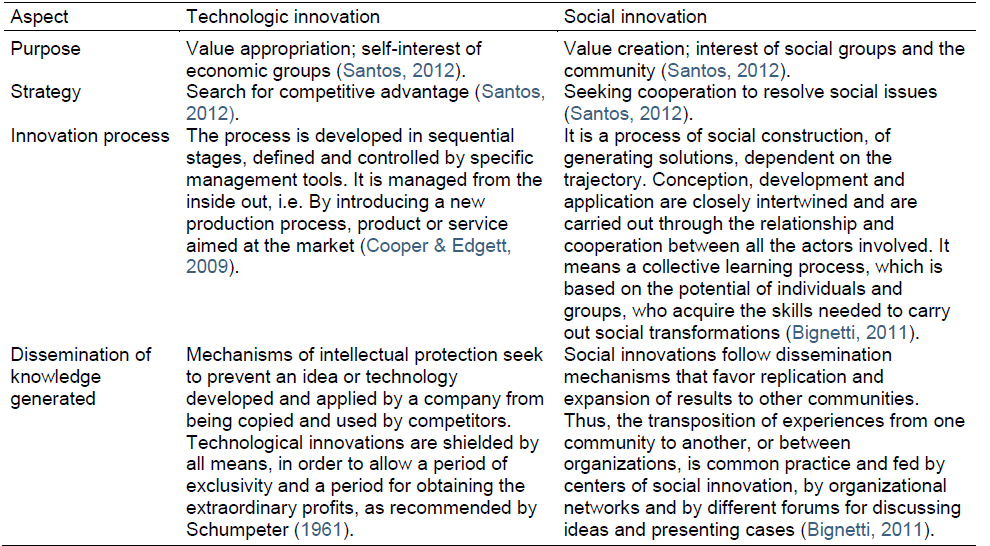
Source: prepared on the basis of Schumpeter (1961), Cooper and Edgett (2009), Bignetti (2011), Santos (2012).
Considering the distinctions between technological innovation and social innovation (Table 1), responses were sought in this study on how the commitment of R&D&I teams can contribute distinctively to the innovation capacity of TB and SIB, assuming, prepositively, that TB is the locus of technological innovation and the SIB of social innovation (Cajaiba-Santana, 2014; Camelo-Ordaz, Garcia-Cruz, Sousa-Ginel, & Valle-Cabrera, 2011), thus following the Neo-Schumpeterian approach that the innovative process has the company as its central agent (Nelson & Winter, 1982). Thus, the theoretical constructs that supported the study are discussed below, being: commitment and innovation capacity.
With the challenge of understanding the bond of commitment or, more precisely, unraveling what kind of psychological process that underlies the relationship of the individual with the organization, a model was created able to reflect the thoughts of the collaborators – termed as the Three-Dimensional (Meyer & Allen, 1997). This model is based on three dimensions of commitment: affective, continuance and normative.
Therefore, the three dimensions of commitment of individuals are: (i) affective, which represents individuals with strong affective commitment to remain in the organization; (ii) continuance, where people remain because they need something of the organization, as in a utility function; and (iii) normative, where people remain in the organization because they feel obliged to. Based on these dimensions it is possible to find individuals with different levels and types of commitment, such as a strong need (continuance), a strong obligation (normative) and a low desire (affective) to remain in the organization (Karim & Noor; 2006; Meyer & Allen, 1997; Ramdhani, A., Ramdhani, & Ainisyifa, 2017; Van Der Voet & Vermeeren, 2017). Table 2 shows the three dimensions of commitment.
Three dimensions of commitment
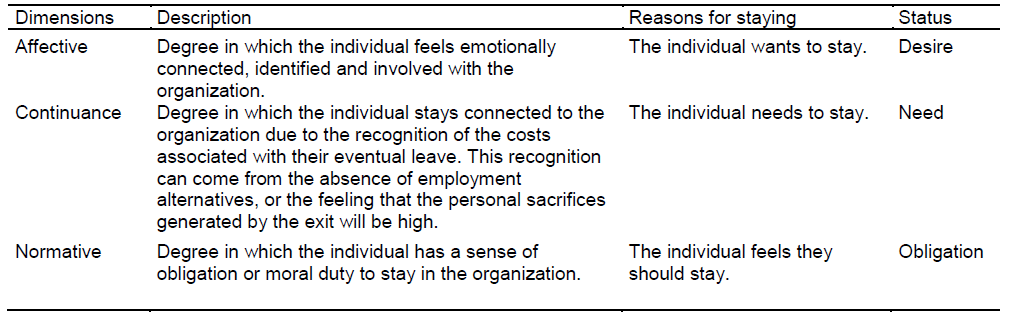
Source: Adapted from Meyer and Allen (1997), Ramdhani, et al. (2017), Karim and Noor (2006), Van Der Voet and Vermeeren (2017).
Notwithstanding the importance of understanding commitment, it is also important to study their contributions to the mobilization of resources that foster innovation capacity, because regardless of the type of innovation (technological or social), a potentially distinctive element is the commitment of the individuals who work in the R&D&I teams, given that they are (those leading and being led in R&D&I) those responsible for mobilizing pro-innovation resources, including human, physical, technological and financial resources that foster innovation capacity.
By the capacity for innovation it is possible to continuously transform internal and external knowledge into new products, processes, business models and systems, in order to be used for their benefit and their stakeholders, leading to innovation (Saunila et al., 2014; Tidd & Bessant, 2008). On the models of innovation capacity considered in the research (Lawson & Samson, 2001; Saunila & Ukko, 2012; Saunila et al., 2014; Zawislak, Cherubini Alves, Tello-Gamarra, Barbieux, & Reichert, 2012), a summary of their respective dimensions of analysis is given in Table 3.
Finally, it should be considered that the innovation capacity requires constancy and commitment of the team. In addition, the use of communication channels with the various stakeholders leads to a greater engagement for social innovations (Bhimani, Mention, Barlatier, 2019). For Chang, Wang, and Huang (2013), high absenteeism and/or turnover are indicators that there is low commitment on the part of employees, which has a negative effect on the results of a business, either by the inconstancy in the performance of duties or by the loss of valuable labor, when the individual’s decision to leave the organization takes place (Akhavan & Hosseini, 2016). In small and medium-sized enterprises, the impact is greater because of the smaller number of employees (Chang et al., 2013; Chang, Liao, & Wu, 2017). Thus, medium and small businesses represent a fertile field for the empirical investigation of the constructs commitment and ability to innovate, which justifies the choice of study units of analysis, which will be explored better in the next section.
Models of innovation capacity and its dimensions
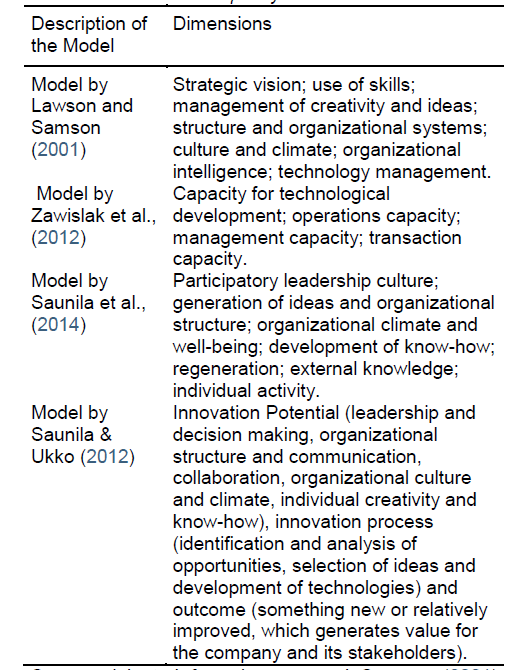
Source: Adapted from Lawson and Samson (2001), Zawislak et al. (2012), Saunila and Ukko (2012), Saunila et al. (2014).
Method
In this research, which is qualitative (Godoy, 1995a; Minayo, 2011) and descriptive (Martins & Theóphilo, 2009), we used the multiple case study as a method (Creswell, 2007; Yin, 2001), with the units of analysis being: (a) a TB, the BRAILE (winner of the “FINEP Innovation Award”, Medium-sized enterprise category); (b) and a SIB, the Nutrition Education and Recovery Center - CREN (winner of the “Social Entrepreneur” from the Folha de S. Paulo newspaper). The choice of these awards was due to the innovations generated for health with distinction of merit (including technological and social innovations), the size of business (organizations) and its purpose (business of technological and social innovation).
Primary data were collected from 14 semi-structured interviews (Martins & Theóphilo, 2009) in loco, carried out with directors, human resources managers, R&D&I managers and employees of the BRAILLE and CREN teams of R&D&I. Moreover, as a collection procedure, we collect secondary data in documents in the area of human resources, namely: frequency report (attendance clocking), promotions received, turnover report in the R&D&I area and the result of the last three formal performance evaluations of R&D&I staff.
Particularly, the data collection instruments we used include the semi-structured interview script and the documentary analysis roadmap, both based on literature, namely: Meyer and Allen (1997), Lawson and Samson (2001), Zawislak et al. (2012), Saunila et al. (2014) and Saunila and Ukko (2012).
It is also worth mentioning that the field research resulted in 10 hours and 30 minutes of recording and 114 pages of transcription, in addition to the collection of documents, which resulted in two pages of compilation of the collected evidence. Table 4 shows the interviewees' position and the duration of each interview.
To mitigate socially desirable answers problems (Protzko, Zedelius, & Schooler, 2019), the researchers conducted the interviews based on the previously constructed protocol. It is worth mentioning that the personal interview already inhibits this type of problem by having other types of communication and not only verbal. Non-verbal signals, volume and tone of voice, among others, were also taken into account in the interviews. Additionally, in relation to the interviews, we follow the recommendations of Dilley (2000) who states that the interview to be robust must have some key elements, such as basic information, analysis of interviews and creation of protocols. In this sense, researchers should receive relevant information about the interviewee's cultural context before the interview. As a consequence, researchers can rely more on analysis and expand their perception of the content of the interviews.
Position of respondents and the duration of each interview conducted in loco
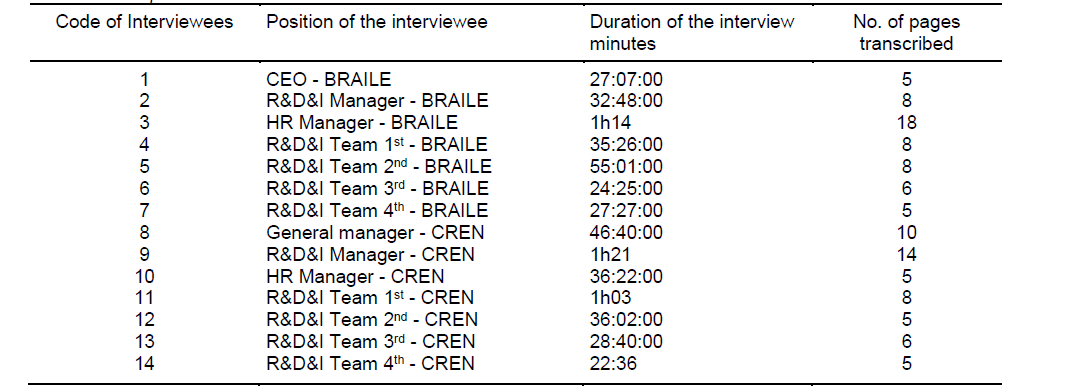
Source: Prepared by the authors, 2018.
The data were interpreted by the content analysis of the interviews and the secondary documents collected. Specifically, in content analysis, we sought reliable inferences of data and information, with respect to a given context and from the written or oral discourses of its actors and/or authors; the essence of a text, in the details of the available information, data and evidence. It is emphasized that in this analysis, it is not only the text, but the details of the context, so it can be used both for exploratory purposes (of discovery) verification (confirming, or not, propositions and evidence; Martins & Theóphilo, 2009).
When treating the data, the researchers took into account the search for consistency between the conceptual abstractions constituted from the interpretations and the previously raised theoretical concepts. As Fereday and Muir-Cochrane (2006) point out, a theoretical model must be recognizable and understood by the “actors” in their daily lives, and it is essential to clearly demonstrate how the interpretations of the data were succeeded with citations or other sources of evidence such as interviews. The data analysis process described in this article demonstrates how broad themes are supported by excerpts from raw data to ensure that data interpretation remains directly linked to participants' words.
The analysis categories were built from the data-driven inductive and the theory-driven deductive perspectives through a coding process that looks for patterns (Fereday & Muir-Cochrane, 2006; Joffe & Yardley, 2004). The data-driven perspective allows starting from the data of the evidence sources for the construction of analysis categories. The theory-driven perspective is built from theoretical assumptions previously used by authors that investigate the studied phenomenon. For the construction of the theory-driven categories, mainly the contents presented in Tables 1, 2 and 3 were used. It is worth mentioning that this content was used for the construction of the interview protocol, being a relevant part of the questions formulated in this research. For example, regarding the categories, “innovation capacity” and “commitment of the R&D&I team”, several theoretical excerpts throughout the text appears that provided conceptual support for these categories.
Therefore, in the case of “innovation capacity” category, Table 3 also served as a basis for the codification process. In the case of the “commitment of the R&D&I team”, theoretical assumptions are also constructed throughout the text, and Table 2 shows the dimensions of commitment. Still on this last category, the establishment of the R&D&I team code was coined based on the established focus of analysis that was the R&D&I teams. Although the code contains some specificity concerning the R&D&I team, its conceptual basis is in the theoretical assumptions presented here.
The data analysis process described in this article demonstrates how the categories of analysis are supported by excerpts of raw data to ensure that the interpretation of the data remains directly linked to the speeches of the participants (Joffe & Yardley, 2004). Finally, we highlight the use of the Atlas.Ti software that, according to Lee and Esterhuizen (2000), enables the organization and retrieval of information related to the idea or concept underlying the categories of analysis created by the researcher – an important procedure for structuring and validating them empirically in the process of returning to qualitative data. In this research, these categories were defined as: innovation capacity and commitment of the R&D&I team. Table 5 shows a methodological synthesis of the study.
As can be seen in Table 5, the main questions applied in the interviews are also available, noting that because it was a semi-structured interview, other questions were elaborated.
Methodological summary of the study
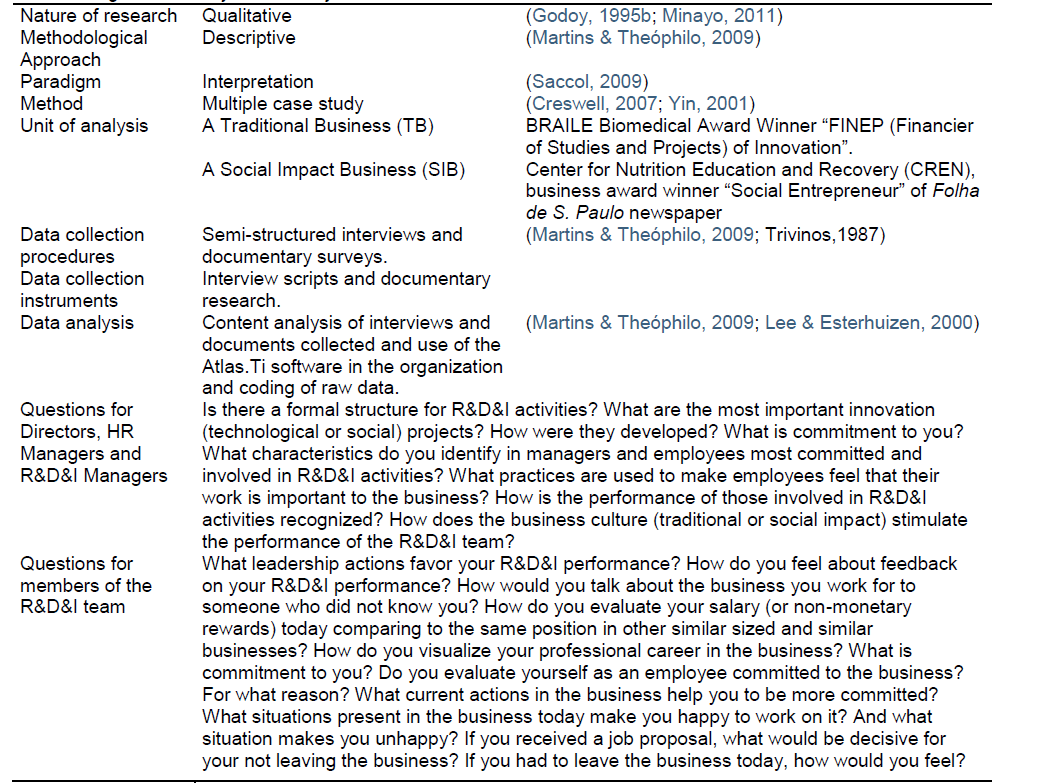
Source: Prepared by the authors, 2018.
Results and Discussions
The coding of the data in Atlas.Ti resulted in 381 citations linked to 13 codes, that is, 381 evidences related to the analysis components of the study. It is worth mentioning that, of the 13 evidenced codes (components of the categories), 7 emerged from the field (codes marked with asterisks in Table 6) and 6 had been predicted in the research protocol (Table 6).
It was also analyzed the co-occurrence of all 13 codes as evidence to relate them. Thus, it was initially generated from Atlas.Ti, the table of co-occurrence with all codes (total of 13), evidencing the presence of language units (citations, that is, fragments of text that gave meaning to the phenomenon) that occurred simultaneously in the same context of analysis. Thus, the codes were related taking into account their higher levels of co-occurrence (cells highlighted in Table 6).
It should be noted that this indicator of the relationship between the analyzed codes represents the correlation intensity of the mentioned language units (Friese, 2012). This intensity is based on the degree of proximity between two codes in the same analyzed context. The indicator consists of a value between 0 and 1, these values being different for each base analyzed. The values should be analyzed by the researchers, who determine a more intense relationship for values greater than and equal to .2 presented in Table 6.
As an example of the results of this analysis, particularly in the last column of Table 6, we found that: the highest level of co-occurrence occurred between the codes “Results (of innovation capacity)”, “Affective Commitment” and “Commitment of R&D&I Teams” (.03); therefore, they were analyzed (by retrieving the raw data, that is, from the citations of both codes) and, subsequently, related for evidencing the simultaneous occurrence of linguistic units in the same context of analysis. For the other columns the same procedure of analysis was adopted, resulting, in the end, in the relationship of codes considering the highest levels of co-occurrence, as shown in Table 6, which subsidized the analyzes, as well as grounded the proposal of a framework (Figure 1) on the significance of the contributions of the commitment of R&D&I teams to the mobilization of resources that foster innovation capacity, emphasizing the distinctions and similarities of TB and SIB.
Considering, therefore, the occurrence of the codes (Table 6), intra-case analyzes were performed for the analysis categories “Commitment” and “Innovation Capacity”, in accordance with the following paragraphs. The following excerpts from the interviews show the teams' commitment:
· If you are committed to what you are going to do, there is nothing to stop you from doing the job well. (CREN)
· A committed employee innovates more. I have two people inside, a nutritionist and a physical educator, they made a proposal for the teenagers on vacation. (CREN)
· I have a link to that and I want it to happen. And I'm there connected with that goal. (BRAILE)
· The more commitment she has to the job, the more the thing will come out, the more innovative, the easier it will achieve what the company, our product or service has to do. (BRAILE)
Furthermore, also in relation to the category “Commitment”, it is worth emphasizing, according to Mowday et al., (1979), that the affective type commitment is triggered by previous work experiences, especially those that have met the individual's psychological needs, making them feel comfortable within the organization and competent in their role. They are indicators of affective commitment: the happiness of the individual in dedicating the rest of their career to the organization, the perception that organizational problems belong to them, the strong sense of integration with the organization, the emotional bond maintained with it, and the immense personal meaning provided (Moscon et al., 2012; Rowe et al., 2013).
In BRAILE, the R&D&I team members interviewed reported that their psychological needs are met, which results in the feeling of belonging and also of satisfaction. When questioned about what they planned for their careers, all interviewees stated that they wanted to stay in the company, in higher or current positions, showing satisfaction with the current situation and personal goals of growth. The following excerpts from the interviews show aspects related to career, including demonstrating the commitment to innovation of the company:
· But we are always attentive to people who propose to study, to always put themselves at the front; so there are some who never stop: they dedicate themselves to English, Spanish, to study, because it is an area that has to be always studying, right? There are some people who stand out because they already have a second language there, a good education and such, these people end up accelerating more growth within the company. It ends up being that natural. (BRAILE)
· That's the point, right? It is always improving, always growing, trying to do the best, because
Co-occurrence of codes
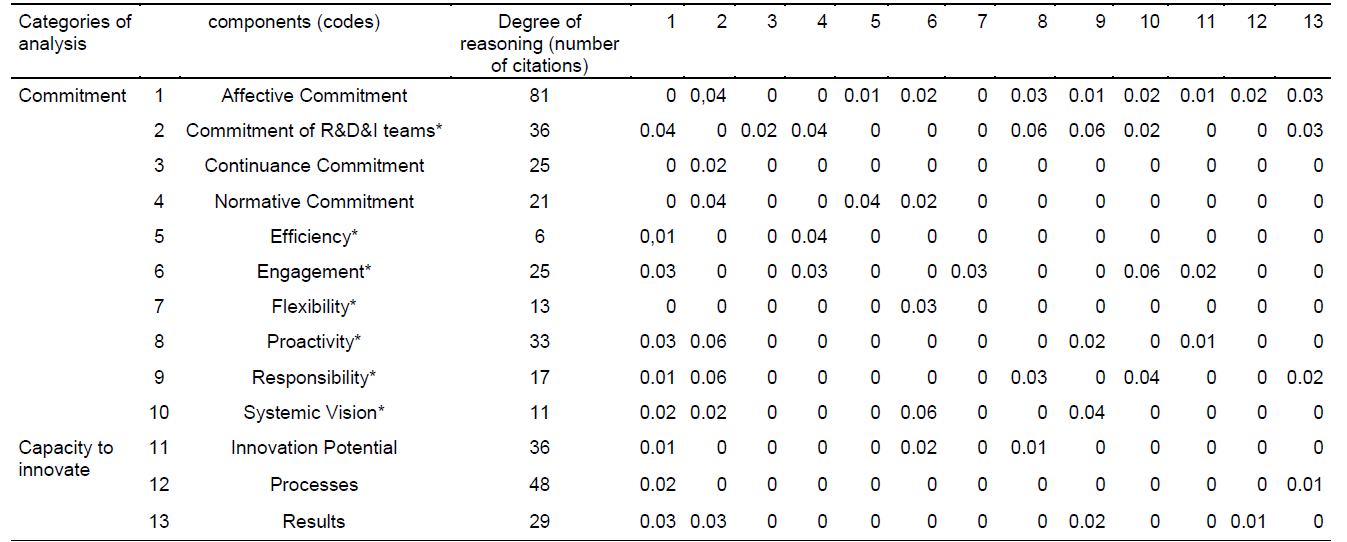
Source: Elaborated by the authors, with the help of Atlas.Ti software.Note * New components (codes) that emerged from the field.
I don’t know, where we got here has been building, studying, innovating, I think it’s there. (BRAILE)
· I want to study more, I want to grow more, and I want to grow here. I want to do projects together with CREN, to go after it, together with CREN, because I like this work, I like what I do. (CREN)
· I like what I do, I don't think of anything other than what I do inside. CREN arises from a history with the formation of a group, which founded this institution and that group was the board for many years. (CREN)
· My plan is to study so that I can improve professionally and help CREN improve as well. (CREN)
Another indicator of affective commitment also evidenced is the fact that the individual perceives the organizational problems as being theirs. The financial crisis faced by BRAILE and the dismissal of Dr. Domingos (founder), were always present in the speeches of the interviewees, evidencing the understanding of the seriousness of the facts, the impact on the company's results and, consequently, on the professional daily life. The last indicator also evident in the interviewees' speeches, refers to the emotional bond maintained with BRAILE and the personal meaning.
In CREN, indicators of affective commitment were also confirmed, but in different intensity and shape. All interviewees involved in R&D&I activities are clear about the importance of the results to receive funding from the partnerships and donations. The problems of the entity are understood and felt as personal problems of each one, evidencing a sense of integration with the organization. The emotional bond manifested in the interviewees, represents a personal meaning with the entity, reinforced by two aspects: feeling of belonging to the business (being informed, having their ideas considered, freedom and confidence in the performance of work, for example) and direct contact with the child and the pleasure of being able to change their development.
The result of the research showed high adherence to the theory (Karim & Noor, 2006; Meyer & Allen, 1997; Ramdhani et al., 2017; Van Der Voet & Vermeeren; 2017), because in the speech of all the interviewees it was made explicit the pleasure they feel in working in their organizations, by the identification of purpose, regardless of the type of business (economic or social purposes). It is worth mentioning that the aspect of purpose is an important factor for contemporary companies (Mackey & Sisodia, 2014). In the case of BRAILE there is mainly a wait for financial results (profit). In the case of CREN, results in percentages of children and families recovered, who changed their eating habits. Another finding in the interviews, which is adherent to the theory, is that all interviewees were aware of and practiced “doing something more” for the benefit of the organization, either in the performance of their duties or in the help of colleagues in other areas. We emphasize that sense of purpose promotes greater team engagement that results from an emotional bond and sense of belonging.
According to Meyer and Allen (1997), individuals often remain in the organization because they feel they have an obligation to reciprocate everything they have received from it and to continue in the organization by gratitude, being, therefore, an indicator of normative commitment (Karim & Noor; 2006; Ramdhani et al., 2017; Van Der Voet & Vermeeren; 2017). The speech of an interviewee at BRAILE demonstrates a sense of gratitude evidenced in this study: "Maybe I bring some of the relationship with the company's founder. He always gave me a lot of freedom for development, he always contributed a lot with my work, so it is not just for debt of gratitude, but it always has that associated ". In both cases, in BRAILE and in CREN, the feeling of gratitude is present in all subjects interviewed, but it is not the only reason that keeps them working in these companies. In general, what motivates them is the receipt of a wage compatible with the position/market, career development, feeling relevant in fulfilling a purpose, which includes saving lives through products or guidance and nutritional care for children in situations of social vulnerability.
About the continuance commitment, involving the feeling and the need to stay in the company due to lack of options, it is highlighted that this indicator was not evidenced in the interviews conducted in BRAILE and CREN. However, some interviewees even received an invitation to leave, but did not accept. The alleged motive for non-acceptance was the work environment, both in the R&D&I area, and in the company in general. Regarding wage levels, another indicator of instrumental commitment, both in BRAILE and in CREN, keeping wages in the range of the market is a concern of the HR area and, in practice, this does occur. For this reason, even in the questions that addressed the subject of salary, the majority affirmed that the wage conditions were in the market average and they felt satisfied. The following excerpts from the interviews show aspects related to salary:
· CREN maintains, of course, that a social institution has many difficulties in the sense that it is not always possible to maintain the same level of everything, but today at CREN it is within an adequate level. It is not superior to others, but adequate to what social reality is. (CREN)
· The salary has to be fair, you know? I am not going to practice super low salaries because they are passionate about the institution, because it is not fair, understand? I think we have to start with justice. (CREN)
· It would be an interesting way to reward those who are bringing more results to the company. It would be more interesting. The same people can do the same functions, but someone is looking for more information out there and bringing more results to the company. So if the company had any type of award for production, it would be a way to encourage employees to grow and seek information abroad. (BRAILE)
· So, I think that remuneration can lead people to produce more. (BRAILE)
Regarding the category of analysis “Innovation Capacity”, it is worth emphasizing that in BRAILE the processes inherent in this capacity involve applied research and experimental development and, finally, the pursuit of certification (ANVISA). Therefore, in BRAILE the development projects of new products require investments, risk management and contingency plans for non-successful projects, since not all the innovation potential identified, a priori, is in fact successfully converted into product for the market.
In addition to the development of standardized products, BRAILE also meets the specific demands of physicians, hospitals and universities, such as the development of endoprostheses, that need to be customized to the patient’s biotype. According to one of the interviewees, “a BRAILE customized endoprosthesis is developed in 20 days, with the same product being imported takes 3 months and has a higher price”. In CREN, the concern with the innovation processes bears some similarities with BRAILE, but are more flexible, by the very type of “service” that is provided. The identification of opportunities arises as one looks at the service indicators and, mainly for the field, which is the central driver of the innovation process in force in CREN.
Therefore, distinctive actions influence the innovation process in CREN, including: (a) scientific research developed in partnership with universities (such as the anthropometric census); (b) the home visit for the active search of malnourished children; and (c) intervention in the field, in the semi-boarding school and in the experimental kitchen. It should be noted that in CREN the revenue diversification and internal and external communication activities are also activities that corroborate the innovation process. For Bignetti (2011), in SIB, innovation is a social construction of solution generation dependent on the trajectory. Conception, development and application are closely intertwined and are carried out through the relationship and cooperation between all the actors involved. This means that there is a collective learning process, based on the potential of individuals and groups, which acquire the necessary capacities to carry out the social transformations. At CREN, the process of innovation is through learning and collective social intervention, being fundamental the know-how and the experience of each employee, and the team as a whole, with the subjects assisted.
Specifically, BRAILE’s innovation capacity in terms of product development stand out: the new membrane oxygenator, a more compact model, which required a smaller amount of materials, optimizing its market price; (b) the biological cardiac valve, with extended lifespan (anticalcifier); and (c) the balloon-expandable Inovare valve, mounted on a catheter, which enters from the femoral and reaches the heart, and then release. Thus, one can observe an adherence of these results to the concept of frugal innovation, that is, a solution (a) rapidly available to the market; (b) with ease and simplicity of use by the users; (c) with resource savings; (d) fault tolerant during use; and (e) with potential for scalability in other markets and regions (Basu et al., 2013; Zeschky et al., 2011).
Regarding the results of CREN's innovation capacity: (a) provision of public health services, in an expanded perspective, involving children and their family environment; (b) technical and scientific publications to disseminate the knowledge generated, based on the intervention methodologies developed by CREN; and (c) education, training and performance of multidisciplinary teams (doctors, nurses, nutritionists, physical educators, pedagogues and psychologists). Thus, we note an adherence of these results to the concept of social innovation, that is, methodologies that enable the improvement of the quality of life of the other and reduce inequalities (Farfus & Rocha, 2007). Here is an intra-category synthesis of the Commitment and Capacity for Innovation categories (Table 7).
Lastly, it should be noted that the elements in Table 5 make it possible to construct a framework that helps in understanding how commitment is related to the innovation capacity in TB and SIB. It should be noted that the distinctions and similarities between the two cases are consistent with the very essence of each business, but relevant evidence in this analysis is the affective commitment as a stimulus factor to increase innovation capacity. A sense of purpose explains engagement and commitment in both businesses.
Intra-case synthesis of the Commitment and Innovation Capacity categories
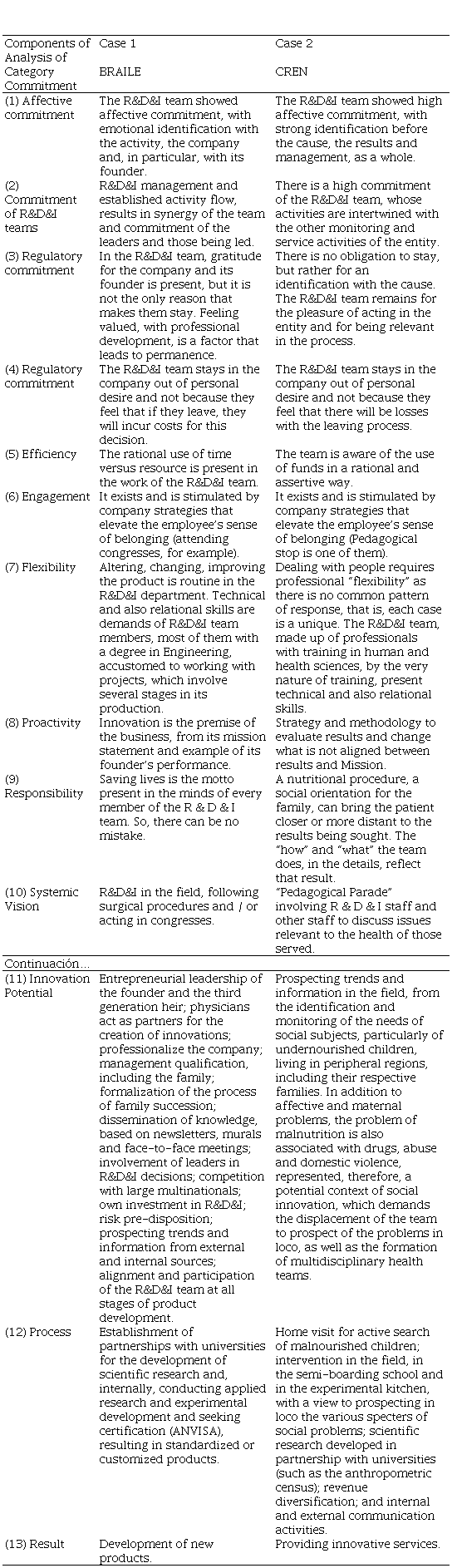
Source: data from the research prepared by the authors with the aid of Atlas.Ti software, 2018.Note Components from 1 to 10 are from the category “Commitment”; Components from 11 up to 13 are from the category “Innovation Capacity”
Framework Proposal
Based on the reports it is possible to say that the affective commitment of the R&D&I team is a result of a sense of belonging, of being important to someone and/or a purpose. This situation makes individual performance and the relationship with pro-innovation organizational resources align more successfully. An example of this was the question of identifying and analyzing opportunities, a fact crucial to decision-making, the potential of innovation and the aspect of “what” and “how” to invest money and time in both businesses investigated (TB and SIB).
In contact with the customer (doctors and children), there is no pre-established roadmap of questions to ask, or even aspects to be observed by employees, to identify opportunities and needs for innovation. The degree of depth in contact, observation, perception of improvement or opportunity of new products or services, occurs in a different way between the one who is committed or not. The committed employee tends to have more interest in the event (whether social or technological) than that which is not affectively compromised, that is, that which only fulfills its function. The committed goes beyond the obvious, asks pertinent questions, wants to understand, since he/she has an interest and desire to, effectively, gather information to bring innovation opportunity for the business, designed at that time, as “unique” and should be exploited to the fullest extent in order to leverage the potential for business innovation as a consequence. This reality demonstrates the importance of understanding the level and type of commitment of the R&D&I team.
Another example related to affective commitment was the collaboration relationship between the R&D&I team of the cases studied, this occurring even in the TB, well structured, with complementary expertise in its composition. However, in an environment without affective commitment, the environment that presents most of the time is that of competition. Thus, one can spend energy dealing more with conflicts than with research and analysis itself. Therefore, in the R&D&I team with affective commitment, as verified in the investigated businesses, the other was seen as a partner and not as a competitor. Everyone is there to meet the purpose or mission of the business, not having the concern of overcoming the other. The healthy competition, in turn, present in the analyzed businesses stimulated the search for knowledge and technological improvement as a differentiating factor.
Leadership was another relevant resource as a promoter of the innovation capacity in the analysis made, since, in addition to being the interface between the higher levels and the team, it also promoted coordination and systematization of activities, focused on results, hiring, training and accompanying the R&D&I team. In the two businesses surveyed, BRAILE and CREN, the leaders not only expressed high commitment to the position, leading effectively their role - fact confirmed by the results achieved and prizes received, but also obtained the admiration, respect and acceptance of those being led, directly and indirectly, who recognized their technical and behavioral capacity in the daily conduct of the various projects under their responsibility. In teams with low affective commitment, leadership is generally not perceived as facilitating daily dynamics, but as a constraint.
The use of the accumulated know-how in the performance of the role was another factor considered relevant to the innovation capacity of the studied businesses. A R&D&I team with a high degree of commitment, which identifies with the values of the business in which they operate, the search for knowledge, both academic and practical, is done naturally by personal interest and desire. It is to obtain this, in their daily professional routine, with support of the organization, whether participating in internal trainings, congresses, fairs and surgical procedures (BRAILE); or attending external specializations, as part of internal trainings and meetings (CREN), it was one of the reasons identified as a motivator for staying in the investigated businesses. Thus, it was possible to conclude that teams with a high degree of affective commitment are happy to learn something that can assist them in the development of their work, because the motivation is intrinsic and personal.
Culture was also signified by the social subjects interviewed as a resource that encourages innovation capacity. The two cases studied revealed unusual situations in the business reality (examples, therefore, of rare cases), revealing the combination of factors favoring innovation. In BRAILE, the personal position of its founder, Dr. Domingos, gave clarity and direction to what the company proposes to do and how to do it: “save lives in cardiac surgical procedures”. In CREN, there is not a striking figure, but a purpose and a competent and committed management, necessary for the continuity of the existence of the entity. This culture favored the emergence of the affective commitment of the R&D&I team. It is worth noting that it is not because of this commitment that the culture exists, but its maintenance is only possible if there is such a positive attitude on the part of the employees.
Although there were evidences in the field related to the three types of commitment (affective, continuance and normative), by interpreting them in aggregate form, it was possible to infer that: (a) the continuance commitment was not prevalent in the investigated businesses, despite the presence of some of its descriptor factors, such as high amount of working time and attained positions; (b) in this same line of interpretation, we find that the normative commitment was not preponderant in the investigated businesses, because the feeling of wanting to leave and feel in debt was not identified in the R&D&I team of both businesses investigated; (c) the affective commitment, in turn, was what prevailed, i.e., that which in fact, fostered the development of resources that promote innovation capacity in the businesses studied, because those leading and being led, who are part of the R&D&I team, identify with the business and its activities, wanting to keep this relationship, that is, they want the best for the business and for them too.
Thus, from the aggregated conclusions of the research, it was possible to discuss, from a higher propositional level, the coexistence of these types of impairment (affective, normative and continuance), considering those leading and being led who are part of the TB and SIB of the R&D&I team. We conclude, however, that, even in coexisting, there will always be a predominance of one of the types. Based on the prevailing commitment is that the leader or led predominantly run their behaviors and attitudes related to the performance of the activities of R&D&I.
By adopting a more colloquial language, it can be said that leaders and led members of the R&D&I team “give their best to the company”, when the affective commitment is prevailing, that is, there is an emotional connection with the company, generated by the identification with its purpose, its activity and management. Now when normative commitment is preponderant, they “give their best to the business”, but also do their best for themselves, in a simple analogy, since they feel gratitude for all that they have received or receive and feel they have to reciprocate; otherwise they will feel as if in debt. What makes them stay, therefore, in the business, are these “have to”, that is, it is not the passion that motivates them, but the feeling of gratitude. Finally, when continuance commitment is predominant, the analogy could be “do your best for what is trending now”, that is, leaders and led in R&D&I analyze the cost of their leaving versus staying, and whichever is more advantageous, will be assumed as the choice.
Based on the analyzes performed from the reality studied, represented in Table 7, we were able to propose a framework on the meaning of the contributions of the commitment of R&D&I teams to the mobilization of resources that foster innovation capacity (Figure 1). Synthesizing, finally, the meanings of the contributions of the commitment of R&D&I teams to the mobilization of resources that foster innovation capacity (potential of innovation, processes and results) of the businesses investigated, we highlight: (a) optimization in the perception of business opportunities (new products or social intervention services) and contact with the “customers” and “social subjects” (doctors and children/family), increasing the potential for innovation; (b) performance, with a high degree of collaboration, minimizing the traditional conflicts between team members and leveraging the innovation process; (c) manifestation of admiration, respect and acceptance of leadership, perceiving coherence, justice, technical and behavioral training in conducting R&D&I activities, which facilitates the innovation process; (d) utilization of the know-how acquired from external partnerships (doctors, hospitals and universities), expanding it through the acquisition of new knowledge and experiences and, finally, promoting the scalability of the results of the innovations generated, being these of frugal nature in the TB and of social nature in the SIB (Figure 1).
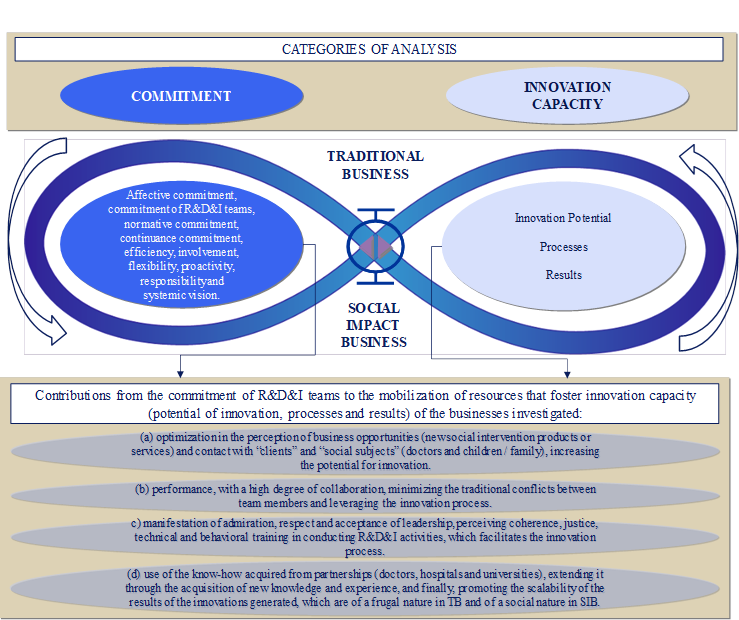
Figure 1
Framework for the commitment of R&D&I teams
Source: data from the research prepared by the authors with the aid of Atlas.Ti software, 2018.
Conclusions
At the end of this research it is possible to conclude that the feelings expressed in the interviewees’ talk, both in BRAILE and in CREN, were of admiration, strong identification with the objectives and values of the organizations in which they act; strong desire to remain in it; as well as willingness to exert considerable effort in the search for innovative results, thus leveraging the business innovation capacity. This set of manifestations adhered to the three-dimensional model by Meyer and Allen (1991), who classified them as affective commitment (Karim & Noor; 2006; Ramdhani et al., 2017; Van Der Voet & Vermeeren, 2017).
Finally, it is worth mentioning that this study contributes to the advancement of knowledge, because it presents a detailed understanding of how the commitment of the R&D&I teams contributes to the innovation capacity, highlighting the distinctions and similarities of this contribution in TB and SIB. There are also practical contributions and insights, obtained from the empirical results of the research, useful to HR managers and the R&D&I area, by highlighting the behavioral characteristics of employees and staff, which foster commitment to the business and innovation of TB and SIB. This can help in defining practices related to attracting, selecting, training and monitoring the performance of the team involved in R&D&I processes, from the peculiarity of the business, thus raising the chance of success in achieving the objectives of innovation.
A relevant aspect in this study is the evidence of affective commitment as an important factor in the innovation capacity of R&D&I teams, since this commitment is taken into account in staying in the company and their engagement in the development of new products. An example of this reality can be perceived in the phase of exploring stakeholder demands, the interviewees were engaged to understand and empathize the demands of these stakeholders.
One of the limitations of the research is the number of TB and SIB investigated (one of each type), therefore, analyzes and propositions presented should be considered with due parsimony. There is also the fact that they are businesses that, at the beginning, are already differentiated from the others, in their category, due to the prizes received (FINEP and Social Entrepreneur), leading in their segments, evidencing thereby its distinction.
As a suggestion, it is worth noting that future research on commitment and innovation capacity in other SIB, in different segments, such as education, security and sustainability, with social demands still neglected, in developing countries, such as India and South Africa, seeking to enrich the proposed framework.
Acknowledgments
Se agradece a Coordenação de Perfeição de Pessoal de Nível Superior – CAPES.
References
Akhavan P., & Hosseini, S. M. (2016). Social capital, knowledge sharing, and innovation capability: an empirical study of R&D teams in Iran. Technology Analysis & Strategic Management, 28(1), 96-113. doi: 10.1080/09537325.2015.1072622
ATLAS.ti (2022). Scientific Software Development GmbH. Berlín, Alemania.
Avelino, F., Wittmayer, J. M., Pel, B., Weaver, P., Dumitru, A., Haxeltine, A., ... O'Riordan, T. (2017). Transformative social innovation and (dis) empowerment. Technological Forecasting and Social Change, 145, 195-206. doi: 10.1016/j.techfore.2017.05.002
Bahmani, S., Galindo, M. Á., & Méndez, M. T. (2012). Non-profit organizations, entrepreneurship, social capital and economic growth. Small Business Economics, 38(3), 271-281. doi: 10.1007/s11187-010-9274-7
Barney, J. (1991). Firm resources and sustained competitive advantage. Journal of Management, 17(1), 99-120. doi: 10.1177%2F014920639101700108
Basu, R. R., Banerjee, P. M., & Sweeny, E. G. (2013). Frugal Innovation: Core Competencies to Address Global Sustainability. Journal of Management for Global Sustainability, 1(2), 63-82. doi: 10.13185/JM2013.01204
Becker, H. S. (1960). Notes on the concept of commitment. American journal of Sociology, 66(1), 32-40. doi: 10.1086/222820
Bignetti, L. P. (2011). As inovações sociais: uma incursão por ideias, tendências e focos de pesquisa. Ciências Sociais Unisinos, 47(1). doi: 10.4013/csu.2011.47.1.01
Bhimani, H., Mention, A. L., & Barlatier, P. J. (2019). Social media and innovation: A systematic literature review and future research directions. Technological Forecasting and Social Change, 144, 251-269. doi: 10.1016/j.techfore.2018.10.007
Cajaiba-Santana, G. (2014). Social innovation: Moving the field forward. A conceptual framework. Technological Forecasting and Social Change, 82, 42-51. doi: 10.1016/j.techfore.2013.05.008
Caldwell, D. F., Chatman, J. A., & O’Reilly, C. A. (1990). Building organizational commitment: A multifirm study. Journal of Occupational and Organizational Psychology, 63(3), 245-261. doi: 10.1111/j.2044-8325.1990.tb00525.x
Camelo-Ordaz, C., Garcia-Cruz, J., Sousa-Ginel, E., & Valle-Cabrera, R. (2011). The influence of human resource management on knowledge sharing and innovation in Spain: the mediating role of affective commitment. The International Journal of Human Resource Management, 22(7), 1442-1463. doi: 10.1080/09585192.2011.561960
Chang, W. J., Liao, S. H., & Wu, T. T. (2017). Relationships among organizational culture, knowledge sharing, and innovation capability: a case of the automobile industry in Taiwan. Knowledge Management Research & Practice, 15(3), 471-490. doi: 10.1057/s41275-016-0042-6
Chang, W. J., Wang, Y. S., & Huang, T. C. (2013). Work design–related antecedents of turnover intention: A multilevel approach. Human Resource Management, 52(1), 1-26. doi: 10.1002/hrm.21515
Chen, C. J., & Huang, J. W. (2009). Strategic human resource practices and innovation performance—The mediating role of knowledge management capacity. Journal of Business Research, 62(1), 104-114. doi: 10.1016/j.jbusres.2007.11.016
Cooper, R. G., & Edgett, S. J. (2009). Product innovation and technology strategy. Londres, Reino Unido: Product Development Institute.
Creswell, J. W. 2007. Projeto de pesquisa: métodos qualitativo, quantitativo e misto. Porto Alegre: Artmed.
Damanpour, F., & Gopalakrishnan, S. (2001). The dynamics of the adoption of product and process innovations in organizations. Journal of Management Studies, 38(1), 45-65. doi: 10.1111/1467-6486.00227
Defourny, J. (2014). Social enterprise and the third sector. Changing European landscapes in a comparative perspective. Londres, Reino Unido: Routledge.
Dilley, P. (2000). Conducting Successful Interviews: Tips for Intrepid Research. Theory Into Practice, 39(3), 131–137. doi: 10.1207/s15430421tip3903_3
Donate, M. J., Peña, I., & Sanchez De Pablo, J. D. (2016). HRM practices for human and social capital development: effects on innovation capabilities. The International Journal of Human Resource Management, 27(9), 928-953. doi: 10.1080/09585192.2015.1047393
Engelke, H., Mauksch, S., Darkow, I. L., & Heiko, A. (2015). Opportunities for social enterprise in Germany—Evidence from an expert survey. Technological Forecasting and Social Change, 90, 635-646. doi: 10.1016/j.techfore.2014.01.004
Farfus, D., & Rocha, M.C.S. (2007). Inovação Social: um conceito em construção. Inovações Sociais. Curitiba, Brasil: SESI/SENAI/IEL/UNINDUS.
Feldman, T, Lam, D., & Simon S. K. (2010). Psychological contract breaches, organizational commitment, and innovation-related behaviors: a latent growth modeling approach. Journal of applied Psychology, 95(4), 744-751. doi: 10.1037/a0018804
Fereday, J., & Muir-Cochrane, E. (2006). Demonstrating rigor using thematic analysis: A hybrid approach of inductive and deductive coding and theme development. International Journal of Qualitative Methods, 5(1), 80-92. doi: 10.1177%2F160940690600500107
Friese, S. (2012). Qualitative data analysis with Atlas.Ti. London: Sage.
Godoy, A. S. (1995a). Introdução à pesquisa qualitativa e suas possibilidades. Revista de administração de empresas, 35(2), 57-63. doi: 10.1590/S0034-75901995000200008
Godoy, A. S. (1995b). Pesquisa qualitativa: tipos fundamentais. Revista de Administração de empresas, 35(3), 20-29. doi: 10.1590/S0034-75901995000300004
Gopalakrishnan, S., & Damanpour, F. (1997). A review of innovation research in economics, sociology and technology management. Omega, 25(1), 15-28. doi: 10.1016/S035-0483(96)00043-6
Hammarfjord, M. O., & Roxenhall, T. (2017). The Relationships Between Network Commitment, Antecedents, And Innovation In Strategic Innovation Networks. International Journal of Innovation Management, 21(04). doi: 10.1142/S1363919617500372
Itelvino, L. D. S., Costa, P. R. D., Gohn, M. D. G., & Ramacciotti, C. (2018). Formação do empreendedor social e a educação formal e não formal: um estudo a partir de narrativas de história de vida. Ensaio: Avaliação e Políticas Públicas em Educação, 26(99), 471-504. doi: 10.1590/s0104-40362018002600960
Joffe, H., & Yardley, L. (2004). Content and thematic analysis. D. F. Marks & L. Yardley (eds.), Research Methods for Clinical and Health Psychology,(pp. 56-68). London: Sage.
Karim, N. H. A., & Noor, N. H. N. M. (2006). Evaluating the psychometric properties of Allen and Meyer’s organizational commitment scale: A cross cultural application among Malaysian academic librarians. Malaysian Journal of Library & Information Science, 11(1), 89-101.
Lawson, B., & Samson, D. (2001). Developing innovation capability in organizations: a dynamic capabilities approach. International Journal of Innovation Management, 5(3), 377-400. doi: 10.1142/S1363919601000427
Lee, R. M., & Esterhuizen, L. (2000). Computer software and qualitative analysis: trends, issues and resources. International Journal of Social Research Methodology, 3(3), 231-243. doi: 10.1080/13645570050083715
Mackey, J., & Sisodia, R. (2014). Conscious capitalism. Cambridge: Harvard Business Review Press.
Marescaux, E., De Winne, S., & Sels, L. (2013). HR practices and affective organizational commitment:(when) does HR differentiation pay off? Human Resource Management Journal, 23(4), 329-345. doi: 10.1111/1748-8583.12013
Martins, G. D. A., & Theóphilo, C.R. (2009). Metodologia da investigação cientifica. São Paulo: Atlas.
McDermott, A. M., Heffernan, M., & Beynon, M. J. (2013). When the nature of employment matters in the employment relationship: A cluster analysis of psychological contracts and organizational commitment in the non-profit sector. The International Journal of Human Resource Management, 24(7), 1490-1518. doi: 10.1080/09585192.2012.723635
Meyer, J. P., & Allen, N. J. (1991). A three-component conceptualization of organizational commitment. Human Resource Management Review, 1(1), 61-89. doi: 10.1016/1053-4822(91)90011-Z
Meyer, J. P., & Allen, N. J. (1997). Commitment in the Workplace: Theory, Research, and Application (Advanced Topics in Organizational Behavior). Thousand Oaks, CA: Sage Publications.
Minayo, M. C. S. (2011). Pesquisa social. Teoria, método e criatividade. Rio de Janeiro: Editora Vozes Ltda.
Moscon, D. B., Bastos, A. V. B., & Souza, J. J. (2012). É Possível Integrar, em um mesmo Conceito, os Vínculos Afetivo e Instrumental? O olhar de gestores sobre o comprometimento com a organização. Organizações & Sociedade, 19(61), 357-373. doi: 10.1590/S1984-92302012000200010
Mowday, R. T., Steers, R. M., & Porter, L. W. (1979). The measurement of organizational commitment. Journal of Vocational Behavior, 14(2), 224-247. doi: 10.1016/0001-8791(79)90072-1
Nelson, R., & Winter, S. (1982). An evolutionary theory of technical change. Cambridge: Harvard.
Popa, S., Soto-Acosta, P., & Martinez-Conesa, I. (2017). Antecedents, moderators, and outcomes of innovation climate and open innovation: An empirical study in SMEs. Technological Forecasting and Social Change, 118, 134-142. doi: 10.1016/j.techfore.2017.02.014
Protzko, J., Zedelius, C. M., & Schooler, J. W. (2019). Rushing to Appear Virtuous: Time Pressure Increases Socially Desirable Responding. Psychological Science, 30(11), 1584-1591. doi: 10.1177%2F0956797619867939
Ramdhani, A., Ramdhani, M., & Ainisyifa, H. (2017). Conceptual Framework of Corporate Culture Influenced on Employees Commitment to Organization. International Business Management, 11(3), 826-830. doi: 10.36478/ibm.2017.826.830
Rao-Nicholson, R., Vorley, T., & Khan, Z. (2017). Social innovation in emerging economies: A national systems of innovation based approach. Technological Forecasting and Social Change, 121, 228-237. doi: 10.1016/j.techfore.2017.03.013
Rhisiart, M., Störmer, E., & Daheim, C. (2017). From foresight to impact? The 2030 Future of Work scenarios. Technological Forecasting and Social Change, 124, 203-213. doi: 10.1016/j.techfore.2016.11.020
Rowe, D. E. O., Bastos, A. V. B., & Pinho, A. P. M. (2013). Múltiplos comprometimentos com o trabalho e suas influências no desempenho: um estudo entre professores do ensino superior no Brasil. Organizações & Sociedade,20(66), 501-521. doi: 10.1590/S1984-9230201300300008
Saccol, A. Z. (2009). Um retorno ao básico: compreendendo os paradigmas de pesquisa e sua aplicação na pesquisa em administração. Revista de Administração da Universidade Federal de Santa Maria, 2(2). doi: 10.5902/198346591555
Santos, F. M. (2012). A positive theory of social entrepreneurship. Journal of Business Ethics, 111(3), 335-351. doi: 10.1007/s10551-012-1413-4
Saunila, M., Pekkola, S., & Ukko, J. (2014). The relationship between innovation capability and performance: The moderating effect of measurement. International Journal of Productivity and Performance Management, 63(2), 234-249. doi: 10.1108/IJPPM-04-2013-0065
Saunila, M., & Ukko, J. (2012). A conceptual framework for the measurement of innovation capability and its effects. Baltic Journal of Management, 7(4), 355-375. doi: 10.1108/17465261211272139
Schumpeter, J. A. (1961). The Theory of Economic Development: An Inquiry into Profits, Capital, Credit, Interest, and the Business Cycle. Cambridge. Harvard
SEBRAE (2014, abril 11). O que são negócios de impacto social? Retrieved from: http://www.sebrae.com.br/sites/PortalSebrae/sebraeaz/o-que-sao-negocios-de-impacto-social,1f4d9e5d32055410VgnVCM1000003b74010aRCRD
Steers, R. M. (1977). Antecedents and outcomes of organizational commitment. Administrative Science Quarterly, 22(1), 46-56. doi: 10.2307/2391745
Tidd, J., & Bessant, J. (2008). Gestão da inovação. 5.ed. Porto Alegre, RS: Bookman Editor.
Van Der Voet, J., & Vermeeren, B. 2017. Change management in hard times: can change management mitigate the negative relationship between cutbacks and the organizational commitment and work engagement of public sector employees? The American Review of Public Administration, 47(2), 230-252. doi: 10.1177%2F0275074015625828
Wright, P. M., McMahan, G. C., & McWilliams, A. (1994). Human resources and sustained competitive advantage: a resource-based perspective. International Journal of Human Resource Management, 5(2), 301-326. doi: 10.1080/09585199400000020
Yin, R. (2001). Metodologia de Estudos de Caso. Porto Alegre: Bookman.
Zawislak, P. A., Cherubini Alves, A., Tello-Gamarra, J., Barbieux, D., & Reichert, F. M. (2012). Innovation capability: From technology development to transaction capability. Journal of Technology Management & Innovation, 7(2), 14-27. doi: 10.4067/S0718-27242012000200002
Zeschky, M., Widenmayer, B., & Gassmann, O. (2011). Frugal innovation in emerging markets. Research-Technology Management, 54(4), 38-45. doi: 10.5437/08956308X5404007
Notas de autor
Enviar correspondencia a: Rezende da Costa, P. E-mail: priscilarezende@yahoo.com.br
Información adicional
Citar este artículo como: Ronzani, C. M., Rezende da Costa P., & Ferreira Da Silva L. (2022). Team's Affective Commitment as a Factor to Stimulate Innovation Capacity in Traditional Business and Social Impact Business. Revista Argentina de Ciencias del Comportamiento, 14(2), 108-126.
Enlace alternativo
https://revistas.unc.edu.ar/index.php/racc/article/view/26506/38690 (pdf)
