The Concept of Justice in Stakeholder Theory: A Systematic Literature Review
O Conceito de Justiça na Teoria dos Stakeholders: Uma Revisão Sistemática de Literatura
The Concept of Justice in Stakeholder Theory: A Systematic Literature Review
Base Revista de Administração e Contabilidade da UNISINOS, vol. 17, no. 3, pp. 429-455, 2020
Universidade do Vale do Rio dos Sinos
Received: 24 November 2019
Accepted: 22 April 2020
Abstract: In strategic management, the Stakeholder Theory proclaims that in order to achieve better performance and sustainable competitive advantage, the organization has to treat each of its stakeholders fairly. Hence, the concept of justice becomes relevant in assessing the effectiveness of managerial decisions and is ingrained in the Stakeholder Theory literature. This paper aims to examine how the notion of justice is conceptualized and applied in the Stakeholder Theory literature; and to propose new avenues of research regarding the interconnections between these two subjects. We present a systematic literature review to synthesize the research in the area. A careful screening held in April 2019, resulted in 75 papers published in 35 journals from 1999 to 2019. The results were presented in two phases. First, in the form of a descriptive and bibliometric analysis of the selected papers. Second, by reviewing those papers, we offer a framework of how the notion of justice has been conceptualized and applied in the Stakeholder Theory literature. Finally, we propose an agenda for future research regarding the interconnection between justice and Stakeholder Theory.
Keywords: Fairness, Justice, Stakeholder Theory, Systematic Literature Review.
Resumo: Na gestão estratégica, a Teoria dos Stakeholders indica que, para alcançar melhor desempenho e vantagem competitiva sustentável, a organização deve tratar cada uma das partes interessadas de maneira justa. Nesse sentido, o conceito de justiça se torna relevante na avaliação da eficácia das decisões gerenciais e está enraizado na literatura da Teoria dos Stakeholders. Este artigo tem como objetivo examinar como a ideia de justiça é conceitualizada e aplicada na literatura da Teoria dos Stakeholders, e propor novos direcionamentos de pesquisas futuras sobre as interconexões entre esses dois temas. Apresentamos uma revisão sistemática da literatura para sintetizar a pesquisa na área. Uma triagem em diferentes etapas, resultou em 75 artigos publicados em 35 revistas de 1999 a 2019. Os resultados foram apresentados em duas fases. Primeiro, na forma de uma análise descritiva e bibliométrica dos trabalhos selecionados. Segundo, revisando esses documentos, oferecemos uma estrutura de como a noção de justiça foi conceitualizada e aplicada na literatura da Teoria dos Stakeholders. Por fim, propomos uma agenda para pesquisas futuras sobre a interconexão entre justiça e a Teoria dos Stakeholders.
Palavras-chave: Justiça, Justiça, Teoria das Partes Interessadas, Revisão Sistemática da Literatura.
Introduction
The Stakeholder Theory gained ground in international literature through the publication of Freeman's Strategic Management: a stakeholder approach, in 1984. According to Freeman (1984), stakeholders are groups or individuals that can affect or be affected by the organization. The organization's role should be to strategically manage the company's stakeholders (Frooman, 1999). By doing so, organizations could achieve better results and sustainable competitive advantage (Freeman, 1984; Harrison et al., 2010).
Considering the stakeholder perspective, it is notable its prominence in the contemporaneous world scenario and the new challenges and complexities the organizations need to deal with. The recent statement presented at the World Economic Forum (WEF) that seeks to redefine the purpose of companies proves the growing importance of the Stakeholder Theory. The so-called Davos Manifesto defines that the purpose of a company is to engage all its stakeholders in shared and sustained value creation, understanding and harmonizing the divergent interests of stakeholders through a shared and fair commitment (Schwab, 2020).
In this context, researchers who study the theory offer new models and perspectives on how the organization should manage its stakeholders (e.g. Donaldson & Preston, 1995; Mitchell, Agle & Wood, 1997; Freeman, Harrison & Wicks, 2007; Harrison et al., 2010; Miles, 2017). Thus, we can see the inclusion of new concepts in strategic management, many related to the nature and goals of the relationship between organization and stakeholders, such as reciprocity, equity, fairness, justice, among others (Bosse, Phillips & Harrison, 2009; Bridoux & Stoelhorst, 2014).
With respect to justice, this concept has been the focus of many studies from a wide variety of subjects and lenses in the field of management. Although its components have been scrutinized and applied to different degrees in the management literature, such as Human Resources (Bies & Moag, 1986; Tyler and Bies, 1990), Marketing (Laczniak & Murphy, 2007), and Strategic Management (Kim and Mauborgne, 1998; Luo, 2007), the stakeholder management, underpinned by the Stakeholder Theory, distinguish itself as been the one that applies the notion of justice as a key component for its models and a requisite for an effective implementation in the managerial activity (Freeman, 1994; Harrison et al., 2010).
Nonetheless, the concept of justice can be viewed and applied in different manners, and the notion of what is considered to be fair, from a stakeholder standpoint, is not a clear-cut definition (Bridoux & Stoelhorst, 2016). As a result, it’s important to understand how justice has been studied and applied through the lens of the Stakeholder Theory, in order to better understand what aspects are relevant and how can we further advance the theoretical and empirical approach of the subject in the theory.
As argued, the stakeholder literature has been expanding its reach over the years and consolidating itself as a theoretical approach. With this development, it is noted the importance of studies that seek to understand such expansion and propose new ways and connections with different concepts (Laplume, Sonpar & Litz, 2008; Freeman et al., 2010; Stocker et al., 2019) as objectified in this study.
The present study aims to attain two goals: first, to provide a theoretical background and framework about justice in the Stakeholder Theory literature and how this concept has been applied on some the most relevant studies in the field; and second, to present new avenues of research regarding the interconnections between the concept of justice and Stakeholder Theory. Therefore, in this paper, we aim to answer the following research question: How the concept of justice has been addressed in the Stakeholder Theory literature?
In the following sections, we offer a theoretical background about justice and the Stakeholder Theory, in order to highlight the main concepts about those subjects. After that, we explain the methodology used for data collection and analysis for the study. Finally, we present the results and discussion, including some propositions for new avenues of research.
Theoretical Background
Justice in Management Literature
The literature about justice on management began with a narrower conception of the construct. Organizational justice was characterized by a descriptive approach, in which it sought to understand the posture and behavior of managers towards their employees. In this way, it followed a straightforward analysis between employee and employer (Cropanzano et al., 2007). In its formation, organizational justice is composed of three main components: distributive justice, procedural justice, and interactional justice (Cohen-Charash & Spector, 2001; Cropanzano et al., 2007).
Distributive justice, as the first component presented in the management literature, derive much from the works of John Rawls applied to Business Ethics (Cohen, 2010). According to Rawls, justice should only be concerned with the distribution of primary goods - goods necessary to meet human needs. Following this principle, the author suggests social and economic inequalities must be arranged so that both are for the benefit of the less favored (John, 1971). From there, it’s understood that distributive justice deals with fairness of outcomes (Folger & Konovsky, 1989). On an organizational level, it concerns with the relationship of the outcomes and the behavior and expectations of the employees (Cohen-Charash & Spector, 2001; Folger & Konovsky, 1989).
Procedural justice, on the other hand, consider the process by which the outcomes are achieved. Thus, the outcome is relegated to a less important aspect of the process (Cropanzano et al., 2007; De Cremer & Tyler, 2005). There are six rules that helps guide a fair process of justice in an organization: 1) consistency rule; 2) bias suppression rule, 3) accuracy rule, 4) correctability rule, 5) representativeness rule, 6) ethicality rule (Leventhal, 1980).
Interactional justice concerns with the way the managers behave towards the employees along the process of communication. In this manner, it deals with the communication process and examines the way through which managers address the employees, such as politeness, honesty and respect (Bies & Moag, 1986; Tyler & Bies, 1990).
Although these three types of justice are the most used in management literature, other derivations of the concept of justice are found. Berry (2003) uses the term Environmental Justice to refer to the distribution of environmental impacts, power relations, discourses, policy formulation and mobilization in a local and specific way. More broadly, Brink and Eurich (2006) use the term Social Justice to define the way in which legitimate stakeholder groups are recognized to ensure fair treatment between them.
The study on justice, through its three organizational components (distributive, procedural and interactional justice), has been performed in a variety of subjects within the management literature. For instance, in human resources management, research has been done about organizational justice, mostly concerning an instrumental aspect of justice, such as personnel selection, compensation systems and performance systems, as well as communication and the general well-being of the employee (Ferris, 1999; Folger & Bies, 1989). By the nature of the field, human resources management employs a tridimensional approach to organizational justice, focusing on the distributive (e.g. Ferris, 1999), procedural (e.g. Folger & Bies, 1989) and interactional (e.g. Kuvaas, 2007) aspects of the concept.
In Marketing, starting from a distribute view, justice is seen as the way in which the marketing system, in terms of its structure, policies or practices, fairly distributes the rewards and penalties among the various parties affected by the processes of market exchange (Laczniak & Murphy, 2007). Nonetheless, instead of focus on an employer-employee perspective, there was a concern, among the scholars, to include other stakeholders in the process (Crul & Zinkhan, 2008).
In Strategic Management, the concept of justice has been a component in a few studies. Starting from a procedural justice perspective, conclude that a fair process in the strategic planning and decision-making of an organization lead to an environment of cooperation, trust and commitment from the employees (Kim & Mauborgne, 1998). In International Business Strategy, Taggart (1997) offers a model to evaluate the strategy of subsidiary companies that uses procedural justice as an integrated component. Luo (2007), when examining the effects of the components of justice in strategic alliances, concluded that those who present high levels of distribute, procedural and interactional justice have a better performance than those whose levels are lower.
Although some of these studies focused on a few aspects of justice in the strategic management of an organization, the stakeholder management extends on this notion by making justice a key component of the strategic management. Through the stakeholder theory, justice not only has to be observed from every stakeholder standpoint, but it became a prerequisite for an effective organizational strategy (Bosse et al., 2009; Donaldson & Preston, 1995; Jones and Wicks, 1999; Mitchell et al., 1997; Phillips et al., 2003).
Justice in the Stakeholder Theory Perspective
Stakeholder is any group or individual that can affect or be affected by the achievement of the organization's objectives (Freeman, 1984). These stakeholders can be characterized by the degree of their contribution to organizational performance (Ribeiro & Costa, 2017). There are two classes of stakeholders: the primary ones, that are preponderant for the survival of a focal organization; and the secondary ones, with less influence for the survival of the organization (Clarkson, 1995). The primary stakeholders are buyers, suppliers, shareholders, employees and the community. Secondary stakeholders are government, media, competitors, environmentalists, consumer protection agencies and other interest groups. This classification is adaptable to the reality of the company (Freeman et al., 2007).
In strategic business formation it is important to align social and ethical issues with the company's traditional view, and that changes in strategic direction should consider the impact on stakeholders, especially on primary stakeholders (Freeman, 1984). Evan and Freeman (1993) propose as the objective function of companies that the true purpose of the company is to serve as a vehicle for coordinating the interests of stakeholders. The proposed objective function contributed to the incorporation of stakeholder theory into the context of the business strategy discipline, contradicting the primacy of shareholders, defended by Firm Theory, which culminated in criticisms and misinterpretations of Stakeholder Theory in the course of its development (Phillips, 2003).
The Stakeholder Theory based on Freeman (1984) permeates conversations in different areas of strategic management, thus, it is understood that is a constantly moving theory (Laplume et al., 2008). The Stakeholder Theory is justified due to its descriptive accuracy, instrumental power and normative validity, and models like the stakeholder salience model, have helped to develop the concepts of this theory in the research field of business (Donaldson & Preston, 1995; Mitchell et al., 1997).
There are some definitions related to the study of stakeholders that can be found in the literature. Some of these may be broader, and others narrower. The narrower visions of the term aim to define relevant groups according to the main economic interests, whereas the broad visions are based on the empirical reality of how organizations can be affected or can affect almost everyone, regarding its stakeholders (Boaventura et al., 2009).
In a recent research, Freeman (2017) discuss on the idea of “managing for stakeholders” or, in his words, “value creation stakeholder theory”. For him, business is about how customers, suppliers, employees, financiers, communities, and managers interact and create value. In other words, business can be understood as a set of value creating relationships among groups that have a stake in the activities that make up the business. To understand a business is to know how these relationships work (Freeman, 2017) because firms exist through interaction with its stakeholders and business is about creating value with and for stakeholders (Freeman et al., 2010; Kujala et al., 2017).
The Stakeholder theory presents certain problems, such as the prioritization of certain stakeholders to the detriment of others who have less influence in the organization, and the identification of who is or is not a stakeholder (Phillips, 1997). This leads to the use of justice, which is defined as the equality between different stakeholders, in which everyone must be treated without differences (Freeman, 1994). And so, through fairness it is possible to identify who is or is not a stakeholder (Phillips, 1997).
To manage the stakeholders, it is necessary to understand that all the actions of an organization influence different stakeholders and that the needs of each one must be identified (Harrison et al., 2010). Through justice, one of the relevant aspects of management concerns the type of stakeholder involved and their motivations, i.e., to succeed, the stakeholder must value equity, impartiality and morality among all actors (Bridoux & Stoelhorst, 2014). They must realize that their needs are being met and that everyone is being treated fairly and with respect (Harrison et al., 2010). Behaviors deemed fair are rewarded, while behaviors considered unfair are punished (Phillips, 1997).
Fairness-based obligations arise when actors, whether individual or in groups, engage in voluntary exchanges, which bring benefits to both parties (Phillips, 1997). The perceived fairness of a stakeholder occurs over time and is influenced by the relationship that the organization maintains with other stakeholders, i.e. if the organization is unfair to a stakeholder, it may influence the perception of fairness of other stakeholders (Bosse et al., 2009). That is because stakeholders are aware that it is not possible to meet all stakeholders need at the same time, so the payoff will be only seen in the long run (Harrison et al., 2010).
In stakeholder theory, justice is also discussed in its dimensions of distributive, procedural and interactional justice (Bosse et al, 2009). Distributive justice is present in Stakeholder Theory through active stakeholder participation, such as the active participation of employees in the organization's success; with the community, through the company's commitment to the environment; and with customers, through loyalty (Donaldson & Preston, 1995). The focus on stakeholder theory is primarily on procedural and interactional justice, where the organization interacts with stakeholders by giving voice to them and always presenting their decisions (Harrison et al., 2010). In this way, companies that maintain distributive, procedural and interactional justice manage to create more value over time (Bosse et al., 2009).
Recent studies in the stakeholder literature show the perspective of justice associated with themes consolidated in the stakeholder theory, such as engagement and value creation for stakeholders. Seeking to develop an integrative perspective on stakeholder thinking and existing perspectives on engagement, Lindgreen et. al. (2018) bring in their book some reflections on justice based on Rawls' ideas. Such and Rühli (2011), also discuss stakeholder engagement under a paradigm that contemplates different perspectives, which involves the notion of justice, necessary for the organization to adapt to the growing dynamic complexities of the economic and social context.
To create value, some studies discuss how organizations should establish contracts based on justice with their respective stakeholders according to their interests (Freeman, 1994). However, if certain stakeholders are more valuable to the organization, there may be differences. In general, justice can contribute to the company's performance, value creation and competitive advantage (Donaldson & Preston, 1995; Harrison et al., 2010; Bridoux & Stoelhorst, 2014), resulting in more resources, tangible or intangible, for the company and its customers. (Bosse et al., 2009).
Below, we present a framework with definitions and concepts used in the Stakeholder Literature regarding the notion of justice. As we can see, the definition of Justice is well stablished following the classical composition in three dimensions: distributive justice, procedural justice, and interactional justice, even though this last concept is less present in the literature. This occurrence, nonetheless, is expected. Earlier considerations about interactional justice argues that it is an extension of procedural justice (e.g. Cohen-Charash & Spector, 2001; Tyler & Bies, 1990). However, more recently, some authors defend that there’s a difference between both concepts (Cropanzano et al., 2002; Bies, 2005), pointing out that there’s practical utility in using both separately, since they can predict and generate different results.
| Authors | Definitions and concepts |
| Greenberg, (1990) | Justice theory is composed of two general areas: distributive justice and procedural justice. Distributive justice refers to perceptions regarding the fairness of the actual distribution of outcomes or the ends achieved. Procedural justice, on the other hand, focuses on the fairness of the process used to distribute outcomes or achieve ends. |
| Phillips (1997) | Whenever persons or groups of persons voluntarily accept the benefits of a mutually beneficial scheme of cooperation requiring sacrifice or contribution on the parts of the participants and there exists the possibility of free riding, obligations of fairness are created among the participants in the cooperative scheme in proportion to the benefits accepted. |
| Berry (2003) | Environmental justice has traditionally been concerned with the distribution of environmental impacts, power relations, discourses, policy formulation, and mobilizations [...] the environmental justice movement fights specific and local environmental issues but is more generally concerned with social justice and perceived patterns of institutional discrimination. |
| Brink & Eurich (2006) | Stakeholder management can no longer be based on a distributive justice approach to benefits its stakeholders. It’s necessary to adopt a social justice perspective, with the purpose to fairly recognize the legitimate stakeholder groups and ensure fair treatment. |
| Crul & Zinkhan (2007) | The principle of Distributive Justice is concerned with a fair distribution of outcomes within the economic system. Procedural Justice, on the other hand, deals with fair procedures in making decisions. Those two types of justice are fundamental to avoid conflicts and asses shared benefits among stakeholders. |
| Bosse et al. (2009) | [...] Distributional Justice refers to the material outcomes of a regime of distribution [...] Procedural Justice refers to the fairness of the rules and procedures that make up that regime [...] Interactional Justice refers to the manner in which actors treat one another. That is, apart from the outcomes or procedures used to derive them, actors may be treated with courtesy, dignity, and respect, or rudely and dismissively. |
| Goodstein & Butterfield (2010) | Distributive justice pertains to people's reactions to unfair outcome distributions. Procedural justice focuses on the fairness of the procedures used to achieve those outcomes, such as taking affected parties' viewpoints into consideration and making decisions without undue bias. Interactional justice refers to the perceived quality of the interpersonal treatment used by decision makers, including respectful behavior, truthfulness of communication, and showing adequate concern toward affected parties. |
| Fong (2010) | Organizational justice is composed of distributive justice, procedural justice and interactional justice. From those, distributive justice is the one that plays a role in the relationship between CEO and the Stakeholder Management of a company. There’s a positive correlation between the CEO payment and the increase in Stakeholder Management of a company. |
| Harrison et al. (2010) | The distributional justice literature suggests stakeholders are fully cooperative only when they perceive the value they get is fair in comparison to the value received by other stakeholders [...] Firms that manage for stakeholders give salience to multiple and often competing stakeholder interests when they make decisions. Procedural justice refers to a stakeholder’s perception of how fair a decision-making process is. [...] Interactional justice refers to fairness in the way that stakeholders are treated in transactions with the firm. Together, procedural and interactional justice compensate for the fact that a genuinely fair distribution of tangible value among stakeholders is elusive. |
| Fassin (2012) | Fairness in business [...] implies honest and correct treatment of all business partners. This means that the terms of agreements between business partners or other stakeholders should be fair [...] Fairness towards all stakeholders will help to build mutual trust. Fairness presupposes equity in transaction. |
| Pollack & Bosse (2014) | Distributive, procedural and interactional Justice can be seemed as an important way to establish social norms and facilitate the interaction between investors and entrepreneurs. A rupture on those concepts can lead to lack of trust between those two agents. |
| Hayibor (2015) | Stakeholder fairness is considered through the lens of distributive, procedural and interactional justice. The behavior of stakeholder can be assessed using a fairness-based perspective. Thus, a fair treatment of stakeholders, following the concepts of justice outlined, can lead to a positive reaction from stakeholders. On the other hand, an unfair treatment, or perceived unfair treatment, leads to a negative response from those stakeholders. |
| Richter & Dow (2017) | Based on a deliberative approach between stakeholders within a company, procedural Justice plays a role in assessing conflict resolution and overcoming governance gaps. The rules, languages and procedures used in the dialogues of the normative propositions are on par with the definition of procedural justice within an organization. |
Moreover, it’s important to note the occurrence of different types of Justice in the Stakeholder Literature, such as Environmental Justice and Social Justice. Those correlates mostly with secondary stakeholders and offer new perspectives on how the managers can applied them in a useful way.
Methodology
In the present study, we perform a systematic literature review. Cooper and Hedges (2009) define systematic review, analogous to the terms research synthesis and research review, as the application of a set of literature review processes. These processes aim to minimize the research biases and to evaluate the selected studies.
In relation to management studies, Tranfield et al. (2003) argue that the literature review process is an important tool to manage the plurality of knowledge for a specific academic research. Authors from different areas provide different ways to conduct a systematic literature review (Atallah & Castro, 1998, Tranfield et al., 2003, Crowther et al., 2010). Among those models, Cooper (2015) was chosen in this research. The author sought to aggregate a series of research activities, structuring them in 7 steps that allow the conduction of a systematic literature review. The steps are shown in table 2.
| The steps of a systematic literature review – Cooper (2015) | |
| 1 | Identification / formulation of the research problem |
| 2 | Collection of literature |
| 3 | Collection of information from each study |
| 4 | Evaluation of study quality |
| 5 | Analysis and synthesis of discussions/results of the studies |
| 6 | Interpretation of collected data |
| 7 | Presentation of search results |
According to the methodology suggested by Cooper (2015), the first step addresses the formulation of the research problem. Based on the studied framework, the first objective of the research is given through the following question: how is the concept of justice presented in the literature of stakeholder theory? From this definition, the next steps sought to collect data and interpret the results obtained.
In order to define the study sample, the steps described in figure 1 were followed. Initially, a search was made in the Web of Science database in April 2019, designating the terms “stakeholder * theory” OR “stakeholder * management” AND “justice” OR “fairness”. After applied some filters, the resulting was an extract of 75 papers. From this sample, efforts were made to carry out a descriptive analysis, observing the evolution of the research over the years; the characteristics of the authorship; the journals where they were published; and the authors that published the most relevant works. These steps are described in the following topics.
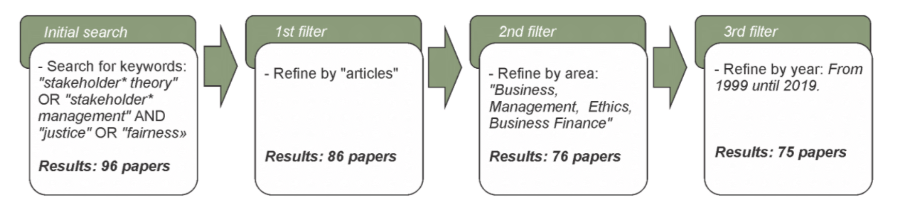
Figure 1.
Selection of Papers
Source: Authors (2019)
For the literature review, we employ a thorough analysis of each of the 75 selected papers. This review will be based on the literature on stakeholder theory and justice, in order to identify the concepts used in these studies and classify them according to the main aspects of justice pointed out in the theoretical background. Based on the review of these papers, we aim to (1) classify them according to the main notions of justice used; (2) categorize the main concepts associated with each dimension of justice used in the selected papers; and (3) offer and historical evolution and frequency of use of each dimension of justice used in the papers.
Results and Discussion
Data Description (75 papers)
The results of the sample indicate that the approach of justice aligned to the Stakeholder Theory has a non-linear development in the last 20 years. Figure 2 shows the evolution of the publications that correlate the two subjects over the years. The graph also shows the percentage variation of the number of publications of the year in relation to the previous one. It should be noted that the publications on those subjects gain a higher impulse mainly in the year of 2010, in which a total of 9 publications were observed. This impulse can be attributed to the book Stakeholder theory: The state of the art (Freeman et al., 2010), which favored, in general, the expansion of discussions around the Stakeholder Theory. Another relevant paper was the Bridoux and Stoelhorst (2014), which highlighted the idea of justice in the discussion of the concept of microfoundations, which can be associated with a boost in publications on the theme in the following year. In general, the inconsistency in the number of published papers suggests that the issue of justice can still be seen as a superficial and sporadic in the Stakeholder literature, which results in a lack of a research agenda and partnerships between authors.
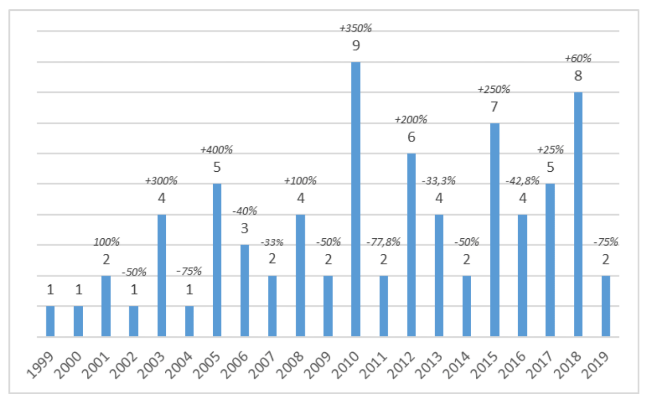
Figure 2.
Evolution of scientific production on justice and Stakeholder Theory
Source: Authors (2019)
The 75 papers analyzed are distributed in 35 journals. The most representative journal is The Journal of Business Ethics (23 publications) with about 30% of the sample observed, followed by the Business Ethics Quarterly (14 publications) and the Business Society (3 publications). These are high impact journals, listed in the JRC for the year 2017, with the impact factor of 2,917, 1,735 and 3,214 respectively. The Journal of Business Research, Organization Science, Organization Studies and Strategic Management Journal present 2 publications each. The other 27 papers (36% of the sample) are distributed in 27 journals.
In relation to authorship, it is also observed that there is little representation of authors dedicated to discuss both subjects in analysis. Most of the sample is composed of authors who published only 1 work relating to justice and Stakeholder Theory. The authors with the highest number of publications are respectively: Robert Phillips (6 publications) and Douglas Bosse (4 publications), followed by Jeffrey Harrison, Sefa Hayibor and Harry Van Buren (3 publications each). Brammer S., Fassin Y., Greenwood M. and Moriaty J. present 2 publications each.
The sample examined indicates that the paper with the highest impact is the one written by Aguilera, Rupp and Williams (2007). The paper has a total of 970 citations and addresses a theoretical model that integrates theories of justice, corporate governance and capitalism variables to understand why business organizations are increasingly involved in corporate social responsibility (CSR) initiatives and, from there, show the potential for positive social change. Table 3 lists the 10 most cited papers in the sample.
| Title | Authors | Journal | Publication Year | Total of Citation |
| Putting the S back in corporate social responsibility: A multilevel theory of social change in organizations | Aguilera, Ruth V.; Rupp, Deborah E.; Williams, Cynthia A.; Ganapathi, Jyoti | Academy Of Management Review | 2007 | 970 |
| What stakeholder theory is not | Phillips, R; Freeman, RE; Wicks, AC | Business Ethics Quarterly | 2003 | 389 |
| The contribution of corporate social responsibility to organizational commitment | Brammer, Stephen; Millington, Andrew; Rayton, Bruce | International Journal Of Human Resource Management | 2007 | 340 |
| Managing for stakeholders, stakeholder utility functions, and competitive advantage | Harrison, Jeffrey S.; Bosse, Douglas A.; Phillips, Robert A. | Strategic Management Journal | 2010 | 257 |
| Stakeholder legitimacy | Phillips, R | Business Ethics Quarterly | 2003 | 168 |
| Stakeholders, reciprocity, and firm performance | Bosse, Douglas A.; Phillips, Robert A.; Harrison, Jeffrey S. | Strategic Management Journal | 2009 | 147 |
| Balancing ethical responsibility among multiple organizational stakeholders: The Islamic perspective | Beekun, RI; Badawi, JÁ | Journal Of Business Ethics | 2005 | 115 |
| Ethics and HRM: A review and conceptual analysis | Greenwood, MR | Journal Of Business Ethics | 2002 | 112 |
| Corporate social responsibility as a source of employee satisfaction | Bauman, Christopher W.; Skitka, Linda J. | Research In Organizational Behavior | 2012 | 93 |
| The environment as a stakeholder? A fairness-based approach | Phillips, RA; Reichart, J | Journal Of Business Ethics | 2000 | 81 |
After an initial descriptive analysis of the studies that integrate the concepts of justice and Stakeholder Theory, we continue with a literature analysis of the papers.
Literature Analysis
On this section, we proceed to the literature review of the selected papers. In total, it was selected 37 papers – 29 theoretical papers and 8 empirical papers, based on the frequency and depth in which the two main concepts are discussed. Those papers were examined according to the theoretical background presented on stakeholder theory and justice. Table 4 presents the results for this analysis. The analysis was made in order to classify them according to the main notions of justice used and to categorize the main concepts associated with each dimension of justice used in the papers.
| Author | Year | Concepts of justice | Nature of study |
| Strong, Ringer & Taylor | 2001 | Distributive: Outcome/Output fairness Procedural: Justness of action | Empirical Research |
| Phillips, Freeman & Wicks | 2003 | Distributive: Outcome/Output fairness Procedural: Justness of process; Participation in the process | Theoretical Research |
| Berry | 2003 | Environmental: Fair environment treatment | Empirical Research |
| Simmons & Lovegrove | 2005 | Distributive: Outcome/Output fairness Procedural: Justness of process/procedures Interactional: Ease of communication; Fair interpersonal treatment | Theoretical Research |
| Smith | 2005 | Distributive: Outcome/Output fairness Procedural: Justness of process/procedure; Participation in the process | Theoretical Research |
| Aguilera et al. | 2007 | Distributive: Outcome/Output fairness Procedural: Justness of actions Interactional: Fair interpersonal treatment | Theoretical Research |
| Brammer, Millington & Rayton | 2007 | Procedural: Ethical citizenship; Justness of process/procedure | Empirical Research |
| Van Buren III & Greenwood | 2008 | Distributive: Outcome/Output fairness Procedural: Justness of process/procedure | Theoretical Research |
| Harrison, Bosse & Phillips | 2008 | Distributive: Outcome/Output fairness Procedural: Justness of action Interactional: Fair interpersonal treatment | Theoretical Research |
| Crul & Zinkhan | 2008 | Distributive: Outcome/Output fairness; Justness of allocation Procedural: Justness of process/procedure; Justness of action | Theoretical Research |
| Harrison, Bosse & Phillips | 2009 | Distributive: Balance of power Procedural: Justness of process/procedure Interactional: Fair interpersonal treatment | Theoretical Research |
| Greenwood & Van Buren III | 2010 | Distributive: Justness of allocation Procedural: Justness of actions Interactional: Ease of communication; Fair interpersonal treatment | Theoretical Research |
| Heath, Moriarty & Norman | 2010 | Distributive: Outcome/Output fairness Procedural: Justness of process/procedures Interactional: Ease of communication; Fair interpersonal treatment | Theoretical Research |
| Niedermeyer, Jaskiewicz & Klein | 2010 | Procedural: Justness of process/procedures | Theoretical Research |
| Goodstein & Butterfield | 2010 | Distributive: Outcome/Output fairness Procedural: Justness of process/procedure Interactional: Fair interpersonal treatment | Theoretical Research |
| Fong | 2010 | Distributive: Justness of allocation | Empirical Research |
| Werder | 2011 | Distributive: Outcome/Output fairness Procedural: Justness of actions | Theoretical Research |
| Del Bosco & Misani | 2011 | Procedural: Justness of process/procedures Interactional: Fair interpersonal treatment | Theoretical Research |
| Bauman & Skitka | 2012 | Procedural: Justness of process/procedures Interactional: Fair interpersonal treatment | Theoretical Research |
| Lamin & Zaheer | 2012 | Distributive: Outcome/Output fairness | Empirical Research |
| Brown & Forster | 2012 | Distributive: Justness of allocation | Theoretical Research |
| Hayibor | 2012 | Distributive: Justness of allocation Procedural: Participation in the process | Theoretical Research |
| Fassin | 2012 | Distributive: Outcome/Output fairness | Theoretical Research |
| Harrison & Bosse | 2013 | Distributive: Outcome/Output fairness; Procedural: Justness of actions; Participation in the process | Theoretical Research |
| Pollack, Bosse | 2013 | Distributive: Justness of allocation Procedural: Justness of process/procedure Interactional: Fair interpersonal treatment | Theoretical Research |
| Moriarty | 2014 | Distributive: Outcome/Output fairness Procedural: Participation in the process | Theoretical Research |
| Beekun & Badawi | 2014 | Distributive: Justness of allocation Social: Equality of treatment | Theoretical Research |
| Phillips & Reichart | 2014 | Environmental: Fair environment treatment | Theoretical Research |
| Tashman & Raelin | 2015 | Interactional: Ease of communication; Fair treatment | Theoretical Research |
| El Akremi et al. | 2015 | Distributive: Outcome/Output fairness Procedural: Justness of actions Interactional: Fair interpersonal treatment | Empirical Research |
| Feng, Wang & Saini | 2015 | Distributive: Justness of allocation Procedural: Justness of process/procedures | Empirical Research |
| Fassin & Drover | 2015 | Distributive: Outcome/Output fairness Procedural: Justness of process/procedures Interactional: Fair interpersonal treatment | Theoretical Research |
| Hahn | 2015 | Distributive: Outcome/Output fairness Procedural: Justness of process; Justness of action Intentional: Fair motivation | Theoretical Research |
| Halybor | 2015 | Distributive: Justness of allocation Procedural: Justness of process/procedure Interactional: Ease of communication; Fair interpersonal treatment | Theoretical Research |
| Beckman, Khare & Matear | 2016 | Procedural: Participation in the process Environmental: Fair environment treatment | Theoretical Research |
| Manita et al. | 2018 | Social: Equality of opportunity | Empirical Research |
| Wiseman & Faqihi | 2018 | Distributive: Justness of allocation | Theoretical Research |
We draw a graph presenting an historical evolution and frequency of use of each dimension of justice used in the papers previously examined. This summarization can be found in the Figure 3 below:
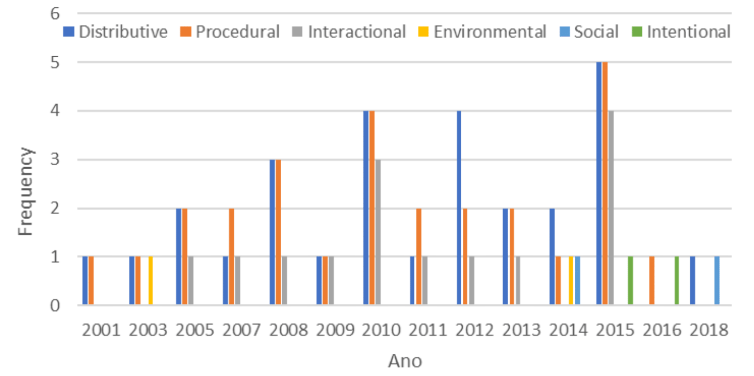
Figure 3.
Frequency of justice dimensions used over the years
Source: Authors (2009)
The Table 5 presents a synthesis of the main concepts associated to each dimension found in the previous analysis. As we can see from those results, distributive, procedural and, on a lesser extent, interactional justice are the main dimensions referenced on papers regarding the stakeholder theory. These finds follow the bulk of the literature on the subject, that points that those are the three main dimensions that comprise the notion of justice in the business literature (Cohen-Charash & Spector, 2001; Cropanzano et al., 2007).
“Outcome/Output fairness” and “Justness allocation”, related to distributive justice, and “justness of process/procedures” and “justness of action”, related to procedural justice, represent the majority of the concepts used in the studies. These concepts deal with notions very present in the development of stakeholder theory and its models, such as fair value distribution to stakeholders and fair process of distribution (Bosse et al., 2009; Harrison et al., 2010).
We see an increase in concepts related to inclusion of stakeholders in decision-making process through “Participation in the process”, and the fair treatment of stakeholders from an interpersonal level through “Fair interpersonal treatment”. These results further the notion of stakeholder engagement as a way for a firm to manage its stakeholders and increase performance, something pointed out by the literature (e.g. Ayuso et al., 2011; Harrison & Wicks, 2013; Henisz et al., 2014).
Moreover, in recent years, we see the increase interest in new forms of justice by the scholar, such as environmental justice, social justice and intentional justice. Those new types of justice come from different fields of knowledge, such as philosophy, environment studies and sociology/feminism studies, and can act as a way to further the potential of stakeholder management in dealing with an increase diverse society and demands.
| Type of Justice | Main concepts | Source |
| Distributive | Outcome/Output fairness | Strong, Ringer & Taylor (2001); Phillips, Freeman & Wicks (2003); Simmons & Lovegrove (2003); Smith (2005); Aguilera et al. (2007); Van Buren III & Greenwood (2008); Harrison, Bosse & Phillips (2008); Crul & Zinkhan (2008); Goodstein & Butterfield (2010); Werder (2011); Lamin & Zaheer (2012); Fassin (2012); Harrison & Bosse (2013); Moriarty (2014); El Akremi et al. (2015); Fassin & Drover (2015); Hahn (2015) |
| Justness of allocation | Crul & Zinkhan (2008); Greenwood & Van Buren III (2010); Fong (2010); Brown & Forster (2012); Hayibor (2012); Harrison & Bosse (2013); Pollack & Bosse (2013); Beekun & Badawi (2014); Feng, Wang & Saini (2015); Halybor (2015); Wiseman & Faqihi (2018) | |
| Balance of power | Harrison, Bosse & Phillips (2009) | |
| Procedural | Justness of process/procedures | Simmons & Lovegrove (2003); Smith (2005); Brammer, Millington & Rayton (2007); Van Buren III & Greenwood (2008); Crul & Zinkhan (2008); Harrison, Bosse & Phillips (2009); Niedermeyer, Jaskiewicz & Klein (2010); Goodstein & Butterfield (2010); Del Bosco & Misani (2011); Bauman & Skitka (2012); Pollack & Bosse (2013); Feng, Wang & Saini (2015); Fassin & Drover (2015); Hahn (2015); Halybor (2015) |
| Justness of actions | Strong, Ringer & Taylor (2001); Phillips, Freeman & Wicks (2003); Aguilera et al. (2007); Harrison, Bosse & Phillips (2008); Crul & Zinkhan (2008); Greenwood & Van Buren III (2010); Werder (2011); Harrison & Bosse (2013); El Akremi et al. (2015); Hahn (2015) | |
| Participation in the process | Phillips, Freeman & Wicks (2003); Smith (2005); Hayibor (2012); Harrison & Bosse (2013); Moriarty (2014); Beckman, Khare & Matear (2016) | |
| Ethical citizenship | Brammer, Millington & Rayton (2007) | |
| Interactional | Ease of communication | Simmons & Lovegrove (2003); Greenwood & Van Buren III (2010); Tashman & Raelin (2015); Halybor (2015) |
| Fair interpersonal treatment | Simmons & Lovegrove (2003); Aguilera et al. (2007); Harrison, Bosse & Phillips (2008); Harrison, Bosse & Phillips (2009); Greenwood & Van Buren III (2010); Goodstein & Butterfield (2010); Del Bosco & Misani (2011); Bauman & Skitka (2012); Pollack & Bosse (2013); Tashman & Raelin (2015); El Akremi et al. (2015); Fassin & Drover (2015); Halybor (2015) | |
| Environmental | Fair environment treatment | Berry (2003); Phillips & Reichart (2014); Beckman, Khare & Matear (2016) |
| Social | Equality of opportunity | Manita et al. (2018) |
| Equality of treatment | Beekun & Badawi (2014) | |
| Intentional | Fair motivation | Hahn (2015) |
Research agenda
After the systematic review of the data, we propose below a few propositions for future research. These propositions are based on the theoretical background and the framework of the studies gathered and examined in this paper.
Proposition 1: How can justice be applied to secondary stakeholders on an organizational level?
Much of the theoretical and empirical research done on Stakeholder Theory and justice focused on the relationship between managerial justice, applied by the firm, and primary stakeholders (Freeman, 1984; Mitchell et al., 1997; Harrison et al., 2010). There is a lack of studies that seek to deepen the theoretical and practical knowledge of distributive justice, procedural justice and interactional justice among secondary stakeholders.
Most of the stakeholder management models (e.g. Mitchell et al., 1997; Harrison et al., 2010; Bridoux and Stoelhorst, 2014) do not take into consideration how concepts of justice, such as distributive justice, procedural justice, and interactional justice can be applied to secondary stakeholders. Considering that Stakeholder Theory praises itself as been a theory that aims to include the needs of all stakeholders (Freeman, 1984), further investigation on secondary stakeholders and how justice can influence their actions is warranted.
Proposition 2: Can other types of justice influence primary stakeholders value creation?
In the Stakeholder Theory Literature, distributive, procedural and, to a lesser degree, interactional justice are important factors in value creation for primary stakeholder. However, we see the growth of other types of justice influencing organizations' strategic decisions, such as environmental justice, social justice and intentional justice. Factors that influence strategic management decisions play a big role on value creation for firms and its stakeholders (Bosse et al., 2009).
Although these types of justice are more associated with secondary stakeholders, there is a need for studies that show whether other kinds of justice, more associated to secondary stakeholders, can influence value creation for primary stakeholders.
Proposition 3: What is the role of interactional justice in firm performance and value creation for primary stakeholders?
Interaction justice has been addressed in the Stakeholder Theory literature largely from a theoretical perspective (Bosse et al., 2009, Goodstein & Butterfield, 2010; Pollack & Bosse, 2014). However, there is an absence of empirical studies that verify the influence of interactional justice in value creation for stakeholders and firm performance.
The literature on the subject highlights the practical utility in applying procedural justice and interactional justice separately (Moye et al., 1997; Cropanzano et al., 2002). Therefore, efforts need to be made in order to examine the role of interactional justice in firm performance and value creation in a separate way from its relation to procedural justice.
Proposition 4: Does one type of justice leads to better firm performance and value creation for stakeholders over another? Is it possible to establish a hierarchical degree with respect to justice and its outcomes for the firm and its stakeholders?
The theoretical approach to justice in the Stakeholder Literature often conveys the importance of organizational justice and its three major components. However, those components were rarely put to test to see which of them could offer a better improvement with regards to firm performance and value creation for stakeholders.
The few empirical studies on those matters rely on the assumption that those aspects of justice exist and are necessary (Greenberg, 1990; Strong et al., 2001) or that one is prevalent over another for the analysis (Hahn, 2015; Fong, 2010), without any judgment about which one is better. Therefore, empirical research could be done isolating specifics aspects of justice, and comparative measures could be made in order to verify which concept of justice leads to greater improvement given similar variables and contexts.
Conclusion/ Contributions
Stakeholder Theory employs a myriad of concepts with the goal to verify and broaden its vision and improve the organization-stakeholders relationship. The concept of justice has, in the meantime, been the focus of many studies, being a key component in model development and the improvement of managerial strategies (Freeman, 1994; Harrison et al., 2010). The present study sought to achieve two objectives: (1) to provide a theoretical basis and a panoramic view on the concept of justice in the literature of Stakeholders Theory and how this concept has been applied in some of the most relevant studies in the field; and (2) offer a research agenda for future studies regarding these two subjects. The analysis of 75 papers that deal with the relationship of the two main subjects showed that there are few associations and a low rate of collaboration among authors, which may indicate an irregular and superficial consideration of them in the literature. These findings help further the knowledge about the current state of the Stakeholder Theory literature and its main scholars on the subject of justice in the theory, and offer some guidance to current and future researchers who intend to expand on the relationship between these subjects.
Future studies may seek to answer the propositions indicated in this research, which suggests the following questions: (1) How can justice be applied to secondary stakeholders at the organizational level? (2) Can other types of justice, related to secondary stakeholders, influence the creation of value for key stakeholders? (3) What is the role of interactional justice in company performance and value creation for key stakeholders? (4) Does one type of justice lead to better company performance and value creation for stakeholders at the expense of another? Is it possible to establish a hierarchical degree in relation to justice and its results for the company and its stakeholders? Moreover, further research can attempt to deepen the understanding between the concept of justice and Stakeholder Theory through statistical techniques. A cluster analysis to identify co-citations, co-occurrence of keywords and bibliographical coupling can be performed to assist on this matter. Finally, the use of a relatively small sample and the need to explore the concept of justice in other areas of management can be identified as the limitations of this study.
References
Atallah, A. N., & Castro, A. A. (1998). Revisão sistemática da literatura e metanálise. Medicina baseada em evidências: fundamentos da pesquisa clínica (pp. 42-48). São Paulo: Lemos-Editorial.
Ayuso, S., Ángel Rodríguez, M., García-Castro, R., & Ángel Ariño, M. (2011). Does stakeholder engagement promote sustainable innovation orientation?. Industrial Management & Data Systems, 111(9), 1399-1417. https://doi.org/10.1108/02635571111182764
Berry, G. R. (2003). Organizing against multinational corporate power in cancer alley: The activist community as primary stakeholder. Organization & Environment, 16(1), 3-33. https://doi.org/10.1177/1086026602250213
Bies, R. J. 2005. Are Procedural Justice and Interactional Justice Conceptually Distinct? In J. Greenberg & J. A. Colquitt (Eds.), Handbook of organizational justice (pp. 85-112). Mahwah, NJ, US: Lawrence Erlbaum Associates Publishers.
Bies, R. J., & Moag, J. F. (1986). Interactional justice: Communication criteria of fairness. In R. J. Lewicki, B. H. Sheppard, & M. H. Bazerman (Eds.), Research on negotiations in organizations (Vol. 1, pp. 43–55). Greenwich, CT: JAI Press.
Boaventura, J. M. G., Rodrigues, F., Silva, E., & Silva, R. (2009). Teoria dos stakeholders e teoria da firma: um estudo sobre a hierarquização das funções-objetivo em empresas brasileiras. Revista Brasileira de Gestão de Negócios, 11(32).
Bosse, D.A, Phillips, R.A, & Harrison, J.S. 2009. Stakeholders, reciprocity, and firm performance. Strategic Management Journal 30: 447–456. https://doi.org/10.1002/smj.743
Bridoux, F., & Stoelhorst, J. W. (2014). Microfoundations for stakeholder theory: Managing stakeholders with heterogeneous motives. Strategic management journal, 35(1), 107-125. https://doi.org/10.1002/smj.2089
Bridoux, F., & Stoelhorst, J. W. (2016). Stakeholder relationships and social welfare: A behavioral theory of contributions to joint value creation. Academy of Management Review, 41(2), 229-251. https://doi.org/10.5465/amr.2013.0475
Brink, a., & Eurich, J. (2006). Recognition based upon the vitality criterion: A key to sustainable economic success. Journal of Business Ethics, 67(2), 155-164. https://doi.org/10.1007/s10551-006-9020-x
Clarkson, M. E. (1995). A stakeholder framework for analyzing and evaluating corporate social performance. Academy of management review, 20(1), 92-117. https://doi.org/10.5465/amr.1995.9503271994
Cohen, M. A. (2010). The narrow application of Rawls in business ethics: A political conception of both stakeholder theory and the morality of markets. Journal of Business Ethics, 97(4), 563-579. https://doi.org/10.1007/s10551-010-0525-y
Cohen-Charash, Y., & Spector, P. E. (2001). The role of justice in organizations: A meta-analysis. Organizational behavior and human decision processes, 86(2), 278-321. https://doi.org/10.1006/obhd.2001.2958
Cooper, H. (2015). Research synthesis and meta-analysis: A step-by-step approach (Vol. 2). Sage publications.
Cooper, H., Hedges, L. V., & Valentine, J. C. (2009). The handbook of research synthesis and meta-analysis. Russell Sage Foundation.
Cropanzano, R., Bowen, D. E., & Gilliland, S. W. (2007). The Management of Organizational Justice. Academy of Management Perspectives, 21(4), 34–48.https://doi.org/10.5465/amp.2007.27895338
Cropanzano, R., Prehar, C. A., & Chen, P. Y. (2002). Using Social Exchange Theory to Distinguish Procedural from Interactional Justice. Group & Organization Management, 27(3),324–351.https://doi.org/10.1177/1059601102027003002
Crowther, M., Lim, W., & Crowther, M. A. (2010). Systematic review and meta-analysis methodology. Blood, 116(17), 3140-3146. https://doi.org/10.1182/blood-2010-05-280883
Crul, L., & Zinkhan, G. M. (2008). A theory of the firm perspective on marketing and distributive justice. Journal of Macromarketing, 28(1), 12-23. https://doi.org/10.1177/0276146707311242
De Cremer, D., & Tyler, T. R. (2005). Managing group behavior: The interplay between procedural justice, sense of self, and cooperation. In M. Zanna (Ed.), Advances of experimental social psychology (Vol. 38, pp. 151–218). New York: Academic Press. https://doi.org/10.1016/S0065-2601(05)37003-1
Donaldson, T., & Preston, L. E. (1995). The stakeholder theory of the corporation: Concepts, evidence, and implications. Academy of management Review, 20(1), 65-91. https://doi.org/10.5465/amr.1995.9503271992
Evan, W. M., & Freeman, R. E. (1993). A stakeholder theory of the modern corporation: Kantian capitalism. In W.M. Hoffman, & R.E. Frederick (Eds.), Business Ethics: Readings and Cases in Corporate Morality. Wiley.
Ferris, G. (1999). Human resources management: some new directions. Journal of Management, 25(3), 385–415. https://doi.org/10.1177/014920639902500306
Folger, R., & Bies, R. J. (1989). Managerial responsibilities and procedural justice. Employee Responsibilities and Rights Journal, 2(2), 79–90. https://doi.org/10.1007/BF01384939
Folger, R., & Konovsky, M. A. (1989). Effects of procedural and distributive justice on reactions to pay raise decisions. Academy of Management journal, 32(1), 115-130. https://doi.org/10.2307/256422
Fong, E. A. (2010). CEO pay fairness as a predictor of stakeholder management. Journal of Business Research, 63(4), 404-410. https://doi.org/10.1016/j.jbusres.2009.04.017
Freeman, R. E. (1984). Strategic management: a stakeholder approach. Boston: Pitman.
Freeman, R. E. (1994). The politics of stakeholder theory: Some future directions. Business ethics quarterly, 409-421. https://doi.org/10.2307/3857340
Freeman, R. E. (2017). Five challenges to stakeholder theory: A report on research in progress. In Stakeholder Management (pp. 1-20). Emerald Publishing Limited. https://doi.org/10.1108/S2514-175920170000001
Freeman, R. E., Harrison, J. S., & Wicks, A. C. (2007). Managing for stakeholders: Survival, reputation, and success. Yale University Press.
Freeman, R. E., Harrison, J. S., Wicks, A. C., Parmar, B. L., & De Colle, S. (2010). Stakeholder theory: The state of the art. Cambridge University Press. https://doi.org/10.1017/CBO9780511815768
Frooman, J. (1999). Stakeholder influence strategies. Academy of management review, 24(2), 191-205. https://doi.org/10.5465/amr.1999.1893928
Goodstein, J., & Butterfield, K. D. (2010). Extending the horizon of business ethics: Restorative justice and the aftermath of unethical behavior. Business Ethics Quarterly, 20(3), 453-480. https://doi.org/10.5840/beq201020330
Greenberg, J. (1990). Organizational Justice: Yesterday, Today, and Tomorrow', Journal of Management 16, 399-432. https://doi.org/10.1177/014920639001600208
Hahn, T. (2015). Reciprocal stakeholder behavior: A motive-based approach to the implementation of normative stakeholder demands. Business & Society, 54(1), 9-51. https://doi.org/10.1177/0007650312439029
Harrison, J. S., Bosse, D. A., & Phillips, R. A. (2010). Managing for stakeholders, stakeholder utility functions, and competitive advantage. Strategic management journal, 31(1), 58-74. https://doi.org/10.1002/smj.801
Harrison, J. S., & Wicks, A. C. (2013). Stakeholder theory, value, and firm performance. Business ethics quarterly, 23(1), 97-124. https://doi.org/10.5840/beq20132314
Henisz, W. J., Dorobantu, S., & Nartey, L. J. (2014). Spinning gold: The financial returns to stakeholder engagement. Strategic Management Journal, 35(12), 1727-1748. https://doi.org/10.1002/smj.2180
John, R. 1971. A theory of justice. Cambrigde: Harvard University Press.
Jones, T. M., & Wicks, A. C. (1999). Convergent stakeholder theory. Academy of management review, 24(2), 206-221. https://doi.org/10.5465/amr.1999.1893929
Kim, W., & Mauborgne, R. (1998). Procedural justice, strategic decision making, and the knowledge economy. Strategic management journal, 19(4), 323-338.
Kujala, J., Lehtimäki, H., & Myllykangas, P. (2017). Value Co-creation in Stakeholder Relationships: A Case Study. In Stakeholder Engagement: Clinical Research Cases (pp. 15-30). Springer, Cham. https://doi.org/10.1007/978-3-319-62785-4_2
Kuvaas, B. (2007). An Exploration of How the Employee? Organization Relationship Affects the Linkage Between Perception of Developmental Human Resource Practices and Employee Outcomes. Journal of Management Studies, 45(1), 1-25. https://doi.org/10.1111/j.1467-6486.2007.00710.x
Laczniak, G. R., & Murphy, P. E. (2007). Distributive Justice: Pressing Questions, Emerging Directions, and the Promise of Rawlsian Analysis. Journal of Macromarketing, 28(1), 5–11. https://doi.org/10.1177/0276146707312214
Laplume, A. O., Sonpar, K., & Litz, R. A. (2008). Stakeholder theory: Reviewing a theory that moves us. Journal of management, 34(6), 1152-1189. https://doi.org/10.1177/0149206308324322
Leventhal, G. S. (1980). What should be done with equity theory? New approaches to the study of fairness in social relationships. In K. J. Gergen, M. S. Greenberg, & R. H. Willis (Eds.), Social exchange: Advances in theory and research (pp. 27–55). New York: Plenum. https://doi.org/10.1007/978-1-4613-3087-5_2
Lindgreen, A., Maon, F., Vanhamme, J., Florencio, B. P., Vallaster, C., Strong, C. (Eds.). (2018). Engaging with Stakeholders: A Relational Perspective on Responsible Business. Routledge. https://doi.org/10.4324/9780429450341
Luo, Y. (2007). The Independent and Interactive Roles of Procedural, Distributive, and Interactional Justice in Strategic Alliances. Academy of Management Journal, 50(3), 644–664. https://doi.org/10.5465/amj.2007.25526452
Miles, S. (2017). Stakeholder theory classification: A theoretical and empirical evaluation of definitions. Journal of Business Ethics, 142(3), 437-459. https://doi.org/10.1007/s10551-015-2741-y
Mitchell, R. K., Agle, B. R., & Wood, D. J. (1997). Toward a theory of stakeholder identification and salience: Defining the principle of who and what really counts. Academy of management review, 22(4), 853-886. https://doi.org/10.5465/amr.1997.9711022105
Moye, N. A., Masterson, S. S., & Bartol, K. M. (1997). Differentiating antecedents and consequences of procedural and interactional justice: Empirical evidence in support of separate constructs. Paper presented at the annual meeting of the Academy of Management, Boston, MA.
Phillips, R. (2003). Stakeholder theory and organizational ethics. Berrett-Koehler Publishers.
Phillips, R. A. (1997). Stakeholder Theory and a Principle of Fairness', Business. Ethics Quarterly 7(1), 51-66. https://doi.org/10.2307/3857232
Phillips, R., Freeman, R. E., & Wicks, A. C. (2003). What stakeholder theory is not. Business ethics quarterly, 13(4), 479-502. https://doi.org/10.5840/beq200313434
Pollack, J. M., & Bosse, D. A. (2014). When do investors forgive entrepreneurs for lying?. Journal of Business Venturing, 29(6), 741-754. https://doi.org/10.1016/j.jbusvent.2013.08.005
Ribeiro, H. C. M., & Costa, B. C. (2017). Influência dos Stakeholders na gestão e no controle das organizações esportivas. Revista Ciências Administrativas, 23(1), 42-69. https://doi.org/10.5020/2318-0722.23.1.42-69
Sachs, S., & Rühli, E. (2011). Stakeholders matter: A new paradigm for strategy in society. Cambridge University Press. https://doi.org/10.1017/CBO9781139026963
Schwab, K. (2020). Davos Manifesto 2020: The Universal Purpose of a Company in the Fourth Industrial Revolution. Retrieved April 4, 2020, from: https://www.weforum.org/agenda/2019/12/davos-manifesto-2020-the-universal-purpose-of-a-company-in-the-fourth-industrial-revolution/.
Stocker, F., Mascena, K. M. C., Azevedo, A. C., & Boaventura, J. M. G. (2019). Teoria de Redes de Influências de "Stakeholders": uma abordagem revisitada. Cadernos EBAPE.BR, 17(Spe), 673-688. https://doi.org/10.1590/1679-395176683
Strong, K. C., Ringer, R. C., & Taylor, S. A. (2001). The rules of stakeholder satisfaction (*Timeliness, honesty, empathy). Journal of Business Ethics, 32(3), 219-230. https://doi.org/10.1023/A:1010714703936
Taggart, J. H. (1997). Autonomy and Procedural Justice: A Framework for Evaluating Subsidiary Strategy. Journal of International Business Studies, 28(1), 51–76. https://doi.org/10.1057/palgrave.jibs.8490093
Tranfield, D., Denyer, D., & Smart, P. (2003). Towards a methodology for developing evidence‐informed management knowledge by means of systematic review. British journal of management, 14(3), 207-222. https://doi.org/10.1111/1467-8551.00375
Tyler, T. R., Bies, R. J. (1990). Beyond formal procedures: The interpersonal context of procedural justice. In J. S. Carroll (Ed.), Applied social psychology and organizational settings (pp. 77–98). Hillsdale, NJ: Erlbaum. https://doi.org/10.4324/9781315728377-4