Artigos
An appraisal of the measures taken by the Indian Government to attain sustainable development goals and to meet the commitments of the Paris Agreement
Uma avaliação das medidas tomadas pelo governo indiano para atingir as metas de desenvolvimento sustentável e cumprir os compromissos do Acordo de Paris
Una evaluación de las medidas adoptadas por el Gobierno de la India para alcanzar los objetivos de desarrollo sostenible y cumplir los compromisos del Acuerdo de París
Un bilan des mesures prises par le gouvernement indien pour atteindre les objectifs de développement durable et respecter les engagements de l'Accord de ParisParis
评估印度政府为实现可持续发展目标和履行《巴黎协定》承诺所采取的措施摘要

An appraisal of the measures taken by the Indian Government to attain sustainable development goals and to meet the commitments of the Paris Agreement
Passagens. Revista Internacional de História Política e Cultura Jurídica, vol. 15, núm. 2, pp. 301-318, 2023
Universidade Federal Fluminense

Esta obra está bajo una Licencia Creative Commons Atribución 4.0 Internacional.
Recepción: 22 Julio 2022
Aprobación: 31 Octubre 2022
Abstract: India has been at the forefront of reducing the emission of the greenhouse gases even before the countries agreed upon the Paris Agreement. India has designed the National Action Plan for Climate Change (NAPCC). The effort shows the sensitivity of the country towards the climate issues. The country has seen lot of progress in the direction from laying down the different mission under NAPCC in the year 2008 to submission of the Intended Nationally Determined Contributions, in 2015. The Country has been making strides to achieve the goals set out in the INDCC. It has been seen that goal pertaining to the installed capacity of renewable energy is on the path of being achieved before the schedule. The commitment with which Indian government has been working towards meeting its targets set out in the INDCC, shows the country is determined to contribute in achieving the climate neutrality, much essential to safeguard the Mother Earth and the humanity. The Researcher has discussed the Policy measures adopted by India in order to achieve the targets set out in the INDCC. The Researcher has relied on the Government data and Report of the independent institutions, in order to analysis the progress of the country with respect to achieving the objectives of the Paris Agreement.
Keywords: greenhouse gases, Paris Agreement, renewable energy, National Environment Policy, climate change.
Resumo: A Índia esteve na vanguarda da redução das emissões de gases de efeito estufa antes mesmo da adoção do Acordo de Paris. A Índia já tinha elaborado um Plano de Ação Nacional de Combate às Mudanças Climáticas. Tal esforço mostra a sensibilidade do país em relação às questões climáticas. O país tem visto muitos avanços entre o estabelecimento, no ano de 2008, das diferentes missões a empreender no quadro do NAPCC e a apresentação das Contribuições determinadas a nível nacional (Intended Nationally Determined Contributions - INDCC) de 2015. O país não mediu esforços para atingir as metas estabelecidas nas INDCC. Viu-se por exemplo que a meta referente à capacidade instalada de energia renovável está a caminho de ser alcançada antes do previsto. O empenho com que o governo indiano tem trabalhado para cumprir as metas estabelecidas nas INDCC mostra a determinação do país em contribuir para a neutralidade climática, tão essencial para a preservação da Mãe Terra e da humanidade. Trata-se aqui de discutir as medidas políticas adotadas pela Índia para atingir as metas estabelecidas nas INDCC, baseando-se nos dados do governo e nos relatórios de instituições independentes, a fim de analisar os progressos do país no que diz respeito ao cumprimento dos objetivos do Acordo de Paris.
Palavras-chave: gases de efeito estufa, Acordo de Paris, energia renovável, Política Nacional do Meio Ambiente, mudanças climáticas.
Resumen: La India estaba a la vanguardia en la reducción de las emisiones de gases de efecto invernadero incluso antes de que los países firmasen el Acuerdo de París. Además, este país ha diseñado un Plan Nacional de Acción para el Cambio Climático (NAPCC), un esfuerzo que muestra la sensibilidad de la India hacia los problemas climáticos. La India ha avanzado mucho en esta dirección, desde el establecimiento de diferentes misiones bajo el NAPCC en 2008 hasta la presentación de las Contribuciones Determinadas a Nivel Nacional (INDCC) en 2015. El país ha dado grandes pasos para alcanzar los objetivos establecidos en las INDCC. Según los datos, el objetivo relacionado con la capacidad instalada de energía renovable es posible que se alcance antes de lo previsto. El compromiso con el que el gobierno indio ha estado trabajando para cumplir los objetivos establecidos en las INDCC demuestra que el país está decidido a contribuir a la neutralidad climática, esencial para proteger a la Madre Tierra y a la humanidad. Esta investigación ha analizado las medidas políticas adoptadas por la India para alcanzar las metas establecidas en las INDCC. Además, se ha basado en datos del gobierno y en informes de instituciones independientes para analizar el avance del país en relación con el cumplimiento de los objetivos del Acuerdo de París.
Palabras clave: gases de efecto invernadero, Acuerdo de París, energía renovable, Política Nacional de Medio Ambiente, cambio climático.
Résumé: L’Inde était à l’avant-garde de la réduction des émissions de gaz à effet de serre avant même la signature de l’Accord de Paris. L’Inde avait en effet déjà élaboré un Plan d’action national de lutte contre le changement climatique (NAPCC). Cet effort montre bien la sensibilité du pays aux enjeux climatiques. Le pays a connu d’énormes avancées entre la définition en 2008 des différentes missions à mener dans le cadre du NAPCC et la présentation des objectifs des Contributions déterminées au niveau national (Intended Nationally Determined Contributions-INDCC) de 2015, pour lesquelles le pays a fourni d’importants efforts. On a pu constater que l’objectif afférent à la capacité installée d’énergie renouvelable est en passe d’être atteint avant la date prévue. La volonté politique avec laquelle le gouvernement indien s’est efforcé d’atteindre les objectifs définis dans les INDCC montre bien la détermination du pays à contribuer à la neutralité climatique, essentielle pour préserver la Terre Mère et l’humanité avec elle. Il s’agit ici de débattre des mesures politiques adoptées par l’Inde afin d’atteindre les objectifs fixés par les INDCC, en se basant sur les données du gouvernement et les rapports d’institutions indépendantes pour analyser les progrès réalisés par le pays en vue de la réalisation des objectifs de l’Accord de Paris.
Mots clés: gaz à effet de serre, Accord de Paris, énergies renouvelables, Politique nationale de l’environnement, changement climatique.
摘要: 在各国达成《巴黎协定》之前,印度就一直走在减少温室气体排放的国家的前列。印度制定了应对气候变化国家行动计划(NAPCC)。这一努力表明该国对气候问题的敏感性。从 2008 年起,在NAPCC 框架下,印度政府制定不同的使命,到 2015 年提交国家自主贡献计划(INDCC),该国在减少温室气体排放上取得了很大进展。该国一直在朝着实现 INDCC 中设定的目标迈进。可以看出,与可再生能源装机容量相关的目标正在提前实现。印度政府一直致力于实现INDCC 中设定的目标,表明该国决心为实现气候中和做出贡献,这对保护地球母亲和人类至关重要。研究人员讨论了印度为实现 INDCC 中规定的目标而采取的政策措施。研究人员依据印度政府的数据和独立机构的报告,分析该国在实现《巴黎协定》目标方面的进展。
關鍵詞: 温室气体, 巴黎协定, 再生能源, 国家环境政策, 气候变化.
Introduction
The Paris Agreement has been entered into by the majority of the nations across the world. The Primary concerns for which the agreement has been reached out, is to combat the adverse impact of the climate change (MOUSAVI et al., 2020). The issue of the climate change is the most important one, which concerns the mankind, at the moment. The ultimate objective of the Paris Agreement is to bring consensus among the countries to make efforts to contain the rise in global temperature up to 2 degrees centigrade, most preferably to 1.5 degree centigrade (BECK; JEROEN, 2021). The total emissions of the world, in the year 2021, had gone to the level of around 36 billion tonnes (INTERNATIONAL ENERGY AGENCY, 2022, p. 3). The share of India in the global emissions is around 7% (LE QUERE, 2021). India has always considered that despite it not being the part of problem, it wants to become the part of the solution. In furtherance of the objective of the Paris Agreement, it is expected that countries will try to achieve the peak of the Greenhouse gas emissions at the earliest. The framework of the Paris Agreement is based on the three broad parameters: Financial, Technical and Capacity Building Support (STEINEBACH, 2021). Under the financial parameter, agreement envisages provisioning of the financial support for the mitigation and adaptation. The Parameter of the Technical calls for the technological support to the developing countries from the developed countries. This will help in achieving the climate neutrality. It is a comprehensive term to denote that the net greenhouse gas emission has become zero or negative. This is possible, when the countries are taking efforts in reducing the greenhouse gas emissions and ensuring that the emissions are not exceeding the natural absorption through forest cover and Oceans. It calls for the individual and organizations to take efforts in offsetting the emissions. Offsetting is also a form of climate action, wherein the organizations can compensate for the emissions, they are responsible for.
Analysis of Paris Agreement
The Paris Agreement is the one of the path-breaking developments in the history of the fight of mankind, to save itself from the ensuing danger from the climate change. The agreement attains the importance in terms of its inclusivity, regarding the concerns of the countries, other than the developed countries. It is a matter of fact that the developed countries, had achieved the peak, as far as the greenhouse gas emissions are concerned. However, the developing and least developed countries have their commitment to their people. At the time of entering into the agreement, the electrification in India, was at the stage, where it was difficult to expect the country to commit for something which is legally binding, in terms of its greenhouse gas emissions.
The objectives of the Paris Agreement are aligned with efforts to ensure mitigation and adaptation, with reference to the greenhouse gas emissions, in order to arrest the rise in the temperature to 2 degrees centigrade and preferably to 1.5 degree centigrade in comparison to the pre-industrial levels.
Legal Architecture of the Paris Agreement
The Paris Agreement has been a historic and visionary document, as far as the fight against the climate change is concerned. There have been varied issues, in the form of concern, from the developing countries, regarding the expectations pertaining to cut in emissions. The tussle, whether the agreement would be legally binding or not, has been there at the inception of the formulation of provisions of the Paris Agreement. Though it may be the debate over the usage of the wording in the agreement yet, that acquired the importance, as the legal nature of the document was dependent upon it. Initially, the parties to the agreement have been wary over the usage of the words like “commitment”. However, later there was a change in the terminology and the word “contribution” was used, which later became the part of the Intended Nationally Determined Contributions (INDC). That move was the transition from the binding to the non-binding nature of the document. The approach in achieving the objectives under the agreement has been a subject matter of debate. The overview of the Paris Agreement shows that the requirement to submit the intended nationally determined contributions, by the countries, provide the shape of bottom-up approach. However, review by the highest decision-making body under the agreement, and expectations set under the Paris Agreement, do give the impression of top-down approach at times. Hence, it will be more appropriate to call the approach as hybrid.
Financial and Technical assistance to Developing Countries
Article 3 of the Paris Agreement stresses that for the successful implementation of the provisions of the agreement, there is a need that the developing countries need to be supported.
The Paris Agreement stresses on the need to provide assistance to the developing countries (JERNNÄS; BJÖRN-OLA, 2019). The agreement presumes that the threat of climate change requires the efforts at global level. However, as the developing countries, not having enough wherewithal to fight the climate change, requires the support from the developed countries.
The developing countries, which are vulnerable to the impact of the climate change, require assistance in varied forms from the world bodies and the developed countries. The developing countries, lacking technical assistance, need to be provided, the same. The finance is also a critical issue, which needs to be taken care of. It is not possible for the least developed countries, to give up their reliance on the polluting sources of energy, without having reasonable alternative sources of energy. The development of the alternative sources of energy, require technical assistance and financial assistance from the developed countries (MIRZA et al., 2009).
The Article 2(2) of the Paris Agreement refers to the principle of the common but differentiated responsibilities and respective capabilities. It is being mentioned that the implementation of the agreement should be such that it should reflect the above principle.
The Preamble states that there is a need to realize that there are special needs and circumstances of the least developed countries, which needs to be catered through the support in terms of the finances and transfer of the technology.
The Preamble to the agreement talks about the participation of the developed countries as the leader in the implementation of the agreement. It presupposes, that in terms of the wherewithal, the developing countries, might not be in the position, to have the necessary resources, in order to achieve the objectives, mentioned in the agreement.
Article 9 of the Agreement seeks for the cooperation from the developed countries in providing the financial resources to the developing countries in formulating the strategies to mitigate the ill effects of the climate change and also to develop adaptation strategies, looking at the long-term threats posed by changing climate.
Article 10(1) of the Agreement states that the long-term strategy needs to be developed, as far as the development of the innovative technology to avert the rise in the greenhouse gas emissions is required. The Article also mentions that the transfer of technology hold importance in light of collaborative approach, envisioned in the preamble to the agreement. It is also stated in the agreement that the developed countries should provide a roadmap of the assistance to be provided to the developing, least developed and island nations, which are vulnerable to the climate change.
There are references in the agreement regarding the enhancement of capacity of developing countries to avert the hovering crisis due to the climate change. The need to enhance the capacity holds importance, in the light of urgent need to switch to cleaner energy alternatives. If it goes unheeded, there is a danger that the efforts undertaken globally, would go in vain, as the developing countries would not be able to adapt to the requirements under this agreement. Also, it will be unreasonable to expect from the developing world to divert their limited resources to cater to the needs of this agreement. The Paris Agreement itself, in its preamble states that the needs of the poor, disabled, women and children need to be accommodated, while planning under this agreement. The agreement stresses upon the institutional arrangement, in order to cater to the capacity building requirement. The agreement under Article 11 expects the developed countries to ensure the capacity building of the developing countries through the bilateral or multilateral mechanism. Also, under Article 11(4) of the agreement, it is stated that there should be the reporting of the measures undertaken to support the parties under the category of developing countries.
Article 13 envisages the development of transparency framework, wherein the mutual trust can be built between the developed and developing countries. It is stressed upon that in order to build the trust, it is important that there should be proper reporting of the assistance and support provided, as per the objectives laid down under Article 2 of the agreement. There is a need to build the trust, as that will encourage the developing countries to align their national policies in sync with the objectives of the agreement, within the limited arena of climate change.
The agreement is a vision drafted by the visionary leaders of the world, with an aim to protect the Mother Earth from the vagaries of the climate change. The mechanism established under this agreement is more of a self-driven process, rather than thrusted upon any country. It is expected that the countries will have the true self appraisal of the progress made. The agreement presupposes that not all the countries are at the same level to implement the visions and missions under this agreement.
Inclusivity in the Paris Agreement
The Paris Agreement is the reflection of the aspirations of the countries at the global level, to avert the threat, emerging from the after effects, of the climate change. The Agreement stresses that there is an urgent need to address the issue. The agreement relies on the available scientific documents to conclude there is an urgency which needs to be reflected in the actions of the world bodies in tackling the issue. However, it is appreciable that the draftsmen of the agreement, has not forgone the much-required inclusivity, which is required, in order to ensure the climate justice.
The Preamble to the agreement takes into account the importance, which different cultures attach to the ecosystem, by equating the Earth as the mother. There has been references that there has to be the involvement of all the countries globally. The importance to the collective decision making, ensures that the fight against the threat of the climate change is not of any one nation, however it is a collective battle against the danger hovering over the Mother Earth.
The agreement envisages that the decision makers, while taking any concrete actions, will take into account the rights of every human being. The explicit mention of the indigenous people, disabled, children and women ensure that the leader don’t ignore the general principles of equity, while setting out any long or short-term goals. The Preamble to the agreement specifically refers to the inter-generational equity. It requires restraint by the succeeding generation, while utilizing the providence from the earth.
Paris Agreement and Sustainable Development Goals
The objective behind the creation of the framework of the Paris Agreement was the reigning in the climate change. The sustainable development goals have been formulated with the multifarious objectives in mind, which include concrete steps to end all forms of poverty, to undertake the activities of economic development and to take urgent steps to combat the climate change. The three dimensions of the sustainable development goals include social, economic and environmental. The connection between the Paris Agreement and 2030 Agenda becomes pertinent when one goes through the 17 sustainable development goals. Following sustainable development goals find linkage with the objective of the Paris Agreement:
- 1. SDG 2 aims to end the hunger. The efforts require sustainable practices of agriculture, which can contribute in not letting the global temperatures rise above 2 degrees centigrade;
- 2. SDG 6 targets that there should be availability of clean water and sanitation;
- 3. SDG 7 mentions that there should be efforts in ensuring clean and affordable energy for all. In order to reduce the reliance on fossil fuels the countries should provide more impetus to renewable sources of energy;
- 4. SDG 11 refers to sustainable cities and human settlements which need to include the stress upon the reliance on climate friendly resources;
- 5. SDG 13 makes the direct reference to the climate action, which needs to be taken in order to avert the impact from the climate change;
- 6. SDG 15 states the importance of sustainably utilizing the resources of the ecosystems. The goal 15 is concerned with the life on the land. In order to sustain the life on the Earth, there have been references to protecting the forests and make efforts to overcome the desertification.
The comprehensive understanding of the sustainable development goals in Paris Agreement, appears to be an attempt at the global level, to improve the living conditions of every human on the Earth. The means suggested are the sustainable one in varied forms, which directly or indirectly affect the human life. The principal objective of the Agenda 2030 is to prepare the world to come up with measures which can defeat the poverty and hunger (QURESHI, 2015). The danger posed by climate change is multifarious. The adverse impacts of the climate change, has the potential to bring disruptions in the way of efforts of the countries, to attain the objectives of the Agenda 2030. The countries across the globe need to scale up their vigil against the factors contributing to climate change. The efforts should be taken in collaborative way, in order to have reasonable overall impact. There is no doubt that the consequences from the climate change have become more visible in the form of changing weather patterns. These signals from the nature should not be taken lightly and timely action on the front of climate change, is the need of the hour.
Efforts by the Government of India in order to achieve the goals of Paris Agreement
The condition for the implementation for the Paris Agreement was that at least 55 countries, which in aggregate contribute around 55 % of the gas emission, should ratify the agreement (SAVARESI, 2016). It was on 5th October 7, that conditions for enforcing the agreement was met and agreement came into force on 4th November, 2016.
It is a matter of fact that India has ratified the Paris Agreement under United Nations Framework for Climate Change on 2nd October, 2016. India became the 62nd country to have ratified the Paris Agreement. India’s share in the global greenhouse gas emissions is of 7%. India has formed an Apex Committee for the implementation of the Paris Agreement. India has made the efforts to achieve the installed capacity of electricity from non-fossil sources, to 39%, which is significant, in the background that India has pledged for the development of 40% of power capacity from non-fossils by the year 2030 (ROGELJ et al., 2017).
Intended Nationally Determined Commitments
India had been tackling the climate change prior to becoming the part of Paris Agreement. National Action Plan of India for Climate Change has been adopted way back in 2008. The Plan consists of total eight programmes. The Programmes include development of solar energy, energy efficiency, conservation mechanism of water resources, and sustainable agriculture among others. At the time of inception of these plans, India was one among the ten countries to have such plans, which shows that India has always been at the forefront, in implementing the climate action plans. The Plans under National Action Plan for Climate Change (NAPCC) are under different Ministries. It requires better coordination among the ministries, in order to meet the commitments, made by the Nation. The National Solar Mission under the NAPCC is to develop the capacity of renewable energy. India has been performing great on this front, as the initial target for the development of the 20 GW of capacity of solar energy has already been met before the schedule (RATHORE, 2017).
Electric Vehicle Policy
India is expected to become the third largest producer of automobiles, in the world. The Country has seen the exports of the automobiles rising year-on-year. The current growth of the export has been around 16%. In light of the above developments, it becomes important to streamline the evolving automobile sector with the mission set by the country, in line with the commitments in the Paris Agreement. It is very crucial for the country at the moment to make the switch from the Internal Combustion engines to the electric or hybrid vehicles.
In order to meet its commitment under the Paris Agreement, the government of India has been steering hard to promote the electric vehicles in India. It is envisaged by the authorities under the Government of India, that, by 2030, there will be a 100% switch to the electric and hybrid vehicles. This will substantially reduce the emissions contributing in the climate change.
The Policy for the adoption of Electric vehicle has been consolidated by the Notification dated 8th March, 2019 by the Department of Heavy Industries, Ministry of Heavy Industries and Public Enterprises. National Automotive Board, Department of Heavy Industries has been given the responsibility to implement the Faster Adoption and Manufacturing of Hybrid & Electric (FAME) vehicles in India. The Scheme of FAME is in its second phase at present. The outlay of around Rs.10,000 crore has been made for the implementation of the second phase of FAME (JUYAL, 2022). The first phase of FAME has commenced from 1st April, 2015. The first phase was initially planned for two years. However, it got extended to 31st March 2019. The fund allotted for the implementation of the first phase was 795 crores. Later it was enhanced to 895 crores.
The responsibility to implement the Phase II of the FAME has been entrusted upon an Inter-ministerial Empowered Committee. It will act as the Project Implementation and Sanctioning Committee (PISC). The PISC will be headed by the secretary, Department of Heavy Industries. The Scheme of FAME has been planned to be implemented through the following important verticals:
-
Demand Incentives
-
Laying down the network of Charging stations
-
Information and Educational activities
The first vertical has been given the due importance, which is visible from the allocation of the budget outlay for the same. Eighty per cent of the total budget outlay for the FAME II scheme has been made for the first vertical. Around Rs. 8596 crores have been allocated for boosting the demand. As far as the laying down of network of charging stations is concerned, Rs.1000 crore has been laid down for it. For the administration of scheme, which include the promotional activities, Rs. 38 crores have been allotted.
It is a matter of fact that the adoption of Electric mobility requires support from the state governments. In order to achieve the objective under the FAME scheme, the states need to offer the fiscal as well as the non-fiscal incentives. The state governments should offer concession and waiver with respect to road tax, toll tax, parking fees and registration charges.
National Hydrogen Policy
The fact that India spends around 12 lakh crores, in importing the Petroleum Products, to meet its needs is an important factor, why India needs the mission akin to National Hydrogen Mission (KUMAR; ALOK; SHASHI, 2012). The Hydrogen, though not source of energy, is an important energy carrier. Hydrogen is a non-polluting source of energy. In comparison, the hydrocarbons contain on an average 75 percent of carbon content. It is a matter of fact, that the combustion of hydrogen produces considerably three times more energy than the combustion of the gasoline. The important fact regarding the combustion of hydrogen is that, as a byproduct, the water is released rather the greenhouse gas emissions (NOWOTNY; NEJAT, 2011). As a pilot project, the blending of hydrogen with CNG in buses has been experimented. India has been looking for making strides in this direction, by collaborating with the gulf countries. The Mission has gained momentum, after the reference as made the Prime minister of India during his speech on Independence Day in the year 2021. The Hydrogen fuel cells help in converting the chemical energy of hydrogen and oxygen into the electrical energy.
Results of the Policies adopted to achieve the targets under Paris Agreement
The impact of the policies adopted by the Government of India in order to achieve the targets, submitted under NDCs submitted has been detailed out, by targeting the energy sector in particular.
| Data on Capacity of Electricity Generation in Utilities and Non-utilities (in Mega Watt = 103 Kilo Watt ) | ||||||
| Utilities | ||||||
| As on | Thermal | Hydro | Nuclear | RES* | Total | |
| 1 | 2 | 3 | 4 | 5 | 6 | |
| 31.03.2011 | 112,824 | 37,567 | 4,780 | 18,455 | 173,626 | |
| 31.03.2012 | 131,603 | 38,990 | 4,780 | 24,503 | 199,877 | |
| 31.03.2013 | 151,530 | 39,491 | 4,780 | 27,542 | 223,344 | |
| 31.03.2014 | 168,255 | 40,531 | 4,780 | 34,988 | 248,554 | |
| 31.03.2015 | 188,898 | 41,267 | 5,780 | 38,959 | 274,904 | |
| 31.03.2016 | 210,675 | 42,783 | 5,780 | 45,924 | 305,162 | |
| 31.03.2017 | 218,330 | 44,478 | 6,780 | 57,244 | 326,833 | |
| 31.03.2018 | 222,907 | 45,293 | 6,780 | 69,022 | 344,002 | |
| 31.03.2019 | 226,279 | 45,399 | 6,780 | 77,642 | 356,100 | |
| 31.03.2020 (P) | 230,600 | 45,699 | 6,780 | 87,028 | 370,106 | |
Analyzing the figures of Installed capacity of Thermal and Non-Thermal capacities of electricity generation, it can be observed that a significant progress has been made towards the goals set out in Paris Agreement. The graphical representation of the comparison of installed capacity of thermal and non-thermal power generation is provided below:
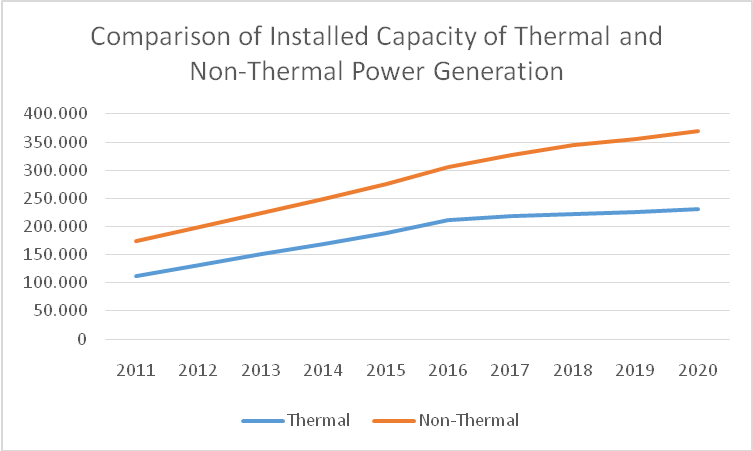
Graph 1:
Comparison of Installed Capacity of Thermal and Non-Thermal Power Generation
Energy Statistics India 2021 (INDIA, 2021).
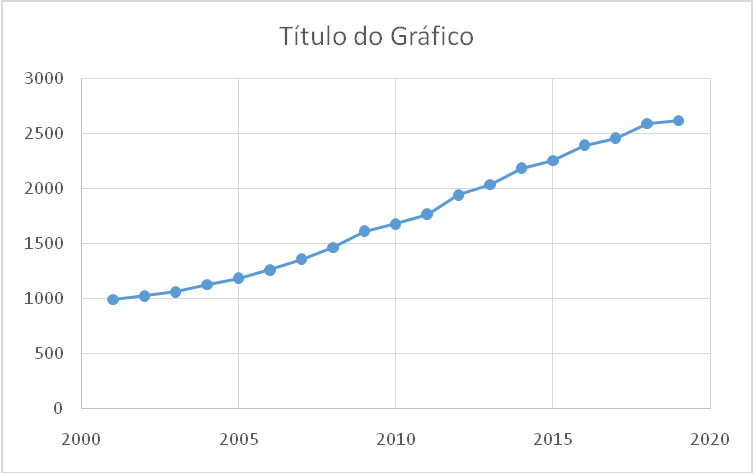
| Year | Co2 Emission (in million tonnes) | CO2 Growth Percentage |
| 2001 | 992.529 | 1.441 |
| 2002 | 1022.849 | 3.055 |
| 2003 | 1059.416 | 3.575 |
| 2004 | 1125.264 | 6.215 |
| 2005 | 1185.761 | 5.376 |
| 2006 | 1259.522 | 6.221 |
| 2007 | 1357.916 | 7.812 |
| 2008 | 1462.574 | 7.707 |
| 2009 | 1612.515 | 10.252 |
| 2010 | 1678.479 | 4.091 |
| 2011 | 1766.065 | 5.218 |
| 2012 | 1941.313 | 9.923 |
| 2013 | 2033.412 | 4.744 |
| 2014 | 2184.432 | 7.427 |
| 2015 | 2253.429 | 3.159 |
| Year | Co2 Emission (in million tonnes) | CO2 Growth Percentage |
| 2016 | 2392.36 | 6.165 |
| 2017 | 2456.848 | 2.696 |
| 2018 | 2591.324 | 5.474 |
| 2019 | 2616.449 | 0.97 |
Analysis of the data of the emission shows that intensity of emission is becoming lesser. The same is depicted in the form of graph below:
| Year | Consumption of Coal in Electricity Generation(in Million Tonnes) |
| 2010-11 | 395.84 |
| 2011-12 | 410.37 |
| 2012-13 | 446.76 |
| 2013-14 | 448.95 |
| 2014-15 | 497.70 |
| 2015-16 | 517.77 |
| 2016-17 | 535.04 |
| 2017-18 | 585.49 |
| 2018-19 | 621.64 |
| 2019-20 | 611.41 |
The figures shows that there is not significant growth in dependency on the coal in the electricity generation, which is a positive sign from the perspective of Environment conservation. The same is depicted in the form of the graph as provided below:
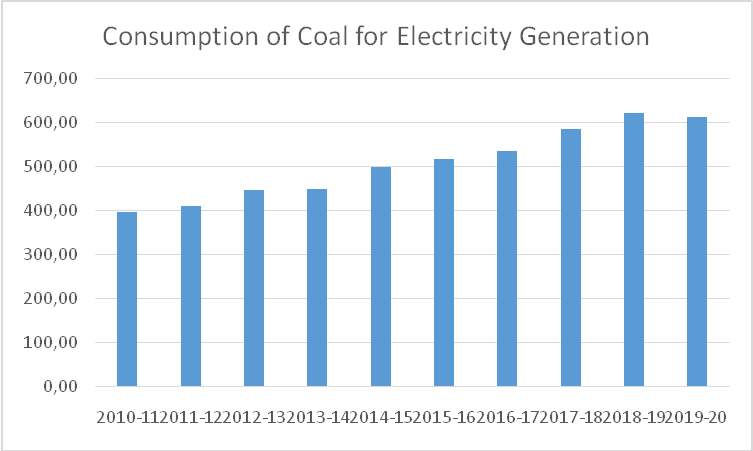
Graph 3:
Consumption of Coal for Electricity Generation
Office of the Coal Controller, Ministry of Coal, Government of India
The analysis of the graph above depicts that as far as the reliance of electricity generation from coal is concerned it is getting stabilized, with negative relationship between the electricity generation and coal consumption.
Conclusion
India has performed better in terms of achieving the Intended Nationally determined contribution. As per the United Nations Framework Convention on Climate Change (UNFCC) parameters, it is the only country to be 2 degree compatible. If the other major emitters are looked into, it can be seen that they are critically insufficient or high insufficient. India is not only able to achieve the targets it has laid down for itself, but also it has been seen that India has revised the targets, as it sees lot of potential in achieving the targets on higher side. Still, there could be an improvement on some aspects. If we look into the installed capacity on the renewable energy side, we see that it is 24% of the total capacity, however, on the side of the generation of the energy, we see that India is generating only 10% from its installed capacity. The world is divided on the issue of measuring the emissions. China stresses on measuring the emission intensity, however, US and Russia stresses on measuring the emission reductions in absolute terms. There are expectations from the world regarding the India’s performance. India has shown in the last 10 years that it is committed towards developing an ecosystem, which works for the overall development of the technologies, to reduce the greenhouse gas emissions. The years ahead are challenging with the pressing issues of COVID-19. However, looking at the determination shown to accomplish the targets laid down in the Paris agreement, evident from the performance of India in the past years, it can be said that India would lead the world stage in protecting the Mother Earth.
References
BECK, Silke; JEROEN, Oomen. Imagining the corridor of climate mitigation – What is at stake in IPCC’s politics of anticipation? Environmental Science & Policy, v. 123, p.169-178, 2021. https://doi.org/10.1016/j.envsci.2021.05.011
INTERNATIONAL ENERGY AGENCY. Global Energy Review: CO2 Emissions in 2021. Paris, 2022. Available at: https://iea.blob.core.windows.net/assets/c3086240-732b-4f6a-89d7-db01be018f5e/GlobalEnergyReviewCO2Emissionsin2021.pdf. Accessed on: May 29, 2022.
INDIA. Ministry of Statistics and Programme Implementation. Energy Statistics India 2021. Available at: https://mospi.gov.in/publication/energy-statistics-india-2021. 2021. Accessed on: Sept. 30, 2021.
JERNNÄS, Maria; BJÖRN-OLA, Linnér. A discursive cartography of nationally determined contributions to the Paris climate agreement. Global Environmental Change, v. 55, p. 73-83, 2019. https://doi.org/10.1016/j.gloenvcha.2019.01.006
JUYAL, Shikha. Electric Mobility and Electric Vehicles Management in India. In: JADHAV, Pravin; CHOUDHARY, Rahul (Org.). Infrastructure Planning and Management in India. Singapore: Springer, 2022. p. 159-172.
KUMAR, Sunil; ALOK, Chaube; SHASHI, Kumar Jain. Sustainability issues for promotion of Jatropha biodiesel in Indian scenario: a review. Renewable and Sustainable Energy Reviews, v. 16, n. 2, p.1089-1098, 2012. https://doi.org/10.1016/j.rser.2011.11.014
LE QUÉRÉ, Corinne et al. Fossil CO2 emissions in the post-COVID-19 era. Nature Climate Change, v. 11, p. 197-199, 2021. https://doi.org/10.1038/s41558-021-01001-0
MIRZA, Umar K. et al. Identifying and addressing barriers to renewable energy development in Pakistan. Renewable and Sustainable Energy Reviews, v. 13, n. 4, p. 927-931, 2009. https://doi.org/10.1016/j.rser.2007.11.006
MOUSAVI, Arefeh et al. Health system plan for implementation of Paris agreement on climate change (COP 21): a qualitative study in Iran. BMC Public Health, v. 20, p.1-13, 2020. https://doi.org/10.1186/s12889-020-09503-w
NOWOTNY, Janusz; NEJAT Veziroglu. Impact of hydrogen on the environment. International Journal of Hydrogen Energy, v. 36, n. 20, p. 13218-13224, 2011. https://doi.org/10.1016/j.ijhydene.2011.07.071
QURESHI, Sajda. Are we making a better world with information and communication technology for development (ICT4D) research? Findings from the field and theory building. Information Technology for Development, v. 21, n. 4, p. 511-522, 2015. https://doi.org/10.1080/02681102.2015.1080428
RATHORE, Pushpendra Kumar Singh et al. Solar power utility sector in india: Challenges and opportunities. Renewable and Sustainable Energy Reviews, v. 81, p. 2703-2713, 2017. https://doi.org/10.1016/j.rser.2017.06.077
RITCHIE, Hannah; ROSER, Max. India: CO2 Country Profile. Our World In Data, 2020. Available at: https://ourworldindata.org/co2/country/india#citation. Accessed on: Sep. 19, 2021.
ROGELJ, Joeri et al. Understanding the origin of Paris Agreement emission uncertainties. Nature communications, v. 8, p. 15748, 2017. https://doi.org/10.1038/ncomms15748
STEINEBACH, Yves; JULIAN, Limberg. Implementing market mechanisms in the Paris era: the importance of bureaucratic capacity building for international climate policy. Journal of European Public Policy, v. 29, n. 7, p. 1153-1168, 2021. https://doi.org/10.1080/13501763.2021.1925330
SAVARESI, Annalisa. The Paris Agreement: a new beginning? Journal of Energy & Natural Resources Law, v.34, n.1, p. 16-26, 2016. https://doi.org/10.1080/02646811.2016.1133983
Notas de autor
Información adicional
redalyc-journal-id: 3373
Enlace alternativo
https://periodicos.uff.br/revistapassagens/article/view/55174 (html)