Artículos
Received: 15/11/2015
Corrected: 01/12/2016
Accepted: 05/12/2016
Abstract: This paper reports a study on a business analysis and diagnostic tool known as CDS Model (competitiveness-differentiation-sustainability), which was developed using design management concepts. The objective was to identify and evaluate indicators in a company that sells coffee and baked goods, employing the mentioned tool to perform a situational diagnostic. The study is characterized as applied research, exploratory research and case study. Data were collected through interviews as well as through systematic and asystematic observation. The study identified strengths and weaknesses in the company, leading to the construction of a portfolio of strategic and operational initiatives to improve competitiveness, differentiation and sustainability.
Keywords: CDS Model, Competitive Advantage, Design Management.
Resumen: Este artículo presenta un estudio sobre el uso de una herramienta de análisis y diagnóstico de negocio, estructurada en los preceptos de la gestión del diseño, denominado Modelo CDS (competitividad-diferenciación-sostenibilidad). El objetivo fue identificar y evaluar los indicadores de gestión y de operaciones en una empresa del sector comercial, que opera en el sector de café, dulce y salado. La aplicación de la herramienta resulto en un diagnóstico situacional y propone acciones estratégicas y operacionales que pueden contribuir en la mejoría del desempeño de la empresa junto al actual mercado competitivo. La investigación se caracteriza como aplicada, exploratoria y estudio de caso. Las informaciones fueron recogidas por medio de entrevistas y observaciones sistemáticas y asistemáticas. La investigación permitió identificar las fuerzas y vulnerabilidades de la empresa estudiada. Con base en ellas fue posible proponer una serie de acciones estratégicas con la finalidad de mejorar sus índices de competitividad, diferenciación y sostenibilidad.
Resumo: Este artigo apresenta um estudo sobre a utilização da ferramenta de análise e diagnóstico empresarial, estruturada nos preceitos da gestão de desenho, denominada Modelo CDS (competitividade-diferenciação-sustentabilidade). O objetivo foi identificar e avaliar indicadores de gestão e operações em uma empresa do ramo comercial, que atua no negócio de cafés, doces e salgados. A aplicação da ferramenta possibilitou a geração de um diagnóstico situacional que embasou a proposição de ações estratégicas e operacionais que podem contribuir para a melhoria do desempenho da empresa frente ao competitivo mercado de atuação. O trabalho caracteriza-se com pesquisa aplicada, pesquisa exploratória e estudo de caso. As informações foram geradas e coletadas por meio de entrevista e observação sistemática e assistemática. O estudo permitiu identificar pontos positivos e vulneráveis da empresa estudada. Com base nas informações foi possível construir um portfólio de ações estratégicas para que a empresa construa melhores índices de competitividade, diferenciação e sustentabilidade.
Market uncertainty, competitor activity and sudden innovation are aspects that impact the management and operation of companies. In order to survive and flourish in the market, companies must pay attention to changes and offer products and services that provide desirable benefits to customers. They must also be aware of and seize opportunities and compete against external influences. According to Charan (2013), managers should maintain harmony between the internal and external environments so that they can detect not only unstoppable trends, but small decisive events as well.
It follows, therefore, that old strategies cannot be relied on forever and that a company must be aggressive when developing current and new businesses and markets. Cohesive strategies are necessary, and they result from management practices that ensure effectiveness in market activities, including the management of resources and processes in all areas of the organizational modus operandi, whether tactical or operational (Cavalcanti, 2003; Porter, 2009).
Cohesive results are a direct consequence of the productive use of the various inputs deployed by companies to create competitive advantage (Porter, 1989), which include rare, hardto-imitate, irreplaceable and versatile resources and capabilities. According to Floriani et al. (2009), a business acquires organizational competence upon developing a set of resources and capacities that add value to its strategy in terms of uniqueness rather than imitation.
Due to the constant demand for updated and innovative products and services, design management should be considered a major factor in fostering the development of business strategies. Design management involves a set of activities that require multiple knowledge bases and permanent interaction with an ever-changing consumer market, being characterized as the identification of paths by which design can add strategic value to companies. It refers to the strategic channeling of activities within a company by integrating design into the operational, tactical and strategic levels (Mozota, 2002).
Managers should be focused on attaining sustainable competitive advantages and should act in a context of temporary competitive advantage (Mcgrath, 2013). Through design management, companies can track changes in consumer habits and identify new trends, attempt to block entry to competitors, build greater flexibility and explore opportunities in emerging businesses (Gimeno, 2000). Given that it draws from the same ingenuity and rigor used to discover innovative solutions, design management is a platform for business innovation and growth, fostering strategies and actions in favor of organizational sustainability and good performance levels by facilitating deliberation about how to concentrate effort and activate a new vision (Fraser, 2012).
Good performance levels are the result of well-designed guidelines practiced at all organizational levels. Thus, organized references about the environment are required and have to be “based on information about markets, customers and noncustomers; about technology in one’s own industry and others; about worldwide finance; and about the changing world economy” (Drucker, 2009: 347).
Based on these considerations, the research problem that guided this study was: How can design management help define strategies and actions to improve a company’s performance levels? Thus, this paper presents the results of research from the sphere of design management. The CDS (competitiveness-differentiation-sustainability) model, which is a tool for business diagnostics and analysis developed by researchers at the Management Design Center, Universidade Federal de of Santa Catarina, Brazil, was applied in order to identify and evaluate management indicators and operations in a retail enterprise. Based on the findings, a set of actions was proposed to improve performance levels.
This research report is the result of applied research, exploratory research and case study, and it involved direct contact with the studied enterprise. The results indicate that the use of the CDS Model streamlines organizational management, enhances the decision-making process and aligns strategic and operational actions with the expectations of the consumer market and the organizational goals.
Design Management
Given that constant innovations have been modifying product technologies, services and production, and are driving changes in the strategies and operations of organizations, design must assume a strategic role as it draws attention to processes, systems and organizations, rather than merely household products (Neumeier, 2010a). This author stressed that companies need to be fast, flexible, innovative and agile. Agility is an unpredictable characteristic that emerges when a company has the appropriate skills and speed required to multiply competences.
Liedtka (2007) points out that differentiated and promising approaches to management are emerging from the universe of design; more participative processes that focus on the theme than the schedule, and prefer to learn from, rather than avoid, conflict. Neumeier (2010b) emphasizes that design-based thinking is useful in business management because it seeks to identify potential future paths and establish connections with clients, as well as to simplify the business model. This shows that design is the new central capacity of innovative organizations.
Review of the literature indicates that certain elements of design contribute to the contextual and conceptual basis of design management. Joseph (2000) and Mozota (2002) claim that design management has been following the evolution of management, which has shifted focus from Taylor’s model to organizations that are more intelligent, flexible and supportive of risky decision-making, autonomy and initiative. These organizations are more user-centered and encourage change in organizational culture.
The function of design management is, according to Wolf (1998: 18), to “plan and coordinate strategies that correspond to the goals and values of the company, motivate employees and monitor their work, ensuring that they comply with objectives, deadlines and planned costs”. Martins and Merino (2011) explain that design management is about integrating technological, social, economic and biological needs, the psychological effects of materials, shapes, colors, volume and space, providing the perception of the whole and of the details, of the short term and the long term.
The scope of design management is fulfilled to the degree that it provides the tools for integrating the operational functions developed in each department of the company, so that previously determined organizational objectives can be achieved. Mozota (2002) points out that design management communicates the values and philosophy of the company to the environment in which it operates. Consistent corporate design will lead to discursive cohesion, ease in identifying a company’s message and, thus, memorization and behavioral exchange.
Gimeno (2000) stresses the importance of design for companies by highlighting its role in competitiveness. Mozota et al. (2011) emphasizes that design management can and should participate in the formulation and selection of strategies and must commit itself to implanting the spirit of design in a company’s objectives. The mission of design management is to make a company’s strategy visible in order to affect comprehensive performance.
Best (2009) points out that within organizations design management is present in the work of brand communication, in product and service development, in the organization of business environments and in the company’s marketing strategies. Regarding the external environment, design can provide answers for increasing pressure to abide by government regulations and can transform both attitudes and local and global resource management.
Chiva and Alegre’s (2009) study on the relationship between design and business performance highlighted design’s positive effects on company performance and the dividends accrued from investing in it. Of course, design does not emerge by chance; it is the result of a managed processes that require certain skills consistent with best management practices for organizational competitiveness.
Fraser (2012) claims that the use of design in business will create competitive advantage inasmuch as three factors are simultaneously engaged: a) effective and tireless dedication in customer service, b) the continuous expansion of possibilities, and c) a flow of experiments and expansion initiatives to maintain the organization’s strategic course. She goes on to state that the application of design in the management environment of organizations is a platform for innovation and business growth, because it helps clearly define how to converge efforts and effectively stimulate a new vision, applying the same ingenuity and rigor used to find an innovative solution.
Therefore, the precepts of design and management can converge to foster more precise conditions for decision making, structural improvement and innovation, and for operational implementation, all of which can spawn competitive advantage.
Competitive Advantage
Since the emergence of the first business organizations, one of the main objectives of managers has been to gain and maintain target clients while keeping the enterprise competitive in the market. However, it is very difficult to gauge the elements necessary for organizational success, since the factors that trigger competitiveness are constantly changing. Machado-da-Silva and Barbosa (2002) observe, from a technical point of view, that organizational competitiveness is linked to the acquisition, maintenance and use of appropriate resources to achieve the economic and technical-operational indicators valued and interpreted as expressions of competence and competitiveness. Competitiveness, in this context, is assessed by means of quantitative indicators of quality, productivity, efficiency and economic performance.
Competitiveness is something that goes beyond operational efficiency. Measured by quantitative means according to logical factors, strategies for each organization are formulated in accordance with the organization’s situation, culture, goals and environment. The ability to share activities in the value chain is the basis for business competitiveness, because sharing highlights the competitive advantage by increasing differentiation (Porter, 2009). However, Kim and Maubogne (2005) claim that there is no such thing as permanent organizational excellence and emphasize the importance of building high degrees of trust and commitment through the constant practice of intellectual and emotional recognition, which plays a key role in strategy development. By contrast, Senge (2009), stated categorically that successful future businesses will be the ones that discover ways of fostering employee commitment and learning capacity at all organizational levels.
To achieve such success, cohesive strategies are necessary. Strategies that stem from management practices that ensure effectiveness in market activities, as well as from the management of resources and processes that make up the organizational modus operandi, whether tactical or operational (Porter, 2009). A strategy is a long-term direction that acquires advantages in a turbulent environment by conforming resources and competences to meet stakeholder expectations (Johnson et al., 2011).
Organizational competition, therefore, does not consist of economic factors alone. The features necessary for competition are not only technical but also institutional. Organizations must conform to technical standards, but they are also pressed by other organizations and society in general to meet socially accepted standards of conduct. Such pressure requires symbolic components, as is a reputation for efficiency, prestige and socially legitimized conduct (Machado-Da-Silva and Barbosa, 2002).
Developing and maintaining competitive advantage requires continuous effort and intelligence since companies need continuous innovation, optimization, articulation and adaption to the requirements and provisions of the market and society in general. As Carvalho and Laurindo (2012) point out, although identifying the skills required for creating competitive advantages in an ever-changing market is complicated, nevertheless, the ability to exploit their potential and to develop them consistently, can be decisive for a successful positioning in the competitive scenario.
While much can be said about competitiveness, what is clear is that for businesses it is achieved through the accumulation of strategic competitiveness. According to Charam (2013), it is crucial to develop a new vision of the world that is keenly aware of how forces that seem related to one’s business could interact and combine to create opportunities or threats.
Porter (2009) points out that competitive advantage is related to corporate organization in that it consists of a set of activities whose objective is to create, produce, market, deliver and support company products. The construction of competitive advantages is, therefore, the accuracy and dynamism of the processes of analysis and decision making in organizations. Thus, models that facilitate analysis of the decision-making process are important tools for achieving performance expectations.
The CDS Model
The management and operationalization of various design aspects in the different areas of a company is a necessary condition for the development of competitive advantage. However, competitive advantage is not solely a result of the possession of competitive resources or market power in an industrial structure; rather, it stems from the value created by connecting the external and internal environments. This positioning defines a company’s relationships and its power asymmetries, positioning and information.
In the design of strategies, whether deliberate or emergent, knowledge of the company’s business, its features and its institutional and operational environments is crucial (Carvalho and Laurindo, 2012). This knowledge is generated through management activities, which require systemic vision of the economic and social context, especially of the industrial sector in which the company operates (Mintzberg, 2010).
According to Bahiana (1998), investment in organizational design has shifted from a matter of aesthetics to one of strategy. He explains that when companies adhere to the assumptions of design management, they adopt techniques that increase the quality and differentiation of their products, as well as streamline production costs.
Merino et al. (2012) show that the role of design management is to provide effective design solutions skillfully and at an appropriate cost through a wide range of capacities. Due to the need for coordinating and articulating corporate resources, these authors developed the CDS (competitiveness-differentiation-sustainability) methodology as a diagnostic tool for focusing on the three strategic dimensions represented in its name. The application of this tool yields a set of indicators that enable a quantitative and qualitative performance assessment for each related or correlated item that the method encompasses. Figure 1 provides an overview of the methodology.
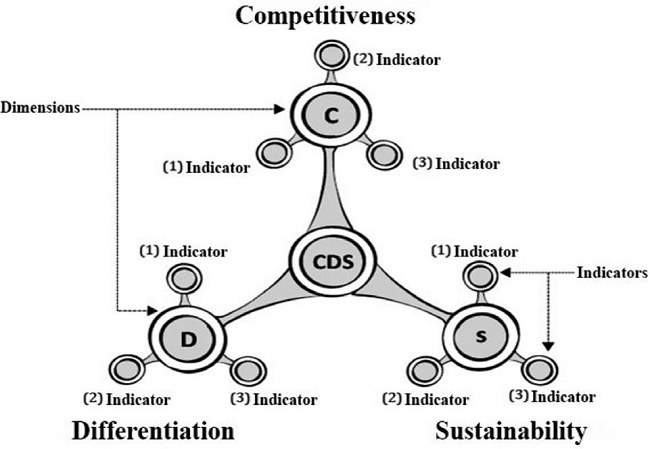
Figure 1
Overview of the CDS model and its indicators (generic case).
Source: Data from NGD - Design Management Center.
According to this model, the strategies, operations and activities within the scope of these three dimensions give an organization its competitive advantage. Diagnosing these areas is, therefore, fundamental to design management, since it prioritizes the global visualization of performance indicators and leads to the definition of actions that either maintain or improve performance levels.
Manzini (2008) stressed that ‘competitiveness’ is the result of offering a product or service at a lower cost than the competition or supplying products or services that are identified by buyers as different, and thus of superior value, to those of the competition. However, according to Neves and Castro (2003), ‘differentiation’ is due to attributes that stand out from the competition, including visual appearance, quality, taste, durability, style, service, competence, politeness, credibility, etc. ‘Sustainability’ involves a systemic approach encompassing environmental, social and economic perspectives, since, in short, sustainable development and social development cannot be separated (Merino et al., 2012).
In order to operationalize these three dimensions of analysis, it is necessary to identify and determine the relevant indicators belonging to each one. The inclusion of indicators in this model is important because they facilitate the decision-making process by revealing information (either qualitative or quantitative). Such information then serves as a basis for managers to define actions toward achieving their goals. The same number of indicators should be used for all dimensions so that the derived means will be of equal weight.
The indicators are measured using a Likert scale from 1 to 5. In this scale, 1 represents a negative impact or weakness, 3 is neutral and 5 implies potential, being indicated by red, yellow and green colors, respectively, or by gray shades; 2 and 4 are intermediate values indicated by orange and light green colors, or intermediate shades. The scale is represented by shades of gray in the insets of Figure 2.
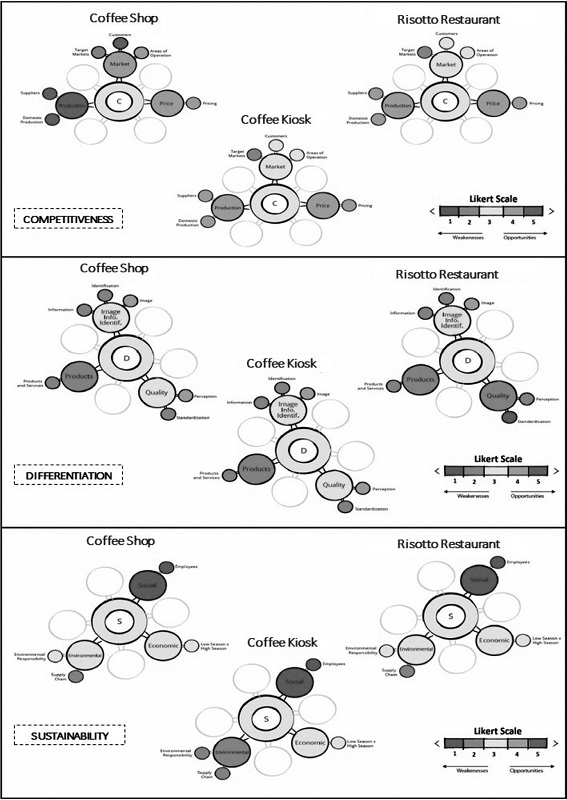
Figure 2
Result of the application of the CDS model.
After the measures are applied, a color (or shade), will be incorporated into each indicator according to the results, and each dimension will assume a color (or shade) in response to the mean results of the indicators. The combination of visual elements (dimensions, indicators and, colors or shades) is important in the CDS model since it facilitates a faster and more cohesive decision-making process, clarifying the situation of the overall framework.
By analyzing a company’s current conditions and prospects with respect to its business and its market, the decision-making process regard ing strategies, projects and actions becomes more consistent. This is due to the fact that the process becomes based on the metrics outlined in each of the three dimensions, which are decisive in organizational management.
Methodology
This study should be considered applied research, since it aims to develop knowledge for the solution of specific problems and involves both general truths and local interests (Silva and Menezes, 2005). Applied research has situational characteristics because it seeks to diagnose specific problems in specific situations in order to achieve practical results. This type of research is being established as a means of intervention and development in groups of organizations and communities (Gil, 2010).
The goal of the present study, which can also be classified as exploratory research, is to provide a larger set of information regarding the object of study (Prodanov, 2013), given that greater knowledge about the problem in view will better clarify it (Gil, 2010). Moreover, the procedures involved in this research classify it as a case study. According to Yin (2001), a case study is an investigation that retains holistic and relevant characteristics of real life, dealing with a contemporary phenomenon in its real life context. Its value consists in providing thorough knowledge of a narrowly-framed reality, and its results allow hypotheses for future research (Triviños, 1987).
The present case study describes aspects of the use of the CDS Model in a retail company operating located in greater Florianopolis, in Southern Brazil. The company consists of a network of eight stores that sell coffee and baked goods. The study was developed according to the plan shown in Table I.
RESEARCH PLAN
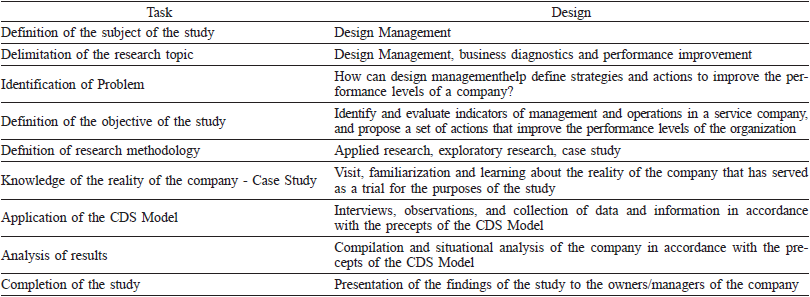
Field data were collected in the second half of 2014 through interviews and through systematic and unsystematic observation. The interviews were conducted with company managers and supervisors, i.e. the company’s executive team. The information was compiled in a participatory and dialogic manner with all the participants and was gathered as the steps of the CDS Model unfolded. The data were treated as descriptive and analytical; the information was compiled and categorized, and was then compared with the theoretical basis upon which the model had been built.
Case Study
The company observed in this study emerged when a failing coffee shop in a mall located in the suburb of São José, Florianopolis, Santa Catarina, Brazil, was offered to its current owner. Working directly with the public was a new experience to the entrepreneur, who accepted the challenge to manage and de velop the business.
Subsequently, by investing in emerging opportunities, other stores were gradually developed, resulting in the current eight points of sale in the metropolitan region. The continued growth turned what had been intended as a hobby into the entrepreneur’s main business. According to its mission statement, the company seeks to satisfy its customers by providing a pleasant, cozy atmosphere featuring quality products.
The eight points of sale are distributed in three business groups: a) a coffee shop, the largest single unit, which is located in a major gastronomic neighborhood; b) coffee kiosks: smaller structures located in malls and hypermarkets; and c) a risotto restaurant, a single point of sale in a mall.
The design management project developed with this company consisted of three different interconnected stages: a) initial contact and familiarization; b) implementation of the CDS model; and c) based on the CDS results, a proposal of strategic and operational actions.
The first step was familiarization with the people involved in the project, which consisted of learning about the history of the company, the management structure and decision-making process, the flow of operations and on-thespot verification of the environments and daily operations of each of the stores.
After familiarization with the enterprise, the next step was to apply the CDS model in order to diagnose its competitiveness, differentiation and sustainability. When structuring the model, three indicators were defined per dimension. The indicators for competitiveness were market, production and price. The indicators for differentiation were image, products and quality; the indicators for sustainability were economic, social and environmental.
The indicators were evaluated through an interview involving a structured questionnaire (closed questions). The items were validated with the Likert scale, according to the model’s previously presented assumptions. The data were tabulated in a spreadsheet and, after the mean values for each indicator had been determined, the data were plotted in the color or in the corresponding shade for each dimension of the model. The results are summarized in Figure 2.
Greater positive fluctuation is shown in the competitiveness dimension, which indicates a favorable situation for the company. The scenario is more fragile, however, in the differentiation dimension. Here the scale tends toward the intermediate, which indicates a larger number of vulnerabilities. Thus, differentiation is an area where a significant range of actions should be planned and implemented. Figure 3 shows a summary of the proposals developed, which are directed, first, toward improving the quality of products and processes and, second, improving the company’s image, information and identification.
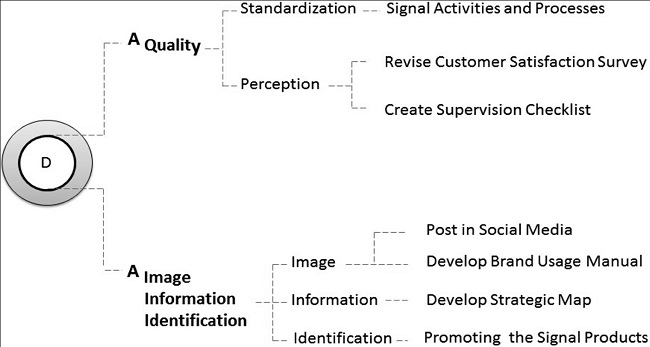
Figure 3
Actions defined on the basis of applying the CDS model= indicator of differentiation.
The sustainability dimension, however, was the most critical, revealing a greater degree of fragility, primarily regarding the social sustainability indicator. Figure 4 shows the summary of the actions defined for this dimension.
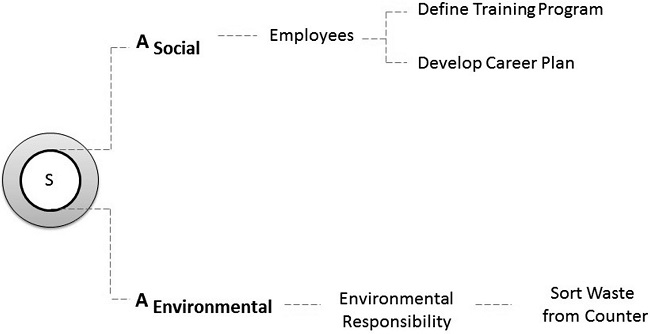
Figure 4
Actions defined on the basis of applying the CDS model= indicator of sustainability.
The work sequence was based on this map of actions. Standardizations were introduced in the context of managerial and operational processes. Actions were emphasized for improving the image, information and identification of products, since consumer satisfaction is strongly associated with the perception of products and services. The organizational architecture was further developed, emphasizing the need for greater clarity about the hierarchy and activity flow charts for each unit.
In the sustainability dimension, where the worst performance was observed, emphasis was placed on practical actions to correctly dispose of company waste, thus improving the environmental sustainability indicator. Regarding the social sustainability indicator, attention was focused on better staff training to begin immediately upon hiring. The result was the creation of a Staff Training Program whose basics are shown in Figure 5.
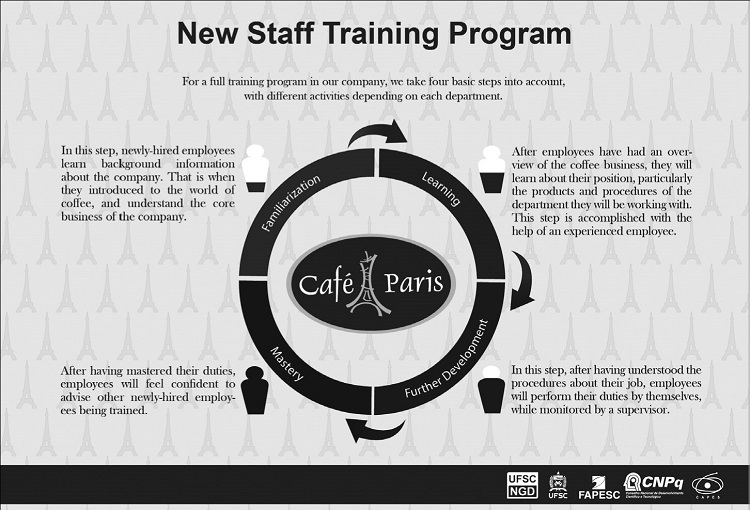
Figure 5
Staff training program.
The results indicate that the CDS model is effective for broader management work, incorporating dimensional indicators that are crucial for the construction of competitive advantage. This perception is consistent with Gimeno’s (2000) statement that design management is a set of techniques for organizational management which maximizes a company’s competitiveness by employing design as a tool for business strategy at the lowest possible cost.
Final Remarks
The greatest challenge for organizations in today’s market is to remain competitive with strong foundations capable of sustaining the necessary changes. Design management should be considered a reference for companies, since it contributes to competitive differentiation. As a result of its use, organizations develop a comprehensive business vision rather than a product-oriented vision. Design management works as a set of guidelines to align an organization’s efforts with the strategies required to reach its objectives.
Design management represents a strategic approach to company management. Thinking about design beyond product appearance and functionality means using design assumptions, tools and techniques to develop and implement competitive strategies, so as to ensure corporate sustainability in today’s turbulent social and economic scenario.
The functionality of design management was demonstrated in this study, in its precisely identified and applied means of creating competitive advantage in a small chain of coffee shops. A broad situational diagnosis of the company was produced using the CDS method, including information indicators regarding market, production, price, image, products and quality, as well as social, environmental and economic sustainability.
Based on the data collected in the diagnosis, a portfolio was defined with strategic actions that can increase the company’s competitive advantages. For the team of researchers, the study was valuable in that a theoretical model developed in an academic context was put into practice. It is reasonable to expect that design management can make a real contribution to the strategic management of companies because, according to Mozota (2002), it identifies and communicates paths by which strategic value can be added to companies. In other words, design management unveils the mechanics of design for companies so that they can better develop their own strategies at operational and tactical levels.
REFERENCES
Bahiana C (1998) A Importância do Design Para Sua Empresa. CNI, COMPI, SENAI/DR-RJ, Brasilia, Brazil. 56 pp.
Best K (2009) Gestão de Design: Gerir a Estratégia, os Processos e a Implementação do Design. Diverge Design SA. Lisboa, Portugal. 221 pp.
Carvalho MM, Laurindo FJB (2012) Estratégia Competitiva: dos Conceitos à Implementação. 2nd ed. Atlas. Sao Paulo, Brazil. 227 pp.
Cavalcanti M (Org) (2003) Gestão Estratégica de Negócios. Pioneira Thomson Learning. Sao Paulo, Brazil. 251 pp.
Charam R (2013) Ruptura Global: Liderando Seu Negócio Através da Grande Transformação do Poder Econômico Muncial. HSM Editora. Sao Paulo, Brazil. 251 pp.
Chiva R, Alegre J (2009) Investment in design and firm performance: The mediating role of design management. J. Prod. Innov. Manag. 26: 424-440 pp.
Drucker PF (2004) Peter Drucker na Prática. Elsevier. Rio de Janeiro, Brazil. 107 pp.
Drucker PF (2009) Management. Rev. ed. Harper Collins. Nova York, USA. 609 pp.
Floriani DE, Borini FM, Fleury MTLO (2009) Processo de internacionalização como elemento gerador de capacidades dinâmicas: O caso da WEG na Argentina e na China. Rev. Bras. Gest. Negóc. 11(33): 367-382.
Fraser HMA (2012) Design para Negócios na Prática: Como Gerar Inovações e Crescimento nas Empresas Aplicando o Business Design. Elsevier. Rio de Janeiro, Brazil. 207 pp.
Gil AC (2010) Como Elaborar Projetos de Pesquisa. 5th ed. Atlas. Sao Paulo, Brazil. 187 pp.
Gimeno JMI (2000) La Gestión del Diseño en la Empresa. McGraw-Hill. Madrid, Spain. 473 pp.
Johnson G, Scholes K, Whittington R (2011) Fundamentos de Estratégia. Bookman. Porto Alegre, Brazil. 336 pp.
Joseph JP (2000) Performance metrics to measure the value of design. Des. Manag. J. 11(4): 71-75.
Kim WC, Mauborgne R (2005) A Estratégia do Oceano Azul: Como Criar Novos Mercados e Tornar a Concorrência Irrelevante. 16th ed. Elsevier. Rio de Janeiro, Brazil. 241 pp.
Liedtka J (2007) Se os Executivos Pensassem Como Designers. HSM Management, Nº 62, Maio-Junho. 5 pp.
Machado-Da-Silva CL, Barbosa SL (2002) Estratégia, fatores de competividade e contexto de referência das organizações: Uma análise arquetípica. Rev. Admin. Contemp. 6(3): 7-32.
Manzini E (2008) Design para a Inovação Social e Sustentabilidade: Comunidades Criativas, Organizações Colaborativas e Novas Redes Projetuais. E-papers. Rio de Janeiro, Brazil. 104 pp.
Martins RFF, Merino EAD (2011) A Gestão do Design Como Estratégia Organizacional. 2nd ed. EDUEL. Londrina, Brazil. 247 pp.
McGrath R (2013) O Fim da Vantagem Competitiva: um Novo Modelo de Competição Para Mercados Emergentes. Elsevier. Rio de Janeiro, Brazil. 256 pp.
Merino G, Gontijo LA, Merino EAD (2012) Modelo CDS Competitividade, Diferenciação e Sustentabilidade Aplicadas ao Design. In Martins RFF, Linden JCS VD (Eds.) Pelos Caminhos do Design. EDUEL. Londrina, Brazil. pp. 419-438.
Mintzberg H (2010) Managing: Desvendando o Dia a Dia da Gestão. Bookman. Porto Alegre, Brazil. 304 pp.
Mozota BB, Klöpsch C, Costa FCX (2011) Gestão do Design: Usando o Design para Construir Valor de Marca e Inovação Corporativa. Bookman. Porto Alegre, Brazil. 344 pp.
Mozota BB (2002) Design Management. Éditions d’Organization. Paris, France. 293 pp.
Neumeier M .2010a. A Empresa Orientada Pelo Design. Bookman. Porto Alegre, Brazil. 200 pp.
Neumeier M (2010b) Quando Menos É Mais. HSM Management. Nº 79. 5 pp.
Neves MF, Castro LT (Orgs.) (2003) Marketing e Estratégia em Agronegócios e Alimentos. Atlas. São Paulo, Brazil. 365 pp.
Porter M (2009) Competição. Rev. ed. Elsevier. Rio de Janeiro, Brazil. 546 pp.
Porter M (1989) Vantagem Competitiva: Criando e Sustentando um Desempenho Superior. Campus. Rio de Janeiro, Brazil. 512 pp.
Prodanov CC (2013) Metodologia do Trabalho Científico: Métodos e Técnicas da Pesquisa e do Trabalho Acadêmico. Feevale. Novo Hamburgo, Brazil. 276 pp.
Senge PM (2009) A Quinta Disciplina: Arte e Prática da Organização que Aprende. 25th ed. BestSeller. Rio de Janeiro, Brazil. 530 pp.
Silva EL, Menezes EM (2005) Metodologia e Elaboração de Dissertação. 4th ed. UFSC. Florianópolis, Brazil. 139 pp.
Triviños ANS (1987) Introdução à Pesquisa em Ciências Sociais: a Pesquisa Qualitativa em Educação. Atlas. Sao Paulo, Brazil. 175 pp.
Wolf B (1998) O Design Management Como Fator de Sucesso Comercial. FIESC/IEL, ABIPTI, Programa Catarinense de Design, SEBRAE, CNPq. Florianópolis, Brazil. 25 pp.
Yin RK (2001) Estudo de Caso: Planejamento e Métodos. Bookman. Porto Alegre, Brazil. 205 pp.
Author notes
