FINANCIAL ASPECTS OF SOFTWARE PRODUCT DEVELOPMENT
ASPECTOS FINANCIEROS DEL DESARROLLO DE PRODUCTOS DE SOFTWARE
ASPECTOS FINANCEIROS DO DESENVOLVIMENTO DE PRODUTOS DE SOFTWARE
FINANCIAL ASPECTS OF SOFTWARE PRODUCT DEVELOPMENT
Interciencia, vol. 42, no. 12, pp. 823-827, 2017
Asociación Interciencia
Received: 23 January 2017
Accepted: 25 November 2017
Abstract: Software is an essential component in a continuously growing number of applications. In order to be useful, software products not only need to satisfy all customer requirements, but also they must be produced with the highest quality standards by following sophisticated development methodologies that altogether require both adequate planning and funding. The importance of proper funding practices and initiatives is crucial in numerous productive sectors and industries, and software, like any other industry requires sufficient funds to develop high quality products and services. This paper presents an empirical study to show the approximate financial support that Mexican software companies are receiving, in particular new and recently created providers, from either local government or financial sectors, to foster the development of software products and services in Mexico.
Keywords: Financial Projects, Software Development.
Resumen: El software es un componente esencial en un número siempre creciente de aplicaciones. Para ser útiles, los productos de software no solo deben satisfacer las necesidades del cliente, sino también deben ser desarrollados con los más altos estándares de calidad siguiendo metodologías de desarrollo sofisticadas que requieren una planificación y financiamiento adecuados. La importancia de las prácticas e iniciativas de financiamiento es crucial en numerosos sectores productivos e industrias, y el software, como cualquier otra industria, requiere fondos suficientes para desarrollar productos y servicios de alta calidad. Se presenta un estudio empírico para mostrar el apoyo financiero aproximado que están recibiendo las empresas mexicanas de software, en particular proveedores nuevos y de reciente creación, ya sea del gobierno local o del sector financiero, para fomentar el desarrollo de productos y servicios de software en México.
Resumo: O software é um componente essencial em um número sempre crescente de aplicações. Para serem úteis, os produtos de software devem, não apenas satisfazer as necessidades do cliente, mas também devem ser desenvolvidos com os mais altos padrões de qualidade seguindo metodologias de desen- volvimento sofisticadas que requerem planificação e financiamento adequados. A importância das práticas e iniciativas de financiamento é crucial em numerosos sectores produtivos e indústrias. O software, como qualquer outra indústria, requer fundos suficientes para desenvolver produtos e serviços de alta qualidade. Apresentase um estudo empírico para mostrar o apoio financeiro aproximado que estão recebendo as empresas mexicanas de software, em particular provedores novos e de recente criação, seja do governo local ou do sector financeiro, para fomentar o desenvolvimento de produtos e serviços de software no México.
Introduction
Software products and services continue to be the main drivers in a continuously growing number of applications, which make software, in general, an essential component in any possible situation, process or activity. The benefits of using some form of software are also quite numerous to mention, but at a minimum, it can help companies and enterprises achieve their business goals and increase their productivit y. However, developing software products and services of the highest quality is usually a complex task in which several major factors are involved and need to be considered. First, software product companies or simply software providers require a strategic process that can offer a systematic approach to software development and its implementation. It is well known that such processes divide all software development work into several stages or phases to essentially increase efficiency and control over the whole process (Sommerville, 2004; Pressman, 2005). Typically, the stages of software development not only need to be adequately planned and executed but also they require sufficient funding in order to be delivered on time and within budget projections. Currently, the number of available software development methodologies that can be applied to any given project or business necessity is considerable and consequently, they need to be selected carefully based on the context and scope of the required product or service. For example, there still may be situations where a more linear and sequential approach such as the Waterfall software development methodology could be more suitable as opposed to the more recent agile and concurrent approaches (Sommerville, 2004; Pressman, 2005). More specifically, the Waterfall model assumes that all customer requirements are complete at the beginning of the development cycle and no further changes or additions are allowed afterwards, a situation which is less likely to occur given the current software trends observed virtually everywhere. On the other hand, agile methodologies have recently witnessed tremendous acceptance, not only for their faster development times, but also for their ability to accommodate changes more easily throughout the development process (Abrahamsson, 2002; Qureshi, 2012). In this work, we are not focusing on a particular software development methodology, but rather we try to emphasize that any methodology contains at least the previous stages that altogether need to be properly funded.
In addition to a software development methodology, software providers need to consider several other factors that play a major role in the whole development process and for which enough funding is also required in order to be executed as planned. For instance, the number of available personnel with the appropriate set of technical skills to perform the work as well as implementing an effective project management strategy capable of estimating and managing several major issues involved in any software development project, such as personnel, costs, and scheduling issues. Likewise, software project management should also be able to handle any potential risks that could jeopardize the entire project and may have impact on the operating budget, e.g., personnel shortage, time and cost overruns, among others. However, among the various factors around any business or commercial software development effort, we think the financial factor is perhaps the most critical one because without it, none of the other work would be possible. Software, like any other industry that develops useful products and services, requires enough funding and financial support in order to develop high quality software products. Of course, the level of financial support should be proportional to the level of complexity, functionality and scope of the requested software product. Consequently, any software company must always pay special attention to all financial and cost details. However, new or recently created small software providers or sometimes, also referred to as startups (Giardino et al., 2014) should be even more careful with those sensitive matters given their limited work experience or lack of it. In general, as shown by Giardino et al. (2014), soft- ware startups face several challenges that, at times, may complicate the process of securing the necessary funding requirements to develop their products or services.
So far, we have identified the main sources that have a direct impact on project funding, i.e., the software development methodology, available personnel, training programs, an appropriate project management strategy, as well as other tangible resources such as equipment, support tools, working premises and infrastructure, among others. Depending on the context and scope of the proposed software solution, there may be other additional expenses which altogether make the whole cost estimation process (Boehm, 1981; Kemerer, 1987; Jorgensen, 2014; Sharma et al., 2014) a difficult task present in any software development project. As opposed to large longtime providers with a proven record, sometimes software startups may encounter difficulties to get enough funds to start their projects (Giardino et al., 2014). Moreover, the software industry in Mexico is still dominated by a few large foreign enterprises with more than enough resources to satisfy virtually any of their clients’ needs. Hence, the latter represents one of the bigger challenges any local software startup company must face, i.e., how to convince potential customers, both foreign and domestic, that they can be as good choice as any of the big and renowned players.
The motivation for this work is to investigate the approximate level of financial support that Mexican software startup firms receive to develop software products or services. Despite their high level of significance, little empirical research has been executed to analyze the financial support details behind the development of such products and services. Therefore, the main research question is: Are local government or financial institutions supporting commercial or business software development projects carried out by Mexican software startup companies?
For that, we designed and applied a survey-based study to estimate such levels of financial support. We consider this kind of experimental studies can be valuable as they can show what the current state is for a particular subject matter and, in general, what may be some of the possible effects or implications it may cause in certain countries or regions (Lee et al., 2012). In this case, analyzing the financial status of several Mexican software startups can help raise more awareness not only among software development organizations but also on decision makers from both government and financial sectors about the importance of increasing their financial support to their own software and technological industries. In general, our goal is to provide an assessment about the current financial situation of some Mexican software development companies, i.e., whether they are able to achieve their commitments with the funding levels they operate on. After the presentation of some background information and motivation for this work, we describe the details pertaining to our survey and the main characteristics of the companies that participated in this study. Then, we present the results in conjunction with our judgments and interpretations and, finally, we provide conclusions and some future research topics along this line.
Background and motivation
Clearly, any process aimed to develop some kind of product or service requires, among several things, enough funding so that it can achieve its main goals and purpose. As mentioned, funding levels in soft- ware development vary according to multiple factors, mainly based on a continuously growing number of practical applications and the evolution of the software development processes themselves. Moreover, several efforts have been made to study different aspects related to software development, from which we attempt to describe to what degree a particular country is committed, financially speaking, to foster the internal development of software products and services. Given the ubiquitous nature of software the latter is important, because the more a country supports its software industry the more their products and services can be positioned and demanded in other countries and regions. In fact, the previous scenario gave rise to the phenomenon known as offshore software development, an outsourcing in which, basically, client organizations subcontract some or all of their software development needs to a particular vendor, supplier or outsourcing company typically located in what is known as developing or emergent countries; hence, the term offshore (Khan et al., 2012, 2013; Niazi et al., 2013).
Currently, offshore software outsourcing has become one of the main drivers for economic growth in several countries and, consequently, has produced multiple benefits for both the outsourcing companies and all their clients or customers (Smite et al., 2015). For instance, through subcontracting, clients can receive high quality software products from outsourcing companies at lower costs compared to what an onshore supplier would charge or that of the clients doing it by themselves. Moreover, there have been several studies analysing different aspects of off- shore software development outsourcing. For instance, in Khan et al. (2013) a study is presented of the critical success factors involved in such projects, along with data that shows how much such practice has increased both its expenditure and revenue figures over the last years. Other efforts have identified what are some of the main trust factors (Niazi et al, 2013) that play a major role in successful offshore software development projects, whereas others analyze intercultural challenges that outsourcing and client companies should always be aware of in order to have successful experiences and long term relationships (Khan et al., 2014). As of now, the main players in the offshore software outsourcing game are mostly companies from India and China, which have had great success mainly in North American and European markets ( Moitra, 2001; McLaughlin, 2003; Kshetri, 2005; Khan et al., 2013). The significance and relevance of offshore software outsourcing companies would not be what it is today had not been for the financial support they initially received from either their local governments or financial institutions. Given the importance and the promising outlook that this software development practice has for the years ahead, we consider it important to present what the latest status is regarding financial support initiatives for software companies established in Mexico, one of the so called developing countries.
Methodology
To better understand how new software products or services are developed at Mexican software startup companies, we designed as our main data collection tool a questionnaire of four questions using a five point scale for each question. Our questionnaire is actually a subset of a larger questionnaire intended to analyze a wide range of topics found in most common software development efforts, and even though all are important, in this case we are only focusing on the financial part. The questionnaire was developed at the Software Development Center of the Universidad Autónoma de Nuevo Leon, the third largest public university in Mexico. Besides carrying out applied research in various areas of software development, the center also provides software development services to local companies and businesses as any other software outsourcing company does.
The complete survey is part of an on-going study aimed to understand what are some of the main critical success factors (Reel, 1999) for developing software products and services in Mexican software firms. As mentioned, the main goal of this work is to investigate whether the Mexican government and financial sectors are financially supporting their software industry, in particular small and/or recently created software providers, and how that impacts their productivity and efficacy. In order to do that, we rely on the results obtained from the selected questions to perform any assessments.
Prior to the application of the four main questions, the survey gathers demographic information about the participants, such as company name, address, years of service, approximate company size, and the job title of the company’s representative responsible for taking the survey. Since they have both knowledge and control over any budget related issues, the respondents were primarily either IT directors, development managers or project leaders who had to rate each item among five possibilities based on their own knowledge and experience. To conclude this preliminary information gathering stage, all participants should also indicate what is (are) their primary business market(s), i.e., USA, Latin America, Europe or others.
Regarding the questionnaire (Table I), the first question requests the number of new software products or services that each participant company is capable to release every year on average, i.e., one through five or more. Then, the next three questions measure the approximate level of financial support that each participant received by selecting the percentage range (0 –20; 21– 40; 41– 60; 61– 80; 81–100) that they think best reflects their situation. Since we realized some participants may be concerned and reluctant to share this kind of information, we made clear to them that all the information provided and responses would be used with confidentiality and solely for research purposes, and that no information such as names of the companies, interviewees or project details would be disclosed without their consent, including this paper.

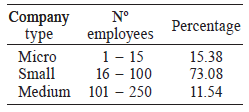
The target population was selected after consulting a recent official census issued by Mexico’s Secretary of Economics which contained a total of 50 Mexican software companies listed in the state of Nuevo Leon. It is worth to mention that both Mexico City and the state of Nuevo Leon concentrate most of the IT and software development industries in the country. At the end, we received responses from 26 software startup companies, that is, one person per company answered the questionnaire, during the second half of 2013. A breakdown of the participants based on company size is shown present in Table II. The distribution confirms the fact that most participants are considered small in personnel size, i.e., based on participants’ responses more than 85% have less than 100 employees and also the majority indicated that they have no more than five years of service. The above classification in conjunction with the intervals for the number of employees was also taken from the aforementioned census.
Results
Annual number of new software products or services
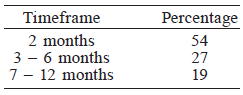
The first question provides the distribution of new software development projects or products released on a yearly basis. In Table III it can be observed that more than 80% of the respondents claimed that their companies are capable of producing between 4 to 5 or, possibly even more, new product releases every year. In order to better understand the outcome for this question, the respondents were also asked a few other additional questions that are not considered part of the main survey but nonetheless they are useful to support or clarify certain details. First, the participants had to indicate the approximate project development timeframe for each requested software product or service, with the results shown in Table IV. Hence, 54% selected an average two-month period from inception to completion, followed by 27% who agreed on a six-month interval and only 19% mentioned the overall development time lasted up to a year. The latter distribution supports the relatively high number of product releases per year. The next additional question is concerned the type and scope associated to every software release that was reported. In this case, about 70% of the participants indicated that their main software needs focused on solving any business or administrative processes or tasks. The remaining 30% fell into other categories such as consumer/commercial or component-based software development. In general, the results for this question were expected, given the nature of software startups as described in (Giardino et al., 2014), i.e., given their limited resources they often concentrate on specific market segments or customers.
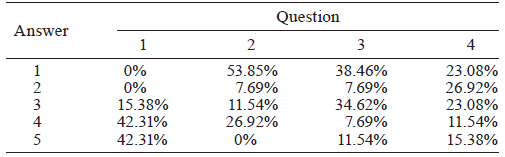
Funding increase from strategic alliances and/or mergers The second question inquires how much was the overall funding increased due to any company alliances and/ or mergers. We can see (Table III) that about 54% of the participants indicated that their funding increased up to 20% after any of the aforementioned organizational changes. The latter indicates that more than half of the participants have seen minimal increase in their budgets due to such actions even though 27% repor ted a budget increase between 61 and 80%. Interestingly, none of the participants selected the 81-100% option, which in this case implies that, so far, no such corporate moves have increased funding to those levels yet. Maximum level of financial support from government or financial institutions
The last two questions deal with the maximum level of financial support provided by government and financial institutions, respectively. Based on a recent initiative of Mexico’s Secretary of Economics, the term ‘financial support’ refers to the ability of a software provider to obtain funding mainly from either financial institution in order to be productive and become a profitable enterprise. As far as government support goes, almost 39% of the participants stated that they receive up to 20% of their operating funds from government agencies followed by 35% who responded that they can obtain between 41 and 60%. By contrast, less than 20% of the respondents indicated that the majority of their funding (>60%) comes from government areas. Finally, the results corresponding to financial institutions funding showed a slightly more even distribution across all five possibilities.
Through the application of this survey, we are able to gain some insight about the approximate level of financial support that Mexican software companies receive from either government or financial institutions to support their productivity. The level of financial support that this kind of companies receives is still below that which other countries promote and allocate (Moitra, 2001; McLaughlin, 2003; Kshetri, 2005). For instance, India and its highly successful software consultancy firms not only provide traditional offshore software development services, but also they are able to manufacture and export their software products to customers all over the world. In fact, some Indian software companies have even established regional offices in several countries including Mexico (e.g., Infosys Technologies).
Our results indicate that almost 40% of the participants have seen budget increases of up to 20% due to government participation. Meanwhile, funding by financial institutions has seen some improvement, as almost 75% claimed their budgets increased by up to 60%. The latter is not surprising, as the majority of Mexican software companies have been created with capital investments from either groups or financial institutions. Therefore, in a similar way as other nations are doing (Moitra, 2001; Kshetri, 2005), Mexico’s federal and state governments should coordinate and increase their participation in funding
Results showed that most of the software funding has been coming from financial institutions to address, for the most part, specific software needs in specific businesses or markets. Except for one software provider, there has been an absence of a broader vision to produce and export Mexican software mainly due to a lack of financial support from federal and state governments. However, the latest federal reforms and policies might start to open new opportunities for Mexican software companies, but there is still much work to do in this area and it would be interesting to reapply the survey to see how much funding levels have changed as software providers are expected to gain knowledge and experience.
Finally, despite the low levels of financial support, several Mexican software firms have adopted the right strategies to improve their processes and become more efficient by gradually investing in new technologies and training programs for their personnel.
The latter constitutes another interesting area to explore and analyze; i.e., how new software development companies are managing both technology and personnel to be more competitive. Since technology and methodologies are changing very rapidly, it is evident that both government and financial institutions must become more involved and support their own software industry, as it is a key component of any world economy.
Conclusion
Software products and services will continue to evolve and expand into many more areas and applications. As development methodologies progress, not only the quality of software products may increase, but also their overall development timeframes could get shorter. However, as we have seen, there are always multiple factors that play a major role in the development of commercial or business software applications, where proper funding and financial support initiatives represent an essential component that can determine the success or failure of the whole development effort. Thus, adequate funding is always required in order to first have an organization that is capable to produce software products with the highest quality within the established time frames and budgets.
In this work we have presented the results of a survey to investigate the approximate level of financial support that Mexican software providers receive from either local government or financial institutions to develop software products and services. The study focused on small and/or recently created software providers since they very often struggle to obtain the funding necessary to develop larger and more complex software solutions rather than just small and simple requirements. On the other hand, we are aware that the main limitation of this work comes from the dynamic nature of software itself; i.e., it is always a challenge to keep up with the latest state-of-the-art in any software or technological studies, since they change very rapidly and the results become outdated quickly. Nevertheless, it is worth the effort to report some of the main issues that affect the development of software products and services in certain countries or regions. Furthermore, our literature review found no previous efforts that focused on any cost or financial aspects related to software development in Latin American countries.
REFERENCES
Abrahamsson P, Salo O, Ronkainen, J (2002) Agile software development methods: review and analysis. VTT Publications. 478.
Boehm BW (1981) Software Engineering Economics. Prentice- Hall. Englewood Cliffs, NJ, USA. 767 pp.
Giardino C, Unterkalmsteiner M, Paternoster N, Gorschek T, Abrahamsson P (2014) What do we know about software development in startups?. IEEE Soft- ware 31: 28-32.
Jorgensen M (2014) What we do and don’t know about software development effort estimation. IEEE Software 31: 37-40.
Kemerer CF (1987) An empirical validation of software cost estimation models. Commun. ACM 30: 416-429.
Khan AW, Khan SU (2013) Critical success factors for offshore software outsourcing contract management from vendors perspective: an exploratory study using a systematic literature review. IET Software 7: 327-338.
Khan SU, Azeem MI (2014) Intercultural challenges in offs-hore software development outsourcing relationships: an exploratory study using a systematic literature review. IET Software 8: 161-173.
Khan SU, Niazi M, Ahmad R (2012) Empirical investigation of success factors for offshore soft- ware development outsourcing vendors. IET Software 6: 1-15.
Kshetri N (2005) Structural shifts in the Chinese software industry. IEEE Software 22: 86-93.
Lee J, Kang S, Lee D (2012) Survey on software testing practices. IET Software 6: 275-282.
McLaughlin L (2003) An eye on India: outsourcing debate continues. IEEE Software 20: 114-117.
Moitra D (2001) India’s software industry. IEEE Software 18: 77-80.
Niazi M, Ikram N, Bano M, Imtiaz S, Khan SU (2013) Establishing t rust in offshore software outsourcing relationships: an exploratory study using a systematic literature review. IET Software 7: 283-293.
Pressman RS (2005) Software Engineering: A Practitioner’s Approach. McGraw Hill, New York, NY, USA. 880 pp.
Qureshi, MRJ (2012) Agile software development methodology for medium and large projects. IET Software 6: 358-363.
Reel JS (1999) Critical success factors in software projects. IEEE Software 16: 18-23.
Sharma A, Vardhan M, Kushwaha DS (2014) A versatile approach for the estimation of software development effort based on SRS document. Int. J. Software Eng. Knowl. Eng. 24: 1-42.
Smite D, Calefato F, Wohlin C (2015) Cost savings in global software engineering: where’s the evidence. IEEE Software 32: 26-32.
Sommerville I (2004) Software Engineering. International Computer Science Series. Addison Wesley Longman. Amsterdam, The Netherlands. 963 pp.
Author notes