Comunicaciones
BODY COMPOSITION AND SOMATOTYPE OF ELITE 10 KILOMETERS RACE WALKING ATHLETES
COMPOSICIÓN CORPORAL Y SOMATOTIPO DE ATLETAS MARCHISTAS DE ÉLITE DE 10km
COMPOSIÇÃO CORPORAL E SOMATOTIPO DE ATLETAS CAMINHANTES DE ELITE DE 10km
BODY COMPOSITION AND SOMATOTYPE OF ELITE 10 KILOMETERS RACE WALKING ATHLETES
Interciencia, vol. 43, no. 4, pp. 289-294, 2018
Asociación Interciencia
Received: 21/11/2017
Corrected: 26/04/2018
Accepted: 26/04/2018
Funding
Funding source: Universidad de Tarapacá
Contract number: UTA Mayor No. 5750-15
Abstract: The somatotype of athletes has been determined for many sports. However, there are few reports on race walkers and even fewer on female athletes. The aim of this study was to describe the body composition and somatotype of young elite 10km race walkers. Twenty females aged 17.2 ±1.14 and 10 males aged 19.45 ±4.30, who competed in the XVII Pan American Race Walking Cup, were evaluated. Their weight, height, body mass index (BMI) and percentage of body fat (%BF) were recorded. The Heath-Carter method was used to determine the somatotype. In male, the mean values for BMI (20.58 ±0.35), %BF (7.64 ±1.55) and somatotype (2.34 ±0.89; 3.33 ±0.92; 3.39 ±0.66) are reported. For female, the mean values for BMI (20.67 ±0.55), %BF (13.94 ±3.66) and somatotype (3.11 ±1.26; 3.04 ±1.08; 2.93 ±1.24) were also determined. Males presented a significantly lower %BF. In addition, females had a significantly greater endomorphic component than males. Performance was better in males than in females (47min 53s vs 52min 34s). It is concluded that there are significant differences by sex in the body composition and somatotype of these young elite Pan American athletes. The characteristics of elite race walkers by sex provide relevant information that can be assistive to coaches or sport science professionals during the training of these athletes.
Keywords: Anthropometry, Athletic Performance, Body Fat, Endomorph, Race Walkers.
Resumen: El somatotipo de los atletas en muchos deportes ha sido determinado. Sin embargo, hay pocos informes sobre la marcha olímpica y menos aun sobre las mujeres que lo practican. El objetivo de este estudio fue describir la composición corporal y el somatotipo de caminantes jóvenes de elite de 10km. Se evaluó a 20 mujeres de 17,2 ±1,14 años de edad y a 10 varones de 19,45 ±4,30 años, quienes compitieron en la XVII Copa Panamericana de Marcha Olímpica. Se registró peso, altura, índice de masa corporal (IMC) y porcentaje de grasa corporal (%MG), y se utilizó el método Heath-Carter para determinar el somatotipo. En hombres se obtuvieron valores medios para IMC de 20,58 ±0,35%; para %BF de 7,64 ±1,55 y un somatotipo de 2,34 ±0,89; 3,33 ±0.92; 3,39 ±0,6). Para las mujeres, se determinaron los valores medios para IMC (20,67 ±0,55), %MG (13,94 ±3,66) y somatotipo (3,11 ±1,26; 3,04 ±1,08; 2,93 ±1,24). Los varones presentaron un %BF significativamente menor. Además, las mujeres poseen un componente endomórfico significativamente mayor que en los varones. El rendimiento de la prueba fue mejor en hombres que en mujeres (47min 53s vs 52min 34s). Se concluye que existen diferencias significativas por sexo en la composición corporal y el somatotipo de estos atletas jóvenes de élite panamericanos. Las características de los marchistas de élite por sexo proporcionan una información relevante que ayuda a entrenadores o profesionales de las ciencias del deporte durante el entrenamiento de estos atletas.
Resumo: O somatotipo dos atletas em muitos esportes tem sido determinado. No entanto, há poucos relatos sobre a marcha atlética e ainda menos sobre as mulheres que a praticam. O objetivo deste estudo foi descrever a composição corporal e o somatotipo de caminhantes jovens de elite de 10km. Avaliou-se 20 mulheres de 17,2 ±1,14 anos de idade e 10 homens de 19,45 ±4,30 anos, quem competiram na XVII Copa Panamericana de Marcha Atlética. Registrou-se peso, altura, índice de massa corporal (IMC) e porcentagem de gordura corporal (%BF), e se utilizou o método Heath-Carter para determinar o somatotipo. Em homens se obtiveram valores médios para IMC de 20,58 ±0,35%; para %BF de 7,64 ±1,55 e um somatotipo de 2,34 ±0,89; 3,33 ±0.92; 3,39 ±0,6). Para as mulheres, se determinaram os valores médios para IMC (20,67 ±0,55), %MG (13,94 ±3,66) e somatotipo (3,11 ±1,26; 3,04 ±1,08; 2,93 ±1,24). Os homens apresentaram %BF significativamente menor. Além disso, as mulheres possuem um componente endomórfico significativamente maior que nos homens. O rendimento da prova foi melhor em homens que em mulheres (47min 53s vs 52min 34s). Conclui-se que existem diferenças significativas por sexo na composição corporal e o somatotipo destes atletas jovens de elite panamericanos. As características dos marchadores de elite por sexo proporcionam uma informação relevante que ajuda a treinadores ou professionais das ciências do deporte durante o treinamento de estes atletas.
Introduction
Race walking is historically one of the first-foot racing specialties practiced, although it is poorly known among different disciplines of athletics. It is very popular in some countries, such as Spain, Italy, China, Japan, Mexico, Guatemala, and Russia, where there is a tradition of race walkers. The emergence of world-class athletes has increased its popularity in countries, such as Kenya and Ethiopia, which have outstanding performers in this discipline (Carter et al., 2008; Vernillo et al., 2013).
Race walking differs from other athletic sports of displacement because in its execution there is no ‘flight’ phase; i.e., the race walker must at no time lose contact with the ground during the race. This forces the performers to develop a technique that differs with respect to the usual running technique, with several important differences. Race walking is an Olympic specialty with usual track distances of 10, 20 and 50km, being thus considered as a middle- or long-distance event (Vernillo et al., 2012; Hanley, 2015). Most authors identify knee joint and lower limb kinetics during the race cycle as the primary indicators for expressing better athletic achievements (Donà et al., 2015; Hanley et al., 2013).
Athletic performance is influenced by several factors. Body composition has shown to be one of the most determinant of them, due to the importance that anthropometric characteristics have on a specific sport, as do arm spam or muscle groups in basketball players and swimmers (Carter and Heath, 2005; Arrese and Ostáriz, 2006; Högström et al., 2012; Buśko et al., 2017). Consequently, competitors in different disciplines present different physiques, and athletes from different categories and genders might have different body composition profiles. It is therefore relevant to determine the ideal body composition and morphological characteristics of each sport, in order to establish a reference point for future athletes and coaches (Carter and Heath, 2005).
Some researchers have used the Heath-Carter method to classify individual athletes according to three essential elements, namely, endomorphy (relative adiposity), mesomorphy (the tendency for relative musculoskeletal development) and ectomorphy (the tendency to relative linearity), which results in the somatotype or biotype of the subject. This is an anthropometric method that has important relevance in the classification of athletes and non-athletes (Carter and Heath, 2005; Díaz and Espinoza-Navarro, 2012; Högström et al., 2012; Lizana et al., 2015).
Understanding the somatic traits of a specific discipline that may differentiate relevant qualities for establishing an association between body dimensions and the best dynamic performance is a challenge for kinanthropometrists and sport science researchers (Landers et al., 2000; Kandel et al., 2014) Therefore, the objective of the present study was to determine and analyze the body composition and somatotype by sex of young 10km race walkers who participated in a sports competition in Arica, Chile, in 2015.
Methods
In this observational study, the anthropometric characteristics of junior category race walking athletes participating in a 10km Pan American competition for elite athletes representing countries from the Americas, the XVII Pan American Race Walking Cup, held in Arica-Chile, in 2015, were assessed and described.
Athletes were invited to participate prior to the competition. Data from athletes who agreed to participate and fully completed the race were finally included. The competition was completed by 22 male and 25 female athletes. Of the 47 runners, 30 decided to participate and were finally included in the study. These were 20 females and 10 males with average ages of 19.45 and 17.2 years, respectively.
The athletes were evaluated two days before the competition by two researchers (JG and OE) during the morning session. Measurements were performed following the standard protocols of the International Society for Advancement of Kinanthropometry (ISAK, 2001). Weight and height were determined with a Dectecto model 2391 scale (Webb City, NY, USA) with precision of 0.1kg and 0.1cm. Using the measurements of the weight and height, the body mass index (kg/m) was determined. The percentage of body fat (%BF) was calculated via the Carter equation (Carter et al., 1982), which was specifically designed for athletes, as follows: male %BF= (Σ6 skinfolds × 0.1051) + 2.58; and female %BF= (Σ6 skinfolds × 0.1548) + 3.58, incorporating six cutaneous folds (triceps, subscapular, supraspinal, abdominal, anterior thigh and medial calf). The cutaneous folds, perimeters and diameters were determined using a Rosscraft anthropometric set (Rosscraft, Surrey, Canada).
Anthropometrical somatotype
For the evaluation of the anthropometric somatotype, the Heath-Carter method was used, which includes two basic measurements (weight and height), four skinfolds (triceps, subscapular, supraspinal, and medial calf), two bone diameters (biepicondylar humeral and femoral) and two perimeters (flexed arm in maximal tension and maximum leg perimeter). The three components of the somatotype (endomorphy, mesomorphy, and ectomorphy) were determined from the measurements. The sample was also represented with a somatochart, and the thirteen categories proposed by Carter (Carter and Heath, 2005) were determined to describe the categories of the somatotypes.
The evaluations were performed with the athletes standing barefoot and wearing light clothes. All measurements were performed three times, with the median used as the final result, following the recommendations in ISAK (2001). The anthropometric measurements were performed at the right hemibody.
The process of anthropometric assessments was orally explained to each athlete. Then, informed consent was signed by the athletes. The Ethics Committee of the Universidad of Tarapacá of Chile approved the working protocols in accordance with the outlines of the Declaration of Helsinki.
Statistical analysis
All the obtained data were processed using the statistical package STATA 12 (Stata, College Station, TX, USA) software. The results are expressed in frequency, mean, standard deviation and confidence interval. A pre-hoc inspection of normality was performed using the Shapiro-Wilk test. For the comparison of the variables by sex, the t-test and Mann-Whitney test were used. The significance level was set at p <0.05.
Results
Table I contains the characteristics of the study sample. Males had a significantly greater weight and height than females. The skinfolds of the triceps, front thigh and medial calf were significantly lower in males than females. In general, it is observed that females present greater measurements in their skinfolds. The femoral diameter was greater in males. The time of execution of the race (10km) was significantly shorter (p<0.05) in males (47min 53s) than in females (52min 34s).
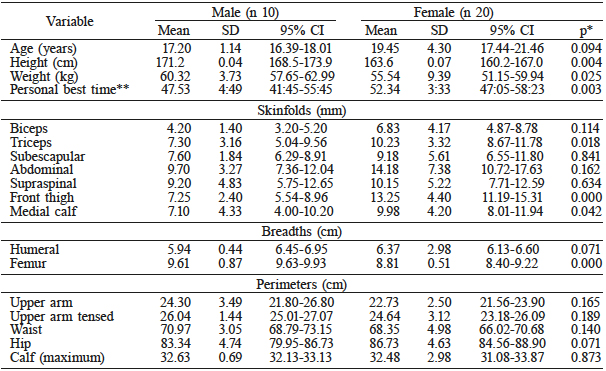
SD: standard deviation, CI: confidence interval.* Mann-Whitney test for comparison of all variables, except height, personal best, supraspinal skinfold, abdominal skinfold, humeral breadth, upper arm tensed, waist, hip, and calf, for which t-test were used.** Minimum and maximum personal best time (min:s).
Table II shows the body composition and somatotype of the race walkers. The percentage of bofy fat, the sum of six skinfolds and endomorphy were significantly greater in females as compared to males (p<0.05). There were no differences by gender in body mass index.

SD: standard deviation, CI: confidence interval.* Mann-Whitney test for comparison of all variables, except ectomorphy for which t-test was used.
Table III shows the distribution of the somatotype categories according to those proposed by Carter and Heath (2005). Females showed a large dispersion, predominating the mesomorphic endomorph (15%), balanced mesomorph (15%) and ectomorphic endomorph (15%) categories, while in males, the ectomorphic mesomorph category was predominant (50%).

Values are expressed as percentage and (frequency).
Figure 1 is the somatochart of the male athletes. A distribution of somatopoints centered between the mesomorphic and ectomorphic components is reported with a mean somatotype of 2.3-3.3-3.4.
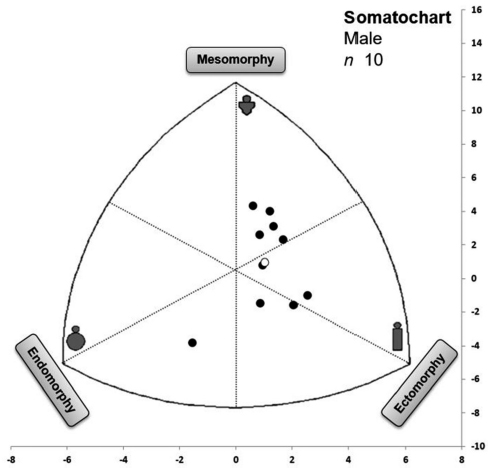
Figure 1
Somatotype distribution of elite male race walkers (10km). White circle: mean somatotype (2.3-3.3-3.4).
Figure 2 shows the somatochart for the female athletes, in which a large dispersion of somatopoints is observed with a mean somatotype of 3.1-3.0-2.9.
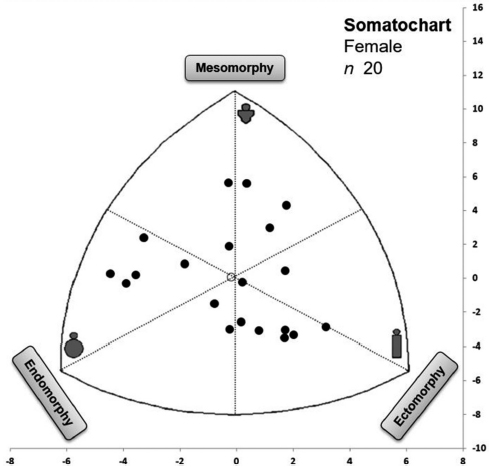
Figure 2
Somatotype distribution of elite female race walkers (10km). White circle: mean somatotype (3.1-3.0-2.9).
Discussion
Biotypology using the Heath-Carter anthropometric somatotype is one of the most widely used methods for the selection of gifted and talented people for sports (Lentini et al., 2004; Almagià et al., 2009; Sterkowicz-Przybycien and Gualdi-Russo, 2018). When the anthropometric study is performed amongst elite competitors, this provides valuable data on the structural requirements necessary in the different disciplines, since there are somatic characteristics that are selective in the world of sport. Likewise, other authors point to the concept of morphological prototype related to the performance of athletes from the point of view of kinanthropometric techniques and establish an ideal figure possible through the optimization of body variables (Carter and Heath, 2005; Donà et al., 2009; Hanley et al., 2013).
The search for athletes with the right characteristics to compete successfully at top levels is increasingly difficult. Anthropometry and somatotype seem to be the most influential physical characteristics. Based on these methods, several authors determined the importance of adiposity levels in sports performance (Legaz and Eston, 2005; Arrese and Ostáriz, 2006); however, different disciplines also have their own morphological requirements, such as long arms for rowing, greater endomorphy for throwing sports, or greater ectomorphy for long-distance running (Kerr, 1995). These morphological parameters are largely hereditary (Baker, 2001; Norton and Olds, 2001; Calò and Vona, 2008).
When analyzing anthropometric characteristics and somatotypes in our study sample according to gender (Tables I and II), it is observed that male have a significantly higher weight and height and a significantly lower %BF compared to female. The respective somatocharts show a uniform pattern, with predominantly ecto-mesomorphic nature in males compared to a more dispersed distribution in females, where the endomorphic component being predominant (Table II, Figures 1 and 2). Lentini et al. (2004) in a study of high-performance Argentinean athletes, determined a predominantly mesomorphic somatotype in males and a medium, mesomorph-endomorph biotype in females, reaffirming a sexual dimorphism between athletes and different athletic disciplines. Eiin et al. (2007) described the somatotype of young race track Malaysian athletes of both sexes, finding a meso-ectomorphic somatotype in males and a large ectomorphic component in females, which differs from our results. Martínez-Sanz et al. (2011) established international referential somatotypes in which, specifically for Olympic male race walkers, a predominantly mesomorphic somatotype and low endomorphy were observed; however, they did not report the length of the race nor the values for female race walkers. A study performed on male Kenyan elite marathon athletes showed that this population presents a somatotype of 1.53-1.61-3.86, with a dominant ectomorphic component (Vernillo et al., 2013), an aspect that is consistent with the male junior athletes of our sample because the two highest components presented by them were mesomorphic and ectomorphic. A high ectomorphic component and a smaller mesomorphic component of male athletes in our study may be related to long-distance running tests and lower muscular effort, which influences energy expenditure (Morgan and Daniels, 1994). However, for female athletes in this category, there is no dominant component (average somatotype), which may be because, in this junior category, the biotype of the female race walker remains undefined. In addition, the high dispersion of somatopoints may also be related to the wide range of ages of female athletes in our sample, with a difference of four years between the youngest and oldest participants, as opposed to males, amongst which there was a difference of only two years.
Rodríguez et al. (2014) reported anthropometric characteristics of high performance Chilean athletes, determining an average somatotype of 2.0-4.0-3.8 for mid distance male runners, with dominant components of mesomorphy and ectomorphy, similar to our results. The endomorphic component was also the lowest of the three, similar to the findings of the present study. In females, a somatotype of 2.9-3.3-3.0 was observed, with no major differences between the components of the somatotype, which is also similar to our study. Additional studies are required in male and female Olympic race walkers and athletes of greater distances, such as 20km and 50km, due to the scarcity of existing reports.
Another frequently mentioned component of sports practice is the percentage of body fat due to its relation with performance (Kandel et al., 2014). Table I shows a lower %BF in males than females. Arrese and Ostáriz (2006) found a strong relationship between the thickness of the thigh and leg skinfolds and the time of execution of a distance running test. They observed a high relation when comparing the skinfolds of the front thigh and medial calf. Bale et al. (1986), when comparing skinfolds and percentage of body fat mass in 10km male runners, found that the elite group had a body fat mass percentage of 8.0 ±0.5 vsaverage athletes with a fat mass percentage of 12.1 ±1.5. Our study group reveals a similar percentage of body fat mass in males, 7.64 ±1.55, while in our female study population it was 13.94 ±3.66, similar to that observed in the average male athletes.
Knechtle et al. (2010a, b) associated and correlated the best personal execution times of running tests with the endomorphic component between males and females and found better performances in athletes with a lower endomorphism and, consequently, lower body fat, as observed in Table II of our study, where males show significantly lower body fat values than females and lower adipose components such as endomorphy and Σ6 skinfolds, which may influence the sports performance of females.
A challenge for the kinanthropometrists and the scholars in sports sciences is the understanding of the somatic traits that differentiate relevant aspects, in order to establish the association between a body dimension and the best dynamic performance. The analysis of the functional components of the Olympic race walking practice is relevant, given its special technique involving the ankle, knee and hip joints, where the pace and cadence length must be coordinated, which involves a great control of the skeletal neuro-muscular system (Preatoni et al., 2010). Henley and Bissas (2013) determined that knee flexors undergo heavy wear during the oscillation phase of the race, which may increase the risk of injury to ischemic muscles.
This study aimed to provide additional information regarding the discipline of Olympic race walking in male and female junior athletes of the 10km running test, information that remains scarce in the literature, so as to serve future research in the determination of sports talents in this discipline.
The anatomical conditions according to the different age groups, gender, origin and environment, evidently generate dissimilar sports performance responses, for which more rigorous comparative analyzes are necessary in order to be useful for coaches and sport science professionals (Pavei et al., 2014).
Conclusions
There are significant differences by gender in the body composition and somatotype of these young elite Pan American race walking athletes, with significantly lower skinfolds in males. Females have significantly more body fat mass than males (13.94 ±3.66% vs 7.64 ±1.55%), which is an aspect that could influence their sports performance. Further studies are required in this regard. The time used to finish the race was significantly lower in males than females.
Acknowledgements
This work was funded by project UTA Mayor No. 5750-15, Universidad de Tarapacá, Chile.
REFERENCES
Almagià A, Rodríguez F, Barrraza F. Lizana P, Marincovich D, Binvignat O (2009) Perfil antropométrico de jugadores profesionales de voleibol sudamericano. Int. J. Morphol. 27: 53-57.
Arrese A, Ostáriz E (2006) Skinfold thicknesses associated with distance running performance in highly trained runners. J. Sports Sci. 24: 6976.
Baker J (2001) Genes and training for athletic performance revisited. Sportscience 5(2) http://sportsci.org/jour/0102/jb.htm
Bale P, Bradbury D, Colley E (1986) Anthropometric and training variables related to 10km running performance. Brit. J. Sports Med. 4:1 70-173.
Buśko K, Pastuszak A, Lipińska M, Lipińska M, Gryko K (2017) Somatotype variables related to strength and power output in male basketball players. Acta Bioeng. Biomech. 19: 161-167.
Calò C, Vona G (2008) Gene Polymorphisms and elite athletic performance. J. Anthropol. Sci. 86: 113-131.
Carter L, Ross W, Aubry S, Hebbelinck M, Borms J (1982) Anthropometry of Montreal Olympic athletes. IN Carte L (Ed.) Physical Structure of Olympic Athletes. Part I. Karger. Basel, Switzerland. pp. 25-52.
Carter R, Cheuvront S, Harrison C, Proctor L, Myburgh K, Brown M, Malina R (2010) Success, race and athletic performance. J. Stud. Sports Athlet. Educ. 4: 207-229.
Carter J, Heath B (2005) Somatotyping; Development and Applications. Cambridge University Press. Cambridge, UK. 520 pp.
Díaz J, Espinoza-Navarro O (2012). Determination of fat mass percentage by measuring body circumference, weight and height: A validation study. Int. J. Morphol. 30: 1604-1610.
Donà G, Preatoni E, Cobelli C, Rodano R, Harrison A (2009) Application of functional principal component analysis in race walking: an emerging methodology. Sports Biomech. 4: 284-301.
Eiin WJ, Flyger N, Wilson N (2007) Somatotypes of young Malaysian track and field athletes. Asian J. Exer. Sports Sci. 4: 29-35.
Hanley B (2015) Gait alterations during constant pace treadmill race walking. J. Strength Cond. Res. 29: 2142-2147.
Hanley B, Bissas A (2013) Analysis of lower limb internal kinetics and electromyography in elite race walking. J. Sports Sci. 11: 1222-1232.
Högström GM, Pietilä T, Nordström P, Nordström A (2012) Body composition and performance: influence of sport and gender among adolescents. J Strength Cond. Res. 26: 1799-804.
ISAK (2001) International Standards for Anthropometric Assessment. International Society for Advancements of Kinanthropometry. Underdale, Australia. 139 pp.
Kandel M, Baeyens P, Clarys P (2014) Somatotype, training and performance in ironman athletes. Euro. J. Sport Sci. 14: 301-308.
Kerr D, Ackland T, Schreiner A (1995) The elite athlete-assessing body shape, size, proportion and composition. Asia Pacific J. Clin. Nutr. 4: 25-29.
Knechtle B, Wirth A, Baumann B, Knechtle P, Rosemann T, Oliver S (2010a) Differential correlations between anthropometry, traininig volume and performance in male and female ironman triathletes. J. Strength. Cond. 24: 2785-2793.
Knechtle B, Wirth A, Baumann B, Knechtle P, Rosemann T (2010b). Personal best time, percent body fat, and training are differently associated with race time for male and female ironman triathletes. Res. Quarterly Exer. Sport 81: 62-68.
Landers G, Blanksby T, Smith D (2000) Morphology and performance of world championship triathletes. Ann. Hum. Biol 27: 387-400.
Legaz A, Eston R (2005) Changes in performance, skinfold thicknesses, and fat patterning after three years of intense athletic conditioning in high level runners. Br. J. Sports Med 39: 851-856.
Lentini N, Gris G, Cardey M, Aquilino G, Dolce P (2004) Estudio somatótipico en deportistas de alto rendimiento de Argentina. Arch. Med. Dep. 21: 497-509.
Lizana PA, Olivares R, Berral F (2015) Somatotype tendency in Chilean adolescents from Valparaíso: review from 1979 to 2011. Nutr. Hosp. 31: 1034-1043.
Martínez-Sanz J, Urdampilleta A, Guerrero J, Barrios V (2011) El somatotipo-morfología en los deportistas. ¿Cómo se calcula? ¿Cuáles son las referencias internacionales para comparar con nuestros deportistas? Ed. Fis. Dep. Nº 159: 1-17.
Morgan D, Daniels J (1994) Relationship between VO2max and the aerobic demand of running in elite distance runners. Int. J. Sports Med, 15: 426-429.
Norton K, Olds T (2001) Morphological evolution of athletes over the 20th Century: Causes and consequences. Sports Med. 31: 763-783.
Pavei G, Cazzola D, La Torre A, Minetti A (2014) The biomechanics of race walking: Literature overwiew and new insights. Eur. J. Sports Sci. 7: 661-670.
Preatoni E, Ferrario M, Donà G, Hamill J, Rodano R (2010) Motor variability in sports: A non-lin ear analysis of race walking. J. Sports Sci. 12: 1327-1337.
Rodríguez P, Castillo V, Tejo C, Rozowski J (2014) Somatotipo de los deportistas de alto rendimiento de santiago, Chile. Rev. Chil. Nutr. 41: 29-39.
Sterkowicz-Przybycien K, Gualdi-Russo E (2018) Evaluation of somatotype in artistic gymnastics competitors: a meta-analytical approach. J. Sports Med. Phys. Fitness. doi: 10.23736/S0022-4707.18.08332-9 (pre-print)
Vernillo G, Agnello L, Drake A, Padullo J, Piacentini M, La Torre A (2012) An observational study on the perceptive and physiological variables during a 10,000-m race wallking competition. J. Strengh Cond. Res. 26: 2741-2747.
Vernillo G, Schena F, Berardelli C, Rosa G, Galvani G, Maggioni M, Agnello L, La Torre, A (2013) Anthropometric characteristics of top-class Kenyan runners. J. Sports Med. Phys. Fitness 53: 403-408.
Author notes
Corresponding author: Omar Espinoza-Navarro. Address: Laboratory of Reproduction and Development, Department of Biology, Universidad de Tarapacá. General Velásquez Nº 1775, Arica, Chile. e-mail: oespinoz@uta.cl
Alternative link
https://www.interciencia.net/wp-content/uploads/2018/05/289-6353-ESPINOZA-43-04.pdf (pdf)