Comunicaciones
POTENTIAL OF ENERGY PRODUCTION FROM SLAUGHTERHOUSE WASTEWATER
POTENCIAL DE PRODUCCIÓN DE BIOGÁS A PARTIR DE AGUAS RESIDUALES DE RASTRO
POTENCIAL DE PRODUÇÃO DE BIOGÁS A PARTIR DE ÁGUAS RESIDUAIS DE ABATEDOURO
POTENTIAL OF ENERGY PRODUCTION FROM SLAUGHTERHOUSE WASTEWATER
Interciencia, vol. 43, núm. 8, pp. 558-565, 2018
Asociación Interciencia
Recepción: 14/08/2016
Corregido: 05/07/2018
Aprobación: 10/07/2018
Financiamiento
Fuente: Mexican Council for Science and Technology (CONACYT)
Nº de contrato: CB-24325
Financiamiento
Fuente: Mexican Council for Science and Technology (CONACYT)
Nº de contrato: CB-51739
Descripción del financiamiento: Mexican Council for Science and Technology (CONACYT) for the financial support through the project CB-24325 and CB-51739.
Abstract: This paper assesses the potential of slaughterhouse wastewater as raw material for biogas production in Mexico. First, wastewater from an abattoir is directly treated in lab scale anaerobic bioreactors; batch configuration with immobilized biomass was implemented in order to evaluate the biogas production. After that, an estimation of the energy generation from the produced biogas is carried out. From the experimental assays, ~90% of the chemical oxygen demand was removed and a production of 0.78m3 of biogas per m3 of treated water was obtained. Thus, if the whole of wastewater generated in Mexican slaughterhouses (8,026,596m3) was treated by anaerobic processes, more than 16,500MWh/year could be generated by considering a 75% of methane concentration in biogas, as obtained in this work. In consequence, the emission of around 8,400t CO2eq/year could be avoided.
Keywords: Anaerobic Digestion , Bacteria Immobilization , Biogas , Natural Zeolite , Renewable Energy.
Resumen: En este documento se analiza el potencial de producción de biogás en México a partir de aguas residuales de rastro. Primero, se tomaron muestras de un rastro y se usaron directamente en bioreactores anaeróbicos de laboratorio que fueron operados en modo de lotes con bacterias inmovilizadas a fin de evaluar la producción de biogás. Después, se estimó la generación de energía eléctrica a partir del biogás producido. Los resultados muestran una remoción de ~90% de la demanda química de oxígeno y una producción de 0,78m3 de biogás por m3 de agua residual tratada. De esa manera, si toda el agua residual de los rastros mexicanos (8.026.596m3) fuese tratada por digestión anaeróbica, el análisis de producción de energía indica que es posible obtener más de 16.500MWh/año considerando biogás con una concentración de metano de 75%, como la obtenida en este trabajo. En consecuencia, se puede evitar la emisión de alrededor de 8.400t CO2eq /año.
Resumo: Neste documento se analisa o potencial de produção de biogás no México a partir de águas residuais de abatedouro. Primeiro, recolheram-se amostras de um abatedouro e se usaram diretamente em biorreatores anaeróbicos de laboratório que foram operados em modo de lotes com bactérias imobilizadas a fim de avaliar a produção de biogás. Depois, se estimou a geração de energia eléctrica a partir do biogás produzido. Os resultados mostram uma remoção de ~90% da demanda química de oxigênio e uma produção de 0,78m3 de biogás por m3 de água residual tratada. Então, se toda a água residual dos abatedouros mexicanos (8.026.596m3) fosse tratada por digestão anaeróbica, a análise de produção de energia indica que seria possível obter mais de 16.500MWh/ano, considerando biogás com uma concentração de metano de 75%, como a obtida neste trabalho. Em consequência, pode ser evitada a emissão de aproximadamente 8.400t CO2eq /ano.
Introduction
Animal slaughter in abattoirs produces different kinds of wastes: fat, blood, sludge, bones, and wastewater. Some wastes are used to synthesize other products (Hejnfelt and Angelidaki, 2009; Seck and Gueye, 2010; Galanakis, 2012), but in many cases, they are directly rejected without an adequate treatment process (Mittal, 2006; Arvanitoyannis and Ladas, 2008) leading to environmental and health problems. For example, the presence of pathogenic microorganisms could cause diseases such as typhoid fever, dysentery, cholera and hepatitis (Signorini Porchieto et al., 2005; Signorini, 2008). High concentrations of blood, proteins and fats induce water pollution, turbidity and even eutrophication (Gutiérrez-Sarabia et al., 2004; Romero-Ortiz et al., 2011). Different cases have been reported describing real problems arising from slaughterhouse wastewater (Signorini, 2008; Padilla Gasca, 2010; Castillo Borges et al., 2012; Sun et al., 2017; Marcos et al., 2017).
In Mexico, slaughterhouses are classified in three categories depending on their infrastructure and the inspection regulations: Ministry of Health Inspection Type (MHIT), Federal Inspection Type (FIT), Private Slaughterhouse Type (PST). Those of the first type are commonly known as Municipal Slaughterhouses; they have limited equipment and offer the basic services (slaughter, meat cut and direct sale); the inspection is done by the Ministry of Health and focuses on the meat quality. The FIT slaughterhouses have a better infrastructure, and besides the basic services they offer additional ones (meat packaging, clinical suture, meat wastes processing). They are inspected by the Ministry of Agriculture, Livestock, Rural Development, Fisheries and Food (SAGARPA); the inspection includes meat quality, infrastructure and processes. The quality standards are higher and they are oriented to industrialize their products for large metropolitan areas or for export; also, a basic valorization of wastes is considered (Rocha Sánchez, 2006; Signorini, 2007). The first FIT was implemented in 1949. The last category (PST) corresponds to slaughterhouses operated by private companies; they have mixed MHIT and FIT characteristics and are usually inspected by the Ministry of Health. According with the Agrifood and Fisheries Sectors Information Service, there exist 1151 slaughterhouses in Mexico: 913 MHIT, 97 FIT and 141 Private (SIAP, 2018).
The production of cattle meat in Mexico during the last ten years (2008-2017) amounted to 18,026,089.66t from 84,490,490 sacrificed animals. According with the Food and Agriculture Organization (Quiroga Tapias and García de Siles, 1994) and some other reports (Warnecke et al., 2008; Ziara, 2015; Food Northwest, 2018), the processing of cattle requires around 1000 liters of water per animal. Based on reference information (Signorini, 2007), in this document it is considered that 95% of the water becomes wastewater and the other 5% is lost mainly by evaporation. Therefore, the annual average generation of wastewater from cattle slaughtering is estimated on 8,026,596.55m3.
On the other side, official statistics indicates that around 37% of the wastewater from slaughterhouses in México is treated and 63% is sent to municipal sewage systems, streams, rivers or septic tanks. This situation represents a high environmental risk and important challenges for government, technologic and scientific sectors.
In this context, it is well known that biological processes offer important benefits concerning the treatment of wastewater. Anaerobic digestion allows efficient treatment of effluents with high organic load, transforming the wastes into biogas. Since biogas is mainly composed of methane (CH4) and carbon dioxide (CO2), it can be used as an alternative source of energy. In different reports it is concluded that anaerobic processes are well suited to degrade slaughterhouse effluents and to obtain biogas (Salminen and Rintala, 2002; Saddoud and Sayadi, 2007; Battimelli et al., 2010; Palatsi et al., 2011; Bayr et al., 2012; Marcos et al., 2012) even though some aspects of the process are amenable to improvements. For example, bacteria immobilization is an alternative to accelerate the biological reactions, as it allows to concentrate the active microorganisms and to improve the mass transfer. Different materials, such as synthetic polymers, zeolites and others, have been evaluated for its application (Romero-Güiza et al., 2016; Luo et al., 2015; Zheng et al., 2015). There exist commercial materials for this use; however, the high cost could be limiting for many users. For this reason, currently low cost materials are investigated as solid support for anaerobic bacteria. Among these materials, natural zeolites have been studied showing interesting performance (Montalvo et al., 2012).
Finally, according to the National Energy Balance (SENER, 2017), ~90% of primary energy in Mexico is provided by non-renewable sources such as oil, natural gas, coal and radioactive materials. Alternative energies began to be utilized few years ago, including biogas. Currently biomass contributes 4.7% of the energy. The government has promoted the use of cattle farming wastes to produce electricity and heat; also, some industries use biogas to provide part of the energy required in their processes. Moreover, some projects have been developed for the exploitation of biogas produced in landfills. Besides, the National Strategy for Energy (NSE) has been designed in order to state directives concerning the generation and management of the energy. An important objective is to produce 35% of energy from clean technologies by 2024 (SENER, 2014). This goal implies great challenges from a scientific and technologic viewpoint. Thus, diverse raw materials for production of biogas are being studied.
The first goal of the paper is to show that the application of an anaerobic treatment with immobilized bacteria in a natural zeolite contributes to the efficient removal of the organic pollutants in slaughterhouse effluents. Natural zeolites are abundant in Mexico, but they are little used; these minerals are usually extracted from natural deposits and they are sold without added value. The idea is to propose an alternative for the valorization of natural zeolites, as its application on the treatment of complex wastewater could be of benefit to the environmental and energy sectors. The second goal is to determine, based on the experimental results, the potential of energy generation from the anaerobic treatment of slaughterhouse wastewater in Mexico. The calorific potential of biogas depends on the CH4 concentration and this potential can be transformed into electrical energy.
Materials and Methods
Characterization of raw materials and products
Substrate
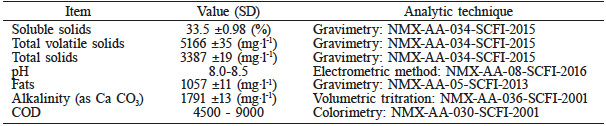
The substrate for anaerobic digestion was obtained from an abattoir situated at Saltillo, Coahuila, Mexico, according with the official regulation (NMX-AA-03-1980), and was used in the experiments without any additional treatment. The samples were collected from a homogenization tank were wastewater is stocked before aerobic treatment. Depending on the experimentation time (2-8 weeks), 10 liter samples of wastewater were used for each experiment. The characterization of the wastewater samples was carried out following the local official regulations as presented in Table I.
The inoculum used in the experimental tests was obtained from a brewery wastewater treatment plant.
Bacterial support
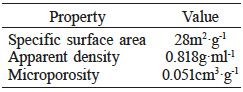
The natural zeolite used in the experiments is a clinoptilolite provided by Zeomex S.A. de C.V. The identification of the zeolite was determined by X-ray diffraction using a Phillips X´Pert equipment. The surface characteristics were obtained by N2 adsorption/desorption using an Autosorb-1C analyzer. Table II includes the results obtained. Two particle sizes were tested (9-10 and 20-35 mesh) in order to evaluate their effect on biofilm formation and on wastewater treatment performance.
Chemical oxygen demand (COD)
During the experiments, the reaction medium was sampled at intervals of 48-72h to measure COD, which was determined by colorimetry with a HACH® kit having a detection range of 20-1500mg·l-1. Duplicate analyzes of samples before each experiment and during the biogas production tests were carried out.
Biogas
The biogas composition was determined by gas chromatography (Agilent Technologies® 6890) with a thermal conductivity detector (TCD) using He as carrier. The separation of the biogas compounds was carried out using a Supel-QTM Plot capillary column (30m×0.53mm). Subsequently, the results from the biogas samples taken from the bioreactor were compared with a gas standard mixture composed of CH4 and CO2.
Experimental set-up
Batch tests were performed to evaluate the COD removal and biogas production. Three kinds of experiments were conducted in order to evaluate process performance:
-
Without biofilm formation (WOB). The main objective of these experiments was to allow the biofilm formation over the zeolite particles. Although the presence of clinoptilolite influences the treatment of water, the absence of biofilm implies there is not bacterial immobilization. Therefore, WOB experiments are considered as being without bacterial support and they were taken as the reference condition. Two experiments were carried out by duplicate for each selected zeolite particle size (four in total).
-
With biofilm formation at 120ml scale (B120). Two preliminary stages for the biofilm formation were considered: 45 and 60 days. In this period, anaerobic bacteria are adapted to the substrate as the zeolite is colonized by the microorganisms. Three sequential B120 experiments were performed by duplicate for each selected zeolite particle size (six in total).
-
With biofilm formation at 7 liter scale (B7L). Once the best particle size had been identified, the experimental set up was scaled up to a bioreactor of 7 liter. Measures of pH, temperature, agitation and biogas production were taken each hour. Every 12h a sample of substrate was taken so as to evaluate COD removal. Biogas production was measured by liquid displacement in a graduated burette. Five single sequential B7L experiments were performed.
The operating conditions were selected following bibliographic recommendations (Rodriguez et al., 2002) and are presented in Table III. Also, schematic representations of the reactors are presented in Figure 1.
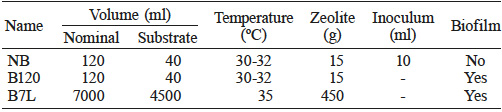
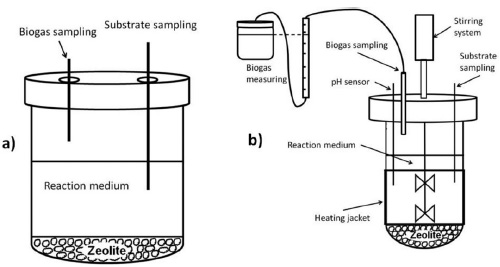
Figure 1
Schematic representation of a bioreactors: a) 120ml, b) 7 liters.
Potential for energy production and CO2 emissions
From the experimental data obtained, the analysis concerning energy production was done. Although there exist different alternatives for biogas transformation, the use of a biogas internal combustion engine coupled to an electrical generator was considered since this is a commercially accessible and easy to implement technology (FIRCO, 2007; Sun et al., 2017; Hakawati et al., 2017). Figure 2 presents a schematic representation of the electricity production from biogas.
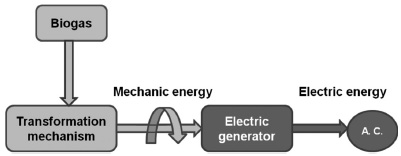
Figure 2
Schematic representation of a biogas electrical plant
Eq. (1) was used to compute the potential for electricity generation (P; kWh) from the slaughterhouse wastewater. It was deduced from the biogas availability and the theoretical energy content of biogas. Some different forms of this equation have been reported in other works (Gomez et al. 2010; Surroop and Mohee, 2012; Hakawati et al., 2017).
 (1)
(1)where : production yield of biogas from wastewater, it is computed with Eq. 2 and depends on the performance of B7L experiments; CH4: content of CH4 in biogas (%), it is considered in the range of 50-80% since these are recommended values for this kind of applications (Hakawati et al., 2017); : low heat value of CH4, a known constant to determine the energy content in biogas, = 10.28kWh (Gomez et al. 2010; Surroop and Mohee, 2012); : global efficiency for electricity generation, is taken as =0.35 due to the feasibility of available technology (FIRCO, 2007).
 (2)
(2)where Vb: volume of produced biogas (liters) and Vw: corresponding volume of treated wastewater (liters).
On the other side, the reduction of equivalent CO2 emissions (RCO2eq) from the utilization of biogas was estimated. This was done according with the Green House Gases Mexican Program (SEMARNAT, 2014) by using Eq. 3.
 (3)
(3)where EFEM: last reported emission factor for electricity in Mexico (http://www.geimexico.org/factor.html), which is EFEM= 0.4999t CO2eq/MWh; PAB: avoided conventional electricity due to the transformation of biogas which is equivalent to the estimation done with Eq. 1.
Results and Discussion
Experiments without biofilm formation
Figure 3 illustrates the performance for COD removal and CH4 formation. During the first four days, more that 95% of the COD is transformed. After five days, the concentration of COD remains almost constant; that means, the anaerobic digestion is practically finished. These results are consistent with those reported for treatment of a synthetic swine waste, where 80% of COD reduction was reached in around 30 days (Montalvo et al., 2006).
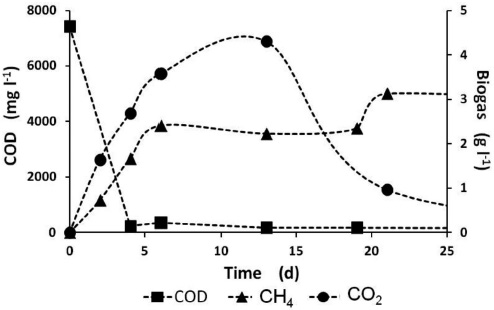
Figure 3
COD removal and methane production without biofilm (particle size: 9-10 mesh)
In agreement with the COD consumption, the production of CH4 increases exponentially until it reaches a maximum around 2.4g·l-1 after six days. According to the methanogenesis stage in a normal anaerobic digestion process, besides CH4, an exponential formation of CO2 is produced reaching a maximum in 13 days.
The results do not show a significant influence of zeolite particle size on the COD removal efficiency, as can be appreciated in Figures 3 and 4. This could be explained as follows: the total biofilm formed in the material surface is similar for each particle size since the amount of zeolite is the same (15g) and the micropore size of the zeolite is not enough to increase the effective area. This implies that the effective amount of biofilm is very similar for both particle sizes, and therefore the efficiency of the treatment process is similar.
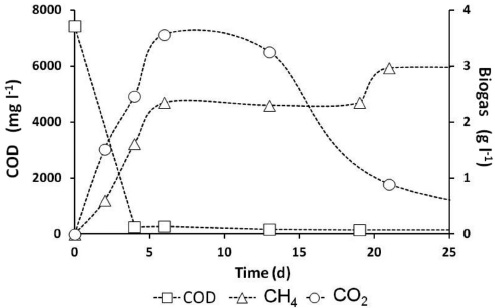
Figure 4
COD removal and CH4 production without biofilm (particle size: 20-35 mesh)
The tendency of the COD is similar in both experiments, as well as the production of CH4 and CO2. The trend of the CO2 formation in both assays shows an initial increment and decreases from day 13; this phenomenon can be due to an adsorption effect of the CO2 on the zeolite surface, in agreement with research about the adsorption of a CO2/CH4 mixture on a natural clinoptilolita (Hernandez Huesca et al., 1999).
At day 20, fresh wastewater (~5ml) was added to the reactor in order to simulate an increase of COD. The objective of this action is to analyze the process behavior concerning the COD transformation, with the perspective of a future configuration in continuous mode. An increment in CH4 production is remarked without affecting the COD degradation. This situation allows the expectation of good results from a continuous-flow configuration.
Experiments with biofilm formation
The results obtained in assays using zeolite with biofilm formed in 45 days are presented on Figures 5 and 6. An important difference with respect to the experiments without biofilm can be noted: the conversion of COD is faster and a removal of 95% is reached in two days. Besides, the biogas composition is ~77% CH4 and ~23% CO2. The CH4 formation follows the same trend, reaching a maximum production of 2.6gl-1 in eight days. The main difference in comparison with the process behavior without biofilm concerns the CO2 formation: a low concentration is obtained, the maximum is reached in four days; after that, a constant production is remarked instead of decreasing as in the previous experiments. This phenomenon can be explained by the zeolite porosity occlusion; it means that the formed biofilm prevents a direct contact between the substrate and the zeolite surface, reducing the adsorption capacity. However, the concentration of the produced CO2 is always lower than in the case of Figures 3 and 4. Concerning the effect of zeolite dimension, no significant influence on the process performances is observed (Figure 6).
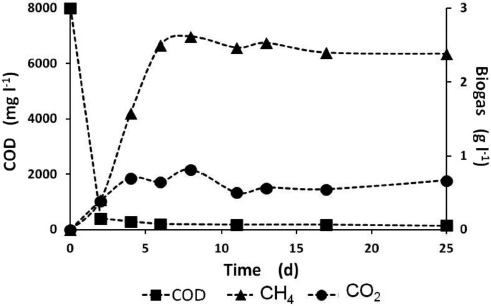
Figure 5
Process performance with biofilm: 45 days (particle size: 9-10 mesh)
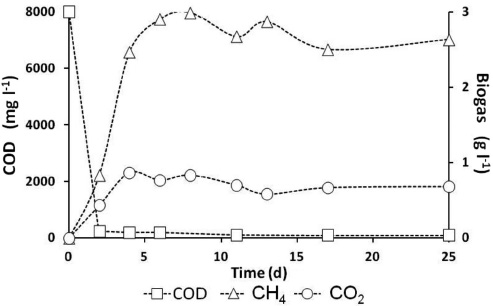
Figure 6
Process performance with biofilm: 45 days (particle size: 20-35 mesh)
Finally, the results obtained from the assay with 60 day-biofilm are presented on Figures 7 and 8. The COD removal is ~95% in 48h, as for the assays with 45 days-biofilm. As for the previous experiments, the biogas composition is ~77% CH4 and 23% CO2. The maximal CH4 production is reached in eight days: 2.6 and 3.0g·l-1 for the 9-10 and 20-35 mesh particle size, respectively. The particle size does not affect considerably the COD removal. In addition, it is deduced that 45 days as preliminary stage are enough for the biofilm formation.
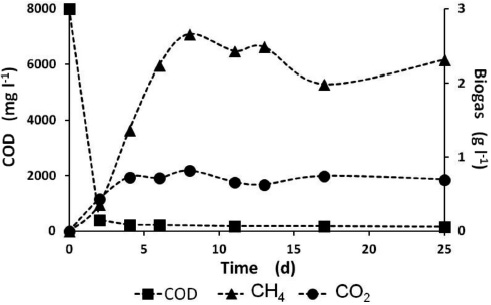
Figure 7
Process performance with biofilm: 60 days (particle size: 9-10 mesh)
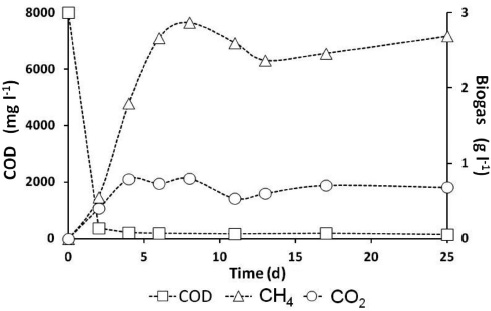
Figure 8
Process performance with biofilm: 60 days (particle size: 20-35 mesh)
At small scale, a COD removal >95% was observed in an interval of 2-4 days. These results are similar to the ones obtained in other studies (Bowman, 2003; Tada et al., 2005). This supposes advantages of natural Mexican zeolite for the immobilization of the bacterial consortium. As stated before, even if the presence of the zeolite could influence the COD removal, the absence of biofilm implies there is not bacterial immobilization.
Anaerobic digestion in 7 liter reactor
The initial COD ranged between 4,100 and 8,100mg·l-1, and pH between 7.7 and 10.8 due to the different operating conditions of the slaughterhouse. The previous experiments show that particle size does not affect significantly the process performance; therefore, the tests on the scaled set up were performed using a particle size of 20-35 mesh, as it was easier to handle.
The results are presented in Figures 9 to 11. As can be seen in Figure 9, the values of initial pH are different for each experiment: pHini= 8.1, 8.5, 7.7, 10.9 and 9.0; the more alkaline samples coincide with a cleaning of the slaughterhouse installations, for which basic substances are employed. It should be mentioned that there is no regulation of pH in the experimental tests. However, approximately on the second day, the pH reaches its minimum value and after that it attains a steady state for each experiment as follows: pHfin= 7.4, 7.1,7.0, 6.7 and 6.8. This behavior corresponds to the typical performance of anaerobic processes and it suggests that the production of acids in the acetogenesis stage is fast, as reported in the specialized literature (Angelidaki et al. 1999; Beteau et al., 2005; Hu et al., 2018). This implies that the CH4 production starts in a few days.
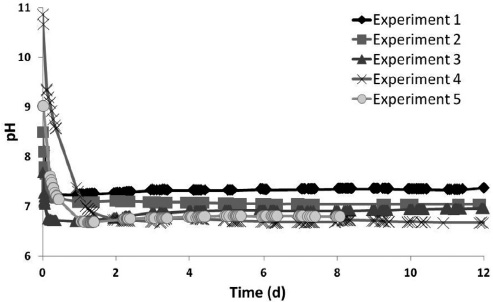
Figure 9
pH trends for batch experiments in a 7 liter reactor
On the other side, the COD removal corresponds qualitatively to the previous series of experiments, regardless of the initial conditions (Figure 10). Since the wastewater samples were collected in different days at different operating conditions, the initial COD is not the same for each experiment: CODini= 4191, 4176, 8070, 4840 and 5240mg·l-1. The samples were placed directly on the bioreactor in order to evaluate the process performances at different operating conditions. The final COD for each experiment reached the following values: CODfin= 360, 410, 1405, 540 and 606mg·l-1. As can be remarked, a large percentage of COD removal is attained: COD%= 91.41, 90.18, 82.58, 88.84 and 88.43%. The worst performance (82.58%) corresponds to the maximal initial COD (8070mg·l-1), which could be due to the relation between the active biomass and the reaction volume and initial COD: it is possible that the quantity of colonized zeolite is not enough to reach the same dynamics as for the other operating conditions. As an alternative, this situation could be solved either increasing the quantity of colonized zeolite inside the reactor or increasing the residence time. For the other cases, the performance is ~90%. Even if it is lower than that obtained in the small scale experiments, the performance can be considered as high.
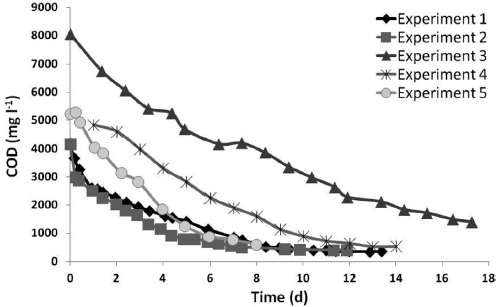
Figure 10
COD removal from batch experiments in a 7 liter reactor
Biogas production is presented in Figure 11. The maximal production is achieved between the second and the fifth day for all the experiments; after that, biogas production decreases fast. In this interval of time, the process generates an average production of biogas of 11, 21, 14, 17 and 22ml·h-1. In all the experiments, the final amount of biogas was ~3.5 liters, excepting the experiment 3, where it was ~1.5 liters. It can be remarked that the smallest and largest biogas formations correspond to the first and last experiments, respectively. In addition, for the fifth experiment the production increases faster; a large production is obtained in few days and after that it decreases very fast. That means that the anaerobic bacteria are better adapted after several sequential experiments. Also, a relation between the pH dynamics and biogas production can be remarked: when pH decreases very fast, biogas production is larger than that corresponding to a slower pH dynamics.
From the previous information, it can be concluded that the natural zeolites used as bacterial support in anaerobic processes are an interesting alternative. A high COD removal is achieved and an attractive biogas production is generated.
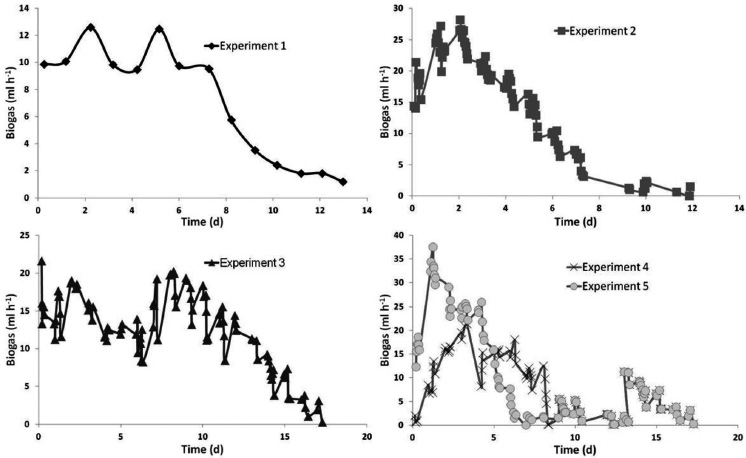
Figure 11
Biogas production from batch experiments in a 7 liter reactor
Potential for energy generation and reduction of CO2eq emissions
The values for the parameters involved in Eq. 1 were mentioned above, excepting the biogas production yield. This is obtained from data of B7L experiments:
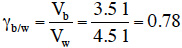
In order to facilitate the analysis of the electricity production potential, the treatment of 1m3 of wastewater producing 0.78m3 of biogas, according with the obtained yield, is assumed as a basis for the computation.
An example of the use of Eq. 1 to estimate the energy potential is presented hereafter. The considered parameters are = 0.78, CH4= 50%, = 10.280kWh and = 0.35. Then, the energy potential is:

In addition, considering that the previous power replaces the equivalent amount of traditional electricity (PAB), the corresponding RCO2eq is estimated with Eq. 2 as follows.

In the best scenario, if the whole of wastewater generated from bovine slaughterhouses (8,026,596.55m3/year) in Mexico could be treated by anaerobic processes, it could be possible to produce 16,855.85 MWh/year by considering a 75% of CH4 concentration in biogas, as obtained in this work. This is equivalent to avoid the emission of 8,426.24t CO2eq/year.
On the other side, considering some more practical situations, Table IV shows the estimation of energy and emissions reduction potential considering different scenarios. Entries in the first column represent the concentration of CH4 in the biogas. The second and third columns include the amount, expressed in m3, of CH4 in the biogas for 1 m3 of treated water and for 50m3, respectively. The fourth column corresponds to the potential of 1m3 of wastewater, considering the characteristics of the samples used in this work. Column five indicates the potential of a small slaughterhouse where 55 animals are sacrificed each day (50m3 of wastewater). Finally, last columns show the RCO2eq from the treatment of 1m3 and 50m3, respectively.
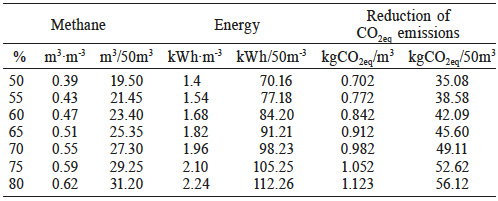
Considering the treatment of 1m3 of wastewater and a CH4 concentration of 50% in biogas, it is possible to obtain 1.4kWh·m-3. If the CH4 concentration is 80%, then 2.24kWh of electricity can be expected with the current commercial technology. This alternative for energy generation implies a RCO2eq of 702g and 2.24kg for 1m3 and 50m3, respectively. It seems to be small energy generation and emissions reduction; however, these numbers correspond to the slaughter of one animal; the larger amounts of treated water, the more relevant benefits could be obtained. For example, processing of 55 animals, which is feasible in most of slaughterhouses in the country, 50m3 of wastewater are produced; therefore the production of electricity is ranged between 70.16 and 112.26kWh, corresponding to the range of CH4 concentration of 50 and 80%, respectively. Regarding the emissions reduction, 35.08kg of CO2eq could be avoided if CH4 is 50% and 56.12kg of CO2eq if it is 80%.
The produced energy can be used for the slaughterhouse operation, reducing the energy consumption from the grid. For example, the required power for some common equipment used in slaughterhouses is presented in Table V. The corresponding data are taken from technical specifications of commercial products (Aseragro, 2018).
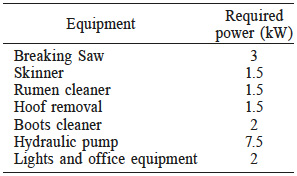
Considering the worst case, which corresponds to the treatment of 50m3 of wastewater producing biogas with 50% of CH4 concentration, it is possible to obtain 70.16kWh. Possible scenarios for the use of this energy in the hypothetic slaughterhouse operation are: 1) all the equipment presented in Table V during 3.7h; 2) a hydraulic pump during a complete work day (8h), able to provide compressed air to operate a series of pneumatic equipment such as, stunner, small breaking saws, etc.; 3) in one complete work day: 1 breaking saw, 1 skinner, 1 rumen cleaner, 1 hoof removal and 1 boots cleaner, considering that the last equipment is used in small time intervals; or 4) lights and office equipment and some other energy requirement during all the work day.
Therefore, this alternative offers environmental benefits since anaerobic digestion reduces the organic pollutants in wastewater, at the same time that it allows the production of electricity, which can be used to provide a fraction of the energy requirements in a slaughterhouse.
Conclusions
Experiments at a 120ml scale were performed to allow the biofilm formation in zeolite particles during the treatment of slaughterhouse wastewater. It was found that particle size has not representative influence on the treatment performances since the total formed biofilm is similar for the tested conditions.
At the same bioreactors scale, two preliminary stages for biofilm formation were tested: 45 and 56 days, deducing that 45 days are enough. In addition, the obtained results show that the natural zeolite can be used as support for anaerobic bacteria in wastewater treatment processes. Removal of 95% of COD and 3g·l-1 of CH4 production was reached.
At a 7 liter scale, a slower dynamics of COD removal and CH4 production was observed. Nevertheless, a biogas yield production biogas/wastewater of 0.78 was obtained and 90% of COD removal. An alternative to improve the process performance is to increase the amount of zeolite with biofilm in the reactor. This leads to have more active bacteria to transform organic material in biogas.
On the other hand, the potential for electricity generation from slaughterhouse wastewater is enough to manage a reasonable fraction of the abattoir operation.
More than 16,500MWh/year could be generated and around 8,400t CO2eq/year could be avoided if all the wastewater was treated by anaerobic digestion.
More research is required in order to optimize the process performance in larger scale reactors and in other operating configurations, such as semi-continuous and continuous mode.
Acknowledgments
The authors express their gratitude to the Mexican Council for Science and Technology (CONACYT) for the financial support through the project CB-24325 and CB-51739.
REFERENCES
Angelidaki I, Ellegaard L, Ahring BK (1999) A comprehensive model of anaerobic bioconversion of complex substrates to biogas. Biotechnol. Bioeng. 63: 363-372.
Arvanitoyannis IS, Ladas D (2008) Meat waste treatment methods and potential uses. Int. J. Food Sci. Tech. 43: 543-559.
Aseragro (2018) Technical specifications of products for processing pigs and bovines in slaugtherhouses. http://www.aseragro.com/sitio/productos_aseragro.php (Cons. 06/2018).
Battimelli A, Torrijos M, Moletta R, Delgenès JP (2010) Slaughterhouse fatty waste saponification to increase biogas yield. Bioresource Technol. 101: 3388-3393.
Bayr S, Rantanen M, Kaparaju P, Rintala J (2012) Mesophilic and thermophilic anaerobic co-digestion of rendering plant and slaughterhouse wastes. Bioresource Technol. 104: 28-36.
Béteau JF, Otton V, Hihn JY, Delpech F, Chéruy A (2005) Modelling of anaerobic digestion in a fluidised bed with a view to control. Biochem. Eng. J. 24: 255-267.
Bowman RS (2003) Application of surfactants-modified zeolites to environmental remediation. Micropor. Mesopor. Mat. 61: 43-56.
Castillo Borges ER, Bolio Rojas A, Méndez Novelo RI, Osorio Rodríguez JH, Pat Canul R (2012) Remoción de materia orgánica en aguas residuales de rastro por el proceso de Contactor Biológico Rotacional. Ingeniería 16: 83-91.
FIRCO (2007) Aprovechamiento de biogás para la generación de energía eléctrica en el sector agropecuario. Claridades Agropec. 168: 3-43.
Food Northwest (2018) Water and wastewater use in the food processing industry - Meat and poultry processing. http://www.foodnorthwest.org (Cons. 06/2018).
Galanakis CM (2012) Recovery of high added-value components from food wastes: Conventional, emerging technologies and commercialized applications. Trends Food Sci. Tech. 26: 68-87.
Gómez A, Zubizarreta J, Rodrigues M, Dopazo C, Fueyo N (2010) An estimation of the energy potential of agro-industrial residues in Spain. Resource Conserv. Recycl. 54: 972-984.
Gutiérrez-Sarabia A, Fernández-Villagómez G, Martínez-Pereda P, Rinderknecht-Seijas N, Poggi-Varaldo HM (2004) Slaughterhouse wastewater treatment in a full-scale system with constructed wetlands. Water Environ. Res. 76: 334-343.
Hakawati R, Smyth BM, McCullough G, De Rosa F, Rooney D (2017) What is the most energy efficient route for biogas utilization: Heat, electricity or transport? Appl. Energy 206: 1076-1087.
Hejnfelt A, Angelidaki I (2009) Anaerobic digestion of slaughterhouse by-products. Biomass Bioener. 33: 1046-1054.
Hernandez-Huesca R, Diaz L, Aguilar-Armenta G (1999) Adsorption equilibria and kinetics on CO2, CH4 and N2 in natural zeolites. Sep. Purif. Technol. 15: 163-173.
Hu C, Yan B, Wang KJ, Xiao XM (2018) Modeling the performance of anaerobic digestion reactor by the anaerobic digestion system model (ADSM). J. Environ. Chem. Eng. 6: 2095-2104.
Luo C, Lü F, Shao L, He P (2015) Application of eco-compatible biochar in anaerobic digestion to relieve acid stress and promote the selective colonization of functional microbes. Water Res. 68: 710-718.
Marcos A, Al-Kassir A, López F, Cuadros F, Brito P (2012) Environmental treatment of slaughterhouse wastes in a continuously stirred anaerobic reactor: Effect of flow rate variation on biogas production. Fuel Proces.s Technol. 103: 178-182.
Marcos AC, Al-Kassir A, Cuadros F, Yusaf T (2017) Treatment of slaughterhouse waste water mixed with serum from lacteal industry of Extremadura in Spain to produce clean energy. Energies 10(765): 1-15.
Mittal GS (2006) Treatment of wastewater from abattoirs before land application -A review. Bioresource Technol. 97: 1119-1135.
Montalvo S, Guerrero L, Borja R, Travieso L, Sánchez E, Díaz F (2006) Use of natural zeolite at different doses and dosage procedures in batch and continuous anaerobic digestion of synthetic and swine wastes. Resource Conserv. Recycl. 47: 26-41.
Montalvo S, Guerrero L, Borja R, Sánchez E, Milán Z, Cortés I, de la Rubia MA (2012) Application of natural zeolites in anaerobic digestion processes: A review. Appl Clay Sci. 58: 125-133.
NMX-AA-03-1980 Norma Mexicana: Aguas Residuales. Muestreo. Secretaría de Comercio y Fomento Industrial. Mexico City.
NMX-AA-05-SCFI-2013. Water analysis - Measurement of extractables fats and oils in natural waters, wastewaters and treated wastewaters - Test method. Secretaría de Economía. Mexico City.
NMX-AA-08-SCFI-2016. Water analysis - Measurement of ph in natural waters, wastewaters and treated wastewaters - Test method. Secretaría de Economía. Mexico City.
NMX-AA-030-SCFI-2001. Water analysis - Determination for chemical oxygen demand in natural, wastewaters and wastewaters treated - Test method. Secretaría de Economía. Mexico City.
NMX-AA-034-SCFI-2015. Water analysis - Measurement of salts and solids dissolved in natural water, wastewaters and treated wastewaters - Test method. Secretaría de Economía. Mexico City.
NMX-AA-036-SCFI-2001. Water analysis - Determination of acidity and alkalinity total in natural, wastewaters and wastewaters treated. Secretaría de Economía. Mexico City.
Padilla Gasca E (2010) Evaluación de un Filtro Anaerobio de Flujo Ascendente para Tratar Agua Residual de Rastro. Thesis. Centro de Investigación y Asistencia en Tecnología y Diseño del Estado de Jalisco. Guadalajara, Mexico. 94 pp.
Palatsi J, Viñas M, Guivernau M, Fernandez B, Flotats X (2011) Anaerobic digestion of slaughterhouse waste: Main process limitations and microbial community interactions. Bioresource Technol. 102: 2219-2227.
Quiroga Tapias G, García de Siles JL (1994) Manual for Installing a Small FAO Modular Abattoir. Food and Agriculture Organization: Rome. 250 pp.
Rocha Sánchez B (2006) Alternativas para la Utilización de Plasma y Globina de Sangre Bovina. Thesis. Universidad Nacional Autónoma de México. 78 pp.
Rodríguez-Martínez J, Rodríguez-Garza I, Pedraza-Flores E, Balagurusamy N, Sosa-Santillan G, Garza-García Y (2002) Kinetics of anaerobic treatment of slaughterhouse wastewater in batch and upflow anaerobic sludge blanket reactor. Bioresource Technol. 85: 235-241.
Romero-Güiza MS, Vila J, Mata-Alvarez J, Chimenos JM, Astals S (2006) The role of additives on anaerobic digestion: A review. Renew. Sust. Energy Rev. 58: 1486-1499.
Romero-Ortiz L, Ramírez-Vives F, Álvarez-Silva C, Miranda-Arce MG (2011) Uso de hidrófitas y un sistema anaerobio para el tratamiento de agua residual de rastro. Polibotánica 31: 157-167.
Saddoud A, Sayadi S (2007) Application of acidogenic fixed-bed reactor prior to anaerobic membrane bioreactor for sustainable slaughterhouse wastewater treatment. J. Haz. Mat. 149: 700-706.
Salminen E, Rintala J, (2002). Anaerobic digestion of organic solid poultry slaughterhouse waste -A review. Bioresource Technol. 83: 13-26.
Seck MA, Gueye MY (2010) Agronomical valorization of bovine slaughterhouse waste by aerobic composting. In Marques dos Santos CSC, Ferreira L (Eds.) Proc. 14th Ramiran International Conference. Instituto Superior de Agronomia. Lisboa, Portugal. pp. 1-4.
SEMARNAT (2014) Versión de difusión del Programa Especial de Cambio Climático 2014-2018. Ministerio del Ambiente y los Recurso Naturales. Mexico.
SENER (2014) Estrategia Nacional de Energía 2014-2028. Ministry of Energy. Mexico.
SENER (2017) Balance Nacional de Energia. Ministry of Energy. Mexico City, Mexico.
SIAP (2018) Records of Slaughterhouses in Mexico. Agrifood and Fisheries Sectors Information Service. http://nube.siap.gob.mx/cierre_pecuario (Cons. 06/2018).
Signorini M (2007) Evaluación de riesgos de los rastros y mataderos municipales. Nacameh. 1: 118-141.
Signorini M (2008) Rastros municipales y su impacto en la salud pública. Nacameh. 2: 1-24.
Signorini Porchieto M, Civit Gual S, Cervantes ME (2005) Guía para la Administración de Rastro y Mataderos Municipales. Comisión Federal para la Protección contra Riesgos Sanitarios. Mexico. 21 pp.
Sun M, Yu PF, Fu JX, Ji XQ, Jiang T (2017) Treatment of slaughter wastewater by coagulation sedimentation- anaerobic biological filter and biological contact oxidation process. IOP Conf. Ser.: Earth Environ. Sci. (82): 1-11.
Surroop D, Mohee R (2012) Technical and economic assessment of power generation from biogas. 2012 International Conference on Environmental Science and Technology IPCBEE, IACSIT Press, Singapore.
Tada C, Yang Y, Hanaoka T, Sonoda A, Ooi K, Sawayama S (2005) Effect of natural zeolite on methane production for anaerobic digestion of ammonia rich organic sludge. Bioresource Technol. 96: 459-464.
Warnecke M, Farrugia T, Ferguson C (2008) Review of Abattoir Water Usage Reduction, Recycling and Reuse. Meat & Livestock Australia Limited, Sidney, Australia. 48 pp.
Zheng H, Li D, Stanislaus MS, Zhang N, Zhu Q, Hu X, Yang Y (2015) Development of a bio-zeolite fixed-bed bioreactor for mitigating ammonia inhibition of anaerobic digestion with extremely high ammonium concentration livestock waste. Chem. Eng. J. 280: 106-114.
Ziara R (2015) Water and Energy Use and Wastewater Production in a Beef Packing Plant. Thesis. University of Nebraska-Lincoln, USA. 60 pp.
Notas de autor
Correponding author: Salvador Carlos Hernández. e-mail salvador.carlos@cinvestav.mx
Enlace alternativo
https://www.interciencia.net/wp-content/uploads/2018/08/558-6007-HERNANDEZ-43_08.pdf (pdf)