Comunicaciones
PHYTOBIOTIC ACTIVITY OF Larrea tridentata, Origanum vulgare AND Plectranthus amboinicus IN GRAM POSITIVE AND GRAM NEGATIVE BACTERIAS
ATIVIDADE FITOBIÓTICA DE Larrea tridentada, Origanum vulgare E Plectranthus amboinicus EM BACTÉRIAS GRAM POSITIVAS E GRAM NEGATIVAS
ACTIVIDAD FITOBIÓTICA DE Larrea tridentate, Origanum vulgare Y Plectranthus amboinicus EN BACTERIAS GRAM POSITIVAS Y GRAM NEGATIVAS
PHYTOBIOTIC ACTIVITY OF Larrea tridentata, Origanum vulgare AND Plectranthus amboinicus IN GRAM POSITIVE AND GRAM NEGATIVE BACTERIAS
Interciencia, vol. 44, no. 5, pp. 298-302, 2019
Asociación Interciencia
Received: 27 February 2019
Corrected: 22 May 2019
Accepted: 27 May 2019
Resumen: El objetivo del presente estudio fue evaluar la actividad fitobiótica de Larrea tridentata,Origanum vulgare y Plectranthus amboinicus en bacterias Gram positivas y Gram negativas de presencia común y que ponen en riesgo la salud humana directa o indirectamente. Se prepararon extractos de hojas de las tres especies en alcohol etílico 75% en proporciones del 30, 35 y 40%, para un total de nueve tratamientos. Las cepas bacterianas fueron divididas en dos grupos dependiendo de su capacidad de tinción: Gram (+) y Gram (-). La variable de respuesta fue el tamaño del halo de inhibición de crecimiento bacteriano. Los datos se analizaron usando la prueba de Kruskal-Wallis. Se encontró diferencia (P<0.05) según el tipo de extracto, el nivel de concentración y el tipo de bacteria, así como en la interacción extracto y nivel (P<0.04) e interacción extracto, nivel y bacteria (P<0.002). Se concluye que L. tridentata al 35% tuvo mayor actividad fitobiótica, comparado con O. vulgare y P. amboinicus.
Abstract: The objective of the study was to evaluate the phytobiotic activity of Larrea tridentata, Origanum vulgare and Plectranthus amboinicus on Gram positive and Gram negative bacteria of common presence that endanger human health directly or indirectly. Extracts of leaves from each of the three plants under study were prepared in 75% ethyl alcohol, in proportions of 30, 35 and 40%, for a total of nine treatments. The bacterial strains were divided into two groups, depending on their staining properties: Gram (+) and Gram (-). The response variable was the size if the inhibition halo of bacterial growth. The data was analyzed using the Kruskal-Wallis test. Differences were found (P<0.05) in the type of extract, concentration level and type of bacteria, as well as in the interaction of the extract and level (P<0.04), and in the interaction of extract, level and bacteria (P<0.002). It is concluded that L. tridentata at 35% had a higher phytobiotic activity, compared with O. vulgare and P. amboinicus.
Keywords: Antimicrobial Activity , Larrea tridentate , Oregano , Plant Extracts .
Resumo: O objetivo deste estudo foi avaliar a atividade fitobiótica Larrea tridentata, Origanum vulgare e Plectranthus amboinicus em bactérias Gram positivas e Gram negativas presença comum e ameaçando a saúde humana direta ou indiretamente. Extratos de folhas foram preparadas em álcool etílico 75% em proporções de 30, 35 e 40% de cada uma das três plantas em estudo, para um total de nove tratamentos. As cepas bacterianas foram divididas em dois grupos, dependendo de sua capacidade de coloração: Gram (+) e Gram (-). A variável resposta foi a dimensão do halo de inibição do crescimento bacteriano. Os dados foram analisados por meio do teste de Kruskal-Wallis. Diferenças (P <0,05) no tipo de nível de concentração do extrato e tipo de bactérias, e também em a interação extrato nível (P <0,04), e em interação extrato, nível e bactérias (P <0,002) foram encontradas. Concluiu-se que L. tridentata 35% tinha a maior actividade fitobiótica, em comparação com O. vulgare e P. amboinicus.
Introduction
Antimicrobials have been used since 1950 as growth promoters in animal production to increase the growth rate and efficiency of food, as well as to prevent and treat bacterial diseases, to favor the growth of animals (Sen et al., 2011;Holman and Chénier, 2014). During the last decades the industrial use of these antimicrobials has resulted in an increase in the number and types of resistant microorganisms (Kalra, 1998; Kalemba and Kunicka, 2003), a process that is enhanced by the ability of certain bacteria to transfer resistance, even between different genera and species, originating different disorders in the balance of the gastrointestinal microbiota, mainly antimicrobial resistance, making therapeutic treatments difficult (Haščík et al., 2016). The presence of these antimicrobials in the tissue or by-products of the animals has also been reported, putting at risk the safety of the food destined for human consumption (Mehndiratta and Bhalla, 2014; Chávez et al., 2015). Only in the USA, more than 47 million episodes of diseases and more than 100,000 hospitalizations occur yearly due to the presence of foodborne pathogens (Scharff, 2012).
The prohibition of the use of antimicrobials as feed additives has led to and has accelerated the study of alternative antimicrobial molecules that can be used in the food of animals destined for production (Nicoletti et al., 2010). Several lines of research are trying to counteract the adverse effects of antimicrobials through less aggressive means (Ojeda, 2008). Some plants, or parts of them, contain natural antimicrobials known as phytobiotics that are mainly phenolic compounds and phyto-alexins. These types of antimicrobials are considered as a potentially safe source because they do not lead to bacterial resistance (Davis et al., 1990; García et al., 2010; Rodríguez, 2011).
The extracts of these antimicrobial-containing plants are easily obtained complex products of secondary metabolites and are less aggressive to nature, as compared to the antibacterial chemicals that are currently used (García et al., 2010). The results of their study cover a broad spectrum of pharmacological functions such as anti-inflammatories, antioxidants, anticancer agents, anthelmintics, antidiarrheals, antitussives, antivirals (Davis et al., 1984), biological activity and biocides, among others (García et al., 2010).
Plant extracts can be isolated by various methods, such as steam distillation or Soxhlet extraction, which do not need expensive reagents or sophisticated equipment (Iáñez, 2005;Moreno-Limón et al., 2011).
Larrea tridentata, locally known as ‘gobernadora’, is a desert shrub widely found in the deserts of Mojave in the USA (Tequida-Meneses et al., 2002) and of Sonora and Chihuahua in Mexico (Tequida-Meneses et al., 2002), and has shown to have antifungal activity (Vargas-Arispuro et al., 2005; Saldivar et al., 2006; Osorio et al., 2010) mainly against Aspergillus flavus, A. niger, Penicillium chrysogenum, P. expansum, Fusarium poae and F. moniliforme (Lira-Salvidar et al., 2003, Vargas-Arispuro et al., 2005;Osorio et al., 2010). It is the nordihidroguayaretic acid (NDGA) phenolic derivative compound that is considered has antifungal activity (Moreno-Limón et al., 2011). Some studies have reported as well a nematicidal or nematostatic effect on nine genera of nematodes, and insect repellency (Lira-Saldivar, 2003).Lira-Salvidar (2003) also mentions that more than 45 bacteria are susceptible to the resin or its constituents, and that the flavonides of the resin are active against viruses that affect RNA.
Common oregano (Origanum vulgare) has been shown to have phytobiotic activity on strains of Gram negative bacteria such as Escherichia coli, Pseudomonas aeruginosa, Salmonella tiphymurium, S. choleraesuis and Vibrio cholerae, and on Gram positive bacteria such as Staphylo-coccus aureus and Bacillus cereus (Ayala et al., 2011). These effects are due to its essential oils, such as thymol, carvacrol, pinene, cymol, alpha thuyone, selinene, dipentene, and alpha terpinene (Kalra, 1998). Phenols such as thymol and carvacrol possess phytobiotic activity due to the acid nature of the hydroxyl group (García et al., 2010).
The oregano ‘orejon’ (Plectranthus amboinicus), which belongs to the Coleus genus (Lamiacea family) and is also known as ‘french’ oregano in Cuba, has shown to possess antitussive, bacteriostatic (70% ethanol), antioxidant (30% ethanol) and phytobiotic activities due to its essential oils, rich in thymol and carvacrol (Menéndez and Pavón, 1999; Bakkali et al., 2008).
The objective of this work was to evaluate the phytobiotic activity of leaf extracts of ‘gobernadora’ (L. tridentata), common oregano (O. vulgare) and oregano ‘orejón’ (P. amboinicus) in Gram positive and Gram negative bacteria of interest in the animal feed sector.
Materials and Methods
Study site and sample preparation
Vegetative material from ‘gobernadora’ (L. tridentata), common oregano (O. vulgare) and oregano ‘orejón’ (P. amboinicus) was collected in the greenhouse of the Universidad Autonoma de Ciudad Juárez, located at 31.746276, -106.442276. Subsequently, they were manually defoliated in the laboratory and the leaves were dried in an incubator (Thermo Fisher Scientific®, USA) at 45˚C for 48h (Kalra, 1998). Once the leaves were dehydrated, they were milled using a blender high speed (Classic model, Oster®, USA) until a fine powder was obtained and kept in a glass container previously labeled and perfectly closed.
The powder samples (ground) of each plant were weighed using an analytical balance (A-160 model, Devender Instrument Co, USA) and extracts were prepared at 30, 35 and 40% solution in 75% ethyl alcohol. The obtained extracts were allowed to stand for 72h before its use. A total of nine treatments (three for each species) were used.
Preparation of the sensidisks
Sensidisks of 5mm diameter were obtained using filter paper (MN 615, 11cm, Machery-Nagel, Germany), with the help of a metal drill with a 1-hole clamp. They were introduced in a 100ml glass container with metal lid for sterilization at 102°C for 30min in a 25 liters autoclave (All American, USA) and then cooled for 24h at room temperature. The sensidisks were immersed in each plant extract for seven days before being placed in a Petri dish of 15cm diameter.
Bacterial strains
A total of eight reference strains were tested and cultivated in the Chemistry Department of the Universidad Autónoma de Ciudad Juárez, of which five correspond to Gram (+) strains: Streptococcus pyogenes (reference ATCC19615), Staphylococcus aureus (reference ATCC25923), Entero-coccus faecalis (reference ATCC19433), Salmonella gallinarum(Klein) (reference ATCC700623) and Bacillus subtilis (reference ATCC6051); and three to Gram (-) strains: Klebsiella oxytoca (reference ATCC13182), enteric Salmone-lla (reference ATCC29630) and Escherichia coli (reference ATCC25922).
In vitro evaluation
Bacterial concentrations were standardized to 50 Klett units using the Klett-Summerson colorimeter. For this, 15×16mm tubes were used to add 5ml of 0.85% sterile saline, and once the bacterial concentrations were standardized, they were inoculated in the Petri dishes containing Muller Hinton agar (Merck - EMB 500g, code 1054370500). They were inoculated in triplicate of each bacterium by plant extract, for a total of 216 inoculated Petri dishes. Immediately, with the help of a clip sterilized with absolute grade ethyl alcohol and flaming, the sensidisks (previously immersed in each extract for seven days) were impregnated with the corresponding extract. Finally, the Petri dishes were placed in a bacteriological stove (Heratherm IMC18, Thermo Scientific, USA) for 24h at 37°C. After an incubation period of 72h the bacterial growth inhibition halo (BGIH) was measured with the help of a 12-inch digital vernier (Bearings, USA) according to the technique described by Bauer et al. (1966).
Statistical analysis
The response variable was the BGIH, which was analyzed using the non-parametric Kruskal-Wallis test using SAS/STAT version 9.3 (SAS, 2009) and comparison of means performed by the Tukey method (Mendenhall, 1994) with α=0.05% as the minimum significant difference.
Results and Discussion
In Figure 1 the halos (BGIH) formed with 35% extracts of the three plants are shown. According to the results obtained, the extracts of the three plants analyzed have phytobiotic activity. Significant differences (P<0.05) were found in the three concentration levels, the inhibition being highest when it was 35%. L. tridentata at 30% had the highest BGIH compared to extracts from P. amboinicus, followed by that from O. vulgare, also at 30%, on an enteric Salmonella strain. S. gallinarum and E. coli were inhibited to a lesser degree by extracts at 30%. Similar results in the BGIH of the extracts were observed for the different strains of Gram (+) and Gram (-) bacteria. Table I shows differences (P<0.05) in the type of extract and level of concentration of the extract (P<0.04).

Figure 1
Halo of inhibition of bacterial growth (mm) of extracts Larrea tridentata, Origanum vulgare and Plectranthus amboinicus at 35% in a Petri dish with Muller Hinton agar inoculated with Salmonella enterica. Photograph by Mateo Itza-Ortiz.
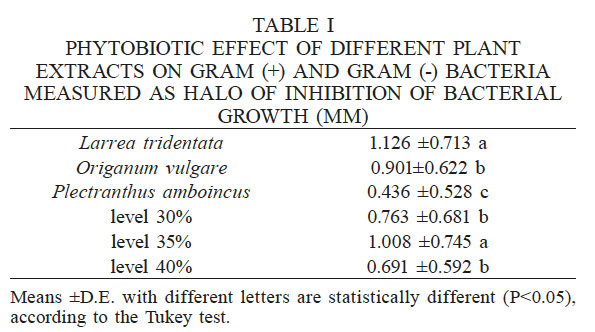
Means ±D.E. with different letters are statistically different (P<0.05), according to the Tukey test. Means ±D.E. with different letters are statistically different (P<0.05), according to the Tukey test
The results indicate that L. tridentata has phytobiotic activity in addition to its known antifungal activity (Vargas-Arispuro et al., 2005; Lira-Saldivar et al., 2006;Osorio et al., 2010), especially against Gram-positive bacteria (Table II). The results also support what was reported by Lira-Saldivar (2003) but in the present work the phytobiotic activity was in the leaf extract in addition to that reported in the resin. The phenolic substances that the extracts contain are bactericidal because they can react chemically with the sensitive systems of the enzymes and make them catalytically inactive (Lira-Saldivar, 2003;Bakkali et al., 2008). et al

Media ±D.E. with different literals in a given column are significantly different (P <0.05). Media ±D.E. with different literals in a given column are significantly different (P <0.05).
In the case of the oreganos, the inhibition of bacterial growth is possibly due to phenolic compounds, polymers and monomers, organic acids and phyto-alexins, which they contain (Osorio et al., 2010). This type of phytobiotics are considered as potentially safe sources (Lv et al., 2011; Rodríguez, 2011). The antifungal activity of extracts from plants such as L. tridentata is based on the ability of these phenolic compounds, poly and monomers, to form complexes with proteins and polysaccharides that are present in the outer membrane of the cell, destabilizing the function of the membrane and cell wall, causing the death of the microorganism (Aguilar et al., 2007).
On the other hand, essential oils share a similar chemical structure called isoprene, the chemical unit of the terpenoids, which derive in three phenols with phytobiotic properties: thymol, carvacrol and eugenol (Bakkali et al., 2008). According to the inclusion concentration, carvacrol and eugenol would dissociate the outer membranes of Gram negative bacteria such as E. coli, S. typhimurium, K. pneumoniae, Y. enterocolitica and E. cloacae; and Gram positive S. aureus, S. epidermidis, L. monocytogene and B. subtilis (Lee et al., 2003;Lv et al., 2011; Ayala et al., 2011; Solorzano-Santos and Miranda-Novales, 2012). NDGA is a phenolic derivative compound with antifungal activity on species like A. flavus and A. parasiticus (Moreno-Limón et al., 2011), and even greater sensitivity is reported on dermatophytes (Conner and Beuchat, 1984); however, levaduriform species are resistant to NDGA (Moreno-Limón, 2011) and the NGDA is not responsible for all of the antimicrobial activity (Lira-Saldivar, 2003).
Larrea tridentata inhibited, although in lesser degree, the growth of S. gallinarum and E. coli, two important bacteria that cause enteritis; the first of them in birds (Closa et al., 1999; Rosario, 2006) and the second one affecting humans (WHO, 2013). Salmonellosis, caused by Salmonella bacteria that can survive several weeks in a dry environment and several months in water, is the cause of the most common and widespread foodborne disease (WHO, 2013). As observed in the present work, there are species of the Salmonella genus that are susceptible to plant extracts.
It is possible that the NDGA has partial phytobiotic action on bacteria and that some other phenolic compound is playing a phytobiotic role in the leaf extracts, giving rise to other activities, not studied, with the use of L. tridentata. Its use does not cause bacterial resistance and favors the innocuousness of the feed, promoting its bactericidal or bacteriostatic potential with a lower environmental impact.
Conclusions
Larrea tridentata, in addition to its antifungal action, has a higher phytobiotic activity on Gram positive bacteria such as Staphylococcus and on Gram negative bacteria such as Salmonella, when compared to O. vulgare and P. amboinicus. It can be used in concentrations of 35% against Gram positive bacteria as well as Gram negative potentially pathogenic ones that endanger human health directly or indirectly. The study reveals the biological potential of L. tridentata and opens the possibility of seeking a greater use as a phytobiotic of this species than other, better known, oreganos.
Acknowledgements
The authors thank the Programa para el Desarrollo Profesional Docente (PRODEP), Chihuahua State, Mexico, for funding the research reported herein.
PHYTOBIOTIC ACTIVITY OF Larrea tridentata, Origanum vulgare AND Plectranthus amboinicus IN GRAM POSITIVE AND GRAM NEGATIVE BACTERIAS
Aguilar CN, Rodríguez R, Gutierrez-Sanchez G, Augur C, Favela-Torres E, Prado-Barragán LA, Ramírez-Coronel A, Contreras-Esquivel JC (2007) Microbial tannases: Advances and perpectives. Appl. Microbiol. Biotechnol. 76: 47-59.
Ayala L, Silvana N, Zocarrato I, Gómez S (2011) Utilización del orégano vulgar (Origanum vulgare) como fitobiótico en conejos de ceba. Rev. Cub. Cienc. Agríc. 45: 159-161.
Bakkli F, Averbeck S, Averbeck D, Idaomar M (2008) Biological effects of essential oils- A review. Food Chem. Toxicol. 46: 446-475.
Bauer AW, Kirby WM, Sherris JC, Turk M (1996) Antibiotic susceptibility test by standarized single disk method. Am. J. Clin. Path. 45: 493-496.
Chávez L, López A, Parra JE (2015) La inclusión de cepas probióticas mejora los parámetros inmunológicos en pollos de engorde. Rev. CES Med. Vet. Zootec. 10: 160-169.
Closa SJ, Marchesich C, Cabrera M, Morales JC (1999) Composition of chicken and quail eggs. Arch. Latinoam. Nutr. 49: 181-185.
Conner DE, Beuchat LR (1984) Efects of essecial oils from plants on growth of food spoliage yeast. J. Food Sci. 49: 419-429.
Davis LE, Jin-Kun S, Yan C (1990) Antifulgal activity in human cerebro espinal fluid and plasma after intravenous administration of Allium sativant. Antimicrob. Ag. Chemother. 34: 651-653.
García CL, Martínez RA, Ortega JLS, Castro BF (2010) Componentes químicos y su relación con las actividades biológicas de algunos extractos vegetales. Quím. Viva 2(9): 86-96.
Haščík P, Trenbecká L, Bobko M, Kačániová M, Čuboň J, Kunová S, Bučko O (2016) Effect of diet supplemented with propolis extract and probiotic additives on performance, carcass characteristics and meat composition of broiler chickens. Potravinarstvo 10: 1-5
Holman DB, Chénier MR (2014) Temporal changes and the effect of subtherapeutic concentrations of antibiotics in the gut microbiota of swine. FEMS Microbiol. Ecol. 90: 599-608.
Iáñez E (2005) Agentes Químicos. Microbiología General. Universidad de Granada, España. http://www.ugr.es/~eianez/Microbiologia/14ag quimicos.htm
Kalemba D, Kunicka AK (2003) Antibacterial and antifungal properties of essential oils. Curr. Med. Chem. 10: 813-829.
Kalra YP (1998) Handbook of Reference Methods for Plant Analysis. Soil and Plant Analysis Council, Inc. CRC Press, USA: 300 p.
Lee KW, Everts H, Kappert HJ, Yeom KH, Beynen AC (2003) Dietary carvacrol lowers body weight gain but improves feed conversion in female broiler chickens. J. Appl. Poultry Res. 12: 394-399.
Lira-Saldivar RH, Hernández-Suárez M, Hernández-Castillo FD (2006) Activity of Larrea tridentata (D.C.) Coville L. extracts and chitosan against fungi that affect horticultural crops. Rev. Chapingo Ser. Hort. 12: 211-216.
Lira-Saldivar RH (2003) Estado actual del conocimiento sobre las propiedades biocidas de la Gobernadora (Larrea tridentata). Rev. Mex. Fitopatol. 21: 214-222.
Lv F, Liang H, Yuan Q, Li C (2011) In vitro antimicrobial effects and mechanism of action of selected plant essential oil combinations against four food-related microorganisms. Food Res. Int. 44: 3057-3064.
Mehndiratta PL, Bhalla P (2014) Use of antibiotics in animal agriculture & emergence of methicillin-resistant Staphylococcus aureus (MRSA) clones: need to assess the impact on public health. Indian J. Med. Res. 140: 339-344.
Mendenhall W, Beaver RJ (1994) Introduction to linear models and the design and analysis of experiments. In Mendenhall W (Ed.) Introduction to Probability and Statistics. Duxbury. Belmont, CA, USA. pp. 244-251.
Menéndez CRA, Pavón GV (1999) Plectranthus amboinicus (Lour.) Spreng. Rev. Cub. Plantas Medic. 3(3): 110-115.
Moreno-Limón S, González-Solís LN, Salcedo-Martínez SM (2011) Efecto antifúngico de extractos de gobernadora (Larrea tridentata L.) sobre la inhibición In vitro de Aspergillus flavus y Penicillium sp. Plibotánica 32: 193-205.
Nicoletti D, Quintana F, Terraes J, Kuttel J (2010) Parámetros productivos y morfológicos en pollos parrilleros suplementados con ácidos orgánicos y levadura. Sitio Argent. Prod. Anim. 21: 23-27.
Ojeda A (2008) El rompimiento de la humanidad con la naturaleza. Un abordaje desde la dialéctica crítica. Tecsistecatl: Econ. Soc. Méx. 1: 4.
OMS (2013) Centro de Prensa. Salmonella (no tifoidea), Nota Descriptiva No. 139. http://www.who.int/mediacentre/factsheets/fs139/es/# (04/15/2016).
Osorio E, Flores M, Hernández D, Ventura J, Rodríguez R, Aguilar C (2010) Biological efficiency of polyphenolic extracts from pecan nuts shell (Carya Illinoensis), pomegranate husk (Punica granatum) and creosote bush leaves (Larrea tridentata Cov.) against plant pathogenic fungi. Indust. Crops Prod. 31: 153-157.
Rodríguez SEN (2011) Uso de agentes antimicrobianos naturales en la conservación de frutas y hortalizas. Ra Ximhai 7: 153-170.
Rosario C (2006) Escherichia coli: Generalidades. FMVZ. Universidad Nacional Autónoma de México. 96 pp.
SAS (2009) SAS/STAT ver. 9.3. User’s Guide. SAS Institute Inc., Cary, NC, USA.
Scharff RL (2012) Economic burden from health losses due to foodborne illness in the United States. J. Food Prot. 75: 123-131.
Sen S, Ingale SL, Kim JS, Kim KH, Kim YW, Khong C, Chae BJ (2011) Effect of supplementation of Bacillus subtilis LS 1-2 grown on citrus-juice waste and corn-soybean meal substrate on growth performance, nutrient retention, caecal microbiology and small intestinal morphology of broilers. Asian-Australas. J. Anim. Sci. 24: 1120-1127.
Solorzano-Santos F, Miranda-Novales M (2012) Essential oils from aromatic herbs as antimicrobial agents. Curr. Opin. Biotechnol. 23: 136-141.
Tequida-Meneses M, Cortez-Rocha M, Rosas-Burgos EC, López-Sandoval S, Corrales-Maldonado C (2002) Efecto de extractos alcohólicos de plantas silvestres sobre la inhibición de crecimiento de Aspergillus flavus, Aspergillus niger, Penicillium chrysogenum, Penicillium expansum, Fusarium moniliforme y Fusarium poae. Rev. Iberoam. Micol. 19: 84-88.
Vargas-Arispuro I, Reyes-Báez R, Rivera-Castañeda G, Martínez-Téllez MA, Rivero-Espejel I (2005) Antifungal lignans from the creosotebush (Larrea tridentata). Indust. Crops Prod. 22: 101-107.
Author notes
mateo.itza@uacj.mx