Comunicaciones
COMMERCIAL AND NUTRACEUTICAL QUALITY OF JALAPEÑO PEPPER AFFECTED BY SALICYLIC ACID LEVELS
CALIDAD COMERCIAL Y NUTRACÉUTICA DEL CHILE JALAPEÑO AFECTADA POR NIVELES DE ÁCIDO SALICÍLICO
QUALIDADE COMERCIAL E NUTRACÊUTICA DA PIMENTA JALAPEÑO AFETADA PELOS NÍVEIS DE ÁCIDO SALICÍLICO
COMMERCIAL AND NUTRACEUTICAL QUALITY OF JALAPEÑO PEPPER AFFECTED BY SALICYLIC ACID LEVELS
Interciencia, vol. 45, núm. 9, pp. 423-427, 2020
Asociación Interciencia
Recepción: 16 Agosto 2019
Corregido: 09 Septiembre 2020
Aprobación: 10 Septiembre 2020
Abstract: The aim of this study was to evaluate the effect of salicylic acid (SA) added via nutrient solution on yield and both commercial and nutraceutical quality of ‘jalapeño’ pepper cv. Mitla. Increasing doses of SA: 0.025, 0.050, 0.075, 0.1 and 0.2mM were applied, and there was a group of control plants without application. A completely randomized experimental design layout with ten replications was used. The variables evaluated were yield, polar and equatorial diameter, pulp thickness, firmness, content of total phenolic compounds, total flavonoids and total antioxidant capacity. Results indicate that the 0.2mM dose of SA increased yield by 35%. There was an increase of 22 and 30% in polar and equatorial diameter respectively and fruit firmness increased 48% with the highest dose of SA, in respect to the control plants. Nutraceutical quality was significantly affected with increases of 42, 70 and 9% on phenolic compounds, flavonoids and total antioxidant capacity respectively, compared to the control plants without application. The incorporation of SA via nutrient solution represents an alternative to increase production and nutraceutical quality of jalapeño pepper fruits.
Keywords: Capsicum annuum L, Elicitors, Phyitochemicals.
Resumen: El objetivo del presente estudio fue evaluar el efecto del ácido salicílico (AS) agregado a través de la solución nutritiva sobre el rendimiento, la calidad comercial y la calidad nutracéutica del chile jalapeño cv. Mitla. Se aplicaron dosis crecientes de AS: 0,025; 0,050; 0,075; 0,1 y 0,2mM y hubo un grupo de plantas control sin aplicación. Se utilizó un diseño completamente al azar con 10 repeticiones. Las variables evaluadas fueron rendimiento, diámetro polar y ecuatorial, espesor de la pulpa, firmeza, contenido de compuestos fenólicos totales, flavonoides totales y capacidad antioxidante total. Los resultados indicaron que la dosis de 0,2mM de AS aumentó el rendimiento en un 35%. El diámetro polar y ecuatorial incremento en 22 y 30% respectivamente y la firmeza del fruto aumentó un 48% con la dosis más alta de AS, con respecto al control. La calidad nutracéutica fue afectada significativamente con un aumento del 42, 70 y 9% en compuestos fenólicos, flavonoides y capacidad antioxidante total respectivamente, en comparación con el control de plantas sin aplicación. La incorporación de SA a través de la solución nutritiva representa una alternativa para incrementar la producción y calidad nutracéutica de frutos de chile jalapeño.
Resumo: O objetivo do presente trabalho foi avaliar o efeito do ácido salicílico (AS) adicionado através da solução nutritiva sobre o rendimento, qualidade comercial e qualidade nutracêutica da pimenta ‘jalapeño’ cv. Mitla. Doses crescentes de AS: 0,025, 0,050, 0,075, 0,1 e 0,2mM foram aplicadas, e houve plantas controle sem aplicação. Foi usado um delineamento inteiramente casualizado com 10 repetições. As variáveis avaliadas foram rendimento, diâmetro polar e equatorial, espessura da polpa, firmeza, teor de compostos fenólicos totais, flavonóides totais e capacidade antioxidante total. Os resultados indicaram que a dose de 0,2mM de AS aumentou o rendimento em 35%. O diâmetro polar e equatorial aumentou em 22 e 30% respectivamente e a firmeza do fruto aumentou em 48% com a maior dose de AS, em relação ao controle. A qualidade nutracêutica foi significativamente afetada com um aumento de 42, 70 e 9% nos compostos fenólicos, flavonóides e capacidade antioxidante total respectivamente em relação ao controle de plantas sem aplicação. A incorporação do AS através da solução nutritiva representa uma alternativa para aumentar a produção e a qualidade nutracêutica dos frutos da pimenta ‘jalapeño’.
Introduction
The increase in production and quality of crops under protected agriculture is one of the greatest challenges of cuurent times because generally both aspects are difficult to achieve together (Chacón-Padilla and Monge-Pérez, 2016). In this regard, alternatives have been proven to increase yield without compromising the quality of crops, such as the type of coverage (Juarez-López et al., 2012), climate control (López et al., 2011) and the application of elicitors, which induce signaling pathways to avoid the decrease in yield and activate metabolic pathways that increase the biosynthesis of phytochemicals in the plant (Miura and Tada, 2014). Salicylic acid (SA) is a signaling molecule (Chen et al., 2009) that has been shown to improve yield (Flores-López et al., 2016), prolong shelf life in fruits (Fugate et al., 2013) and increase the biosynthesis of antioxidant compounds (Lee et al., 2010).
Antioxidant compounds have a chemical structure that prevents the formation of free radicals, being able to prevent and treat diseases that are caused by oxidative stress (Biruete-Guzmán et al., 2009). Among the most important antioxidants are phenolic compounds, isoflavonoids, flavonoids and carotenes (Calderon-Montano et al., 2011) that, when consumed by humans, provide pharmacological and biological activity as an anti-inflammatory, anticancer, antiviral, antiallergic and as well antioxidant activity (Reyes-Munguía et al., 2017). Therefore, many studies have focused on increasing these compounds because of their importance for public health (Granados et al., 2014).
In Mexico, one of the most commonly cultivated vegetables is the ‘jalapeño’ pepper (Capsicum annum L.) due, not only to a culture of consumption, but to its wide range of uses, among which its nutritional use is emphasized (Sánchez-Chávez et al., 2011) due to its high content of antioxidants such as flavonoids and vitamin C, leading to its presence in dishes cooked worldwide (Ramírez-Ibarra et al., 2017). In addition, it is in high demand in the cosmetic and pharmaceutical industry (Chunab et al., 2011). The objective of the present work was to determine possible increases in the yield and nutraceutical quality of jalapeño peppers by applying different concentrations of salicylic acid added via the nutrient solution.
Materials and methods
Experimental place and greenhouse conditions
The study was performed in a greenhouse at the Instituto Tecnológico de Torreón, Mexico, 25°32'38''N and 103°25'08''W, 1120masl. The vegetative material was jalapeño pepper cv. Mitla. Seedlings were transplanted in black polyethylene pots of 500µm thickness and 20 liters capacity. Washed river sand was used as growing medium. Before transplant, sand was sterilized with 5% NaClO. The pots were arranged in double rows, with a staggered arrangement and a separation between rows of 1.6m, to obtain a density of 4 plants/m..
Evaluated treatments
Five doses of salicylic acid (0.025, 0.05, 0.075, 0.1, 0.2mM) and a control without SA were used. After transplant, the various doses were supplied daily in the nutrient solution until physiological maturity of the plant. The irrigation regime was carried out twice a day using a drip irrigation system, with a nutrient solution volume of 200ml/pot from the time of transplant to the beginning of flowering, and 400ml/pot from flowering to harvest.
Fruit yield per plant
Fruit production per plant was expressed as the average weight of total fruits per plant. An analytical balance (Sartorius, BL3100) was used and the results were expressed in kg/plant. The fruits of seven plants (repetitions) per treatment were harvested from the first to the eighth bunch when the fruit presented an intense red color.
Commercial quality of the fruit
Fruit quality was evaluated in ten fruits taken randomly by treatment and repetition. Fruits were harvested when they showed a bright green color, which indicated that they were physiologically mature. The variables assessed were length and equatorial diameter, pulp thickness and firmness. The length of fruits from apex to peduncle, the equatorial diameter at the maximum expansion point of the fruit on its horizontal axis, and the thickness of the pulp in the middle part of the fruit on its horizontal axis were all measured using a digital Vernier (Truper, CALDI-6MP) and the data expressed in mm. Pulp firmness was measured using a penetrometer (Extech, FHT200) bearing a 3mm diameter strut, reporting the measurements in Newtons (N).
Nutraceutical quality
The nutraceutical quality of the fruits was measured as content of total phenolic compounds, total flavonoids and total antioxidant capacity.
Preparation of extracts for nutraceutical quality. Fresh chili pulp (5g) were mixed with 10ml ethanol in a plastic tube with screw cap, which was placed on a rotary shaker (ATR Inc., EU) for 6h at 20rpm, at 5°C. The tubes were then centrifuged at 3000rpm for 5min and the supernatant was extracted for analytical tests (Salas-Pérez et al., 2016).
Content of total phenolic compounds. The total phenolic content was measured using the Folin-Ciocalteu method (Singleton et al., 1999). A mixture of 300μl of sample, 1080ml of distilled water and 120μl of Folin-Ciocalteu reagent (Sigma-Aldrich, St. Louis, MO, USA), was vortexed for 10sec. After 10min, 0.9ml of Na.CO. (7.5% w/v) were added, stirring for 10sec. The solution was allowed to stand at room temperature for 30min and its absorbance at 765nm read in a HACH 4000 spectrophotometer. The phenolic content was calculated by means of a standard curve using gallic acid (Sigma, USA) and the results were reported in mg of equivalent gallic acid per 100g, based on fresh weight (mg equiv GA / 100g FW). The measurements were performed by triplicate.
Total flavonoid content. In order to determine the content of total flavonoids, the technique described by Lamaison and Carnet (1990) was used, taking 250μl of the supernatant of the ethanolic extract, adding 1.25ml of distilled water and 75μl of 5% NaNO., and vortexing the mixture and letting it react for 5min. Subsequently, 150μl of 10% AlCl·H.O were added, vortexing again and allowing the mixture to react for 6min. Then, 500μl of 1M NaOH and 275μl of water were added. The absorbance was read on a UV spectrophotometer (Genesys 10) at 510nm. For the concentration calculation a standard curve prepared with quercetin. The results were expressed in mg equivalents of quercetin per 100g, based on fresh weight (mg equiv Q·/ 100g FW).
Total antioxidant capacity. Determination of the total antioxidant capacity of the different samples was carried out based on the method of Brand-Williams et al. (1995) with slight modifications. A free radical solution of 1.1-diphenyl-2-picrylhydrazil (DPPH; Aldrich, USA) was prepared in a flask completely covered with aluminum foil, containing 5mg DPPH. in 100ml of analytical grade ethanol. The mixture was vigorously stirred while the flask was kept covered to prevent rapid degradation; then, 300μl samples of the extract were diluted in triplicate test tubes with 1200μl of distilled water and centrifuged at 3000rpm for 10sec. DPPH (1ml) was added and centrifuged again at 3000rpm for 10sec. The readings were made at 517nm after 90min. The total antioxidant capacity was calculated using a standard curve with the Trolox reference antioxidant and the results were expressed in μM Trolox per 100g, based on fresh weight (μM Trolox·/ 100g FW).
Data analyses
All variables measured as explained above were evaluated by one-way ANOVA by the GLM method of SAS statistical package version 9.1 (SAS Institute, 2009). Tukey simultaneous test was used for comparing statistical means, at (P≤0.05).
Results and Discussion
Yield of the plant
The addition of salicylic acid (SA) in the nutrient solution significantly affected the yield. The dose of 0.2mM resulted in a 35% greater yield as compared with the control Sa without application (Table I). It has been reported that SA increases yield in Gerbera jamesonii (Morales-Pérez et al., 2014), an effect that is attributable to the fact that SA acts as a growth regulator (Martín-Mex et al., 2013), which increases cell division (Dawood, 2012) and as a consequence, crop yield is favorably increased (Javid et al., 2011) without affecting the quality of the fruits (Larqué-Saavedra and Martin-Mex, 2007).
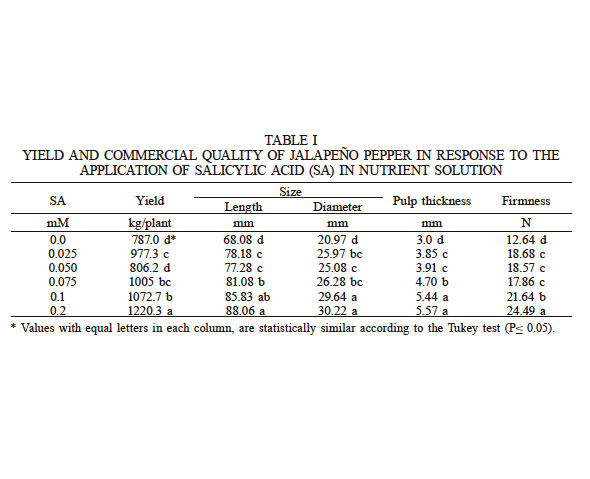
* * Values with equal letters in each column, are statistically similar according to the Tukey test (P≤ 0.05).
Commercial quality of fruit
In relation to the size (length and diameter) of the fruit, the dose of 0.2mM SA in the nutrient solution produced the largest fruit size, exceeding 22.69% in length and 30.61% in diameter as compared to the control plants without application (Table I). This effect was similar to the one reported in sweet cherries by Giménez et al. (2014), noting that the application of SA increased the size of the fruits. It has been reported that SA plays an important role in the growth of plants (Najafian et al., 2009) since SA produces an increase in cell division and stimulates the accumulation of abscisic acid and indoleacetic acid in the plant (Javid et al., 2011), and these in turn increase the size of fruits by promoting greater cell division (Montaño-Mata and Méndez-Natera, 2009).
High doses of SA promoted greater thickness of pulp and firmness of jalapeño pepper fruits (Table I), a desirable effect and characteristic since these fruits could have greater resistance to transport and longer post-harvest life (Coelho et al., 2003). Tareen et al. (2012) report that SA increases fruit firmness, which delays maturation of fruits by decreasing ethylene biosynthesis, which extends post-harvest quality (Giménez et al., 2014) in addition to inhibiting enzymes that degrade the cell wall, such as polygalacturonase, cellulase or pectin methylesterase (Giménez et al., 2014), allowing the integrity of membranes and cell walls for longer peiods (Quintero and Herrera, 2013), delaying the fruit ripening (Valero et al., 2013).
Nutraceutical quality
A high content of phytonutrients in fruits is desirable because these could act as health promoters in humans. Phytonutrients may protect from certain chronic-degenerative diseases and their consumption decreases oxidative damage, improving health (Salas-Pérez et al., 2016). In this regard, our results indicate that high doses of SA significantly increase the content of phytochemicals (Table II), obtaining the highest values jalapeño pepper fruits treated with doses of 0.075, 0.1 and 0.2mM of SA. The latter doses resulted in increases of 42, 70 and 9% of phenolic compounds, flavonoids and total antioxidant capacity, respectively, compared to the control. Similar results were reported in Zea mayz by Al-Mohammad (2009) who indicated that SA increases the content of phenolic and flavonoid compounds by 20.63 and 12.54% compared to the control. Ferrari (2010) points out that SA activates the enzyme phenylalanine ammonia-lyase (PAL) that catalyzes the production of phenolic compounds. On the other hand An and Mou (2011) and Ghasemzadeh and Jaafar (2012) attributed the increase to the fact that SA stimulates the activity of chalcone synthase, a key enzyme in the synthesis of flavonoids. On the other hand, Arfan (2009) and Pérez et al. (2014) report that applications of SA generate an increase in the antioxidant capacity of fruits because the it activates the secondary metabolism of the plants, thus increasing the synthesis of antioxidants in fruits (Khandaker et al., 2011; Dawood., 2012).
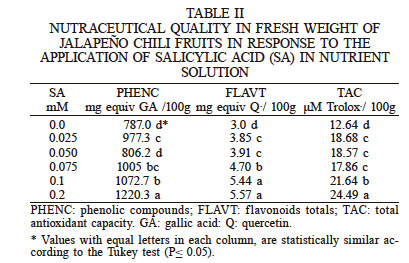
PHENC PHENC: phenolic compounds; FLAVT: flavonoids totals; TAC: total antioxidant capacity. GA: gallic acid: Q: quercetin.
* Values with equal letters in each column, are statistically similar according to the Tukey test (P≤ 0.05).
Conclusion
The results obtained indicate that the 0.2 mM dose of SA increased yield by 35%. There was an increase of 22 and 30% in polar and equatorial diameter respectively and the firmness increased 48% with the highest dose of SA, with respect to the control plants. The nutraceutical quality was significantly affected, with 42, 70 and 9% increase in phenolic compounds, flavonoids and total antioxidant capacity respectively, compared to the control plants without application. Therefore, the addition of SA in the nutrient solution is a viable alternative to increase the production and nutraceutical quality of jalapeño pepper cv. Mitla grown under greenhouse conditions and hydroponics.
COMMERCIAL AND NUTRACEUTICAL QUALITY OF JALAPEÑO PEPPER AFFECTED BY SALICYLIC ACID LEVELS
Al-Mohammad MH (2017) Effect of spraying salicylic acid and collection dates of corn silk (Zea mays L.) on growth, yield and content of some antioxidant compounds. J. Glob. Pharma Technol. 9: 98-103.
An C, Mou Z (2011) Salicylic acid and its function in plant immunity. J. Integr. Plant Biol. 53: 412-428.
Arfan M (2009) Exogenous application of salicylic acid through rooting medium modulates ion accumulation and antioxidant activity in spring wheat under salt stress. Int. J. Agr. Biol. 11: 437-442.
Biruete Guzmán A, Juárez Hernández E, Sieiro Ortega E, Romero Viruegas R, Silencio Barrita J (2009) Los nutracéuticos. Lo que es conveniente saber. Rev. Mex. Pediatr. 76: 135-145.
Brand-Williams W, Cuvelier ME, Berset C (1995) Use of a free radical method to evaluate antioxidant activity. LWT-Food Sci. Technol. 28: 25-30.
Calderon-Montano J, Burgos-Morón E, Pérez-Guerrero C, López-Lázaro M (2011) A review on the dietary flavonoid kaempferol. Mini Rev. Med. Chem. 11: 298-344.
Chacón-Padilla K, Monge-Pérez JE (2016) Evaluation of yield and quality of six genotypes of cucumber (Cucumis sativus L.) grown under greenhouse conditions in Costa Rica. Rev. Colomb. Cienc. Hortíc. 10: 323-332.
Chunab CN, Sauri Duch E, Olivera Castillo L, Rivas Burgos JI (2011) Evaluación de la calidad en la industrialización del chile habanero (Capsicum chinense). Rev. Iber. Tecnol. Postcos. 12: 222-226.
Coelho EL, Fontes PCR, Finger FL (2003) Qualidade do fruto de melão rendilhado em função de doses de nitrogênio. Bragantia 62: 173-178.
Chen Z, Zheng Z, Huang J, Lai Z, Fan B (2009) Biosynthesis of salicylic acid in plants. Plant Signal. Behav. 4: 493-496.
Dawood MG, Sadak MS, Hozayn M (2012) Physiological role of salicylic acid in improving performance, yield and some biochemical aspects of sunflower plant grown under newly reclaimed sandy soil. Aust. J. Basic Appl. Sci. 6: 82-89.
Ferrari S (2010) Biological elicitors of plant secondary metabolites: mode of action and use in the production of nutraceutics. In Bio-Farms for Nutraceuticals. Springer. pp. 152-166.
Flores-López R, Martínez-Gutiérrez R, López-Delgado HA, Marín-Casimiro M (2016) Aplicación periódica de bajas concentraciones de paclobutrazol y ácido salicílico en papa en invernadero. Rev. Mex. Cs. Agric. 7: 1143-1154.
Fugate KK, Ferrareze JP, Bolton MD, Deckard EL, Campbell LG, Finger FL (2013) Postharvest salicylic acid treatment reduces storage rots in water-stressed but not unstressed sugarbeet roots. Postharv. Biol. Technol. 85: 162-166.
Ghasemzade A,Jaafar HZ (2012) Effect of salicylic acid application on biochemical changes in ginger (Zingiber officinale Roscoe). J. Med. Plants Res. 6: 790-795.
Giménez MJ, Valverde JM, Valero D, Guillén F, Martínez-Romero D, Serrano M, Castillo S (2014) Quality and antioxidant properties on sweet cherries as affected by preharvest salicylic and acetylsalicylic acids treatments. Food Chem. 160: 226-232.
Granados C, Yáñez X, Acevedo D (2014) Evaluación de la actividad antioxidante del aceite esencial foliar de Myrcianthes leucoxyla de Norte de Santander (Colombia). Inf.Tecnol. 25: 11-16.
Javid MG, Sorooshzadeh A, Moradi F, Sanavy SAMM, Allahdadi I (2011) The role of phytohormones in alleviating salt stress in crop plants. Aust. J. Crop Sci. 5: 726-734.
Juárez-López P, Bugarin-Montoya R, Sánchez-Monteón A, Balois-Morales R, Juarez-Rosete C, Cruz-Crespo E (2012) Horticultura protegida en Nayarit, México: Situación actual y perspectivas. BioCiencias 4: 16-24.
Khandaker L, Masum Akond A, Oba S (2011) Foliar application of salicylic acid improved the growth, yield and leaf's bioactive compounds in red amaranth (Amaranthus tricolor L.). Veg. Crop Res. Bull. 74: 77-86.
Lamaison J, Carnet A (1990) Contents in main flavonoid compounds of Crataegus monogyna Jacq. and Crataegus laevigata (Poiret) DC flowers at different development stages. Pharm. Acta Helvet. 65: 315-320.
Larqué-Saavedra A, Martin-Mex R (2007) Effects of salicylic acid on the bioproductivity of plants. In Hayat S, Ahmad A (Eds.) Salicylic Acid: A Plant Hormone. Springer. Dordrecht, Netherlands. pp. 15-23.
Lee S, Kim SG, Park CM (2010) Salicylic acid promotes seed germination under high salinity by modulating antioxidant activity in Arabidopsis. New Phytol. 188: 626-637.
López PJ, Montoya RB, Brindis RC, Sánchez-Monteón MAL, Cruz-Crespo E, Morales RB (2011) Estructuras utilizadas en la agricultura protegida. Fuente 3: 21-27.
Martín-Mex R, Nexticapan-Garcéz A, Larqué-Saavedra A (2013) Potential benefits of salicylic acid in food production. In Hayat S, Ahmad A, Alyemeni MN (Eds.) Salicylic Acid. Springer. Dordrecht, Netherlands. pp. 299-313.
Montaño-Mata NJ Méndez-Natera JR (2009) Efecto del ácido indol-3-acético y el acido naftalenacético sobre el largo y ancho del fruto de melón (Cucumis melo L.) cultivar Edisto 47. Rev. Cient .UDO Agríc. 9: 530-538.
Miura K, Tada Y (2014) Regulation of water, salinity, and cold stress responses by salicylic acid. Front. Plant Sci. 5: 4-8.
Morales-Pérez E, Morales-Rosales E, Franco-Mora O, de Jesús Pérez-López D, González-Huerta A, Urbina Sánchez E (2014) Producción de flores de Gerbera jamesonii cv. ‘Dream’ en función de los ácidos giberélico y salicílico. Phyton 83: 333-340.
Najafian S, Khoshkhui M, Tavallali V, Saharkhiz MJ (2009) Effect of salicylic acid and salinity in thyme (Thymus vulgaris L.): investigation on changes in gas exchange, water relations, and membrane stabilization and biomass accumulation. Aust. J. Basic Appl. Sci. 3: 2620-2626.
Pérez MGF, Rocha-Guzmán NE, Mercado-Silva E, Loarca-Piña G, Reynoso-Camacho R (2014) Effect of chemical elicitors on peppermint (Mentha piperita) plants and their impact on the metabolite profile and antioxidant capacity of resulting infusions. Food Chem. 156: 273-278.
Quintero GV, Herrera JÁ, Sanabria OA (2013) Efecto de la aplicación de giberelinas y 6-bencilaminopurina en la producción y calidad de fresa (Fragaria ananassa Duch.). Bioagro 25: 195-200.
Ramírez-Ibarra JA, Troyo-Dieguez E, Preciado-Rangel P, Fortis-Hernández M, Gallegos-Robles MÁ, Vázquez-Vázquez C, Ríos-Plaza JL, García-Hernández JL (2017) Diagnóstico de nutrimento compuesto e interacciones nutrimentales en chile Jalapeño (Capsicum annuum L.) en suelos semiáridos. Ecosist. Recursos Agropec. 4: 233-242.
Reyes Munguía A, Reyes Martínez A, Aguilar González N, Carríllo Inungaray ML (2017) Propiedades antioxidantes de infusiones de neem (Azadirachtaindica) encapsuladas con proteína de soya. Nova Scient. 9: 67-185.
Salas-Pérez L, González-Fuentes JA, García Carrillo M, Sifuentes-Ibarra E, Parra-Terrazas S, Preciado-Rangel P (2016) Calidad biofísica y nutracéutica de frutos de tomate producido con sustratos orgánicos. Nova Scient. 8: 310-311.
Sánchez-Chávez E, Barrera-Tovar R, Muñoz-Márquez E, Ojeda-Barrios DL, Anchondo-Nájera Á (2011) Efecto del ácido salicílico sobre biomasa, actividad fotosintética, contenido nutricional y productividad del chile jalapeño. Rev Chap Ser. Hort. 17: 63-68.
SAS (2009) Statistical Analysis System Institute. SAS Proceeding Guide, Version 9.2. SAS Institute. Cary, NC. USA.
Singleton VL, Orthofer R, Lamuela-Raventós RM (1999) Analysis of total phenols and other oxidation substrates and antioxidants by means of folin-ciocalteu reagent. Meth. Enzymol. 299: 152-178.
Tareen MJ, Abbasi NA, Hafiz IA (2012) Effect of salicylic acid treatments on storage life of peach fruits Cv.‘flordaking’. Pak. J. Bot. 44: 119-124.
Valero D, Castillo S, Díaz M, Huertas M, Martínez R, Serrano M, Valverde J, Zapata P (2013) Un nuevo tratamiento post-recolección con ácido salicílico que mantiene la calidad de las ciruelas Angeleno. Horticultura 309: 76-81.
Notas de autor
ppreciador@yahoo.com.mx