Comunicaciones
Recepción: 23 Julio 2021
Corregido: 26 Abril 2022
Aprobación: 27 Abril 2022
Financiamiento
Fuente: The authors thank Caitie Frenkel for supporting the English edition and Andrés Mansilla for the summary in portuguese. J. Rau thanks the Fondecyt Regular project 201922 and J. Ojeda the Fondecyt Regular project 1190984. We thank the Universidad de Los Lagos for financing the costs of this publication and, Soraya Sade for editing the final text.
Nº de contrato: J. Rau thanks the Fondecyt Regular project 201922 and J. Ojeda the Fondecyt Regular project 1190984.
Beneficiario: Jaime R. Rau ; Jaime Ojeda.
Abstract: A historical and geographical analysis of the Chilean salmon aquaculture colonization was carried out considering aquaculture licenses. This industry has many environmental and social conflicts in Patagonian seascapes, so a historical view can provide insights for future marine exploitation planning. A total of 1,398 salmon aquaculture licenses have been granted over 40 years, and 367 applications are under evaluation. Most granted license sites are located in the north side of Patagonia (39% and 51.8% in Los Lagos and Aysén regions, respectively) and, the southernmost region (Magallanes) contains 8.5% of granted licenses, though it has the highest number of pending licenses (47.7%), which are under assessment processes. Over time, the geographical areas of salmon farming operations have changed due to multiples factors such as marine pollution, excess of salmon farms, and disease outbreaks, triggering three pulses of colonization. This process has generated many conflicts linked to indigenous marine stewardship, customary sea tenure, and biodiversity conservation. Considering this scenario, in this work it is considered that new salmon farming expansion could change the social-ecological system in the southern tip of South America.
Keywords: Aquaculture Industry, Chilean Patagonia, Environmental and Social Conflicts, Glocalization, Indigenous Marine Stewardship, Socio-Ecological Systems.
Resumen: Se llevó a cabo un análisis histórico y geográfico de la colonización de la piscicultura del salmón chileno en el marco de las licencias de acuicultura. Esta industria tiene muchos conflictos ambientales y sociales en los paisajes marinos de la Patagonia chilena, por lo que una visión histórica puede brindar información para la planificación futura de la explotación marina. Se han otorgado 1398 licencias de acuicultura de salmón durante 40 años y se están evaluando 367 solicitudes. La mayoría de las licencias otorgadas se ubican en el lado norte de la Patagonia (39% y 51,8% en las regiones de Los Lagos y Aysén, respectivamente) y la región más austral (Magallanes) contiene el 8,5% de las licencias otorgadas, pero tiene la mayor cantidad de licencias pendientes (47,7%), que se encuentran en procesos de evaluación. Con el tiempo, las áreas geográficas de las operaciones de cultivo de salmón han cambiado debido a múltiples factores, tales como la contaminación marina, exceso de granjas de salmón y brotes de enfermedades, lo que desencadenó tres pulsos de colonización. Este proceso ha generado muchos conflictos relacionados con la administración marina indígena, la tenencia consuetudinaria de la mar y la conservación de la biodiversidad. Considerando este escenario, pensamos que la nueva expansión de la salmonicultura podría cambiar el sistema socioecológico en el extremo sur de América del Sur.
Resumo: Realizamos uma análise histórica e geográfica da colonização da aquicultura do salmão chileno no âmbito das licenças de aquicultura. Esta indústria tem muitos conflitos ambientais e sociais nas paisagens marinhas da Patagônia, portanto, uma visão histórica pode fornecer informações para um futuro planejamento da explotação marinha. Ao longo de 40 anos foram concedidas 1.398 licenças de aquicultura de salmão e 367 pedidos estão sendo avaliados. A maioria das licenças concedidas está localizada no lado norte da Patagônia (39% e 51,8% nas regiões de Los Lagos e Aysén, respectivamente) e a região mais ao sul (Magallanes) contém 8,5% das licenças concedidas, mas tem o maior número de licenças pendentes (47,7%), que se encontram em processo de avaliação. Com o tempo, as áreas geográficas das operações de criação de salmão mudaram devido a vários fatores, tais como poluição marinha, crescimento desmesurado de fazendas de salmão e aparição de novas doenças, desencadeando três pulsos de colonização. Este processo gerou muitos conflitos relacionados à administração marinha indígena, posse tradicional do mar e conservação da biodiversidade. Diante desse cenário, pensamos que a nova expansão da criação de salmão pode mudar o sistema socioecológico no extremo sul sul-americano.
Introduction
In the last 40 years, aquaculture production has sharply increased worldwide, and most captured fisheries are overexploited globally (Volpe et al., 2013; Belton et al., 2020). In the food industry, fish aquaculture has been an alternative to cover the global demand for seafood. However, the interdependence of coastal and ocean fisheries and terrestrial agriculture has increased as a result of the aquaculture feed production (Naylor et al., 2021). In this global need for incorporating a new actor in the seafood supply chain, fish-aquaculture industries searched for countries achieving high production rates while their production costs (labor, taxes, etc.) have been minimized. Additionally, the environmental production costs are externalized, and for that purpose, aquaculture industries need countries with flexible regulations and low compliance levels. The salmon farming market represents a glocalization process (see Swyngedouw, 2004) because it can operate at supra-national levels (globalization), but can be established on local spaces, using their global influences with different local actors and national policies (localization).
Salmon farming is the leading aquaculture activity in Chile, although pathogens have been one of the important issues in the aquaculture expansion. Since 1980, this food industry has grown almost continuously, placing the country as the second-largest global producer, just behind Norway (FAO, 2020). In 2007, the industry was hit by the infectious salmon anemia (ISA) virus. This event caused significant mortality on the salmon net pens in the Los Lagos region (Valdés-Donoso et al., 2013), triggering a decline in production volume and a social crisis with about 20,000 job losses (Quiñones et al., 2019). In April 2013, the ISA virus expanded its presence to southern areas. The salmon industry partially controlled the ISA virus, though the production system is still fragile due to pathogens (Bravo et al., 2013).
In Chile, a substantial number of scientific reports have been published about how salmon farming operations have impacted marine environments from ecological and social aspects. It is known that the increase of nutrient loads, such as phosphorus and nitrogen, can be an important factor in the increase of phytoplankton density and the shift in dominant groups, from diatoms to dinoflagellates (Soto et al., 1997;Buschmann et al., 2006). Salmon farms increase the organic matter sedimentation, triggering lower oxygen levels and reducing species richness (Buschmann et al., 2009; Miranda et al., 2020). Furthermore, an overuse of antibiotics can have silent consequences on antibiotic resistance in bacteria (see Jara et al., 2021) and, they can affect native fishes as well. For instance, oxytetracycline and quinolone residues have been found in muscle samples of the fishes Eleginops maclovinus and Sebastes capensis (Fortt et al., 2007). Reports indicate that Chilean salmon farms use up to 20 times more antibiotics than those in Norway (Carranza et al., 2020).
Another significant impact is the escaped salmonids from farms that can alter trophic webs in southern Chile. Salmonids can prey on native species such as Odonthestes regia (Niklitschek et al., 2013), and juveniles of the Macrorunusmagellanicus (Soto et al., 1997), that are relevant species for artisanal fisheries. Indeed, 650,000 salmon escaped in 2018 from a net pen, with an enormous potential impact on native ecosystems (Gomez-Uchida et al., 2018). These ecological effects also embrace social-ecological consequences. For example, the salmon farming industry is responsible for 30%, 46%, and 67% of the conflict-generating projects in the Los Lagos, Aysén, and Magallanes regions, respectively (Carranza et al., 2020). These conflicts have increased the pressure to access marine areas, but many Indigenous communities such as the Yagan people try to defend seascapes, biodiversity and, wellbeing (Mapuexpress, 2019).
In this study, a historical and geographical analysis of the salmon aquaculture devel- opment in the three regions of Southern Chile (Los Lagos, Aysén and Magallanes) was carried out, regarding granted and pending licenses to understand their spatial and temporal patterns. After that, a discussion about conflicts and future pressures that the salmon farming colonization generate in the still pristine southern tip of South America is presented.
Methods
Search source
The database included in the official website of the Chilean Undersecretary of Fisheries (http://www.subpesca.cl/portal/619/w3-article-92935.html) was searched in order to analyze the temporal dynamics of granted and pending licenses related to salmon operations. The last available update, from December 2019, in the version posted on June 8th, 2020, was accessed). Forty years of the aquaculture industry were considered, divided into three periods, leaving aside the first five years (1980-1985) when the industry was still undergoing a developing process. During the first period (1985-2003) took place the big boom of development in the Inner Sea of Chiloé (Los Lagos region). The second period (2003-2013) was when the industry started to run out of space in Chiloé and had to move to other regions to maintain its growth. The third period (2013-2020) was when the ISA crisis burst in the Aysén region, and the industry had to plan a new southern expansion. This ISA burst was followed by an outbreak of the rickettsia Piscirickettsiasalmonis (Gerhart, 2017).
Results
Spatial and temporal aspects of granted and pending licenses
Official statistics from the Chilean Undersecretary of Fisheries report a total of 1,398 salmon aquaculture licenses granted for exploitation in the last 40 years (1980-2020) and, 367 applications are under evaluation. Many of the granted license sites are located in the most southern regions of Los Lagos (39%) and Aysén (51.8%), whereas a small but increasing number of these licenses (8.5%) are placed in the Magallanes region (Figure 1a). In terms of the pending licenses, the percentages are inverse. While in the Los Lagos region 7.2% of licenses are still pending of concession, the Aysén region has a 17.9% of the licenses pending. The Magallanes region has the highest number of pending licenses (47.7%), waiting to complete the evaluation process (Figure 1b).
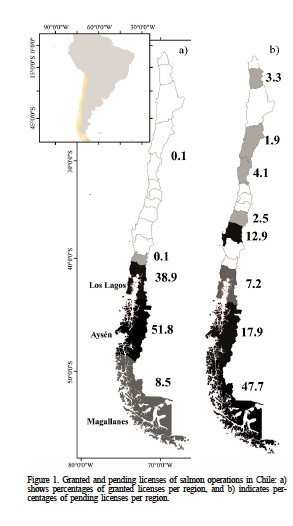
Figure 1.
Granted and pending licenses of salmon operations in Chile: a) shows percentages of granted licenses per region, and b) indicates percentages of pending licenses per region.
On the temporal scale, the granted licenses changed when associated with salmon farming expansion to southern areas (Figure 2). Los Lagos region was the origin of the salmon industry. Between the years 1985 and 2003, the average number (mean ±SD) was 22.1 ±11.9 granted licenses per year; in this period, the Los Lagos region absorbed 71 ±26.8% of the granted licenses. Between 2003 and 2013, the Los Lagos region stopped leading the concession of aquaculture licenses, and the Aysén region experienced a boom of granted licenses, with an average of 40.7 ±31.1 per year. In the final period, 2013-2019, the pressure on granted licenses dropped to an average of 5.6 ±3.7 per year. At this time, in Chile, this percentage dropped to an average of 23 ±20 per year. The Magallanes region experienced the opposite temporary development of salmon granted licenses compared to the Los Lagos region. While in the first period Magallanes represented only 3% of the total with an average of 4 ±3 of granted licenses per year, when the Aysén region had its peak, in the intermediate period, the Magallanes region represented less than 10% of the total licenses. In the 2013-2019 period, the Magallanes region led in the relative number of granted salmon licenses, with 70% of the total.
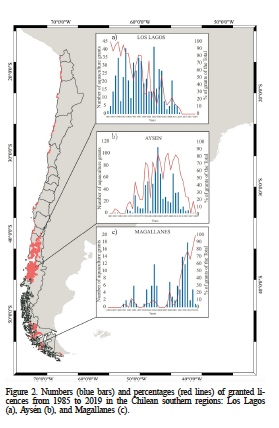
Figure 2
Numbers (blue bars) and percentages (red lines) of granted licences from 1985 to 2019 in the Chilean southern regions: Los Lagos (a), Aysén (b), and Magallanes (c).
Discussion
Expansion of the salmon industry to the southern tip
In the 1980s, the salmon industry in Chile began exploitation in the inner sea of Los Lagos region (Figure 2) and in 2008 the aquaculture system was near to collapse due to the ISA virus. The salmon farming industry started its expansion towards southern neighbor areas (Aysén and Magallanes regions). The Aysén region absorbed two roles at the same time: it absorbed the need for increasing the neglected production in Los Lagos region and for buffering the impact of the Chilean salmon crisis. Both roles caused the Aysén region to become the region with the highest percentage of salmon aquaculture licenses. In 2013, the ISA virus crisis flipped this geographic pattern, and the Magallanes region became the new area of salmon farming colonization.
The Magallanes region has ecological and cultural attributes with both local and global relevance for biocultural conservation (see Rozzi et al., 2010). This region is considered one of the last 12 wilderness areas worldwide, because it preserves 70% of its original vegetation and has a low industrial and urban development (Mittermeier et al., 2003). Many marine taxa increase their diversity in this austral seascape. For instance, macroalgae and mollusks increase their richness and endemism (Santelices and Marquet, 1998; Valdovinos et al., 2003; Linse et al., 2006). In the Magellanic Sub-Antarctic Channels, indigenous coastal communities, such as the Kawésqar and the Yaganes, have developed during millennia multiple interactions with marine ecosystems that remain nowadays (Emperaire, 1963; Ojeda et al., 2018). Both indigenous communities have historically experienced a terrible European colonization process (e.g., genocide, pandemics, land rights loss; see Emperaire, 1963) and, to some extent, current salmon farming operations would contribute a new marine colonization process. In 2019, the Yagan community and local citizens of Puerto Williams carried out massive demonstrations against salmon farming industries that are planned to be established inside the Cape Horn Biosphere Reserve (Mapuexpress, 2019). This reserve prioritizes customary uses and human activities with low environmental impacts such as ecotourism and artisanal fisheries (Rozzi and Schüttler, 2015).
Conflicts between customary tenure and growing industrial business
In 2009, under the ILO 169 Agreement’s legal umbrella, Chile recognized the right of indigenous people to claim territorial rights regarding the management of natural resources and environmental defense. The development of the new law by the Chilean government has had many difficulties and conflicts among indigenous-local communities, policy makers, and business leaders. As a result, indigenous people mainly represented by Lafkenche communities developed with the government the Act No.20.249 (also known as ‘Lafkenche Law’) to promote the legal tool to recognize the association between indigenous people and coastal seascapes. The Lafkenche Law provides a national policy in which indigenous communities can apply for the customary management on coastal areas known as ‘ECMPO’ (Espacio Costero Marino de Pueblos Originarios; Hiriart-Bertrand et al. 2020).Williche, Kawésqar and Yagan communities have claimed to preserve marine areas, but salmon farming intents are overlapped with them, causing conflicts in the sea tenure (Outeiro et al., 2015a, b). Today, it is known that administration from the indigenous perspective might contribute to rebuilding traditional practices and biodiversity conservation (IPBES, 2019). Thus, the future effectiveness of customary areas could be weak if the Chilean government is not capable to comply with their national and international commitments with indigenous and local communities.
The overlapping among salmon farming applications, Chilean national parks, natural reserves and natural monuments creates unclear priorities in the Magallanes region. Over 50% of the territory has a category linked to biological and cultural conservation (Sielfeld 1997; Rozzi and Schüttler, 2015) although, paradoxically, most national parks include only regulations on terrestrial ecosystems and there is no clear jurisdiction on marine ecosystems (Rozzi et al., 2010). The salmon farming industry could take advantage to operate on the marine side of national parks, increasing the risk of ineffectiveness and generating the so-called ‘paper parks’. Thus, in the same vein as Navedo and Vargas-Chacoff (2021) it is posed that protected areas in the Magallanes region could align targets of biodiversity conservation, indigenous practices and activities with low environmental impacts.
Concluding remarks
The southern expansion of salmon farming in Chile is presented using the number of concessions granted from north to south in the Chilean Patagonia. For four decades, salmon aquaculture has had the same colonization pattern; when the environmental and sanitary problems exploded on seascapes where the industry was settled, it moved southwards. First, the Los Lagos region was exploited; once the ‘collapse’ took place, the industry moved to the Aysén region, where granted licenses proliferated. Consequently, the next area is the pristine seascape of the Magallanes region, the last fringe of South America. As exposed in this study, cultural and biological diversity in the southern tip of South America has a fragile situation to confront and stop a new aquaculture collapse. In this pandemic crisis, the industries’ glocalization in developing countries has been proved once more to be a social-ecological conflict, costly for the environment and customary practices.
Acknowledgments
The authors thank Caitie Frenkel for supporting the English edition and Andrés Mansilla for the summary in portuguese. J. Rau thanks the Fondecyt Regular project 201922 and J. Ojeda the Fondecyt Regular project 1190984. We thank the Universidad de Los Lagos for financing the costs of this publication and, Soraya Sade for editing the final text.
HISTORICAL - GEOGRAPHICAL COLONIZATION OF SALMON FARMING IN PATAGONIA
Bravo S, Nuñez M, Silva MT (2013) Efficacy of the treatments used for the control of Caligus rogercresseyi infecting Atlantic salmon, Salmo salar L., in a new fish-farming location in Region XI, Chile. J. Fish Dis. 36: 221-228. doi:10.1111/jfd.12023
Belton B, Little DC, Zhang W, Edwards P, Skladany M, Thilsted SH (2020) Farming fish in the sea will not nourish the world. Nat. Comm. 11(5804). doi.org/10.1038/s41467-020-19679-9
Buschmann AH, Riquelme VA, Hernández-González M C, Varela D, Jiménez JE, Henríquez LA, Vergara PA, Guíñez R, Filún L (2006) A review of the impacts of salmonid farming on marine coastal ecosystems in the southeast Pacific. ICES J. Mar. Sci. 63: 1338-1345. doi:10.1016/j.icesjms.2006.04.021
Buschmann AH, Cabello F, Young K, Carvajal J, Varela DA, Henríquez L (2009) Salmon aquaculture and coastal ecosystem health in Chile: Analysis of regulations, environmental impacts and bioremediation systems. Ocean Coast. Manag. 52: 243-249. doi:10.1016/j.ocecoaman.2009.03.002
Carranza DM, Varas-Belemmi K, De Veer D, Iglesias-Müller C, Coral-Santacruz D, Méndez FA, Torres-Lagos E, Squeo FA, Gaymer CF (2020) Socio-environmental conflicts: An underestimated threat to biodiversity conservation in Chile. Environ. Sci. Policy 110: 46-59. doi:10.1016/j.envsci.2020.04.006
Emperaire J (1963) Los Nómades del Mar. Universidad de Chile. Santiago, Chile. 263 pp.
FAO (2020) The State of World Fisheries and Aquaculture. Sustainability in Action. U.N. Food and Agriculture Organization. Rome, Italy. 244 pp. https://doi.org/https://doi.org/10.4060/ca9229en
Fortt ZA, Cabello CF, Buschmann RA (2007) Residues of tetracycline and quinolones in wild fish living around a salmon aquaculture center in Chile. Rev. Chil. Infectol. 24: 8-12. doi:/S0716-10182007000100002
Gerhart A (2017) Petri dishes of an archipelago: the ecological rubble of the Chilean salmon farming industry. J. Polit. Ecol. 24: 726-742. doi.org/10.2458/v24i1.20963
Gomez-Uchida D, Sepúlveda M, Ernest B, Contador TA, Neira S, Harrod C (2018) Chile’s salmon escape demands action. Science 361: 857-858.
Hiriart-Bertrand L, Silva JA, Gelcich S (2020) Challenges and opportunities of implementing the marine and coastal areas for indigenous people policy in Chile. Ocean Coast. Manag. 193: 105233. doi:10.1016/j.ocecoaman.2020.105233
IPBES (2019) Global Assessment Report on Biodiversity and Ecosystem Services. Brondizio E, Settele J, Díaz S, Ngo H (Eds.). Intergovernmental Science-Policy Platform on Biodiversity and Ecosystem Services. Bonn, Germany. 1148 pp.
Jara B, Tucca F, Srain BM, Méjanelle L, Aranda M, Fernández C, Pantoja-Gutiérrez S (2021) Antibiotics florfenicol and flumequine in the water column and sediments of Puyuhuapi Fjord, Chilean Patagonia. Chemosphere 275: 130029. doi:10.1016/j.chemosphere. 2021.130029
Linse K, Griffiths HJ, Barnes DKA, Clarke A (2006) Biodiversity and biogeography of Antarctic and sub-Antarctic mollusca. Deep Sea Res. Part II Top. Stud. Oceanogr. 53: 985-1008. doi:10.1016/j.dsr2.2006.05.003.
Mapuexpress (2019) Comunicado con las salmoneras en territorio ancestral Yagán. https://www.mapuexpress.org/2019/07/25/comunicado-contra-las-salmoneras-en-territorio-ancestral-yagan/ (Cons. 07/05/2020).
Miranda RM, Águila-Torres P, Aranda CP, Maldonado J, Casado A (2020) Taxonomy and diversity of bacterial communities associated with marine sediments from Chilean salmonid farms. Aquacult. Res. 1-16. doi:10.1111/are.15014
Mittermeier R, Mittermeier CG, Brooks TM, Pilgrim JD, Konstant WR, da Fonseca GB, Cormos C (2003) Wilderness and biodiversity conservation. Proc. Natl. Acad. Sci. USA 100: 10309-13. doi:10.1073/pnas. 1732458100
Navedo J, Vargas-Chacoff L (2021) Salmon aquaculture threatens Patagonia. Science 372: 695-696. doi: 10.1126/science:abj1044
Naylor RL, Hardy RW, Buschmann AH, Bush SR, Cao L, Klinger DH, Little DC, Lubchenco J, Shumway SE, Troell M (2021) A 20-year retrospective review of global aquaculture. Nature 591: 551-563. doi:10.1038/s41586-021-03308-6
Niklitschek EJ, Soto D, Lafon A, Molinet C, Toledo P (2013) Southward expansion of the Chilean salmon industry in the Patagonian Fjords: main environmental challenges. Rev. Aquacult. 5: 172-195. doi:10.1111/raq.12012
Ojeda J, Rozzi R, Rosenfeld S, Contador T, Massardo F, González-Calderón J, Mansilla A (2018) Interacciones bioculturales del pueblo Yagán con las macroalgas y moluscos: una aproximación desde la filosofía ambiental de campo. Magallania 46: 155-181.
Outeiro L, Gajardo C, Oyarzo H, Ther F, Cornejo P, Villasante SL, Bas-Ventine (2015a) Framing local ecological knowledge to value marine ecosystem services for the customary sea tenure of aboriginal communities in southern Chile. Ecosyst. Serv. 16: 354-364. doi:10.1016/j.ecoser.2015. 04.004
Outeiro L, Häussermann V, Viddi F, Hucke-Gaete R, Försterra G, Oyarzo H, Kosiel KS, Villasante SL (2015b) Using ecosystem services mapping for marine spatial planning in southern Chile under scenario assessment. Ecosyst. Serv. 16: 1-13. doi:10.1016/j.ecoser.2015.03.004
Quiñones RA, Fuentes M, Montes RM, Soto D, León-Muñoz J (2019) Environmental issues in Chilean salmon farming: a review. Rev. Aquacult. 11: 375-402. doi:10.1111/raq.12337
Rozzi R, Schüttler E (2015) Primera década de investigación y educación en la Reserva de la Biosfera Cabo de Hornos: el enfoque biocultural del Parque Etnobotánico Omora. An. Inst. Patagon. 43: 19-43.
Rozzi R, Anderson CB, Pizarro J, Massardo F, Medina Y, Mansilla AO, Kennedy JH, Ojeda J, Contador T, Morales V, Moses K, Poole A, Armesto JJ, Kalin MT (2010) Field environmental philosophy and biocultural conservation at the Omora Ethnobotanical Park: Methodological approaches to broaden the ways of integrating the social component (“S”) in Long-Term Socio-Ecological Research (LTSER) Sites. Rev. Chil. Hist. Nat. 83: 27-68.
Santelices B, Marquet A (1998) Seaweeds, latitudinal diversity patterns, and Rapoport’s Rule. Divers. Distrib. 4: 71-75. doi.org/10.1046/j.1472-4642.1998.00005.x
Sielfeld W (1997) The protected areas in the XII Chilean region in the marine mammals perspective. Estud. Ocean. 16: 87-107.
Soto D, Jara F, Guerrero A, Moreno C, Molinet C, Godoy C, Niklitschek E, Aedo E (1997) Evaluación de Salmónidos de Vida Libre Existentes en las Aguas Interiores de las Regiones X y XI. http://www.subpesca.cl/fipa/613/articles-89537_informe_final.pdf.
Swyngedouw E (2004) Globalisation or ‘glocalisation’? Networks, territories and rescaling. Cambridge Rev. Int. Aff. 17: 25-48. doi:10.1080/095575704 2000203632
Valdés-Donoso P, Mardones FO, Jarpa M, Ulloa M, Carpenter TE, Perez AM (2013) Co-infection patterns of infectious salmon anaemia and sea lice in farmed Atlantic salmon, Salmo salar L., in southern Chile (2007-2009). J. Fish Dis. 36: 353-360. doi:10.1111/jfd.12070
Valdovinos C, Navarrete S, Marquet PA (2003) Mollusk species diversity in the Southeastern Pacific: why are there more species towards the pole? Ecography 26: 139-144. doi:10.1034/j.1600-0587.2003. 03349.x
Volpe J, Gee J, Ethier V, Beck M, Wilson A, Stoner J (2013) Global Aquaculture Performance Index (GAPI): The first global environmental assessment of marine fish farming. Sustainability 5: 3976-3991. doi:10.3390/su5093976
Notas de autor
jrau@ulagos.cl
