Articles
What do light clocks say to us regarding the so-called clock hypothesis?
What do light clocks say to us regarding the so-called clock hypothesis?
THEORIA. Revista de Teoría, Historia y Fundamentos de la Ciencia, vol. 33, no. 3, pp. 435-446, 2018
Universidad del País Vasco/Euskal Herriko Unibertsitatea
Received: 15 October 2017
Accepted: 10 May 2018
Abstract: The clock hypothesis is taken to be an assumption independent of special relativity necessary to describe accelerated clocks. This enables to equate the time read off by a clock to the proper time. Here, it is considered a physical system—the light clock—proposed by Marzke and Wheeler. Recently, Fletcher proved a theorem that shows that a sufficiently small light clock has a time reading that approximates to an arbitrary degree the proper time. The clock hypothesis is not necessary to arrive at this result. Here, one explores the consequences of this regarding the status of the clock hypothesis. It is argued in this work that there is no need for the clock hypothesis in the special theory of relativity.
Keywords: light clock, proper time, clock hypothesis, relativity.
Resumen: La hipótesis del reloj se considera un supuesto independiente de la relatividad especial necesario para la descripción de relojes acelerados. Esto permite identificar la medida del tiempo de un reloj con el tiempo propio. En este artículo, consideramos un sistema físico—el reloj de luz—propuesto por Marzke y Wheeler. Recientemente, Fletcher demostró un teorema según el cual, para un reloj de luz suficientemente pequeño, su medida del tiempo se aproxima arbitrariamente cerca del tiempo propio. La hipótesis del reloj no es necesaria para llegar a este resultado. En este artículo, vamos a explorar las consecuencias de este resultado con respecto al estatus de la hipótesis del reloj. Se argumenta que la hipótesis del reloj resulta no ser necesaria en la relatividad especial.
Palabras clave: reloj de luz, tiempo propio, hipótesis del reloj, relatividad.
1. Introduction
In the special theory of relativity, the description of the time reading of an accelerated clock seems to be possible only when adopting an independent assumption that is not part of the structure of the theory—the so-called clock hypothesis (see, e.g., Rindler 1960, 28). With this assumption, one can relate the Minkowski proper time, which is the invariant length of a segment of a timelike worldline (and has the dimension of time),[1] to the time read off by a clock. According to the clock hypothesis, the rate of an accelerated clock only depends on its instantaneous velocity;[2] this makes possible the identification of the infinitesimal interval along a timelike worldline at a particular event with the (infinitesimal) time reading of a clock (with that worldline and at that event). The integration of the infinitesimal interval between two events of the worldline gives the total proper time of that segment which is equal to the total time read off by the clock between these events.
It seems that to associate directly a notion of time and its measurement to non-geodesic worldlines it is necessary an independent assumption, postulating physical systems—clocks—whose “workings” are such that the total duration of their “ticks” is equal to the length of any segment of their worldlines (even for infinitesimal intervals). The fact that the length of a timelike worldline is an invariant with the dimension of time does not entail by itself that one might regard the infinitesimal interval or total length of a segment of the worldline as giving the value of the time gone by a physical system with that worldline. This is a subtle but important point; by assuming the clock hypothesis one is not simply making an assumption regarding a particular type of physical systems one calls clocks; one is extending the notion of time (or coordinate time)—that is measured by clocks in inertial motion and whose trajectory in space-time are geodesics (straight lines)—to a time associated to non-geodesic (timelike) worldlines that is measured by clocks. This extension of the notion of time and its measurement to non-geodesic worldlines was made implicitly by Einstein in his famous 1905 paper. In this work, Einstein considers a clock in inertial motion in relation to an adopted inertial reference frame (“the system at rest”) and arrives at the well-known time dilation formula 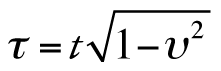 relating the time reading of the clock τ to the coordinate time t (being υ the velocity of the clock). Einstein then applies this formula in the case in which the clock spacial trajectory is a “continuously curved line” (Einstein 1905, 153), arriving at the following result:
If there are two synchronous clocks in A, and one of them is moved along a closed curve with constant velocity until it has returned to A, which takes, say, t sec, then this clock will lag on its arrival at A [tυ2/2] sec behind the clock that has not been moved. (Einstein 1905, 153)
The implication of this result is made clearer in a text from 1911, where Einstein considers a clock that is launched into a uniform motion with a velocity close to that of light in one direction and then by imparting “a momentum in the opposite direction” (Einstein 1911, 348), the clock returns (again with a very high velocity) to the point “from which it has been launched” (Einstein 1911, 348). The consequence of this motion (with an acceleration at the point in which the clock inverts the direction of its motion) is according to Einstein the following:
It then turns out that the positions of the clock’s hands have hardly changed during the clock’s entire trip, while an identically constituted clock that remained at rest at the launching point during the entire time changed the setting of its hands quite substantially … Were we, for example, to place a living organism in a box and make it perform the same to-and-fro motion as the clock discussed above, it would be possible to have this organism return to its original starting point after an arbitrarily long flight having undergone an arbitrarily small change, while identically constituted organisms that remained at rest at the point of origin have long since given way to new generations. (Einstein 1911, 348-9)
In these derivations, Einstein is implicitly assuming the validity of 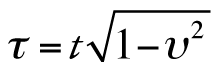 for an infinitesimal interval along a non-geodesic worldline. That is, Einstein is associating directly a notion of time and its measurement to non-geodesic worldlines by assuming (implicitly) the clock hypothesis. As one can see, an extraordinarily important consequence of the theory regarding the time gone by a physical system, which is validated by experiments (see, e.g., Brown and Read 2016), seems to depend on taking into account an independent assumption.
As it is, the status of the clock hypothesis might seem to be settled. However, as will be seen here, this is not the whole story.[3] There is a physical system that is described in very simple terms in the special theory of relativity that has physical properties that are relevant to the discussion of the status of the clock hypothesis. This physical system when in inertial motion has a cyclic behavior that mimics the coordinate time; i.e. its “ticks” measure time. One may call this physical system a light clock. It turns out that, as shown by Fletcher (2013), under certain conditions, light clocks when accelerated read off a time (i.e. have a “ticking”) that can approximate to an arbitrary degree the infinitesimal interval along their timelike worldlines and the total length of any segment under consideration. That is, for sufficiently small light clocks (as defined in Fletcher 2013), their “ticking” approximates to an arbitrary degree the total proper time (they are accurate) and the infinitesimal proper time (they are regular). In this paper, it is made the case that this result changes the status of the clock hypothesis. It is not that it turns out that the clock hypothesis follows from the theory. It is more than that. One simply does not need the clock hypothesis to have in the theory a notion of time and its measurement associate to non-geodesic worldlines.
To make this point, the work is organized as follows: in section 2 the clock hypothesis is addressed, as traditionally presented. In section 3 light clocks and their properties are addressed. Finally, in section 4 it is made the case that the clock hypothesis is not necessary; i.e., in the theory, to associate a notion of time and its measurement to non-geodesic worldlines, it is not necessary to stipulate clocks whose “ticks” are such that they measure the (temporal) length of the worldline.
2. The clock hypothesis
According
to special relativity the relation between the time read off by two (identical)
clocks in
relative motion is given by 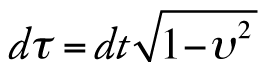 where d τ is the time read off by a clock taken to be in motion with a
uniform velocity u in relation to the other clock (taken to be at rest), which has a time
reading dt identical to the time reading of the clocks of the adopted inertial
reference frame (in relation to which this clock is at rest). This relation
derived from the Lorentz transformations only applies to clocks in inertial
motion. It is at this point that one considers what is now called the clock
hypothesis. In Møller's words:
where d τ is the time read off by a clock taken to be in motion with a
uniform velocity u in relation to the other clock (taken to be at rest), which has a time
reading dt identical to the time reading of the clocks of the adopted inertial
reference frame (in relation to which this clock is at rest). This relation
derived from the Lorentz transformations only applies to clocks in inertial
motion. It is at this point that one considers what is now called the clock
hypothesis. In Møller's words:
This equation is now assumed to be valid also for an arbitrarily moving clock where [υ] is the [instantaneous] velocity of the clock. Hence we assume that the acceleration of the clock relative to an inertial system has no influence on the rate of the clock. (Møller 1955, 49)
As one
can see in the mathematical expression, if the infinitesimal interval along the
clock’s worldline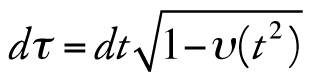 is taken to be equal to the (infinitesimal)
time read off by the clock during
the coordinate time interval dt, then one
is in fact assuming not just that the acceleration has no influence on the rate
of the clock but more exactly that this rate only depends on the clock’s
instantaneous velocity υ(t). This was expressed with clarity, e.g., by
Rindler, according to whom:
is taken to be equal to the (infinitesimal)
time read off by the clock during
the coordinate time interval dt, then one
is in fact assuming not just that the acceleration has no influence on the rate
of the clock but more exactly that this rate only depends on the clock’s
instantaneous velocity υ(t). This was expressed with clarity, e.g., by
Rindler, according to whom:
If an ideal clock moves non-uniformly through an inertial frame, we shall assume that acceleration as such has no effect on the rate of the clock, i.e. that its instantaneous rate depends only on its instantaneous speed υ […]. This we shall call the clock hypothesis. Alternatively, it can be regarded as the definition of an ideal clock. (Rindler 1960, 28)
If one reads Rindler’s words carefully, one notices an issue that needs to be addressed. As it is, it seems that assuming the clock hypothesis is somehow equivalent to defining an ideal clock. So, is the assumption the same as a definition?
This apparent possible alternation between an assumption and a definition can be found, e.g., in the work of Anderson:
One sometimes defines an ideal clock as being one that ticks off intervals proportional to ∫dτ along its trajectory […]. In effect, the assumption that an ideal clock measures ∫dτ along its trajectory is equivalent to the assumption that one can ignore the accelerative effects on its internal working. (Anderson 1967, 173)
If one defines an ideal clock as a clock that reads off a time equal to the Minkowski proper time, what is the role of the assumption? By defining an ideal clock is one assuming anything? In Anderson’s words, one assumes that an ideal clock measures the length of (a segment of) the worldline; i.e., one assumes that an ideal clock reads off a time equal the length of (a segment of) the worldline. But an ideal clock is supposed to measure it by definition. To disentangle the clock hypothesis from the definition of an ideal clock, one might first define an ideal clock as a clock whose time reading is equal to the Minkowski proper time; then one makes the assumption that the timelike worldline under consideration is the worldline of a physical system that behaves as an ideal clock. The assumption is that the rate of the clock only depends on its instantaneous velocity, in which case the clock’s behavior is that of an ideal clock. This is basically how Fock (1959) presents the clock hypothesis. According to Fock:
In the case of accelerated motion the interpretation of t as a time registered by a moving clock cannot be derived from the theory of relativity. Such an interpretation may only be introduced as a separate assumption. (Fock 1959, 34-5)
In a footnote, Fock further mentions that:
One could, of course, introduce the notion of a clock insensitive to
accelerations (such as an atomic system with very large proper frequencies);
the assumption would then consist in that this “acceleration-proof” clock exists and behaves
according 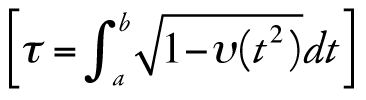 to and
not otherwise. (Fock 1959, 35)[4]
to and
not otherwise. (Fock 1959, 35)[4]
The notion of “a clock insensitive to accelerations” is what was called an ideal clock. In this way, in Fock’s presentation, one defines an ideal clock, and afterward one assumes that a clock with a non-geodesic worldline behaves in a way that the time read off by the clock is equal to the Minkowski proper time, i.e. one assumes the clock hypothesis.
A recent formulation of the clock hypothesis along the lines of what one has just seen is that of Brown, according to whom, the clock hypothesis is “the claim that when a clock is accelerated, the effect of motion on the rate of the clock is no more than that associated with its instantaneous velocity—the acceleration adds nothing” (Brown 2005, 9; see also Brown and Read 2016, 330). As mentioned by Brown and Pooley, “this assumption is not a consequence of Einstein’s 1905 postulates” (Brown and Pooley 2001, 265). This is what one might call the traditional rendering of the clock hypothesis. An alternative but equivalent rendering is, e.g., the one made by Maudlin:
Clock Hypothesis: The amount of time that an accurate clock shows to have elapsed between two events is proportional to the Interval along the clock’s trajectory between those events, or, in short, clocks measure the Interval along their trajectories. (Maudlin 2012, 76)[5]
There is no mention of the rate of the clock, but these renderings are equivalent: a clock that between two events of its non-geodesic worldline has a time reading that is equal to the integral of the infinitesimal interval along the worldline between the two events is a clock whose rate only depends on its instantaneous velocity, and vice versa.
3. The light clock
The light clock as it is considered in this work is a physical system implemented by Marzke and Wheeler in a paper published in 1964.[6] This physical system is constituted by two “particles” that are described in very simple terms by their timelike worldlines and by electromagnetic radiation—light—that is also described very simply in terms of null worldlines. In this way, matter and light are described in terms of their trajectories in space-time. What characterizes this physical system is the consideration that light is “bouncing” between the particles. Marzke and Wheeler describe the light clock as follows:
Having two particles moving along parallel world lines, we can let a pulse of light be reflected back and forth between them. In this way we define a geodesic clock. It may be said to “tick” each time the light pulse arrives back at the object number one. (Marzke and Wheeler 1964, 53)
As it is, the interaction of matter and light is described very simply, just in terms of the worldlines. For example, the “emission” of light by one particle is described through its representation with worldlines. In this case, one would consider a null worldline emerging from the timelike worldline. In similar terms, the “reflection” of light by a particle is described and represented by a null worldline ending at an event of a timelike worldline with a new null worldline emerging from this event (see figure 1).
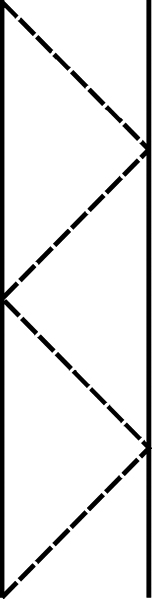
Fig. 1
Two segments of the straight worldlines of two particles with light “bouncing” between them, corresponding to two “ticks” of the clock formed by the particles and the light. Here, it is represented the simple case of a light clock in inertial motion. In the general case, the worldlines are not geodesics (for details on this see Fletcher 2013).
One might say that one has a kinematical description of a light clock, as mentioned by Fletcher in his description of a light clock:
Briefly, the simplest form of a light clock consists of a light ray bouncing between two parallel perfectly reflective mirrors separated by a distance d […]. Because one can represent the mirrors using timelike curves and the bouncing light ray as a set of null geodesics, one can represent a light clock’s dynamics in a relativistic spacetime without appealing to Einstein’s field equations. (One might say that the description becomes purely kinematical.) (Fletcher 2013, 1370)
The light clock was originally considered by Marzke and Wheeler in relation to general relativity with the purpose of having a clock that does not depend on the atomic structure of matter:
Whether the clock ticks rapidly or slowly is a matter of choice, based on whether the two [particles] are far apart or close together. In any event, questions of atomic constitution have nothing to do with the length of the tick! (Marzke and Wheeler 1964, 53)
This is what one might call a physical property of this physical system: a light clock does not depend on its atomic constitution (see also Ohanian 1976, 192-3). Another physical property more relevant for this paper relates to the time read off by a light clock. For the case of a light clock in inertial motion, the “ticks” of the light clock correspond to the coordinate time. Ohanian called the attention to this feature of the light clocks:
The construction of the [light clock] guarantees that the time measured by this clock coincides with the time variable t that appears in the equations of motion of a particle, in the Maxwell equations, in the Lorentz transformation equation, etc. (Ohanian 1976, 195)
One has then a physical system described kinematically in the special theory of relativity which has very particular physical properties: (1) its time reading does not depend on its atomic constitution; (2) its time reading when in inertial motion, corresponds to the coordinate time.
One might at this point consider the question of what is the physical behavior of the light clock when in accelerated motion? Or more to the point, what is its time reading in this case?
In a recent work, Fletcher (2013) proved a theorem that shows that the time read off by a sufficiently small light clock along a segment of its worldline approximates to an arbitrary degree the length of this segment, i.e. the proper time. For the purpose of this work, it is not necessary to go into the mathematical details of the proof. It will be sufficient to grasp what notion of sufficiently small light clock is at play in contrast to a not-so-small light clock, which might not read off a time similar to the proper time, and also to consider what physical notions are at work in the derivation; in particular one must consider if there are any assumptions applied which are not a consequence of the special theory of relativity.
In the proof of Fletcher’s theorem, a mirror/particle is described simply in terms of a C(2) timelike worldline γ. By definition, the proper time for a segment of this worldline is given by its length |I´|, where I´ is a closed interval. One considers a “family” of light clocks constituted by the particle with worldline γ and particles each with a worldline γα, where α is an index that labels the worldlines in the companion family. According to Fletcher, “the curves of the companion family will represent the spacetime locations of one of the [particles] in a collection of light clocks recording the elapsed time along the [particle] γ[I´]” (Fletcher 2013, 1376). Importantly, one is considering a convergent companion family to γ[I´]. To understand what this means one must take into account that for each light clock one defines a non-zero scalar radius field (or radial distance field) rα. One can regard rα as giving a measure of the distance between the two particles in γ and in γα (however this distance is not a privileged one; for details see Fletcher 2013, 1381). By requiring that ra is non-zero, one ensures that “there is a non-zero distance between the [particles], hence the “photon bouncing” is always well-defined” (Fletcher 2013, 1376). Now, a second condition is given: limα→∞ rα = 0. This condition “specifies the sense in which the [companion] family is convergent” (Fletcher 2013, 1376). In intuitive terms, the condition limα→∞ rα = 0 means that one can choose smaller and smaller light clocks. According to Fletcher, “having a convergent family of companion curves means that there is always available a sufficiently “small” light clock as determined by the scalar field r” (Fletcher 2013, 1381). This is then our notion of a sufficiently small light clock. What does Fletcher prove regarding the time read off by these clocks? According to Fletcher:
One can then state the theorem in words as follows. Given a closed segment of a timelike curve and any εA, εR > 0, there is a sufficiently small and unvarying light clock that measures the [length of] that segment within an accuracy of εA and ticks with no more than εR variation in regularity. (Fletcher 2013, 1382)[7]
From here one can grasp what would be the result of a “measurement” made by a not-so-small light clock. In this case, the accuracy would be larger that eA and the variation in regularity larger than εR; one would have a light clock that is not accurate or regular.
In the derivation of the theorem, Fletcher only considers the properties of timelike and null worldlines, nothing more. There is some restriction regarding the acceleration of light clocks since Fletcher’s results only apply to a C(2) timelike worldline g; but this is not an independent assumption regarding the “workings” of light clocks. There is also an important property of null worldlines left implicit. According to the principle of the constancy of the velocity of light, the two-way speed of light is a constant (see, e.g., Brown 2005, 77; Jammer 2006, 122). One can notice this result at work when Fletcher considers the case of a light clock in inertial motion: “if the light ray completes n round-trips between the mirrors, then the clock has recorded an elapsed time of 2nd” (Fletcher 2013, 1370). The two-way speed of light is a constant set to one. This means that the null worldlines correspond always to a propagation of light such that the two-way speed of light is a constant.[8] Again, this is a basic aspect of special relativity.
One finds that light clocks have a third physical property beside the two previously mentioned: (3) for a sufficiently small light clock its time reading approaches to an arbitrary degree the proper time along its worldline. There is nevertheless a difference. Properties (1) and (2) are shared by any light clock. Property (3) only stands for sufficiently small light clocks. One can conclude from Fletcher’s proof that in the case of (sufficiently small) light clocks the clock hypothesis is not necessary. But now, one has a problem to face: how does this result bear on the clock hypothesis? Does one still need it, or light clocks are a game changer?
4. Light clocks and the clock hypothesis
Let us consider the case of a generic clock—a physical system that one takes to be a clock, but for which does not give any physical description (besides assuming that it is not a light clock). In this case, the clock hypothesis seems to be necessary to equate the time read off by a generic clock with the length of its worldline (the proper time).
But if now instead of considering a generic clock one is more specific and considers a particular case, the atomic clock (or more simply atoms), does one needs the clock hypothesis? Here, one will consider the atomic clock (or atoms) in two ways: (1) as a material physical system whose physical properties one determines experimentally; (2) as a physical system described by a relativistic quantum field theory. Experimental results with atomic systems (or particles) found no influence of the acceleration in the case of very high accelerations, e.g., of the order of 1016 g and 1018 g, where g is the Earth gravitational acceleration (see, e.g., Brown and Read 2016). Recently, using a theoretical model for an atomic clock—a toy atomic clock—it was calculated that only in experiments involving an acceleration greater than 1023 g would the effect of the acceleration in the rate of an atomic clock become detectable (Dahia and Felix da Silva 2015). This means that unless one considers extremely high accelerations one does not expect that an atomic system will have a time reading that is not equal to the proper time. If one assumes that the worldline corresponds to, e.g., an atom, one does not need the clock hypothesis to consider that the atom’s “time reading” is equal to the proper time. One could say, in this case, that instead of assuming the clock hypothesis one is assuming that the worldline corresponds to the space-time trajectory of an atomic clock. Importantly, one would also be assuming something external to the special theory of relativity since the physical properties of atoms are not described by the theory. What would one say now about the clock hypothesis? Maybe that for a generic clock, which implicitly one considers not to be a light clock and also not to be an atomic clock/system, one still needs the assumption of the clock hypothesis.
As it is, the role of the clock hypothesis is becoming less clear. It seems that one needs to take into account clauses indicating which physical systems—described in special relativity (light clocks), by other theories, or resulting from experimentation—are not to be included. But also, one might suspect, as mentioned, that taking into account light clocks might somehow circumvent the need for the clock hypothesis.
To clarify things, one might for a moment forget about the clock hypothesis and consider what is on the table. From what one has seen, there are two types of clocks that seem relevant to address an enquiry regarding the rate of accelerated clocks in general. Accordingly:
-
1. In special relativity, one describes a particular physical system—the light clock—whose time reading is “equal” to the proper time.
2. There are “real” physical systems—atoms—(that can be theoretically described in relativistic quantum field theory) whose time reading is “equal” to the proper time.
Let us envisage the following thought experiment: several light clocks sharing the same trajectory in space-time (i.e. one takes the light clocks to have the same worldline). Let these light clocks be sufficiently small in the sense implied in Fletcher’s proof. Accordingly, all of them have a time reading that approximates to an arbitrary degree the length of the worldline—in the limit, they read off the same time. If these light clocks gave different time readings there would be no criteria to establish which, if any, gives a “correct” time associated to a (timelike) non-geodesic of space-time. Fletcher’s theorem shows that one has a criterion to identify a “correct” time based on clocks that have the same time reading (this implies also that one can distinguish a clock functioning appropriately from a malfunctioning clock). The proper time is an invariant with the dimension of time and the theory describes a type of clock that reads off a time “equal” to the proper time.[9]
But one might defend a more heterodox view: why not assume that any light clock (or another clock) gives its own “correct” time according to how it “ticks”? Why should one presuppose that for an accelerated system there is a “correct” time associate to its worldline? Might this be an implicit assumption independent of the theory? When talking about time, one does so in the context of an adopted system of units and standard or unit-measuring clocks whose “ticks” correspond to the adopted unit of time. When considering accelerated clocks, their “ticks” must be compared to those of the adopted system—i.e. to the “ticks” of standard clocks in inertial motion. Sufficiently small light clocks that read off a time equal to the length of their worldline have the following property, which importantly, in this case, is not an assumption:
The increase in the [the time read off by] the clock at any time is the same as that of the standard clocks in the rest system Sº, i.e. the system in which the clock is momentarily at rest. (Møller 1955, 49)
This means that for a sufficiently small light clock, its rate corresponds always to that of clocks giving the adopted unit of time: if one considers a unit-measuring clock momentarily side-by-side with a sufficiently small light clock (undergoing an accelerated motion) their time readings (their “ticks”) are equal. In this way, there is in the theory a notion of time and its measurement associated to non-geodesic timelike worldlines: the length of (a segment of) a timelike worldline is a time (interval) that is measured, e.g., by light clocks.
If one makes the same thought experiment with a “large” light clock, its “ticks” will differ from the unit of time, along its trajectory in space-time. One cannot, in this case, consider the clock’s “ticks” as corresponding to a “correct” time. Being more exact, these “ticks” cannot be identified with a measurement of time and this physical system should not even be considered a clock. A physical system to be a clock must “tick” according to the coordinate time of an inertial reference frame in relation to which it is momentarily at rest (when accelerated) or at relative rest or motion (when in inertial motion).
Let us consider a second thought experiment: a light clock that reads off a time “equal” to the proper time has the same trajectory in space-time as some other physical systems (some of which, if working properly, might even be clocks). What time does one ascribe to all of these physical systems? The light clock reads off what one takes to be a physical time associated to the worldline. As such, this time is ascribed to all the physical systems sharing this worldline since all of them go by the same worldline’s length (i.e. by the same total proper time). But what happens if one of the other physical systems is supposed to be a clock, but its time reading differs from the proper time? In this case, one can consider that the time gone by this physical system is equal to the proper time even if it measures time incorrectly (i.e. even if its “workings” are such that as a clock it is malfunctioning).
Notice that one is not relying on atomic clocks. If one made these thought experiments with atomic clocks instead of light clocks one would rely on results external to the theory; one would be assuming in special relativity properties of atomic systems that are not described in the theory. With light clocks, one does not have this situation. One does not assume anything or include anything external to special relativity.
What is the implication of these ideas in relation to the clock hypothesis? Regarding any C(2) timelike worldline one can always argue that if this worldline corresponded to the trajectory in space-time of a sufficiently small light clock, the time read off by this clock would be “equal” to the length of the worldline. The fact that this length is invariant and has the dimension of time is complemented by the description within the theory of a type of clocks—the (sufficiently small) light clocks—such that all of them measure this (temporal) length. That is, there is in the theory a notion of time and its measurement associated to non-geodesic timelike worldlines. One does not need any independent hypothesis to arrive at this result. An altogether different matter would be to determine when a particular clock stops reading off this “correct” time. In relation to this question one can regard the content of the clock hypothesis (or the definition of an ideal clock) as giving a general criterion for when a particular clock may be considered to be “functioning” properly: when the rate of the clock only depends on its instantaneous velocity the clock is working well.
5. Conclusion
In this work, it was addressed the status of the clock hypothesis when taking into account the description of light clocks as made in the special theory of relativity. That clocks when accelerated read off a time equal to the length of their worldline (the proper time) has been considered as an assumption independent of the special theory of relativity. This has been called the clock hypothesis, usually presented as the assumption that the rate of a clock only depends on its instantaneous velocity. When considering light clocks, one does not need the clock hypothesis. A sufficiently small light clock reads off a time that approximates to an arbitrary degree the length of its worldline (the proper time). There is no independent assumption at play to arrive at this result. For any C(2) timelike worldline, one can imagine it as corresponding to the worldline of a light clock that reads off proper time (i.e. the light clock’s “ticks” measure the length of the segment of the worldline being considered). This provides, an extension, de facto, of a notion of clock that measures the coordinate time (which, in this case, has the same value as the proper time since the clock’s trajectory in space-time is a straight worldline) to a notion of clock that still measures under acceleration the length of the worldline (i.e. the proper time). One does not assume anything to arrive at this result. In this way, there is a physically meaningful notion of time associated to non-geodesic worldlines that can be measured by (sufficiently small) light clocks. There is no need for the clock hypothesis in the special theory of relativity.
References
Anderson, James L. 1967. Principles of relativity physics. New York: Academic Press.
Arthur, Richard. 2010. Minkowski’s proper time and the status of the clock hypothesis. In V. Petkov (ed.), Space, time and spacetime, pp. 159-180. Berlin: Springer-Verlag.
Brown, Harvey. 2005. Physical relativity: spacetime structure from a dynamical perspective. Oxford: Oxford University Press.
Brown, Harvey and Pooley, Oliver. 2001. The origin of the spacetime metric: Bell’s ‘Lorentzian pedagogy’ and its significance in general relativity. In C. Callender and N. Huggett (eds.), Physics meets philosophy at the Planck scale, pp. 256-272. Cambridge University Press: Cambridge.
Brown, Harvey and Read, James. 2016. Clarifying possible misconceptions in the foundations of general relativity. American Journal of Physics, 84: 327-334.
Dahia, Fábio, and Felix da Silva, Patricio José. 2015. Acceleration effects on atomic clocks. Classical and Quantum Gravity, 32: 177001.
Einstein, Albert. 1905. On the electrodynamics of moving bodies. In J. Stachel et al. (eds.), The collected papers of Albert Einstein (English translation), Vol. 2, pp. 140-171. Princeton: Princeton University Press.
—. 1911. The theory of relativity. In, J. Stachel et al. (eds.), The collected papers of Albert Einstein (English translation), Vol. 3, pp. 340-350. Princeton: Princeton University Press.
—. 1913. On the present state of the problem of gravitation. In, J. Stachel et al. (eds.), The collected papers of Albert Einstein (English translation), Vol. 4, pp. 198-222. Princeton: Princeton University Press.
Fletcher, Samuel C. 2013. Light clocks and the clock hypothesis. Foundations of Physics, 43: 1369-1383.
Fock, Vladimir. 1959. The theory of space-time and gravitation. New York: Pergamon Press.
Jammer, Max. 2006. Concepts of simultaneity: from antiquity to Einstein and beyond. Baltimore: The Johns Hopkins University Press.
Malament, David B. 2012. Topics in the foundation of general relativity and Newtonian gravitation theory. Chicago: University of Chicago Press.
Marzke, Robert F., and Wheeler, John Archibald. 1964. Gravitation as geometry I: the geometry of space-time and the geometrodynamical standard meter. In Hong-Yee Chiu and W. F. Hoffmann (eds.), Gravitation and relativity. New York: W. A. Benjamin, Inc, pp. 40-64.
Maudlin, Tim. 2012. Philosophy of physics: space and time. Princeton: Princeton University Press.
Minkowski, Hermann. 1908 [2012]. Space and time. In V. Petkov (ed.), Space and time: Minkowski’s papers on relativity. Montreal: Minkowski Institute Press.
Møller, Christian. 1955. The theory of relativity. Oxford: Clarendon Press.
Ohanian, Hans C. 1976. Gravitation and spacetime. New York: W. W. Norton & Company.
Rindler, Wolfgang. 1960. Special Relativity. Edinburgh: Oliver and Boyd.
Valente, Mario B. 2016. Proper time and the clock hypothesis in the theory of relativity. European Journal for Philosophy of Science, 6: 191-207.
—. 2017. The conventionality of simultaneity in Einstein’s practical chrono-geometry. Theoria. An International Journal for Theory, History and Foundations of Science, 32: 177-190.
Notes
 . Throughout, one adopts geometric units (c = 1).
Additional information
BIBLID: 0495-4548(2018)33:3p.-446