Artículos de investigación científica y tecnológica
UNIVERSITY TEACHER´S EDUCATIONAL PRAXIS FOR MEANINGFULL LEARNING
PRAXIS EDUCATIVA POR DOCENTES UNIVERSITARIOS PARA UN APRENDIZAJE SIGNIFICATIVO
UNIVERSITY TEACHER´S EDUCATIONAL PRAXIS FOR MEANINGFULL LEARNING
PANORAMA, vol. 15, núm. 29, 2021
Politécnico Grancolombiano

Esta obra está bajo una Licencia Creative Commons Atribución-NoComercial-CompartirIgual 4.0 Internacional.
Recepción: 08 Agosto 2019
Aprobación: 15 Julio 2021
Abstract:
The general purpose of this study considers the strategies of educational praxis used by university teachers in order to reinforce meaningful learning. Likewise, this research is framed under the qualitative approach in a broad naturalistic field, it is descriptive and allows interpretation, and it follows the ethnographic method. Observation guides, field notebook and interviews to university teachers and students were used for this purpose. Resulting information showed that it is necessary for all teachers, in their exercise, to handle and make use of every pedagogical tool available in the educational field to benefit and successfully achieve significant learning in students, thus, teachers must be ready to incorporate and handle new alternatives and methodological strategies that allow them to reach the proposed objective, strengthening both educational praxis and significant learning. Educational praxis, meaningful learning, strategies
https://doi.org/10.15765/pnrm.v15i29.2591
Keywords: Educational praxis, meaningful learning, strategies.
Resumen: El propósito general del presente estudio se orienta a considerar las estrategias de la praxis educativa universitaria, utilizadas por los docentes, en miras de fortalecer el aprendizaje significativo. De igual manera, esta investigación está enmarcada bajo el enfoque cualitativo, de forma amplia naturalista de campo, descriptiva, permitiendo la interpretación, con un método de tipo etnográfico. Para ello se emplearon guías de observación, cuaderno de campo y entrevistas aplicadas a los profesores y estudiantes de educación universitaria. La información que emergió deja en evidencia que es preciso que todo el personal docente en su pleno ejercicio maneje y haga uso de todas las herramientas pedagógicas habidas y por haber dentro del plano educativo para favorecer y lograr con éxito un aprendizaje significativo en los educandos, por lo que todos los docentes deben estar prestos a incorporar y manejar nuevas alternativas y estrategias metodológicas que le permitan logran el objetivo planteado, fortaleciendo tanto la praxis educativa como el aprendizaje significativo.
Palabras clave: praxis educativa, aprendizaje significativo, educación.
Introduction
Venezuelan higher education faces the challenge of instilling a critical attitude in teachers’ trainers’ educational praxis to drive new perspectives and teaching competences within the scope of meaningful learning. In this approach, reasoning articulates with the comprehensive training offered to future teachers to engage in the transformation processes required by the country, signifying its leading presence as a key actor in didactic experience, based on critical and generative reflection of their educational training, along with the platform of knowledge and onset of several curricular demands.
In that regard, teachers’ role in the classroom must be subject to planning, based on students’ cognitive and emotional processes, and on active participation for them to build their own learning (Ruiz-Bolivar, 1998).
According to the aforementioned, this research on educational praxis aimed at meaningful learning intends to show, with simple language, the activities and procedures that steer efficient and effective teacher practice; also, to encourage actors in the university process to training based on the development of educational praxis for meaningful learning by university teachers.
Moreover, with this perspective, this research takes into account the strategies of educational praxis at university level that are used by teachers with the intention to strengthen meaningful learning. The study was conducted following a qualitative approach and an ethnographic model.
Method
Theoretical Approach to Research
Educational Praxis
In educational praxis, reflection and actions of the teacher in situ generate change and transformation. The university environment is conducive and connects scientific, technical and daily aspects of daily duties, which demand permanent reflection, creation and transformation. Delgado (2017) asserts: “Praxis is a social practice that is understood as a set of actions by social actors, with which their needs are satisfied, implying operational, attitudinal and behavioral actions” (p. 21).
Similarly, Freire (2018) states:
Educational praxis is a critical reflection of the teaching practice and of how teachers act with students. The fundamental assumption underlying this vision is the imperative of teachers’ respect for students’ dignity, autonomy and identity throughout the process. Teachers must frequently ponder about their pedagogical practice, conducting an analysis framed in the broader social, political economic and cultural analysis. This implies that a teachers’ pedagogical competence is not restricted to his/her disciplinary and didactic theoretical knowledge, but it also demands a view and a stance of the world and the real context in which the educational action is taking place. (p.30)
Therefore, educational practice or praxis maybe defined as a set of experiences or situations within the institutional framework that positively influence the teaching-learning process, once students and teachers’ interactions connect with their surrounding reality and environment, not just the classroom; to a greater extent, it is based on the managerial and institutional organization rationales of the educational center (Garcia-Cabrero et al., 2008).
Meaningful Learning
Meaningful learning goes hand in hand with a change in the meaning of experiences. In that regard, human experience takes thinking and affectivity into account; once this elements are considered, the individual is trained to acquire meaningful improvement of his/her experiences (Ausubel, 2018).
Several elements need to be considered to achieve meaningful learning in the teaching practice, e.g., didactics, logical structures, psychological structures, prior experiences, and others that might strengthen and provide feedback as to how students’ cognitive experiences are formed and experienced (Acevedo-Valencia & Suarez-Saldaña, 2015; Diaz, 2016; Rivera & Coronado, 2015) (Guzman, 2015; Rivera & Coronado, 2015; Vargas, Pichardo, & Iñiguez, 2015).
Thus, teachers must explore students’ previous knowledge, considering it the fundamental basis to achieve meaningful learning. This result takes place when new information connects with a relevant concept present in the cognitive structure, this will have implications on students’ new conceptual ideas and they will be able to learn in a meaningful way by building availability in the cognitive structure, closing the gap between initial and new knowledge (Hernandez, 2017).
Consequently, since the main objective of the teaching practice is to generate meaningful learning in students, they have to be able to significantly contribute to it, working on their comprehensive memory, i.e., having the fortitude to learn how to learn with active student-teacher and student-student interaction (Garza, 2018).
Epistemological Approach
This study has a qualitative paradigmatic approach, it focuses on an interpretative ethnographic methodology based on the collection of data that shows facts, phenomena or situations that took place. In that regard, Sandin (2005) manifests: “Qualitative research has to do with the lives of people, their history, behavior, as well as their organizational behavior, social movements, relationships or interactions; that type of data can be quantified but its analysis is qualitative in itself.” (p.47)
However, the research is oriented towards considering the strategies of educational praxis used by university teachers, with the aim of strengthening meaningful learning. This inquiry calls for data collection and a process of interpretation, to build up participants’ criteria or opinion based on the characteristics of the approach. This is why the qualitative research paradigm was used because it allows getting to know teachers and students’ concerns, interests, needs, problems and expectations. On the other hand, it enables interaction with these subjects in their natural environment, i.e., in their context (inside the classroom or institution).
Research Method
The research follows the interpretative ethnographic methodology; this method contributes strategies, techniques and resources that may be directly applied to the analysis unit, in other words, in the natural context in which the events, facts or phenomena takes place without incurring in misleading the representation of reality.
Research Design
The scheme taken as reference for this study is that of Bonilla and Rodriguez (2017, p.127). Diagram 1 illustrates its three moments; the authors have considered to add other elements with the goal of offering pertinent information to better understand the phenomenon being studied.
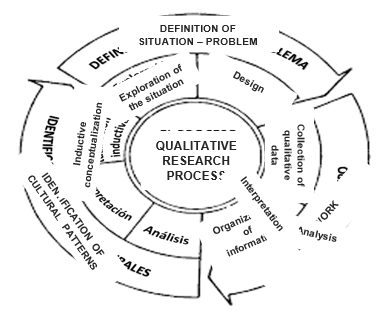
Diagram 1
The Qualitative Research Process
Source: Bonilla and Rodriguez (2017, p.127).
Based on the aforementioned, the new design was made up of five moments, which have been adapted and named differently, but that lead to the same essence of scientific research; namely: description of the study’s topic, theoretical approach, methodological moment, content analysis moment, categorization and theorization, and finally, research findings. Likewise, the design was divided in several segments that explain each moment’s content (Alzate & Góez, 2017; Leon, 2014).
Diagram 2 introduces the authors’ adaptations, summarizing the process of the study’s qualitative research in its different moments.

Diagram 2
The Qualitative Research Process
Source: compiled by the authors (2021) based on Bonilla and Rodriguez (2017).
The study’s design applied an experimental introspective approach, specifically within the qualitative ethnographic tradition. Considering the epistemological path or operational sequence conducted in the processes of inquiry, information collection, interaction with observed subjects, implementation of data collection techniques and instruments, the structure was defined as follows:
Configuration of the sample: in qualitative research, the sample is not selected, it is configured based on the purpose outlined by researchers to understand the phenomenon. To configure this study’s sample, a series of criteria were defined with the context of higher education in mind.
Criteria to configure the sample: prior experience as researchers and contact throughout the inquiry stage in the research scenario; the following criteria configured the sample: teachers and students.
Data Collection Techniques and Instruments
The technique followed by this research was participant observation without direct intervention; the data collection instrument consisted of an in-depth interview. The first one allowed to become familiar with students’ reality in the university, and the second induced a friendly and informal conversation with university teachers and students in which they could openly express their ideas, thoughts and feelings. A script was used to gather information during the interview, it included questions aimed at key informants, which they answered freely according to their personal opinion and criteria (Montes, 2015).
Reliability and Validity
Information obtained in the observation and interviews was subject to triangulation as contrast method. For Kemmis, cited by Perez (1994, p.81), triangulation "...is a cross-check between different data sources: people, instruments, documents or its combination".
Triangulation gives control over different stories’ coherence and provides deep and clear comprehension of the reality being studied. Based on the types of triangulations suggested by Perez (1994, p.85), this work applied the triangulation that consisted of using the same method in different occasions and cross-referencing the information obtained by the different sources: participant observation and in-depth interviews.
In this framework, triangulation enabled comparisons that acted as filters to selectively capture elements, strategies and processes of education at university level; the different sources will coincide in said processes, evincing the study’s validity.
Methodological Strategies for Student Learning
This category has to do with teachers’ strategies that help impart meaningful learning in their students. In other words, preparing students to develop their knowledge and skills in their environment of choice.
Subjects in the study concurred in the fact that teachers implement workshops, debates, knowledge exchange through reflexive dialogue, worktables, presentations and also in formulate questions, teamwork and dialogue. Other subjects stated that they used life projects, reflections and participatory action research depending on the curricular unit; as well as content contextualization with the country’s social, political, economic, cultural and historical reality. Some teachers mentioned that planning is paramount to attain meaningful learning: planning and researching to be successful in learning and for students in class to retain it.
Diaz and Hernandez (2018) suggest that achieving meaningful learning requires taking several elements into account: one of them being handling new information, which needs to be substantially and non-arbitrarily related with students’ prior knowledge, i.e., considering prior experiences and willingness. Finally, assessing the subject’s content and the environment in which the learning will take place.
It must be said that meaningful learning demands learning material introduced by the teacher to be potentially innovative, thus meaningful, since it is considered the logical structure of the subject or area of knowledge and the students psychological structure. These resources have to encourage a cognitive conflict that results in the need to modify preestablished mental schemes, providing information to restructure said mind schemes, which is what the teacher purposely intends to do, therefore attaining meaningful learning (Diaz & Hernandez, 2018).
In that regard, teacher strategies to achieve meaningful learning in students need to be framed in the creation of an instruction environment, based on understanding and comprehension and not on memorization; depending on it, students need to be able to apply that knowledge in diverse contexts and situations or realities of their daily lives by assertively using the acquired learning tools. Nevertheless, as stated by Diaz and Hernandez (2018), student’s motivation is crucial, to awaken it, teachers must make use of their pedagogical skills, consequently accomplishing meaningful learning.
Consistently with the aforementioned, it was observed that some teachers implement different strategies based on students’ prior knowledge, favoring knowledge exchange though reflexive dialogue, worktables and presentations, as well as through workshops, debates and video forums. Planning and research must be regarded to strengthen and solidify learning and attaining new knowledge.
Considering the suggested theories on achieving meaningful learning in students, teachers must be prepared for changes and transformations that unlock tools to sustain it. In that sense, teachers must engage with social reality, contextualize content and value feedback based on students’ prior experiences, with the aim of adapting the best learning strategies to reorganize students’ cognitive structures, thus ensuring the quality training set forth by the law.
Incorporating Educational Praxis Into Academic Performance
This category is based on the pertinence of teachers delivering meaningful learning to students. The following findings and points of view came up in the interviews.
Incorporated through a diagnosis by the teacher, subsequently, strategies are socialized with students and their input for teachers is considered; meaningful learning requires paying attention to educational needs and the way in which students learn.
Knowledge is expanded via worktables and projects with other student collectives in a dialectic and organized process, which progressively and constantly focuses on learning moments; both students and teachers learn something new every day.
Based on the observations, it was evinced that teachers in the study diagnosed and then socialized the selected strategies with the students, and their contributions were taken into account. Likewise, the teacher understands that meaningful learning requires attention to the educational needs and to how students learn, which can be fulfilled with formal research and feedback with them, interactive chats on the internet can also be used for this purpose. Teachers proved to be committed with the educational dynamics in the classroom environment, applying reflection, practical and dynamic methods.
Meaningful learning leads to modifications in the meaning of experience. In that sense, human experience does not only imply thought but also affectivity, only when both are jointly considered is the person capable to enrich the meaning of his/her learning. (Ausubel, 2018, p.61)
Ausubos (2018) also mentions that students’ learning depends on prior experiences, meaning on the preestablished cognitive structure that is related to new information, assuming that cognitive structure involves concepts and ideas that an individual has and applies to a certain field of knowledge. For the author, it is critical to be familiar with students’ cognitive structures, highlighting the fact that it is not just about knowing the amount of information students have, but the concepts and propositions they master and the extent of their stability.
Regarding the aforementioned and to achieve meaningful learning, it is convenient to state that teachers must plan activities that students are familiar with, yet there is a chance that teachers will have to deal with prior knowledge that differs between students, and even with students that lack background about the topics meant to be taught. When this happens, it is feasible for teachers to resort to strategies that drive prior information in order to activate, relate and share a student’s earlier knowledge about a specific topic.
Noticeably, one of the goals pursued by teachers with meaningful learning is to foster students’ capacity to enhance knowledge by themselves, and to associate and relate prior knowledge with the new information.
This is linked with the findings of AMEI (2019), which highlights that educational intervention’s pressing goal is to enable students to realize their own meaningful learning, considering teacher-student and student-student interaction, constructively developing their cognitive structure, resulting in autonomously learning how to learn.
Critical Reflection of Educational Praxis as University Teachers
This category is part of every university teacher’s training, it pertains to knowledge and competences acquired in their career which translate to their professional praxis. From this perspective, interviewees’ testimonies resulted in the following takeaways:
The applied praxis evinced difficulties in awakening the students in terms of meaningful learning inside the classroom environment, it is observed that students seldom read and illustrate themselves on the assigned topics, therefore, it is a great effort for them to get to the initial objective of reflexive critical thinking.
The topic of educational praxis needs to be carefully pondered, it is not just about saying and doing something, it is about experiencing and believing it; the practice does not happen overnight, it entails a process that unlocks knowledge as people get engaged with what they do. On the other hand, it is key to be aware of what is happening with society in general, to avoid being isolated from reality. In that sense, ethics and politics must be part of what is taking place in classrooms.
Also, teachers have to remain continuously updated about ongoing events. Otherwise, students would be exposed to programmatic content without developing critical thinking, which is at the core of popular education.
University teachers have a great responsibility, teaching in itself implies change and transformation, thus, teaching is a transformative process that entails continuous learning and embracing new technologies on a daily basis, with the aim of extracting the best to benefit teaching and learning.
As previously said, it is important to reiterate the need to encourage actions that lead to reflexive criticism, setting off from the reality of their environment and current reality. This is why it is imperative to contextualize pragmatic content with social reality, in order to foster change in students’ actions and thoughts to, ultimately, benefit society.
Although it is true that behaviorism has played a significant role in university students’ training (and perhaps still does), this is precisely where teachers must restructure their pedagogical model and encourage meaningful learning through constructivism, making students protagonists of their own knowledge and of their meaningful learning.
Consequently, Olaves (2018) asserts that it is vital for teachers to internalize education as a dynamic and transformative process that aims at building knowledge through daily experiences creatively connected with information. This drives students’ knowledge construction in an active way, considering that teaching facilitates tools, far from memorization or repetition, and closer to creating and building their own learning.
In addition to the aforementioned, Aldape (2018) affirms that new educational and pedagogical paradigms -substantiated in psychology and cognitive science’s constructs about how humans learn- help acknowledge the fact that students must learn cognitive strategies, i.e., think about new procedures to acquire, recover and apply information. In that regard, sociocultural constructivism places students’ mental activity at the base of knowledge appropriation, understanding that knowledge is appropriated when it is interiorized and incorporated to the mental structure.
Abello (2018) evinces the teachers’ diverse and significant roles in students’ learning, highlighting participation as an intermediary instrument between students and knowledge, acting as facilitator of conditions to build knowledge and as inspiration to generate transformation, fully aware that the teaching-learning process is considered to be a shared and creative pedagogical unit.
Consequently, it is propitious to add that teachers have to be able to handle a series of tools (theoretical, conceptual, procedural and methodological) that allow in-depth knowledge of the environment and the students. In that sense, as a professional teacher, it is critical to manage the field of specific knowledge, and to have elements that enable going deeper, applying them and being in permanent update (Hortal, 2018).
Nowadays, teachers must be familiar with the new educational paradigms, realizing that their role goes beyond the simple traditional professor that engages in repetitive and memory-centered learning. Teachers should focus on creating and innovating, as well as on facilitating their students’ knowledge building through experiences lived, and above all, promoting self-training (Aldape, 2018).
Overall, university teachers require elements and tools that offer their students the opportunity to build and put into practice their own learning instruments. In that sense, Colomer (2018) states that university teachers are essentially innovators of methods and learning environments, capable of assembling work groups with their students and other teachers with the goal of unlearning and learning, discovering, innovating, thus disseminating knowledge.
Results
Information Analysis and Categorization
In terms university teachers’ educational praxis for meaningful learning, four categories were established based on the interviews: educational strategies applied in knowledge development, methodological strategies used for student learning, incorporation of educational praxis into academic performance, and lastly, critical reflection of educational praxis as university teachers.
Educational Strategies Applied to the Praxis While Developing Knowledge
In this research, this category refers to the support offered by teachers to their students before, during and after their practice, i.e., providing necessary information to program and undertake the activities of each subject, aimed at achieving the greatest success in its development.
It is worth mentioning that the subjects in the study mentioned using the following resources:
Reading comprehension, synoptic charts, concept maps, collective construction of knowledge through comprehensive training programs, both in the virtual and face-to-face modalities. Another subject added that he used popular education, such as exchange of ideas and experiences, video forums, conferences. Moreover, another subject mentioned that strategies used in classroom environments transport them to a knowledge society in which they face and deal with the enormous responsibility of leading teaching-learning process; feedback takes place with the use of new technologies as learning support.
Likewise, this situation became evident in the observations; it was evinced that the aforementioned strategies were being applied although but by a minority, many teachers still resist changes demanded by educational entities. University teaching implies approaching and linking scientific and technical aspects with daily tasks, which benefits criticism, reflection, creation and transformation.
According to the aforementioned, teachers must be open to social changes and transformations to attain meaningful learning in students, therefore, teachers have to be subject to changes that favor updating their educational praxis. Similarly, Freire (2018) asserts that it is necessary for teachers to continuously reconsider their pedagogical practices, approaching and covering social, political, economic and cultural analysis, without disregarding students’ criteria, autonomy and identity in the process.
In that regard, Zavalza (2006) says that educational practice (as a reflexive and dynamic process) needs to be immersed in pedagogy before and after the classroom’s interactive processes, which comprise the interaction between teacher-student and student-student. Likewise, teachers must constantly update their knowledge, innovate strategies, develop skills and attitudes, apply actions substantiated on educational theories that allow understanding and supporting the student from a cognitive, affective, social and psychomotor point of view.
Discussion and Conclusion
Teachers are obliged to constant updates that will consolidate their knowledge, skills and attitudes, introducing actions that are justified on educational theories that help understand and service students from the cognitive, affective, social and psychomotor standpoints.
Within teaching’s extensive universe, it is critical for teachers to offer and handle pedagogical strategies and tools aimed towards meaningful learning; to do so, getting to know the students and adapting the strategies and tools to their realities and environment is a necessity.
It is relevant for classes to be entirely participatory, creative and transforming. Accordingly, an active and dynamic interaction between teacher-students, students-teacher and among students is required, it would significantly contribute to the quality of teaching and therefore, to meaningful learning.
In terms of teachers’ incorporation and handling of alternative methodological strategies, aimed at solidifying the educational praxis and meaningful learning to benefit students, teachers have to promote an incorporation of students’ experiences into their learning, being able to associate it and relate it, having them learn how to learn, in order for their learning to be continuous and permanent.
In the development of educational praxis, university teachers (who act as knowledge mediators and facilitators) should make students accountable for their own training, knowledge and training, meaning, having students be responsible for guiding and handling information autonomously.
References
Acevedo-Valencia, L., & Suárez-Saldaña, J. E. (2015). Los operadores económicos autorizados en Colombia: ¿puede el modelo estandarizado de la Organización Mundial de Aduanas facilitar la inserción nacional en la realidad del comercio exterior mundial? Panorama, 9(17), 124–131. https://doi.org/10.15765/pnrm.v9i17.796
Abelló, L. (2018). El desarrollo de competencias docentes en la formación del profesorado. España: Secretaría General Técnica. Ministerio de Educación y Ciencias.
Aldape, T. (2018). Desarrollo de las competencias del docente. Demanda de la Aldea Global del siglo XXI. México: Editorial Libros en Red.
AMEI. (2019). XXXIII Congreso Anual de la AMEI – Monterrey.
Ausubel, D. (2018). Psicología educativa: un punto de vista cognoscitivo. México: Editorial Trillas S.A
Alzate, D. M. O., & Góez, Á. M. B. (2017). LA NUEVA MISIÓN DE LA UNIVERSIDAD. CONTEXTUALIZACIÓN Y RESULTADOS: CASOS DE TRES UNIVERSIDADES PÚBLICAS COLOMBIANASLA NUEVA MISIÓN DE LA UNIVERSIDAD. CONTEXTUALIZACIÓN Y RESULTADOS: CASOS DE TRES UNIVERSIDADES PÚBLICAS COLOMBIANAS-The new mission of... Panorama, 11(20), 82–94. https://doi.org/10.15765/pnrm.v11i20.1010
Bonilla, E., & Rodríguez, P. (2017). Más allá del dilema de los métodos. La investigación en las ciencias sociales. Bogotá: Ediciones Uniandes.
Colomer, A. (2018). La participación en las administraciones públicas: ¿cooperación o enfrentamiento? España: UPV.
Correa, M. (2006). Contexto, interacción y conocimiento en el aula. Revista Pensamiento Psicológico, 2(7), 133-148.
Delgado, F. (2017). El pluralismo axiológico de la ciencia y praxis educativa. Madrid: Ediciones Alfaguara.
Díaz, F., & Hernández, G. (2018), Estrategias docentes para un aprendizaje significativo. Una interpretación constructivista. Ciudad de México, México: McGraw Hill Interamericana S.A.
Díaz, A. M. (2016). Evaluación de la propuesta de enseñanza de las áreas de lenguaje y matemáticas en la Institución Educativa San José del Pantano. Panorama, 9(17), 25–39. https://doi.org/10.15765/pnrm.v9i17.789
Freire, P. (2018). Pedagogía de la Autonomía. Buenos Aires, Argentina: Siglo XXI Editores.
García-Cabrero, B., Loredo, J., Carranza, G., Figueroa, A., Arbesú, I., Monroy, M., & Reyes, R. (2008). Las aproximaciones teórico–metodológicas en los trabajos de la RIED: consideraciones en torno a la construcción de un modelo de evaluación de la práctica docente. La evaluación de los profesores como recurso para mejorar su práctica, 162-220
Garza, R. (2018). Aprender cómo aprender. Ciudad de México: Editorial Trillas.
Hernández, V. (2017). Mapas conceptuales. La gestión del conocimiento en la didáctica. Ciudad de México, México: Alfaomega Grupo Editor S.A. de C.V.
Guzmán, J. P. H. (2015). El Estado en la sociedad, explicación de cómo la disposición de las burocracias determina los órdenes en países periféricos. Panorama, 9(17), 104–122. https://doi.org/10.15765/pnrm.v9i17.795
Hortal, A. (2018). Ética profesional y universidad. Caracas. Venezuela: Publicaciones UCAB.
León, E. M. (2014). Ampliación de horizontes epistemológicos para la construcción de nuevos entornos organizativos en instituciones educativas universitarias. Panorama, 8(14), 60–72. https://doi.org/10.15765/pnrm.v8i14.496
Martínez, M. (2012). La investigación cualitativa etnográfica en educación. Manual teórico-práctico. México: Editorial Trillas.
Montes, A. M. (2015). Optimización de la autoformación a través de la enseñanza virtual. Panorama, 9(17), 41–49. https://doi.org/10.15765/pnrm.v9i17.790
Olaves, V. (2018). Competencias del docente de educación integral en el contexto de la realidad educativa venezolana. Maracaibo, Venezuela: Colegio Universitario Dr. Rafael Belloso Chacín.
Pérez, M. (1994). Investigación cualitativa. Retos e interrogantes. España: Editorial la Muralla.
Rivera, G. O., & Coronado, M. L. C. (2015). La formación científica en los primeros años de escolaridad. Panorama, 9(17), 10–23. https://doi.org/10.15765/pnrm.v9i17.788
Ruiz-Bolívar, C. (1998). La estrategia didáctica mediadora: ocho años después. Investigación y Postgrado 13(1), 15-38.
Sandín, M. (2003). Investigación cualitativa en educación. Fundamentos y tradiciones. Madrid: McGraw Hill/interamericana, S.A.O
Vargas, I. C. M., Pichardo, C. M. R., & Íñiguez, F. J. M. (2015). Desarrollo de competencias integrales con tecnologías de la información y de la comunicación en educación superior a distancia. Panorama, 9(16), 9–19. https://doi.org/10.15765/pnrm.v9i16.631
Zavalza, M. (2006). Competencias docentes del profesorado universitario. Madrid: Narcea.