World geography of publications on tourism-related innovations
Publicaciones sobre innovaciones relacionadas con el turismo a escala mundial
World geography of publications on tourism-related innovations
Revista Geográfica Venezolana, vol. 58, no. 1, pp. 134-147, 2017
Universidad de los Andes

This work is licensed under Creative Commons Attribution-NonCommercial-ShareAlike 3.0 International.
Received: 15 August 2015
Accepted: 15 June 2016
Abstract: Innovations in tourism industry are essential for its own growth, which have become important research directions. 94 journal articles were published on this subject by 215 specialists from 33 countries since 2013. This research is well-balanced and truly global in extent. However, it tends to concentrate in Europe and Southeast Asia. The countries with the most studied innovations in tourism industry are Spain, China, and Taiwan. The biggest number of journal articles were published by specialists from the same countries (and Denmark), which boast about having the largest research communities. It is established that this research direction grows well in countries with big number of international arrivals, innovationoriented economy, and prominent studies of innovation processes in economy. Probably, some other factors, including the ‹purely academic› curiosity also matter.
Keywords: tourism, hotels, innovations, innovation economics, geographical research, tourist destinations, tourist flows.
Resumen: Las innovaciones en la industria del turismo son esenciales para su crecimiento, y su estudio se ha convertido en una importante línea de investigación. Se han publicado 94 artículos de revistas sobre este tema por 215 especialistas de 33 países desde 2013. Esta investigación está bien equilibrada y de alcance global. Sin embargo, se concentra en Europa y el sudeste asiático. España, China y Taiwán son los países con las innovaciones más estudiadas en la industria del turismo. El mayor número de artículos de revistas fueron publicados por especialistas de estos mismos países, además de Dinamarca; también cuentan con las mayores comunidades de investigadores. Se ha visto que esta línea de investigación tiende a crecer en países con gran número de ingresos internacionales, economía orientada a la innovación e importantes estudios de procesos de innovación en economía. Es bastante probable que otros factores también sean significativos, incluyendo la curiosidad ‹meramente académica›.
Palabras clave: turismo, innovación, innovación económica, investigación geográfica, destinos turísticos, flujos turísticos.
1. Introduction
Innovation-oriented development is a serious advantage of the modern economy (Cooke, 2001; Antonelli, 2003; Atkinson & Ezell, 2012; Squalli & Wilson, 2014; Cecere, 2015). If so, the world tourism industry has to spend efforts to follow this way of development in order to increase (or even to sustain) its economic proficiency. Undoubtedly, the only science provides the necessary foundation for development of tourism-related innovations, and, thus, the relevant research marks the potential for further achievement of this ambitious task. It is of big interest to learn where the research in tourism-related innovations grows, who are the main contributors, and what are the triggers.
An objective of the present paper is to document simple geographical patterns of the current research in innovations in tourism industry. The special attention should be paid to distribution of this research by countries. On the one hand, a given country can serve as a research focus, i.e., the number of studies devoted to innovations in the tourism industry of this country is analyzed. On the other hand, the intensity of such a research can be also analyzed per countries.
2. Theoretical foundation
Tourism-related innovations has become recently an important research topic. Hjalager (2015) summarized 100 innovations that facilitated the growth of tourism. Medina-Munoz et al. (2013), Liu et al. (2014), and Damian and Suarez-Barraza (2015) demonstrated that outstanding importance on this topic. Finally, Ruban (2015) distinguished five types of tourism-related innovations (Figure 1). And there were much more studies undertaken recently (see below). But why studying the per-country distribution of this research is so important? Several lines of theoretical evidence are as follows.
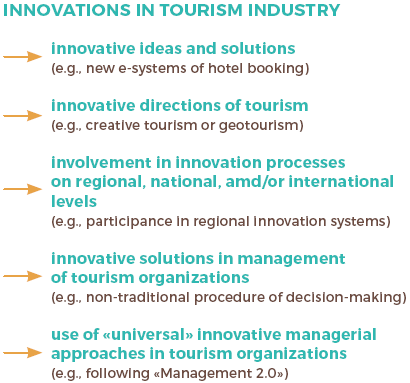
Figure 1
Classification of tourism-related innovations (based on Ruban, 2015)
First, the publishing activity is a direct and most important (although not the only!) indicator of research activity in the modern world if even too much attention to citations and impact factors is a misleading approach (Snieder & Larner, 2009; Gabrys & Langdale, 2011; Lund, 2012; Dowling, 2014; McKerchner, 2015). Therefore, bibliographical survey permits to understand where this research is more intense.
Second, the intensity of the research in tourism-related innovations marked by the number of articles in professional journals, number of specialists, etc. indicates where the potential for science-based innovations of such kind is bigger. This is so because many innovations are by definition research- driven because of their complexity, novelty, and (the main!) demand for creativity, the latter of which is available in the research community. It has been considered already that the number of scientific publications contributes significantly to the innovation potential (e.g. Carree et al., 2014), and this idea can be employed directly for the case of tourism-related innovations.
Third, the previous studies have shown that per-country bibliographical surveys (measurement of the number of publications) permits tracing some interesting patterns that can be brought in correspondence with the state of research in particular subject, the state of the academic science, and the socio-economic situation in the countries (e.g. Li et al., 2015; Pitt et al., 2016).
3. Material and method
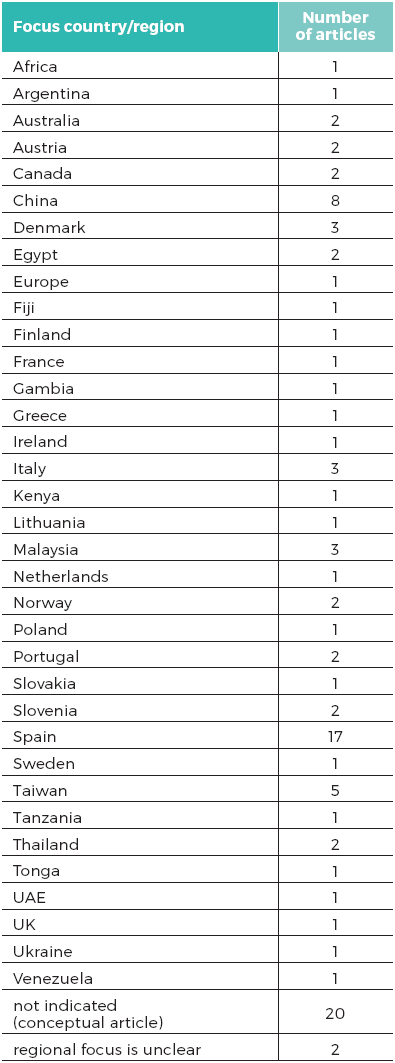
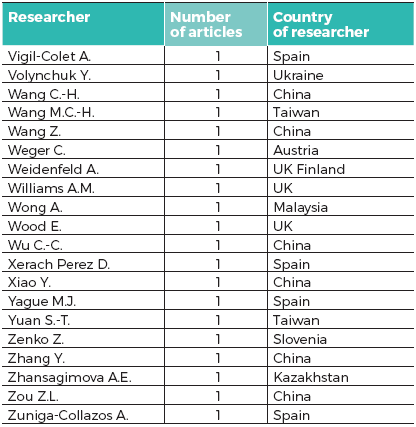
The data for the present analysis were collected with the on-line bibliographical database Scopus (scopus.com). Journal articles published since 2013 were selected because the three year period seems to be enough to characterize the current state of research activity. The search for these journal articles was conducted on October 17 (2015). A total of 94 journal articles with the terms «tourism» and/or «hotel» and «innovations» in their titles were selected (Table 1). Such a filtering of the available bibliographical data permits to avoid a kind of «noise» from numerous papers irrelevant to the present study. Full collected bibliographical information can be received from the corresponding author upon request.
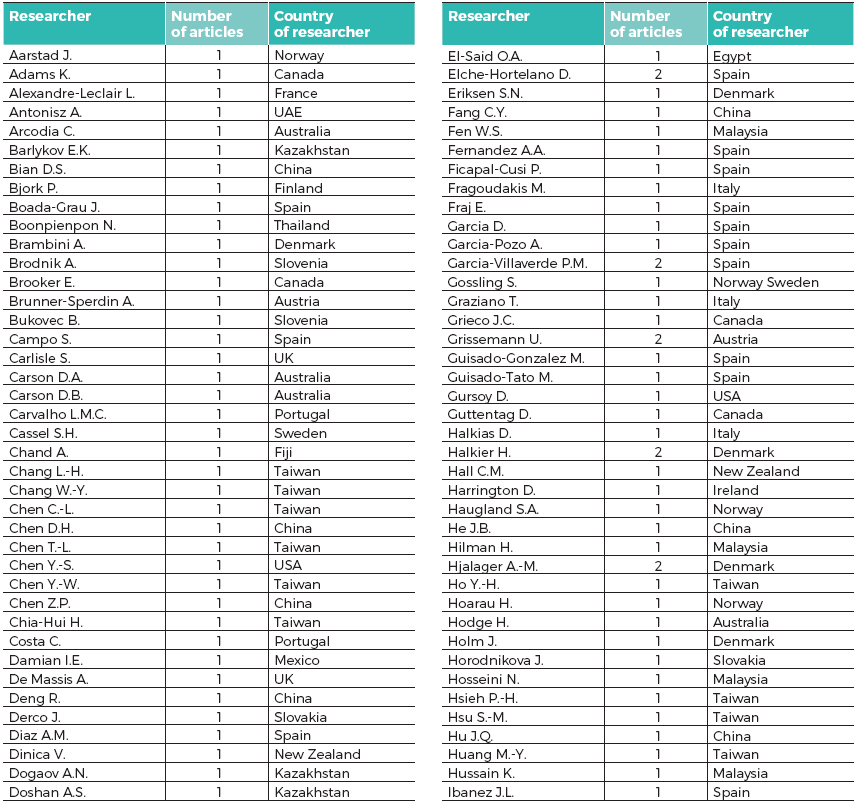
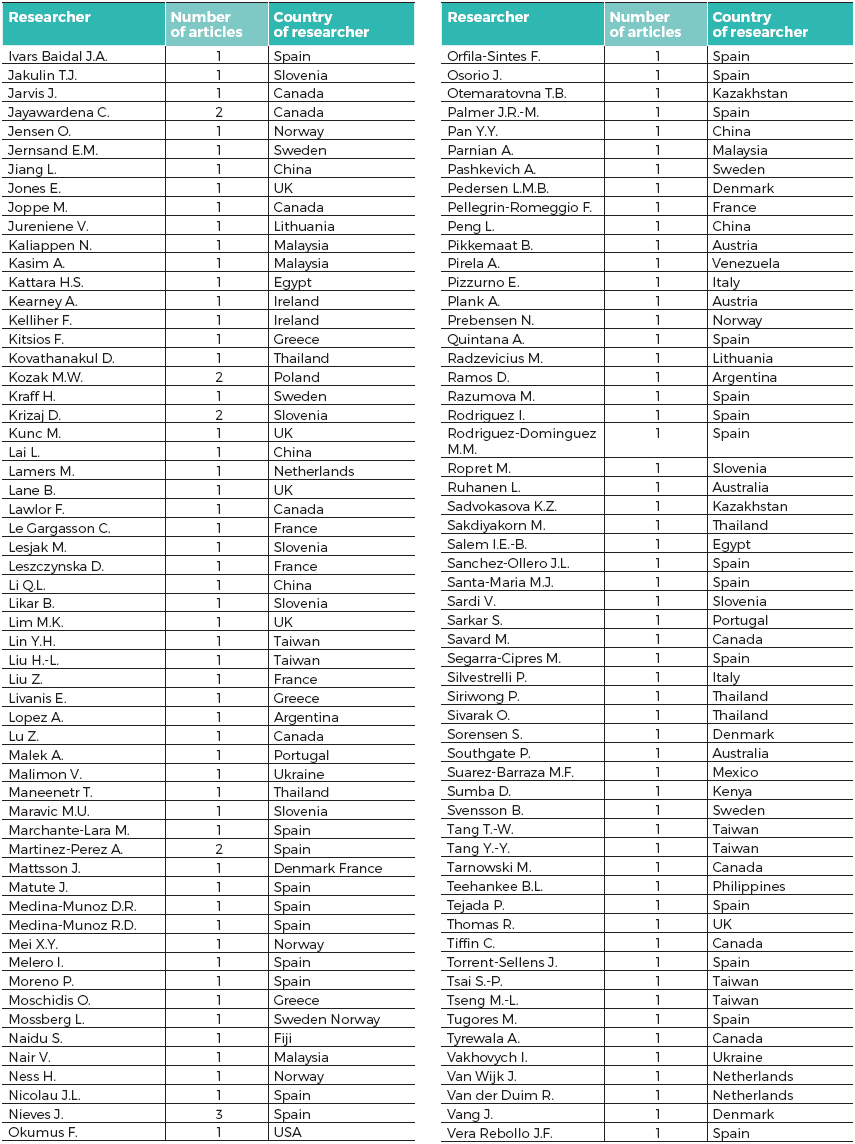
Bibliometric studies (bibliographical surveys) have been used actively in the modern science for assessment of geographical patterns of research activity (e.g. Gorraiz et al., 2016). The geographical distribution of the current research in innovations in tourism industry is conducted with three approaches. First, the number of journal articles that discuss particular countries is calculated. Of course, some articles are conceptual essentially, and they do not focus on any territory. Second, the number of journal articles published by researchers from different countries is measured. Third, the number of researchers who published these articles is established per countries. For this purpose, the database on researchers who have studied innovations in tourism industry is constructed (Table 2). The first method permits to conclude about the geography of research focus. The second and third methods reveal the geographical localization of this research, i.e., the world distribution of the relevant intellectual potential.
4. Results
A total of 94 journal articles devoted to innovations in tourism industry were published since 2013 (Table 1). 68 of them deal with innovations in tourism, 25 articles deal with innovations in hotels, and 1 paper deals with the both topics. 70 journal articles are devoted to particular countries – chiefly to one country (entirely or any area) and rarely to two and more countries; 2 papers address to parts of the world, namely Africa and Europe. The number of case studies is by ~5 times larger than the number of conceptual reviews, although the latter are not so infrequent. This indicates a ‘balanced’ research, when numerous case studied are accompanied by the appropriate amount of synthetic or theoretical works. The topics of all these articles differ. Many (~50 %) deal with innovations in tourism/ hospitality practice, and many (~35 %) deal with innovations in management of tourism organizations and hotels. A few are devoted to innovations linked to infrastructure, as well as to economic and social aspects of tourism.
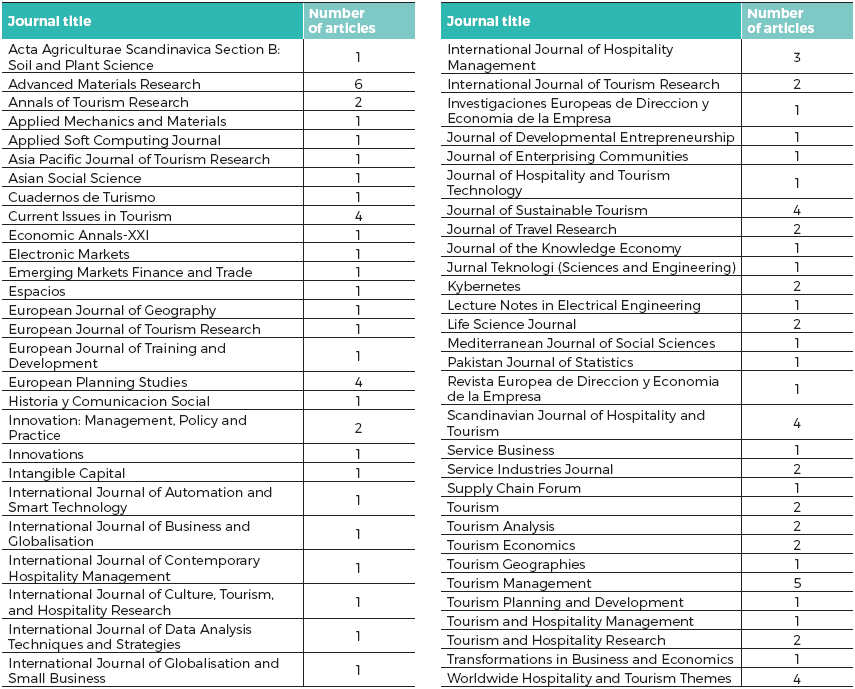
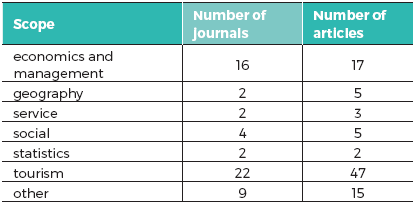
The articles are published in a broad spectrum of journals. The total number of the latter is 57 (Table 3). The majority published only one or two articles on tourism-related innovations, which means publications on this research topics are dispersed among numerous journals. The scope of the journals differ significantly (Table 4). Although about a half of articles on the discussed topic were published in tourism journals, many appear in journals focused on economics and management. Surprisingly, a big amount of articles are published in the journals that are not linked to fields relevant anyhow to tourism (these are labelled as ‹other journals›). A typical example is ‘Advanced Materials Research’ preferred by many Chinese researchers (Table 3). In contrast, a minimal number of articles are published in geographical journals (Table 4). It should be stressed that such leading journals as ‹Annals of Tourism Research› and ‹Tourism Management› published only a few articles on tourism-related innovations. Finally, the only 2 of 57 journals deal specifically with innovations (Table 3). Such a situation marks a kind of ‹marginal› position of the current research in tourism-related innovations.
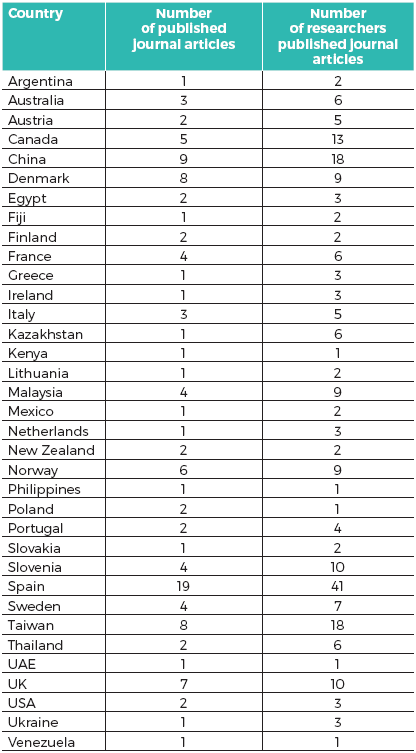
The research in innovations in tourism industry focused on 33 countries (Table 1). These are located on all continents (except for Antarctica), although especially much attention is paid to Europe and Southeast Asia. Three most studied countries are Spain, China, and Taiwan. The journal articles on tourism-related innovations were published by specialists from 35 countries (Table 5). These also tend to concentrate in Europe and Southeast Asia. The most active are researchers from Spain, China, Denmark, and Taiwan. 215 specialists were involved in research in the discussed field (Table 2). The articles are authored usually by 2-3 specialists. In many countries, the community of researchers studying innovations in tourism industry is small, and it does not exceed 5 persons. However, Spain, China, Taiwan, and Canada boast by large community. This is especially true for Spain, where as much as 41 specialists published articles on tourism-related innovations during three years.
Of interest are journal preferences of researchers dealing with tourism-related innovations in different countries. Although many prefer tourism journals, some choose journals with a different scope, including those with evident absence of links to tourism (‹other journal›), and the latter is especially typical for China (Table 6). Such a pattern is ambivalent. On the hand, it marks the preference of tourism journals by the relatively large national research communities involved in the studies of tourism-related innovations. On the other hand, it also implies that even a relatively intense research in this topic on a national level does not guarantee easy publishing in tourism journals that leads to the often preference of journals from the adjacent and even remote fields of science.
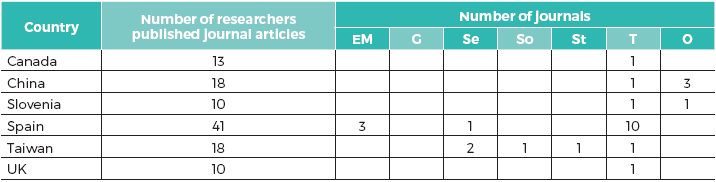
Abbreviations: EM – economics and management, G – geography, Se – service, So – social, St – statistics, T – tourism, O – other.
The results of the present analysis imply that the research in innovations in tourism industry is really of global extent, and it is rather intense. However, it focuses only on some major geographical regions, and it concentrates only in some places of the world. In the other words, this research direction seems to be ‹biased›. Very often the countries serving as a research focus are also ‹centres› of this research with large intellectual potential. Particularly, this is evident by examples of Spain, China, and Taiwan. Spain is a kind of absolute world leader of studies of tourism-related innovations. None other country can boast by the same attention of specialists, the same productivity of research, and the same research community.
5. Discussion
Processes of globalization and appearance of multipolarity (Antonescu & Stock, 2014; Arkhipov & Yeletsky, 2015; Huebener et al., 2016) facilitate apparently the both dispersal of tourism-related innovations and their scientific studies. The documented geographical distribution of the world tourism-related innovation research can be explained differently. Three most evident explanations concern the size of tourist flows, the role innovations play in the national economies, and the attention of specialists to innovation research (of course, more explanations can be considered in the future).
From three most studied countries, namely Spain, China, and Taiwan, two former are among the top 10 world tourist destinations, and the number of international arrivals to there is big (Table 7). As for the countries serving as ‘centres’ of research in tourism-related innovations, many attract ~ 10 mln., and more tourists annually. However, Denmark, Norway, and especially Slovenia are exceptions. These are significantly less popular tourist destinations (Table 7). Moreover, only some of countries that are the top 10 world tourist destinations (UNWTO, 2015) are in research focus or host specialists studying innovations in tourism industry. For instance, this is the case of France, the USA, and Germany. Such a complex relationship can be explained in the terms of destination ‹novelty›. Such countries as France that attract a lot of tourists ‹traditionally› may not require innovations, because their resources are anyway enough to sustain large tourist flow. China and Taiwan are relatively ‹new› destinations, where innovations are necessary to attract tourists.
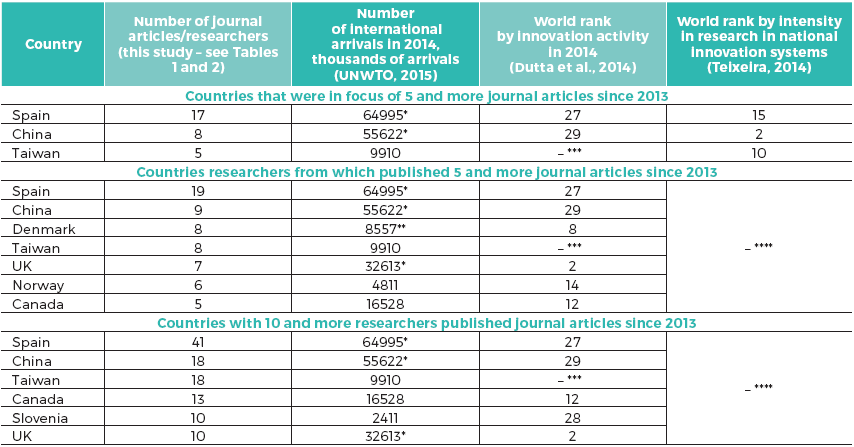
* Top 10 world tourist destinations. ** Data are available only for 2013. *** Data not available. **** Comparison is not sensible because Teixeira (2014) listed the only countries with the best studied national innovation systems, but not the “centres” of research.
Innovations are important in the modern economy (Cooke, 2001; Antonelli, 2003; Atkinson & Ezell, 2012; Squalli & Wilson, 2014; Cecere, 2015), but the innovation activity differs by countries significantly (Dutta et al., 2014). Considerations of the world ranking of countries by this activity indicates on two facts. On the one hand, the tourism-related innovation research tends to concentrate in the only countries with the relatively high innovation activity (Table 7). They are ranked among the top 30. On the other hand, only a few of these countries (the UK and Denmark, which are among the top 10) are true leaders of the innovation economy. Very similar observation can be made if the intensity of research in national innovation economy is considered. The countries where innovations in tourism industry are well studied are also characterized by attention to national innovation systems (Table 7). It should be added that the only 3 of 94 articles on the discussed subject were published in journals specialized in innovations (Table 3), and the authors of these articles are from Spain and France. The both countries boast by more or less significant attention of researchers on the problems of innovation economy (Teixeira, 2014). However, tourism-related innovations are not well studied in many countries, where innovations in the entire economy are studied intensively [e.g. the USA, Japan, and South Korea – see Teixeira (2014)].
The evidence presented above suggests that the size of tourist flows, the role innovations play in the national economies, and the attention of specialists to innovation research are premises for the current research in innovations in tourism industry. However, the presence of all or some of these premises in any given country does not lead necessarily to the growth of the noted research direction. If so, it is possible to hypothesize that something else besides the practical needs facilitate an interest of specialists in tourism-related innovations. A very simple explanation is that the latter are well studied simply because of ‘purely academic’ interest. The results of the present study also indicates that when research in innovations become ‘popular’ in any country this only facilitates its further growth, and this is a kind of ‹self-acceleration›. One would expect that the continuous growth of this research in the world in the past decades will decrease its concentration in particular countries or major regions of the world. But the results indicate that this concentration (in Europe and Southeast Asia) remains, and specialists from one country (Spain) published significantly larger amount of journal articles since 2013 than those of the other countries. These findings echo the ideas of Nakajima (1999; 2007) who emphasized on the complexity of the development of the modern science.
Two additional observations should be noted. Firstly, Spain with its intense research in tourism-related innovations has had some economic perturbations in the past years. That is why innovation development there may be a strategy (chosen specially or, more probably, followed intuitively) to sustain tourist flow. Secondly, many countries, which attract attention of researchers in innovations in tourism industry and/or host these researchers (Table 7), are more rich in cultural than in natural tourist resources. Hypothetically, this may also matter for explanation of the geographical patterns established in this paper, but further investigations are required to present any definite conclusion.
6. Conclusion
The undertaken analysis of the current literature devoted to innovations in tourism industry permits to make three general conclusions:
-
1) The research in tourism-related innovations is global, if even biased geographically.
-
2) This research tends to concentrate in Europe and Southeast Asia, and Spain in the world leader.
-
3) The examined research direction grows well in countries with big number of international tourist arrivals, innovation- oriented economy, and big intensity of studies of innovation processes in economy.
Acknowledgements
The authors are grateful to the journal editors and reviewers for constructive suggestions, as well as M. Dejardin (Belgium), A.-M. Hjalager (Denmark), H. Nakajima (Japan), A.A.C. Teixeira (Portugal), and many other colleagues for their help with literature.
8. References quoted
ANTONELLI, C. 2003. The Economics of Innovation, New Technologies, and Structural Change. Routledge, London, UK.
ANTONESCU, A. & M. STOCK. 2014. «Reconstructing the globalisation of tourism: A geo-historical perspective». Annals of Tourism Research, 45: 77-88.
ARKHIPOV, A.YU. & A. N. YELETSKY. 2015. «Various Aspects of Multipolarity within the World Economic System». Mediterranean Journal of Social Sciences, 6: 59-66.
ATKINSON, R. D. & S. J. EZELL. 2012. Innovation Economics. The Race for Global Advantage. Yale University Press New Haven.
CARREE, M.; DELLA MALVA, A. & E. SANTARELLI. 2014. «The contribution of universities to growth: empirical evidence from Italy». Journal of Technology Transfer, 39: 393-414.
CECERE, G. 2015. «The economics of innovation: a review article». Journal of Technology Transfer, 40: 185-197.
COOKE, P. 2001. «Regional Innovation Systems, Clusters, and the Knowledge Economy». Industrial and Corporate Change, 10: 945-974.
DAMIAN, I. E. & M. F. SUAREZ-BARRAZA. 2015. «Process innovation in tourism management. A review of the literature». Intangible Capital, 11: 147-165.
DOWLING, G. R. 2014. «Playing the citations game: From publish or perish to be cited or sidelined». Australasian Marketing Journal, 22: 280-287.
DUTTA, S.; LANVIN, B. & S. WUNSCH-VINCENT (Eds.). 2014. The Global Innovation Index 2014: The Human Factor in Innovation. WIPO. Geneva, Switzerland
GABRYS, B. J. & J. A. LANGDALE. 2011. How to Succeed as a Scientist: From Postdoc to Professor. Cambridge University Press. Cambridge.
GORRAIZ, J.; GUMPENBERGER, C. & T. GLADE. 2016. «On the bibliometric coordinates of four different research fields in Geography». Scientometrics, 107: 873-897.
HJALAGER, A. M. 2015. «100 Innovations That Transformed Tourism». Journal of Travel Research, 54: 3-21.
HUEBENER, P.; O’BRIEN. S.; PORTER, T.; STOCKDALE, L. & Y. R. ZHOU. 2016. «Exploring the Intersection of Time and Globalization». Globalizations, 13: 243-255.
LIU, C. C.; WU, S. C. & E. Y. LI. 2014. A research growth of tourism innovation from Bibliometric perspective. Proceedings - 2014 International Symposium on Computer, Consumer and Control, IS3C 2014. pp. 1.148-1.151. Taichung, Taiwan.
LI, J.; JOVANOVIC, A.; KLIMEK, P. & X. GUO. 2015. «Bibliometric analysis of fracking scientific literature». Scientometrics, 105: 1.273-1.284.
LUND, R. 2012. «Publishing to become an ‹ideal academic›: An Institutional Ethnography and a Feminist Critique». Scandinavian Journal of Management, 28: 218-228.
MCKERCHNER, B. 2015. «Why and where to publish». Tourism Management, 51: 306-308.
MEDINA-MUNOZ, D. R.; MEDINA-MUNOZ, R. D. & A. ZUNIGA-COLLAZOS. 2013. «Tourism and innovation in China and Spain: A review of innovation research on tourism». Tourism Economics, 19: 319-337.
NAKAJIMA, H. 1999. «STS Towards the Twenty-first Century». Science, Technology and Society, 4: 55-58.
NAKAJIMA, H. 2007. «Differences in East Asian STS: European Origin or American Origin?». East Asian Science, Technology and Society, 1: 237-241.
PITT, C.; GOODMAN, C. & K. HANSON. 2016. «Economic Evaluation in Global Perspective: A Bibliometric Analysis of the Recent Literature». Health Economics, 25: 9-28.
RUBAN, D. A. 2015. «Innovatsionnyj menedzhment v turizme: napravlenija i upravlentcheskie dejstvija [Innovation management in tourism: directions and managerial actions]». Vestnik UrFU. Serija ekonomika i upravlenie, 1: 114-126. (in Russian).
SNIEDER, R. & K. LARNER. 2009. The Art of Being a Scientist. A Guide for Graduate Students and their Mentors. Cambridge University Press. Cambridge.
SQUALLI, J. & K. WILSON. 2014. «Intelligence, creativity, and innovation». Intelligence, 46: 250-257.
TEIXEIRA, A. A. C. 2014. «Evolution, roots and influence of the literature on National Systems of Innovation: a bibliometric account». Cambridge Journal of Economics, 38: 181-214.
UNTWO 2015. UNWTO Tourism Highlights. Available on-line at http://www.unwto.org.