PSYCHOMETRIC PROPERTIES OF PORTUGUESE VERSION OF TRAIT META-MOOD SCALE (TMMS24)
PSYCHOMETRIC PROPERTIES OF PORTUGUESE VERSION OF TRAIT META-MOOD SCALE (TMMS24)
International Journal of Developmental and Educational Psychology, vol. 2, no. 1, pp. 133-141, 2016
Asociación Nacional de Psicología Evolutiva y Educativa de la Infancia, Adolescencia y Mayores

This work is licensed under Creative Commons Attribution-NonCommercial-NoDerivs 4.0 International.
Received: 07 January 2016
Accepted: 15 February 2016
Abstract: It was intended to evaluate de psychometric properties of Trait Meta-Mood Scale (TMMS24), Portuguese version of Queiroz et al. (2005) in 170 athletes, male gender sample. Statistical analysis was performed through the software Statistical Package for Social Sciences (SPSS) version 20 for Windows. We proceeded to the analysis of the reliability of the 24 items of the instrument in order to see if the items were to measure the construct and obtain a high internal consistency (a = 0.890), almost unchanged with the elimination of any item. The inter-item correlation was not as strong, confirming the analysis of alpha. However, the items in each category tend to have a stronger relation/correlation with each other, between categories. We conducted factor analysis, and variability between the variables, so as to reduce them to a particular number of dimensions. Initially we observed a six-dimensional division, but we forced the analysis to only three resulting in a division of the items according to the original scale, Thus, we concluded that the TMMS24 has a high internal consistency, good reliability and validity, offering us a suitable and reliable tool which we can conduct investigations in different areas such as the sports universe.
Keywords: TMMS24, Emotional Intelligene, Psychometric Properties, Soccer Athletes.
INTRODUCTION
It is being understood that the competitive nature of sport can trigger a range of emotions, ranging from mild to intense (Botterill & Brown, 2002; Jones, Hanton, & Connaughton, 2007) and which are considered essential for performance, let’s against postulated by Lazarus (1991, 2000), by proposing a hierarchical structure of emotions, it is said that a stronger and more important objective can trigger intense emotions. In contrast, the emotional intensity can vary and depend on individual and situational factors, and in this sense, some researchers postulate that athletes need to develop skills to recognize and manage their own emotions (Botterill & Brown, 2002; Gaudreau, Nicholls, & Levy, 2010; Hanin, 2000; Jones, 2003, 2007; Meyer & Fletcher, 2007; Silverio & Srebro, 2008).
The regulation and management of emotions can relate closely with the construct of emotional intelligence (EI) Salovey and Mayer (1990), which refers to the ability to manage emotions and use them to guide new thoughts and actions. In this sense, some studies (Parker, Summerfeldt, Hogan, & Majeski, 2004; Slaski & Cartwright, 2002; Zeidner, Matthews, & Roberts, 2004) demonstrates the efficacy of emotional intelligence in a variety of fields, corroborating some meta-studies analysis (Schutte, Malouff, Thorsteinsson, Bhullar, & Rooke 2007, Van Rooy & Viswesvaran, 2004), who postulated the utility of emotional intelligence in work performance, which is the starting point for some researchers (Meyer & Fletcher, 2007; Meyer & Zizzi, 2007) to develop studies on EI in sport. According to recent studies (Lane, Thelwell, Lowther, & Devonport, 2009; Thelwell, Lane, Weston, & Greenlees, 2008), the athlete is fully aware of their own emotions and the regular capacity through the use of psychological skills, it can be guided by the positive belief and the desire to succeed, since EI, individuals tend to face more successfully the perception, assessment and management of their emotions.
Therefore, the study and development of EI can be an important element in sport and in athlete’s performance (Lane et al, 2009, Meyer & Fletcher, 2007; Meyer & Zizzi, 2007; Thelwell et al., 2008). To Silverio and Srebro (2008), the athlete must train to reach the emotional control, and so reach its maximum capacity, referring even that an athlete does not accede to a high level in any sport with- out emotional control. Since the theoretical model of Mayer and Salovey (1993) emotional intelligence is known as a genuine intelligence, based on adaptive use of emotions, so that the individual can solve problems and adapt to the environment around him. This hierarchical model includes a set of skills from the most basic psychological processes (perception of emotions accurately) to complex (regulation of emotions and promote emotional and intellectual growth), considering that the most basic skills are needed to access to the most complex.
The model of Mayer and Salovey (1993), coated from greater scientific rigor, since its publication in 1997, when that emotional intelligence has become known as the ability to understand, appreciate and express emotions accurately; the ability to access and generate feelings that facilitate thought; the ability to understand emotion and emotional knowledge; and the ability to regulate emotions and promote emotional and intellectual growth (Mayer & Salovey, 1997). More specifically, according to some authors (Mayer & Salovey, 1997; Salovey, Mayer, Goldman, Turvey, & Palfai, 1995; Salovey, Stroud, Woolery, & Epel, 2002; Fernandez-Berrocal, Extremera, & Ramos, 2004; Queirós, Fernández-Berrocal, Extremera, Carral, & Queiroz, 2005), skills that make up the template: I - perception, judgment and expression of emotions, II - The thrill as a facilitator of thought refers to the emotions that act on the thought and on how to process the information; these emotions will determine and improve thinking because of the direct attention of individuals for important information. Emotional changes will allow the individual to adopt different views and multiple perspectives of their problems; III - The emotional knowledge: ability to understand emotions including the ability for catalog (meaning) and relate them to their meaning. It also emphasizes the ability to understand complex emotions, as well as those that occur simultaneously; IV - The regulation of
emotions: it is a more complex emotional process and includes the ability to be open and available to emotions, both positive and negative, emphasizing the ability to manage emotions, moderating the negative and increase the positive without repressing or exaggerating the information contained. This model consists in different skills, allowing the development of well-structured programs that enable their easy application, monitoring and evaluation in order to obtain more sense, rigor and consistency (Salovey et al, 1995; Mayer & Salovey, 1997; Mayer, Roberts, & Barsade 2008). According to Salovey et al. (1995), Queiroz et al. (2005) developed the Trait Meta-Mood Scale (TMMS24) Portuguese version. It is a measure of self-reported perceived EI, consisting in 24 items that assesses the relatively stable individual differences in the tendency that people have to deal with their emotional and emotions states, making a clear distinction between them and regulate them through the three dimensions of emotional intelligence perceived in three subscales: I - Attention to emotions, II - Clarity of feelings, III - Repair of the emotional state.
Taking into account the measurement approach of emotional intelligence based on Mayer and Salovey (1993) model, the aim of this study is to assess the psychometric properties of the Portuguese version of Trait Meta- Mood Scale (TMMS - 24) Queiroz et al , (2005), serving as a support tool for future research that we intend to pursue.
2. METHODS
2.1. Participants:
The sample consisted in 170 athletes from football mode, volunteers, whose average age stood at 18.50 years, with a minimum of 13 and a maximum of 33 years. All participants were male. The constituents of the sample belonged to three clubs from central and northern regions of the country designated as clubs A, T and P, and 88.2% of the sample was integrated in the main divisions of the national championship of the respective mode (Club A and P) and 11.8% fell within a competitive level with the name given by the Portuguese Football Federation as 2nd National Division Center (Club T). To level the playing position, 18 subjects (10.6%) occupied the goalkeeper position; 28 subjects (16.5%) were central defense; 26 subjects (15.3%) were side defense; 46 subjects (27.1%) were central midfielder; 30 subjects (17.6%) were high ward and 22 individuals (12.9%) were the spearhead.
2.2. Instruments:
2.2.1. Socio-Demographic Survey and Sports Practice,
developed specifically for age, marital status, educational attainment, household, competitive ranking and competitive division. An attempt was also made in the same questionnaire, information on sports careers of athletes such as: years of practice, playing position, number of workouts per week, time spent traveling for training, training duration and training period.
2.2.2. Importar imagenTrait Meta-Mood Scale (TMMS-24)
Portuguese version (Queiroz et al, 2005) is a 24 items self-report measure of perceived emotional intelligence. They are evaluated through a Likert scale of 5 points, ranging from (1) “strongly disagree” to (5) “strongly agree”. This measure assesses individual differences, relatively stable in the tendency that people have to deal with their emotional states and emotions in three subscales: I - Attention to emotions that characterizes the belief of individuals in their emotions (items 1, 2, 3, 4, 5, 6, 7, 8); II - Clarity of feelings, which refers to how individuals realize their emotions (items 9, 10, 11, 12, 13, 14, 15, 16); III - Repair of the emo- tional state that characterizes the belief that the individual has to believe in their ability to stop the negative emotional states and prolong the positive (items 17, 18, 19, 20, 21, 22, 23, 24). Cronbach’s alpha coefficients for the subscales of the Portuguese version are: ATTENTION emotions = 0.80 (university), 0.88 (seniors); CLARITY feelings = 0.79 (university), 0.83 (seniors); REPAIR emotional state = 0.85 (university), 0.92 (seniors).
2.3. Procedures:
We tested the reliability and factorial validity. To ensure the factorial validity, we used exploratory factor analysis in order to observe the existing patterns of correlations between variables and use those same standards to group your variables factors, checking how the scale items were grouped. Therefore, we used the Kaiser rule that the root or first value should be greater than 1.
Was also used Varimax rotation, a method of orthogonal rotation and intended that for each principal component, there are only a few significant weight and all others are near zero, i.e., the goal is to maximize the variance between the weights of each component principal, hence the name Varimax. The intention was to reduce the original variables; thus, the method aims to minimize the number of variables that have high loads a factor. Although there are oblique rotation methods, the most used by researchers is the orthogonal rotation, as it maintains the perpendicular factors, facilitating the interpretation (Favero et al, 2009; Hair et al 2010; Kahn, 2006; Moreira 2004; Pallant, 2001; Pestana & Gageiro, 2008).
All analyzes reported were carried out using the Statistical Package for Social Sciences (SPSS) version 20 for Windows.
3. RESULTS:
Psychometric properties of TMMS24 Assessment Tool:
According to Table 1, we can see that the TMMS scale shown a high internal consistency (a = 0.890), with isolated dimensions, internal consistency levels slightly lower against the alpha of 24 items, and the size “state Repair Emotional “that has the lowest internal consistency, although higher (a = 0.818). However, there is great variability observed in alpha when there is a removal of items.
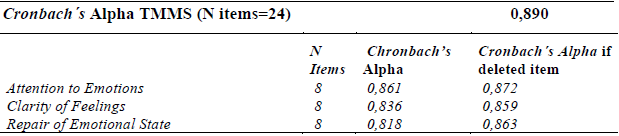
In terms of inter-item correlation, we observe a generally weak correlations between the items, however, among the items that make up the categories, the correlation tends to strengthen, decreasing when compared to items in other categories. As for the Factorial Analysis, we found correlation between the variables by the Bartlett sphericity test (p <0.01) and observed a KMO 0.866 (that compares the simple partial correlations observed between variables), which indicates a good degree of common variance, allowing us to continue factor analysis (Table 2).

Regarding commonalities (Table 3), we found that, with the exception of item 14 TMMS’s, all remaining items are explained, at least half of the variance in the original variables (> 0.5).
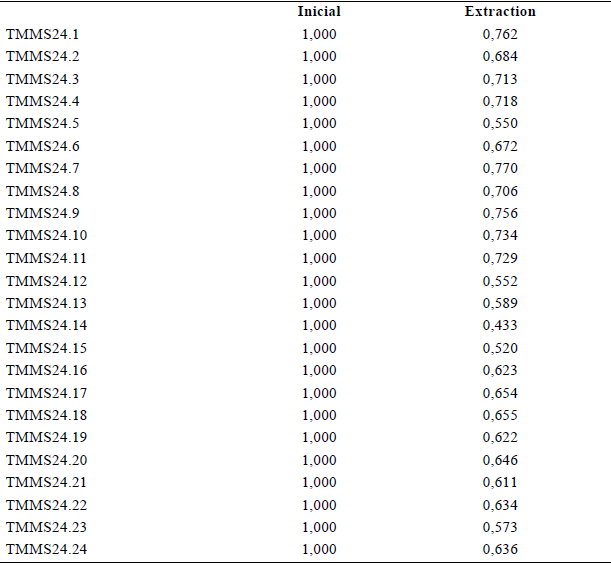
Extraction method: Principal Component Analysis
The analysis of the Eigenvalues and the discretion of the root Latent (p> 1.0), verified the existence of 6 Representative factors of about 65% of the total variance. In order to understand which variables are associated with each factor, we opted to use Varimax rotation with Kaiser Normalization. By analyzing the Factorial loads of each item (Table 4), we can distribute the items TMMS 1 to 4 in Component 1, items 9, 10, 11, 12, 14 and 16 of TMMS in component 2, items 17 to 20 TMMS of the component 3, items 13, 15, 21, 22 and 23 of TMMS in the component 4, the items 6 to 8 in part 5, and the items in the component 5 and 24 in the component 6.
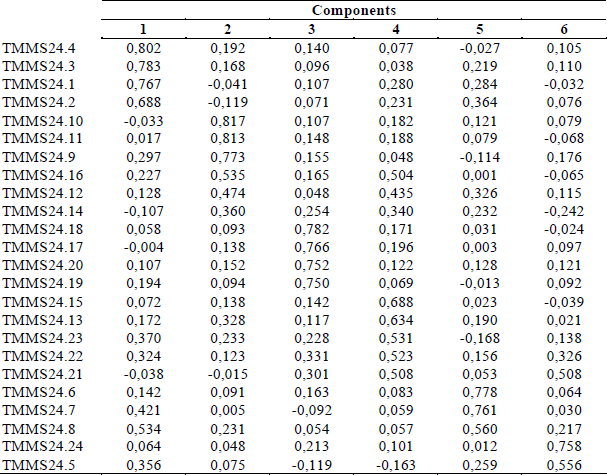
Extraction method: Principal Component Analysis; Rotation Method: Varimax with Kaiser Normalization (a) Rotation converged in 9 interactions.
However, as can be seen (Table 5), forcing the extraction of the factor analysis to be performed, only three factors / dimensions, we note that items 24 are divided in these three factors, such as the division of the original scale: Factor 1 (Items 1 to 8), Factor 2 (Items 9 to 16) and Factor 3 (Items 17 to 24).
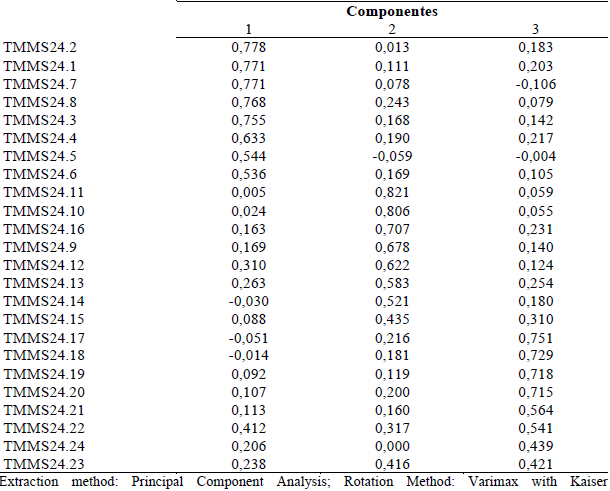
Normalization; (The). Rotation converged in 4 interactions.
4. DISCUSSION:
Regarding TMMS24, we proceeded to the analysis of the reliability of the 24 items of the instrument in order to see if the items were to measure the construct and obtain a high internal consistency ( = 0.890), almost unchanged with the elimination of any item.
With regard to the Cronbach’s alpha acording to Pestana and Gageiro (2008), to obtain a good reliability is required a Cronbach’s alpha greater or equal to 0.7, and the value obtained in the present study was well above the recommended.
Using the cutoff points of DeVellis (2003) for the social sciences ( 0.60 ), all alpha values were well above recommended . Overall, these results indicate very good reliability; both in clinical practice and in research.
The inter-item correlation was not as strong, confirming the analysis of alpha. However, the items in each category tend to have a stronger relation/correlation with each other, between categories. We conducted factor analysis, and variability between the variables, so as to reduce them to a particular number of dimensions. Initially we observed a six-dimensional division, but we forced the analysis to only three resulting in a division of the items according to the original scale (Queirós et al., 2005). Thus, we concluded that the TMMS24 has a high internal consistency, good reliability and validity, offering us a suitable and reliable tool which we can conduct investigations in different areas such as the sports universe.
REFERENCES
Botterill, C., & Brown, M. (2002). Emotion and perspective in sport. International Journal of Sport Psychology, 33, 38-60.
DeVellis R. F. (2003). Scale Development: Theory and Applications.(2nd Ed.). Newbury Park. Thousand Oaks, CA: Sage Publications.
Fávero, L., Belfiore, P., Silva, F., & Chan, B. (2009). Data analysis : Multivariate Modeling for Decision Making . 1. ed . Rio de Janeiro : Elsevier Fields.
Fernández-Berrocal, P., Extremera, N. & Ramos, N. (2004). Validity and reliability of the Spanish modified version of the Trait Meta-Mood Scale. Psychological Reports, 94, 751-755. doi: 10.2466/pr0.94.3.751-755
Gaudreau, P., Nicholls, A., & Levy, A. R. (2010). The ups and downs of coping and sport achievement: An episodic process analysis of within-person associations. Journal of Sport and ExercisePsychology, 32, 298-312.
Hair Jr., et al. (2005). Multivariate Data Analysis . 5ª.ed. Porto Alegre : Bookman.
Hanin, Y.L. (2000). Successful and poor performance and emotions, In: Emotions in sport. Ed: Hanin, Y. Champaign : Human Kinetics. 157-188.
Jones, G., Hanton, S., & Connaughton, D. (2007). Mental Toughness: An examination of Olympic and world champion performers. The Sport Psychologist, 21, 243-264.
Jones, M. V. (2003). Controlling emotions in sport. The Sport Psychologist, 17, 471-486.
Lane, A. M., Thelwell, R., Lowther, J., & Devonport, T. (2009). Relationships between emotional intelligence and psychological skills among athletes. Social Behaviour and Personality: An International Journal, 37, 195-202.
Lazarus, R. S. (1991). Emotion and adaptation. Em Pervin, L. A. (Eds). Handbook of personality: Theory and Research (pp. 609-637). New York: Guilford.
Lazarus, R. S. (2000). How emotions influence performance in competitive sports. The Sport Psychologist, 14, 229-252.
Kahn, J. (2006). Factor analysis in counseling psychology research, training, and practice: Principles, advances, and applications. The Counseling Psychologist, 34, 684-718. doi: 10.1177/0011000006286347
Mayer, J. D. & Salovey, P. (1993). “The intelligence of emotional intelligence”. Intelligence, 17, 433- 442.
Mayer, J. D. & Salovey, P. (1997). What is emotional intelligence? Emotional development and emotional intelligence: implications for educators. New York: Basic Books, 3-31.
Mayer, J. D., Roberts, R. D. & Barsade, S. G. (2008). Human Abilities: Emotional Intelligence. The Annual Review of Psychology, 59, 507-536.
Meyer, B. B., & Fletcher, T. B. (2007). Emotional intelligence: A theoretical overview and implications for research and professional practice in sport psychology. Journal of Applied Sport Psychology, 19, 1-15.
Meyer, B. B., & Zizzi, S. (2007). Emotional intelligence in sport: conceptual, methodological, and applied issues. Mood and human performance: Conceptual, measurement, and applied issues (pp. 131-154). Hauppauge, New York: Nova Science.
Moreira J. (2004). Questionários: teoria e prática. Coimbra: Livraria Almedina.
Pallant, J. (2001). SPSS survival manual. Buckingham: Open University Press.
Parker, J. D. A., Summerfeldt, L. J., Hogan, M. J., & Majeski, S. A. (2004). Emotional intelligence and academic success: examining the transition from high school to university. Personality and Individual Differences, 36, 163-172. doi:10.1016/S0191-8869(03)00076-X.
Pestana, M., & Gageiro, J. (2008). Análise de Dados para Ciências Sociais - A Complementaridade do SPSS. 5ª Ed. Lisboa: Sílabo.
Queirós, M., Fernández-Berrocal, P., Extremera, N., Carral, J. M. C., & Queirós, P. S. (2005). Validação e fiabilidade da versão portuguesa modificada da Trait Meta-Mood Scale. Psicologia, Educação e Cultura, 9 (1), 199-216.
Salovey, P., & Mayer, J. D. (1990). Emotional intelligence. Imagination, Cognition and Personality, 9, 185-211. doi:0.2190/DUGG-P24E-52WK-6CDG
Salovey, P., Mayer, J. D., Goldman, S. L., Turvey, C., & Palfai, T. P. (1995). Emotional attention, clarity, and repair: Exploring emotional intelligence using the Trait Meta-Mood Scale. In A. J. W. Pennebaker (Eds.). Emotion, Disclosure, and Health (pp. 123-154). New York: Bantam Books.
Salovey, P., Stroud, L., Woolery, A., & Epel, E. (2002). Perceived emotional intelligence, stress reactivity and symptom reports: Further explorations using the Trait Meta-Mood Scale. Psychology and Health, 17, 611-627. doi: 10.1080/08870440290025812
Silvério, J., & Srebro, R. (2008). Como ganhar usando a cabeça. (4.ª ed., pp.187-293). Coimbra: Quarteto.
Slaski, M. & Cartwright, S. (2002). Health performance and emotional intelligence: An exploratory study of retail managers. Stress and Health, 18, 63-68.
Schutte, N. S., Malouff, J. M., Thorsteinsson, E. B., Bhullar, N., & Rooke, S. E. (2007). A meta-analytic investigation of the relationship between emotional intelligence and health. Personality and Individual Differences, 42, 921-933. doi:10.1016/j.paid.2006.09.003
Thelwell, R.C., Lane, A.M., Weston, N.J.V. & Greenlees, L.A. (2008). Examining relationships between emotional intelligence and coaching efficacy. International Journal of Sport & Exercise Psychology, 6, 224-235.
Van Rooy, D. L., & Viswesvaran, C. (2004). Emotional intelligence: A meta-analytic investigation of predictive validity and nomological net. Journal of Vocational Behavior, 65, 71- 95. doi:10.1016/S0001-8791%2803%2900076-9
Zeidner, M., Matthews, G., & Roberts, R. D. (2004). Emotional Intelligence in the Workplace: A Critical Review. Applied Psychology: An International Review, 53, 371-399. doi:10.1111/j.1464- 0597.2004.00176.x