Artigos
Open Government Data and Urban Mobility: Comparative Analysis of Buenos Aires and Rio de Janeiro
Dados Abertos Governamentais e Mobilidade Urbana: Análise Comparada de Buenos Aires e Rio de Janeiro
Datos de Gobierno Abierto y Movilidad Urbana: Análisis Comparativo de Buenos Aires y Río de Janeiro
Open Government Data and Urban Mobility: Comparative Analysis of Buenos Aires and Rio de Janeiro
Administração Pública e Gestão Social, vol. 14, núm. 4, 2022
Universidade Federal de Viçosa

Esta obra está bajo una Licencia Creative Commons Atribución-NoComercial-SinDerivar 4.0 Internacional.
Recepción: 06 Septiembre 2021
Aprobación: 03 Mayo 2022
Publicación: 17 Noviembre 2022
Abstract:
Research objective: Characterize and interpret the strategies for the use and availability of open data on urban mobility in two Latin American metropolises – Buenos Aires and Rio de Janeiro – which are understood as relevant cases for the study of open data on urban mobility in the region, due to its characteristics and trajectories of data management, use and opening.
Theoretical framework: Incorporated the main analytical and explanatory models on government data opening strategies and instruments, with emphasis on the Berners-Lee’s Five Star model and the Opengovdata 15 Open Data Principles.
Methodology: based on a collective case study applied to two cases, according to Robert Stake (1995), without prejudice to its future expansion to more cases. .
Results: Both individually – for each local government – and in the comparisons made, it was possible to understand a number of strategies used, as well as their relationship with the context and the limits and potentials of opening data in this field. The cases differ from each other in their open government policies and open data mechanisms, but they also share common elements such as the types of urban mobility data made available and the nature of some open data strategies and initiatives adopted.
Originality: In addition to the originality of the theoretical model, which can support the study of new cases, the analysis provide an original contribution to the study of data opening in urban mobility in two Latin American metropolises.
Theoretical and practical contributions: The study paves the way for applying the model to other cities and for the deepening of knowledge the opening of urban mobility government data.
Keywords: Open government data, Open government, Technology, Urban mobility.
Resumo:
Objetivo da pesquisa: Caracterizar e interpretar as estratégias para uso e disponibilização de dados abertos de mobilidade urbana em duas metrópoles latino-americanas, Buenos Aires e Rio de Janeiro, entendidas como casos relevantes para o estudo da abertura de dados de mobilidade urbana no contexto regional, por conta de suas características e trajetórias de gestão, uso e abertura de dados.
Enquadramento teórico: Incorporou os principais modelos analíticos e explicativos sobre as estratégias e instrumentos de abertura de dados governamentais, com destaque para o modelo de Cinco Estrelas de Berners-Lee e os 15 Princípios de Dados Abertos do Opengovdata.
Metodologia: Baseou-se em um estudo de caso coletivo aplicado a dois casos, conforme Robert Stake (1995), sem prejuízo de sua expansão futura a mais casos.
Resultados: Tanto individualmente – para cada governo local – quanto nas comparações realizadas, foi possível compreender as estratégias utilizadas, bem como sua relação com o contexto e os limites e potenciais da abertura de dados nesse campo. Os casos guardam diferenças entre si, em suas políticas de governo aberto e mecanismos de dados abertos, mas também compartilham elementos comuns, como os tipos de dados de mobilidade urbana disponibilizados e a natureza de algumas estratégias e iniciativas de dados abertos adotadas.
Originalidade: Além da originalidade do modelo teórico, que pode embasar o estudo de outros casos, as análises produzidas aportam uma contribuição original para o estudo da abertura de dados em mobilidade urbana em duas significativas metrópoles latino-americanas.
Contribuições teóricas e práticas: O estudo abre caminho para a aplicação do modelo em outras cidades e para o aprofundamento do conhecimento sobre abertura de dados governamentais de mobilidade urbana.
Palavras-chave: Dados governamentais abertos, Governo aberto, Tecnologia, Mobilidade Urbana.
Resumen:
Objetivo de la investigación: Caracterizar e interpretar las estrategias para el uso y disponibilización de datos abiertos sobre movilidad urbana en dos metrópolis latinoamericanas, Buenos Aires y Río de Janeiro, comprendidas como casos relevantes para el estudio de datos abiertos sobre movilidad urbana en el contexto regional, por sus características y trayectorias de gestión, uso y apertura de datos.
Marco teórico: incorporó los principales modelos analíticos y explicativos sobre estrategias e instrumentos gubernamentales de apertura de datos, con énfasis en el modelo Berners-Lee Five Star y los 15 Open Data Principles de Opengovdata.
Metodología: se basó em un estudio de caso colectivo aplicado a dos casos, de acuerdo con Robert Stake (1995), sin prejuicio de su expansión futura hacia más casos.
Resultados: Tanto en forma individual – para cada gobierno local – como en las comparaciones realizadas, es posible comprender estrategias utilizadas, así como su relación con el contexto y los límites y potencialidades de la apertura de datos en este campo. Los casos difieren entre sí en sus políticas de gobierno abierto y mecanismos de datos abiertos, pero también comparten elementos comunes como los tipos de datos de movilidad urbana disponibles y la naturaleza de algunas estrategias e iniciativas de datos abiertos adoptadas.
Originalidad: Además de la originalidad del modelo teórico, que puede basar el estudio de otros casos, los análisis producidos también aportan una contribución original para el estudio de la apertura de datos de movilidad urbana em dos significativas metrópoles latinoamericanas.
Aportes teóricos y prácticos: El estudio abre camino a la aplicación del modelo a otras ciudades y a la profundización del conocimiento sobre la apertura de datos gubernamentales de movilidad urbana.
Palabras clave: Datos gubernamentales abiertos, Gobierno abierto, Tecnología, Movilidad urbana.
INTRODUCTION
The use of Open Government Data (DGA), understood as the result of "making available, through the Internet, public domain information and government data for free use by society" (Agune, Gregorio Filho, & Bolliger, 2010, pp. 8), has gained to impose a stake in the structuring of public policies, for the design of public services and for the promotion of development. The World Wide Web Consortium (W3C), the world wide web's leading standardization organization, distinguishes three "effects" of DGAs.inclusion, as the provision of data in standardized and accessible formats, allows anyone to make use of software tools to adapt them to their needs; transparency, given that Public Sector Information (ISPs) becomes open and freely accessible; and accountability, by opportunistic different points of view for the scrutiny of performance and achievement of government goals (Cgi.br, 2011). In this sense, there are three main reasons commonly pointed out for the opening of government data: transparency, increased social and commercial value, and participatory government (Attard, Orlandi, Scerri, & Auer, 2015).
Actions of availability and use of open data, in turn, can be based on different strategies, with different degrees of active participation of various stakeholders. Among the most common strategies, we highlight the creation of open data portals, which provide data on the different themes present in public administration; the realization of events such as hackathons, a tool to find new strategies for the relationship between governments and the population; the development of mobile applications made by public or private actors; and the creation of living labs, an innovation mechanism aimed at the development of public services, through technologies (Santos, 2017).
Urban mobility is a challenge for large cities, because of the high traffic of people and cargo, the increase in population and high demand for public and individual transport, and if not properly addressed, it can become a problem for public administration. At the same time, services related to urban mobility are producers and consumers of large volumes of data. Thus, the use of DGAs emerges as an instrument with great potential to contribute to the resolution of problems in this area (Yadav, Hasan, Ojo, & Curry, 2017). Using open transport and mobility data, it is possible to develop systems that make public policies more beneficial to citizens, such as GPS data installed on buses, which are updated every minute and made available in different open formats (Bertoche, 2016).
Although policies to make DGA available and encourage the use of DGA are generally recent and even incipient, there are governments that have emerged in their implementation, which makes it important to analyze their experiences to extract learning. It is in this sense that this research aims to identify and analyze the strategies for the use and availability of open data on urban mobility in the Latin American metropolises of Buenos Aires and Rio de Janeiro, chosen because they are relevant examples of municipal governments that have implemented policies for the use and offering of these data.
Once this introduction is made, the article is structured in six more sections. The first presents an analysis model, based on selected contributions from the DGA literature, which we built to examine the experience of the two cities, that is, the opening and use of data in each of them. The following is a section of presentation of the methodological procedures used for the research of data and application of the model in each of the cities, with due reasoning. The following sections refer to the results and their discussion, starting with the presentation of each of the cases separately (including the evaluation of the data opening and an analysis of the initiatives adopted in each city) and proceeding with a comparative analysis and joint discussion of the two cases. Finally, the conclusions of the work are found, including possibilities for future research and reflection on the context of the use of open data on urban mobility in Latin American metropolises.
A MODEL OF ANALYSIS OF DGA STRATEGIES IN URBAN MOBILITY
Due to the social demand for transparency in public management and access to government data, it is necessary to expand the creation of systems that reduce barriers to access to citizen information. Transparency and DGA are related, because the second expression concretize the first, since with the opening of data there is the possibility of effective government transparency (Oliveira & Marques, 2019).
In 2007, a group of 30 open government advocates, coordinated by Tim O'Reilly and Carl Malamud, boosters of the open source and free software movement, proposed eight principles to be followed in making government data available. The first eight principles, listed below, were added seven more, so that in its current version the relationship brings together 15 principles (Santos, 2017, pp. 15-16). According to them, government data should be:
1. Complete: All public data must be available. Public data is the data that is not subject to valid limitations of privacy, security, or access control.
2. Primary: Data is presented such as those collected at source, with the highest possible level of granularity and without aggregation or modification.
3. Timely: Data is made available as quickly as necessary to preserve its value.
4. Accessible: Data is made available for the widest possible reach of users and for the widest possible set of purposes.
5. Machine processable: Data is reasonably structured to enable automated processing.
6. Non-discriminatory: Data are available to everyone, without requirement of application or registration.
7. Non-proprietary: Data is available in a format over which no entity has exclusive control.
8. License-free: Data is not subject to any restriction of copyright, patent, intellectual property, or industrial secrecy. Sensible restrictions related to privacy, security, and access privileges are allowed.
9. Online & Free: Data and information is not publicly significant if it is not available on the Internet at no cost, or at least no more than the marginal cost of playback.
10. Permanent: Data should be available at the same web address indefinitely and in a stable format if possible.
11. Trusted: Published content must be digitally signed or include a date certificate of publication and/or creation, authenticity, and integrity. Digital signatures help the public validate the source of the data they find, so they can trust that the data has not been modified since its publication.
12. A presumption of openness: It is based on laws such as the U.S. Freedom of Information Act, procedures that include records management and tools such as data catalog.
13. Documented: Records must exist in relation to the format and meaning that data acquires throughout the process of its publication.
14. Safe to open: Publishing agencies must publish using formats that do not include executable content, as it is within documents that poses a security risk to users.
15. Designed with public input: The public is the one who is in the best position to determine which information technologies will be best suited for the applications that are intended to be created for use, so the participation of data users is crucial for the dissemination of information in such a way that it has value.
Another lens for open data analysis was created by British scientist Tim Berners-Lee to help diagnose the level of openness of public bodies. This model describes five steps to reach a desirable level of open data opening. To these steps, Benders-Lee attributes one to five "stars" (Summers, 2010).
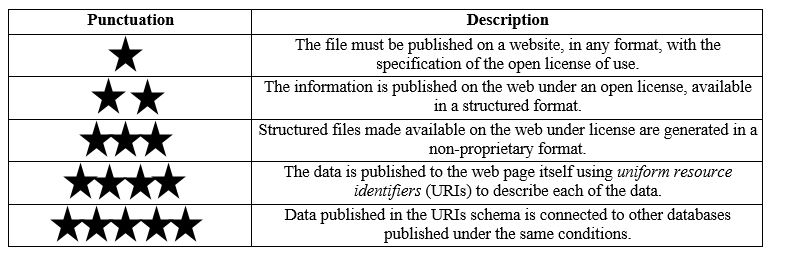
Source: Adapted by the authors from Summers (2010).
Both models indicate patterns to be followed for the opening of government data by government spheres, aiming to create conditions for the give of full access of society to public information, allowing individuals and legal entities to access and process them (Oliveira & Marques, 2019).
Despite their prescriptive and normative character, these classifications can be used as an element for the construction of an analytical framework, through which it is possible to analyze and evaluate the level of openness of the data performed. Previous research has used these references for the construction of models of analysis of DGA experiences, including other themes, in addition to urban mobility (Matheus, Ribeiro, & Vaz, 2018; Matheus, Rodrigues, Vaz, & Jayo, 2016; Klein, Luciano, & Macadar, 2015).
The opening of government data on urban mobility is an example of an initiative that contributes to greater access to data, improvement of the formulation and implementation of public policies (Matheus et al., 2016). New forms of urban governance have been developing and applying the use of information and communication technologies (ICT) and open government data to solve problems and create innovative services to society related to mobility (Aifadopoulou, Salanova, Tzenos, Stamos, & Mitsakis, 2018).
METHODOLOGY
The research strategy used in this work was based on a "collective case study", according to Stake (1995), applied to two cases: Buenos Aires and Rio de Janeiro. Thus, it was intended to examine the characteristics of each case in order to obtain insights that would allow identifying variations and similarities, thus expanding the knowledge about limits and possibilities of the strategies of opening this type of governmental data in metropolises of Latin America.
For Stake (1995), a case can be an object, individual or system that can be investigated empirically, which can help the researcher to construct interpretations on a given topic of interest. There are three modalities of case studies considered valid by the author: intrinsic, instrumental and collective. In the intrinsic case study, the interest of the research is in the case itself – that is, the interest of the researcher lies in understanding the object, individual or system analyzed. In the instrumental modality, a case is analyzed in order to provide insights about a broader phenomenon, which goes beyond the case. Finally, the collective case study corresponds to an instrumental study applied to more and one case: different cases are examined to provide insights on the same topic of interest. The collective study does not imply, however, the use of a widely replicable and reproducible methodology: each case examined has idiosyncratic particularities or characteristics, which may require specific approaches from the researcher in the collection, analysis and interpretation of the data.
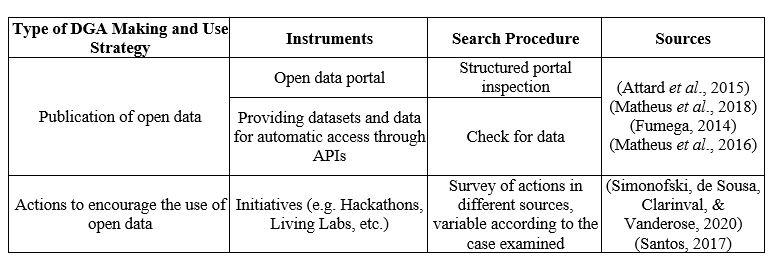
The research thus sought to analyze, for two municipal governments (cases), the strategies for the availability and use of government data and their respective instruments. The research procedures were guided by the principles summarized in Chart 2 and described below.
Source: Prepared by the authors.
The analysis of the first type of strategy, the publication of data, required a very simple data collection strategy: the examination of the open data portals of each city, in order to verify the profile of published data on urban mobility in open format. Open government data portals are one of the most common, if not the most common, ways governments use to materialize the provision of government data (Fumega, 2014). For the analysis, the technique of structured inspection of open data portals was adopted, examining its structure and content. This technique "consists of carrying out inspections, automated or not, in portals selected to verify the existence and analyze, objectively, the level of implementation of certain requirements established beforehand, either from the application of instruments already established in the literature, or from instruments specifically designed for the portals under study", according to Matheus et al. (2016, pp. 4-5).
It is important to mention that, within the scope of this research, the inspection was performed by a single researcher (the first author of this article). For reasons related to the limitation of resources and time, for example, more robust collection techniques were not carried out, such as parallel inspection by different individuals followed by the comparison of the collected data and the analysis/correction of possible discrepancies. These techniques, which certainly confer more reliability to the data collected, can of course be applied in the use, in future research, of the inspection model presented here.
Another open data publishing tool is the provision of datasets and Application Programming Interface (APIs). The catalog and publication of digital data in reusable formats, allows applications to be built and created to use them (Fumega, 2014).
Thus, for each of the municipalities analyzed, we carried out a survey and analysis of the open data found, using for both different public sources of information (government reports, public sites, local standards and legislation, news in the media) variable according to the case examined. This allowed us to diagnose aspects such as: what kind of strategy was adopted by the city; what techniques and resources were used to publish the data; what type of data was opened; and whether the data is stimulated or used by society.
After this stage, the analysis of the strategies turned to a second dimension: the actions to encourage the use of open data. These include other initiatives that complement the publication of data such as hacking, creating living labs, the existence of monitoring centers and management, creation and use of applications, among others. The analysis of these initiatives allows us to understand the complexity of activities, actions, internal and external government actors for the continuity of data opening (Matheus et al., 2018).
For the analysis of the first strategy of open government data in the two cases studied, this study produced an Open Data Assessment Scale (Chart 3).
The functionality of this Scale is as follows: for each criterion, there is an analysis dimension to be scored, with 1 point being the maximum score per criterion.
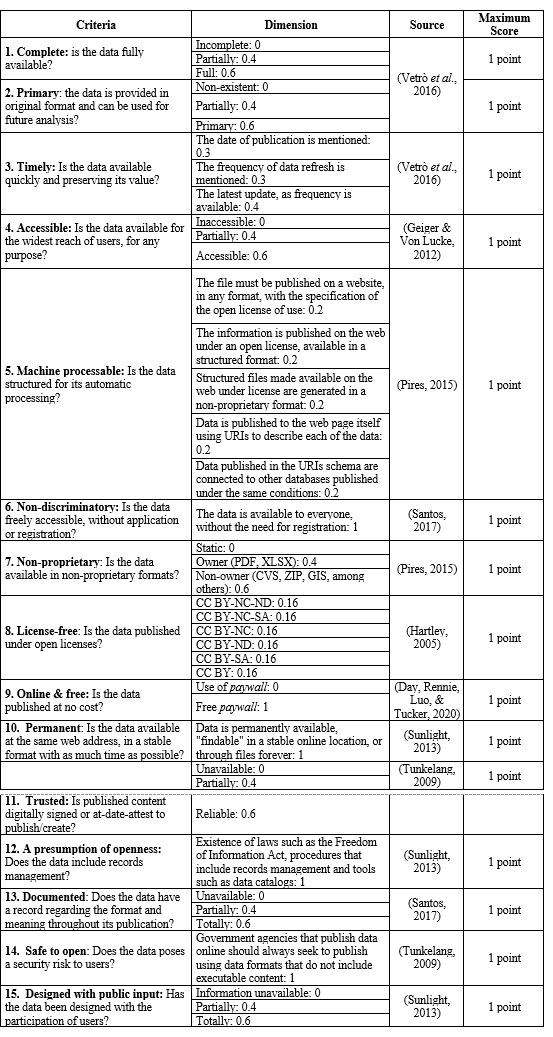
Source: Prepared by the authors.
Therefore, after this analysis, to verify the result of the evaluation of each of the criteria, we performed the final calculation based on the equation:
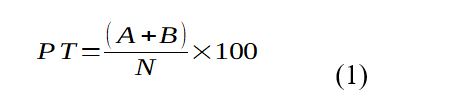
PT represents the Total Score, (A + B) is the sum of the set of values of each data in each criterion, and N is the total number of the data set. The final value establishes a percentage calculated for each criterion.
Another evaluation mechanism, built for the execution of the second strategy of this methodology, is the Model of Categorization of Open Data Initiatives (Chart 4). Through this, it is possible to examine how these efforts have been concentrated. In this categorization, we established three main types of initiatives pointed out by the literature – events, living labs and applications – each of which has its dimensions of analysis.
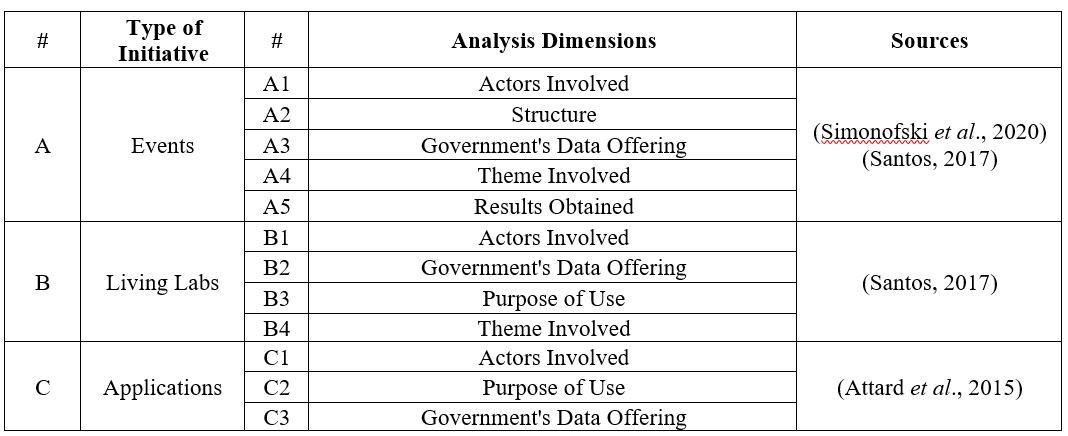
Source: Prepared by the authors.
The application of these stages of analysis to the selected cases allowed a better understanding of the potential and limits of the strategies for opening government data in the two municipal governments.
RESULTS OBTAINED FOR CASE 1: BUENOS AIRES
The Autonomous City of Buenos Aires (CABA) is the capital and largest city of Argentina, being considered the second largest metropolitan area in South America, just behind São Paulo. It belonged to the province of Buenos Aires until 1880; he remained under federal administration between 1880 and 1994, and finally gained political autonomy by constitutional amendment of 1994, when he received his current name.
During the municipal administration of Mayor Mauricio Macri, in 2012, through the Ministry of Modernization (body equivalent to a municipal secretariat), the Decree of Open Government (156/2012) was signed, which establishes the general guidelines for a policy based on transparency, collaboration and citizen participation (Bonina, 2015). The decree also established the creation of the open data portal (data.buenosaires.gob.ar), launched at the end of the same year.
In the legal framework, the city counts a Law on Access to Public Information (Law No. 104/1998) (Ley No. 104, 15 de diciembre de 2016, 2016), which guarantees the right of every person to request and receive complete public information, without the need to indicate the reasons for the request. In addition, another important decree created in the municipality was Decree 478/2013 (Decree 478, 6 of 2013, 2013), establishing that all data produced by the City Government are public, unless a regulation establishes otherwise.
With the legal regulations and the creation of the open data portal, Buenos Aires Data, the municipality became the first Argentine institution to create an organizational area for the implementation of open government policies (Bonina, 2015).
The publication of open data in Buenos Aires takes place through Buenos Aires Data (data.buenosaires.gob.ar). The main features of the portal are: use of the CKAN platform, an open source software that helps manage and publish Open Knowledge Foundation (OKFN) data collections; has 371 data from 30 different organizations, 50 of which are urban mobility; and its latest updated version is 2.6.3.
The structured analysis of the portal was preceded by a free navigation, of preparatory character, to inspect its general operation and detect in advance problems of navigability by the content that could hinder the work after the analysis was started. With this initial inspection, we found no significant problems or incidents with the operation of the site. The portal has different datasets of the most distinct themes of public management, such as education, health, safety, urban mobility, culture, and tourism, among others. In addition to the datasets, the site has information about open government decrees, a word glossary, information about private partnerships and data, and resources such as manuals and support guides.
The Buenos Aires Data portal has 50 published urban mobility datasets, related to the Chief of Ministers, Ministry of Economy and Finance, and the Ministry of Public Space and Urban Hygiene. It is also important to highlight that, as the portal was analyzed, new data were included, some of them related to the Covid-19 pandemic. The urban mobility data that were opened are data on bike lanes, public transport information such as routes, stops and stations, traffic light control, parking lots, traffic sensors, garages, and flow of vehicles and people, among others.
Evaluation of the opening of mobility data in Buenos Aires
Through the Evaluation Scale created (Chart 5), we analyzed the 50 urban mobility datasets of Buenos Aires. In the table below, you can view the summary of this analysis after the calculation according to the Total Score equation.
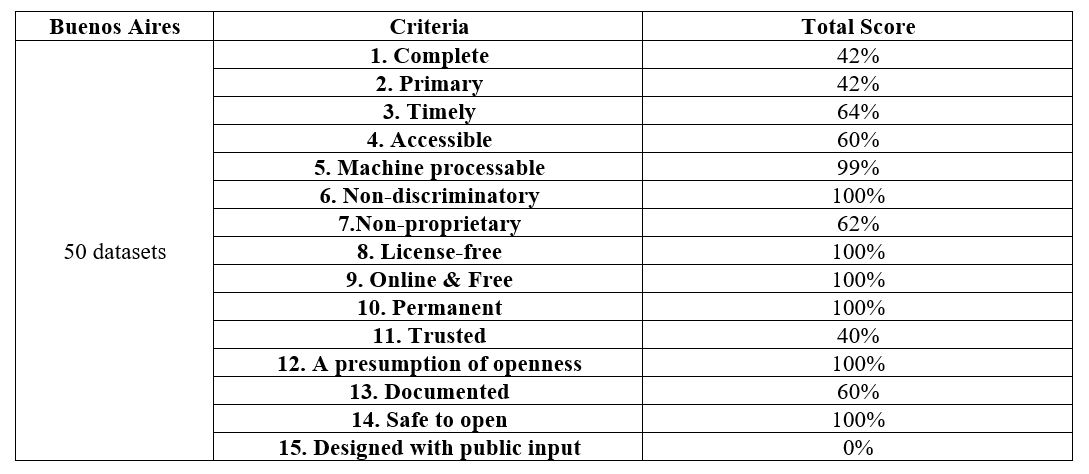
Source: Prepared by the authors.
From this analysis it was possible to conclude that there is an incompleteness of the data, and many of them are not provided in their original format to be reused. The biggest problem found in some data was the absence of the possibility of downloading, despite the offer of such data in non-proprietary formats. Regarding updating this data, we realize that there is a lot of information about the date of creation, update frequency and last update. Considering their reported frequencies, there are categories such as "eventual" and "annual" update. These constitute 28 datasets that may eventually be updated by the end of the year (data collection for the survey took place in October 2020). Next, we have 17 data groups that are out of date, and 3 dataset. that have been updated at the correct time-frequency, included in these quarterly, monthly, bimonthly, and daily updates. In addition to the points presented, there is in the open data portal the provision of data APIs, categories that continuously update and work.
We also noticed that the platform has data related to mobility in different forms and extensions: some are in proprietary formats, such as XLSX, and others in non-proprietary formats such as CSV, XLSX, and ZIP, in addition to others in more elaborate open formats such as SHP, GeoJSON and KML, commonly used for simple or spatial geographic data. There is also data in proprietary formats, such as PDF, that are difficult to export and process by machines.
In general, some aspects denote good quality of data opening, such as the use of free licenses, a presumption of openness, gratuity, reliability, permanence and security to be opened. Other aspects leave to be desired in relation to the documentation of registration and meaning throughout its publication, and there is also no information if the data were designed with the participation of the public.
Mobility data opening initiatives in Buenos Aires
Actions to encourage the use of open data began to occur throughout the opening process, through the Open Data Initiatives Categorization Model (Chart 4), it was possible to identify which were them.
The first type of initiative most found in the city of Buenos Aires was the events, which included competitions, meetings, either through hackathons or events in general. We have identified the existence of several editions of hackathons in different years, which means a continuity of this type of initiative, usually with a scope of government tender, in which citizens, government agents, companies, entrepreneurs or specialists participate, in favor of solutions to problems of the municipality, and often such contests resulted in the creation of award-winning applications, with winning teams in the spotlight. You can see in the table below the description of the analysis dimensions of this category.
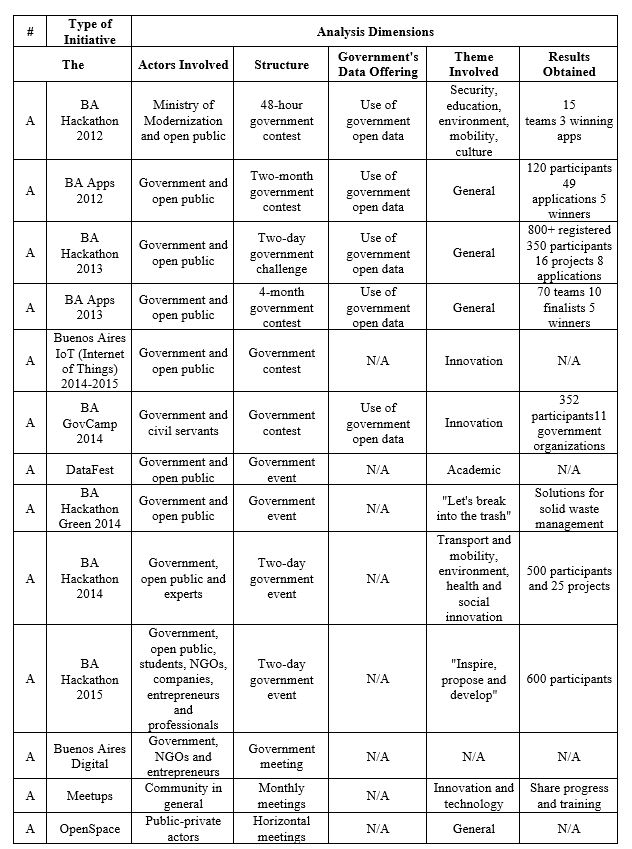
In this same category, there were also other types of events, such as competitions for the development of civic mobile applications, BA Apps. In addition, other initiatives related to open data, such as Buenos Aires IoT, BA GovCamp, DataFest, for example, take place.
Another type of initiative analyzed through the Initiatives Categorization Model was living labs. In Buenos Aires, we realize that the municipality has some research spaces for the creation, development and implementation of programs that make available to government teams and the open public, tools such as technical assistance, mentors, and space for accelerating high-impact projects.
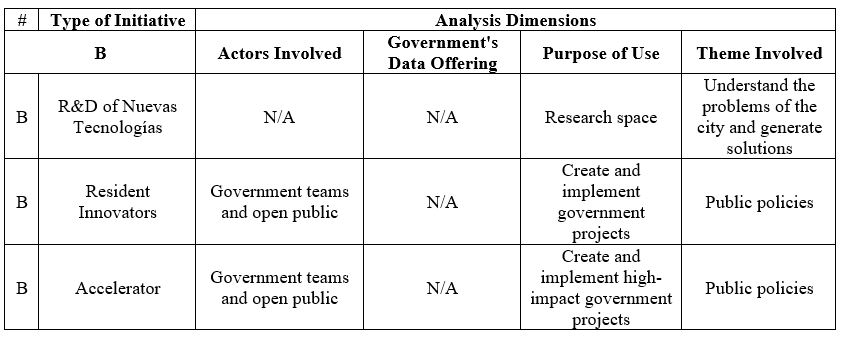
Source: Prepared by the authors, with data from Bonina (2015) and Patiño (2014).
Finally, the third type of initiative analyzed was the applications. You can view the analysis dimensions in the table below.
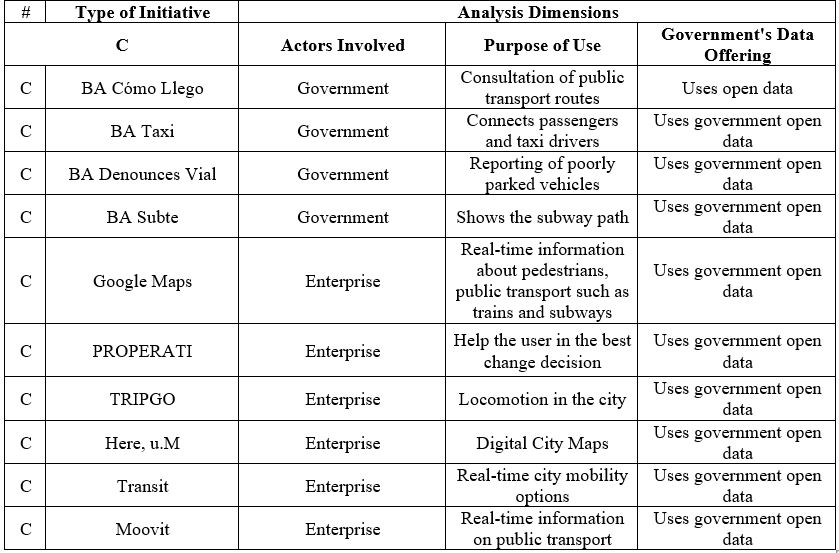
Source: Prepared by the authors, with data from the City of Buenos Aires (2020).
In this category, we find mobile applications built by the City Hall and companies, which use open government data from the Buenos Aires Data portal. It is interesting to understand how the availability of such data is used in these applications for daily use, facilitating daily life in urban mobility technologies. In the case of government initiatives, we have applications on real-time public transport information, the public's connection with taxi drivers, and even reports of poorly parked vehicles. On the part of companies, many of these applications are best known among users, such as Moovit and Google Maps, who use real-time transportation information and geographic information, useful for mobility in the city.
RESULTS OBTAINED FOR CASE 2: RIO DE JANEIRO
Rio de Janeiro is one of the economic, cultural and financial centers of Brazil. The policy of open data in the city begins in October 2001, during the government of Mayor Cesar Maia (2001-2009), with the launch of the first open data portal, the Data Warehouse, with a very innovative model for the time. It obtained about 4,000 monthly accesses (Imagem, 2018), offering statistical information on the city's geographic, a pioneering project of the Pereira Passos Institute (IPP), an organ of the City of Rio de Janeiro.
In 2004, PortalGeo was launched, the first geographic data portal at the municipal level, with dynamic maps. Then, specific for children and adolescents, The Data Store is launched in 2008, focused on the public education network. In 2010, during the government of Eduardo Paes (2009-2017), in partnership with the Department of Finance and Department of Urbanism, CadTec (Multifinalitário Technical Registry) is presented. A few years later, in 2013, the Rio de Excellence Project took place, with financial support from World Bank resources, aiming at social governance and monitoring and evaluation of public policies, innovations in the provision of public services, the new data warehouse (Imagem, 2018).
The following year in 2014, the Open Data Portal, an updated version of the Data Warehouse is created, together with the Municipal Urban Information System (SIURB), a geographic information system that allows users to access a wide variety of databases, as well as information analysis and dissemination tools. Finally, in 2017, the DATA portal is born. River (data.rio).
In legal matters, in the City Hall of Rio, the Law on Access to Information (LAI) is regulated through Rio Decree No. 44,745/2018 (RIO Decree No. 44,745, July 18, 2018, 2018), which also consolidated and repealed previous legislation, valid for all municipal agencies and entities.
With the creation of the DATA portal. In Rio, the publication of open government data was institutionalized in a way that promised more technology, agile and interactive information, with a new model of planning, integration, management and dissemination of information (Imagem, 2018). The main features of the portal are: use of the CKAN platform; has 1,077 data, of which 56 of these are transport; and there is no information on what would be its latest updated version.
Your software infrastructure works through three platform levels (Image, 2018). The first level is the SIURB work platform, portal for ArcGIS, a map-centric content management system that the organization can use the web geographic information system (GIS) portal concept in its infrastructure. The second level is the DATA work platform. Rio, ArcGIS Online, a cloud-based analysis and mapping solution. Finally, the last level is the public collaboration platform, ArcGIS Hub, a cloud-based engagement platform that enables organizations to communicate effectively (https://developers.arcgis.com/documentation/mapping-apis-and-services, retrieved September 24, 2020)
Analyzing the portal, you can see that it is a platform with content in addition to open data. In total, the DATA. Rio has more than 3,100 content types, such as open data, spreadsheets, applications, and documents. As verified in the analysis of the Buenos Aires portal, DATA. Rio also did not present any significant problems or any incidents with the site, in an initial preparatory experience, of general navigation through its pages. In addition, the platform has information about the city of Rio de Janeiro, geographical, historical characteristics, and curiosity, among others. It also has publications studies, official reports, technical notes, and theses. It has information about the budget of the city, population and households, and indexes, among others. Regarding the theme of data in general, these are present in different categories, such as territory and environment, health, culture, population, economy, tourism, education, transportation and the like. Open urban mobility data contain historical information data from previous years, from 1960 to 2019, such as the flow of passengers on public transport, the evolution of the extension of bicycle paths, daily or annual performance indicators, movement of loads and direction of navigation, passengers transported, among others.
Evaluation of the opening of mobility data in Rio de Janeiro
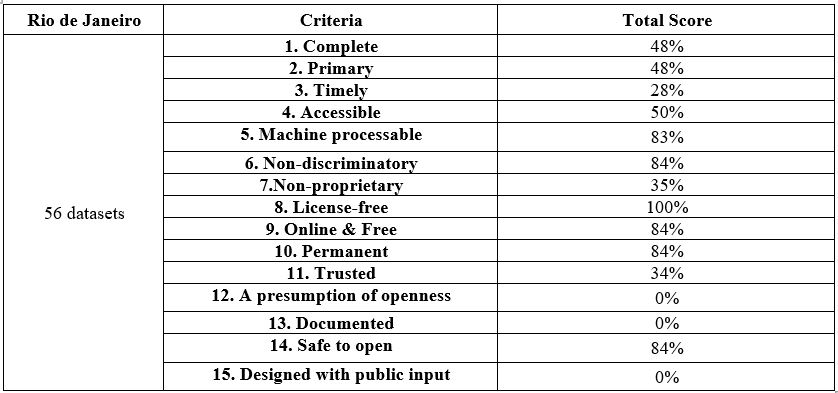
The evaluation of the open data in the city of Rio de Janeiro, through the Evaluation Scale (Chart 5), was carried out based on the 56 mobility data that the DATA portal. Rio offers. In Chart 9, you can view the summary of this analysis after calculating the Total Score equation.
Source: Prepared by the authors.
Through the analysis, there is an incompleteness of the data, and many of them presented problems regarding the possibility of downloading. There were several situations during the inspection, in which the data were totally incomplete, obtaining a zero score in each of the criteria.
Regarding data refresh, there is little information. It is not possible to know the date of creation of the data, nor its frequency of updating, being only informed the date of the last update, which makes it difficult to analyze in relation to this criterion.
There is also data in non-proprietary formats, such as WMS, GeoService, GeoJSON, SHP, KML, used for simple or spatial geographic data. However, there is a lot of data in proprietary formats such as XLSX and PDF, those that have difficulty being exported and processed by machines. Data using the API interface has its non-proprietary formats and is generally used in geographic or spatial representations, but errors in the functioning of this data have been found.
In addition, other criteria were positive, such as the use of free licenses, gratuity, permanence and security to be opened. The rest of the criteria, such as the documentation of registration and meaning throughout its publication, presumption of openness, reliability, and public participation obtained a reduced score.
Mobility data opening initiatives in Rio de Janeiro
In the city of Rio de Janeiro, based on the Open Data Initiatives Categorization Model (Chart 4), we identified the following initiatives, according to the three main categories.
"Events" was the first category most found in the municipality as an incitive of open data. In this, we noticed that there was an edition of hackathon encouraged by the Citizen Service Center, open to the public, with theme of solving problems related to infrastructure and mobility. In relation to competitions focused on application development, there were two editions of Rio Apps, having as main actors the government and the open public. There was also another type of government contest, Rio Ideias, which sought everyday solutions for residents and visitors, with more than 5,000 ideas entered.
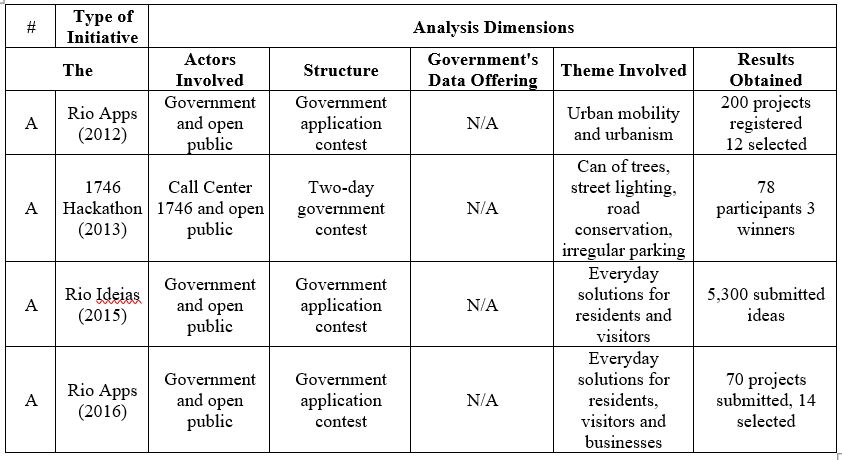
Source: Prepared by the authors, partially using data from the City of Rio de Janeiro (2020).
The second category analyzed was living labs. In this case stands out the Rio Operations Center (COR), inaugurated in 2010, and responsible for the integration and monitoring of urban operations of 30 government agencies, in addition to utilities, in order to manage risks of events such as floods, landslides and accidents, and proposing solutions. The creation of COR was part of the preparations for the 2016 Olympic Games: during the games, the Integrated Center for Urban Mobility (CIMU) operated there, which monitored the city's transport system (http://cor.rio/institucional, retrieved on September 26, 2020).
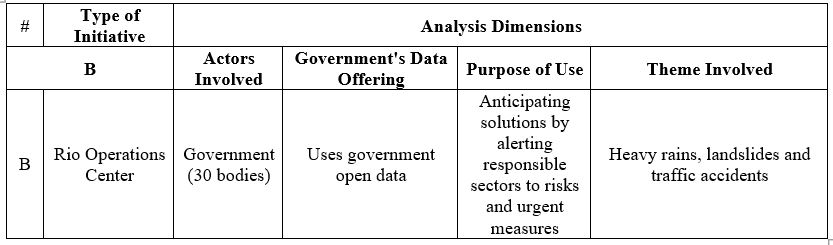
Source: Prepared by the authors, partially using data from the City of Rio de Janeiro (2020).
The third type of category analyzed were applications. You can view the analysis dimensions in table 12.
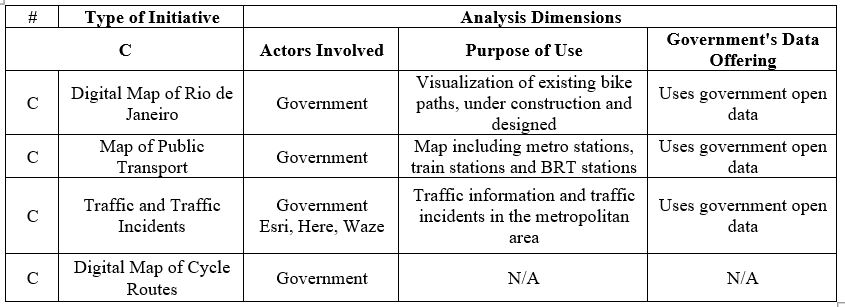
Source: Prepared by the authors, partially using data from the City of Rio de Janeiro (2020).
In the case of applications, we found four of these related to urban mobility, such as the visualization of existing bike lanes, public transport map, traffic information and traffic incidents. However, they are not mobile applications, but are available on the web, and when accessing them, the Digital Map of Cycle Routes presents malfunction and Traffic and Traffic Incidents asks the registration for its operation.
COMPARATIVE ANALYSIS AND DISCUSSION OF CASES
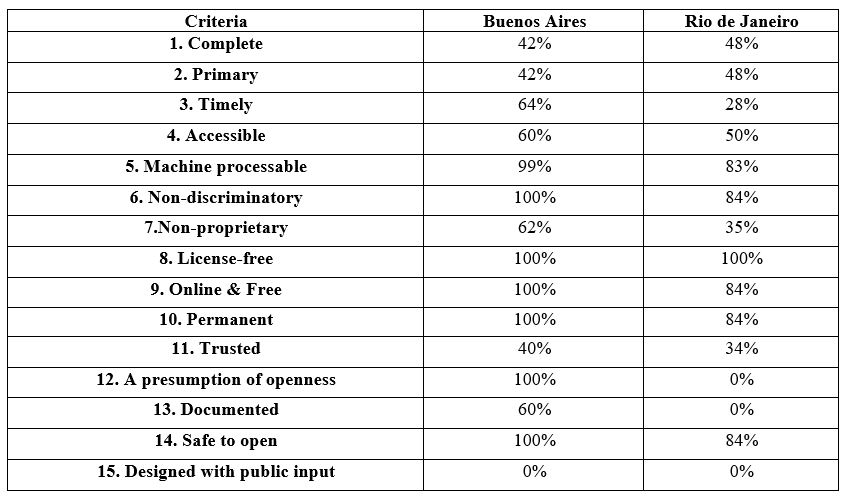
After presenting the results of each of the cases, we can make a comparison between them to verify common and divergent points. Through the Open Data Assessment Scale, you can notice some relevant points in each municipality. In the case of Buenos Aires, the Buenos Aires Data portal was very adherent to the principles of open government data recommended by Tim O'Reilly and Carl Malamud, as systematized, for example, by Santos (2017), and this portal is free of license and updated. On the other hand, the open data available reveal a greater accumulation of efforts in data related to the daily life of urban mobility, such as traffic light control, traffic sensors, public transport information, and others. Using as criteria the principles of open data systematized by Santos (2017), we realize that these are mostly current, accessible, machine-compatible, non-discriminatory, non-proprietary, free of license, free and online, permanent, with presumption of openness, documented and safe to be opened, which indicates the fulfillment of most of the 15 principles prescribed by the literature There are however some that obtained a low score (less than half of the maximum action point of the analytical model), indicating a limited degree of care, such as completeness, primacy, reliability and design together with the public.
In the case of Rio de Janeiro, the DATA portal. Rio is license-free and up to date, following the principles of open government data. The data opened in this case focused on historical information data from previous years, such as the evolution of the length of bike lanes, daily or annual performance indicators of public transport, among others. Among the principles of open data (Santos, 2017), these data were mostly accessible, understandable by machines, non-discriminatory, free of license, free and online, permanent, and safe to open. The criteria that obtained less than half of the maximum score is completeness, primary, current, non-proprietary, reliable, with presumption of openness, documented and designed together with public input.
In the table below, we can see a comparative summary of the evaluation of open data in each city, for each of the open data principles listed by Santos (2017).
Source: Prepared by the authors.
With regard to the principles of government data opened in both cities, some points can be highlighted, such as the similarity of performance in the criteria: complete and primary data, understandable by machines, non-discriminatory, with free, free and online and permanent licenses. There was a disparity in updating the data, a criterion in which Buenos Aires presented a score of 64% and Rio de Janeiro of 28%, which may be justifiable, however, because the first city has more real-time daily mobility data, which must always be up to date, while the second has historical data for a long period of time, in simpler proprietary format, such as . XLSX, which would not necessarily need constant updating.
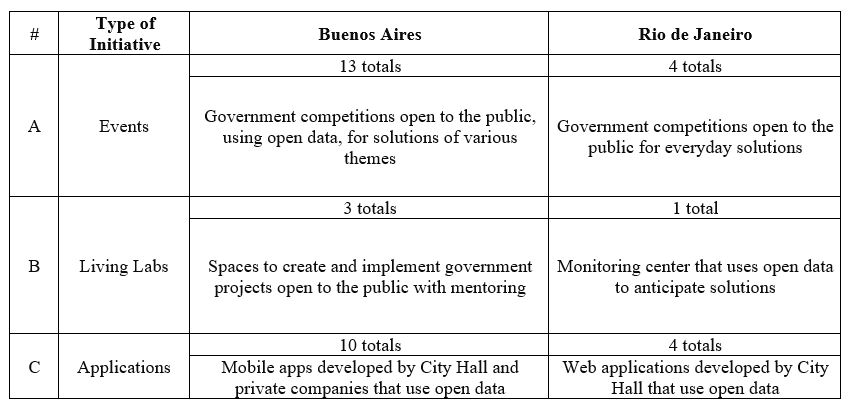
In relation to the initiatives, through the Categorization Model of Open Data Initiatives, we can evaluate some aspects. Table 14 shows a summary of what we find in terms of the efforts of each metropolis in types of initiatives present in literature: events (Simonofski et al., 2020; Santos, 2017); living labs (Santos, 2017), and application development (Attard et al., 2015).
Source: Prepared by the authors.
The open data initiatives in the case of Buenos Aires were largely in the category "events", described in the literature by Simonofski et al. (2020) and by Santos (2017): this is the case of government tenders that used open government data to solve the city's problems, involving the open public, civil servants, companies, entrepreneurs and specialists. Another category highlighted the "applications" (Allard et al., 2015), developed by the City Hall or by private companies, which work on mobile devices based on the open data offered.
In the case of open data initiatives in Rio de Janeiro, these occurred mostly in the "events" category, such as government tenders for the development of ideas or applications of resolutions for everyday life, which involved the open public and the government, but it was not possible to identify whether open government data were used. Another featured initiative is the category "applications", these developed by the City Hall, operating on the Web, using government data, one of them in partnership with private companies.
We can also affirm, with the data in Chart 14, that there was a greater number of open data initiatives found in Buenos Aires compared to Rio de Janeiro. Thus, it is possible to say that there is in the first case, greater incentive of the government to society for open data actions and a continuity of this policy.
In view of the above, despite the similarities found, in each case addressed here there is a greater concentration of efforts in certain criteria, dimensions and open data initiatives. However, it is possible to compare some aspects. Regarding the existence of open government policies, the city of Buenos Aires shows a more active and continuous policy since its creation in 2012, while Rio de Janeiro has a historical policy of open data since 2001, but that was weakened in the 2017-2020 administration. The lack of available information or errors with sites and portals of the City Hall is one of the aspects that shows this effect.
FINAL CONSIDERATIONS
This research aimed to identify and interpret strategies for the use and availability of open data on urban mobility in the Latin American metropolises of Buenos Aires and Rio de Janeiro. To achieve this purpose, we employ the concepts of transparency, open government and open government data, using an Open Data Assessment Scale produced from the Open Data Principles and the Open Data Initiatives Categorization Model for case analysis. In addition to discussing the experiences of opening mobility data in two metropolises, the contribution of the article consisted in developing an analytical model for this, based on the literature of strategies and instruments for opening government data, with emphasis on Berners-lee's Five Star Model (Summers, 2010) and the 15 Open Data Principles of Opengovdata (Santos, 2017).
Other works (such as Matheus et al., 2018; Matheus et al., 2016; Klein et al., 2015), had already produced similar models for evaluation of data opening in other sectors of governmental activity, but the development of a specific model for mobility and transport data is an original contribution of this article.
The metropolis of Buenos Aires has shown an active and continuous policy of open data since 2012, involving a greater incentive of public administration to society for actions and continuity of this policy. The Buenos Aires Data portal adheres to the principles of open data, with more current data, available and in non-proprietary formats, and has more than 20 types of initiatives to open different data found.
The city of Rio de Janeiro had its open data policy weakened in the 2017-2020 administration. The DATA portal. Rio has a gap of available information and errors with city websites, its data are less current and in proprietary formats, having nine different types of initiatives found.
It was possible to identify that the policies for opening government data on urban mobility adopted by the two municipal governments share some degree of similarity in the instruments and strategies adopted. The adoption of instruments and strategies of the same nature may indicate the possibility of their prevalence in other municipal governments in Latin America, configuring a basic portfolio of instruments and strategies shared by different municipalities. Further investigations may verify this hypothesis, which is plausible by the data collected and by an initial observation, unstructured of the actions of other municipal governments.
However, although they present similarities in the instruments and strategies adopted, the two cases examined here are not comparable in their entirety, since there are different approaches to open government data in each of them. These differences are related to the objectives of government policy, the use of applications and tools such as open data portals, data offering standards and the implementation of initiatives to promote the use of open data.
This research did not aim to investigate the genesis of these differences, nor to understand the determining factors or to analyze their degree of contribution in both cases. However, the results in both municipalities have relationships of trajectory dependence with the evolution of institutional and political characteristics of their context.
The deepening of these trajectories and causalities may be the object of further research, with case studies in greater depth on each of the municipalities and, eventually, with the inclusion of new cases. Differences between the strategies and actions of governmental and non-governmental actors; previous accumulations in information technology and transparency policies; pressures from the local political context; and role of municipal bureaucracies are central variables that seem to influence the adoption of strategies and instruments in government mobility data opening policies and, as such, deserve to be investigated.
Since striking similarities were found in cases from two different countries in Latin America, it is concluded that the present study can be continued, maintaining the same objectives and methods, for other municipalities. With this, a more enriched interpretive panorama can be built. For this, it will be important to overcome some limitations found in the realization of this study. Given the large volume of data to be analyzed, it was not possible to expand the number of cases studied or deepen the topics mentioned above, but the inclusion of new cases (cities) in the study would certainly bring more comprehensive insights, robust the study.
Therefore, it is suggested, for future studies, the application of the analysis model developed here to other metropolises, which may have results similar or not to those presented here for the cases of Buenos Aires and Rio de Janeiro. This replication to new cases can help address other studies or improvements in open data management, considering the particularities of each case involved. The increase in the number of cases, however, will certainly not involve a pure and simple reproduction of methodological procedures, since it will require (as already required in the two metropolises studied) the work with variable data sources according to the case examined.
Given that significant differences were found between the two cases, we can assume that the expansion to new cases could bring other differences, pointing to the idea that strategies for the use of open government mobility data tend to vary from place to place, and should be considered within their context.
REFERENCES
Agune, R. M., Gregorio, A. S. Filho, Bolliger, S. P. (2010). Governo aberto SP: disponibilização de bases de dados e informações em formato aberto. Anais do Congresso Consad de Gestão Pública, Brasil, 3. Recuperado em 10 de 2022, https://www.prefeitura.sp.gov.br/cidade/secretarias/upload/controladoria_geral/arquivos/C3_TP_GOVERNO%20ABERTO%20SP%20DISPONIBILIZACAO%20DE%20BASES%20DE%20DADOS.pdf
Aifadopoulou, G., Salanova, J., Tzenos, P., Stamos, I., Mitsakis, E. (2018). Big and open data supporting sustainable mobility in smart cities: the case of Thessaloniki. The 4th Conference on Sustainable Urban Mobility, 386-393.
Attard, J., Orlandi, F., Scerri, S., Auer, S. (2015). A systematic review of open government data initiatives. Government Information Quarterly, 32(4), 399-418.
Bertoche, U. S. P. (2016). Sistema de Apoio à Mobilidade Urbana com Dados Abertos. Trabalho de conclusão de curso. Escola de Informática da Universidade Federal do Estado do Rio de Janeiro, Rio de Janeiro, Brasil. Recuperado em 10 de agosto de 2022 de https://bsi.uniriotec.br/wp-content/uploads/sites/31/2020/05/201612UrielBertoche.pdf
Bonina, C. (2015). Co-creación, innovación y datos abiertos en ciudades de América Latina: lecciones de Buenos Aires, Ciudad de México y Montevideo. 2015 Open Data Research Symposium. Recuperado em 10 de agosto de 2022 de http://riga.idatosabiertos.org/papers/co-creacion-innovacion-y-datos-abiertos-en-ciudades-de-america-latina-lecciones-de-buenos-aires-ciudad-de-mexico-y-montevideo.html
Cgi.br. (2011). Manual dos dados abertos: governo. Recuperado em 10 de agosto de 2022 de http://www.governoaberto.sp.gov.br/wp-content/uploads/2016/02/Manual_Dados_Abertos_WEB.pdf
Day, S., Rennie, S., Luo, D., Tucker, J. (2020). Open to the public: paywalls and the public rationale for open access medical research publishing. Research involvement and engagement, 6(1), 1-7.
Decreto 478, 6 de diciembre de 2013. (2013). Gobierno de la Ciudad Autónoma de Buenos Aires.
Decreto RIO nº 44.745, 18 de julho de 2018. (2018). Prefeitura do Rio de Janeiro.
Fumega, S. (2014). Opening cities: open data in Buenos Aires, Montevideo and Sao Paulo; report-city of Buenos Aires, Open Government Data initiative. IRCD Montreal. Recuperado em 10 de agosto de 2022 de http://hdl.handle.net/10625/55359.
Geiger, C. P., Von Lucke, J. (2012). Open government and (linked)(open)(government)(data). JeDEM-eJournal of eDemocracy and open Government, 4(2), 265-278.
Hartley, J. (2005). Creative industries: Hoboken: Blackwell Publishing Ltd.
Imagem. (2020, dezembro 9). Caso de Sucesso: Open Data na cidade do Rio de Janeiro - EU Esri 2018 [Video File]. Video posted to https://www.youtube.com/watch?v=ztceqLYjQSY&feature=emb_title
Klein, R., Luciano, E., Macadar, M. (2015). Grau de transparência de dados abertos governamentais do site dados.rs.gov.br. Revista Economia & Gestão, 15(41), 256-285.
Ley n° 104, 15 de diciembre de 2016. (2016). Ministerio de Gobierno.
Matheus, R., Ribeiro, M., Vaz, J. (2018). Strategies and instruments for the dissemination and promotion of open government data use in Brazil: case study of Rio de Janeiro city hall. Revista Tecnologia e Sociedade, 14(33), 172-189.
Matheus, R., Rodrigues, D., Vaz, J., Jayo, M. (2016). Análise do nível de abertura de dados governamentais da área do trânsito no Brasil. Revista Eletrônica de Sistemas de Informação, 15. doi:10.21529/RESI.2016.1502004e
Oliveira, E., Marques, R. (2019). Diagnóstico de dispensas de licitações em Minas Gerais: uma análise fundamentada nos dados do portal Minas Transparente. Ciência da Informação, 48(1), 130-149.
Patiño, A. (2014). Datos abiertos y ciudades inteligentes en América Latina: estudio de casos. Santiago: CEPAL. Recuperado em 10 de agosto de 2022 de https://www.bivica.org/file/view/id/4746.
Pires, M. (2015). Guia de Dados Abertos. Recuperado em 10 de agosto de 2022 de https://www.nic.br/media/docs/publicacoes/13/Guia_Dados_Abertos.pdf
Santos, A. S. (2017). Dados governamentais abertos, mobilidade urbana e laboratórios vivos (Living labs): um estudo a partir da experiência do MobiLab no município de São Paulo. Dissertação (mestrado em Gestão de Políticas Públicas) Universidade de São Paulo.
Simonofski, A., de Sousa, V., Clarinval, A., Vanderose, B. (2020). Participation in Hackathons: A Multi-Methods View on Motivators, Demotivators and Citizen Participation. International Conference on Research Challenges in Information Science, 229-246.
Stake, R. (1995). The art of case study research. Thousand Oaks: Sage Publications.
Summers, Ed (2010, jun. 4). The 5 stars of open linked data. Recuperado em 10 de agosto de 2022 de https://inkdroid.org/2010/06/04/the-5-stars-of-open-linked-data/.
Sunlight, F. (2013). Open Data Policy Guidelines. Recuperado em 10 de agosto de 2022 de https://sunlightfoundation.com/opendataguidelines/
Tunkelang, D. (2009). ACM Recommendations on Open Government. Recuperado em 10 de agosto de 2022 de https://thenoisychannel.com/2009/02/05/acm-recommendations-on-open-government/.
Vetrò, A., Canova, L., Torchiano, M., Minotas, C., Iemma, R., Morando, F. (2016). Open data quality measurement framework: Definition and application to Open Government Data. Government Information Quarterly, 33(2), 325-337.
Yadav, P., Hasan, S., Ojo, A., Curry, E. (2017). The role of open data in driving sustainable mobility in nine smart cities. 25th European Conference on Information Systems. Recuperado em 10 de agosto de 2022 de https://aisel.aisnet.org/ecis2017_rp/81.