Artigos

Esta obra está bajo una Licencia Creative Commons Atribución-NoComercial-SinDerivar 4.0 Internacional.
Recepción: 12 Octubre 2021
Aprobación: 18 Mayo 2022
Publicación: 17 Noviembre 2022
Abstract:
Objective: The aim of the article is to identify the types of innovations produced by public sector organizations in Ecuador during the first months of the COVID-19 pandemic.
Theoretical framework: The paper builds on systematic reviews of publications on public sector innovation to identify types of innovations, antecedents of organizations, both at the external and internal organizational levels, and outcomes of the innovations.
Methodology: The paper is exploratory in nature and mixes quantitative and qualitative data to characterize innovations. For this, an online survey questionnaire was sent to public servants to identify innovations, and a structured interview was then carried out to flesh out some of the details of the processes of innovation reported.
Results: Findings show that most innovations in the Ecuadorean public sector are top-down in nature, and relate to adopting technologies to support existing interventions. These technologies; however, go beyond those used for facilitating telework. Moreover, most innovations are produced in organizations perceived as centralized, where there is continuous support for innovation. The main finding of this research relates to the presence of specialized units within public sector organizations, which support innovation and help the development of interorganizational networks. This type of unit has been overlooked in the literature and require further investigation in regards to when and how they bridge between organizations to facilitate lasting innovations.
Originality: The article introduces a distinction between organizations that have direct or indirect interactions with clients or citizens which helps to take stock of the incentives they may have for innovating. The article then identifies the different types of innovations produced in public sector organizations when this substantive difference is taken into account.
Theoretical and practical contributions: The study offers support to findings made in other contexts, while also contributes with findings that add qualitative depth to the relationships between organizational characteristics, innovation processes, external factors and outcomes. It highlights the importance of supporting and strengthening the units specialized on innovation to make the most out of crises and structural reform.
Keywords: Innovation during the COVID-19 pandemic, Public sector organizations, External shocks, Public sector in Ecuador.
Resumen:
Objetivo: El objetivo del artículo es identificar los tipos de innovaciones producidas por las organizaciones del sector público en el Ecuador durante los primeros meses de la pandemia del COVID-19.
Marco teórico: el estudio se fundamenta en los resultados de revisiones sistemáticas de la literatura sobre innovación del sector público para identificar tipos de innovaciones, antecedentes de organizaciones, tanto a nivel organizacional externo como interno, y los resultados de las innovaciones.
Metodología: El documento es de naturaleza exploratoria y combina datos cuantitativos y cualitativos en el análisis. Para esto, se envió un cuestionario de encuesta en línea a servidores públicos para identificar las innovaciones, y luego se realizó una entrevista estructurada para conocer algunos de los detalles de los procesos de innovación.
Resultados: Los hallazgos muestran que la mayoría de las innovaciones en el sector público ecuatoriano son de naturaleza vertical y se relacionan con la adopción de tecnologías para apoyar las intervenciones existentes. Estas tecnologías, sin embargo, van más allá de aquellas utilizadas para facilitar el teletrabajo. La mayoría de las innovaciones se producen en organizaciones percibidas como centralizadas, donde existe un apoyo continuo a la innovación. El principal hallazgo de esta investigación se relaciona con la presencia de unidades especializadas dentro de las organizaciones del sector público, que apoyan la innovación y ayudan al desarrollo de redes interorganizacionales. Este tipo de unidad se ha pasado por alto en la literatura y requiere más investigación con respecto a cuándo y cómo se conectan entre organizaciones para facilitar innovaciones duraderas.
Originalidad: El artículo introduce una distinción entre organizaciones que tienen interacciones directas o indirectas con clientes o ciudadanos, lo que ayuda a evaluar los incentivos que pueden tener para innovar. Además, el artículo identifica los diferentes tipos de innovaciones que se producen en las organizaciones del sector público cuando se tiene en cuenta esta diferencia sustantiva.
Contribuciones teóricas y prácticas: El estudio ofrece sustento a hallazgos realizados en otros contextos, a la vez que aporta hallazgos que profundizan cualitativamente las relaciones entre características organizacionales, procesos de innovación, factores externos y resultados. Destaca la importancia de apoyar y fortalecer las unidades especializadas en innovación para aprovechar al máximo las crisis y la reforma estructural.
Palabras clave: Innovación durante la pandemia por la COVID-19, Organizaciones del sector público, Sector público del Ecuador.
Resumo:
Objetivo: O objetivo do artigo é identificar os tipos de inovações produzidas por organizações do setor público no Equador durante os primeiros meses da pandemia de COVID-19.
Enquadramento teórico: o estudo se baseia nos resultados de revisões sistemáticas da literatura sobre inovação no setor público para identificar tipos de inovações, antecedentes das organizações, tanto no nível organizacional externo quanto interno, e os resultados das inovações.
Metodologia: O artigo é de natureza exploratória e combina dados quantitativos e qualitativos na análise. Para isso, foi enviado um questionário de pesquisa online aos servidores públicos para identificar as inovações e, em seguida, foi realizada uma entrevista estruturada para conhecer alguns detalhes dos processos de inovação.
Resultados: Os resultados mostram que a maioria das inovações no setor público equatoriano é de natureza vertical e se relaciona com a adoção de tecnologias para apoiar as intervenções existentes. Essas tecnologias, no entanto, vão além daquelas utilizadas para facilitar o teletrabalho. A maioria das inovações ocorre em organizações percebidas como centralizadas, nas quais há suporte contínuo para a inovação. O principal achado desta pesquisa está relacionado à presença de unidades especializadas dentro das organizações do setor público, que apoiam a inovação e auxiliam no desenvolvimento de redes interorganizacionais. Esse tipo de impulso foi negligenciado na literatura e requer mais pesquisas sobre quando e como eles se conectam entre as organizações para facilitar inovações duradouras.
Originalidade: O artigo introduz uma distinção entre organizações que têm interações diretas ou indiretas com clientes ou cidadãos, o que ajuda a avaliar os incentivos que podem ter para inovar. Além disso, o artigo identifica os diferentes tipos de inovações que ocorrem nas organizações do setor público quando se leva em conta essa diferença substantiva.
Contribuições teóricas e práticas: O estudo oferece suporte a constatações feitas em outros contextos, ao mesmo tempo em que traz achados que aprofundam qualitativamente as relações entre características organizacionais, processos de inovação, fatores externos e resultados. Destaca a importância de apoiar e fortalecer unidades de inovação especializadas para aproveitar ao máximo as crises e a reforma estrutural.
Palavras-chave: Inovação durante a pandemia de COVID-19, Organizações do setor público, Setor público do Equador.
Introduction
In his book on Epidemics and Society, historian Frank Snowden (2019) argues that infectious diseases have shaped social change in no less powerful ways than have wars and economic crises. The pandemic caused by the quick spread of the virus SARS-CoV-2 since late 2019 is definitely shaping contemporary societies. There is no doubt that economic performance and labor relations, as well as community bonds, have been deeply impacted by this pandemic. By December 21, 2020, nearly 77 million cases have been registered worldwide (Elflein, 2020) and the United Nations reports regressions in the advances achieved by economic and social policies made in recent years, especially in the poorest countries (United Nations et al., 2020). In addition, telework has re-shaped labor dynamics in several industries (Eyméoud et al., 2021), and communities have devised new means to maintain cohesion and to create new forms of solidarity and reciprocity (Córdoba, Peredo, . Chávez, 2021). The effects of the pandemic have been widespread and deep but the study of how the public sector responds to the rising challenges is just beginning.
The COVID-19 pandemic has put public administrative systems under duress as they had to react quickly to strengthen the capacity of the health systems, secure the distribution of food, re-organize education, offer security, and organize elections, among many other sectorial and inter-sectorial tasks (Capano et al., 2020). It is due to its widespread impact across sectors and levels of government that the current pandemic offers an important opportunity to deepen our understanding of how innovation is produced in the public sector. The literatures on institutional change (Lowndes & Roberts, 2013; Scott, 2010; Scott, 2014) and organizational innovation (Brown & Osborne, 2013; OECD, 2015; Windrum & Koch, 2008) have pointed out at the important role of shocks and fast changing environments for creating opportunities for change through diverse pathways. They include entrepreneurs, additional resources (ideas, information, political support, among others), and challenges to stablished ways of thinking and delivering services. Understanding the types of innovations produced in times of crisis and the prospects for their institutionalization is particularly important for developing countries, which in some cases fared better than expected but still are at the risk of regressing in some important indicators that contribute to the welfare of their populations and the accomplishment of the Sustainable Development Goals (BID, 2020; CEPAL & Naciones Unidas, 2020).
This paper presents the results of an exploratory study of innovation in the public sector of Ecuador during the first months of the COVID-19 pandemic (March-September 2020). The aim of the research is to identify the types of innovations produced by public sector organizations. The paper is structured into five sections. In section 1, it discusses some fundamental concepts. It departs from an overview of how crisis opens opportunities for organizational and policy changes. This discussion is complemented with a review of current research on the factors that influence innovation in the public sector. Section 2 presents the methods used for data gathering and interpretation. A standardized survey questionnaire and structured interviews were employed to gather data on innovations produced during the early phases of the state of emergency declared in Ecuador. In addition, an inductive approach was used to examine a subset of innovations to understand the antecedents, as well as its most immediate outcomes, and the perceived challenges to their institutionalization. Section 3 presents the results obtained from the survey and the interviews. Section 4 discusses the findings and some of the limitations of the study and identifies avenues for future research on the topic of interest. Finally, section 5 presents the conclusion and brings the paper to a close.
1 Theory: Organizations and innovation in the public sector
Research on organizations has shown multiple paths to organizational change. One of such paths is triggered by major disruptions such as economic or political crises, that cause punctuations on the organization’s trajectory (Aldrich & Ruef, 2006; Wischnevsky & Damanpour, 2005). However, crisis or periods of fast change do not always lead to revolutionary changes or large punctuations, besides, they can precipitate incremental changes with years in the making (Windrum & Koch, 2008). In both cases, crises open opportunities for organizations, and entrepreneurs in particular to produce innovations that challenge the status quo or take advantage of emerging opportunities. By making resources available, crisis create conditions for organizations to adopt new processes, make investments, hire personnel, etc (Brown & Osborne, 2013; Stewart‐Weeks & Kastelle, 2015).
Organizations face challenges to adapt to changing contexts due to power imbalances, competing agendas, and institutional rigidities (Andrenacci, 2020; Arellano Gault, 2010). Thus, not all organizations respond in an equal manner to the opportunities and challenges created by external events such as a pandemic that alters the priorities of governments and citizens and changes the availability of resources. Some organizations are better equipped to capitalize opportunities for change than others, and some face more acute pressures for change. For example, some organizations may lack policy entrepreneurs who can frame and mobilize support for change (Schneider et al., 1995). On the other hand, others may be considered priority for the government thus receiving more political support and other critical policy resources (Aucoin, 1986).
Traditionally, the study of innovation in the public sector has been approached from the perspective of governments being either an obstacle or promoters of innovation according to Lewis, Considine, and Alexander (2011). Several factors have been highlighted in the literature as the main contributors to relative lack of innovation in the public sector, among them, the complexity of the decision-making environment vis-à-vis that of the private sector, uncertainty of outcomes and conservative biases (Crosby, t’ Hart, & Torfing, 2016; Tan, 2004). The issue of how innovation inside governments works has received less scholarly attention until very recently (Considine, Lewis, & Alexander, 2009; Vries, Bekkers, & Tummers, 2015). Some of the central issues in the emerging scholarship related to innovations in the public sector are: the antecedents and factors that promote innovations, the type and roles of the actors involved, the effects of innovation in the production of public value and how these relate to different types of innovations (Vries et al., 2015).
The literature on innovation in the public sector in Latin America is scarce (Argothy Almeida & González Alvárez, 2020; Navarro, 2017). However, some have taken to the task of identifying factors that influence the production of different types of innovation in governmental organizations. These distinguish between the internal and external factors. However, before presenting these factors, it is important to clarify one aspect often lacking in most innovation studies, the dependent variable (Vries et al., 2015).
In their systematic review of the literature on innovation in the public sector, Vries et al. (2015) argue that most studies do not provide a definition of innovation. Brown and Osborne (2013), as well as many others dating back to Schumpeter, recommend distinguishing between innovations as a specific discontinuous type of change instead of an expression of marginal changes. Influential definitions of innovation derived from the business environment often argue that only significant changes from previous products or processes are innovations (OECD/Eurostat, 2018); however, this is not consistent with the types of innovations reported in multiple studies of the public sector where certain types of innovations, such as those related to administrative processes and product or service innovations often fall into the realm of incremental change (Halvorsen, Hauknes, Miles, & Røste, 2005). In this line, Norman and Verganti (2014) argue for a dualistic understanding of (product) innovations where marginal changes are critical to push a design upwards on the quality slope within a design space and radical innovations (often associated with changes in technology) push a design to a different design space.
Moreover, as Martínez Navarro (2018) points out, public innovation and innovation in the public sector are two different things. The first one involves the interaction between public sector organizations and networks with the citizens, often in problem-oriented forums (Martínez Navarro, 2018). On the other hand, the latter refers to the initiatives within the state apparatus to introduce changes in response to external factors or policy requirements, and it is the kind that this study focuses on.
Based on elements taken from Hagedoorn (1996) and Considine et al. (2009), we adopt the less stringent definition of innovation in the public sector as the implementation of an idea that allows action over a problem generating public value. This broader definition adopted in this paper captures the wide variety of changes produced by governments in response to the COVID-19 pandemic seen around the world (Mintrom & O’Connor, 2020; Moshe & Howlett, 2020).
The working definition has other advantages. It follows the argument advanced by Kastelle and Steen (2011) about the need to think of innovations beyond invention and to center the discussion on implementation. It also allows researchers to capture marginal or incremental changes and larger changes within governmental organizations that are tilted towards outcomes; therefore, discarding changes whose effects are yet to be known; such as modifications to mandates or regulations not yet implemented but intended to produce innovation. In this line, understanding the factors that are associated with facilitating the process of innovation could inform their systematic management and larger innovation policies (Arundel, Bloch, & Ferguson, 2019).
Drawing from Vries et al. (2019), we use a classification for innovation types that includes new processes, administrative process, process-technology innovations, new services, governance and conceptual innovations. Respectively, these types of innovation are concerned with the improvement of quality and efficiency of internal and external processes, the creation of new organizational forms, the introduction of management methods, techniques and working methods, the creation or use of new technologies, introduced in an organization to render services to users and citizens, the creation of new public services or products, development of new forms and processes to address specific societal problems, and the introduction of new concepts, frames of reference or new paradigms that help to reframe the nature of specific problems as well as their possible solutions.
Research on the factors involved in the production of innovations takes a property approach in which variance of the association between variables is used to explain differences across organizational properties (Scott, 2010). Research on the internal factors focuses on the attributes of public organizations such as the organizational structure, and leadership as sources of innovation. Findings regarding the characteristics of the organizational structure on innovation are mixed. Some authors report that excessive hierarchization inhibits innovation (Laegrid, Roness & Verhoest, 2011), while others report that centralized decision-making supports innovation (Palmer & Dumford, 2001).
There is more convergence on the issue of strategies that support innovation, such as incentives and rewards, as elements that reduce risk aversion creating a more innovative organization (Cinar, Trott, & Simms, 2018). In the same line, Considine et al. (2009) highlight the positive role that units with innovation skills and resources can have in the production of incentives to innovate. Findings on the association between leadership and innovation are also mixed, and definitions and operationalizations of the independent variables are myriad. However, the meta-analysis conducted by da Costa et al. (2014) shows that supportive and transformative leadership contribute to innovation.
Among the external drivers, the most often considered in existing studies include the political and legal environment, demographic and social factors, technology, economic factors and changes in budgets, and external networks (Argothy Almeida & González Alvárez, 2020). Data availability allows us to consider only some of these factors in the present study.
Governments influence the environment for organizations to produce innovations in many ways. Among many others, governments promote ideas that change the cognitive policy landscape for organizations and they can impose priorities or moderate political influence to allow for greater autonomy (Stewart-Weeks & Kastelle, 2015). The most relevant aspect of the influence of government decisions for this study is the level of priority the organization had during the pandemic. High-levels of priority can be associated with the allocation of resources such as information and financial support which are key to produce innovations (Cinar et al., 2018).
Demographic changes generate innovations via shifts in the values and preferences of individuals that influence markets (Argothy Almeida & González Alvárez, 2020). However, due to the relatively short time-span considered for this study, demographic changes are not considered a relevant factor.
Social initiatives can also perform as sources of innovation in public organizations. We expect to capture social inputs by differentiating between organizations that provide goods and services directly to clients from those who do not. Organizations providing goods and services directly should exhibit more innovation that other providing services indirectly. The difference lies in presence of middle-management and frontline workers that bring up ideas that may complement those at the top-management level (Argothy Almeida & González Alvárez, 2020). Therefore, using the top-down vs. bottom-up dichotomy to categorize the origin of the innovation should broadly capture several aspects in which frontline workers and middle management positions impact innovations. Among these are; their relative autonomy, motivation, socio-emotional climate, and organizational climate, which are also regarded in some studies as relevant internal factors (Argothy Almeida & González Alvárez, 2020; da Costa et al., 2014).
Finally, we consider the formation of external networks as a potential source of additional resources that directly or indirectly impact the production of innovations in public sector organizations. Among others, networks make political resources such as information, ideas, money, or forums available for creating and adopting practices or developing blueprints for products or services (Considine et al., 2009; Koschatzky, Kulicke, & Zenker, 2001). The expectation is to find the presence of collaboration within networks in less decentralized organizations (Schoen et al., 2014).
In terms of the outcomes of innovations, the systematic review by Vries et al. (2015, pp. 159-160) reports that most studies do not identify outcomes of public sector innovation. Those that do, report on effectiveness (increased and decreased effectiveness), increased efficiency, involving private partners or citizens, and increasing customer satisfaction. Some studies even report the alignment of outcomes and goals, specially, increased effectiveness and efficiency. The relationship between organizational characteristics and innovation types is often reported as enabling of all innovation types. On the other hand, governance innovations are frequently connected to environmental antecedents. Finally, all the innovation types are most frequently reported in terms of the outcome of effectiveness, especially for process innovations.
In addition, McKelvey (2020) states that one of the most important and often overlooked and immediate effects of an innovation is the creation of a new problem that innovators must tackle to maintain effectiveness of their innovation. Innovations then are not single products that fix a problem. Instead they are made of several components which interaction produce ‘innovation stacks’.
2 Methods
This research used a mixed-methods approach to study innovations in the Ecuadorean public sector. The two-steps of the methodological design were implemented as follows. First, data of innovations was collected through an online standardized survey questionnaire directed at public and civil servants across sectors and levels of government[i]. The sample was obtained using a database of public servants available at the national public university that offers graduate degrees to public servants in Ecuador since 2010. These registers were merged and verified, containing approximately 8000 valid email addresses. Mass emails were sent in waves to these addresses between April and July of 2020, receiving 403 valid responses. It must be noted that, this is not a random sample of public and civil servants, but one obtained using a snowball method. Respondents were asked to share the link to the survey with their contacts in the public sector which, as we report below, contributed to the concentration of innovations reported in few sectors. Thus, results cannot be generalized beyond the sample.
The online questionnaire and the structured interview were designed following the three themes of the systematic review conducted by Vries et al. (2015). Those themes include: innovation types, goals of innovation, antecedents of innovation, and outcomes of innovation. The online questionnaire asked respondents to identify their organization, indicate if there had been an innovation produced since the declaration of the pandemic by the government, describe the innovation in detail, identify who promoted the innovation, and indicate if they will be willing to participate in a structured interview. Responses were coded by one researcher using the categories presented in table 1. Summaries of this data are presented in section 3.
Second, an interview with a subset of the original respondents who agreed to participate (approximately 10%) was conducted by one researcher between November and December of 2020 by telephone. In some cases, the same innovation was reported more than once, only the first response was included in the subset of cases. Also, reports with missing data were excluded and others were taken out of the subset because the contact information provided by the respondent was not accurate. The final number of interviewees was 27.
In the interview, informants were asked to a) specify if the innovation had been generated in a unit within the organization or if it had an organization-wide origin; b) identify the number of people who work in the unit where the innovation was produced, c) indicate if there exists a specialized unit within the organization in charge of innovations, d) categorize the organization as centralized or decentralized, e) define if managers within the organization have a permanent role in innovation processes, f) indicate if at the time of the innovation the organization was a priority for the national government, g) identify the challenges that emerged to maintain the innovation, h) indicate if the innovation was produced with support from other organizations, i) identify the effects of the innovation in the organization, j) its effects on clients or beneficiaries, and k) if additional problems emerged with the adoption of innovation.
Figure 1 presents the complete list of the typologies used to categorize the innovations, their objectives and their outcomes. It also presents the internal and external factors considered in the analysis. The table also specifies if the measurement was made through the questionnaire for the complete dataset (CDS) or through the structured interview for the data sub-set (DSS). Finally, the references from which the scale of measurement was taken is specified in the last column of Table 1.
Categories used to code innovations
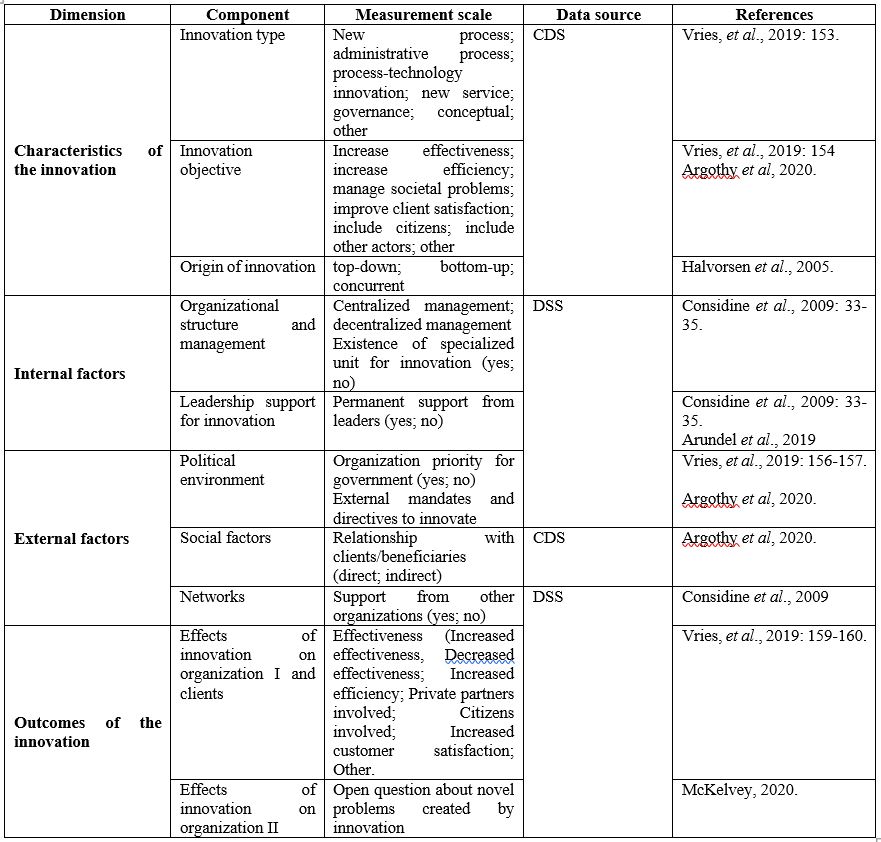
Two caveats must be taken into account before reading the results. The response rate to the mass emails was lower than 5%, which suggests that responses may only cover the tip of the innovation iceberg. Besides, only a handful of innovations were explored in-depth to investigate the relationships between internal and external factors and innovation antecedents and outcomes. Most of these innovations pertain to an even smaller subset of public organizations located at the national level and predominantly in the agricultural sector. This concentration suggests a potential self-selection bias by participants.
3 Results
The presentation of results is divided into three parts. The first part presents background information on the state of emergency declared in Ecuador to manage the COVID-19 pandemic. The second section summarizes the relationships between the reported innovations and the characteristics of the organization, the process by which the innovation was produced, and the goals of the innovation. The third part presents a summary of the dataset built from the interviews.
3.1 A State in disarray
In 2017, president Lenin Moreno launched reforms to the size and role of the to cut public spending and to service the external debt (Labarthe & Saint-Upéry, 2017; Wolff, 2018). Reforms reduced the number of ministries and other agencies through fusions and terminations and the public sector faced at least three waves of lay-offs, a hiring ban, and the reduction of salaries for those with temporary contracts. Local governments also struggled to receive resources from the national government to fulfill their obligations[ii]. In October of 2019, president Moreno announced further reforms aimed at reducing public spending, changing labor regulations, and creating tax incentives for foreign investment. These reforms were pursued in advance to seeking financial assistance from the International Monetary Fund (Frieiro & Sánchez, 2021).
It is against this backdrop of economic and political disarray that the first confirmed case of COVID-19 was reported in Ecuador in late February 2020. The decision of declaring a state of emergency was made public by the National Committee for Emergencies (COE) almost three weeks later, on March 13, when the number of confirmed cases reached 27. With this decision, the country came to a sudden halt as restrictions on mobility were imposed in most cities by local governments, and the national government enforced martial law. The number of cases grew rapidly and unevenly across the country. According to the COVID-19 database maintained by John Hopkins University (Dong, Du, & Gardner, 2020), the number of daily new confirmed cases of COVID-19 in Ecuador reached 427 in April 2020 (the excess mortality was up to 410%) when the survey was launched. By September 3rd, Ecuador reported 107.404 confirmed cases and 6.648 deceases. Chauca (2021) indicates that the public sector was largely overwhelmed by the social demands deepened by the pandemic.
3.2 Public sector innovations: types, organizational characteristics, external factors, processes and outcomes
Out of the 403 responses to the online survey, 285 (70%) respondents identified at least one innovation in their organization during the period under study. Nearly 20% reported their organizations did not produce innovations, and almost 10% reported not knowing whether their organization had done so.
Out of the total of relevant innovations reported[iii], only 74 (30%) are not related to the mandatory systemic-wide transition to remote work adopted by presidential decree on March 17 of 2020 or the adoption of biosecurity measures. The information presented below is extracted from the analysis of this sub-group that covers 51 different organizations from across sectors and levels of government.
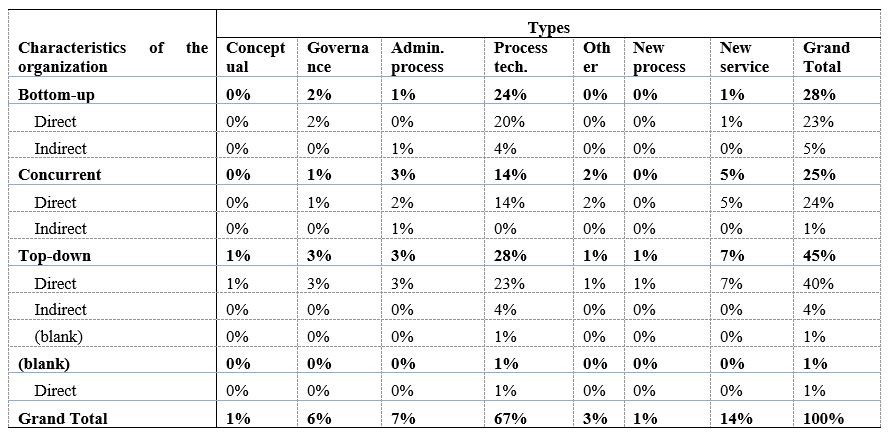
Table 2 shows that most public sector organizations (88.5%) report providing services directly to clients, while only 10.5% do it indirectly. Approximately 67% of the 84 innovations reported, were identified as process-technology innovations, which use new technologies to deliver services for users and citizens. This type of innovation was followed by new services (14%), innovations in administrative processes (7%) and governance innovations (6%).
Innovations aimed at improving effectiveness (80%), managing societal problems (12%) and improving efficiency (6%). As for the source of the innovation process, Table 2 shows that that 45% originated in top-down processes, while 28% correspond to bottom-up and 25% to concurrent processes (a combination of top-down and bottom-up initiatives). The dominance of top-down processes holds for all innovation types and corresponds, and the two types of provision of services (direct and indirect).
Table 2: Types of innovations, relationship with clients and innovation process
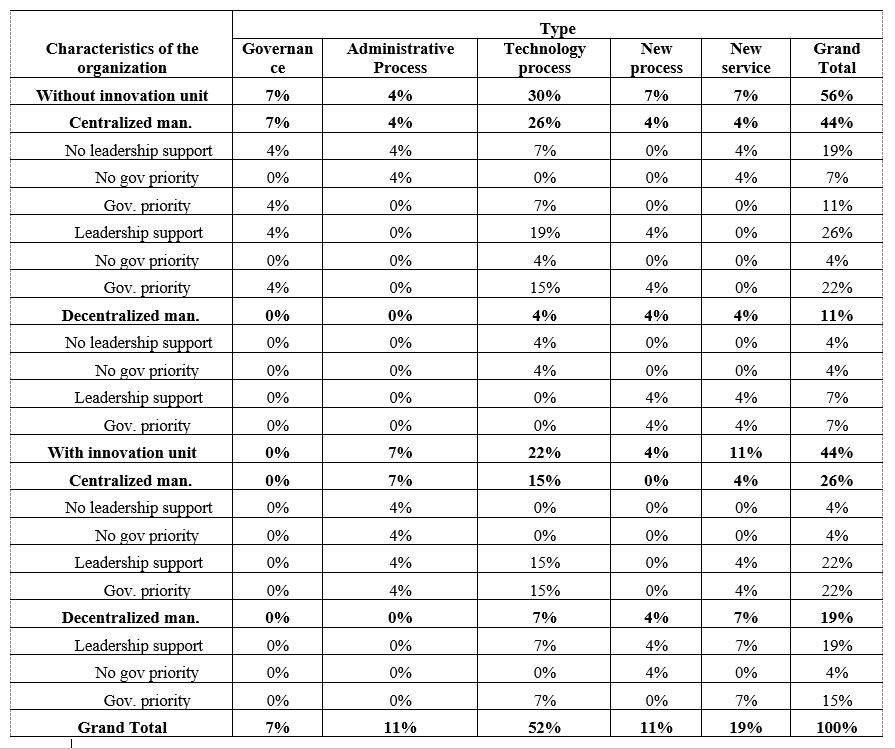
The remainder of this section presents information about the subset of 27 innovations surveyed in the second part of the study. This subset includes ministries (3), subnational governments (2), sectorial regulators (2), a public bank, and the jurisdictional regulator. As Table 3 shows, approximately, 52% of the innovations in this subset relate to process-technology innovations. Some examples are the adoption of direct producer to consumer channels for agricultural products promoted by the Ministry of Agriculture, and the Provincial Government of Pichincha, and the creation of web platforms to process charges for services by the Public Water Company of the Municipality of Mejía.
Organizational characteristics and type of innovation
The objective of most of these organizations (80%) relates to increasing the effectiveness of service delivery, while the remainder were designed with the broader objective of attending societal problems.
Table 3 also reveals that 59% of the organizations reported being priority for the government. Besides, most organizations were characterized as centralized in regard to their management (70%), and the percentage of organizations without a specific unit supporting innovation is higher than those with a specialized unit (56% and 44% respectively). Almost 74% or respondents indicated that support from leadership roles was present during the process of innovation. Processes of innovation were characterized as top-down (63%), concurrent (22%) and bottom-up (15%). Also, he majority of organizations (67%) relied on collaboration with others for the production of the innovations reported.
Regarding the most common problems experienced during the adoption of the innovation, informants reported that 33% of organizations suffered from lack of resources to respond to growing demands for change. Besides, 26% faced lack of knowledge by the final users that reduced the relevance of the innovation or affected the scope or its rate of diffusion. Finally, 7.4% experienced problems stemming from the organizational culture and with logistics.
The large majority of reports (85.18%) show that adopting the innovations produced positive effects on the organizations, including increases in effectiveness (14.81%) and efficiency (33.3%), or both (7.41%). A third of the informants reported that developing the innovation impacted positively on efficiency in the use of resources, mostly due to shortening of response-times or reduction of transportation to deliver services (e.g., field surveys in the agricultural sector were automatized). Other positive effects related to improving the availability or quality of information for the organization (14.8%). Approximately, 15% reported negative effects including, reductions in effectiveness (7.41%) and increased demand for resources (7.41%).
In terms of the impacts on the clients or beneficiaries, 55.6% of informants report that innovations reduced user’s costs; while 22.22% reported that the innovations expanded the scope of the services provided by the organization. However, 7.41% reported that innovations increased the complexity of processes for clients and beneficiaries, in particular those who have limited access to up-to-date technology or lack the knowledge to use it. The same percentage reported improving information availability for clients.
Finally, informants identified potential challenges to maintaining the adoption. The majority relate to expanding the scope of the system where the innovation was adopted (18.52%), perfecting certain aspects of the innovation (29.63%). Others point out to the user’s culture (14.81%), and challenges with the organizational culture (7.41%). Almost 7.5% pointed at structural problems for access to technology within the population as the main challenge, and a similar percentage identified the lack of resources as the main challenge.
4 Discussion
The emergence of innovations in a context of deep social and economic uncertainty is not surprising. However, the dominant type of innovation, related to the adoption of new technologies within existing processes (69%) shows a dominance of marginal changes. This finding is much higher than the 7% reported by Vries et al. (2015). The nature of the context in which the innovations developed, which reduced the possibility of direct contact within and among organizations and with clients, could explain this finding but also the overall lack of resources caused by the structural reform. Nevertheless, it remains unclear why the percentages for all the other types of innovations, shown in Table 1 and Table 2, are so much lower than those reported by Vries et al. (2015) given that the pandemic stressed all areas of organizational performance, including internal administrative processes, and interactions with clients and partners. Perhaps more radical forms of change emerged after this study was conducted.
Regarding the goals of the innovations, the categories with higher frequency of reports are the same as those reported by Vries et al. (2015). Those categories are: increasing effectiveness, increasing efficiency and tackling societal problems. However, this study found increasing effectiveness in 80% of the reports, versus 18% reported by Vries et al. (2015, p. 154), while tackling societal problems reached 12%, versus 10% and improving efficiency 6%, versus 15%. This difference could relate to the timing of the data collection. Innovation stacks may have been only starting in mid-2020, thus, future studies could explore whether the original components and objectives of these innovations (and their outcomes) were maintained, and in what form, as the consequences of the pandemic deepened. The fact that most innovations originate in top-down processes suggests that those innovations may have to undergo a series or recalibrations in the near future to respond to emerging demands and deteriorating economic conditions in the public sector.
Table 2 indicates that environmental pressures, particularly a high level of priority assigned to the organization by the government, was 9.6%, on average. This percentage is higher for organizations were there was support from leadership positions to innovation teams and organizational management was described as centralized (on average 22%) than in the more decentralized ones (11% on average). This makes sense considering the higher count of centralized organizations (70% vs 30%), but also because transmitting political demands across sectors and levels requires more direct channels of communication which are often clearly defined in centralized organizations.
Most organizations in the subset (56%) reported not having a specialized unit supporting the process of innovation. Moreover, almost 44% of those that reported a specialized unit were perceived as centralized. This percentage fell for those perceived as decentralized (26%). This finding suggests that organizational capacities to innovate may be vulnerable in the majority of organizations considering the high rates of staff turn-a-round and recurrent lay-offs characteristic of the Ecuadorean public sector.
Findings relating to the source of the innovations indicate a majority of top-down processes; however, the percentage of concurrent processes is important and highlights the need to understand the feedbacks between top-managers and middle-level managers and frontline staff within these processes. Complementary, the percentages of organizations that reported top-down processes and specialized units that support innovation and those with similar processes and no specialized units are quite similar (33% and 30%). This suggests that such units may not be critical to the production of innovations, in particular for the dominant type related to process technology.
Data shows that specialized units that support innovation processes are more important for generating collaborations. Almost 67% of organizations with a specialized unit engaged in collaboration. Determining how these units or processes operate in a highly centralized context is one area where future studies could make a valuable contribution to public administration theory and practice. Some issues worth exploring relate to their internal affairs (management, culture), the specific outputs they produce, and their capacity to reach within and beyond the organization. Future studies may ask for example, what resources are organizations sharing to produce information? and is the basis for their interactions derived from personal relationships or do they correspond to some sectorial space that emerges from design? These and other questions about the ways in which these units support the permanence of their networks, and vice versa, in a context of public sector instability and reform demands additional empirical work.
Future studies could focus on shedding light on how organizations tackle the challenges produced by the introduction of innovations to make those more effective, permanent or to expand them to generate more public value. As mentioned by several interviews, the institutionalization of some innovations reported may require additional resources (information, technology, political support, organizational culture), which are hard to mobilize in a context of diminished support for public investment and aggressive initiatives to reduce the size of the public sector. Moreover, the expansion, scalability, and reproducibility of the innovations reported in this study may highly depend on the effective mobilization of additional resources, which will receive a boost from entrepreneurs that connect them to larger networks of support (Koliba, Meek, & Zia, 2010). However, who becomes an entrepreneur in such an unstable context and how does it perform both bonding (within organizations) and bridging functions (across organizations)?
In this line, it is also important to note that respondents were not asked to differentiate between collaborations with public and private partners. This is an important characteristic of the innovation process that deserves more attention. As mentioned in section 2, the literature on innovation has treated innovation in the public sector almost as an anomaly and focused mostly on the reasons why public sector organizations do not innovate. In addition, others are making theoretical headway on public-private partnerships (Maurrasse, 2013; Witters, Marom, & Steinert, 2012) and in collaboration -mainly with citizens and users, as means to develop innovation (Farr, 2013; Jæger, 2013). Therefore, a change of focus is required to shed light over the informal interactions where public and private organizations respond to external changes.
Finally, more work needs to be done in terms of understanding how these innovations are reported. Considine et al. (2009) have shown that role, rank, normative climate (culture) influence how people frame innovations from a normative perspective. Clearly, self-selection is a problem in the present study, and with it, a whole range of reporting biases towards managers and the way organizations behave. Future studies should employ designs that allow parsing out the effects of these individual attributes on the characterization of innovations and their effects both within and outside the organization.
5 Conclusion
It is highly accepted within the organizational change literature that crises, such as the COVID-19 pandemic, ease individuals and organization from the confinements of the paradigms and institutional rigidities in which they operate. This greater latitude can translate into organizational changes depending on how internal and external factors are managed. This study reported on the innovations produced in the Ecuadorean public sector in the early stages of the pandemic. It confirmed the validity of findings made in other contexts, while also highlighted results that add qualitative depth to the relationships between organizational characteristics, innovation processes, external factors and outcomes.
In this line, future studies on the later stages of the innovations reported could evaluate the capacity of organizations to produce innovations that use information and communication technologies to improve economic performance (enhancing investments or reducing costs). As the OECD (2015) highlights, innovation is an imperative in the public sector and in the context of rebuilding after COVID-19, policymakers must invest in innovative technology to leapfrog obstacles to inclusive development, keeping a tight rein on automation (Acemoglu, 2021). This study suggest that such challenge could be managed with the formation of new cooperative networks among public sector organizations, providers, and consumers (Hämäläinen & Heiskala, 2007, pp. 13-14) that produce a more acceptable balance of increased dependency on technology while considering the existing capacities and barriers to promoting their use. However, decision-makers must take into account that not all networks operate in the same organizational ecosystem; thus, they require different forms of support to be effective.
References
Acemoglu, D. (2021). The post-COVID world. To reverse widening inequality, keep a tight rein on automation. Finance & Development, 5-9.
Aldrich, H. E. Ruef, M. (2006). Organizations Evolving (Second). SAGE.
Andrenacci, L. E. (2020). ¿Cómo se concibe hoy la gestión pública desde la ciencia? El conocimiento en la gerencia pública, 1-30.
Arellano Gault, D. (2010). El Enfoque organizacional en la política y la gestión públicas. Entendiendo las organizaciones gubernamentales. In Merino M., Cejudo, G. Problemas, decisions y soluciones. Enfoques de política pública. México: FCE, CIDE. pp. 61-92.
Argothy Almeida, A., González Alvárez, N. (2020). Determinantes de Innovación Pública en Ecuador: Un Análisis Descriptivo. Administração Pública E Gestão Social, 12(3), 1–22.
Arundel, A., Bloch, C., Ferguson, B. (2019). Advancing innovation in the public sector: Aligning innovation measurement with policy goals. Research Policy, 48(3), 789-798. http://doi.org/10.1016/j.respol.2018.12.001
Aucoin, P. (1986). Organizational Change in the Machinery of Canadian Government: From Rational Management to Brokerage Politics. Canadian Journal of Political Science, 19(1), 3-28. https://doi.org/10.1017/s0008423900057954
BID. (2020). América Latina y El Caribe Post COVID-19 Retos y Oportunidades (pp. 1–65). BID.
Brown, L., Osborne, S. P. (2013). Risk and innovation: Towards a framework for risk governance in public services. Public Management Review, 15(2), 186-208.
Capano, G., Howlett, M., Jarvis, D. S. L., Ramesh, M., Goyal, N. (2020). Mobilizing Policy (In)Capacity to Fight COVID-19: Understanding Variations in State Responses. Policy and Society, 39(3), 285-308. http://doi.org/10.1080/14494035.2020.1787628
CEPAL, Naciones Unidas. (2020). Informe Especial COVID-19 No 1. América Latina y el Caribe ante la pandemia del COVID-19. Efectos económicos y sociales, 1-15.
Chauca, R. (2021). La covid-19 en Ecuador: fragilidad política y precariedad de la salud pública*. História, Ciências, Saúde-Manguinhos, 28(2), 587-591. https://doi.org/10.1590/s0104-59702021005000003
Cinar, E., Trott, P. Simms, C. (2018). A systematic review of barriers to public sector innovation process. Public Management Review, 21(2), 1-27. https://doi.org/10.1080/14719037.2018.1473477
Considine, M., Lewis, J. M., Alexander, D. (2009). Networks, Innovation and Public Policy: Politicians, Bureaucrats and the Pathways to Change inside Government. New York: Palgrave MacMillan.
Córdoba, D., Peredo, A. M., Chávez, P. (2021). Shaping alternatives to development: Solidarity and reciprocity in the Andes during COVID-19. World Development, 139, 105323. https://doi.org/10.1016/j.worlddev.2020.105323
Crosby, B. C., t’ Hart, P., Torfing, J. (2016). Public value creation through collaborative innovation. Public Management Review, 19(5), 1-15. https://doi.org/10.1080/14719037.2016.1192165
da Costa, S., Páez, D., Sánchez, F., Gondim, S., Rodríguez, M. (2014). Factores favorables a la innovación en las organizaciones: una integración de meta-análisis. Journal of Work and Organizational Psychology, 30, 67-74. http://doi.org/10.1016/j.rpto.2014.06.006
Dávila, M. J., Villares, G. Placencia, M. (2018). Recursos financieros de los Gobiernos Autónomos Descentralizados: Caso de estudio Gobiernos Autónomos Descentralizados Municipales. Economía y Negocios, 9(2), 53-70. https://doi.org/10.29019/eyn.v9i2.499
Dong, E., Du, H. Gardner, L. (2020). An interactive web-based dashboard to track COVID-19 in real time. The Lancet Infectious Diseases, 20(5), 533-534. https://doi.org/10.1016/s1473-3099(20)30120-1
Elflein, J. (2020). Number of cumulative cases of coronavirus (COVID-19) worldwide from January 22 to December 21, 2020, by day. Retrieved from: https://www.statista.com/statistics/1103040/cumulative-coronavirus-COVID-19-cases-number-worldwide-by-day/.
Eyméoud, J., Nicolas, Petroski-Nadeau, N., Sateulàlia-Lopiz, R., Wasmer, E. (2021). Labor Dynamics and Actual Telework Use during Covid-19: Skills, Occupations and Industries [Barcelona GSE Working Paper Series].
Farr, M. (2013). Citizens and the co-creation of public service innovations. In Handbook of innovation in public services. Edward Elgar Publishing.
Frieiro, L. Sánchez, B. (2021). Ecuador: El neoliberalismo por sorpresa. Revista Argentina de Ciencia Política, 1(26), 125-164.
Hagedoorn, J. (1996). Innovation and Entrepreneurship: Schumpeter Revisited. Industrial and Corporate Change, 5(3), 883-896.
Halvorsen, T., Hauknes, J., Miles, I., Røste, R. (2005). On the differences between public and private sector innovation. NIFU STEP.
Hämäläinen, T. J., Heiskala, R. (Eds.). (2007). Social Innovations, Institutional Change and Economic Performance. Chaltenham: Edward Elgar.
Jæger, B. (2013). User involvement in public services innovation. In Handbook of innovation in public services. Edward Elgar Publishing.
Kastelle, T., Steen, J. (2011). Ideas are not innovations. Prometheus, 29(2), 199-205. https://doi.org/10.1080/08109028.2011.608554
Koliba, C., Meek, J. W., Zia, A. (2010). GOVERNANCE NETWORKS IN PUBLIC ADMINISTRATION AND PUBLIC POLICY. Boca Raton: CRC Press.
Koschatzky, K., Kulicke, M., and Zenker, A. (2001). Innovation Networks: Concepts and Challenges in the European Perspective. Springer.
Labarthe, S., and Saint-Upéry, M. (2017). Leninismo versus correísmo: la <<tercera vuelta>> en Ecuador. Nueva Sociedad, 272(noviembre-diciembre), 29-42.
Lægrid, P., Roness, P., Verhoest, K. (2011). Explaining the Innovative Culture and Activities of State Agencies. Organization Studies, 32(0), 1321-1347.
Lewis, J. M., Considine, M., Alexander, D. (2011). Innovation Inside Government: The Importance of Networks. In Innovation in the Public Sector (pp. 107-133). Palgrave Macmillan, London.
Lowndes, V. Roberts, M. (2013). Why Institutions Matter The New Institutionalism in Political Science. Palgrave Macmillan.
Navarro, F. M. (2017). Innovación pública en América Latina: conceptos, experiencias exitosas, desafíos y obstáculos. Revista de Gestión Pública, VI(1), 5-18.
Maurrasse, D. (2013). Strategic public private partnerships: innovation and development. Edward Elgar Publishing.
Martínez Navarro, F. (2018). Innovación pública en América Latina: conceptos, experiencias exitosas, desafíos y obstáculos. Revista De Gestión Pública, 6, 1-14.
McKelvey, J. (2020). The Innovation Stack: Building an Unbeatable Business One Crazy Idea at a Time. Penguin.
Mintrom, M., O’Connor, R. (2020). The importance of policy narrative: effective government responses to Covid-19. Policy Design and Practice, 3(3), 205-227. http://doi.org/10.1080/25741292.2020.1813358
Moshe, M., Howlett, M. (2020). Explaining variations in state COVID-19 responses: psychological, institutional, and strategic factors in governance and public policy-making. Policy Design and Practice, 3(3), 228-241. http://doi.org/10.1080/25741292.2020.1824379
Norman, D. A., Verganti, R. (2014). Incremental and Radical Innovation: Design Research vs. Technology and Meaning Change. Design Issues, 30(1), 78-96. https://doi.org/10.1162/desi_a_00250
OECD. (2015). The Innovation Imperative in the Public Sector. https://doi.org/10.1787/9789264236561-en
OECD/Eurostat (2018), Oslo Manual 2018: Guidelines for Collecting, Reporting and Using Data on Innovation, 4th Edition, The Measurement of Scientific, Technological and Innovation Activities. https://doi.org/10.1787/9789264304604-en
Palmer, I., Dunford, R. (2001). The diffusion of managerial innovations: a comparison of Australian public and private sector take-up rates of new organizational practices. International Public Management Journal, 4(1), 49-64.
Scott, W. R. (2010). Reflections: The Past and Future of Research on Institutions and Institutional Change. Journal of Change Management, 10(1), 5-21.
Scott, W. R. (2014). Institutions and organizations. Ideas, Interests and Identities. SAGE.
Schneider, M., Teske, P. Mintrom, M. (1995). Public Entrepreneurs. Princeton University Press.
Schoen, M. W., Moreland-Russell, S., Prewitt, K., and Carothers, B. J. (2014). Social network analysis of public health programs to measure partnership. Social Science & Medicine, 123, 90-95. https://doi.org/10.1016/j.socscimed.2014.10.057
Snowden, F. M. (2019). Epidemics and Society: From the Black Death to the Present. Yale University Press.
Stewart‐Weeks, M. Kastelle, T. (2015). Innovation in the Public Sector. Australian Journal of Public Administration, 74(1), 63-72. https://doi.org/10.1111/1467-8500.12129
Tan, B. S. (2004). The Consecuences of Innovation. The Innovation Journal: The Public Sector Innovation Journal, 9(3), 1-36.
United Nations., Min, Y. Perucci, F. (2020). Impact of COVID-19 on SDG Progress (United Nations). https://www.un-ilibrary.org/content/papers/27081990/24
Vries, H., Bekkers, V., Tummers, L. (2015). Innovation in the Public Sector: A Systematic Review and Future Research Agenda. Public Administration, 94(1), 146-166. http://doi.org/10.1111/padm.12209
Vries, H., Tummers, L., Bekkers, V. (2019). The benefits of teleworking in the Public Sector: Reality or Rhetoric? Review of Public Personnel Administration, 39(4), 570-593. DOI: 10.1177/0734371X18760124
Wischnevsky, J.D. and Damanpour, F. (2005), Punctuated equilibrium model of organizational transformation: sources and consequences in the banking industry, Research in Organizational Change and Development, 15: 207-239.
Windrum, P. Koch, P. (Eds.). (2008). Innovation In Public Sector Services Entrepreneurship, Creativity and Management. Edward Elgar.
Witters, L., Marom, R., Steinert, K. (2012). The role of public-private partnerships in driving innovation. The global innovation index, 2012, 81-87.
Wolff, J. (2018). Ecuador after Correa: The Struggle over the "Citizens" Revolution. Revista de Ciencia Política, 38(2), 281-302.
Notes
