Artigos
Ação Empreendedora na Gestão Escolar Pública
Entrepreneurial Action in Public School Management
Acción Emprendedora en la Gestión de la Escuela Pública
Ação Empreendedora na Gestão Escolar Pública
Administração Pública e Gestão Social, vol. 14, núm. 4, 2022
Universidade Federal de Viçosa

Esta obra está bajo una Licencia Creative Commons Atribución-NoComercial-SinDerivar 4.0 Internacional.
Recepción: 28 Noviembre 2021
Aprobación: 05 Mayo 2022
Publicación: 17 Noviembre 2022
Resumo:
Objetivo da pesquisa: O presente artigo busca identificar ações desenvolvidas por atores públicos na secretaria municipal de educação, de um município localizado no sul de Minas Gerais, para o cumprimento do Plano Nacional de Educação, bem como explicá-las e analisá-las a partir da teoria da ação empreendedora. Enquadramento teórico: O estudo da ação empreendedora busca compreender por completo um empreendimento, seus motivos impulsionadores, seu desenvolvimento e os atores envolvidos. A ação empreendedora pode ocorrer em diversos ambientes, pois ela pode ser encontrada em qualquer processo que foi modificado pela criatividade, logo, pode ser identificada na gestão escolar brasileira, e apesar de não ser um conceito inovador, sua efetivação se apresenta como um desafio para os gestores públicos. No setor público, a ação empreendedora pode ser definida como resultado exitoso do entrelaçamento entre agentes públicos, organização e sociedade, que resultem em novos bens e serviços, ou reestrutura de processos que atendam às demandas públicas. Metodologia: A pesquisa possui uma abordagem qualitativa, com objetivos explicativos, tratando-se de um estudo de caso. O objeto de estudo é a secretaria municipal de educação de um município do sul de Minas Gerais, que se destaca pela forma criativa com que gerencia suas demandas. Os atores da pesquisa são servidores públicos que estão lotados na secretaria municipal de educação. A coleta dos dados ocorreu a partir de entrevistas em profundidade e grupo focal. Inicialmente foi realizado um grupo focal com quatro atores da secretaria municipal de educação, que possibilitou o mapeamento de ações com potenciais indícios empreendedores; feito isso, foram realizadas seis entrevistas em profundidade para coleta de informações mais profundas sobre essas ações. Para análise dos dados coletados foi utilizado o procedimento metodológico da análise de conteúdo. Resultados: Da análise dos dados foi possível identificar quatro ações empreendedoras que estão vinculadas ao atendimento dos alunos, pais/sociedade, professores, gestão e, também as metas 4, 18, 19, do PNE-2014/2024. As ações identificadas foram: criação do serviço de atendimento e apoio à inclusão, feira do jovem permacultor, regulamentação da hora-atividade e a terceirização da merenda escolar. As ações surgiram a partir de tensões na lógica institucional e foram efetivadas pela mobilização dos atores da pesquisa na criação de intercâmbios inovadores que levaram a melhoria da gestão. Originalidade: A investigação da ação empreendedora no Brasil é uma temática nova, com poucos estudos desenvolvidos. Nesse sentido, o desenvolvimento de um estudo teórico/empírico sobre a ação empreendedora no cenário nacional, especialmente na efetivação da desafiadora gestão escolar, com o detalhamento teórico e empírico de todas as etapas da ação, permite compreender como os gestores públicos se articulam para resolver as demandas existentes de forma criativa e inovadora, contribuindo para o fortalecimento da gestão pública, desestigmatização de sua ineficiência e o desenvolvimento teórico da ação empreendedora. Assim, este artigo proporciona, por meio do estudo da ação empreendedora, uma nova maneira de compreender o empreendedorismo público, que investiga o entrelaçamento de variados atores que permite a criação e aproveitamento de oportunidades. Contribuições teóricas e práticas: O estudo contribui para o campo das ciências sociais, notadamente, para o estudo da administração pública, ao evidenciar o pressuposto da ação empreendedora como fenômeno identificável nas instituições públicas que possibilita a melhoria da gestão. Contribui também ao discutir teoricamente o fenômeno da ação empreendedora e fornecer um esquema teórico para aplicação em outros estudos. Como contribuições práticas, vislumbra-se que as ações empreendedoras identificadas demonstram a busca dos gestores públicos pela efetivação de uma gestão escolar competente, inovadora e comprometida com os resultados sociais, o que evidencia que a ação empreendedora é um fenômeno de extrema valia para a administração pública brasileira, pois se a criatividade, o diálogo e a inovação forem utilizados em projetos empreendedores coletivamente, gestores públicos podem provocar mudanças e melhorias, enfrentando as tensões existentes.
Palavras-chave: Criatividade situada, Setor público, Modelo de emergência da ação empreendedora.
Resumen:
Objetivo de investigación: Este artículo busca identificar las acciones desarrolladas por los actores públicos en el departamento de educación municipal, en un municipio ubicado en el sur de Minas Gerais, para cumplir con el Plan Nacional de Educación, así como explicarlas y analizarlas desde la teoría de acción empresarial. Marco teórico: El estudio de la acción empresarial busca comprender en profundidad una empresa, sus motivos impulsores, su desarrollo y los actores que intervienen. La acción empresarial puede ocurrir en diferentes ambientes, ya que se puede encontrar en cualquier proceso que haya sido modificado por la creatividad, por lo que se puede identificar en la gestión escolar brasileña, que a pesar de no ser un concepto innovador, su efectividad se presenta como un desafío administradores públicos. En el sector público, la acción empresarial puede definirse como el resultado exitoso del entrelazamiento entre los agentes públicos, la organización y la sociedad, que da como resultado nuevos bienes y servicios, o procesos de reestructuración que satisfacen las demandas públicas. Metodología: La investigación tiene un enfoque cualitativo, con objetivos explicativos, siendo un estudio de caso. El objeto de estudio es la secretaría municipal de educación de un municipio del sur de Minas Gerais, que se destaca por la forma creativa en que gestiona sus demandas. Los actores de la investigación son servidores públicos adscritos al departamento de educación municipal. La recolección de datos se llevó a cabo a través de entrevistas en profundidad y grupos focales. Inicialmente, se realizó un grupo focal con cuatro actores de la secretaría de educación municipal, lo que permitió mapear acciones con potenciales señales de emprendimiento; Una vez hecho esto, se realizaron seis entrevistas en profundidad para recopilar información más detallada sobre estas acciones. Para analizar los datos recolectados, se utilizó el procedimiento metodológico de análisis de contenido. Resultados: A partir del análisis de los datos, fue posible identificar cuatro acciones empresariales que se vinculan al servicio de los estudiantes, padres/sociedad, docentes, gestión, y también las metas 4, 18, 19, del PNE-2014/2024. Las acciones identificadas fueron: creación del servicio de atención y apoyo a la inclusión, feria del joven permacultor, regulación del tiempo-actividad y tercerización de la alimentación escolar. Las acciones surgieron de tensiones en la lógica institucional y se realizaron movilizando a los actores de la investigación para generar intercambios innovadores que redundaron en una mejor gestión. Originalidad: La investigación de la acción empresarial en Brasil es un tema nuevo, con pocos estudios desarrollados. En ese sentido, el desarrollo de un estudio teórico/empírico sobre la acción emprendedora en el escenario nacional, especialmente en la implementación de la gestión escolar desafiante, con detalle teórico y empírico de todas las etapas de actuación, permite comprender cómo los gestores públicos se articulan para resolver las demandas existentes de forma creativa e innovadora, contribuyendo al fortalecimiento de la gestión pública, la desestigmatización de su ineficiencia y el desarrollo teórico de la acción empresarial. Así, este artículo aporta, a través del estudio de la acción emprendedora, una nueva forma de entender el emprendimiento público, que investiga el entrelazamiento de diversos actores que permite la creación y aprovechamiento de oportunidades. Aportaciones teóricas y prácticas: El estudio contribuye al campo de las ciencias sociales, en particular, al estudio de la administración pública, al destacar la asunción de la acción emprendedora como un fenómeno identificable en las instituciones públicas que permite mejorar la gestión. También contribuye discutiendo teóricamente el fenómeno de la acción empresarial y proporcionando un marco teórico para su aplicación en otros estudios. Como contribuciones prácticas, se ve que las acciones emprendedoras identificadas demuestran la búsqueda de los gestores públicos por la eficacia de una gestión escolar competente, innovadora y comprometida con los resultados sociales, lo que demuestra que la acción emprendedora es un fenómeno de valor extremo para la administración brasileña. público, porque si la creatividad, el diálogo y la innovación se utilizan en proyectos emprendedores de forma colectiva, los gestores públicos pueden generar cambios y mejoras, afrontando las tensiones existentes.
Palabras clave: Creatividad situada, Sector público, Modelo emergente de acción emprendedora.
Abstract:
Research objective: Besides identifying actions developed by municipal public actors in the education department of a municipality located in the south of Minas Gerais to fulfill the National Education Plan, this article seeks to explain and analyze them from the theory of entrepreneurial action. Theoretical framework: The study of entrepreneurial action seeks to fully understand an enterprise, its driving motives, development, and actors involved. The entrepreneurial action can occur in different environments, being inherent to any process modified by creativity despite not being an innovative concept and being present in school management in Brazil, its effectiveness poses a challenge for the public managers. In the public sector, entrepreneurial action can be defined as a successful result of the intertwining between public agents, organization, and society, resulting in new goods and services, or restructuring processes that meet public demands. Methodology: The research has a qualitative approach, with explanatory objectives, becoming a case study. The goal of this study is the education department of a municipality in the south of Minas Gerais, which stands out for the creative way in which it manages its demands. The research actors are public workers assigned to the municipal education department. Data collection took place through in-depth interviews and focus groups. Initially, a focus group carried out with four actors from the municipal education department enabled to map out the potential entrepreneurial actions. Afterward, six in-depth interviews collect thorough information about them. The data collected were analyzed by the methodological procedure of content analysis. Results: Data analysis allowed us to identify four entrepreneurial actions linked to the service of students, parents/society, teachers, management, also goals 4, 18, 19 of the PNE-2014/2024; being the creation of the service of attendance and support to the inclusion, the young permaculturist fair, the time-activity regulation, and the outsourcing of school meals the ones identified. The actions emerged from tensions in the institutional logic, being carried out by research actors mobilized in creating innovative exchanges that led to improved management. Originality: The entrepreneurial action investigation is a new topic with few studies developed in Brazil. Studying school management from the entrepreneurial action perspective with all action steps detailed to understand how public managers creatively and innovatively articulate to solve existing demands can help promote the already shaken public policy management stigmatized by its inefficiency and improve the theoretical development of entrepreneurial action. Therefore, this article provides a new way of understanding public entrepreneurship through the study of entrepreneurial action, investigating the intertwining of various actors and how it allows the creation and use of opportunities. Theoretical and practical contributions: This study contributes to the field of social sciences, notably, to the study of public administration, by highlighting the assumption of entrepreneurial action as an identifiable phenomenon in public institutions that makes it possible to improve management. It also contributes by discussing the phenomenon of entrepreneurial action and providing a theoretical framework for application in other studies. In terms of practical contributions, the identified entrepreneurial actions demonstrate the public managers' search for effective, competent, innovative school management committed to social results, being a phenomenon of extreme value for the Brazilian public administration. Besides, the use of creativity, dialogue and innovation allows the public managers to bring about changes and improvements in facing the existing tensions.
Keywords: Situated creativity, Public sector, Emergence model of entrepreneurial action.
1 INTRODUCTION
In 1980, school administration became the focus of growing awareness—particularly in terms of the conception of school—and identified that it was necessary to establish alliances, networks and partnerships to effectively solve the most complex and heterogeneous demands; this resulted in the term “administration” being replaced by “school management” (Lück, 2009). School management then began to gain prominence in debates about public schools in the interest of encouraging the decentralization, democracy and autonomy of the school environment to facilitate pedagogical options (Krawczyk, 1999).
Although school management is not a new concept, its effective implementation remains a challenging task for public managers given that public schools are responsible for addressing the most varied social problems—the heterogeneity of students and a lack of community participation—and are at the center of conflicts of interests in the development of public educational policies (Krawczyk, 1999; Lück, 2009; Azevedo, 2014).
Furthermore, Brazilian public management characterizes a system with many bureaucratic dysfunctions that make it impossible for managers to act politically to avoid populism and clientelism, which prevents them from effectively meeting public demands of a more subjective nature (Rua, 1997). Public governance is a form of management that allows expanding the mechanisms of popular participation, identifying and resolving this type of demand (Rua, 1997; Santos & Rover, 2019). However, the disputes and conflicts of interests involved in the public domain hinder the establishment of dialogue, trust and understanding between the participants of these networks, which implies low effectiveness of the decisions taken (Tonelli, Costa, & Sant'Anna, 2018; Santos & Rover, 2019).
To ensure the fulfillment of the minimum guarantees and establish goals for school management, the Plano Nacional de Educação (National Education Plan for Brazil, PNE) was developed to serve as a compass for managers. The PNE is a reference document for Brazilian educational policy, presenting principles, guidelines, priorities, goals and strategies for addressing educational problems. Furthermore, it seeks to ensure and maintain the development of education at different levels, stages and modalities through integrated actions by public authorities at the different federal levels (Ministério da Educação, 2018). It is currently one of the primary education policy tools and reflects the development of Brazilian society in terms of the need for education to promote a better future (Azevedo, 2014). The need for improvements in Brazilian school management is urgent considering the low performances (395 in Pisa 2015; 5.8 in IDEB 2017) obtained by students in basic education assessment exams, especially those from the public network (Ministério da Edudação, 2019).
The changes desired by school management can arise from the efficient and creative use of available resources – through interactions among individuals, organizations and society – to implement the PNE. When all the different actors work towards the same goal, entrepreneurial action can emerge.
Entrepreneurial action is a creative, innovative and adventurous exchange that occurs through the interweaving of individuals, organizations and society and modification of the existing structure (Spedale & Watson, 2014). It requires a new perspective on entrepreneurship; it leaves behind the narrow focus on the individual or context and seeks instead to understand entrepreneurship through action.
Hence, the problem of this study is as follows: how are entrepreneurial actions related to fulfilling the goals of the PNE developed by the board of education of a municipality in southern Minas Gerais, Brazil? This study seeks to identify entrepreneurial actions in the context of school management, notably those actions that involve fulfilling the PNE; it also aims to explain and analyze the identified actions using the theory of entrepreneurial action.
Therefore, this study adapted the emergency scheme from the entrepreneurial action proposed by Spedale and Watson (2014) to theoretically and empirically understand entrepreneurial action in the public context, particularly in the school management of a municipality of Minas Gerais. Here we highlight some studies developed in Brazil on entrepreneurial action, which focused on understanding entrepreneurial action as a multidimensional approach to entrepreneurship that arises from collective work (Sousa, Paiva Junior, & Lira, 2010); shifting focus from the individual to action in entrepreneurship research (Gomes, Lima, & Capelle, 2013); investigating entrepreneurial action in solidarity credit programs (Silva, Valadares, & Andrade, 2016); understanding the process of entrepreneurial action in an association of recyclable material collectors (Hansen, Maciente, Andrade, & Lima, 2019);proposing a theoretical framework to analyze the entrepreneurial action in the creation of a post-purchase sector in an Institution of Higher Learning (Lacerda & Andrade, 2021).
This study is important as it will verify how public managers are running the public education system and will identify the challenges and the potential entrepreneurial solutions implemented to address those demands. Such efforts are necessary as they seek to empirically demonstrate the existence of entrepreneurial action, in which there is an interweaving of individuals, organizations and context to resolve tensions within the institutional logic. Another relevant topic is the investigation of entrepreneurial action in the Brazilian public sector, which deserves special attention because it presents the strategic arrangements that public managers have developed to creatively meet the demands of this sector.
Based on this study, public managers will be able to guide and motivate their actions from the entrepreneurial actions investigated, using the knowledge arising from practice as a tool for resolving institutional tensions that emerge in organizational contexts. In addition, the research results contribute to trades between the public sector, society, and private organizations, which can result in creative actions contributing to the improvement of teaching, management, and the whole society.
To this end, this article will first present the theoretical framework that under lies entrepreneurial action in the public sector. Next, it will present the methodology, results and discussion, followed by the final considerations, which indicate that entrepreneurial action in the public sector is the result of creative exchanges among individuals, organizations and society that facilitate processes and effectuate quality services.
2 ENTREPRENEURIAL ACTION IN THE PUBLIC SECTOR
The study of entrepreneurial action involves focusing on a specific period of time to fully understand an enterprise, its motivations, and its development and the actors involved. It is a new way of assimilating a reality that investigates individuals, organizations, and society, without privileging any one perspective. Moreover, it involves trying to understand the selection of one path over many others, unveiling the cognitive process that emotionally and rationally leads actors to select a choice and the outcomes that follow (Sarasvathy, 2001; Mocelin & Azambuja, 2017). The focus of the study is on the diversity and heterogeneity of the actors (Cramer, Cappelle, Andrade, & Brito, 2012).
Outstanding elements for entrepreneurial action in public management are collectivity, partnership, dialogue, and interaction between public and private actors, whereas bureaucratic dysfunctions limit the process, according to the Brazilian literature. In this sense, Sousa et al. (2010) consider the entrepreneurial action in the Brazilian public sector more promising than in the private one since there is a network of relationships established between management and society, such as agreements, public notices, and technical cooperation contracts. However, the authors warn that the search for impersonality and primacy of technical and rational knowledge in the contracts limit the partnership formation and consequently the surge of entrepreneurial actions (Sousa, Paiva, & Lira, 2010; Silva, Valadares, & Andrade (2016) also consider collectivity as well as collaboration and dialogue as fundamental elements for entrepreneurial action success, and their benefits go beyond economic issues, becoming a source of social changes.
Hansen et al. (2019) highlight in their study the involvement of a set of actors, institutions, and stakeholders as essential for the surge of entrepreneurial action, which is the result of an interactive and dynamic process. Lacerda and Andrade (2021), in turn, emphasize that several factors such as the organizational and external contexts, the life orientation and social interaction of those involved in the entrepreneurial action influence its success. In the same way, some authors emphasize that no revolutionary or heroic action is necessary to develop an entrepreneurial action in the public sector, but everyday and common situations identified by managers may present themselves as opportunities (Lacerda & Andrade, 2021).
Actions organizational generally occur in a habitual way—in other words, they are institutionalized—but there are often constraints that require a change in the way these actions are practiced both to ensure their continuity and to provide a new way to execute them (Berglund, 2005). Along this path, it is possible for actors to act in a totally creative and innovative way that leads to the emergence of an entrepreneurial action (Berglund, 2005; Watson, 2013; Spedale & Watson, 2014).
Spedale and Watson (2014) refer to these constraints as tensions within the institutional logic; that is, situations that disrupt socially constructed standards, rules, beliefs, and values. Entrepreneurial action thus emerges from the intersection between tensions within the institutional logic and the life-orientation of individuals involved in an entrepreneurial action; namely, their personal history, experiences, and cultural and discursive factors (Spedale & Watson, 2014).
For Spedale and Watson (2014), entrepreneurial action is defined as the creation of adventurous, creative (or innovative) exchanges (or deals) between entrepreneurial actors, a home enterprise and other parties with which that enterprise trades. Adapting the concept to the public sector, entrepreneurial action can be defined as a successful outcome of the interweaving between public agents, organizations and society; in other words, the convergence between the values of public actors, the values of an organization and the values of society in addressing tensions that result in new goods and services or in the restructuring of processes that respond to public demands.
For entrepreneurial action to occur, there must be an intersection between the tensions within the institutional logic and the life-orientation of individuals. The development of entrepreneurial action in the Brazilian public sector thus takes place according to Figure 1.
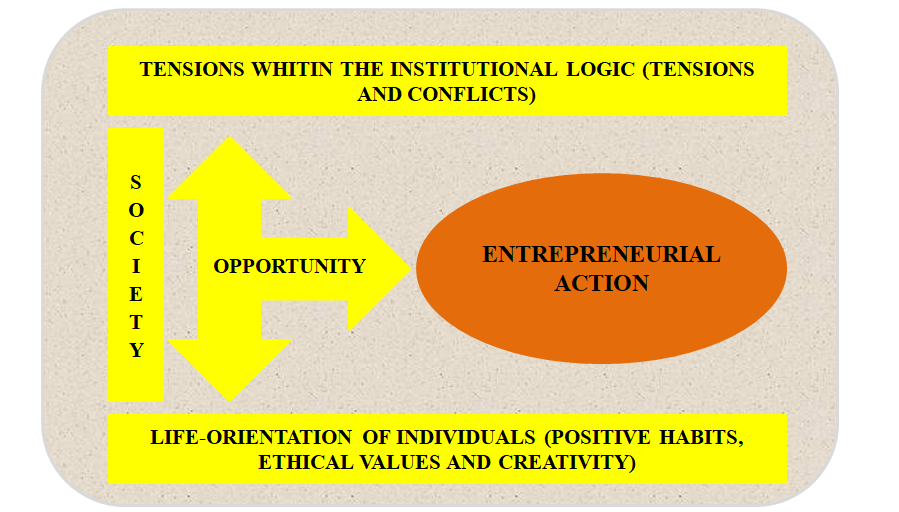
Figure 1: Model of the emergence of entrepreneurial action in the public sector
Source: Adapted from Spedale, S., & Watson, T. J. (2014). The emergence of entrepreneurial action: at the crossroads between institutional logics and individual life-orientation. International Small Business Journal, 32(7), 759-776.
Source: Adapted from Spedale, S., & Watson, T. J. (2014). The emergence of entrepreneurial action: at the crossroads between institutional logics and individual life-orientation. International Small Business Journal, 32(7), 759-776.
TENSIONS within the institutional logic are understood as situations characterized by tensions and conflicts within institutions. In the entrepreneurial process, there will initially be tensions: situations that provoke high emotions that public actors identify must be modified or controlled but that only affect the microenvironment; or rather, “personal and social circumstances (…) which orient them to act in particular ways with regard to their future” (Spedale & Watson, 2014, p. 764). Uncontrolled, the tensions will generate friction and disagreements that can take on larger dimensions in the macro environment and become CONFLICTS, which are agents of organizational change inherent in society that reveal divergences between organizational and individual needs (Motta, 1970; Ferreira, Alencar, & Lourenço, 2015).
These situations involving tensions within the institutional logic provide public actors with a timely opportunity to take advantage of available environmental conditions and human resources and act differently, with the goal of controlling or healing the frictions; in other words, there is an OPPORTUNITY to modify the problems created by interactions between individuals (Spedale & Watson, 2014).
To try to reverse the conflicts generated, public actors will act according to their life-orientations, namely, their POSITIVE HABITS, which are frequently repeated successful practices oriented by culture; in other words, “essential elements of all human activity” (Spedale & Watson, 2014, p. 765) that promote individual action. However, for positive habits to provide effective results for public management, these actors must have ETHICAL VALUES, which are a set of principles that orient the good behavior of individuals and “prevent decisions that may be characterized as illegal or corrupt habits” (Sousa, Paiva, & Lira, 2010, p. 343), and CREATIVITY, which is the ability to develop activities in a fruitful or innovative way that “reorient[s] the flow of ongoing action, [and] introduces something new” (Spedale & Watson, 2014, p. 771) that modifies the tension and results in an entrepreneurial action.
Entrepreneurial action will thus emerge from the intersection of tensions within the institutional logic and the individual’s life-orientation, and both variables are influenced by society. It should be emphasized that the model is an attempt to understand entrepreneurial action that can be modified according to the context in which it occurs; the stages are therefore not static and can be modified.Moreover, it should be emphasized that entrepreneurial action may be totally innovative in one place but have already become institutionalized in others. An action will therefore be categorized as entrepreneurial (or not) in an institution based on the innovation and creativity necessary for it to have taken place.
3 METHODOLOGY
The present study has a qualitative approach as its primary focus is an empirical analysis of the reality of a particular context based on the researcher’s direct contact with the study environment. In terms of objectives, it is an explanatory study, in terms of procedures, it is a case study.The object of study is the municipal board of education of a municipality in southern Minas Gerais. This municipality, and four others in the same region, belonged to a larger entrepreneurial action research andfrom exploratory study, it was found that the reported municipality has been highlighted in terms of creativity and innovation compared to the other municipalities previously investigated in wider study. Therefore, it is understood that this study requires a more detailed analysis.The study’s actors are public servants working at the municipal board of education, specifically those who have knowledge of the projects developed by the board and are actively involved with them. It is worth mentioning that interviewees who held positions of trust were career teachers at the time of data collection.
To carry out the present study, in-depth interviews and focus groups were conducted. These were guided by a script that contained ten questions that sought to identify the fulfillment of eleven of the twenty goals established by the 2014-2024 PNE. The eleven goals were selected because they addressed practices on the municipal level, (Figure 2). The other goals are aimed at secondary and higher education and education of youths and adults.
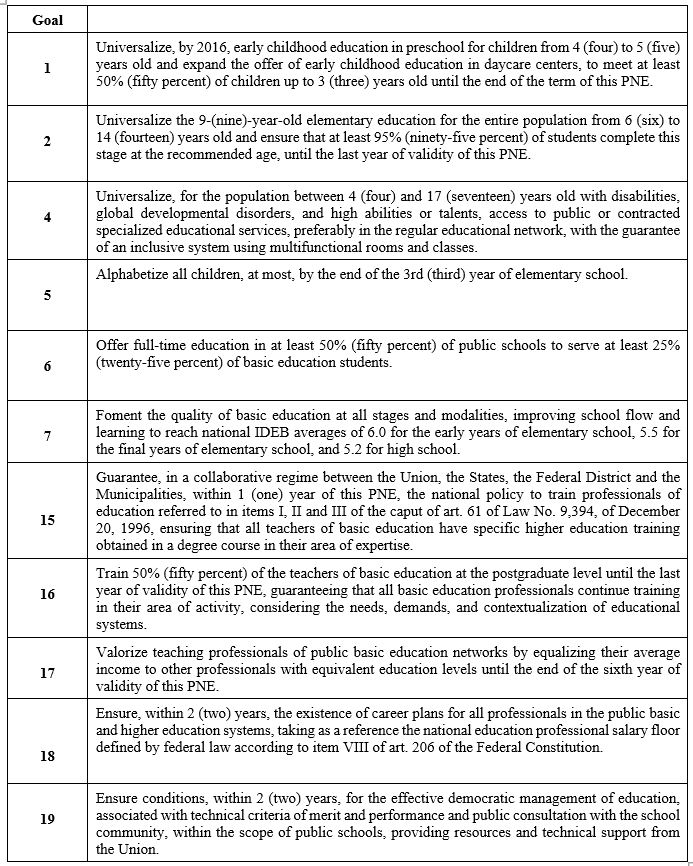
Figure 2: Selected targets from the PNE 2014-2024Note Source: From the authors (2018).
The data were collected from November 23, 2017, to June 21, 2018, in the researched municipality, through in-depth interviews and focus groups, which took place at different times. The meetings were recorded and later transcribed.
The first focus group that happened with the municipal secretary advising team was previously scheduled by telephone and in the presence of four interviewees and five researchers. At the beginning of the focus group, the project was explained to the research actors who received complete freedom for comments and opinions – that moment was an occasion of free and informal discussion whose conversation would be recorded, and the data analyzed. Afterward, the actors answered questions according to the local reality and the issues demanding greater attention were referred to as possible entrepreneurial actions. Furthermore, we mapped out the demands and actions identified as entrepreneurial ones.
After mapping the demands and identifying possible entrepreneurial actions, in-depth interviews were carried out. The interview with the municipal secretary was the first script-guided, and both the interviewee and interviewers were allowed to freely enter other pertinent subjects and gather more information about the identified demands and actions.
After selecting the actions identified as entrepreneurial ones, we prepared a new interview script and field trip. At this stage, six individual-in-depth interviews were conducted with those in charge of the identified entrepreneurial actions, namely, pedagogical manager, educational advisor, three pedagogical coordinators and lunch technician. All interviews and focus groups were recorded and transcribed, and the data was grouped according to each identified action.
3.1 Data analysis
The methodological procedure used to analyze the collected data was content analysis, which makes it possible to interpret the information contained in a message (Bardin, 1977). The names of the interviewees and people or companies mentioned by the interviewees are not disclosed to maintain the integrity of the study and the confidentiality of the statements. It is worth mentioning that the name of the city has been changed to “Joy” to in order to keep its anonymity. Therefore, the interviewees were named as shown in Figure 3:
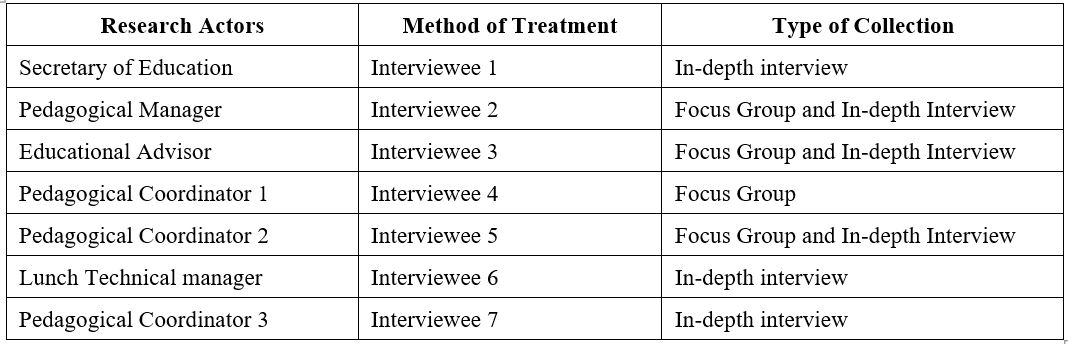
Note. Source: From the authors (2018).
It is noteworthy that the names of people or companies mentioned by the interviewees as well as the investigated municipality were changed to ensure anonymity. Secondary data such as reports, manuals and leaflets were also used to complement the primary ones and to explain and analyze the actions found from the theory of entrepreneurial action. Moreover, data triangulation allowed to describe the identified entrepreneurial actions, their objectives and operationalization.
The eleven goals selected from the PNE were related to four major areas that municipal school managers need to deal with on a daily basis and that can cause tensions within the institutional logic. Those areas are students (goals 1 and 4), society/parents (goal 19), teachers (goals 15, 16, 17 and 18) and management (goals 2, 5, 6, 7).
One entrepreneurial action was selected for each of the study’s four areas of analysis—students, society/parents, teachers and management. Consequently, when investigating the fulfillment of a PNE goal, the aim was to concomitantly identify the occurrence of an entrepreneurial action involving students, society/parents, teachers and management that was used to solve a tension within the institutional logic.
To recognize an action as entrepreneurial, situations were identified in the interviewees’ statements that indicated the presence of tension, conflict, opportunity, positive habits, ethical values and creativity and demonstrated the intersection between the tension within the institutional logic and life-orientation, following the model adapted from Spedale and Watson (2014) (Figure 1), (Figure 4).
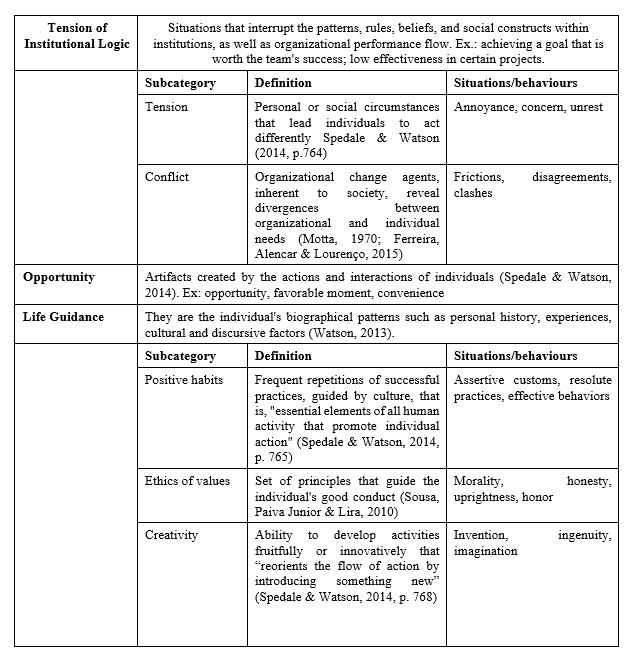
Note. Source: From the authors (2018).
4 RESULTS AND DISCUSSION
The four entrepreneurial actions will be described and explained below, beginning with the action directed at the students, followed by the action for society/parents, then the action to improve management and, finally, the action aimed at the teachers.
4. 1 Program for the Support and Monitoring of Inclusion Rooms
The Serviço de Atendimento e Apoio à Inclusão (Program for the Support and Monitoring of Inclusion Rooms; SAAI) is designed for students with disabilities, pervasive developmental disorders and advanced skills/giftedness who are enrolled in schools and municipal childcare centers in the municipal public system. This service aims to support the learning of students who are the target recipients of special education. It seeks the development of a child-centered pedagogy that respects both the dignity and differences of all students.
The SAAI was effectuated through an agreement with the Organização de Assistência e Serviços Integrados aos Sujeitos com Necessidades Especiais (Organization of Care and Integrated Services for Subjects with Special Needs; OASIS). This is a nonprofit institution that has been dedicated to the care of people with disabilities for more than sixteen years. Through this partnership, professionals are hired to work at OASIS and in municipal schools to meet the specific needs of special students.
Because it was effectuated through an agreement, the SAAI allows the municipal board of education to hire all the professionals required, without their salaries coming out of the payroll budget. We will now look at how this entrepreneurial action took place, using the model adapted from Spedale and Watson (2014) (Figure 1).
Federal Law no. 13,146/2015 guarantees that all students with disabilities, pervasive developmental disorders and advanced skills/giftedness will be monitored by a support professional and, in specific cases, by a professional from the Atendimento Educacional Especializado(Specialized Educational Service; AEE). In the investigated municipality, this monitoring was performed by teachers in the system who had this training; this was the prevailing institutional logic as it was the standard used to run the organization (Baratter, Ferreira, & Costa, 2010; Berglund, 2005; Watson, 2013).
However, this procedure became delegitimized, which led individuals to act differently to adjust for the divergences. The process of delegitimation occurs when there is no longer consensus about the use or continuity of a standard in the organization – due to either external or internal pressures – which makes the possibility for change feasible (Tolbert & Zucker, 2007). This process is illustrated in the following quote:
This was creating a huge conflict because there were a lot of teachers outside the classroom who needed to work in their positions, for which they had passed an exam, and there wasn’t any more money in the payroll budget, so it was a very difficult year and a half for us precisely because we had to put those teachers back in the classroom, and there was no support for these disabled children (Interviewee 2).
The tension caused within the institutional logic by the lack of money in the payroll budget and teachers working in different positions, which caused discomfort and concern, provided an opportune moment for resolving the conflict—that is, an opportunity (Berglund, 2005; Watson, 2013)—which can be seen in the following statement: “It was a very difficult year, but even so, we looked for alternatives” (Interviewee 2).
Committed to addressing this tension, the managers sought viable means to solve it using their positive habits and successful practices oriented by culture (Spedale & Watson, 2014). Collectively, they decided to act:
We were studying how Belo Horizonte had solved this problem. I remember that at the time I was working in the director’s office at an NGO[1] and I had an experience there that I ended up bringing to Jane. I said, ‘Jane, the Centro de Desenvolvimento da Criança e do Adolescente (Center for the Development of Children and Adolescents; CDCA) is a nonprofit entity that receives funds from the municipality for a wonderful project [...], and if the people there do this work, why can’t we make an agreement with an NGO that does this work and have the municipality pass the money on? And then these professionals wouldn’t be part of the payroll budget and this NGO would provide a service to us’ (Interviewee 2).
In this stage of the action, it is possible to see that, with the means available at that time (who they are, what they know about the situation and who can help them) (Sarasvathy, 2001; Berglund, 2005; Watson, 2013) and positive habits, the managers were able to change the situation. Sarasvathy (2001) calls this an effectuation process; in this process, the individual selects possible means of effectuating their intention. In the present case, as the means had already been selected (i.e., the actors had entered into an agreement), all that remained was for the exchange to take place:
Then, the studying began, a year of studying, and we discovered that something similar exists in São Paulo[...], so within this NGO model and within this São Paulo model, we created a model, the SAAI [...]. The SAAI, it was a long process because a law had to be passed by the city council; money had to be found. ‘This money, to do what? What is it going to look like? Where are you going to take that money?’ [...] After this law was passed by the city council—and it wasn’t easy to convince those on the council to approve this law—we had to draw up the bill, draw up the agreement, draw up[...] the public hiring announcement. (Interviewee 2).
Thus, after coordinating with intra and interorganizational actors (the city of São Paulo, Belo Horizonte, the city council and NGOs), the municipal board of education promoted a creative and innovative exchange by creating its own model of care for special students that did not involve additional expenses, did not compromise the payroll budget, and did not affect the activities of the professionals who have already been hired, thus facilitating the emergence of an entrepreneurial action. Collective work and ethical values—which require mutual aid, sharing of values and pursuit of the common good (Sousa et al., 2010) can be identified in this action:(the initiative to implement the SAAI -remark by the researcher) “was done by a group of people who work in education and by the municipal secretary, who fought for and believed in it. The secretary has a progressive vision regarding inclusive education” (Interviewee 2).
The following statement also illustrates this process: “we know how important it is for the child to have all this help in order for them to develop” (Interviewee 5).
The interweaving of individuals, an organization and society thus culminated in a creative and innovative exchange between inter-and intraorganizational actors, guided by their life-orientation and ethical values, which led to the resolution of a tension within the institutional logic and culminated in the emergence of an entrepreneurial action: the SAAI, which is the product and stimulus of a reflexive social action (Baratter et al., 2010).
4.2 Youth Permaculture Fair
The entrepreneurial action directed toward society and parents is known as the “Youth Permaculture Fair,” which is the result of the interweaving of the municipal board of education, the company “XYZ” and the families of students at a rural school. This interconnection facilitated the strengthening of this link.
The fair takes place once a month at a rural school in the municipal school system and came about through a partnership between the municipal board of education and the company “XYZ”. The fair offershigh-quality products, such as organic vegetables, cakes, pastries, yogurt and homemade sweets, which are produced by the students’ families.
The partnership between the municipal board of education and the company “XYZ” involves offering courses and workshops for parents and students at a rural school, teaching them to work with available raw materials and giving guidance to the producers on fair days. The courses and workshops offered to the families take place during the afterschool hours. The emergence of this action followed the model of entrepreneurial action for the public sector adapted from Spedale and Watson (2014) (Figure 1).
In 2007, through the implementation of the “Mais Educação” (“More Education”) federal program, there was an attempt to effectuate comprehensive education in the state and municipal education systems by extending the school day in public schools to at least 7 hours per day through optional activities.
However, the program did not provide the desired improvements, nor did it deliver what it had promised, causing a tension within the institutional logic. Tension within the institutional logic emerges from situations that cause concern and disrupt the flow of organizational performance, which the actors identify as a need for changed (Spedale & Watson, 2014). This tension is described in the following quote: “the government initially started with that comprehensive project, right, Mais Educação. At the beginning, everything went well, but after a certain point, no funds were sent. They stopped sending them; you started a project, and the funds didn’t come” (Interviewee 1).
The mismanagement of the program by the federal government caused tensions within the institutional logic as managers developed projects that would last the entire academic year with the program’s funds but, given the uncertainty of the funds arriving, the projects could be stopped at any time. The tensions soon became conflicts—agents of organizational change (Motta, 1970; Ferreira et al., 2015) — as the municipality, which had hired professionals to effectuate the program, was not receiving any funds: “there was no way to pay the monitors, and you hadn’t planned for it; none of this was in the budget. (...) Now this year, they (the federal government) cut the funds altogether” (Interviewee 1).
Thus, in an attempt to continue projects that had begun with the “Mais Educação” program and maintain the afterschool activities, the managers identified an opportune moment to change the situation; that is, an opportunity: an artifact created through the actions and interactions of individuals (Spedale & Watson, 2014). This process is illustrated in the following statement: “What did we have to do to maintain what already existed? We had to enter into partnerships. We had some, and we made more with private companies and university trainees” (Interviewee 1).
The team thus mobilized to find partnerships and potential “means” to effectuate them (Sarasvathy, 2001; Cramer, Capelle, Andrade, & Brito, 2012; Mocelin & Azambuja, 2017). Accordingly, projects were developed and presented by the municipal board of education to potential partners and, through creativity, these actors were able to develop these activities in a fruitful and innovative way and redirect the flow of action (Spedale & Watson, 2014):
Sometimes, at a meeting, we put - we did this once - we put up videos of children, put up interviews with the companies that were participating, so you can call someone who’s participating, who’s backing it, to give it value, a testimonial, right, do some marketing, say that it’s good for your company, right, because it’s linked to education (Interviewee 1).
Ethical values, a set of principles that orient the good behavior of individuals (Sousa et al., 2010), were present in the emergence of this action, as the team’s main concern was the student: “therefore, this question is good for the company, it’s good for us, it’s good for everyone, especially for our students; it’s better for everyone, so that means it’s a win-win” (Interviewee 1).
The experience gained from years of practice enabled the team to identify that merely “chasing after” partners would not be enough to establish partnerships. This situation was defined by the personal history, experiences, and cultural and discursive factors of these individuals, which collectively are called life-orientation (Spedale & Watson, 2014). The life-orientation of these individuals influenced the way the action would be carried out and helped them recognize that it was also necessary to use a positive habit; in other words, they needed to apply an assertive custom: “selling your image.”
You have to show the company (potential partner) that you aren’t asking, that this isn’t a favor. You have to show that it’s a win-win: think about what people are going to see, your company linked to education, quality education. It means I have to show that the partnership is good for your company. It isn’t a favor, it isn’t asking. Oh, that “we need,” no! We have come here to show you a project that will give credibility to your company! It’s different, this is selling your image! It’s marketing! (Interviewee 1).
And it was through a partnership to ensure the continuity of after-school activities at the rural school that the municipal board of education effectuated a creative and innovative exchange, establishing a partnership with “XYZ” and the rural community and turning it into an entrepreneurial opportunity:
(The company) taught the parents how to be entrepreneurs. Now we have a permanent fair at the school, so I go to the fair, I participate, I buy what they produce. Then, the community holds the fair inside the school through the partnership with the company, and since the school is a partner, there’s no charge for anything (Interviewee 1).
This action is thus a legitimate entrepreneurial action as it made it possible to resolve a tension—the maintenance of afterschool activities—and, at the same time, to confront the reduction of funds by the federal government. From this context emerged a creative, innovative exchange between individuals, an organization and society that facilitated a positive modification of the existing order, effectuated through the Youth Permaculture Fair. The action enabled the effective development of school management by transforming the school into a meeting place between the state and society in the pursuit of a better education (Krawczyk, 1999).
4.3 Implementation of the 1/3 planning and preparation period in the municipal system
The action directed at teachers involved the implementation of a planning and preparation period, which guaranteed that teachers would have a paid period for study, planning and grading included in their work schedule.
Following the enactment of Federal Law no. 11,738 of 2008, professionals working in public basic education were guaranteed the national minimum wage. Furthermore, they were also guaranteed that 1/3 (one-third) of their work schedule would be reserved for outside-of-class activities.
The planning and preparation period is a period reserved for study, planning and grading that must be included in the work schedule of education professionals. This time should be used for training activities, planning, meetings and other activities that do not involve teaching students in a classroom; the planning and preparation period cannot be used to substitute for other teachers.
In the municipality investigated, the teachers in the municipal school system did not have a period for nonteaching activities that would allow them to prepare lessons and grade tests, among other things; this was done by the teachers at home, after school had ended. This was the prevailing institutional logic as it was the standard followed by the municipal board of education that guided the organization (Spedale & Watson, 2014). However, with the enactment of Federal Law no. 11,738/08, which guaranteed that 1/3 (one-third) of the teachers’ time would be reserved for planning and preparation, the municipality began to receive complaints from the teachers:
The planning and preparation period was already a requirement of a federal law, which is the minimum wage law. This law already required that all municipalities implement this time for study, preparation, planning, for the teacher to focus on this work that is specific to teaching so that they can be paid for those hours worked. So since the enactment of law 11,738/2008, which is known as the minimum wage law, which regulates the planning and preparation period, there was demand by teachers here in the municipality of ‘Joy’ to implement this law here (Interviewee 2).
There was thus a need to interrupt the standard being followed; that is, there was no longer consensus about the continuity of the standard in the organization (delegitimation), which created an opening for an organizational change (Tolbert & Zucker, 2007). However, since each action described in this study is an attempt to portray a reality that follows a pre-established model (Figure 1), in certain cases, the reality may not completely follow the defined phases.
In this case, the tension caused within the institutional logic by the need to implement the planning and preparation period did not lead to a conflict; before that happened, individuals mobilized and identified an opportunity to change the situation: “the right moment was very well evaluated because it took two years for it to be put into practice. Therefore, when we implemented it, it went very smoothly because (…) everyone knew it was going to happen that way, so they knew it would be like that” (Interviewee 2).
For the implementation of the planning and preparation period to proceed smoothly, the managers applied their life-orientations -personal history, experiences, and cultural and discursive factors (Watson, 2013; Spedale & Watson, 2014). In the present case, positive habits and assertive customs oriented by culture were used (Spedale & Watson, 2014), such as the habit of studying, the use of planning, and inspiration from successful practices developed by other institutions:
We have a team here at the board who loves studying, who loves to stay up to date; (...) 2013 was a year of studying, of understanding what happened in other municipalities. (...) It was a year of intense research, of understanding, of talking to the school, of preparing the school for this possibility, of gleaning what the school truly expected;2014 was the year when we put all these observations into studies and put them into practice. We had several meetings in 2014 to understand the possibilities, to simulate the schedules with the management teams, that is, with directors, supervisors and counselors from all the schools, all the units. We presented what the proposal would look like, we heard the managers’ opinion about what could go wrong if it was implemented that way and not another way, all this before sending the law to the city council. Then, when we sent the law to the city council, (...) very extensive work had already been done - conversation, negotiation -to understand what the implementation of it would look like (Interviewee 2).
In this process, the ethical values of the individuals involved, that is, the principles that guide their good behavior (Sousa et al., 2010), such as honesty, commitment, and morality, were also present: “public resources are being invested in teachers, so we had to keep up with this very closely to be able to make it clear that these resources are being well-invested and will be returned in the quality of the education” (Interviewee 2).
However, the team did not stagnate; using their creativity and ability to develop innovative activities (Watson, 2013; Spedale & Watson, 2014), the group decided to assess how the implementation of the planning and preparation period had proceeded:
In the first two years, at the end of each year, we did an assessment, following the theory of public policy assessment; (...) we did an implementation assessment, a process assessment and a results assessment. Questionnaires were applied (...) about how the implementation had gone, what the process was like, what results we had achieved. In addition, the results were assessed, how the students performed, the teachers’ level of progress in relation to their own training, and then we also gathered suggestions for improvements. With all this material, (...) with these data, we sat down with the managers and replanned 2016 (Interviewee 2).
The information gathered from the assessments performed by the municipal board of education showed that high teacher turnover in classrooms—a result of implementing the planning and preparation period—compromised the students’ literacy process. A change was therefore made to the municipal legislation to promote an extension to the teachers’ work schedule in the municipal school system that involved expanding from 24 to 30 modules, with the teacher spending20 modules teaching and ten in the planning and preparation period.
The implementation of the planning and preparation period in the municipality investigated thus made it possible for teachers in the municipal system to study much more —and thus to invest in their continuing education—and to set aside time at home to work extensively on good planning and grading without compromising their time, which demonstrates the municipal board of education’s concern for ensuring that its professionals are valued.
4.4 Outsourcing of school lunches
The entrepreneurial action directed at processes that facilitate management is related to outsourcing school lunches. The provision of lunches in the public school system encounters different dilemmas ranging from the purchasing process to the production and distribution of lunches, given the bureaucratic dysfunctions in the Brazilian public sector. In the municipality analyzed, an action that brought efficiency and effectiveness to this process was identified.
With the objective of optimizing the preparation, logistics and food storage of school lunches, the investigated municipality outsourced their preparation and provision through a bidding process, thus shifting from self-management to outsourcing. This process can be explained using the theory of entrepreneurial action adapted from Spedale and Watson (2014):
Before outsourcing, the prevailing institutional logic — in other words, the organization’s standard of behavior (Spedale & Watson, 2014) — involved self-management of the lunches by the municipality. In this process, the municipality purchased the food and controlled the inventory, distribution and preparation of the lunches within each school unit. However, this entire process had been compromised; there was no longer consensus regarding its use (Tolbert & Zucker, 2007): “when I worked in the system, (the lunches) were very expensive, there was theft, the hygiene was not very good and, unfortunately, there is no way for us to check all of this” (Interviewee 1).
These tensions caused conflicts, which reveal divergences between organizational and individual needs (Motta, 1970; Ferreira, Alencar, & Lourenço, 2015):
When we have employees, who are cafeteria workers in this case, it creates a bond with the rest of the school, and the cafeteria more or less becomes their home. Therefore, they don’t follow a menu, they do what they want, come up their own ideas with the food we send, and it ends up being totally different than the nutritional principle we had planned. (...) Therefore, we would arrive and it would be pasta and rice pudding, when the menu was supposed to be meat with vegetables and salad. Then, the product that wasn’t being used went to waste, right? There was also the question of everyone eating at the school, so I went into Aunt Joanna’s home kitchen, and when I got there I saw a principle, a teacher, all smoking inside the kitchen, without wearing hairnets. (...) Sometimes, the cafeteria workers were wearing flip flops, sometimes earrings, rings, and I went to talk to them and they didn’t like it very much (Interviewee 7).
The team identified that something needed to be done to change that situation, and outsourcing provided such an opportunity: “the municipality’s demand was too great for self-management to be able to meet it properly, so one of the ideas was outsourcing” (Interviewee 7). “For the city, everything is much more difficult; there has to be a bidding process for everything. A company doesn’t; it buys from whoever it wants, right? So the company has no problem with inventory; it doesn’t need to have inventory” (Interviewee 1).
The municipality mobilized to effectuate the outsourcing and, after its implementation, the company became responsible for supplying all the food stuffs except the produce, yogurt and cheese, which were supplied by the municipality because they were purchased through the family farm food purchasing program. The company was also responsible for supplying kitchen equipment, utensils, and labor; preparing the best practices manual, the technical data sheets, the students’ nutritional assessments, and the students’ nutritional education; providing rat extermination and pest control for the kitchen and inventory; and supplying food for any special diets.
For this entire process to actually promote changes in the management of the school lunches, the municipality supervised the actions of the outsourced company. However, it was essential that the individuals involved in this supervision used their positive habits to ensure the smoothness of this procedure. This could also be observed with in the municipality:
With the outsourcing, I have a guarantee that this exact menu is going to be prepared because it is one of the points that I evaluate at the time of the inspection. (...) Schedule? They can’t change their schedule because there is a certain time when the lunches have to be served so students have the guarantee of this food every day, with the guaranteed nutritional value, since this is the focus (Interviewee 7).
Ethical values are the set of principles that orient the good behavior of individuals (Spedale & Watson, 2014). The application of such values made a difference in the change in the management of the school lunches:
Almost nobody likes this school lunches part, and since I was teaching public health, I already had a good command of the public part. It’s a question of love, right, whether you like it or not. So when we come you, try to embrace the cause to make it better, you know? We’re going to try to do what is good for the municipality, but I can’t lose the main focus, which is the children, right? (Interviewee 7).
This entire process highlights the team’s ingenuity in developing activities in an effective way, circumventing the frictions and reorienting the flow of action by introducing something new through creativity (Spedale & Watson, 2014), as seen in the following statement:
(Outsourcing) decreased the city’s payroll expenses. (...) (Without outsourcing), you need to have an employee, and then this employee will retire. (...) Whenever you give the company any feedback, it has a very strong interest in staying, in keeping this contract. Because we are a showcase, other municipalities come to see our work, how we do our lunches (Interviewee 1).
In this way, the outsourcing of school lunches enabled the municipal board of education to provide food with the desired nutritional quality and special diets for all the students who needed them, ensured that there would be no food waste and had a savings of almost 300,000 Brazilian reais per year when the school lunches were designated only for students. This change represents an effective entrepreneurial action that arose from the interweaving of individuals, an organization and society.
Based on the previous discussion, it is clear that the developed model (Figure 1) made it possible to identify entrepreneurial actions taken by the municipal board of education of a municipality in southern Minas Gerais. However, the present study was limited because it considered only the perspective of individuals within the organization; other actors could also have been investigated. The model also made it possible to explain how the emergence of tensions within the institutional logic occurred and how individuals mobilized to create innovative exchanges that facilitated improved management, which also testifies to its applicability in the context of Brazilian public management.
Likewise, these results corroborate the findings of Sousa et al. (2010), Silva et al. (2016), Hansem et al. (2019) and Lacerda and Andrade (2021), who point out that entrepreneurial action in public management stems from exchanges signed by the state, organizations and society, so it is an action carried out collectively, in which dialogue and understanding between participants are fundamental and enhance the results. In addition, as pointed out by Lacerda and Andrade (2021), the investigated actions did not result from heroic or radical acts, which provoke disruptive changes, but from the predisposition of the actors to identify that institutional tensions could be opportunities to modify the reality experienced.
On the other hand, this study identifies that creativity, besides other elements presented by similar studies, is a central element for the entrepreneurial action to occur since it encourages the actors to break the current logic and identify in a tension situation an opportunity to improve or transform. Moreover, the diversity of actors in the public context and their alignment with organizational objectives emerge as elements that contribute to achieving the common good.
5 CONCLUSION
The present study sought to identify entrepreneurial actions in the context of school management, notably those involving the fulfillment of goals established in the PNE, and to explain and analyze them using the theory of entrepreneurial action. In this regard, this paper facilitates the development of new studies that investigate entrepreneurial action in the public sector by applying the developed model (Figure 1) to different contexts in the public domain. This paper contributes to the field of the social sciences, and particularly to the study of public administration, by proving that entrepreneurial action is an identifiable phenomenon in public institutions that makes it possible to improve management.
The study also offers theoretical contributions by demonstrating, through the study of entrepreneurial action, a new way of understanding public entrepreneurship; it investigates the interweaving of different actors in a manner that enables the creation and utilization of opportunities that result in entrepreneurial actions. Furthermore, by adapting Spedale and Watson's (2014) theoretical framework, which includes new elements such as positive habits and the ethics of values, the model emphasized, beyond any strategic action, that the actors' involvement in this process acting for the common good without any private interests as cornerstones for the success.
Empirically, the study identified four entrepreneurial actions in school management taken in a municipality in southern Minas Gerais that were directed at students, parents/society, teachers, management and goals 4, 18 and 19 of the 2014/2024 PNE. Furthermore, the study identified four actions that demonstrate the public managers’ aim to effectuate competent and innovative school management committed to social outcomes that spares no effort to circumvent any institutional tensions that arise and redirect the flow of action to create a better social outcome.
With the creation of the SAAI, the investigated municipality was able to care for all students with disabilities, pervasive developmental disorders and advanced skills/giftedness who were enrolled in the municipal school system by providing quality inclusive education without affecting the payroll budget. The “Youth Permaculture Fair,” a partnership between the municipal board of education and a company based in the studied municipality, guaranteed the maintenance of afterschool activities and provided the parents of students at a rural school with the opportunity to work with raw materials available in their homes.
The implementation of the 1/3 planning and preparation period in the municipal system provided professionals working in public basic education with a period reserved for studying, planning and grading, which reveals the municipality’s concern for ensuring that its professionals are valued and for implementing federal laws. Finally, with the outsourcing of school lunches, it was possible to observe the implementation of an effective process for the purchase, production and distribution of lunches that ensured compliance with the menu and the nutritional value of the meals.
It is clear that there are opportunities for entrepreneurial action in the public sector. Accordingly, in this study, the life-orientation of the interviewees proved to be essential; since they were all career teachers, the experiences and anxieties they gained from teaching made them very observant and helped them address the tensions inherent within the institutional logic. Ethical values were present in each implemented action, in the willpower to make them happen and, above all, in the belief that it was possible to make public school a welcoming place for interaction and learning.
The diversity of actors in Brazilian public management facilitates entrepreneurial action and increases its effectiveness; it is essential for these actors to understand the aims of their organization and to engage in working towards these aims while applying their ethical values. In this sense, the academy plays a fundamental role in spreading this awareness, both in the training of new professionals and in interactions with the community and the supervisory bodies responsible for controlling and combating practices that detract from this aim.
In this sense, entrepreneurial action in the public sector can be defined as a positive change arising from the interweaving of individuals, organizations and society to address tensions within the institutional logic that generates new goods and services or restructures processes in a creative way. Entrepreneurial action can thus be valid for Brazilian public administration because if creativity, dialogue and innovation are used in entrepreneurial projects that seek to guarantee citizenship and promote democracy, public managers can collectively bring about changes and improvements and confront the existing tensions.
Since the research data came from the perspective of the actors involved in school management, some overestimation may have resulted. Therefore, we suggest that future studies include other actors in data collection to cross the data to refute them or not. Likewise, we indicate as a proposal for future studies the application of the theoretical scheme here developed (Figure 1) in other organizational contexts than just education and the public sector to verify the pertinence of the proposed theoretical scheme. In the case of being used in the private sector, it is important to observe the behavior of the ethical categories of positive values and habits, to understand their implication in a context where profit is the priority.
REFERENCES
Azevedo, J. M. L. de. (2014). Plano Nacional de Educação e Planejamento a questão da qualidade da educação básica. Revista Retratos da Escola,8(15), 265-280.
Baratter, M. A., Ferreira, J. M., Costa, M. C. (2010). Empreendedorismo institucional: características da ação intencional. Perspectiva Contemporânea, (special ed.), 237-266.
Bardin, L. (1977). Análise de Conteúdo. Lisboa: Edições 70.
Berglund, H. (2005). Toward a theory of entrepreneurial action exploring risk, opportunity and self in technology entrepreneurship (Thesis of degree of Doctor). Chalmers University of Technology, Gothenburg, Sweden.
Cramer, L.; Cappelle, M. C. A., Andrade, A. L. S., Brito, M, J. de. (2012). Representações femininas da ação empreendedora: uma análise da trajetória das mulheres no mundo dos negócios. Revista de Empreendedorismo e Gestão de Pequenas Empresas, 1(1), 53-71.
Ferreira, P. A., Alencar, E., Lourenço, C. D. da. S. (2015). Administração, Sociologia e Análise Mutiparadigmática. Cadernos de Ciências Sociais Aplicadas, 20, 13-46.
Gomes, A. F., Lima, J. B., Cappelle, M. C. A. (2013). Do empreendedorismo à noção de ações empreendedoras: reflexões teóricas. Revista Alcance, 20(2), 203-220.
Hansen, K., Maciente, C., Andrade, D. M., Lima, J. B. (2019). Inovação e ação empreendedora em uma associação de catadores de material reciclável localizada no sul de Minas Gerais. Revista Gestão e Planejamento, Salvador, 20, 660-676.
Hardy, C.; Nord, W. R. (1998). Handbook de estudos organizacionais: modelos de análise e novas questões em estudos organizacionais. Caldas, M.; Fachin, R.; Fischer (Braz. Orgs. Eds.). São Paulo: Atlas.
Krawczyk, N. (1999). A gestão escolar: um campo minado... análise das propostas de 11 municípios brasileiros. Educação & Sociedade, 20(67), 112-149.
Lacerda, G. D., Andrade, D. M. (2021). Entrepreneurial Action in the Public Sector: the "Post-purchase" Sector of a Public University of Minas Gerais. Journal of Accounting, Management and Governance, 24(2), 38-56.
Lück, H. (2009). Dimensões da gestão escolar e suas competências. Curitiba: Positivo.
Ministério da Educação. (2018). Planos de Educação. Recovered fromhttp://pne.mec.gov.br/planos-de-educacao.t
Ministério da Educação. (2019). Compromisso Nacional pela Educação Básica. Recovered from https://observatoriodeeducacao.institutounibanco.org.br/cedoc/detalhe/ta-compromisso-nacional-pela-educacao-basica,fd9f2fbc-0cb2-4990-811b-d9c6d4263c16.
Mocelin, D. G., Azambuja, L. R. (2017). Empreendedorismo intensivo em conhecimento: elementos para uma agenda de pesquisas sobre a ação empreendedora. Sociologias, (19), 30-75.
Motta, F. C. P. (1970). O estruturalismo na teoria das organizações. ERA, 10(4), 23-41.
Rua, M. das. G. (1997). Desafios da administração pública brasileira: governança, autonomia, neutralidade. Revista do Serviço Público, 48(3), p. 133-152.
Santos, R. R. dos., Rover, S. (2019). Influência da governança pública na eficiência da alocação dos recursos públicos. Revista de Administração Pública, 53(4), 732-752.
Sarasvathy, S. D. (2001). Causation and effectuation: toward a theoretical shift form economic inevitably to entrepreneurial contingency. Academy of Management Review, v. 26(2), 243-263.
Silva, C, de. A., Valadares, J. L., Andrade, D. M. (2016). Ações empreendedoras na gestão pública: análise do programa de crédito solidário (PSC) em um município do sul de Minas Gerais. Revista Eletrônica de Ciência Administrativa, 15(1), 55-68. Recovered from http://www.periodicosibepes.org.br/index.php/recadm/article/view/2256/882.
Sousa, J. L. de., Paiva, F. G. de. Jr., Lira, Z. B. (2010). Abordagem multidimensional do empreendedorismo no setor público: o caso da ação empreendedora da fundação Joaquim Nabuco. Revista Gestão e Planejamento, 11(2), 337-354.
Spedale, S., Watson, T. J. (2014). The emergence of entrepreneurial action: at the crossroads between institutional logics and individual life-orientation. International Small Business Journal, 32(7), 759-776.
Tolbert, P. S., Zucker, L. G. (2007). A institucionalização da teoria institucional. In Clegg,
Tonelli, D. F., Costa, H. A. C., Sant’Anna, L. (2018). Governança colaborativa em parques tecnológicos:estudo de casos em Minas Gerais. Gestão & Regionalidade, 34(101).
Watson, T. J. (2013). Entrepreuneurship in action: bringing together the individual, organizational, and institutional dimensions of entrepreneurial action. Entrepreneurship & Development, 25, 404-422.