Artigos
Capacity for Local Government Implementation of Public Policies: Analytical Model based on the theory of Political Management
Capacidade de Implementação Local de Políticas Públicas: Modelo Analítico com base na Teoria da Administração Política
Capacidad de implementación local de políticas públicas: Modelo Analítico basado en la Teoría de la Administración Política
Capacity for Local Government Implementation of Public Policies: Analytical Model based on the theory of Political Management
Administração Pública e Gestão Social, vol. 14, núm. 4, 2022
Universidade Federal de Viçosa

Esta obra está bajo una Licencia Creative Commons Atribución-NoComercial-SinDerivar 4.0 Internacional.
Recepción: 10 Enero 2022
Aprobación: 04 Mayo 2022
Publicación: 17 Noviembre 2022
Abstract:
Research objective: The central proposal of the study is the construction of analytical model of the capacity of local government implementation of public policies.
Theoretical framework: The paper was based on the theoretical-methodological framework of Political Management.
Methodology: The methodology used is exploratory and qualitative. The analysis model was based on a systematic literature review. The review obtained the selection of forty-seven papers about the research object. The selected papers were analyzed using the content analysis technique. After the analysis, the factors that influence the execution of public policies were mapped. Next, these elements were categorized based on the dimensions of Theory of Political Management.
Results: The analysis model contemplates the inseparable dimensions of (1) management capacity, involving the factors: (a) institutional design of the policy; (b) intergovernmental relationship; (c) social participation and (2) administrative management capacity, with the factors: (a) physical, financial and human resources; (b) implementing bureaucrats; (3) local context.
Originality: The analytical tool presents an innovative theoretical construct, which allows for an integrated understanding of the technical, relational, and political aspects of public policy implementation, moving away from studies that verify individual and specific elements of the public policy implementation process that do not translate its reality and complexity.
Theoretical and practical contributions: The analysis of political and operational aspects concerning implementation of public policies, in addition to filling theoretical gaps, can assist public managers in understanding the competencies that need to be undertaken for the successful execution of public policies. The analysis model, despite its emphasis on local government, can be applied to analyze the implementation of public policies by other spheres of government, with the necessary adjustments in its variables.
Keywords: Management capacity, Administrative management Capacity, Political Administration.
Resumo:
Objetivo da pesquisa: A proposta central do estudo é a construção de um modelo de análise da capacidade de implementação local de políticas públicas.
Enquadramento teórico: O artigo utilizou os fundamentos teóricos-metodológicos da Teoria da Administração Política.
Metodologia: A metodologia utilizada é de natureza exploratória e qualitativa. O modelo de análise foi construído por meio da revisão sistemática da literatura. A revisão obteve a seleção de quarenta e sete trabalhos sobre o objeto de pesquisa. Os trabalhos selecionados foram analisados por meio da técnica de análise de conteúdo. Após a análise, foram mapeados os fatores que influenciam a execução das políticas públicas. Em seguida, esses elementos foram categorizados com base nas dimensões da Teoria da Administração Política.
Resultados: O modelo de análise contempla as dimensões indissociáveis da (1) capacidade de gestão, envolvendo os fatores: (a) desenho institucional da política; (b) relacionamento intergovernamental; (c) participação social e (2) capacidade de gerência, com os fatores: (a) recursos físicos, financeiros e humanos; (b) burocratas implementadores; (3) contexto local.
Originalidade: O instrumento analítico apresenta um constructo teórico inovador, que permite compreender de forma conjunta e integrada os aspectos tecnicistas, relacionais e políticos da execução de políticas públicas, afastando-se dos estudos que verificam elementos individuais e específicos do processo de implementação da política pública e que não traduzem a sua realidade e complexidade.
Contribuições teóricas e práticas: A análise dos aspectos políticos (gestão) e operacionais (gerência) da implementação de políticas, além de sanar lacunas teóricas, pode auxiliar os gestores públicos na compreensão das competências que necessitam ser empreendidas para o êxito na execução de políticas públicas. Registra-se que o modelo de análise concebido nesse estudo, apesar de ter a sua ênfase no governo local, pode ser aplicado para analisar a implementação de políticas públicas por outras esferas de governo, com os devidos ajustes necessários em suas variáveis.
Palavras-chave: Capacidade de gestão, Capacidade de Gerência, Administração Política.
Resumen:
Objetivo de la investigación: El propósito principal del estudio es la construcción de un modelo para analizar la capacidad de implementación local de políticas públicas.
Marco teórico: El artículo utilizó los fundamentos teórico-metodológicos de la Teoría de la Administración Política.
Metodología: La metodología utilizada es exploratoria y cualitativa. El modelo de análisis se construyó a través de una revisión sistemática de la literatura. La revisión obtuvo la selección de cuarenta y siete trabajos sobre el objeto de investigación. Los trabajos seleccionados fueron analizados mediante la técnica de análisis de contenido. Luego del análisis, se mapearon los factores que inciden en la ejecución de las políticas públicas. Luego, estos elementos fueron categorizados con base en las dimensiones de la Teoría de la Administración Política.
Resultados: El modelo de análisis incluye las dimensiones inseparables de (1) capacidad de gestión, involucrando los factores: (a) diseño institucional de la política; (b) relación intergubernamental; (c) participación social y (2) capacidad de gestión, con los factores: (a) recursos físicos, financieros y humanos; (b) burócratas ejecutores; (3) contexto local.
Originalidad: El instrumento analítico presenta un constructo teórico innovador, que permite una comprensión conjunta e integrada de los aspectos técnicos, relacionales y políticos de la ejecución de políticas públicas, alejándose de estudios que verifican elementos individuales y específicos del proceso de implementación de políticas públicas y que no reflejan su realidad y complejidad.
Aportes teóricos y prácticos: El análisis de los aspectos políticos (gestión) y operativos (gestión) de la implementación de políticas, además de resolver vacíos teóricos, pueden ayudar a los gestores públicos a comprender las competencias que deben emprender para la implementación exitosa de políticas públicas. Se advierte que el modelo de análisis concebido en este estudio, a pesar de tener su énfasis en el gobierno local, puede ser aplicado para analizar la implementación de políticas públicas por parte de otras esferas de gobierno, con las variables necesarias en sus variables.
Palabras clave: Capacidad de gestión, Capacidad de gestión, Administración política.
Introduction
In Brazil and several federated countries, the process of decentralization of government management has placed in charge of municipalities (local agencies) the competence to implement various public policies to meet the demands of society (Lavalle, Rodrigues, & Guicheney, 2019). Local government capacity to execute public policy is a predictive factor for its successful implementation (Trein & Maggetti, 2019).
However, implementing public policy is not an easy task. Routinely, the execution of public policies presents failures in their operationalization and/or divergence of results (Arretche, 2001; Khan, 2016). These problems can be provoked by several factors, such as conflicts of interest between government and society, limitation of physical, human, and material resources necessary for the execution of the policy, need for adjustments to the local context, lack of clarity regarding the objectives and goals of the policy project, difficulty of coordination, communication, and relationships with other governmental instances (Bhuyan, Jorgensen, & Sharma, 2010; Lipsky, 2010; Petersen, 2018; Pressman & Wildavsky, 1973).
Since the 1970s, academic studies were initiated to understand the failures and difficulties in the implementation of public policies and mitigate these problems (Mota, 2020). However, to date, public policy implementation is still considered an incipient and embryonic research field, as it relies on prominently utilitarian studies and analyses of singular aspects of the policy execution process, with extremely delimited themes, such as bureaucracy, networks, governance, and cooperation, resulting in limited views of the research field and that do not reflect or explain the reality and complexity of the implementation process (Gomes, 2012; Lotta, 2019; Perez, 2010; Santos et al., 2017).
Given this context, the literature began to recommend that new studies be developed on the implementation of public policies, seeking, however, an expanded and holistic understanding of the research field, through the joint evaluation of the technical, relational, and political aspects (Di Gusto & Ribeiro, 2019; Gomes, 2019; Honig, 2006).
To remedy this gap, the Theory of Political Administration, from a reflexive and critical stance, considers that studies on public policies should occur from the integrated and inseparable analysis of the management capacity (conception and conduction of the political aspects) and the administrative management capacity (techniques and relations in the execution), to understand the total reality of the research field (Amaral & David, 2017; Sumiya, Silva, & Araújo, 2014).
This theoretical-methodological proposal is based on the understanding that administrative knowledge and practices are present both in their political (theoretical) dimension, in the sense of conducting the management of an organization and/or society, and in their empirical (practical) dimension, referring to the technical bases for their execution (Santos et al., 2017; Santos, Ribeiro, & Santos, 2009). Therefore, the theory of Political Management presented itself as adequate to meet the current scope of research in public policy implementation.
Because of the above, this paper is defined as a general objective to propose an analytical model of the local implementation capacity of public policies, based on the theoretical and methodological foundations of Political Management. As specific goals it was established: (a) to understand the dimensions of management and administrative management that make up the capacity to produce public policies in the light of the Theory of Political Management; (b) to map the factors that condition the implementation of public policies, through a systematic literature review; (c) to classify and group the conditioning factors of policy implementation, systematizing them to the analytical dimensions of Political Management.
We emphasize that this work sought to develop a theoretical construct that can serve to analyze, in an integrated and correlated way, the multiple factors involved in policy implementation, which can elucidate the interfaces involved in policy implementation and can also contribute to public managers' understanding of which capabilities are necessary for the implementation of public policies at the local level.
We describe the theoretical framework of this study in the following section.
The theory of Political Management: Management and Administrative Management Capacity
The theory of Political Management was created in 1993 by a group of researchers at the Federal University of Bahia (UFBA), under the leadership of Professor Mr. Reginaldo Santos. Only since the 2000s, did the theory begin to stand out in the Brazilian literature as a theoretical-methodological approach in organizational studies (Santos et al., 2017).
The theory of Political Management is based on the multiparadigmatic contributions that (1) the economic dynamics does not correspond only to the most efficient use of the production factors, such as land, capital, labor, technology, since there are elements of different natures (social values, culture, norms, laws, regulations, among others) that condition the economic results (Santos, 2003); and that (2) "the administrator's task, in the last analysis, consists of the rational use of the available resources, in a given situation, for the attainment of certain objectives" (Ribeiro, 2006, p. 167).
In this sense, this theory has established itself as a field of knowledge that opposes the majority academic work, of neoclassical, positivist, and functionalist orientation, which was considered insufficient to explain the current organizational phenomena, and began to defend the need to contemplate the various analyses of the management of social relations of production, regardless of the historical time and the economic system of production (Santos et al., 2017; Sumiya et al., 2014).
From this context, Political Management has settled its core concept of studying the conception of the social relations of production and distribution of a given society, aiming to understand "how to do"/"how to manage"/"how to organize" the social relations of production and distribution for the achievement of a specific standard of social welfare (Pinto & Ribeiro, 2014; Ribeiro, 2008).
To this end, the Theory of Political Management holds that Politics (planning of how to do) and Management (administrative tools for doing) are inseparable phenomena, since the man – as a political being – makes his administrative decisions based on his political ideals (beliefs, values, ideas etc.). Thus, in managerial contexts there is no neutrality of politics; therefore, Management is political (Ribeiro, 2006; Santos, 2004; Santos et al., 2009).
Thus, the central basis of the Theory of Political Management is not only organizational knowledge and practices have both a political (theoretical) and an empirical (practical) dimension. In this scenario, the scientific field of management presents itself as a complex and multidisciplinary knowledge, responsible both for defining the conception of a given administrative mode (of conducting the running of an organization and/or society) and for determining the technical bases for its complete and effective execution, through managerial practices (Santos et al., 2017).
Thus, the Theory of Political Management focuses on the management, not on the organization, widely studied by administrative theories, because (1) the organization is the object of analysis of other consolidated sciences, such as psychology, sociology, political science, making it impossible to establish a unique theoretical framework; (2) management, in this perspective, can be a specific field of knowledge for managers; (3) functionalist-based administration focuses on the efficient and rational operation of the productive aspects of the organization and the interpretation of individuals' behavior within organizations, becoming mere technical-professional instruments of the organization (Amaral & David, 2017; Justen, Gurgel, Ferraz, & Cunha, 2017).
Then, the precursors of the theory pointed out that one may analyze management from two strands - theoretical and practical -, which are: (1) the political field, aimed at a macro analysis, in a broader spectrum; and (2) the professional field, focused on the micro dimension. (Gomes, 2012). They also clarified that, by defining management as its object of study, the Theory of Political Management did not disregard the importance of organizations. On the contrary, "organizations/institutions constitute the genres that contain essential elements of the object of administration; they are particular spaces where only the object dwells" (Santos, 2001, p. 62).
Thus, the effort of epistemological and theoretical-methodological studies of Political Administration has been to differentiate 'management' as the scientific object of the field and 'organizations' as the privileged locus where 'management' (theoretical/abstract dimension - subjective) and managerial administration (practical dimension) manifest and materialize.
By privileging management as a political expression, the Theory of Political Administration establishes a strong approximation of the concept of public governance. However, the main difference between these concepts is that management can be seen as an administrative, social, and political element, in an integrated way. On the other hand, public governance, in a broader sense, represents only a part (important, no doubt) of the managerial phenomena, focused on procedural and regulatory aspects (mechanisms; components; practice; control) to direct, monitor, and encourage public organizations to positive administrative practices, within an essentially functionalist perspective (Teixeira & Gomes, 2012).
Concerning the above, Political Management claims that managing involves two integrated and unified dimensions, called management and administrative management. In Portuguese it is translated as “gestão” and “gerência”. The management dimension concerns the conception of conducting social relations of production, circulation, and distribution, observed at any level of human organization (individual, organizational, and collective). The administrative management dimension, in turn, is defined as the action, the act of doing, the materialization conceived at the management level (Santos et al., 2009; Santos et al., 2017).
The Political Administration Theory also argues that the State action is the primary vector of the relations established in society, having the competence to develop the tasks of the administrator (responsible for designing the project of a nation) and also of the manager (responsible for the execution of this macro project), of the social relations of production, circulation, and distribution, constituting the core entrepreneur of national capitalism (Santos, Ribeiro, Ribeiro, Santos, & Costa, 2004).
To fulfill its tasks, the State should develop several public policies. In this regard, this theory understands that state actions (public policies) result from complex social processes and dynamics that involve agents located in several and different spheres of representatives from society, thus determining the recognition of the existence of formal and informal mechanisms of access to the decision-making centers of the policy (Santos et al., 2017).
It is noteworthy that public policies are influenced by government ideologies, international context, political forces, and economic guidelines (Gomes, 2012). For that reason, Political Management must be part of the administration studies concerning directives, actions, programs, and projects of public policies (Santos et al., 2017).
Bearing in mind that the central dimensions of analysis of the Theory of Political Management are management and administrative management, understanding the phenomenon of public policies from the perspective of this theory requires an expanded comprehension of politics. It considers the following analytical categories: (1) management capacity: focused on analyzing the state, the macro environment, in which the internal conflicting forces of society that have been developed by the social relations of production crystallize; (2) administrative management capacity: based on the design and implementation of the administrative micro-processes that guide the quality of the implementation of the management pattern of a given society or organization. These two capacities integrate the political and instrumental/technical dimensions as inseparable elements of the administrative phenomenon (Gomes, 2019; Santos, 2004; Santos et al., 2017).
A systematic review of the literature was conducted to map and categorize the factors that condition the implementation of public policies and classify them in the management and administrative management dimensions of the Theory of Political Management, as presented below.
Conditioning factors of Public Policy Implementation
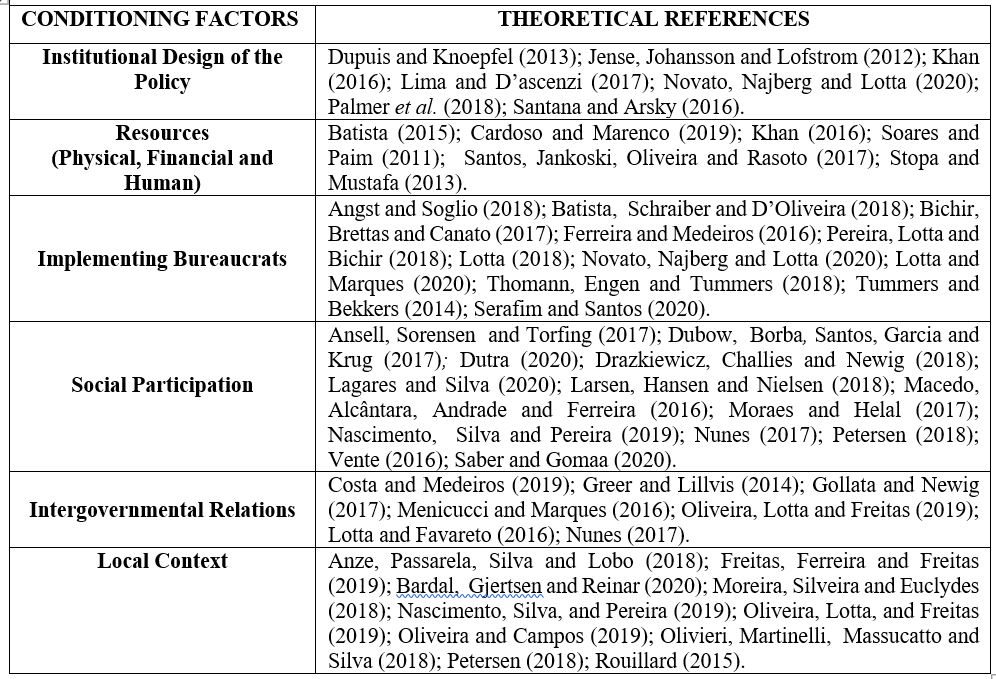
Research on public policy implementation has multiple theoretical and methodological approaches, resulting in a high dispersion of the topic (Lima & D'ascenzi, 2019). Given this scenario, we developed a systematic review of the national and international literature to identify and categorize the factors that impact public policy implementation, as presented in Table 1.
Protocols were oriented by Bicudo (2014) and Pereira et al. (2019). To search for the material, we used terms in Portuguese and English on public policy implementation on these platforms: Google Academic, SPELL, and Capes, until saturation of the theoretical subject.
In this part of the literature review (Chart 1), we selected the following criteria: (1) papers published from 2010 to 2020; (2) theoretical-empirical scientific papers published in Brazilian and international journals, in Portuguese or English languages; (3) technical studies of research agencies. Bibliographic research, monographs, dissertations, theses, and book chapters were excluded.
After gathering the papers, 94 papers were cataloged. These studies went through initial filtering, by reading their abstracts and conclusions, to verify their coherence. After this, 47 studies remained.
We assessed those papers by employing content analysis. The structuring literature review, following the assumptions of Political Management Theory, allowed us to identify six factors that influence the implementation of public policies (Chart 1). Then, these factors were evaluated and allocated in the analytical model proposed in this work (Figure 1).
Source: Elaborated by the authors (2021).
The analysis model of the public policy refers to the idea that implementation occurs after its formulation, following the guidelines of the policy's institutional design (political plan). Currently, it regards this process as cyclical and sequential. However, for successful policy execution, it is necessary - among other factors - that the institutional design (developed during the formulation stage) presents appropriate theoretical foundations, achievable targets, and objectives, and determining timeframes. In addition, the wording of the policy design cannot include ambiguities (in legal, cultural, and social aspects) and must be clear and concise (Khan, 2016; Novato, Najberg & Lotta, 2020).
It is also noteworthy that the institutional design should observe the characteristics of the implementing agencies or entities and the limitations of the execution scope, as well as define the limits and strategies for adapting and adjusting the policy to local reality and monitoring the results (Dupuis & Knoepfel, 2013; Jense, Johansson, & Lofstrom, 2012; Santana & Arsky, 2016).
When the policy design allows for a free and subjective interpretation of its normative structure, it presents incomplete instructions or poor specifications; implementers may have distinct explanations of the policy plan, leading to executions that are totally disparate from the policy's core aims (Lima & D'ascenzi, 2017; Lotta, 2018). On the other hand, extremely rigid policy plans can make local adaptations difficult, create operational barriers, and demotivate the team responsible for execution (Palmer et al., 2018).
In addition to analyzing and comprehending the policy plan, implementing organizations need to estimate and mobilize the physical, financial, and human resources required to implement the policy. In this regard, the implementing agency must develop action plans indicating: (1) the availability, capacity, and quantity of physical, technological, and material spaces; (2) the number of public servants, as well as their qualification and training to meet the policy; (3) the budget availability for the implementation of the policy (Khan, 2016; Stopa & Mustafa, 2013).
Thus, the entity in charge of the execution may perform, before implementation, the acquisition of materials, works, and services hiring and training of personnel, the definition of managers and their duties and responsibilities, sizing, and financial disbursement so that policy has no interruptions or failures (Batista, 2015; Cardoso & Marenco, 2019; Santos et al., 2017; Soares & Paim, 2011).
Implementing bureaucrats, at each of their levels, work based on the perspective of bounded rationality and make decisions based on their discretionary power (when allowed in the institutional design of the policy), on personal factors (beliefs, customs, values, altruism, vocation, self-interest), on the availability of resources and budget, and on the way they relate to the other actors involved in the policy and target audience. They may have a flexible, legalistic, or associative role, in the sense of connecting with their partners and supporters (Batista, Schraiber & D'Oliveira, 2018; Bichir, Brettas, & Canato, 2017; Ferreira & Medeiros, 2016; Lotta & Bichir, 2018; Lotta & Marques, 2020).
In public policy implementation, the street-level bureaucrat is the actor who effectively contributes the most to policy execution (Angst & Soglio, 2018). These actors make discretionary decisions to settle: (1) conflicts of interests and social pressures on the policy; (2) vague guidelines and insufficient guidelines from the policy itself; (3) absence or deficiency of resources for execution; (4) the need to adapt to the local reality, among other factors. This situation leads bureaucrats, especially at the street level, to decide what can be done/executed in the face of a given context, not necessarily doing what they want, but what they can do. (Lota, 2018).
The actions of bureaucrats, especially street-level ones, can translate and align the policy's goals and language to the community's desires, as well as promote adaptations of the policy's goals and strategies to adjust it to local dynamics, resources, and capacities, modifying the policy's expected outcomes (Angst & Soglio, 2018; Thomann, Engen, & Tummers, 2018; Tummers & Bekkers, 2014; Serafim & Santos, 2020).
Besides bureaucrats, the implementation of a public policy relies on the social participation of multiple actors, through interest groups, organized civil society, business groups, or even through the isolated actions of citizens and media actions. These actors build a network to implement the policy to imprint on the policy their understandings, interests, conflicts, power, ideologies, and dispute for resources and legitimacy (Macedo et al., 2016; Nascimento, Silva, & Pereira, 2019; Saber & Gomaa, 2020).
In general, social participation allows greater interlocution between governments and civil society; promotes the inclusion of segments traditionally excluded from decision-making processes; confers a more participatory and democratic character to the implementation of a policy; expands the monitoring and oversight of the use of public resources; provides knowledge and information; enables the achievement of partners and collaboration; propitiates the overcoming of obstacle and conflict resolution; builds trust and acceptance of the authority of implementing bureaucracies; promotes sustainable and socially just decision-making; identifies flexible and workable solutions; extends policy reach; legitimizes policy as public; directs policy implementation that is best suited to local need and reality, contributing to policy outcomes (Ansell, Sorensen, & Torfing, 2017; Dubow, 2017; Drazkiewicz, Challies, & Newig, 2018; Dutra, 2020; Nunes, 2017; Vente, 2016; Petersen, 2018).
The implementation of the policy should provide spaces for dialogue and social interaction because the absence of social participation can indicate the centralizing character of the program, lack of transparency, generation of conflicts with citizens and interest groups, unequal distribution of costs and benefits of the policy, and the execution of policies that are merely a transcription of the institutional design, without contemplating the reality and demands of the municipal sphere (Lagares & Silva, 2020; Moraes & Helal, 2017; Larsen, Hansen, & Nielsen, 2018).
Next, due to the decentralization of public policy production, with municipalities having the role of executor and the higher entities having the mission of planning, inspection, and in some cases sponsorship, it is necessary to undertake intergovernmental relations (also called multilevel governance) so that the policy can be implemented (Menicucci & Marques, 2016; Oliveira, Lotta, & Freitas, 2019).
This integration is a management strategy that aims to improve the quality of care for users, based on a service delivery network that can involve vertical federative entities - between the Federal Government, States, and Municipalities - to horizontal relations through integrated activities between local agencies (secretariats), policy execution agreements, and the third sector (Costa & Medeiros, 2019).
Intergovernmental relations ought to be based on collaboration and synergy among executing agencies to guide, subsidize, and support local implementers, particularly municipalities that work with small budgets and have lower institutional capacities (Gollata & Newig, 2017; Greer & Lillvis, 2014; Nunes, 2017). These intergovernmental relations should not be rigid and limit local autonomy and adaptations (Lotta & Favareto, 2016).
Local context is a relevant point in the implementation process. In this regard, the course of the policy and consequently its results can be influenced by contextual factors, such as city size; division of roles and responsibilities among national, regional, and local authorities; administrative and political autonomy of subnational agencies; city-level operational capacity; lobby influence; changes in elected representatives due to the end of the mandate; replacement of commissioned staff; corruption; and local culture guide policy implementation and, consequently, its outcomes (Anze et al., 2018; Bardal, Gjertsen, & Reinar, 2020; Nascimento, Silva, & Pereira, 2019; Oliveri et al., 2018; Rouillard, 2015).
At a practical level, the local context can induce a better execution of policy, when the municipality has both structure and interests aligned with the scope of the policy, not deviating from its objectives, and expanding the reach and the quality of the results (Moreira, Silveira, & Euclydes; 2018). The local implementer can also customize the public policy to local interests and resources, modify normative instruments, distort objectives, and amplify the divergence of results, in a scenario often promoted to overcome local social, economic, and cultural difficulties (Oliveira & Campos, 2019).
Therefore, the public policy implementation process must consider the nuances of the local context so it can produce adequate results for the target audience (Freitas, Ferreira, & Freitas, 2019; Rouillard, 2015). In this sense, as already discussed in the institutional design factor, the policy is oriented to be structured from models that enable a precise wording of its objectives to the different publics and regionalities and define the limits of its suitability to the local context (Oliveira, Lotta, & Freitas, 2019; Petersen; 2018).
Having finished the systematized literature review, one can see that the six factors that determine the implementation of public policy are complex and inseparable. One cannot measure or explain the implementation of public policies by analyzing only one of these factors, even in-depth, since this would not suffice to understand its complexity.
Thus, it is possible to state that the present literature review met the assumptions of the Theory of Political Administration, as it presented variables linked to the macro processes of the policy, as well as the elements involved in the management of resources and instruments needed for its implementation (Santos et al., 2009; Santos et al., 2017). In this scope, this study was not limited to functionalist and delimited themes of public policy implementation and sought to map in a broad, in-depth, and interrelated way the political, social, relational, and technical factors involved in policy execution (Pinto et al., 2017; Santos et al., 2017; Santos, Santana, & Piau, 2011).
From this perspective, we intend to analyze the multiple factors presented above (Chart 1) in an integrated manner and associated with the dimensions (1) management capacity and (2) managerial capacity of the Management Theory (Figure 1) to provide a broader comprehension of the process of public policy implementation.
Analysis model: Capacity for local implementation of public policies
The early studies on public policy implementation assumed that a flawlessly public policy should be well-designed in its formal and technical dimensions, based on well-defined goals and strategies, and with available human and financial resources (top-down approach). So, they disregarded the relationship between the policy, its actors, context, and society (Van Meter & Van Horn, 1975; Sabatier, 1986; Sabatier & Mazmanian, 1980). This notion has been complemented by the understanding that elements such as discretionary power, social and cultural heterogeneity, different levels of government, and intergovernmental relations (bottom-up approach) within the normative and prescriptive universe (Farah, 2018; Lipsky, 2010; Thomann, Van Engen, & Tummers, 2018).
In broader terms, there is no best approach. The literature has pointed out that both perspectives – top-down and bottom-up – are appropriate, depending on the context and structure of the implemented policy (Matland, 1995; Thomann, Lieberherr, & Ingold, 2016). Nowadays, hybrid theoretical models are recommended to move away from antagonism and toward a combined application, associated with institutional, political, and local contexts (Andrews, Boyne, Law, & Walker, 2011).
To get this outcome, a theoretical basis that enables an integrative view of the process of public policy implementation and a joint evaluation of political, relational, and technical elements of public policy implementation is essential (Di Gusto & Ribeiro, 2019). In this sense, the Theory of Political Management has shown itself as a coherent theoretical-methodological approach by proposing to analyze the complex relationships among society, government, and the market, through the capacity of management and administrative management (Santos et al., 2017; Santos et al., 2009; Santos & Ribeiro, 1993).
In public policy domain, the Society represents individual needs, embodied in social demands; the Government represents the capacity to plan and execute public policies; and the Market refers to the competence of other fields of knowledge and social practices in implementation (execution) (Santos, Ribeiro, Ribeiro, & Pinto, 2017).
In this sense, analyzing public policies based on the Theory of Political Management requires understanding the relationship among political, technical, and social elements, and it indicates to adopt as analytic categories the (1) management capacity, linked to political and social macro processes, along with the (2) administrative management capacity, associated with administrative practices and tools (Santos et al., 2017). These two dimensions are specific to Political Management Theory and are considered inseparable and must be analyzed in an integrated approach.
The six dimensions of public policy implementation (Chart 1) were combined into the core categories of management capacity and administrative management capacity. This action enabled the formulation of hypotheses as a basis for the analysis model represented in Figure 1.
In this model, the management capacity (political macro process) refers – as an analytical dimension – to the management of political plans, the structuring of coordination, relationship and control instruments, and the achievement of social, economic, or cultural conditions of society (Gomes, 2019; Santos, 2004). For the Theory of Political Administration, the concept of management, when representing the theoretical/abstract (subjective) dimension of administrative phenomena, corresponds to the macro organizational level (which reflects the dimensions of society) and to the meso organizational level that reflects the role of the State (Santos et al., 2017).
In this sense, the management capacity relates to conditioning factors of public policy implementation such as (1) institutional design of policy frameworks; (2) intergovernmental relationships, and (3) social participation, as described in Figure 1. Thus, it is assumed that:
H. - Policy institutional design, intergovernmental relationships, and social participation contribute to the management capacity of public policy implementation.
H. - Management capacity influences the results of public policy implementation.
The administrative management capacity dimension (micro-processes and execution tools) refers to both the decisions made by bureaucrats and other social actors based on their local contexts, conditions and resources, and the daily administrative routines that guide the pattern and quality of public policy implementation (Gomes, 2019; Santos, 2004; Santos et al., 2017). The administrative management corresponds to the micro organizational level and, as defined by Santos et al. (2009, p. 929), reflects the “place of exercising the functions, the way of doing, the process of doing, production engineering in all senses”.
In this sense, administrative capacity relates to factors such as (1) physical, financial, and human resources; (2) implementing bureaucrats; and (3) local context, described in Figure 2. Therefore, it can be assumed that:
H. - The planning and allocation of physical, financial, and human resources, the actions of implementing bureaucrats, and the local context contribute to the administrative management capacity of public policy implementation.
H. - Administrative management capacity influences the results of public policy implementation.
Still concerning the analysis model, according to the Political Management Theory, Administration is political - it is not a complementary relation, but a connected activity between thinking (management planning) and doing (administrative execution) within a context, essentially guided by man, who is a political being (Ribeiro, 2006; Santos, 2004; Santos et al., 2009; Santos & Ribeiro, 1993). Thus, it is assumed that:
H. - Management and administrative management capacities contribute to local public policy implementation capacity.
H. - Local government implementation capacity influences policy results.
The graphical representation of the analysis model is presented below.
Figure 2: Public Policy Implementation Analysis Model
Source: Elaborated by the authors (2021).
The model in question assumes that it is possible to build a holistic knowledge about the implementation of public policy, through the joint analysis of management and administrative management capacities of the execution of policies, which enables to understand the reality, complexity, and totality of the phenomenon (Gomes, 2019; Honig, 2006).
In this sense, it is recommended to study a type of public policy at the local level, such as health, education, or environment, for the operationalization of this model (Santos et al., 2017). This recommendation is because each public policy has specific goals and elements. Therefore, it is necessary to map the actors and social groups involved, the field of execution, local and governmental relations, and preliminary or definitive results, if any.
From this, it will be possible to list/assign elements of analysis, for each of the six analytical factors previously described, appropriate to the scope of the policy to be studied. This model should be executed through mixed research methods (qualitative and quantitative) since they provide a practical way to understand multiple perspectives, different types of causal paths, and various outcomes, listing common characteristics of research problems on public policy implementation (Peters, Adam, Alonge, Agyepong, & Tran, 2014).
Finally, the purpose of this analytical framework is not to evaluate the policy, in the sense of measuring its outcomes, but to analyze the factors and variables that direct certain policy outcomes, to understand the totality and interrelatedness of the conditions that impact the implementation of public policy.
Final Considerations
Studies on the implementation phase of public policies began in the 1970s, aiming to understand the factors that provoke failures in the execution of policies or interfere in their results (Lipsky, 2010; Pressman & Wildavsky, 1973). Today, the literature converges on the following understandings: (1) despite theoretical advances, policy implementation is still considered an embryonic field of research studies; (2) implementing public policies is a complex and multifaceted phenomenon, given its many dimensions and intervening factors; (3) it is necessary to undertake studies that portray the integration of individual, institutional, cultural, political, and organizational elements that interfere in the implementation of public policies, as opposed to research that analyzes isolated or utilitarian aspects of the policy, without presenting or understanding the reality as a whole (Arretche, 2001; Gusto & Ribeiro, 2019; Gomes, 2019; Honig, 2006; Lotta, 2019).
In this sense, the Theory of Political Management presented itself as competent to fulfill the current needs of this field. It articulates macro and micro dimensions - management and administrative management - to the conditioning factors of the implementation of public policies, enabling an analytical model (Figure 1) to guide holistic and integrative studies (Amaral & David, 2017; Santos et al., 2017; Sumiya et al., 2014).
Therefore, it is possible to broaden and, at the same time, deepen the study of managerial administration concerning the political, social, and technical-operational dimensions of public policy implementation, aiming to get outcomes that explain the totality and reality of the phenomenon (Pinto et al., 2017; Santos et al., 2017).
This non-functionalist comprehension of the implementation of public policies can guide local governments on (1) management capacity, through the evaluation of the policy's institutional design, intergovernmental relationship, and social participation; and (2) administrative management capacity, measured by the planning and allocation of physical, financial, and human resources, the performance of implementing bureaucrats, and the local context. Both abilities are considered inseparable and necessary to implement public policies - from the standpoint of the Political Management Theory.
We point out that the analysis model proposed in this paper, despite having emphasized local government capacity, can be applied to analyze the implementation of public policies by other governmental levels, with the necessary adjustments in its variables.
Finally, for upcoming research, it was planned to test the hypotheses listed, to validate the theoretical constructs and ratify the assumptions of the Theory of Political Administration.
References
Amaral, I. G., David, I. P. (2017). Administração Política: Um caminho para ampliação do Campo De Estudo Das Ciências Administrativas? Revista de Estudos Organizacionais e Sociedade, 4(10), 1-13.
Angst, I. T., Soglio, F. K. D. (2018). Implementação de políticas públicas na pesca artesanal: a atuação dos burocratas de nível de rua. Revista Extensão Rural, 25(1), 93-111.
Ansell, C., Sorensen, E. & Torfing, J. (2017). Improving policy implementation through collaborative policymaking. Policy and politics, 45(3), 467-486.
Anze, V. R., Passarela, G., Silva, D. C. A., ,Lobo, V. (2018). Desafios para a implementação e o acompanhamento das políticas de fomento à economia solidária. RCIPEA – Repositório de conhecimento do IPEA, 64(1), 141-152.
Andrews, R., Boyne, G. A., Law, J. ,Walker, R. M. (2011). Strategy Implementation and Public Service Performance. Administration & Society, 43(6), 643-671.
Arretche, M. (2001). Uma contribuição para fazermos avaliações menos ingênuas. In M.C.R.N. Barreira, M.C.B. Carvalho. (Orgs.). Tendências e perspectivas na avaliação de políticas e programas sociais (pp. 43-55). São Paulo: IEE/PUC-SP.
Bardal, K. G., Gjertsen, A., Reinar, M. B. (2020). Sustainable mobility: Policy design and implementation in three Norwegian cities. Transportation Research Part D, 82(1), 1-15.
Batista, M. (2015). Burocracia local e qualidade da implementação de políticas descentralizadas: uma análise da gestão de recursos federais pelos municípios brasileiros. Revista do Serviço Público, 66(3), 345-370.
Batista, K. B. C., Schraiber, L. B., D’Oliveira, A. F. P. L. (2018). Gestores de saúde e o enfrentamento da violência de gênero contra as mulheres: as políticas públicas e sua implementação em São Paulo, Brasil. Cadernos de Saúde Pública, 34(8), 1-11.
Bichir, R. M., Brettas, G. H., Canato, P. (2017). Multi-level governance in federal contexts: the social assistance policy in the city of São Paulo. Brazilian Political Science Review, São Paulo, 11(2), 1-28.
Bicudo, M. A. V. (2014). Meta-análise: seu significado para a pesquisa qualitativa. Revista Eletrônica de Educação Matemática, 9(0), 7-20.
Cardoso, A. L. R., Marenco, A. (2019). Qualidade Burocrática e Performance Estatal: desvendando a caixa preta do município. Administração Pública e Gestão Social, 4(11), 1-21.
Costa, R., Medeiros, A. (2019). Cooperação e Intersetorialidade na Política sobre Drogas no Brasil. Revista de Administração, Sociedade e Inovação, 5(1), 21-40.
Di Gusto, S. M. N., Ribeiro, V. M. (2019). Implementação de Políticas Públicas: conceito e principais fatores intervenientes. Revista de Estudios Teóricos y Epistemológicos en Política Educativa, (4), 1-10.
Draskiewicz, A., Challies, E., Newig, J. (2015). Public participation and local environmental planning: Testing factors influencing decision quality and implementation in four case studies from Germany. Land Use Policy, 46(1), 211-222.
Dubow, C. Borba, T. T., Santos, C. R., Garcia, E. L., Krug, S. B. F. (2017). Participação social na implementação das políticas públicas de saúde: uma revisão crítico reflexiva. Saúde & Transformação Social, 8(2), 103-111.
Dupuis, J., Knoepfel, P. (2013) The Adaptation Policy Paradox: the implementation deficit of policies framed as climate change adaptation. Ecology and Society, 18(4), 1-31.
Dutra, R. (2020) Political-administrative system and the interactions in the implementation of public policies. Revista Brasileira de Ciências Sociais, 35(102), 1-21.
Farah, M. F. S. (2018). Abordagens teóricas no campo de política pública no Brasil e no exterior: do fato à complexidade. Revista do Serviço Público, edição especial, 53-84.
Ferreira, V. R. S., Medeiros, J. J. (2016). Fatores que moldam o comportamento dos burocratas de nível de rua no processo de implementação de políticas públicas. Cadernos EBAPE.BR, 14(3), 776-793.
Freitas, A. F., Ferreira, M. A. M., Freitas, A. F. (2019). A trajetória das organizações de agricultores familiares e a implementação de políticas públicas: Um estudo de dois casos. Revista de Economia e Sociologia Rural, 57(1), 10-27.
Gollata, J. A. M., ,Newig, J. (2017). Policy implementation through multi-level governance: analysing practical implementation of EU air quality directives in Germany. Journal of European Public Policy, 24(9), 1-20.
Gomes, F. G. (2012). O jovem percurso da administração política. Revista de Administração Pública, 46(1), 7-24.
Gomes, S. (2019). Sobre a viabilidade de uma agenda de pesquisa coletiva integrando implementação de políticas, formulação e resultados. In Lotta, Gabriela (Org). Teoria e análises sobre implantação de políticas públicas no Brasil. Brasília: Enap.
Greer, S. L. ,Lillvis, D. F. (2014). Beyond leadership: Political strategies for coordination in health policies. Health Policy, 116(1), 12-17.
Honig, M. I. (2006). Complexity and policy implementation: challenges and opportunities for the field. In Honig, Meredith I. (Ed.). New directions in education policy implementation: confronting complexity. Sunny Press.
Jensen, C., Johansson, S., Löfström, M. (2012). The project organization as a policy tool in implementing welfare reforms in the public sector.International Journal of Health Planning and Management, 28(1), 122-137.
Justen, A., Gurgel, C. R. M., Ferraz, D. L. S., Cunha, E. P. (2017) Administração política: por uma agenda de pesquisa marxista. Revista de Estudos Organizacionais e Sociedade, 4(10), 663-759.
Khan, A. R. (2016). Policy implementation. Journal of Community Positive Practices, 16(3), 3-12.
Lagares, R., Silva, M. L. A. (2020). (IN)Capacidade de implementação de políticas públicas educacionais no município de Miracema do Tocantins : perspectivas , complexidades e possibilidades. Jornal de Políticas Educacionais, 14(39), 1-28.
Larsen, S. V., Hansen, A. M., Nielsen, H. N. (2018). The role of EIA and weak assessments of social impacts in conflicts over implementation of renewable energy policies. Energy Policy, 115(4), 43-53.
Lavalle; A. G., Rodrigues, M., Guichney, H. (2019). Agência local e indução federal: a operação da política municipal de habitação em Recife e Curitiba. Revista Sociologia e Política, 27(71), 1-27.
Lima, L. L., D ’Ascenzi, L. (2017). O papel da burocracia de nível de rua na implementação e (re) formulação da Política Nacional de Humanização dos serviços de saúde de Porto Alegre (RS) Governo do Estado do Rio Grande do Sul / Agência Estadual de Regulação dos Serviços Públicos Delegados. Revista de Administração Pública, 51(1), 46-63.
Lima, L. L., D ’Ascenzi, L. (2019). Implementação e avaliação de políticas públicas: intersecções, limites e continuidades. In Lotta, Gabriela (Org.). Teoria e análises sobre implantação de políticas públicas no Brasil. Brasília: Enap.
Lipsky, M. (2010). Street-level bureaucracy: dilemmas of the individual in public services. New York: Russell Sage Foundation.
Lotta, G. (2019). A política pública como ela é: contribuições dos estudos sobre implementação para a análise de políticas públicas. In Lotta, Gabriela (Org.). Teoria e análises sobre implantação de políticas públicas no Brasil. Brasília: Enap.
Lotta, G. (2018). Bureaucrats, social networks and interaction: An analysis of public policies implementation. Revista de Sociologia e Política, 26(66), 145-173.
Lotta, G., Favareto, A. (2016). Desafios da integração nos novos arranjos institucionais de políticas públicas no Brasil. Revista de Sociologia e Politica, 24(57), 49-65.
Lotta, G. S., Marques, E. C. (2020). How social networks affect policy implementation: An analysis of street-level bureaucrats’ performance regarding a health policy. Social Policy and Administration, 54(3), 345-360.
Macedo, A. S., Alcântara, V. C., Andrade, L. F. S., Ferreira, P. A. (2016). O papel dos atores na formulação e implementação de políticas públicas: dinâmicas, conflitos e interesses no Programa Mais Médicos. Cadernos EBAPE.BR, 14, 593-618.
Matland, R. E. (1995). Synthesizing the implementation literature: the ambiguity-conflict model of policy implementation. Journal of Public Administration Research and Theory, 5(2), 145-174.
Menicucci, T., Marques, A. M. F. (2016). Cooperação e Coordenação na Implementação de Políticas Públicas: O caso da saúde. Dados - Revista de Ciências Sociais, 59(3), 823-865.
Moraes, J. Sobrinho, Helal, D. H. (2017). A implementação de políticas públicas voltadas a atividades artesanais: análise do programa de artesanato da Paraíba. Organizações & Sociedade, 24(80), 115-134.
Moreira, V. S., Silveira, S. F. R., Euclydes, F. M. (2018). Dinâmicas locais na implementação de políticas públicas: análise do PMCMV em Minas Gerais. Cadernos Gestão Pública e Cidadania, 23(75), 170-193.
Mota, L. (2020). Estudos de implementação de políticas públicas: uma revisão da literatura. Sociologia, Problemas e Práticas, 1(92), 133-150.
Nascimento, I. R. T., Silva, H. A. S., Pereira, V. DA S. P. (2019). Análise da ação de atores sociais no processo de implementação de políticas públicas: uma proposta de aplicação da metodologia da arena de atores. RECC – Revista Eletrônica Científica do CRA-PR, 6(2), 63-77.
Novato, V. O. L., Najberg, E., Lotta, G. S. (2020). O burocrata de médio escalão na implementação de políticas públicas, 54(3), 416-432.
Nunes, A. C. A. S. (2017). Análise de arranjos de implementação de políticas públicas de enfrentamento à violência contra mulheres em municípios de pequeno porte. Revista do Serviço Público, 68(3), 503-532
Oliveira, L. A., Campos, M. D. S. (2019). Variações locais na implementação de políticas públicas de educação integral: estudo de casos de duas escolas da rede pública estadual do município de Patos de Minas/MG. Revista Brasileira de Política e Administração da Educação, 35(3), 998-1017.
Oliveira, V. E., Lotta, G. S., Freitas, M. N. (2019). Desafios da implementação de uma política intersetorial e federativa: as burocracias de médio escalão do Programa Bolsa Família. Revista do Serviço Público, 70(3), 458-485.
Olivieri, C., Martinelli, B., Massucatto, P., Silva, C. B.(2018). Gestão municipal e corrupção na implementação de programas educacionais federais. Revista de Administração Pública, 52(1), 169-179.
Palmer , K. S., Brown, A. D., Evans, J. M., Marani, H., Russell, K. K., Martin, D., Ivers, N. M. (2018). Qualitative analysis of the dynamics of policy design and implementation in hospital funding reform. PLOS ONE, 13(1), 1-18.
Pereira, G. N., Lotta, G. S., Bichir, R. M. (2018). Implementação de políticas públicas no nível intramunicipal: o caso das Supervisões de Assistência Social da cidade de São Paulo. Revista Brasileira de Políticas Públicas e Internacionais - RPPI, 3(1), 286-311.
Pereira, R. S., Santos, I. C., Oliveira, K. D. S., Leão, N. C. A. (2019). Metanálise como instrumento de pesquisa: Uma revisão sistemática dos estudos bibliométricos em Administração. Revista de Administração Mackenzie, 20(5), 1-33.
Perez, J. R. R. (2010) Por que pesquisar a implementação de políticas educacionais atualmente? Educação e Sociedade, 31(113), 1179-1193.
Peters, D. H., Adam, T,. Alonge, O., Agyepong, I. A., Tran, N. (2014). Republished research: Implementation research: What it is and how to do it. British Journal of Sports Medicine, 48(8), 731-736.
Petersen, J. P. (2018). The application of municipal renewable energy policies at community level in Denmark: A taxonomy of implementation challenges. Sustainable Cities and Society, 38(12), 205-218.
Pinto, F. L. B., Silva, R. R. C. C., Matos, L. S., Pereira, G. T. J. (2017). O ensino da administração política no Brasil: conteúdos, relatos e perspectivas. Revista de Estudos Organizacionais e Sociedade, 4(10), 524-599.
Pressman, J. L., Wildavsky, A. (1984). Implementation: how great expectations in Washington are dashed in Oakland. Berkeley: University of California Press.
Pressman, J. L., WIildavsky, A. (1973). Implementation. Berkeley: University of California Press.
Ribeiro, J. U. (2006). Administração e política. Organizações & Sociedade, 13(38), 162-194.
Rouillard, J, J., Ball, T., Heal, K. V. Reeves, A. D. (2015). Policy implementation of catchment-scale flood risk management: Learning from Scotland and England.Environmental Science and Policy, 50(1), 155-165.
Sabatier, P. (1986). Top-down and bottom-up approaches to implementation research: a critical analysis and suggested synthesis. Journal of Public Policy, 6(1), 21-48.
Sabatier, P., Mazmanian, D. (1980). Policy implementation: a framework of analysis.Policy Studies Journal, 8(4), 538-560.
Saber, H., Gomaa, S. S. (2020). Policy networks as a unit of analysis of public policies: a case study of the social and health insurance policy network in Egypt (2015–2019).Review of Economics and Political Science, 1(1), 1-15.
Santana, V. L. Arsky, I. D. C. (2016). Aprendizado e inovação no desenho de regras para a implementação de políticas públicas: a experiência do Programa Cisternas. Revista do Serviço Público, 67( 2), 203-226.
Santos, F. R., Jankoski, A. R. M. C., Oliveira, A. G., Rasoto, V. I. (2017). O orçamento-programa e a execução das políticas públicas. Revista do Serviço Público, 68(1),191-212.
Santos, R. S. (2004). A administração política como campo do conhecimento. São Paulo/Salvador: Hucitec/Mandacaru.
Santos, R. S., Ribeiro, E. M. (1993). A administração política brasileira. Revista de Administração Pública, 27(4), 102-135.
Santos, R. S., Ribeiro, E. M., Santos T. C. S. (2009). Bases teórico-metodológicas da administração política. Revista de Administração Pública, 43(4), 919-941.
Santos, R. S., Ribeiro, E. M., Ribeiro, M. M., Santos, T. C. S., Costa, V. M. (2004). Reestruturação produtiva do Estado na perspectiva neoliberal. Revista de Administração Pública, 38(1), 7-32.
Santos, R. S., Ribeiro, E. M., Ribeiro, M. M., Pinto, F. L. B. (2017). Administração política e políticas públicas: em busca de uma nova abordagem teórico-metodológica para a (re)interpretação das relações sociais de produção, circulação e distribuição. Cadernos EBAPE.BR, 15(4), 939-959.
Santos, E. L., Santana, W. S. P., Piau, D. D. N. D. (2011). Reflexões sobre os Rumos da Administração Política. Anais do Encontro Nacional da Associação Nacional de Pós-Graduação e Pesquisa em Administração, Rio de Janeiro, RJ, Brasil, 25.
Serafim, N. C. C., Santos, M. H. P. (2020). Análise da implementação da política pública ronda Maria da Penha em Juazeiro - BAHIA. Revista Opara – Ciências Contemporâneas Aplicada., 10(2), 84-94.
Soares, C. L. M., Paim, J. S. (2011). Aspectos críticos para a implementação da política de saúde bucal no Município de Salvador, Bahia, Brasil. Cadernos de Saúde Publica, 27(5), 966–974.
Stopa, R., Mustafa, P. S. (2013). A implantação do Sistema Único de Assistência Social em Ourinhos/SP: a contribuição do Serviço Social. Serviço Social em Revista, 15(2), 152-174.
Sumiya, L. A., Silva, M. P., Araújo, M. A. D. (2014). Paradigmas e críticas presentes na construção do campo de conhecimento da administração política. Revista Pensamento Contemporâneo em Administração, 8(1), 35-49.
Teixeira, A. F., Gomes, R. C. (2019). Governança pública: uma revisão conceitual. Revista do Serviço Público, 70(4), 519-550.
Thomann, E., Liebeherr, E. Ingold, K. (2016) Torn between state and market: Private policy implementation and conflicting institutional logics. Policy and Society, 35(1), 57-69.
Thomann, E., Van Eengen, N. Tummers, L. (2018) The mecessity of discretion: a behavioral evaluation of bottom-up implementation theory. Journal of Public Administration Research and Theory, 28(4), 583-601.
Trein P., Maggetti. M. (2019). Patterns of Policy Integration and Administrative Coordination Reforms: A Comparative Empirical Analysis. Public Administration Review, 1(1), 1-11.
Tummers, L., Bekkers, V. (2014). Policy Implementation, Street-level Bureaucracy, and the Importance of Discretion. Public Management Review, 16(4), 527-547.
Van Meter, D. S., Van Horn, C. E. (1975). The policy implementation process: a conceptual framework. Administration and Society, 6(4), 445-88.
Vente, J., Reed, M. S., Stringer, L. C., Valente, S., Newig, J. (2016). How does the context and design of participatory decision making processes affect their outcomes? Evidence from sustainable land management in global drylands. Ecology and Society, 21(2), 1-24.