Dismantling and Reconstruction of Public Policies in Brazil: From Bolsonaro’s Destruction to the Possibilities of Union to Rebuild
Desmonte e Reconstrução de Políticas Públicas no Brasil: Da Destruição de Bolsonaro às Possibilidades de União para Reconstruir
Desmantelamiento y Reconstrucción de Políticas Públicas en Brasil: De la Destrucción de Bolsonaro a las Posibilidades de Unión para Reconstruir
Dismantling and Reconstruction of Public Policies in Brazil: From Bolsonaro’s Destruction to the Possibilities of Union to Rebuild
Administração Pública e Gestão Social, vol. 16, núm. 2, 2024
Universidade Federal de Viçosa

Esta obra está bajo una Licencia Creative Commons Atribución-NoComercial-SinDerivar 4.0 Internacional.
Recepción: 16 Mayo 2023
Aprobación: 28 Noviembre 2023
Publicación: 25 Abril 2024
Resumo:
Objetivo da pesquisa: Este artigo discute a situação política brasileira com foco no desmonte de políticas públicas ocorrido durante o governo do presidente Bolsonaro (2019-2022) e aborda a possibilidade de reconstruir o Estado brasileiro que surgiu com a eleição do presidente Lula.
Enquadramento teórico: O estudo segue análises contextuais anteriores que mostram como a crise da democracia brasileira levou à eleição de Bolsonaro e à formação de seu governo. A literatura sobre desmantelamento de políticas é considerada para analisar as estratégias desenvolvidas por um governo populista de extrema direita, como o de Bolsonaro no Brasil.
Metodologia: Este trabalho é um ensaio que analisa a conjuntura político-econômica brasileira durante a administração Bolsonaro.
Resultados: O artigo demonstra como o Estado brasileiro foi desmantelado, comprometendo a provisão de políticas públicas que garantam os direitos sociais, políticos e humanos consagrados na Constituição brasileira de 1988. Foi desenvolvida uma análise crítica do desempenho de seis diferentes áreas de políticas públicas e a identificação dos efeitos das mudanças disruptivas deliberadamente realizadas pelo governo Bolsonaro. Além disso, o artigo ilustra as primeiras soluções propostas pelo novo governo e as perspectivas de enfrentamento da crise política gerada pela extrema direita populista no Brasil.
Originalidade: Diferentemente de outras pesquisas que se concentraram em apenas uma área de política pública, este trabalho analisa um conjunto de áreas estrategicamente relevantes. O escopo da análise ilustra o modus operandi da administração Bolsonaro e esclarece o desenho ideológico de seu governo e sua base de apoio eleitoral.
Contribuições teóricas e práticas: Este artigo contribui para a caracterização do “Bolsonarismo” como um fenômeno político, seus efeitos e permanência, mesmo após a derrota eleitoral. O trabalho também explica a dinâmica das relações entre o governo e o parlamento, diante da pressão de grupos políticos com interesses alinhados às ideias de extrema direita.
Palavras-chave: Desmonte de políticas públicas no Brasil, Rompimento das instituições democráticas, Perspectivas de reconstrução.
Abstract:
Research objective: This article discusses the Brazilian political situation with a focus on the public policy dismantling that occurred during the government of President Bolsonaro (2019-2022) and addresses the possibility that emerged with the election of President Lula of rebuilding the Brazilian state.
Theoretical framework: The study follows previous contextual analyses that show how the crisis of Brazilian democracy led to the election of Bolsonaro and the formation of his government. Policy dismantling literature is considered to analyze the strategies developed by a populist far-right government, such as Bolsonaro’s in Brazil.
Methodology: This work is an essay that analyzes the Brazilian political-economic conjuncture during the Bolsonaro administration.
Results: The article demonstrates how the Brazilian state was dismantled, jeopardizing the provision of public policies that guarantee the social, political, and human rights enshrined in the 1988 Brazilian Constitution. A critical analysis of the performance of six different areas of public policy and identification of the effects of the disruptive changes deliberately made by the Bolsonaro administration were developed. In addition, the article illustrates the first solutions proposed by the new government and prospects for tackling the political crisis generated by the populist extreme right in Brazil.
Originality: Unlike other research that have focused on just one area of public policy, this work analyzes a set of strategically relevant areas. The scope of the analysis illustrates the modus operandi of the Bolsonaro administration and sheds light on the ideological design of his government and electoral support base.
Theoretical and practical contributions: This article contributes to the characterization of “Bolsonarism” as a political phenomenon, its effects and permanence, even after the electoral defeat. The work also explains the dynamics of relations between government and parliament, in the face of pressure from political groups carrying interests aligned with extreme right-wing ideas.
Keywords: Public policies dismantling in Brazil, Disrupt of democratic institutions, Reconstruction perspectives.
Resumen:
Objetivo de investigación: Este artículo discute la situación política brasileña con un enfoque en el desmantelamiento de políticas públicas que ocurrió durante la administración del presidente Bolsonaro (2019-2022) y aborda la posibilidad de reconstruir el Estado brasileño surgida con la elección del presidente Lula.
Marco teórico: El estudio sigue análisis contextuales previos que muestran cómo la crisis de la democracia brasileña llevó a la elección de Bolsonaro y a la formación de su gobierno. Se considera la literatura sobre desmantelamiento de políticas para analizar las estrategias desarrolladas por un gobierno populista de extrema derecha como el de Bolsonaro en Brasil.
Metodología: Este artículo es un ensayo que analiza la coyuntura político-económica brasileña durante el gobierno Bolsonaro.
Resultados: El artículo demuestra cómo el Estado brasileño fue desmantelado, comprometiendo la provisión de políticas públicas que garanticen derechos sociales, políticos y humanos consagrados en la Constitución brasileña de 1988. Desarrolla un análisis crítico del desempeño de seis áreas diferentes de políticas públicas e identifica los efectos de los cambios disruptivos perpetrados deliberadamente por el gobierno Bolsonaro. El artículo ilustra las primeras soluciones propuestas por el nuevo gobierno y las perspectivas para enfrentar la crisis política generada por la extrema derecha populista en Brasil.
Originalidad: A diferencia de otros estudios centrados en un área de política pública, este trabajo analiza un conjunto de áreas estratégicamente relevantes. El alcance del análisis ilustra el modus operandi de la administración Bolsonaro y arroja luz sobre el diseño ideológico de su gobierno y base de apoyo electoral.
Aportes teóricos y prácticos: Este artículo contribuye a la caracterización del “Bolsonarismo” como fenómeno político, sus efectos y permanencia, incluso después de la derrota electoral; explica la dinámica de las relaciones entre el gobierno y el parlamento, ante la presión de grupos políticos con intereses alineados con ideas de extrema derecha.
Palabras clave: Desmantelamiento de políticas públicas en Brasil, Ruptura de las instituciones democráticas, Perspectivas de reconstrucción.
1 Introduction
This article discusses the Brazilian political situation with a focus on the dismantling that occurred during the government of President Jair Bolsonaro between 2019 and 2022 and the possibility of rebuilding politics and the Brazilian state, which came with the election of President Lula da Silva in October 2022. The study seeks to demonstrate how the Brazilian state was dismantled, jeopardizing the provision of public policies that guarantee the social, political, and human rights enshrined in the 1988 Brazilian Constitution. This article follows previous contextual analyses we have developed – see Fernandes et al. (2020) and Fernandes et al. (2022). In summary, these two works show how the crisis of Brazilian democracy led to the election of Bolsonaro and his subsequent administration, which dismantled the Brazilian state and public policies.
Brazil entered crisis of its democracy as of 2013. The so-called “June Days” of 2013 in Brazil are characterized by a series of diffuse demands, but which began led by the Free Pass Movement (Movimento do Passe Livre), which complained about the increase in bus fares in São Paulo. From then on, a series of mass mobilizations spread to all the country's capital and medium-sized cities, bringing many different groups and individuals to the streets for a wide variety of claims, such as police violence, lack of investment in services and infrastructure, spending on the mega-sporting events that would be hosted in Brazil (the 2014 World Cup and the 2016 Olympic Games), as well as corruption, the prevalence of a system of politicians and parties driven by opportunistic interests and the inability of representative democracy to respond effectively to the demands of the population. These protests lasted until October 2013 and ended up being dominated by mostly conservative and right-wing groups and leaders, with the support of the mainstream press. These events were one of the embryos of President Dilma's impeachment process and the broad democratic crisis that followed.
Along with the political crisis, an economic crisis was triggered which, together with the other elements described below, resulted in the election of President Bolsonaro in 2018. The first element refers to social media and its role in spreading fake news and creating a channel conducive to the hyper-politics of hate and resentment (Quadrado & Ferreira, 2020; Mercuri & Lima-Lopes, 2020). The other element was the impeachment of President Dilma Rousseff in 2016, which was alleged as a crime of responsibility for credit operations between the National Treasury and public banks (BNDES, Caixa Econômica Federal and Banco do Brasil), carried out in a disguised and illicit manner, without legal provision or legislative authorization, with the aim of artificially improving public accounts, the so-called “fiscal pedalling” (pedaladas fiscais). In 2022, the 5th Coordination and Review Chamber of the Tribunal de Contas da União (the Federal Court of Auditors) ruled out the possibility of holding public agents who participated in the tax cycles liable, concluding that those involved acted in accordance with the conduct of the Ministry of Planning, Budget and Management. In other words, the impeachment of Dilma Rousseff was nothing more than a purely political deposition of the President, articulated by the National Congress, with the support of the mainstream press and far-right movements. It is important to highlight that impeachment is a frequent practice in South American countries with a presidential system and causes extreme future political instability, often irreversible (Hochstetler, 2007). Impeachment has proved to be one of Brazil's greatest historical self-deceptions.
After impeachment, the other element that makes the crisis of Brazilian democracy acute is President Temer's mandate. It was marked by the implementation of anachronistic neoliberalism, a destroyer of social rights, evidenced in Constitutional Amendment (EC) 95/2016 (spending cap) and in law 13467/2017 (labor reform), which paved the way for a wild economy. Also, this atmosphere contributed to the return of the military to the political scene, particularly when the State of Rio de Janeiro requested federal intervention to address a problem of public security and the military took over the area under the command of a general between February and December 2018 (Teles & Quinalha, 2021).
Along with the administration of President Temer, the so-called “Car Wash Operation” (Operação Lava Jato) advances. At first, the operation was a task force to combat corruption. However, it turned into an attempt to create a parallel and histrionic justice system characterized by its relationship with the media mainstream and by improperly performing police activities. The operation gained support from major media outlets and a segment of the justice system. While Operation Car Wash contributed to turning public opinion against the political system, it actually had its own political agenda, which became evident with the rise of the far right and the election of Bolsonaro (Duarte, 2020; Kerche & Marona, 2022).
Another important element in explaining the crisis of Brazilian democracy that led to Bolsonaro's election was the accession of the “new middle class” (nova classe media). Made up of low and low-middle-income populations – to the media narrative around Operation Car Wash. This population segment is conservative in customs and believes in an abstract meritocracy that attributes its failure to the political system (Unger, 2018). The analyses developed by Fernandes et al. (2020) and Fernandes et al. (2022) demonstrate how Brazil entered a political crisis ten years ago, which triggered an economic crisis that, added to other factors, led to the election of President Bolsonaro in 2018.
However, the crisis of democracy with the rise of the far right was not exclusive to Brazil. The election of Viktor Orban (Hungary), Mateusz Morawiecki (Poland), Sebastian Kurz (Austria), Matteo Salvini and Giorgia Meloni (Italy), Rodrigo Duterte (Philippines), Erdogan (Türkiye), Trump (United States); Boris Johnson (UK), Andrej Babis (Czech Republic) and, most recently, Javier Milei (Argentina) are examples of this emergence worldwide. The rise of the far right was observed in several countries on different continents, and many nations faced or are facing problems like those in Brazil. The far right has expanded worldwide in the last decade, increasing the number and influence of its think tanks, which disseminate ultraconservative thinking. Also, funding to far-right movements has increased with the participation of grant making organizations such as Atlas Network and Koch Foundation (Schiavon, 2020). In addition, there is a diffusion of conservative traditionalism through digital influencers (Teitelbaum, 2020).
One question remains unanswered: why, in recent years, have we witnessed the election of far-right reactionary leaders? Some elements may serve as hypotheses. The first element is the crisis of representative democracies, which has been accentuated by the advances in fighting and preventing corruption. Despite being a crucial activity in democratic systems, fighting corruption has led to an unbridled wave of investigations worldwide from 2013, mining the image of the entire political system with public opinion. The fight against corruption is also a political process that depends on the countries’ political regimes and on constructing legislation and institutions.
The clash between the multilateral global advances and the local xenophobic reactions is the second element. Since the global environmental framework based on ECO-92 (1992), Conferences of the Parties (1997), Rio +10 (2002), Rio +20 (2012), and the Sustainability Charter (2015), multilateral organizations have advanced in a global consensus about a better social life. However, globalization entails many challenges, such as the refugee zones with populations from poor countries and/or countries devastated by civil wars and dictatorial regimes. The number of refugees is quite high, which generates economic, social, and political impacts on the nations that receive these people.
The crisis of contemporary democracy is also a crisis of distrust among ordinary citizens towards institutions and politicians. The marches of 2012 and 2013: Occupy Wall Street (USA), Los Indignados (Spain) and the protests in Brazil, among others, show disbelief in democracy, politicians and parties. Political systems are limited in representing citizens and the demands of society exceed the capacity of the State. The rise of anti-politics and the choice of outsiders and representatives of the extreme right, who previously lived in ostracism and political caricature, is a response to this context. This, combined with social media platforms that have been used to mobilize uninformed people involved in the dissemination of false news stimulated by algorithms (Silva, 2017; Silveira, 2019), are important elements in the crisis of contemporary democracies.
The common thread of the global far right is that its constituents are a sectarian minority that supports a family and/or religious nuclear ultra-conservatism. They are pro-gun, racist, xenophobes, misogynists, homophobes, and transphobes. The far-right governments are characterized by violence and repression, often with links with neo-Nazi or neo-fascist political groups. From the economic point of view, they defend anachronistic neoliberalism (Klein, 2008), where there is a minimal state and widespread defence of business interests. Furthermore, they form authoritarian governments that aim to destroy the sedimentary institutions of the democratic state (Levitsky & Ziblatt, 2018; Mounk, 2019; Empoli, 2019). In addition to the conspiratorial view of political life, the anti-science character in favor of ignorance should also be highlighted.
During his 30 years as a federal deputy and four years as president, Jair Bolsonaro was perhaps one of the world’s greatest syntheses of the far right. His government was an attempt to destroy everything that existed in terms of public policy. His management was riddled with evidence of crimes of responsibility and common crimes being investigated, in addition to leaving the country in a terrible economic situation (inflation, low growth, increased inequality, the return of hunger and child malnutrition, etc.). The relationship established with the legislature was of co-optation and vote-buying, with the sole aim of staying in office and avoiding impeachment. During the pandemic, President Bolsonaro was one of the most denialist world leaders, driving the country to 700,000 deaths from COVID-19. He sabotaged the 2022 electoral process in every way; for example, by openly stimulating distrust of the ballot boxes, sanctioning assistance and distribution programs to specific groups months before the election, or by imposing barriers to prevent voters from reaching polling stations on voting day. After the electoral defeat, he was silent while a civic-military coup was staged on January 8, 2023, where thousands of people invaded government buildings, destroying the palaces of the National Congress, the Federal Supreme Court (STF), and Palácio do Planalto (president’s workplace). The country will suffer the price of the rise and legacy left by Bolsonaro and his reactionary populism for some time, and that legacy will have to be fought for many years to come (Lynch & Cassimiro, 2022).
This article explores how the Brazilian state was dismantled as a provider of public policies, observing the intentional political inaction of Bolsonaro’s administration and how they tried for four years to destroy important policies or state structures established over decades after the 1988 Brazilian constitution.
The dismantling of public policies and public administration from populist far-right governments consists of changes of a direct, indirect, hidden, or symbolic nature that result in cuts, reductions, or even abolition of the budget, rules, capacities, and instruments of the policy or government department (Bauer & Knill, 2014; Bauer et al., 2021). The most recent far-right populist movement is a trend that relates in a way to state bureaucracy and, therefore, affects public policies. During their time in office, these far-right governments seek to dismantle policies through different strategies, such as marginalizing or co-opting public servants. In the current Brazilian federal government, it is possible to identify all of them. Leadership positions are occupied by ideological outsiders, often with views and positions contrary to the historical demands of these sectors or ministerial public policy portfolios. The co-optation of civil servants is a strategy, especially in the emphasis on careerism in the economic and justice areas and, in the Brazilian case, in military careers, if they are police officers. The reactions of public servants may be to work normally, accepting and implementing superior decisions; or to reduce the intensity of activities and pursue exit strategies (shirking), given the cutting of financial resources and investment in government programs; or to resist the attacks by carrying out sabotage actions (Bauer et al.,2021). In the Brazilian case, all this happened, but the third type of reaction was less common. These dismantling strategies have been carried out by the Bolsonaro administration in various areas, such as the Environment, with the paralysis of institutions responsible for implementing the National Environmental Policy, like Ibama (Brazilian Institute of the Environment and Renewable Natural Resources) and ICMbio (Chico Mendes Institute for Biodiversity Conservation) (Paz et al., 2022; Bonelli et al., 2023); or Public Health (Mendes et al., 2022), Culture (Moreira & Spada, 2021), and Economy (Moreira, 2022).
The areas that we will deal with here as cases of dismantling public policies are: health, education, environment, culture, foreign affairs, and economy. The approach to these areas is related to the fact that the country has made significant and positive progress in these issues over the last 30 years, becoming a benchmark for good practice in the management of these public policies. Evidently, it is beyond the scope of this article – a reflection on the Brazilian political situation – to provide an exegesis of the qualitative explanatory bias of these areas, which is important, but would require a space far beyond this article (Beach & Pedersen, 2016; Machado, 2021).
This article is divided into four sections, including this introduction. Section 2 deals with the dismantling of the state and public policies in Brazil in the six areas mentioned above. In this section, we seek to show the disastrous results and some processes that contributed to the dismantling of policies in these areas. Section 3 addresses the possibilities of reconstruction with the new government in office since January 2023, under the leadership of the President Lula da Silva. Throughout this section we try to show how quickly the reconstruction of public policies began, even before President Lula took office and after ten months, and how important results are already appearing in the country, as a result of the reconstruction. The final section presents the conclusions.
2 The dismantling of the state and public policies
Health
Brazil has the world’s largest public and free national health system – SUS. The system offers basic, medium, and high-complexity care and is a coordinated policy between the federal, state, and local governments, transferring resources to be spent locally. President Bolsonaro showed no concern over the COVID-19 pandemic, and his administration sabotaged SUS. However, the disastrous consequences of his approach toward the pandemic could be even worse without the reaction of the policy community and the majority of governors and mayors who make up SUS’s decision-making structure – CONANSS and CONSEMS.
The president’s denial over the pandemic reached such a point that a parallel office was created to deal with the matter, composed of a group of nationalist doctors and health professionals linked to the president. The group was against vaccination and in favor of natural immunization, advocating treatment with scientifically proven ineffective remedies. The federal government strategy facilitating the dissemination of the SARS-CoV-2 is evidenced in the document published by the Center for Studies and Research in Sanitary Law at the University of São Paulo (CEPEDISA/USP) and in the final report of a parliamentary committee of inquiry on the pandemic (CPI). The committee conducted an exhaustive and systematized examination of documents regarding acts of the federal government and the propaganda against public health put forward by the president himself and public agents linked to the presidency.
During the pandemic, the president appointed a general as Minister of Health, who stated in a public event that he did not know what SUS was before taking office. The minister appointed military personnel for the first and second echelons positions and worked to disrupt the efforts of governors and mayors in fighting the pandemic. The minister was consistently against lockdown and social distancing measures, claiming a false dilemma between the economy and health. In addition, he delayed the acquisition of vaccines by at least three months in the second half of 2020, when many countries were already acquiring them. The case of delaying vaccine purchasing was proven when the CPI identified that Pfizer had offered vaccines for months without getting a response from the Brazilian government and when the federal government refused to buy immunizers produced in a partnership between the Brazilian Butantã Institute and the Chinese laboratory SINOVAC. The result is that Brazil, with 2.7% of the world’s population, concentrated around 13% of the world’s deaths from COVID-19, and its economic recovery was relatively lower than countries that adopted systematic lockdowns and social distancing measures and purchased vaccines in advance. The approach adopted by Bolsonaro’s administration resulted in an additional death toll of about 500,000 people, and the economic recovery was slower than expected.
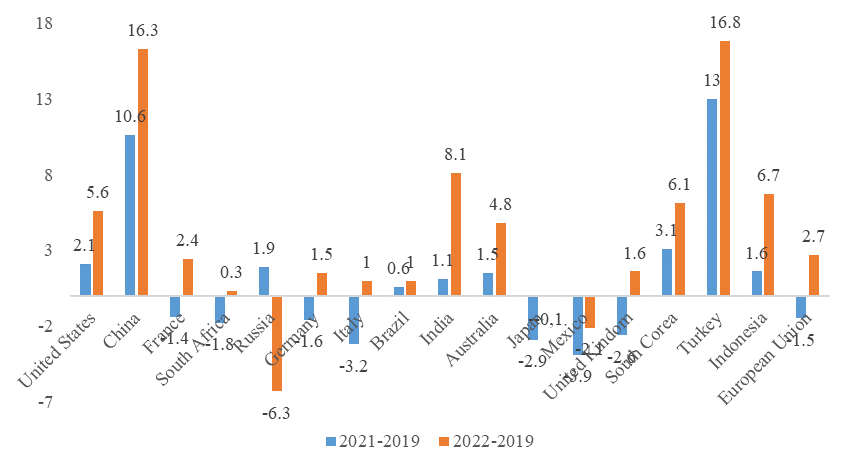
Figure 1 Countries and pre-pandemic GDP recovery (in % per year)
Note. Source: OCDE (2023), retrieved from https://www.oecd.org/.
The anti-vaccination campaign against COVID-19 vaccines was successful among Bolsonaro’s followers and substantially harmed the National Immunization Program. Immunization coverage has dropped in Brazil – a country considered exemplary worldwide for its vaccination programs and comprehensive coverage, particularly among children – and cases of diseases that had been eradicated, such as measles, emerged again in the country in 2021. The total immunization coverage in the country dropped sharply, going from an overall average of 96.3% of the population vaccinated in 2015 to 77% in 2022.
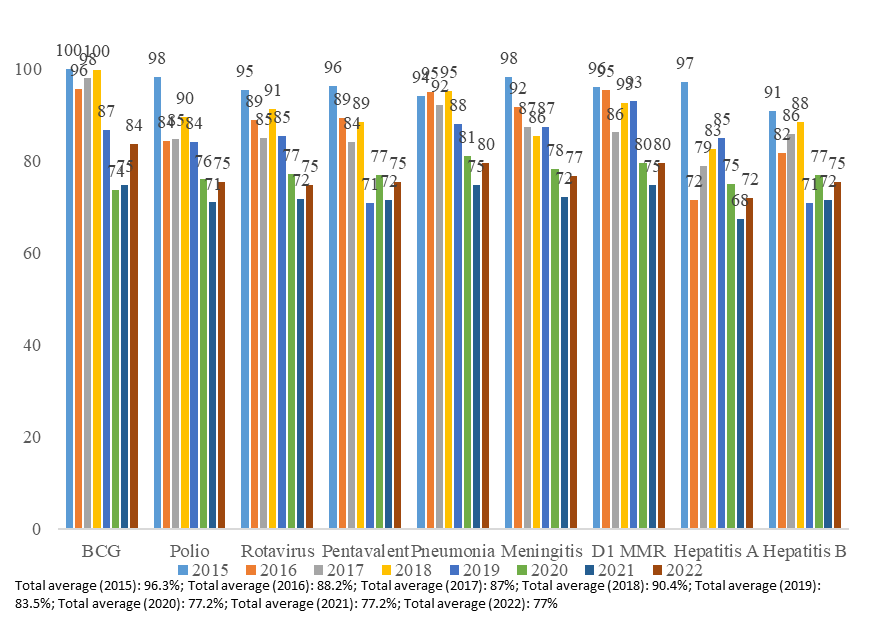
Note. Source: Ministério da Saúde/DataSUS (2023), retrieved from http://tabnet.datasus.gov.br/cgi/dhdat.exe?bd_pni/cpnibr.def.
One of the problems suffered by the National Immunization Program and other important programs maintained by the Ministry of Health was the lack of resources. This occurred, for example, with Farmácia Popular, a program that promotes free access to specific medication through a partnership with private pharmacies and drugstores. It was also the case of surgeries that had to be postponed, increasing the queue of people who needed imminent surgery due to the budget cuts in health in 2022 due to the spending cap legislation and the negligence of Bolsonaro’s administration.
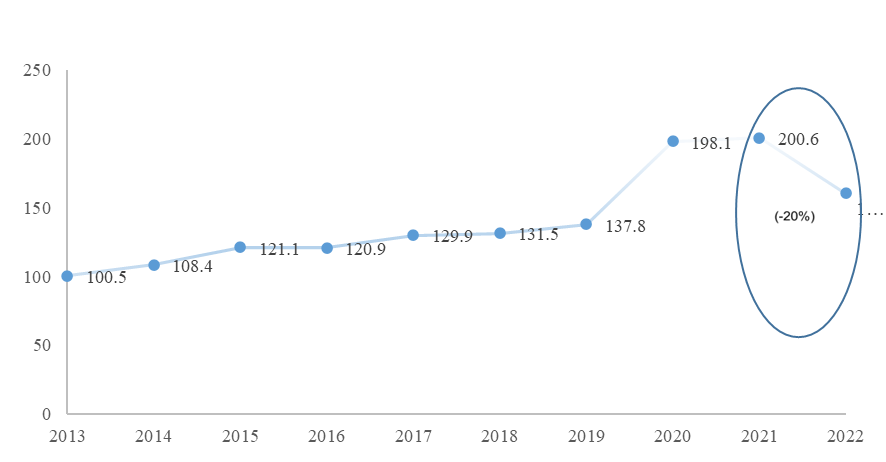
Figure 3 Ministry of Health - Executed budget 2013-2022 (BRL billion)
Note. Source: Controladoria Geral da União (2023), retrieved from https://portaldatransparencia.gov.br/orgaos-superiores/37000-controladoria-geral-da-uniao.
Education
This was perhaps the hardest hit structural area in Bolsonaro’s administration. Throughout his term, the Ministry of Education was occupied by ideological ministers from the far right, people without any experience with education management or even public management, who only tried to carry out political proselytism and did little to produce results in all subareas: preschool, elementary, and higher education.
Several ministers occupied the command of Education, all unknown and without any legitimacy in the policy community. The first to occupy the chair was Ricardo Vélez, who did not stay long and was replaced in 2019 by Abraham Weintraub, who remained in office until June 2020.
Almost all Brazilian municipalities rejected the federal government’s idea of military-civic schools. Also, the government was interested in implementing homeschooling, but the idea was never consolidated in a proposal and did not resonate in Brazilian society. In addition, the academic community despised the program Future-se, an unrealistic proposal for higher education institutions, utterly alien to the reality of Brazilian universities. Milton Ribeiro was appointed minister of education in July 2020 and stayed until March 2022 (the previous minister had stayed five days in office). During this period, the Ministry of Education was almost deactivated, except for the appointments of ideological rectors to assume the administration of federal universities. These appointees lacked academic seniority but were aligned with the federal government’s ideas. Part of the most important programs was under a form of paralysis. The Ministry of Education only executed priority programs – like the national exam to evaluate high school students (ENEM) – thanks to career civil servants that kept their routine of work.
Milton Ribeiro left office amidst corruption allegations. He was arrested and subsequently released by the Federal Police in an investigation into influence trafficking to transfer public funds from the National Fund for Education Development (FNDE). The investigation examined funds designated for construction works in daycare centers and schools and purchasing equipment to benefit specific municipalities in negotiations mediated by two evangelical pastors who allegedly requested bribes and did not hold positions in the federal government.
Added to this is the decrease in resources for education. In 2021, the resources for education reached the same level as in 2013. Universities were hard hit by budget cuts, being unable to maintain research and extension activities and, in some cases, unable to pay the utility bills.
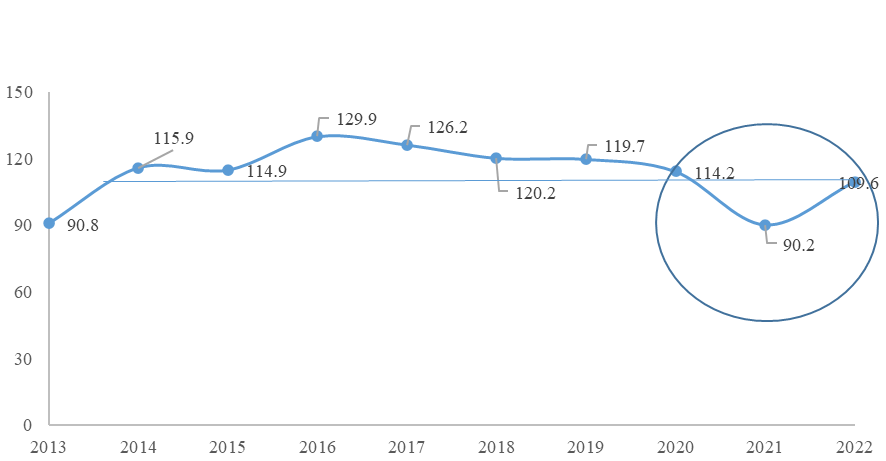
Figure 4 Ministry of Education - Executed budget 2013-2022 (BRL billion)
Note. Source: Controladoria Geral da União (2023), retrieved from https://portaldatransparencia.gov.br/orgaos-superiores/37000-controladoria-geral-da-uniao.
Environment
The area of environment followed the same method of dismantling as education and reaped harmful results for the country from an international point of view. Environmental management, conservation, and designation of areas to native peoples are currently among Brazil’s greatest assets. The country gained credibility throughout history and is respected by the international community for its efforts to protect its biomes, particularly the Amazon. This approach toward the environment has ensured agreements or promises of future agreements (as was the case with the European Union-Mercosur agreement). However, the direction Bolsonaro’s administration chose for the Ministry of Environment under the leadership of Minister Ricardo Salles frustrated these treaties.
The ideological element imbricated in the ministry activities was climate change denial, and there was a widespread notion that environmental protection was an obstacle to the country’s economic growth and that the Amazon should be explored and deforested. With this, illegal mining, fishing, and logging activities were supported in the Amazon, including in environmental reserves and lands of original peoples, such as the lands of the Yanomami people. In addition, the inspection apparatus of the environmental agency Ibama, ICMBio and the federal police were completely demobilized (Bonelli et al., 2023).
Among the deleterious actions taken against environmental protection by the Ministry of the Environment were the withdrawal of civil society participation from the National Council for the Environment (Conama); the repeal of resolutions that protected salt marshes and mangroves; liberation from the burning of toxic waste in cement kilns; stoppage of the Amazon Fund; advance of mining in protected areas and conservation units; dismantling of environmental protection agencies, such as Ibama and ICMBio (Bonelli et al., 2023); suspension of environmental fines (Observatório do Clima, 2022).
December 2020 saw five years of the Paris Agreement, and all signatory countries, including Brazil, should have updated and renewed the commitments assumed in 2015. The minister presented a new target that would allow the country to emit, by 2030, 400 million tons more greenhouse gases than forecast in the original target. This new target for Brazil presented by Salles in the Paris Agreement allowed for 78% more deforestation in 2025 than in the pre-Bolsonaro period.
Ricardo Salles left MMA in June 2021 amidst denounces related to the largest illegal timber smuggling in Brazilian history, under investigation by the Federal Police.
As a result of the dismantling of the environmental area, deforestation across the Amazon in 2020 and 2021 was the highest in over a decade.
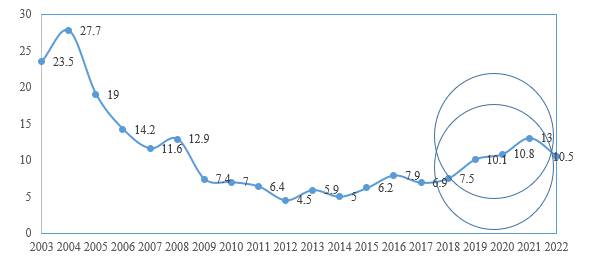
Figure 5 Deforestation in the Amazon 2003-2022 (Km2 in thousands)
Note. Source: PRODES-Amazônia/INPE (2023), retrieved from http://www.obt.inpe.br/OBT/assuntos/programas/amazonia/prodes
Culture
The anti-culture was widespread in this area, and a common element in the dismantling project could be observed – the appointment of people without any managerial experience in the area but ideologically in tune with Bolsonaro’s administration. This began in 2019 with the extinction of the Ministry of Culture, which transformed into a Special Secretary under the Ministry of Tourism.
Three secretaries occupied the position during the mandate. The first, Roberto Alvin, took office in November of 2019 and left in 2020 due to a speech to the nation to launch the National Arts Award, where he reproduced phrases from a speech by Joseph Goebbels, Minister of Propaganda in Nazi Germany.
In his place, Bolsonaro appointed actress Regina Duarte. In addition to failing to take office, in an interview with CNN Brasil, she minimized deaths from COVID-19 and tried to mitigate the military dictatorship and its regime of repression and torture. After she left, the secretary was taken over by Mario Frias, a little-known TV actor. Among some of the actions during his tenure, the rejection to fund a jazz festival (Capão Jazz Festival in Chapada Diamantina-BA) stands out. The opinion of the agency responsible for evaluating the request (FUNARTE) stated that the “ultimate object and purpose of all music should be none other than the glory of God and the renewal of the soul” (Vettorazzo, 2021).
The most iconic case demonstrating the ideology permeating Bolsonaro’s administration in the area of culture occurred in the Palmares Cultural Foundation, commanded by journalist Sergio Camargo (2019-2022). Under his management, the agendas of anti-racism and preservation and appreciation of Afro-Brazilian culture were changed. In addition to defending the past of slavery, he questioned the leading role of Black women and men considered heroes in Brazil’s history, in addition to questioning the importance of great contemporary Black personalities (Araujo & Venturini, 2022).
In short, Bolsonarism in culture rejected the African heritage, rejected the contribution of indigenous peoples to Brazil, and had a colonized, poor, mediocre, ignorant, and superficial view of Brazilian culture (Moreira & Spada, 2021).
Foreign affairs
There was also ideological dismantling in international relations, where Brazil traditionally exercises soft power worldwide. Bolsonaro appointed diplomat Ernesto Araújo on the recommendation of the late far-right guru Olavo de Carvalho. Araújo occupied the direction of the Department of the United States, Canada, and Inter-American Affairs since 2016. He was promoted in June 2018 to Minister of First Class (according to the nomenclature adopted in the Ministry of Foreign Affairs), a position at the same level as an ambassador, even though Araújo has never headed an embassy.
In addition to reproducing Bolsonaro’s hatred toward the left-wing political party that was leading the opposition (Workers’ Party – PT), Araújo condemned the “globalism” that he considered as a movement led by “cultural Marxism.” He assumed his position pro-Trump in 2017 in an article published in the journal Cadernos de Política Exterior of the Institute of Research in International Relations of the Ministry of Foreign Affairs, entitled “Trump and the West,” where he defends the existence of a God who saves history, the “...God of Trump” (Araújo, 2017, p.350).
Araújo’s administration was marked by a distancing of Brazil in global geopolitics, redefining international actors considered priority allies. Over the past two decades, Brazil has been an ally of developing countries and multilateral organizations, such as the World Health Organization (WHO) and the United Nations (UN). However, Ernesto Araújo started to attack the multilateral organizations – according to him, these organizations are “the face of globalism” and the “preparatory stage for communism.” During his administration, relations with Mercosur and the cooperation of the BRICS cooled. It was evident the alignment with the positions of the United States in the Trump administration and Israel in the administration of Prime Minister Benjamin Netanyahu, both leaders of the far right.
In international forums, Brazil changed its position as a mediator of international conflicts and started to take positions on the internal coalitions of governments or even against issues such as human rights and global warming. In defense of “religious freedoms” and “family values,” he aligned with countries like Saudi Arabia against actions in favor of sex education and gender equality. Brazilian diplomats were instructed to replace the term “gender” with “sex” in their manifestations to combat the so-called “gender ideology.”
The result was Brazil’s complete distancing from the international community, where the country was involved in episodes of estrangement with China and France and approached authoritarian and self-isolated countries such as Hungary, Poland, Russia, and Guinea Bissau. Brazil has become an “international pariah.”
Economy
The management of the economy was disastrous in many ways. In the administrative reform of the state at the beginning of the mandate, several areas with the status of ministry were combined under the umbrella of the Ministry of Economy. Also subordinated to this ministry were agencies and state-owned enterprises such as the presidencies of the Brazilian Development Bank (BNDES), Banco do Brasil, Petrobrás, and Eletrobrás; the Brazilian Institute of Geography and Statistics (IBGE); Secretary for Debureaucratization; Secretary for Privatization; Department of Programs; and Secretary of Social Security and Labor. Although subordinated to the same ministry, they operated without coordination.
The Ministry of Economy proposed and passed the Constitutional Amendment EC 103/19 (social security reform). This amendment abolished retirement based on contribution time and raised the minimum age for retirement by the public system (INSS) to 62 years for women and 65 for men, establishing the same rule for public servants (this group has its own system). They established gradual changes and forms of tolls to accommodate the rights of age groups on the verge of retirement and people over 50 years of age when the law passed. Other changes for future workers joining the system also passed, such as the calculation of the pension benefits that considered an average of the top 80% of contributions and now considers the average of all contribution wages. Although the greater per capita deficit of Brazilian social security in 2019 was observed in the military, the reform did not touch this group (army, navy, and air force). The military did not have any reduction in the expectation of social security, receiving 100% of the last salary applied to their position. The reform, as often happens, was unfair to the poorest workers who cannot prove their length of service, especially at this time when informal work and lack of formal contracts make up the majority of the workforce in Brazil.
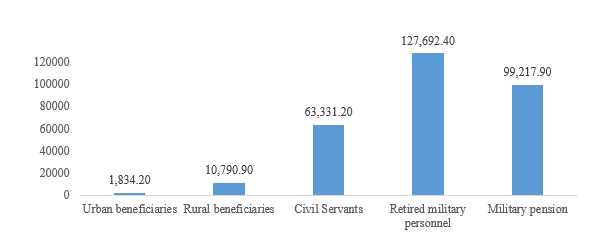
Figure 6 Per capita deficit per social security beneficiary group 2019 (in BRL)
Note. Source: Tesouro Nacional Transparente (2023).
There was intentional inaction regarding the exchange rate since the currency had the greatest devaluation against the dollar, in absolute values, since 1994, going from BRL 3.88 on January 01, 2019, to BRL 5.27 on December 31, 2022 (Central Bank of Brazil, 2023). The Ministry of Economy’s office was complacent and supportive of the Brazilian Real devaluation against the dollar. The effect of the maximum devaluation of the Real was that fuel prices rose sharply – additionally, the global shortage crisis caused by the pandemic increased fuel prices worldwide. In 2021, the average price of a barrel reached its highest value, USD 85, an increase of 54% compared to 2020. The result was that fuel prices in Brazil skyrocketed, having the highest increase in 17 and a half years of three previous administrations – Lula da Silva (first and second terms), Rousseff (first and second terms), and Temer.
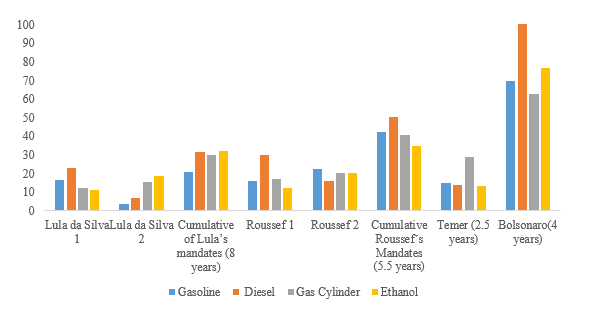
Figure 7 Cumulative increase in fuel prices (%)
Note. Source: Petrobras (disclosure of price adjustments, various periods) (2023), retrieved from https://petrobras.com.br/fatos-e-dados/.
On the other hand, between 2021 and 2022, the state-owned oil company Petrobrás had the highest profits and also the highest distribution of dividends among shareholders in the company’s entire history, reaching, in 2022, a record figure of BRL 215.7 billion in dividends distributed to shareholders, more than double what was paid in 2021 (Poder 360, 2022; Poder 360, 2023; Rivas, 2022; Nakagawa, 2023; Silva, 2022).
A sudden measure was taken in the election year to make the unbridled increase in fuel yield, which was the provisional measure MP 118/22. This MP stipulated a zero rate of four taxes (ICMS, PIS, Cofins, and Cide) included in the fuel price until December 2022. COMSEFAZ, the national committee of the states’ treasury offices, estimated a loss of around BRL 45 billion in tax revenues for the states (ICMS) during the six months reached by the federal government’s provisional measure.
Although the Ministry of Economy’s orientation was orthodox neoliberal and a strong advocate of the spending cap, the ministry submitted the constitutional amendment bill – PEC nº 23/21, proposing changes in court-ordered payments. According to the bill, government debts due in 2022 could be paid in installments, opening a space of approximately BRL 91.6 billion in the budget, which was then used to finance the new conditional cash transfer (CCT) program “Auxílio Brasil” that replaced the CCT created in the 2000s Bolsa Família).
The government breached the spending cap in the second half of 2022. The expenses made were a mixture of “electoral counter” with excessive public spending, yet another contradiction for a self-affirmed ministry of ultra-neoliberal orientation. In July 2022, the constitutional amendment bill PEC 01/2022 (called PEC Kamikaze) passed in the National Congress and had to be endorsed by the Supreme Court since the amendment proposed increasing expenses in specific programs during election years, which was unconstitutional. The following resources were approved and released right before the elections, to be spent before December 2022: increase in the amount given through the CCT program Auxílio Brasil from BRL 400 to BRL 600; allowance of BRL 1,000 for truck drivers; allowance of BRL 200 for taxi drivers; increase in the gas voucher to BRL 120 every two months; ethanol cost subsidy in more than BRL 3.8 billion; BRL 2.5 billion for free urban public transport for those over 60.
The intentional inaction of the Ministry of Economy was explicit. When food inflation in Brazil was in double digits, especially in 2021 and 2022, there was no exchange rate management or regulatory stocks. As a result, the country has returned to hunger and child malnutrition.
It is worth mentioning the emergency aid program, which consumed BRL 311 billion in 2020 to support the low-income population during the COVID-19 pandemic, and the Auxílio Brasil (90 billion in 2022). These programs disregarded the records of the previous program Bolsa Família and were designed ad hand-outs partially run through a cell phone application. Therefore, there was almost no federative control or coordination. As a result, millions of new registrations were made, and the waiting list for benefits became long.
The complementary law LC 179/2021 giving operational autonomy to the Central Bank, was a “Trojan Horse” for the Ministry of Finance that took over after Bolsonaro’s mandate. In practice, the Central Bank works as an independent “branch” despite the Ministry of Finance. The Boletim Focus, a survey of only 100 financial market members, has been the only source of consultation to give any reference to the Central Bank. This shows that the Central Bank only considered the position of the financial market and was only concerned with regulating interest rates, given that the exchange rate and the flexibility of inflation targets aimed at economic growth were not observed more broadly, considering the economy as a whole.
Another problem that Bolsonaro’s Ministry of Economy left was the Census/IBGE. Due to the Pandemic, the Census/IBGE, which was supposed to be carried out in 2020, was postponed to 2022. However, the budget provision for carrying out the census was late and insufficient, and the census was only carried out from August 2022, taking more than five months to be completed. Two major problems occurred. The first was the time to conduct the survey, which usually takes two months. This time, it took six months, and many people refused to answer the census, increasing the use of estimations. Census workers were threatened, and many left their job unmotivated. This was due to yet another campaign by the President, supported by the Minister of Economy, who waged war against carrying out the census/IBGE. In 2019, the President said that the IBGE produced indexes made to deceive the population and that these statistics were a farce.
Bolsonaro’s administration also campaigned against civil servants. The Ministry of Economy defended an unsuccessful administrative reform (PEC 32/20) with the sole purpose of reducing public spending. Among the elements of the proposal most harmful to the public service were: 1) extensive outsourcing and hiring of private company personnel to provide public services; 2) a 10-year maximum period for a temporary employee contract; 3) the possibility of reducing the remuneration and working hours of public servants in the event of an economic crisis. The other elements in the proposal, roughly speaking, are surreptitious with treatment contemplated in the Federal Constitution and Law 8112/89 and do not substantially add to what was already regulated.
3 Possibilities of reconstruction
The 2022 presidential election in Brazil was, unfortunately, a wild process. The coalition led by the Worker’s Party (PT), with candidates Lula da Silva, for president and Geraldo Alckmin, for vice president, won by a small margin of valid votes (1.9%). Deaths occurred during the campaign, in addition to irregularities from the Presidency, campaigns against the Supreme Electoral Court (TSE), electronic voting, etc. When President Lula da Silva won, Bolsonaro voters and supporters asked for military intervention. They camped out for over two months in front of army headquarters throughout Brazil. These fanatics also blocked highways trying to stop the flow of vehicles.
The idea of a coup to prevent Lula da Silva from taking office was supported by part of the military who defended Bolsonaro’s permanence and also by some business people. The idea was put together in several acts. On the day the TSE declared the election finished and certified the winning candidates, Brasília suffered acts of vandalism, with the burning of buses and depredation of the Federal Police building. On Christmas Eve, a bomb was found in a truck carrying fuel parked near Brasilia airport. Finally, on January 8, the civic-military coup attempt took place, where thousands of fanatics invaded the buildings of the National Congress, the Planalto Palace, and the Supreme Court, vandalizing and destroying the building and the collection of artwork and rare furniture that was there. The investigations suggest that the command of Public Security in Brasilia and part of the military had some participation in the events. The former security secretary of the Federal District was arrested, and the Governor of the Federal District was removed from office for three months. The result was the destruction of public property, arrests in the act, subsequent arrests of extremist Bolsonaro-followers, blocking of assets and accounts of extremist business people who financed the coup, and more arrests.
This shows that the far right in Brazil has grown, and the fight against extremist fanatics will be constant. Evidence of this is that 66 Bolsonaro-followers were elected federal deputies and 12 senators. From now on, politics requires vigilance, as democracy is still under threat.
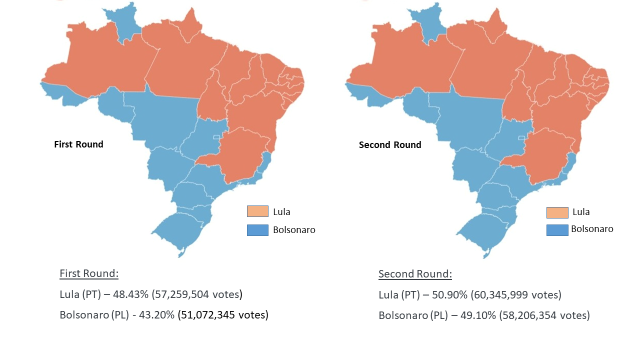
Figure 8 Results of the 2022 Presidential Election – First and Second rounds
Note. Source: TSE (https://www.tse.jus.br/).
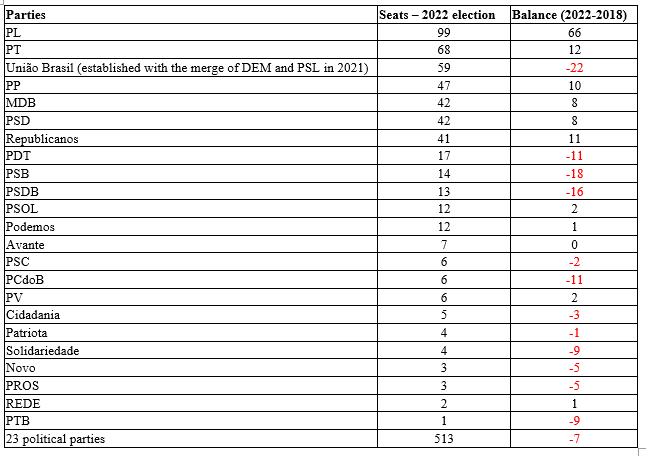
Table 1 Political parties represented in the Chamber of Deputies
Note. Source: TSE, March 02, 2023, retrieved from www.tse.jus.br.
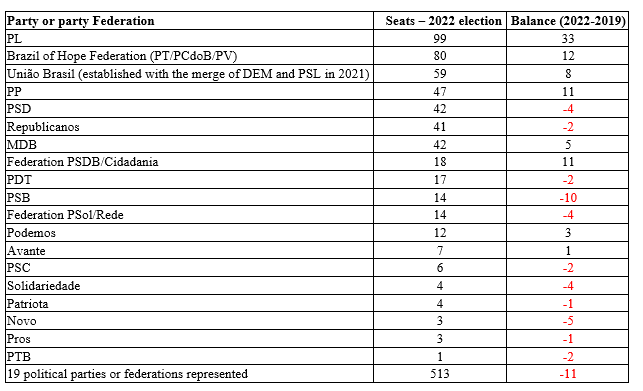
Note. Source: TSE, March 02, 2023, retrieved from www.tse.jus.br.
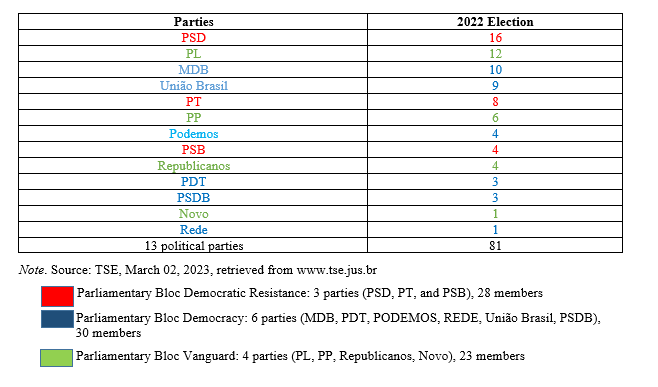
Note. Source: TSE, March 02, 2023, retrieved from www.tse.jus.br Parliamentary Bloc Democratic Resistance: 3 parties (PSD, PT, and PSB), 28 members Parliamentary Bloc Democracy: 6 parties (MDB, PDT, PODEMOS, REDE, União Brasil, PSDB), 30 members Parliamentary Bloc Vanguard: 4 parties (PL, PP, Republicanos, Novo), 23 members
Lula da Silva’s government does not count on the majority to pass constitutional amendments in the National Congress, but it has enough support in the parliament to pass complementary laws. A 3/5 majority needed to pass constitutional amendments is under formation, and the Government will likely obtain a broader base of support in Congress. Lula’s government is formed based on a great alliance, and most of the members of Congress are part of a bloc called “centrão,” a group of parliamentarians who are always very supportive and flexible. This element suggests an increase in votes to pass constitutional amendments.
Some elements of the beginning of the reconstruction during the ten months of Lula’s administration can be highlighted:
-
Even before taking office, Lula’s team worked with Congress to pass the constitutional amendment bill PEC 32/22, which allowed the new government to increase the spending cap by BRL 145 billion in the 2023 Budget to cover expenses such as the CCT program Bolsa Família, social programs such as Auxílio Gás, Farmácia Popular, and other public policies.
Change of military command of the army to a general from the democratic wing of the force.
Return of policies deactivated by Bolsonaro (e.g., the CCT program Bolsa Família).
Enactment of the provisional measure MP 1157/23 that maintains exemption of the taxes PIS and COFINS for fuels and derivatives while ceasing the exemption of the state tax ICMS after March 01, 2023. The prices will be stabilized using resources from the government’s dividends from Petrobras and crude oil exports.
Debates about the high interest rates and the substantial influence of the financial market on the Central Bank.
Brazil returns to the international scene, resumes multilateral environmental agreements, and receives resources from several countries. Resumption of the European Union-Mercosur agreement. Visit to China which resulted in direct investment agreements in infrastructure.
Brazil returns to the BRICS, which now has former President Dilma Rousseff as President. The BRICS Bank brings hope to the perspective of a multipolar world from a macroeconomic point of view, with Brazil at the forefront of this process. From January 1st 2024, the BRICS will be the Brics Plus with the entry of Egypt, Argentina, United Arab Emirates, Saudi Arabia, Ethiopia and Iran.
Updates to the budget of several ministries, especially education and health.
Support for native peoples (the Yanomami genocide was denounced and addressed), gender agenda, and the agendas of women’s rights, Black people, LGBTQI+ community, civic behavior, and support for people with disabilities and other minorities.
The government counts on an outstanding staff in the ministries formed by experienced former governors, civil society activists and experts, and members of Congress. The ministers and their staff have in-depth knowledge of their area of activity.
A record number of women ministers were appointed, 11 women.
It is important to highlight that the Lula Government resumes social participation in management. A network of social participation and diversity advisors was created with representatives from different ministries to coordinate actions. Under the coordination of the General Secretariat of the Presidency, the focus is on dialogue with civil society, something that has always been one of President Lula's flags and which were emptied or deactivated during Bolsonaro's administration. The National Council for Food and Nutritional Security (CONSEA) was reactivated and a network of dialogues on the Amazon began with a view to preparing the Amazon Summit to be held in August 2024, an event that will bring together heads of state from around the world.
As already mentioned here, as of the second half of 2022, Bolsonaro’ government spent BRL 300 billion on federal and state exemptions, which generated a budget gap of BRL 200 billion, in addition to the highest real interest rate in the world. The task of Lula’s government is to harmonize fiscal and monetary policy, rescuing the states’ revenues and distributing the burden of the previous government’s measure on oil companies, exporters, and Petrobras. This was a management measure taken by the Minister of Finance, Fernando Haddad, since he had room in the Petrobrás international parity price to ease the recovery of taxes.
The sustainable fiscal regime (complementary law 200/2023) – known as the new fiscal framework – was sent by the Minister of Finance Fernando Haddad and approved by the National Congress, which was also well received by the financial market. The proposal provides that the variation in expenditure will always be less than the variation in revenue. Thus, it is established that the annual growth in expenditure will be limited to 70% of the revenue variation recorded in the last 12 months (until July). There is still an estimated floor and a ceiling for the real growth of expenses, which cannot grow less than 0.6% or more than 2.5% per year. Resource transfers and court orders used by creditors, Fund for Basic Education (Fundeb), and Constitutional Fund of the Federal District (FCDF) will not be affected by these limits. In addition, there is an estimation for a primary surplus target for public accounts, combined with a system of bands (floor and ceiling) with a variation of 0.25% upward or downward and a mechanism to lock expenditure in case of non-compliance. Thus, when the surplus exceeds the band ceiling, the surplus will be used for investments in the following year. When it stays below the floor, the expense will grow less in the following year. Minister Haddad states that the objective in this case is to have a zero deficit, a goal that is very difficult and may be unnecessary to promise.
The Ministry of Finance also designed and sent to the National Congress the tax reform Proposed Amendment to the Constitution (PEC 45/2019), which has already been approved in two rounds by the Senate and is now in the Chamber of Representatives for approval of the final text that goes to presidential sanction. The essence of the PEC is the simplification of taxes by replacing five taxes (ICMS, ISS, IPI, PIS and Cofins) with three: Tax on Goods and Services (IBS), Contribution on Goods and Services (CBS) and Selective Tax (IS). The proposal also provides for exemption of basic food products, in addition to several measures.
4 Conclusions
The dismantling of the State and public policies occurred during the Bolsonaro government between 2019 and 2022. Because of this dismantling strategy, the areas mentioned in this paper – health, education, environment, culture, foreign affairs, and economy – were affected by ideology and spending cuts. In the case of the economy, there was excessive public spending to finance palliative cash transfer policies in the run-up to and on the eve of the elections.
In addition to the lack of resources and ideology, this reflection on Bolsonaro's disastrous administration highlights the practice of appointing unprepared people to key government positions based solely on their ideologies and alignment with Bolsonaro's destructive agenda. It was the most military government in history, many thousands positions of trust distributed to members of the armed forces.
The Bolsonaro government ended with an attempted military coup, something that matured over four years in addition to a management full of accusations of crimes of responsibility and common crimes that are currently being investigated by the Federal Police.
From a political point of view, the Superior Electoral Court judged him ineligible for eight years (until 2030) in 2 processes, the first which referred to a meeting with ambassadors in which he stated that the electoral process was not reliable and a second process of economic abuse during the September 7th commemoration.
Even with Bolsonaro ineligible and President Lula da Silva continuing his good government, the Brazilian extreme right will find another name for the national political conflict. However, this time, you will no longer find the circumstances of electoral competitiveness observed in 2018 and 2022.
Bolsonaro did not create “Bolsonarism”, or the set of characteristics that allows his ideology to be identified – characteristics that were reflected in his management. “Bolsonarism” was already present in a significant portion of Brazilian voters, notably in the middle and high income classes, mainly in the south and southeast regions of the country. Bolsonaro may no longer be the leader of the Brazilian far right, as he is the target of dozens of lawsuits for common crimes (incitement to rape and insult, creation and dissemination of fake news about vaccines in the pandemic, interference in the Federal Police, leaks of confidential information, fake news in general and digital militias, subtraction of jewelry, given to the Brazilian government by Saudi Arabia, which, according to Law 8,394/1991 and Decree 4,344/2002, are legally considered Union assets). Of course, they will rush through the lower courts and take time.
Looking at the long-term perspective from 2013 and into the future, with the rise of the extreme right in Brazil, what we observe are parliamentarians who have no commitment to improving or discussing public policies. There is a significant group in the National Congress of “bolsonaristas” who have no expertise whatsoever, are social media influencers and their objective is just, as they say nowadays, to "seal" to gain "likes". They defend absurd agendas, against human, social and political rights, as well as against the institutional system. The tone of the speech is impolite and almost always promotes turmoil. In other words, the coup continues daily on the part of Bolsonaro congressmen.
The last one was PEC 8/2021, which prohibits Supreme Court Judges from issuing monocratic decisions that suspend: the effectiveness of laws; normative acts (commands from the Executive Branch for the correct application of laws); and acts of the President of the Republic, the Senate, the House of Representatives. The president of the Senate, was supporter of the measure, as his likely successor, his ally, wants to be President of the house and needs the support of the Bolsonariam extremists.
The Lula government will have to continue developing public policies and at the same time having fight the dispute over narratives on social media, with fanatical Bolsonarian extremists.It is not an easy task, but it is inevitable. Brazilian politics today only has two sides, the one that wants democracy, institutions and public policies, and the other side that wants authoritarianism, the coup, and generalized confusion. Parties and politicians, previously considered centrist, from parties like PSDB, and others, because they did not want to understand the moment, and compromised with extremism, ended up politically undermined.It is important to note that according to the Atlas Intel survey carried out from November 17 to 20, 2023, it shows that the negative evaluation (45%) of the government of Lula da Silva (PT) numerically exceeded the positive (43%) for the 1st time since the beginning of his mandate. This may point to the fact that the reconstruction is already in its final phase and that it will now be necessary to think about what comes after the reconstruction. This requires innovation, management capacity, federative coordination, and the management under the leadership of the Lula government certainly has it, even with all the obstacles brought about by the dystopian Bolsonarista policy.
Observing the recent Brazilian past and what we are experiencing at the moment, with the rise of the far right, we can make an analogy between Brazil and the Myth of Sisyphus. Because when the country thought we had solved several historic problems, a crisis of expectations arose in 2013. The country did not realize that the extreme right was growing and was sheltering within the umbrella of the opposition's electoral preferences, located mainly among part of the voters who voted for the PSDB. From then on, what started as a movement, in 2013, Movimento do Passe Livre (which demanded the non-increase of BRL 0.20 in the bus fare) in the capital of São Paulo, under the administration of, at that time mayor and current minister of Finance, Fernando Haddad, was the loose wire that short-circuited the entire country. That made the far right emerge in full force, and from then on, the country no longer had any political peace. Its expressions ranged from the mediatic Operation Car Wash to pro-gun neo-Nazism, with veiled support from sectors of the media and the financial market that do not tolerate any social policy.
The country was condemned to face a reactive movement towards socio-economic progressivism. This reaction, led by the military, middle-aged and elderly segments, which thought was buried, seems to have re-emerged from the catacombs of Brazilian reactionism, as we have noticed since 2013, 10 years ago. Suddenly a political force is revealed with strong support from society, against the maintenance of the achievements of social, political and human rights, as well as progress in guaranteeing diffuse rights as environment, social diversity and the production of public policies that benefit the population at its largest poor, which is the majority of the country. Perhaps it will be up to future generations to free us from Sisyphus' condemnation by no longer allowing the extreme right to rule the country's political life again.
References
Araújo, E. (2017). Trump e o Ocidente. Cadernos de Política Exterior, 3(6), 323-357.
Araujo, F., & Venturini, A. C. (2022, junho 23). Fundação Cultural Palmares: presidentes e ações. Nexo (Políticas Públicas). Recuperado de https://pp.nexojornal.com.br/linha-do-tempo/2022/Funda%C3%A7%C3%A3o-Cultural-Palmares-presidentes-e-a%C3%A7%C3%B5es
Banco Central do Brasil (2023). Cotações e Boletins. Recuperado de https://www.bcb.gov.br/estabilidadefinanceira/historicocotacoes
Bauer, M. W., & Knill, C. (2014). A Conceptual Framework for the Comparative Analysis of Policy Change: Measurement, Explanation and Strategies of Policy Dismantling. Journal of Comparative Policy Analysis: Research and Practice, 16(1), 28-44. https://doi:10.1080/13876988.2014.885186
Bauer, M., Peters, B., Pierre, J., Yesilkagit, K., & Becker, S. (Eds.). (2021). Democratic backsliding and public administration: How populists in government transform state bureaucracies. Cambridge University Press. https://doi:10.1017/9781009023504
Beach, D., & Pedersen, R. B. (2016). Causal case study methods: Foundations and guidelines for comparing, matching, and tracing. University of Michigan Press. 388p. ISBN 978-04-72053-22-3
Bonelli, F., Fernandes, A. S. A., & Cavalcante, P. L. C. (2023). The active dismantling of environmental policy in Brazil: paralysis and setbacks of the deforestation inspection and control. Sustainability in Debate, 14(1), 58-80. https://doi.org/10.18472/SustDeb.v14n1.2023.44277
Coelho-Junior, M. G., Valdiones, A. P., Shimbo, J. Z., Silgueiro, V., Rosa M., Marques, C. D. L., Oliveira, M., Araújo, S., & Azevedo, T. (2022). Unmasking the impunity of illegal deforestation in the Brazilian Amazon: A call for enforcement and accountability. Environmental Research Letters, 17(4), 041001. https://doi:10.1088/1748-9326/ac5193
Duarte, L. (2020). Vaza Jato: os bastidores das reportagens que sacudiram o Brasil. Mórula. 320p. ISBN 978-65-86464-23-8
Empoli, G. (2019). Os engenheiros do caos: como as fake news, as teorias da conspiração e os algoritmos estão sendo utilizados para disseminar ódio, medo e influenciar eleições. Vestígio.
Fernandes, A. S. A., Teixeira, M. A. C., & Palmeira, J. S. (2020). The long Brazilian critical juncture since 2013: Crisis and punishment. Cadernos Gestão Pública e Cidadania, 25 (81), 1-19. http://dx.doi.org/10.12660/cgpc.v25n81.81577
Fernandes, A. S. A., Teixeira, M. A. C., do Nascimento, A. B. F. M., & Zuccolotto, R. (2022). Entre a estabilidade (1995-2014) e a escolha pelos riscos de ruptura democrática: o Brasil na era do bolsonarismo. Administração Pública e Gestão Social, 14(2). https://www.redalyc.org/articulo.oa?id=351570330011
Fórum Brasileiro de Segurança Pública (2022). Armas de fogo e homicídios no Brasil, 1-26. https://forumseguranca.org.br/wp-content/uploads/2022/09/informe-armas-fogo-homicidios-no-brasil.pdf. ISBN 978-65-89596-26-4.
Hochstetler, K. (2007). Repensando o presidencialismo: contestações e quedas de presidentes na América do Sul. Lua Nova, 72, 9-46. https://doi.org/10.1590/S0102-64452007000300002
Kerche, F., & Marona, M. (2022). A política no banco dos réus: a Operação Lava Jato e a erosão da democracia no Brasil. Autêntica. ISBN 978-65-5928-080-3.
Klein, N. (2008). A Doutrina do Choque: O auge do capitalismo do desastre. Nova Fronteira. ISBN 978-85-2092-071-8.
Lemos Azevedo, D. D., Brandão, S., Vendramini, E., Cunha, R. M. C. D., Leirner, P. C., Almeida Teles, J. D., & Quinalha, R. (Orgs). (2020). Espectros da ditadura: da Comissão da Verdade ao bolsonarismo. Autonomia Literária.
Levitsky, S., & Ziblatt, D. (2018). Como as democracias morrem. Zahar. ISBN 978-85-378-1800-8.
Lynch, C., & Cassimiro, P. H. (2022). O Populismo reacionário: Ascensão e legado do bolsonarismo. Contracorrente.
Machado, D. B. (2021). Sete elementos do processo de seleção de casos: contribuições para um maior rigor e transparência nas Ciências Sociais. Revista Brasileira de Ciência Política, 36, 1-32. https://doi.org/10.1590/0103-3352.2021.36.243087
Mounk, Y. (2018). O Povo contra a democracia. Companhia das Letras.
Mendes, Á., Melo, M. A., & Carnut, L. (2022). Análise crítica sobre a implantação do novo modelo de alocação dos recursos federais para atenção primária à saúde: operacionalismo e improvisos. Cadernos de Saúde Pública, 38(2). https://doi.org/10.1590/0102-311X00164621Mercuri, K. T., & Lima-Lopes, R. E. D. (2020). Discurso de ódio em mídias sociais como estratégia de persuasão popular. Trabalhos em Linguística Aplicada, 59(2), 1216-1238. https://doi.org/10.1590/01031813760991620200723
Moreira, M. S. (2022). O Enigma do Governo Bolsonaro e os Caminhos da Democracia Brasileira. Caderno CRH, 35, 1-6. https://doi.org/10.9771/ccrh.v35i0.45560
Moreira, R., & Spada, L. (2021). O fim do Ministério da Cultura: reflexões sobre as políticas públicas culturais na era pós-MinC. Imaginário Coletivo. 270p.
Nakagawa, F. (2023, março 01). Petrobras paga até 9 vezes mais dividendos que concorrentes internacionais. CNN Brasil. Recuperado de https://www.cnnbrasil.com.br/business/petrobras-paga-ate-9-vezes-mais-dividendos-que-concorrentes-internacionais/
Observatório do Clima (2022, fevereiro 01). A Conta Chegou: o terceiro ano de destruição ambiental sob Jair Bolsonaro. Recuperado de https://www.oc.eco.br/wp-content/uploads/2022/02/A-conta-chegou-HD.pdf
Paz, M. G. A. D., Silva Júnior, R. D. D., Jacobi, P. R., Lauda-Rodriguez, Z., & Milz, B. (2022). Guide for the dismantling of Brazilian environmental policy. Ambiente & Sociedade, 25. https://doi.org/10.1590/1809-4422asoceditorialvu2022L5EDENG
Poder 360 (2022, novembro 07). Petrobras é a petroleira que mais pagou dividendos no 3º trimestre. Recuperado dehttps://www.poder360.com.br/economia/petrobras-e-a-petroleira-que-mais-pagou-dividendos-no-3o-tri/
Poder 360 (2023, março 04). Petrobras lidera petroleiras em percentual de lucro sobre receita. Recuperado de https://www.poder360.com.br/economia/petrobras-lidera-petroleiras-em-percentual-de-lucro-sobre-receita/
Peeters, R. (2013). Responsibilisation on government’s terms: new welfare and the governance of responsibility and solidarity. Social Policy and Society, 12(4), 583-595. https://doi.org/10.1017/S1474746413000018
Quadrado, J. C., & Ferreira, E. D. S. (2020). Ódio e intolerância nas redes sociais digitais. Revista Katálysis, 23(3), 419-428. https://doi.org/10.1590/1982-02592020v23n3p419
Rivas, K. (2022, agosto 24). Petrobras se torna maior pagadora de dividendos do mundo; veja ranking. Infomoney. Recuperado de https://www.infomoney.com.br/onde-investir/petrobras-se-torna-maior-pagadora-de-dividendos-do-mundo-veja-ranking/
Schiavon, C. R. M. (2020). Irmãos Koch, think tank, coletivos juvenis: a atuação da rede libertariana sobre a educação [Dissertação de mestrado, Programa de Pós-Graduação em Educação, Pontifícia Universidade Católica de São Paulo – PUC-SP].
Silva, N. M. R. D. (2017, junho 29 a julho 01). Fake News: a revitalização do jornal e os efeitos Fast-Checking e CrossCheck no noticiário digital. Sociedade Brasileira de Estudos Interdisciplinares da Comunicação (Org.). Anais do XIX Congresso de Ciências da Comunicação na Região Nordeste, Fortaleza, CE, Brasil.
Silva, V. (2022, agosto 27). Como a Petrobrás se tornou a maior pagadora de dividendos do mundo? UOL. Recuperado de https://economia.uol.com.br/noticias/redacao/2022/08/27/por-que-a-petrobras-se-tornou-a-maior-pagadora-de-dividendos-do-mundo.htm
Silveira, S. A. D. (2019). Democracia e os códigos invisíveis: como os algoritmos estão modulando comportamentos e escolhas políticas. Edições Sesc.
Teitelbaum, B. R, & Costa, C. (2021). Guerra pela eternidade: O retorno do tradicionalismo e a ascensão da direita populista. Editora Unicamp.
Tesouro Nacional Transparente (2023). Aspectos Fiscais da Seguridade Social no Brasil. Recuperado de https://www.tesourotransparente.gov.br/.
Unger, R. M. (2018). Depois do colonialismo mental: repensar e reorganizar o Brasil. Autonomia Literária.
Ventura, D. D. F. L., Aith, F. M. A., Reis, R. R., Ferreira, A. B., da Rosa, A. V., Farias, A. S., Valentim, G. D. S., & Herzog, L. B. (2021). LexAtlas C19-Brazil - The Timeline of the Federal Government’s Strategy to spread Covid-19. University of São Paulo.
Vettorazzo, L. (2021, julho 12). Governo cita Deus e recusa Lei Rouanet para festival de Jazz na Bahia. Postagem antirracista em página do evento foi uma das justificativas dadas. Veja. Recuperado de https://veja.abril.com.br/coluna/radar/governo-cita-deus-e-recusa-lei-rouanet-para-festival-de-jazz-na-bahia/