RESEARCH ARTICLE
CELLULAR AUTOMATA: TOWARDS POSSIBLE APPLICATIONS IN URBAN DESIGN EDUCATION AND PRACTICE
AUTÔMATOS CELULARES: VISANDO POSSÍVEIS APLICAÇÕES NO ENSINO E NA PRÁTICA DO URBANISMO

CELLULAR AUTOMATA: TOWARDS POSSIBLE APPLICATIONS IN URBAN DESIGN EDUCATION AND PRACTICE
Oculum Ensaios, vol. 16, no. 2, pp. 395-408, 2019
Pontifícia Universidade Católica de Campinas, Programa de Pós-Graduação em Urbanismo
Received: 14 March 2018
Accepted: 06 June 2018
ABSTRACT: This article investigates how Cellular Automata have been applied to the design process in the fields of architectural and urban design. It begins by systematically mapping published applications of Cellular Automata in the design process in order to outline the state of the art. The methods employed in the reviewed papers are analyzed and contrasted in order to develop a conceptual framework to guide future applications of Cellular Automata as a tool in the urban design process in academic environments, aiming at future applications in actual practice.
KEYWORDS: Cellular Automata (CA), Complexity, Design Process, Urban Design.
RESUMO: Este artigo investiga como Autômatos Celulares têm sido aplicados ao processo de projeto nos campos da arquitetura e do urbanismo. A partir de um mapeamento sistemático, foram levantadas as aplicações publicadas de Autômatos Celulares no processo de projeto, a fim de delinear o estado da arte. Os métodos empregados nos artigos revisados são analisados e contrastados para desenvolver uma estrutura metodológica que vise orientar futuras aplicações da Autômatos Celulares como ferramenta no processo de projeto urbano em ambientes acadêmicos, intencionando-se futuras aplicações na prática de projeto.
PALAVRAS-CHAVE: Autômatos Celulares (CA), Complexidade, Processo de Projeto, Urbanismo.
INTRODUCTION
In the field of architecture and urbanism the word complexity is widely used to describe cities (HEALEY, 2007; KASPRISIN, 2011) as being formed by multiple layers and interconnected structures. However, less numerous are the authors who approach it as a Complex System, from the Complexity Theory point of view, a field of study with numerous scientific ramifications. Cities are not only complicated, they are complex in the sense that they are characterized by emergent behaviors that cannot be accounted for by the sum of the parts (HOLLAND, 2014).
Johnson (2003) and Batty (2007) credit Jacobs (1961) for the introduction of concepts of the complexity theory into the repertoire of urbanism. They refer to passages in which the author argues that the city is a problem of organized complexity. This concept was successively addressed in other seminal texts of the area, such as A Pattern Language (ALEXANDER et al., 1977) and Space Syntax (HILLIER et al., 1976).
Johnson (2003) compares cities to anthills, where the social organization of the whole emerges from individual decisions taken by each ant based on their contact with neighbors in their direct vicinity. This idea resonates with Batty's (2007) definition of the city as a self-organizing entity. According to him the structure of a city emerges from bottom-up actions taken by its individuals, and that top-down decisions only affect the whole if individual agents decide to adopt them, thus configuring a complex adaptive system. To simulate this bottom-up emergence of organization in a city, Batty (2007) employs Cellular Automata based tools to model how basic elements can lead to large scale organization patterns in a city, by influencing only its direct vicinity.
Cellular Automata (CA) are a method for describing complex behavior. Its origins are usually traced back to Von Neumann (1966), who applied it to model self-replicating machines, and Ulam (1972), who used it to model crystal growth. CA are formed by a discrete grid of cells in one, two, or three dimensions, where each cell is attributed a state, or value. These states can be expressed as colors, binary code, numbers, or even images assigned to individual cells. A set of rules determines how a cell can transition to another state, based on the states of the cells in its neighborhood, in the next discrete time step. The neighborhood that affects a cell is also a predetermined feature in this type of model and is usually represented by a group of adjacent cells (WOLFRAM, 1983; SHIFFMAN, 2012). Commonly used neighborhood types are Von Neumann and Moore. In the former, only cells that share edges with the central cell are considered, and in the later the corner cells are also part of its neighborhood. Depending on the purpose of the model, larger radii can also be adopted, with two or more cells, or even different shapes (BATTY, 2007).
The need for more reliable simulations led to a transition from regional models to smaller scale problems and microsimulation. This, in addition to the lack of data for model calibration, paved the way for the introduction of CA in the field of Urban Studies, which can be credited to Tobler (1970) and Couclelis (1985). The concept was later developed by White and Engelen (1993), and Michael Batty, Couclelis and Eichen (1997) and Batty (2007). CA-based models in urban studies can be divided into three main purposes (NORTE PINTO & PAIS ANTUNES, 2007):
- 1. Exploring Spatial Complexity;
- 2. Researching economic, sociological, and geographical aspects of space;
- 3. Designing operational tools for planning.
The main approaches to the simulation of urban phenomena with CA-based models were classified by O'Sullivan and Torrens (2000) in the following categories: studies on land use dynamics; regional scale urbanization studies; urban socio-spatial segregation studies; location analysis; urbanism; and studies on urban growth and sprawl. The advantage of the application of CA to urban modelling is its decentralized approach, as it enables the simulation of bottom-up processes, the simplicity with which outcomes can be visualized, and the high level of abstraction that allows its employment to a wide range of phenomena (O'SULLIVAN & TORRENS, 2001).
The simulation of urban processes with CA, where cities are represented as an array of cells and urban transitions as rules is almost intuitive in urban studies. The grid of cells can be translated to pixels in a satellite image, broadly used in urban planning. However, this type of analogy is a profound simplification of urban processes, as it overlooks the agents that led to the city's transitions. According to O'Sullivan and Torrens (2001), the original structure of CA is not well suited to model urban phenomena, and before it can be applied to this task it must undergo “radical modification”.
To deal with these limitations, relaxations had to be made to the original structure of CA, in order to adapt it to the construction of urban models that were better suited to represent real urban processes. The most conspicuous departures from the original structure of CA are listed below, as reviewed by Santé et al. (2010):
-
Incorporation of more complex transition rules through the use of artificial intelligence to change the rules during the simulation, or fuzzy logic to add a layer of uncertainty to the model in order to better represent human behavior;
-
Relating cell space to urban space, where cells are compared to the size of preassigned areas; Use of irregular grids, with cells of different shapes and sizes in the same model;
-
Use of non-uniform cell space, where cells are characterized not only by their state, but also by external constraints, not inherent to CA;
-
Growth of the area subject to state transition constrained by parameters external to the CA simulation;
-
Extended neighborhoods with the incorporation of a distance-decay effect;
-
Non-stationary neighborhoods that change according to the cell state;
-
Non-stationary transition rules that change during the simulation;
-
Variable time steps within the same simulation, according to cell state or location, or triggered by events in the simulation.
According to Santé et al. (2010), even though these relaxations from the original structure of CA may allow a more realistic prediction of urban processes, the initial simplicity, which is central to the idea of emergence, is lost in the course. Instead of a simple set of states and transitions leading to complexity, most models are already very complex from the start. In some cases, the departures are so extensive that the resulting models barely resemble a CA at all. According to the authors, transition rules should be implemented according to standard methods, but it remains difficult to define simple rules that are able to represent all the variety of processes that take place within a city. Software for urban modelling based on CA usually require the user to have knowledge of computer programming, which hinders their application as a widespread tool for urban design.
This article focuses on the question of how to apply CA in the practice of urban design as defined by Gunder (2011, p.184): “a subfield of urban planning particularly concerned with urban form, livability and aesthetics”. Thus, urban design can be understood as the part of planning that is concerned with practice, which leads to the question of how CA can be applied to the urban design process. CA has been widely used to implement theoretical models to simulate a large number of urban phenomena, and many researchers have been focusing on calibration in order to apply these models to urban planning, but very few practical examples have been published (SANTÉ et al., 2010), and this number seems to shrink even further when the subject is urban design.
The following study begins with a Systematic Mapping of Literature (SML) on applications of CA to the design process in Architecture and Urban Studies in order to outline the state of the art in the field. The papers gathered in the previous phase were later examined in order to extract data on how CA has been applied and interpreted in the design process. Finally, through the analysis of the discussions and conclusions presented in the reviewed papers, a conceptual framework was developed to guide future applications of CA as a tool in the urban design process. The objective of this research is to aid the application of CA in academic environments, aiming at future applications in actual practice.
Through an initial Exploratory Review of Literature, a great number of articles that studied how to use CA to model a wide range of urban phenomena was collected. However, few of them discussed how to apply this method to the design process. The articles by Herr and Kvan (2007) and Araghi and Stouffs (2015) were evidences that significant work had been done in the field, yet both were more concerned with matters of architecture than urban design. To further investigate how CA had been used in the design process, a Systematic Mapping of Literature was conducted. The criteria adopted in this SML were the search for articles, books, chapters, and conference papers that studied the applications of CA in the design process in urban design, as well as in architecture. Both fields were used in this survey in order to search for methods adopted for the latter and that could be transposed to the first.
This SML used a Boolean search for the following terms and connectors organized in the form of the following string: “cellular automata” AND “design process” AND (architecture* OR urban*). The SML was divided into three search rounds. Firstly, the Boolean search was undertaken in 9 search engine indexes: Scopus, CumInCAD, Science Direct, Compendex, Web of Science, Sage Journals, JSTOR, IEEEXplore, and Wiley Online Library. This search generated 444 hits. Secondly, the hits from the first round were manually selected, based on the titles and abstracts, as to whether they were related to the fields of Architecture and Urban Studies, generating 137 hits. Grey literature, indexes, summaries, book reviews, citations, and patents were all excluded. In the third-round, papers were skimmed through to see if they actually fit the SML criteria and had usable examples of applications of CA in the design process (Table 1). References from these papers that contained the word “cellular automata” were also reviewed and, when applicable, were added to this research as snowballing results. Google scholar was searched for last and 10 relevant hits were added to the study. Figure I illustrates the distribution of the reviewed papers by year and type of publication showing a constant interest in the theme in the past decades with a recent increase.
| Search Engines | 1st Rnd | Exclusion | 2nd Rnd | 3rd Rnd | SnB |
|---|---|---|---|---|---|
| Total Hits | Relevant | Reviewed | Reviewed | ||
| Scopus | 13 | 3 unrelated hits | 10 | 6 | 5 |
| CumInCAD | 12 | 6 repeated hits | 6 | 6 | 2 |
| Science Direct | 154 | 103 unrelated hits,3 repeated hits | 48 | 5 | 1 |
| Compendex | 12 | 3 unrelated hits,7 repeated hits | 2 | 0 | 0 |
| Web of Science | 13 | 4 unrelated hits,8 repeated hits | 1 | 0 | 0 |
| SAGE Journals | 65 | 37 unrelated hits,1 repeated | 27 | 0 | 0 |
| JSTOR | 13 | 7 unrelated hits | 5 | 1 | 0 |
| IEEEXplore | 97 | 80 unrelated hits,1 repeated hit | 16 | 0 | 0 |
| Wiley Online Library | 64 | 42 unrelated hits | 22 | 0 | 0 |
| Scholar Google | 1060 | All previous hits | 10 | 10 | 0 |
| Total | 443 | 147 | 28 | 8 | |
| Total number of articles reviewed for this paper | 36 | ||||
| Conference papers | Top | Generative Art 6, CAADFutures 4, CAADRIA 3 | 14 | 4 | |
| Articles in journals | Top | Automation in Construction 4 | 11 | 4 | |
| Book Chapters | 3 | 0 | |||
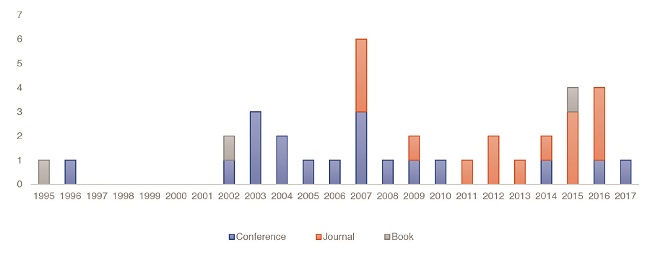
FIGURE 1
Publications by year and type.
Source: Elaborated by the author (2017).
REVIEW OF THE APPLICATIONS OF CA IN THE DESIGN PROCESS IN ARCHITECTURE AND URBAN DESIGN
One the difficulties in applying CA to urban planning is choosing an appropriate model. Applying it to the design process becomes an even more difficult task, because it involves translating a very abstract model into an actual project for a specific place (SANTÉ et al., 2010; PATT, 2015). Another problem is that urban models seldom allow for user customization and, even if they do, an extensive knowledge of computer programming is required (FISCHER & HERR, 2007; SANTÉ et al., 2010; JENSEN & FOGED, 2014). Urban models tend to focus on a large scale and it becomes difficult to relate their results to design problems (KOENIG, 2011; PATT, 2015). Furthermore, finding an appropriate set of rules for a model can be a daunting task due to the large number of possibilities and little guidance on how to choose the best options (SPELLER; WHITNEY; CRAWLEY, 2007; JENSEN & FOGED, 2014).
In the field of architecture, CA have been commonly used to explore building form directly through three-dimensional CA (COATES et al., 1996; FRAZER, 2002; KRAWCZYK, 2002; FISCHER & HERR, 2007; VAN DER ZEE & DE VRIES, 2008; DEVETAKOVIC et al., 2009; ARAGHI & STOUFFS, 2015). In these cases, the influence of the model on the form of the buildings is clear. In other examples, CA were used to generate diagrams that were later interpreted, either manually or digitally, by substituting cells for a design grammar to generate cross sections (CRUZ; KIRLEY; KARAKIEWICZ, 2017), floor plans (DINÇER; CAGDAS; TONG, 2014; LEE & KIM, 2016), structures (ANZALONE & CLARKE, 2003; ARAUJO & CELANI, 2016), and complex surfaces (DEVETAKOVIC et al., 2009). CA have also been used to generate rule-based bubble diagrams to organize design programs (HERR & KARAKIEWICZ, 2007) and as a framework to explore time-based design proposals (JENSEN & FOGED, 2014), thus serving as a source of inspiration for designers and influencing design indirectly.
For Singh and Gu (2012), CA are a particularly useful tool for generative urban design due to their capability to simulate scenarios. Their context-sensitive nature renders them a suitable method to support bottom-up design and zoning tasks. They can also be integrated to other generative design methods, such as parametric design, genetic algorithms, Lindenmayer systems (L-Systems), flocking algorithms, ontologies, patterns, and shape grammars to enhance and optimize its generative capabilities (CANEPARO, 2007; VAN DER ZEE & DE VRIES, 2008; HUA, 2012; SINGH & GU, 2012). In the field of urban design, CA have been commonly used to generate streets, blocks, and site massing in new urban developments (WATANABE, 2002; FINUCANE; DERIX; COATES, 2006; CANEPARO, 2007; KOENIG & BAURIEDEL, 2009; HUA, 2012; DINÇER; CAGDAS; TONG, 2014; PATT, 2015). In urban design, CA have also been used as a source of inspiration for self-assembly urban systems (FISCHER; BURRY; FRAZER, 2003).
Anzalone and Clarke (2003) describe two applications of CA to generate space-truss structures. The first applied a one-dimensional CA to design space-truss structures. Cells generated by the CA were then interpreted into nodes and bars with different lengths and angles to create the three-dimensional truss design. Depending on how the cells were interpreted through an algorithm, the same CA generated different trusses. The second started with a three-dimensional CA based on Game of Life rules to generate buildings after the interpretation made by another algorithm. Similarly, Caneparo et al. (2007) used CA integrated with an ontology of urban typologies to generate urban morphologies based on optimal relationships to create mixed-use neighborhoods.
Herr and Kvan (2007) propose CA as a method in which design steps are translated into transition rules. During the simulation, the designer can manually interfere in the outcome in order to generate the desired result. The location and distribution of buildings and the definition of height and density were then chosen by the designers without the aid of CA. Similarly, Araghi and Stouffs (2015) use CA to generate a variety of diagrammatic building forms for a high-density housing. The authors created the rules for the CA following accessibility and lighting requirements to generate floor plans. The simulation starts from fixed cells that represent the accessibility cores of the building. Cells grow around these cores and are interpreted as rooms in units that range from studios to two-bedroom apartments, depending on the number of cells. The translation of these diagrams into the actual design is done manually. The form of the resulting buildings strongly resembles the diagrams generated with CA.
Koenig and Bauriedel (2009) and Koenig (2011) apply CA to generate optimal street configurations and site massing for new developments. The model is divided into mutually dependent layers. There are larger scale layers that model urban development and layers with a higher resolution for urban design. CA are used to generate buildings in a street design generated in the lower resolution layer. The issue of scale and the applicability of urban models in design is a problem recurrently addressed by the authors reviewed in this study. Patt (2015) believes that the regularity of the grid used in traditional CA is one of the main problems in relating models to reality. He advocates that the use of irregular meshes adapted to topography and land use are an important relaxation to minimize arbitrary interpretations of urban models in the practice of urban design.
Jensen and Foged (2014) propose the use of CA as a method to explore time-based design proposals. With this in mind, they created a 2D model that recorded every time step, so that the user could compare the results of design decisions through time. Their main goal was to stimulate users to focus on overall design intents rather than absolute design solutions. They believe a large number of cell states and a low-resolution model are the best way to stimulate creative design solutions, with high levels of complexity. Berger et al. (2015) voxelate 3D scenarios and use the resulting model to run a CA-based simulation of urban heat distribution in order to support the urban design process and evaluate the outcome of design decisions in regard to heat distribution in the urban environment.
DISCUSSION
Herr and Ford (2016) believe CA are used as a tool in the architectural design process much more often than suggested by the literature. Designers fail to perceive the value of their experimental uses of CA for others because it has to be modified and adapted to each specific use in the design process and, in the end, the focus falls on the design and details of the process are lost. This lack of documentation leads those who are trying to apply CA to the design process to constantly repeat the errors of their predecessors and, thus, little ground is covered in each experience, which, in turn, leads to the underdevelopment of CA as tool for design.
Herr and Kvan (2007), Herr and Fischer (2013), and Herr (2015) suggest that, in order to take CA out of the realm of simulations and prediction of future scenarios, which is where it is generally applied in the field of urban studies, CA must become a tool for speculation and form-finding. Therefore, tools should allow high levels of interference by the designer, as well as relaxations in the original structure of CA. To this type of CA-based tool, the authors give the name of second-order CA (HERR & FISCHER, 2013; HERR, 2015).
However, differently from architecture, in the field of urban design, simulating, analyzing, and predicting are still important matters in the development of a project. But they do not stand alone, as they are allied to the speculative activity of designing. Thus, time cannot necessarily be taken out of the equation (CANEPARO, 2007; JENSEN & FOGED, 2014). Specific methods for applying CA to the task of urban design should, ideally, serve as a means to predict the outcomes of design decisions through the bottom-up development of a project, while stimulating creative thinking and problem solving. Such a tool would enable designers to guide the self-organization of cities through local interventions. The tool developed by Koenig and Bauriedel (2009) and Koenig (2011) are an example of how this can be accomplished through models that combine different scales for simulation and design interventions, thus simulating impacts of design decisions throughout its interconnected layers. When applying CA to design, the design intent is the main question that has to be defined at the very beginning. This is a shift from the traditional design process where the focus tends to be on a final and static design proposal (JENSEN & FOGED, 2014).
Despite the need for practical methods to inform decision making, and to model future scenarios, one of the main difficulties in applying CA to the architectural design process is that the outcome generated by a set of transition rules is nearly unpredictable and, therefore, constructing rules with desired outcomes in mind can be ineffective (HUA, 2012; HERR & FISCHER, 2013). Hua (2012) suggests that, in order to give a user more control over the outcome of a CA model and make the method more useful for urban design, it should allow the user to select potential outcomes from a variety of different simulations and use an evolutionary strategy to combine these results, by crossover and mutation, so as to generate a larger set of desirable results from which to choose.
Another recurrent issue in the application of CA to the design process is the influence exerted by the regular grid of cells on the final form. This is clearly noticeable in examples from the literature, such as the experiments presented by Coates et al. (1996), Krawczyk (2002), Herr and Kvan (2007), and Araghi and Stouffs (2015). Works by Herr and Karakiewicz (2007) and Anzalone and Clarke (2003) demonstrate interesting approaches to the problem, using CA to generate diagrams that would later be translated into design, the former by manual interpretation by the designer and the later through an algorithm that substituted cells with a structural grammar according to the cells in their neighbourhood.
The possibility of using shape grammars as an approach to generate rules for CA is also addressed in a number of the reviewed papers (ANZALONE & CLARKE, 2003; SPELLER, WHITNEY, CRAWLEY, 2007; SINGH & GU, 2012; VITINS & AXHAUSEN, 2016) and presents itself as an important strategy to deal with the difficulty of defining transition rules for the application of CA in the design process. To generate variety parametric design, L-systems, genetic and flocking algorithms can be integrated with CA-based models. They can also be used to optimize design selection.
Figure 2 illustrates the conceptual framework to develop a CA model, as deduced from the works reviewed in the SML, and how it can be integrated to other generative design methods to create tools for urban design.
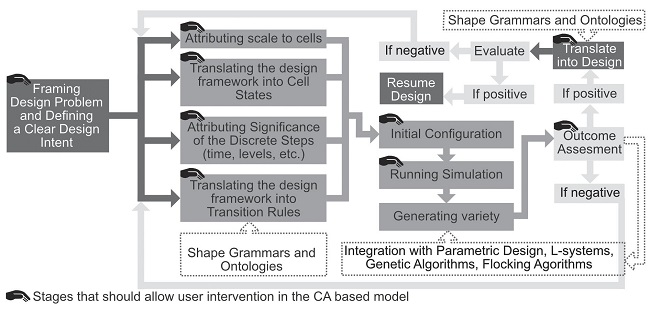
FIGURE 2
Conceptual framework for applying CA to the Urban Design Process.
Source: Elaborated by the author (2017).
In a seminal work in which generative design systems are defined, Mitchell (1975) categorizes them using representation methods. According to him, iconic representation is the most commonly option used by architects. However, generative systems based on analog or symbolic representations can deepen the understanding of a phenomenon and are more easily dealt with by the computer.
In the applications of CA reviewed in this paper, it was possible to notice a tendency to translate spatial aspects into the model in an iconic way, rather than a symbolic or analog way, which often led to very literal interpretations of CA-based models into designs. Perhaps this tendency could explain why we have found so many papers related to the application of CA to direct graphic design, such as building form and street networks (COATES et al., 1996; WATANABE, 2002; KRAWCZYK, 2002; HERR & KVAN, 2005; ARAGHI & STOUFFS, 2015), and not as many to a more abstract modeling of urban emergent behaviors, such as those published by Batty (2007).
Another decisive factor to keep CA in the realm of symbolic generative systems is the scale of the model. Many documented experiences that apply CA to architecture tended to assign a cell the scale of a room or an apartment in the building. When applying CA to urban design, the best scale for modelling seems to be that of the city or region (BATTY, 2007), and then, to zoom in to the site and use what was generated to make informed design decisions without the influence of shapes. It is possible that the same idea could be of value for architectural design. Instead of using room sized cells, very small cells could be used to generate clouds of cells that can later be translated into architectural concepts in a symbolic way.
FINAL CONSIDERATIONS
From what was seen in the literature presented above, the use of CA in urban design is still on the verge of its practical applications. One of the main problems noticed was that, when using CA software, probably unconsciously, designers are apparently drawn in by squares and cubes generated on the interface, resembling rooms and buildings, so that even if the final design barely resembles the model on which the design is based, the cubes appear in the final form as a prevalent reminder of the use of the tool. This needs to be taken into account when applying CA to the design process, especially in academic environments, to avoid the influence it exerts on form. Tools that combined CA models with generative design methods, such as shape grammars and ontologies, to process the CA into design, were generally more successful to avoid this influence on form. Further applications of the method in urban design studios are needed to test if the proposed methods are effective for generating better solutions for urban problems.
In summary, it is possible to conclude that CA can be a powerful tool in urban design, considering the complexity of cities and the necessity to deal with specific problems from the bottom-up, since top-down strategies have proved not to be so efficient in dealing with local issues. With the present availability of data and development of computation there is no more need to use general approaches to deal with urban problems, as cellular automata can be used to implement - or at least to inspire - a better customized urbanism.
ACKNOWLEDGEMENTS
This study was financed by the Coordenação de Aperfeiçoamento de Pessoal de Nível Superior. Finance Code 001 through PhD Scholarships in Brazil and abroad (Process n° 88881.187989/2018-01).
REFERENCES
ALEXANDER, C. et al. A pattern language. New York: Oxford University Press, 1977.
ANZALONE, P.; CLARKE, C. Architectural applications of complex adaptive systems. In: ASSOCIATION FOR COMPUTER AIDED DESIGN IN ARCHITECTURE CONFERENCE, 22., 2003, Indianapolis. Proceedings [...]. Indianapolis: ACADIA, 2003. p.325-335.
ARAGHI, S.K.; STOUFFS, R. Exploring cellular automata for high density residential building form generation. Automation in Construction, v.49, part A, p.152-162, 2015.
ARAUJO, A.L.; CELANI, G. Exploring weaire-phelan through Cellular Automata: A proposal for a structural variance-producing engine. Proceedings Blucher Design, v.3, n.1, p.710-714, 2016.
BATTY, M. Cities and complexity: Understanding cities with cellular automata, agent-based models, and fractals. Cambridge: The MIT press, 2007.
BATTY, M.; COUCLELIS, H.; EICHEN, M. Editorial: Urban systems as cellular automata. Environment and Planning B: Planning and Design, v.24, n.2, p.159-164, 1997.
BERGER, M. et al. CAD integrated workflow with urban simulation-design loop process. In: INTERNATIONAL CONFERENCE ON URBAN REGENERATION AND SUSTAINABILITY: SUSTAINANBLE CITY, 10., 2015, Medellin. Proceedings [...]. Medellin: WIT Transactions on Ecology and The Environment, v.194, 2015. p.11-22.
CANEPARO, L. Generative platform for urban and regional design. Automation in Construction, v.16, n.1, p.70-77, 2007.
CANEPARO, L. et al. Generating urban morphologies from ontologies. In: WORKSHOP COST ACTION C21 CONFERENCE: TOWNTOLOGY, 2., 2007, Castello del Valentino, Turin. Proceedings [...]. Turin: European Cooperation in Science and Technology, 2007. p.171-184.
COATES, P. et al. The use of Cellular Automata to explore bottom up architectonic rules. In: EUROGRAPHICS UK CHAPTER, 14., 1996, London. Proceedings [...]. London: Eurographics Association UK, 1996. p.26-28.
COUCLELIS, H. Cellular worlds: A framework for modelling micro-macro dynamics. Environment and Planning A, v.17, n.5, p.585-596, 1985.
CRUZ, C.; KIRLEY, M.; KARAKIEWICZ, J. Generation and exploration of architectural form using a composite Cellular Automata. In: AUSTRALASIAN CONFERENCE ON ARTIFICIAL LIFE AND COMPUTATIONAL INTELLIGENCE, 2017, Melbourne. Proceedings [...]. Cham: Springer, 2017. p.99-110.
DEVETAKOVIC, M. et al. Les folies cellulaires an exploration in architectural design using cellular automata. In: GENERATIVE ART CONFERENCE, 12., 2009, Milan. Proceedings [...]. Milan: Generative Art, 2009. p.181-192.
DINÇER, A.E.; CAGDAS, G.; TONG, H. A Computational model for mass housing design as a decision-support tool. Procedia Environmental Sciences, v.22, p.270-279, 2014.
FINUCANE, E.; DERIX, C.; COATES, P. Evolving urban structures using computer optimization techniques. In: GENERATIVE ART CONFERENCE, 9., 2006, Milan. Proceedings [...]. Milan: Generative Art, 2006. p.1-26.
FISCHER, T.; BURRY, M.; FRAZER, J. How to plant a subway system. In: INTERNATIONAL CONFERENCE ON COMPUTER AIDED ARCHITECTURAL DESIGN FUTURES, 10., 2003, Dordrecht. Proceedings [...]. Dordrecht: Kluwer Academic Publishers, 2003. p.403-412.
FISCHER, T.; HERR, C.M. The designer as toolbreaker? Probing tool use in applied generative design. In: ASSOCIATION FOR COMPUTER-AIDED ARCHITECTURAL DESIGN RESEARCH IN ASIA: DIGITALIZATION AND GLOBALIZATION, 12., 2007, Nanjing. Proceedings[...]. Nanjing: Southeast University Press, 2007. p.367-375.
FRAZER, J. Creative design and the generative evolutionary paradigm. In: BENTLEY, P.J.; CORNE, D.W. (Ed.). The Morgan Kaufmann series in artificial intelligence. San Francisco: Morgan Kaufmann, 2002. p.253-274.
GUNDER, M. Commentary: Is urban design still urban planning? An exploration and response. Journal of Planning Education and Research, v.31, n.2, p.184-195, 2011.
HEALEY, P. Urban complexity and spatial strategies: Towards a relational planning for our times. Londres: Routledge, 2007.
HERR, C.M. Second-order cellular automata to support designing. Kybernetes, v.44, n.8/9, p.1251-1261, 2015.
HERR, C.M.; FISCHER, T. Systems for showing and repurposing: A second-order cybernetic reflection on some cellular automata projects. Journal of Mathematics and System Science, v.3, n.4, p.201-216, 2013.
HERR, C.M.; FORD, R. Cellular automata in architectural design: From generic systems to specific design tools. Automation in Construction, v.72, part 1, p.39-45, 2016.
HERR, C.M.; KARAKIEWICZ, J. Algogram: Automated diagrams for an architectural design studio. In: INTERNATIONAL CONFERENCE ON COMPUTER AIDED ARCHITECTURAL DESIGN FUTURES, 12., 2007, Sydney. Proceedings [...]. Dordrecht: Springer, 2007. p.167-180.
HERR, C.M.; KVAN, T. Using cellular automata to generate high-density building form. In: INTERNATIONAL CONFERENCE ON COMPUTER AIDED ARCHITECTURAL DESIGN FUTURES, 11., 2005, Vienna. Proceedings [...]. Dordrecht: Springer, 2005. p.249-258.
HERR, C.M.; KVAN, T. Adapting cellular automata to support the architectural design process. Automation in Construction, v.16, n.1, p.61-69, 2007.
HILLIER, B. et al. Space syntax. Environment and Planning B: Planning and Design, v.3, n.2, p.147-185, 1976.
HOLLAND, J.H. Complexity: A very short introduction. London: Oxford, 2014.
HUA, H. Planning meets self-organization: Integrating interactive evolutionary computation with cellular automata for urban planning. Frontiers of Architectural Research, v.1, n.4, p.400-404, 2012.
JACOBS, J. The death and life of great American cities. New York: Vintage Books, 1961.
JENSEN, M.B.; FOGED, I.W. Cellular Automata as a learning process in Architecture and Urban design. In: EDUCATION AND RESEARCH IN COMPUTER AIDED ARCHITECTURAL DESIGN IN EUROPE, 32., 2014, Newcastle. Proceedings [...]. ewcastle: eCAADe, 2014. p.297-302.
JOHNSON, S. Emergência: a dinâmica de rede em formigas, cérebros, cidades e softwares. Rio de Janeiro: Jorge Zahar, 2003.
KASPRISIN, R. Urban design: The composition of complexity. London: Taylor and Francis, 2011.
KOENIG, R. Generating urban structures: A method for urban planning supported by multi-agent systems and cellular automata. Przestrze i Forma, v.16, p.353-376, 2011.
KOENIG, R.; BAURIEDEL, C. Generating settlement structures: A method for urban planning and analysis supported by cellular automata. Environment and Planning B: Planning and Design, v.36, n.4, p.602-624, 2009.
KRAWCZYK, R.J. Architectural interpretation of cellular automata. In: GENERATIVE ART CONFERENCE, 5., 2002, Milan. Proceedings [...]. Milan: Generative Art, 2002. p.7.1-7.8.
LEE, Y.; KIM, S.H. Algorithmic design paradigm utilizing cellular automata for the han-ok. Nexus Network Journal, v.18, n.2, p.481-503, 2016.
MITCHELL, W.J. The theoretical foundation of computer-aided architectural design. Environment and Planning B: Planning and Design, v.2, n.2, p.127-150, 1975.
NORTE PINTO, N.; PAIS ANTUNES, A. Cellular automata and urban studies: A literature survey. Architecture, City and Environment, v.1, n.3, p.368-399, 2007.
O'SULLIVAN, D.; TORRENS, P.M. Cellular models of urban systems. In: Bandini, S.; Worsch, T. (Org.). Theoretical and practical issues on cellular automata. London: Springer-Verlag, 2000. p.108-116.
O'SULLIVAN, D.; TORRENS, P.M. Cellular automata and urban simulation: Where do we go from here? Environment and Planning B: Planning and Design, v.28, n.2, p.163-168, 2001.
PATT, T. Generative masterplanning inspired by cellular automata with context-specific tessella-tions. In: EDUCATION AND RESEARCH IN COMPUTER AIDED ARCHITECTURAL DESIGN IN EUROPE, 33., 2015, Liverpool. Proceedings [...]. Liverpool: eCAADe, 2015. v.2, p.461-466.
SANTÉ, I. et al. Cellular automata models for the simulation of real-world urban processes: A review and analysis. Landscape and Urban Planning, v.96, n.2, p.108-122, 2010.
SHIFFMAN, D. The nature of code: Simulating natural systems with processing. [S.l.:S.n.], 2012. Available from: <http://natureofcode.com/book/>. Cited: Dec. 19, 2017.
SINGH, V.; GU, N. Towards an integrated generative design framework. Design Studies, v.33, n.2, p.185-207, 2012.
SPELLER, T.H.; WHITNEY, D.; CRAWLEY, E. Using shape grammar to derive cellular automata rule patterns. Complex Systems, v.17, n.1/2, p.79-102, 2007.
TOBLER, W.R. A computer movie simulating urban growth in the Detroit region. Economic Geography, v.46, p.234-240, 1970.
ULAM, S.M. Some ideas and prospects in biomathematics. Annual Review of Biophysics and Bio-engineering, v.1, p.277-292, 1972.
VAN DER ZEE, A.; DE VRIES, B. Design by computation. In: GENERATIVE ART CONFERENCE, 11., 2008, Milan. Proceedings [...]. Milan: Generative Art, 2008. p.35-37.
VITINS B. J.; AXHAUSEN K.W. Shape grammars overview and assessment for transport and urban design: Review, terminology, assessment, and application. Journal of Transport and Land Use, v.9, n.1, p.65-96, 2016.
VON NEUMANN, J.A. Theory of self-reproducing automata. Illinois: University of Illinois Press, 1966.
WATANABE, M.S. Induction design: A method for evolutionary design. Basel: Birkhauser, 2002.
WHITE, R.; ENGELEN, G. Cellular automata and fractal urban form: A cellular modelling approach to the evolution of urban land-use patterns. Environment and Planning A, v.25, n.8, p.1175-1199, 1993.
WOLFRAM, S. Cellular automata. Los Alamos Science, v.9, p.2-21, 1983.
Como citar este artigo/How to cite this article
Author notes
M.N.P. OLIVEIRA E SOUSA: responsible for article conception and design; bibliographical review; data analysis and interpretation. M.G.C. CELANI: Responsible for proposing the theme of the article, advising the main author on its conception and design, and for reviewing and approving the final version of the article.
* Correspondence to/Correspondência para: M.G.C. CELANI | E-mail: <celani@fec.unicamp.br>.