Articles
DESIGN STRATEGIES TO DEFINE THE ARCHITECTURAL PARTI DURING PROBLEM SOLVING 1
ESTRATÉGIAS DE PROJETO PARA DEFINIR O PARTIDO ARQUITETÔNICO DURANTE A SOLUÇÃO DE PROBLEMAS
 WILSON FLORIO wilsonflorio@gmail.com
RAFAEL PERES MATEUS
WILSON FLORIO wilsonflorio@gmail.com
RAFAEL PERES MATEUS
DESIGN STRATEGIES TO DEFINE THE ARCHITECTURAL PARTI DURING PROBLEM SOLVING 1
Oculum Ensaios, vol. 17, e204363, 2020
Pontifícia Universidade Católica de Campinas, Programa de Pós-Graduação em Urbanismo
Received: 17 September 2018
Revised document received: 20 March 2019
Accepted: 17 April 2019
ABSTRACT: Based on video/audio design protocols, this paper aims to analyze the definition of the architectural parti in the design process. Video recordings occurred between the years of 2011 and 2012, and involved three active experienced architects who had their own studios. All architects were experienced designers and developed a single-family residence during one hour based on the same briefing. Each design process was taped with two cameras: one focusing on the actual drawing production, and the other on the architects, so as to register all their actions during the process. There was an accurate registry of the drawing and pause instances, aiming to provide an interpretation of each architect’s design procedure in the development of the architectural parti. This registry contributed to present a graphic representation of the design process frequency showing the time in which designers conceived the parti core. Architects were also interviewed, and their resulting designs were compared beholding the following parameters: (i) Site occupation x topography x open areas; (ii) Sectorization and functionality; (iii) Geometry and volume. The results obtained suggest that self-imposed restraints play an important role in the definition of the architectural parti, confirming this paper contribution to the comprehension of strategies used in the architectural design.
KEYWORDS: Design cognition, Design process, Protocol analysis.
RESUMO: Baseado em protocolos audiovisuais de projeto, o artigo objetiva analisar a definição do partido arquitetônico no processo de projeto. Filmagens ocorreram entre os anos de 2011 e 2012 e envolveram três arquitetos que possuíam seus próprios escritórios. Todos os arquitetos eram experientes e desenvolveram o projeto de uma residência unifamiliar por uma hora a partir do mesmo programa de necessidades. Cada processo de projeto foi filmado por duas câmeras: uma focada na realização do desenho, e a outra, no arquiteto, a fim de registrar todas as suas ações durante o processo. Houve um registro preciso dos períodos de desenho e pausa, com o objetivo de fornecer uma interpretação do procedimento de projeto de cada arquiteto na definição do partido arquitetônico. Esse registro contribuiu para apresentar uma representação gráfica da frequência do processo de projeto, na qual estão situados os momentos em que os projetistas conceberam questões centrais para o partido. Os arquitetos também foram entrevistados, e seus projetos resultantes foram confrontados, observando os seguintes parâmetros: (i) ocupação do local x topografia x áreas abertas; (ii) setorização e funcionalidade; (iii) geometria e volume. Os resultados obtidos sugerem que as restrições autoimpostas desempenham um papel importante na definição do partido, confirmando a contribuição deste estudo para a compreensão de estratégias elaboradas na concepção do projeto arquitetônico.
PALAVRAS-CHAVE: Cognição em projeto, Processo de projeto, Protocolos de análise.
INTRODUCTION
The rationale behind this paper is the investigation about the definition of the architectural parti into the design process. The parti covers all the main aspects essential to the definition of the proposal’s form and space. In other words, it concisely unveils the design intentions from the requisites to solve the problem. Based on protocol analysis, this paper discusses the role of the problem requirements and also the restraints imposed by the architects in designing strategies to define the architectural parti.
The paper is organized as follows: initially a selection of published studies provides a context to help understand the role of the problem in design activity as well as that of the architectural parti. This is followed by a description about the investigation methodology applied in this paper, based on video/audio design protocols of three experienced architects solving a problem proposed (the challenge). In addition, a specific analysis is presented about the basis of graphic representation of the design process frequency where the time points in which architects conceived the core of the parti are located. Subsequently, results are demonstrated and interpreted. At last, considerations are made on results obtained and implications for future design practices and architectural design education.
ROLE OF PROBLEMS IN THE STRATEGIES OF THE ARCHITECTURAL PARTI
During the last decades, the design process has gone through a considerable amount of academic exploration under an array of methodological approaches, known as Design Methods. Although there are differences amongst these approaches, they do have something in common: the design process blossoms from a problem. At first, this situation implies in identifying a need (ASIMOW, 1962) to be addressed by the design. Therefore, it’s crucial to identify the necessary requirements to solve the problem (ALEXANDER, 1964), as well as to define the task to be performed considering the final object functions (CROSS, 2008; PAHL et al., 2011). Comprehension of the basic requirements of the project has a unique importance as to the division of the problem in smaller parts, henceforth offering an easier solution.
Alexander (1964) states that the problem should be broken down into manageable subsets - where the sub-problems are resolved - to be regrouped into a preliminary solution. This preliminary solution establishes the parameters needed for the design definition. In line with Alexander, the investigations undertaken by Pahl et al. (2011) point out that the problem division allows the solution to be formulated from manageable modules. In connection with that division, Cross (2008) mentions that there are sub-solutions within the process, where alternatives are contemplated and the design detailing enhanced, seeking an overall solution capable of dealing with the problem as a whole.
The above studies are based on approaches that examine the role of the problem in design activity. Nevertheless, identifying the design problem is not an easy task, which leads to a great volume of interpretations made by designers. Designing is poorly structured, and the initial objects are not clear at the beginning of the creative process (REITMAN, 1964). The present study defined the understanding of problem in design like baseline for characterizing the design strategies in the conceptual phase. In an analogous way to Moneo (2013), strategy is understood as mechanisms, procedures, paradigms and representational artifacts undertaken by architects during the design process.
Architect’s own requirements are also investigated, because designers regularly (re)define and frame the challenge during their design thinking activities (GOLDSCHMIDT; RODGERS, 2013). Consequently, the architect’s interpretation of the problem is analyzed, as well as its influence on the architectural parti. Parti could be defined as a diagrammatic scheme of a given building, a conceptual and generic idea (MAHFUZ, 1995); it synthetizes the architectural proposal and its main internal and external definitions, from the site plan, to its connections and surroundings, and its functional and technical premises. In essence, designers use the briefing as well as their own abilities/knowledge and representational media in drawing their parti (FOZ, 1972). For this reason, the development of a better understanding about design strategies during the definition of the parti in problem solving is suggested.
METHODOLOGICAL PROCEDURES
The methodology used in this study is based on protocol analysis (EASTMAN, 1968; NEWELL; SIMON, 1972; AKIN, 1986; ERICSSON; SIMON, 1993; DORST; DIJKHUIS, 1995); and Alexander’s (1964) “problem break down” design method. Since the 1960’s there has been a steady growth in empirical research on design cognition, particularly from studies performed by Eastman (1968). Different approaches have been taken to study design process, including case studies, protocol analysis and performance tests (CROSS, 2001). Among these methods, protocols are those with the most recurrent use over the years (ERICSSON; SIMON, 1993). Newell and Simon (1972) argue that protocols are recordings of subject’s problem-solving behavior which can be subsequently analyzed to identify the invariance in the subject’s patterns of behavior. On the other hand, Alexander’s (1964) “problem break down” method proposed a manner for structuring design problems to make them easily solved (breaking down the problems into sub-problems). According to the theoretical assumptions, this study observes how the architects monitored had listed all the requirements and had grouped them into clusters in sub-problems relatively independent (site occupation x topography x open areas; sectorization and functionality; geometry and volume).
Design processes were monitored based on video/audio protocols with focus on designer’s strategies to defining the architectural parti. To reach this objective, this investigation followed the drawing activities performed by designers throughout the process. Goldschmidt’s research (GOLDSCHMIDT, 1991) applies protocols to demonstrate how it is possible to study the creative process from drawings conceived during the design process. Furthermore, designer’s utterances were transcribed, because they frequently indicate some intention that the designer has in mind; in addition the pauses reveal changes in issues addressed by designers (SUWA et al., 1998). Therefore, this investigation sought to understand how architects deal with problem’s briefing requirements and also how they set up their own requisites. In order to achieve this aim, it is necessary to break-down into parts the solution adopted by each architect, and then analyze the interactions among them.
PROCEDURE AND PARTICIPANTS
An experimental protocol analysis was performed between the years of 2011 and 2012, and counted with three experienced architects regularly engaged in their professions and who own their studios. These are prized architects, with good reviews from critics who possess traits invaluable to their profession. Only experienced architects were monitored in this research because studies have indicated that intensive practice allows automating procedures of design, improving the speed in the process (ERICSSON; SMITH, 1991; ERICSSON; SIMON, 1993). All the architects developed a design for a single-family residence in the Santa Terezinha Hill, a district of the coastal city of Santos, in the state of São Paulo, Brazil (Figure 1), with the same initial data. This initial data consisted of briefing, topographical plans, site and surrounding pictures, weather and local code information. The briefing described five sectors: social (living room, dining room, hall, toilet), intimate (four suites, office with library, atelier), back-house (kitchen, laundry room, pantry, storage), leisure (balcony, barbecue grill, swimming pool) and garage (three parking spaces).
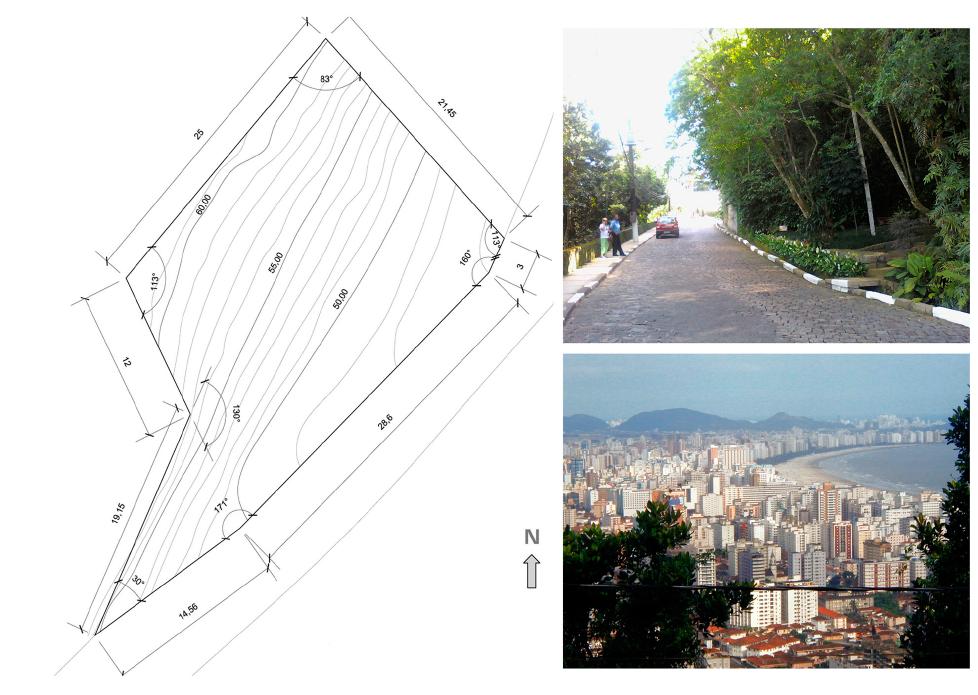
Figure 1
Topographical site plan, picture from access to the site and visual perspective.
Source: Developed by authors (2010).
Each design process lasted one hour and was taped by two cameras: one pointing at the drafting table, aiming to monitor the drawing production, and the other focusing on the architect, seeking to verify his other activities which give support to the design activity. To obtain more information regarding the project, it was requested that the architects spoke out their thoughts (think aloud) during the whole process. The think aloud protocol allows observation of cognitive operations, responsible for the solutions generated (ERICSSON; SIMON, 1993). Utterances are fundamental for interpretation of aspects not present in the drawings, such as architects’ intentions and their conceptual and functional attributes. After the monitoring, the architects were interviewed.
DEVELOPMENT OF THE GRAPHIC REPRESENTATION
This investigation presents a graphic representation that illustrates the frequency in the design process. The graphic representation is based on monitoring two types of instances: drawing and pause. Drawing instances are each and every depiction made on paper by each of the architects during the monitoring. Drawing activity has the capacity of storing information which can be used in different moments of the creative process (BILDA et al., 2006). The recording of each drawing instance was done with a precision of seconds and marked between the moments that the architect placed his pencil’s point on the paper to the moment he stopped. On the other hand, pauses are moments between drawing sections. It’s important to note that during these pauses there’re also important activities in progress, such as: taking notes regarding some aspect in the drawing; analyzing the briefing and code; setting up the drafting table; examining the drawing’s characteristics; erasing something etc.
The identification of data from the protocol analysis, is essential to develop a coding scheme (CHI, 1997). Thus, a code for each instance undergone by the architects was established. This code is constituted by the first letter of the instance in question and followed by its chronological order. For example, the first drawing instance was named D1, the second D2, and so on. Consequently, each pause instance (P1, P2, P3, etc.) had a similar code.
The development of a strategy for coding data made possible the elaboration of a graphic representation for understanding the frequency of drawing-pause instances during the design process (Figure 2). The frequency of monitored instances was obtained by placing all of them in chronological order in the x axis of a Cartesian plane. It’s important to note that drawing instances were placed in the first quadrant and pause instances were placed in the fourth quadrant. The y axis was destined for registry of time (in seconds). Hence, the longer the duration of drawing or pause instance, the bigger the frequency amplitude.
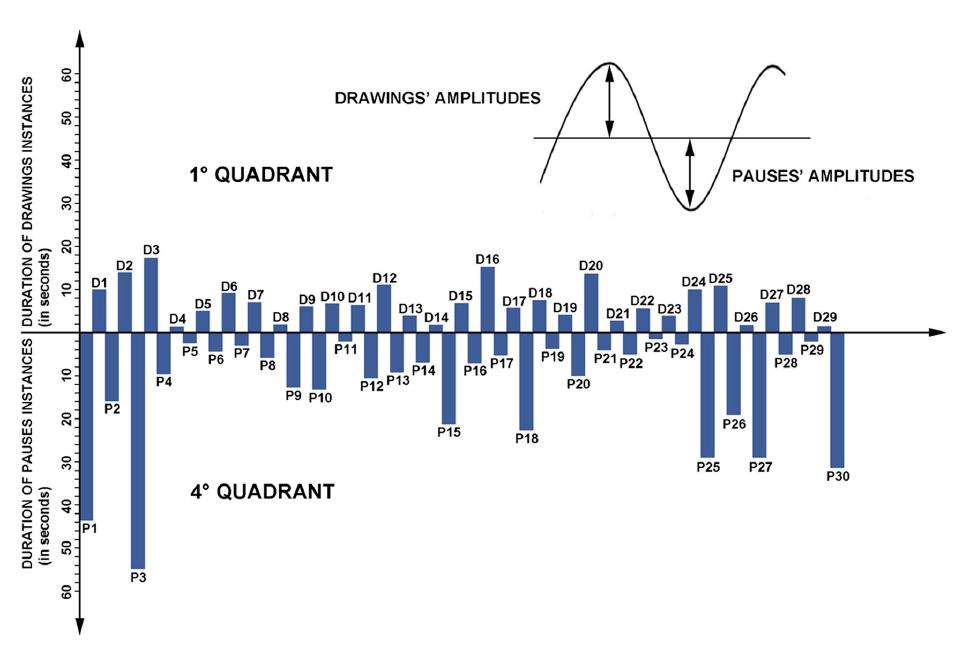
Figure 2
Elaboration of graph measuring frequency of drawing-pause instances during the design process.
Source: Developed by authors (2018).
RESULTS
The architectural propositions and verified data were considered to understand strategies during the definition of the architectural parti. Besides, the protocol’s results were compared beholding the following parameters: site occupation x topography x open areas; sectorization and functionality; geometry and volume. The architects’ behaviors have been analyzed on the basis of graphs of drawing-pause frequency with the purpose of examining changes generated by the problem requirements and by the requirements imposed by the designers themselves.
PARTI PROPOSITIONS
Initially, it is possible to observe that the three architectural parti have contrasting characteristics amongst themselves (Figure 3). Architect 1 developed a parti distributing the rooms in all three floors, occupying the terrace level with a leisure space. The resulting building is constituted by vertical and adjacent blocks, where uses are indicated by the volume. Architect 2 suggested a three-level architectural parti, in which uses are distributed, with the highest level being constituted by a regular block, for the intimate portions of the building. Architect 3 elaborated a conspicuously vertical parti, with five levels, distributing all the rooms amongst them.
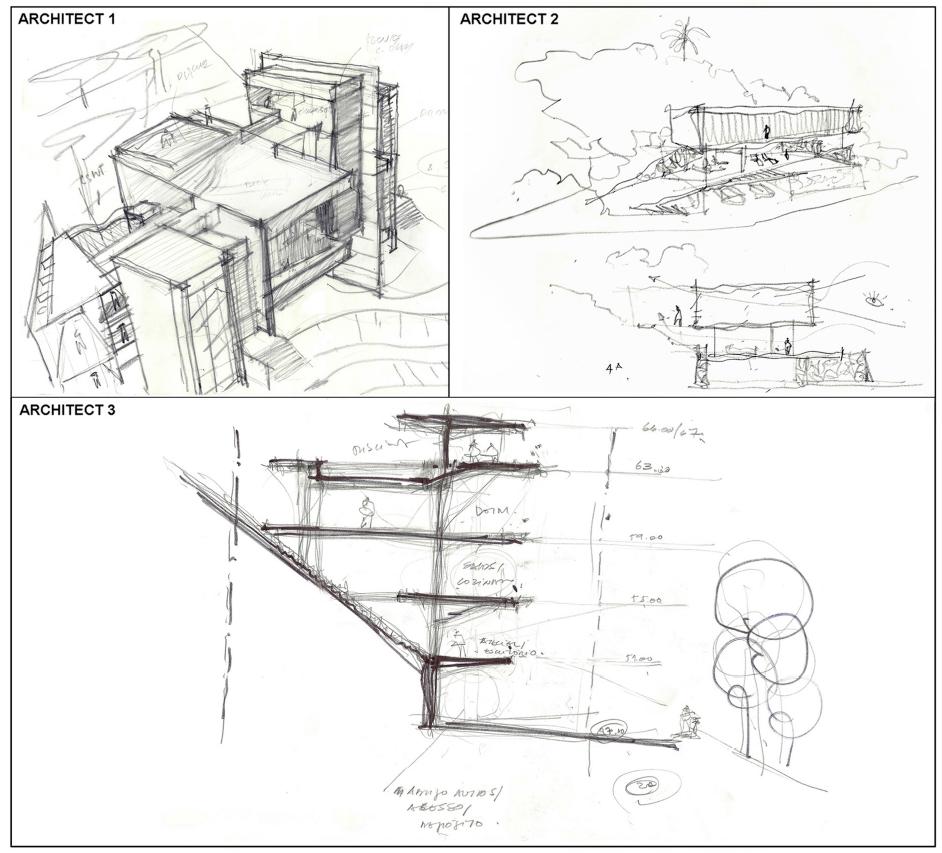
Figure 3
Architectural Parti elaborated by the architects.
Source: Developed by authors (2018).
As a result of the strong site inclination, all architects started the design process through sections, suggesting a residence requirements distributed between three and five levels. However, there were different strategies when it comes to the site occupation and its relation to the site’s natural topography. There were also differences between the distribution of intimate, social, and back-house portions of the briefing; horizontal and vertical circulations were thought out differently; and suggestions of geometry goes from regular to curvilinear. As we shall see further along, this difference had emerged from the designers’ interpretations of the problem, besides the deep analysis regarding the conditions which were presented to them.
VERIFIED DATA
In the same way that three architectural parti have different characteristics amongst themselves, resulting data was also divergent. As can be seen in Table 1, architects had different absolute values when it comes to drawing instances. Coincidentally, the architect with less work expertise (Architect 1) had a smaller number of drawing instances (162), while the designer with most work expertise had the largest number (226).
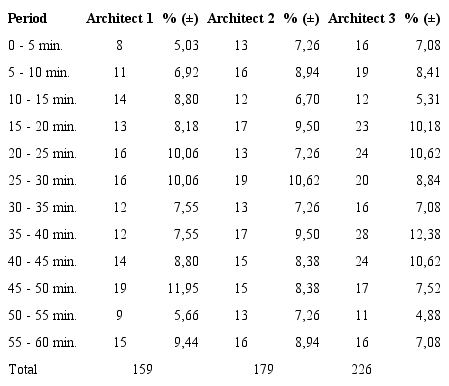
There are singularities in the variation of the number of drawing instances registered on protocols: Architect 1 had strong variation on the final twenty minutes, while the oscillation of Architect 3 lasted all along. Nonetheless, Architect 2 was the one who had the smallest fluctuation at the end of the monitoring process (Figure 4a).
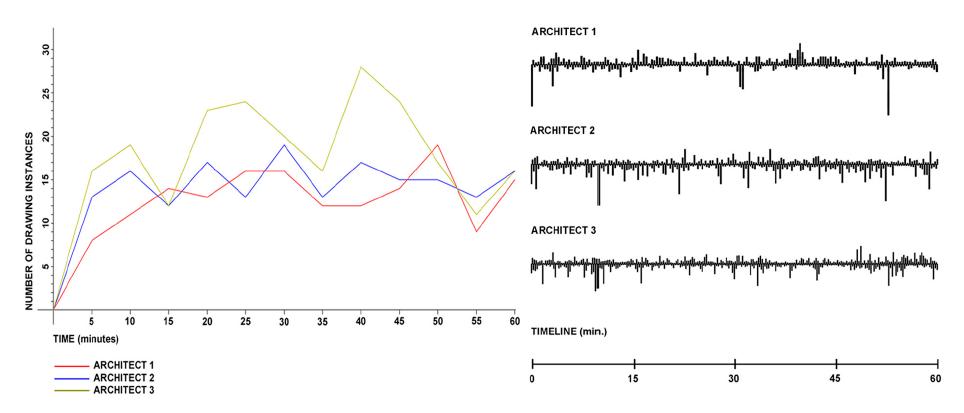
Figure 4
Oscillations in the amount of drawing instances by the architects during the monitoring (left) and frequency of the drawing-pause instances (right).
Source: Developed by authors (2011).
Even though there were differences in the number and distribution of drawing instances, the drawing-pause frequencies of experienced architects were highly similar. Correspondingly, it’s important to mention that three architects frequencies show a predominance of lower amplitudes (Figure 4b), which result from the great number of drawings and pauses with short duration. Basically, these short durations come from constant inferences of the architects about the requirements which existed in the problem and those set by the designers themselves during the design process. These inferences allowed repeated analysis and evaluations of ideas synthetized on the drawings.
SITE OCCUPATION X TOPOGRAPHY X OPEN AREAS
Free-hand drawings by the architects show that site occupation, topography and open areas were addressed in particularized ways. The site occupation strategy of Architects 1 and 2 were very much alike. Both cherished the dense tree formations, and sough to use the site’s steep slope in their favor. As stated in the interview after the taping: “The first goal was to use the site’s characteristics in our favor, a dense tree formation […]” (Architect 1). “The site has a considerable geography, so I tried to adjust myself to that” (Architect 2).
In both designs, the house was placed near the street, parallel to its level, with minimal cut and fill, resulting in a retaining wall. The perspective drawings and sections show that the levels would grow, with the smallest area allocated at the ground level, and the largest on the third floor. Albeit these similarities, other aspects were very contrasting. When compared to Architect 2, Architect 1 showed the biggest concern regarding the site’s open areas: “The key point is to occupy the site keeping its context as original as possible” (7 minutes and 2 seconds from the start of monitoring).
However, he suggested a rather irregular volume, which advances over part of the existing trees on the site. On the other hand, Architect 2 addresses the topography with greatest ability, examining the street slopes and the site’s original slopes. After taping, Architect 2 stated the following: “It has a compositional concern, that is, how one thing is related to another, how an environmental context relates to another […]”.
Architect 3’s strategy focused on establishing a direct relationship with the site’s topography. Based on a proposition consisting of five narrow and elongated levels, the architect made each floor structure extend itself until anchoring itself into the site’s natural slopes. In the interview, Architect 3 explained his intentions as can be seen below: “Architectural parti […] I believe it’s a matter of establishing the greatest relationship with the site, thus anchoring itself in the site”.
In the same fashion as the other designers, Architect 3’s proposition included larger upper floors, lifting the building above the ground level. The architect showed concerns regarding the site topography, with the street slope, conceiving a suspension structural system which would interfere the least with the site: “This […] [cantilever deck in the roof’s frontal portion] has to be placed here somewhere, because I didn’t want to do anything else [rejects placing new columns in the structural system]” (27 minutes and 22 seconds from the start of monitoring).
The topography comprehension and decision making regarding the site’s occupation happened rather rapidly in the design processes monitored (before approximately the first ten minutes). The drawing-pause frequencies at the beginning of the monitoring showed that the pause amplitudes reach higher values compared to the drawing amplitudes (Figure 5). This can be explained by the fact that understanding the design problem, that is, the comprehension of the site intrinsic aspects and of the initial briefing, demands bigger pauses. Also, the establishment of requisites by the designers - responsible for guiding their conceptual prerogatives - occurred during the pauses. On the other hand, the drawing instances were usually shorter, because the architects were making constant inferences regarding what was put on paper.
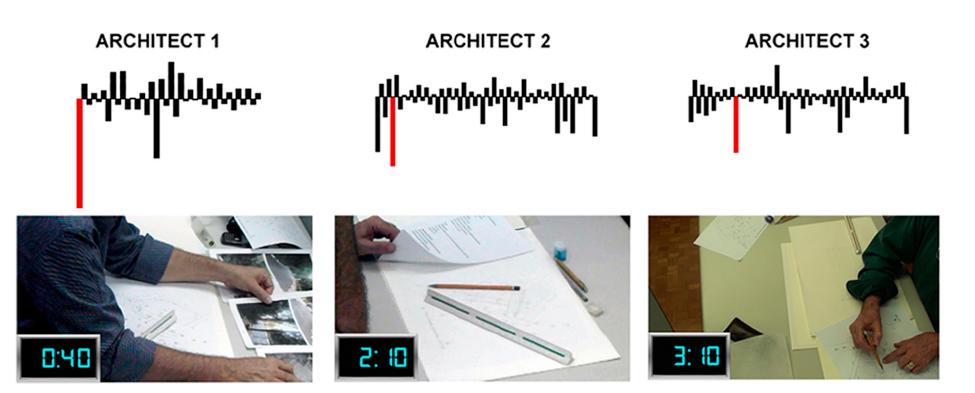
Figure 5
Frequencies of drawing-pause instances in the first ten minutes of monitoring. Longer pauses are highlighted in red.
Source: Developed by authors (2018).
SECTORIZATION AND FUNCTIONALITY
All architects adopted different strategies regarding sectorization and functional distribution (Figure 6). Architect 1 suggested that the distribution of sectors must be shown in the volume, by separated blocks, which would be connected by a passageway: “[…] the main problem is the largest areas, which are to be located in the main block, that is, this block will be bigger than the rest. Then, the other volumes came up, as complements. I concentrated the back-house portions alongside the laterals, just so it could have an independent access […]”.
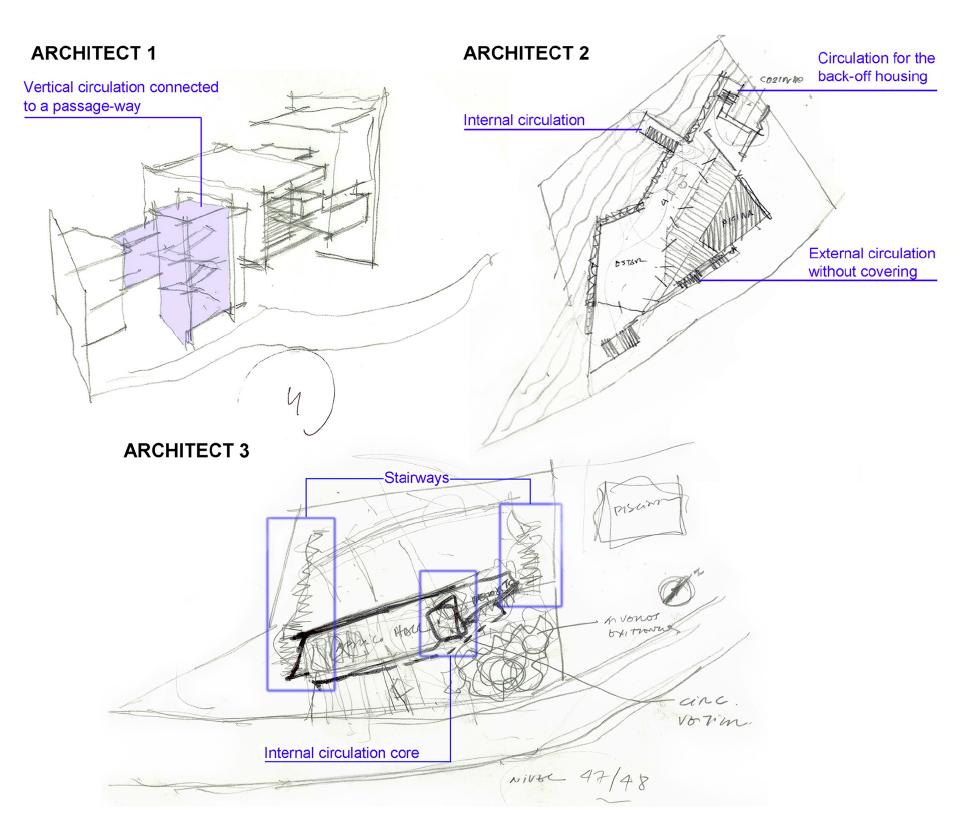
Figure 6
There were different approaches regarding the functionality, as could be seen analyzing the placement of the circulation set up.
Source: Developed by authors (2018).
Therefore, he suggested a back-house block (on the right side), a centralized social and intimate block, vertical circulation (center-left), and a block containing atelier, office, and library (left). The resulting architectural parti were constituted by briefing-oriented blocks.
Architect 2 distributed the sectors in a rather more traditional manner, with social and back-house sectors on the first floor, and intimate premises on the second. As Architect 1, Architect 2 allocated the garage and storage rooms on the ground floor. Architect 2 justified the sectorization due to time constraints regarding the design: “I needed to make a deeper technical analysis, but since I didn’t have the chance, I opted for a rather conservative alternative”
In spite of that, Architect 3 distributed the three sectors into five floors. The ground level is just for garage, while the first floor was destined to the atelier, office and library. The second floor is wholly social, whilst the third is private. Lastly, the upper floor was assigned to the leisure activities: “I grouped analog uses. So, bedrooms are on a specific floor, while on the second floor there are the living-room and kitchen. The atelier is on the first floor, because it is where you get visitors” (Architect 3).
When it comes to the functionality of the internal circulation set up, there’s plenty of difference between the three designs. Architect 1 sets apart an intimate core from a social core, with vertical circulation. This vertical communication is connected to a passage-way, which allows access to the other blocks that shape the house. It’s possible to materialize Architect 1’s proposition of an exclusive circulation for the back-house areas: “[…] the circulation core pretty much organizes the design solution, and when it flourished in the first sketch, I noticed that it could, by means of a transition core, divide the sectorization […]” (Architect 1).
Nonetheless, Architect 2 created a rather diversified circulation solution. He suggested an internal circulation going from the ground level to the intimate sector; an exclusive circulation for the back-house and an external circulation, without a cover, going from the ground level to the social sector. The architect elaborated this external circulation based on the site conditions, which favor looking at the surrounding view: “I noticed that the client, in this case you, guys... you really paid a lot of attention about it […] the site selection, the landscape” (Architect 2).
Lastly, architect 3 came up with a single internal circulation core, which gave access to all sectors and levels. After the monitoring, he explained himself as follows: “[…] it created a course for the user, a vertical course […] either you go straight up through the elevator, or you walk by the sides and reach the floors […]” (Architect 3).
Architect 3 mentioned a secondary external circulation, constituted by two staircases. As opposed to architects 1 and 2, he also suggests that the circulation between the bedrooms could be done through the terrace facing the street. This parti is justified by the site location and by the briefing that requires considering two young dwellers, ten and fifteen years-old respectively. In the interview, Architect 3 explained his thoughts as follows:
[…] I went ahead and did it, because we are dealing with a condominium. So safety isn’t that big of a deal here. So, I went after something lighter, and I think it’s nice to think they are […]. I have a kid and a teenager […]. This freedom […] for them […] to be able to play, even bring the kid here and let the other one throw a party over these counters etc. I believe that’s all about the course.
The frequency on the periods where the architects thought about sectorization and functionality has singular characteristics. It’s possible to note that these periods are mostly marked by short drawing periods and pause instances, where designers made many inferences regarding their hypothesis. Those inferences didn’t allow longer periods of drawing and pause instances, since the ideas flowed continuously and needed to be promptly drawn and observed. Therefore, the moments where architects were elaborating circulation and functional alternatives resulted in longer pause periods (Figure 7), where the adopted solutions were evaluated.
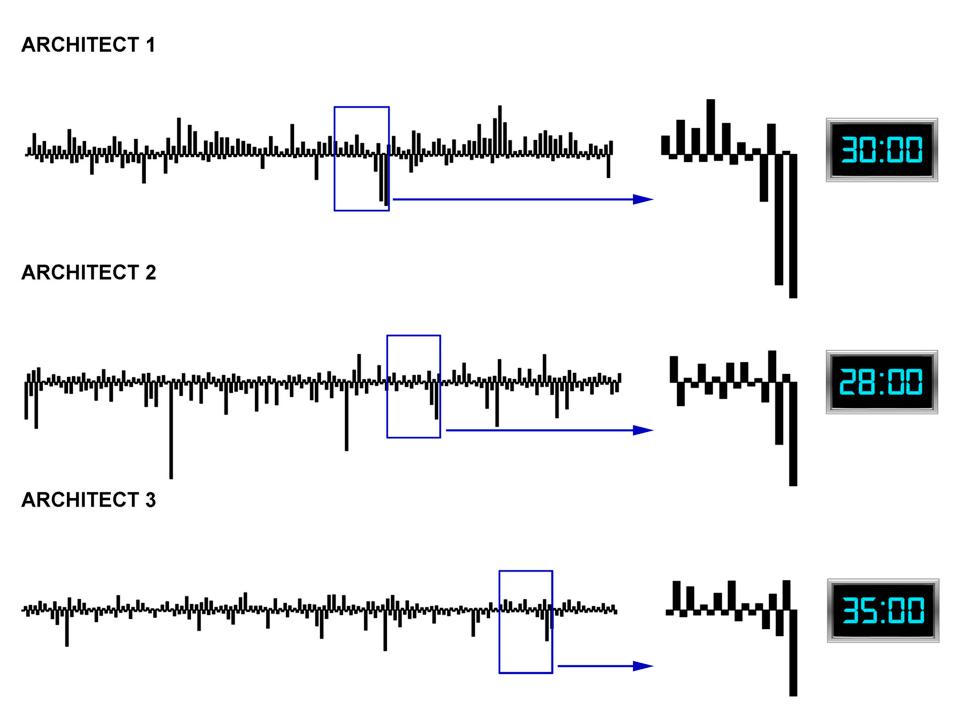
Figure 7
Frequencies on periods where sectorization and functionality are being defined, highlighting the longer pauses where evaluations were taking place.
Source: Developed by authors (2018).
GEOMETRY AND VOLUME
All the proposals positioned the house parallel to contour lines, where width was more prominent than depth, although other aspects are very contrasting. Both Architects 1 and 2 made perspective drawings where it’s possible to see their suggested volume and geometry. The time frame where the perspective drawings were made show the largest drawing time amplitudes, since this kind of drawing takes up more time. Architect 1 conceived his volume in parts, highlighting different sectors of the house. In the interview following the taping, he explained as follows: “[…] when you look at it from the outside, you’d understand its logic. You’d have the main planes, and they’d be taller, in evidence, loose […]. So, who would be looking from the outside, would see that it’s a house that’s all split up, but that’s one single drawing” (Architect 1).
The perspective drawing of Architect 1 illustrates his concern about separating and accentuating, volumetrically speaking, the verticality on the edges and horizontality in the middle. There’s a clear hierarchy in the volume of the intimate and social sectors, since they’re emphasized by the bigger dimension at the volume’s center. Blind areas contrast with glassed areas, with openings that are in proportion to the spaces.
Architect 2 employs a strategy in which each floor has different geometrical traits, generating stratified volumes on each floor. The ground level is the most irregular, with indentations and bulges. The second floor has a rather regular volume, although it has inclined and glass walls. The third floor, where the intimate portion of the house is located, is pretty regular and seems to float over the glassed part right below it. Thus, the volume gains dynamism with advancing and retreating parts, but in balanced proportions, albeit asymmetric. This volumetric composition had the site’s complexity as its main guideline, as the architect himself points out in the interview: “[…] I tried to adjust, let’s put it this way, a volume within a topographical context, which, to me is an intrinsic characteristic of this site” (Architect 2).
The volume proposed by Architect 3 is clearly consequential from his conception of the architectural parti via sections, as confirmed by the author in the following interview: “[…] it seems as the section gives us hints, but it’s nothing but logic, the section isn’t enough, but it’ll give you hints all along, will it not?” (Architect 3).
Architects spent more time developing their conceptions through sections, to only later tackle floor plans. According to Architect 3: “Floor plans are confusing; you get lost and locked out as your final decision”.
Architect 3 didn’t come up with a perspective drawing, which would allow a better comprehension of his intentions. However, his floor plans suggest a volume that goes along with the site’s slope, that is, the floor levels’ perimeter goes along with the natural topography. This shows his concern regarding a connection between the site and his design. By means of his floor plans, it is possible to infer that there would be wide openings and a contrast between the verticality of the volume and its horizontality.
DISCUSSION
At first, it is possible to identify some correlated situations that happened within the three design processes. The design solutions didn’t just start with the problem identification, since the architect’s interpretation had singular importance. If all the basic requirements for the solution were intrinsically inserted into the problem (site characteristics and briefing), the designers would also have to hierarchize the postulates that operated as guidelines for their actions, that is, they established their own requisites that were based on previous knowledge, global awareness and conceptual prerogatives. This set of requisites provided the parameters for the solution of the problem’s parts (sub-problems) that address different matters within the design (accesses, sectorization, functionality, structure etc.) When all the solutions are aggregated into a conceptual generic idea, the architectural parti flourishes in the process (Figure 8).
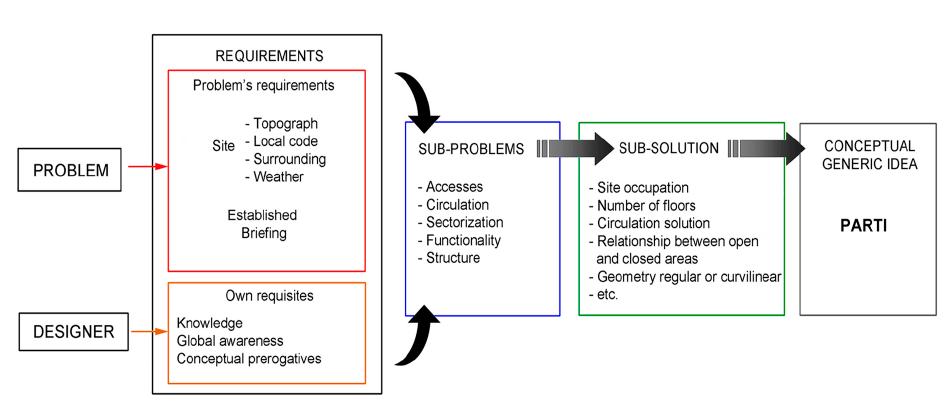
Figure 8
Definition of the architectural parti process.
Source: Developed by authors (2018).
The design solutions conceived by the three architects show expertise when tackling the proposed topics, and this could be clearly seen in the drawings and posterior explanations. It was possible to note a solid proficiency on the technical, functional and aesthetic aspects of those architects. However, each architect emphasized one of those aspects regarding their own analysis of the problem at hand. The emphasis of architect 1’s design is a plastic expression, acting as a reflection of the house’s interior, while architect 2’s design is marked by a connection with the site. Notwithstanding, the emphasis placed by architect 3 on his design resides on his structural solution and his respect for the site’s topography. These different approaches demonstrate how the interpretations regarding a given problem play a fundamental role in the process of conceiving an architectural parti.
It is possible to note that Architects 1 and 3 explored the verticality in their design, whilst architect 2 highlighted horizontality. This made designs from Architects 1 and 3 to hide the dense forest formations behind the house, while Architect 2 made sure these formations appear to be above his house, as enunciated by his perspective drawing. When each Architect comes up with a unique solution for the different parts of the problem, new ways in which the design solution could interact with the site’s vegetation emerge.
The initial set of free-hand drawings shows that the architects’ intention wasn’t to occupy much of the site. However, during the process, the architects noted that the briefing demanded that they occupied considerable portions of the site, and that the initial hypothesis of occupying only the site’s frontal portion wasn’t feasible. This significant change of course of action happened from the moment the designers realized that the interaction between the problem’s requisites and those established by them would imply on relativizing some of the adopted postulates. It becomes clear that there’re changes between the initial sketch and the dimensioning of the final floor plans. In this sense, Architect 1 discussed these matters in the following excerpt: “[…] you get bored on the first sketches; they try a minimum occupation. So you go along understanding the site’s scale […]”. Architect 2 also expressed the same concerns during his interview: “[…] sometimes the form drives away from the initial notion […]”.
It’s notable the manner in which the geometry employed by Architects 1 and 2 were rather regular, with straight angles and well defined volumes, while Architect 3 employed a rather curvaceous geometry, adapted to the site’s context. Apparently, the site’s lateral boundaries didn’t seem to be determinant in the architect’s design decisions, but the analysis of the different sub-problems - briefing, topography, code etc. - were determinant in this change of course of action. In the interviews, the architects showed that the site’s boundary lines and angles had an influence on the occupation of the site, as well as in the construction proposal’s perimeter. Regarding this matter, architects showed the importance of the briefing upon their design at different moments:
At first I thought that I wouldn’t need to worry about the boundaries, but later on I noticed that they’d become the main role players […] they’d set the limits” (Architect 1, interviewed after the designer’s taping).
I noticed that the briefing’s details […] I started to look at them more carefully. I noticed that [without going all the way to the boundaries] it wouldn’t fit (Architect 2, after the designer’s taping).
Here [pointing to his notes regarding the briefing] is a big summary that I prepared, in order to be able to incorporate the boundaries, the code and all (Architect 3, after the designer’s taping).
Also, the design activities sequence offers important hints about the choices that were made, showing direction shifts. These changes in the course of action, sometimes brisk, sometimes subtle, are represented graphically in the drawing-pause frequencies. The frequency amplitude is related directly with key moments of the design process, because it reveals transformation of the ideas conceived by the architects. The concentration of short drawing and pause instances generates low amplitudes, and evidences constant procedure changes that were often made based on the problem’s understanding combined with the restraints imposed by the architects. On the other hand, longer drawing periods suggest a deeper elaboration of a given idea, while longer pauses correspond to profound analysis or evaluations. Therefore, these oscillations amongst drawing and pause instances were fundamental in the design strategies.
Likewise, the monitoring of this sequence allowed the precise definition of the architectural parti, that is, when the determination of the design’s central matters came to pass. Such matters include number of floors, sectorization, circulation and site plan (Figure 9). At this time, the architects retrieved previous knowledge, made associations with previously conceived ideas, and established analogies between known circumstances and the current design activity. This could be exemplified in the following speech of Architect 2 during the monitoring: “There’re so many possibilities here [in order to occupy a site with a steep slope], oh man! Hard to choose […]” (14 minutes and 40 seconds after beginning the monitoring).
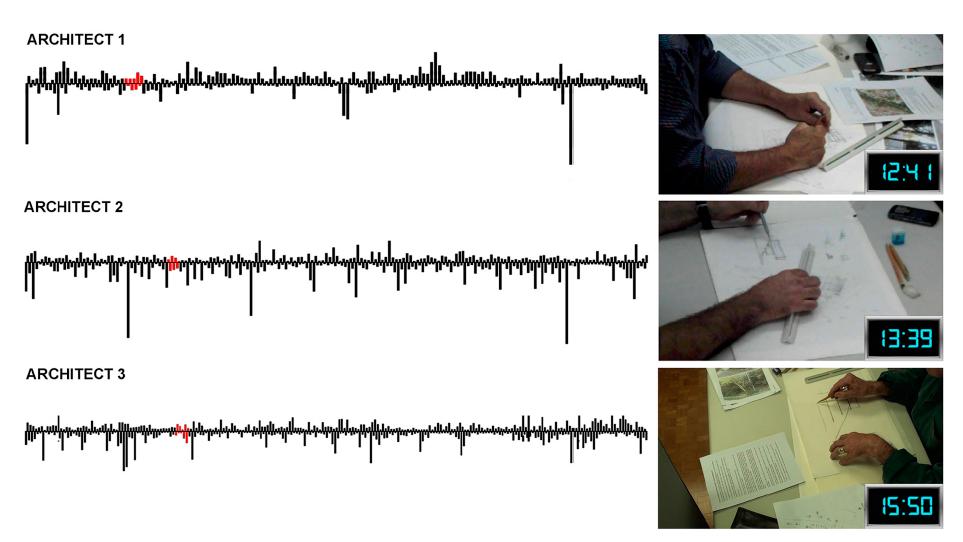
Figure 9
Moment (highlighted in red in the frequency) in which architects conceived core matters in the architectural parti.
Source: Developed by authors (2018).
It becomes clear that creative processes result in particularized design solutions, showing a unique global awareness and cultural array of the architect upon the problem being tackled. Nonetheless, there’re operational principles that surpass design strategies. Therefore, it’s noticeable that the design oscillates between general and specific aspects, just as collective interests and personal ideals. At some moments, the experienced architects showed those ideals during monitoring as can be seen below:
It’s funny how our minds make us do something that […] a way to see the world, to draw, that makes us do things the way we do them (Architect 1, monitoring, 43 minutes and 17 seconds).
A beautiful site, in my opinion, green, wonderful, for me it’s an untouchable place, I’m pretty much pious in this sense. I’m playing here […] I’d rather work in places that are already destroyed, that call for a reformulation […] (Architect 2, interview after monitoring).
It’s an extra chance I gave myself, to see something like this, without pressure or anything else, just wanting to do my best; now, it’s a pity that we can see so far beyond within our heads even at this early stage (Architect 3, interview after monitoring).
If on the one hand, design solutions usually incorporate previous professional knowledge, there are moments where new knowledge is generated, which amplify the professional field as a whole. Constantly, architects recall existing conditions at the beginning of the creative process, which generate specific knowledge: “[…] public spaces didn’t have much precision [at first]. There’s this boundary here […] there’s already an evaluation on how to use it” (Architect 1, after 52 minutes and 10 seconds monitoring).
Results of design protocols show that designer’s analyses were based on previously accumulated knowledge during their careers. In addition, protocols reveal that when the designers come into contact with the problem, they apply previous knowledge to establish requisites that are not originally listed in the briefing, neither is in the code information. Expert architects personalized their design solution based on several requisites formulated by them. Concomitantly, graphics with drawing-pause frequency helped to demonstrate some procedures that were carried out by architects when they defined strategies for the conception of their architectural parti. Finally, the results obtained discuss how protocols are adequate to investigate cognitive actions performed by designers during elaboration of solutions - which corroborates the understanding of Cross (2001).
FINAL CONSIDERATIONS
Architectural designs are not the result of random processes. Even though it may not be possible to retrieve all design process steps, the monitoring of drawing time and pauses makes it possible to identify some procedures and operations within the design process. Monitoring allows us to represent graphically, in a systematic manner, drawing-pause frequencies during a design conception. Although many design actions come from motivations and choices that aren’t that easily perceived, taping of the whole process allows the identification of fundamental aspects that serve as guidelines for these actions. A careful observation of the sequence of design actions sanctions the understanding of some of the procedures adopted by the architects, deeming monitoring a viable instrument for the comprehension of the design process.
Drawing-pauses frequencies indicate that architects define their parti in a creative manner when they draw with greater intensity, doing constant inferences based on their perceptions, retrieving their previous knowledge and constantly evaluating the result of their design solution. New investigations are necessary in order to understand the role of cognitive actions within the architectural parti conception process, suggesting a relevant research field for studies seeking to further design practices.
Like the problem requirements, self-imposed restraints play an essential role in the design process, particularly about the strategies to define the architectural parti. Based on these findings, it is possible to offer new study programmes and educational objectives in order to obtain improvements in architectural design education. Students of architecture can be encouraged to set up their own requisites in practical exercises, because a satisfactory solution is not derived solely from a proper analysis of the problem’s requirements proposed by educators. Thus, a better understanding of restraints imposed by designers provides considerable prospects for their application in architectural design pedagogy.
A well-defined architectural parti enhances the designer’s definitions. To do so, it is fundamental for the architect to efficiently deal with the problems intrinsic to the design process, besides appropriately synthesizing the different solutions that make up the parti. During this process, previously and currently acquired knowledge are inserted into the conception process, as the architect’s cultural repertoire. Consequently, there isn’t a way to dissociate the designer from the design process. Therefore, in an attempt to understand this process, this article collaborates with the debates over the role of self-imposed restrictions by architects on the strategies used in the definition of the architectural parti.
ACKNOWLEDGMENTS
The authors are grateful for the generous participation of the architects involved in the experiments that supported the writing of this paper.
REFERENCES
AKIN, O. Psychology of architectural design. London: Pion Limited, 1986.
ALEXANDER, C. Notes on the synthesis of form. Cambridge: Harvard University Press, 1964.
ASIMOW, M. Introduction to design. Englewood Cliffs: Prentice-Hall, 1962.
BILDA, Z. et al. To sketch or not to sketch? That is the question. Design Studies, v. 27, n. 5, p. 587-613, 2006.
CHI, M. T. H. Quantifying qualitative analyses of verbal data: a practical guide. The Journal of the Learning Sciences, v. 6, n. 3, p. 271-315, 1997.
CROSS, N. Design cognition: results from protocol and other empirical studies of design activity. In: EASTMAN, C. M. et al. (ed.). Design knowing and learning: cognition in design education. Amsterdam: Elsevier, 2001. p. 79-103.
CROSS, N. Engineering design methods: strategies for product design. Chichester: John Wiley & Sons, 2008.
DORST, K.; DIJKHUIS, J. Comparing paradigms for describing design activity. Design Studies, v. 16, n. 2, p. 261-274, 1995.
EASTMAN, C. M. Explorations of the cognitive processes in design. 1968. 100 f. Dissertation (pHd in Computer Science Department) - Carnegie Mellon University, Pittsburgh, 1968.
ERICSSON, K.A.; SMITH, J. (ed.). Toward a general theory of expertise: prospects and limits. Cambridge: Cambridge University Press, 1991.
ERICSSON, K. A.; SIMON, H. A. Protocol analysis: verbal reports as data. Cambridge: MIT Press, 1993.
FOZ, A. Some observations on designer behaviour in the parti. 1972. 134f. Thesis (Department of Urban Studies and Planning) - Massachusetts Institute of Technology, Cambridge, 1972.
GOLDSCHMIDT, G. The dialects of sketching. Creativity of Research Journal, v. 4, n. 2, p. 123-143, 1991.
GOLDSCHMIDT, G.; RODGERS, P. A. The design thinking approaches of three different groups of designers based on self-reports. Design Studies, v. 34, n. 4, p. 454-471, 2013.
MAHFUZ, E. C. Ensaio sobre a razão compositiva. Belo Horizonte: UFV, 1995.
MONEO, J. R. Inquietação teórica e estratégia projetual na obra de oito arquitetos contemporâneos. São Paulo: Cosac & Naify, 2013.
NEWELL, A.; SIMON, H. A. Human problem solving. Englewood Cliffs: Prentice-hall, 1972.
PAHL, G. et al. Engineering design: a systematic approach. Darmstadt: Springer, 2011.
REITMAN, W. R. Heuristic decision procedures, open constraints, and the structure of Ill-defined problems. In: SHELLY, M. W.; BRIAN, G. L. (ed.). Human judgements and optimality. New York: John Wiley and Sons, 1964. p. 282-315.
SUWA, M. et al. Macroscopic analysis of design processes based on a scheme for coding designers’ cognitive actions. Design Studies, v. 19, n. 4, p. 455-483, 1998.
NOTES
Author notes
Correspondence to/Correspondência para: W. FLORIO | E-mail: wilsonflorio@gmail.com