DOSSIÊ: CIDADE EM TEMPOS DE PANDEMIA
Received: 11 February 2020
Revised document received: 12 June 2021
Accepted: 12 July 2021
DOI: https://doi.org/10.24220/2318-0919v18e2021a5136
ABSTRACT: The high incidence of COVID-19 cases in low-income communities, the context of disinformation around the disease, and the vacuum of public policies have made low-income communities more vulnerable to the pandemic. Considering that scenario, this paper analyzes how urban collectives have used social media to create and share narratives about COVID-19. We frame those contributions through the lens of insurgency, an area of planning studies that is based on grassroots counter-hegemonic actions. We conduct a sentiment and thematic analysis of Instagram posts from urban collectives in Fortaleza to show how social media has been appropriated as a space to cope with the virus and to support insurgency. Our findings show, even though most strategies are geared towards emergency relief, collectives also harness the atmosphere of crisis brought by covid-19 to raise awareness of other structural issues. Collectives promote insurgency by creating their own content, information, and research material about COVID-19 in their communities and by partnering with institutions to scale up their claims.
KEYWORDS: Civic engagement, Collectives, Content analysis, Insurgent planning, Social media.
RESUMO: A alta incidência de casos de covid-19 em comunidades de baixa renda, o contexto de desinformação em torno da doença e o vácuo nas políticas públicas deixaram comunidades de baixa renda mais vulneráveis à pandemia. Considerando esse cenário, este artigo analisa como coletivos urbanos têm usado as mídias sociais para criar e compartilhar narrativas sobre a covid-19. Essas contribuições foram enquadradas através da lente teórica da insurgência, uma área de estudos de planejamento que se baseia na contra-hegemonia criada por movimentos de base. Realizou-se uma análise de sentimento e temática sobre as postagens no Instagram de coletivos urbanos em Fortaleza para mostrar como as mídias sociais têm sido apropriadas como um espaço de enfrentamento ao vírus e apoio à insurgência. Os resultados mostram que, embora a maioria das estratégias sejam voltadas para o alívio emergencial, os coletivos também aproveitam a atmosfera de crise trazida pela covid-19 para aumentar a conscientização para outras questões estruturais. Os coletivos promovem a insurgência criando seu próprio conteúdo, informações e material de pesquisa sobre a covid-19 em suas comunidades e firmando parcerias com instituições para ampliar suas reivindicações.
KEYWORDS: Ativismo, Análise de Conteúdo, Insurgência, Assentamentos Informais, Redes Sociais.
INTRODUCTION
THE CRISIS BROUGHT by COVID-19 has highlighted several systemic issues when it comes to the structures in place that guarantee basic human rights such as health, food and shelter. In Brazil, the vacuum of policies to support vulnerable communities has also made dwellers vulnerable to false truths and fake news which hamper risk perception or how the virus can impact low-income families in Brazil. Official channels of communication and media have presented inconsistent statements regarding adequate physical distancing, quarantine, vaccines, effective treatments and hygiene protocols. Several grassroots strategies had to be employed by Brazilian community leaders to address the needs of dwellers living in informal settlements through crowdfunding, donations and contact tracing (FURTADO, 2020). This paper is nested within that specific context of misinformation and the challenges it poses for local organizations: how to ensure continuous engagement in communities and promote wellbeing.
We present how community groups and local dweller associations, which we call here ‘collectives’1, make use of social media to present a counter-narrative about COVID-19 that is pertinent to their experiences. Through a content analysis of posts of community group Instagram (IG) profiles, our analysis shows how activists and leaders create narratives to cope with the process of misinformation and emphasize risks in their communities. Also, they raise awareness of other structural problems affecting low-income settlements and promote actions to cope with a broad set of challenges.
COVID-19 IN BRAZIL: FIGHTING THE AGE OF MISINFORMATION WITH GRASSROOTS COUNTER-NARRATIVES
The spread of COVID-19 in Brazil deserves special attention due to particular events that, as Henriques and Vasconcelos put it, have led to “a crisis within a crisis” (HENRIQUES; VASCONCELOS, 2020). In late January 2020, after several warnings by the World Health Organization and the rapid spread of the virus in Italy; the Brazilian public health system started preparing for future coronavirus cases and establishing protocols to deal with contagion. Simultaneously, far-right president Jair Bolsonaro issued public statements undermining the problem and polarizing the public debate (HENRIQUES; VASCONCELOS, 2020). The dissonance between the statements and actions sponsored by the government and scientific communities has put citizens in a state of uncertainty where no truth is evidently universal. Tensions between the federal administration, the Health Ministry, and the scientific community created the perfect environment for misinformation and the exponential growth of fatalities. As of this date (December 2021), the number of losses due to the coronavirus is the third largest among all nations totalling over 600K.
Studies have shown that those losses are more prominent in low-income communities, where workers have to endure long rides in public transportation and do not have the economic freedom to stay home following quarantine (ATAÍDE et al., 2020). A study by Data Favela back in March, 2020 found that 7 out of 10 families living in informal settlements had already experienced a drop in the family income and 72% of female households voiced concerns on food security (PERES, 2020). The difficulty to conduct large-scale testing and the under-reporting of cases pose challenges when it comes to showing the severity of the virus and prioritizing areas for public health policies. Nonetheless, research has shown that incidence and prevalence rates of COVID-19 tend to be higher in the poorest regions such as informal settlements, which concentrate vulnerable groups such as Blacks, women and the elderly (SILVA, 2021). Social movements, NGOs and collectives had the challenge of promoting strategies in their communities in face of the inaction from both federal and local governments.
It is also worth mentioning that the spread of COVID-19 presented these collectives with a new challenge to engage with their communities in ways that are not tied to the urban and public space. The public realm as a space that embraces contestation and social networking has always served as a political platform for social movements. However, due to physical restrictions imposed by social distancing, this engagement process had to search for alternatives to continue mobilizing in digital venues. In his seminal book “Networks of Outrage and Hope: Social Movements in the Internet Age”, Castells presents how new digital technologies can complement street activism (CASTELLS, 2012). Social media may also provide an escape due to distress people may have experienced from missing access to public and green spaces and cultural venues (COCOZZA; MESSIAS; TALARICO, 2021).
In contrast, we have also witnessed how social media may discourage people from protesting in the streets, which is still a key variable for the success of social movements. However, this new pandemic context has relied on new digital spaces for debate, which are also created and maintained through collective action. Social media can be a tool to cope with hegemonic structures of power - especially in nations that impose a rational order that is disconnected from the reality of those disenfranchised. Seminal studies detail how new information and communication technology were key for protesters to quickly gather support around a cause such as the Arab Spring, the Wallstreet Occupy Movement and the June Protests in Brazil (TUFEKCI; WILSON, 2012; CUSTODIO, 2014).
However, other studies are reluctant to attribute the success of social organizers and activism solely to social media. In his book about the Arab Spring in Cairo, Murthy (2013) emphasizes the crucial role of in-person protests occupying streets and public spaces to bring the revolution forward. Additionally, not all information is beneficial. Since other agents become empowered to generate content through instantaneous and cheap messages, citizens become overloaded with information and unable to differentiate fact from opinion (HENRIQUES; VASCONCELOS, 2020). The State hegemony over data and information is often “structurally committed to the reproduction of the status quo” and representing those historically in power (DE SOUZA, 2006).
Despite those diverging studies, Shirky reminds us that technology can be radical due to its ability to promote changes in human behavior, a notion that is overwhelming but can be harnessed to catalyze activism (SHIRKY, 2008). The concept of ‘mediactivism’ complements this idea and refers to how those deprived of civil rights have used different media in political fights to inform human rights violations (MEIKLE, 2002; SOUZA E ZANETTI, 2013). Leon et. al. presented a framework that looks at how the activity of social movements is divided into two different moments which make up a cycle of protest: rupture and abeyance. The first takes place when the movement is active and seeking attention for a cause while the latter is the period of decline which follows intense organization (LEONG et al., 2019). It is important to keep this distinction in mind since this paper is interested in the first moment of rupture when groups are constantly developing strategies as the COVID-19 crisis unfolds.
Alternate means of communication maintained by grassroots movements in informal settlements are instrumental to portraying the local reality and decentralizing the power of information. Producing content no longer comes from expert groups and corporations that have historically monopolized how data is created and spread (FURTADO; RENSKI, 2019). This bottom-up creation of knowledge fits within a larger movement of insurgency, which promotes independent action from civil society against these so-called hegemonic structures.
PLANNING FOR COVID-19 WITH INSURGENT INFORMATION
Within the framework of counter-hegemonic practices and theories, it is important to highlight the literature on insurgent planning. The general idea of insurgency initially gained traction under the homologous term of radical planning through the seminal work by John Friedmann. The author stressed the importance of social mobilization in partnership with planners who can use their technical skills to provide support towards planning practice that is disentangled from authoritarian State planning (FRIEDMANN, 1987). Subsequent studies by Leonie Sandercock (1998) and Roy (2005) have built on that idea and coined the term ‘insurgent planning’ to question the power imbalance in planning processes. They state that new tactics to promote public engagement can be used to pacify community members with the illusion of inclusion, but without actually contributing to the end of their marginalization. Additionally, the most recent work by Miraftab (2009) brought those principles to the current context of neoliberalism and showed how insurgency emerges from the grassroots in order to oppose the structured systems of oppression perpetuated by predatory economic systems.
It is important to notice that there is unique literature that separates Radical Planning and Insurgent Planning, but Huq (2020, p.373) has summarized how those two theories “[…] recognize the dirty history of planning and want to undo the consequences through their shared commitment to spatial justice, their historicized analysis of oppression and strategizing liberation in specific contexts and in alliance with social movements”. The author also emphasizes how insurgent planning is inherently tied to the practice of social and marginalized movements, which is the focus of this paper. Thus, we build on the conceptual framework of insurgent planning to evaluate how information plays a role in the pursuit of counter-hegemonic practices by communities in Fortaleza in the state of Ceará.
One example of insurgent practice was documented about the community of Poço da Draga, an informal settlement in Fortaleza established in 1907. Dwellers of Poço da Draga have historically withstood the risk of housing displacement largely brought by government projects under the premise of bringing development but with the overarching goal of redesigning that area, located in the touristic waterfront. The local planning authority developed plans for Poço da Draga based on an incomplete census that underestimated the number of homes and dwellers impacted by the policy and failed to provide alternatives to mitigate impacts brought by urban interventions (NOGUEIRA, 2019). Dwellers saw this lack of adequate data and as a tactic used by the government to devalue their claims and mobilized to develop insurgent mapping strategies. In 2016, the community initiated a local census to collect information about the inhabitants, their history in the community, educational attainment and employment, tenure status, relation to sporting activities and to the waterfront, and perceptions about the redevelopment project. They also mapped out inconsistencies in the official maps being used by the planning department. With regards to insurgency, Nogueira concludes that the census seeks to:
Overcome the representations of the community based on stigmas and strengthen the community with consistent information, produced by the residents themselves, in contrast to the divergent official data, such as those raised by Instituto Brasileiro de Geografia e Estatística (IBGE, Brazilian Institute of Geography and Statistics) and by the municipality. The consistency of these data is intended to bring relevant arguments for the community to resist frequent removal risks, as well as to guide public policies that benefit them (NOGUEIRA, 2019, p. 15, our translation).
The autonomy of dwellers in Poço da Draga is a clear example of how the production of information and knowledge is a process that can strengthen a sense of place, value local culture and history, and transfer power to marginalized communities so they can challenge existing narratives. Another study by Rebouças, Manzi and Mourad (2019). showed how traditional urban planning tools such as development plans, which are traditionally used as mechanisms for real estate developers to profit from strategic public investment in land development, can be used by citizens to produce their own space. Neighborhood plans and insurgent technologies can incorporate information produced by the excluded and highlight conflicts and other hidden aspects of the territory (REBOUÇAS; MANZI; MOURAD, 2019).
Another key aspect of insurgent planning is its connection to a physical space in which dwellers contest who has access to the urban realm and re-appropriate it for alternative purposes. However, as stated, this physical embodied aspect of insurgency dwindled due to the social distancing imposed by COVID-19. Thus, this scenario allows us to look at the appropriation of a different kind of [virtual] space where we can still identify insurgent practices in which urban collectives question the legitimacy of the dominant narrative about the virus portrayed by a neoliberal extremist State.
In the context of urban planning and COVID-19, it is possible to find cases in which information and alternative media have supported insurgency: “People-controlled and alternative means of communication such as podcasts, street art and local speakers are essential to share effective information on how to prevent the virus from spreading. Locally respected spokespeople complement official statements about the severity of covid-19 by highlighting how it specifically impacts their communities” (FURTADO, 2020. p. 4). A supporting text details how informal dwellers face challenges adopting basic hygiene routines recommended by the World Health Organization. In order to cope, many collectives have created banners to be placed in strategic areas of their communities with direct language to encourage solidarity, social distancing and cleaning (PERES, 2020).
Despite all the situations of adversity generated by COVID-19, these examples signal that we are presented with an opportunity to look at how the disruptions brought by the virus make people become engaged to process and control ‘a new normal’ state of living.
RESEARCH GOAL
The present literature review attests to the potential of information which is generated from social movements as an antithesis to hegemonic narratives that often portray marginalized communities through biased and incomplete views. This issue was critical during the COVID-19 crisis, in which misinformation regarding the severity of the virus and safety protocols had a serious impact on more vulnerable communities. Such a scenario of hardship demanded a different type of organizing from social movements, which have historically used public spaces as a platform for debate, mobilization and contestation. However, social distancing protocols required these collectives to innovate and use social and digital media in order to reach their communities and mitigate the deadly consequences of COVID-19.
Sarrica et al. (2018, p.322) conducted research on a different context of risk (environmental disaster due to earthquakes), but with a similar goal of looking at how social media is appropriated by civil society in order to empower themselves and “[…] co-construct the emergency they live through”. Thus, the risk brought by COVID-19 allows us to witness how communication strategies from grassroots organizations can further an agenda of insurgency based on collective necessity.
Considering that scenario, this paper seeks to conduct a content analysis to systematize how community groups, civic associations and collectives have used social media to create and share a counter-narrative about COVID-19. We also seek to analyze those contributions through a lens of insurgency, an area of planning studies that is based on practice and that “[…] is in its very early stages and much more remains to be done in order to enrich and deepen the conception of IP as a set of practices” (HUQ, 2020. p.15).
Specifically, we seek to investigate the following aspects:
-
What strategies and topics have been shared by these collectives through social media and narratives in order to cope with the virus?
-
How have the processes and content created by these collectives promoted insurgent citizenship?
-
How has the issue of COVID-19 been associated or brought to attention other urban agendas and structural issues?
This research does not seek to necessarily present the disruptive and revolutionary potential of social media, but to highlight the set of practices from these urban collectives and how they use information to “[…] enact equality, counter-hegemony, transgression, and imagination through situated political contestations that lead to the reconstitution of political subjects” (HUQ, 2020, p.15).
METHODOLOGICAL PROCEDURES
The main methodology for this study consists of content analysis of 556 Instagram (IG) posts made by 15 urban collectives in the city of Fortaleza, between March and August of 2020. We largely follow the steps presented by Leão et al. (2020). in their analysis of IG profiles of major health organizations (2020). Their goal was to analyze the content of the posts and how they were in line with the recommendations established by the World Health Organization (WHO) and the United Nations Children’s Fund (UNICEF) to fight COVID-19. The authors argue that social media that relies on visual content such as Instagram (where posts are necessarily linked to a photo or video) tend to be more effective in influencing the senses and emotions of their specific target audience (LEÃO et al., 2020).
The digital media model also allows a large number of posts at a low cost, which can be an advantage in the face of an unprecedented situation that requires a continuous and rapid update of the information being passed on to the public. It is also worth noting that IG was purchased by the Facebook group and direct communication between both platforms enables users to share what is posted on IG to their Facebook pages. Thus, most content in Facebook would mirror what was found on IG and was deemed insignificant for our purposes of extracting new content.
Considering these advantages and characteristics, we focus on IG due to its potential to highlight priorities and influence decisions of the target audience of vulnerable communities during COVID-19. We divide the study into three phases: (1) Establishing criteria and selecting social media profiles; (2) Data mining for text patterns and emerging themes; and (3) Content extraction and inductive coding.
ESTABLISHING CRITERIA AND SELECTING IG PROFILES AND POSTS:
As a starting point, we used the database from the Somar project developed by the Universidade Federal do Ceará (UFC, Federal University of Ceará) which mapped associations and groups that promote solidarity in Fortaleza, especially relevant during the COVID-19 crisis. Somar compiled 31 different initiatives, 24 of them reported a social network profile (ARQPET, 2020). We examined all of those IG profiles added other profiles through snowball sampling based on similar profiles suggested by IG. The final profiles were filtered according to the following criteria:
-
To present a considerable history of activity presenting over 100 posts;
-
To be a public profile that represents a group or association (not individuals);
-
Not to have been created with the sole purpose of gathering donations (it was common to find profiles solely with bank account information for crowdfunding);
Our final sample totaled 15 IG profiles representing 13 neighborhoods of Fortaleza mapped in Figure 1.
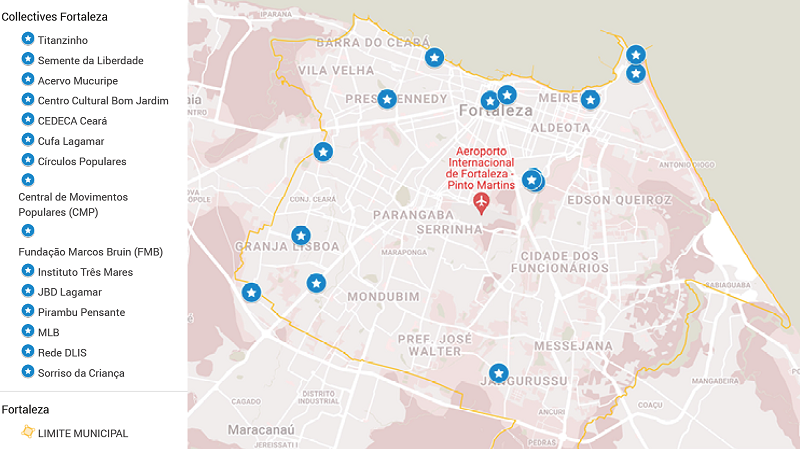
Figure 1.
Location of collectives studied in the city of Fortaleza.
Source: Elaborated by authors (2020), with Google MyMaps platform.
We extracted posts from the main fixed gallery which presents texts associated with images and we did not consider stories, videos from IGTV, or the content of Lives. We collected the content that was posted for 6 months: from March 1st to August 31st, 2020 when we started our analysis. Figure 2 details the concentration of COVID-19 and non-COVID-19 posts in the 15 chosen IG profiles. It is possible to see how some COVID-19 posts are disproportionately concentrated in specific accounts (cedecaceará, centroculturalbomjardim, circulospopulates, mlb.ce and rededlis).
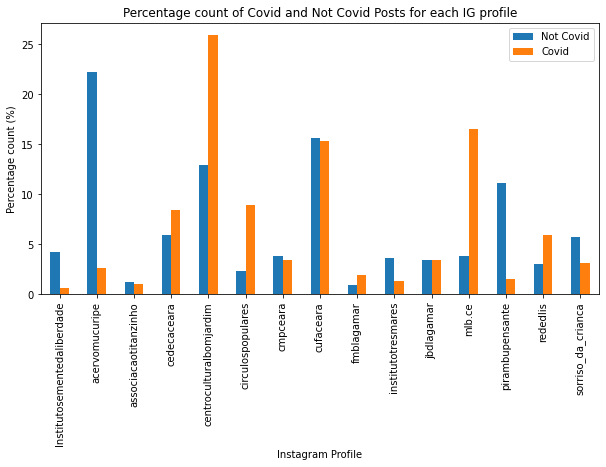
Figure 2.
Fraction of content related or not to COVID-19 that was posted by each collective.
Source: Elaborated by authors (2020).
Thus, coronavirus content was not distributed equally among accounts and collectives also did not stop posting about their original agendas. However, the virus did require digital attention and became a new topic of activism.
DATA MINING AND CONTENT ANALYSIS
In total, our 15 profiles provided us with 2518 posts, which were coded using the software NVivo. We conducted three different rounds of coding. This first initial and exploratory round used Python, a common programming language, to clean and select valuable posts that talked about COVID-19. We used text mining algorithms to conduct a sentiment analysis and examine how words are clustered to form meaning. Text sentiment analysis technology searches for emotions in texts through computer technology such as natural language processing, machine learning and data mining (XU et al., 2019). Sentiment analysis is a text classification method to classify a big amount of unstructured information inside texts in a positive or negative manner. In recent works, it has been used widely to analyze the sentiment of social media information such as Twitter (KANDASAMY et al., 2020), Instagram (GANGRADE; SHRIVASTAVA; GANGRADE, 2019) and Facebook posts (RODRIGUEZ; ARGUETA; CHEN, 2019). The goal of this step was to reduce the set of posts to be closely examined and coded manually in future rounds. In total, we ended up with 556 posts that were COVID-19 related, which we classified through second and third rounds of coding.
We then followed a methodology employed by Leão et al. (2020) which consists of thematic or concept coding to identify large emerging themes and group key ideas related to key study concepts. This process involved looking for repetitions, repeated expressions, similarities and differences. The last round employed Holistic Coding as a more detailed step to identify which passages directly answered research questions (SALDAÑA, 2016). A diagram with the final themes that were found shows all the thematic categories and how they were grouped based on the research questions (Figure 3).
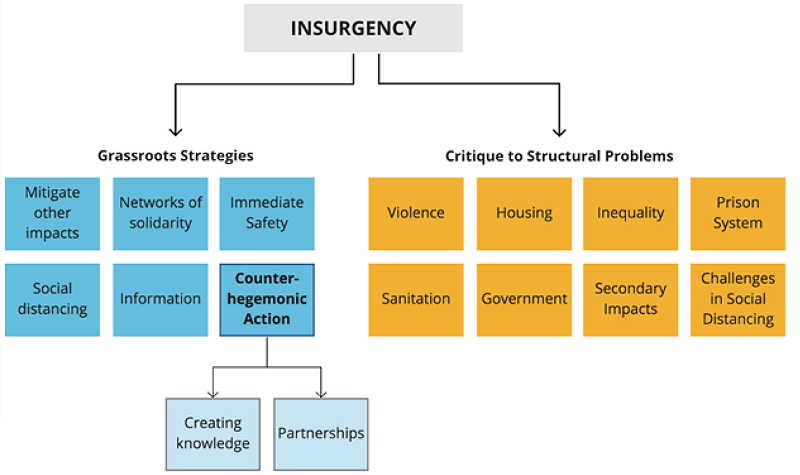
Figure 3.
Thematic categories obtained after all rounds of coding.
Source: Elaborated by authors (2020).
CAVEATS
It is worth pointing out that research has identified a growing trend in favor of news shared via WhatsApp, which could influence the impact of IG as a tool to effectively communicate such counter-hegemonic narratives (AGUIAR; RODRIGUES, 2019). Additionally, we did not examine the posts that did not mention the virus or COVID-19, which provides us with a partial view of these organizations. It is also very important to notice that, at the time of research, there had been no updates with regards to a vaccine and that content was not present, nor the goal of collectives. However, our goal was to look at insurgency in the context of COVID-19 and we consider that these methodological decisions were appropriate to answer the research questions.
RESULTS
As a reminder, in this section, we present themes that emerged from the 556 COVID-related posts (22%). These posts are a small fraction of the social media content produced by these collectives which indicates that organizations did not completely change their digital identity. At first, we performed a word frequency analysis from all posts, which showed an overwhelming amount of content related to donations, bank accounts, solidarity and crowdfunding strategies. It is clear that the primary goal of these collectives was to promote financial relief and support to their vulnerable communities. Additionally, the concept coding analysis identified two main key categories of posts: those that shared strategies and those that presented critiques.
STRATEGIES
First and foremost, it is critical to remember that, in the context of the pandemic, the immediate topic that emerges is about the vulnerability of low-income communities and their urgent need for assistance. The analysis shows an overwhelming amount of content in different topics about strategies employed by collectives to cope with the virus in their communities. We have classified those topics following a theoretical framework presented by Furtado, which presents a five-level hierarchy to systematize the needs arising in informal settlements due to COVID-19 and how communities respond. The levels go from the most to the least urgent and consist of Basic Safety, Health, Social Network, Information and Personal (FURTADO, 2020).
The first level of Basic Safety consists of practices developed to make sure that basic human needs are met: financial security, food and shelter. Nearly 40% of all posts were created with the goal of collecting or advertising actions for solidarity to bring resources to families in need. Health-related posts were also prominent which included strategies to increase social distancing such as creating urban signs with hygiene recommendations, distribution of cleaning supplies and most important texts, videos and images to promote risk awareness. These posts have a clear text about the seriousness of the virus and the goal of @rededelis to remind followers to be careful:
*Is it still necessary? * You must be finding all these daily cleaning and security protocols super tiring because of COVID-19. But have you ever stopped to think how much these actions helped save lives? The virus is something invisible, unable to be seen with the “naked eye”. For this reason, it is impossible to say that it is over. * COVID is not over. * Keep washing your hands, wearing a mask, always cleaning the house, objects and food * ALL THIS IS STILL NEEDED*.
You know, you must stay home, but if you need to go out, go to the grocery store, buy bread, go to the pharmacy, go with a mask. Don’t hesitate, otherwise Corona catches you! (REDE DLIS DO GRANDE BOM JARDIM, 2020, online, our translation)2.
Additionally, collectives emphasized the importance of community pride and networks of solidarity. The ultimate goal was to provide a sense of hope and also motivate community members to continue to help their neighbors. Sentences such as “we will get through this together” and “when all this is over” emerged to create a vision for a better future symbolizing the Social Network level.
Tomorrow, May 1st, a day of struggle of the working class, the Solidarity Front: Periphery Against Corona will carry out small activities of solidarity with the most vulnerable families in Serrinha. The program includes donations of food parcels, fixing of informative posters, and a sound truck with messages about protection from the Coronavirus, all carried out with due care to prevent the spread of the disease. This is a historical day for the working class, and even though we are unable to occupy the streets, as we always do, we will be carrying out these actions, which minimize the impacts of this crisis on the periphery (MOVIMENTO SOCIAL CIRCULOS POPULARES - CEARÁ, 2020, online, our translation)3.
As previously mentioned, the current political context in Brazil has been characterized by constant fake news and contradictory government statements regarding COVID-19. Thus, a critical strategy of collectives has been to educate and to provide accurate and reliable information. Specifically, collectives share academic material (such as reports and results from research) and also repost official government statements and ordinances - in language that is easily accessible for community members. Thus, they act as translators and as reliable representatives who filter out inaccurate information.
To complement those strategies, specific groups acknowledged the importance of personal relationships and entertainment options for dwellers to find joy during this period of hardship. Cultural online activities were instrumental - especially for the youth - to encourage quarantine while simultaneously building on that community pride and educating dwellers about their own history and neighborhood.
Centro Cultural Bom Jardim (CCBJ, Bom Jardim Cultural Center) launches #FiqueEmCasa with cultural programming tips (online and free), following the campaign proposal initiated by the Secretaria de Cultura do Estado do Ceará (State Department of Culture from Ceará), last week. In times of social isolation, CCBJ also prepared the rescue of several moments that marked the trajectory of CCBJ in the past year. They are photographic records of cultural actions, tips from our artists and the CCBJ family, for you to enjoy time at home (CENTRO CULTURAL BOM JARDIM, 2020, online, our translation)4.
The posts presented here make up a very small sample, but illustrate the multitude of strategies being employed and how collectives take on a holistic approach to mitigate the impacts of the health crisis.
FINDING INSURGENCY
In addition, we identified posts that presented strategies worthy of attention based on their insurgent counter-hegemonic character. Those posts indicate a deeper understanding of which practices are needed to reach more considerable gains. Out of the 15 collectives, 6 found it useful to create (and share it on IG) strategic partnerships. Those groups developed processes to map community resources and found key institutions to collaborate with, such as municipal schools, universities (UFC and UFABC), NGOs (Amnesty International, Habitat Brasil) and research institutes (Fiocruz). The role of smaller governmental institutions should not be dismissed, especially secretaries at the local municipal level (Secretaries for Health and for Culture). These are examples of a larger list of partners that have helped collectives develop their own research agendas and projects, find funding for structural actions and create strategic knowledge.
Strategies are also developed with political aspirations. Gathering information that is not State-controlled can disrupt how peripheries are portrayed and change legislation in their favor. In the following post, @rededlis shares one such goal from a partner group called Frente de Luta por Moradia (FLMD, Housing Struggle Front):
In an attempt to combat and reduce the impacts of the pandemic caused by the new coronavirus, FLMD is carrying out actions that range from the construction of forms of political influence, for example, with the elaboration of a dossier with information on the situation of the communities in Fortaleza during the COVID-19 pandemic to actions of immediate effectiveness, which can supply the most urgent basic needs. Thus, in addition to supporting specific community actions, FLMD organized itself to apply for announcements that provide financial support (REDE DLIS DO GRANDE BOM JARDIM, 2020, online, our translation)5.
Nearly all collectives (14) developed their own type of original content, using social media to build new narratives and to bring a new level of awareness to community issues. The goal was twofold: to promote community knowledge as expert knowledge (especially when it comes to COVID-19 in informal communities) and to promote debates about other structural issues:
‘Back to normal’. ‘A normality’ in which humanity wants to divorce from nature, devastate the planet, and dig a huge gap of inequality between people and societies. After the terrible experience the world is going through, it will be necessary to work so there are profound and significant changes in the way we live. Did you find this interesting? The Reading Cycle invites you to this reflection on the post-pandemic. What does the future hold? How will we adjust post-COVID? We don’t have ready answers, but we can start thinking about our tomorrow, today with the reading of ‘Tomorrow is not for sale’ (CENTRO CULTURAL BOM JARDIM, 2020, online, our translation)6.
This production of knowledge goes beyond sharing information created by institutional stakeholders. Collectives are highly aware of the specificity of their problems and that their needs are not met by traditional ways of communication presented through official government statements. Thus, insurgency takes place when urban collectives develop agency into which kind of content is produced and disseminated in their communities:
In the coming days, the campaign will launch a series of images with expressions, used in the language of the periphery, as well as a series of videos with testimonials from residents of Grande Bom Jardim, artists and CCBJ collaborators, reinforcing preventive measures and showing actions to cope with COVID-19. We will highlight tips, care alerts, testimonials, solidarity initiatives with communities and records of the main social benefits (CENTRO CULTURAL BOM JARDIM, 2020, online, our translation)7.
Another collective, for instance, applied for a special research grant from a large institution (FioCruz) to implement emergency actions to help vulnerable populations impacted by COVID-19. Not only do they create information in the ‘language of the favela’, but they also escalate their message to a higher institutional level and voice their complaints in an organized fashion to the State. Several social movements and collectives signed an open letter demanding action from the Governor in order to alleviate the needs of the poorest population of Ceará.
Most importantly, these issues are communicated along with calls to action. Collectives catalyze a sense of unfairness due to how COVID-19 disproportionately impacted their communities. They call community members (or at least IG followers) to engage in online debates, join campaigns and even go to protests to ask the State to alter the legislation and provide adequate health infrastructure:
We want to invite every student, every woman, the Brazilian blackness, the working class, the homeless, the landless to join the campaign. We defend TESTING FOR EVERYONE. CAMPAIGN HOSPITALS IN THE PERIPHERY AND EMERGENCY AID UNTIL DECEMBER (MOVIMENTO SOCIAL CIRCULOS POPULARES - CEARÁ, 2020, online, our translation)8.
Thus, these sets of posts show how collectives have exposed structural sources of oppression and aimed to expand the discussion beyond a theoretical debate to promote large-scale insurgency.
CRITIQUES OF STRUCTURAL PROBLEMS
These posts have also shown us how bottom-up communication can make use of the existing situation of disaster to communicate new questions through new voices (SARRICA et al., 2018). Collectives are aware that the pandemic has revealed structural failures in society and the environment, which they show in several posts about the conditions of marginalized groups and how they have been impacted in several areas that are not part of the mainstream conversation.
These sets of posts are the most critical of the current forces emerging in the context of crisis: the private sector putting pressure against quarantine and for the opening of businesses, lack of clear instructions in favor of masks and hygiene protocols, lack of basic sanitation made worse by intense rain and flooding and a burdened health system. These hardships put the lives of low-income dwellers at risk, but other structural issues cannot be forgotten. Figure 4 shows the other topics that are mentioned specifically in conjunction with COVID-19.
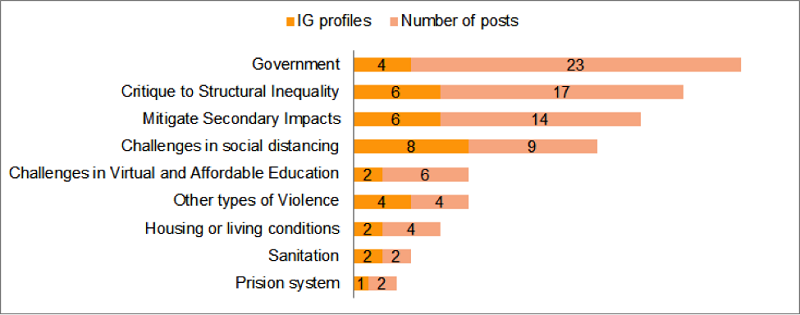
Figure 4.
Detailing of sub-themes that were presented in posts as structural issues. The graph shows the number of posts and how many collectives have addressed those specific issues.
Source: Elaborated by authors (2020).
This figure makes it evident that none of the critiques are disconnected from the larger political context: the majority of posts critique the decisions of austerity made by the Federal government since 2015, which have made Brazilian social and institutional infrastructures weak to withstand the impacts of the pandemic.
The following post presents a clear example of the role of collectives: it shows a simple and clear message about a federal ordinance, which may otherwise be complex to understand, and concludes with a call to action to change the legislation:
Four months after the approval of the law for emergency measures to fight COVID-19, not even half of the money was spent (executed) […]. In health, only 25% of the resources were used. […] If Constitutional Amendment 95 (EC95), which imposes a limit on public investment, remains in effect, there will be even more cuts in 2021. This is because EC95 sets the limit on resources by correcting the value for the previous year’s inflation. If there is negative inflation in 2020, the cuts will be even greater in 2021. Therefore, we need to change the 2021 Budget Guidelines Law (LDO) and end the spending cap. #AcabaTetodeGastos (MOVIMENTO DE LUTAS NO BAIRRO - CEARÁ, 2020, online, our translation)9.
These 23 posts are a result of only 4 IG profiles, but a higher number of profiles expressed discontent with challenges of maintaining social distancing due to structural inequality and lack of appropriate instruction. Other types of violence such as those against children, domestic violence and unfairness of the prison system are also mentioned. The state of Ceará is known for its high incidence of crime, a topic that did not go unnoticed:
Until April 30th, 1,521 intentional lethal violent crimes have been counted in Ceará. […]. In this tragic and dark context, the Committee joins the health authorities to reinforce the need to maintain collective social distance measures as a strategy to fight the pandemic and also draws attention to another epidemic that in recent years has placed Ceará among the states with the highest growth in the number of deaths: homicides (CEDECA CEARÀ, 2020, online, our translation)10.
This post is a clear display of how collectives use the current context of COVID-19 to show how all social issues are connected and that the pandemic should not mask other challenges. Collectives that posted about housing and sanitation called for special attention to the issue of evictions and the importance of adequate living conditions. Since the beginning of the quarantine, millions of Brazilians have suffered a brutal reduction in their incomes and have been unable to pay rent and other bills. On a similar note, several Brazilians live without access to water and sanitation due to years of systemic abandonment of areas considered “informal”. These issues come hand in hand, and these posts promote insurgency by seeking to “[…] expose and change the structural sources of oppression” (HUQ, 2020, p.13).
CONCLUSION
This paper conducted content analysis to systematize how community groups, civic associations and collectives have used social media to create and share a counter-narrative about COVID-19. We analyzed posts from the social media IG to categorize contributions by 15 urban collectives in Fortaleza through the lens of insurgency - an area of planning studies that is based on grassroots practice and empowerment. We examined through posts how collectives became producers of technical knowledge, critiqued other systems of oppression and developed strategic partnerships to deploy subversive and empowering practices in their communities.
Perhaps the most prominent form of counter-hegemonic action has been their agency in developing and sharing content through autonomous reports, debates and tactical interventions. This is aligned with a key aspect of insurgency that promotes strategic and technical knowledge produced by the grassroots as part of their claims. As such, collectives and dwellers who are often silenced or ignored by the State, are now taking action to force a response and perceive their agency to talk about and to their communities as an empowerment tool. The ‘lives’ and debates promoted, for instance, are a clear display of that dynamic. The conversations are promoted by collectives as a response to the lack of institutional information about the pandemic in low-income communities. By bringing experts from various fields to have a conversation that is mediated by community members, collectives are able to generate knowledge and display their embodied knowledge. This process brings a new level of empowerment when dwellers embrace that they are respected as the most appropriate agents to talk about a subject.
When analyzing the results, the pandemic was officially decreed in a national ordinance on March 12th, 2020; the quarantine officially started in the state of Ceará on March 20th, 2020 (when a decree established the closing of businesses) and the reopening process started on June 1st, 2020. These key dates reflect the level of posts shown in Figure 5. As we can see, a spike in COVID-19 related posts happened right around when the governor of Ceará announced the closing of businesses and there was a sharp drop in June with more flexible rules on social distancing.
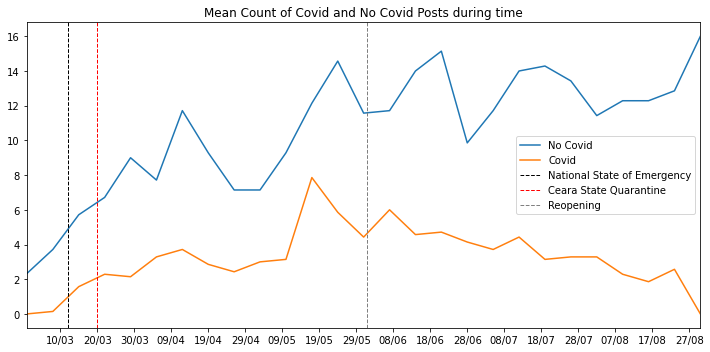
Figure 5.
Average number of posts counted every 7 days and key dates in Ceará.
Source: Elaborated by authors (2020).
It is important to consider those numbers since they show how situations of trauma and stress can catalyze activism. However, it remains to be seen whether that effect is lasting and whether it can lead to concrete changes. Nonetheless, some of the posts already show how urban collectives have appropriated a digital space (historically been used to indoctrinate) for subversive means: to send out calls to action, promote reflection to structural issues and promote community unity. What we see is the value of digital media content to provoke broader discussions and potentially address future issues. Finally, strategic partnerships were instrumental for several of these groups to expand their reach and social impact. It is imperative for governments to provide visibility to content produced at the community level and to see it as a successful initiative that could be leveraged through institutional support.
REFERENCES
AGUIAR, L. A. D.; RODRIGUES, C. M. As rotinas produtivas do coletivo Mídia Ninja: narrativas jornalísticas e midiativismo. Jornalismo e Crítica de Mídia, v. 16, n. 1, p. 157-168, 2019.
ARQPET. Mapa Solidário. Fortaleza: Projeto Somar, 2020. Disponível em: Disponível em: https://www.somarqpet.org/mapasolidario. Acesso em: 2 nov. 2020.
ATAÍDE, R. et al. Quem tem fome tem pressa: as respostas lentas do Estado frente à ameaça do coronavírus nas periferias do Brasil. Rio de Janeiro: Observatório das Metrópoles, 2020.
CASTELLS, M. Networks of outrage and hope: Social movements in the Internet age. Cambridge: Polity, 2012.
CEDECA CEARÁ. Publicado no perfil da Cedeca no Instagram, 2020. Disponível em: Disponível em: https://www.instagram.com/cedecaceara/#:~:text=Cedeca%20Cear%C3%A1%20(%40cedecaceara)%20%E2%80%A2%20Instagram%20photos%20and%20videos. Acesso em: 2 nov. 2020.
CENTRO CULTURAL BOM JARDIM. Publicado pelo perfil do Instagram do Centro Cultural Bom Jardim, 2020. Disponível em: Disponível em: https://www.instagram.com/centroculturalbomjardim/. Acesso em: 2020.
COCOZZA, G. P.; MESSIAS, G. R., TALARICO, A. L.B. A falta que a cidade faz. Oculum Ensaios, v. 18, p.1-18, 2021. https://doi.org/10.24220/2318-0919v18e2021a5139
CUSTODIO, L. Tipos de midiativismo de favela. Blog London School of Economics, 2014. Disponível em: Disponível em: https://blogs.lse.ac.uk/favelasatlse/2014/09/18/tipos-de-midiativismo-de-favela/. Acesso em: 3 mar. 2020.
DE SOUZA, M. L. Social movements as ‘critical urban planning’ agents. City, v. 10, n. 3, p.327-342, 2006.
FRIEDMANN, J. Planning in the Public Domain: From Knowledge to Action. Princeton, NJ: Princeton University Press, 1987.
FURTADO, L. Viewpoint strategies in Brazilian informal settlements: fighting covid-19 towards urban resilience. The Town Planning Review, 2020.
FURTADO, L.; RENSKI, H. Insurgent data building in informal settlements. V!RUS, v. 19, 2019. Available from: Available from: http://www.nomads.usp.br/virus/virus19/?sec=4&item=4&lang=p. Cited: Feb. 1, 2020.
GANGRADE, S.; SHRIVASTAVA, N.; GANGRADE, J. Instagram sentiment analysis: opinion mining. SSRN Electronic Journal, Proceedings of Recent Advances in Interdisciplinary Trends in Engineering & Applications (RAITEA) 2019. Available at SSRN: http://dx.doi.org/10.2139/ssrn.3372757. Cited: 10, março 2020.
HENRIQUES, C. M. P.; VASCONCELOS, W. Crises dentro da crise: respostas, incertezas e desencontros no combate à pandemia da Covid-19 no Brasil. Estudos Avançados, v. 34, n. 99, p. 25-44, 2020. Disponível em: Disponível em: http://www.scielo.br/scielo.php?script=sci_arttext&pid=S0103-40142020000200025&nrm=iso. Acesso em: 5 abr. 2020.
HUQ, E. Seeing the insurgent in transformative planning practices. Planning Theory, v. 19, n. 4, p.371-391, 2020.
KANDASAMY, I. et al. Sentiment analysis of tweets using refined neutrosophic sets. Computers in Industry, v. 115, p. 103180, 2020.
LEÃO, C. F. et al. Covid-19 em revistas no Instagram: uma análise de conteúdo relacionada às orientações do UNICEF e da OMS. Paradoxos, v. 5, n. 1, p.20-35, 2020.
LEONG, C. et al. Social media empowerment in social movements: power activation and power accrual in digital activism. European Journal of Information Systems, v. 28, n. 2, p.173-204, 2019. https://doi.org/10.1080/0960085X.2018.1512944.
MEIKLE, G. Future active: media activism and the internet. London: Routledge, 2002.
MIRAFTAB, F. Insurgent planning: situating radical planning in the global south. Planning Theory, v. 8, n. 1, p.32-50, 2009. Available from: Available from: http://www.jstor.org.silk.library.umass.edu/stable/26165884. Cited: Mar. 16, 2020.
MOVIMENTO DE LUTAS NO BAIRRO - CEARÁ. Publicado pelo perfil no Instagram do MLB Ceará, 2020. Disponível em: Disponível em: https://www.instagram.com/mlb.ce/. Acesso em: 2 nov. 2020.
MOVIMENTO SOCIAL CIRCULOS POPULARES - CEARÁ. Postagem Publicada no perfil do Instagram do Circulos Populares, 2020. Disponível em: Disponível em: https://www.instagram.com/circulospopulares/?hl=pt. Acesso em: 2 nov. 2020.
MURTHY, D. Twitter: social communication in the twitter age digital media and society. Cambridge, UK: John Wiley and Sons, 2013.
NOGUEIRA, A. M. A. Possibilidades e desafios de práticas insurgentes: o caso da comunidade poço da draga. In: ENANPUR, 18., 2019, Fortaleza. Anais […]. Natal: UFRN, 2019.
PERES, A. C. Favelas contra o vírus: como as periferias vêm lidando com a pandemia de covid-19, em meio aos problemas cotidianos e diante da ausência de ações governamentais. RADIS: Comunicação e Saúde, n. 212, p.20-25, 2020.
RAMALHO, R.; MAIA, K. Estudos metodológicos: a aplicação da Análise de Discurso para interpretar a produção de sentido de coletivos midiativistas. Verso e Reverso, v. 32, n. 81, p.187-200, 2018.
REBOUÇAS, T. D. M.; MANZI, M.; MOURAD, L. N. Experiências de planos de bairro no Nordeste brasileiro: articulando planejamento insurgente e direito à cidade. Cadernos Metrópole, v. 21, p.855-878, 2019. Disponível em: Disponível em: http://www.scielo.br/scielo.php?script=sci_arttext&pid=S2236-99962019000300855&nrm=iso. Acesso em: 20 mar. 2020.
REDE DLIZ DO GRANDE BOM JARDIM. Publicação do perfil da Rede DLIs no instagram. 2020. Disponível em: Disponível em: https://www.instagram.com/rededlis/. Acesso em: 25 out. 2020.
RODRIGUEZ, A.; ARGUETA, C.; CHEN, Y.-L. Automatic detection of hate speech on facebook using sentiment and emotion analysis. Proceedings from the International Conference on Artificial Intelligence in Information and Communication (ICAIIC), p.169-174, 2019. Available from: 10.1109/ICAIIC.2019.8669073. Cited: Mar. 22, 2020.
ROY, A. Urban informality: toward an epistemology of planning. Journal of the American Planning Association, v. 71, n. 2, p.147-158, 2005. Available from: https://www.tandfonline.com/doi/abs/10.1080/01944360508976689. Cited: Apr. 15, 2020.
SALDAÑA, J. The coding manual for qualitative researchers. 3th. London: Sage Publications, 2016.
SANDERCOCK, L. Towards cosmopolis: planning for multicultural cities. Chichester: John Wiley & Sons, 1998.
SARRICA, M. et al. Shaken and stirred: social representations, social media, and community empowerment in emergency contexts. Semiotica, v. 2018, n. 222, p.321-346, 2018. Available from: Available from: https://www.degruyter.com/view/journals/semi/2018/222/article-p321.xml. Cited: Apr. 22, 2020.
SHIRKY, C. Here comes everybody: the power of organizing without organizations. New York: Penguin Books, 2008.
SILVA, S. A. A Pandemia de Covid-19 no Brasil: a pobreza e a vulnerabilidade social como determinantes sociais. Confins, v. 53, n.4, p.1-27, 2021. Disponível em: Disponível em: http://journals.openedition.org/confins/40687. Acesso em: 12 dez. 2021.
SOUZA, P. L. A.; ZANETTI, J. P. Comunicação e juventudes em movimento: novas tecnologías e desigualdades. Rio de Janeiro: IBASE, 2013.
TUFEKCI, Z.; WILSON, C. Social media and the decision to participate in political protest: observations from Tahrir Square. Journal of Communication, v. 62, p. 363-379, 2012.
XU, G. et al. Sentiment ANALYSIS of Comment Texts Based on BiLSTM. IEEE Access, v. 7, p.51522-51532, 2019.
Notes
