THE IMPACT OF DIGITAL GOVERNMENT ON THE MODERNIZATION OF THE STATE: SYSTEMATIC REVIEW
THE IMPACT OF DIGITAL GOVERNMENT ON THE MODERNIZATION OF THE STATE: SYSTEMATIC REVIEW
Revista Científica "Visión de Futuro", vol. 29, núm. 1, pp. 107-125, 2025
Universidad Nacional de Misiones

Esta obra está bajo una Licencia Creative Commons Atribución-NoComercial-CompartirIgual 2.5 Argentina.
Recepción: 06 Noviembre 2023
Aprobación: 04 Marzo 2024
Abstract: This article aims to analyze the implementation of the Digital Government in Peru within the framework of the State Modernization Policy. For this purpose, a systematic review was used as the main analysis methodology. Inclusion and exclusion criteria were established based on the research question "What is the current level of implementation of the Digital Government in Peru within the framework of the State Modernization Policy?". The results of this systematic review reveal trends in the modernization of the State, highlighting progress in the implementation of digital technologies to increase the efficiency of government and the provision of citizen services. In conclusion, this analysis provides an overview of the state of Digital Government in Peru. Likewise, it allows us to identify areas of opportunity and improvement in the effective modernization of the State through digital technologies, to guarantee more efficient management focused on the well-being of citizens.
Keywords: Digital government, State modernization policy, Information technology, Citizen services, Citizen participation.
INTRODUCTION
In recent decades, the rapid development of technology has fundamentally changed how social groups interrelate. In this context, governments around the world have recognized the importance of adapting to these changes and have embraced the idea of Digital Government as a fundamental tool to modernize their structures and services (Caravaca et al., 2021). Peru has been no exception and has implemented a state modernization policy with a focus on the strategic use of information and communication technologies (ICTs) to improve government efficiency and citizen participation (Pérez et al., 2021).
The State Modernization Policy in Peru is an ongoing process that seeks to transform and optimize public management to provide quality services to citizens and improve government efficiency (Dill'Erva, 2021). The main pillars of this approach are the simplification of procedures, the reduction of bureaucracy, and the promotion of a more transparent and participatory administration (Pérez et al., 2021).
Since its inception, the modernization of the State in Peru has faced significant challenges, such as postural tenacity in the face of transformations, lack of resources, and the complexity of some administrative processes (Flores and Núñez, 2021). Although the Peruvian government has committed to this policy, its effective implementation still faces significant challenges and barriers, which will require specific strategies to overcome the challenges identified in the literature. An objective analysis of its achievements, difficulties, and areas for improvement will allow the formulation of recommendations to promote successful state modernization.
In parallel with the State Modernization Policy, Digital Government has emerged as a key element in facilitating the interaction between government and citizens through the use of ICTs (Rodríguez, 2021). This initiative seeks to take advantage of technology to make government services and procedures available to citizens in a faster, more efficient, and accessible manner (Vargas, 2021).
One of the main strategies of Digital Government in Peru has been the implementation of online platforms that offer a wide range of government services (Curioso and Galán-Rodas, 2020). These platforms allow citizens to carry out procedures, obtain information, and access public services from anywhere and at any time, thus avoiding long lines and unnecessary trips to government offices. In addition, secure authentication mechanisms have been established to ensure the privacy and security of citizens' data (Ripalda, 2019).
The adoption of Digital Government has also boosted government transparency and accountability (Toro-García et al., 2020). The digitization of documents and data has facilitated access to public information, allowing citizens to monitor and evaluate the management of public officials and state resources (Tafur, 2022).
Likewise, Digital Government has promoted citizen participation in the decision-making process. Through web portals and mobile applications, citizens can participate in public consultations, express their opinions on public policies, and contribute with proposals to improve governance and development of the country (Franciskovic et al., 2021). This active citizen participation strengthens the legitimacy of government decisions and fosters greater social cohesion (Montecinos and Contreras, 2019).
The modernization of the state through Digital Government has not only benefited the interaction with citizens but has also driven significant improvements in the internal management of the government. The implementation of digital systems has allowed greater efficiency in resource management, process automation, and data integration between different government entities (Barragán, 2022). This has resulted in more agile and coordinated management, reducing duplication of efforts and improving informed decision-making (Velthius and Gonzales, 2022).
In addition, the adoption of digital technologies has fostered innovation and the development of new technology companies in Peru. The digital ecosystem has created opportunities for entrepreneurs and has boosted the country's economic growth, generating employment and promoting competitiveness in the global arena (Nolasco et al., 2023).
Although the Digital Government and the State Modernization Policy have made significant progress in Peru, they still face important challenges (Ángeles, 2022). The digital divide and the lack of Internet access in some rural areas represent obstacles to ensuring equitable citizen participation and a fair distribution of the benefits of Digital Government (Tenorio, 2022). Likewise, cybersecurity and personal data protection are critical aspects that need to be addressed with greater emphasis to maintain citizen trust in government digital platforms (Mejía and Azar, 2021). Thus, the main objective of our research is to analyze the implementation of Digital Government in Peru within the framework of the State Modernization Policy.
DEVELOPMENT
Methodology
The present research was carried out following the guidelines and principles established for the systematic review of a qualitative approach, descriptive in nature, under the PRISMA method, using the Scielo, Google Scholar, Scopus, and Redalyc databases as search engines, using specific terms as keywords, which ensured the inclusion of relevant studies (Table 1). The choice of using this approach to address the objective of the study was based on its ability to systematically integrate and synthesize relevant information from previous research. This methodology allows for a critical analysis of the existing evidence, identifying trends, patterns, and gaps in the scientific literature, and obtaining solid and reliable conclusions (Pardal-Refoyo and Pardal-Peláez, 2020). The essential steps followed to conduct this review included identification of the research question, literature search in recognized academic databases (Codina and Lopezosa 2022), study selection, data extraction, and synthesis of results (Villasís-Keever et al., 2020).
The research question was important to clearly define the objective and scope of the systematic review (Marín, 2022). In this case, it focused on analyzing the current state of implementation of Digital Government in Peru in the context of the State Modernization Policy. Thus, a general question was formulated as follows: What is the progress in the implementation of Digital Government initiatives in Peru under the framework of the State Modernization Policy? And a specific question: What are the main trends guiding the implementation of Digital Government in Peru?
| Search Engine | Keywords |
| Scielo | Digital Government |
| Google Scholar | Modernization of the State and Digital Government |
| Scopus | Digital Government and Peru |
| Redalyc | Digital Government |
An initial filtering process was performed by reviewing the titles and abstracts obtained from the literature search. Then, the selected articles were read to determine their relevance and their adherence to the previously established inclusion and exclusion criteria. These criteria made it possible to select the most relevant studies for the research objectives (Table 2).
| Criteria | Inclusion Criteria | Exclusion Criteria |
| 1 | Academic articles in indexed journals | Textbooks, theses, dissertations, doctoral theses, thesis chapters, conference proceedings, and other non-academic documents. |
| 2 | Academic articles due for publication between 2019 and 2023 | Academic articles due for publication before 2019 |
| 3 | Articles published in English and Spanish languages | Articles published in languages other than English or Spanish |
| 4 | Articles with different approaches and strategies for the implementation of Digital Government in Peru. | Articles with different approaches or strategies for implementing Digital Government outside Peru. |
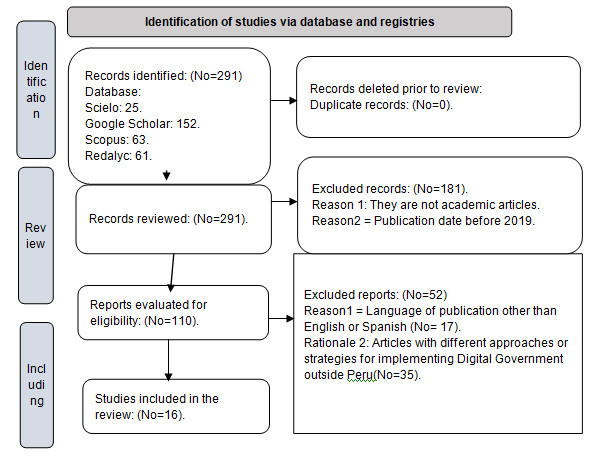
The combination of these search engines guarantees a homogeneous search of the scientific and technical literature related to the implementation of Digital Government in Peru within the framework of the State Modernization Policy. By using these search engines, it was expected to identify relevant and varied studies that address the topic of Digital Government, providing information on the status of this governmental strategy in the country. The application of the PRISMA method (Figure 1) made it possible to synthesize and analyze the information gathered to provide a basis for future decision-making and public policies related to Digital Government in Peru.
Note: Own elaboration
Results
The systematic review of the sources resulted in the initial location of 291 research articles published in the last five years. In the second case, 16 articles were selected from 4 databases. Finally, it should be noted that we included works found in the Google Scholar database with 6, Scopus with 4 articles, 4 in Scielo, and 2 in Redalyc. Figure 2 shows the percentage distribution of articles by database.
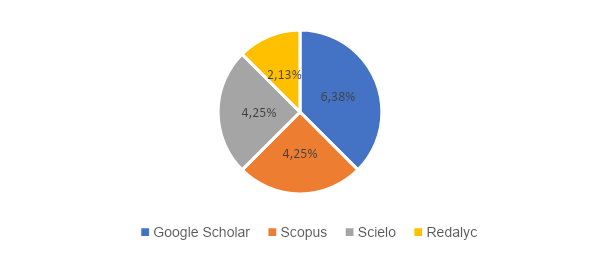
Figure 2
Percentage distribution of articles according to database
Note: Own elaboration
Figure 3
Percentage distribution of articles according to language
Note: Own elaboration
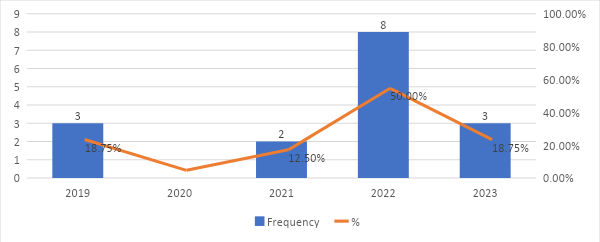
Figure 4
Percentage distribution of articles by year of publication
Note: Own elaboration
DISCUSSION
Implementation of digital government within the framework of the state modernization policy
First, the analysis focused on 16 academic publications on Digital Government in the Peruvian context. In these, several trends were identified where significant progress was observed in the adoption of digital technologies to improve government efficiency and the provision of citizen services. However, they also highlighted challenges in the consummation of Digital Government, as well as the need to promote digital inclusion and adequately manage knowledge in the governmental sphere.
In each article analyzed, the results and contributions were examined. In this sense, the findings obtained showed the type of Digital Government implementation in the context of the State Modernization Policy. Studies such as Roseth et al. (2018) have shown the relevance of evaluating the implementation of Digital Government in different dimensions to understand its scope and effectiveness.
In this order of ideas, the qualitative findings obtained from the analysis of the academic publications considered are presented. Through the systematic review of the selected studies, valuable findings were obtained that shed light on the state of Digital Government in the Peruvian context. The results presented in Table 3 show a diversity of trends that enrich the understanding of the adoption and impact of information and communication technologies on public management and citizen services.
| Title | Author(s) | Findings related to the scope of implementation |
| Digitalization and satisfaction among Peruvian users towards their civil registration office | Vicente et al. (2022) | It was found that the digital process positively affected user satisfaction in terms of the processes for documents referring to birth, while for divorce it did not. |
| E-Government and its development in the region: Challenges | Valenzuela, et al. (2023) | E-government processes were accepted according to the characteristics of citizens and their attitude towards technology; however, public entities continue to show problems, highlighting a marked inability to effectively and efficiently resolve the functions they are responsible for, despite having the appropriate technological tools and implements. |
| Collaborative platform to improve e-government in public entities | Jimenez et al. (2022) | It was found that the digital platform did improve the perception of e-government and that there were highly significant differences in the perception of e-government. |
| ICT Services of a Provincial Municipality in Peru. A Case Study | Feijoo et al. (2022) | Although the software and hardware was implemented to support the use of ICT services in its internal systems and external processes, there was evidence of a low level of use and satisfaction among the province's citizens. This is due to the lack of training programs for personnel and end users. |
| Digital citizen participation in Peru and Ecuador during governmental crisis management by COVID-19 | Márquez et al. (2022) | With the Peruvian Ministry of Health, the citizenry expresses -that is, above all with emotion rather than reason- greater acquiescence, debate, and interaction, although anger is evident; in the digital space of the Ecuadorian Ministry, on the contrary, there is less diversity of emotions and less room for democratic conversation. |
| A Digital Identity Management Model for the Peruvian State | Cuno et al. (2021) | A digital identity management model was presented for Peru's digital government, with the support of technicians and specialists in digital identity. Its scope is specific to interactions between individuals and legal entities with all public administration entities. |
| Challenges in the implementation of e-government for public institutions in Peru | Rentería et al. (2019) | The implementation of electronic billing systems for the Guillermo Díaz de la Vega Regional Hospital's taxpayer system revealed barriers to the implementation of e-government services: economic aspects, digital literacy, differences in receipt and invoice formats, and information security. |
| Transforming Service Delivery with TOGAF and Archimate in a Government Agency in Peru | Valenzuela (2019) | Two business architecture modeling languages were applied, achieving the redesign of the transversal citizen services, standardizing, and making the corresponding information systems interoperable. |
| Evaluation of Local E-government Maturity in the Lima Metropolitan Area | Paiva et al. (2019). | It was shown that the e-information dimension is more developed than the e-service dimension which, in turn, is more developed than the e-participation dimension. |
| Financial Inclusion Through Digital Banking: The case of Peru | Julião et al. (2022) | It was evident that, although there is an effective potential for the digital transition to have an impact on the financial inclusion of unbanked institutions, there is still a long way to go to achieve a successful outcome with this inclusive e-wallet. |
| Knowledge management in financial education in Peruvian government programs focused on women: Progress and challenges. | Machuca-Vílchez et al. (2023) | The knowledge management component of the programs should focus on economic empowerment and attitudes towards money and not only on practical knowledge of financial products and services, and the State should implement policies to ensure that beneficiaries have access to technological equipment so that training uses digital resources and not only face-to-face training resources. |
| Digital government, state modernization, and citizen service | Rodriguez and Lopez (2023) | The Regional Government of Lima Provinces is just developing e-government actions, and moving to a digital government strategy requires understanding the significant factors and associated agents, to establish a digitization strategy. |
| Digital transformation in public administration: challenges for an active governance in Peru. | Huamán and Medina (2022) | Digitization represents an opportunity for governance to be optimized by restructuring public services, making use of digital technologies to increase their effectiveness and efficiency to achieve the digital well-being of the population and substantial savings. |
| Digital government in local governments in Latin America | Rodriguez (2021) | Implementing an e-government requires a management oriented to the social reality, being able to awaken the interest of the population to participate in the resolution of problems, however, this is associated with political interests of the rulers, so there is still a long way to consolidate an e-governance. |
| Open Data and Open Government in Peru's Regional and Local Governments | García-Estrella et al. (2022) | Currently the open data portals in regional and local governments are: one regional government and four local governments that have implemented their open data portals, only the Metropolitan Municipality of Lima complies with all the open data principles and has implemented all the categories; as well as the Regional Government of La Libertad, which, despite its early implementation, complies with six of these principles |
| Municipal digital government from the perception of citizens | Espinoza et al. (2023) | The population perceives that the digital government implemented by the municipality is deficient, so the reformulation of the digital government plan is required. |
These findings provide an overview of the level of implementation of Digital Government in the Peruvian context and offer valuable information for future research, as well as for the outline of guidelines and maneuvers that promote an effective modernization of the State through digital technologies, improving the effectiveness and fragility of public goods for the benefit of all citizens.
In a palpable context, Digital Government and its integration into the State Modernization Policy have been the subject of detailed scrutiny in various academic studies within the Peruvian context. Thus, three studies were found that highlight significant challenges in the adoption of digital technologies in the governmental sphere. Márquez et al. (2022) explored digital citizen participation during crisis management by COVID-19. Machuca-Vílchez et al. (2023) focused on knowledge management in government programs focused on women, while Rodríguez (2021) analyzed Digital Government in local governments in Latin America.
On the other hand, seven publications addressed various aspects of Digital Government in the Peruvian context. Rodríguez and López (2023) investigated the relationship between Digital Government, modernization of the State, and citizen services. Huamán and Medina (2022) analyzed the digital transformation in public administration and its challenges for active governance. Feijoo et al. (2022) conducted a case study on ICT services in a provincial municipality. Rentería et al. (2019) focused on the challenges of e-government implementation in public institutions. Valenzuela et al. (2023) analyzed how the implementation and development of digital government has been in Latin America. Valenzuela (2019) explored the transformation of service delivery using TOGAF and Archimate in a government agency in Peru. Cuno et al. (2021) developed a Digital Identity management model for the Peruvian State.
Among the documents reviewed, six publications highlighting successful examples of the adoption of digital technologies in the Peruvian government were found. García-Estrella et al. (2022) studied the use of open data and open government in national and local governments. Jiménez et al. (2022) presented a collaborative platform to improve e-government in public entities. Paiva et al. (2019) evaluated the maturity of e-government in the Metropolitan Area of Lima. Julião et al. (2022) analyzed financial inclusion through digital banking in Peru. Vicente et al. (2022) investigated the digitalization and satisfaction of Peruvian users with their civil registry offices.
Finally, Espinoza et al. (2023) investigated citizens' perception of municipal Digital Government. These publications show a diverse picture regarding the implementation of Digital Government in the Peruvian context. While some studies highlight significant advances, others emphasize the need to address challenges and obstacles to achieve a more efficient and effective implementation. These findings provide a solid foundation for future research and the design of strategies to promote effective modernization of the State through Digital Government.
Trends on Digital Government within the framework of the State Modernization Policy.
The first trend highlighted is the importance of digital transformation in public administration and e-government. Studies by Vicente et al. (2022) and Jiménez et al. (2022) have revealed how the digitization of public services can have a significant impact on citizen satisfaction and improve government efficiency through the use of collaborative platforms. This predisposition highlights the need to adopt information technologies to improve the delivery of services to citizens and optimize the internal processes of government institutions.
Another relevant trend is the crucial role of information technologies in the modernization of government institutions. The study Valenzuela, et al. (2023) highlights how technological advances in different Latin American countries are essential to improve the efficiency and quality of government services. This trend emphasizes the need to take advantage of information and communication technologies to optimize management and decision-making in government institutions.
However, during the analysis, challenges in the implementation of Digital Government have also been identified. The study by Rentería et al. (2019), has highlighted the existence of obstacles and barriers that must be overcome to ensure an effective transition to a more digitized government. This trend underscores the importance of addressing and resolving the challenges that may arise in the process of adopting digital technologies.
In addition, the digitalization of financial services has been identified as an important trend in the Peruvian context, which goes beyond financial inclusion through digital banking. Studies such as those by Julião et al. (2022) and Valenzuela (2019) have evidenced how information technologies can expand the accessibility and availability of financial products for the population. This perspective highlights the relevance of facilitating equitable access to financial solutions for all segments of society, taking advantage of digital tools. Promoting financial inclusion and education, as well as fostering innovation to design products tailored to users' needs, are key aspects to materialize the potential of digital transformation in this strategic sector.
In the same approach, knowledge management has also been identified as an essential aspect in the government context. The study by Cuno et al. (2021) has proposed a model for managing digital identity and modernizing the state. Likewise, the work of Machuca-Vílchez et al. (2023) has investigated knowledge management in government financial education programs for women.
These trends emphasize the importance of promoting education and access to financial information for all citizens, as well as the need to adequately manage knowledge in the governmental sphere. In this regard, Huáman and Medina (2022) have explored the possible difficulties that may arise in digital transformation. In this way, they elaborate an analysis focused on the challenges of digital and active governance.
At the local and regional level, a propensity has been found in the implementation of digital technologies in local governments and the adoption of open data, to improve service delivery and increase transparency and accountability. Studies by Paiva et al. (2019), Garcia-Estrella et al. (2022), and Feijoo et al. (2022) have examined these aspects and highlighted their relevance for improving governance and interaction between government and citizens at the local level.
In addition to all this, citizen perception of municipal digital government has been identified as a key factor in strengthening trust in government institutions. Studies such as those by Rodríguez and López (2023) and Rodríguez (2021), have explored citizen satisfaction concerning the digital services offered by the public sector, highlighting their relevance for improving government efficiency and legitimacy. Along these lines, the research conducted by Márquez et al. (2022) argues that citizen participation is fundamental in the processes of digital transformation of the State and for compliance with the standards of a Digital Government.
However, it is important to clarify that digitization does not necessarily entail a modernization of government processes, since there are cases in which the hasty incorporation of technologies can hinder more comprehensive initiatives of institutional innovation. Therefore, a strategic vision is required to guide the adoption of digital solutions so that they effectively contribute to modernizing and improving public services in areas such as efficiency, transparency, and citizen-centeredness.
In reflection, the findings of the various research studies analyzed reflect important trends in Digital Government in Peru, including the need to adopt information technologies, overcome challenges in their implementation, promote financial inclusion, adequately manage knowledge, promote transparency, accountability and strengthen citizen confidence in government institutions through efficient and accessible digital services.
Another relevant indication is the crucial role of information technologies in the modernization of government institutions. The Valenzuela, et al. (2023) study highlights how public agencies continue to present problems despite having the necessary technological tools and implements. This should also be considered to improve the efficiency and quality of government services since this trend emphasizes the need to take advantage of information and communication technologies to optimize management and decision-making in government institutions.
However, during the analysis, challenges in the implementation of Digital Government have also been identified. The study by Rentería et al. (2019) has highlighted the existence of obstacles and barriers that must be overcome to ensure an effective transition to a more digitized government. This trend underscores the importance of addressing and resolving discrepancies that may arise in the process of adopting digital technologies.
In addition, financial inclusion through digital banking is a relevant trend in the Peruvian context. The study by Julião et al. (2022) and Valenzuela (2019) has shown how information technologies can improve the accessibility and availability of financial services for the population. This approach highlights the importance of promoting equal access to financial services through the use of digital technologies.
Knowledge management has also been identified as an essential aspect in the government context. The study by Cuno et al. (2021) has proposed a model for managing digital identity and modernizing the State. Likewise, the work of Machuca-Vílchez et al. (2023) has investigated knowledge management in government financial education programs for women. These trends underscore the importance of providing access to financial education and information for all citizens and the need to manage knowledge favorably in government. In this regard, Huamán and Medina (2022) have explored the possible difficulties that may arise in digital transformation. In this way, they elaborate an analysis focused on the challenges of digital and active governance.
At the local and regional level, a trend has been found in the implementation of digital technologies in local governments and the adoption of open data to improve service delivery and increase transparency and accountability. Studies by Paiva et al. (2019), Garcia-Estrella et al. (2022), and Feijoo et al. (2022) have examined these aspects and highlighted their relevance for improving governance and interaction between government and citizens at the local level.
Finally, citizen perception of municipal digital government has been identified as a fundamental factor in strengthening trust in government institutions. Studies by Rodríguez and López (2023), Rodríguez (2021), and Espinoza et al. (2023) have explored citizen satisfaction with digital services and state modernization, and have highlighted their importance in improving government efficiency and legitimacy.
Accordingly, the research conducted by Márquez et al. (2022) argues that citizen participation is necessary and vital for the digitization of the State and compliance with Digital Government standards. In summary, the findings detected from the various research studies analyzed project fundamental guidelines for the modernization and continuous improvement of government and the provision of services to citizens.
CONCLUSIONS
The conclusions of the research have been established in 8 points, due to the diversity of topics and to facilitate their presentation, they are presented in the following way:
- 1. Diversity of trends: The systematic review reveals a wide variety of trends related to Digital Government in Peru. These findings show that there are multiple approaches and perspectives on the adoption and impact of information and communication technologies in public management and citizen services.
- 2. Successful implementation: Regarding implementation, successful examples of acceptance of digital technologies in the Peruvian government stand out. This includes the use of open data and open government in regional and local governments, as well as the digitization of public services that have increased user satisfaction with their civil registry offices.
- 3. Implementation challenges: Significant challenges were observed in the implementation of digital technologies at the governmental level. These include the need to improve digital citizen participation in crisis management and the introduction of digital government in Latin American municipalities.
- 4. Areas for improvement: The implementation addresses various aspects of Digital Government that require attention. This includes the need to address the challenges of implementing e-government in public institutions, the proper management of knowledge in government programs, and the challenges of digital transformation in public administration.
- 5. Financial inclusion: The importance of financial inclusion through digital banking is highlighted as a relevant trend in the Peruvian context. This demonstrates how information technologies can improve the accessibility and availability of financial services for the population.
- 6. Importance of citizen perception: Citizen perception of municipal digital government has been identified as a key factor in strengthening trust in government institutions. Citizen satisfaction with digital services and the modernization of the State are key elements to improve the efficiency and legitimacy of government.
- 7. Relevance of knowledge management: The studies also highlight the importance of proper knowledge management in government. This includes the need to promote education and access to financial information for all citizens, as well as effective digital identity management, to modernize the state.
- 8. Potential at the local and regional level: A trend has been found in the implementation of digital technologies in local governments and the adoption of open data to improve service delivery and increase transparency and accountability.
Finally, these conclusions provide an overview of the progress of Digital Government implementation in the Peruvian context, showing both the advances and challenges faced by the country in this area. The results obtained are fundamental to guide future research and the design of effective policies and strategies that promote a successful modernization of the State through the use of digital technologies, improving the efficiency and accessibility of public services for the benefit of all citizens.
REFERENCES
Ángeles, N. (2022). Desafíos de la gestión de recursos humanos para la transformación digital de la administración pública peruana. Universidad de los Andes. https://repositorio.uniandes.edu.co/entities/publication/b9c548ce-8b9e-4274-be11-2b69800f551d
Barragán, X. (2022). Posmodernidad, gestión pública y tecnologías de la información y comunicación en la Administración pública de Ecuador. Estado & comunes, revista de políticas y problemas públicos, 1(14). https://doi.org/10.37228/estado_comunes.v1.n14.2022.244
Caravaca, J. Daniel, C. Lenarduzzi, J. and Mattina, G. (2021). Modernizar el Estado. Plan y agentes del cambio en la era cambiemos. Argentina, 2015-2019. Revista de Gestión Pública, 9(1), 5–42. https://doi.org/10.22370/rgp.2020.9.1.2679
Codina, L. and Lopezosa, C. (2022). Cómo resolver la fase de búsqueda y evaluación de una revisión de la literatura mediante bases de datos académicas. Máster Universitario en Investigación en Comunicación (MUIC. Universitat Pompeu Fabra). Barcelona. Departamento de Comunicación.
Cuno, A. Aldoradín, Y. Ganz, H. Veliz, F. and Quiroz, E. (2021). Un modelo de gestión de la Identidad Digital para el Estado Peruano. RISTI - Revista Ibérica de Sistemas e Tecnologias de Informação, 2021(E46), 166–182. https://siis.unmsm.edu.pe/es/publications/un-modelo-de-gesti%C3%B3n-de-la-identidad-digital-para-el-estado-perua
Curioso, W. and Galán-Rodas, E. (2020). El rol de la telesalud en la lucha contra el COVID-19 y la evolución del marco normativo peruano. Acta méd. peru, 366–375. https://pesquisa.bvsalud.org/portal/resource/pt/biblio-1142025
Dill’Erva, I. (2021). Retos de la administración pública del bicentenario. Saber Servir, Revista De La Escuela Nacional De Administración Pública, (5), 117–138. https://doi.org/10.54774/ss.2021.05.07
Espinoza, J. Ramos, E. and Orosco-Fabian, J. (2023). Gobierno digital municipal desde la percepción de los ciudadanos. Revista internacional de investigación en ciencias sociales, 19(1), 131–140. https://doi.org/10.18004/riics.2023.junio.131
Feijoo, M. Núñez. L- Campana, A. and Quispe, J. (2022). ICT Services Of A Provincial Municipality In Peru. A Case Study. Journal of Pharmaceutical Negative Results, 13, 32-41. https://doi.org/10.47750/pnr.2022.13.S05.05
Flores, S. and Núñez, L. (2021). Gestión por procesos en el marco de la Modernización de la Gestión Pública en el Perú. Alpha Centauri, 2(3), 140–164. https://doi.org/10.47422/ac.v2i3.54
Franciskovic, J. Hamann, A. and Miralles, F. (2020). Las TIC, una oportunidad de participación ciudadana en los gobiernos subnacionales. Revista Republicana, 29, 21–46. https://doi.org/10.21017/rev.repub.2020.v29.a85
García-Estrella, C. Santa-Maria, J. and Celis Hernandez, M. (2022). Datos abiertos y gobierno abierto en los gobiernos regionales y locales del Perú. Enfoque UTE, 13(3). https://doi.org/10.29019/enfoqueute.838
Huamán, P. L. and Medina, C. G. (2022). Transformación digital en la administración pública: desafíos para una gobernanza activa en el Perú. Comuni@cción, 13(2), 93–105. https://doi.org/10.33595/2226-1478.13.2.594
Jiménez, L. Reyna, W. Jiménez, M. and Trujillo, P. (2022). Plataforma colaborativa para mejorar el gobierno electrónico en entidades públicas. Revista Ibérica De Sistemas e Tecnologias De Informação, 433-442. https://www.proquest.com/docview/2735285388?pq-origsite=gscholar&fromopenview=true
Julião, J., Ayllon, T. and Gaspar, M. (2022). Financial Inclusion Through Digital Banking: The case of Peru. En Lecture Notes in Mechanical Engineering, 294–304. Springer International Publishing.
Machuca-Vílchez, J. Jeanett Ramos-Cavero, M. and Cordova-Buiza, F. (2023). Knowledge management in financial education in Peruvian government programs focused on women: Progress and challenges. Knowledge and Performance Management, 7(1), 1–14. https://doi.org/10.21511/kpm.07(1).2023.01
Marín, V.I. (2022). La revisión sistemática en la investigación en Tecnología Educativa: observaciones y consejos. RiiTE Revista interuniversitaria de investigación en Tecnología Educativa, 13, 62-79. https://doi.org/10.6018/riite.533231
Márquez, C. Calva, K. and Duque, V. (2022). Participación digital ciudadana en Perú y Ecuador durante la gestión gubernamental de crisis por la COVID-19. Revista Española de la Transparencia, 14, 181–205. https://doi.org/10.51915/ret.197
Mejía, D. and Azar, K. (2021, July 13). Políticas de inclusión financiera y las nuevas tecnologías en América Latina. Caracas: CAF. Retrieved from https://scioteca.caf.com/handle/123456789/1755
Montecinos, E. and Contreras P. (2019). Participación ciudadana en la gestión pública: Una revisión sobre el estado actual. Revista venezolana de gerencia, 24(86), 341–362. https://www.redalyc.org/articulo.oa?id=29059356004
Nolasco, M. Choque, R. Choque C. and Molina, M. (2023). Innovación y emprendimiento en el Perú. e-Revista Multidisciplinaria del Saber, 1, RMS01042023. http://revista.investigaciondetecnologias.com/index.php/e-RMS/article/view/e-RMS01042023
Paiva, G. Tupia, M. and Reyes, J. (2019). Evaluation of local E-government maturity in the Lima metropolitan area. En Advances in Intelligent Systems and Computing, pp. 585–594. Springer International Publishing.
Pardal-Refoyo, J., & Pardal-Peláez, B. (2020). Anotaciones para estructurar una revisión sistemática. Revista ORL, 11(2), 155-160. https://dx.doi.org/10.14201/orl.22882
Pérez, M. E. Rodríguez, J. M. Álvarez, L. & Palomino, G. del P. (2021). Interoperabilidad en la gestión documentaria en el sector público. Ciencia Latina Revista Científica Multidisciplinar, 5(3), 3081-3095. https://doi.org/10.37811/cl_rcm.v5i3.507
Rentería, R. Rojas, H. Aguirre, W. Arévalo, Z. & Ibarra, M. (2019). Challenges in the implementation of e-government for public institutions in Peru. Proceedings of the 10th International Conference on E-Education, E-Business, E-Management and E-Learning.
Ripalda, J. (2019). El Gobierno electrónico como estrategia para lograr eficiencia en la gestión pública. Dilemas contemporáneos: educación, política y valores. https://doi.org/10.46377/dilemas.v30i1.1216
Rodríguez R. (2021). Gobierno digital en los gobiernos locales en América Latina. Revista Arbitrada Interdisciplinaria Koinonía, 6(11), 163-179. https://doi.org/10.35381/r.k.v6i11.1227
Rodríguez, L. and López, R. (2023). Gobierno digital, modernización del Estado y servicio al ciudadano: Consideraciones en una estrategia de gobierno digital en Perú. VISUAL REVIEW. Revista Internacional de Cultura Visual, 13(2), 1–8. https://doi.org/10.37467/revvisual.v10.4567
Roseth, B. Reyes, A. Farias, P. Porrúa, M. Villalba, H. Acevedo, S. and Fillotrani, P. (2018). El fin del trámite eterno: Ciudadanos, burocracia y gobierno digital. Inter-American Development Bank.
Santana, L. and Serra, I. (2022). El enfoque de derechos humanos y ciudadanía digital en la ciudad: conceptos y propuesta. Editorial CEPAL https://repositorio.cepal.org/handle/11362/48062
Tafur J. (2022). El derecho del acceso a la información, transparencia de la gestión pública y datos abiertos en los gobiernos locales del Perú. Revista científica de sistemas e informática, 2(1), e274. https://doi.org/10.51252/rcsi.v2i1.274
Tenorio, K. (2022). Análisis de la participación ciudadana en la gestión ambiental: A la luz de los principios del buen gobierno. (Tesis de grado, Pontificia Universidad Católica del Perú). https://tesis.pucp.edu.pe/repositorio/bitstream/handle/20.500.12404/24902/TENORIO_PALOMINO_KELY_MILAGROS_TSE.pdf?sequence=7&isAllowed=y
Toro-García, A. Gutiérrez-Vargas, C. and Correa-Ortiz, L. (2020). Estrategia de gobierno digital para la construcción de Estados más transparentes y proactivos. Trilogía Ciencia Tecnología Sociedad, 12(22), 71–102. https://doi.org/10.22430/21457778.1235
Vargas, D. (2021). El gobierno digital y su implementación en el estado. Ciencia Latina Revista Científica Multidisciplinar, 5(6), 13767–13777. https://doi.org/10.37811/cl_rcm.v5i6.1356
Velthius, M. and González, F. (2022). Gobierno y gestión de las tecnologías y los sistemas de información. Ediciones de la U.
Valenzuela, J. (2019). Transforming service delivery with TOGAF and archimate in a government agency in Peru. International Journal of Advanced Computer Science and Applications:IJACSA, 10(7). https://doi.org/10.14569/ijacsa.2019.0100756
Valenzuela, L., Ocaña, Y., Soto, C., Cotrina, J., & Fuster-Guillén, D. (2023). E-Government and its development in the region: Challenges. Intern. - 8(1), 01-15, e0939. Doi: https://doi.org/10.26668/businessreview/2023.v8i1.939
Vicente, Y. Vizarreta, R., Rojas, C. and Ledesma, M. (2022). Digitalization and satisfaction among Peruvian users towards their civil registration office. International journal of data and network science, 6(4), 1147–1154. https://doi.org/10.5267/j.ijdns.2022.7.005
Villasís-Keever, M. Rendón-Macías, M. García, H, Miranda-Novales, M. & Escamilla-Núñez, A. (2020). La revisión sistemática y el metaanálisis como herramientas de apoyo para la clínica y la investigación. Revista alergia México, 67(1), 62-72. https://doi.org/10.29262/ram.v67i1.733
Información adicional
redalyc-journal-id: 3579