042019
621
18092018
4032019
 Germán A. de la Reza (delareza@hotmail.com)
Universidad Autónoma Metropolitana, Mexico
Abstract: This paper addresses the need for a new analytical framework to reach a thorough understanding of the outcomes of unequal trade integration, in North America and beyond. To achieve this goal, it was divided in four main sections: the deconstruction of the orthodox argument of free trade areas; the assessment of the contrasting outcomes of NAFTA; an overview of relevant literature; and the delineation of an interdisciplinary agenda. The hypothesis is that the lack of theoretical certainty is due, in parts, to the causal opening of the object of study and to the scarce interaction of specialties.
Keywords: North American regionalismNorth American regionalism,Interdisciplinary approachInterdisciplinary approach,North-South regionalismNorth-South regionalism,MexicoMexico,United StatesUnited States.
Article
The cost of unequal integration: an interdisciplinary agenda for its rediscovery in North America and beyond
Germán A. de la Reza (delareza@hotmail.com)
Received: 18 September 2018
Accepted: 4 March 2019
From an analytical point of view, the North American Free Trade Agreement (NAFTA) represents one of the most controversial agreements in force, as its economic literature registers numerous contradicting and/or changing conclusions. 1 One of the sets of studies notes the existence of highly satisfactory results in the fields of trade and investment, while the less positive effects are often due to factors external to the agreement, such as the Peso Crisis of 1994-1995, political instability, or corruption. The second set of conclusions stresses the adverse effects of the agreement, including the incapacity of translating high levels of trade and investment into economic and wage growth, - among the lowest in Latin America.
Starting in 2017, the governments of the region began renegotiating the agreement to address the United State’s claims regarding its trade deficit with Mexico and its loss of jobs in the manufacturing sector. 2 The ongoing context and its determinants are likely to foster a third set of considerations. The preliminary understanding in 2018, driven by an active U.S. unilateralism (i.e., one-sided adoption of trade policies, as in Krishna and Mitra 2005 , 461), includes the following items: new rules of origin with regional content requirement of 75 percent; the commitment that 40-45 percent of the auto content will be produced by workers earning more than US$ 16 per hour; the shoulder of the Chapter 19 on Dispute Settlement, and the reintroduction of tariffs for certain products, especially steel and aluminum. 3 These changes, incorporated in the United States-Mexico-Canada Agreement (USMCA), - the hitherto ratified successor to NAFTA, - together with other sources of uncertainty, feed a more confusing perception of the cost/benefit relationship within free trade agreements (FTAs) between developed and emerging economies ( Mayer and Phillips 2019 ).
This paper addresses the need for a new analytical framework for a thorough understanding of the outcomes of unequal trade integration, - in North America and beyond. To achieve this goal, it was divided in two main sections. The first endeavors to deconstruct the orthodox argument of FTAs through a close examination of their logic, and subsequently assesses the contrasting results of NAFTA. The second is an overview of relevant literature on international integration among unequal partners (the negotiating capacity of asymmetric countries, the effects of concentric integration for regional stability, and the role of core countries in relation to international peace), as well as the definition of the prominent themes of an interdisciplinary agenda. The underlying hypothesis is that the ongoing lack of theoretical certainty is due, in part, to the causal opening of the object of study and to the scarce interaction of different specialties.
As a whole, this work seeks to contribute to the literature of North-South regionalism in three main ways. First, by reminding international integration scholars of the importance of understanding the complexity of unequal trade integration, a trait of most FTAs notified to the World Trade Organization (WTO), 311 in force at 2019. Second, by highlighting the institutional shortcomings of NAFTA-based trade agreements, a neglected aspect of the literature on unequal integration. Finally, by shedding light on the need for an interdisciplinary approach, best prepared for decryption of the causally opened phenomena.
The orthodox argument concerning the economic effects of unequal integration employs a static model composed of a small nation or price taker (N 1 ), a large nation (N 2 ) and two goods (X and Y). 5 Due to the liberalization process, the structure of prices of N 2 determines the structure of N1 and the equilibrium price of both goods is equal to N 2 . Then, N 2 maintains the manufacturing of the same basket of goods, while N 1 must adjust its production costs based on the price difference. Because N 1 depends on international trade, liberalization favors it through less expensive imports (acquired without a tariff), and the specialization in the goods in which it has greater comparative advantages. In fact, N 1 benefits from economic integration on three sides: trade, specialization and investment. Meanwhile, N 2 perceives the gains of its central position in the agreement.
More optimistic versions of this approach argue that asymmetric regionalism also favors technology transfer and industrial learning. If the process is provided with deep integration mechanisms, such as factor mobility and coordination in monetary and macroeconomic policies, the benefits for smaller countries are even greater and are oriented towards more efficient resource allocation, the increase of competitiveness, and the growth of international trade ( Huang and Huang 2014 , 187). 6
The majority of the formal estimates of the possible effects of the integration of different-size-economies converge with this hypothesis. Shortly before the implementation of NAFTA, a study with a wide influence on decision-making compared seven econometric projections on the impact of the agreement in the three member countries ( Hufbauer and Schott 1993 ). In the case of Mexico, the study predicted a high growth of trade and investment, encouraging the convergence of North-American wages, although in a study seventeen years later, the same authors admitted that the less positive results “could never be achieved solely through a free trade deal” ( Hufbauer and Schott 2007 ). 7
At the beginning of the new millennium, several South American countries rejected the implementation of the Free Trade Area of the Americas (FTAA), a Hemispheric development of NAFTA that was cancelled after the Summit of the Americas in 2005. 8 NAFTA, however, continued for nearly a quarter of a century, becoming an important reference for the evaluation of agreements between developed and emerging countries ( United Nations Conference on Trade and Development 2007 , 54). Easterly et al. (2003) observe that, despite its existence, the growth rate of the Mexican economy was not different from that of other Latin American countries and the situation did not seem to contribute to closing the gap with the U.S. For these authors, the convergence process seemed to have “a limit.” A concomitant World Bank study coordinated by Lederman et al. (2005 , 166-167) concluded that NAFTA had brought benefits to the Mexican economy and society, but had not been sufficient to ensure convergence with U.S. levels. The authors recognized that the wage differences between the two countries had not decreased, and stated that the last time wages converged was the oil bonanza prior to the international debt crisis, i.e., the late 1970s and early 1980s.
Recently, Blecker and Esquivel (2010 , 2) and Esquivel (2014) reached a more clear-cut conclusion: NAFTA has failed in its attempt to close the Mexican-American gap. For its immediate objectives (trade and investment), NAFTA could be regarded as positive. The effect on the average annual growth in GDP per capita and GDP per worker, however, was clearly unsatisfactory because Mexico ranked 15 out of 17 Latin American countries in GDP growth and 11 out of 13 countries in rates of investment. Regarding the economic gap in relation to the U.S., the agreement did not only fail to decrease the differences, but also seemed incapable of avoiding “a certain divergence in time.” The last indicator, salaries, is the one that best illustrates the poor performance of NAFTA: only in 2012 Mexico registered the same wage level as of 1982.
Why is there such a wide discrepancy among the empirical evaluations of the North American integration? A comprehensive analysis is beyond the purpose of this article, although it is possible to address a few important reasons. One problem arises from the economic measurement itself, especially for the years 1994-1995, when the agreement entered into functions, and almost simultaneously the Peso Crisis erupted creating a double effect: the decrease of income, and the sharp increase of exports ( Hoyos Navarro 2013 , 103-127). Other significant problems result from the understanding that adjusting the price structure and the productive specialization are relatively linear processes. Even if the small/less developed economies can adapt to conditions of greater competitiveness, the structural adjustment represents the most challenging task of the unequal integration. In NAFTA, as in most free trade agreements, this is addressed through sectoral programs, limited credits, and longer liberalization periods, but not a single mechanism for regional cooperation, enhancing the difficulties of the transition period. 9
The third obstacle has a macroeconomic foundation: free trade encourages the consumption of imported goods, which can complicate economic balances in the small/less developed countries due to their lack of industrial experience, the incipient diversification of the productive structure, the difficulty in absorbing losses, and their higher administrative costs. In this context, the country tends to depend on the companies that generate foreign exchange (necessary for the flow of imports), which in turn seek to increase their market power at the expense of competitiveness. 10
The fourth limitation is a typical consequence of formalization and its dependence on static assumptions: full free trade, full employment, perfect competition (in the sense that none of the companies exercises market power), and perfect mobility of production factors. The latter represents a particularly distorting factor in the sense that free trade agreements do not allow for labor mobility and leave intact or even reinforce the non-tariff barriers. As a result, these agreements have little in common with a full free trade setup, an aspect that we address in the next section.
A further constraint of the model is the lack of sensitivity in capturing the specific variables of underdevelopment. At least five factors can influence the greater or lesser use of the advantages of free trade: the lower capacity in infrastructure, the complications in accessing special services, the relative narrowness of the capital markets, the insufficiency of qualified human resources, and inferior managerial capacities. Compared to United States, Mexico shows substantially lower levels in all these indicators.
This lack of sensitivity includes a more important but less noticed distortion: its disregard for the complexity of the transition period. The central objective of free trade agreements is the elimination of tariff barriers to the flow of goods and services. In 2017, the average Latin American tariff rate was higher than 10 percent, while that of the U.S. was 3.36 percent (“ Tariff rate, applied, simple mean, all products (%)” 2019 ). In addition, approximately 90 percent of Latin American exports to the U.S. market entered duty-free; for countries in the Andean Community and Common Market of the Southern Cone (MERCOSUR), this percentage was even higher. Thus, the effort to dismantle tariffs falls almost exclusively on small/less developed economies, where the average tariff is usually higher. The U.S., in contrast, faces insignificant fiscal effects because its trade barriers are concentrated in few industries.
The second objective, the elimination of non-tariff barriers, represents a far more important issue, due to the proliferation of customs barriers, phytosanitary restrictions, contingent obstacles (anti-dumping measures and compensatory duties), voluntary restrictions on exports, and protectionist rules of origin. Only in 2018, Mexico was affected by 4 safeguards under the Section 201 (temporary tariffs applied to exports of solar cells, solar modules, large residential washers, parts washers); 2 retaliatory measures under the Section 232 (new tariffs of 10 and 25 per cent applied to aluminum and steel for indefinite period); 17 anti-dumping measures (affecting 17 manufactured products); and the nearly permanent tuna embargo ( Economic Commission for Latin America and the Caribbean 2018 ).
For a closer look at the performance of these instruments, let us consider Section 301 of the 1974 Trade Act, a little-known U.S. trade law. Its logic corresponds to an anti-dumping measure in reverse because its goal is to break foreign markets whose rules block the import of U.S. products. In more concrete terms, Section 301 authorizes the Trade Representative to retaliate against governments that refuse to eliminate or reduce these obstacles. Section 301 provides two reinforcements: Super 301, which determines the identification of unfair practices in international markets, and Special 301, which monitors the compliance of commitments regarding the protection of intellectual property.
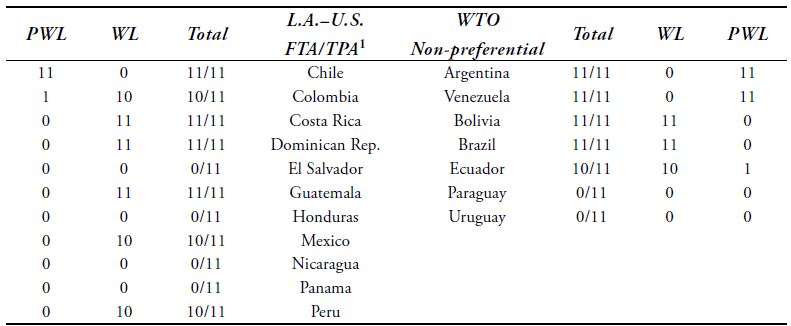
Under the guidelines of Special 301, two lists of countries are provided each year: The Priority Watch List (PWL), which precedes the retaliatory policies, and the Watch List (WL), that indicates which countries perform unfair domestic practices. In 2018, both registers included 12 Latin American countries, two more than in 2017. They have included nearly the same countries for over a decade. Important to our analysis, the lower legal hierarchy of free trade or trade promotion agreements in the U.S. trade legislation permits the exercise of Section 301 without being affected by their existence. From 2008 to 2018, Mexico and six other signatory countries of FTA/TPA with U.S. were permanent targets of these lists (see Table 1 ).
As with other non-tariff barriers, the economic effects of Section 301 are difficult to quantify since they combine three types of costs: threats of retaliation, retaliation itself, and administrative costs. Although exceptional, the recent imposition of additional tariffs on China’s imports illustrates the scope of this device. 11 The U.S.’ response under the Section 301 to “unfair trade practices” related to “the forced transfer of American technology and intellectual property,” contains three successive sets of new tariffs. The first one is valued at US$34 billion of Chinese imports; the second, US$ 16 billion, and the third, US$ 200 billion ( Economic Commission for Latin America and the Caribbean 2018 , 15; Brew et al. 2018 , 1). Summing up, due to “aggressive unilateralism” ( McMillan 1990 , 45), the second objective of the agreements, i.e., the liberalization of non-tariff barriers, does not imply significant concessions from the US’ point of view.
A few words about the common justifications of the U.S. trade laws, concerning the extreme external imbalance of the country and the loss of jobs. 12 Let us examine the data. Of 17 Latin American countries, the U.S. has trade surpluses with 11 (eight with FTA/TPA) and registers trade deficits with only four (two with agreements). The deficits are not lacking nuance. The case of Venezuela is due to the extraordinary circumstances of 2016, related to its economic downturn and its dominant oil exports. Colombia, on the other hand, registered a bilateral deficit a year earlier (2015) of US$ 2.2 billion ( Table 2 ).
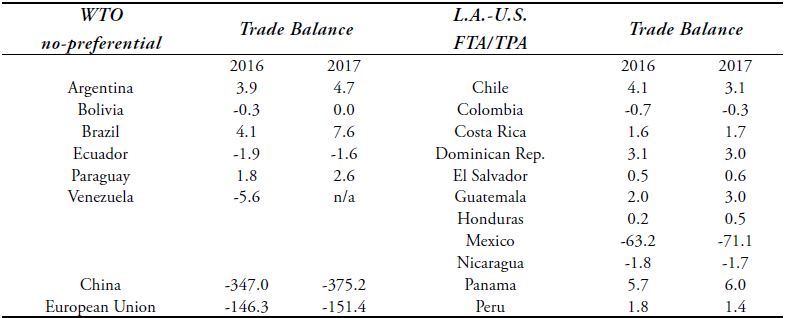
The deficit with Mexico, the most significant of the list, exhibits specific features that are not easily understandable at first sight. Approximately 40% of Mexican exports include inputs/operations fabricated or performed in the United States. Due to the 1992 change in the Mexican accounting system of the external sector, the maquila cannot be detected in the trade balance, yet it affects: a) the added value of Mexican exports; b) the depth of productive chains; c) the growth of the economy, and d) the industrial wage level. 13
With regards to the United States’ loss of 6 million jobs during 1991-2007, a study performed by the ECLAC ten years later states that this was due to the technological revolution and to the entry into the WTO of China, a nation whose exports to the U.S. grew 1150 percent during the period ( Economic Commission for Latin America and the Caribbean 2016 , 17). 14 The loss of 8.8 million jobs between 2008 and 2010, on the other hand, seems to be due to the poor regulation of the U.S. financial sector, not to the direct investment in Mexico ( Goodman and Mance 2011 , 3). It should be added that the impact of the crisis went far beyond the U.S. labor market: it fueled the international food crisis, the collapse of several stock markets, the activation of trade restrictions at the global level, the crisis of the euro system, the European economic stagnation, and the necessity to rescue Greece, Ireland, and Portugal. 15
To be sure, neo-protectionist behavior is not exclusive to the U.S. government. Virtually all countries in the world possess an arsenal of restrictive instruments, although industrialized nations implement, develop, and use them with higher frequency. During the first half of 2016, for instance, the countries of the Group of Twenty (G20) adopted more than 400 trade restriction policies (primarily anti-dumping measures); four times more than seven years before ( Economic Commission for Latin America and the Caribbean 2016 , 7). At the same time, decision-making at the multilateral level has been stagnant, and “gridlock is becoming a general condition of the multilateral system” ( Hale et al. 2013 , 233). This situation adds nuances to U.S. neo-protectionism, but reinforces the concerns about North-South regionalism.
Arrived here, we can address a last and long-term limitation of the orthodox argument: its disciplinary encapsulation. Rather than an economic process, trade integration represents the interaction of a set of intergovernmental institutions, different types of actors (consumers, workers, enterprises), goods and capital flows, relationships and causalities whose range or variety exceeds the scope of the market. As an open system, the understanding of this cannot depend exclusively on the formalization, since it has to review a host of non-economic phenomena ( Lawson 1997 ).
That said, what do other research areas say about the effects of the unequal integration? We should be interested not only in the answers, but in the specificity of their objects of study, which are interconnected, and not identical, but equally relevant for a more in depth understanding of the process. Each captures a different aspect of the issue:
a) Negotiating outcomes
Does economic disparity affect the negotiating capacities of small/less developed countries? The discipline that addresses international negotiations lists three contrasting groups of hypotheses. According to one of them, a positive relationship exists between success in negotiations and the availability of resources: the more resources, the better the result ( Bailer 2004 , 115; Knight 1994 ; Nash 1950 , 155-162). The second group of hypotheses appeals to the negotiations of the European Union (EU), an area characterized by its greater attention to the criteria of inequality ( Hug and König 2002 ; Schneider and Cederman 1994 ). As expected, they endorse the idea that dominance is not decisive ( Nye 1990 ), although it can hardly be attributed to general validity ( Marconini 2010 , 91), especially in regions lacking proper institutions.
There is a third approach, which supports the lack of clarity of the role of disparities. Its conclusions highlight that: a) “it is not necessarily a disadvantage to be weak” ( Pfetsch and Landau 2000 , 40), i.e., the resources needed for successful negotiation are not directly related to the size of the economy; b) moreover, the fragility can improve results depending on the forum ( Putnam 1988 ; Schelling 1960 ); c) the concessions at the negotiating table are guided by the expectations of improving collective benefits ( Moravcsik 1998 ; Keohane and Nye 1977 ); and d) economic size and geographic distance can be less important in the choice of FTA partners ( Spilker et al. 2016 , 706-718).
The contrast of the three approaches reflects less the ambiguity of the phenomenon than the particularities and the timing of the negotiation. The original NAFTA negotiation (1991-1993) sought to spread the benefits among the participating countries, while the USMCA negotiations (2017-2018), were guided by the United State’s interests and claims. Summarizing, no economic sizes or degrees of homogeneity guarantee good results, although some issues appear most frequently: the institutional framework, the characteristics of the asymmetry ( Pfetsch and Landau 2000 , 21-42), the meanings of the context, and the number of participants ( Schneider et al. 2010 ; Straubhaar 1987 ).
b) Direction of the integration process
Several studies focusing on economic disparity argue that disparity inhibits fragmentations and tends to preserve the unity of the grouping due to the high costs of one of the members leaving (Luo 2008). This approach retakes an old hypothesis according to which the existence of a strong core facilitates collective decision-making ( Kindleberger 1973 ). Seemingly, the international economy operates more efficiently when a country or a group of countries can supply the demand and liquidity necessary for the functioning of the zone. The larger economy acts as an anchor or a source of stability for the management of exchange rates, the harmonization of monetary policies and the absorption of new exporting capacities of the associated countries. Conversely, when no country or group of countries occupies a central position, the system is less likely to succeed and its vulnerability increases. 16
However, this approach does not take into consideration the risks of unilateral management and the primacy of the interests of the most powerful nation. The interactions between Mexico and the United States are driven by a domination/dependency relationship, which includes high dependence on unilateral and removable preferences (Manger and Shadlen 2014, 79-91), but not exclusively. This relationship permeates issues such as: foreign investment, drugs, energy, migration, and border ( Weintraub 2010 , 6). The situation tends to exacerbate bilateral mistrust, which in the case of Mexico goes back to the loss of territories during the XIX Century, various military invasions, and onerous economic impositions.
c) Strategic alignment
Does the integration of economies of different sizes favor conflict resolution? 17 As in other fields, the main conjectures are contradictory. One of them states that the critical dominance of a country has a dissuasive impact on the production of conflicts; i.e., represents a condition of pacification since it inhibits dissension and smoothes the adoption of consensual policies ( Fearon 1995 ; Geller 1993 ; Bremer 1992 , 337; Gochmann 1990 ). From this perspective, disparity supports a system of relations in which the strategic competences are delegated to the larger partners, and hegemony manifests through norms and institutions ( Kindleberger 1973 ). This argument completes an older hypothesis according to which the absence of important risks to the U.S. primacy stimulates the substitution of hard power with a diplomacy based on economic strategies ( Haftel 2007 ; Jaguaribe 1996 ; Desch 1993 ). 18
The second approach posits that power relations combine elements of consensus and coercion arranged in an asymmetric manner ( Arrighi 1993 ). In other terms, consensual policies are inversely correlated with the exercise of hard diplomacy. Inter-American relations offer abundant evidence of the transition from one strategy to another, from the policy of consensus to the active unilateralism.
The third argument contains a warning: the absence or ineffectiveness of regulations and institutions responsible for preserving a win-win relationship favors the exercise of hard power. The objective of the larger country consists in the expansion of its resources through periodic conflicts or by diminishing the options of small/less developed countries. The alternative to this type of relationship should be less integration with the dominant country: if the burdensome effects of economic interdependence can lead to an increase in international conflict, then “the benefits of a simple economic interconnection can favor the reduction of conflicts” ( Gasiorowski 1986 , 24). 19 This hypothesis has been retaken by a recent study, according to which the existence of previous disputes facilitates the emergence of new conflicts ( Gomez-Mera and Molinari 2014 ).
The conflicting stances of the theories reviewed in this paper suggest the convenience of an analytical agenda able to decrypt the disciplinary impurity of the object of study, i.e., the interaction of knowledge of several specialties with the scope of shedding new light on complex phenomena (Brewer 1999, 328). Although the design and the application of a specific methodology exceeds the purposes of this article, the prominent themes that mark its construction can be discussed: disciplines and problems to be addressed; the most frequent recommendations in the studies on unequal integration; and research teams formulated as open systems.
a) Interdisciplinary framework
According to the specialists, the first issue to be considered by an interdisciplinary research programme are the “disciplines” concerned. This recommendation seems self-evident. In a laboratory setting it happens somewhat different: the teams are guided not by disciplines, but by a set of common or relevant problems belonging to different sub-disciplines ( Reza and Lara 2012 ; Dogan 1998 ). 20 In addition, this type of selection facilitates the next stage and its questions: (1) the strengths and weaknesses of the hypothesis; (2) the ethical outlook; (3) the ideological bias; and (4) the epistemological background ( Szostak 2009 , 100-101) ( Figure 1 ). These questions not only affect the interdisciplinary framework, but they also enclose the main sources of obstacles for cooperative research ( Lélé and Norgaard 2005 ).

b) A case-by-case approach
A conclusion that derives from the previously revised literature stresses the non-generalizable features of the case studied. The general implication is that the analysis should appeal to lower degrees of abstraction and have closer proximity to the real object. Thus, instead of initiating with abstract models, a research team ought first to identify the relevant factors and then select the appropriate level/area of formalization. It is opportune to insist that a complete formalization only occurs in closed systems, whereas an open system, such as unequal trade integration, links a wide range of non-formal causalities.
c) Comparative forms of integration
Another recurrent conclusion in the reviewed literature is the need for regional institutions. As was said, NAFTA influences several aspects of the FTAs, including an institutionality that “respects the market more and trusts bureaucracy less” ( Pastor 2008 ), a trait which is considered to be “consistent with the nature of a modern State” ( Kozolchyk 1996 , 13). For its part, the integration in Europe “is achieved through endowing specific institutions with far-reaching decision-making powers to shape the behavior of the member states,” while in Asia it is conducted through an “open-ended networked regionalism” ( Yeo 2010 , 324). These alternatives suggest that one of the main problems facing the construction of a common research agenda is how the different forms of integration can affect the small/less developed economies. Here, it becomes necessary to develop a line of research on compared regionalisms.
d) Building the research team
In recent decades, the networks of researchers that share an interdisciplinary perspective show the tendency to attract scientists from different countries; in a way, they are operating as open systems in themselves ( Wagner et al. 2015 , 6). This aspect of the new interdisciplinarity is of particular interest in our discussion since it allows to map the determinants of the unequal integration problem more precisely. Indeed, the presence of researchers of different nationalities, and not only of different disciplines, could appeal to a series of themes that otherwise would be left without attention.
The controversies surrounding the effects of NAFTA on the Mexican side are likely to become more confusing once the USMCA enters in force. Apart from showing the empirical and epistemological foundations of a number of studies, in this article we highlight the lack of theoretical certainty on the benefits of this agreement. The importance of the subject is given not only because it refers to a country of about 130 million inhabitants, but also because NAFTA is a model for a growing number of North-South agreements.
As a way to overcome the analytical boundaries, this paper proposes to reunite different fields of expertise, and in doing so it explores the key issues of an interrelated research agenda. From a methodological point of view, it seeks to deepen the understanding of unequal integration as an open system, whose amount of information, techniques, methods and findings remains fragmented in different scientific specialties.
Thus, the traditional call for further research is in order. In our case, however, the rationale goes beyond the need to improve the knowledge of a particular phenomenon and adds two central goals: bring together scientific expertise in an area of growing importance for international relations, and establish a more stable relationship between scientific research and international decision-making.
