2021
641
6012021
4032021
 Alana Camoça Gonçalves de Oliveira (alanacamoca@gmail.com)
Universidade Federal do Rio de Janeiro, Brazil
Abstract: Using a neoclassical realist model, this paper builds an analytical model to understand how countries are able to change or adjust their security and foreign policies. The article analyzes Japan’s foreign and security policies under the Shinzo Abe government, exploring how the Japanese government’s internal and international propaganda on Chinese maritime assertiveness and the Senkaku/Diaoyu Islands issue influenced the government’s capacity to mobilize resources in order to transform security policies and legitimize Japan’s military role in the Asia Pacific.
Keywords: Security policiesSecurity policies,JapanJapan,Neoclassical realismNeoclassical realism,Resource mobilizationResource mobilization,International prestigeInternational prestige,PropagandaPropaganda.
Article
Mobilizing resources and signaling intentions: a neoclassical realist analysis of Japan’s domestic and international instrumentalization of the Senkaku Islands dispute and China’s maritime assertiveness
Alana Camoça Gonçalves de Oliveira (alanacamoca@gmail.com)
Received: 6 January 2021
Accepted: 4 March 2021
“Japan is back” announced the Japanese Prime Minister Shinzo Abe in 2013 during his interview to Foreign Affairs, with the intention to inform audiences that Japan’s behavior in the international arena might change. During Abe’s government, Japan has adopted different types of policies regarding its security structure and capacity. Policies that can be seen with Japan’s first National Security Strategy, through which it has developed, for example, the discourse and ideas for a “Proactive Contributor to Peace” foreign policy. Besides that, throughout 2014 and 2015, Prime Minister Abe Shinzo invested his energy to advance a “limited” form of collective self-defense security policy which Japan has not exercised since the mid-1950s (Hughes 2016).
It is true that Japan’s security policies have been changing since Koizumi’s era, however, due to the changes in the balance of power in East Asia and the growing fear of China’s maritime assertiveness in the East and South China Seas, Japan’s military upsurge in Abe’s era became more evident. Therefore, it is not surprising that his discourse and initiatives tried to promote greater economic and military international involvement.
However, for Japan to be able to really “come back,” Shinzo Abe needs to take into account Japan’s historical presence and actions from late 19th century up until the end of World War II and the traumas of the consequences of its militarism. In this regard, Japan needs to pursue a dual strategy in the domestic and international arenas. Accordingly, Japan needs to be able to: (a) extract resources and mobilize an alignment between state foreign policy goals and society’s expectations and, concomitantly, (b) signal to other countries that Japan is a restrained military country, a victim of potential aggression in its regional environment and a pacifist actor willing to contribute to the security affairs in the international order. Even if the latter seems contradictory, this issue symbolizes the interrelation between the chrysanthemum and the sword, the two symbols that still sometimes characterize Japan’s posture towards its military forces.
Through the lens of neoclassical realist theory, this article aims to debate how states can, through internal and external propaganda, instrumentalize disputes with the intent to (i) mobilize domestic resources and domestic support to be able to implement changes in their security and foreign policies, and (ii) to boost one country’s image and to form alliances or establish cooperation in the international level. Analyzing the Japanese case and the domestic and international instrumentalization of both the dispute over the Senkaku/Diaoyu islands post-2012 and the “China threat,” this article analyzes the need for the Japanese government to reach domestic and international audiences to justify its military upsurge and to manage adjustments in its security policies.
Thus, the article proposes an analytical model that considers not only the ability to mobilize resources, but also how statesmen are concerned with the country’s international prestige and image, and how they are perceived by other countries. Then, the article analyzes the Abe administration and shows that Shinzo Abe (2012-2020) instrumentalized China’s assertiveness in the East China Sea in order to promote an alignment between state and society aiming to gain support for its security policy changes. Also, he used the “China threat” to boost and/or establish close relations with countries in the South China Sea, propagating the image of Japan as a peaceful country and China as an aggressor.
In order to do so, first, the article presents the neoclassical realism theory, building a model to interpret and analyze how decision makers/leaders (Foreign Policy Executives - FPE) use propaganda as tools to boost domestic mobilization for security issues and international prestige and to signal their intentions to other countries. And second, I present the case study for the model discussed, where I analyze the Japanese instrumentalization of the Senkaku/Diaoyu Islands and Chinese maritime assertiveness.
Neoclassical realism is a hybrid theory that combines the structure of the international system with variables at the unit level to explain foreign policy, security policies, major country strategies, as well as to understand the changes within and in the structure of the International System (Rose 1998; Saltzman 2015; Ripsman et al. 2016). The theory incorporates multiple domestic variables returning to the states’ political agency, something that was lost in neorealist theory (Saltzman 2015; Rose 1998; Ripsman et al. 2016), and in doing so, neoclassical realism creates a theory that incorporates all levels of analysis.
Neoclassical realists “point out that there is no immediate or perfect transmission belt linking material capabilities to foreign policy behaviors” and due to that fact, domestic variables need to be accounted for to understand the foreign policy choices of some countries (Rose 1998, 146-147). Since the structural conditions are “permissive or ‘profound’ causes of specific actions: they allow certain things to happen by providing opportunities for and constraints on actors’ behaviors” (Schweller 1998, 3). However, the structural conditions do not define the states’ actions as whole because “there is no perfect transmission belt linking the relative distribution of power and states’ foreign policy behavior” (Taliaferro 2006, 485) and you cannot simply assume a constant mobilization capacity.
As Saltzman (2015, 502) argues “the availability of material resources does not guarantee governments’ capacity to convert them into power or influence abroad”. Also, as Christensen (1996, 11) points out, without a “degree of consensus behind security strategies, no state can harness its population and project national power abroad.” Considering this, some authors have already written about how states can mobilize resources (Christensen 1996; Taliaferro 2006). Still, neoclassical realism could be complemented with the discussion about which methods one government can use to boost its resource extraction capacity, to achieve deeper alignment between state goals and domestic expectations and to promote on country’s image, concerns and fears internationally. Therefore, this article also intends to analyze how propaganda can be broadcasted in the domestic arena to mobilize resources (Carr 2001) and to improve the prestige or translate an image that one state wants to portray in the international arena. In the latter case, on the international level, perceptions can be related both to balance of power and threat perceptions, which can be associated with Stephen Walt’s argument in “The Origins of Alliance,” that states balance not simply power but the perceived threats.
Since countries live in an anarchic system where there is a perpetual struggle between self-interest groups under conditions of general scarcity and uncertainty (Ripsman et al. 2016), all the actions of a given country, mainly of the major powers, is the focus of the attention of others. As Morgenthau (1948, 51) argued before,
[…] in the struggle for existence and power, which is, as it were, the raw material of the social world, what others think about us is as important as what we actually are. The image in the mirror of our fellows’ minds, that is, our prestige, rather than the original, of which the image in the mirror may be but the distorted reflection, determines what we are as members of society.
Just as statesmen perceive the threats of the international system and are pressured to respond to them, they also calculate, to a certain extent, the “limit” of their actions in the international arena and how its actions can affect the prestige and image of the country – damaging or improving it (Morgenthau 1948). At the same time, the way that one country answers to one systemic pressure affects its capacity to form alliances or establish cooperation with other states. Walt (1987, 26) argues that “in a balancing world, policies that demonstrate restraint and benevolence are best. Strong states may be valued as allies because they have much to offer their partners, but they must take particular care to avoid appearing aggressive.”
As can be seen in Figure 1, the starting point of this model is the international/systemic pressure translated by leaders’ perceptions and images that affect policy choices and the decision making process. At the same time, systemic pressure also affects other countries’ perspectives and the image of each country in the world arena. Policy choices and decision making are affected not only by leaders’ perceptions and images, but also by the prestige and perceptions of other countries. At the same time, policy choices and decision making can, through propaganda and diplomacy, boost the prestige of one country and its resource mobilization capacity.
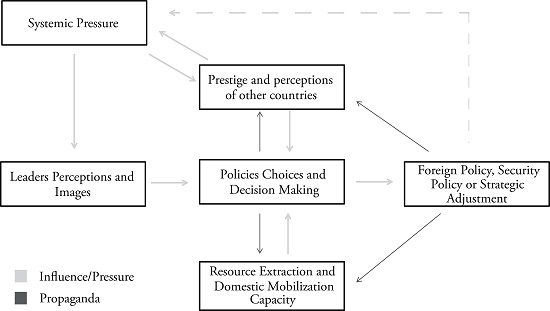
The capacity of a state to mobilize domestic resources is commonly debated in neoclassical realist theory (Zakaria 1996; Christensen 1996; Schweller 1998). Therefore, several authors find the explanations for why policy X or Y was chosen analyzing the most diverse group of domestic variables. Authors such as Kitchen (2010) present variables commonly related with the constructivist approach, such as strategic culture and the power of ideas, while Zakaria (1996) and Christensen (1996) justify political choices in FPE perceptions and the alignment between the state and society. Also, authors of the book organized by Lobell et al. (2009) bring different concepts and ideas to neoclassical realism, incorporating variables about domestic institutions, national identities, nationalism and so on.
For the purpose of this article, our main domestic variable is the FPE’s perceptions, since they have privileged information about the international system (Ripsman et al. 2016). Due to that fact, it is common that leaders often find it difficult to convince the public to make significant sacrifices for national security, even if it is in the public interest (Christensen 1996; Taliaferro 2006). Also, the article takes into account state and society relations in order to understand how propaganda can be used to enhance the FPE’s capacity to mobilize resources in the domestic level to change or implement specific foreign and security policies.
It is noteworthy that, one of the main characteristics of realism is the understanding that in an anarchic environment, individuals cannot survive alone and, for this reason, they become members of larger groups. A necessary condition for the formation of these groups is the distinction between insiders and outsiders. Thus, fear and the idea of a common enemy can be used as tools to generate cohesion inside the group. To be able to mobilize resources, propaganda that disseminates fear or the idea of threat can be crucial to create support for stronger and costly foreign policies (Christensen 1996). As stated by Taliaferro (2006, 492), “Fear plays a crucial role in the formation of political groups, if only because physical security is a prerequisite for the pursuit of any other individual or collective goal.”
Given that, power over opinion is an important instrument to be able to obtain support for specific policies and increase the alignment between the state and society interests. As pointed out by Carr (2001), this power is no less essential to political goals than economic or military power, and has always been associated with them. One of the main tools used by statesmen to obtain power over opinion is propaganda which, according to the author, is widely recognized as a national political weapon, to the point that clauses regarding its use are quite common in international agreements (Carr 2001). Propaganda is used not only in authoritarian governments, but also in democratic regimes and, as Carr points out, “democracies, or the groups that control them, for their part, are not entirely innocent in the arts of shaping and directing the opinion of the masses” (Carr 2001, 174).
Propaganda can be necessary, to the extent that Waltz (1979) himself mentions, in his theory of balance of power, the fact that any balancing effort, especially when it involves the domestic sphere, can be costly. This is so because there is the need to increase military expenditure, which can generate dissatisfaction among the people. Propaganda can be disseminated in official documents, through speeches in the media, pamphlets, posters, and even the educational system . All of them can be used as an instrument of political power to endorse one specific policy.
Those can be important means, capable of assisting the government to stay in power and change security and foreign policies (Morgenthau 1948; Carr 2001; Kitchen 2010; Schweller 2018; Oliveira 2019; 2021). That’s why propaganda about threats can strengthen the national cohesion or the very character of the Nation (Sterling-Folker 2009; Morgenthau 1948), or even stimulate in-group and out-group perceptions. All of this can affect nationalism and national identity, since “State leaders always attempt to encourage, reiterate, or impose particular visions of national identity in order to obtain support for their policies and preferences” (Sterling-Folker 2009, 114).
In sum, it is possible to argue that by fostering the imminence of external threat and stimulating fear, propaganda can be used as a tool in which countries can mobilize resources and domestic support (Christensen 1996). As stated by Carr (2001, 178), “the same way that I launch howitzers in enemy trenches, or poison gas on the enemy [...] as an enemy, have the right to use propaganda against him.”
Walt (1985; 1987) argues that countries balance not only power, but also against those countries that appear especially dangerous to them. In fact, to the extent that countries experience a common enemy, alliances will most likely be made in order to guarantee security and survival. As can be seen in world history, although in many cases it is not necessary to signal to other countries that they have a common threat, it can be necessary to boost reconciliation or cooperation between rival countries. As the fear and the idea of a common enemy can be used as tools to generate cohesion inside countries (Christensen, 1996), it can also have an important role for countries to strengthen relations with other countries that share the same threat perceptions.
Despite the fact that authors such as Morgenthau and Gilpin are most concerned with the logic of power balance and the relation between prestige and the intention and willingness to use power; prestige can be associated with how one state behaves and the image of one country, be it positive or negative, in the international arena (Morgenthau 1948). This can also foster perceptions that can bring together countries that aim to balance against one specific threat.
However, it is noteworthy that a country’s image and prestige can be biding, since it creates expectations to other players in how a country should behave. Not by chance, a state with great economic power, although having a pacifist rhetoric and a history of reactive behavior in international affairs, such as Japan, may be required by others to take a more active international role (Uehara 2003). As an example, during and after the Gulf War (1990-1991), Japan’s decision to only provide assistance in the economic field was heavily criticized by the US and European countries (Saltzman 2015). Due to this pressure, Japan has been seeking legitimacy for changing security and foreign policies by sending signals to the international system that it aims to contribute more actively in security issues. Yet, Japan must still be careful not to appear aggressive in the eyes of some countries in East Asia because of its imperialist past in the late 19th and early 20th centuries (Midford 2015).
By using propaganda, through Defense Papers, official documents, diplomatic meetings, international summits, forums and various other international events, a government can broadcast their intentions to other countries in the international system, signaling its interests and willingness to cooperate. Thus, countries can reach foreign audiences and showcase their claims and interests in the international arena. In doing so, propagandas, which can change depending on the international audience or country that one government wants to reach, can be one instrument that states can use to improve their image and send signals to other countries about their fears and threats in a way to foster alliance behaviors.
The Senkaku / Diaoyu Islands consist of eight small uninhabited rocky islands located in the East China Sea. Japan argues that those islands were incorporated into its territory through Okinawa Prefecture in 1895, after the authorities concluded that there had been no previous occupation of these territories by another country. In the Post-World War II period, Japan considers that the islands came under US control due to the San Francisco Treaty (1951) and returned to Japan in 1972 with the Reversion of Okinawa (Oliveira 2019; 2021).
Chinese documents indicate that the islands belonged to it since the Ming and Qing dynasties (1644-1911). The Chinese government argues that by the end of the 19th century, with the First Sino-Japanese War (1894-1895), some Chinese territories were ceded to Japan due to the Shimonoseki Treaty (1895) – including the Senkaku / Diaoyu islands. Thus, these should have been returned with the unconditional Japanese acceptance of the Cairo Declaration (1943), Potsdam Declaration (1945) and the San Francisco Treaty (1951), given that Japan was obliged to return Taiwan and the territories usurped during its imperialist past to Chinese sovereignty (Oliveira 2021).
The islands gained economic value in the late 1960s when the Cooperation Committee on Prospecting for Mineral Resources in Asian Offshore Areas (CCOP), together with the United Nations Economic Commission for Asia and the East (ECAFE), published a report concluding that there was a high probability that the continental shelf between Taiwan and Japan would be one of the most prolific petroleum reservoirs in the world. Since then, the islands started to be disputed by China, Japan and Taiwan. The major escalations episodes occurred in 1978, 1990, 1996, and in the beginning of the 21st century, between 2004-2005, in 2010 and in 2012, the last two had greater impacts for the Sino-Japanese relations (Drifte 2013; Oliveira 2019; 2021).
Regarding the most recent escalation, in summary, on April 16th, 2012, Ishihara Shintaro, governor of Tokyo, stated the intention of using government money to buy the islands of Uotsuri, Kita-ko and Minami-ko. In order to buy the islands before the Tokyo government, the Japanese Prime Minister Yoshihiko Noda (2011-2012) confirmed the purchase by the central government of Japan. The announcement was made close to the 75th anniversary of the Marco Polo Bridge Incident, which generated greater tension within China and encouraged popular demonstrations during the months of August (Drifte 2013; 2016). Since then, actions such as incursions by Chinese ships near the islands and measures such as naval drills and other unilateral Chinese military actions, have become recurrent (Drifte 2013; 2016).
Still in 2012, shortly before his rise to power once again, and after the incidents related to the escalation of the dispute in 2012, Shinzo Abe explicitly mentioned China in his election campaign. The Japanese Prime Minister stated that “from tomorrow, we will finally begin an election to determine the future of Japan. Emerging China never conceals its ambition for Japanese territories… How do we manage this crisis? […] If we can fill Akihabara with people with high motives, that will certainly change Japan” (apudMurai and Suzuki 2014, 190).
Since the beginning of his term, Shinzo Abe demonstrated his willingness and intention to restructure Japanese security policies and legitimize Japan’s Self-Defense Forces (SDF), due to his perceptions of an increasingly unstable international scenario. This was especially related with his concerns in regards to the North Korean threat, the Chinese maritime assertiveness and fears of instability in the Japan-US security alliance (Saltzman 2015; Hughes 2016; Pugliese and Insisa 2017). However, as history has shown, the Japanese security policies are constrained both domestically and internationally since the World War II (Pyle 2007; Hughes 2016; Saltzman 2015; Pugliese and Insisa 2017). Thus, one of the ways that the Japanese Prime Minister found to boost his capabilities and gain support for change in security and foreign policy was to endorse the image of a threatening regional environment, especially because of China and North Korea (Pugliese 2015; Pugliese and Insisa 2017; Oliveira 2019; 2021).
In order to make changes, even if minor ones, the Japanese government has promoted a dual strategy to mobilize domestic support towards its interest in changing some aspects of its security arrangement, such as the SDF (Saltzman 2015). Aiming to obtain support for SDF legitimacy, the Japanese government has, for example, broadcasted internal propaganda on the websites of the ministries of defense and foreign affairs about the role of the SDF (MOD 2018). Also, it was created a manga and pamphlets showcasing the SDF, explaining its role and seeking to encourage the population to join the institution.
In regards to the Senkaku / Diaoyu island dispute, at the beginning of 2013 the Japanese government formed a group of advisers to work in the Cabinet on communications concerning territorial disputes between countries. The aim of this action was to increase Tokyo’s ability to project messages at the international and the domestic levels (Cabinet Secretariat 2013; Pugliese and Insisa 2017). Besides that, official government documents have been constantly emphasizing the idea of a threatening China due to its actions in the East China Sea and South China Sea. As an example, in the Defense White Papers, which has national and international reach, it has portrayed China’s rise and presence in the East China Sea as a threat. As can be seen in the 2014 and 2019 documents below,
On the military front, China has been strengthening its military forces broadly and rapidly by sustaining large increases in its defense budget. […] As part of such efforts, it is believed that China is enhancing its asymmetric military capabilities to deter military forces of other countries from approaching and advancing to China’s surrounding region, and to inhibit their military activities […] (MOD 2014, 32-33).
China, particularly regarding maritime issues where its interests conflict with others’, continues to act in an assertive manner, which includes dangerous acts that could cause unintended consequences. Additionally, China continues to demonstrate its willingness to realize its unilateral assertions without making any compromises, steadily moving forward with efforts to change the status quo by coercion and to create a fait accompli (MOD 2019, 58).
Several newspapers also have presented China as a threat. Yomiuri Shimbun, a conservative national newspaper, published a story on March 22nd, 2014 about how the Japanese Coast Guard (JCG) was unprepared to recover the Japanese islands in the event of an attack. The article also stated that if Chinese fishing vessels (that can be armed) wished to occupy the islands, the SDF could hardly be mobilized (“Government to probe China media machine” 2014). In the same year, the newspaper published an editorial arguing about the need for the government to discuss national security issues more aggressively (“Behind the Propaganda Wars. Xi’s rhetoric on history defies international norms” 2014).
In 2014, MEXT implemented the new educational guidelines for areas of geography, civic studies and history, in which presented the Senkaku / Diaoyu islands as part of the Japanese territory. The material teaches about the Japanese geographic location, claims and states the sovereignty over islands disputed with other countries. The guidelines pointed out that,
Regarding the territorial issues [...] it shall be understood that position for continuous efforts towards peaceful settlement based on broad vision is essential. […] Further with regard to the current situation of the Senkaku Islands, an inherent part of Japan, it shall be instructed that there exists no issue of territorial sovereignty to be resolved concerning the Senkaku Islands with reference to the development so far and Japan’s legitimate position (Cabinet Secretariat 2014).
In regard to the Chinese threat and the instrumentalization of the islands, the most evident point to our argument was Shinzo Abe’s interview on the television program Minna no News on July 20th, 2015, where he sent a message to the public on defense policies and the Senkaku / Diaoyu Islands issue. Abe emphasized that the Japanese regional environment was becoming increasingly restrictive due to threats from its neighbors. Although he did not direct his speech to a specific country, when asked about the Senkaku/Diaoyu islands issue, he said that advancing security policies would be a way of “closing the door on thieves and sharpers,” preventing that they continue to try to meddle in or usurp Japanese territory (FNNSLINE 2015; Pugliese 2015; Pugliese and Insisa 2017).
The Japanese government’s documents, propaganda and speeches inflated the population’s perception of the Chinese threat, which can be seen in an opinion poll by the NPO Genron in 2014. The Japanese public saw that the main military threats to the archipelago were North Korea and China, with 68.6% and 64.3% respectively. However, with regard to the islands, the same opinion poll showed that while 63.7% of the Chinese population supported more assertiveness of China in the islands, only 22.7% of Japanese supported the country’s assertiveness in the region (GENRON NPO 2014).
Between 2014-2015 the Japanese government approved a series of security measures, where the main point was the reinterpretation of the Constitution allowing the SDF to provide military assistance to allies, even if Japan is not under attack (Saltzman 2015; Oliveira 2019; 2021). Titled as Japan’s Peace and Security Legislation, it constituted the enactment of a new law, the International Peace Support Law, and the revision of ten laws, including the reinterpretation of the Japan’s right to exercise Collective Self Defense (CSD) (Akimoto 2016; Saltzman 2015). In sum, the bargaining for passing the law began on May 20th, 2014 and on July 1st, 2014. After negotiations between the LDP and the New Komeito coalition, the Prime Minister’s office approved the revision of several laws and the reinterpretation of defense rights (Akimoto 2016).
In the last few years, despite the increase in nationalist voices in support of Japan’s security policies changes, this does not represent that there is a full support (and mobilization capacity) from the Japanese population for Tokyo to pursue stronger security policies (Pugliese 2015; Pugliese and Insisa 2017). Even though the Japanese population can be aware and perceive some countries as threats, this does not fully translates in unconditional support for Tokyo’s security policy changes/adjustments. A portion of the population did not accept (and still does not accept) the costs of militarization.
Even when analyzing the case of the reinterpretation, Asahi Shimbun released a public opinion poll in April 2014, where only 29% of respondents supported the CSD (Kamiya 2014). In 2015, the same newspaper released slightly different figures, where 43% were against the proposal and 33% were in favor (Sebata 2016). Opinion polls conducted by Yomiuri Shimbun in May 2014 showed that 11% of respondents supported the CSD unrestrictedly, while 60% supported only the minimum necessary CSD (Kamiya 2014). For this reason, even with the diffusion of propagandas, the ultimate nature of Japan’s security policy reform was not as sweeping as Abe had hoped (Saltzman 2015). This shows that the propaganda endorsed by the government was not enough to promote drastic Japanese security policy changes.
For the approval of the abovementioned security laws, the dispute over the islands and the China threat were instrumentalized. At the time of the negotiations, New Komeito and the Liberal Democratic Party presented several scenarios to justify the change in security legislation with the objective of improving US-Japan relations and deterrence capability against China and North Korea. The scenarios presented were, for example: the protection of strategic sea lines and possible gray-zone contingencies (Hughes 2016; Oliveira 2019).
It is worth mentioning that, despite the approval of the limited reinterpretation, Abe wanted to take forward a possible amendment to Article 9 of the Constitution to legitimize the existence of the SDF. Shinzo Abe’s interests to amend the Constitution in order to eliminate doubts about the unconstitutionality of the SDF encountered resistance and were not fulfilled during his term (CFR 2019).
Although the Japanese government uses propaganda to stimulate a critical view of the Chinese government and seek to internally justify the need to strengthen its military power; Tokyo still faces restrictions to change its security policies, since it can be said that the Japanese society is still reluctant to accept Japan’s stronger security role in the international arena (Saltzman 2015; Pugliese 2015; Pugliese and Insisa 2017). After all, for any constitutional change Japan needs more than 2/3 of the Upper and Lower Houses, as well as approval in a popular referendum, which were the main obstacles to Shinzo Abe’s project to “bring Japan back.”
Because it faces its imperialist past and has been trying to build up its prestige and image since the end of World War II, Japan is commonly portrayed as a reactive actor with low involvement in international security matters (Pyle 2007). Nevertheless, since China has been acting more assertively in the East China Sea and in the South China Sea and the balance of power in East Asia continues to change; Tokyo sought to use Chinese assertiveness to approach the countries that have territorial disputes with China (Midford 2015; Drifte 2016). Thus, shortly after the 2012 escalation, the Chinese and Japanese governments started a ‘propaganda war’ to reach out to other countries and portray one another as a threat, utilizing lobbying strategies for international support, sending members of the government and ministers to different countries in the world.
Some examples of Japanese diplomats’ actions were: Ichiro Komatsu served as ambassador of France in 2012 and explained in detail the Japanese position on the territorial dispute (“Japan, China embark on ‘propaganda war’” 2012); Keiichi Hayashi, ambassador to the United Kingdom, also contributed with comments on November 14th, 2012 to the Financial Times with the title “Time for China to calm down and stop bullying” (Hayashi 2012); Yoshitaka Akimoto was interviewed in June, 2013 by an Australian newspaper; Masaru Tsuji, ambassador to the Netherlands, wrote an article to the Dutch newspaper Volkskrant in which he explains the Japanese government’s active stance and promotes the archipelago’s positive international image (Zhang 2014); Kennichiro Sasae, Japan’s ambassador to the US, wrote an opinion article for the Washington Post making accusations against the Chinese government, emphasizing that “I cannot predict whether China’s anti-Japan propaganda campaign will work inside China, but it certainly does not resonate internationally […] Ultimately, the international community will be swayed by China’s deeds, not by anachronistic propaganda” (Sasae 2014).
Tokyo’s disclosures were promoted not only in relation to the islands, but also seeking to emphasize the reasons why Japan has pursued some transformations in its security policies. According to Yomiuri Shimbun (“Behind the Propaganda Wars. Anti-Japan rhetoric demands a firm response” 2014), since the beginning of 2014, “an increasing number of Japanese ambassadors and other officials around the world have appeared on local TV programs and written for local newspapers and other publications to put forth Japan’s position on diplomatic and security issues.” In 2015, for example, MOFA received an increase of US$ 500 million to improve the country’s strategic communication.
In addition, Tokyo launched an explanatory website on Japanese claims and the Senkaku Islands issue in English, Arabic, Chinese, French, Dutch, Italian, Korean, Portuguese, Russian and Spanish. It also launched an informational pamphlet on the islands and distributed it to some academics worldwide (MOFA 2018; Oliveira 2021). In addition to these measures, Japan’s instrumentalization of the China threat can be seen in its annual defense books and in international speeches in which it is emphasized the role of international law and the country’s pacifism. One example is the 2014 Shangri La Forum, where Shinzo Abe pointed out the problems of maritime assertiveness in countries in the Asian regional environment, emphasizing that Japan is not willing to use force to modify the region’s status quo (Abe 2014).
During this period, in 2014, it is noteworthy that Abe administration developed the “Proactive Contributor to Peace” foreign policy. The implementation of the document and the objectives of such a policy represented not only a step towards Japan’s normalization, but also its international involvement. The Japanese government argues that it could not protect its daily peace unless it actively contributed to regional and global stability and security in cooperation with the international community (MOFA 2014).
Since 2012 Abe administration has constantly sought to connect disputes in the South and East China Seas in order to fortify the political and normative grounds that would reinforce Japanese conceptions of justice and willingness to contribute with the regional security. Some of the interconnections made by the Japanese government can be seen in Shinzo Abe’s 2013 interview to Foreign Affairs. When asked about the possibility of an unresolved settlement on the Senkaku / Diaoyu islands, Shinzo Abe replied:
The Chinese claims means Japan should admit that there exists an issue of territorial sovereignty to be resolved. We can never let this argument take place. The Chinese side has been using a similar argument against Vietnam and the Philippines to gain control over the islands in the South China Sea (Abe 2013).
In ministerial visits, for example, and in the annual forums between Japan and Asean (Japan-Asean Summit), Tokyo constantly pointed out the need for the rule of law and Japan’s fears about maritime disputes. During a visit to Manila in June 2013, the Japanese Minister of Defense Onodera Itsumori stated that “the Japan side is very concerned that this kind of situation in the South China Sea could affect the situation in the East China Sea” (apudDrifte 2016, 14).
The instrumentalization of the China threat through propaganda fulfills the objective of stimulating Japan’s image as a peaceful, peace-promoting and resolute country that seeks to increase its prestige and actively participate in the international order (Abe 2014). Not by chance, the propagandas and Japan’s interest in boosting relations with countries in the region are growing. Countries like the US and the Philippines have expressed their support to Japan’s possible change of stance regarding its militarization or, in the case of the latter, on the greater activism of Tokyo in the South China Sea. It can be noted that, during the Abe administration, Japan sought to improve relations with the US, which resulted in the 2015 U.S.-Japan Defense Guidelines and growing cooperation between both countries. Barack Obama stated during a press conference that
the alliance that has been built with the United States is principally one that seeks to defend our countries from potential attack or aggression. [....] the collective defense approach that Prime Minister Abe is proposing, it simply upgrades our ability to carry out those functions (“Statement by the President on the Trans-Pacific Partnership” 2015).
Also in 2014, Obama explicitly stated that the Senkaku / Diaoyu islands were under the US protection umbrella, and that the US opposed any unilateral attempts to undermine Japan’s administration of those islands.
Considering countries in the South China Sea, the Philippine secretary of foreign affairs at the time, Albert del Rosario, stated that
the Philippines welcomes the passage of legislation on national security by the National Diet of Japan. We look forward to efforts that strengthen our Strategic Partnership with Japan and those that would contribute further to shared goals of greater peace, stability, and mutual prosperity in the international community (“Statement of Secretary del Rosario on Japan’s Security Bill” 2015).
Also, Perfecto Yasay, while secretary of foreign affairs of the Philippines, after meeting with the Japanese Foreign Minister, connected the seas and told the press that “we had the same experience in the East China Sea and the South China sea for that matter, with respect to certain actions that use force, intimidation, provocation in order to assert one’s claim over a particular territory” (Franz-Stefan 2016; “Japan, Philippine defense chiefs agree to cooperate on maritime security” 2016).
During a visit by the Vietnamese Armed Forces’ (VPA) delegation to Japan in June 2018, a Vietnamese military officer granted an interview to The Sankei Shimbun and Japan Forward stating that “I hope Japan [will] reform Article 9 and get involved more actively for our region’s security” (Okada 2018). The official’s statement endorses the argument that some countries in Southeast Asia have been supporting a greater Japanese military participation despite its imperialist past. Following this, in 2018 the former Vietnamese President Tran Dai Quang praised Japan’s more active participation in the South China Sea (Sieg 2018).
Altogether with trying to connect the East and South China Sea, Japan sought to get closer to the countries of Asia-Pacific, and that can be seen by the strengthening of ties with countries such as the Philippines, Vietnam and Australia. In the South China Sea, Japan focused particular attention on building closer relations with the Philippines and a number of joint initiatives and agreements were made.
In regards to Vietnam, in 2014, after the deterioration of relations between China and Vietnam with the incident on the Hai Yang Shi You 981 oil platform (HD-981), the Japanese government sent Foreign Minister Fumio Kishida to visit Hanoi and offered the Vietnamese government to sell patrol ships for $ 5 million dollars (Inoguchi and Panda 2018). In 2017, during one of Prime Minister Shinzo Abe’s visits to Southeast Asia, Prime Minister Phuc of Vietnam expressed appreciation for Japan’s active role in territorial disputes in the South China Sea and maritime security in Vietnam through the promotion of trade and the transfer of armaments and technologies for the country (MOFA 2017). It is also important to highlight that Japan is moving closer to India and Australia, which can be seen with the development of the Quadrilateral Security Dialogue initiatives (Oliveira 2021).
Adjustments in countries’ strategies and changes in their foreign and security policies are commonplace in realist studies of international relations. However, there are still gaps that need to be filled regarding the countries’ ability to use a particular enemy, common or not, to legitimize and even change a specific foreign or security policy. For Japan, the fact that Abe managed to push new security policies cannot be fully explained with theories such as neorealism and constructivism. Even neoclassical realism approaches lack the discussion on the dual strategy that countries need to pursue to be able to change deep-rooted foreign and security policies. The model presented in this article aimed to help fulfill this gap using the case study of Japan. The article shows that Abe used propaganda in both internal and external fronts to boost his resource extraction and domestic mobilization capacity and to signal its intentions internationally, therefore increasing Japan’s prestige and improving other countries’ perceptions of Japan. Thus, Japan’s government is managing (at least partially) to gain support for some security policy changes and to form or improve alliances (informal and formal) or simply increase security ties with neighboring countries.
The Japanese case is an important example to demonstrate how a country that has long been considered an “anomaly” by some realist studies is willing to change its posture and its security policies. Nonetheless, Japanese leaders need to be aware not only of the problems of its imperialist past in order to stimulate the image of a peaceful country, but also the need to promote an alignment between state and society to carry out its project.
