Article
The Rise and Decline of Brazil as a Peacekeeper
 Geraldine Rosas Duarte geraldine@pucminas.br
Letícia Carvalho leticiacarvalho@pucminas.br
Dawisson Belém Lopes dawisson@ufmg.br
Geraldine Rosas Duarte geraldine@pucminas.br
Letícia Carvalho leticiacarvalho@pucminas.br
Dawisson Belém Lopes dawisson@ufmg.br
The Rise and Decline of Brazil as a Peacekeeper
Revista Brasileira de Política Internacional, vol. 68, no. 1, e001, 2025
Centro de Estudos Globais da Universidade de Brasília
Received: 09 September 2024
Accepted: 17 December 2024
Abstract: The article investigates the trajectory and transformations of Brazil’s involvement in UN peacekeeping operations, seeking to explain the recent hesitation to assume a leadership role in contrast to previous periods, particularly during the two initial presidential terms of Luiz Inácio Lula da Silva (2003-2011). It highlights the influence of international and domestic factors on Brazil’s new stance, including changes in the nature of UN peacekeeping missions and the impact of the deep politico-economic crisis Brazil experienced between 2013 and 2022. The shifts in foreign policy during the governments of Michel Temer and Jair Bolsonaro resulted in a more isolationist view and a significant reduction in Brazil’s participation in peacekeeping operations. The article concludes by analyzing the need for a strategic reassessment by Brazil of the dynamics of peacekeeping operations and the domestic challenges faced by the new Lula da Silva government to realign its future participation with its national interests and capabilities.
Keywords: Brazilian Foreign Policy, Peacekeeping Operations, United Nations, Brazil, Lula.
Introduction
The beginning of a third term for Luiz Inácio Lula da Silva in January 2023 brought various reflections on the possible developments for Brazil’s placement into international politics. The final report of the External Relations working group of Brazil’s Governmental Transition Commission, completed in December 2022, indicated that the dismantling of public policies, coupled with an isolationist worldview, affected Brazil’s external image during Jair Bolsonaro’s presidency (2019-2022), reducing Brazil’s capacity to influence the global agenda (Comissão de Transição Governamental 2022a). Specifically concerning the field of international security and the role of UN peacekeeping operations, Brazil’s diminished prominence precedes Bolsonaro’s term and finds its roots in the termination of MINUSTAH (United Nations Stabilization Mission in Haiti) in 2017. Currently, among 60,000 blue helmets serving in 11 active peacekeeping operations worldwide, only 81 individuals are Brazilian1 (United Nations Peacekeeping 2023).
The External Relations working group believes Brazil needs to reflect on its involvement in the UN Security Council agenda and its troop contributions to peacekeeping operations – considering the recent evolution of peace missions and the outcomes of Brazil’s participation in previous periods (Comissão de Transição Governamental 2022b). Given this scenario of change and the challenging need for adaptation, we aim to assess the possibility of Brazil’s significant return to UN peacekeeping operations during the current Lula government2. Our hypothesis is that, starting with the new Lula government, Brazil will likely adopt a cautious position in peacekeeping operations, dismissing the leadership roles it previously sought. This shift can be attributed to two central and interconnected factors: (i) a change in the profile of UN peace operations and (ii) a domestic focus on avoiding the empowerment of the Brazilian military establishment.
The first aspect relates to recent changes observed in UN peacekeeping itself. More recent peace operations tend towards conflict stabilization, combining military robustness with mandates that include strengthening state authority (Duarte and Carvalho 2022). These stabilization missions do not seem to be the ideal springboard for Brazil, either because Brazil’s contribution would be more significant in multidimensional peace operations involving economic and social development projects or because a militarization of peacekeeping may be incompatible with the image of a conciliatory and pacifist country.
The second aspect concerns the empowerment of the Brazilian military establishment – which began precisely with Brazil’s increased involvement in UN peacekeeping operations in the early 2000s. In 2004, for the first time in its history, Brazil commanded the UN multinational troops in the Haiti peacekeeping mission, led by General Augusto Heleno. This commitment to order and peace in the Caribbean country promoted several other military personnel who gained international experience and subsequently served in prominent domestic political positions in Brazilian governments, notably under Michel Temer and mainly Jair Bolsonaro (Amorim Neto 2022).
Combining these two facets, our forecast is that the current Lula government will bet on the demilitarization of Brazil’s international agenda since it seems that participation in UN peacekeeping operations does not meet Brazil’s interests in international prominence. To investigate this hypothesis, we will conduct an extensive discussion, relying on academic, journalistic, documentary sources, and descriptive statistics, to explain the causal mechanism in question. To address the first aspect, concerning the changing profile of peace operations, we will provide a descriptive analysis of how UN peace operations have evolved over the decades and how Brazil has contributed to this process, particularly in shaping the so-called ‘multidimensional operations.’ The second aspect is explored through a qualitative approach, focusing on domestic political factors related to Brazil’s interests in contributing troops to peace operations and the role of the military in Brazilian politics.
Thus, the text will be structured into three main sections followed by final remarks. In the following section, we will briefly trace the development of the security agenda in Brazilian foreign policy from the beginning of Lula’s first government (in 2003) to the present, to identify political trends and preferences. Amid this panorama, we will specifically present in section 3 the history of Brazil’s participation in UN peacekeeping operations, highlighting the prominent role the country achieved during Lula’s first presidency (2003-2011) and emphasizing the shift, especially from the second decade of this century, in the international panorama. This reality, fundamentally marked by Brazil’s role in MINUSTAH, could lead to the idea that in Lula’s new government, resuming this role could be a priority target of Brazilian foreign policy. However, external and internal aspects do not seem to point in that direction (Lopes 2023; 2024). In section 4, we will examine the domestic factors that seem to discourage Brazil’s commitment to peace operations, namely the lack of specific national interests in active peace operations and the apparent unwillingness of the new government to empower the military.
Foreign Policy and Peacekeeping: The Brazilian Perspective
Brazilian foreign policy’s agenda regarding international security has been marked by the defense of principles such as territorial sovereignty and non-intervention in the domestic affairs of foreign countries, as well as the pursuit of autonomy and recognition of the country as a relevant actor on the international stage. Historically, peacekeeping operations have been an important element of this agenda, reflecting, on the one hand, a consistent engagement pattern; and on the other, significant inflection points in how this engagement was instrumentalized, especially in recent decades.
With the return to democracy, Brazil also needed to adapt to a rapidly transforming international scenario. In response, Brazilian foreign policy underwent reformulation, and a less introverted posture was implemented (Fonseca Jr. 1998). In the area of international security, Brazil adhered to major conventions, notably committing constitutionally to the Nuclear Non-Proliferation Treaty (NPT); however, its stance on international interventions and proposals for reforming the UN’s collective security regime remained cautious, including humanitarian interventions. As Esteves and Herz (2020) state, Brazilian diplomacy expressed concern that these interventions could represent a politicization of humanitarian protection and development promotion, reaffirming that international intervention, even with humanitarian justification, should only be considered as a last-resort strategy.
During Fernando Henrique Cardoso’s two presidential terms, Brazil’s contribution to peacekeeping operations increased, especially in 1996 and 1997, with the deployment of 1,080 military personnel to UNAVEM III (United Nations Angola Verification Mission III, 1995-1997) (Ministério da Defesa 2023). Troops were also sent to MONUA (United Nations Observer Mission in Angola, 1997-1999) and two operations in Timor-Leste, UNTAET (United Nations Transitional Administration in East Timor, 1999-2002) and UNMISET (United Nations Mission of Support in East Timor, 2002-2005) (Ministério da Defesa 2023), the latter extending into Lula da Silva’s first government. The practice of sending observers and police, as had happened during the Collor de Mello and Franco presidential mandates, continued (Fontoura 2005), including missions in the former Yugoslavia, Angola, and Timor-Leste (Ministério da Defesa 2023). However, as in previous periods, the numbers were not significant.
According to Kenkel et al. (2020), Lula’s inauguration in 2003 marked a significant shift in Brazilian foreign policy, signaling a more active role based on deepening ties between Brazil and other countries of the so-called Global South and reviving a discourse that positioned development as a path to maintaining peace and security. During this period, Brazil’s stance on peacekeeping operations became more assertive, based on articulating the principle of non-intervention with a logic of non-indifference to human suffering (Fontoura 2005). MINUSTAH (United Nations Stabilization Mission in Haiti), authorized by the UNSC in 2004, was seen as an opportunity for Brazil to fulfill its new commitments (Kenkel et al. 2020). As illustrated in Figure 1, during Lula’s first two terms in the presidency (2003-2011), Brazil’s participation in peacekeeping increased exponentially, driven by a massive deployment to Haiti. At the same time, Brazil also contributed to other missions, particularly in Africa, with troops, military observers, and police, although on a much smaller scale.
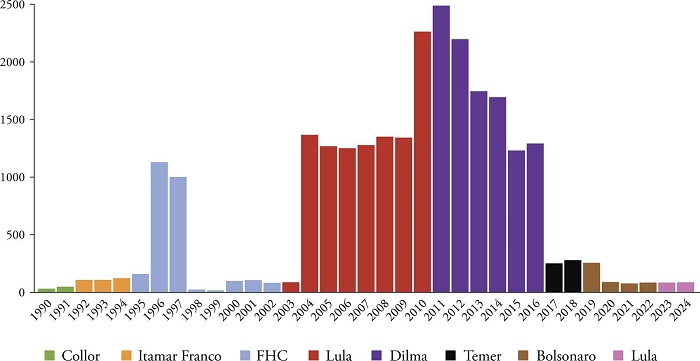
Figure 1
Contributions of Brazil to UN Peacekeeping Operations by Government (1990-2024)
Source: Own elaboration based on UN Peacekeeping (2024).
Esteves and Herz (2020) argue that involvement in MINUSTAH was conceived by the new government as a way to overcome Brazil’s previously reactive (and even negative) stance towards expanding the collective security agenda and to try to assume a more prominent role in the international system: that of a regional leader with a global reach. Kenkel et al. (2020) add that the participation of other South American countries in MINUSTAH helped to strengthen regional defense cooperation, contributing to the creation of the South American Defense Council (CDS) and the Latin American Association of Training Centers for Peacekeeping Operations (ALCOPAZ). More importantly, MINUSTAH reinforced Brazil’s ambition to be seen as an emerging power capable of eventually assuming a role on the UNSC (Kenkel et al. 2020). For Brazilian diplomacy, the idea that maintaining and promoting security, whether national or international, is largely anchored in socioeconomic development, is recurrent and influential. In this sense, Brazil’s distinctive position is characterized by the combination of solidarity and responsibility, the intrinsic link between security and development, and the idea of directing this agenda towards combating hunger and poverty (Esteves and Herz 2000). Additionally, Brazil argued that peacekeeping operations should increasingly emphasize less militarization (Neves 2009), reaffirming that the use of violence as a crisis response strategy brings more problems than solutions.
The emphasis on the risks associated with using force, especially when conducted by major powers and global bodies, was reinforced during President Dilma Rousseff’s government (2011-2016), partly in response to the international reaction to the Libya crisis and partly as a signal of Brazil’s strategy to build new international partnerships via BRICS grouping (Esteves and Herz 2020). The president’s proposal was clear in the idea of “Responsibility while Protecting” (RwP), attempting to differentiate Brazil’s position from both Western established powers and non-Western emerging powers. Although it arguably had little impact on the collective security regime, it was a turning point in Brazil’s strategy to vie for a prominent role in the international system (Kenkel et al. 2020).
It is important to note that, despite Brazil’s bet on MINUSTAH as an attempt to offer a path of innovation for peacekeeping operations, the results were far less significant than intended, and the criticisms were much greater. Cavalcante (2009), for example, points out that the operation was more successful in reducing direct violence than in contributing to advancing Haiti’s political process or promoting and protecting human rights. Even after years of intervention, the country still presents very low human development indices, a fragile economy largely sustained by diaspora remittances, precarious infrastructure and institutions, including in the security sector (Seitenfus 2014). Additionally, MINUSTAH members, including Brazilian military personnel, were accused of numerous cases of violence and sexual exploitation of girls and women (Toledo and Braga 2020). In any case, participation in MINUSTAH remains the most significant in Brazil’s peacekeeping history, and the engagement in this mission is fundamental to understanding the high numbers of Brazilian contributions during Rousseff’s two terms, when Brazil also sent a significant number of military personnel to UNIFIL in Lebanon (Ministério da Defesa 2023).
However, this pattern was not maintained by the governments that followed. With Michel Temer, the country’s peacekeeping leadership declined rapidly, a trend that continued with Jair Bolsonaro, as shown in Figure 1. The decline coincided with the end of MINUSTAH’s activities determined by the UNSC in 2017 and the Bolsonaro government’s distrust of Brazil’s participation in “globalist” multilateral arrangements (Kenkel 2019). Although Brazil remained present in some important operations, such as in Lebanon, and accepted to send a general to command MONUSCO from 20183 (Kenkel et al. 2020), its participation became quite limited. As summarized by Hamann (2015), Brazil’s engagement has been driven by the country’s specific interests in some cases – Haiti, Lusophone countries, and Lebanon – as well as the desire to contribute to varied missions, marking its presence in multilateral environments, even with a reduced number of professionals in the field. Quantitatively, cases that specifically interest Brazil accounted for 98% of the military and police personnel sent by the country to peacekeeping operations between 1948 and 2015: 78% of this personnel were in Haiti; 15% in Lusophone countries; and 5% in Lebanon; while the other 2% were dispersed across 9 different missions (Hamann 2015). Beyond these numbers, it is necessary to consider Brazil’s positioning in light of the transformations in peacekeeping over the years, which will be discussed in the next section.
Peacekeeping: An Idea in Continuous Transformation
It is worth mentioning that from 1948 – when the first peacekeeping operation was deployed – until the late 1990s, UN peacekeeping was generally based on a logic of containing armed conflicts (mainly interstate during the Cold War and intrastate during the 1990s). The central objective was to ensure “negative peace” (i.e., the absence of war), prevent conflict spillover, and monitor peace processes from a traditional peacekeeping perspective. However, the UN’s failures in places like Bosnia, Somalia, and Rwanda, the persistent humanitarian challenges caused by the armed conflicts of the 1990s, and the emergence of the concept of “human security,” which reveals a broader intersubjective understanding of peace, led the UN to seek to revitalize peacekeeping from the early 2000s (Duarte et al. 2022; Peter 2019).
As Duarte et al. (2022) point out, traditional peacekeeping gave way to so-called multidimensional operations, presenting a broad proposal for the reconstruction of conflict-affected states, highlighting the articulation between the notions of security, development, and humanitarian assistance. These peace operations combine military robustness with a wide range of civilian tasks associated with the economic, institutional, and infrastructural reconstruction of conflict-affected countries. The shift, which points more towards conflict resolution than merely containing violence, is the result of recommendations systematized in the Brahimi Report, reflecting the understanding that the UN should support processes of “positive peacebuilding” (i.e., going beyond the mere absence of armed conflict). In this sense, the peacekeeping operations emerging from the 2000s onwards began to include mandates that entail tasks such as holding elections, security sector reform, institutional reforms, economic reconstruction, disarmament, demobilization and reintegration of ex-combatants, promotion of human rights, among others.
This trend was reinforced with the propagation of the Responsibility to Protect (R2P) principle in the early 2000s and the publication of the Capstone Doctrine in 2008 (United Nations 2008). The understanding that the international community has the responsibility to protect populations from genocide, war crimes, crimes against humanity, and ethnic cleansing when states fail to do so, coupled with the understanding that peacebuilding involves a process that requires a multidimensional approach, led to more comprehensive and costly peacekeeping operations that involved large contingents and were authorized to use force – anchored in Chapter VII of the UN Charter – in defense of the civilian population.
In this context, Brazil engaged more expressively in UN peacekeeping operations, reaching the peak of involvement in 2011 when there were 2,493 Brazilian citizens serving under the UN flag. As recorded, the number of Brazilians serving in peacekeeping operations increased from 82 in 2003 to 1,367 in 2004 when the Brazilian government accepted to lead the mission in Haiti (United Nations Peacekeeping 2023). Brazil’s involvement with MINUSTAH represented a historical milestone as it was the first time the country sent troops to a mission sustained by Chapter VII of the UN Charter. This stance was defined based on the idea of “non-indifference” – as a rhetorical alternative to the principle of non-interference – guided by the conception that Brazil would only participate in an intervention after receiving a formal request and if it considered itself capable of making a positive contribution. Brazil’s significant presence in MINUSTAH, among other initiatives, reflected a strategy of Brazilian foreign policy during Lula da Silva’s first two terms, which aimed to expand relations between Brazil and the Global South and sought to build the country’s image as a responsible actor in collective security (Kenkel et al. 2020).
MINUSTAH as a Watershed: Brazil and its Contribution to Multidimensional Peace Operations
Given this background, involvement in MINUSTAH was undoubtedly a significant political challenge beyond a military one for Brazil. To address it, Brazil, as a rotating member of the UN Security Council, actively participated in formulating the operation’s mandate, including objectives related to development, and not just security. Another important strategy was to seek regional consensus with other South American countries that contribute to sending peacekeepers to UN missions to legitimize a mission under the aegis of Chapter VII (Abiola et al. 2017). Thus, through its significant role in Haiti and, to a lesser extent, in other peacekeeping operations, Brazil was able to empirically participate in developing so-called multidimensional operations over a little more than a decade. At least three main elements deserve mention in this process: (i) Brazil’s contribution to strengthening the nexus between security and development; (ii) Brazil’s role in strengthening the Global South’s participation in UN peacekeeping operations; and (iii) the introduction of the Responsibility while Protecting (RwP) concept.
The Nexus between Security and Development
The Brazilian experience in Haiti seems to have been crucial in delineating Brazil’s perspective on the ideal path for building positive peace. As Napoleão and Kalil (2015) point out, the peacebuilding à la brésilienne practiced in Haiti was marked by demand-driven development projects, public policies aimed at poverty reduction, non-intrusive support for security sector reforms – including police training – and respect for Haitian society, among other factors. Notable examples include the daily mediation activities practiced by MINUSTAH troops and the implementation of community violence reduction programs conducted by the Brazilian NGO Viva Rio. The technical cooperation between Brazil and Haiti in areas such as food security, sanitation, rural development, public health, and basic education also point to the understanding that long-term peacebuilding essentially involves development. Brazil, which had been experiencing significant poverty reduction during Lula da Silva’s years of government (2003-2011), seemed to have positive experiences to share. This was particularly evident through the Quick Impact Projects (QIPs) implemented by MINUSTAH in Haiti. While active, the peace operation received the most resources for this type of project, accounting for more than a quarter (26.36%) of the total budget available for this purpose. The Brazilian contingent implemented 38 projects aimed at restoring schools, police units, prisons, and public spaces, supporting football clubs, ensuring street cleaning and garbage collection, building markets, and improving access to potable water conditions.
Brazil became a protagonist in QIPs, promoting them in its diplomatic discourse at the UN and taking responsibility for conducting projects not only in Haiti but also in peacekeeping operations in Lebanon and Sudan (Hamann et al. 2017). At Brazil’s insistence, the UNSC authorized the use of resources allocated to peacekeeping, usually restricted to funding the blue helmets and their operational needs, for quick impact projects, investing approximately USD $5 million in these initiatives in Haiti (Abdenur and Call 2017). These projects helped build the local population’s trust in the peacekeeping operation, facilitating the integration of peacekeepers and increasing the credibility and legitimacy of the mission’s actions. Besides their low cost, quick impact projects bring more immediate effects and tangible improvements perceived by the population (Rocha 2021). This Brazilian formula, much more focused on a comprehensive peacebuilding approach, reflects the understanding that security is not separate from the development process and reinforces the multidimensionality that characterized peacekeeping operations in the 2000s. In February 2011, while holding the UNSC presidency as a rotating member, a statement from Brazil was particularly enlightening in this regard:
The Security Council underlines that security and development are closely interlinked and mutually reinforcing and key to attaining sustainable peace. The Council recognizes that their relationship is complex, multifaceted, and case-specific. (...) The Security Council reiterates that to support a country to emerge sustainably from conflict, there is a need for a comprehensive and integrated approach that incorporates and strengthens coherence between political, security, development, human rights, and rule of law activities and addresses the underlying causes of each conflict. In this regard, the Council affirms the necessity to consider relevant economic, political, and social dimensions of conflict. (Ministério das Relações Exteriores do Brasil 2011, 1)
The Emergence of the Global South
The second aspect worth highlighting regarding Brazil’s contribution to the multidimensional peacekeeping operations of the 2000s relates to strengthening Global South countries’ roles in peacekeeping. Many factors explain the disengagement of developed countries from peacekeeping operations starting in the 2000s. As Abiola et al. (2017) point out, it seems an international division of labor has been established, positioning Global South countries as the main troop contributors while Northern countries continue to bear political (mandate formulation) and financial responsibility for peacekeeping operations. While countries like Canada, Finland, Austria, and Norway were major troop suppliers in the 1990s, the current top contributors include Bangladesh, Nepal, India, Rwanda, and Pakistan (Duarte et al. 2022; United Nations Peacekeeping 2023). This change in contributors’ profile results from a set of political, economic, military, institutional, and normative motivations that have led developing countries to fill the gap left by developed countries (Bellamy and Williams 2013). In Brazil’s particular case, involvement in MINUSTAH from 2004 elevated Brazil from the 51st position in 2003 to the 15th in 2004 in the overall ranking of troop-contributing countries. At its peak in 2011, Brazil ranked 11th (United Nations Peacekeeping 2023).
Beyond personnel deployment (troops, police, and civilians), given the greater complexity of multidimensional peacekeeping operations, Brazil also emerged as a potential contributor in terms of training and meeting the security standards set by the UN (Kenkel 2019). Notably, the creation of the Brazilian Peacekeeping Operations Joint Center (CCOPAB) in 2010, subordinated to the Brazilian Army but linked to the Ministry of Defense, became an institution recognized by the UN for training and preparing Brazilian peacekeepers, ensuring the normative and doctrinal standards advocated by the organization. As Santos (2019) points out, by having instructors from MINUSTAH and using UN documents and materials as references, peacekeeper training would involve a broad peacebuilding approach resulting from practical experience accumulated during the Haiti peacekeeping operation. Thus, by emphasizing activities related to development promotion and mediation in the curriculum of formation courses and internships, Brazil contributed to normative and doctrinal standards for peacekeeping operations beyond just sending troops. A similar role was played by the Naval Peace Operations School, officially established in 2011, largely as a result of Brazil’s significant participation in UNIFIL, where the country gained experience in commanding the Maritime Task Force.
Responsibility while Protecting (RwP)
Thirdly, considering Brazil’s contribution to the “decade of multidimensional operations,” it is necessary to address Brazil’s attempt to introduce the Responsibility while Protecting (RwP) concept. Announced by President Dilma Rousseff in her speech at the UN General Assembly in September 2011, shortly after NATO’s controversial action in Libya authorized by the UNSC, this initiative positioned Brazil as a normative entrepreneur since it was the first time the country proposed a global norm on peacekeeping. This normative entrepreneurship essentially revolved around recognizing the Responsibility to Protect (R2P) principle and the need to complement it to avoid side effects of dubious implementation. Responsibility while Protecting would involve exhausting peaceful means before resorting to force by the international community; the UNSC (or the UN General Assembly in exceptional circumstances) authorizing the use of force; limiting the use of force to what is prescribed in the mandate; and holding accountable those authorized to use force in peacekeeping operations for improper acts (Benner 2013).
According to Benner (2013), this initiative represented an exception in Brazilian foreign policy trajectory since it was a rare episode where the country emphatically presented a norm on something as significant as state sovereignty, recognizing the need for international intervention in certain circumstances. Historically, Brazil’s stance is non-interventionist, leading to some skepticism in dealing with the R2P concept. Recognizing interventions in certain scenarios as imperative through RwP represented a deviation from the previous position. Even if the Responsibility while Protecting concept sounded like a more refined and responsible version of Responsibility to Protect, it still involved defending intervention in certain contexts.
Although this debate did not advance much further, Hamann and Jumbert (2020) explain that it seems to result from Brazil’s role in Haiti, specifically during the stabilization phase (2005-2007), leaving important lessons about using force to stabilize areas and protect civilians. This “laboratory” experienced by Brazil suggested that it is possible to apply the Responsibility while Protecting principle at the tactical level to robust peacekeeping operations with mandates that include using force to protect civilians. As the authors state, Brazil’s evolving participation in peacekeeping reveals a gradual but clear shift in Brazil’s position on using force in UN missions. However, this change did not seem sufficient for Brazil to support the stabilization peacekeeping operations that emerged from 2010.
Stabilization Missions: The Use of Force Dilemma
This trend towards stabilization is understood as the hallmark of peacekeeping operations from the 2010s, when missions in the Democratic Republic of Congo, Mali, and the Central African Republic introduced significant nuances in the mandates that established them and operational dynamics. Although the term stabilization was present in the names of previous peacekeeping operations, including MINUSTAH, the cases of MONUSCO (United Nations Organization Stabilization Mission in the Democratic Republic of Congo), MINUSMA (United Nations Multidimensional Integrated Stabilization Mission in Mali), and MINUSCA (United Nations Multidimensional Integrated Stabilization Mission in the Central African Republic) present a turning point for peacekeeping. These operations entertain not only military robustness but also mandates that involve supporting the mission to extend or restore state authority (Duarte et al. 2022; Duarte and Carvalho 2022). Although there is no clear normative or doctrinal clarity around stabilization, these peacekeeping operations are deployed in active conflict locations where widespread violence poses the challenge for peacekeepers to protect civilians and extend state authority over weak governments amid violent extremist groups, transnational organized crime, large-scale migration, and state failure (Osland and Peter 2021). The mandates of these operations, almost entirely devoid of political, economic, and infrastructural reconstruction tasks and long-term peacebuilding tasks, authorize the use of force beyond self-defense by the blue helmets to defend the mission’s mandate, expanding the prerogatives for a more militarized stance. Currently, peacekeeping operations in Congo, Mali, and the Central African Republic each have over 11,000 troops in the field, with total personnel (including police, specialists, and civilians) exceeding 16,000 people (United Nations Peacekeeping 2023).
In addition to extending or restoring state authority, including combating non-state actors considered spoilers, these operations’ mandates include significant exceptions that help understand what stabilization peacekeeping means in practice. In 2013, MONUSCO incorporated the Force Intervention Brigade (FIB), a force authorized to conduct offensive operations aimed at neutralizing non-state armed groups, reducing the threat posed by these groups to state authority and civilian security. In the cases of MINUSMA and MINUSCA, their original mandates included using force by French military operations – Operation Barkhane and Operation Sangaris, respectively – in support of the mission (Duarte and Carvalho 2022). The possibility of using “all necessary means” to achieve the mandate, combined with a large military contingent and the emptying of peacebuilding tasks, makes stabilization operations more like enforcement peacekeeping rather than initiatives that promote conflict resolution (Tull 2017; Osland and Peter 2021; Duarte et al. 2022).
This trend towards stabilization in contemporary peacekeeping appears to be an operational response by the UN to a set of current challenges, such as combating terrorism and violent extremism (Karlsrud 2018), but it has not been accompanied by normative or doctrinal advances. For example, the HIPPO Report, produced after then UN Secretary-General Ban Ki-moon expressed concern that peacekeeping operations were being deployed where “there is no peace to keep” (United Nations Security Council 2014, p.2), fails to establish clear limits for using force in peacekeeping operations. It signals that stabilization operations support extending or restoring state authority, possibly operating during active conflict, and reinforces the use of force as essential for civilian and mandate protection, although it categorically states that this does not involve peacekeepers in counterinsurgency or counterterrorism operations (United Nations 2015).
A few years later, the publication of the Cruz Report, informally named after its first author, the Brazilian Army General Carlos Alberto dos Santos Cruz, added further controversy to the issue of robust force use by blue helmets. The report, which specifically addresses the increasing lethality of peacekeeping operations, points to the need for an active stance to demobilize and eliminate armed groups that hinder peacekeepers’ work. It suggests overcoming the ‘Chapter VI syndrome,’ which would prevent an advance beyond traditional peacekeeping, and emphasizes intensive force use to reduce threats to peacekeepers’ security. In this sense, it calls for a doctrinal review, so the foundational principles of impartiality, consent, and minimal force use enshrined in the Capstone Doctrine could be reassessed (United Nations 2017; Macedo and Silveira 2018).
Although the Cruz Report was produced with the collaboration of a Brazilian Army General, it does not reflect Brazil’s traditional perspective on the controversial robust force use in peacekeeping operations. On the contrary, in crucial moments of the debate, Brazil’s official position in the UNSC has been reticent about sending peacekeeping operations to active conflict locations, calling attention to the need to support development processes as a peacebuilding strategy. In the UNSC meeting on June 11, 2014, when the UN Secretary-General stated that peacekeeping operations are being sent to places where there is no peace to keep, Brazil, present as a guest, stated:
In certain parts of the world, international challenges to peace and security find their root causes in poverty, social exclusion, discrimination, and impunity before the law. Without addressing those root causes, there can be little hope that a stable and peaceful situation will ensue. The integration of peacekeeping and peacebuilding is therefore crucial for the longstanding stabilization of States emerging from conflict. It would be a serious setback if new peacekeeping operations trends (...) lead to the prevalence of military solutions in detriment to multidimensional mandates that include parallel effective peacebuilding efforts. (United Nations Security Council 2014, 48)
This understanding that peacekeeping and peacebuilding must be integrated to ensure a long-term stabilization process was expressed by Brazil when endorsing the Action for Peacekeeping (A4P) initiative launched by the UN in 2018. This international commitment to strengthening and improving peacekeeping operations involves principles and consensuses around issues such as seeking political solutions to armed conflicts, the women, peace, and security agenda, civilian protection, and the safety of peacekeepers, among others (United Nations 2019). In Brazil’s statement of support for the initiative, it was uttered:
We believe that peace imposed by a military solution lacks self-sustaining bases. Brazil favors an integrated approach to peacekeeping operations, one that promotes stabilization, national reconciliation, and long-term development, guided by the primacy of political solutions to conflict. Emphasis on the use of force should never replace the political process of peace, which must be integrated, locally owned, and supported by the long-term efforts of the international community. (Ministério das Relações Exteriores do Brasil 2018, 1)
More recently, even though Brazil is more distant from the peacekeeping universe given its disengagement since the end of MINUSTAH, the official position of Brazilian diplomacy does not seem to have changed. The document supporting Brazil’s candidacy for the UNSC for the 2022-2023 term, for which the country was indeed elected, on the topic of effective peacekeeping, records the commitment to observing the basic premises for UN action: the existence of peace to be kept, consent, and minimal use of force. Brazil commits to defending “the approval of mandates that corroborate the interdependence between security and development and conflict prevention” (Ministério das Relações Exteriores do Brasil 2021, 5).
Given this brief overview of peacekeeping operations and the reflection on Brazil’s positioning regarding such observed changes, it is possible to perceive that the contemporary peacekeeping scenario has been distancing itself from what would be an ideal stage for Brazil’s performance. While Brazil advocates for broad, multidimensional peacekeeping operations focused on conflict resolution and state development as key to building positive peace, contemporary peacekeeping is adopting a more robust use of force aimed at stabilization, while becoming devoid of a broad range of reconstruction tasks. In the next section, we will show that participating in UN peacekeeping operations does not seem to meet Brazil’s foreign policy priorities in the Lula da Silva government inaugurated in 2023.
Peacekeeping Operations and the Brazilian National Interest
With the end of MINUSTAH, the total number of Brazilians serving in peacekeeping operations dropped from 1,291 in 2016 to 248 in 2017. Of these 248 Brazilians, 206 were soldiers: 205 in Lebanon and only 1 in Cyprus (United Nations Peacekeeping 2023). This scenario also coincides with a period of profound political and economic turmoil in Brazil. The Rousseff government ended through an impeachment trial in August 2016, and the new president, Michel Temer, made it clear that his foreign policy priorities would be different. With the end of MINUSTAH in October 2017, there was no Brazilian movement to engage substantively in other peacekeeping operations, despite a discussion on this matter within the Foreign Ministry about the impact of troop reduction on Brazil’s international visibility (Abdenur and Call 2017).
MINUSCA, the UN peacekeeping operation in Central African Republic, was mentioned as a potential substitute for Brazilian troop engagement in post-MINUSTAH peacekeeping missions. At the MINUSTAH closure ceremony, then Minister of Defense Raul Jungmann stated that CAR would be the most likely scenario for a Brazilian contribution and that Brazil had “the desire to bring peace, stability, and our values” (Platonow 2017). However, as Uziel and Marcondes (2021) explain, the apparent inability of the Foreign Ministry and the Defense Ministry to align their interests, combined with the country’s financial and budgetary situation, led to a decision by the Brazilian government not to contribute troops. This inability to align interests can be partly translated as a lack of strategic interest in the Central African Republic. Hamann (2015) states that Brazil’s trajectory in peacekeeping centers around three priority axes: Haiti, Lusophone countries (especially Angola, Mozambique, and Timor-Leste), and Lebanon. In these cases, Brazil deployed troops (collective missions); in all other peacekeeping operations, Brazilian participation occurred through individual deployments (experts on mission), pointing to a behavior pattern that seems to engage only when specific mission goals exist.
According to a study conducted by the Ministry of Defense in 2017, known as the SETA Project, the priority peacekeeping operation for Brazilian troop contribution would be UNIFIL in Lebanon. However, since the UN did not request additional personnel for the mission at that time, MINUSCA was considered the first option. As already mentioned, not only did the troop deployment in CAR not occur, but the contingent in Lebanon was reduced in 2020 from 205 soldiers to just 25 when the Brazilian frigate participating in UNIFIL’s maritime task force returned. Since then, the Brazilian contribution has hovered around 80 peacekeepers, with only 8 being soldiers (Uziel and Marcondes 2021; United Nations Peacekeeping 2023).
Observing all the active UN peacekeeping operations, there does not seem to be any involving specific interests that could be the ideal stage for a triumphant Brazilian return – except for the operation in Lebanon if the UN needed to expand the contingent there. As the map below shows (see Figure 2), there were 12 active peacekeeping operations as of 2023. Of these 12, 6 had a traditional peacekeeping character aimed at monitoring ceasefires, borders, or demilitarized zones. This means that to maintain a negative peace scenario, the UN would hardly need additional personnel in the missions in Western Sahara (MINURSO), the India-Pakistan border (UNMOGIP), Kosovo (UNMIK), the Middle East (UNTSO), Golan (UNDOF), and Cyprus (UNFICYP), so these would not be alternatives even if Brazil were interested.
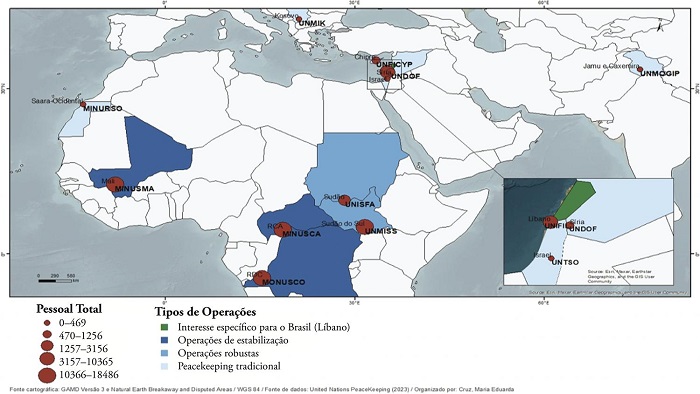
Figure 2
United Nations Peacekeeping Operations Active in 2023
Source: United Nations Peacekeeping (2023).
The missions in Sudan (UNISFA) and South Sudan (UNMISS) also do not seem to be the motivation for greater Brazilian engagement since they do not fit the Lusophone axis, and for years Brazil has contributed to the operations through individual missions, although there has never been a Brazilian move to support them with troop deployment (collective missions). Data from March 2023 indicate that 5 Brazilian individuals were serving in UNISFA and 17 in UNMISS as experts on mission, staff officers, or police (United Nations Peacekeeping 2023). The peacekeeping operations in Congo (MONUSCO), Mali (MINUSMA), and CAR (MINUSCA), given their stabilization nature and robust use of force, do not qualify as the most suitable choice for Brazil’s re-engagement. These highly militarized missions, for being devoid of development projects, do not align with Brazil’s diplomatic discourse at the UN, which emphasizes the connection between peace and development and highlights the role of peacebuilding initiatives as instruments for addressing the root causes of conflicts. Brazil’s discourse at the UNSC in November 2022 during a discussion on integrating actions for building resilience in peacekeeping operations clearly illustrates this stance:
Focusing solely on the security dimension of conflicts will lead to endlessly renewing peacekeeping mandates without achieving the desired results. Or else it will leave fragile countries chronically dependent on humanitarian aid. Resilience-building, peacebuilding, and the promotion of development are essential to addressing the root causes of conflict. (Ministério das Relações Exteriores do Brasil 2022, 23)
Thus, among those active peacekeeping operations, only the mission in Lebanon (UNIFIL) seems to be a viable alternative for Brazil’s significant return to UN peacekeeping operations. Lebanon is an axis of specific interests for Brazil, as Hamann (2015) states, and despite the mission’s robust contingent, it does not have a stabilization character. However, the UN has not signaled an interest in increasing the contingent there, and the mission has been slightly reducing its scope. From 10,317 blue helmets in 2018, by the end of 2022, there were a total number of 9,511 peacekeepers in Lebanon (United Nations Peacekeeping 2023). Unless there is a new request for UNIFIL or a new peacekeeping operation authorized by the UNSC, the currently active peacekeeping operations do not spark greater Brazilian involvement, even if it were in Brazil’s interest.
The desire for Brazil to regain a place of prominence in the international security arena through peacekeeping operations could exist for two main reasons in the new Lula da Silva government. The first relates to the fact that during Lula’s first presidency (2003-2011), Brazil took on the task of leading MINUSTAH, gaining international prestige. It might be in Brazil’s interest to regain this space by retracing the steps that elevated the country from a mere supporting actor in international security to a state leading peacekeeping operations and contributing to the multidimensionality of UN missions. The second reason would hypothetically relate to the new Brazilian government’s opposition to the previous government’s handling of the issue. Considering that this agenda was almost completely emptied during the Bolsonaro years, there might be a chance that Lula would seek to revitalize Brazil’s role in peacekeeping operations. Although the Ministry of Defense and the Bolsonaro government denied that the reduction of Brazilian contingent in UN missions represented a change in the country’s orientation, claiming it was motivated by operational, logistical, and strategic factors, the number of Brazilian peacekeepers was reduced by 72% during Jair Bolsonaro’s administration (Estadão Conteúdo 2020).
However, it can be observed that Brazil’s re-engagement in peacekeeping is unlikely due to both (i) the international context, as previously evidenced, and (ii) domestic issues. Domestically, peacekeeping operations do not appear as a priority on the new government’s foreign policy agenda. The final report by the Foreign Relations Technical Group of the Governmental Transition Commission identified priority measures to be pursued within the first 100 days of government – among which resuming leadership in UN peacekeeping was not included. They were:
The return to Unasur and Celac, organizing the summit of Amazonian countries, resuming foreign policy for Africa, preparing for Brazil’s G20 presidency, returning to the Global Compact for Migration, revising humanitarian visa regulations for Haitians and Afghans, formulating a legal framework for Brazilian technical cooperation, normalizing relations with Venezuela, withdrawing Brazil from the Geneva Consensus, and finally, replenishing human resources to enable the execution of the new Brazilian foreign policy by the Foreign Ministry. (Comissão de Transição Governamental 2022b)
The discussions that took place in the Foreign Relations and National Defense Committee (CREDN) of the Brazilian Chamber of Deputies during the first half of 2023 seemed to reaffirm these priorities. As Menucci (2023) states, foreign policy debates revolved around Brazil’s re-entry into Unasur, accession to the OECD, and rapprochement with Nicaragua and Venezuela. Another relevant domestic issue – more abstract and therefore more difficult to assess – is the alleged lack of willingness of the new Lula government, which began on January 1, 2023, to give leeway to the Brazilian military establishment, which was clearly empowered during the Bolsonaro government. As Cafarelli (2022) points out, this empowerment has its roots in MINUSTAH and the Law and Order Operations (GLO) widely used during Lula’s first two terms and Rousseff’s government as well. These initiatives contributed to increasing the military’s clout and rebuilding their institutional reputation tarnished since the 1964 coup d’état. According to the author, the result was a process of “coming out of the barracks” and joining the government through elections to the legislative and executive branches. The military’s dissatisfaction with leftist governments, particularly due to the implementation of the Truth Commission in Brazil, led the Armed Forces to massively support and sponsor Bolsonaro’s presidential candidacy. With Jair Bolsonaro’s victory, many military who served in MINUSTAH were appointed to political positions in the federal administration:
General Augusto Heleno – first force commander of the MINUSTAH mission in 2004 and 2005 – held the position of Minister-Chief of the Institutional Security Office (GSI); General Carlos Alberto dos Santos Cruz – force commander in Haiti between 2007 and 2009 – held the position of Minister-Chief of the Government Secretariat of the Presidency during the first year of the mandate; General Luís Eduardo Ramos – who commanded the Brazilian troops in Haiti between 2011 and 2012 – held the position of Chief of Staff; General Floriano Peixoto Vieira Neto – who commanded MINUSTAH troops between 2009 and 2010 – held the position of Minister-Chief of the General Secretariat of the Presidency; General Edson Leal Pujol – who led the MINUSTAH operations between 2013 and 2014 – held the position of Commander of the Brazilian Army; Captain Tarcísio Gomes de Freitas – who served as Chief of the Technical Section of the Brazilian Peacekeeping Engineering Company between 2005 and 2006 – held the position of Minister of Infrastructure; General Fernando Azevedo e Silva – who served as Chief of Operations of the Brazilian contingent in Haiti – held the position of Minister of Defense; General Otávio Rêgo Barros – who served as Commander of the 1st Peacekeeping Infantry Battalion – was the Government Spokesperson. (Cafarelli 2022, 52)
To the names mentioned above, we must add Vice-Admiral Carlos Chagas Vianna Braga, a member of the MINUSTAH staff between 2004 and 2005; General Ajax Porto Pinheiro, Force Commander of MINUSTAH from 2015 to 2017; and General Francisco Mamede de Brito Filho, Colonel José Arnon dos Santos, and Colonel Freiberg Rubem do Nascimento, commanders of the Brazilian contingent (BRABAT). In addition to those who served in MINUSTAH, General Márcio Braga Netto, who served as Minister of Casa Civil between February 2020 and March 2021, was a military observer in the United Nations Transitional Administration in East Timor (UNTAET). Former Vice President General Hamilton Mourão also served as a military observer in the United Nations Angola Verification Mission (UNAVEM III). As Villa and Passos (2023) note, during the Bolsonaro government, the number of Brazilian military personnel (former peacekeepers) appointed to ministerial positions increased from two (in the Dilma and Temer governments) to sixteen.
The apparent disinterest of the new Lula government, initiated in January 2023, in empowering the Armed Forces is rooted in the politicization of the military and their role during the Bolsonaro government, culminating in the events of January 8, 2023, when three Brazilian governmental palaces were stormed. As Villa and Passos (2023) argue, the Brazilian case – where the military’s presence in power contributed to polarizing the country and supporting an authoritarian president – challenges the notion that peacekeeping promotes democratic practices in troop-contributing countries. Despite Lula’s hesitant moves to approach the military, empowering them through Brazil’s involvement in UN peacekeeping operations, granting them access to abundant public resources and prestigious credentials, does not seem to be on the decision-maker’s horizon. This factor, combined with the proliferation of stabilization peacekeeping operations devoid of development projects and endowed with great autonomy for using force, results in high improbability of Brazil utilizing peacekeeping as a platform for international prominence again.
Final Remarks
Historically, Brazil has played a significant role in peacekeeping missions, most notably during its leadership of MINUSTAH in Haiti. This involvement not only elevated Brazil’s international stature but also allowed the country to influence norms and practices in global peacekeeping. Notwithstanding, recent changes in operations, which tend to focus more on military stabilization than on multidimensional peacebuilding, appear to be less aligned with Brazil’s traditional approach – less interventionist and more focused on development and national reconstruction. Currently, the international scenario and Brazil’s internal politics suggest that a return to leadership in peacekeeping operations is not going to happen. Contemporary stabilization operations, which frequently require a more combative stance and are conducted in active conflict zones, might not be compatible with Brazil’s diplomatic principles, as the country favors long-term peacebuilding and sustainable development. Additionally, the gradual disengagement of Brazil since the end of MINUSTAH, combined with a severe political and economic crisis faced over the last decade, has limited the country’s ability and interest in making commitments in this field.
Given these considerations, it seems important for Brazil to reassess its strategy for future engagement in peacekeeping operations. The capacity to positively influence global peacekeeping will depend on Brazil’s skill in adapting to changes in the international security landscape while maintaining commitments to promoting development and regional stability. This challenge requires a carefully calibrated foreign policy that recognizes current limitations but also explores strategic opportunities for Brazil to reaffirm its presence and values on the international stage, focusing on areas where it can offer a unique contribution, such as institutional strengthening and socioeconomic development in post-conflict zones.
References
Abdenur, A. E., and C. T. Call. "A 'brazilian way?' Brazil's approach to peacebuilding." In Rising powers and peacebuilding: rethinking peace and conflict studies, edited by C. T. Call and C. Coning, 15-38. Cham: Palgrave Macmillan, 2017.
Abiola, S., C. Coning, E. Hamann, and C. Prakash. “The large contributors and UN peacekeeping doctrine.” In UN peacekeeping doctrine in a new era: adapting to stabilisation, protection and new threats, edited by C. Coning, C. Aoi, and J. Karlsrud, 152-185. London: Routledge, 2017.
Amorim Neto, O. De Dutra a Lula: a condução e os determinantes da política externa brasileira. Rio de Janeiro: Konrad-Adenauer-Stiftung, 2011.
Benner, T. "O Brasil como um empreendedor normativo: a responsabilidade ao proteger." Política Externa 21, no. 4 (2013): 35-46.
Cafarelli, A. "O retorno dos militares à política: uma análise da saída da caserna durante o governo de Jair Bolsonaro." Master Diss., Universidade Federal de São Paulo, 2022.
Cavalcante, F. "Sucesso ou fracasso? Uma avaliação dos resultados da MINUSTAH." e-Cadernos CES 6, (2009): 56-66. doi: https://doi.org/10.4000/eces.342
Comissão de Transição Governamental 2022. Gabinete de transição governamental: relatório final. Brasília, 2022a. Accessed on March 14, 2023. https://static.poder360.com.br/2022/12/Relatorio-final-da-transicao-de-Lula.pdf
Comissão de Transição Governamental 2022. Relatório do grupo técnico de relações exteriores produto 2: relatório final. Brasília, 2022b.
Duarte, G. R., and L. Carvalho. "'No peace to keep'? Reflexões sobre as operações de paz de estabilização." In Azul da cor da paz? Perspectivas e tendências das operações de paz da ONU, edited by G. R. Duarte and L. Carvalho. Belo Horizonte: Pontifícia Universidade Católica de Minas Gerais, 2022.
Duarte, G., L. Carvalho, and M. Souza. "Entre a contenção e a resolução: desafios históricos e contemporâneos das operações de paz da ONU." In Azul da cor da paz? Perspectivas e tendências das operações de paz da ONU, edited by G. Duarte and L. Carvalho, 23-41. Belo Horizonte: Pontifícia Universidade Católica de Minas Gerais, 2022.
Estadão Conteúdo. "Com Bolsonaro, número de brasileiros em missões de paz cai 72%." Carta Capital, December 30, 2020. Accessed on July 12, 2023. http://www.cartacapital.com.br/politica/com-bolsonaro-numero-de-brasileiros-em-missoes-de-paz-cai-72
Esteves, P. and M. Herz. "Climbing the ladder: Brazil and the international security field." In Status and the rise of Brazil: global ambitions, humanitarian engagement and international challenges, edited by P. Esteves, M. Jumbert, and B. Carvalho, 113-131. Cham: Palgrave Macmillan, 2020.
Fontoura, P. R. O Brasil e as operações de manutenção da paz das Nações Unidas. Brasília: Fundação Alexandre de Gusmão, 2005.
Haman, E., H. Garbino, and M. Folly. Confiança em desenvolvimento: o Brasil e os projetos de impacto rápido. Artigo Estratégico 24. Brasília: Instituto Igarapé. 2017.
Hamann, E. A força de uma trajetória: o Brasil e as operações de paz da ONU (1948 - 2015). Nota Estratégica 19. Brasília: Instituto Igarapé, 2015.
Hamann, E., and M. Jumbert. "Brazil's evolving 'balancing act' on the use of force in multilateral operations: from robust peacekeeping to 'responsability while protecting'." In Status and the rise of Brazil: global ambitions, humanitarian engagement and international challenges, edited by P. Esteves, M. Jumbert, and B. Carvalho, 153-173. Cham: Palgrave Macmillan, 2020.
Karlsrud, J. The UN at war: peace operations in a new era. Cham: Palgrave Macmillan, 2018.
Kenkel, K. Contributor profile: Brazil. New York: International Peace Institute, 2019. Accessed on November 6, 2023. https://www.ipinst.org/wp-content/uploads/2020/05/Brazil-Kenkel-05-Feb-2019-002.pdf.
Kenkel, K., D. Souza Neto, and M. Ribeiro. "Peace operations, intervention and brazilian foreign policy: key issues and debates." In Status and the rise of Brazil: global ambitions, humanitarian engagement and international challenges, edited by P. Esteves, M. Jumbert, and B. Carvalho, 133-151. Cham: Palgrave Macmillan, 2020.
Lopes, D. B. "A nova política externa brasileira." Nexo, June 13, 2023. Accessed on April 2, 2024. https://pp.nexojornal.com.br/ponto-de-vista/2023/06/13/a-nova-politica-externa-brasileira
Lopes, D. B. "A política exterior no ano inaugural do governo Lula III." CEBRI Revista 3, no. 9 (2024): 80-103.
Macedo, G. C., and K. V. R. Silveira. "Cruz Report: conteúdo e críticas." Conjuntura Internacional 15, no. 3 (2018): 18-27. doi: https://doi.org/10.5752/P.1809-6182.2018v15n3p18
Ministério da Defesa. Quadro de participação brasileira em operações de paz e de desminagem humanitária. Brasília, 2023. Accessed on October 15, 2023. https://www.gov.br/defesa/pt-br/assuntos/relacoes-internacionais/copy_of_missoes-de-paz/arquivos/historico-da-participacao-brasileira-em-missoes-da-onu/historicobrasileironoconcertodasnacoesset23.pdf.pdf
Ministério das Relações Exteriores do Brasil. Candidatura do Brasil ao Conselho de Segurança das Nações Unidas. Brasília: Fundação Alexandre de Gusmão, 2021. Accessed on May 3, 2023. https://funag.gov.br/biblioteca-nova/produto/1-1144
Ministério das Relações Exteriores do Brasil. Statement by Ambassador João Genésio de Almeida Filho. 2022. Accessed on June 1, 2023. https://documents-ddsny.un.org/doc/UNDOC/PRO/N22/672/33/PDF/N2267233.pdf?OpenElement
Ministério das Relações Exteriores do Brasil. Statement by Ambassador Nelson Antônio Tabajara de Oliveira. 2018. Accessed on May 3, 2023. https://peacekeeping.un.org/sites/default/files/a4p-event-brazil-statement.pdf
Napoleão, T., and M. Kalil. "Stabilization as the securitization of peacebuilding? The experience of Brazil and MINUSTAH in Haiti." Braziliana: Journal for Brazilian Studies 3, no. 2 (2015): 87-112.
Neves, G. Comissão das Nações Unidas para consolidação da paz: perspectiva brasileira. Brasília: Fundação Alexandre de Gusmão, 2009.
Osland, K., and M. Peter. "UN Peace operations in a multipolar order: building peace through the rule of law and bottom-up approaches." Contemporary Security Policy 42, no. 2 (2021): 197-210. doi: https://doi.org/10.1080/13523260.2021.1898166
Peter, M. "Peacekeeping: resilience of an idea." In United Nations peace operations in a changing global order, edited by C. De Coning and M. Peter, 25-44. Cham: Palgrave Macmillan, 2019.
Platonow, V. "Após saída do Haiti, Brasil poderá atuar em missão de paz na África." Agência Brasil, October 10, 2017. Accessed on May 26, 2023. https://agenciabrasil.ebc.com.br/geral/noticia/2017-10/apos-saida-do-haiti-brasil-podera-atuar-em-missao-de-paz-na-africa.
Rocha, C. Implementação da agenda Action for Peacekeeping, sob a ótica da doutrina militar brasileira, em um futuro emprego de tropas em missões de paz da ONU. Rio de Janeiro: Escola de Comando e Estado-Maior do Exército, 2021. Accessed on April 11, 2023. https://bdex.eb.mil.br/jspui/bitstream/123456789/9980/1/MO%201023%20-%20Carlos%20Henrique%20Martins%20ROCHA.pdf.
Santos, R. "A contribuição brasileira para as operações de paz das Nações Unidas na virada do século: do envio de tropas à cooperação normativa e doutrinária." Conjuntura Internacional 16, no. 1 (2019): 41-45. doi: https://doi.org/10.5752/P.1809-6182.2019v16n1p41
Seitenfus, R. Haiti: dilemas e fracassos internacionais. Ijuí: Unijuí, 2014.
Toledo, A., and L. Braga. "Abuso e exploração sexual em operações de paz: o caso da MINUSTAH." Revista Estudos Feministas 28, no. 3 (2020): 1-14.
Tull, D. "The limits and unintended consequences of UN peace enforcement: the Force Intervention Brigade in DR Congo." International Peacekeeping 25, no. 2 (2017): 167-190. doi: https://doi.org/10.1080/13533312.2017.1360139
United Nations - UN. "General Elias Martins, novo comandante da Missão da ONU na República Democrática do Congo." UN News, May 2, 2018. Accessed on May 26, 2023.
United Nations - UN. Action for peacekeeping: declaration of shared commitments on un peacekeeping operations. New York, 2019. Accessed on April 11, 2023. https://peacekeeping.un.org/sites/default/files/a4p-declaration-en.pdf
United Nations - UN. Improving security of United Nations Peacekeepers: we need to change the way we are doing business. Independent Report. New York, 2017. Accessed on April 11, 2023. https://peacekeeping.un.org/sites/default/files/improving_security_of_united_nations_peacekeepers_report.pdf
United Nations - UN. Report of the high-level independent panel on peace operations on uniting our strengths for peace: politics, partnership and people. New York, 2015. Accessed on April 11, 2023. https://www.un.org/en/ga/search/view_doc.asp?symbol=A/70/95
United Nations - UN. United Nations Peacekeeping operations principles and guidelines. New York, 2008. Accessed on January 15, 2022. https://www.un.org/ruleoflaw/files/Capstone_Doctrine_ENG.pdf
United Nations Peacekeeping. Data: troop and police contributors. New York, 2023. Accessed on March 14, 2023. https://peacekeeping.un.org/en/troop-and-police-contributors
United Nations Security Council - UNSC. Statement by the president of the security council. New York, 2014. Accessed on April 11, 2023. https://documents-dds-ny.un.org/doc/UNDOC/GEN/N11/231/78/PDF/N1123178.pdf?OpenElement
Uziel, E., and D. Marcondes. "The peacekeeping deployment that never was: domestic considerations behind Brazil's decisions not to send troops to MINUSCA." International Peacekeeping 28, no. 5 (2021): 757-782.
Villa, R., and A. Passos. "Engagement of military peacekeepers in Brazilian politics (2011-2021)." Armed Forces & Society 49, no. 3 (2023): 752-775. doi: https://doi.org/10.1177/0095327X221087254
Notes