Article
What makes a legislator promote or thwart trade liberalization in developing democracies?
 Simón Lodato S.Lodato@mdx.ac.uk
Andrés Dockendorff adocken@uchile.cl
Dorotea López dolopez@uchile.cl
Simón Lodato S.Lodato@mdx.ac.uk
Andrés Dockendorff adocken@uchile.cl
Dorotea López dolopez@uchile.cl
What makes a legislator promote or thwart trade liberalization in developing democracies?
Revista Brasileira de Política Internacional, vol. 68, no. 1, e002, 2025
Centro de Estudos Globais da Universidade de Brasília
Received: 22 October 2024
Accepted: 10 February 2025
Funding
Funding source: Fondecyt Regular
Contract number: 1241567
Funding
Funding source: ANID Millenium Science Initiative Program
Contract number: NCS2024_007
Funding
Funding source: ANID Millenium Science Initiative Program
Contract number: NCS2022_053
Funding statement: This work was supported by the following: Fondecyt Regular Grant Nº 1241567;ANID Millenium Science Initiative Program [grant NCS2024_007] and ANID Millennium Science Initiative Program NCS2022_053.
Abstract: This paper investigates how ideological polarization and constituency factors influence legislators’ voting behaviour on Free Trade Agreements (FTAs). We explore the Chilean case, where trade policy has recently become highly politicized, to test three key relationships. First, we argue that right-wing legislators are more likely to champion FTAs when trade becomes a highly politicized issue, as the ratification of the CPTPP shows. Conversely, when trade is less politically salient, right-wing legislators are less likely to vote favourably for FTAs. Second, legislators representing regions with a high concentration of workers in tradable sectors are less likely to support trade liberalization, as it can put jobs at risk in their districts. Our results show that ideology explains legislators’ support to FTAs but only when the trade policy is politicized. Also, the probability of voting in favour of FTAs decreases as the proportion of workers in tradable sectors within the region increases. From a comparative perspective, the results highlight how the effect of politicization, observed mainly in European settings, is generalizable to a different set up: a presidential developing democracy.
Keywords: Legislators, politicization, Free Trade Agreements, ideology, tradable sectors, Chile, trade liberalization, trade policy.
Introduction
In recent years, the global landscape of trade has been marked by a growing trend of trade wars and contentious political debates, particularly in developed countries. However, the dynamics of trade liberalization are significantly different in developing nations, where the intricate interplay of domestic politics, socioeconomic concerns, and broader development goals can profoundly influence legislators’ attitudes toward trade agreements. This paper examines this crucial dimension of trade policy by examining the case of Chile, a developing economy that has historically maintained a strong consensus on trade openness but has experienced a recent surge in politicization surrounding the Comprehensive and Progressive Agreement for Trans-Pacific Partnership (CPTPP). We explore the Chilean case to shed light on the interplay of ideology, constituency, and political salience in shaping legislators’ voting behaviour on Free Trade Agreements (FTAs) in a country with an extensive network of those instruments of economic cooperation.
In this article, we aim to understand the circumstances under which legislators support or oppose FTAs in developing or emerging democracies. To do so, we will consider factors such as economic interests, ideological alignment, constituent pressure, development goals, historical context, global trends, the influence of lobbying and special interests, and local economic conditions. Analysing these dynamics comprehensively is crucial for understanding the role legislators play in shaping trade policies.
While FTAs often benefit the economy as a whole, they can also adversely affect various social and demographic sectors, regions, and local producers, indicating that their positive effects are not universally inclusive. The heterogeneous impact of FTAs is well-documented in the literature1, which explores whether constituency characteristics (such as the exposure of specific regions to international competition) or ideological and partisan factors (between protectionism and liberalism) more effectively explain the support or opposition of democratic representatives to trade liberalization. The significance of ideological factors largely hinges on the political and economic context of the country where trade policies are being debated.
In developed nations, trade wars and contentious politics surrounding trade have emerged as prominent issues. A growing body of research has focused on the politicization of trade policy and the increasing polarization of opinions on this matter, particularly in Europe and the European Union (EU) (see, for instance, Antoine et al. 2024; Cabras 2024; Dür et al. 2024a; Hurrelmann and Wendler 2024; Poletti et al. 2021). However, there is a notable gap in understanding the politicization of trade policy debates in developing democracies or in distinct political regimes outside the EU. This paper aims to address that gap.
According to existing literature on the European Union (e.g., Migliorati and Vignoli 2022; Basedow and Hoerner 2024), when parliamentarians engage in a politicized debate, they often emphasize more radical ideological positions. In the context of a developing country like Chile, which is the focus of this article, we argue that politicization leads to a significant reconfiguration of legislators’ behavior during Free Trade Agreement (FTA) debates. Our framework presents three hypotheses: two related to ideological factors and one that examines the effect of regional or electoral districts.
First, legislators on the right side of the ideological spectrum are more likely to support FTAs, but this tendency is heightened when trade issues are highly politicized. Second, right-wing legislators may be less inclined to vote in favor of FTAs when trade is perceived as less salient. Third, legislators representing regions with a larger population employed in tradable sectors—who are more vulnerable to competition from imports and foreign labor—are less likely to support trade liberalization. In the next section, we will outline the framework from which these hypotheses logically emerge.
This relationship is tested using data from Chile, which serves as an effective case study because it is a developing economy that takes part in one of the largest networks of Free Trade Agreements (FTAs). These enable us to examine both our ideological and constituency hypotheses while controlling for the varying costs and benefits of additional FTAs over time. Equally important to our research motivation is the fact that Chilean trade policy has historically been characterized by low salience and a prevailing consensus on trade openness (Bianculli 2016; Fermandois and Henríquez 2005; López and Muñoz 2015). However, the Comprehensive and Progressive Agreement for Trans-Pacific Partnership (CPTPP) has become highly contested and divisive since debates began in 2016. Therefore, the Chilean context provides an optimal environment for testing our hypothesis regarding the impact of politicization on legislators’ attitudes toward trade openness.
The contribution of this article is twofold. First, we extend the literature on politicization, which, to the best of our knowledge, focuses almost exclusively on developed countries, particularly in Europe. Second, we contribute to the growing field that examines domestic factors explaining politicians’ (and voters’) attitudes towards trade liberalization in countries such as Argentina, Brazil, and Chile (e.g., Campello and Urdinez 2021; Murillo and Pinto 2022; López et al. 2024; Leiva 2021), as well as at a comparative level across the region (Dür et al. 2024a). Overall, our research corroborates that some of the relationships found in European democracies hold true for Chile, a developing democracy highly exposed to international trade.
The rest of the paper is organized as follows: the next section introduces the theoretical framework, followed by a description of the Chilean case, in Section III. Section IV presents the data, methods, and main results. In Section V, we discuss our findings.
Trade Politicization and legislators’ votes.
Two main motives explain why legislators support or oppose trade liberalization: their ideological preferences and their constituency exposure to international trade (Kucik and Moraguez 2017). Regarding the ideology factor, the literature offers mixed findings. On one hand, studies show that right-wing members of the U.S. Congress tend to support trade liberalization and free trade agreements (FTAs) more than their left-wing counterparts (Milner and Judkins 2004; Milner and Tingley 2011). For instance, Gartzke and Wrighton (1998) found that more liberal legislators were less likely to vote in favour of the 1994 GATT agreement in the U.S. House of Representatives. On the other hand, some scholars question the strength and direction of this ideological relationship. Conley (1999) highlights that in 1997, more conservative members opposed the Fast-Track Trade Authority due to economic nationalism, anti-trade sentiments, and concerns over U.S. sovereignty. He argues that constituency factors had gained importance over time, while ideology had become less significant in explaining support for fast-track authority. Similarly, Sussman and Daynes (1995) acknowledge the role of ideology in fast-track votes but assert that it is not the primary determinant of roll call behaviour. Evidence from the U.S.-Korea FTA also suggests that national security concerns, rather than ideology, drive members`; votes on FTAs (Choi 2015).
Among non-ideological factors, interest groups play a key role in shaping legislators’ attitudes toward FTAs. For instance, campaign contributions have been shown to explain much of the variance in voting behavior on NAFTA and the Uruguay Round Agreement, with ideology or party affiliation playing a lesser role (Baldwin and Magee 2000). While evidence for the United States does not rule out a correlation between trade votes and ideology, it remains inconclusive. The situation in European countries differs considerably.
Indeed, when we shift our focus to evidence from European democracies, the key difference with the U.S case lies in a context unique to the EU: the politicization of trade policy. The politicization of international cooperation and trade liberalization is relatively recent in European political debates and so are studies on this issue, which are also geographically concentrated (i.e., Andrione‐Moylan et al. 2024; De Bièvre and Poletti. 2020). Politicization, in this context, refers to greater polarization of opinions and increased salience of trade debates (De Wilde, 2011). With higher levels of politicization, it is reasonable to expect more conflict compared to the earlier phases of trade liberalization (Young 2019). Notably, the ratification debates around TTIP, ACTA, and CETA sparked protests, demonstrations, and polarized discourse, leading to changes in parliamentarians’ behaviour, which is particularly relevant to our research (Diuna 2019; Dür et al. 2024b). Now, note that politicization may occur if no majority exists against trade in the public opinion. This is due to the strategic political action of interest groups and parties against trade liberalization or specific FTAs (Schimmelfennig 2020; Young 2019). This resembles what we observe in the case examined here. While somehow narrow interest groups, activists and parties with anti-trade preferences increased their level of attention and mobilization about the CPTPP (López et al. 2024), the preferences of the public have remained largely unaltered, as different surveys have shown (see: Valdivia 2023).
At this point, it is worth noting that, even when building on this literature, we do not view votes on trade policy as necessarily having a material impact on foreign policy. Rather, we interpret legislators’ votes as a tool for position-taking during trade debates, with politicization strengthening the alignment between ideological positions and votes on FTAs. As Migliorati and Vignoli (2022) show, while right-wing and pro-Europe Members of the European Parliament (MEPs) are generally more supportive of FTAs compared to left-wing MEPs, politicization intensifies this effect. The authors argue that MEPs are sensitive to the political climate, with politicization pushing them toward a more ideological stance in parliamentary debates, thereby “magnifying” the influence of ideology. Similarly, Basedow and Hoerner (2024) observed that politicization “may harden MEP preferences (…) societal contestation is likely to incentivise MEP to engage in political grandstanding and to refuse concessions”. As a result, centre-left party groups at the European Parliament, previously skeptical of trade deals, have shifted their positions in response to increased politicization (De Ville and Gheyle 2024). During the highly politicized debate over CETA, right-wing parties were more likely to vote in favour of ratification, while parties prioritizing social equality in their platforms were less inclined to support the agreement (Maatsch 2022). Therefore, in the European context, ideological factors become more pronounced as politicization increases.
To accurately capture the contextual impact of politicization in developing democracies, an important caveat must be addressed. In the European case, politicization is typically an additional effect, or technically, an interaction effect, where pre-existing positions on trade and European integration are further amplified. However, in developing contexts, such as the case examined in this article, the empirical expectation tied to the politicization of trade debates is better understood as a turning point or a complete realignment in legislators’ attitudes. The rationale is as follows: historically, conservative parties in Latin America—including Chile—have maintained close ties to agricultural lobbies and geographically specific constituencies (Moulian and Torres 2011; Scully 1992; Valenzuela 1985), sectors that are often threatened by trade liberalization.2 This is also different to what we observe in other developed setting, such as the U.S case. In fact, right wing Republicans changed from supporting high tariffs as far back as the 1940s becoming more sensitive to export lobbies rather than import competing domestic producers (Irwin and Kroszner 1999). In Chile, meanwhile, electoral incentives, therefore, pushed these right-wing parties and legislators to align with their constituencies until recently. Anecdotal evidence suggests that anti-trade views were not absent among conservative parliamentarians in the 1990s and 2000s. For instance, during the debate on the U.S.-Chile FTA under Ricardo Lagos’s administration (2000-2006), right-wing senators and deputies, who typically advocated for more open trade elsewhere, became vocal critics of the policy (Leight 2008). Other studies have also documented cases where the government and the opposition aligned, that is the case of the U.S.-Chile FTA, though the effect is not always clear (Baeza Freer and López Varas 2015). A more comprehensive study shows that ideology does not produce significant estimates across various FTAs, such as MERCOSUR, P-4, and the U.S.-Chile agreements, concluding that ideology does not strongly correlate with trade votes (Leiva 2021). This mixed evidence on the ideology factor supports the strategy we adopt in this article, where we capture the effect of politicization using different debates on different FTAs, and so under different levels of politicization.
An alternative but complementary view would stress the cumulative effect of trade liberalization. The adoption of new FTAs may produce a cumulative effect that gradually reduces resistance to embracing new commercial compromises. This is particularly evident in the case of services. Here, the inclusion of specific chapters about services and the commitment to avoid advancing towards more restrictive legislation on the matter result in obligations which, in turn, are automatically extended due to the principle of “most favoured nation treatment” (CEPAL 1999). In the case of the trade on goods, the cumulative effect may also be present. Indeed, at the time the CPTPP was voted on, previous FTAs had already granted access to all the CPTPP economies. For example, with Japan, 86% of Chilean exports were already free of export tariffs. A similar pattern is observed in the cases of Vietnam, Canada, and Malaysia, where various goods and sectors were previously excluded from bilateral FTAs. As it stands, productive sectors were less affected by new deregulations, or the effect was marginal. How has trade become politicized if distributive effects are less likely to affect productive sectors? Again, this underscores the role played by parties and lobbies, which may use trade policy to seek opportunities for political gain by mobilizing new activists (see: De Vries and Hobolt 2012). Ideological positions toward free trade agreements should be more visible but only when the politicization of trade policy is mounting within the elites, as in the case examined here (See: López et al. 2024).
The actual votes on FTA of Chilean legislators seems to contradict their attitudes in parliamentary surveys, where right-wing legislators (compared to left-wing) show more support for economic integration with the U.S. and the EU (Bohigues and Manuel Rivas 2019). These inconsistent results may reflect a disconnection between trade policy attitudes and actual votes, especially in developing contexts where right-wing parties are closely tied to rural constituencies. In a less politicized environment, there are less incentives for ideological voting, that is, votes do not reflect the conflict between liberalization versus protectionism.3 It is then when right-wing legislators with strong rural ties may have more room to oppose free trade. We then argue that in developing democracies, contrary to the European case, politicization realigns rather than polarize legislator behavior. From this discussion, two hypotheses follow:
Hypothesis 1a:Right-wing (conservative) legislators are more supportive of FTAs than left-wing members, but the effect is conditional on politicization.
Hypothesis 1b:When the FTA ratification process is not politicized, right-wing legislators are less likely to vote favourably.
In addition to ideology, trade liberalization can cause conflict when perceived as harmful to some electoral districts. The threat or perception of issues like unemployment resulting from liberalization may incentivize protectionist stances (Gould, Ruffin, and Woodbridge 1993; Heinisz and Mansfield 2006). Similarly, evidence from the U.S. Congress trade reform votes shows that electoral incentives make politicians less likely to support trade openness (Conconi, Facchini et al. 2014). The logic is straightforward: free trade agreements typically reduce tariffs and other trade barriers and increase competition because of the consequent lower prices of imports. Workers in tradable sectors may view this heightened competition as threatening their job security, wages, or working conditions—particularly if they fear their jobs could be outsourced or undercut by cheaper foreign labour or products. This (perceived or real) threat can lead to reduced political support for free trade agreements among these workers and, consequently, the legislators who represent them.
The constituency effect is generally universal, so it should also apply to Latin America. In Argentina, for example, Murillo and Pinto (2022) found that during the 2008 Export Tax Bill debate, legislators from agricultural regions were more likely to oppose the bill compared to those from import-competing areas. In Chile, Leiva (2021) documented that district economic factors, such as agriculture and manufacturing jobs, explained the rejection of FTAs in several cases during the 2000s. Before trade debates became politicized with the CPTPP, positions on earlier FTAs were shaped by constituency interests rather than ideological factors (Borges 2019). Likewise, when examining Brazilian voters’ and legislators’ attitudes toward foreign trade, Campello and Urdinez (2021) found that both groups from regions hurt by Chinese import shocks held negative views about China, which could eventually lead to protectionist policies.
One way to specify the model is by including the share of tradable sectors in a constituency as an independent variable for legislators’ votes on trade, identifying how politicization or salience can increase opposition to trade liberalization for legislators from districts more exposed to trade. As Murillo and Pinto (2022) noted, when trade debates are more salient, interest groups and local, voters are more informed about distributional costs and policymakers decisions. This increased attention, and the potential negative effects, increases incentives for individual representatives to respond. In conclusion, we expect that a higher share of workers in tradable sectors increases the likelihood of rejecting trade liberalization. This leads to our third hypothesis:
Hypothesis 2:Legislators from districts in regions with a higher proportion of the population employed in tradable sectors are less likely to support trade liberalization.
The next section describes the Chilean case and justifies its selection.
The Chilean Case
With an extensive network of Free Trade Agreements (FTAs) covering over 85% of global GDP and 65% of the world’s population (Toledo 2023), Chile has been a champion of open trade for decades. Its commitment to trade liberalization, largely unchallenged since the democratic restoration in 1990, has historically been fueled by a broad consensus that free trade is vital for economic growth and development (Fermandois and Henríquez 2005; López and Muñoz 2015; Wilhelmy and Durán 2003). This consensus has contributed to a political climate where trade policy has traditionally been considered a low-salience issue, rarely generating major divisions among parliamentarians before the CPTPP ratification process. Indeed, numerous studies confirm the high level of consensus surrounding trade policy liberalization in Chile (Ffrench-Davis, 2022), indicating a remarkable consistency in approach across the years4.
The ratification debates surrounding the Chile-U.S., Chile-EU, and P-4 FTAs largely revolved around technical details and the specific sectors that would benefit or be negatively impacted by these agreements. While the FTA with the European Union, signed in May 2002, was hailed as a significant achievement, marking a culmination of Chile’s progressive rapprochement with the European bloc, the Ricardo Lagos administration (2000-2006) aimed to solidify Chile’s trade openness even further by prioritizing an FTA with the United States.5 However, during the negotiations and parliamentary debates for the Chile-U.S. FTA, conflict over trade remained largely confined to specific sectors or industries. While farmers occasionally voiced concerns about certain clauses, opposition to ratification was often attributed to the perceived negative impacts on particular sectors. The dairy sector, for instance, mobilized against the P4 agreement, highlighting how specific groups can exert influence over trade policy decisions (Van Klaveren, 2011).
During the debate on the U.S.-Chile FTA under President Ricardo Lagos’s administration (2000-2006), a surprising shift emerged. Right-wing senators and deputies, typically strong proponents of open trade, became vocal critics of the policy (Leight 2008). This apparent contradiction between their stated positions and their voting behavior reveals a complex dynamic in Chilean politics. Parliamentary surveys, often reflecting a stronger preference for economic integration with the United States and the European Union among right-wing legislators compared to their left-wing counterparts (Bohigues and Manuel Rivas 2019), suggest a clear discrepancy between expressed attitudes and actual voting behavior. This discrepancy underscores the need to look beyond stated opinions and consider the nuanced interplay of ideology, constituency, and political context in shaping legislators’ decisions on trade policy.
The long-standing stability and quiet policy-making surrounding trade policy in Chile dramatically shifted with the emergence of the CPTPP debate.6 The discussion shifted from technical matters, in previous ratification processes, to a platform for opposition against Chile’s existing economic model. The agreement faced a protracted legislative journey, becoming stalled in parliament in 2018. A divided vote in the Chamber of Deputies in 2019 led to a prolonged debate in the Senate, spanning over two years. The center-right government of Sebastián Piñera found itself unable to secure a consensus with the opposition senators, highlighting the deep divisions surrounding the agreement.
Institutional incentives may have influenced this change regarding partisan and politicians’ positions on trade. Indeed, the 2015 Electoral Reform increased the size of electoral districts and, consequently, reduced the thresholds for gaining parliamentary representation (Alemán 2023). As such, the reform provides incentives for the entry of new parties. Particularly important was the entry of a new political bloc, the ‘Frente Amplio,’ into the 2018–2022 legislature, becoming the third political bloc in the Chamber of Deputies. The members of this conglomerate subscribed to a position openly critical of the country’s trade policies. Actually, the 2017 electoral manifesto of the Frente Amplio’s presidential candidate announced that the party/bloc would stop the trade liberalization policy of the country. Overall, it is plausible to argue that because of the new electoral rules, incentives to compete for the median voter in electoral districts diminished, so now those advocating more extreme platforms may benefit from postulating anti-trade views to target activists and narrow sectional lobbies. This is because the preference for protectionism represents only a minority of the Chilean voters, as diverse surveys show. We will return to this point below.
Then, the 2021 presidential election, which saw Gabriel Boric rise to power leading the Frente Amplio on a platform explicitly critical of Chile’s three-decade-long trade policy and its implementation, particularly targeting the CPTPP, further intensified the political debate surrounding the agreement. This shift in the political landscape underscored the growing public dissent towards the CPTPP. While the Senate ultimately approved the agreement in late 2022, the debate itself was highly politicized. Research reveals that parliamentary speeches became a platform for ideological arguments, underlining the influence of political ideology (López et al., 2024). Moreover, the politicization extended to business lobbies, who, in a departure from typical practices, publicly campaigned in favor of ratification, demonstrating the significant shift in the political landscape surrounding trade policy in Chile (Dockendorff and López 2023).
At the systemic level, the role of parties in the politicization of FTAs is associated with those away from the center of the political landscape. Unlike the center-left parties that governed Chile since 1990, the new left-wing party organizations had not signed or voted on the trade liberalization treaties in the National Congress and thus faced different constraints” (López et al. 2024: 5). These parties embraced more anti-liberal outlooks regarding trade. As it stands, protectionism and skepticism about open trade policies have primarily been associated with leftist parties, as in Chile (López et al. 2024: 10). This includes the new left (Frente Amplio) and also the Communist Party, which, in the latter case, obtained parliamentary seats in 2009. Consequently, they did not participate in trade debates in Congress during the 1990s and 2000s. Moreover, interest groups that mobilized during the ratification process against the CPTPP were closer to these new left parties (López et al. 2024).
A dimension that should be considered is associated with the patterns of legislative behaviour in the Chilean Congress. During the first decades after the democratic restoration, the Chilean party system was characterized by bipolar competition, with two coalitions that were relatively disciplined in legislative votes (Alemán and Saiegh 2007). When the center-left coalition ‘Concertación’ was in power, the unified behavior of legislators from the government bloc contrasted with the more heterogeneous behaviour of opposition members from right-wing parties (Toro-Maureira 2007; Campos-Parra and Navia 2017). When the analysis includes right-wing administrations, the Alianza, a right-wing coalition, exhibited less discipline compared to the center-left towards the end of the government (Zorrilla and Navia 2019, 254).7
Economic expectations and performance may also affect trade debates. Thus, an additional item that requires further description is associated with the economic scenario at the time when the different FTAs in our sample were debated and voted on in Congress. The ratification processes of FTAs with the U.S., the EU, and the P-4 occurred in a context of relatively high economic growth, low unemployment, and low inflation. Between 2004 and 2013, the average GDP growth was almost 5%, with a per capita growth of 3.7%. Salaries, employment, and family incomes increased (Sanhueza and Claro 2023). However, for the decade of 2014-2023, during which the CPTPP was signed and debated in Congress, several economic indicators deteriorated: the economic growth rate was 1.5% and the per capita expansion was just 0.6%. As Sanhueza and Claro (2023) documented, this scenario reduced the economy’s capacity to create job opportunities. Indeed, between 2004 and 2013, an average of 206,000 jobs were created per year, and real wages grew at a rate of 2.4%. In contrast, from 2014 to 2023, only an average of 93,000 jobs were created annually, less than half, while wages grew at 1.2%, a rate 50% slower.
However, these economics trends did not affect the public opinion mood about trade liberalization, except by narrow single-issue groups and new parties mobilized around the issue. Indeed, in 2008, the opinion of the Chilean public towards FTAs was overall positive. Almost 50% of the respondents in a national survey declared that the foreign policy of Chile had been enhanced during the last decade due to the adoption of FTAs (Universidad de Chile 2008). Years later, when the CPTPP was debated in parliament in 2022, only a marginal proportion of respondents in a survey declared disagreement with the following statement: ‘Do you believe that FTAs have benefited you directly?’ (Toledo 2022). Moreover, most Chileans embrace the view that, thanks to trade liberalization, Chile has access to better products and goods (Valdivia 2023). What is equally interesting, and perhaps paradoxical, is that protectionist views among the Chilean public were relatively higher at a time when Chile was implementing FTAs with the U.S. and other economies around 2003 and 2004, when a majority of respondents embraced protectionist attitudes, compared to recent years (Valdivia 2023). All the above corroborates that the politicization of the CPTPP seems to be endogenously propelled by interest groups, activists and political parties (López et al. 2024). Recall that the politicization of trade debates may be observable even in the absence of views against trade in the public opinion or the electorate.
As it stands, the case of Chile provides an ideal setting to test our hypotheses about the effect of politicization on legislators’ votes on trade policy. As it stands, we can observe distinct determinants of congressional votes in contexts of low politicization or none, and a highly contentious and politicized process, such as the CPTPP. The next section describes the data, explains the methodology, and presents our main results.
Data, empirical strategy and results
To test our hypotheses, we collected data at the individual deputy level from three different Chilean legislatures: 2002-2006, which corresponds to the ratification of the U.S.-Chile FTA and Chile-EU FTAs; 2006-2010, during which the P4 was voted on; and 2018-2022, when the CPTPP was debated.8 Evidence from these three different legislatures allows us to compare the effects of ideology across the varying levels of politicization associated with each legislature.
Our dependent variable, Vote_favour, is dichotomous, taking the value of one when legislators vote in favor of the trade agreement and zero otherwise. The independent variables are as follows. Ideology corresponds to the W-Nominate scores developed by Poole and Rosenthal (1997), which range from -1 for the most extreme left position to 1 for the extreme right. Second, to capture the vulnerability that the FTA can expose a district to, we use data on the share of employment in tradable sectors for Latin American countries by Dür et al. (2024a). Specifically, the variable Share_Trad captures the share of workers employed in tradable sectors in the region where each district is located. We include additional controls, such as stc_tba, which measures subnational trade competitiveness and is also obtained from Dür et al. (2024a). Among the individual-level factors that may influence a legislator’s vote, we capture experience using Freshmen, a dummy variable that takes the value of one for newcomers and zero otherwise. Gender is another control, coded as one for female legislators. The data sources include the Chamber of Deputies website, with information about legislators’ districts coming from the Census and profiles recorded by the Library of Congress (BCN). We run a logit regression where the coefficients represent changes in the log odds of voting in favour of the corresponding FTA. Since coefficients derived from dichotomous models are not fully informative, we also compute predicted probabilities for our main predictors (See Figures 1 and 2 below).
If our first hypothesis is correct, we expect stronger support from right-wing legislators for the CPTPP ratification vote due to their ideological alignment with trade liberalization. This is because the debate on CPTPP ratification was highly politicized. In contrast, the effect of ideology should diminish or be less pronounced for FTAs discussed in less politicized environments, such as the U.S. and EU FTAs, and the P-4 agreement. The results preliminarily support the first hypothesis, though with some nuance.
Column (1) in Table 1 displays the results for the CPTPP. The estimate for Ideology is positive and statistically significant at the 0.01 level. This estimate measures the increase in the log odds of voting in favour of the agreement as one moves further to the right on the political spectrum. As expected, our hypothesis linking ideology to the ratification of trade liberalization holds. More extreme left-wing legislators were considerably less likely to vote in favor of the CPTPP.
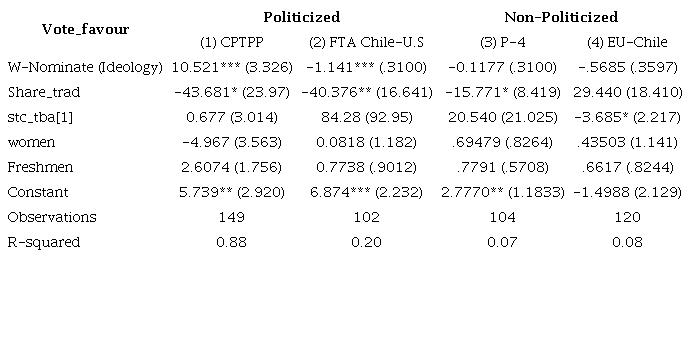
Standard errors in parentheses. * p < .10 ** p < 0.05, *** p < 0.01
The remaining three columns in Table 1 show the results for FTAs where politicization was absent. Column (2), corresponding to the U.S.-Chile FTA voted on in 2004, presents a negative and statistically significant estimate for Ideology, consistent with our framework, which predicts that support for FTAs from right-wing legislators and opposition from left-wing legislators depends on politicization. The results for the non-politicized FTAs—Column (3) for the P-4 and Column (4) for the EU—show coefficients for Ideology that are not statistically significant at any level. Thus, the comparison of the role of ideology between politicized and non-politicized trade debates aligns with our hypothesis, but only in the cases of the CPTPP and the U.S.-Chile FTA. Additional tests confirm our results. Given that Nominate-scores were derived from legislators’ votes, we used data obtained from parliamentary surveys to estimate the models with a different specification for our variable Ideology. The results (See appendix A1) corroborate the main results reported in Table 1 above. Ideology, when computed as the mean of party ideological self-placement in the L-R scale, is positively correlated to the outcome in the case of the CPTPP, and statistically significant at the 0.01 level. Meanwhile, the variable is negatively correlated to the outcome in the vote for the Chile-U. S FTA (and statistically significant at the .05 level). In the remaining two FTAs, the coefficient is also negative but significant only in Model 4. Post estimation tests report that the main results hold even after running the regression analysis with robust standard errors.9
Now, we need to rule out the possibility that the government opposition divide has better explanatory power that ideology at the legislator level. Although not included in our sample, the second vote on the CPTPP held in 2022 during Boric first year in office reveals an in interesting pattern. In the Chilean Senate, where the FTA was voted in in a second reading, all the votes against it came from left-wing senators from the Frente Amplio, the Communist Party and the Socialist Party, even though the executive supported the ratification after a change of criteria in comparison to positions adopted in the past (“Pese a la residencia en sectores oficialistas gobierno decide avanzar en el TPP11.” 2022). Meanwhile, favourable votes came from right wing senators and some representatives from centre-left parties. The above suggests that the dichotomy government and opposition does not necessary explain legislators votes in FTAs in the case studied here. To further add to the previous point, let’s take a look to the votes in the case of P-4. The data shows that support to the P-4 was relatively even between legislators from the government coalition and the opposition: 34 deputies out of 47 voted favourably in the case of the right-wing opposition members, while 43 out of 57 members casted a favourable vote in the government side.
Our second hypothesis is based on the interests of the region where the district is located and predicts a positive relationship between the share of workers in tradable sectors and the probability that a legislator votes in favour of the FTA. Specifically, we expect a positive estimate for early FTAs, such as the U.S.-Chile, P-4, and EU-Chile agreements, where the costs to local constituencies had not yet been fully internalized. For later FTAs, like the CPTPP, the increased vulnerability to foreign competition due to the agreement should be less significant. As expected, in Columns (1), (2), and (3), the variable Share_Trad—representing the share of workers in tradable sectors—shows negative and statistically significant coefficients. This suggests that the results are not conditional on how local constituencies, theoretically threatened by liberalization, internalized these costs. The rationale is as follows: in countries with multiple FTAs, it is plausible to argue that over time, both workers and politicians already internalized the costs of prior agreements that opened the economy to foreign competition and labour. If the above holds, initially, the likelihood of approving a new FTA is negatively correlated with the share of a constituency or region that has not yet faced competition from imports or foreign labour. From this perspective, as a country adopts more FTAs, the marginal cost of signing another diminishes. This appears to be the case in Chile, where before joining the CPTPP, the country already had access to over 80% of global GDP and 65% of the world’s population. Regardless of the above, our findings confirm that economic incentives influence legislators’ behaviour. As it stands, perceptions about the specific impact of an additional FTA, especially when sources of competition were seemingly exhausted do not conditionate the effect of district factors.
Predicted probabilities provide a more intuitive interpretation of the results. Figure 1 illustrates how the probability of voting in favor of the CPTPP increases as we move toward the right end of the political spectrum. Conversely, as we shift left on the x-axis, the probability of voting in favor decreases, reaching its lowest point at the most extreme left value of the ideological score. Figure 2 displays the predicted probabilities based on estimates for the variable Share in Tradable Sectors. The probability of voting in favor decreases as the proportion of workers in tradable sectors within the region increases. Our second hypothesis holds but with some nuance. When comparing models, we still observe a significant effect of the Share in Tradable Sectors variable on the vote for the CPTPP, where political costs, as we hypothesized, were already internalized. However, a cautionary note: the wide confidence intervals in both plots in Figure 2 suggest that the results should be interpreted with caution.

Figure 1
Predicted Probabilities of Voting in Favour Predicted Probabilities of voting in favour of the CPTPP by ideolog (nominate) of U.S-Chile by ideology (nominate)

Figure 2
Predicted Probabilities of voting in Favour Predicted Probabilities of voting in Favour The CPTPP by tradable sectors of the U.S-Chile by tradable sectors
Control variables are not statistically significant at any level. For instance, that is the case of Subnational Competitiveness. Our results, therefore, contrast with what Dür et al. (2024a) have documented using parliamentary surveys in Latin America. According to their findings, legislators consider their regions competitiveness when expressing their preferences toward trade liberalization. This may suggest that attitudes—what legislators declare in surveys—do not always align with their actual behavior, such as how they vote on FTAs. The models above demonstrate how ideology may play a role alongside constituency factors in understanding what drives a legislator to promote or oppose trade liberalization in developing democracies.
Discussion
The debate on trade liberalization is fundamental in international political economy, particularly in the context of globalization and its effects on national economies. However, while much of the literature focuses on trade politics in developed democracies, less attention has been paid to the dynamics of trade liberalization in developing democracies, such as the case studied in this article.
This article aims to fill this gap by exploring the ideological and socio demographic factors behind the votes in favour or against trade liberalization. Our evidence suggests that in Chile ideology explains support but only when the trade policy is politicized. The case of the CPTPP corroborates that ideological divisions are more likely to appear when the debate is politicized. The comparison with other votes shows that regional characteristics have been relevant, even in the case of the CPTPP, that took place after many other FTAs, and so one should have expected diminishing political costs at the district. Hence, regions labour variables may be inelastic to the accumulative effect of trade liberalization. Overall, we corroborate that labour force in tradable sectors may perceive threats from international trade which are not easily inferred by voters so their lobby to their representatives is not affected by the level of public debate. As it stands, voting behaviour of Chilean legislators in the FTA examined here seems to contradict attitudes captured by parliamentary surveys, where right wing legislators declare to be more supportive of economic integration with United States and the European Union in comparison to members of leftists’ parties (Bohigues and Manuel Rivas 2019). This is suggestive of the importance of taking in consideration the limitations of elite surveys to generate reliable estimates of legislators’ preferences.
From a comparative perspective, the effect of politicization on trade debates has been observed in European parliamentary settings recently. Politicization may induce gridlock and ideological debates around trade policy. Behavioural disparities may reflect other sources of division within the political system, but we show how it may affect debates about trade. we expand the literature on politicization, focused mainly on European settings, to a presidential Latin American case. An important difference is observed thought. In Chile, a developing democracy, politicization does not only induce an additional effect on previous ideological cleavages and alignment. Moreover, it may produce a complete realignment of preferences. Right wing parties, and legislators, may shift their attitudes to trade liberalization from protectionist outlooks to positions closer to their overall ideological location within the main axis of political conflict. Even though we are not in a position to claim that our findings can be extrapolated to other developing democracies, the empirical results we offer here allow for further examination of the patterns identified in other developing settings.
Understanding the context of trade debates in developing economies is quite important. Many implications follow. Dropping or eliminating barriers to trade among economies has far-reaching social and economic consequences, opening, or thwarting, opportunities for development and progress in countries struggling to achieve development and a more competitive and inclusive economy.
Acknowledgements
This work was supported by the following: Fondecyt Regular Grant Nº 1241567;ANID Millenium Science Initiative Program [grant NCS2024_007] and ANID Millennium Science Initiative Program NCS2022_053.
References
Alemán, E. "Policy positions in the chilean senate: an analysis of coauthorship and roll call data." Brazilian Political Science Review 2, no. 2 (2008): 74-92. doi: https://doi.org/10.1590/1981-3846200800020003
Alemán, E. The breakdown of the post-authoritarian party system. Working Paper. Houston: University of Houston, 2023.
Alemán, E., and A. Dockendorff. "Seeking friends and influencers: business and labor groups lobbying in the Chilean congress." Business and Politics 25, no. 4 (2024): 665-683. doi: https://doi.org/10.1017/bap.2024.32
Alemán, E., and P. Navia. "Institutions and the legislative success of 'strong'presidents: an analysis of government bills in Chile." Journal of Legislative Studies 15, no. 4 (2009): 401-419. doi: https://doi.org/10.1080/13572330903302471
Alemán, E., and P. Navia. "Presidential power, legislative rules, and lawmaking in Chile." In Legislative institutions and lawmaking in Latin America, edited by E. Alemán and G. Tsebelis, 92-121. Oxford: Oxford University, 2016.
Alemán, E., and S. M. Saiegh. "Legislative preferences, political parties, and coalition unity in Chile." Comparative Politics 38, no. 3 (2007): 253-272. doi: https://doi.org/10.2307/20434040
Alemán, E., J. P. Micozzi, and M. M. Ramírez. "The hidden electoral connection: analyzing parliamentary questions in the Chilean Congress." Journal of Legislative Studies 24, no 2 (2018): 227-244.
Andrione-Moylan, A., P. De Wilde, and K. Raube. "(De-) politicization discourse strategies: the case of trade." JCMS: Journal of Common Market Studies 62, no. 1 (2024): 21-37. doi: https://doi.org/10.1111/jcms.13475
Antoine, E., E. Ö. Atikcan, and A. W. Chalmers "Politicisation, business lobbying, and the design of preferential trade agreements." Journal of European Public Policy 31, no. 1 (2024): 239-268. doi: https://doi.org/10.1080/13501763.2023.2218413
Baeza Freer, J., and M. A. López Varas. "El Congreso Nacional de Chile y el proceso de ratificación del Tratado de Libre Comercio con los Estados Unidos de América." Estudios Internacionales 47, no. 182 (2015): 37-55. doi: https://doi.org/10.5354/0719-3769.2015.37883
Baldwin, R. E., and C. S. Magee. "Is trade policy for sale? Congressional voting on recent trade bills." Public Choice 105, no. 1 (2000): 79-101. doi: https://doi.org/10.1023/A:1005121716315
Basedow, R., and J. M. Hoerner. "Trading votes: what drives MEP support for trade liberalisation?" Journal of European Public Policy 31, no. 1 (2024): 20-53. doi: https://doi.org/10.1080/13501763.2023.2236654
Bianculli, A. C. Negotiating trade liberalization in Argentina and Chile: When policy creates politics. London: Routledge, 2016.
Bohigues, A., and J. Manuel Rivas. "Free trade agreements and regional alliances: support from Latin American legislators." Revista Brasileira de Política Internacional 62, no. 1 (2019): 1-22. doi: https://doi.org/10.1590/0034-7329201900101
Borges, F. A. "Debating trade: the legislative politics of free trade agreements in Latin America." Government and Opposition 54, no. 2 (2019): 336-364. doi: https://doi.org/10.1017/gov.2017.28
Cabras, L. "Explaining the politicization of EU trade agreement negotiations over the past 30 years." Italian Political Science Review 54, no. 2 (2024): 1-16. doi: https://doi.org/10.1017/ipo.2023.30
Campello, D., and F. Urdinez. "Voter and legislator responses to localized trade shocks from China in Brazil." Comparative Political Studies 54, no. 7 (2021): 1131-1162. doi: https://doi.org/10.1177/0010414020970233
Campos-Parra, H., and P. Navia. "Disciplina legislativa en la Cámara de Diputados de Chile, 2010-2014." Política y Gobierno 24, no. 1 (2017): 81-123.
Campos-Parra, H., and P. Navia. "Ideological polarization in roll call votes in constitutional conventions: the case of Chile in 2021-2." Parliamentary Affairs 78, no. 1 (2024): 203-225. doi: https://doi.org/10.1093/pa/gsae009
CEPAL. Manual para la preparación del cuestionario sobre las medidas que afectan al comercio de servicios en el hemisferio. Unidad de Comercio Internacional de la División de Comercio Internacional y Financiamiento para el Desarrollo. Naciones Unidas, Santiago, 1999. https://hdl.handle.net/11362/5558
Choi, Y. "Constituency, ideology, and economic interests in US Congressional voting: the case of the US-Korea free trade agreement." Political Research Quarterly 68, no. 2 (2015): 266-279. doi: https://doi.org/10.1177/1065912915577818
Conconi, Paola, Giovanni Facchini, and Maurizio Zanardi. "Policymakers' horizon and trade reforms: The protectionist effect of elections." Journal of International Economics 94.1 (2014): 102-118.
Conley, R. S. "Derailing presidential fast-track authority: The impact of constituency pressures and political ideology on trade policy in Congress." Political Research Quarterly 52, no. 4 (1999): 785-799. doi: https://doi.org/10.1177/106591299905200406
De Bièvre, Dirk, and Arlo Poletti. "Towards explaining varying degrees of politicization of EU trade agreement negotiations." Politics and Governance 8.1 (2020): 243-253.
De Vries, C. E., and S. B. Hobolt. "When dimensions collide: the electoral success of issue entrepreneurs." European Union Politics 13, no. 2 (2012): 246-268. doi: https://doi.org/10.1177/1465116511434788
Dockendorff, A. "When do legislators respond to their constituencies in party controlled assemblies? Evidence from Chile." Parliamentary Affairs 73, no. 2 (2020): 408-428. doi: https://doi.org/10.1093/pa/gsz002
Dockendorff, A. "Why are some parliamentarians' bills more likely to progress? Sponsorship as a signal." The British Journal of Politics and International Relations 23, no. 1 (2021): 139-157. doi: https://doi.org/10.1177/1369148120949978
Dockendorff, A., and D. López. "When do business groups embrace outside lobbying in trade policy? The case of the CPTPP in Chile." Estudos Internacionais 11, no. 2 (2023): 7-23. doi: https://doi.org/10.5752/P.2317-773X.2023v11n2p7-23
Dür, A., R. A. Huber, and Y. Stiller. "Trade competitiveness, constituency interests, and legislators' attitudes towards trade agreements." Legislative Studies Quarterly 49, no. 2 (2024a): 353-382. doi: https://doi.org/10.1111/lsq.12426
Dür, A., S. M. Hamilton, and D. De Bièvre. "Reacting to the politicization of trade policy." Journal of European Public Policy 31, no. 1 (2024b): 1-19. doi: https://doi.org/10.1080/13501763.2023.2258157
Fermandois, J., and M. J. Henríquez. "¿Contradicción o díada? Política exterior de Chile ante el Mercosur." Estudios Internacionales 148 (2005): 55-77.
Gamboa, R., and S. Y. Toro. "The electoral connection in presidential systems: non-legislative actions inside the Chilean congress." The Journal of Legislative Studies 24, no. 3 (2018): 249-271. doi: https://doi.org/10.1080/13572334.2018.1516602
Gartzke, E., and J. M. Wrighton. "Thinking globally or acting locally? Determinants of the GATT vote in Congress." Legislative Studies Quarterly 23, no. 1 (1998): 33-55. doi: https://doi.org/10.2307/440213
Gould, David M., Roy J. Ruffin, and Graeme L. Woodbridge. "The theory and practice of free trade." Economic Review (1993): 1-16.
Henisz, Witold J., and Edward D. Mansfield. "Votes and vetoes: The political determinants of commercial openness." International Studies Quarterly 50.1 (2006): 189-211.
Hurrelmann, A., and F. Wendler. "How does politicisation affect the ratification of mixed EU trade agreements? The case of CETA." Journal of European Public Policy 31, no. 1 (2024): 157-181. doi: https://doi.org/10.1080/13501763.2023.2202196
Irwin, D. A., and R. S. Kroszner. "Interests, institutions, and ideology in securing policy change: the Republican conversion to trade liberalization after Smoot-Hawley." The Journal of Law and Economics 42, no. 2 (1999): 643-674.
Jean, S., M. Nanno, and M. P. Ramos. "Reacting to the politicization of trade policy." Economic Modelling 31, no. 1 (2014): 33-45. doi: https://doi.org/10.1080/13501763.2023.2258157
Kucik, J., and A. Moraguez. "Balancing multiple goals: analyzing votes on free trade agreements in the US House of representatives." Congress & the Presidency 44, no. 1 (2017): 29-54. doi: https://doi.org/10.1080/07343469.2016.1261964
Leight, J. "The political dynamics of agricultural liberalisation in the US-Chile free trade agreement." Journal of Latin American Studies 40, no. 2 (2008): 225-249. doi: https://doi.org/10.1017/S0022216X08003970
Leiva, A. "'Entre la ideología y el distrito': factores que influyen en el proceso de ratificación de los Acuerdos Comerciales en la Cámara de Diputados del Congreso Nacional de Chile, durante los Gobiernos de la Concertación." Master Thesis, University of Chile, 2021.
Linarello, A. "Direct and indirect effects of trade liberalization: evidence from Chile." Journal of Development Economics 134, (2018): 160-175. doi: https://doi.org/10.1016/j.jdeveco.2018.05.012
López, D., and A. Dockendorff, and S. Lodato. "Parties and interests groups in the CPTPP ratification process in Chile: a case of politicisation?" World Affairs 184, no. 4 (2024): 437-447. doi: https://doi.org/10.1002/waf2.12042
López, D., and F. Muñoz N. "Cuarenta años de apertura comercial chilena." Cuadernos Americanos 4, no. 154 (2015): 125-151.
López, M. Á., A. Dockendorff, and P. L. Figueroa. "Estabilidad y cambio del voto por la derecha en Chile a la luz de las elecciones presidenciales del 2009." Revista de Sociología, no. 26 (2011): 117-135. doi: https://doi.org/10.5354/0719-529X.2011.27490
Maatsch, A. "Ratification of the comprehensive economic and trade agreement (CETA): towards a new structure of political conflict?" Polish Political Science Review 10, no. 1 (2022): 21-34. doi: https://doi.org/10.2478/ppsr-2022-0002
Migliorati, M., and V. Vignoli. "When politicization meets ideology: the European Parliament and free trade agreements." Italian Political Science Review 52, no. 3 (2022): 346-361. doi: https://doi.org/10.1017/ipo.2021.50
Milner, H. V., and D. H. Tingley. "Who supports global economic engagement? The sources of preferences in American foreign economic policy." International Organization 65, no. 1 (2011): 37-68.
Milner, H., and B. Judkins. "Partisanship, trade policy, and globalization: is there a left-right divide on trade policy?" International Studies Quarterly 48, no. 1 (2004): 95-119. doi: https://doi.org/10.1111/j.0020-8833.2004.00293.x
Moulian, T., and I. Torres Dujisin. Discusiones entre honorables: triunfos, fracasos y alianzas electorales de la derecha en Chile, 1938-2010. Santiago: Akhilleus, 2011.
Murillo, M. V., and P. M. Pinto. "Heeding to the Losers: Legislators' Trade-Policy Preferences and Legislative Behavior." Legislative Studies Quarterly 47, no. 3 (2022): 539-603. doi: https://doi.org/10.1111/lsq.12337
"Pese a la residencia en sectores oficialistas gobierno decide avanzar en el TPP11." Diario UChile, September 12, 2022. https://radio.uchile.cl/2022/09/12/pese-a-la-resistencia-en-sectores-oficialistas-gobierno-decide-avanzar-en-el-tpp-11/
Poletti, A., D. Sicurelli, and A. B. Yildirim. "Promoting sustainable development through trade? EU trade agreements and global value chains." Italian Political Science Review 51, no. 3 (2021): 339-354. doi: https://doi.org/10.1017/ipo.2020.33
Poole, K., and H. Rosenthal. Congress: a political economic history of roll call voting. New York: Oxford University, 1997.
Porras, J. I. La estrategia chilena de acuerdos comerciales: un análisis político. Santiago: División de Comercio Internacional e Integración de la Comisión Económica para América Latina y el Caribe, 2003.
Sanhueza, G. and A. Claro. "Una década perdida". Mirada FEN: Revista Economía y Administración, no. 184 (2023): 22-31. https://mirada.fen.uchile.cl/uploads/pdf/79b2fe333d8616ba5b4d10ece0db2aee478d1567.pdf
Schimmelfennig, F. "Politicisation management in the European Union." Journal of European Public Policy 27, no. 3 (2020): 342-361. doi: https://doi.org/10.1080/13501763.2020.1712458
Scully, T. R. Rethinking the center: party politics in nineteenth and twentieth century Chile. Stanford: Stanford University, 1992.
Sussman, G., and B. W. Daynes. "The impact of political ideology on congressional support for presidential policy making authority: the case of the fast track." Congress & the Presidency 22, no. 2 (1995): 141-152. doi: https://doi.org/10.1080/07343469509507725
Thomaz, L. F., G. Madeira, P. B. D. S. Pedrosa, and C. E. Carvalho. Voting free trade agreement under divided government: the case of US-Colombia. Revista de Ciencia Política 43, no. 3 (2023): 1-24. doi: https://doi.org/10.4067/s0718-090x2023005000122
Toledo, M. "Encuesta constata que la mitad de la población estima que ha recibido beneficios directos de los TLC." Diario Financiero, June 13, 2022. https://www.df.cl/economia-y-politica/macro/encuesta-constata-que-solo-la-mitad-de-la-poblacion-estima-que-ha
Toro-Maureira, S. "Conducta legislativa ante las iniciativas del ejecutivo: unidad de los bloques políticos en Chile." Revista de Ciencia Política 27, no. 1 (2007): 23-41. doi: https://doi.org/10.4067/S0718-090X2007000200002
Toro-Maureira, S., and N. Hurtado. "The executive on the battlefield: government amendments and cartel theory in the Chilean Congress." Journal of Legislative Studies 22, no. 2 (2016): 196-215. doi: https://doi.org/10.1080/13572334.2016.1163881
Universidad de Chile. Chile, las Américas y el Mundo: opinión pública y política exterior 2008. Santiago: Instituto de Estudios Internacionales, 2008.
Valdivia, C. "Comercio exterior e inversión extranjera: un amplio respaldo ciudadano." Centro de Estudios Públicos - Diarios Regionales, April 23, 2023. https://www.cepchile.cl/comercio-exterior-e-inversion-extranjera-un-amplio-respaldo-ciudadano/
Valenzuela, J. S. Democratizion via reforma: la expansion del sufragio en Chile. Buenos Aires: Instituto de Desarrollo Económico y Social, 1985.
Wilhelmy, M., and R. Durán. "Los principales rasgos de la política exterior chilena entre 1973 y el 2000." Revista de Ciencia Política 23, no. 2 (2003): 273-286. doi: https://doi.org/10.4067/S0718-090X2003000200014
Young, A, R. "Two wrongs make a right? The politicization of trade policy and European trade strategy." Journal of European Public Policy 26, no. 12 (2019): 1883-1899. doi: https://doi.org/10.1080/13501763.2019.1678055
Zorrilla, D. M., and P. Navia. "Determinantes de la cohesión en la votación del legislativo en las coaliciones oficialistas y de oposición en la Cámara de Diputados de Chile, 2006-2014." Revista de Estudios Políticos 185, no. 2019 (2019): 225-258. doi: https://doi.org/10.18042/cepc/rep.185.08
Appendix
Determinants of FTA Ratification in the Chilean Congress with a different operationalization for Ideology using parliamentary survey data.
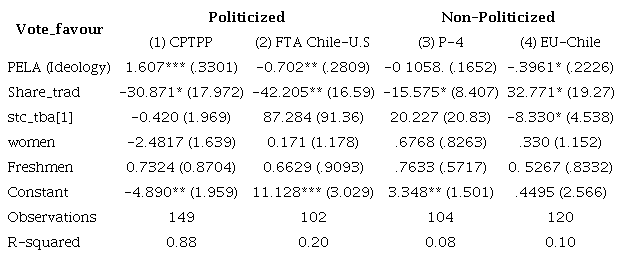
Standard errors in parentheses. * p < .10 ** p < 0.05, *** p < 0.01
Notes