Carátula del artículo
Brazilian autonomy in the quest for United Nations Security Council reform
 Mariana Pimenta Oliveira Baccarini (mariana.baccarini@academico.ufpb.br).
Universidade Federal da Paraíba, Brasil
Pascoal Teófilo Carvalho Gonçalves pascoal.goncalves@academico.ufpb.br
Universidade Federal da Paraíba, Brasil
Revista Brasileira de Política Internacional, vol. 68, no. 1, e007, 2025
Centro de Estudos Globais da Universidade de Brasília
Received: 30 January 2025
Accepted: 15 May 2025
Introduction
The search for reform of the United Nations Security Council (UNSC), the main body responsible for maintaining international peace and security in the United Nations (UN), is a constant. The distribution of permanent seats and the power of veto were questioned even before the creation of the UN, during the San Francisco Conference (Garcia 2012). Its only formal reform took place in the 1960s, increasing the number of non-permanent members from six to ten, while keeping the five permanent members (United States, Russia, China, France, and United Kingdom) and their veto power intact (Luck 2006; Smith 2006; Baccarini 2018; O’Neill 1996). This reform did not increase the power of the non-permanent body members. Still, the greater possibility of participation in the UNSC could imply some degree of prestige, participation in decisions, and access to information (O’Neill 1996).
With the end of the Cold War, questions were raised about the legitimacy and authority of the UNSC due to its lack of representation (Hurd 2007). In 1993, the Open-ended Working Group on the Question of Equitable Representation on and Increase in the Membership of the Security Council and Other Matters Related to the Security Council was created with the mission of advancing the issue at the UNGA. In 2004, the UN Secretary-General created the High-Level Panel on Threats, Challenges and Change, to rethink the new threats, challenges, and necessary changes to tackle international security issues in the 21st century (Luck 2006; Baccarini 2018).
In response, the countries organized themselves into a series of groups to strengthen their proposals and shape the debate. It is in this context that the G4 emerged, uniting Brazil, Germany, India, and Japan in a joint quest for permanent seats on the body (Baccarini 2018)1. In addition to the G4, it is worth remembering that Brazilian participation in other groups, such as BRICS and IBSA, could also facilitate negotiations.
These joint actions are justified because Article 118 of the UN Charter states that any change to the Charter requires approval by two-thirds of the UNGA and ratification by two-thirds of all UN members, including the permanent members of the UNSC (United Nations 1945). In other words, it is necessary to seek external support for the claim, especially in the form of a vote.
The search for external support, who to seek it from, where, and when are all issues addressed in the debate on autonomy in Brazilian foreign policy. Understood by Vigevani and Cepaluni (2007) as a “foreign policy free from the constraints imposed by powerful countries,” autonomy was seen as a condition to be sought by Latin American countries (Russel and Tokatlian 2003). In Brazilian literature, in particular, autonomy also refers to independence in policy formulation, discussing the more or less insular position of Itamaraty in defining and conducting Brazil’s foreign relations (Faria 2012).
The quest for autonomy goes hand in hand with efforts to enhance the representativeness and authority of multilateral international institutions like the UN. Specifically, reforming the UNSC could elevate Brazil’s global standing, as gaining a permanent seat would allow the country to operate more independently from major powers.
Nevertheless, to push for UNSC reform, the Brazilian government would need to constantly and assertively approach possible supporters, given that the first step towards its implementation would be approval by the UNGA. The question then arises: how and to what extent did Brazil, through its civilian presidents, seek international support for the reform of the Security Council?
Different governments can present different foreign policy objectives with different emphases (Hermann 1990). Concerning Brazil’s quest to reform the Security Council, few studies have looked at the issue, especially empirically.
Therefore, this article aims to analyze the active pursuit by Brazilian presidents of this objective of Brazilian foreign policy (BFP) from re-democratization to the end of the Bolsonaro administration. To this end, all presidential speeches made available on the website of the Library of the Presidency of the Republic were download and processed. As discussed below in this paper, the processed database was coded automatically using the term “security council” using content analysis software Atlas.ti. Then we proceeded with manual review of the coding and categorization, organizing the results in graphs and figures.
Based on the evidence found, we argue that, although designed as a state agenda for Brazilian foreign policy and a constant theme in Brazilian positions over the last few decades, the search for reform of the Security Council was a specific policy of the Lula government during its first two terms in office. We also argue that the pursuit of greater foreign policy autonomy under the Lula administration and the intensification of presidential diplomacy constitutes key explanatory factors in this process.
As discussed below, the concept of presidential diplomacy implies the “personal conduct of foreign policy matters, outside the mere routine or ex officio attributions, by the president, or, in the case of a parliamentary regime, by the head of state and/or the head of government” (Danese 1999, 51). Which means that the president goes beyond his institutional role, playing a more active role in formulating and implementing foreign policy (Barnabé 2010).
Analyzing the intensity and the strategies of each president in pursuing the reform of the UNSC shed light on the level of autonomy of Brazil’s international actions. In order to do so, after the introduction, the second section of the article presents the theoretical discussion on autonomy in Brazilian foreign policy. In the following section, an empirical analysis is conducted in order to identify whether the pursuit of UN Security Council reform constitutes a state policy (long-term, consensus-driven) or a government policy (short-term, tied to specific administrations). Finally, the political strategy behind presidential speeches and what we term the “geopolitics” of reform is analysed.
Throughout the article, we identify the intensity each president—whether bilaterally or multilaterally, across different international forums—sought to incorporate the push for UNSC reform into their rhetoric. Additionally, we assess whether these speeches were strategically targeted—that is, whether they showed preference for supporters from specific countries, regions, or income groups. In the conclusion, we synthesize these findings and suggest avenues for future research to further expand upon them.
“Autonomy” and Brazilian Foreign Policy
A recurring concept in the literature on the foreign policy of Latin American countries is the concept of autonomy. In this paper, we specifically consider two major debates in Brazilian foreign policy: the autonomy of Itamaraty in the formulation of the BFP and the autonomy (or not) of countries in their international relations. We will first deal with the more or less insular position of the Ministry of Foreign Affairs about domestic policy. Subsequently, we will look at autonomy as a concept for analyzing Brazil’s international insertion.
The last decades of the 20th century reinforced the questioning of the thesis that foreign policy is something sui generis, different from other types of public policy. Despite the existence of previous contributions (Snyder et al. 1962; Rosenau 1967; Allison 1971), the emergence of structural realism had relegated the field of Foreign Policy Analysis to the background, insisting on the black box of the “national interest” (Milani and Pinheiro 2013).
According to Oliveira (2005), for example, when raising the question of whether foreign policy is a government policy or a state policy, “foreign policy is considered to represent national interests (or permanent interests) and is therefore a state policy.” In this way, foreign policy would show relative, punctuated by changes in style resulting from the personality of the individual actors and from economic constraints. In Brazil’s case, this would be even stronger due to the isolation of the main body responsible for formulating foreign policy, Itamaraty.
Faria (2012) recalls the already consolidated debate on Itamaraty’s autonomy/insulation, which would guarantee more continuities than ruptures in the formulation and implementation of the BFP. However, internal pressures since re-democratization, and external pressures with the end of the Cold War, aimed to increase participation in the formulation of Brazilian foreign policy, which engendered efforts by the MRE towards greater cooperation with sub-national and inter-sectoral actors. In this sense, thinking of foreign policy as a public policy implies
“bringing foreign policy to the terrain of politics, that is, recognizing that its formulation and implementation are part of the dynamics of government choices which, in turn, result from coalitions, bargains, disputes, agreements between representatives of different interests, which express, in short, the very dynamics of politics” (Milani and Pinheiro 2013, 24. Emphasis in original).
In this way, the authors remove from foreign policy its supposed inertial condition associated with a state policy immune to party-political dynamics. Milani et al. (2017) complement the argument by considering that BFP changes according to the government in office, and there is practically no consensus among the Brazilian elite on the country’s pattern of international relations.
Thus, the consensus that the BFP should be understood as a state policy is broken and it is understood as a public policy, permeated by different actors and interests, and also subject to domestic politics, in addition to international politics (Milani and Pinheiro 2013; Faria 2008; Faria 2018, 31-45; Lopes 2014). Given the resistance, even today, and to systematize the debate on the subject, Valente and Lopes (2022) set out to carry out a literature review on the concepts of public policy and foreign policy, as well as defending the need for evaluation as a research approach.
For the authors:
“Public policy is defined as a set of interrelated decisions taken by groups of actors, state or state-mediated, based on formal and informal interactions with organized interests, under internal and external constraints, which define objectives, action strategies, choice of means and allocation of resources, to produce preventive or corrective actions or omissions, aimed at maintaining or changing the reality of one or more sectors of social life” (Valente and Lopes 2022, 11).
Foreign policy must therefore be fully considered as a public policy, despite its supposed specificities, which are not contradictory to the concept presented.
In this sense, the political and social context described above has a direct impact on the formulation and implementation of various issues addressed by the BFP2. However, despite the evolution of the theoretical debate, it is still implied that (international) security remains, to a large extent, an exclusive issue on the state agenda, within what is defined as high politics.
In their article, for example, Milani and Pinheiro (2013, 26) argue, citing Brazilian re-democratization and globalization, that: “These phenomena were responsible, respectively, for the decapsulation of global issues (environment, human rights, etc.) from the logic of bipolar competition, in this sense removing them from the realm of security” (emphasis added).
Consequently, the search for reform of the UN Security Council, and the inclusion of permanent membership for the Brazilian state, would be part of what we would usually characterize as a state political agenda, something supposedly aimed at “national interests,” with a view to representation, political prestige, greater access to information, and participation in decisions regarding international security. And, in this sense, it would constitute a perennial agenda of the Brazilian PEB, at least since the country’s re-democratization.
On the other hand, Latin American academic interest in the concept of autonomy stems mainly from the region’s position in the international system (Russell and Tokatlian 2003). Vigevani and Cepaluni (2007), for example, developed the concept by following Brazil’s quest for autonomy from the mid-1980s until the second Lula government. The authors argue that this search has been constant, although it varies around three types of ideas: autonomy through Brazil’s distancing itself from the dominant states, with an emphasis on sovereignty; autonomy from the dominant states through participation in institutional arrangements; and, finally, autonomy through diversifying its contacts with a wide range of states and arenas3.
Pinheiro and Lima (2018) review the academic trajectory of the concept, recalling the importance of a nation’s internal strength and the acceptance of the international community for true autonomy. Autonomy was initially understood as a country’s independence in decision-making, considering both its internal strength and the way it fits into the global power structure4. After the Cold War, autonomy came to be understood as a country’s ability to control its processes beyond its borders, emphasizing the freedom to act according to its interests on the global stage, regardless of its power concerning others (Russell and Tokatlian, 2003). In this sense, countries balance their interests with the pressures and opportunities presented by the international system. Russell and Tokatlian (2003) call this definition “relational autonomy,” which expresses a country’s ability to make its own decisions without interference, which should not be confused with isolation or resistance to external influence5.
In a similar way, Russell and Tokatlian (2003) identify two factors that affect autonomy: 1. the global power structure, in which a country’s autonomy is influenced by its position in the global hierarchy (including economic power, political influence, and access to resources); 2. internal factors, such as a country’s ability to transform itself and maintain political stability, which highlights the importance of elements such as good governance and social cohesion.
On the other hand, Milani et al. (2017) approach autonomy from the concept of graduation. According to this understanding, countries such as Brazil face a graduation dilemma in their strategic foreign policy decisions: more autonomous or more dependent development? In security, a position of bandwagoning or balancing? In multilateralism, traditional alliances or innovative and flexible coalitions? In development cooperation, an emphasis on North-South relations over South-South relations?
These dilemmas stem from the change in a country’s economic position and the implications this has for access to various international resources, such as trade agreements, aid, and development funding. This transition is not just about economic growth, but also about a country’s position in the global hierarchy and its ability to influence international affairs. Developing countries often view the prospect of graduation with trepidation, as it could lead to the loss of the preferential treatment and benefits they enjoyed when they were developing nations. This fear is rooted in the understanding that the international system is not always equitable, and graduation can result in a significant setback for a country’s development goals.
To systematize this classification, Milani et al. (2017) identify four ideal types of strategy: i. Autonomy: countries prioritize independence and self-sufficiency in their foreign policy, seek to maintain control over their development and resist external influence, even at the cost of limited access to international resources; ii. Acquiescence: countries adopt a more passive strategy to ensure access to resources, prioritizing stability and short-term gains over long-term strategic goals; iii. Assertiveness: countries actively negotiate better terms for their graduation with the international community, seeking to leverage their position and resources to secure favourable agreements that support their development goals; iv. Adaptation: countries are willing to make strategic concessions and trade-offs to ensure a smooth transition during graduation, having the flexibility and capacity to adjust to changes in international dynamics.
To summarise, the concept of autonomy and the debate surrounding it offer a number of perspectives on Brazil’s international relations, covering five points: 1. autonomy as the freedom to act according to one’s interests on the global stage (Russel and Tokatlian 2003); 2. autonomy as a constant search in Brazil’s international relations (Vigevani and Cepaluni 2007); 3. autonomy permeated by the understanding of foreign policy as politics, subject to the domestic political scenario (Milani and Pinheiro 2013); 4. internal and external factors affecting a country’s autonomy (Pinheiro and Lima 2018); and 5. the dilemmas of gradual insertion (Milani et al. 2017).
In this sense, the debate on the autonomy of Brazilian foreign policy is present and directly related to the search for reform of the Security Council. Questions regarding the representativeness, authority, and legitimacy of the UNSC (Luck 2006)—and of any international organization—are directly linked to the interest of (dissatisfied) states in seeking greater participation and autonomy. A permanent seat on the UNSC amplifies a country’s voice, grants access to privileged information, enhances prestige, and perhaps even confers veto power (O’Neill 1996). Thus, power—even if institutional—translates into greater autonomy.
This debate relates directly with scholarly examining the critical role of presidential diplomacy in shaping Brazilian Foreign Policy (BFP)6. As Burges and Bastos (2017) demonstrate, presidential leadership serves as a fundamental catalyst for strategic realignments and innovative policymaking within BFP. Conversely, administrations characterized by limited presidential engagement – as evidenced by the Itamar Franco and Dilma Rousseff governments – tend towards policy inertia and institutional continuity, demonstrating reduced capacity for diplomatic innovation.
The literature identifies two key dimensions of presidential influence: first, as a democratizing force that expands foreign policy formulation beyond traditional diplomatic channels to incorporate diverse ministerial and societal actors; second, as an executive mechanism that transcends ceremonial representation to encompass strategic decision-making and bureaucratic negotiation (Burges and Bastos, 2017).
Notably, the Lula administration (2003-2010) presents a paradigmatic case of intensified presidential diplomacy, characterized by summit diplomacy and personalistic leadership. While this approach enhanced Brazil’s global visibility, it simultaneously introduced vulnerabilities through excessive centralization in the executive and tensions with professional diplomatic corps. Media critiques from influential outlets like Folha de S.Paulo and O Estado de S.Paulo further underscored the contested nature of this diplomatic model (Casarões, 2012). The subsequent Rousseff administration (2011-2016) is notable for the marked decline in presidential engagement, as evidenced by a significant decrease in international visits and diminished personal involvement in foreign affairs. This retrenchment correlated with measurable declines in key initiatives, particularly South-South Cooperation (Menezes and Fingermann, 2020).
According to Amorim Neto and Malamud (2019), the greater the presidential activism, the less authority is delegated to the Ministry of Foreign Affairs, reducing its capacity to influence policies. This can be explained by the tendency of presidents to centralize decisions and bypass traditional diplomatic bureaucracy. The absence of presidential delegation is evident in a number of indicators such as: frequency of international travel; appointment of non-diplomats to key embassies; the strength of Ministers of Foreign Affairs. The Brazilian case, however, presents a paradox, as Itamaraty maintained its prestige but lost real power under FHC and Lula due to presidential activism.
Therefore, two dimensions require investigation: 1) whether this objective is a state agenda or government policy (being reconfigured and reinterpreted with each government). In this case, the intensity and manner in which each administration pursued UN Security Council reform can be considered an indicator of their quest for autonomy, specifically in terms of seeking greater participation within international organizations; 2) and whether the active search by Brazilian presidents for support from other countries follows an alignment with the great powers or values the autonomy of its foreign relations, linked solely to the interests outlined.In the next section, we move on to the empirical analysis of the object, i.e., the analysis of the presidential speeches regarding the quest for reform of the Security Council.
Brazilian Presidents’ Defense of UNSC Reform: State Agenda vs. Government Policy
The academic debate surrounding Brazil’s quest to reform the UN Security Council has paid little attention to the use of empirical evidence. In a search of the Scopus, Scielo, and Web of Science databases, using the terms “security council” AND “reform” AND “Brazil,” 20, 1, and 6 articles were found, respectively, that could in some way analyze the reform of the UNSC from the point of view BFP, or at least that show Brazil as a protagonist in this process.
Of the 27 references found, only 7 articles deal with Brazil’s position7, most of which focus on analyzing the groups to which Brazil belongs (G4, BRICS, and IBSA), or the direct relations between Brazil and the member countries of these groups8. For Stuenkel (2012), Brazilian foreign policy is turning to informal organizations as the main political strategy in the 21st century. The creation of organizations and groups such as the BRICS, IBSA, the G20, and even the G4, was the means found not only to increase Brazil’s weight in international negotiations but also to overcome the frustrated and slow negotiations in formal organizations. The creation of informal organizations and groups was then presented as a strategy, a source of status, and a mechanism for reducing frustration (Stuenkel 2012).
Gasimova (2012) and Binder and Heupel (2020) analyze the clash between the groups that most emphatically seek reform, such as the G4 and Uniting for Consensus, their positions, justifications, and strategic errors. On the other hand, Hodzi (2018) argues that the opportunities for IBSA to reorder the international system are diminishing9. The UNSC reform would be an important objective in this recognition and was defended in a speech at the group’s 2008 summit. However, from 2009 onwards, the previously annual summits became scarce (Hodzi 2018).
Chinese influence and relevance and the inclusion of South Africa in the BRICs, now BRICS, have overshadowed IBSA as a group. The Global South’s discontent with US leadership has boosted the influence of its political and geostrategic rivals (Russia and China). In addition to the resistance of the permanent members of the UNSC (the P5) and the strict opposition of countries such as Argentina, Mexico, and Pakistan, Brazil and India have been seeking their seats via the G4, bypassing South Africa (Hodzi 2018).
However, while cooperation has been fruitful in scientific, technological, and commercial terms, there has been no similar progress in the political-strategic area (Bizzozero Revelez and Raggio 2020). BRICS member states have divergent positions on the issue, despite Russia and China reiterating the other members in international affairs (Petrone 2021). Russia would supposedly be interested in BRICS members joining the UNSC, as a way of protecting itself from the Western countries, but in practice, the status quo continues to be defended. China, on the other hand, defends the enlargement of the UNSC, without specifically favoring any effective change (Petrone 2021).
Thus, in order to empirically analyze the search for UNSC reform as one of the main goals of BFP, we carried out a comparative content analysis of the speeches of Brazilian presidents since re-democratization, made available by the Library of the Presidency of the Republic on its website.
To do this, we used the database “Speeches by the Civilian Presidents of Brazil – 1985-2022,” which compiles the speeches by all the presidents since re-democratization (beginning of the Sarney government in 1985) until the end of the Bolsonaro government, totalling 6,073 speeches in 37 years10.
For the qualitative analysis, we proceeded with coding in the Atlas.ti software11. We searched automatically for the term “security council” as a registration unit and chose to mark the phrase to create quotes with the context unit to facilitate analysis in the following stages12. We found 286 citations referring to the term research. However, there were many mentions of the Food Security Council13. After manual inspection and selecting only the UNSC citations, 273 results remained. Of these, we excluded all those that did not mention the reform of the body, leaving 172 citations. We then identified the presence of duplicate speeches based on the Presidency of the Republic’s original base, leaving 171 citations to be analyzed.
We would like to point out that we did not normalize the data14 because it is considered that the fact that a president speaks more times in total and, consequently, more times on a given topic, is an indication of greater presidential activism and political strategy to achieve foreign policy objectives.
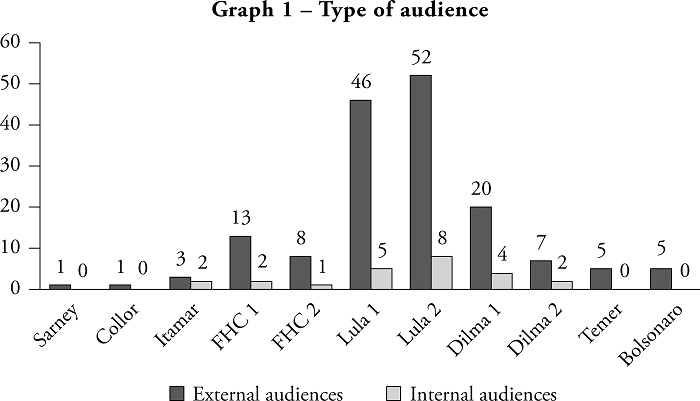
The first categorization we made was about who the speech was addressed to, whether the internal audience or the external audience15. The classification was done manually and sought to identify the listening audience (to whom the Head of State was speaking). The result can be seen in Graph 1 below, which also shows the emphasis given to UNSC reform by each government during the period analyzed:
 Graph 1
– Type of audience
Source: Research data
Graph 1
– Type of audience
Source: Research data
Graph 1 shows that although all civilian presidents since the re-democratization have at least once advocated reform of the UNSC, it received varying levels of attention. We can see a greater emphasis on the issue in the Lula governments, and its consequent decline from Dilma onwards.
We can also see that advocacy for reform of the UNSC was characterized primarily as an agenda aimed at external audiences, and was not used as a platform domestically. This active search for international support is a clear political strategy and is in line with the internal mechanism for institutional change in the UN itself, set out in Article 118 of the UN Charter, as mentioned above.
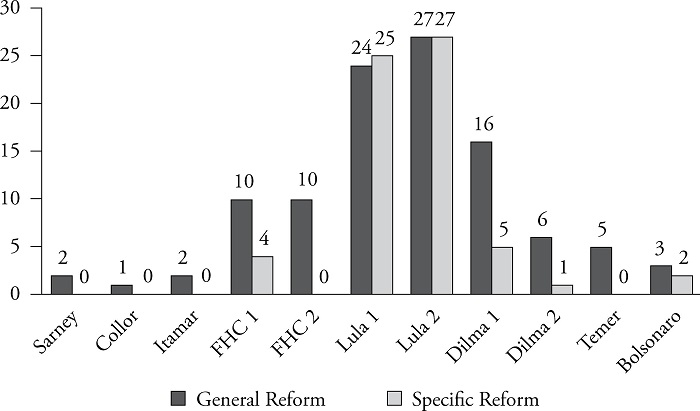
However, merely advocating a reform of the UNSC doesn’t tell us much about the efforts being made for greater Brazilian participation and relevance in the body. Graph 2 shows the type of reform advocated. “General reform” is understood to be when the discourse only mentions the need to reform international institutions. “Specific reform,” on the other hand, are discourses that explicitly advocate that Brazil should be a permanent member of the UNSC, albeit without veto power.
 Graph 2
– Type of Reform
Source: Research data
Graph 2
– Type of Reform
Source: Research data
The difference concerns the emphasis of the discourse. The search for UNSC reform can be defended in a more general way, or based on more specific proposals, such as possible formats for the new Council and the inclusion of specific countries. In this case, it is expected that the Brazilian representative will advocate reform with the inclusion of Brazil as a permanent member of the UNSC, either individually or through some group to which he belongs, such as the G4.
As we can see, the “specific reform” was strongly defended during the Lula governments, as opposed to the other Brazilian governments.
The strategy of discourse: the search for support for UNSC reform and Brazil as a possible permanent member
Much of the strategy stems from the assertion that multilateral institutions must adapt to the new distribution of international power, which has been reconfigured over the last few decades. Thus, in many speeches we can see the justifications for reforming multilateral institutions, especially the UNSC, linked to issues of legitimacy, authority, effectiveness (efficiency), democracy, and representativeness16.
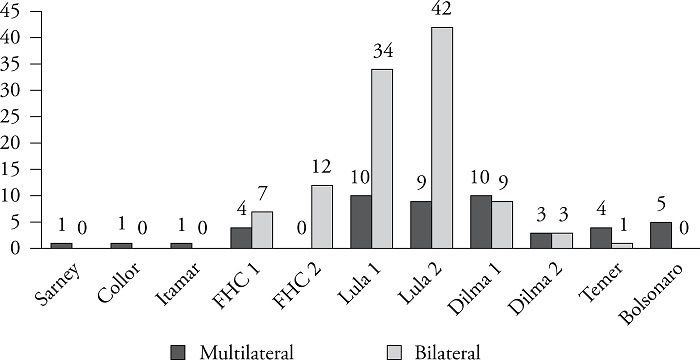
Thus, presidents implement a mixed strategy of advocating reform either in multilateral organizations or in bilateral meetings and declarations. We have therefore categorized the advocacy for UNSC reform as multilateral or bilateral17. This categorization is particularly important because it provides clues about the strategy of seeking international support for Brazil’s demand.
By methodological choice, we included in the bilateral defense speeches by presidents addressed to the population of another country, and not only to the authorities, because we understand these speeches as a search for agenda-setting, albeit obviously limited, strategically addressed to specific epistemic communities.
Graph 3 shows the comparative results of this categorization. We can easily see that Lula was the president who made the most effort to garner direct, bilateral support from other countries. On the other hand, advocating UNSC reform in multilateral forums was a constant but timid strategy of Brazilian presidential diplomacy during the period analyzed.
 Graph 3
– Bilateral vs. Multilateral Defense
Source: Research data
Graph 3
– Bilateral vs. Multilateral Defense
Source: Research data
The multilateral nature of reform advocacy
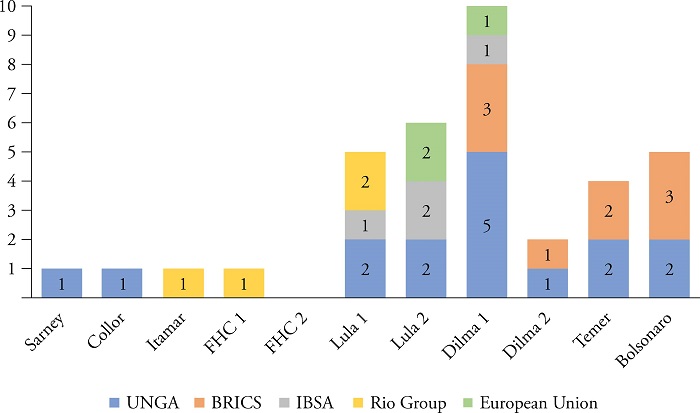
This section details the defense of reform in multilateral spaces or meetings. Graph 4 shows the main multilateral forums in which Brazil, through its chief executive, has advocated UNSC reform. To make it easier to see, we only present the forums that were used more than once.
 Graph 4
– Multilateral Defense – greater than 1
Source: research data
Graph 4
– Multilateral Defense – greater than 1
Source: research data
In the time frame analyzed, Brazilian presidents advocated UNSC reform at the UNGA 16 times. The issue was first raised by Sarney at the opening of the 1989 session, followed by Collor in 1990. After a 14-year hiatus, it was taken up again by Lula at the opening session of the 2004 UNGA. In this sense, it is worth noting that of the 8 presidents analyzed, only Itamar and FHC did not use the opening of the General Assembly to advocate UNSC reform.
While Lula made specific defenses in 2004, 2006, 2007, and 2009, Rousseff defended UNSC reform at the UNGA in every year of her mandate. For his part, Temer, an active figure in Dilma’s controversial impeachment in 2016, also advocated reform as soon as he took office in 2016 and 2017. Finally, despite ideological differences with previous governments, the issue was taken up again by the Bolsonaro government in 2021 and 2022.
In the Rio Group18, the subject appeared in four speeches, the first time in 1994, in the last year of the Itamar government. In a timid and vague way, the then president mentioned that “[t]he maturity of our external action is projected in the United Nations, whose debates include the issue of expanding the Security Council” (Itamar, 09-09-1994). FHC, on the other hand, specifically advocated reform of the UNSC at the Group’s opening meeting in Asunción on August 23, 1997. The tone was followed by Lula in 2003, in a specific way, and in 2004, more emphatically, drawing attention to the need for legitimacy and representativeness of the bodies dedicated to collective security.
For its part, the Europe Union listened to Brazilian demands on three occasions between 2008 and 2011. At the Brazil-European Union Summit in 2008, Lula briefly defended the reform of the UN and the UNSC within the context of the Strategic Partnership Action Plan that was being defined as a framework for “dialogue and cooperation.” In 2010, Lula returned to the subject by addressing the need to democratize global governance, an argument repeated in 2011 by President Dilma.
An important multilateral arena, the issue of UNSC reform was raised by Brazilian presidents in IBSA four times, during the Lula and first Dilma governments. Lula advocated reform at the first IBSA summit in 2006. Addressing the Prime Minister of India and the South African President directly, Lula said:
“Brazil, India and South Africa agree that an urgent reform of the Security Council is essential. Only in this way will the United Nations be able to respond effectively to the challenges of maintaining peace, security and stability in the world. The Council needs to reflect the growing weight of developing countries on the international stage. Its current composition represents a world that no longer exists. We will continue to work for an expansion of the Security Council to include developing countries in the categories of permanent and non-permanent members. It is essential that we reach a decision in 2006” (Lula, 09-13-2006).
The Trilateral Forum served as a platform for Brazilian interests again in 2007, 2010, and 2011. It is worth noting that Lula only mentioned the general reform of the Council, in the lines of the passage quoted above. In 2011, Dilma argued that the “presence of our countries [Brazil, India, and South Africa] in the Security Council this year demonstrated, once again, that we have all the credentials to take a permanent seat and give that body the legitimacy it lacks” (Dilma, 10-18-2011).
However, IBSA is losing its relevance to the detriment of the BRICS, which is becoming one of the main multilateral arenas for advocating UNSC reform. The Group was founded in 2006 and its first summit took place in 2009. It was only in 2011 that the space was used to defend Brazilian interests in reforming the UNSC, under the Dilma government. The meeting in question, held on April 14, 2011, in Sanya, China, marked the entry of South Africa into the grouping.
Since then, Brazil has advocated UNSC reform at the BRICS Summits in 2012, 2013, 2015, 2016, 2017, 2020, 2021, and 2022. It’s interesting to note that neither Dilma nor Temer advocated a specific reform that included Brazil. It was up to Bolsonaro in 2020, to defend the inclusion of IBAS members as permanent members19.
The bilateral nature of the reform
Having presented the multilateral character of the reform, we move on to the bilateral character, when presidents sought specific or general support from specific interlocutors. Firstly, it should be noted that four of the presidents analyzed did not seek bilateral support. Sarney, Collor, Itamar, and Bolsonaro only spoke out multilaterally.
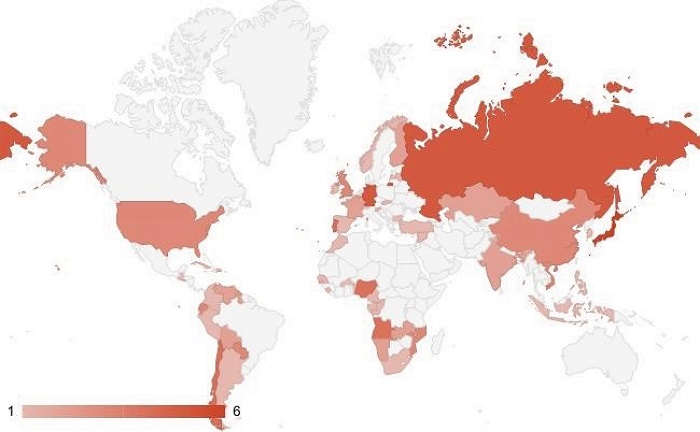
The Map Chart below gives an overview of the bilateral support garnered by FHC, Lula, Dilma, and Temer.
 Graph 5
– Search for Bilateral Support
Source: research data
Graph 5
– Search for Bilateral Support
Source: research data
The country most targeted by Brazilian presidential diplomacy to support UNSC reform was Japan, a total of six times, three times during the Lula 1 administration, once during Lula 2, once during the first Dilma administration, and once during the Temer administration.
In September 2004, during a lunch with Japanese Prime Minister Junichiro Koizumi, Lula set the tone for the rapprochement with Japan:
“The union between Brazil and Japan has a global dimension (…) We are committed to multilateralism as an instrument for dialogue and cooperation in solidarity between peoples and nations (…). These are the principles that guide our actions at the UN and that have made us the two countries that have been elected to the Security Council the most times. We have an unquestionable vocation to occupy permanent member seats in a renewed Security Council (…).” (Lula, September 16, 2004).
The text was repeated practically in its entirety on May 26, 2005, and slightly modified the following day, when Lula stressed that “countries […] such as Germany and Japan, […] India and Brazil, […] representatives of the African continent, are participating definitively as permanent members of the Security Council” (Lula, 05-27-2005). In other words, the emphasis of the discourse is on building the joint proposal of the expanded G4 (Brazil, Germany, Japan, India, and African representatives).
The second and third countries most targeted by Brazilian presidential diplomacy to support UNSC reform were Germany and Russia, five times each. Germany was approached by FHC on two occasions, in 2000 and 2002. About Germany, FHC and Lula advocated reform in general and Dilma, for her part, moved towards advocating reform specifically on two occasions. The first was in 2011 to Christian Wulff, President of the Federal Republic of Germany, when Rousseff returned to the issue of legitimacy,
“Only […] with the presence on the Council of countries that reflect the new balance of power in the world will it be possible to have a Council that is more effective, more efficient and that, in fact, represents the interests of humanity. I believe that there is sufficient basis for an initiative on reform that includes the expansion of permanent and non-permanent seats” (Dilma, May 05, 2011).
In 2015, in a statement to the press after a meeting with the then Chancellor of Germany, Angela Merkel, Rousseff again reaffirmed the role of the “[…] G4, […] partners in this issue of expanding the United Nations Security Council” (Dilma, 08-20-2015)20.
In addition to the strategic rapprochement with G4 member countries, the support of P5 is an indispensable prerequisite for the enlargement of the body. According to Article 118 of the UN Charter, presented above, even if a formal change is approved by two-thirds of the UNGA, it must also be ratified by two-thirds of UN members, including the permanent members of the UNSC (United Nations 1945). In other words, in practice, P5 have veto power over the issue.
Regarding Russia, a member of BRICS and a permanent member of the UNSC, Lula personally thanked President Putin in 2004, and President Dmitri Medvedev in 2008 and 2010, for supporting Brazil’s quest for a permanent seat on the UNSC in 2004.
About China, a BRICS and P5 member, in 2004, President Lula favorably interpreted the talks with Chinese President Hu Jintao as a “favorable manifestation for Brazil to participate as a permanent member in the work of a reformed Security Council” (Lula, 11-12-2004). In 2015, President Dilma addressed the issue in general terms in a speech in the presence of Li Keqiang, Prime Minister of the People’s Republic of China.
Concerning the other permanent members of the UNSC, Lula and Dilma addressed three times the issue in a general way after meeting a US president. In 2007, with Lula and George W. Bush, and in 2011, twice on the same day, with Dilma and Barack Obama. The issue has also been discussed with the UK three times, but without the speech being specifically directed at any political representative21.
Finally, about France, the subject was raised twice. The first time, in 2010, when Lula received the France Brazil Personality Award, in the presence of the French ambassador, and stated that:
“Because everyone knows that the UN Security Council still has a representation from years ago, when geopolitics had nothing to do with current geopolitics. And it was exactly President Chirac and President Sarkozy who said that it was inexplicable for Brazil not to take part in the UN Security Council” (Lula, November 19, 2010).
And secondly, in 2012, when Rousseff spoke at the “Forum for Social Progress: Growth as a Way Out of the Crisis,” in the presence of French President Françoise Hollande, but addressed the issue in a very general way.
The “geopolitics” of reform: the regional and multilateral nature of the quest for a permanent seat
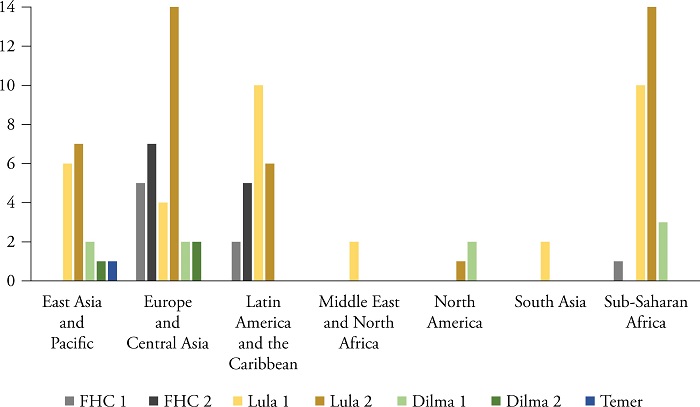
Finally, we used the World Bank’s classification of income and region22 to summarize the strategy of Brazil’s search for bilateral support for the reform of the Council. From the analysis, we identified some patterns in the presidents’ bilateral approach and some broader patterns of Brazil’s international insertion. To improve visualization, we have excluded from the analysis below those presidents who did not advocate reform bilaterally.
The result is summarized in Graph 6 that shows the regional distribution of countries approached by Brazilian presidential diplomacy. The Europe and Central Asia region concentrates the largest number of countries with which Brazilian presidents sought bilateral support23. In total, there were 34 speeches advocating reform to countries in this region.
 Graph 6
– Regional Nature of the Search for Support
Source: research data
Graph 6
– Regional Nature of the Search for Support
Source: research data
The second region from which support was most sought was sub-Saharan Africa24, largely due to the diplomatic efforts of Lula, who alone sought support 24 out of 28 times in this region during his first two terms in office.
In third place is Latin America and the Caribbean25, with 23 speeches. The bar shows that this region was favoured by Lula in his first term, when he advocated for Bolivia (1 time), Chile (3 times), Ecuador (2 times), Guyana (2 times), and Venezuela (2 times).
In his second term inauguration speech, FHC defended the reform of the Council directly to the heads of state of Argentina, Colombia, Ecuador, Paraguay, and Peru. It was FHC’s only speech aimed at the countries of the region in his second term. In his first term, he made two speeches, one at the multilateral level of the Rio Group in Asuncion, and the other at the Rio Group meeting in a joint communiqué to Argentina, when he obtained the explicit support of then president Carlos Menem for a specific reform of the Council26. It’s worth noting that he was the only Brazilian president to win support from Argentina and, conversely, Menem was the only one to endorse the Brazilian request (at least as far as can be seen by analyzing the presidential speeches).
In fourth place was East Asia and the Pacific27, with 17 speeches. As previously reported, Japan was the country most targeted by Brazil in the period, followed by China and Vietnam (three times each). In the case of Vietnam, only Lula in his first term sought support from that country. And, far removed in terms of relevance from the other regions, South Asia, the Middle East and North Africa, and North America were only questioned two or three times. In South Asia, only India was the object of political mobilization by Brazil, as discussed above.
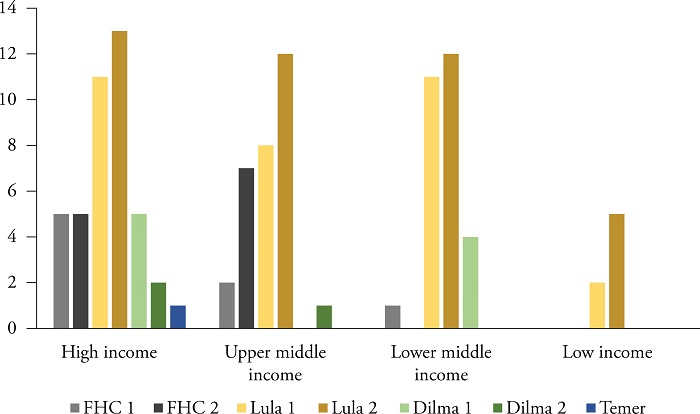
Finally, when we organize the data by income bracket, we get a very interesting view of the support sought by Brazil concerning the world’s centers of power.
Graph 7 below shows this categorization:
 Graph 7
– Seeking Support by Income Group
Source: research data
Graph 7
– Seeking Support by Income Group
Source: research data
It is noteworthy that all the presidents who sought bilateral support advocated UNSC reform with high-income countries28, with 42 speeches addressed. The incisive search for support from this group cannot be justified in terms of this group being a permanent member of the UNSC, since, as we can see, in the World Bank’s classification, China and Russia are in the upper middle-income group.
In terms of the president’s strategies, there is a clear change in FHC’s strategy, as in his second term he focused more on upper-middle-income countries29. Rousseff, on the other hand, presents a strategy focused on high-income countries and lower-middle-income countries.
In turn, the only president who paid equal attention to high-income, upper-middle-income, and lower-middle-income countries30 was Lula. We can see in the graph that strategy was to seek the broadest possible support for UNSC reform, regardless of whether the country was a world power, a Western country, or a high-income country. In addition, Lula was also the only president to seek support from low-income countries, which reflects the autonomy of the government’s foreign policy.
Conclusion
The quest for UNSC reform and the principle of autonomy feature prominently in specialized literature as core BFP objectives . Nevertheless, empirical research examining the concrete actions and strategic approaches used to advance this agenda remains scarce.
This study helped to fill this gap by systematically examining all the presidential speeches available in the Library of the Presidency of the Republic in order to assess whether the UNSC reform constitutes a perennial and uncontested objective of Brazilian Foreign Policy, or a government-specific priority tied to particular administrations.
The analysis also engages with key theoretical debates regarding the nature of autonomy in BFP, particularly its persistence across different ideological orientations and despite political/economic pressures from major powers. Throughout our analisys, we sought to delineate Brazil’s strategic autonomy in international relations, its engagement through international institutions, and its involvement within Global South partners.
An analysis of 37 years of presidential diplomacy reveals that the goal of reforming the UN Security Council (UNSC) has remained a constant agenda item, as evidenced by its presence in the speeches of every civilian president. However, efforts to accomplish this objective are intrinsicallypolitical and subject to shifts in power dynamics.
The intensity of presidential diplomacy, tied to these political changes, shapes the government’s level of engagement. Conversely, the robust presidential diplomacy characteristic of Lula’s government accounts for the remarkable frequency with which this theme appeared in both bilateral and multilateral international addresses. The issue emerged tentatively between the Sarney and Itamar Franco administrations, gained modest traction during the Cardoso government, and only under Lula’s presidency was it actively pursued as a strategic political objective.
In contrast, the assertive presidential diplomacy that defined Lula’s administration explains the striking prevalence of this theme across both bilateral and multilateral diplomatic engagements. Consequently, following Lula’s first two terms, UNSC reform saw a marked decline in priority—receiving only superficial treatment under Dilma Rousseff and marginal attention during the Temer and Bolsonaro administrations.
Our analysis also reveals significant variation in strategies toward both global powers and Global South countries—whether pursued bilaterally or multilaterally—with distinct approaches evident across different presidential administrations. Crucially, these shifts appear far more contingent on the political orientation and personal priorities of individual presidents than on any inherent institutional design of Brazilian foreign policy (BFP). This suggests that active efforts to secure support for UNSC reform are better understood as an extension of domestic political dynamics—akin to other policy areas.
Over the decades, Brazilian foreign policy (BFP) has oscillated between strategies of autonomy, acquiescence, assertiveness, and adaptation. However, only under Lula’s administration did the pursuit of UNSC reform reflect a distinctly autonomous approach—though Cardoso (FHC) and, to a lesser extent, Dilma Rousseff, demonstrated assertiveness in their efforts. For instance, while the strategy of bilateral coalition-building was initiated under Cardoso, it was systematically intensified under Lula.
Similarly, in terms of diplomatic outreach, Lula’s government (and, partially, Dilma’s) uniquely sought broad-based support, engaging states across income levels, whereas other administrations predominantly targeted high- and upper-middle-income countries. Consequently, the concept of “graduation” proves especially valuable for analyzing Brazil’s global positioning—particularly when combined with the ideological orientation of the executive.
Ultimately, while UNSC reform has been rhetorically upheld as a long-standing state priority, empirical evidence reveals that only Lula’s government treated it as a central foreign policy objective. Moreover, the unrestricted diplomatic campaign—transcending regional, economic, and ideological divides—demonstrates that genuine autonomy in foreign relations on this issue was achieved exclusively under Lula.
However, we acknowledge that this article does not exhaust the subject—rather, it opens avenues for further inquiry. As potential directions for future research, empirical analysis should extend beyond presidential speeches to examine: 1) The shaping of foreign policy agendas, particularly the influence of key actors such as Itamaraty, presidents, and their closest advisors in these processes; 2) The distinct national and international contexts confronted by successive administrations, along with their implications for foreign policy formulation. Examining these contextual factors facilitates the classification of foreign policies as either state-driven or government-specific, and also deepens the interpretation of presidential addresses; 3) The evolution of UN reform debates on the international stage, especially at the UN General Assembly (UNGA), identifying periods of heightened activity and stagnation—and correlating these phases with Brazil’s diplomatic efforts to advance its objectives; 4) The instrumentalization of foreign policy for domestic political purposes, including the impact of far-right ascendancy (particularly under Bolsonaro) and its explicit rejection of the liberal international order; among other dimensions.
References
Allison, G. T. Essence of decision: explaining the cuban missile crisis. Boston: Little Brown, 1971.
Amorim Neto, O., and A. Malamud. "The policy-making capacity of foreign ministries in presidential regimes: a study of Argentina, Brazil, and Mexico, 1946-2015." Latin American Research Review 54, no. 4 (2019): 812-834. doi: https://doi.org/10.25222/larr.273
Bardin, L. Análise de conteúdo. Lisboa: 70, 1979.
Barnabé, I. R. "O Itamaraty e a diplomacia presidencial nos governos FHC e Lula." Revista de Estudos Internacionais 1, no. 2 (2010): 1-9.
Binder, M., and M. Heupel. "Rising powers, UN security council reform, and the failure of rhetorical coercion." Global Policy 11, no. 53 (2020): 93-103. doi: https://doi.org/10.1111/1758-5899.12857
Bizzozero Revelez, L., and A. Raggio. "Cooperative relations with China in Brazil's international politics: scope and interests of the global strategic partnership." In China-Latin America relations in the 21st Century: the dual complexities of opportunities and challenges, edited by R. Bernal-Meza, and L. Xing, 83-109. Berlin: Springer Nature, 2020.
Burra, S., and H. Jamil. "A critic and an apologist: India's quest for UN security council permanent membership." In Locating India in the contemporary international legal order, edited by S. Burra, and R. Rajesh Babu, 31-50. Berlin: Springer, 2018.
Casarões, G. S. P. "Media and foreign policy in Lula's Brazil." Austral: Revista Brasileira de Estratégia e Relações Internacionais 1, no. 2 (2012): 211-236. doi: https://doi.org/10.22456/2238-6912.32661
Çolak, O., and I. Köse. "The problematic of the United Nations Security Council reform: expectations and strategies of Italy." Gazi Akademik Bakis-Gazi Academic View 13, no. 26 (2020): 21-48.
Danese, S. Diplomacia presidencial. Rio de Janeiro: Topbooks, 1999.
Dominic, M., and T. H. Mathew. "Afro-decolonial critique of South Africa's call for reform of the United Nations Security Council in the context of BRICS." African Renaissance 18, no. 4 (2021): 201-214. doi: https://doi.org/10.31920/2516-5305/2021/18n4a10
Faria, C. A. P. "Desencapsulamento, politização e necessidade de (re)legitimação da política externa brasileira: razões e percalços para o seu monitoramento e a sua avaliação." Revista Tempo do Mundo 4, no. 1 (2018): 65-93.
Faria, C. A. P. "O Itamaraty e a política externa brasileira: do insulamento à busca de coordenação dos atores governamentais e de cooperação com os agentes societários." Contexto Internacional 34, no. 1 (2012): 311-355. doi: https://doi.org/10.1590/S0102-85292012000100009
Faria, C. A. P. "Opinião pública e política externa: insulamento, politização e reforma na produção da política exterior do Brasil." Revista Brasileira de Política Internacional 51, no. 2 (2008): 80-97. doi: https://doi.org/10.1590/S0034-73292008000200006
Faria, C. A. P. Políticas públicas e relações internacionais. Brasília: Escola Nacional de Administração Pública, 2018.
Garcia, E. V. O sexto membro permanente: o Brasil e a criação da ONU. Rio de Janeiro: Contraponto, 2012.
Gasimova, S. V. "The security council's endless enlargement debate." Central European Journal of International & Security Studies 6, no. 3-4 (2012): 1-20.
Hermann, C. F. "Changing course: when governments choose to redirect foreign policy." International Studies Quarterly 34, no. 1 (1990): 3-21. doi: https://doi.org/10.2307/2600403
Hodzi, O. "'Empty bravado or hopeful illusions': rising democratic powers and reordering of the international system." International Politics 56, (2018): 444-456. doi: https://doi.org/10.1057/s41311-018-0146-0
Hurd, I. After anarchy: legitimacy & power in the United Nations Security Council. Princeton: Princeton University, 2007.
Locatelli, N. "China and India in Latin America: a secondary area of competition." In China and India in Asia: paving the way for a new balance of power, edited by C. Astarita, and Y. H. Lim. Hauppauge: Nova Science, 2011.
Lopes, D. B. "Da razão de estado ao republicanismo mitigado: uma narrativa faoriana sobre a produção da política externa brasileira." Dados 57, no. 2 (2014): 481-516.
Luck, E. C. UN Security Council: practice and promise. New York: Routledge, 2006.
Malamud, A. "Presidential diplomacy and the institutional underpinnings of Mercosur: an empirical examination." Latin American Research Review 40, no. 1 (2005): 138-164. doi: https://doi.org/10.1353/lar.2005.0004
Maseng, J. O., and F. G. Lekaba. "United Nations Security Council reform and the dilemmas of african continental integration." African Security Review 23, no. 4 (2014): 395-404. doi: https://doi.org/10.1080/10246029.2014.948896
Mbara, G. C., N. Gopal, S. O. Ehiane, and H. O. Patrick. "Re-evaluating the African Union's Ezulwini consensus in the reform of the United Nations' Security Council." Journal of African Union Studies 10, no. 1 (2021): 53-70 doi: https://doi.org/10.31920/2050-4306/2021/10n1a3
Menezes, R. G., and N. N. Fingermann. "Cooperação sul-sul no governo de Dilma Rousseff (2011-2016): retração ou transformação?" Revista Sociedade e Cultura 23, (2020): 1-34. doi: https://doi.org/10.5216/sec.v23i.59660
Milani, C. R. S., L. Pinheiro, and M. R. S. Lima. "A política externa do Brasil e o 'dilema da graduação'." International Affairs 93, no. 3 (2017): 585-605.
Minayo, M. C. S. O desafio do conhecimento: pesquisa qualitativa em saúde. 7th ed. São Paulo: Hucitec, 2000.
Oliveira, H. A. Política externa brasileira. São Paulo: Saraiva, 2005.
Petrone, F. "BRICS and global governance: will the grouping be able to reform the United Nations Security Council?" International Studies 58, no. 3 (2021): 363-379. doi: https://doi.org/10.1177/00208817211029409
Pinheiro, L., and M. R. S. D. Lima. "Between autonomy and dependency: the place of agency in brazilian foreign policy." Brazilian Political Science Review 12, no. 3 (2018): 1-22. doi: https://doi.org/10.1590/1981-3821201800030003
Rosenau, J. Domestic sources of foreign policy. London: Collier-Macmillan, 1967.
Russell, R., and J. G. Tokatlian. "From antagonistic autonomy to relational autonomy: a theoretical reflection from the Southern Cone." Latin American Politics and Society 45, no. 1 (2003): 1-24. doi: https://doi.org/10.1111/j.1548-2456.2003.tb00230.x
Santos, J. C. "Uma realidade distante? O Brasil e seu dilema em reformar as Nações Unidas." Iberoamérica, no. 4 (2022): 113-140. 10.37656/s20768400-2022-4-06
Silva, A. L. R., and G. D. F. Costa. "Brazil and Turkey in the 21st century: strategic interests in comparative perspective." Estudos Internacionais: Revista de Relações Internacionais da PUC Minas 8, no. 4 (2020): 132-150. doi: https://doi.org/10.5752/P.2317-773X.2020v8n4p132-150
Smith, C. B. Politics and process at the United Nations: the global dance. Boulder: Lynne Rienner, 2006.
Snyder, R. C., H. W. Bruck, and B. Sapin. Foreign policy decision making: an approach to the study of international politics. New York: Free Press, 1962.
Stuenkel, O. "De quantos diplomatas umas potência emergente precisa?" Oliver Stuenkel, June 11, 2012.
Valente, M. S., and D. E. B. Lopes. "Por uma política externa baseada em evidência: política externa como política pública integral e a avaliação como abordagem de pesquisa." Carta Internacional 17, no. 2 (2022): 1-23. doi: https://doi.org/10.21530/ci.v17n2.2022.1254
Notes
Notes
1 Other relevant groups: Coffee Club/Uniting for Consensus (Argentina, Colombia, Mexico, Kenya, Algeria, Italy, Spain, Pakistan, and South Korea); and Ezulwini Consensus (made up of African countries).
2 Such as human rights, the environment, health, education, culture, international trade, migration, poverty, and development cooperation.
3 In an earlier iteration of this debate, the authors categorize variations in Brazilian foreign policy as follows:1) Autonomy through distance: Characterized by a systematic refusal to participate in international regimes, aiming for partially autarkic development focused on the domestic market; 2) Autonomy through participation: Marked by adherence to international regimes to influence the formulation of international principles and norms; 3) Autonomy through diversification: Participation in these norms and principles is strategically used to reduce global asymmetries by building coalitions with Global South countries (including regional partners) and diversifying ties with non-traditional partners (
Vigevani and Cepaluni, 2007).
4 The definition had two components, one structural and the other “agential.” The first concerns the basic requirements for autonomy, including a nation’s ability to stand on its own (national viability) and to be accepted as independent by other countries (international permissibility). The “agential” component refers to the strategies and alliances a country forms to maintain its autonomy, highlighting the active role a nation plays to guarantee its independence.
5 Instead, “relational autonomy” is seen as a more complex concept that involves a country’s position in the world, its internal strength, and its ability to work with others while maintaining its independence.
6 Many studies highlight the importance of presidential diplomacy in BFP. Carvalho (2012), for example, discusses the importance of new actors and presidential diplomacy for Brazil’s position on climate change and forest policies.
Malamud (2005) analyzes presidential diplomacy in the context of MERCOSUR, highlighting it as a central mechanism for advancing and resolving conflicts in the bloc, especially due to the absence of strong regional institutions or high levels of prior economic interdependence. However, although effective, presidential diplomacy is seen as a fragile substitute for robust regional institutions.
7 Five articles that appeared repeatedly in two databases were excluded. Another 8 articles were excluded after a more detailed analysis, as they did not fit the scope of the research and dealt with different issues or in a very superficial way, which was not their focus. Another 6 articles delve deeper into the topic of Security Council reform, focusing on other countries, especially India (
Burra and Jamil, 2018;
Locatelli, 2011) and African states (
Dominic and Mathew 2021;
Mbara et al. 2021;
Maseng and Lekaba 2014). In turn, Çolak and Kose (2020) analyze the Italian perspective and
Locatelli (2011) compares the cases of China and India. Specifically on the Brazilian position, we only found one article, but it was very superficial. Costa
Santos (2022), although claiming to point out the real reasons for Brazil’s quest for a permanent seat on the UNSC, makes a superficial review and lists some Brazilian initiatives, such as speeches at the General Assembly and participation in peace operations, especially UNIFIL and MINUSTAH, claiming that the Bolsonaro government has curbed the issue.
8 The exception is the article by Da
Silva and Costa (2020), which focuses on comparatively analyzing the discourses of Turkey and Brazil at the UNGA, since the emergence of the Workers’ Party in Brazil and the AKP (Justice and Development Party) in Turkey. The article analyzes points of convergence and divergence in the countries’ foreign policies, with Security Council reform being one of the variables analyzed. The authors find that there is divergence on this issue, as the Brazilian reform proposal, anchored in the G4 alliance, is opposed by Turkey. Based on an analysis of President Dilma’s speeches at the UNGA, the authors state that UN reform is associated with a loss of legitimacy and efficiency, with multilateral bodies being embroiled in a crisis of governance and political trust, hence the defense of Brazil as the permanent representative of Latin America.
9 For the author, despite basing their efforts on their democratic credentials and economic growth, they have been unable to converge them into global influence. On the other hand, Chinese leadership and US retreat have marked the new reordering.
11 Among the various existing techniques of content analysis, we are inspired by two: 1. Thematic or categorical analysis: which are operations to break down texts into categories in order to discover nuclei of meaning and their frequency; 2. Expression analysis: which works with indicators to achieve formal inference, analyzing the correspondence between the type of discourse, its author and the medium, characteristic of political speeches. For more information see
Bardin (1979) and
Minayo (2000).
13 The Food Security Council was created in 1993 under the Itamar Franco government and was abolished the following year, only to be recreated in 2003 as CONSEA. For more information, see
https://jornal.usp.br/?p=218444.
14 According to the Atlas.ti software technical note: “Normalization equalizes the coding density of all the documents in the table. Each document is considered to have the same number of citations. Unbalanced documents become comparable for relative code frequencies.” In other words, we used the data with absolute values, not relative values.
15 We differentiate between internal and external audiences based on the target audience of the speech, excluding the entourage accompanying the head of state. On many occasions, such as the Rio Branco Institute’s graduation ceremonies, we consider the speech to be aimed at both internal audiences (new diplomats) and external audiences (diplomats, ambassadors, and other consular representatives from other countries), which implies that the sum of the two audiences is different from the total of speeches advocating UNSC reform.
16 Some excerpts illustrate the point: “If it is not to become a sterile formula, the ‘new multilateralism’ must be truly innovative and attentive to the imperative of representativeness.” […] Important institutional changes can be foreseen in the Organization, even before its fiftieth anniversary, with the aim of reflecting in multilateral diplomacy the international realities that are emerging everywhere.” (Collor, September 24, 1990). “[…] But it also has to do with this lack of balance, of equilibrium between the globalization capacity of the economy and the lack, until now, of a legitimacy of international decisions that is really shared by all nations. And this has to do with the reform of the United Nations and issues that some think are momentary, such as the Security Council and others, which concern precisely […].” (FHC, August 23, 1997). “Only the Security Council can give legitimacy to actions in the field of international peace and security. But its composition must be adapted to today’s reality, and not perpetuate that of the post-World War II or Cold War era. Any reform that limits itself to a new guise for the current structure, without increasing the number of permanent members, is certainly insufficient.” (Lula, September 21, 2004).
17 This categorization was done in the same way as the type of reform: we classified all the speeches as multilateral or bilateral.
18 According to
Gonçalves (2011), the Rio Group has its origins in the Group of Eight (G8), a regional cooperation initiative from the 1980s. The G8 brought together the Contadora Group (Colombia, Mexico, Panama, and Venezuela) and the Contadora Support Group (Argentina, Brazil, Peru, and Uruguay), and in 1990, the G8 became the Permanent Mechanism for Political Consultation and Concertation in Latin America and the Caribbean, better known as the Rio Group, including Bolivia, Chile, Ecuador, and Paraguay.
19 In addition to these main forums, it is worth mentioning that the speeches defending the reform of the UNSC were mapped only once, in the Caribbean Community (Caricom) (Lula, on February 16, 2005), the Economic Commission for Latin America and the Caribbean (ECLAC) (FHC, on March 3, 1995), the Council on Foreign Relations (FHC, on April 19, 1995), in a meeting with the UN Secretary General (FHC, on July 13, 1998), the Community of Portuguese-Speaking Countries (CPLP) (Lula, on July 26, 2004), at the UNSC itself (Lula, on September 14, 2005), II Conference of Intellectuals from Africa and the Diaspora (Lula, on July 12, 2006), audience with African ambassadors at the Planalto Palace on the occasion of Africa Day (Lula, on May 25, 2007), G4 (Dilma, on September 26, 2015), International Labor Organization (ILO) (Lula, on the occasion of the 91st International Labor Conference on February 6, 2003), African Union. It is also worth mentioning that Lula defended the reform of the UNSC to the international magazine “The Economist” in an interview published on March 12, 2008.
20 With regard to India and South Africa, the other components of the G4 and IBSA, only President Lula, in 2004 for India and 2010 for South Africa, mentioned the need to reform the UNSC in a very general way in his speeches.
21 In 1997, when FHC spoke at a conference at the London School of Economics and Political Science. In 2002, when FHC gave a lecture on “Towards Democratic Global Governance: A Brazilian Perspective.” In 2009, when President Lula spoke at the ceremony to receive the Chatham House Prize.
23 Belgium, Bulgaria, Kazakhstan, Finland, France, Germany, England, Ireland, Latvia, Norway, Portugal, Russia, Slovakia, Slovenia, Spain, Switzerland, Turkey.
24 Angola, Benin, Burkina Faso, Cape Verde, Cameroon, Congo, Gabon, Ghana, Malawi, Mozambique, Namibia, Nigeria, Senegal, Sierra Leone, Zambia.
25 Argentina, Bolivia, Chile, Colombia, Cuba, El Salvador, Ecuador, Guatemala, Guyana, Paraguay, Peru, Dominican Republic, Venezuela.
26 “[…] we must all always be focused on the international order, on redefining the international political order, because this also has to do with internal democracy, with our ability to control decisions that end up affecting our societies, and with the themes that are so often reiterated at every international meeting, starting with capital flows. But it also has to do with this lack of balance, of equilibrium between the ability to globalize the economy and the lack, until now, of legitimacy for international decisions that is truly shared by all nations. And this has to do with the reform of the United Nations and with issues that some think are momentary, such as the Security Council and others, which concern precisely how we as a region are going to be able to participate in these decisions, sharing the difficulties, desires and possibilities internally and having a voice, a vote and a veto, as President Menem said, at the level of what counts, which are international decisions […]” (FHC, August 23, 1997).
27 China, Singapore, South Korea, Philippines, Indonesia, Japan, East Timor and Vietnam
28 Germany, Belgium, Chile, Singapore, South Korea, Slovakia, Slovenia, Spain, USA, Finland, France, Guyana, England, Ireland, Japan, Latvia, Norway, Portugal and Switzerland.
29 South Africa, Argentina, Bulgaria, Kazakhstan, China, Colombia, Cuba, El Salvador, Ecuador, Gabon, Guatemala, Indonesia, Namibia, Paraguay, Peru, Dominican Republic, Russia and Turkey.
30 Burkina Faso, Malawi, Mozambique, Sierra Leone and Syria.
