Article
“A verification cotton” between crystals: the Discussions about Regional Nuclear Verification Mechanisms in South America and the Creation of the Brazilian-Argentine Agency for Accounting and Control of Nuclear Materials (ABACC) (1967-1992)
 Leonardo Bandarra leonardo.bandarra@uni-due.de
“A verification cotton” between crystals: the Discussions about Regional Nuclear Verification Mechanisms in South America and the Creation of the Brazilian-Argentine Agency for Accounting and Control of Nuclear Materials (ABACC) (1967-1992)
Revista Brasileira de Política Internacional, vol. 68, no. 1, e008, 2025
Centro de Estudos Globais da Universidade de Brasília
Received: 24 September 2024
Accepted: 19 May 2025
Funding
Funding source: German Ministry for Education and Research
Contract number: 01UG2210A
Funding statement: The German Ministry for Education and Research generously supported this research under Grant Number 01UG2210A (VeSPoTec).
Abstract: The Brazilian-Argentine Agency for Accounting and Control of Nuclear Materials (ABACC) was established in 1991. It marked the culmination of a rapprochement process that began in the 1980s, as two former adversaries transitioned into cooperative partners. This article explores the rapprochement process between Brazil and Argentina in the nuclear field, leading to the creation of ABACC. It examines two key periods: the adversarial relations between 1967-1982, when most verification proposals originated from extra-regional actors or epistemic communities, and the 1982-1992 rapprochement era, when discussions on verification gained traction domestically in both countries, particularly after their return to democracy. This article classifies these proposals into three models: (1) ad hoc inspections, (2) regional verification, and (3) bilateral verification.
Keywords: Nuclear Verification, ABACC, Safeguards, Nuclear Non-Proliferation, Brazil-Argentina Relations.
Introduction
In September 1990, Fernando Collor, Brazil’s first directly elected president after the military dictatorship, visited Serra do Cachimbo, a low mountain base in the Amazon. There, he symbolically threw a spade of lime on what was intended to be a nuclear test site, signalling Brazil’s commitment to ending its pursuit of nuclear explosives. This act, referencing an ancient practice of using lime to mask the smell of corpses, was a powerful metaphor for closing a contentious chapter in Brazil’s history. The following year, Collor and Argentine President Carlos Menem signed a bilateral agreement in Guadalajara, creating the Brazilian-Argentine Agency for Accounting and Control of Nuclear Materials (ABACC), a binational verification agency to ensure non-proliferation and the peaceful use of nuclear technology.
With ABACC, Brazil and Argentina established a unique cooperative framework that enabled them to gradually integrate into the global nuclear non-proliferation regime as credible partners. This collaborative approach to nuclear non-proliferation enhanced regional security by easing tensions and consolidating the rapprochement between South America’s largest powers, which began in the 1980s. ABACC’s foundation rests on mutual inspections conducted by an independent binational organisation, operating in cooperation with and complementary to the International Atomic Energy Agency (IAEA)’s safeguards framework. It exemplifies a creative institutional pathway for ensuring the peaceful management of nuclear materials and highlights how verification mechanisms can foster trust between countries with a history of tension.
ABACC remains an understudied topic, particularly from historical perspective. The most comprehensive study on this binational verification organisation is the 2020 book “O Modelo ABACC: Um marco no desenvolvimento das relações entre Brasil e Argentina,” edited by Odilon Canto, ABACC’s former Secretary (Canto 2020). Other significant studies include Patti and Mallea’s (2018) work on the Findley proposal, Plum and de Resende (2016)’s research on ABACC’s role in enhancing the credibility of the Brazilian and Argentine nuclear programs, and Wrobel and Redrick (1998)’s and Sara Kutchesfahani’s (2015) accounts on the role of scientists in the rapprochement between the two countries, including on creating the conditions for the creation of ABACC. Inspectors and technicians have also made technical assessments of the bilateral organisation’s role in the safeguards regime (Goldemberg et al. 2018; Alvim et al. 1997).
This article contributes to the existing literature by identifying proposals and ideas for nuclear verification and cooperation between Brazil and Argentina that emerged between the 1960s and the 1990s. The analysis is structured into three parts. First, it explores the roots of bilateral cooperation, illustrating how Brazil and Argentina transitioned from adversarial to cooperative relations during the 1970s and 1980s. This shift was marked by the resolution of disputes over hydroelectric dam construction in 1979, Brazil’s unofficial support for Argentina during the Malvinas War in 1982, and both countries’ return to democracy in the late 1980s. Second, it examines the creation of ABACC and demonstrates how this unique verification model drew on earlier proposals while also introducing innovative elements. Third, the article summarises the nuclear verification models proposed during this period, highlighting their role in fostering trust between the two countries. These models are classified into three types: (1) ad hoc mutual inspections, (2) regional verification, and (3) bilateral verification.
This analysis is based on primary archival research conducted in Argentina, Brazil, and Germany, as well as online databases such as the Wilson Center and the IAEA Oral History Project. Archival evidence is further complemented by anonymous interviews with experts and policymakers who were directly involved in the creation of ABACC.
The Roots of Cooperation: The Resolution of Bilateral Disputes, Emerging Epistemic Communities, and Early Verification Proposals (1967-1989)
Brazil and Argentina are notable examples of former rivals evolving into close cooperation partners (Plum and de Resende 2016). Throughout the 20th century, shifts between dictatorship and democracy, coupled with disputes over dominance in the Platine Basin, led to periods of conflict and cooperation between both countries (Patti 2021; Coutto 2014; Vargas 1997). From the 1960s to the 1990s, nuclear power and proliferation became central concerns. During this time, neither country was a member of the Nuclear Non-Proliferation Treaty (NPT), yet both had developed significant nuclear capabilities, including indigenous nuclear programs outside international safeguards in the 1970s and 1980s (Patti 2021; Coutto 2014). The bilateral relationship fundamentally shifted in the 1990s when both nations decided to integrate their economies and align foreign and defence policies. This rapprochement was consolidated with the creation of ABACC in the nuclear field and Mercosur in the economic and political arenas. The rapprochement process, however, has its roots in the 1970s, when verification solutions were also discussed by multiple stakeholders.
In this section, I delineate the antecedents for the creation of ABACC in two periods. First, I address the context of mistrust and rivalry in the mid-1960s and 1970s, but also when preliminary ideas for nuclear cooperation emerged from epistemic communities. Second, I show the origins of the rapprochement between Brazil and Argentina in the late 1980s, and highlight early ideas and proposals for regional nuclear cooperation.
Solving “Pending Issues”: Early Proposals in the 1970s
Early cooperation between Brazil and Argentina in nuclear non-proliferation and disarmament policies started in the 1950s. In that period, both countries held similar foreign policy interests, focusing on promoting non-proliferation norms while ensuring full access to nuclear technology. An example of such coordination is during the negotiations of the IAEA statute, when they coordinated to ensure their continued presence in the Board of Governors through a rotation system, which has “except for a crisis in 1962 […]always been respected” (Patti 2021, 49).
Following the establishment of military dictatorships in Buenos Aires (1962) and Brasília (1964), Brazilian policymakers became cautious about a rapprochement with Argentina, especially in the nuclear field. This was due to a shared history of mistrust and adversarial relations (Coutto 2014; Saraiva 2012). Even if both nuclear programmes had mostly peaceful purposes1, considerations of prestige and mistrust about another’s intentions were frequent (Kutchesfahani 2015; Pozzo 2018). Both countries still pursued initial talks for cooperation in the peaceful uses of nuclear energy between 1967 and 1970, with bilateral negotiations between foreign ministries (Conselho de Segurança Nacional da República Federativa do Brasil 1974). These negotiations, however, were adjourned due to a changing geostrategic environment and rising bilateral tensions (Pozzo 2018), particularly stemming from the “waterfalls crisis,” centred on the construction of two hydropower plants: Itaipu (between Paraguay and Brazil) and Corpus Christi (between Paraguay and Argentina). For Brazil, Itaipu was vital for industrial growth and energy security in the southeast (Queiroz 2012). Argentina, however, feared that the Brazilian-Paraguayan dam could reduce the river’s water volume, jeopardizing the Corpus Christi project downstream (Queiroz 2012).
Despite political tensions, close contacts continued at the technical level, with bilateral exchanges between scientists who fostered strong epistemic communities where prospects for nuclear cooperation were regularly discussed (Kutchesfahani 2015). For example, in 1973, Brazilian engineer Julius Wilberg visited the Atucha nuclear power plant near Buenos Aires. This was followed in 1974 by a delegation from the Brazilian War College, accompanied by Brazilian diplomat Luiz Augusto de Castro Neves. Both visits were hosted by the plant’s director, Jorge Cosentino, who maintained strong ties with Brazilian scientists. Cosentino emphasised the benefits of resuming bilateral technological cooperation in the nuclear field (Ministério das Relações Exteriores da República Federativa do Brasil 1974; Conselho de Segurança Nacional da República Federativa do Brasil 1974).
According to Cosentino, such cooperation offered significant technical and political advantages. Technically, the two countries could learn from each other’s “different experiences” in the nuclear field: Argentina’s choice of reactors fueled by natural uranium and Brazil’s preference for enriched uranium (Ministério das Relações Exteriores da República Federativa do Brasil 1974). Politically, bilateral cooperation would send a clear signal to the international community about the peaceful intentions behind both nations’ nuclear programs, countering “malicious” accusations that either country sought to develop a nuclear bomb (Conselho de Segurança Nacional da República Federativa do Brasil 1974, 3).
These political signals became especially important due to growing international suspicions following India’s nuclear explosive test in 1974, just weeks before the Brazilian delegation’s visit to Atucha. The technical and political benefits of cooperation were also underscored by Brazilian Foreign Minister Azeredo da Silveira in a memorandum to President Geisel (Conselho de Segurança Nacional da República Federativa do Brasil 1974, 3). However, in a handwritten comment, Geisel noted that any nuclear cooperation with Argentina would only be possible “after the resolution of pending issues (…) including (illegible) Itaipu” (Conselho de Segurança Nacional da República Federativa do Brasil 1974, 1).
As a reaction to the 1974 Indian nuclear test, the United States, together with countries with advanced nuclear programmes in Europe, pushed for the establishment of an export control regime, leading to the creation of the Nuclear Suppliers Group in that same year. Meanwhile, Brazil and West Germany signed the 1975 nuclear cooperation agreement. This so-called “deal of the century” outlined plans for the construction of eight nuclear power plants over 15 years, and included the transfer of the full uranium cycle technology to Brazil. The agreement relied on the experimental jet nozzle technology, which ultimately proved to be uncompetitive in the long run (Bandarra 2021).
The prospects of a large expansion of the Brazilian nuclear programme were followed with concern by international observers in North America, West Europe, and even the Soviet Union (Ministério das Relações Exteriores da República Federativa do Brasil 1977). During these negotiations, both Brazilians and West Germans were pressured to ensure strong verification and non-proliferation standards, including the signing of a comprehensive safeguards agreement with the IAEA in 1976. The latter was also required by the Bundestag as a condition for approving the agreement (Deutscher Bundestag 1993). To alleviate international concerns, West German negotiators, led by Ambassador Werner Ungerer, suggested the creation of a regional intergovernmental organisation which would verify facilities and ensure regional cooperation and transparency among South American countries (“An Das AA von Vertretung BDR Bei Den Internationalen Organisationen. Von Ungerer Btr.: Zündung Eines Nuklearen Sprengsatzes Durch Indien Hier: Ergebnisniederschrift Über Die Ressortbesprechung in Auswärtigen Amt Am 18. Juli 1974 von 30 Juli 1974.” 1974). The West German delegation even suggested the possible name of SUDATOM, in reference to EURATOM, a regional European organisation responsible for nuclear inspections and safeguards.
SUDATOM was envisioned as a regional intergovernmental organization designed to oversee safeguards at local nuclear facilities and promote regional cooperation and transparency among South American countries (“An Das AA von Vertretung BDR Bei Den Internationalen Organisationen. Von Ungerer Btr.: Zündung Eines Nuklearen Sprengsatzes Durch Indien Hier: Ergebnisniederschrift Über Die Ressortbesprechung in Auswärtigen Amt Am 18. Juli 1974 von 30 Juli 1974.” 1974). Modelled after Euratom, the initial members would be Brazil and Argentina, with the potential for regional expansion. The organisation aimed to facilitate the export of sensitive nuclear technology to South America by establishing regional verification mechanisms and possibly creating regional nuclear facilities. This was particularly relevant given West Germany’s plans to sell eight reactors to Brazil, a country that refuse to sign the NPT (Ministério das Relações Exteriores da República Federativa do Brasil 1985a).
The SUDATOM proposal also aimed to reduce verification costs by establishing a local inspection body (“An Das AA von Vertretung BDR Bei Den Internationalen Organisationen. Von Ungerer Btr.: Zündung Eines Nuklearen Sprengsatzes Durch Indien Hier: Ergebnisniederschrift Über Die Ressortbesprechung in Auswärtigen Amt Am 18. Juli 1974 von 30 Juli 1974.” 1974, own translation). West German Ambassador Ungerer suggested that if successful, SUDATOM could serve as a model for other regions, positioning West Germany as a major supplier of nuclear technology (Bandarra 2021; “Telegram. Betr.: Konferenz Der Hauptlieferländer Für Zivile Nukleartechnologie. Bezug.: Fernmündliche Gespräche Zwischen Ihnen Und Dem Unterzeichnenden Am 20.06.1975.” 1975). Ungerer envisioned the possibility of creating an international organisation to manage decentralised uranium enrichment and reprocessing facilities2, but supported by a regional verification body.
These facilities would be strategically located to supply nearby nuclear plants in various regions, including South America. That model would be based on “geographically dispersed” enrichment and reprocessing facilities “that are not too far away from facilities that demand nuclear fuel. […] One could think of building an enrichment facility in East Asia to supply Japan, South Korea, Taiwan and the Philippines; another in South America, supplying primarily Brazil and Argentina; another in North America, supplying Mexico and certain nuclear facilities in the southwestern United States; and one or two facilities in western Arizona” (“An Das AA von Vertretung BDR Bei Den Internationalen Organisationen. Von Ungerer Btr.: Zündung Eines Nuklearen Sprengsatzes Durch Indien Hier: Ergebnisniederschrift Über Die Ressortbesprechung in Auswärtigen Amt Am 18. Juli 1974 von 30 Juli 1974.” 1974, 5). The Brazilian counterparts were not convinced by “SUDATOM” proposal, which was not discussed further. In 1976, Brazil and West Germany signed a safeguards agreement with the IAEA which granted the international organisation full access to all facilities developed under the joint-programme.
Another noteworthy mutual verification proposal from the 1970s came from US Congressman Paul Findley, chair of the Atomic Energy Commission at the House of Representatives. In 1977, Findley held bilateral meetings in Buenos Aires and Brasilia to suggest a bilateral inspection system. He initially published his proposal in the Washington Post and sent it to Argentina’s President Videla and Brazil’s Vice-President Pereira dos Santos (Mallea et al. 2015). Findley suggested that “Argentina and Brazil, [should,] without signing the NPT or adhering to Tlatelolco (SIC), voluntarily renounce any intention to develop nuclear explosives and agree to mutual, on-site, monitoring of their respective nuclear facilities” (Patti and Mallea 2018, 2).Those joint nuclear inspections would allow inspectors to verify nuclear materials in both countries and monitor nuclear facilities as a complementary effort to obligations taken through bilateral treaties with the IAEA (Congress of United States 1977). They would signal to the international community of the peaceful intentions of both countries’ nuclear programmes.
The Carter administration, who had previously pressured against the nuclear agreement between Brazil and West Germany and who deemed Brazil as a possible proliferator (Bandarra 2021; Gray 2012), reacted sceptically and dismissed the proposal (Mallea 2016). Brazilian officials dismissed it as a “non-governmental initiative submitted by an individual citizen” (Patti and Mallea 2018, 2) who aimed to express a view “to allay doubts about a possible arms race. (…). According to the agreement he proposed, Brazil and Argentina would renounce the intention to develop a nuclear device and would accept mutual inspections of their respective nuclear facilities’ (Congress of United States 1977). Conversely, the proposal was well-received in Buenos Aires. The Argentine foreign ministry believed it would ease “tensions with Canada, one of Argentina’s main partners in the nuclear field, regarding safeguards concerns”, following Ottawa’s new policy towards non-NPT member states after the 1974 Indian nuclear explosion (Patti and Mallea 2018, 8). The proposal could mitigate international concerns over a nuclear arms race in South America and “defuse international pressure on Argentina’s autonomous nuclear programme” (Patti and Mallea 2018, 8). Findley’s ideas may have had a positive impact in shaping future negotiations on nuclear verification between Brazil and Argentina, particularly in Buenos Aires. The extent of this impact is, however, still unclear.
From Strategic Balancing to Rapprochement: Early Proposals in the 1980s
The “waterfalls crisis” was resolved with the Tripartite Agreement between Argentina, Brazil, and Paraguay on October 19, 1979, which set water levels and limits for dam constructions in the Paraná Basin, allowing both Itaipu and Corpus Christi to proceed (Lima 2013). This agreement was a pivotal moment that eased security concerns and paved the way for bilateral rapprochement (Lafer 2004). It also highlighted the importance of keeping the military balance between both countries. Luis Garasino, an influential Argentine journalist specialised in the military, pointed out in 1974 report that both countries “were already theoretically able to build an atomic bomb”, but there was no political decision in this direction, since it would jeopardise the fragile balance of power between both rival countries. Citing a nuclear engineer Elve Monteiro de Castro: “a simple agreement like that of Itaipu would be impossible if one of our neighbours had 20kg of plutonium” (Garasino 1974, 97).
Bilateral rivalry and mistrust, however, continued to persist, particularly amongst the ruling military elites in both countries. This would start changing with Brazil’s unofficial support for Argentina during the 1982 Malvinas (Falklands) War. The Malvinas War was a gamble by Argentina’s weakened military government to regain domestic support by reclaiming the Malvinas, South Georgia, and South Sandwich Islands from British control (Musto 2015; Morales 2012). Argentine President General Leopoldo Galtieri expected a delayed response from Prime Minister Margaret Thatcher’s government due to the islands’ distance from London. Buenos Aires also anticipated that Washington would remain neutral or offer mediation, given its alliances with both Argentina and the United Kingdom under the Inter-American Treaty of Reciprocal Assistance (TIAR) and NATO (Rapoport and Spiguel 2005). This gamble failed. With strong backing from her conservative party, Thatcher launched a decisive counter-offensive, and the UK received full support from all NATO allies, including the United States. President Ronald Reagan argued that TIAR did not apply, since Argentina initiated the conflict. Most of Argentina’s supporters remained officially neutral, favouring Buenos Aires through actions rather than statements (Morales 2012). This was the case for countries like Brazil, Peru, and the members of the Non-Aligned Movement (Musto 2015; Rapoport and Spiguel 2005). Brazil, for example, took over Argentine consular duties in the United Kingdom, provided logistical support to the Argentine navy, and delayed the British counter-offensive by complicating British warship refuelling on its coast (Saraiva 2012).
The Royal Navy deployed the nuclear-powered submarines HMS Conqueror (Churchill-class) and HMS Warspite S103 (Valiant-class) to the islands. Conqueror notably sank the Argentine cruiser General Belgrano, accounting for nearly half of Argentina’s losses in the war. The presence of these submarines in the South Atlantic outraged many Latin American countries, as they were suspected of carrying nuclear weapons. The Organization for the Prohibition of Nuclear Weapons in Latin America and the Caribbean (OPANAL), which oversees the Treaty of Tlatelolco—a nuclear-weapon-free zone in the region—condemned their presence (Musto 2015; Ministério das Relações Exteriores, Comercio Exterior e Culto da República Argentina 1984; 1989), leading to a long discussion about the nuclear-free status of the Southern Atlantic. The war significantly altered Brazil and Argentina’s attitudes toward non-proliferation. Instead of fearing regional conflict, both countries revised their military doctrines to emphasize the potential for extra-continental threats (Moniz Bandeira 2004). Brazil’s support for Argentina also underscored the mutual benefits of cooperation, particularly in the face of international isolation. The mirage of a bilateral conflict vanished over the horizon.
The Malvinas/Falklands War worsened Argentina’s already falling economic and political situation, leading to the collapse of its military dictatorship in 1983 and the establishment of a civilian government under Raúl Alfonsín. Meanwhile, across the Paraná River, Brazilian President João Figueiredo, the last General for the military rule established in 1964, initiated political reforms to return power to civilians. In 1985, charismatic congressman Tancredo Neves was indirectly elected president by the Brazilian Congress. In March 1985, President Alfonsín shared with representatives of Brazilian President-elect Tancredo Neves preliminary ideas for conducting nuclear mutual inspections in a new regional framework (Mallea et al. 2015, 96). With Neves’ sudden death, Vice President José Sarney assumed this role. Both Alfonsín and Sarney prioritized strengthening bilateral relations. As the collection of oral history interviews conducted by Rodrigo Mallea, Matias Spektor and Nicholas Wheeler (2015, 11) show, Alfonsín and Sarney already went to “great lengths in debating” regional nuclear inspections before the conception of ABACC.
In May 1985, the same month Sarney took office as Brazilian president, the Alfonsín administration, through Foreign Minister Dante Caputo, submitted to the Brazilian foreign ministry a suggestion to create “a system of bilateral control of nuclear energy applications in the two countries, […] exclusively in the Brazilian-Argentine scope, according to specific standards to be established” (Ministério das Relações Exteriores da República Federativa do Brasil 1985d). This “system” differed from the Findley Proposal as it proposed a verification system independent from the IAEA but credible vis-à-vis that agency (Ministério das Relações Exteriores da República Federativa do Brasil 1985d). Similarly to what was suggested by Cosentino in 1974, Alfonsín’s main goal was to provide the international community with “sufficient guarantees” of the countries’ peaceful intentions while also avoiding an unnecessary accession to the NPT, regarded as an unfair treaty (Ministério das Relações Exteriores da República Federativa do Brasil 1985d).
The contacts and exchange between experts and inspectors aimed at “putting the Argentine nuclear programme in the broad legal framework, capable of earning the support of domestic and international public opinion” (Ministério das Relações Exteriores da República Federativa do Brasil 1985c). Transparent self-regulation and inspections were, in a nutshell, tools for legitimising something that was otherwise seen as untransparent and suspicious due to its secrecy. Brazilian Ambassador Rubens Barbosa noted that “by proposing a regional system of [nuclear] self-management, President Alfonsín would be indirectly giving the Argentine nuclear program, on its autonomous side, greater legitimacy, protecting it from suspicions about the military intentions that hang over this program, reinforced by the Argentine frustration after the Malvinas conflict and the subsequent [Brazilian] announcement of [their] technological success in enriching uranium.” (Ministério das Relações Exteriores da República Federativa do Brasil 1985b, 3), indicating that Brazil had achieved equivalence with Argentina in the field of nuclear technology.
In November 1985, Alfonsín and Sarney signed the Iguaçu Declaration, a comprehensive plan for bilateral integration across key policy areas. This declaration included a “Joint Declaration on Nuclear Policy,” which established a bilateral commission to ensure peace, security, and development in the region (República Federativa do Brasil, and República da Argentina 1985). The Iguaçu Declaration was also followed by four other declarations (in 1986, in Brasilia, in 1987, in Viedma, in 1988, in Iperó and Ezeiza), which consolidated and implemented the suggestions from the working group created in Iguaçu. These suggestions included the exchange of information, and technical and political visits to nuclear installations, in a cooperative framework that enhanced “mutual trust” among both countries, who also expressed their future intention to cooperate in this field with other “Latin American countries” (República Federativa do Brasil, and República da Argentina 1988, 3). Also in this period, both presidents visited the Pilcaniyeu (1987) and Iperó (1988) uranium enrichment facilities, which were developed under secret nuclear programs in Argentina and Brazil, respectively, in the early 1980s.
In the meantime, the Alfonsín administration also suggested a more extensive proposal for creating a regional verification organisation in South America. The name “SUDATOM” remerged, this time through an Argentine proposal to institutionalise verification mechanisms with Brazil (Ministério das Relações Exteriores, Comercio Exterior e Culto da República Argentina 1986). This proposal had two aims. First, avoiding proliferation in the region, following public declarations by former Brazilian military ministers that Brazil would have its first nuclear bomb in 1990 (“Declaração de ex ministro militar à Folha de que o Brasil terá sua primeira bomba em 1990.” 1985). Second, preparing the ground for the withdrawal of both countries’ reservations to the Tlatelolco Treaty3 through the conduction of mutual inspections, in the framework of “multinational organisation for [Latin-?] American nuclear cooperation” (Ministério das Relações Exteriores, Comercio Exterior e Culto da República Argentina 1986). This framework implies that an organisation would be open to other countries from the region, even though Brazil and Argentina were the first countries to join it. It was unclear, however, whether inspections should be implemented on a regular or ad hoc basis.
Initially, this rapprochement raised concerns among international observers, particularly in the United States and Western Europe, who feared that Brazil and Argentina might collaborate on a binational nuclear weapon (Redick 1996). However, as democracy consolidated in both countries, they moved in a different direction, intensifying cooperation that started during the Malvinas War. Despite suggestions for a “system of [nuclear] self-management” and technical visits, the decision to negotiate and formalise such as system was postponed to the following administrations due to domestic constraints Sarney faced with the military. In 1991, under Presidents Carlos Menem (Argentina) and Fernando Collor (Brazil), the bilateral rapprochement culminated in the creation of ABACC, the world’s only bilateral nuclear safeguards agency.
Mutual Inspections and Trust Building: the Brazilian-Argentine Rapprochement and the Establishment of ABACC (1990-1992)
1989 was a pivotal year for Brazilian-Argentine relations. Carlos Menem, a Peronist-liberal lawyer, was elected Argentina’s second civilian president post-military regime. Simultaneously, Fernando Collor, a liberal former governor, became Brazil’s first directly elected president in over two decades. Both leaders pledged to reinforce democratic institutions and integrate their countries fully into the international community, including non-proliferation institutions. Collor notably discontinued the Armed Forces’ secret nuclear program, maintaining the nuclear submarine program under civilian oversight and safeguards.
Collor and Menem chose a novel approach to nuclear management. This approach would build upon the discussions held by the binational working group established in Iguaçu, but creating something new. A former nuclear inspector at the Brazilian Nuclear Energy Commission, noted that the ABACC model was defined by “representatives of Brazil and Argentina, including Diplomats from Itamaraty [the Brazilian foreign ministry] and the Argentine Foreign Ministry, and safeguards experts from both countries (the Brazilian Nuclear Energy Commission – CNEN – and the Argentine Atomic Energy Commission – CNEA)”4. These negotiations were facilitated by prior connections and opportunities for socialisation at both political and technical levels, enabled by the bilateral rapprochement. Marco Marzo, current ABACC secretary, recalled, “at that time, we knew each other from the training course” (Marzo 2015, 16 min.).
The new negotiators’ first decision was establishing a common system for the accounting and control of nuclear materials (SCCC), enabling both countries to access each other’s nuclear programs and collaborate under similar conditions. The SCCC was drafted over a year, primarily at the technical level. However, the implementation structures were negotiated by the respective presidencies, with support from foreign ministries and nuclear commissions. Politically, the parties decided to go beyond the initial idea of systematic mutual inspections by national agencies (as proposed by Findley and Alfonsín), but were hesitant to create a single regional organisation like Euratom. ABACC emerged as a middle ground.
Two reasons justified ABACC’s creation to implement the SCCC: (1) to avoid direct tensions between Brazil and Argentina, and (2) to act as an intermediary institution between both countries and the international community. ABACC addressed these concerns by retaining the national commissions (CNEN and CNEA) and integrating them into the SCCC system, while also establishing an independent organisation with full access to all facilities. This framework allowed ABACC to function as a buffer between both countries and the IAEA without replacing the national commissions.
Marzo recalled a bilateral meeting between Collor and Menem in Foz do Iguaçu in December 1990, where they expressed their desire “to implement that common system and to create an entity, an organisation, to implement that SCCC” (“Interview with Marco Marzo.” 2015, 16min.-19min.). This announcement surprised the scientists involved in drafting the SCCC. Initially, the plan was for the Brazilian Nuclear Energy Commission to inspect Argentina’s facilities and vice-versa for the Argentinean Atomic Energy Commission. However, during discussions in the late 1990s, it was recognised that any detected anomalies could cause conflicts between the countries. Therefore, the decision was made to establish an independent organisation, later named ABACC, to manage such issues and prevent direct conflicts between Brazil and Argentina (“Interview with Marco Marzo.” 2015, 16 min.-19 min.).
The principle of avoiding direct conflict extends to the interactions of both countries with the international community, which, since the 1970s, was marked by widespread suspicions about the peaceful intentions of both nuclear programmes. José Luiz Carvalho described the ABACC’s mutual inspections system as a “nuclear cotton” between the two nations and the IAEA5. The term “verification cotton” metaphorically represents a soft buffer separating two hard yet fragile entities, like cotton placed between two crystals. This analogy was suggested by Bernadino Campos, a former officer of the Brazilian Navy and safeguards expert, to allow for the inspection of Brazil’s nuclear program while mitigating concerns such as industrial espionage, amidst a backdrop of distrust towards international institutions. Consequently, ABACC was established as an independent organisation capable of mediating with the IAEA. Its technical staff would nonetheless be trained by national nuclear energy commissions – CNEN and CNEA – to ensure sustained trust between both countries and ABACC.
ABACC was crucial in integrating both Brazil and Argentina into the international non-proliferation regime without joining the NPT, which they considered discriminatory (Patti 2021; Vargas 1997). The integration occurred in two steps. First, both countries unilaterally rejected the concept of peaceful nuclear explosions. Under Article 1 of the 1991 Guadalajara Agreement, both nations renounced acquiring “any means of any nuclear explosive” since “at present no technical distinction can be made between nuclear explosive devices for peaceful purposes and those for military purposes” (República Federativa do Brasil, and República da Argentina 1991). Second, the two countries, along with ABACC and the IAEA, signed the Quadripartite Agreement, which regulates relations and safeguards implementation between them and verification organisations (ABACC and IAEA).
The Quadripartite Agreement was negotiated alongside the creation of the SCCC. The Guadalajara Treaty took effect in December 1991, shortly before the Quadripartite Agreement was signed. ABACC’s first secretary, Dr. Jorge Coll from Argentina, signed the Quadripartite “one day after” the organisation was established (“Interview with Marco Marzo.” 2015, 21 min 14 sec.). Initially, the roles of the IAEA and ABACC were unclear. Marzo notes that early on, IAEA inspectors doubted ABACC’s viability as an organisation that conducts “technical verifications.” (“Interview with Marco Marzo.” 2015, 31 min. - 34 min.). It took three years to convince the IAEA of ABACC’s capability to implement robust safeguards (“Interview with Marco Marzo.” 2015, 31 min. -34 min.). Today, ABACC is a fully operational verification organisation, conducting over a hundred inspections annually in 75 facilities, including those tied to Brazil’s Navy nuclear propulsion program (Agência Brasileiro-Argentina de Contabilidade e Controle de Materiais Nucleares 2021).
Back to the Proposals: Three Models of Nuclear Verification in South America
The nuclear field was crucial in the rapprochement between Brazil and Argentina, which started in the 1980s and was consolidated in 1991 with the creation of ABACC. As the only bilateral nuclear verification organisation in the world, ABACC shows a creative way through which adversaries can turn into partners. This model, however, did not emerge out of the blue. It followed a continued process of trust building among both countries, along which the remaining sources of distrust were solved after the solution of the waterfall crisis and the Brazilian unofficial support to Argentina in the Malvinas War. As seen above, during this process, different ideas for nuclear cooperation and verification have been proposed by different actors both at the political and the scientific (epistemic communities) level. In this section, I analyse these proposals, classifying them into three models: (1) ad hoc inspections, (2) regional verification, (3) bilateral verification.
Ad Hoc Inspections
The first model is that of ad hoc inspections, under which both countries would agree to open their nuclear facilities to each other. Such inspections would constitute confidence-building measures to promote transparency and demonstrate non-proliferation commitments. They have been among the first to be proposed between Brazil and Argentina, already in the 1960s and 1970s, and have been conducted to some extent in the 1970s and 1980s.
As shown above, Jorge Cosentino, former director of the Atucha nuclear plant, had already hosted Brazilian delegations in 1973 and 1974, and had, on these occasions, pointed out the technical and political advantages of closer and continued nuclear cooperation between both countries. These benefits would include not only learning from each other’s experiences, but also showing the international community about the peaceful intentions of both nuclear programmes. In 1977, US Congressman Paul Findley suggested the most well-studied proposal for continued ad hoc inspections. The Findley proposal consisted of a voluntary renunciation of any intention to develop nuclear explosives and an agreement to conduct mutual, on-site, monitoring of their respective nuclear facilities. These inspections were intended as an additional layer of transparency and confidence-building among both countries, before they place all their nuclear programmes under IAEA safeguards. Further ideas for ad hoc mutual inspections were also discussed and implemented in the 1980s, in the context of the rapprochement between Brazil and Argentina during the Alfonsín and Sarney administrations. In that period, ad hoc inspections were also held at the high political level, with onsite visits of both presidents to each other’s nuclear enrichment facilities.
Figure 1 below illustrates how the proposals for ad hoc mutual inspections would function as a trust-building measure among both countries, creating transparency channels that provide guarantees about each other’s non-proliferation commitments, and laying the ground for cooperation. Under the ad hoc inspections model, both countries would retain a fully independent nuclear verification structure managed by their nuclear regulators – Brazil’s National Commission for Nuclear Energy (CNEN) and Argentina’s National Commission of Atomic Energy (CNEA). The bidirectional arrows between CNEN and CNEA suggest a collaborative or cooperative relationship, which would also allow for and manage the ad hoc presence of each other’s visits to nuclear facilities. This extra layer of cooperation has both an effect of easing tensions between both countries and a signalling effect on the international community, as it reinforces both country’s credibility. Both CNEN and CNEA, with the coordination of the foreign ministries, would keep direct interactions with the IAEA, represented by arrows leading from each entity to the IAEA. This indicates that both countries are accountable to the IAEA, which serves as the only international safeguards agency.
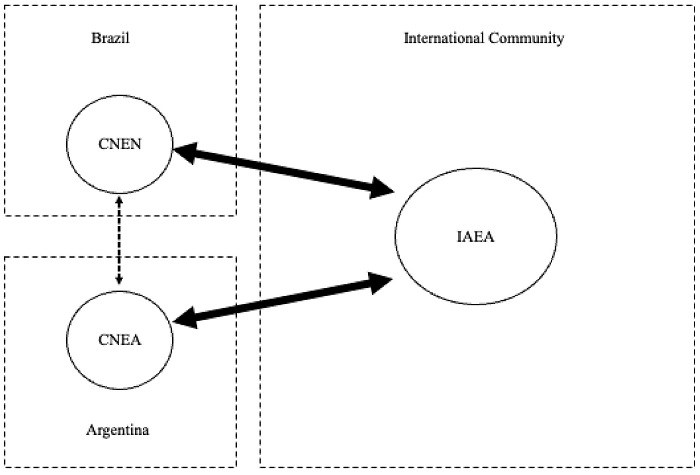
Figure 1
Verification and Trust-Building through Ad Hoc Inspections
Source: Elaborated by the Author
Regional Verification
The second model is that of regional verification, which assumes the creation of a regional organisation to manage safeguards. This model was presented both by the West German delegation led by Ambassador Werner Ungerer in 1974, and by President Raúl Alfonsín in 1986, proposing the name of SUDATOM. The 1974 was inspired by the Euratom model, established in 1957, and it suggested the creation of a multilateral, regional intergovernmental organisation that would conduct nuclear verification inspections and that would be open for membership from other Latin American countries. The 1986 proposal was proposed in parallel to the discussions of the joint-working group created in Iperó, and it suggested the creation of a general broad institutional framework that would ensure continued transparency and demonstrate non-proliferation commitments. Neither the 1974 nor the 1986 proposals define whether CNEN and CNEN would be kept or merged with the future regional organisation.
Figure 2 below illustrates how SUDATOM would function as a trust-building measure among both countries and the international community. Under this model, both nuclear programmes would be inspected by the newly created regional organisation, which would work closely with the countries’ nuclear regulatory agencies. Additionally, other Latin American countries are represented as potential contributors or members, connecting to SUDATOM as well. The bidirectional arrows suggest mutual communication, coordination, or oversight among all parties, but a reduced direct interaction between member states. SUDATOM would interact directly with the IAEA, acting as a regional intermediary or mechanism for collective engagement with the international community.
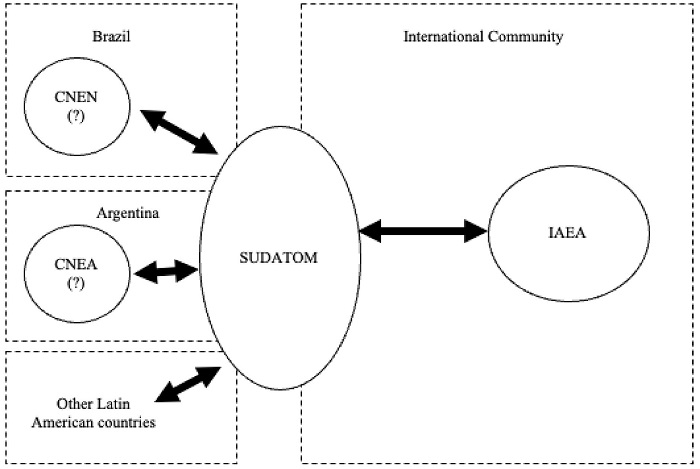
Figure 2
Verification and Trust-Building through Regional Verification
Source: Elaborated by the Author
Bilateral Verification
The third model is mutual inspections through a bilateral verification organisation, which was adopted through ABACC. This model was developed under the Collor and Menem administrations by a joint effort of both countries’ nuclear commissions and foreign ministries in 1990 and 1991, building upon previous suggestions of the working group established in Iguaçu in 1985. Under this model, both countries established a common system for the accounting and control of nuclear materials (SCCC), enabling both countries to access each other’s nuclear programs and collaborate under similar conditions. The countries created a bi-national organisation, ABACC, to implement this common system. ABACC went beyond the initial ideas of ad hoc mutual inspections, but without establishing a single regional organisation open to new countries and retaining the national commissions (CNEN and CNEA), who would provide and train the inspectors for the newly created organisation.
Figure 3 below illustrates how ABACC would function as a trust-building measure among both countries and the international community. Under this model, both nuclear programmes are inspected by the bilateral organisation, which works closely with the countries’ nuclear regulatory agencies. Direct contact between the regulatory agencies and the IAEA is maintained. ABACC adds a new layer of verification and a buffer between both countries and the international community, represented by the IAEA. This buffer, however, does not substitute for the role of the national commissions, nor is it open to other countries in the region, as SUDATOM would have implied. This extra layer of verification also allows for deeper cooperation and transparency between the countries, ensuring both countries’ credibility, and also creating a forum for bilateral communication that hinders new tensions from emerging.
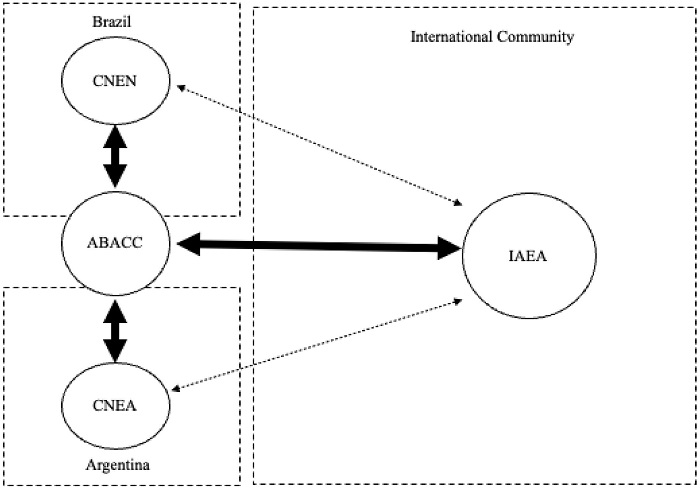
Figure 3
Verification and Trust-Building through Bilateral Verification
Source: Elaborated by the Author
Conclusion
In 1991, Brazil and Argentina established the only bilateral nuclear verification organisation worldwide. ABACC is the culmination point of a rapprochement process that started in the 1980s when former adversarial countries became cooperation partners. This article traced this process, focusing on the nuclear verification proposals that emerged from political and scientific communities, and it shows how these proposals reflect different approaches to transparency and trust-building. I classify these proposals into three models: (1) ad hoc inspections, (2) regional verification, and (3) bilateral verification.
Each of these three models represents a different level of integration and coordination, aimed at ensuring mutual confidence, demonstrating non-proliferation commitments, and building credibility with the international community. The ad hoc inspections model focused on confidence-building measures through frequent mutual visits to nuclear facilities, promoting transparency while retaining national control over verification. This model was already suggested in the 1970s by actors such as Atucha power plant director Jorge Cosentino and by US Congressman Paul Findley. It was also discussed and considered by a binational working group created by the 1985 Iguaçu Declaration. The second mode proposed creating SUDATOM, a regional verification organisation inspired by Euratom, which would oversee safeguards and include other Latin American countries, acting as a regional intermediary with the IAEA. This model was suggested during bilateral negotiations between West Germany and Brazil in 1974, and by representatives of the Raúl Alfonsín government in 1986. Finally, the bilateral verification model, realised through ABACC, established a bi-national organisation to inspect both countries’ nuclear programmes, in coordination with the IAEA. This model simultaneously ensured that the two countries would join the international non-proliferation regime as credible partners while rejecting the NPT.
The history of the Brazilian-Argentine nuclear cooperation demonstrates how trust-building mechanisms can transform rivalries into partnerships, enhance transparency, and provide a robust framework for non-proliferation commitments recognised by the international community. It also shows that long-term solutions to security interests should be driven by regional actors and tailored to their specific needs, in a gradual process of discussion and consideration of multiple options available.
Acknowledgements
The German Ministry for Education and Research generously supported this research under Grant Number 01UG2210A (VeSPoTec).
References
“An Das AA von Vertretung BDR Bei Den Internationalen Organisationen. Von Ungerer Btr.: Zündung Eines Nuklearen Sprengsatzes Durch Indien Hier: Ergebnisniederschrift Über Die Ressortbesprechung in Auswärtigen Amt Am 18. Juli 1974 von 30 Juli 1974.” B136 30554. Bundesarchiv, July 30, 1974.
Agência Brasileiro-Argentina de Contabilidade e Controle de Materiais Nucleares - ABACC. Relatório anual. Rio de Janeiro, 2021. https://www.abacc.org.br/wp-content/uploads/2022/10/ABACC-RA-2021_PT.pdf
Alvim, C. F., O. Y. Mafra, and A. C. Raffo. "ABACC and the Regional Approach for the Application of Safeguards." Paper presented at Nuclear safeguards symposium: the role of national and regional safeguards: past, present and future, Tokyo, February 17, 1997
Bandarra, L. A Luta contra o Tordesilhas Nuclear: três momentos da política brasileira (1969-1998). Master Diss., Universidade de Brasilia, 2017. http://repositorio.unb.br/handle/10482/22361.
Bandarra, L. "From Bonn with Love: West German Interests in the 1975 Nuclear Agreement with Brazil." Cold War History 21, no. 3 (2021): 337-354. doi: https://doi.org/10.1080/14682745.2020.1819245.
Canto, O. A. M. O modelo ABACC: um marco no desenvolvimento das relações entre Brasil e Argentina. Santa Maria: Universidade Federal de Santa Maria, 2020.
Congress of United States. Letter from US Congressman Paul Findley to Brazilian Vice-President Adalberto Pereira Dos Santos. Washington, 1977. https://digitalarchive.wilsoncenter.org/document/123455
Congresso Nacional da República Federativa do Brasil. Relatório Final da Comissão Mista de Inquérito Destinada a Apurar o Programa Autônomo de Energia Nuclear, Também Conhecido Como 'Programa Paralelo'. Brasília, 1990. https://www2.senado.leg.br/bdsf/handle/id/194598
Coutto, T. "An international history of the Brazilian-Argentine rapprochement." International History Review 36, no. 2 (2014): 302-323. doi: https://doi.org/10.1080/07075332.2013.864987
Conselho de Segurança Nacional da República Federativa do Brasil - CSN. Memorando explicativo sobre a cooperação Brasil-Argentina utilização de energia nuclear. Brasília, 1974. http://digitalarchive.wilsoncenter.org/document/116853
"Declaração de ex ministro militar à Folha de que o Brasil terá sua primeira bomba em 1990." La Prensa, April 29, 1985. Archivo Histórico de Cancillería Argentina. AH 0006
Deutscher Bundestag. Drucksache 12/6253. Antwort Der Bundesregierung - Drucksache 12/6056 - Deutsch-Brasilianisches Nuklearabkommen. 12 Wahlperiode. Berlin, 1993. https://dserver.bundestag.de/btd/12/062/1206253.pdf
Garasino, L. Explosion atómica de La India: proyeccion eventual en América Latina. Brasília: Ministério das Relações Exteriores, 1974.
Goldemberg, J., C. F. Alvim, and O. Y. Mafra. "The Denuclearization of Brazil and Argentina." Journal for Peace and Nuclear Disarmament 1, no. 2 (2018): 383-403. doi: https://doi.org/10.1080/25751654.2018.1479129
Gray, W. G. "Commercial liberties and nuclear anxieties: The US-German feud over Brazil, 1975-7." International History Review 34, no. 3 (2012): 449-474. https://doi.org/10.1080/07075332.2012.675221.
Roehrlich, E. "Interview with Marco Marzo." IAEA History Research Project, 2015. https://iaea-history.univie.ac.at/oral-history-videos/interviews-j-o/
Kutchesfahani, S. Z. Z. Politics and the bomb: the role of experts in the creation of cooperative nuclear non-proliferation agreements. New York: Routledge, 2015.
Lafer, C. A identidade internacional do Brasil e a política externa brasileira: passado, presente e futuro. 2nd ed. São Paulo: Perspectiva, 2004.
Lima, M. R. The political economy of Brazilian foreign policy: nuclear energy, trade and Itaipu. Brasília: Fundação Alexandre de Gusmão, 2013.
Mallea, R. "El dimema nuclear que condujo a la creación de la ABACC." In O modelo ABACC: um marco no desenvolvimento das relações entra Brasil e Argentina, edited by O. A. M. Canto, 137-158. Santa Maria: Universidade Federal de Santa Maria, 2016.
Mallea, R., M. Spektor, and N. Wheeler. The Origins of Nuclear Cooperation: A Critical Oral History between Argentina and Brazil. Washington: Woodrow Wilson International Center for Scholars, 2015.
Moniz Bandeira, L. A. As relações perigosas: Brasil-Estados Unidos. Rio de Janeiro: Civilização Brasileira, 2004.
Morales, M. J. Malvinas: la guerra de los neutrales. 2nd ed. Buenos Aires: Continente, 2012.
Ministério das Relações Exteriores da República Federativa do Brasil - MRE. Visita de funcionário da embaixada a central nuclear de Atucha. Telegrama. Brasilia, 1974. https://digitalarchive.wilsoncenter.org/document/telegram-brazilian-embassy-buenos-aires-visit-embassy-employee-nuclear-center-atucha
Ministério das Relações Exteriores da República Federativa do Brasil - MRE. Brazilian Embassy Cable, Brazilian Ambassador to Bonn Reports on Soviet Pressure on West Germany. Brasília, 1977. https://digitalarchive.wilsoncenter.org/document/brazilian-embassy-cable-brazilian-ambassador-bonn-reports-soviet-pressure-west-germany
Ministério das Relações Exteriores da República Federativa do Brasil - MRE. Final Report of the 12th Meeting of the German-Brazilian Joint Commission on Economic Cooperation. Brasília, 1985a.
Ministério das Relações Exteriores da República Federativa do Brasil - MRE. Informações Ao Senhor Chefe Do DEC. Secreto. Energia Nuclear. Relações Brasil-Argentina. April 30, 1985b.
Ministério das Relações Exteriores da República Federativa do Brasil - MRE. Relato das conversações com o chanceler da Argentina, doutor Dante Caputo, em duas reuniões de trabalho no dia 20 de maio de 1985. Brasília, 1985c.
Ministério das Relações Exteriores da República Federativa do Brasil - MRE. Relato de conversações com o chanceler da Argentina, doutor Dante Caputo, em duas reuniões de trabalho no dia 20 de maio de 1985. Brasília, 1985d.
Ministério das Relações Exteriores, Comercio Exterior e Culto da República Argentina - MRECIC. Memorandum para información del Embajador Hugo Gobbi. Producido por el Ministro Raúl A. Estrada Oyuela. Asunto: Proponer alternativa a la ratificación de Tlatelolco. Buenos Aires, 1984.
Ministério das Relações Exteriores, Comercio Exterior e Culto da República Argentina - MRECIC. Sección Reaseguros Mutuos (report)Annex 3. SUDATOM: Propuesta para la creácion de un organismo multinacional de coraboración nuclear americana. Dr Miguel J. Culaciati. Buenos Aires, 1986.
Ministério das Relações Exteriores, Comercio Exterior e Culto da República Argentina - MRECIC. Resolución 170 OPANAL - Condena Sobre Armas Nucleares En Malvinas. Buenos Aires, 1989.
Musto, R. A. "Tlatelolco tested: the Falklands/Malvinas war and Latin America's nuclear weapons free zone." NPIHP Working Paper Nr 8, July, 2015
Patti, C. O programa nuclear brasileiro: uma história oral. Rio de Janeiro: Fundação Getúlio Vargas, 2014. http://bibliotecadigital.fgv.br/dspace/handle/10438/13733.
Patti, C. Brazil in the global nuclear order, 1945-2018. Baltimore: Johns Hopkins University, 2021. https://jhupbooks.press.jhu.edu/title/brazil-global-nuclear-order-1945%E2%80%932018.
Patti, C., and R. Mallea. "American seeds of ABACC? Findley's proposal to create a mutual nuclear inspections system between Brazil and Argentina." The International History Review 40, no. 5 (2018): 996-1013. doi: https://doi.org/10.1080/07075332.2018.1441891
Plum, M. O. N., and C. A. R. Resende. "The ABACC experience: continuity and credibility in the nuclear programs of Brazil and Argentina." The Nonproliferation Review 23, no. 5-6 (2016): 575-593. doi: https://doi.org/10.1080/10736700.2017.1339402.
Pozzo, J. El desarrollo nuclear de Argentina y Brasil: de la desconfianza inicial a la cooperación sostenida. London: Editorial Académica Española, 2018.
Presidência da República Federativa do Brasil, and República da Argentina. Declaração conjunta sobre política nuclear. Brasília, 1985. https://www.abacc.org.br/wp-content/uploads/2016/10/1985-Declara%C3%A7%C3%A3o-conjunta-sobre-Pol%C3%ADtica-Nuclear-portugu%C3%AAs.pdf (era Brasil and Argentina)
Presidência da República Federativa do Brasil, and República da Argentina. Declarcion de Ipéro: Declacion conjunta sobre política nuclear. São Paulo, 1988. https://www.abacc.org.br/es/wp-content/uploads/sites/3/2016/10/Declara%C3%A7%C3%A3o-de-Iper%C3%B3-espanhol-assinada.pdf. (era Brasil and Argentina)
Presidência da República Federativa do Brasil, and República da Argentina. Agreement between the Republic of Argentina and the Federative Republic of Brazil for the Exclusively Peaceful Use of Nuclear Energy. Guadalajara, 1991. https://www.abacc.org.br/en/wp-content/uploads/sites/2/2020/05/Bilateral-Agreement.pdf.
Queiroz, F. A. Hidropolítica e segurança: as bacias platina e amazônica em perspectiva comparada. Brasília: Fundação Alexandre de Gusmão, 2012.
Rapoport, M., and C. Spiguel. Política exterior Argentina: poder y conflictos internos (1880-2001). Buenos Aires: Capital Intelectual S A, 2005.
Redick, J. R. The evolution of the Argentine-Brazilian nuclear raprochement. Washington: Institute for Science and International Security, 1996. http://isis-online.org/596am1a
Saraiva, M. G. Encontros e desencontros: o ligar da Argentina na política externa brasileira. Belo Horizonte: Fino Traço, 2012.
"Telegram. Betr.: Konferenz Der Hauptlieferländer Für Zivile Nukleartechnologie. Bezug.: Fernmündliche Gespräche Zwischen Ihnen Und Dem Unterzeichnenden Am 20.06.1975." AA. B136 30554. Bundesarchiv, 1975.
Vargas, E. V. "Átomos na integração: a aproximação Brasil-Argentina no campo nuclear e a construção do Mercosul." Revista Brasileira de Política Internacional 40, no. 1 (1997): 41-74. doi: https://doi.org/10.1590/S0034-73291997000100003
Wrobel, P. S., and J. R. Redrick. "Nuclear cooperation in South America: the role of scientists in the Argentine-Brazilian rapprochement." Annals of the New York Academy of Sciences 866, no. 1 (1998): 165-181. doi: https://doi.org/10.1111/j.1749-6632.1998.tb09151.x
Notes
Author notes