ABSTRACT: The aim of this study was to evalúate carbohydrates utilization by wild red grouper Epinephelus morio. Juveniles were fed during 93 d on a selection of starches: native raw cornstarch (RCS), waxy cornstarch (WCS), raw potato starch (RPS) and gelatinized potato starch (GP) at 20% inclusión level. The best growth was obtained in fish fed cornstarch either native raw of waxy cornstarch (p < 0.05). Hepatosomatic Índex and blood glucose (40 mg dL-1) were similar as well as hematocrit valúes (50%) (p > 0.05), whereas glycogen content increased up to 200 mg g-1 with waxy cornstarch. Specific activity of α-glucosidase and α-amylase remained stable (p > 0.05). Hepatic glycolytic enzymes increased with raw native and waxy cornstarch (p < 0.05); metabolic enzyme glucose 6 phosphate dehydrogenase (G6P-DH) was activated with raw native cornstarch (p < 0.05) while pyruvate kinase (PK) remained stable regardless of treatments (p > 0.05). Hexokinase (HK1) and glucokinase (GK) varied according to carbohydrate source: valúes were higher with cornstarches than potato starches (p < 0.05). Pentose monophosphate shunt (HMS) remained not altered by starch sources (p > 0.05). In final, the low size of granules from cornstarch favored the assimilation in liver of wild juveniles red grouper.
Keywords:GrouperGrouper,digestive enzymesdigestive enzymes,glucoseglucose,glycogenglycogen,metabolic enzymesmetabolic enzymes.
RESUMEN: El objetivo de este estudio fue evaluar la utilización de carbohidratos en juveniles silvestres del mero E. morio alimentados con una selección de almidones: maíz crudo (RCS), maíz ceroso (WCS), papa cruda (RPS) y papa gelatinizada (GP). Los juveniles de peces se alimentaron durante 93 d con 4 dietas que se prepararon con 20% de nivel de inclusión de almidón. Se observaron diferencias significativas en el coeficiente de crecimiento térmico TGC (p > 0.05). Los mejores coeficientes se obtuvieron con el almidón de maíz crudo y ceroso (p < 0.05). El hematocrito (50%), el índice hepatosomático y glucosa en sangre (40 mg dL-1) fueron similares (p > 0.05), mientras que el contenido de glucógeno aumentó hasta 200 mg g-1 con el almidón de maíz ceroso. La actividad específica de α-glucosidasa y α-amilasa permaneció estable (p > 0.05). Las enzimas glucolíticas hepáticas aumentaron en los peces alimentados con el almidón de maíz crudo y ceroso (p < 0,05). La enzima glucosa 6 fosfato deshidrogenasa (G6P-DH) se activó con el almidón de maíz crudo (p < 0.05). La piruvato cinasa (PK) se mantuvo estable independientemente de los tratamientos (p > 0.05). La actividad hexocinasa (HK1) y glucocinasa (GK) cambiaron con la fuente de almidón, siendo mayor en ambos almidones de maíz que los almidones de papa (p < 0.05). La ruta pentosa fosfato (HMS) permaneció sin alteración por las fuentes de almidón (p > 0.05). En conclusión, el tamaño de partícula de gránulo inferior del almidón de maíz favoreció la asimilación en hígado de juveniles silvestres de mero rojo.
Palabras clave: Enzimas digestivas, glucosa y glucógeno, enzimas metabólicas, mero.
Artículos científicos
Efecto de almidones nativos y modificados sobre el desempeño nutrimental y fisiológico en los juveniles silvestres del mero rojo (Epinephelus morio)
Effect of native and modified starches on nutritional and hysiological performance of wild juveniles of red grouper (Epinephelus morio)
Universidad Juárez Autónoma de Tabasco, Dirección de Investigación y Posgrado
Received: 07 July 2017
Accepted: 21 April 2018
Contract number: 219713-3
Red grouper (Epinephelus morio) is a new candidate species for aquaculture and represents a commercial species in the Gulf of México; however, overfishing led to a drop of the natural populations. E. morio belongs to Serranidae family and like other groupers, is considered a predator that fed on large variety of prey. In this sense, crabs are the most abundant prey in its stomach content; also shrimps, lobsters, cephalopods, and marine fish can be present (Giménez et al. 2001). This diversity of preys in the daily meáis showed the great flexibility and opportunism at a trophic level where groupers can find an adequate nutrition (Schmitt 1986). Al- though, these studies present E. morio as a colossal carnivore, biochemical information on enzymes involved in digestión or intermediary metabolism enzymes related to feeding habits are scarce (Amirkolaie et al. 2005).
In relation to the nutrition of red grouper a previous work has been done (Silva et al. 2014) focusing on protein sources selection and requirement without consideration for dietary carbohydrates. However, dietary carbohydrate as an alternative to limit protein content in feed (Cowey and Walton 1989) were tested in carnivorous species such as Atlantic salmón Salmo salar (Hemre and Hansen 1998), gilthead seabream Sparus aurata (Metón et al. 2003, Enes et al. 2006, Fernández et al. 2007), snout bream Megalobrama amblycephala (Ren et al. 2015), European seabass Dicentrarchus labrax, (Peres and Oliva-Teles 2002), rainbow trout Oncorhynchus mykiss (Kirchner et al. 2005).
Utilization of carbohydrates depends on feeding habits: omnivorous fish exhibited a higher starch utilization compared to carnivorous fish; glucose or maltose dextrin was utilized faster than higher molecular form, such as starches that contain amylose and amylopectin α-D (l-4)-glycosidic bonds (Wilson 1994). However, the digestión of the different starches depends also on the characteristics related to granule size: cornstarch (5 to 25 µm) can be digested better than potato starch (15 to 100 µm) (Buleon etal. 1998). The amylopectin content is also different: waxy and raw cornstarches with 99 and 73% content, and raw and gelatinized potato starches around 78%. Amylopectin was found more soluble and stable in water solution and do not form starches resistant to digestión (Tharanathan 2002).
Considering the above-mentioned, wild juvenile’s E. morio possess a carbohydrase activity in the pyloric caeca and intestine and will be able to digest dietary starches under controlled conditions. In this sense, to guarantee the effective utilization of glucose in the liver, it needs to be phosphorylated by hexokinase (HK) with low Km (0.1 mM). Glucokinase isoform (HK IV) with high km (5-10 mM) plays a regulator role for glycaemia (Metón et al. 2003, Enes et al. 2006) and the metabolic profile responded as an adaptation to various energy sources. The present study aim to the dietary acclimation of wild juvenile’s E. morio and the effect of native and modified starches from various origins for digestión and intermediary metabolism.
Epinephelus morio juveniles (initial mean body weight 109.2 ± 2.4 g) were captured along the Coastal area of the Yucatán, México, and after a short period of quarantine (10 d), fish were trans- ferred to the experimental rearing unit consisting in 15 fiberglass cylindrical tanks (500 L of water capacity each) with recirculated water.
To evalúate the different starches, a com- pletely randomized design with four treatments and three replicates per treatment was set. Juveniles were set into experimental tanks and fed with four different diets for 93 days (3 tanks per diet; n=30 per treatment). The starches tested were: Native raw cornstarch (RCS), waxy cornstarch (WCS), raw potato starch (RPS) and gelatinized potato starch (GP) at a 20% of inclusión level. Crude protein 41-47%; lipid 5-8%; ash 13-15%; Nitrogen free extract 26-29%; 16-17 kJ g-1 (Table 1). The protein sources were selected according to Silva et al. (2014). Macroingredients previously sieved (< 250 ^m) and mixed with micro-ingredients during 15 min then 20-30% water added. The mixture was subsequently extruded through a meat mincer and collets dried to 10% and stored at -20 °C until fed. During the trial, fish were fed 3% body weight, by hand twice a day, 7 days a week and monitored monthly for biometry. Water temperature 27.2 ± 1.1 in the morning and 27.6 ± 0.9°C in the after- noon, salinity 37.4 ± 0.1 ups, dissolved oxygen 5.5 ± 0.3 mg L-1 were recorded.
Composition of experimental diet (g kg-1) and parameters. Raw native cornstarch (RCS), waxy cornstarch (WCS), potato raw starch (PRS), gelatinized potato starch (GPS)
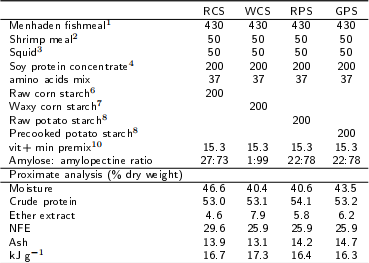
1 Menhaden fishmeal APLIGEN. Special Selection; 2Shrimp meal; 3squid, fishing crude; 4Soy protein concentrate. WACHSEN; 5LYS, THR, LEU, TRP, Future Foods; 6Raw Corn Starch. CP Ingredients; 7Waxy corn starch. WACHSEN; 8Raw potato starch; 9Aluminium silicate 10 DSM (mg kg−1 diet): A, 18000 (IU kg−1 diet); cholecalciferol, Rovimix Stay-C 35 .13%; 2000 (IU kg−1 diet); E, 35; Na menadione bisulphate; B1, 15; B2, 25; Ca pantothenate, 50; nicotinic acid, 200; B6, 5; folic acid, 10; B12, 0.02; biotin, 1.5; C, 50; inositol, 400.11 . amino acids mix (LYS5 THR5 LEU5 TRP5: 12,20,4,1 respectively.
Valúes displayed survival rate (%), thermal growth coefñcient (TGC) daily calculated as: final body weight 1/3-initial body weight 1/3/T°C* number of days*100 (Cho 1992). Ingestion rate was calculated based on 3% biomass recalculated to convert into energy valúes (Table 1).
At the end of growth experiment, 10 fish of each treatment were anesthetized with 0.1 mg mL-1 clove oil poured in seawater and then sam- pled, blood collected from the caudal vein with a heparinized syringe, sealed in a capillary tube, centrifuged at 380 g for one hour (3 replicates per fish); hematocrit valué is the volume occupied by circulating red blood cells in the blood expressed as a percentage of the total volume of blood (Daisley 1973). Glucose concentration was calculated with a standard curve of D-glucose (1 mg mL-1). To measure hepatic glycogen 60 mg liver tissue weighed on an analytical balance (Ohaus Pioneer TM) followed the technique of Dubois et al. (1965). Stomach, liver, pyloric caeca and intestine dissected on ice were frozen at -80°C for further biochemical analysis.
Enzyme extraction was performed by disrupting pyloric ceca and intestine samples in dis- tilled water using an Ultra Turrax IKA T18 (North Chase, Wilmington) then organs homogenized in pyrogen-free water at a ratio 1:5 (w/v), centrifuged at 16170 g -4°C, 20 min, supernatant removed and stored at -80°C for biochemical analysis. Alpha-amylase activity was measured with 2% starch as substrate and a citrate-phosphate buffer 100 mM, NaCI 50 mM pH 7.5. Specific activity was ex- pressed in U mg-1 soluble protein (Robyt and Whelan 1968). Alpha-glycosidase activity was read at 415 nm with 4-nitrophenyl ß-D-glycopyranoside as a substrate in a Na-phosphate buffer (Clark et al. 1984).
Liver was homogenized in 50 mM Tris-HCI with pH 7.5, 4 mM EDTA, 50 mM NaF, 0.5 mM phenylmethylsulfonyl fluoride, 500 mM 1,4- dithiothreitol and 250 mM sucrose and centrifuged at 16 170 g for 30 min at 4°C in an Ultra Turrax IKA T18 (position 4, 10 s). Activities of pyruvate kinase, EC 2.7.1.40, fructose-l,6-biphosphatase (FBPase- 1, EC3.1.3.11), glucose 6-phosphate dehydrogenase (G6P-DH, EC 1.1.1.43), and alanine amino- transferase (ALAT, EC 2.6.1.2) were assayed with crude liver extracts using a Bio-Rad Benchmark Plus microplate spectrophotometer (Bonamusa et al. 1992). Additionally, hexokinase 1(HK-1, HK; EC 2.7.1.1), hexokinase 2 (HK-2, HK; EC 2.7.1.1) and glucokinase (GK, EC 2.7.1.2) activities calcu- lated from a frozen liver sample homogenized (1/5 dilution) in an ice-cold buffer (80 mM Tris, 5 mM EDTA; 2 mM dithiothreitol; 1 mM benzamidine; 1 mM 4-2-aminoethyl benzene sulphonyl fluoride; sucrose 1 M, KCI 1M, pH 7.6. After centrifugation (16 170 g for 40 min at 4°C), the supernatant was sepa- rated on a Sephadex G-25 column. Hexokinase (low Km HKs) and glucokinase (high Km HK or HK IV) activities were measured using 1 M and 100 mM glucose respectively at 37°C. The assay on glucokinase activity from frozen samples required a correction by measuring GDH (EC 1.1.1.47) activity (Tranulis et al. 1996), all enzyme assays analyzed at 30 °C, read at 340 nm.
Activities were expressed as Units per mg soluble protein from liver. Protein concentration (Bradford 1976) used a Sigma protein assay kit with bovine serum albumin as a standard; one unit of enzyme activity was defined as the amount of enzyme that catalyzed hydrolysis of 1 µmol substrate per min at assay temperature.
A one-way ANOVA test was applied with survival percentages that were previously transformed to arcsine valúes. One block of the nested ANOVA (p < 0.05) assessed the significance for thermal growth coefficient, physiological parameters and intermediary metabolic enzymatic activities. Tukey múltiple range test was applied when significant differences were observed. In absence of normality and homogeneity of variances of digestive enzymatic activities, a Kruskal-Wallis test helped compare treatments at a probability of 0.05 for all analyses (Statistica 7.0).
Diets containing starch had no incidence on ingestión rate (p > 0.05) but a positive correlation was observed between final wet weight and ingestión rate (Figure 1). TGC valúes were similar whatever treatment (p > 0.05, Table 2).Diets containing starch had no incidence on ingestión rate (p > 0.05) but a positive correlation was observed between final wet weight and ingestión rate (Figure 1). TGC valúes were similar whatever treatment (p > 0.05, Table 2). Hematocrit (%) was similar for all treatments (p > 0.05, Table 3) as well as plasma glucose level (p > 0.05). Liver glycogen content peaked at 214 ±14 mg g-1 with waxy cornstarch (p < 0.05); hepatosomatic Índex did not change (p > 0.05). Specific activity of α-amylase gave a mean valué of 2768 U and 448 U for pyloric caeca and intestine respectively and α-glycosidase (mean valué 610 U and 487 for pyloric caeca and intestine respectively did not differ whatever dietary treatment (p > 0.05).
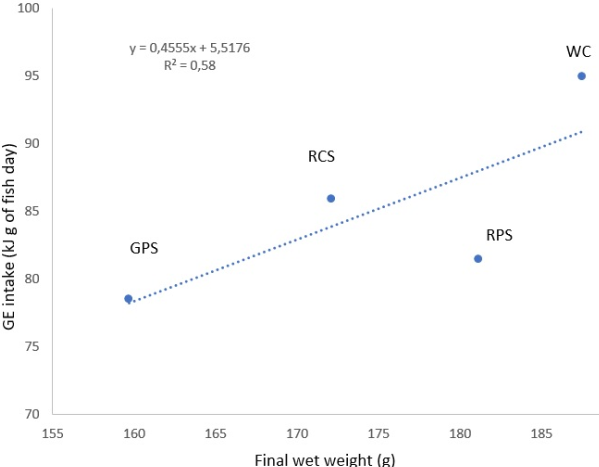
Figure 1
Correlation between final wet weight (g) and ingestion rate (kJ g of fish-1 of the wild juveniles E. morio. Raw native cornstarch (RCS), waxy cornstarch (WCS), raw potato starch (RPS), gelatinized potato starch (GPS)
Zootechnical parameters of wild juveniles of E. morio: initial and final wet weight, survival, thermal growth coefficient (TGC). Raw native cornstarch (RCS), waxy cornstarch (WCS), potato raw starch (PRS), gelatinized potato starch (GPS)

* Different letters in superscript in the same row indicate significant differences. Mean(SE.
Physiological parameters of E. morio fed different diets. Raw native cornstarch (RCS), waxy cornstarch (WCS), raw potato starch (RPS), gelatinized potato starch (GPS)

1 Hematocrit = (viscera weight/body weight) ×100. 2HSI = (liver weight/body weight) ×100. Significant differences in the same row are indicated by different letters (Tukey test, p<0.05). Mean(SE
In liver, metabolic enzymes ofglycolytic path- way reacted according to the nature of starch significantly. HK1, HK2 and GK activities were significantly higher in fish fed raw cornstarch (p < 0.05) but no difference appeared in fish fed waxy cornstarch (p > 0.05). The lowest valúes were ob- served in fish fed gelatinized potato starch; however, no differences were observed in pyruvate kinase ac- tivity (p > 0.05, Table 4). FBPase activity was low in fish fed gelatinized potato starch (p < 0.05), and this was inversely correlated to alanine amino transferase activity, high in this same diet. By last, enzymes belonging to hexose monophosphate shunt presented the highest activity when fish received raw cornstarch (p < 0.05, Table 4).
Specific activities (U mg protein-1) of hepatic intermediary metabolic enzymes in wild juveniles E. morio. Raw native cornstarch (RCS), waxy cornstarch (WCS), raw potato starch (RPS), gelatinized potato starch (GPS)
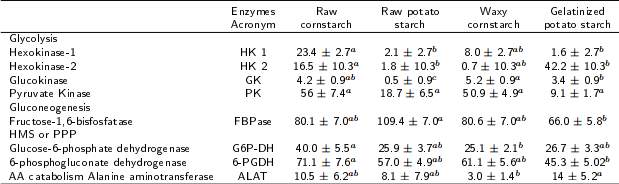
Mean values ±SE for each parameter (n=10). Significant differences in the same row are indicated by different letters in same row (Tukey test, p<0.05). Mean(SE
This study demonstrated the ability of E. morio to incorpórate dietary glucose from different starches to liver intermediary metabolism, in spite to its carnivorous habit and whose natural diet is constituted mainly on crustaceans, mollusks and fish (Giménez et al. 2001). The results of growth showed no significant differences between diets, estimated through thermal growth coefficient (TGC). That led all opportunity to examine the effect of carbohydrate from various origins on fish metabolism. Carnivorous fish received 20% inclusión level during 93 d with a glycaemia that remained relatively stable, suggesting that E. morio can regúlate glucose homeostasis (Furuichi and Yone 1981) and metabolic aspects through phosphorylation and glycolytic pathway. In similar carnivorous species such as Salmo salar, Hippoglosus hippoglosus, Sparus sarba and D. labrax, GK activity had a fundamental role in the glucose regulation (Leung and Woo 2012, Viegas et al. 2015). Another parameter that could indícate that fish were healthy during the time of experiment was the hematocrit allowing eventually an interaction between nutrients in fish diets in captivity (Wahli 2002). Any change in hematocrit valúes may be a sign of immune-suppression; otherwise stress under hypoxia condition may lead to excessive erythrocytes amount that modify blood formula (Valenzuela et al 2002). In this study, hematocrit valúes fluctuated around 50%, and no significant differences between treatments were found. For red grouper in natural environment, hematocrit valúes have been reported around 40%. It may be that under controlled condition (lower stress) fish fed a diet that covers its nutritional requirements produced a high hematocrit valué (50%).
A high assimilation of native cornstarch and waxy cornstarch in relation to the other dietary treatments was corroborated by TGC valúes; however, no differences were found in α-amylase and α-glycosidase activity between diets. But in the caeca, an increment of digestive activities was observed for all treatments. Wilson (1994) pointed out that a simple carbohydrate was absorbed quickly, producing hyperglycemia, unlike a starch digested slowly. Plasma glucose valúes were stable with all diets whatever starch origin. E. morio as a carnivorous species presented less α-amylase compared to an herbivorous fish (Castillo et al. 2018), when fed corn starch small granules (5-30 µ). That would potentiate a hydrolytic activity, liberating glucose and activating glycolytic routes. The situation is different with large granules ( 100 pm) as in potato that reduced the rate of hydrolysis (Bello-Pérez et al 1996). Native cornstarch with large granules size compared to potato starch possesses a greater contact surface area and produced a lower rate of enzymatic hydrolysis (Tester et al 2004). Cornstarch granules had pores and channels that facilitated a diffusion of α-amylase into the substrate and generate a diffused hydrolysis (Zhang et al 2006). Native cornstarch containing small granules can induce HK-I, HK-II and free G-6P activities; therefore the most obvious result with carbohydrate utilization in E. morio recorded through enzymes activity is a control point to incorpórate plasma glucose. By contrast, potato starch was digested by a process of exo-corrosion beginning in outer membrane to end up inside the granule (Tester and Karkalas 2006). Waxy cornstarch produced the highest weight gain, as a result of a positive energetic balance, and also higher glycogen content in liver. This starch rich in amylopectin (99%) presents ramifications that allow a better access via a (1-4) glycosidic linkages hydrolyzed by α-amylase (Bello-Pérez et al. 1996).
The structure of cornstarch helped absorb granules and utilize starchy fraction as evidenced by HK-I and GK activation. 6PG-DH was more active in juveniles fed native raw cornstarch, which activated energy storage. Glycogen submitted to lipogenesis route lead to ribose-5P via pentose phosphate pathway route. In this sense, GK activity regulates glucose homeostasis in fish, in contrast with other hexokinases having a low affinity for glucose (Km 10 mM). This enzyme is not regulated by G6-P and acted only when plasma glucose concentration was high (saturated HK-I and HK-II). GK increased activity occurred with waxy cornstarch, same diet that produced the highest concentration of glycogen in fish. Additionally, PK acting as a third control point in glycolysis presented an increment of activity with raw cornstarch. In such treatment, fish produced enough G6-P substrate via the routes of energy storage: glycogenesis pathway and PPP that generates reducing compounds for unsaturated fatty acids and ribulose 5-P for tissue build-up. In addition, G6P-DH and 6PG-DH had the highest activity with raw cornstarch (p < 0.05). E. morio could be using G6-P for glycolysis, store energy as glycogen form and increase in weight.
Fish in general have a limited tolerance to glucose; it has been shown that there are different factors that lead fish to have a poor utilization and storage capacity for glucose (Wilson 1994, Hemre et al. 2001). Carnivorous fish can tolérate up to 20% carbohydrate without problems of hyperglycemia. In salmonid (Cho 1992), seabream (Metón et al. 2003), tilapia and yellowtail (Shimeno et al. 1996), pompano (Chuanpeng et al. 2015), fish adapt their metabolism to compénsate with dietary changes. Also, groupers assimilate carbohydrate, allowing energy balance to limit dietary protein utilization (Chen and Tsai 1994). Intermediary metabolism was affected by carbohydrate sources at three levels: glycolysis, gluconeogenesis and pentose shunt via (Méton et al. 1999). Fish fed native cornstarch activated glycolytic enzymes (HK-I, HK-II, GK and PK), driving more energy, to achieve its best weight gain valúes.
Gluconeogenesis is a preferred energy route for fish unlike mammals, using amino acid as substrate to obtain energy precursors: regulatory enzymes (FBPase) responsible to produce glucose de novo, from precursors such as lactate, amino acids, glycerol and fructose, gave an indication whether fish took substrates from protein as energy source. FBPase decrease in fish receiving diets containing raw or waxy cornstarch while glycolysis route being active. In this case, rainbow trout fed raw cornstarch increased enzymes of pentose’s pathway (G6P-DH and 6-PGDH), favoring a source of NADPH (Hemre et al. 2001). As for glycolysis, fish fed raw potato starch produced a low GK activity, suggesting poor glucose utilization.
The results showed that E. morio fed waxy or raw cornstarch presented the highest weight gain. All carbohydrate sources were well digested and blood glucose did not vary so far. There were differences at intermediary metabolic enzymes. Glucokinase activity was measured only in fish fed diets containing carbohydrate. Glycolysis was not influenced by carbohydrate accumulation and liver glycogen increased when E. morio received waxy and native cornstarch. These two diets increased activities of HK-I-II and GK. These results suggest that some starches contribute to regulate carbohydrate metabolism. 6PG-DH increased in fish fed native cornstarch. Therefore, E. morio will cope with a metabolism based on waxy cornstarch containing amylopectin (99%) and will be included in future studies as main carbohydrate source.
The authors wish to thank UNAM (IN 219713-3 project) for the financial support. To Karla Escalante, Jaime Suárez, Elisa Chan-Rivas, Korinthya López, Adriana Paredes for their technical support.
Corresponding author: alvarez_alfonso@hotmail.comCorresponding author: mggc@ciencias.unam.mx
Composition of experimental diet (g kg-1) and parameters. Raw native cornstarch (RCS), waxy cornstarch (WCS), potato raw starch (PRS), gelatinized potato starch (GPS)
1 Menhaden fishmeal APLIGEN. Special Selection; 2Shrimp meal; 3squid, fishing crude; 4Soy protein concentrate. WACHSEN; 5LYS, THR, LEU, TRP, Future Foods; 6Raw Corn Starch. CP Ingredients; 7Waxy corn starch. WACHSEN; 8Raw potato starch; 9Aluminium silicate 10 DSM (mg kg−1 diet): A, 18000 (IU kg−1 diet); cholecalciferol, Rovimix Stay-C 35 .13%; 2000 (IU kg−1 diet); E, 35; Na menadione bisulphate; B1, 15; B2, 25; Ca pantothenate, 50; nicotinic acid, 200; B6, 5; folic acid, 10; B12, 0.02; biotin, 1.5; C, 50; inositol, 400.11 . amino acids mix (LYS5 THR5 LEU5 TRP5: 12,20,4,1 respectively.
Figure 1
Correlation between final wet weight (g) and ingestion rate (kJ g of fish-1 of the wild juveniles E. morio. Raw native cornstarch (RCS), waxy cornstarch (WCS), raw potato starch (RPS), gelatinized potato starch (GPS)
Zootechnical parameters of wild juveniles of E. morio: initial and final wet weight, survival, thermal growth coefficient (TGC). Raw native cornstarch (RCS), waxy cornstarch (WCS), potato raw starch (PRS), gelatinized potato starch (GPS)
* Different letters in superscript in the same row indicate significant differences. Mean(SE.
Physiological parameters of E. morio fed different diets. Raw native cornstarch (RCS), waxy cornstarch (WCS), raw potato starch (RPS), gelatinized potato starch (GPS)
1 Hematocrit = (viscera weight/body weight) ×100. 2HSI = (liver weight/body weight) ×100. Significant differences in the same row are indicated by different letters (Tukey test, p<0.05). Mean(SE
Specific activities (U mg protein-1) of hepatic intermediary metabolic enzymes in wild juveniles E. morio. Raw native cornstarch (RCS), waxy cornstarch (WCS), raw potato starch (RPS), gelatinized potato starch (GPS)
Mean values ±SE for each parameter (n=10). Significant differences in the same row are indicated by different letters in same row (Tukey test, p<0.05). Mean(SE
