Comunicación Breve
Seroprevalencia de anticuerpos IgG / IgM anti-T. gondii en mujeres de Coro, Venezuela
Seroprevalence of antibodies IgG/IgM anti-T. gondii in women of Coro, Venezuela
 Semprún-Hernández Neomar neomar.semprun@gmail.com
Martínez-Méndez Dilia dkmartinez.mw@gmail.com
Semprún-Hernández Neomar neomar.semprun@gmail.com
Martínez-Méndez Dilia dkmartinez.mw@gmail.com
Seroprevalencia de anticuerpos IgG / IgM anti-T. gondii en mujeres de Coro, Venezuela
Kasmera, vol. 47, núm. 1, pp. 66-69, 2019
Universidad del Zulia
Recepción: 04 Enero 2019
Preprint: 19 Marzo 2019
Aprobación: 06 Marzo 2019
Resumen: Los estudios muestran una alta frecuencia de IgG contra T. gondii. El objetivo fue evaluar la seroprevalencia de IgG y IgM anti-T. gondii en 522 mujeres. Se encontró 13% de la seropositividad IgG +/IgM- y 0,7% IgG+/IgM+. Esta frecuencia podría deberse a las características del clima. Recomendamos estudiar si el medio ambiente puede afectar la viabilidad de los ooquistes.
Palabras clave: toxoplasmosis, seroprevalencia, IgG e IgM, Toxoplasma gondii, Venezuela.
Abstract: Studies show a high frequency of IgG against T. gondii. The aim was to evaluate the seroprevalence of IgG and IgM anti-T. gondii in 522 women. 13% of seropositivity IgG+/IgM- and 0.7% IgG+/IgM+ was found. This could be due to the climate characteristics who may decrease the transmission. We recommend the evaluation if the environmental may affect the viability of the oocysts.
Keywords: toxoplasmosis, seroprevalence, IgG & IgM, Toxoplasma gondii, Venezuela.
Introduction
Toxoplasmosis is a worldwide parasitic zoonosis produced by Toxoplasma gondii. In immunocompetent individuals, the primary infection is usually asymptomatic, but persists in a latent state throughout life, and can be reactivated in case of immunosuppression 1. The Feline is the definitive host eliminating oocysts in the feces. The mechanisms of human infection are the ingestion of oocysts, blood transfusion, organ transplants and by placental transmission 1-4. Worldwide, the prevalence of toxoplasmosis is high. In the Americas, around 65% of the population has detectable levels of total anti-Toxoplasma gondii specific immunoglobulins, where contact with feces of cats has been shown to be the main risk factor 2.
In Venezuela, studies conducted in pregnant women, children and adults at risk (homeless), blood donors and native populations, show a high frequency of specific IgG against T. gondii5-14. However, because it is not a mandatory reporting disease, there is a sub-registration 15. The aim of this study was to evaluate the seroprevalence of IgG and IgM anti-T.gondii in women of the Coro in 2008 and 2012.
Methods
Design and sample: A comparative study was conducted with 2008 and 2012 data. 522 women from Coro city, randomly selected, participated in the study and a serum sample were collected.
Ethical considerations: All women voluntarily accepted their participation through the signed informed consent. Anonymity and the World Bioethics Congress guidelines as well as Helsinki declaration were preserved.
Technical information: IgG and IgM anti-Toxoplasma gondii detection in 2008 (n=268) was made by the Microparticle Enzyme Immunoassay (MEIA), using the commercial kit (Toxo IgG and Toxo IgM, AxSYM®assay Abbott), and in 2012 (n=254) with the Fluorescent Enzyme-Linked Assay (ELFA), following the protocol of the manufacturer (VIDAS TOXO IgG and IgM system of bioMerieux®Inc). The reference values of the commercial kit were considered as a diagnostic. The MEIA kit reference values for IgG: positive >2.5 IU/ml and lower negative. For IgM: positive >0.600 IU/ml, negative <0.499 IU/ml and indeterminate 0.500-0.599 IU/ml. The ELFA kit reference values for IgG: positive >8 IU/ml and negative less than 4 IU/ml and indeterminate between 4-8 IU/ml. For IgM: positive >0.65 IU/ml, negative <0.55 IU/ml and indeterminate 0.55-0.65 IU/ml. Any indeterminate sample was repeated to confirm the results.
Analysis of the data: Data obtained was entered on to an excel spreadsheet and transferred to SPSS version 21 statistical program for the analysis.
Result
Of the 522 women evaluated, 86% (n=451) were seronegative anti-Toxoplasma gondii specificity IgG-/IgM-. 13% (n=65) presented IgG+/IgM-. 1% was IgG-/IgM+ (n=2) and 1% was IgG+/IgM+ (n=4). The seroprevalence by year and specificity are shown in Table 1. Women who presented seropositivity to IgM received pharmacological treatment. The distribution according to the specificity of IgG/IgM antibody is shown in Figure 1.
| Specificity | 2008 | 2012 | Total | |||
|---|---|---|---|---|---|---|
| n | % | n | % | N | % | |
| IgG+/IgM+ | 0 | 0 | 4 | 2 | 4 | 0.7 |
| IgG+/IgM- | 38 | 14 | 27 | 10 | 65 | 13 |
| IgG-/IgM+ | 1 | 0,3 | 1 | 0,3 | 2 | 0.3 |
| IgG-/IgM- | 229 | 85,7 | 222 | 87,7 | 451 | 86 |
| Total | 268 | 100 | 254 | 100 | 522 | 100 |
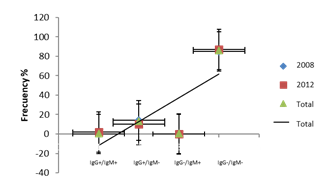
Figure 1
anti-Toxoplasma gondii IgG-IgM specificity distribution. 2008-2012. Coro. Venezuela
Discussion
Toxoplasmosis is the most widespread parasitic zoonosis in nature. It has been shown in all latitudes, in humans, more than 300 species of mammals and around 30 species of birds. It is usually asymptomatic, but it is responsible for many abortions, fetal, perinatal and infant hazard and is the most frequent cause of focal infection of the central nervous system in patients with AIDS, representing a latent threat for all immunosuppressed patients 2-4.
We found 13% of seropositivity of anti-T gondii IgG+/IgM-, keeping low thru the years. No statistically significant variation (p>0.05) during the follow-up. Positivity both for IgG/IgM was observed only in 0.7% of the 2012 samples, probably a reactivation of a past infection and was 0% on the 2008 samples (Table 1). Our data is in contradiction of the studies in Venezuela how show a high prevalence of specific IgG/IgM antibodies in urban areas between 32 5,6 and 61%, in pregnant women and in individuals at risk (homeless) between 42 and 67% 7-9. In rural areas it has been reported from 39 to 49% 10. In native populations: 50% of the Barí of the Sierra de Perijá of Zulia state, 88% of the Güajiba from the Venezuelan Amazon rainforest and 69% from the Piaroa of the Bolívar state 11-14. High prevalence rates are also observed in the rest of the Americas: Brazil 66%, Colombia 47%, Mexico 56%, Trinidad and Tobago 39% 16-19. In Europe, 38% in Croatia 20. In Asia, 42% to 55% in India, Malaysia and Nepal 21,22.
The IgM seroprevalence remained less than 1% during the years, which shows a very low prevalence of acute infection in this population 23,24. This low prevalence is also observed in a small group with no pregnant women in Oman 25. It also proves that both diagnostic techniques (ELFA and MEIA) provide good reproducibility of the results and comparable sensitivity and specificity at the quantitative level of IgG/IgM specific anti-T. gondii (Fig 1). The specific IgG/IgM reactivity it is easier to evaluate the stage of the infection since high IgG levels can persist beyond the year and even low levels can remain in past infections. However, a low titer may also be the first stage in the ascending curve of IgG in a recent infection 26,27.
The lower frequency of infection by T. gondii found in this study comparative with others carried out in the country could be due to the climate characteristics of the Coro city, with high temperatures (24-34ºC), clay soils of acidic pH (4,5-5,5) and strong trade alisios winds 28, which probably affect the viability of the oocysts, decreasing the possibility of transmission.
We recommend keeping the follow-up of the seroprevalence of infection by T. gondii in Venezuela, with the evaluation of the risk factors in the infected people and to study if the environmental characteristics may have consequences of the on the viability of the oocysts.
Acknowledge
To the staff of the laboratories “Virgen María Auxiliadora” and IVSS "Dr. Rafael Gallardo” for all the support and Dr. Rosaura Hernández for the critical review of the manuscript.
Referencias Bibliográficas
Dabanch P J. Zoonosis. Rev Chil infectología [Internet]. 2003;20:47-51. Disponible en: http://www.scielo.cl/scielo.php?script=sci_arttext&pid=S0716-10182003020100008&lng=en&nrm=iso&tlng=en. DOI: 10.4067/S0716-10182003020100008
Hill D, Dubey JP. Toxoplasma gondii: transmission, diagnosis and prevention. Clin Microbiol Infect [Internet]. 2002;8(10):634-40. Disponible en: http://www.ncbi.nlm.nih.gov/pubmed/12390281. PMID: 12390281
Mimica F, Muñoz-Zanzi C, Torres M, Padilla O. Toxoplasmosis, zoonosis parasitaria prevalente en Chile: recuento y desafíos. Rev Chil infectología [Internet]. 2015;32(5):541-9. Disponible en: https://scielo.conicyt.cl/scielo.php?script=sci_arttext&pid=S0716-10182015000600008. DOI: 10.4067/s0716-10182015000600008. PMID: 26633111
Martín-Hernández I. Toxoplasmosis congénita: una mirada al problema. Rev Biomed [Internet]. 2004;15(3):181-90. Disponible en: http://www.uady.mx/sitios/biomedic/revbiomed/pdf/rb041536.pdf
Díaz-Suárez O, Parra AM, Araujo-Fernández M. Seroepidemiología de la toxoplasmosis en una comunidad marginal del municipio Maracaibo, estado Zulia, Venezuela. Invest Clin [Internet]. 2001;42(2):107-21. Disponible en: http://produccioncientificaluz.org/index.php/investigacion/article/view/10238
Chacín-Bonilla L, Sánchez-Chávez Y, Estévez J, Larreal Y, Molero E. Prevalence of human toxoplasmosis in San Carlos Island, Venezuela [Internet]. Interciencia. 2003;28:457-62. Disponible en: http://www.redalyc.org/articulo.oa?id=33908305
Triolo-Mieses M, Traviezo-Valles L. Seroprevalencia de anticuerpos contra Toxoplasma gondii en gestantes del municipio Palavecino, estado Lara, Venezuela. Kasmera [Internet]. 2006;34(1):7-13. Disponible en: http://produccioncientificaluz.org/index.php/kasmera/article/view/4764
León de Bracho D, Sanoja C, Granadillo A. Seroepidemiología de la infección por Toxoplasma gondii en embarazadas. Kasmera [Internet]. 2001;29(2):185-97. Disponible en: http://www.produccioncientifica.luz.edu.ve/index.php/kasmera/article/view/4686
Riera L, Cárdenas E, Bullones X, Traviezo L, Perdomo R, Bonfante-G R. Incidencia y prevalencia de toxoplasmosis en embarazadas que acuden a la consulta prenatal de dos ambulatorios del estado Lara. Rev TALLERES. 2001;7:181.
Álvarez González LC, Rojas Moreno EM. Detección de anticuerpos anti Toxoplasma gondii en una comunidad rural en el estado Trujillo Venezuela. Academia [Internet]. 2003;2(3):36-8. Disponible en: http://erevistas.saber.ula.ve/index.php/academia/article/view/5951
Chacin-Bonilla L, Sanchez-Chavez Y, Monsalve F, Estevez J. Seroepidemiology of Toxoplasmosis in Amerindians from Western Venezuela. Am J Trop Med Hyg [Internet]. 2001;65(2):131-5. Disponible en: http://www.ajtmh.org/content/journals/10.4269/ajtmh.2001.65.131. DOI: 10.4269/ajtmh.2001.65.131
De La Rosa M, Bolivar J, Perez HA. Infección por Toxoplasma gondii en amerindios de la selva amazónica de Venezuela. Med (Buenos Aires) [Internet]. 1999;59(6):759-62. Disponible en: http://medicinabuenosaires.com/revistas/vol59-99/6/v59_n6_759_762.pdf
Díaz-Suárez O, Estévez M J, García P M, Cheng-Ng R, Araujo B J, García P M. Seroepidemiología de la toxoplasmosis en una comunidad indígena Yucpa de la Sierra de Perijá, Estado Zulia, Venezuela. Rev Med Chil [Internet]. 2003 ;131(9):1003-10. Disponible en: https://scielo.conicyt.cl/pdf/rmc/v131n9/art06.pdf
Devera R, Blanco Y, Amaya I, Muñoz R, Pérez K. Seroprevalencia de Toxoplasma gondii en una comunidad indigena del municipio Cedeño, estado Bolívar, Venezuela. Saber [Internet]. 2013;25(1):83-9. Disponible en: http://www.redalyc.org/articulo.oa?id=427739461009
Organización Mundial para la Salud. Reglamento Sanitario Internacional (2005) Áreas de trabajo para su aplicación. 2007 [citado 15 de enero de 2019];31. Disponible en: Disponible en: https://www.who.int/ihr/AreasofworkES.pdf
Barbosa IR, de Carvalho Xavier Holanda CM, de Andrade-Neto VF. Toxoplasmosis screening and risk factors amongst pregnant females in Natal, northeastern Brazil. Trans R Soc Trop Med Hyg [Internet]. 2009;103(4):377-82. Disponible en: http://www.ncbi.nlm.nih.gov/pubmed/19211119. DOI: 10.1016/j.trstmh.2008.11.025. PMID: 19211119
Gómez Marín JE. Toxoplasmosis: Un problema de Salud Pública en Colombia. Rev Salud Pública [Internet]. 2002;4(2):7-10. Disponible en: http://www.scielo.org.co/pdf/rsap/v4s1/v4s1a03.pdf
Adesiyun AA, Ganta K, Seepersadsingh N, Gooding R, Ramsewak S. Seroprevalence and risk factors of Toxoplasma gondii infection among pregnant women in Trinidad and Tobago. Rev Panam Salud Pública [Internet]. 2008;23(3):164-70. Disponible en: https://pdfs.semanticscholar.org/05ca/91ee9fcd6258112af4c534a589bcc868306e.pdf. DOI: 10.1590/s1020-49892008000300003
Alvarado-Esquivel C, Sifuentes-Álvarez A, Narro-Duarte SG, Estrada-Martínez S, Díaz-García JH, Liesenfeld O, et al. Seroepidemiology of Toxoplasma gondii infection in pregnant women in a public hospital in northern Mexico. BMC Infect Dis [Internet]. 2006;6(1):113. Disponible en: http://www.ncbi.nlm.nih.gov/pubmed/16839423. DOI: 10.1186/1471-2334-6-113. PMID: 16839423
Punda-Polić V, Tonkić M, Capkun V. Prevalence of antibodies to Toxoplasma gondii in the female population of the County of Split Dalmatia, Croatia. Eur J Epidemiol [Internet]. 2000;16(9):875-7. Disponible en: http://www.ncbi.nlm.nih.gov/pubmed/11297231. PMID: 11297231
Akoijam BS, Shashikant S, Singh S, Kapoor SK. Seroprevalence of Toxoplasma infection among primigravid women attending antenatal clinic at a secondary level hospital in North India. J Indian Med Assoc [Internet]. 2002;100(10):591-2, 594-6, 602. Disponible en: http://www.ncbi.nlm.nih.gov/pubmed/12452512. PMID: 12452512
Andiappan H, Nissapatorn V, Sawangjaroen N, Nyunt MH, Lau Y-L, Khaing SL, et al. Comparative study on Toxoplasma infection between Malaysian and Myanmar pregnant women. Parasit Vectors [Internet]. 2014;7(1):564. Disponible en: http://www.ncbi.nlm.nih.gov/pubmed/25498432. DOI: 10.1186/s13071-014-0564-9. PMID: 25498432
Martinez Méndez D. Seroprevalencia de la Toxoplasmosis en mujeres no embarazadas en Venezuela. Rev Soc Ven Microbiol [Internet]. 2009;29(1):49-51. Disponible en: https://www.siicsalud.com/dato/resiic.php/120949
Martínez Méndez D. Seroprevalencia de toxoplasmosis en mujeres no embarazadas. Salud i Ciencia [Internet]. 2011;18(7):647-8. Disponible en: https://www.siicsalud.com/saludiciencia/pdf/sic_187.pdf
Alzaheb RA, Al-Amer O. The seroprevalence and risk factors of toxoplasmosis among female undergraduate university students in Saudi Arabia. Oman Med J [Internet]. 2017;32(6):486-91. Disponible en: http://www.ncbi.nlm.nih.gov/pubmed/29218125. DOI: 10.5001/omj.2017.93. PMID: 29218125
Montoya JG. Laboratory Diagnosis of Toxoplasma gondii Infection and Toxoplasmosis. J Infect Dis [Internet]. 2002;185(s1):S73-82. Disponible en: http://www.ncbi.nlm.nih.gov/pubmed/11865443. DOI: 10.1086/338827. PMID: 11865443
Durlach RA, Kaufer F, Carral L, Hirt J. Toxoplasmic lymphadenitis-Clinical and serologic profile. Clin Microbiol Infect [Internet]. 2003;9(7):625-31. Disponible en: https://core.ac.uk/download/pdf/82000581.pdf. DOI: 10.1046/j.1469-0691.2003.00575.x. PMID: 12925102
Instituto Nacional de Estadística. http://www.ine.gov.ve/documentos/see/sintesisestadistica2013/estados/falcon/documentos/SituacionFisica.htm. [citado 15 de enero de 2019]
Notas de autor
Autor de Correspondencia: Martínez Méndez Dilia. Talatona Clinic. International SOS. Luanda. Angola. Rua S10. Sector de Talatona. Zona CC-B2. Luanda. Angola. Telephone: +34622339081 & +244 936174795. E-mail: dkmartinez.mw@gmail.com