Articles
Factors that influence the continuity and survival of a micro-business in Mexico
Factores que influyen en la continuidad y sobrevivencia de un micronegocio en México
Factors that influence the continuity and survival of a micro-business in Mexico
Contaduría y administración, vol. 63, no. 3, pp. 132-152, 2018
Facultad de Contaduría y Administración, UNAM
Received: 28 October 2016
Accepted: 04 September 2017
Abstract: This investigation characterized small business owners in Mexico by enterprise units. Estimations of the expectations and probability of continuing with a micro-business in the future were made. The data were obtained from the 2012 National Poll of Micro-businesses (ENAMIN) conducted by the Instituto Nacional de Estadística y Geografía (INEGI). The results reveal that the reasons Mexican micro-business owners continue operating their micro-business include family traditions, entrepreneurship benefits, and low paying jobs.
Keywords: Micro-business owners, Micro-business, Logit model, M10, M13, M21.
Resumen: Este artículo presentan los resultados de una caracterización del pequeño empresario en México, efectuada mediante el uso de un modelo de elección discreta binaria, que permite obtener estimaciones de la probabilidad y expectativa de continuar con el micronegocio en los años venideros. Para llevar a cabo este estudio, se utiliza la Encuesta Nacional de Micronegocios (ENAMIN) del año 2012, base de datos generada por el Instituto Nacional de Estadística y Geografía. Entre los principales resultados se encontró que los motivos que tienen los microempresarios mexicanos para seguir operando su micronegocio están determinados en gran medida a que son micronegocios que cuentan con una gran tradición familiar y se dio una buena oportunidad de negocio para emprenderlo, ya que los empleos que existen están mal pagados.
Palabras clave: Microempresario, Micronegocio, Modelo logit, M10, M13, M21.
Introduction
In recent years, studies of entrepreneurship has increased in Mexico’s academic and business scope. Gúzman and Trujillo (2008) illustrate two types of entrepreneurship: social-oriented and business-oriented. The primary objective of social-oriented entrepreneurship is the creation of social sustainable value. Business-oriented entrepreneurship refers to the innovating activities that create value to the entrepreneur. This business focused entrepreneurial activity in Mexico contributes to economic growth and the creation of jobs.
The INEGI (2012) stated that there were approximately 5 million enterprise units in Mexico. Of these, 99.8% are micro, small or medium enterprises that generate 52% of Mexico’s Gross Domestic Product (GDP) and employ 72% of the people in the country. Consequently, micro, small, and medium enterprises constitute the spine of the national economy in terms of commercial agreements and enterprise growth. According to the Secretary of the Economy, these enterprises generally only maintain their success in the national market for two or three years. The reasons for this include a lack of planning, data, operational problems, production, finances, vision, intern management, export support, and corruption (Dussel, 2004; Secretaría de Economía, 2013).
Accordingly, the generation and participation of micro, small and medium businesses in the Mexican territory is extremely relevant. In this study, we analyze Mexico’s micro-business. Micro-businesses include a team of up to 10 people in extractive, constructive, service, transport and commercial industries and up to 16 people in the manufacturing industry. These teams include the owner (ENAMIN, 2012).
INEGI conducted a national poll of micro-businesses (ENAMIN, 2012) to collect information about the principal characteristics of micro-business’ productive resources, organization, and expense and income amounts and distributions. We thoroughly reviewed ENAMIN (2012) to determine the reasons people start micro-businesses and their expectations for continuing with it. The present study aims to determine the factors that influence micro-business owners to start a micro-business and to keep operating their micro-businesses in the future. Qualitative and quantitative data were reviewed. A binary discrete choice model1 is used to obtain the estimations of the probability that Mexican micro-business owners will continue operating their micro-business, taking into account business performance and expectations.
Literature review
The creation, development and support of micro, medium and small businesses is a common area of investigation, especially in developing economies. These businesses promote employment, investment, innovations and competition. They significantly contribute to economic growth that, in turn, can increase social benefits.
Audretsch and Fritsch (2002), Foelster (2000), Kleppleer (1996), Audretsch (1995), Hopenhayn (1992) and Lambson (1991) maintain that entrepreneurial activity plays an important role in the economic growth of a country. If the government supports and promotes the creation of new companies, their level of economic growth will be greater. In this sense, Reynolds et al. (2002) points out that the central government of every country will need to formulate more effective public policies for the creation of new enterprises. These policies should focus specifically on the entrepreneurial activities of each society. Entrepreneurial activity is a topic that has had a variety of theorical-methodogical discussions. Hence, there are many ideologies that use different methods to identify and quantify social entrepreneurship. A great diversity of studies that try to explain these issues exist. In this research, the focus is on the business sector, particularly on the entrepreneurial activity of micro-businesses.
Audretsch and Fristsch (1994) and Keeble and Walker (1994) state that measuring the term “entrepreneurship” in any commercial activity is not an easy task, because of its intangible nature. Hence, the definition and measurement of this term can include structural, social and/ or personal factors. Structural factors refer to the factors in the environment that can directly or indirectly influence the entrepreneurial activity (e.g., company culture, economic activity, economic conjecture, financial environment, social capital). The personal factors refer to dissatisfaction with the wage earned job, opportunities, financing capability, the need for achievements, familiar environment, age, academic formation and personal security.
Some studies about entrepreneurial activity, influence, motivation and business opportunities have focused on identifying the aspects or reasons business owners consider relevant for carrying on with the creation of a company. Alonso and Galve (2008), Álvarez and Valencia (2008), García et al. (2010) and Kantis (2003), point out that every initiative or entrepreneurial activity related to the creation of a new enterprise depends on the motivations and observations the person has in relation to changes in their environment. Entrepreneurs are constantly looking for opportunities. They have a knack for finding social relations that depend on their business. They strive to develop loyal clients and suppliers (Gomez, 2007).
Entrepreneurs typically have seven characteristics that influence the creation or successful process of the new enterprise: 1) enthusiasm, 2) risk takers, 3) spirit of sacrifice, 4) need, 5) ambition, 6) independence, and 7) knowledge (Garcia et al., 2007). Entrialgo et al. (1999), Fernández and Junquera (2001), Quintana (2001) and Mintzberg et al. (1999) concur and argue that the personality characteristics of the most successful business owners include a need for success, tolerance to ambiguity, internal control, and a willingness to take risks.
Elston and Audretsch (2011) and Rodríguez (2006) found that in the United States and Venezuela, economic factors or sources of financing are essential for carrying out an entrepreneurial project. The three sources of initial financing of an entrepreneur are their own resources, their family’s resources, and the resources of their partners and friends. Gelderen et al. (2001), Quintana (2001), and Pinillos (2001) maintain that the demographic characteristics of the entrepreneur, from a physiological perspective, are also relevant. These characteristics include age, marital status, level of education, experience in the creation of companies, work experience and a family background in creating companies.
In the case of Mexico, Peña et al. (2012) remarks that not all micro-businesses are similar. This is because the reasons for starting them are different and depends, in many cases, on the opportunities that arise. Some goals include being self-employed and independent. As well, growth perspectives are limited because there is no inversion in capital assets (e.g., infrastructure, equipment, tools). Most micro-business owners are not interested in obtaining the economic support of a financial entity. In this sense, Boenfil (2003) establishes that the micro-business owner goes out to the entrepreneurial world in the quest of the best opportunities and to have more income. Hence, the first financial source they appeal to is their family and friends. Lecuona (2009) mentions that the suppliers are agents of big importance in the success of the micro-business. Through them, they obtain their company’s raw materials. They also occupy the principal position as the source of the micro-business funding.
Casas and Ibarra (2013), Nava (2013), Gómez et al. (2009) and Dussel (2004) analyzed the qualitative factors that influence the creation of companies. They show that business entrepreneurs must have three different perspectives: motivational, economics, and financial factors. These authors conclude that the creation and success of an enterprise depends on several socio-economic factors, including having a well-functioning capital structure. They also need support and financing for the development of innovative companies and services. Accordingly, qualitative and quantitative factors influence the operation or creation of a micro-businesses.
Data
To determine the factors that influence the reasons to operate a micro-business, we use the ENAMIN of 2012.2 This survey is published by INEGI. It contains information about the primary characteristics of a Mexican micro-business’ productive resources, organizations, expense amounts, the distribution of expenses and income. ENAMIN collected specific information about the reasons for starting the surveyed businesses. Approximately 27,000 micro-business owners around the country provided the documentation for this database.
For our investigation, 24,975 observations were useable for the analysis. The collected data highlights the main reasons for how the micro-business began, its financing limitations, whether it is facing problems, salary, personnel employed and the plans of the owner to continue with the micro-business.3
Frequency statistics
Tables 1, 2, and 3 present the descriptive statistics used in this study multiplied by their respective expansion factor.4 Approximately 50% of the data were collected from males and 50% from females. Most of the micro-entrepreneurs surveyed were over 41 years of age. Most of these micro-entrepreneurs operated in the commerce sector; this was followed by the service sector. Likewise, most micro-entrepreneurs indicated that, on average, the income derived from the micro-business was $ 12,327.17 pesos monthly. These businesses were generally operated by 2 to 5 people.
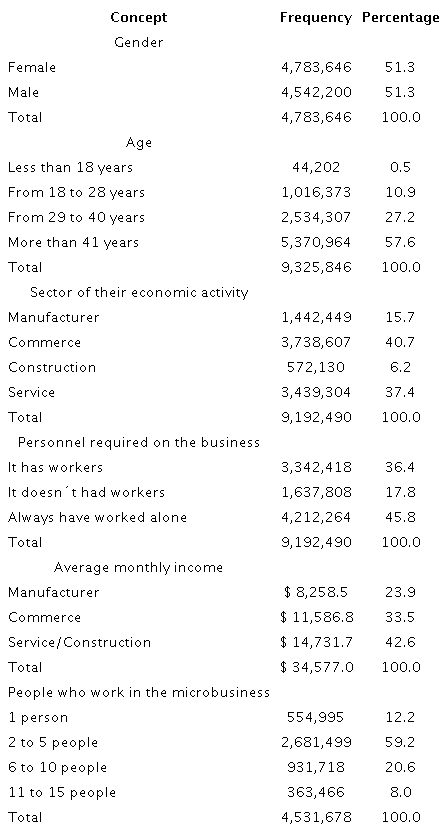
Source: Self-elaboration from ENAMIN, 2012.
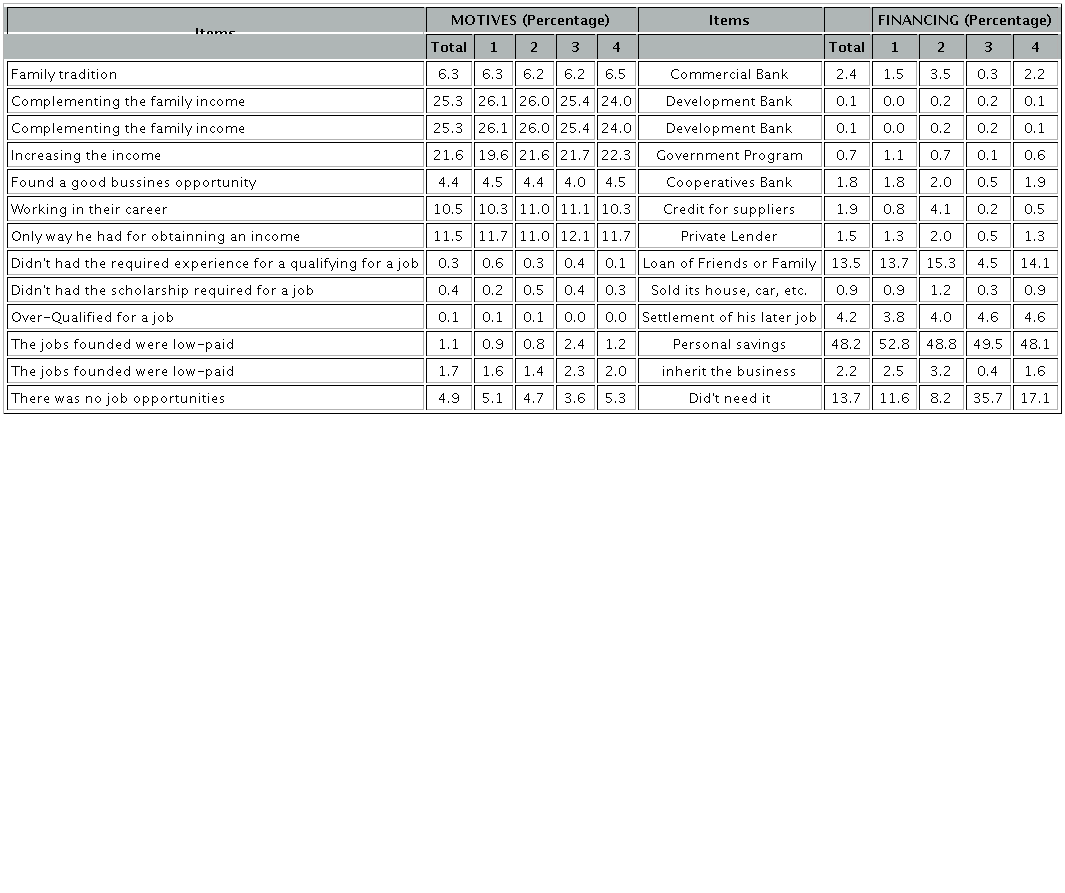
- The sum of the percentages cannot be 100 per cent due to no response. - The manufacturing sector, trade, construction and services are represented by the number 1, 2, 3 and 4, respectively. Source: Self elaboration with information of the ENAMIN, 2012.
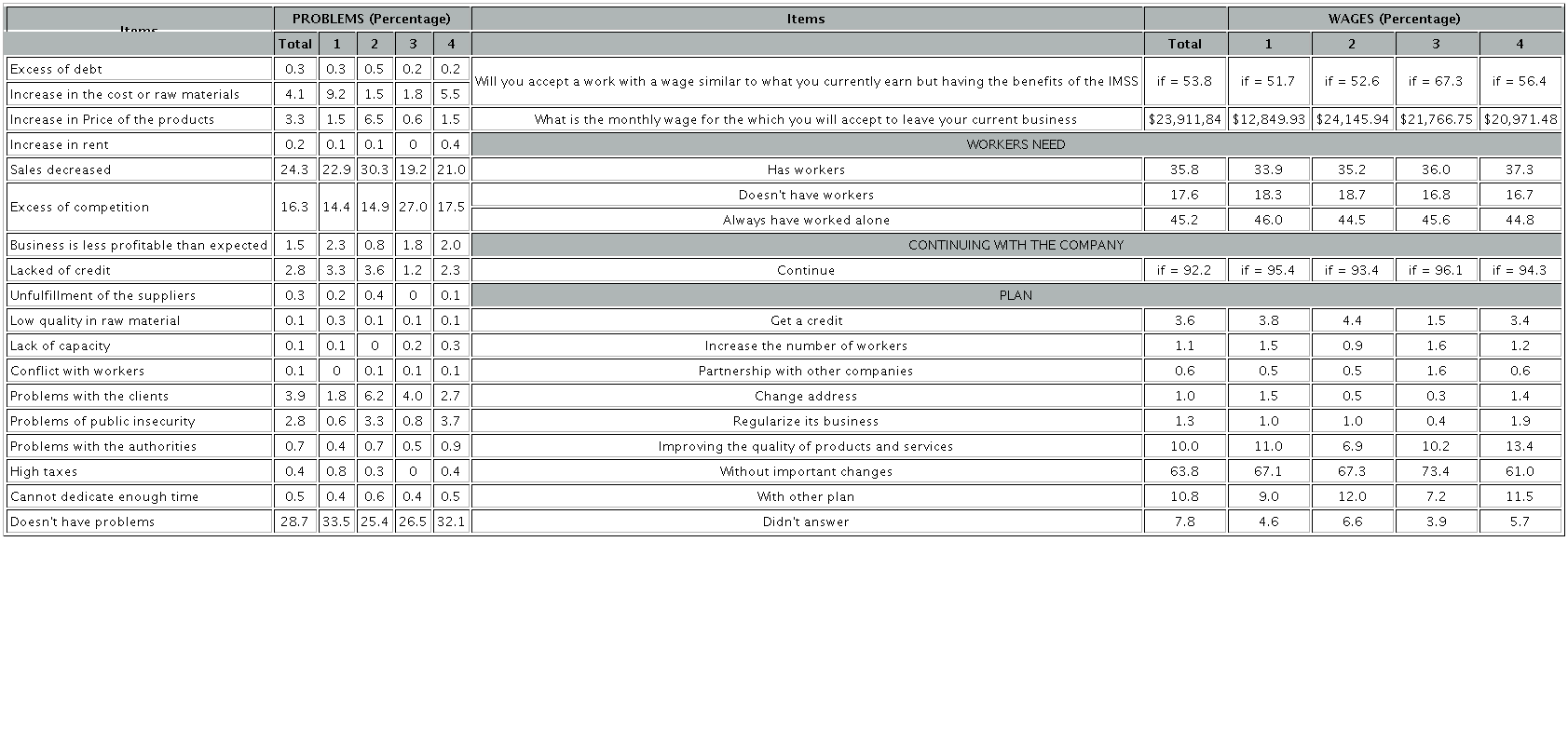
- Manufacture, commerce construction and services sectors are represented with the numbers 1, 2, 3 and 4, respectively. Source: Self-elaboration with data of the ENAMIN, 2012.
Table 2 presents the motives as to why the businesses were created (ENAMIN, 2012). The most frequent motive for starting a business was to “complement the family income.” This was followed by “improving income.” “Being over-qualified for a job” was found to be of little importance. In addition, most micro-business owners started their business with the personal savings they earned over their life (48.2%); 13.7% said they didn’t need this savings.
The motives for creating a micro-business in the different sectors (e.g., manufacturing, commerce, construction, services) includes “complementing the family income”. In the financing of a micro-business, most micro-business owners in the four economic sectors (i.e., 1, 2, 3, 4) argued that they used their “personal savings.” This was followed by “loans from family and friends”.
Table 3 shows how the reasons for continuing a micro-business are related to the performance aspects, principally including the problems they face every day. 28.7% of micro-businesses assured us that they didn’t have problems. Despite this, they were conscious that not offering quality products and services would decrease their sales (24.3%). Another obstacle that must be overcome is competition and problems with clients. However, 92.2% of micro-business owners assured us that they would continue with the business. They also didn’t plan to make any important design or organization changes (63.8%). A motive that leads to hiring more personnel is an increase in competitiveness.
On the other hand, over half of the people that started a micro-business recognized that it was a gamble (45.2%). They stated that is why they work alone. They also emphasize that if the government hires them or they find a job with law benefits, and an average income of $23,911.84 Mexican pesos, they will leave their micro-business.
Descriptive stats
We determined the effects of the explained variables in relation to the probability of a Mexican micro-business owner deciding to continue with their company, due to the problems or events that occurred during the investigation period. The dependent variable is dichotomous, where 1 indicates that the micro-business owner plans to continue with the company, else it equals 0. The independent variables are the factors that were motives or that influenced the owner to keep operating the company. The independent variables5 include (Table 4):
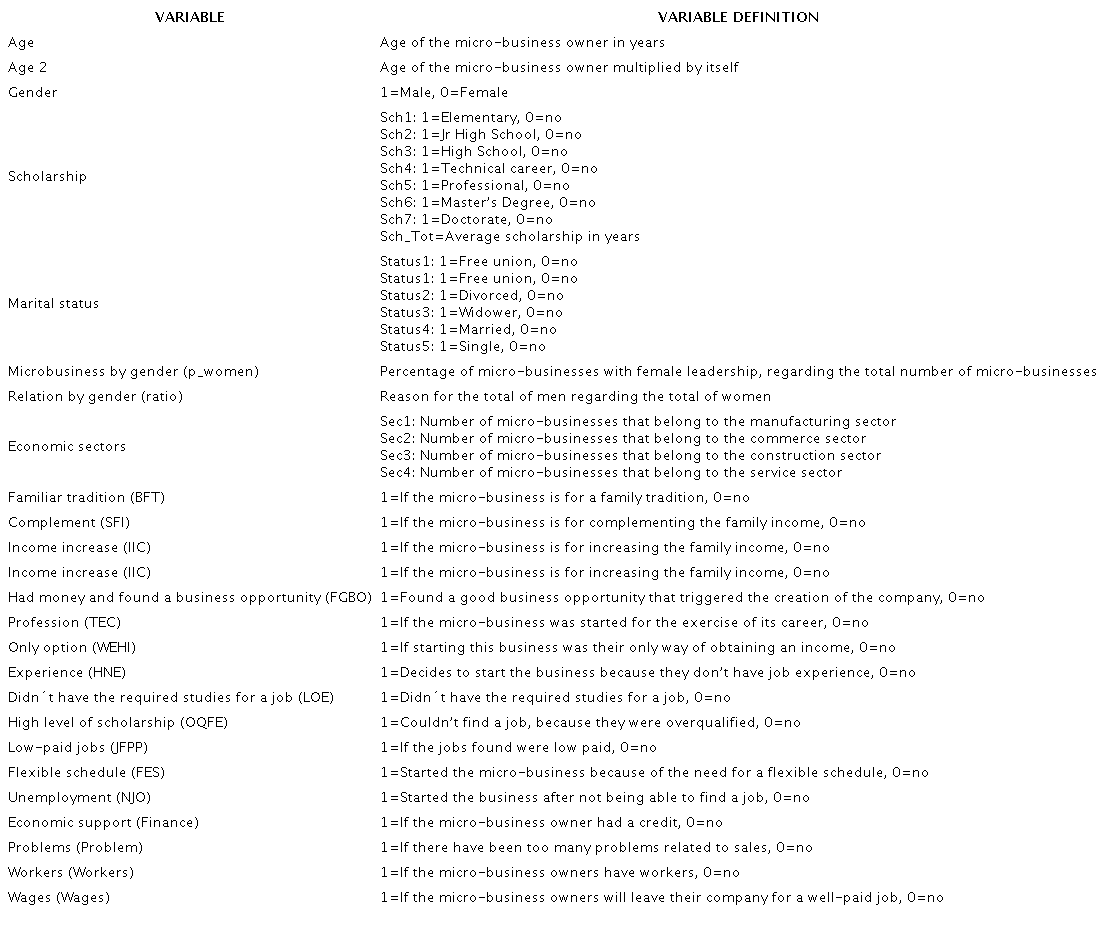
Source: Self-elaboration.
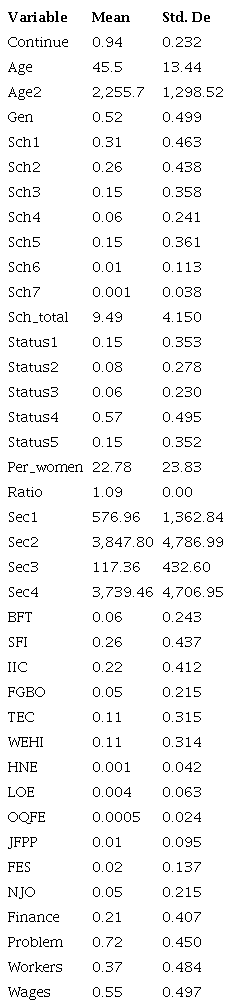
Table 5 shows the classic measures of central tendency. We observe that the 2012 statistics highlight that 94% of micro-business owners will keep operating their company in the upcoming years. We also observe that the average age of micro-business owners is 45 years. The ENAMIN data illustrates that 52% of micro-business owners were male. Most microbusiness owners studied at elementary school (31%) or junior high school (26%). The average number of years of schooling was 9.49 years, which is equivalent to having basic studies. 57% of the micro-business owners were married. Significant motives for starting a micro-business include: improving the family income (22%), complementing the family income (26%), and continuing with the family company (6%).
Source: Self-elaboration.
Empirical analysis
This section presents the empirical model. The model’s purpose is to quantify the effects of the explanatory variables on the probability that a Mexican micro-entrepreneur will continue to operate their micro-business. To achieve this, a binary discrete choice model (logit) is applied. This model allows us to obtain estimates of the probability of an event, identify the risk factors that determine these probabilities, and determine the influence or relative weight that these have on themselves. This procedure is used when the numbers of alternatives are two, qualitative and mutually exclusive.
The logit model allows for the calculation for each sector of the total business (enterprises sample) and the probability of belonging to one or another category established for the dependent variable. For example, if the probability is high, the event has a high chance of occurring, otherwise it has reduced probability values (i.e., close to zero) or a zero chance of occurrence, since the cut-off value is 0.50. Pérez (2005) points out that for a vector X = (X1, X2, ... ,Xn) of independent variables, the probability of event occurrence is calculated by a conditional probability, using the following expression:
 (1)
(1)Where: 0 is the independent term, 1X1 2X2 … kXk are the linear combinations of the independent variables.
Equation (1) represents the probability of the occurrence of the event, given the characteristics determined by the independent variables (X1, X2, ... ,Xn) for each micro-entrepreneur in the business (enterprises sample). This is obtained by an expression involving the exponential functions of base “e” (2.7182...). It can be observed that the denominator of the equation is always greater than the numerator. Hence, in all cases, it is always positive and less than unity.
Rearranging Equation (1), we get:
Using Equation (2), the results can be narrowed between 0 and 1, since:
Therefore, the logit regression model will be as follows:
where: Zi= β1+ β2X2i + …+ βkXki Given the values of the independent variables X2, … ,Xk the probability that the dependent variable takes on the values of 1 and 0 are:
Finally, the marginal effects of the model are calculated from Equation (3), obtaining the (partial derivative) of the variables, resulting in the following form:
Results
Table 6 presents the results of the logit model in relation to continuing to operate a microbusiness in Mexico. The alternatives chosen by the micro-entrepreneur according to the ENAMIN are:
Yi= 1, if the micro-entrepreneur plans to continue with the micro-business in the year following the period of study;
Yj= 0, if the micro-entrepreneur does not plan to continue with the micro-enterprise in the year following the study period.
Each of the explanatory attributes of the probabilities of choice have been incorporated in terms of a set of dummy variables that take on the value of one, if the attribute in question takes a determined modality, and zero otherwise (Table 4).
It is important to mention that when analyzing the quality of the model's adjustment, the indicator of the correctly adjusted values indicates that the model predicts 94.2% of the observations correctly. Similarly, the Wald chi2 function (341.0) shows that the value of the coefficients are jointly significant to explain the probability that micro-entrepreneurs plan to continue with the micro-business. The value of Prob>Chi2 (0.0000) indicates that the hypothesis of all the coefficients that are equal to zero can be rejected at the 1 percent level. Finally, the interpretation of Pseudo R2 (0.0309) establishes that 3.09 percent of the variation of the dependent variable can be explained by the variation in the explanatory variables.
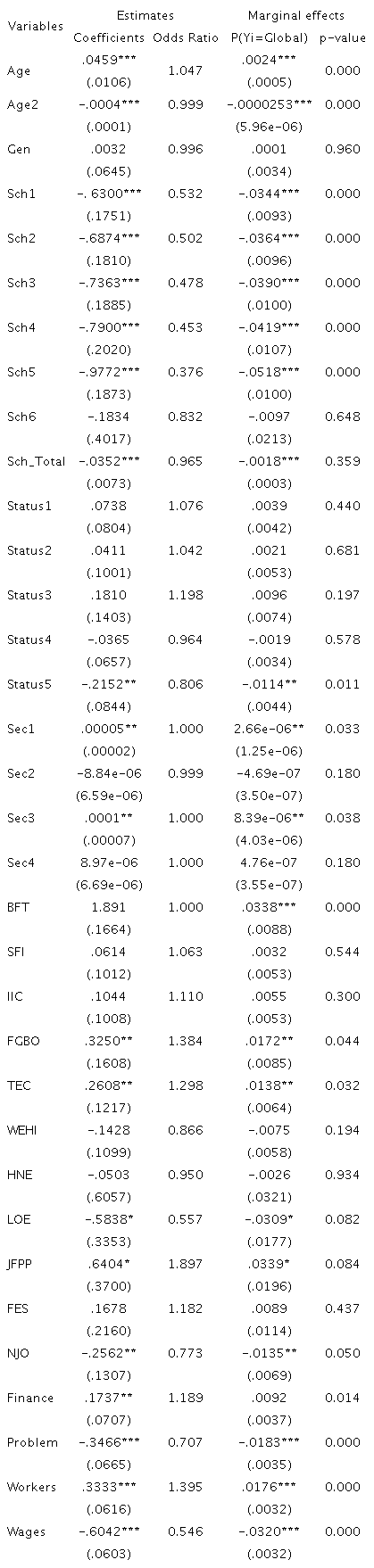
*** Significant at 1%, ** Significant at 5%, * Significant to 10 %. (Standard error in parentheses). -The variables Sch7, percentage of Women, Ratio & OQFE. Were eliminated because they presented problems of collinearity Source: Self-elaboration
In relation to the individual characteristics used as a control, we highlight that age is a factor that explains the probability that a micro-entrepreneur wants to continue with the micro-enterprise. Since it is a statistically significant variable, it can be inferred that a microentrepreneur that is one year older increases their opportunity to continue with the microbusiness by 1.05 times more than that of the younger micro-entrepreneur, keeping all other factors constant.
As for the schooling level, the signs found in the variables (Sch1 and Sch5) are negative, which means that there is a negative relationship between the level of schooling and the reason for continuing with the micro-business. In other words, if a micro-entrepreneur has professional studies (e.g., bachelor’s degree of engineering, Sch5) their opportunity to continue with the micro-business are, on average, 2.65 lower than if they did not have that degree. In general, it is appreciated that as the micro-entrepreneurs have one more year of schooling, the opportunities to continue with the micro-enterprise in Mexico are lower than if they did not. As such, the opportunities practically double if the other constant factors are maintained (Sch1=1.88, Sch2=1.98, Sch3=2.08 and Sch4=2.20).
The results also show that single micro-entrepreneurs (Status5) are less likely to continue with the micro-business. Hence, the estimate of -0.2152 indicates that single micro-entrepreneurs decrease by an average of 0.2 units, suggesting a negative relationship between marital status and continuing to maintain a micro-business. This implies that if a micro-entrepreneur is single, their opportunity to continue or create a micro-business are, on average, 1.24 lower than that of an engaged person, a person in a relationship or a married person.
In our analysis of economic sectors, it was observed that the micro-entrepreneurs most interested in continuing with a micro-enterprise are in the sectors of manufacturing and construction (Sec1 and Sec3). Hence, the opportunity to continue with the business is, on average, 1.01 higher in manufacturing and construction than if they were in another sector.
Other interesting results that should be mentioned include the main reasons microentrepreneurs start a micro-business. Micro-entrepreneurs who inherit the micro-business are more able to continue with it, because it is a family tradition. This means that if a microentrepreneur falls into this category, the opportunity to grow the micro-enterprise is, on average, 1.89 higher. In addition, micro-entrepreneurs who undertake a micro-business to exercise their trade or career (TEC) are motivated and inspired to continue with their micro-business by up to 1.29 times more than those who do not do this.
On the other hand, the LOE and NJO variables decrease by an average of 0.58 and 0.25 units, suggesting a negative relationship between the micro-entrepreneurs who did not have the schooling required for a job and did not find one with the reason to continue attending the micro-business. Micro-entrepreneurs who are within these categories are 1.79 and 1.29, respectively, less likely to continue with the business.
Regarding Finance and Workers, if micro-entrepreneurs plan to continue with the microbusiness, these variables will have a positive and significant impact. The micro-entrepreneurs who undertake a micro-business with the support of a credit or subsidy are motivated to continue their micro-business by up to 1.18 times more than those who do not apply for financing. In addition, micro-entrepreneurs who are in charge of support staff (workers) will continue to operate their micro-enterprise to be more profitable up to 1.39 times more than those who work alone.
By other way, the interpretation of the marginal effects is different regarding the estimates of the logit model. In addition, the calculations for the different types of micro-businesses in the economic sectors applied in this study are different [P(Y =1); P(Y =2); P(Y =3); P(Y =4)]6.
Therefore, for reasons of space, we explain the variables that were significant for those microentrepreneurs who decided to continue with their micro-business in Mexico [P(Y =Global)]7.
However, the reader may make his or her own inferences after reading the following interpretations for the missing variables or economic sectors.
In relation to the variable Age, it is important to mention that an increasing age of the micro-entrepreneur increases the probability of continuing with the micro-business (0.24%), keeping the rest of the variables constant. The age squared coefficient (Age2) indicates that after a certain age, the intention to continue with the micro-business began to decrease by 0.00253%.
The negative sign on the schooling variables (Sch) show that as one year of schooling increases, the impact of continuing and growing a micro-enterprise is lower (Sch1=3.44%, Sch2=3.64%, Sch3=3.90%, Sch4=4.19% and Sch5=5.18%). These results are coherent from the perspective that the more educated individuals are looking for a well-paid salaried job. For this reason, they will begin to neglect their micro-businesses to dedicate themselves to other activities that are more profitable.
On the other hand, the positive signs on the BFT, FGBO and TEC variables show that if the micro-entrepreneur inherits the micro-business, the probability of remaining in this form of association increases by 3.38%. Also, if the micro-entrepreneur has enough capital and finds a good opportunity to start a micro-business, the probability of continuing its operation in the coming years increases by 1.72%. Regarding micro-entrepreneurs undertaking a microbusiness to practice their profession, it is observed that the probability of success or to continue growing is 1.38%.
For the Finance variable, which shows a clear relationship for those micro-entrepreneurs who undertake a micro-enterprise with the support of a bank credit or subsidy, they have more of a probability to grow and continue in the coming years by 0.92%. Similarly, microentrepreneurs in charge of salaried or trustworthy workers are more likely to continue operating their micro-business by up to 1.76% more than those who work alone.
Discussion of the findings
The primary purpose of this paper was to explore the factors that influence the decision to continue operating a micro-business in Mexico once is undertaken. For this purpose, data from the 2012 National Survey of Micro-business, provided by INEGI, was analyzed. The results indicate that most micro-entrepreneurs (92%), despite having limitations, problems and low profits in the operation of their micro-businesses, plan to continue working in the coming years. This discovery is relevant, given the importance of micro-enterprises in the country's economy. Remember that, in Mexico, according to the latest economic censuses of the INEGI in the period of study, economic units total about 5,144,056 units, of which 99.8% employ less than 250 workers. This means that there are about 5,041,175 micro, small and medium enterprises. Of these, 4,886,853 are micro-businesses with less than 10 workers. Hence, of the total number of companies in the country, 95% are micro-enterprises. For that reason, state or federal programs that support the micro-business of the country should be improved or created, since they are strong supporters of the Mexican economy.
Other interesting findings in this paper include the identification of sociodemographic factors and the reasons for undertaking a micro-business and watching how they impact the decision to continue operating in the coming years. For example, the BFT, FGBO, TEC, JFPP, Finance and Workers variables show that there is a statistically significant impact on the probability that micro-entrepreneurs in the study sample will continue to operate their microbusinesses in Mexico. This is interesting if it is discussed from a neoclassical perspective, since economic studies about the theories of profit maximization, utility, and incentives, argue that individuals start a business to generate wealth (Hurst & Pugsley, 2011; 2015). However, the present study finds that the reasons and performance to start a micro-enterprise in Mexico are different in each micro-business and are not necessarily economic.
The results of this research are consistent with that of Cuevas et al. (2005), who indicated that the behavior of micro-enterprises is highly correlated with the sociodemographic characteristics of the pattern. However, economic and market variables are most influential in determining profitability and productivity. Peña et al. (2012) used a linear regression model of probability and found that micro-businesses were not equal, since the reasons for starting them varied according to the expectations of the owners. The authors also point out that differences in these ratios or expectations imply that the goal that all micro-enterprises receive funding may not be desirable from an efficiency standpoint and depends on the economic sector in which the micro-business is located.
Conclusions
This article conducted a descriptive and inferential analysis of the 2012 National Survey of Micro-businesses in Mexico. The results reveal that the main reasons micro-entrepreneurs start or undertake a micro-business are to complement and improve their family income. 13.7% of micro-entrepreneurs in the sample argue that they did not need any type of financing, since their personal savings allowed them to start their own micro-business (48.2%). Most of the micro-entrepreneurs surveyed seemed to have a positive perception about continuing the micro-business, since they maintained that the Mexican government was implementing policies, programs and support funds to strengthen them. We also point out that the results derived from the inferential analysis provide relevant information about the determinant factors to continue operating a micro-business.
The application of a logit model allowed us to determine the effects of the variables that influence the probability of a micro-entrepreneur deciding to continue with his or her microbusiness. Among the main findings of this analysis, we can remark that:
-
Married men are very determined to continue the micro-enterprise, since they want to leave patrimony to their family.
-
More than half of the sample of micro-entrepreneurs who do not have a relationship are willing to leave their micro-business for a better paid or salaried job. The results also show that having a higher education level will make a person more likely to leave their micro-business. However, this result is refuted by pointing out that micro-entrepreneurs only want to continue their micro-business if they can exercise their profession.
-
As for the economic sectors, micro-entrepreneurs in manufacturing and construction stand out in that they will continue to grow and expand. The business owners face low sales every day because the customers buy imported "lower priced" products and an excess of competition by the informality of other businesses of the same activity.
-
The most relevant or significant explanatory variables quantify the effect that microentrepreneurs have in order to continue their micro-business in the coming years (Table 6).
Although this technique may lack predictive power, we understand that it is a valid procedure to select, from the perspective of the probability of micro-entrepreneurs, as certain significant relationships with the activity of continuing to operate a micro-business were identified. Additionally, due to the rigorous work in the application of a binary discrete choice model, in this study, we are aware of the limitations and opportunities for improvement. For example, at the conceptual level, the results have raised some interesting questions about the main determinant factors that currently influence the entrepreneur. A comparison of the same variables in the different states or regions of the Mexican Republic could improve the knowledge, perception and disjunctives in the business activity of the nation. We also recommend that future studies compare more years of data by gender.
References
Alonso, M y Galve, C. (2008). El emprendedor y la empresa: una revisión teórica de los determinantes a su constitución. Acciones e Investigaciones Sociales. 26, 5-44. https://doi.org/10.26754/ojs_ais/ais.200826332
Álvarez, A. y Valencia, P. (2008). Un Análisis de los factores sociodemográficos determinantes en la creación de empresas en el marco de la interculturalidad. Revista de Economía Mundial. 18, 341-353.
Audretsch, D. y Fritsch, M. (1994). The geography of firm births in Germany. Regional Studies, 28(4), 359-365. https://doi.org/10.1080/00343409412331348326
Audretsch, D. (1995). Innovation and industry evolution. MIT Press. Cambridge, MA.
Audretsch, D. Fritsch, M. (2002). Growth regimes over time and space. Regional Studies, 36, 113-124. https://doi.org/10.1080/00343400220121909
Bonfil, C. (2003). Fuentes de financiamiento para la microempresa en México. Aportes: Revista Mexicana de Estudios Sobre la Cuenca del Pacifico, 31(5), 61-85.
Casas, E. e Ibarra, L. (2013). Análisis del impacto de crecimiento en las Pymes que se desarrollaron bajo un Esquema de incubación: caso de estudio. Revista Internacional Administración y Finanzas, 6(3), 85-94.
Cuevas, E., Contreras, A. & A. González. (2005). Micro negocios y autoempleo en México. Un análisis empírico con datos de la ENAMIN. Carta Económica Regional, 17(94), 31-42.
Dussel, E. (2004). Pequeña y mediana empresa en México: condiciones, relevancia en la economía y retos de política. Economía UNAM, 1(2), 64-84.
ENAMIN (2012). Encuesta de micro negocios 2012. Recuperado de http://www3.inegi.org.mx/sistemas/tabuladosbasicos/tabdirecto.aspx?s=est&c=33527
Elston, J. & D. Audretsch. (2011). Financing the entrepreneurial decision: an empirical approach using experimental data on risk attitudes. Small Business Economics, 36(2), 209-222. https://doi.org/10.1007/s11187-009-9210-x
Entrialgo, M.; Fernández, E. y Vázquez, C. (1999). Las características del propietario/directivo de la PYME como factor determinante de su comportamiento emprendedor. Boletín de Estudios Económicos, 54(168), 405-424.
Fernández, E. y Junquera, B. (2001). Factores determinantes en la creación de pequeñas empresas. Papeles de Economía Española, 89(90), 322-342.
Fölster, S. (2000). Do entrepreneurs create jobs? Small Business Economics, 14(2), 37-148.
García, J. Álvarez, P. y Reyna, R. (2007). Características del emprendedor de éxito en la creación de PYMES españolas. Estudios de Economía Aplicada, 25(3), 1-26.
García, C., Martínez, A. y Fernández, R. (2010). Características del emprendedor influyentes en el proceso de creación empresarial y en el éxito esperado. Revista Europea de Dirección y Economía de la Empresa, 19(2), 31-48.
Gelderen, M., Bosma, N. & Thurik, R. (2001). Setting up a business in the Netherland: Who starts, who gives up, who is still trying. Frontiers of Entrepreneurship Research, http://www.babson.edu/entrep/fer/Babson2001/I/IG/IG.htm
Gómez, L. (2007). The process and problems of business Start-Ups. Pensamiento & Gestión, 22, 232-255.
Gómez, A., García, D. y Marín, S. (2009). Restricciones a la financiación de la PYME en México: una aproximación empírica. Análisis Económico, 57(24), 217-238.
Guzmán, A. & Trujillo, M. (2008). Emprendimiento social: Revisión de literatura. Estudios Gerenciales 24(109), 105-125. https://doi.org/10.1016/s0123-5923(08)70055-x
Hopenhayn, H., (1992). Entry, exit and firm dynamics in long run equilibrium. Econometrical, 60, 1127-1150. https://doi.org/10.2307/2951541
Hurst, E. y B. Paisley. (2011). What Do Small Businesses Do?, NBER Working Paper, 17041. https://doi.org/10.3386/w17041
Hurst, E. y B. Pugsley. (2015). Wealth, Tastes and Entrepreneurial Choice, NBER Working Paper, 21644. https://doi.org/10.3386/w21644
Kantis, H. (2003). Componentes macroeconómicos, sectoriales y microeconómicos para la estrategia nacional de desarrollo. Lineamientos para fortalecer las fuentes de crecimiento económico. Programa Multisectorial de Preinversión II préstamo BID 925 OC-AR, Estudio 1.EG.33.3, estudios sobre empleo, componente E: Creación y fortalecimiento de nuevas empresas, Ministerio de Economía de la Nación, Secretaría de Política Económica, Unidad de Preinversión (UNPRE), Buenos Aires, Argentina.
Keeble, D. & Walker, S. (1994). New firms, small firms and dead firm’s spatial patterns and determinants in the United Kingdom. Regional Studies. 28(4), 411-427. https://doi.org/10.1080/00343409412331348366
Kleppeer, S. (1996). Entry, exit, growth, and innovation over the product life cycle. American Economic Review. 86(3), 562-583.
Lambson, V. (1991). Industry evolution with sunk costs and uncertain market conditions. International Journal of Industrial Organization, 9, 171-196. https://doi.org/10.1016/s0167-7187(05)80001-3
Lecuona, R. (2009). El financiamiento a las Pymes en México: La experiencia reciente, Economíaunam. 6(17), 69-91.
Quintana, C. (2001). Dimensiones del éxito de las empresas emprendedoras. Investigaciones Europeas de Dirección y Economía de la Empresa, 7(2), 139-158.
Martínez, E. (2008). Logic model como modelo de elección discreta: origen y evolución. Anuario Jurídico y Económico Escurialense, XLI, 470-483.
Mintzberg, H., Ahlstrand, B. & Lampel, J. (1999). Safari a la estrategia. Una visita guiada por el Management Estratégico, Ediciones Juan Garnica S.A., Barcelona.
Nava, E. (2013). Factores que Influyen la Creación de Empresas Pymes y Empresas Familiares. International Journal of Good Conscience, 8(1) ,11-22.
Peña, P., I. Ríos y S. Salazar. (2012). Los micro negocios en México: razones para emprenderlos, expectativas, tamaño y financiamiento. Estudios Económicos, 1, 77-94.
Pérez, C. (2005). Métodos estadísticos avanzados con SPSS. Editorial Thomson.
Pinillos, M. (2001). Factores coadyuvantes para la creación de empresas en la Comunidad de Madrid. Papeles de Economía Española. 89(90), 343-361.
Reynolds, P, W. Bygrave, E. Autio, L. Cox, & M. Hay. (2002). Global Entrepreneurship Monitor. Executive Report. Babson College. Wellesley, MA.
Rodríguez, A. (2006). El emprendedor venezolano. Debates IESA, 11(3), 20-22.
INEGI (2012). Directorio estadístico nacional de entidades económicas. Consultado el 12 de enero de 2016, página oficial: Consultado el 12 de enero de 2016, página oficial: http://www.inegi.org.mx
Secretaría de Economía (2013). Programa de Desarrollo Innovador 2013-2018, recuperado de http://www.economia.gob.mx
Appendix I
Marginal effects on the economic sectors

*** Significant at 1%, ** significant at 5%, * significant at 10%. (Standard Error in parentheses) - The manufacturing sector, trade, construction and services are represented by the number 1, 2, 3 and 4, respectively - N.A. = Not applicable due to insufficient data found for the bullfight of model. Source: Self-elaboration
Notas
Author notes
*Corresponding author. E-mail address: eliaxalvarado@gmail.com (E. Alvarado Lagunas)