Carátula del artículo
Absorptive capacity development in some firms in Brazil: an
organizational perspective*
Desenvolvimento da capacidade de absorção em algumas empresas no
Brasil: uma perspectiva organizacional
 André Luiz da Silva Teixeira andre.teixeira@unifal-mg.edu.br
Federal University of Alfenas, Brazil
Márcia Siqueira Rapini msrapini@cedeplar.ufmg.br
Federal University of Minas Gerais, Brazil
Thiago Caliari caliari@ita.br
Aeronautics Institute of
Technology, Brazil
Economia e Sociedade, vol. 34, no. 3, e273239, 2025
Instituto de Economia da Universidade Estadual de Campinas;
Publicações
Received: 23 March 2023
Accepted: 10 October 2024
1 Introduction
Firms do not innovate in isolation. Inserted in an Innovation System, they innovate
by accessing knowledge networks and interacting with other agents, such as
suppliers, competitors, and universities (Lundvall
et al., 2009). To do this, firms need to build and manage internal
capabilities to identify the relevant knowledge, assimilate it, and effectively
apply it commercially. In other words, they need to develop Absorptive Capacities
(Cohen; Levinthal, 1989, 1990).
Considered an organizational capability (Cohen;
Levinthal, 1990; Nelson; Winter,
2005), the development of the Absorptive Capacity (ACAP) does not depend
only on internal efforts in Research and Development (R&D), as it is usually
associated, but also “on the links across a mosaic of individual capabilities”
(Cohen; Levinthal, 1990, p.133). This
connection relies on organizational structures, processes, and practices, such as
promoting worker participation in innovative projects and implementing formal
internal procedures, etc. (Jansen; Bosch, Van Den; Volberda, 2005). These
organizational elements can be read as “practical routines” (Lewin; Massini; Peeters, 2011) that help to transform dispersed
individual abilities into organization-level capabilities (Milagres, 2011; Nelson; Winter,
2005).
This paper focuses on this organizational dimension of ACAP, analyzing how some firms
that interacted with universities in Brazil combine different organizational
processes and characteristics in favor of their Absorptive Capacities. For this, the
techniques of Categorical Principal Component Analysis (CatPCA) and fuzzy-set
Qualitative Comparative Analysis (fsQCA) are combined to analyze data from a
specific survey to measure the organizational dimensions and determinants of ACAP of
these firms. This survey was conducted between 2015-2016 with firms that had
previously interacted with universities.
Some contributions to literature are made. First, this paper advances in measuring
the multidimensionality of ACAP and understanding its organizational aspects, as
suggested by some authors (Paranhos; Hasenclever,
2021; Volberda; Foss; Lyles,
2010), but in a developing country context. Second, the fsQCA identifies
multiple pathways to achieve the same level of ACAP, highlighting the evolutionary
nature of capability development (Nelson; Winter,
2005), which is often overlooked in traditional econometric studies.
Third, the results reinforce the relevance of labor abilities in the Brazilian
university-firm context (Negri, 2006; Teixeira; Rapini; Caliari, 2020), especially
when firms focus on developing an ACAP to adapt existing technologies.
The paper is structured across four more sections. The second section debates the
concepts, interpretations, and select organizational determinants of ACAP. In the
third section, methodologies are discussed, encompassing the presentation of the
database and the techniques employed. The fourth section analyzes the results.
Lastly, the concluding section houses the final remarks.
2 Absorptive capacity: interpretations and relevance of the organizational
dimension
2.1 Different conceptual interpretations of ACAP
The concept of ACAP was defined by Cohen and
Levinthal (1989, 1990) as a
firm’s ability to identify relevant external knowledge, assimilate it, and apply
it commercially. Initially, this ability was seen as a by-product of internal
R&D efforts. However, in a later study, Cohen
and Levinthal (1990) employed Nelson and Winter’s (2005) concept of
organizational capability to elaborate on the intra-firm elements that support
the development of ACAP. Among these elements are the gatekeepers, interfaces
between the firm’s areas and external agents, and actions that favor the
dissemination of intra-firm knowledge. These actions allow for connecting a
mosaic of individual abilities (Cohen; Levinthal,
1990) in favor of building a capability at the organizational level.
After this initial work, different reinterpretations have been carried out, and
three of these can be highlighted.
Zahra and George (2002) redefine the ACAP
as a dynamic capability composed of potential and realized capabilities.
Potential ACAP is composed of acquisition and assimilation capabilities. The
first is related to the firms’ capabilities to recognize the value of new
external knowledge, acquire it, and add it to their knowledge base, while the
second is related to the routines and processes that allow the company to
analyze, process, and interpret external knowledge, given the existing
knowledge. The second set - realized ACAP - reflects the capabilities for
transforming and exploiting external knowledge, where the former refers to the
processes for combining old knowledge with new knowledge, and the latter is
associated with the ability to apply knowledge commercially, aiming at raising
or building competencies. For the authors, the higher the ratio between realized
ACAP and potential ACAP, the greater the efficiency in absorption, that is, in
applying the assimilated knowledge in innovations and competitive advantages.
This “efficiency factor” would be determined by “social integration mechanisms”
(Zahra; George, 2002) to be discussed
in the next subsection.
Criticizing the “static” characteristic of this “efficiency factor”, Lane, Koka, and Pathak (2006) redefine ACAP
as a sequential process composed of three forms of learning: exploratory,
transformative, and exploitative learning. The first learning allows the company
to recognize and understand the potential of external knowledge, which is
related to the first dimension of ACAP proposed by Cohen and Levinthal (1990). Transformative learning, on the
other hand, refers to processes for assimilating external knowledge and
combining it with existing knowledge, encompassing the assimilation and
transformation capabilities exposed by Zahra and
George (2002). It is responsible for making a connection between
exploratory and exploitative learning. The latter, in turn, is related to the
application of this new external knowledge. Using March (1991) and Bishop
D’Este and Neely (2011), it can be said that exploratory learning
contributes especially to obtaining long-term benefits by expanding and
diversifying the internal knowledge base, giving greater flexibility to the
company; whereas exploitative learning is more focused on the application of
knowledge in products and processes, focusing on short-term results and more
direct appropriability.
Lane, Koka and Pathak (2006) also
contribute to the literature by decomposing ACAP into two parts: (1) funnel; (2)
pipelines. The first would allow the company to select which are the relevant
knowledge for its strategies, approaching Cohen and Levinthal’s (1990)
“recognition” dimension. This funnel would be determined by the breadth of the
company’s previous knowledge base, built especially through exploratory
learning. The pipelines, on the other hand, refer to intra-company
organizational processes that favor transformative and exploitative learning,
allowing the internalization of external knowledge considered relevant and its
application in the market.
Lewin, Massini, and Peeters (2011) share
this “bipartite” view of ACAP. For the authors, the ACAP would be formed by a
connected set of internal and external meta-routines expressed in observable
practical routines. Internal meta-routines are associated with the process of
intrafirm knowledge construction, refinements, and sharing, helping to build an
intrafirm knowledge base; they are routines that help to (1) modify old
routines, (2) emerge and select new intrafirm ideas, and (3) share existing
knowledge and practices. The external meta-routines are more directly aimed at
the search for external knowledge, being linked to the practical routines for
recognizing the value of external knowledge and learning from external partners,
such as the use of gatekeepers, participation in networks, and R&D
partnerships. These routines are focused on identifying and acquiring external
knowledge, aligning with the funnel concept of ACAP. According to the authors,
the effectiveness of the ACAP depends on the connection between these two
meta-routines, which would be accomplished by meta-routines focused on (1)
creating stimuli to explore knowledge and opportunities (internal or external)
and (2) transferring the external knowledge inside the company through specific
processes, such as the sharing of external knowledge among gatekeepers and other
employees. Without these processes, the effectiveness of external ACAP
diminishes, making absorption highly reliant on the individual capabilities of
gatekeepers (Lewin; Massini; Peeters,
2011). This point will be important in the empirical analyses, as
well as Lane, Koka and Pathak’s (2006) interpretation of ACAP.
2.2 Some organizational determinants of ACAP
As highlighted, the ACAP is an organizational capability that also depends on
processes and routines that disseminate knowledge internally and connect and
drive the actions of individuals (Zahra; George,
2002). Some of these processes are highlighted below, focusing on
those measured in the empirical analysis. An extensive review of them is made by
Volberda, Foss and Lyles (2010).
First, Cohen and Levinthal (1990) already
highlighted theoretically the importance of actions to disseminate
intra-firm knowledge. These actions act as “social integration
mechanisms”, facilitating the flow of intra-firm knowledge and the
transformation and exploitation of external knowledge (Zahra; George, 2002). Examples of these actions include the
promotion of informal interactions among employees, open communication of ideas,
mutual support among departments, and the conducting of internal seminars (Schmidt, 2005).
Another important action in favor of ACAP is the participation of employees
in innovative projects. Jansen, Van
den Bosch, and Volberda (2005) interpret this participation as
greater freedom in the agents’ decision-making, but it has a dubious effect. On
one hand, it increases the ability and motivation of workers to acquire and
assimilate external knowledge, but, on the other hand, it hinders consensus
building, which would negatively affect the realized ACAP. However, Ebers and Maurer (2014) claim that this
greater participation would have a positive effect on the realized ACAP by
allowing greater collaboration and intra-company knowledge exchange.
Formalizations and routines also have dubious effects on ACAP. For
Van den Bosch, Volberda and De Boer
(1999), these formalizations allow the knowledge exchange to occur
through formal means, such as information systems or procedures exposed in
documents, manuals, etc. However, these have dubious effects on both potential
and realized ACAP. For the potential ACAP, these formalizations could increase
the efficiency in the acquisition of external knowledge (Vega-Jurado; Gutiérrez-Gracia; Fernández-De-Lucio, 2008) or
restrict the integration among the members of the company, which disfavors the
potential ACAP (Jansen; Van Den Bosch; Volberda,
2005). For the realized ACAP, formalizations help codify the best
practices for the application of external knowledge, but, on the other hand,
reduce the creativity and flexibility important for this dimension (Jansen; Van Den Bosch; Volberda, 2005;
Vega-Jurado; Gutiérrez-Gracia;
Fernández-De-Lucio, 2008).
The determinants discussed above involve more managerial and deliberate
decisions. However, for Ebers and Maurer
(2014), ACAP can also be favored by strong and trusting
personal relationships. For the authors, this kind of internal
relationship contributes to communication and knowledge exchange among
employees, favoring the transformation and commercial exploitation of new
knowledge. Strong and trusting relationships between the company’s employees and
external partners, on the other hand, affect potential ACAP by favoring the
identification and assimilation of external knowledge.
Finally, the development of capabilities cannot be separated from the company’s
structure (Nelson, 1991). Van den Bosch, Volberda and De Boer (1999)
analyze three types of structural forms (functional, divisional, or matrix),
identifying that more hierarchical forms - such as the functional - tend to
contribute to the efficiency of the external knowledge absorption, but not to
its scope or flexibility. On the other hand, less hierarchical forms - such as
the divisional - favor the flexibility of this ACAP, but limit it as a whole due
to the low integration between the departments that characterize them. Thus, the
ACAP tends to be favored by an intermediate degree of hierarchy, in
which there are gatekeeper positions and stronger connections between R&D
and manufacturing departments, but with some departmental autonomy around
diverse projects. This favors the efficiency, scope, and also flexibility of
ACAP (Van Den Bosch; Volberda; De Boer,
1999; Duchek, 2015).
The next sections empirically investigate the effect of the mentioned
organizational determinants on the ACAP of firms that interacted with
universities. These firms tend to have distinctive capabilities compared to
those that do not do this, because, on the one hand, this interaction is a way
to develop ACAP by the improve of the knowledge base (Bishop; D’este; Neely, 2011) and, on the other hand, it
requires peculiar prior ACAP, built by distinct organizational processes and
innovative efforts (Lane; Lubatkin, 1998;
Murove; Prodan, 2009; Negri, 2006; Schmidt, 2005). However, in a Brazilian context, the
development of ACAP can be limited because the firms’ short-term strategies that
use the universities not only as complementary but also as substitutes for their
internal R&D activities (Rapini et al.,
2009; Teixeira; Rapini; Caliari,
2020).
3 Methodological elements
3.1 Database
The present study uses a database developed between 2015-2016 specifically to
measure the ACAP dimensions and their organizational determinants, focusing on
firms that had interacted with universities in Brazil, according to the 2010
census of Research Groups Directory of the Brazilian National Council for
Scientific and Technological Development (DGP/CNPq, in Portuguese). It is also
collected information about the innovative activities of firms and their
interaction with universities. As discussed before, these firms have different
ACAP, but it is not possible to say a bigger or better ACAP them others,
necessarily. A diversity of ACAP will be identified during section 4.
A detailed description of this base is provided by Teixeira (2020). Here, we focus on presenting its basic
characteristics and the analyzed variables. Tables 1, 2, and 3 show the variables and references used
for their construction. The questionnaire was applied in Portuguese, but the
questions are translated here.
Table 1
Questions about the dimensions of ACAP
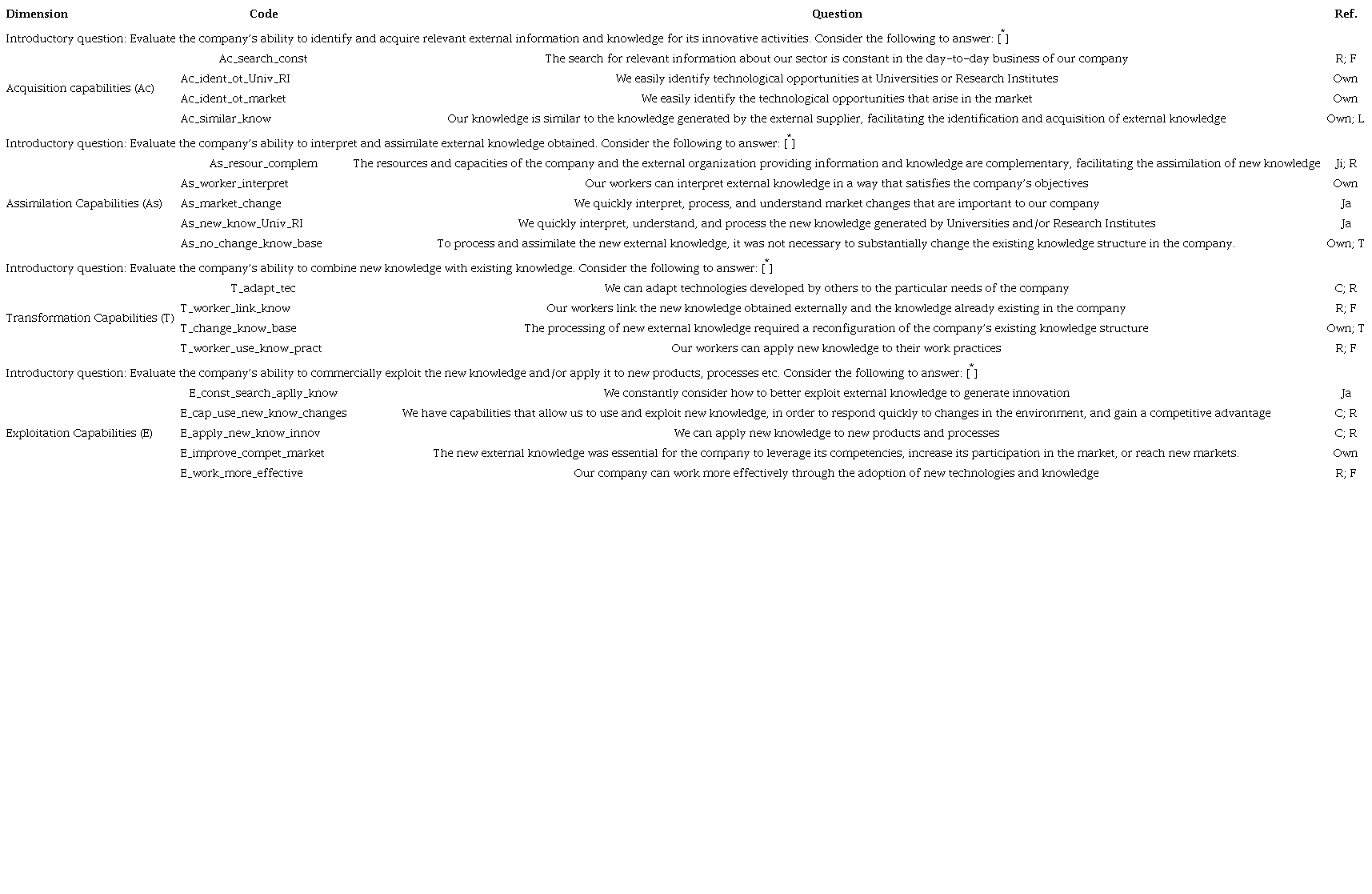
Table 2
Questions to measure the organizational determinants of ACAP
(a)
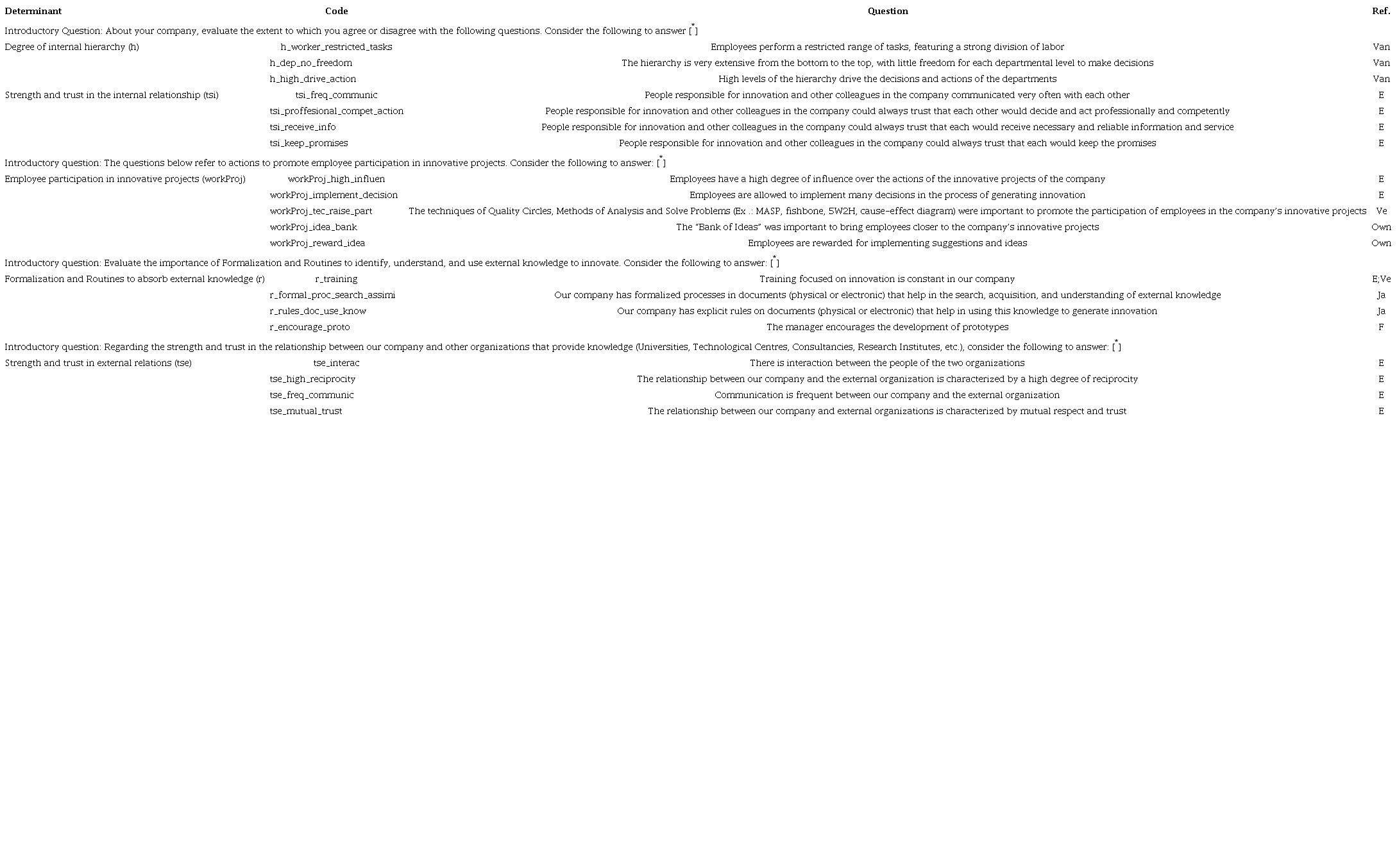
Table 3
Questions to measure the organizational determinants of ACAP
(b)

As shown in these tables, the analyzed variables were measured on a Likert scale
with 4 levels of importance, plus a fifth level called “unable to give an
opinion” (or to respond). It is argued that responses to this item indicate (i)
a lack of understanding of the respondent about the question or (ii) a lack of
knowledge about a particular action.
Regardless of the interpretation, it is assumed that if the respondent chose this
option in all items referring to at least one “construct” (i.e., a dimension or
a determinant of the ACAP), the answer does not portray the construct in
question and, therefore, such a company is removed from the sample. On the other
hand, if at least one item of the construct is answered in another way, then
this company is kept in the sample, understanding that it provides some minimal
information for it. With this strategy, it was possible to maintain a greater
number of firms, but, a different treatment was necessary via the Categorical
Principal Components Analysis (CatPCA), discussed in section 3.2.
It is important to highlight that specific ACAP surveys are important to capture
ACAP multidimensionality and its dependence on organizational factors that go
beyond R&D efforts (Ebers; Maurer,
2014; Jansen; Bosch, Van Den; Volberda, 2005). However, there is no
consensus on how to measure absorptive capacity, given that different studies
focus only on the ACAP dimensions and do not measure their organizational
determinants in the same questionnaire (Camisón;
Forés, 2010; Flatten et al.,
2011; Jiménez-Barrionuevo;
García-Morales; Molina, 2011). This makes it difficult to separate
the antecedents of the ACAP and the “core” of its dimensions - a criticism
similar to the use of R&D as a proxy for the ACAP (Flatten et al., 2011) -, in some cases requiring the use of
the original concept to measure a given dimension.
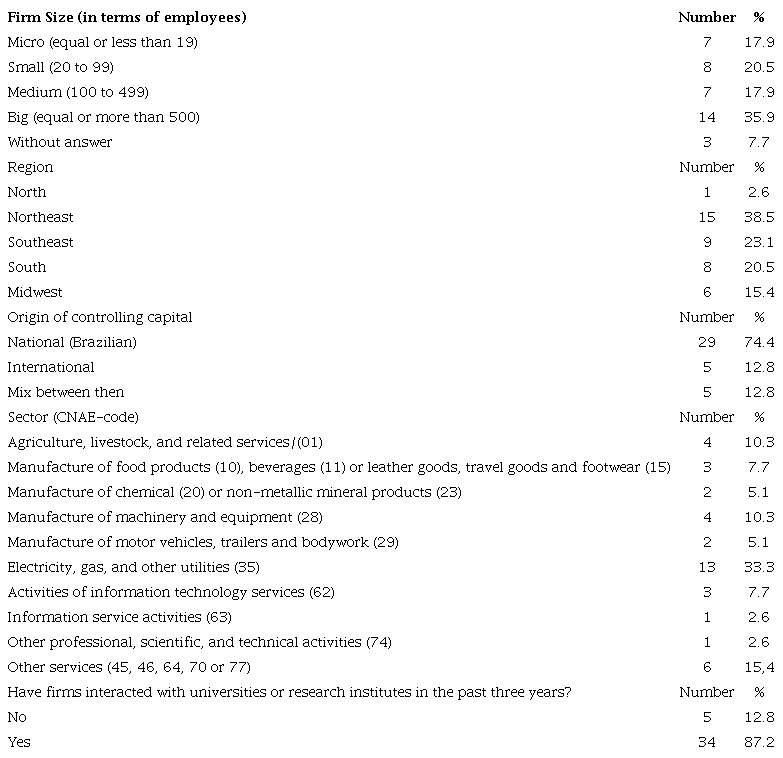
Regarding the general features of the database, it is worth noting that the
collection process resulted in 57 responses1. After the process of cleaning, it has resulted in 39
valid responses2, whose
characteristics are described in Table 4.
The firms are of different sizes, sectors, and regions. There is a predominance
of national firms that interacted with universities in the three years before
the survey (until 2015 or 2016, depending on when the company answered
it)3. Regarding the
respondents, more than half of them have been in the company for at least 6
years (66.7%), have a post-graduation, specialization, or MBA (61.5%), and are
linked to management or R&D activities and innovation (53.8%). Such
characteristics suggest, in general, a respondent with the ability to understand
the questionnaire and with reasonable knowledge about the organizational
characteristics and processes of the company.
Table 4
Description of the basic characteristics of the firms analyzed
(Total: 39 firms)
Therefore, some characteristics of the database demand alternative methods of
analysis: (1) a small number of valid responses; (2) responses such as “unable
to express an opinion” are classified as missing; (3) non-linear Likert-type
responses; (4) possible non-linear relationships between variables. To meet
these specificities, the Categorical Principal Component Analysis (CatPCA)
techniques will be combined with fuzzy-set Qualitative Comparative Analysis
(fsQCA), where the first builds “super conditions” (Berg-Schlosser; De Meur, 2009) to be used in the second to
explain the desired outcomes (i.e. the high ACAP). These techniques are detailed
below.
3.2 Categorical Principal Component Analysis (CatPCA)
The CatPCA is analogous to the linear Principal Component Analysis (PCA) but with
a non-linear feature. The CatPCA reduces many variables into a smaller set of
uncorrelated principal components, minimizing the loss of information. The
method consists of considering each observed value of the ordinal categorical
variable as a “category”. Each category is converted into a numerical value
through a non-linear function (via the optimal scaling quantification method),
transforming the categorical variables into quantifiable variables (Linting et al., 2007). In the present
study, there are four “valid” categories: 1, 2, 3, and 4. This method quantifies
each category, allowing, for example, that the difference between category 1
(strongly disagree) and category 2 (partially disagree) is less than the
difference between this second category and category 3 (partially agree). As a
result, the ordinal character of Likert-scale responses is considered in the
analysis more appropriately than in traditional techniques such as linear
Principal Components and Factor Analysis (Linting et al., 2007). Besides accounting for the ordinal nature of
the variables, this method has other advantages, such as: (a) suitability for
datasets with few observations or more variables than observations; (b) no
requirement for multivariate normality; and (c) internal handling of
"unable to give an opinion" responses, ensuring more comprehensive
data use (Linting et al., 2007; Meulman; Heiser, 2011; Meulman; Kooij; Van Der; Heiser, 2004).
Specifically, about point c, the CatPCA allows treating responses of the type
“not able to give an opinion” in two ways: passive and active. In both cases,
this response is treated as missing, however, its contribution is different for
the quantification of the categories and the construction of the principal
components. In passive form, for example, if a company answers a question - for
example, question “Ac_search_const”as “not able to give an opinion “, but
answers all the others questions as 1, 2, 3, or 4, that company is not
considered for the transformation of the variable “Ac_search_const”, but it is
considered for all other variables. Besides, the object scores (i.e. the value
of indicators) do not take into account the variable “Ac_search_const” to
calculate it. The active form treats missing values as an additional category
and includes them in all stages of the quantification process (IBM, 2011; Meulman; Kooij; Van Der; Heiser, 2004). In the present study, the
passive form was chosen4.
However, this way of dealing with missing values has consequences. First, the
object scores do not necessarily have a weighted average of zero. Second, the
CatPCA does not maximize the P values of the correlation matrix between the
transformed variables, but of a similar matrix, which differs especially by
incorporating a diagonal matrix Mj that considers two possible values: (i) equal
to zero if the object (i.e. the company) is missing in variable j and the
passive strategy was adopted; (ii) equal to the weight of the variable,
otherwise. As a result, component loadings do not necessarily vary between -1
and 1 and cannot be directly interpreted as the correlation between the
transformed variables and the principal component in question. However, a high
component loading, in the mathematical module, continues to represent a high
importance of a certain variable in the composition of a given component. The
direction of this relationship also continues to be represented by the sign of
this component loading (IBM, 2011; Meulman; Kooij, Van Der; Heiser, 2004).
Therefore, in the analysis of the results of the CatPCA (section 4.1) the term
“importance of a given variable” will be used instead of the term “correlation”
to interpret the values of the component loadings. A mathematical detail of this
method can be found in IBM (2011).
3.3 Qualitative Comparative Analysis (QCA)
The indicators built via CatpCA are used as conditions or outcomes in QCA. The
last technique is relevant to this study because (i) it identifies different
behavioral patterns leading to the same result and (ii) is suited for studies
with few cases, typically fewer than 100, but with many explanatory variables
(Berg-Schlosser et al., 2009). Both
are characteristics of the present study.
Regarding point (i), it is not necessary to recognize a single
specific causal model that best fits the data, allowing the identification of
different combinations and configurations that lead to the same result, the
so-called conjunctural causality (Berg-Schlosser
et al., 2009). Regarding this, consider that variables A, B, C, D,
and E may be possible conditions to generate the same product Y (e.g. high ACAP
level). Then, the application of the QCA may conclude that the configuration of
factors AB or ACD generates Y (AB or ACD → Y). Or, still, the lower value of a
factor may be important to achieve the same result: aC → Y, where [a] is the
designation for lower values of factor [A]. In theoretical terms, this is
relevant because it allows different firms to combine differently the
organizational processes analyzed and achieve similar levels of absorptive
capacity. Furthermore, this is in line with the vision of ACAP as an
organizational capability (Cohen; Levinthal,
1990), dependent on intra-firm routines (Lewin; Massini; Peeters, 2011) that can be used differently
between firms (Nelson, 1991; Nelson; Winter, 2005). This heterogeneity
is difficult to capture in econometric models or linear analyses (Berg-Schlosser et al., 2009), being less
present in the literature.
In this work, the fuzzy-set QCA method (fsQCA) is used, which allows the score of
association to a group within the range between 0 and 1. Values greater than 0.5
indicate that the company belongs more to the group of firms with high values
for a certain condition; values less than 0.5, are the opposite. In this method,
the rule used to assess the relationship between the outcome and the variables
analyzed is the inclusion rate, also called the “consistency score” (Longest; Vaisey, 2008). This is given
by:
Where X is the configuration of the predictor (i.e., AB), Y is the product
(outcome), xi defines each association in
configuration X, and yi denotes each association in
the Y configuration.
Considering the conditional probability, the closer the unit is to the value of
IXY, the greater the consistency of the data when stating that X
is a subseries that defines Y (X → Y). Several methods can be used to decide
which configuration of X predictors is sufficient to explain Y. An important
step is to define which configurations will compose the truth table. A first cut
is to keep only configurations with IXY> 0.800. In addition,
configurations considered to be “contradictory” are also excluded from this
table, that is, they explain both outcome Y and 1-Y. This elimination is based
on the principle of asymmetric causality (Berg-Schlosser et al., 2009) and is performed by comparing the
consistency of configuration X against outcome Y vis-a-vis the consistency of X
with outcome 1 - Y. When this difference is not statically significant, this
condition is considered contradictory, being disregarded in the assembly of the
truth table (Longest; Vaisey, 2008).
With the truth table in place, an internal minimization procedure is implemented
to identify sufficient minimum settings to explain outcome Y. These settings are
evaluated in terms of their consistency (given by IXY) and their
coverage (CXY), which is given by:
Although similar to IXY, it provides different information: it is seen
as the portion of the sum of outcome Y covered by configuration X. This can be
interpreted as analogous to the “portion of the variance explained” by this
configuration (Ragin, 2006) or as the
portion of the outcome that can be understood from the final configuration found
(Longest; Vaisey, 2008). Ragin (2006) considers a CXY
above 0.2 to be adequate. Finally, the model allows the best configuration (or
fit) to be presented for each observation (that is, a firm), considering its
variables in comparison to the result Y and the other groups analyzed. All fsQCA
procedures were implemented using the "fuzzy" program by Longest and Vaisey (2008) for Stata®
software.
4 Results
The results are divided into two parts: (1) development of the indicators; (2)
identification of the combinations between the organizational determinants
sufficient for a high ACAP.
4.1 Development of the indicators
4.1.1 Indicators for Absorptive Capacity (ACAP)
To develop an indicator for ACAP, all the 18 items described in Table 1 are used together. It allows us
(i) to test the division of ACAP proposed by Zahra and George (2002), and (ii) to maintain firms that replied
'unable to give an opinion' to any item of any dimension of ACAP. To define
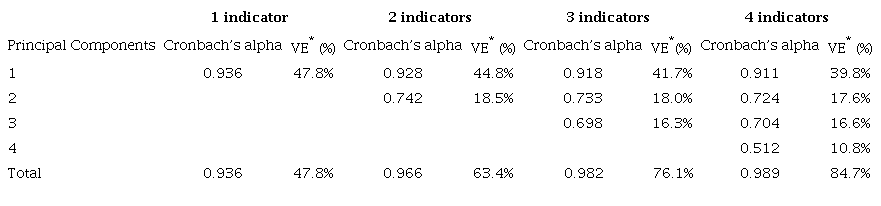
the number of principal components (i.e. the “indicators”), four analyses
were carried out. The comparative results are shown in Tables 5 and 6.
Table 5
Quality of adjustment according to the number of indicators
sought for ACAP
 * VE indicates “Variance Explained”
Table 6
Component loadings for each component of the three analyses to
measure ACAP
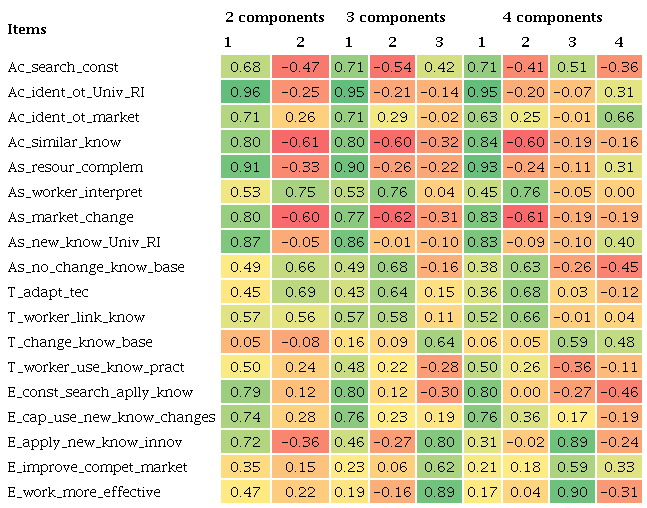
Some points are important in choosing the solution. First, there are gains in
the solution with 3 components over solutions with 1 or 2, either in terms
of explained variance or high internal consistency of these (Cronbach’s
alpha close to or above 0.7)5. The 3-component solution also ensures that all
variables are represented in at least one component (i.e., component loading
close to or greater than 0.5), a condition not met in the other two
analyses. Second, the solution with four components does not contribute to
the interpretation and representation of the variables, given that: (1) the
increase of Cronbach’s alpha and variance explained is lower; (2) all
variables had component loadings close or higher, in absolute values, for
any of the other three components; (3) the internal consistency specific of
the fourth component is less than 0.6.
Therefore, the solution with 3 components is chosen and presented again in
table 7 below. This result has
relevant theoretical implications.
Table 7
Component Loadings of the final solution to measure the
ACAP
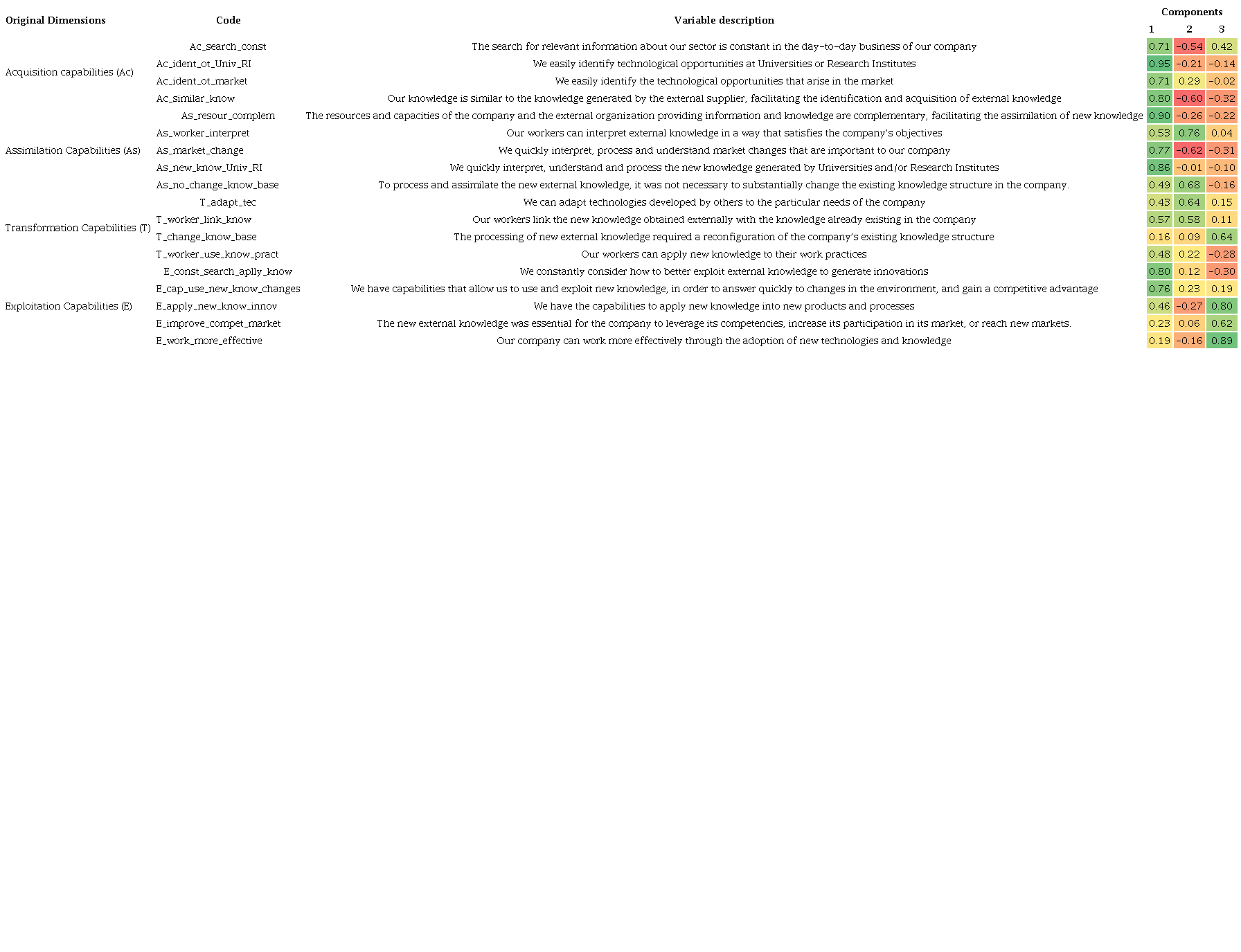
First, it is noted that the first component is composed of items
related to the acquisition and assimilation capabilities and some items to
the exploitation capabilities. This result contradicts the division between
“potential ACAP” and “realized ACAP” for the present context. However, these
items for exploitation capability are aimed at “less specific and concrete”
uses of external knowledge, such as reflecting on “how to apply external
knowledge in innovations” (E_const_search_aplly_know) and “how to use them
to react to changes in the environment” (E_cap_use_new_know_changes). These
items reflect future or hypothetical applications of external knowledge. The
exploitation capability items referring to more “effective, specific and
targeted” applications of external knowledge are linked to the third
component. These applications include: the ability to apply new
knowledge to products and processes (E_apply_new_know_innov), leveraging
skills or market share (E_improve_compet_market), and working more
effectively (E_work_more_effective).
The second component suggests an ACAP not dependent on more
organizational knowledge, either to identify or assimilate external
knowledge, which is represented by the high and negative component loadings
associated with the search for information (Ac_search_const) and
similarities with external knowledge (Ac_similar_know). On the other hand,
this ACAP is favored especially by individual abilities, either to interpret
external knowledge or to combine it with previous knowledge, but without
modifying the existing knowledge base. This “individual dependent” ACAP is
not to innovate stricto sensu, but to adapt existing
technologies, as shown by the high component loading for the item
“T_adapt_tec”.
Therefore, this second component may represent an ACAP to adapt existing
technologies and be more dependent on the employees' abilities. This ACAP
tends to be a result of the peculiarities of the context analyzed, i.e., the
interaction with universities in Brazil. On the one hand, in general, firms
focus essentially on adaptation and improving existing technologies, instead
of on innovations stricto sensu (Pinho; Fernandes, 2015). On the other hand, the
absorption of knowledge from universities depends heavily on individual
abilities in this country (Negri,
2006; Teixeira; Rapini; Caliari,
2020).
Thus, the results of CatPCA for ACAP are not a clear division between
potential ACAP and realized ACAP, since elements previously linked to
different dimensions “mix” in different components. Thus, instead of
identifying “dimensions” of ACAP, it was identified “types” of ACAP, linked
to different strategies by the firm.
This difference against the literature may be due to four reasons: (1) CatPCA
captured non-linear relationships that traditional factor analysis does not;
(2) the database is composed of firms that had already interacted with
universities before, which suggests a previous ACAP or an ACAP developed in
it (Bisho; D’este; Neely, 2011), despite the limitations for this in
Brazilian context (Rapini, 2009; Teixeira;
Rapini; Caliari, 2020); (3) different motivations for interacting
with universities (Fernandes et al.,
2010) may end up reflecting different ACAPs; (4) the concept of
ACAP as a dynamic capability of Zahra and
George (2002) tends to be more appropriate for developed
countries, where firms already have a developed and stronger knowledge base
(Dutrénit, 2004). Therefore, these
different results can be a reflection of the methodologies used here and
also the Brazilian university-firm cooperative peculiarities, discussed
before.
These three types of ACAP will be used as outcomes in the fsQCA analysis in
section 4.2
4.1.2 Indicators for organizational determinants
As shown in Tables 2 and 3, the organizational determinants
analyzed are divided into 5 groups (and their respective
abbreviation): (1) Strength and trust in the internal
(tsi) and external (tse)
relationships; (2) Actions to disseminate external knowledge internally
(diss); (3) Degree of internal hierarchy
(h); (4) Employee participation in innovative projects
(workProj); (5) Formalization and Routines to absorb
external knowledge (r). These determinants will be divided
into three CatpCA: (a) to build an indicator for strength and trust in
internal relations and (b) another for external relations; (c) indicators
for the other determinants.
This division has theoretical motivation. The analyses a and
b focus on characteristics that affect ACAP indirectly
or “unintentionally” (Ebers; Maurer,
2014), and they are not results of managerial decisions
necessarily. In addition, these are more subjective variables than the other
determinants. Tables 8 and 9 present the results for these
analyses, suggesting one indicator for each, given the high Cronbach’s
alpha, explained variance, and component loadings.
Table 8
Indicator for strength and trust in internal relations

Table 9
Indicator for strength and trust in external relations

On the other side, the analysis c focuses on determinants
that generally require managerial decisions to be implemented and can be
designed specifically to affect the dissemination of knowledge internally
and the ACAP. Table 10 shows the
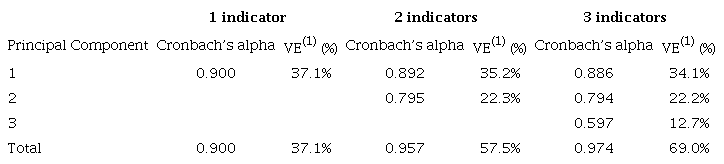
quality adjustment for analysis c, indicating gains in
using more than one component, both in terms of explained variance and new
components with reasonable internal consistency. To decide about two or
three indicators, the component loadings are compared between the solutions,
identifying that the item “workProj_tec_raise_part” would be only
represented in the third component6. Therefore, the solution with two indicators is
adopted because (i) the objective of CatPCA is to create “super conditions”
to be used in the QCA and (ii) this solution presents indicators with high
internal consistency and represents approximately 60% of the variance. This
solution is shown in Table 11
below.
Table 10
Quality of adjustment according to the number of indicators
sought for the “managerial” organizational determinants of
ACAP
 (1) “VE” indicates “Variance explained”.
Table 11
Final decision: Component loadings for the two indicators for
managerial organizational determinants of ACAP
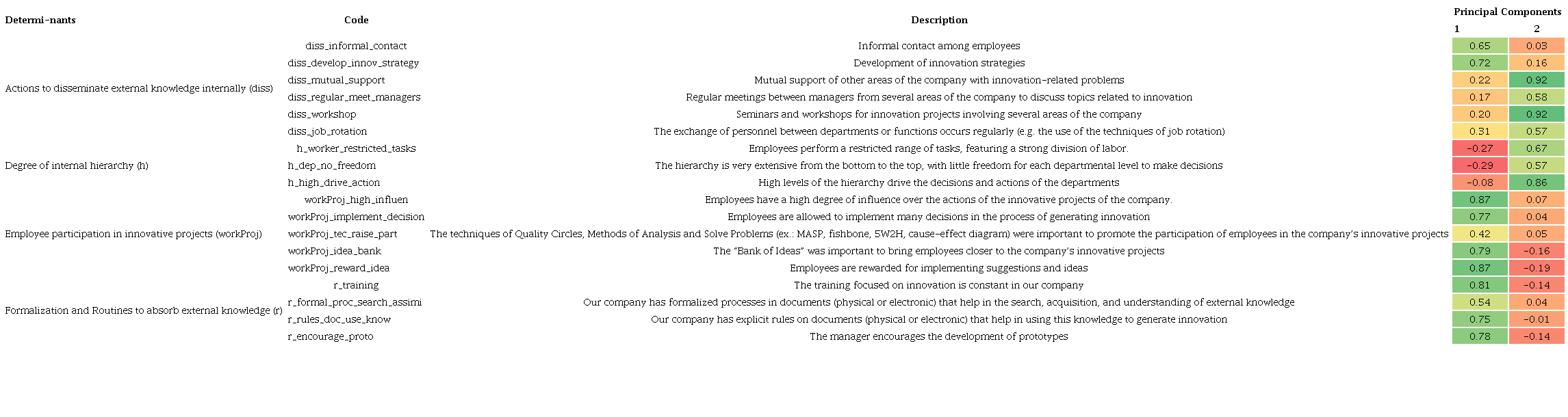
The first component is related to the variables linked to the
participation of employees in innovative projects (variables started in
“workProj_”), combined with informal contacts between them and the
realization of internal training. This labor participation seems to respond
to innovation strategies and to be supported by managers and explicit rules
that drive the use of external knowledge in this process7.
The second component is related to variables referring to the degree of
internal hierarchy (variables beginning with “h_”), where high values
indicate a high degree of internal hierarchy. This component is also marked
by more formal practices for the dissemination of knowledge between
departments, such as regular meetings between managers, mutual support
between different areas, workshops for innovation projects, and the use of
job rotation. However, this component 2 has a weak relationship with the
development of innovation strategies (“diss_develop_innov_strategy”).
Therefore, there is a distinction between the indicators for the managerial
organizational determinants of ACAP. Component 1 is associated
with organizational processes that promote and qualify employee
participation in projects that follow a specific innovative strategy and
guiding rules. Component 2, on the other hand, indicates more
structural characteristics of the firm, where the dissemination of knowledge
internally takes place in a more hierarchical organizational environment and
through more formal processes for this, but without having an explicit
relationship with an innovation strategy.
Using Jansen, Van den Bosch and Volberda
(2005) and Van den Bosch,
Volberda and De Boer (1999), we can interpret Component
1 as an indicator of the combination of coordination and system
capabilities. The first is linked to the participation of the workforce in
innovative projects and training, while the second, with the existence of
explicit rules to direct the use of external knowledge. Component
2, on the other hand, indicates the use of combinative
capabilities (via job rotation, internal workshops, etc.) to disseminate
knowledge in a more hierarchical organizational environment, thereby
increasing the scope of the ACAP, which would otherwise be reduced by this
hierarchical structure.
4.2 fsQCA results
The indicators from the previous sections will be employed in the analysis of the
fsQCA. The role and summary of each indicator are presented in Table 12.
Table 12
Summary of the variables for fsQCA
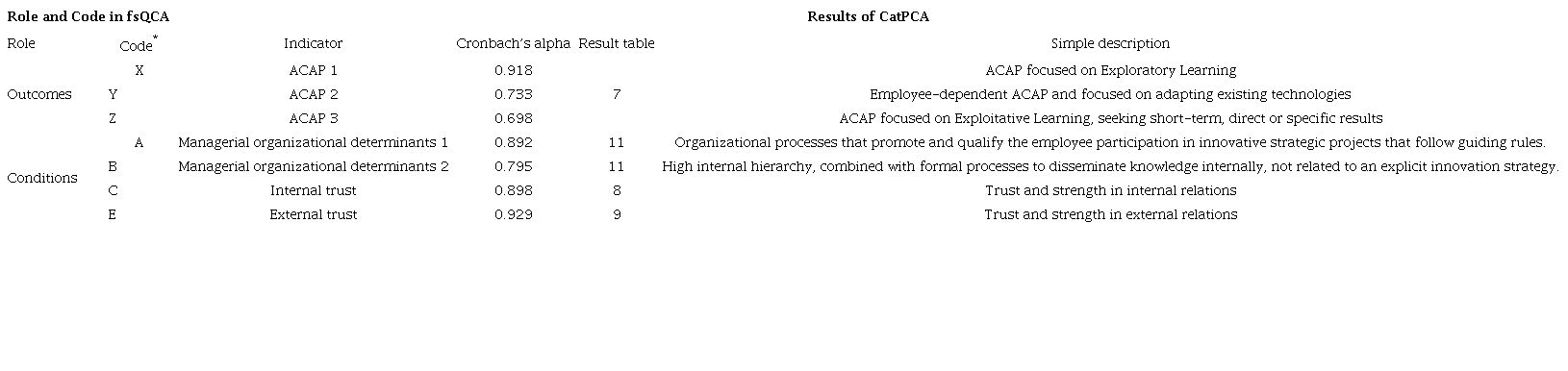 * These codes refer to indicators of the third column transformed into
fuzzy sets.
* These codes refer to indicators of the third column transformed into
fuzzy sets.
Three separate analyses will be studied, seeking to identify, for each type of
ACAP, the sufficient minimum configurations among the organizational
determinants. For this, the first step was to transform these indicators into
fuzzy sets through standardization so that they vary
between 0 and 1, preserving the position of firms in the distribution of a given
variable. These transformed variables are represented by a single uppercase
letter (see the second column of Table
12). In the analysis, uppercase letters denote variables with a score
of association above 0.5, while lowercase letters indicate scores below 0.5. To
exemplify this transformation, one can look at the indicator ACAP 1 (item X in
the fsQCA): when the company has a score of association above 0.5 for ACAP 1, it
will be interpreted that this company has a high ACAP 1 (represented by ‘X’);
when this value is less than 0.5, it is said to have a low ACAP 1 (represented
by ‘x’).
The considered “conditions” allow for 16 logically possible configurations that
would compose the truth table8.
However, not all of these logically possible configurations should be considered
in the analyses, especially in relatively small databases (LONGEST; VAISEY, 2008; RAGIN, 2009). Three criteria were adopted for this exclusion: (1)
the configuration is logically possible, but it was not observed in the
database; (2) it is a contradictory configuration9; (3) the configuration did not show a
consistency score statistically higher than 0.8. In all cases, the significance
level of 10% was considered.
Table 13 depicts the sufficient minimum
configurations for each ACAP and the accuracy of the final adjustment. The three
minimum configurations for each ACAP presented high final consistency (above 0.8
each) and a satisfactory coverage rate (Ragin,
2006). Therefore, these configurations can be considered as
sufficient conditions and will be interpreted as “minimum organizational
configurations” to obtain a certain high ACAP.
Table 13
Minimum organizational configurations sufficient to obtain high
levels of each ACAP

These minimal organizational configurations allow for three following logical
relationships:
(1) If the company combines strong and reliable internal and external
relationships (conditions “C” and “E”), regardless of the organizational
management processes (indicated by the absence of conditions A and B in the
minimum configuration), then the company has a high ACAP 1 (focused on
exploratory learning).
(2) If the firm combines highly trustworthy internal (C) and external (E)
relationships with organizational processes that favor and qualify the
participation of employees in the execution of strategic innovative projects
(A), regardless of the degree of internal hierarchy (indicated by the absence of
condition “B”), so the company has high ACAP 2 (focused on the adaptation of
technologies);
(3) If the firm combines low external trustworthy relations (e) with strong
internal confidence (C), high internal hierarchy (B) and also high employees’
participation in innovative strategic projects (A), then the company has high
ACAP 3 (focused on exploitative learning and results of greater knowledge
appropriability).
These logical relationships imply theoretical discussions.
First, the minimum configurations for a high ACAP 2 are a subset of the minimum
configurations for a high ACAP 1. This has important theoretical implications
for the interpretation of the knowledge absorption process when analyzed
together. To build an ACAP aimed at expanding the knowledge base without a
defined application (i.e. ACAP 1), the combination of strong external and
internal personal relationships is sufficient. The first allows employees linked
to the innovative process to act as gatekeepers, accessing external knowledge
more easily and bringing it to the company. However, for the assimilation in the
internal knowledge base, the external knowledge needs to be disseminated and
shared internally in the company (Cohen;
Levinthal, 1990). In the present study, this is done through strong
internal personal relationships (Ebers; Maurer,
2014) and does not necessarily depend on more managerial
organizational processes. These processes, in turn, are necessary when the
company seeks to build capabilities to adapt existing technologies, that is, to
have a high ACAP 2. For this, the company must combine strong internal and
external relationships with organizational processes that favor, qualify, and
direct the participation of the employees in strategic innovative projects
(i.e., the “presence of “A” in the final solution, together with “C” and “E”).
These actions, when combined, can be seen as intra-firm “pipelines” (Lane; Koka; Pathak, 2006) that allow to
connect workers internally, disseminate external knowledge internally and direct
the application of external knowledge (Ebers;
Maurer, 2014; Vega-Jurado;
Gutiérrez-Gracia; Fernández-De-Lucio, 2008).
In other words, the results suggest that, when the firm seeks to access new
knowledge without a defined application, only personal relationships can be
sufficient; but, when seeking to exploit this knowledge to adapt technologies,
managerial organizational processes are necessary for employee participation.
These processes can be seen as a way of connecting individual actions and
stimulating the exploitation of external knowledge, making ACAP less dependent
on individual characteristics (Lewin; Massini;
Peeters, 2011). It is worth mentioning that ACAP 2, in addition to
focusing on the adaptation of technologies, is also dependent on individual
skills, but it demands internal processes that induce the application of
them.
The second interesting result refers to ACAP 3, which focused on the application
of external knowledge in short-term, specific, and more direct results. To have
a high ACAP 3, the company needs to balance the low confidence in external
relations (represented by “e”) with the combination of a high internal hierarchy
(“B”) with managerial organizational processes (“A”) and internal relations
(“C”) that connect the members of the company, favor their participation in the
innovative process and the consequent dissemination of knowledge within this
more hierarchical structure. Van den Bosch,
Volberda and De Boer (1999) already suggested that a more
hierarchical organizational structure led to greater efficiency in absorbing
external knowledge, but a smaller scope of it. This is in line with this ACAP 3
focused especially on more specific results, such as “working more effectively”
and “gaining market share”, unlike ACAP 1 (focused, for example, on responding
more quickly to changes in the market and having flexibility in the use of
knowledge in innovations). However, given that ACAP 3 is also associated with
the modification of the internal knowledge base10, the high hierarchy is not enough for this.
Processes related to the coordination capacity among members are necessary to
counterbalance the loss of scope and flexibility brought about by this higher
hierarchy (Van Den Bosch; Volberda; De Boer,
1999). In short, the high hierarchy allows for some efficiency in the
application of external knowledge in more specific results, but the other
organizational processes for the participation of the employees in innovation
and the strong internal relations favor the scope and flexibility necessary for
the ACAP 3.
5 Final remarks
This paper delves into an analysis of how firms engaged with research groups in
Brazil develop their Absorptive Capacities (ACAP) through the combination of various
organizational determinants. These determinants encompass factors such as the
strength and trust in internal and external interactions, the degree of hierarchy
and internal formalizations, internal practices concerning knowledge dissemination,
and labor participation in innovative projects. To achieve this, a custom database
was employed, complemented by non-linear Categorical Principal Component Analysis
(CatPCA) and fuzzy-set Qualitative Comparative Analysis (fsQCA) methodologies.
Limited to the context analyzed-firms that interacted with universities in Brazil-the
results suggest an unforeseen partial connection between firms’ strategies, types of
ACAP, and the minimum organizational configurations for these. In this study, firms
that focus on exploratory learning, seeking external knowledge mainly to expand
their existing knowledge base, build their ACAP (ACAP 1) by combining internal
personal relationships of trust with external ones. On the other hand, firms that
build their ACAP to adapt existing technologies (ACAP 2), need to combine these
strong personal relationships (internal and external) with organizational processes
in favor of employee participation in projects linked to this innovative strategy.
Finally, firms that seek more immediate results and more direct appropriability,
focused on exploitative learning (i.e., ACAP 3), depend essentially on strong
internal knowledge and relationships and also depend on the internal dissemination
of knowledge, guided by a strong intra-firm hierarchy that brings efficiency in the
application of external knowledge.
These findings trigger insightful considerations. Firstly, they delve further into
the organizational perspective of capability development (Paranhos; Hasenclever, 2021), spotlighting the notion that
different firms can possess distinct organizational configurations”. This implies
that they can blend organizational determinants differently yet achieve comparable
capability levels, given they adhere to a "minimum configuration" (as
demonstrated by fsQCA). Such outcomes reinforce the nexus between ACAP and the
concept of organizational capabilities, viewing it as an outcome derived from
various permutations of intra-firm routines.
Second, the articulation between firm strategy, types of ACAP, and organizational
configurations is close to Nelson (1991)
explanation of the source of heterogeneity among firms: firm strategy, internal
structure, and core organizational capabilities. Further research may evaluate this
relationship using a broader database and specifically investigate these strategies.
This expanded analysis would allow us to analyze, for example, whether firms seek
those types of ACAP or whether it is what they get from their existing internal
resources. This could be a research agenda.
In addition, these results also reinforce the heterogeneity of ACAP of firms that
interacted with universities in Brazil. As discussed before, in the Brazilian
context, there is a heterogeneity of firms’ strategies to interact with
universities, including an interaction to substitute firms’ internal R&D
activities, which is an engagement type that limits the possibility of developing
ACAP. This paper emphasizes the importance of considering Brazilian heterogeneity in
ACAP analysis and highlights the fsQCA as a valuable method for this purpose.
Finally, this study underscores the importance of individual abilities in firms
interacting with universities in Brazil, particularly regarding ACAP 2, which
reflects the specific characteristics of the analyzed context. However, these
particularities limit the generalizability of the results, necessitating further
studies and broader surveys on the subject.
References
BERG-SCHLOSSER, D. et al. Qualitative comparative analysis as an
approach. In: RIHOUX, B.; RAGIN, C. C. (Org.). Configurational
comparative methods: qualitative comparative analysis and related
techniques. 1. ed. Thousand Oaks: SAGE Publications, 2009. p.
1-18.
BERG-SCHLOSSER, D.; MEUR, G. DE. Comparative research design: case
and variable selection. In: RIHOUX, B.; RAGIN, C. C. (Org.).
Configurational comparative methods: qualitative comparative
analysis and related techniques. 1. ed. Thousand Oaks: SAGE
Publications, 2009. p. 19-32.
BISHOP, K.; D’ESTE, P.; NEELY, A. Gaining from interactions with
universities: multiple methods for nurturing absorptive capacity.
Research Policy, v. 40, n. 1, p. 30-40,
2011.
CAMISÓN, C.; FORÉS, B. Knowledge absorptive capacity: new insights
for its conceptualization and measurement. Journal of Business
Research, v. 63, n. 7, p. 707-715, 2010.
COHEN, W. M.; LEVINTHAL, D. A. Innovation and learning: the two
faces of R&D. Economic Journal, v. 99, n. 397, p. 569-596,
1989.
COHEN, W. M.; LEVINTHAL, D. A. Absorptive capacity: a new
perspective on learning and innovation. Administrative Science
Quarterly, v. 35, p. 128-152, 1990.
DUCHEK, S. Enhancing absorptive capacity for innovation and change:
the role of structural determinants. Journal of Change
Management, v. 15, n. 2, p. 142-160, 2015.
DUTRÉNIT, G. Building technological capabilities in latecomer firms:
a review essay. Science Technology & Society, v. 9, n. 2,
p. 209-241, 2004.
EBERS, M.; MAURER, I. Connections count: how relational embeddedness
and relational empowerment foster absorptive capacity. Research
Policy, v. 43, n. 2, p. 318-332, 2014.
FERNANDES, A. C. et al. Academy-industry links in Brazil: evidence
about channels and benefits for firms and researchers. Science and
Public Policy, v. 37, n. 7, p. 485-498, 2010.
FLATTEN, T. C. et al. A measure of absorptive
capacity: scale development and validation. European Management
Journal, v. 29, n. 2, p. 98-116, 2011.
IBM. IBM SPSS Statistics 20 Algorithms. IBM
Corporation, 2011.
JANSEN, J. J. P.; VAN DEN BOSCH, F. A. J.; VOLBERDA, H. W. Managing
potential and realized absorptive capacity: how do organizational antecedents
matter? Academy of Management Journal, v. 48, n. 6, p.
999-1015, 2005.
JIMÉNEZ-BARRIONUEVO, M. M.; GARCÍA-MORALES, V. J.; MOLINA, L. M.
Validation of an instrument to measure absorptive capacity.
Technovation, v. 31, n. 5-6, p. 190-202,
2011.
LANE, P. J.; KOKA, B. R.; PATHAK, S. The reification of absorptive
capacity: a critical review and rejuvenation of the construct. Academy
of Management Review, v. 31, n. 4, p. 833-863,
2006.
LANE, P. J.; LUBATKIN, M. Relative absorptive capacity and
interorganizational learning. Strategic Management Journal, v.
19, n. 5, p. 461-477, 1998.
LEWIN, A. Y.; MASSINI, S.; PEETERS, C. Microfoundations of internal
and external absorptive capacity routines. Organization
Science, v. 22, n. 1, p. 81-98, 2011.
LINTING, M. et al. Nonlinear principal components
analysis: introduction and application. Psychological Methods,
v. 12, n. 3, p. 336-358, 2007.
LONGEST, K. C.; VAISEY, S. Fuzzy: a program for performing
qualitative comparative analyses (QCA) in Stata. Stata Journal,
v. 8, n. 1, p. 79-104, 2008.
LUNDVALL, B. et al. Innovation system research and developing
countries. In: LUNDVALL, B. et al. (Org.). Handbook of innovation
systems and developing countries: building domestic capabilities in
a global setting. 1. ed. Cheltenham: Edward Elgar Publishing, 2009. p.
1-32.
MARCH, J. G. Exploration and exploitation in organizational
learning. Organization Science, v. 2, n. 1, p. 71-87,
1991.
MEULMAN, J. J.; HEISER, W. J. IBM SPSS Categories
20. 2011.
MEULMAN, J. J.; KOOIJ, A. J. VAN DER; HEISER, W. J. Principal
components analysis with nonlinear optimal scaling transformations for ordinal
and nominal data. In: KAPLAN, D. (Org.). The Sage handbook of
quantitative methodology for the social sciences. Thousand Oaks:
SAGE Publications, 2004. p. 49-70.
MILAGRES, R. Rotinas - uma revisão teórica. Revista
Brasileira de Inovação, v. 10, n. 1, p. 161-196,
2011.
MUROVEC, N.; PRODAN, I. Absorptive capacity, its determinants, and
influence on innovation output: cross-cultural validation of the structural
model. Technovation, v. 29, n. 12, p. 859-872,
2009.
NEGRI, F. Determinantes da capacidade de absorção das firmas
brasileiras: qual a influência do perfil da mão-de-obra. In: NEGRI, J. A.;
NEGRI, F.; COELHO, D. (Org.). Tecnologia, exportação e emprego.
1. ed. Brasília: Instituto de Pesquisa Econômica Aplicada, 2006. p.
101-122.
NELSON, R. R. Why do firms differ, and how does it matter?
Strategic Management Journal, v. 12, p. 61-74,
1991.
NELSON, R. R.; WINTER, S. G. Uma teoria evolucionária da
mudança econômica. 1. ed. Campinas: Editora Unicamp,
2005.
PARANHOS, J.; HASENCLEVER, L. Teoria da firma e empresa inovadora.
In: RAPINI, M. S. et al. (Org.). Economia da ciência, tecnologia e
inovação: fundamentos teóricos e a economia global. 2. ed. Belo
Horizonte: Editora FACE/UFMG, 2021. p. 161-181.
PINHO, M.; FERNANDES, A. C. Relevance of university-industry links
for firms from developing countries: exploring different surveys. In:
ALBUQUERQUE, Eduardo et al. (Org.). Developing national systems of
innovation: university-industry interactions in the global South.
1. ed. Northampton: Edward Elgar, 2015. p. 145-163.
RAGIN, C. C. Set relations in social research: evaluating their
consistency and coverage. Political Analysis, v. 14, n. 3, p.
291-310, 2006.
RAGIN, C. C. Qualitative comparative analysis using fuzzy sets
(fsQCA). In: RIHOUX, B.; RAGIN, C. C. (Org.). Configurational
comparative methods: qualitative comparative analysis and related
techniques. 1. ed. Thousand Oaks: SAGE Publications, 2009. p.
87-122.
RAPINI, M. S. et al. University-industry interactions in an immature
system of innovation: evidence from Minas Gerais, Brazil. Science and
Public Policy, v. 36, n. 5, p. 373-386, 2009.
ROSA, A. C. Capacidade absortiva de empresas que possuem
interação com universidades. 2013. 161p. Dissertação (Mestrado em
Economia)-Universidade do Vale do Rio dos Sinos, São Leopoldo,
2013.
SCHMIDT, T. Absorptive capacity: one size fits all?
Firm-level analysis of absorptive capacity for different kinds of knowledge.
Center for European Economic Research, 2005. (ZEW Discussion Papers,
05-72).
TEIXEIRA, A. L. S. Determinantes organizacionais e
especificidades da capacidade de absorção de firmas no Brasil.
2020. 240p. Tese (Doutorado em Economia)-Universidade Federal de Minas Gerais,
Belo Horizonte, 2020.
TEIXEIRA, A. L. S.; DOS SANTOS, E.; BARBOSA, G. H.; MEDRADO, A.;
RAPINI, M. S.; RUFFONI, J. Interação com universidades e capacidade de
absorção: um olhar para as empresas brasileiras. Belo Horizonte:
Centro de Desenvolvimento e Planejamento Regional (Cedeplar/UFMG), 2017. (Textos
para Discussão, n. 560).
TEIXEIRA, A. L. S.; RAPINI, M. S.; CALIARI, T. Organizational
determinants and idiosyncrasies of firms’ absorptive capacity in a developing
country. Science and Public Policy, v. 47, n. 3, p. 384-395,
2020.
TODOROVA, G.; DURISIN, B. Absorptive capacity: valuing a
reconceptualization. Academy of Management Review, v. 32, n. 3,
p. 774-786, 2007.
VAN DEN BOSCH, F. A.; VOLBERDA, H. W.; DE BOER, M. Coevolution of
firm absorptive capacity and knowledge environment: organizational forms and
combinative capabilities. Organization Science, v. 10, n. 5, p.
551-568, 1999.
VEGA-JURADO, J.; GUTIÉRREZ-GRACIA, A.; FERNÁNDEZ-DE-LUCIO, I.
Analyzing the determinants of firm’s absorptive capacity: beyond R&D.
R&D Management, v. 18, n. 4, p. 392-405,
2008.
VOLBERDA, H. W.; FOSS, N. J.; LYLES, M. A. Absorbing the concept of
absorptive capacity: how to realize its potential in the organization field.
Organization Science, v. 21, n. 4, p. 931-951,
2010.
ZAHRA, S. A.; GEORGE, G. Absorptive capacity: a review,
reconceptualization, and extension. Academy of Management
Review, v. 24, n. 2, p. 185-203, 2002
Notes
Notes
1 Some information about this process is important. First, we identify a phone
contact of the firm and the target respondent (e.g. responsible for the
R&D/Innovation department, interactions or product development), followed by
the send of the questionnaire by email. The questionnaire was applied by
SurveyMonkey® homepage. After this, phone contacts to explain the survey and
request the answer was done frequently by graduating or post-graduating
students. These contacts, in general, followed a guide developed for this and
presented in
Teixeira et al., (2017).
2 Three types of exclusions were carried out: (a) firms that had not answered all
questions about the ACAP dimensions; (b) more than one answer for the same
company; (c) firms that have marked “Unable to give an opinion” for all
questions relating to at least one of the dimensions or one of the
organizational determinants of ACAP described in
Tables 1 to
3.
3 The database is not representative of the universe of firms that interact with
universities in Brazil. According to the 2010 DGP/CNPq Census (our starting
point), 2,543 firms had interactions with research groups. Initially, a
representative sample (in sector and region aspects) of 600 firms was designed.
However, because of time, money, and labor limitations, it was not possible to
achieve it. Besides this limitation, we consider that the database has important
information about the organizational dimension of ACAP and their exploration
could encourage new and larger studies about the theme. More database
information is explained in
Teixeira
(2020).
4 If the active form had been chosen, the CatPCA would estimate a value for the
category “not able to give an opinion”. However, given the small size of the
sample, the number of this kind of answer is low to justify and support this
estimation. In other words, a parsimonious perspective guided the choice.
5 In
Table 6, the 1-component solution is
not analyzed because it represents less than 50% of the variance.
6 This comparison is available upon request.
7 This is represented by component loadings above 0,7 for the variables
“diss_develop_innov_strategy”, “r_encourage_proto” and
“r_rules_doc_use_know”.
8 For example, a company has the configuration “ABCE”, which means that it has a
high labor force participation in strategically innovative projects (represented
by “A”), high internal hierarchy with formal practices to disseminate knowledge
internally (represented by “B”) and high trusting internal and external
relationships (represented by “C” and “E”). Another company presents the
configuration “ABce”, being different from the former because of less reliable
internal and external relationships (represented by “c” and “e”).
9 These “contradictory configurations” do not present a consistency score
significantly superior for a given high ACAP in comparison with the consistency
score for the same ACAP at a low level.
10 It is worth remembering that ACAP 3 is also composed of the item directly
connected to the change in the internal knowledge base through external
knowledge (“T_change_know_base”).
Author notes
EDITOR RESPONSÁVEL PELA AVALIAÇÃO
Rosângela Ballini
